
Quinn J.J., Yi K.-S. Solid State Physics: Principles and Modern Applications
Подождите немного. Документ загружается.

Uncorrected Proof
BookID 160928 ChapID 10 Proof# 1 - 29/07/09
294 10 Magnetic Ordering and Spin Waves
The first term is just the zero temperature value where S
z
= NS and 328
gμ
B
=2μ. The second term results from the presence of spin deviations ˆn
j
. 329
Remember that 330
j
ˆn
j
=
j
a
†
j
a
j
=
j
1
N
kk
e
i(k−k
)·x
j
b
†
k
b
k
=
kk
b
†
k
b
k
δ
kk
=
k
b
†
k
b
k
.
(10.91)
We can define
331
ΔM = M
s
(0) − M
s
(T )=
2μ
V
k
n
k
,
where n
k
=
1
e
Dk
2
/Θ
−1
. Replacing the sum over the wave number k by an 332
integral in the usual way gives 333
ΔM =
2μ
(2π)
3
4π
dkk
2
e
Dk
2
/Θ
− 1
=
μ
2π
2
Θ
D
3/2
y
M
0
dyy
1/2
e
y
− 1
.
(10.92)
Again if Θ ¯hω
M
, y
M
can be replaced by ∞. Then the definite integral has 334
the value Γ(
3
2
)ζ(
3
2
, 1), and we obtain for ΔM 335
ΔM =0.117μ
Θ
D
3/2
=0.117μ
Θ
2a
2
SJ
3/2
. (10.93)
For M
s
(T )wecanwrite 336
M
s
(T )=
N
V
2μS − 0.117
μ
a
3
Θ
2SJ
3/2
. (10.94)
337
For simple cubic, bcc, and fcc lattices,
N
V
has the values 1/a
3
,2/a
3
,and4/a
3
, 338
respectively. Thus, we can write 339
M
s
(T )
2μS
a
3
α − 0.02
Θ
3/2
S
5/2
J
3/2
, (10.95)
where α =1, 2, 4 for simple cubic, bcc, and fcc lattices, respectively. The T
3/2
340
dependence of the magnetization is a well-known result associated with the 341
presence of noninteracting spin waves. Higher order terms in
Θ
J
are obtained if 342
the full expression for γ
k
is used instead of just the long wave length expansion 343
(correct up to k
2
term) and the k-integral is performed over the first Brillouin 344
zone and not integrated to infinity. The first nonideal magnon term, result- 345
ing from magnon–magnon interactions, is a term of order
Θ
J
4
.F.J.Dyson 346
obtained this term correctly in a classic paper in the mid 1950s.
2
347
2
F.J. Dyson, Phys. Rev 102, 1230 (1956).
Uncorrected Proof
BookID 160928 ChapID 10 Proof# 1 - 29/07/09
10.6 Spin Waves in Ferromagnet 295
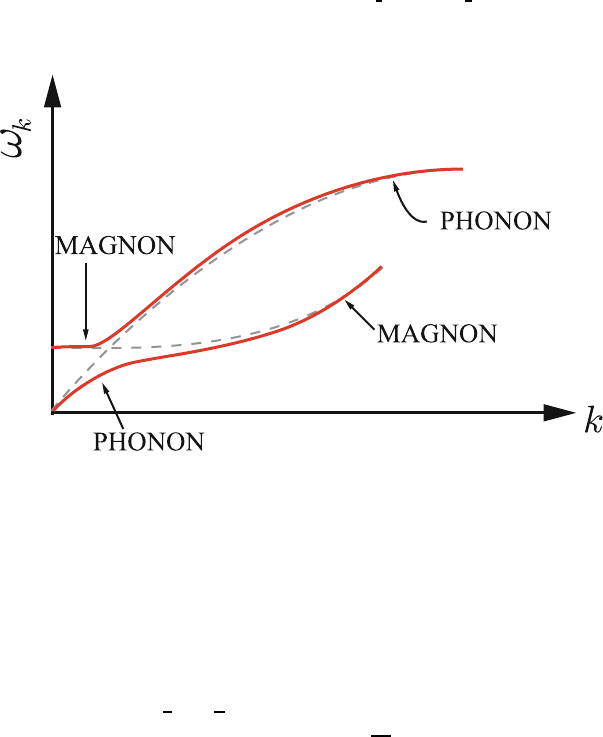
Fig. 10.13. Coupling of magnons–phonons
10.6.6 Experiments Revealing Magnons 348
Among the many experiments which demonstrate the existence of magnons, 349
a few important ones are as follows: 350
1. The existence of side bands in ferromagnetic resonances. The uniform pre- 351
cession mode in a ferromagnetic resonance experiment excites a k =0spin 352
wave. In a ferromagnetic film, it is possible to couple to modes with wave 353
length λ satisfying
1
2
λ =
d
n
where d is the thickness of the film. This gives 354
resonances at magnon wave numbers k
n
=
nπ
d
. 355
2. The existence of inelastic neutron scattering peaks associated with 356
magnons. 357
3. The coupling of magnons to phonons in ferromagnetic crystals (see Fig. 358
10.13). 359
10.6.7 Stability 360
We started with a Heisenberg Hamiltonian H = −J
i,j
ˆ
S
i
·
ˆ
S
j
.Inthefer- 361
romagnetic ground state the spins are aligned. However, the direction of the 362
resulting magnetization is arbitrary (since H has complete rotational symme- 363
try) so that the ground state is degenerate. If one selects a certain direction 364
for M as the starting point of magnon theory, the system is found to be 365
unstable. Infinitesimal amount of thermal energy excites a very large number 366
of spin waves (remembering that when B
0
=0thek = 0 spin waves have zero 367
energy). The difficulty of having an unstable ground state with M in a par- 368
ticular direction is removed by removing the degeneracy caused by spherical 369
symmetry of the Hamiltonian. This is accomplished by either 370

Uncorrected Proof
BookID 160928 ChapID 10 Proof# 1 - 29/07/09
296 10 Magnetic Ordering and Spin Waves
1. Applying a field B
0
in a particular direction or 371
2. Introducing an effective anisotropy field B
A
. 372
For Θ μ
B
|B| where B is either B
0
or B
A
, only small deviations from the 373
ground state occur. The anisotropy field is a mathematical convenience which 374
accounts for anisotropic interaction in real crystals. It is not so important in 375
ferromagnets, but it is very important in antiferromagnets 376
10.7 Spin Waves in Antiferromagnets 377
The Heisenberg Hamiltonian of an antiferromagnet has J > 0sothat 378
H =+2J
i,j
ˆ
S
i
·
ˆ
S
j
− gμ
B
B
0
·
i
ˆ
S
i
, (10.96)
where the sum is over all possible distinct nearest neighbor pairs. The state
379
in which all N spins on sublattice 1 are ↑ and all N spins on sublattice 2 are 380
↓ is a highly degenerate state because the direction for ↑ (or ↓) is completely 381
arbitrary. This degeneracy is not removed by introducing an external field 382
B
0
.For|B
0
| not too large, the spins align themselves antiferromagnetically 383
in the plane perpendicular to B
0
. However, the directionofagivensublattice 384
magnetization is still arbitrary in that plane. 385
Lack of stability can be overcome by introducing an anisotropy field B
A
386
with the following propeties: 387
1. B
A
is in the +z-direction at sites in sublattice 1. 388
2. B
A
is in the −z-direction at sites in sublattice 2. 389
3. μ
B
B
A
is not too small (compared to
1
N
J). 390
Then, the Heisenberg Hamiltonian for an antiferromagnet in the presence of 391
an applied field B
0
= B
0
ˆz and an anisotropy field B
A
can be written 392
H =+J
i,j
ˆ
S
i
·
ˆ
S
j
−gμ
B
(B
A
+B
0
)
l∈a
ˆ
S
a
lz
+gμ
B
(B
A
−B
0
)
p∈b
ˆ
S
b
pz
. (10.97)
393
The superscripts a and b refer to the two sublattices. In the limit where 394
B
A
→∞while J→0andB
0
→ 0, the ground state will have 395
S
a
lz
= S for all l ∈ a
S
b
pz
= −S for all p ∈ b
(10.98)
This state is not true ground state of the system when B
A
and J are both 396
finite. The spin wave theory of an antiferromagnet can be carried out in anal- 397
ogy with the treatment for the ferromagnet. We introduce spin deviations 398
from the “B
A
→∞ground state” by writing 399
S
a
lz
= S − a
†
l
a
l
for all l ∈ a
S
b
pz
= −(S − b
†
p
b
p
) for all p ∈ b,
(10.99)

Uncorrected Proof
BookID 160928 ChapID 10 Proof# 1 - 29/07/09
10.7 Spin Waves in Antiferromagnets 297
where the spin deviation operators satisfy commutation relations
a
l
,a
†
l
=1
400
and
b
p
,b
†
p
= 1. Once again it is easy to show that
401
ˆ
S
a+
l
=(2S − ˆn
l
)
1/2
a
l
;
ˆ
S
a−
l
= a
†
l
(2S − ˆn
l
)
1/2
ˆ
S
b+
p
= b
†
p
(2S − ˆm
p
)
1/2
;
ˆ
S
b−
p
=(2S − ˆm
p
)
1/2
b
p
(10.100)
Here, ˆn
l
= a
†
l
a
l
and ˆm
p
= b
†
p
b
p
. In spin wave theory, we assume ˆn
l
2S 402
and ˆm
p
2S and expand the square roots keeping only linear terms in ˆn
l
403
and ˆm
p
. The Hamiltonian can then be written 404
H = E
0
+ H
0
+ H
1
. (10.101)
Here, E
0
is the ground state energy given by 405
E
0
= −2NzJS
2
− 2gμ
B
B
A
NS, (10.102)
and H
0
is the part of the Hamiltonian that is quadratic in the spin deviation 406
creation and annihilation operators 407
H
0
=2JS
l,p
a
l
b
p
+ a
†
l
b
†
p
+ˆn
l
+ˆm
p
+ gμ
B
(B
A
+ B
0
)
l∈a
ˆn
l
+ gμ
B
(B
A
− B
0
)
p∈b
ˆm
p
.
(10.103)
The sum of products of a’s and b’s is over nearest neighbor pairs. H
1
is a sum 408
of an infinite number of terms each containing at least four a or b operators 409
or their Hermitian conjugates. We can again introduce spin wave variables 410
c
k
= N
−1/2
l
e
ik·x
l
a
l
,c
†
k
= N
−1/2
l
e
−ik·x
l
a
†
l
,
d
k
= N
−1/2
p
e
−ik·x
p
b
p
,d
†
k
= N
−1/2
p
e
ik·x
p
b
†
p
.
(10.104)
In terms of the spin wave variables we can rewrite H
0
as 411
H
0
=2zJS
k
γ
k
c
†
k
d
†
k
+ γ
k
c
k
d
k
+ c
†
k
c
k
+ d
†
k
d
k
+ gμ
B
(B
A
+ B
0
)
k
c
†
k
c
k
+ gμ
B
(B
A
− B
0
)
k
d
†
k
d
k
.
(10.105)
Here, we have introduced
412
γ
k
= z
−1
δ
e
ik·δ
= γ
−k
once again. We are going to forget all about H
1
, and consider for the moment 413
that the entire Hamiltonian is given by H
0
+ E
0
. H
0
is still not in a trivial 414
form. We can easily put it into normal form as follows: 415
1. Define new operators α
k
and β
k
416
α
k
= u
k
c
k
− v
k
d
†
k
; β
k
= u
k
d
k
− v
k
c
†
k
, (10.106)
where u
k
and v
k
are real and satisfy u
2
k
− v
2
k
=1. 417
Uncorrected Proof
BookID 160928 ChapID 10 Proof# 1 - 29/07/09
298 10 Magnetic Ordering and Spin Waves
2. Solve these equations (and their Hermitian conjugates) for the c’s and d’s 418
in terms of α and β.Wecanwrite 419
c
k
= u
k
α
k
+ v
k
β
†
k
; c
†
k
= u
k
α
†
k
+ v
k
β
k
(10.107)
and
420
d
k
= v
k
α
†
k
+ u
k
β
k
; d
†
k
= v
k
α
k
+ u
k
β
†
k
. (10.108)
3. Substitute (10.107) and (10.108) in H
0
to have 421
H
0
=2zSJ
k
γ
k
u
k
v
k
(α
†
k
α
k
+ β
k
β
†
k
+ α
k
α
†
k
+ β
†
k
β
k
)
+ u
2
k
(α
†
k
β
†
k
+ α
k
β
k
)+v
2
k
(β
†
k
α
†
k
+ β
k
α
k
)
+ u
2
k
α
†
k
α
k
+ v
2
k
β
k
β
†
k
+ u
k
v
k
(α
†
k
β
†
k
+ β
k
α
k
)
+ v
2
k
α
k
α
†
k
+ u
2
k
β
k
β
†
k
+ u
k
v
k
(α
k
β
k
+ β
†
k
α
†
k
)
+ gμ
B
(B
A
+ B
0
)
k
u
2
k
α
†
k
α
k
+ v
2
k
β
k
β
†
k
+ u
k
v
k
(α
†
k
β
†
k
+ β
k
α
k
)
+ gμ
B
(B
A
− B
0
)
k
v
2
k
α
k
α
†
k
+ u
2
k
β
†
k
β
k
+ u
k
v
k
(α
k
β
k
+ β
†
k
α
†
k
)
.
(10.109)
We can regroup these terms as follows:
422
H
0
=2
k
2zSJ
γ
k
u
k
v
k
+ v
2
k
+ gμ
B
B
A
v
2
k
+
k
2zSJ
2γ
k
u
k
v
k
+ u
2
k
+ v
2
k
+ gμ
B
B
A
(u
2
k
+ v
2
k
)+gμ
B
B
0
α
†
k
α
k
+
k
2zSJ
2γ
k
u
k
v
k
+ u
2
k
+ v
2
k
+ gμ
B
B
A
(u
2
k
+ v
2
k
) − gμ
B
B
0
β
†
k
β
k
+
k
-
2zSJ
γ
k
(u
2
k
+ v
2
k
)+2u
k
v
k
+2gμ
B
B
A
u
k
v
k
.
α
†
k
β
†
k
+ α
k
β
k
.
(10.110)
4. We put the Hamiltonian in diagonal form by requiring the coefficient of
423
the last term to vanish. We define ω
e
and ω
A
by 424
ω
e
=2JzS and ω
A
= gμ
B
B
A
. (10.111)
We must solve
425
ω
e
γ
k
(u
2
k
+ v
2
k
)+2u
k
v
k
+2ω
A
u
k
v
k
=0, (10.112)
remembering that u
2
k
=1+v
2
k
. Then, (10.112) reduces to 426
1+2v
2
k
2v
k
1+v
2
k
= −
1
γ
k
ω
A
ω
e
+1
.
Solving for v
2
k
gives 427
v
2
k
= −
1
2
+
1
2
ω
A
+ ω
e
(ω
A
+ ω
e
)
2
− γ
2
k
ω
2
e
. (10.113)
Thus, we have
428
u
2
k
=
1
2
+
1
2
ω
A
+ ω
e
(ω
A
+ ω
e
)
2
− γ
2
k
ω
2
e
, (10.114)
Uncorrected Proof
BookID 160928 ChapID 10 Proof# 1 - 29/07/09
10.7 Spin Waves in Antiferromagnets 299
and since 429
u
k
v
k
= −
1
2
γ
k
ω
e
ω
A
+ ω
e
(u
2
k
+ v
2
k
),
we have
430
u
k
v
k
= −
1
2
γ
k
ω
e
(ω
A
+ ω
e
)
2
− γ
2
k
ω
2
e
. (10.115)
Now, let us write the Hamiltonian in a diagonal form
431
H
0
= C +
k
(ω
k
+ gμ
B
B
0
)α
†
k
α
k
+(ω
k
− gμ
B
B
0
)β
†
k
β
k
(10.116)
where
432
ω
k
=2zSJ
2γ
k
u
k
v
k
+ u
2
k
+ v
2
k
+ gμ
B
B
A
(u
2
k
+ v
2
k
)
=
(ω
A
+ ω
e
)
2
− γ
2
k
ω
2
e
.
(10.117)
The constant C is given by
433
C =2
k
2zSJ
γ
k
u
k
v
k
+ v
2
k
+ gμ
B
B
A
v
2
k
=
k
[ω
k
− (ω
A
+ ω
e
)] .
(10.118)
Thus, to this order of approximation we have
434
H = −2NzJS
2
− 2gμ
B
B
A
NS +
k
[ω
k
− (ω
A
+ ω
e
)]
+
k
(ω
k
+ ω
B
)α
†
k
α
k
+
k
(ω
k
− ω
B
)β
†
k
β
k
,
(10.119)
435
where 436
ω
B
= gμ
B
B
0
. (10.120)
10.7.1 Ground State Energy
437
In the ground state 438
0
α
†
k
α
k
0
!
=
0
β
†
k
β
k
0
!
=0.
Thus the ground state energy is given by
439
E
GS
= −2NzJS
2
− 2gμ
B
B
A
NS +
k
[ω
k
− (ω
A
+ ω
e
)] . (10.121)
Let us consider the case B
0
= B
A
=0;thusω
A
→ 0andω
k
→ ω
e
(1 −γ
2
k
)
1/2
. 440
But ω
e
is simply 2JzS. Hence for B
0
= B
A
= 0 the ground state energy is 441
given by 442
E
GS
= −2NzJS
2
− Nω
e
+ ω
e
k
(1 − γ
2
k
)
1/2
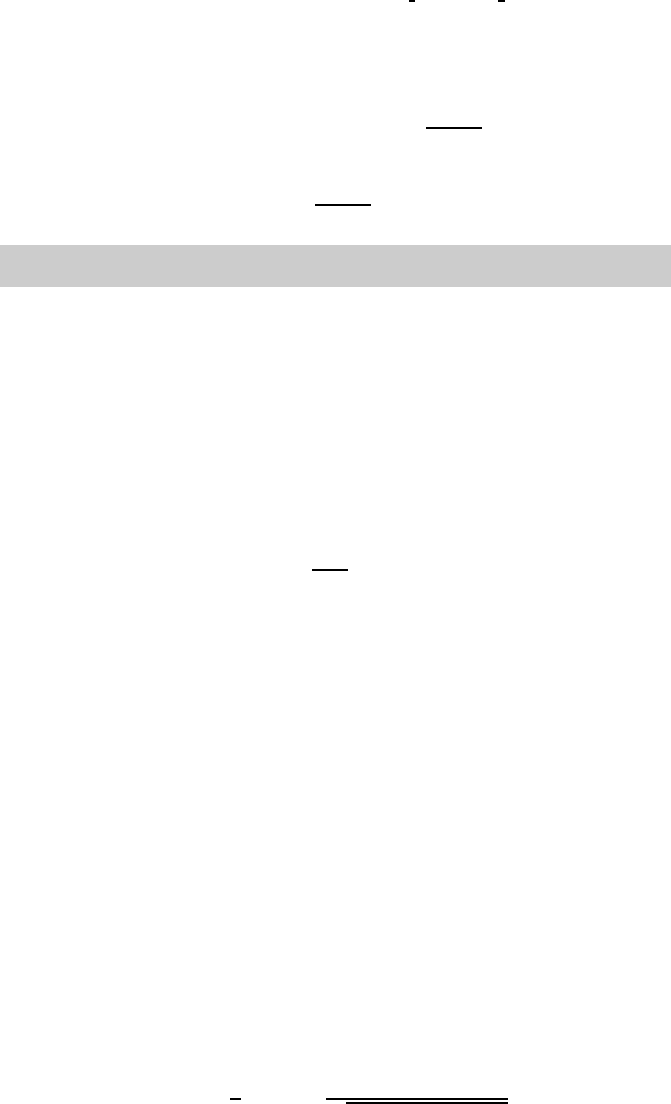
. (10.122)
Uncorrected Proof
BookID 160928 ChapID 10 Proof# 1 - 29/07/09
300 10 Magnetic Ordering and Spin Waves
By using ω
e
=2JzS, this can be rewritten by 443
E
GS
= −2NzJS
S +1− N
−1
k
2
1 − γ
2
k
. (10.123)
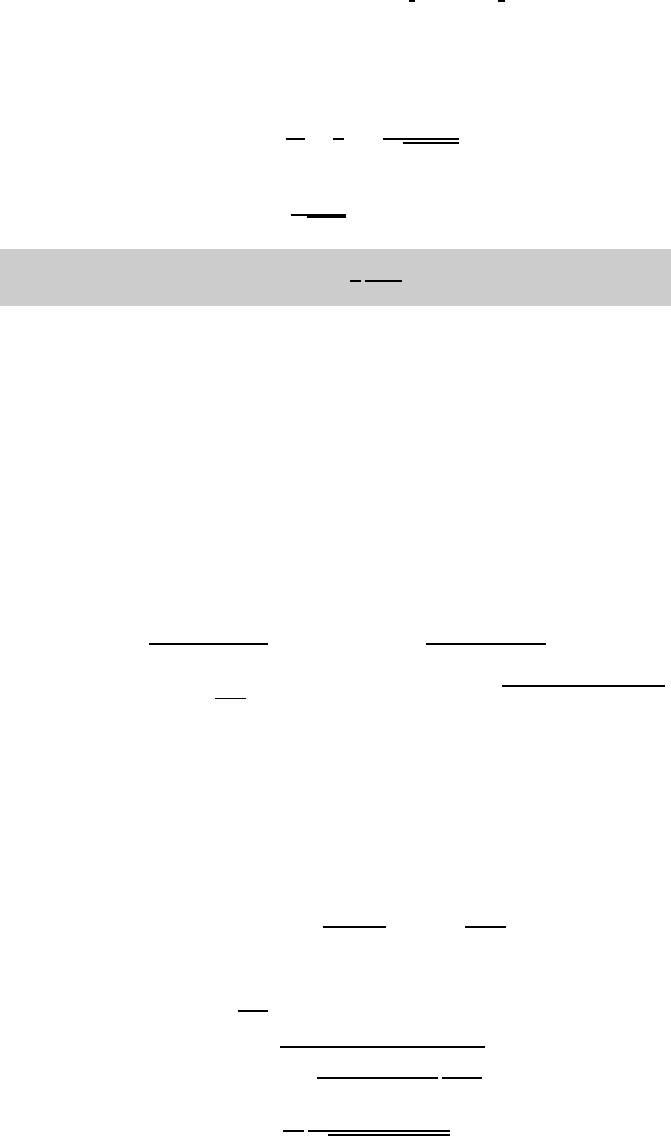
Let us define β = z
1 − N
−1
k
1 − γ
2
k
;thenE
GS
can be written as 444
E
GS
= −2NzJS(S + z
−1
β). (10.124)
445
For a simple cubic lattice β 0.58. For other crystal structures β has slightly 446
different values. 447
10.7.2 Zero Point Sublattice Magnetization 448
For very large anisotropy field B
A
, the magnetization of sublattice a is gμ
B
NS 449
while that of sublattice b is equal in magnitude and opposite in direction. 450
When B
A
→ 0, the resulting antiferromagnetic state will have a sublattice 451
magnetization that differs from the value of B
A
→∞. Then magnetization is 452
given by 453
M(T )=
gμ
B
V
0|
ˆ
S
z
|0
!
, (10.125)
where the total spin operator
ˆ
S
z
is given, for sublattice a, by 454
ˆ
S
z
=
l∈a
S
a
lz
= NS −
l
a
†
l
a
l
. (10.126)
But
l
a
†
l
a
l
=
k
c
†
k
c
k
,andthec
k
and c
†
k
can be written in terms of the 455
operators α
k
, α
†
k
, β
k
,andβ
†
k
to get 456
ˆ
S
z
= NS −
k
u
k
α
†
k
+ v
k
β
k
u
k
α
k
+ v
k
β
†
k
. (10.127)
Multiplying out the product appearing in the sum we can write
457
Δ
ˆ
S≡NS −
ˆ
S
z
=
k
v
2
k
+ u
2
k
α
†
k
α
k
+ v
2
k
β
†
k
β
k
+ u
k
v
k
α
†
k
β
†
k
+ α
k
β
k
.
(10.128)
At zero temperature the ground state |0 > contains no excitations so that
458
α
k
|0 = β
k
|0 =0.Thus,atT =0,ΔS(T )=
0|Δ
ˆ
S|0
!
has a value ΔS
0
459
given by 460
ΔS
0
=
k
v
2
k
= −
1
2
k
1 −
ω
A
+ ω
e
(ω
A
+ ω
e
)
2
− γ
2
k
ω
2
e
. (10.129)
Uncorrected Proof
BookID 160928 ChapID 10 Proof# 1 - 29/07/09
10.7 Spin Waves in Antiferromagnets 301
Let us put ω
A
= 0 corresponding to B
A
→ 0. This gives 461
ΔS
0
= −
N
2
+
1
2
k
1
1 − γ
2
k
. (10.130)
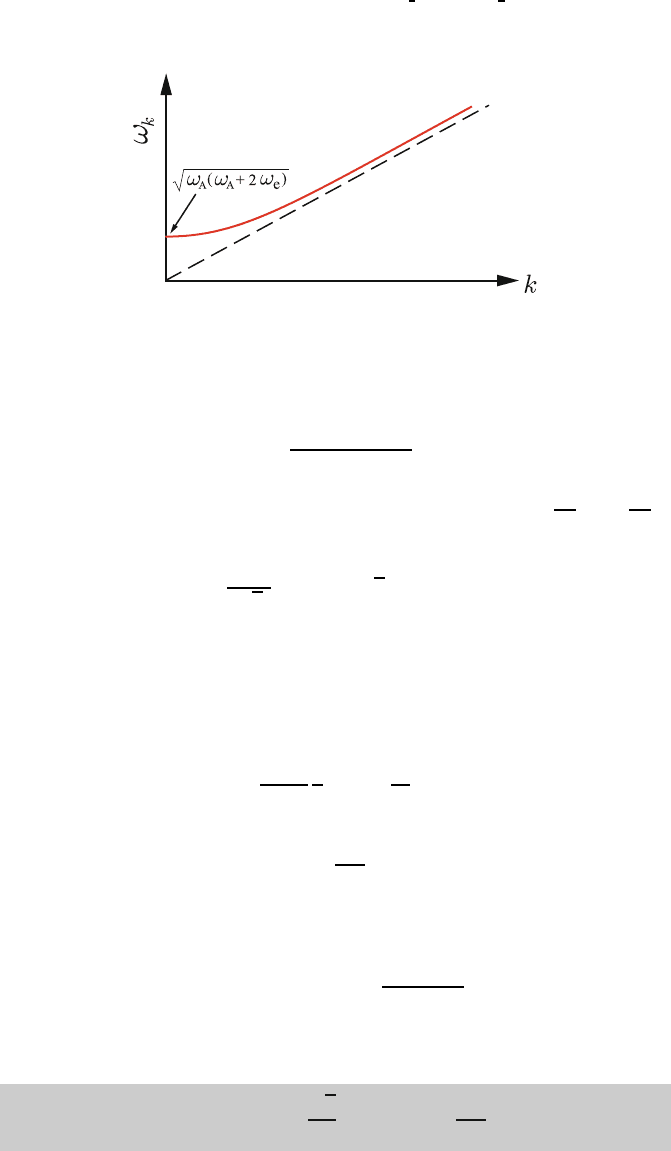
If we define β
= zN
−1
k
1 −
1
√
1−γ
2
k
,thenwehave
462
ΔS
0
= −
1
2
β
N
z
. (10.131)
463
For a simple cubic lattice z =6andβ
has the value 0.94 giving for ΔS
0
the 464
value −0.078N. 465
10.7.3 Finite Temperature Sublattice Magnetization 466
At a finite temperature it is apparent from Eqs.(10.128) and (10.129) that 467
ΔS(T )=ΔS
0
+
k
u
2
k
α
†
k
α
k
!
+ v
2
k
β
†
k
β
k
!
. (10.132)
But the excitations described by the creation operators α
†
k
and β
†
k
have 468
energies ω
k
± ω
B
(the sign − goes with β
†
k
), so that 469
α
†
k
α
k
!
=
1
e
β(ω
k
+ω
B
)
− 1
and
β
†
k
β
k
!
=
1
e
β(ω
k
−ω
B
)
− 1
. (10.133)
In these equations β =
1
k
B
T
, ω
B
=2μ
B
B
0
,andω
k
=
(ω
A
+ ω
e
)
2
− γ
2
k
ω
2
e
. 470
At low temperature only very low frequency or small wave number modes will 471
be excited. Remember that 472
γ
k
= z
−1
δ
e
ik·δ
where δ indicates the nearest neighbors of the atom at the origin. To order 473
k
2
for a simple cubic lattice 474
γ
k
= z
−1
δ
1 −
(k · δ)
2
2
=1−
k
2
a
2
z
.
Thus, the excitation energies ε
k
≡ ω
k
± ω
B
are approximated, in the long 475
wave length limit (k
2
a
2
zω
A
ω
e
1), by 476
ε
k
[ω
A
(ω
A
+2ω
e
)]
1/2
1
1+
ω
2
e
ω
A
(2ω
e
+ ω
A
)
k
2
a
2
z
± ω
B
≈ [ω
A
(ω
A
+2ω
e
)]
1/2
+
1
2z
ω
2
e
ω
A
(ω
A
+2ω
e
)
k
2
a
2
± ω
B
.
(10.134)
Uncorrected Proof
BookID 160928 ChapID 10 Proof# 1 - 29/07/09
302 10 Magnetic Ordering and Spin Waves
Fig. 10.14. Antiferromagnetic spin wave excitation energies in the long wave length
limit
Thus, the uniform mode of antiferromagnetic resonance is given, in the 477
presence of an applied field, by 478
ε
k=0
=
ω
A
(ω
A
+2ω
e
) ± ω
B
. (10.135)
In the long wave length limit, but in the region of 1 k
2
a
2
z
ω
A
ω
e
2+
ω
A
ω
e
,
479
we expect the behavior given by 480
ε
k
ω
e
ka
√
z
± ω
B
≈ 2
√
zJSak ±ω
B
. (10.136)
Figure 10.14 shows the excitation energies ω
k
as a function of wave number 481
k in the long wave length limit. 482
Let us make an approximation like the Debye approximation of lattice 483
dynamics in the absence of an applied field. Replace the first Brillouin zone 484
by a sphere of radius k
M
,where 485
1
(2π)
3
4
3
πk
3
M
=
N
V
to have
486
ε
k
Θ
N
k
M
k. (10.137)
Here Θ
N
is the value of ε
k
at k = k
M
. With a use of this approximation 487
for ε
k
of both the + and - (or α
k
and β
k
) modes one can evaluate the spin 488
fluctuation 489
ΔS(T )=ΔS
0
+
k
u
2
k
+ v
2
k
e
ε
k
/Θ
− 1
. (10.138)
Using our expressions for v
2
k
(and u
2
k
=1+v
2
k
), replacing the k-summation 490
by an integral, and evaluation for Θ Θ
N
we have 491
ΔS(T )=ΔS
0
+
√
3
12
6π
2
2/3
N
Θ
Θ
N
2
. (10.139)
492
Uncorrected Proof
BookID 160928 ChapID 10 Proof# 1 - 29/07/09
10.8 Exchange Interactions 303
10.7.4 Heat Capacity due to Antiferromagnetic Magnons 493
For Θ <ω
0
≡
ω
A
(ω
A
+2ω
e
)
, the heat capacity will vary with temperature 494
as e
−const/T
, since the probability of exciting a magnon will be exponentially 495
small. For somewhat higher temperatures (but not too high since we are 496
assuming small |k|) where modes with ω
k
Θ
N
k
M
k are excited, the specific 497
heat is very much like the low temperature Debye specific heat (the tempera- 498
ture region in question is defined by ω
0
Θ Θ
N
). The internal energy will 499
be given by 500
U =2
k
ω
k
e
ω
k
/Θ
− 1
. (10.140)
Here, we have two antiferromagnetic magnons for every value of k,instead
501
of three as for phonons, and the factor of 2 results from counting two types 502
of spin excitations, α
†
k
and β
†
k
type modes. Replacing the sum by an integral 503
and replacing the upper limit k
M
by infinity, as in the low temperature Debye 504
specific heat, gives 505
U = N
(k
M
a)
3
15
Θ
4
Θ
3
N
π
2
= N
2π
4
5
Θ
4
Θ
3
N
. (10.141)
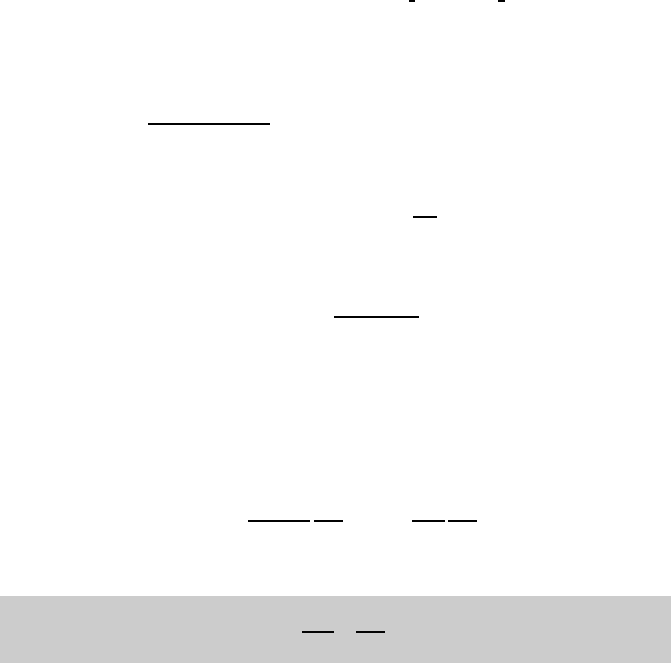
For the specific heat per particle one obtains
506
C =
8π
4
5
Θ
Θ
N
3
. (10.142)
507
10.8 Exchange Interactions 508
Here, we briefly describe various kinds of exchange interactions which are the 509
underlying sources of the long range magnetic ordering. 510
1. Direct exchange is the kind of exchange we discussed when we investigate 511
the simple Heisenberg exchange interaction. The magnetic ions interact 512
through the direct Coulomb interaction among the electrons on the two 513
ions as a result of their wave function overlap. 514
2. Superexchange is the underlying mechanism of a number of ionic solids, 515
such as MnO and MnF
2
, showing magnetic ground states. Even in the 516
absence of direct overlap between the electrons on different magnetic ions 517
sharing a nonmagnetic ion (one with closed electronic shells and located 518
in between the magnetic ions), the two magnetic ions can have exchange 519
interaction mediated by the nonmagnetic ion. (See, for example, Fig. 10.15.) 520
3. Indirect exchange is the magnetic interaction between magnetic moments 521
localized in a metal (such as rare earth metals) through the media- 522
tion of conduction electrons in the metal. It is a metallic analogue of 523