
Quinn J.J., Yi K.-S. Solid State Physics: Principles and Modern Applications
Подождите немного. Документ загружается.


Uncorrected Proof
BookID 160928 ChapID 11 Proof# 1 - 29/07/09
314 11 Many Body Interactions – Introduction
will vanish unless (1) λ = β and μ = α or (2) λ = α and μ = β.Fromthis, 53
we see that 54
V
12
|Φ
αβ
=
1
√
2
λ
μ
[λ
μ
|V
12
|βα−λ
μ
|V
12
|αβ] c
†
λ
c
†
μ
|0.
Taking the scalar product with Φ
γδ
| =
1
√
2
0|c
γ
c
δ
gives 55
Φ
γδ
|V
12
|Φ
αβ
=
1
2
λ
μ
[λ
μ
|V
12
|βα−λ
μ
|V
12
|αβ] 0|c
γ
c
δ
c
†
λ
c
†
μ
|0.
(11.13)
The matrix element 0|c
γ
c
δ
c
†
λ
c
†
μ
|0 will vanish unless (1) δ = λ
and γ = μ
56
or (2) γ = λ
and δ = μ
. The final result can be seen to be 57
Φ
γδ
|V
12
|Φ
αβ
= γδ|V
12
|αβ−γδ|V
12
|βα. (11.14)
If we consider the operator
1
2
i=j
V
ij
we need only note that we can consider 58
a particular pair i, j first. Then, when V
ij
operates on a many particle wave 59
function 60
1
√
N!
P
(−)
P
P {φ
α
(1)φ
β
(2) ···φ
ω
(N)} = c
†
α
c
†
β
···c
†
ω
|0 (11.15)
only particles i and j can change their single particle states. All the rest of
61
the particles must remain in the same single particle states. 62
The final result is that the Hamiltonian of a many particle system with 63
two body interactions can be written 64
H =
kk
k
|H
0
|kc
†
k
c
k
+
1
2
kk
ll
k
l
|V |klc
†
k
c
†
l
c
l
c
k
. (11.16)
65
The operators c
k
and c
†
k
satisfy either commutation relations for Bosons 66
c
k
,c
†
k
−
= δ
kk
, and [c
k
,c
k
]
−
=
c
†
k
,c
†
k
−
=0. (11.17)
or anticommutation relations for Fermions 67
c
k
,c
†
k
+
= δ
kk
, and [c
k
,c
k
]
+
=
c
†
k
,c
†
k
+
=0. (11.18)
11.2 Hartree–Fock Approximation 68
Now, we are all familiar with the second quantized notation for a system of 69
interacting particles. We can write 70
H =
i
ε
i
c
†
i
c
i
+
1
2
ijkl
ij|V |klc
†
i
c
†
j
c
l
c
k
. (11.19)

Uncorrected Proof
BookID 160928 ChapID 11 Proof# 1 - 29/07/09
11.2 Hartree–Fock Approximation 315
Here, c
†
i
creates a particle in the state φ
i
,and 71
ij|V |kl =
dxdx
φ
∗
i
(x)φ
∗
j
(x
)V (x, x
)φ
k
(x)φ
l
(x
). (11.20)
Remember that
72
ij|V |kl = ji|V |lk (11.21)
if V is a symmetric function of x and x
. In this notation, H
0
=
i
ε
i
c
†
i
c
i
73
is the Hamiltonian for a noninteracting system. It is simply the sum of the 74
product of the energy ε
i
of the state φ
i
and the number operator n
i
= c
†
i
c
i
. 75
The Hartree–Fock approximation is obtained by replacing the product of the 76
four operators c
†
i
c
†
j
c
l
c
k
by a c-number (actually a ground state expectation 77
value of a c
†
c product) multiplying a c
†
c;thatis 78
c
†
i
c
†
j
c
l
c
k
≈ c
†
i
c
†
j
c
l
c
k
+ c
†
j
c
l
c
†
i
c
k
−c
†
i
c
l
c
†
j
c
k
−c
†
j
c
k
c
†
i
c
l
.
(11.22)
79
By
ˆ
Ω we mean the expectation value of
ˆ
Ω in the Hartree–Fock ground state, 80
which we are trying to determine. Because this is a diagonal matrix element, 81
we see that 82
c
†
j
c
l
= δ
jl
n
j
. (11.23)
Furthermore, momentum conservation requires
83
ij|V |jk = ij|V |jiδ
ik
, etc.
Then, one obtains for the Hartree–Fock Hamiltonian
84
H =
i
E
i
c
†
i
c
i
, (11.24)
where
85
E
i
= ε
i
+
j
n
j
[ij|V |ij−ij|V |ji] . (11.25)
86
One can think of E
i
as the eigenvalue of a one particle Schr¨odinger equation 87
H
HF
φ
i
(x) ≡
#
p
2
2m
+
"
d
3
x
V (x, x
)
j
n
j
φ
∗
j
(x
)φ
j
(x
)
$
φ
i
(x)
−
"
d
3
x
V (x, x
)
j
n
j
φ
∗
j
(x
)φ
i
(x
)φ
j
(x)=E
i
φ
i
(11.26)
88
Do not think the Hartree–Fock approximation is trivial. One must assume a 89
ground state configuration to compute c
†
j
c
l
. One then solves the “one parti- 90
cle” problem and hopes that the solution is such that the ground state of the 91
N particle system, determined by filling the N lowest energy single particle 92
states just solved for, is identical to the ground state assumed in computing 93
c
†
j
c
l
. If it is not, the problem has not been solved. 94

Uncorrected Proof
BookID 160928 ChapID 11 Proof# 1 - 29/07/09
316 11 Many Body Interactions – Introduction
11.2.1 Ferromagnetism of a degenerate electron gas 95
in Hartree–Fock Approximation 96
One can easily verify that plane wave eigenfunctions 97
φ
ks
(x)=Ω
−1/2
e
ik·x
η
s
,
with single particle energy
98
ε
ks
=
¯h
2
k
2
2m
form a set of solutions of the single particle Hartree–Fock Hamiltonian.
99
If the ground state is assumed to be the paramagnetic state,inwhichthe 100
N lowest energy levels are occupied (each k state is occupied by one electron 101
of spin ↑ and one of spin ↓) then one obtains 102
E
ks
= ε
ks
+ E
Xs
(k) (11.27)
where
103
E
Xs
(k)=−
k
n
k
kk
|V |k
k. (11.28)
Here, we assumed that the nuclei are fixed in a given configuration and pic-
104
tured as a fixed source of a static potential. The matrix element kk
|V |k
k = 105
4πe
2
|k−k
|
2
, and the sum over k
can be performed to obtain 106
E
ks
=
¯h
2
k
2
2m
−
e
2
k
F
2π
2+
k
2
F
− k
2
kk
F
ln
k
F
+ k
k
F
− k
. (11.29)
The total energy of the paramagnetic state is
107
E
P
=
ks
n
ks
ε
ks
+
1
2
E
Xs
(k)
. (11.30)
The
1
2
in front of E
Xs
prevents double counting. This sum gives 108
E
P
= N
3
5
¯h
2
k
2
F
2m
−
3
4π
e
2
k
F
N
2.21
r
2
s
−
0.916
r
s
Ryd. (11.31)
109
OnecaneasilyseethatE
ks
is a monotonically increasing function of k,so 110
that the assumption about the ground state, viz. that all k state for which 111
k<k
F
are occupied, is in agreement with the procedure of filling the N lowest 112
energy eigenstates of the single particle Hartree–Fock Hamiltonian. 113
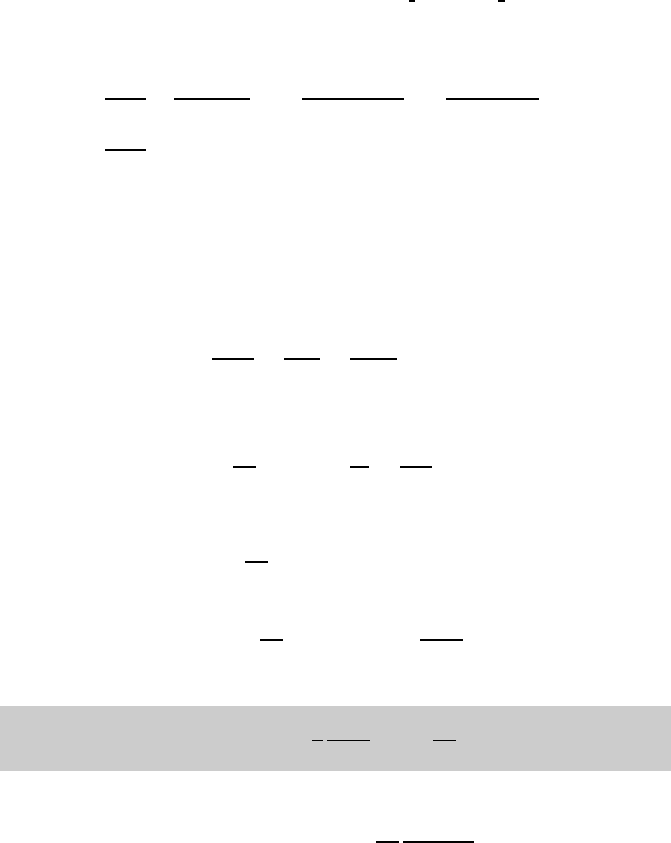
Instead of assuming the paramagnetic ground state, we could assume that 114
only states of spin ↑ are occupied, and that they are singly occupied for all 115
k<2
1/3
k
F
. Then one finds that 116
Uncorrected Proof
BookID 160928 ChapID 11 Proof# 1 - 29/07/09
11.2 Hartree–Fock Approximation 317
E
k↑
=
¯h
2
k
2
2m
−
2
1/3
e
2
k
F
2π
2+
2
2/3
k
2
F
− k
2
2
1/3
k
F
k
ln
2
1/3
k
F
+ k
2
1/3
k
F
− k
E
k↓
=
¯h
2
k
2
2m
.
(11.32)
This state is a solution to the Hartree–Fock problem only if
117
E
k↑
|
k=2
1/3
k
F
< 0, (11.33)
otherwise some of the spin down states would be occupied in the ground state.
118
This condition is satisfied if 119
1
a
0
k
F
>
π
2
2/3
3.142
1.588
=1.98 (11.34)
It is convenient to introduce the parameter r
s
defined by 120
4π
3
(a
0
r
s
)
3
=
V
N
=
3π
2
k
3
F
.
Then, we have
121
4
9π
1/3
r
s
=(a
0
k
F
)
−1
,
or
122
r
s
=
9π
4
1/3
a
−1
0
k
−1
F
1.92
a
0
k
F
. (11.35)
If we sum over k to get the energy of the ferromagnetic state
123
E
F
=
E
k↑
= N
2
2/3
3
5
¯h
2
k
2
F
2m
− 2
1/3
3
4π
e
2
k
F
. (11.36)
124
Comparing E
F
with E
P
,weseethat 125
E
F
<E
P
if a
0
k
F
<
5
2π
1
2
1/3
+1
,
which corresponds to
126
r
s
> 5.45, (11.37)
though the Hartree–Fock solution exists if r
s
≥ 3.8. The present, Hartree– 127
Fock, treatment neglects correlation effects and cannot be expected to describe 128
accurately the behavior of metals. The present treatment does however point 129
up the fact that the exchange energy prefers parallel spin orientation, but the 130
cost in kinetic energy is high for a ferromagnetic spin arrangement. Actually 131
Cs has r
s
5.6 and does not show ferromagnetic behavior; this is not too 132
surprising. 133

Uncorrected Proof
BookID 160928 ChapID 11 Proof# 1 - 29/07/09
318 11 Many Body Interactions – Introduction
11.3 Spin Density Waves 134
We have seen that the exchange energy favors parallel spin alignment, but 135
that the cost in kinetic energy is high. Overhauser
1
proposed a solution of 136
the Hartree–Fock problem in which the spins are locally parallel, but the 137
spin polarization rotates as one moves through the crystal. This type of state 138
enhances the (negative) exchange energy but does not cost as much in kinetic 139
energy. 140
For example, an Overhauser spiral spin density wave could exist with a 141
net fractional spin polarization given by 142
P
⊥
(r)=P
⊥0
(
ˆ
x cos Qz +
ˆ
y sin Qz). (11.38)
143
Overhauser showed that such a spin polarization P
⊥
(r) can result from taking 144
basis functions of the form 145
|φ
k
= a
k
|k ↑ + b
k
|k + Q ↓.
In order that φ
k
|φ
k
= 1, it is necessary that a
2
k
+ b
2
k
= 1. This condition 146
assures that there is no fluctuation in the charge density associated with the 147
wave. Thus, without loss of generality we can take a
k
=cosθ
k
and b
k
=sinθ
k
148
and write 149
|φ
k
=cosθ
k
|k ↑ +sinθ
k
|k + Q ↓. (11.39)
The fractional spin polarization at a point r = r
0
is given by 150
P(r
0
)=
Ω
N
k occupied
φ
k
|σδ(r − r
0
)|φ
k
. (11.40)
Here, σ
= σ
x
ˆx + σ
y
ˆy + σ
z
ˆz,whereσ
x
, σ
y
, σ
z
are Pauli spin matrices, so that 151
σ =
ˆ
z
ˆ
x − i
ˆ
y
ˆ
x +i
ˆ
y −
ˆ
z
. (11.41)
We can write
152
|k ↑ = |k| ↑ =Ω
−1/2
e
ik·r
1
0
and
153
|k + Q ↓ = |k + Q| ↓ =Ω
−1/2
e
i(k+Q)·r
0
1
.
Then
154
↑ |σ|↑=
ˆ
z
↑ |σ
|↓=
ˆ
x − i
ˆ
y
↓ |σ
|↑=
ˆ
x +i
ˆ
y
↓ |σ
|↓= −
ˆ
z.
(11.42)
1
A.W. Overhauser, Phys. Rev. 128, 1437 (1962).

Uncorrected Proof
BookID 160928 ChapID 11 Proof# 1 - 29/07/09
11.3 Spin Density Waves 319
Evaluating φ
k
|σ δ(r − r
0
)|φ
k
gives 155
φ
k
|σδ(r − r
0
)|φ
k
=
1
Ω
(
cos
2
θ
k
↑ |σ|↑+sin
2
θ
k
↓ |σ|↓
+cosθ
k
sin θ
k
e
iQ·r
0
↑ |σ|↓+e
−iQ·r
0
↓ |σ|↑
'
.
(11.43)
Gathering together the terms allows us to express P(r
0
)as 156
P(r
0
)=P
ˆ
z + P
⊥
(
ˆ
x cos Q · r
0
+
ˆ
y sin Q · r
0
) , (11.44)
where
157
P
=
1
8π
3
n
occupied
cos 2θ
k
d
3
k, (11.45)
and
158
P
⊥
=
1
8π
3
n
occupied
sin 2θ
k
d
3
k. (11.46)
Here, n =
N
Ω
and the integral is over all occupied states |φ
k
. We will not 159
worry about P
because ultimately we will consider a linear combination of 160
two spiral spin density waves (called a linear spin density wave)forwhichthe 161
P
’s cancel. 162
It is worth noting that the density at point r
0
is given by 163
n(r
0
)=
k
φ
k
|1δ(r − r
0
)|φ
k
=
1
Ω
k
cos
2
θ
k
+sin
2
θ
k
=
N
Ω
.
(11.47)
When the unit matrix 1
is replaced by σ, it is reasonable to expect the spin 164
density. 165
One can form a wave function orthogonal to |φ
k
: 166
|ψ
k
= −sin θ
k
|k ↑ +cosθ
k
|k + Q ↓. (11.48)
So far, we have ignored these states (i.e. assumed they were unoccupied). We
167
shall see that this turns out to be correct for the Hartree–Fock spin density 168
wave ground state. 169
Recall that the Hartree–Fock wave functions φ
k
(x) satisfy (11.26) 170
H
HF
φ
k
(x) ≡
p
2
2m
+
"
dx
V (x, x
)
q
n
q
φ
∗
q
(x
)φ
q
(x
)
φ
k
(x)
−
"
dx
V (x, x
)
q
n
q
φ
∗
q
(x
)φ
k
(x
)φ
q
(x)=E
k
φ
k
.
(11.49)
We can write H
HF
as 171
H
HF
=
p
2
2m
+ U + A, (11.50)
where
172
U(x)=
dx
V (x, x
)
q occupied
φ
∗
q
(x
)φ
q
(x
) (11.51)

Uncorrected Proof
BookID 160928 ChapID 11 Proof# 1 - 29/07/09
320 11 Many Body Interactions – Introduction
and 173
Aψ(x)=−
dx
V (x, x
)
q occupied
φ
∗
q
(x
)ψ(x
)φ
q
(x). (11.52)
V (x, x
) can be written as 174
V (x, x
)=
q=0
V
q
e
iq·(x−x
)
. (11.53)
Now, consider the matrix elements of A (with the Hartree–Fock ground state
175
assumed to be made up of the lowest energy φ
k
states) between plane wave 176
states. 177
σ|A|
σ
= −
k
q=0
V
q
φ
k
|e
−iq·x
|
σ
σ|e
iq·x
|φ
k
, (11.54)
where
k
means sum over all occupied states |φ
k
. Now use the expressions 178
|φ
k
=cosθ
k
|k ↑ +sinθ
k
|k + Q ↓
φ
k
| = k ↑|cos θ
k
+ k + Q ↓|sin θ
k
(11.55)
179
to obtain 180
σ
|A|
σ
= −
k
q=0
V
q
k ↑|e
−iq·x
|
σ
cos θ
k
+ k + Q ↓|e
−iq·x
|
σ
sin θ
k
×
σ|e
iq·x
|k ↑cos θ
k
+ σ|e
iq·x
|k + Q ↓sin θ
k
.
(11.56)
Because e
±iq·x
is spin independent, we can use σ|↑= δ
σ↑
, σ|↓= δ
σ↓
, etc. 181
to obtain 182
σ
|A|
σ
= −
k
q=0
V
q
(k + q|
δ
σ
↑
cos θ
k
+ k + Q + q|
δ
σ
↓
sin θ
k
)
×(|k + qδ
σ↑
cos θ
k
+ |k + Q + qδ
σ↓
sin θ
k
) .
(11.57)
For σ =↑ and σ
=↓ we find 183
↑|A|
↓ = −
k
q=0
V
q
δ
k+Q+q,
sin θ
k
δ
,k+q
cos θ
k
, (11.58)
which can be rewritten
184
↑|A|
↓ = −
k
V
−k
sin θ
k
cos θ
k
δ
,+Q
. (11.59)
Thus, the Hartree–Fock exchange term A has off diagonal elements mixing
185
the simple plane wave states | ↑ and | + Q ↓. It is straightforward to see 186
that 187

Uncorrected Proof
BookID 160928 ChapID 11 Proof# 1 - 29/07/09
11.3 Spin Density Waves 321
↓|A|
↑ = −
k
V
−k
sin θ
k
cos θ
k
δ
,−Q
, (11.60)
so that A also couples | ↓ to | − Q ↑. The spin diagonal terms are
188
↑|A| ↑ = −
k
V
−k
cos
2
θ
k
(11.61)
and
189
+ Q ↓|A| + Q ↓ = −
k
V
−k
sin
2
θ
k
. (11.62)
Then, we need to solve the problem given by
190
p
2
2m
+ A
D
+ A
OD
− E
k
Ψ
k
=0, (11.63)
where
191
A
D
= −
9
k
V
k−k
cos
2
θ
k
0
0
k
V
k−k
sin
2
θ
k
:
(11.64)
and
192
A
OD
= −g
k
01
10
. (11.65)
We can simply take |Ψ
k
=cosθ
k
|k ↑ +sinθ
k
|k + Q ↓ and observe that 193
(11.63) becomes 194
9
ε
k↑
− E
k
−g
k
−g
k
ε
k+Q↓
− E
k
:9
cos θ
k
sin θ
k
:
=0. (11.66)
In this matrix equation, g
k
denotes the amplitude of the off-diagonal contri- 195
bution of the exchange term A 196
g
k
= k ↑|A|k + Q ↓ =
k
V
k−k
sin θ
k
cos θ
k
, (11.67)
and ε
k↑
and ε
k+Q↓
are the free electron energies plus the diagonal parts (A
D
) 197
of the one electron exchange energy 198
ε
k↑
=
¯h
2
k
2
2m
−
k
V
|k−k
|
cos
2
θ
k
ε
k+Q↓
=
¯h
2
(k + Q)
2
2m
−
k
V
|k−k
|
sin
2
θ
k
. (11.68)

Uncorrected Proof
BookID 160928 ChapID 11 Proof# 1 - 29/07/09
322 11 Many Body Interactions – Introduction
The eigenvalues E
k
are determined from (11.66) by setting the determi- 199
nant of the 2 × 2 matrix equal to zero. This gives 200
E
k±
=
1
2
(ε
k↑
+ ε
k+Q↓
) ±
1
4
(ε
k↑
− ε
k+Q↓
)
2
+ g
2
k
1/2
. (11.69)
201
The eigenfunctions corresponding to E
k±
are given by (11.48) and (11.55), 202
respectively. The values of cos θ
k
are determined from (11.66) using the eigen- 203
values E
k−
given above. This gives 204
cos θ
k
=
g
k
[g
2
k
+(ε
k↑
− E
k−
)
2
]
1/2
. (11.70)
205
We note that the square modulus of the eigenfunction is a constant, and thus 206
a charge density wave does not accompany a spin density wave. 207
Solution of the Integral Equation 208
We have to solve the integral equation (11.67), which is rewritten as 209
g
l
=
V
l−k
cos θ
k
sin θ
k
d
3
k
(2π)
3
. (11.71)
Here, cos θ
k
is given by (11.70), and the ground state eigenvalue E
k
is itself a 210
function of θ
k
and hence of g
k
. This equation is extremely complicated, and 211
no solution is known for the general case. To obtain some feeling for what is 212
happening we study the simple case where V
−k
is constant instead of being 213
given by
4πe
2
|−k|
2
.WetakeV
−k
= γ; this corresponds to replacing the Coulomb 214
interaction by a δ-function interaction. Obviously g
k
will be independent of k 215
in this case, and the integral equation becomes 216
g = γ
d
3
k
(2π)
3
g (ε
k↑
− E
k
)
g
2
+(ε
k↑
− E
k
)
2
(11.72)
where
217
ε
k↑
− E
k
=
1
2
(ε
k↑
− ε
k+Q↓
)+
1
4
(ε
k↑
− ε
k+Q↓
)
2
+ g
2
1/2
. (11.73)
By direct substitution we have
218
g (ε
k↑
− E
k
)
g
2
+(ε
k↑
− E
k−
)
2
=
g
2
1
4
(ε
k↑
− E
k
)
2
+ g
2
1/2
, (11.74)
and the integral equation becomes
219
g = γ
d
3
k
(2π)
3
g
2
1
4
(ε
k↑
− E
k
)
2
+ g
2
1/2
. (11.75)
Uncorrected Proof
BookID 160928 ChapID 11 Proof# 1 - 29/07/09
11.3 Spin Density Waves 323
We replace ε
k↑
− E
k
in (11.75) by 220
ε
k↑
− E
k
≈−
¯h
2
m
Q(k
z
+
Q
2
)
=2
∂ε
∂k
z
k
z
=−
Q
2
k
z
+
Q
2
.
(11.76)
Here,wenotethatweleftoutaterm−γ
"
d
3
k
(2π)
3
cos
2
θ
k
.Thisisthesameterm 221
which appeared in P
, and it had better vanish when we evaluate it using the 222
solution to the integral equation for θ
k
. Now let us introduce 223
μ =
−
∂ε
∂k
z
k
z
=−Q/2
. (11.77)
Then, we have
224
1=
γ
(2π)
3
d
3
k
2
8
g
2
+ μ
2
k
z
+
Q
2
2
. (11.78)
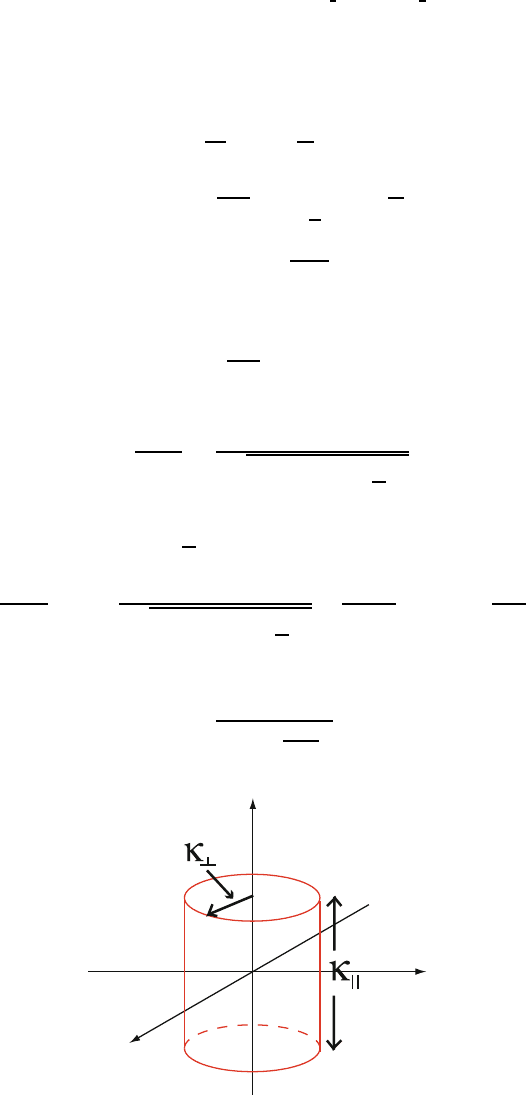
Take the region of integration to be a circular cylinder of radius κ
⊥
and of 225
length κ
, centered at k
z
= −
Q
2
as shown in Fig. 11.1. Then (11.78) becomes 226
1=
γ
(2π)
3
κ
/2
−κ
/2
πκ
2
⊥
d(k
z
+ Q/2)
2
8
g
2
+ μ
2
k
z
+
Q
2
2
=
γκ
2
⊥
16π
2
μ
2sinh
−1
κ
μ
2g
.
(11.79)
Thus, we obtain
227
g =
κ
μ
2sinh
8π
2
μ
γκ
2
⊥
(11.80)
k
x
k
y
k
z
Fig. 11.1. Region of integration for (11.78). The cylinder axis is parallel to the
z axis