
Quinn J.J., Yi K.-S. Solid State Physics: Principles and Modern Applications
Подождите немного. Документ загружается.


Uncorrected Proof
BookID 160928 ChapID 16 Proof# 1 - 29/07/09
16.7 Composite Fermion Picture 497
t2.1 Table 16.2. The effective CF monopole strength 2Q
∗
, the number of CF quasipar-
ticles (quasiholes n
QH
and quasielectrons n
QE
), the quasiparticle angular momenta
l
QE
and l
QH
, the composite fermion and electron filling factors ν
∗
and ν,andthe
angular momenta L of the lowest lying band of multiplets for a ten electron system
at 2Q between 29 and 15
t2.2 2Q 29 28 27 26 25 24 23 22 21 15
t2.3 2Q
∗
11 10 9 8 7 6 5 4 3 −3
t2.4 n
QH
2 1000 0 0 0 00
t2.5 n
QE
0 0012 3 4 5 66
t2.6 l
QH
5.5 5 4.5 4 3.5 3 2.5 2 1.5 1.5
t2.7 l
QE
6.5 6 5.5 5 4.5 4 3.5 3 2.5 2.5
t2.8 ν
∗
12−2
t2.9 ν 1/3 2/5 2/3
t2.10 L 10,8,6, 5 0 5 8,6,4, 9,7,6,5, 8,6,5, 5,3,1 0 0
t2.11 4,2,0 2,0 4,3
2
,1 4
2
,2
2
,0
For example, the Laughlin L = 0 ground state at ν =1/3 occurs when 394
2l
∗
0
= N −1, so that the N composite fermions fill the lowest shell with angular 395
momentum l
∗
0
(=
N−1
2
). The composite fermion quasielectron and quasihole 396
states occur at 2l
∗
0
= N − 1 ± 1 and have one too many (for quasielectron) 397
or one too few (for quasihole) quasiparticles to give integral filling. The single 398
quasiparticle states (n
QP
= 1) occur at angular momentum N/2, for example, 399
at l
QE
=5with2Q
∗
=8andl
QH
=5with2Q
∗
=10forN = 10 as indicated 400
in Table 16.2. The two quasielectron or two quasihole states (n
QP
= 2) occur 401
at 2l
∗
0
= N − 1 ∓ 2, and they have 2l
QE
= N − 1and2l
QH
= N +1. For 402
example, we expect that, for N = 10, l
QE
=4.5with2Q
∗
=7andl
QH
=5.5 403
with 2Q
∗
= 11 as indicated in Table 16.2, leading to low energy bands with 404
L =0⊕ +2 ⊕ +4 ⊕ +6 ⊕ +8 for two quasielectrons and L =0⊕ +2 ⊕ +4 ⊕ 405
+6 ⊕ +8 ⊕ 10 for two quasiholes. In the mean field picture, which neglects 406
quasiparticle-quasiparticle interactions, these bands are degenerate. 407
We emphasize that the low lying excitations can be described in terms 408
of the number of quasiparticles n
QE
and n
QH
. The total angular momentum 409
can be obtained by addition of the individual quasiparticle angular momenta, 410
being careful to treat the quasielectron excitations as a set of fermions and 411
quasihole excitations as a set of fermions distinguishable from the quasielec- 412
tron excitations. The energy of the excited state would simply be the sum 413
of the individual quasiparticle energies if interactions between quasiparticles 414
were neglected. However, interactions partially remove the degeneracy of dif- 415
ferent states having the same values of n
QE
and n
QH
. Numerical results in 416
Fig. 16.3b and d illustrate that two quasiparticles with different L have differ- 417
ent energies. From this numerical data one can obtain the residual interaction 418
V
QP
(L
) of a quasiparticle pair as a function of the pair angular momen- 419
tum L
. In Fig. 16.2, in addition to the lowest energy band of multiplets, 420
Uncorrected Proof
BookID 160928 ChapID 16 Proof# 1 - 29/07/09
498 16 The Fractional Quantum Hall Effect
the first excited band containing one additional quasielectron-quasihole pair 421
can be observed. The “magnetoroton” band can be observed lying between 422
the L = 0 Laughlin ground state of incompressible quantum liquid and a 423
continuum of higher energy states. The band contains one quasihole with 424
l
QH
=9/2 and one quasielectron with l
QE
=11/2. By adding the angu- 425
lar momenta of these two distinguishable particles, a band comprising L of 426
1(=l
QE
−l
QH
) ≤ L ≤ 10(=l
QE
+ l
QH
) would be predicted. But, from Fig. 16.2 427
we conjecture that the state with L = 1 is either forbidden or pushed up by 428
interactions into the higher energy continuum above the magnetoroton band. 429
Furthermore, the states in the band are not degenerate indicating residual 430
interactions that depend on the angular momentum of the pair L
.Other 431
bands that are not quite so clearly defined can also be observed in Fig. 16.3. 432
Although fluctuations beyond the mean field interact via both Coulomb 433
and Chern–Simons gauge interactions, the mean field composite fermion pic- 434
ture is remarkably successful in predicting the low-energy multiplets in the 435
spectrum of N electrons on a Haldane sphere. It was suggested originally 436
that this success of the mean field picture results from the cancellation of the 437
Coulomb and Chern–Simons gauge interactions among fluctuations beyond 438
the mean field level. It was conjectured that the composite fermion transfor- 439
mation converts a system of strongly interaction electrons into one of weakly 440
interacting composite fermions. The mean field Chern–Simons picture intro- 441
duces a new energy scale ¯hω
∗
c
proportional to the effective magnetic field B
∗
, 442
in addition to the energy scale e
2
/l
0
(∝
√
B) associated with the electron– 443
electron Coulomb interaction. The Chern–Simons gauge interactions convert 444
the electron system to the composite fermion system. The Coulomb interac- 445
tion lifts the degeneracy of the noninteracting electron bands. The low lying 446
multiplets of interacting electrons will be contained in a band of width e
2
/l
0
447
about the lowest electron Landau level. The noninteracting composite fermion 448
spectrum contains a number of bands separated by ¯hω
∗
c
. However, for large 449
values of the applied magnetic field B, the Coulomb energy can be made 450
arbitrarily small compared to the Chern–Simons energy ¯hω
∗
c
, resulting in the 451
former being too small to reproduce the separation of levels present in the 452
mean field composite fermion spectrum. The new energy scale is very large 453
compared with the Coulomb scale, and it is totally irrelevant to the deter- 454
mination of the low energy spectrum. Despite the satisfactory description of 455
the allowed angular momentum multiplets, the magnitude of the mean field 456
composite fermion energies is completely wrong. The structure of the low- 457
energy states is quite similar to that of the fully interacting electron system 458
but completely different from that of the noninteracting system. The magne- 459
toroton energy does not occur at the effective cyclotron energy ¯hω
∗
c
.What 460
is clear is that the success of the composite fermion picture does not result 461
from a cancellation between Chern–Simons gauge interactions and Coulomb 462
interactions. 463
Uncorrected Proof
BookID 160928 ChapID 16 Proof# 1 - 29/07/09
16.8 Fermi Liquid Picture 499
16.8 Fermi Liquid Picture 464
The numerical result of the type displayed in Fig. 16.2 could be understood in 465
a very simple way within the composite fermion picture. For the 10 particle 466
system, the Laughlin ν =1/3 incompressible ground state at L = 0 occurs 467
for 2Q =3(N −1) = 27. The low lying excited states consist of a single quasi- 468
particle pair, with the quasielectron and quasihole having angular momentum 469
l
QE
=11/2andl
QH
=9/2.Themeanfieldcompositefermionpicturedoesnot 470
account for quasiparticle interactions and would give a magnetoroton band of 471
degenerate states with 1 ≤ L ≤ 10 at 2Q = 27. It also predicts the degenera- 472
cies of the bands of two identical quasielectron states at 2Q =25andoftwo 473
identical quasihole states at 2Q = 29. 474
The energy spectra of states containing more than one composite fermion 475
quasiparticle can be described in the following phenomenological Fermi liquid 476
model. The creation of an elementary excitation, quasielectron or quasihole, in 477
a Laughlin incompressible ground state requires a finite energy, ε
QE
or ε
QH
, 478
respectively. In a state containing more than one Laughlin quasiparticles, 479
quasiparticles interact with one another through appropriate quasiparticle- 480
quasiparticle pseudopotentials, V
QP−QP
. Here, V
QP−QP
(L
) is defined as the 481
interaction energy of a pair of electrons as a function of the total angular 482
momentum L
of the pair. 483
An estimate of the quasiparticle energies can be obtained by comparing 484
the energy of a single quasielectron (for example, for the 10 electron system, 485
the energy of the ground state at L = N/2=5for2Q =27− 1 = 26) or a 486
single quasihole (the L = N/2 = 5 ground state at 2Q =27+1=28forthe 487
10 electron system) with the Laughlin L = 0 ground state at 2Q = 27. There 488
can be finite size effects, because the quasiparticle states occur at different 489
values of 2Q from that of the ground state. But estimation of reliable ε
QE
490
and ε
QH
should be possible for a macroscopic system by using the correct 491
magnetic length l
0
= R/
√
Q (R is the radius of the Haldane sphere) in the 492
units of energy e
2
/l
0
at each value of 2Q and by extrapolating the results as 493
a function of N
−1
to an infinite system.
8
494
The quasiparticle pseudopotentials V
QP−QP
can be obtained by subtract- 495
ing from the energies of the two quasiparticle states obtained numerically, 496
for example, for the ten particle system at 2Q = 25(2QE state), 2Q = 497
27(QE − QH state), and 2Q = 29(2QH state) the energy of the Laughlin 498
ground state at 2Q = 27 and two energies of appropriate noninteracting quasi- 499
particles. As for the single quasiparticle, the energies calculated at different 500
2Q must be taken in correct units of e
2
/l
0
=
√
Qe
2
/R to avoid finite size 501
effects. 502
8
P. Sitko, S.-N. Yi, K.-S. Yi, J.J. Quinn, Phys. Rev. Lett. 76, 3396 (1996).

Uncorrected Proof
BookID 160928 ChapID 16 Proof# 1 - 29/07/09
500 16 The Fractional Quantum Hall Effect
16.9 Pseudopotentials 503
Electron pair states in the spherical geometry are characterized by a pair 504
angular momentum L
(=L
12
). The Wigner–Eckart theorem tells us that the 505
interaction energy V
n
(L
) depends only on L
and the Landau level index n. 506
The reason of the success of the mean field Chern–Simons picture can be 507
seen by examining the behavior of the pseudopotential V
QP−QP
(L
)ofapair 508
of particles. In the mean field approximation the energy necessary to create 509
a quasielectron–quasihole pair is ¯hω
∗
c
. However, the quasiparticles will inter- 510
act with the Laughlin condensed state through the fluctuation Hamiltonian. 511
The renormalized quasiparticle energy will include this self-energy, which is 512
difficult to calculate. We can determine the quasiparticle energies phenomeno- 513
logically using exact numerical results as input data. The picture we are using 514
is very reminiscent of Fermi liquid theory. The ground state is the Laughlin 515
condensed state; it plays the role of a vacuum state. The elementary excita- 516
tions are quasielectrons and quasiholes. The total energy can be expressed as 517
518
E = E
0
+
QP
ε
QP
n
QP
+
1
2
QP,QP
V
QP−QP
(L)n
QP
n
QP
. (16.31)
519
The last term represents the interactions between pair of quasiparticles in 520
a state of angular momentum L. One can take the energy spectra of finite 521
systems, and compare the two quasiparticle states, such as |2QE, |2QH,or 522
|1QE + 1QH, with the composite fermion picture. The values of V
QP−QP
(L) 523
are obtained by subtracting the energies of the noninteracting quasiparticles 524
from the numerical values of E(L)forthe|1QP + 1QP
states after the 525
appropriate positive background energy correction. It is worth noting that 526
the interaction energy for unlike quasiparticles depends on the total angular 527
momentum L while for like quasiparticles it depends on the relative angular 528
momentum R, which is defined by R = L
Max
− L. One can understand it 529
by considering the motions in the two dimensional plane. Oppositely charged 530
quasiparticles form bound states, in which both charges drift in the direction 531
perpendicular to the line connecting them, and their spatial separation is 532
related to the total angular momentum L. Like charges repel one another 533
orbiting around one another due to the effect of the dc magnetic field. Their 534
separation is related to their relative angular momentum R.
9
535
If V
QP−QP
(L
) is a “harmonic” pseudopotential of the form 536
V
H
(L
)=A + BL
(L
+1)
9
The angular momentum L
12
of a pair of identical fermions in an angular momen-
tum shell or a Landau level is quantized, and the convenient quantum number
to label the pair states is the relative angular momentum R =2l
QP
− L
12
(on a
sphere) or relative angular momentum m (on a plane).
Uncorrected Proof
BookID 160928 ChapID 16 Proof# 1 - 29/07/09
16.9 Pseudopotentials 501
every angular momentum multiplet having the same value of the total angu- 537
lar momentum L has the same energy. Here, A and B are constants and we 538
mean that the interactions, which couple only states with the same total 539
angular momentum, introduce no correlations. Any linear combination of 540
eigenstates with the same total angular momentum has the same energy. We 541
define V
QP−QP
(L
) to be “superharmonic” (“subharmonic”) at L
=2l −R if 542
it increases approaching this value more quickly (slowly) than the harmonic 543
pseudopotential appropriate at L
− 2. For harmonic and subharmonic pseu- 544
dopotentials, Laughlin correlations do not occur. In Figs. 16.3b and d, it is 545
clear that residual quasiparticle–quasiparticle interactions are present. If they 546
were not present, then all of the 2QE states in frame (b) would be degenerate, 547
as would all of the 2QH states in frame (d). In fact, these frames give us the 548
pseudopotentials V
QE
(R)andV
QH
(R), up to an overall constant, describing 549
the interaction energy of pairs with angular momentum L
=2l −R. 550
Figure 16.4 gives a plot of V
n
(L
)vsL
(L
+1)for the n =0andn =1 551
Landau levels. For electrons in the lowest Landau level (n =0),V
0
(L
)is 552
superharmonic at every value of L
. For excited Landau levels (n ≥ 1), V
n
(L
) 553
is not superharmonic at all allowed values of L
. The allowed values of L
for a 554
pair of fermions each of angular momentum l are given by L
=2l −R,where 555
the relative angular momentum R must be an odd integer. We often write the 556
pseudopotential as V (R)sinceL
=2l−R. For the lowest Landau level V
0
(R) 557
is superharmonic everywhere. This is apparent for the largest values of L
in 558
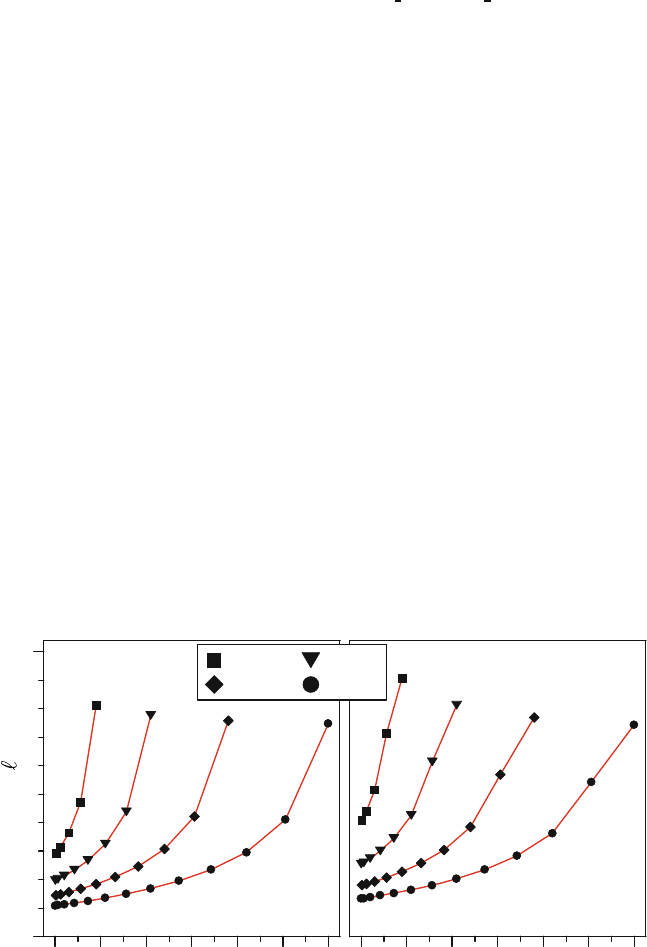
0 100 200 300 400 500 600
L'(L'+1)
0.1
0.6
V (e
2
/ )
0 100 200 300 400 500 600
L'(L'+1)
(a) n=0 (b) n=1
2
l
=10 2
l
=15
2
l
=20 2
l
=25
0
Fig. 16.4. Pseudopotential V
n
(L
) of the Coulomb interaction in the lowest (a)and
the first excited Landau level (b) as a function of the eigenvalue of the squared pair
angular momentum L
(L
+1). Here,n indicates the Landau level index. Squares
(l =5),triangles (l =15/2), diamonds (l = 10), and circles (l =25/2) indicate data
for different values of Q = l + n
Uncorrected Proof
BookID 160928 ChapID 16 Proof# 1 - 29/07/09
502 16 The Fractional Quantum Hall Effect
Fig. 16.4. For the first excited Landau level V
1
increases between L
=2l − 3 559
and L
=2l −1, but it increases either harmonically or more slowly, and hence 560
V
1
(R) is superharmonic only for R > 1. Generally, for higher Landau levels 561
(for example, n =2, 3, 4, ···) V
n
(L
) increases more slowly or even decreases 562
at the largest values of L
. The reason for this is that the wavefunctions 563
of the higher Landau levels have one or more nodes giving structure to the 564
electron charge density. When the separation between the particles becomes 565
comparable to the scale of the structure, the repulsion is weaker than for 566
structureless particles.
10
567
When plotted as a function of R, the pseudopotentials calculated for 568
small systems containing different number of electrons (hence for differ- 569
ent values of quasiparticle angular momenta l
QP
) behave similarly and, for 570
N →∞, i.e., 2Q →∞, they seem to converge to the limiting pseudopotentials 571
V
QP−QP
(R = m) describing an infinite planar system. 572
The number of electrons required to have a system of quasiparticle pairs 573
of reasonable size is, in general, too large for exact diagonalization in terms 574
of electron states and the Coulomb pseudopotential. However, by restricting 575
our consideration to the quasiparticles in the partially field composite fermion 576
shell and by using V
QP
(R) obtained from numerical studies of small systems of 577
electrons, the numerical diagonalization can be reduced to manageable size.
11
578
Furthermore, because the important correlations and the nature of the ground 579
state are primarily determined by the short range part of the pseudopotential, 580
such as at small values of R or small quasiparticle–quasiparticle separa- 581
tions, the numerical results for small systems should describe the essential 582
correlations quite well for systems of any size. 583
In Fig. 16.5 we display V
QE
(R)andV
QH
(R) obtained from numerical diag- 584
onalization of N (6 ≤ N ≤ 11) electron systems appropriate to quasiparticles 585
of the ν =1/3andν =1/5 Laughlin incompressible quantum liquid states. 586
We note that the behavior of quasielectrons is similar for ν =1/3andν =1/5 587
states, and the same is true for quasiholes of the ν =1/3andν =1/5 Laughlin 588
states. Because V
QE
(R =1)<V
QE
(R =3)andV
QE
(R =5)<V
QE
(R =7), 589
we can readily ascertain that V
QE
(R) is subharmonic at R =1andR =5. 590
Similarly, V
QH
(R) is subharmonic at R = 3 and possibly at R =7. 591
There are clearly finite size effects since V
QP
(R) is different for different 592
values of the electron number N. However, V
QP
(R) converges to a rather well 593
defined limit when plotted as a function of N
−1
. The results are quite accurate 594
up to an overall constant, which is of no significance when we are interested 595
10
As for a conduction electron and a valence hole pair in a semiconductor, the
motion of a quasielectron–quasihole pair, which does not carry a net electric
charge is not quantized in a magnetic field. The appropriate quantum number to
label the states is the continuous wavevector k,whichisgivenbyk = L/R =
L/l
0
√
Q on a sphere.
11
The quasiparticle pseudopotentials determined in this way are quite accurate up
to an overall constant which has no effect on the correlations.
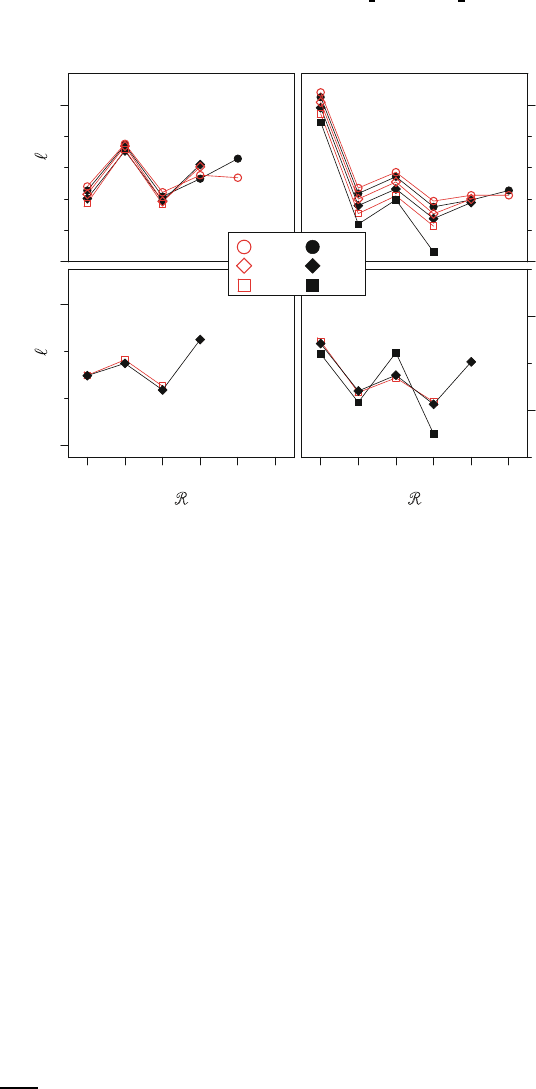
Uncorrected Proof
BookID 160928 ChapID 16 Proof# 1 - 29/07/09
16.9 Pseudopotentials 503
0.10
0.15
V (e
2
/ )
0
V (e
2
/ )
0
0.00
0.05
(a) QE's in ν=1/3 (b) QH's in ν=1/3
0.01
0.04
1357911 1357911
0.00
0.02
(c) QE's in ν=1/5 QH's in ν=1/5)d(
N=11 N=10
N= 9
N= 7 N= 6
N= 8
Fig. 16.5. Pseudopotentials V (R) of a pair of quasielectrons and quasiholes in
Laughlin ν =1/3andν =1/5 states, as a function of relative pair angular momen-
tum R. Different symbols denote data obtained in the diagonalization of between
six and eleven electrons
only in the behavior of V
QP−QP
as a function of R. Once the quasiparticle– 596
quasiparticle pseudopotentials and the bare quasiparticle energies are known, 597
one can evaluate the energies of states containing three or more quasiparti- 598
cles. Figure 16.6 illustrates typical energy spectra of three quasiparticles in the 599
Laughlin incompressible ground states. The spectrum in frame (a) shows the 600
energy spectrum of three quasielectrons in the Laughlin ν =1/3 state of eleven 601
electrons. In frame (b) we show the energy spectrum of three quasiholes in 602
the nine electron system at the same filling. The results from exact numerical 603
diagonalization of the eleven and nine electron systems are represented by the 604
crosses and the Fermi liquid results are indicated by solid circles. The exact 605
energies above the dashed lines correspond to higher energy states containing 606
additional quasielectron–quasihole pairs. It should be noted that in the mean 607
field composite fermion model, which neglects the quasiparticle–quasiparticle 608
interactions, all of the three quasiparticle states would be degenerate and 609
the energy gap separating the three quasiparticle states from higher energy 610
states would be equal to ¯hω
∗
c
=¯hω
c
/3. Although the fit is not perfect in 611
Fig. 16.6, the agreement is quite good and it justifies the use of the Fermi liq- 612
uid picture to describe non-Laughlin type compressible states at filling factor 613
ν =
1
2p+1
. 614
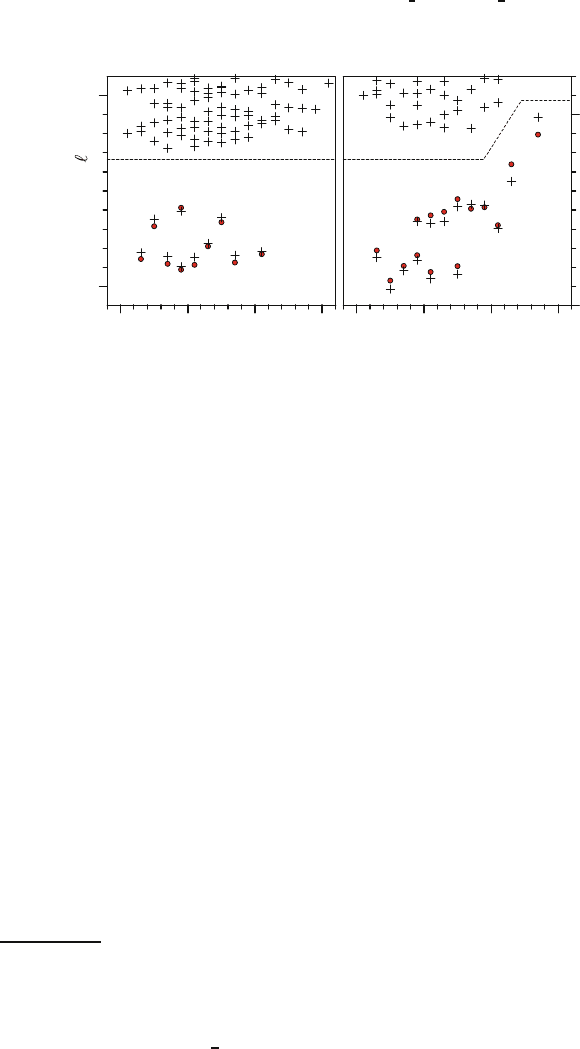
Uncorrected Proof
BookID 160928 ChapID 16 Proof# 1 - 29/07/09
504 16 The Fractional Quantum Hall Effect
0.15
0.25
E
−
E
1/3
0.0
0.1
ν=1/3+3QH
(a) N=11,2Q=27 (b) N=9,2Q=27
0 5 10 15
L
0 5 10 15
L
ν=1/3+3QE
(e
2
/)
0
Fig. 16.6. The energy spectra of three quasielectrons (a) and three quasiholes (b)
in the Laughlin ν =1/3 state. The solid circles denote the Fermi liquid calcula-
tion using pseudopotentials illustrated in Figs. 16.5a and b. The crosses correspond
to exact spectra obtained in full diagonalization of the Coulomb interaction for
electrons of N =11(a)andN =9(b)at2Q =27
16.10 Angular Momentum Eigenstates 615
We have already seen that a spin polarized shell containing N fermions each 616
with angular momentum l can be described by eigenfunctions of the total 617
angular momentum
ˆ
L =
i
ˆ
l
i
and its z-component M =
i
m
i
. We define 618
f
L
(N,l) as the number of multiplets of total angular momentum L that can 619
be formed from N fermions each with angular momentum l. We usually label 620
these multiplets as |l
N
; Lα, where it is understood that each multiplet con- 621
tains 2L + 1 states having −L ≤ M ≤ L,andα is the label that distinguishes 622
different multiplets with the same value of L. We define
ˆ
L
ij
=
ˆ
l
i
+
ˆ
l
j
,the 623
angular momentum of the pair i, j each with angular momentum l. 624
We can write
12
625
|l
N
; Lα =
L
α
L
12
G
Lα,L
α
(L
12
)|l
2
,L
12
; l
N−2
,L
α
; L, (16.32)
where |l
N−2
,L
α
is the α
multiplet of total angular momentum L
of N −2 626
fermions each with angular momentum l.From|l
N−2
,L
α
and |l
2
,L
12
one 627
12
The following theorems are quite useful:
Theorem 1:
ˆ
L
2
+ N(N − 2)
ˆ
l
2
=
i,j
ˆ
L
2
ij
, where the sum is over all pairs.
Theorem 2: f
L
(N, l) ≥ f
L
(N,l
∗
), where l
∗
= l − (N − 1) and 2l ≥ N − 1.
Theorem 3: If b
L
(N,l)isthebosonequivalentoff
L
(N, l), then b
L
(N,l
B
)=
f
L
(N,l
F
), if l
B
= l
F
−
1
2
(N − 1).
The first theorem can be proven using the definitions of
ˆ
L
2
and
i,j
ˆ
L
2
ij
and
eliminating
ˆ
l
i
·
ˆ
l
j
from the pair of equations. The other two theorems are almost
obvious conjectures to a physicist, but there exist rigorous mathematical proofs
of their validity.

Uncorrected Proof
BookID 160928 ChapID 16 Proof# 1 - 29/07/09
16.10 Angular Momentum Eigenstates 505
can construct an eigenfunction of total angular momentum L. Here, we mean 628
that the angular momentum multiplet |l
N
; Lα obtained from N fermions, 629
each with angular momentum l, can be formed from |l
N−2
,L
α
and a 630
pair wavefunction |l
2
,L
12
by using G
Lα,L
α
(L
12
)thecoefficient of fractional 631
grandparentage.TheG
Lα,L
α
(L
12
) produces a totally antisymmetric eigen- 632
function |l
N
; Lα, even though |l
2
,L
12
; l
N−2
,L
α
; L is not antisymmetric 633
under exchange of particle 1 or 2 with any of the other particles. 634
Equation (16.32) is useful because of a very simple identity involving N 635
fermions: 636
ˆ
L
2
+ N (N − 2)
ˆ
l
2
−
i,j
ˆ
L
2
ij
=0, (16.33)
637
where
ˆ
L is the total angular momentum operator,
ˆ
L
ij
=
ˆ
l
i
+
ˆ
l
j
, and the sum 638
is over all pairs. Taking the expectation value of this identity in the state 639
|l
N
; Lα gives the following useful result: 640
L(L +1)+N(N − 2)l(l +1)=l
N
; Lα|
i,j
ˆ
L
2
ij
|l
N
; Lα. (16.34)
Because (16.32) expresses the totally antisymmetric eigenfunction |l
N
; Lα as 641
a linear combination of states of well defined pair angular momentum
ˆ
L
ij
,the 642
right hand side of Eq.(16.34) can be written as 643
1
2
N(N − 1)
α
P
Lα
(L
12
)L
12
(L
12
+1). (16.35)
In this expression P
Lα
(L
12
) is defined by 644
P
Lα
(L
12
)=
L
α
|G
Lα,L
α
(L
12
)|
2
, (16.36)
and is the probability that |l
N
; Lα contains pairs with pair angular momen- 645
tum L
12
. It is interesting to note that the expectation value of square of 646
the pair angular momentum summed over all pairs is totally independent 647
of the multiplet α. It depends only on the total angular momentum L. Because 648
the eigenfunctions |l
N
; Lα are orthonormal, one can show that 649
L
12
L
α
G
Lα,L
α
(L
12
)G
Lβ,L
α
(L
12
)=δ
αβ
. (16.37)
From (16.34)–(16.37) we have two useful sum rules involving P
Lα
(L
12
). They 650
are 651
L
12
P
Lα
(L
12
) = 1 (16.38)
652
Uncorrected Proof
BookID 160928 ChapID 16 Proof# 1 - 29/07/09
506 16 The Fractional Quantum Hall Effect
and 653
1
2
N(N −1)
L
12
L
12
(L
12
+1)P
Lα
(L
12
)=L(L+1)+N(N −2)l(l+1). (16.39)
654
The energy of the multiplet |l
N
; Lα is given by 655
E
α
(L)=
1
2
N(N − 1)
L
12
P
Lα
(L
12
)V (L
12
), (16.40)
656
where V (L
12
) is the pseudopotential describing the interaction energy of a 657
pair of fermions with pair angular momentum L
12
. 658
Equation (16.40) together with our sum rules, (16.38) and (16.39) on 659
P
Lα
(L
12
) gives the remarkable result that, for a harmonic pseudopotential 660
V
H
(L
12
), the energy E
α
(L) is totally independent of α and every multiplet 661
that has the same total angular momentum L has the same energy. This 662
proves that the harmonic pseudopotential introduces no correlations and the 663
degeneracy of multiplets of a given L remains under the interactions. Any 664
linear combination of the eigenstates of the total angular momentum having 665
the same eigenvalue L is an eigenstate of the harmonic pseudopotential. Only 666
the anharmonic part of the pseudopotential ΔV (R)=V (R) − V
H
(R)causes 667
correlations. 668
16.11 Correlations in Quantum Hall States 669
Since the harmonic pseudopotential introduces no correlations, only the 670
anharmonic part of the pseudopotential ΔV (R)=V (R) − V
H
(R) lifts the 671
degeneracy of the multiplets with a given L. The simplest anharmonic pseu- 672
dopotential is the case in which ΔV (R)=Uδ
R,1
.IfU is positive, the lowest 673
energy multiplet for each value of L is the one with the minimum value of 674
the probability P
L
(R = 1) for pairs with R = 1. That is, the state of the 675
lowest energy will tend to avoid pair states with R = 1 to the maximum 676
possible extent.
13
This is exactly what we mean by Laughlin correlations. 677
In fact, if U →∞, the only states with finite energy are those for which 678
P
L
(R = 1), the probability for pairs with R = 1, vanishes. This cannot occur 679
for 2Q<3(N −1), the value of 2Q at which the Laughlin L = 0 incompressible 680
quantum liquid state occurs. If U is negative, the lowest energy state will have 681
a maximum value of P
L
(R = 1). This would certainly lead to the formation 682
of clusters. However, this simple pseudopotential appears to be unrealistic, 683
with nothing to prevent compact droplet formation and charge separation. 684
13
Avoiding R = 1 is equivalent to avoiding pair states with m = 1 in the planar
geometry.