
Quinn J.J., Yi K.-S. Solid State Physics: Principles and Modern Applications
Подождите немного. Документ загружается.

Uncorrected Proof
BookID 160928 ChapID 15 Proof# 1 - 29/07/09
476 15 Superconductivity
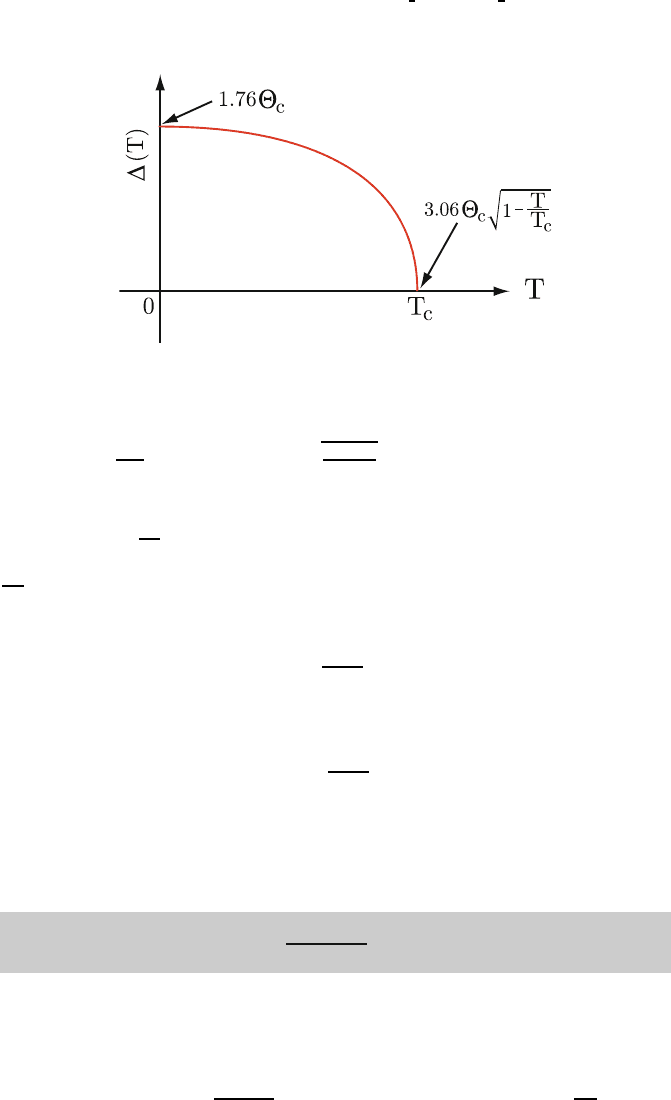
Fig. 15.12. Temperature dependence of the superconducting energy gap parameter
Δ(T ) in the weak coupling limit
the ratio of
¯hv
F
πΔ
( ξ
0
)toΛ
L
=
2
mc
2
4πn
S
e
2
, the London penetration depth, 365
is large or small compared to unity. For example, we have v
F
10
8
cm/s 366
and T
c
≈ 0.57Δ
0
1.2K for Al, and thus ξ
0
3.4 × 10
3
nm and Λ
L
367
30nm resulting
ξ
0
Λ
L
∼ 100. But, for the case of Nb
3
Sn we have v
F
10
6
cm/s 368
and T
c
≈ 0.57Δ
0
20K, and thus ξ
0
2nm and Λ
L
200 nm resulting 369
ξ
0
Λ
L
∼ 10
−2
. 370
The London equation, (15.4), is written as 371
∇×j +
n
S
e
2
mc
B =0. (15.89)
Using B = ∇×A allows us to write
372
j(r)=−
n
S
e
2
mc
A(r). (15.90)
This local relation between j and A is valid only for type II materials where
373
Λ
L
is much larger than ξ
0
and A(r) varies slowly on the scale of ξ
0
.Fortype 374
I materials, Pippard suggested a nonlocal relation between j and A. Pippard 375
equation is written as 376
j(r)=C
A(r
) · R
R
4
Re
−|R|/ξ
0
d
3
r
, (15.91)
377
where R = r−r
. C is determined by requiring that slowly varying A(r) yields 378
the London equation. Then A(r) comes outside the integral (and taking A ˆz) 379
and Eq.(15.91) reduces to 380
j
z
(r)=CA(r)
∞
0
1
−1
R cos θ
R
4
R cos θe
−R/ξ
0
2πd(cos θ)R
2
dR = C
4π
3
ξ
0
A(r).
(15.92)
Uncorrected Proof
BookID 160928 ChapID 15 Proof# 1 - 29/07/09
15.6 Type I and Type II Superconductors 477
We note that, by comparing (15.90) and (15.92), C = −
n
S
e
2
mc
3
4πξ
0
, and picking 381
ξ
0
=
¯hv
F
πΔ
0
(at T = 0) gives excellent agreement with the microscopic theory. 382
For the case Λ
eff
ξ
0
, the vector potential A(r) is finite only in a surface 383
layer and we can write 384
j(r)=−
n
S
e
2
mc
Λ
eff
ξ
0
A(r) (15.93)
leading us to Λ
eff
≈ Λ
L
(
ξ
0
Λ
L
)
1/3
. 385
Flux Penetration 386
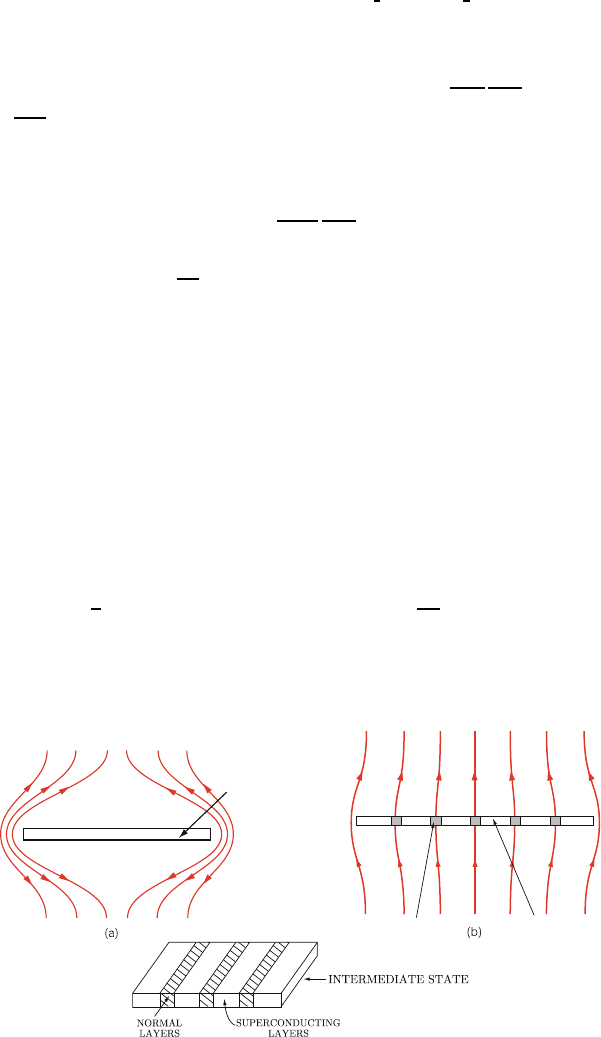
When a disc shaped type I superconductor is aligned perpendicular to an 387
applied magnetic field H
0
, the magnetic field at the boundary of the sample 388
(where the applied field is partially excluded) would become much greater 389
than the magnitude of H
0
(see Fig. 15.13). Then the sample starts to loose 390
superconductivity at an applied field much below the critical field H
c
forming 391
a large number of normal and superconducting regions side by side, and the 392
magnetic field energy gain is reduced significantly. The specimen is known 393
to be in the intermediate state. It is a mixture of normal and superconduct- 394
ing regions due to geometric factors. The intermediate state has a domain 395
structure that depends on competition between (1) superconducting conden- 396
sation energy
1
4
g(E
f
)Δ
2
, (2) magnetic field energy
H
2
8π
, iii) surface energy of 397
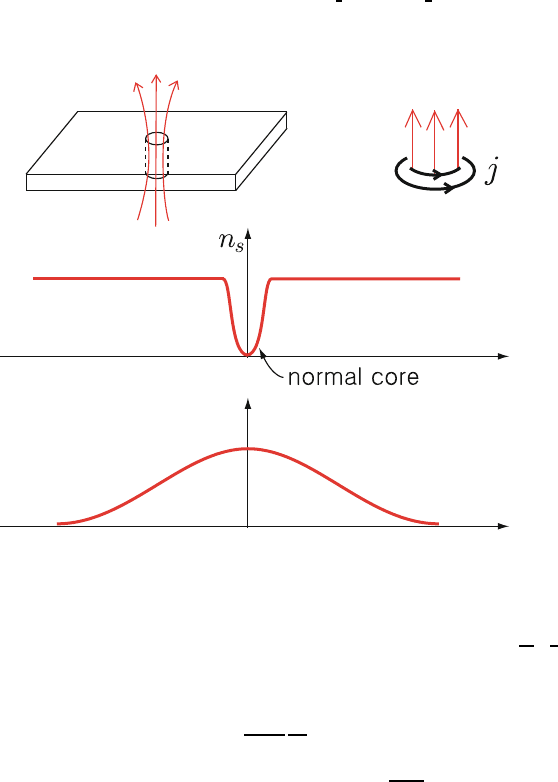
N-S boundary (positive for type I material). In type II materials the surface 398
energy turns out to be negative, and flux penetrates in single vortices each 399
carrying one flux quantum (see Fig. 15.14). In alloys, if impurity scattering 400
type I
Superconductor
Superconducting
layer
Normal
layer
Fig. 15.13. Schematics of the intermediate state in a planar type I superconductor.
It occurs when a planar sample is held perpendicular to an applied magnetic field as
indicatedin(a). Domain structure of normal and superconducting regions is formed
as sketched in (b)and(c) by the magnified magnetic field due to geometric factors
Uncorrected Proof
BookID 160928 ChapID 15 Proof# 1 - 29/07/09
478 15 Superconductivity
r
H
r
Fig. 15.14. Schematic representation of flux and field penetration in a type II
superconductor
leads mean free path l, the Pippard relation replaces e
−R/ξ
0
by e
−R(
1
ξ
0
+
1
l
)
.In 401
the extreme dirty limit of ξ
0
l, relation between j(r)andA(r) becomes 402
j(r)=−
n
S
e
2
mc
l
ξ
0
A(r),
and the corresponding penetration depth Λ
eff
=Λ
L
ξ
0
/l is increased greatly. 403
Uncorrected Proof
BookID 160928 ChapID 15 Proof# 1 - 29/07/09
15.6 Type I and Type II Superconductors 479
Problems 404
15.1. Demonstrate that the electronic contribution to the heat capacity of 405
common intrinsic semiconductors shows the exponential temperature behavior 406
at low temperatures. 407
15.2. Let’s consider the equation of motion of a super fluid electron, which 408
is dissipationless, in an electric field E that is momentarily present in the 409
superconductor. That is, m
dv
S
dt
= −eE,wherev
S
is the mean velocity of the 410
super fluid electron caused by the field E. In order to explain the Meissner 411
effect, London proposed the London equation written as ∇×j +
n
S
e
2
mc
B =0. 412
Show that ∇
2
˙
j =
1
Λ
2
j where Λ
L
=
2
mc
2
4πn
S
e
2
is the so-called the London 413
penetration depth. 414
15.3. Assume c
kσ
and c
†
k
σ
satisfy standard Fermion anticommutation rela- 415
tions. Show that
α
k
,α
†
k
+
and
β
k
,β
†
k
+
each equal δ
kk
for α
k
and β
k
416
defined by the Bogoliubov–Valatin transformation 417
α
k
= u
k
c
k↑
− v
k
c
†
−k↓
β
†
k
= u
k
c
†
−k↓
+ v
k
c
k↑
.
15.4. Let us consider the interaction Hamiltonian H
1
given by 418
H
1
= −V
kk
c
†
k
↑
c
†
−k
↓
c
−k↓
c
k↑
.
Use the Bogoliubov–Valatin transformation to show that H
1
can be written 419
as 420
H
1
= −V
kk
(u
k
α
†
k
+ v
k
β
k
)(u
k
β
†
k
− v
k
α
k
)(u
k
β
k
− v
k
α
†
k
)(u
k
α
k
+ v
k
β
†
k
)
= −V
kk
u
k
v
k
u
k
v
k
(1 − α
†
k
α
k
− β
†
k
β
k
)(1 − α
†
k
α
k
− β
†
k
β
k
)
+ u
k
v
k
(1 − α
†
k
α
k
− β
†
k
β
k
)(u
2
k
− v
2
k
)(α
†
k
β
†
k
+ β
k
α
k
)
+4
th
order off-diagonal terms
.
421
15.5. Consider the condition given by 422
2u
k
v
k
˜ε
k
=(u
2
k
− v
2
k
)V
k
u
k
v
k
.
(a) Determine u
k
and v
k
satisfying the condition given above. Note that 423
u
2
k
+ v
2
k
=1. 424
(b) Obtain the expression Δ defined by Δ = V
k
u
k
v
k
. 425

Uncorrected Proof
BookID 160928 ChapID 15 Proof# 1 - 29/07/09
480 15 Superconductivity
Summary 426
In this chapter, we first briefly review some phenomenological observations of 427
superconductivity and discuss a phenomenological theory by London. Then we 428
introduce ideas of electron–phonon interaction and Cooper pairing to discuss 429
microscopic theory by Bardeen, Cooper, and Schrieffer. The BCS ground state 430
and excited states are discussed through Bogoliubov–Valatin transformation, 431
and condensation energy and thermodynamic behavior of the superconduct- 432
ing energy gap are analyzed. Finally type I and type II superconductors are 433
compared in terms of coherence length and London penetration depth. 434
The Meissner effect indicates that any magnetic field that is present in a 435
bulk superconductor when T>T
c
is expelled when T is lowered through the 436
transition temperature T
c
.Inatype I superconductor, the magnetic induction 437
B vanishes in the bulk of the superconductor for H<H
c
(T ). In a type 438
II superconductor, the magnetic field starts to penetrate the sample at an 439
applied field H
c1
lower than the H
c
. Between H
c2
and H
c1
flux penetrates the 440
superconductor giving a mixed state consisting of superconductor penetrated 441
by threads of the material in its normal state or flux lines. The mixed state 442
consists of vortices each carrying a single flux Φ =
hc
2e
. 443
The London equation is written as ∇×j +
n
S
e
2
mc
B =0, which implies that, 444
in stationary conditions, a superconductor cannot sustain a magnetic field in 445
its interior, but only within a narrow surface layer: ∇
2
B =
4πn
S
e
2
mc
2
B ≡
1
Λ
2
L
B. 446
Here, the quantity Λ
L
=
2
mc
2
4πn
S
e
2
is called the London penetration depth. 447
The Hamiltonian of the electrons in a metal is written as 448
H =
kσ
ε
kσ
c
†
kσ
c
kσ
+
kσ,k
σ
,q
W (k, q)c
†
k+qσ
c
†
k
−qσ
c
k
σ
c
kσ
,
where W
kq
is defined by W
kq
=
|M
q
|
2
¯hω
q
[ε(k+q)−ε(k)]
2
−(¯hω
q
)
2
. Here, M
q
is the 449
electron–phonon matrix element. 450
A pair of electrons interacting in the presence of a Fermi sea of “spectator 451
electrons” is described by H =
,σ
ε
c
†
σ
c
σ
−
1
2
V
σ
c
†
σ
c
†
−
¯σ
c
−¯σ
c
σ
, 452
where ε
=
¯h
2
2
2m
and the strength of the interaction, V , is taken as a constant 453
for a small region of k-space close to the Fermi surface. A variational trial 454
function Ψ =
k
a
k
c
†
kσ
c
†
−k¯σ
| G>gives us
1
V
=
k
1
2ε
k
−E
. Here, | G is the 455
Fermi sea of spectator electrons, | G = Π
k<k
F
|k|
c
†
kσ
c
†
−k¯σ
| 0. Approximating 456
the sum by an integral over the energy ε,wehaveE 2E
F
− 2¯hω
D
e
−2/gV
. 457
The quantity 2¯hω
D
e
−2/gV
is the binding energy of the Cooper pair. 458
In the BCS theory, H is rewritten as H = H
0
+ H
1
, where 459
H
0
=
k
ε
k
c
†
k↑
c
k↑
+ c
†
−k↓
c
−k↓
and H
1
= −V
kk
c
†
k
↑
c
†
−k
↓
c
−k↓
c
k↑
.
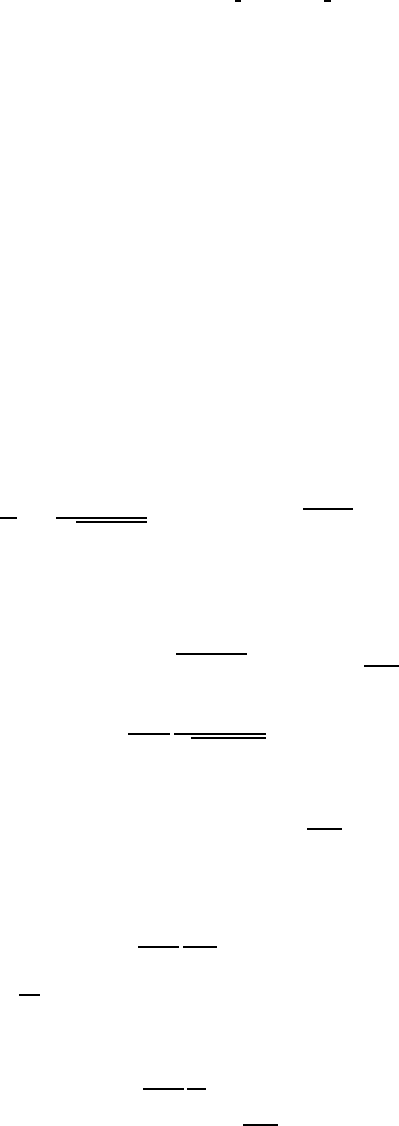
Uncorrected Proof
BookID 160928 ChapID 15 Proof# 1 - 29/07/09
15.6 Type I and Type II Superconductors 481
Introducing α
†
kσ
= u
k
c
†
kσ
+ v
−k
c
−k¯σ
and α
kσ
= u
k
c
kσ
+ v
−k
c
†
−k¯σ
the nonin- 460
teracting Hamiltonian becomes H
0
= E
0
+
k,σ
| ˜ε
k
| α
†
kσ
α
kσ
. The ground 461
state of the noninteracting electron gas (filled Fermi sphere) is given by 462
| GS =
;
kσ
α
kσ
α
−k¯σ
| VAC , where | VAC is the true vacuum state. 463
The Bogoliubov–Valatin transformation defined by 464
α
k
= u
k
c
k↑
− v
k
c
†
−k↓
; β
†
k
= u
k
c
†
−k↓
+ v
k
c
k↑
α
†
k
= u
k
c
†
k↑
+ v
k
c
−k
¯
↓
; β
k
= u
k
c
−k↓
+ v
k
c
†
k↑
gives 465
H = H(0) + H(2) + H(4),
where
466
H(0) = 2
k
ε
k
v
2
k
− V
kk
u
k
v
k
u
k
v
k
; H(2) =
k
E
k
(α
†
k
α
k
+ β
†
k
β
k
).
Here E
k
=˜ε
k
(u
2
k
−v
2
k
)+2Δu
k
v
k
and H(4) contains interactions between the 467
elementary excitations. The equation for the energy gap Δ is given by 468
1=
V
2
k
1
˜ε
2
k
+Δ
2
and Δ = 2¯hω
q
e
−
2
g(E
F
)V
.
The ground-state wave function Ψ
0
of the superconducting system is 469
| Ψ
0
=
k
(u
k
+ v
k
c
†
k
c
†
−k
) | VAC.
The energy of a quasiparticle is E
k
=
˜ε
2
k
+Δ
2
, where ˜ε
k
=
¯h
2
k
2
2m
−E
F
.The 470
density of quasiparticle states in the superconductor is given by 471
g
S
(E)=
mk
F
π
2
¯h
2
E
√
E
2
− Δ
2
.
The type I and type II superconductors are distinguished by whether the
472
ratio of the coherence length ξ
0
to the London penetration depth Λ
L
is large 473
or small compared to unity. The local relation j(r)=−
n
S
e
2
mc
A(r) is valid only 474
for type II materials where Λ
L
ξ
0
and A(r) varies slowly on the scale of 475
ξ
0
. For the case Λ
eff
ξ
0
, the vector potential A(r) is finite only in a surface 476
layer and we have 477
j(r)=−
n
S
e
2
mc
Λ
eff
ξ
0
A(r)
leading to Λ
eff
≈ Λ
L
(
ξ
0
Λ
L
)
1/3
. The intermediate state is a mixture of normal 478
and superconducting regions due to geometric factors and it has a domain 479
structure. In the extreme dirty limit of ξ
0
l,wehave 480
j(r)=−
n
S
e
2
mc
l
ξ
0
A(r),
and the effective penetration depth Λ
eff
=Λ
L
ξ
0
/l is increased greatly. 481

Uncorrected Proof
BookID 160928 ChapID 16 Proof# 1 - 29/07/09
16 1
The Fractional Quantum Hall Effect: The 2
Paradigm for Strongly Interacting Systems 3
16.1 Electrons Confined to a Two-Dimensional Surface 4
in a Perpendicular Magnetic Field 5
The study of the electronic properties of quasi two-dimensional systems has 6
been a very exciting area of condensed matter physics during the last quarter 7
of the twentieth century. Among the most interesting discoveries in this area 8
are the incompressible states showing integral and fractional quantum Hall 9
effects. Incompressible quantum liquid states of the integral quantum Hall 10
effect result from an energy gap in the single particle spectrum. The incom- 11
pressibility of the fractional quantum Hall effect is completely the result of 12
electron–electron interactions in a highly degenerate fractionally filled Landau 13
level. Since the quantum Hall effect involves electrons moving on a two- 14
dimensional surface in the presence of a perpendicular magnetic field, we 15
begin with a description of this problem. 16
The application of a large dc magnetic field perpendicular to the two- 17
dimensional layer results in some notable novel physics. The Hamiltonian 18
describing the motion of a single electron (of mass μ) confined to the x–y 19
plane, in the presence of a dc magnetic field B = Bˆz,issimply 20
H =(2μ)
−1
p +
e
c
A(r)
2
. (16.1)
The vector potential A(r)isgivenbyA(r)=
1
2
B(−yˆx + xˆy)inasymmet- 21
ric gauge. We use ˆx,ˆy,andˆz as unit vectors along the Cartesian axes. The 22
Schr¨odinger equation (H − E)Ψ(r) = 0 has eigenstates
1
23
Ψ
nm
(r, φ)=e
imφ
u
nm
(r), (16.2)
E
nm
=
1
2
¯hω
c
(2n +1+m + |m|), (16.3)
24
1
See, for example, L.D. Landau, E.M. Lifshitz, Q uantum Mechanics (Pergamon,
Oxford, 1977), p. 458; S. Gasiorowicz Quantum Mechanics (Wiley, New York,
1996), ch. 13.
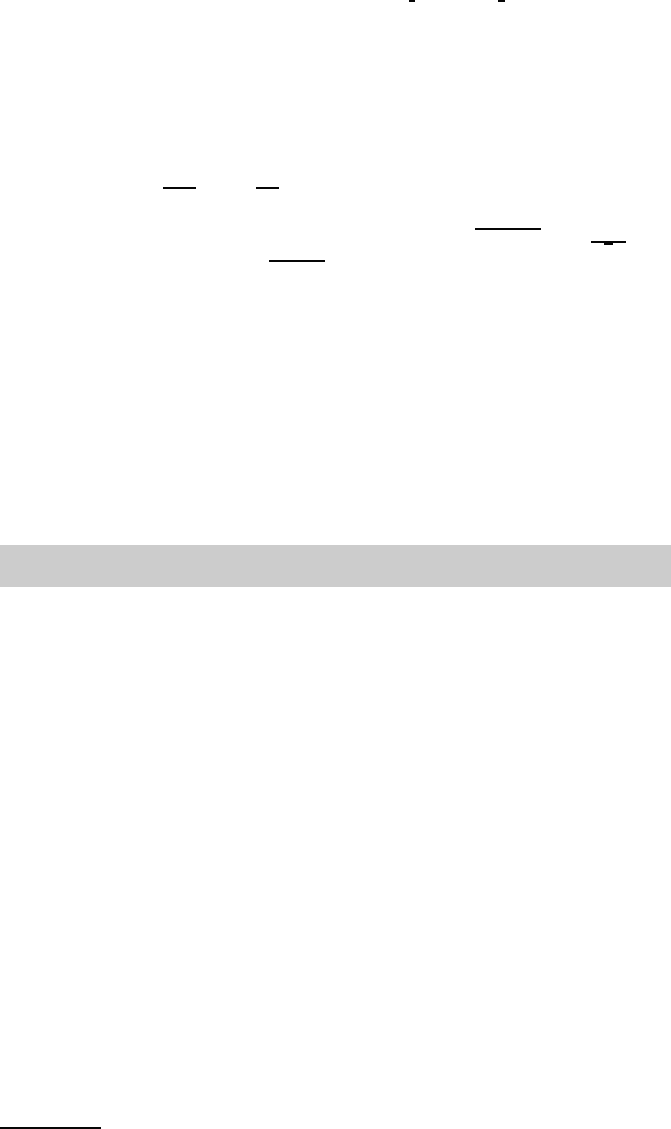
Uncorrected Proof
BookID 160928 ChapID 16 Proof# 1 - 29/07/09
484 16 The Fractional Quantum Hall Effect
where n and m are principal and angular momentum quantum numbers, 25
respectively, and ω
c
(= eB/μc) is the cyclotron angular frequency. The radial 26
function u(r) in (16.2) satisfies the differential equation 27
d
2
u
dη
2
+ η
−1
du
dη
− (m
2
η
−1
+ η
2
− )u =0, (16.4)
where η and are, respectively, defined by η =
eB/2¯hcr =
r
√
2l
0
and 28
=4E/¯hω
c
−2m. Here, l
0
=
¯hc/eB is the magnetic length. The radial wave- 29
functions u
nm
(r) can be expressed in terms of associated Laguerre polynomials 30
L
m
n
as 31
u
nm
(η)=η
|m|
e
−η
2
/2
L
|m|
n
(η
2
). (16.5)
Here, L
|m|
0
(η
2
) is independent of η and L
|m|
1
(η
2
) ∝ (|m|+1− η
2
). The lowest 32
energy level has n =0andm =0, −1, −2,.... The first excited level has n =1 33
and m =0, −1, −2,...,orn =0andm = 1, etc. These highly degenerate 34
levels are separated from neighboring levels by ¯hω
c
. These quantized energy 35
levels are called Landau levels; the lowest Landau level wavefunction can be 36
written as 37
Ψ
0m
= N
m
z
|m|
e
−|z|
2
/4l
0
2
, (16.6)
38
where N
m
is the normalization constant and z stands for z(=x −iy)=re
−iφ
. 39
The maximum value of |Ψ
0m
(z)|
2
occurs at r
m
∝ m
1/2
. 40
For a finite size sample of area S = πR
2
, the number of single particle 41
states in the lowest Landau level is given by N
φ
= BS/φ
0
,whereφ
0
= 42
hc/e is the quantum of magnetic flux. The filling factor ν of a given Landau 43
level is defined by N/N
φ
,sothatν
−1
is simply equal to the number of flux 44
quanta of the dc magnetic field per electron. For a sample of radius R,the 45
number of allowed values of |m| is simply N
φ
. For the lowest Landau level, 46
degeneracy of the level is N
φ
because the allowed values of |m| are given by 47
|m| =0, 1, 2,...,N
φ
− 1. 48
16.2 Integral Quantum Hall Effect 49
The integral quantum Hall effect occurs when N electrons exactly fill an inte- 50
gral number of Landau levels resulting in an integral value of the filling factor 51
ν.Whenν is equal to an integer, there is an energy gap (equal to ¯hω
c
) between 52
the filled states and the empty states. This makes the noninteracting electron 53
system incompressible, because an infinitesimal decrease in the area A,which 54
decreases N
φ
, requires a finite energy ¯hω
c
to promote an electron across the 55
energy gap into the first unoccupied Landau level. This incompressibility is 56
responsible for the integral quantum Hall effect.
2
To understand the minima 57
2
K.vonKlitzing,G.Dorda,M.Pepper,Phys.Rev.Lett.45, 494 (1980).

Uncorrected Proof
BookID 160928 ChapID 16 Proof# 1 - 29/07/09
16.3 Fractional Quantum Hall Effect 485
in the diagonal resistivity ρ
xx
and the plateaus in the Hall resistivity ρ
xy
,it 58
is necessary to notice that each Landau level, broadened by collisions with 59
defects and phonons, must contain both extended states and localized states. 60
The extended states lie in the central portion of the broadened Landau level, 61
and the localized states in the wings. As the chemical potential ζ sweeps 62
through the Landau level (by varying either B or the particle number N), 63
zeros of ρ
xx
(at T = 0K) and flat plateaus of ρ
xy
occur when ζ lies within the 64
localized states. 65
A many particle wavefunction of N electrons at filling factor ν =1can 66
be constructed by antisymmetrizing the product function which places one 67
electron in each of the N states with 0 ≤|m|≤N
φ
− 1. Here, the product 68
function should be antisymmetric under exchange of any two electrons, and 69
the many particle wavefunction is written, for ν =1,as 70
Ψ
1
(z
1
,...,z
N
)=A{u
0
(z
1
)u
1
(z
2
) ···u
N−1
(z
N
)} (16.7)
where A denotes the antisymmetrizing operator. Since u
|m|
(z) ∝ z
|m|
e
−|z
2
|/4l
2
0
, 71
as given by (16.6), (16.7) can be written out as follows: 72
Ψ
1
(z
1
,...,z
N
) ∝
11... 1
z
1
z
2
... z
N
z
2
1
z
2
2
... z
2
N
.
.
.
.
.
. ...
.
.
.
z
N−1
1
z
N−1
2
... z
N−1
N
e
−
1
4l
2
0
i=1,N
|z
i
|
2
. (16.8)
73
The determinant in (16.8) is the well-known Van der Monde determinant writ- 74
ten, simply, as Π
N ≥i>j≥1
(z
i
−z
j
). This is easily demonstrated by subtracting 75
column j from column i and noting z
ij
= z
i
−z
j
is a common factor. Since it is 76
true for every i = j, the result is apparent. Then the N-particle wavefunction 77
corresponding to a filled Landau level becomes 78
Ψ
1
(z
1
,...,z
N
) ∝ Π
N ≥i>j≥1
z
ij
e
−
1
4l
2
0
k=1,N
|z
k
|
2
. (16.9)
In (16.9), the highest power of z
j
is N −1. This means that the allowed values 79
of |m| are equal to 0, 1, 2,...,N − 1 or that the Landau level degeneracy is 80
given by N
φ
= N and hence ν = N/N
φ
= 1. We could obtain (16.9) by 81
the requirement of antisymmetry imposed on the product of single particle 82
eigenfunctions. 83
16.3 Fractional Quantum Hall Effect 84
When the filling factor ν is smaller than unity, the standard approach of 85
placing N particles in the lowest energy single particle states is not applica- 86
ble, because more degenerate states than the number of particles are present 87

Uncorrected Proof
BookID 160928 ChapID 16 Proof# 1 - 29/07/09
486 16 The Fractional Quantum Hall Effect
in the lowest Landau level. For example, for the case of ν =1/3, it is not 88
apparent how to construct antisymmetric product function for N electrons 89
in 3N states to describe fractional quantum Hall states. In this case, no gap 90
occurs in the absence of electron–electron interaction, and it is not easy to 91
understand why fractional quantum Hall states are incompressible. At very 92
high values of the applied magnetic field, there is only one relevant energy 93
scale in the problem, the Coulomb scale e
2
/
0
. In that case, standard many 94
body perturbation theory is not applicable. Laughlin used remarkable physi- 95
cal insight to propose a ground state wavefunction, for filling factor ν =1/n,
3
96
Ψ
1/n
(1, 2, ···,N)=
i>j
z
n
ij
e
−
l
|z
l
|
2
/4l
2
0
, (16.10)
97
where n is an odd integer. 98
The Laughlin wavefunction has the properties that (1) it is antisymmetric 99
under interchange of any pair of particles as long as n is odd, (2) particles stay 100
farther apart and have lower Coulomb repulsion for n>1, and (3) because the 101
wavefunction contains terms with z
m
i
for 0 ≤ m ≤ n(N −1), N
φ
−1, the largest 102
value of m in the Landau level, is equal to n(N −1) giving ν = N/N
φ
−→ 1/n 103
for large systems in agreement with experiment.
4
104
16.4 Numerical Studies 105
Remarkable confirmation of Laughlin’s hypothesis was obtained by exact diag- 106
onalization carried out for relatively small systems. Exact diagonalization of 107
the interaction Hamiltonian within the Hilbert subspace of the lowest Landau 108
level is a very good approximation at large values of B,where¯hω
c
e
2
/l
0
. 109
Although real experiments are performed on a two-dimensional plane, it is 110
more convenient to use a spherical two dimensional surface for numerical diag- 111
onalization studies. Haldane introduced the idea of putting a small number of 112
electrons on a spherical surface at the center of which is located a magnetic 113
monopole. We consider the case that the N electrons are confined to a Hal- 114
dane surface of radius R. At the center of the sphere, a magnetic monopole of 115
strength 2Qφ
0
,where2Q is an integer, is located, as illustrated in Fig. 16.1. 116
The radial magnetic field is written as 117
B =
2Qφ
0
4πR
2
ˆ
R, (16.11)
where
ˆ
R is a unit vector in the radial direction. The single particle Hamilto-
118
nian can be expressed as 119
H
0
=
1
2mR
2
l − ¯hQ
ˆ
R
2
. (16.12)
120
3
R.B.Laughlin, Phys. Rev. Lett. 50, 1395 (1983)
4
D.C. Tsui, H.L. Stormer, and A.C. Gossard, Phys. Rev. Lett. 48, 1559 (1982).