
Quinn J.J., Yi K.-S. Solid State Physics: Principles and Modern Applications
Подождите немного. Документ загружается.

Uncorrected Proof
BookID 160928 ChapID 16 Proof# 1 - 29/07/09
16.4 Numerical Studies 487
0
2Qφ
R
ˆ
rrR=
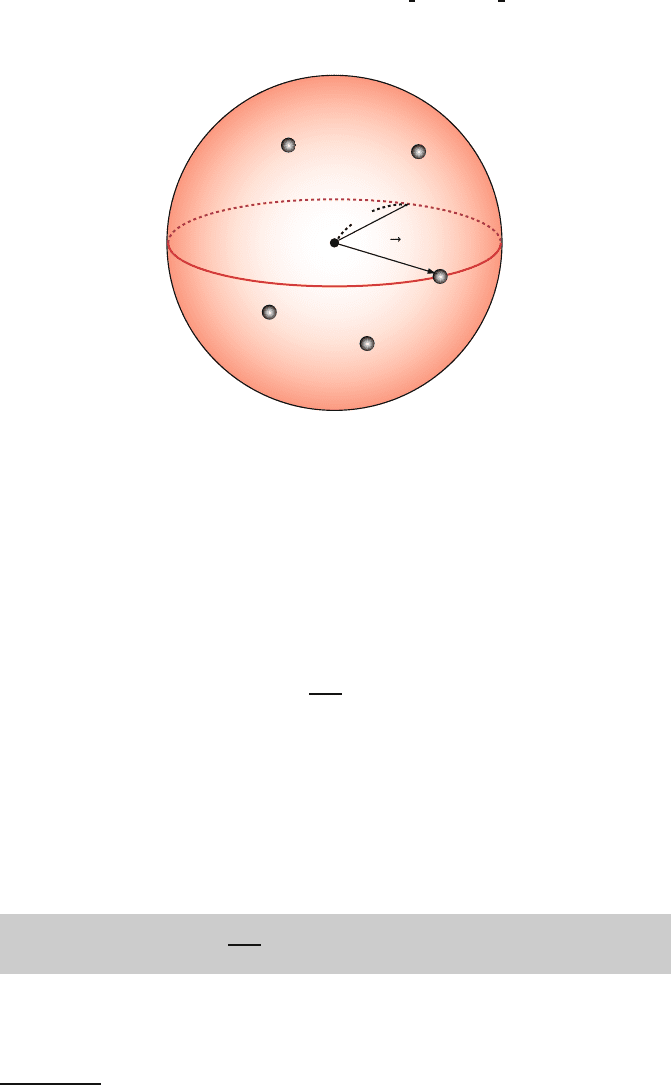
Fig. 16.1. Haldane sphere of radius R with magnetic monopoles of strength 2Q
located at the center of the sphere
Here, l is the orbital angular momentum operator. The components of l satisfy 121
the usual commutation rules [l
α
,l
β
]=i¯h
αβγ
l
γ
, where the eigenvalues of l
2
122
and l
z
are, respectively, ¯h
2
l(l +1) and¯hm.
5
The single particle eigenstates 123
of (16.12) denoted by |Q, l, m are called monopole harmonics.Thestates124
|Q, l, m are eigenfunctions of l
2
and l
z
as well as of H
0
, the single particle 125
Hamiltonian, with eigenvalues 126
ε(Q, l, m)=
¯hω
c
2Q
[l(l +1)− Q
2
]. (16.13)
In writing (16.13), we noted that Λ·
ˆ
R =
ˆ
R·Λ = 0 and, hence, l·
ˆ
R =
ˆ
R·l =¯hQ.
127
Because this energy must be positive, the allowed values of l are given by 128
l
n
= Q + n,wheren =0,1,2,.... The lowest Landau level (or angular 129
momentum shell) occurs for l
0
= Q and has the energy ε
0
=¯hω
c
/2, which is 130
independent of m as long as m is a nonpositive integer. Therefore, the low- 131
est Landau level has (2Q + 1)-fold degeneracy. The nth excited Landau level 132
occurs for l
n
= Q + n with energy 133
ε
n
=
¯hω
c
2Q
[(Q + n)(Q + n +1)−Q
2
]. (16.14)
134
An N-particle eigenfunction of the lowest Landau level can be written, in 135
general, as 136
|m
1
,m
2
, ···,m
N
= c
†
m
N
···c
†
m
2
c
†
m
1
|0. (16.15)
5
We note that, in the presence of the magnetic field, the total angular momentum
is given by Λ = r ×[−i¯h∇+ eA(r)] and that the eigenvalues of Λ
2
are not equal
to l(l +1)¯h
2
. Here, A is the vector potential and [Λ
i
,
ˆ
R
j
]=i¯hε
ijk
ˆ
R
k
.

Uncorrected Proof
BookID 160928 ChapID 16 Proof# 1 - 29/07/09
488 16 The Fractional Quantum Hall Effect
Here, |m
i
|≤Q and c
†
m
i
creates an electron in state |l
0
,m
i
.Sinceweare 137
concentrating on a partially filled lowest Landau level we have only 2Q +1 138
degenerate single particle states. The number of possible way of constructing 139
N-electron antisymmetric states from 2Q+ 1 single particle states or choosing 140
N distinct values of m out of the 2Q + 1 allowed values is given by 141
G
NQ
=
2Q +1
N
=
(2Q +1)!
N!(2Q +1− N)!
. (16.16)
Then, there are G
NQ
N-electron states in the Hilbert subspace of the lowest 142
Landau level. For the Laughlin ν =1/m state, we have 2Q
ν=1/m
= m(N −1). 143
For example, for the case of 2Q =9andN =4(ν =1/3 state for 4 electrons 144
in the lowest Landau level of degeneracy 2Q + 1 = 10), we have l =4.5and 145
there are G
NQ
= 10!/[4!(10 − 4)! = 210 of four-electron states in the Hilbert 146
space of the lowest Landau level. 147
Table 16.1 lists the values of the electron angular momentum
e
,2Q +1 148
(the Landau level degeneracy), G
NQ
(the number of antisymmetric N-electron 149
states), L
MAX
(the largest possible angular momentum of the system), and 150
t1.1 Table 16.1. The angular momentum
e
of an electron in the lowest Landau level;
2Q+1 the Landau level degeneracy; G
NQ
the dimension of N-electron Hilbert space;
L
Max
the maximum value of the total angular momentum L; the allowed L-values for
a system consisting of N electrons on the surface of a Haldane sphere. The exponent
of the allowed L-values indicates the number of times an L-multiplet appears and
the number in parenthesis denotes the total number of L-multiplets
t1.2 N
e
2Q +1 G
NQ
L
Max
Allowed L-values
t1.3 3 3.0 7 35 6 6 ⊕ 4 ⊕ 3 ⊕ 2 ⊕ 0(5)
t1.4 4 4.5 10 210 12
12 ⊕ 10 ⊕ 9 ⊕ 8
2
⊕ 7 ⊕ 6
3
⊕
5 ⊕ 4
3
⊕ 3 ⊕ 2
2
⊕ 0
2
(18)
t1.5 5 6.0 13 1,287 20
20 ⊕ 18 ⊕ 17 ⊕ 16
2
⊕ 15
2
⊕ 14
3
⊕
13
3
⊕ 12
5
⊕ 11
4
⊕ 10
6
⊕ 9
5
⊕
8
7
⊕ 6
7
⊕ 5
5
⊕ 4
6
⊕ 3
3
⊕
2
4
⊕ 1 ⊕ 0
2
(73)
t1.6 6 7.5 16 8,008 30
30 ⊕ 28 ⊕···
(338)
t1.7 7 9.0 19 50,382 42
42 ⊕ 40 ⊕···
(1, 656)
t1.8 8 10.5 22 319,770 56
56 ⊕ 54 ⊕···
(8, 512)
t1.9 9 12.0 25 2,042,975 72
72 ⊕ 70 ⊕···
(45, 207)
t1.10 10 13.5 28 13,123,110 90
90 ⊕ 88 ⊕···
(246, 448)

Uncorrected Proof
BookID 160928 ChapID 16 Proof# 1 - 29/07/09
16.4 Numerical Studies 489
the allowed values of L (the total angular momentum) with a superscript 151
indicating how many times they appear. The number in parenthesis in the 152
allowed L-value column is the total number of different L-multiplets that 153
appear. For three electrons there are five such states, all with different L 154
values. For four electrons there are 18 states; L = 12, 10, 9, 7, 5, and 3 155
each appearing once, L = 8, 2, and 0 each appearing twice, and L =6156
and 4 each three times. For N =10andQ =13.5(ν =1/3 state of 10 157
electrons) G
NQ
=13, 123, 110 and there are 246,448 distinct L multiplets 158
with 0 ≤ L ≤ 90. 159
The numerical problem is to diagonalize the interaction Hamiltonian 160
H
int
=
i<j
V (|r
i
− r
j
|) (16.17)
in the G
NQ
dimensional space. The problem is facilitated by first determining 161
the eigenfunctions |LM α of the total angular momentum. Here,
ˆ
L =
i
ˆ
l
i
, 162
M =
i
m
i
,andα is an additional label that accounts for distinct multiplets 163
with the same total angular momentum L (for example, for the five electron 164
system the seven L = 6 states correspond to seven different values of α). The 165
210 four-electron states of four electrons give us 18 × 18 matrix that is block 166
diagonal with two 3 × 3blocks,three2× 2 blocks, and six 1 × 1blocks.For 167
small numbers of electrons these finite matrices can easily be diagonalized to 168
obtain the many-body eigenvalues and eigenfunctions.
6
169
In a plane geometry, the allowed values of m,thez-component of the sin- 170
gle particle angular momentum, are 0, 1, ···, N
φ
− 1. M =
i
m
i
is the 171
total z−component of angular momentum, where the sum is over all occu- 172
pied states. It can be divided into the center-of-mass (CM) and relative (R) 173
contributions M
CM
+ M
R
. The connection between the planar and spherical 174
geometries is as follows: 175
M = Nl + L
z
,M
R
= Nl − L, M
CM
= L + L
z
(16.18)
The interactions depend only on M
R
,so|M
R
,M
CM
acts just like |L, L
z
. 176
The absence of boundary conditions and the complete rotational symmetry 177
make the spherical geometry attractive to theorists. Many experimentalists 178
prefer using the |M
R
,M
CM
states of the planar geometry. The calculations 179
give the eigenenergies E as a function of the total angular momentum L. 180
6
Because H
int
is a scalar, the Wigner–Eckart theorem
L
M
α
|H
int
|LMα = δ
LL
δ
MM
L
α
|H
int
|Lα
tells us that matrix elements of H
int
are independent of M and vanish unless L
=
L. This reduces the size of the matrix to be diagonalized enormously. For example,
for N =10andQ =27/2(ν =1/3 state of ten electrons) G
NQ
=13, 123, 110
and there are 246,448 distinct L multiplets with 0 ≤ L ≤ 90. However, the largest
matrix diagonalized is only 7069 by 7069.
Uncorrected Proof
BookID 160928 ChapID 16 Proof# 1 - 29/07/09
490 16 The Fractional Quantum Hall Effect
2Q=27
E
Laughlin
ν=1/3 state
1QE+1QH
024681012
L
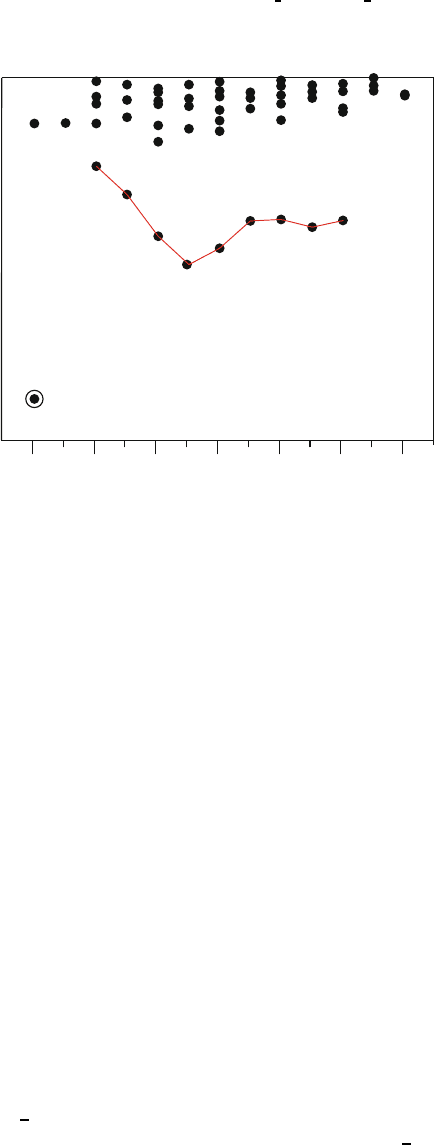
Fig. 16.2. The energy spectrum of 10 electrons in the lowest Landau level calculated
on a Haldane sphere with 2Q = 27. The open circle denotes the L = 0 ground state
The numerical results for the lowest Landau level always show one or more L 181
multiplets forming a low energy band. As an example, the numerical results 182
(E vs L) are shown in Figs. 16.2 and 16.3 for a system of 10 electrons with 183
values of 2Q between 25 and 29. It is clear that the states fall into a well 184
defined low energy sector and slightly less well defined excited sectors. The 185
Laughlin ν =1/3 state occurs at 2Q =3(N − 1) = 27 and the low energy 186
sector consists of a singlet L = 0 state as illustrated in Fig. 16.2. States with 187
larger values of Q contain one, two, or three quasiholes (2Q =28, 29, 30), and 188
states with smaller values of Q,suchas2Q = 25 or 26, contain quasielectrons 189
in the ground states. For 2Q = 26 the system is one single-particle state shy 190
of having the Laughlin ν =1/3 filling. In this case the low energy sector 191
corresponds to having a single Laughlin quasielectron of angular momentum 192
L =5. 193
16.5 Statistics of Identical Particles in Two Dimension 194
Let us consider a system consisting of two particles each of charge −e and mass 195
μ, confined to a plane, in the presence of a perpendicular dc magnetic field 196
B =(0, 0B)=∇×A(r). Since A(r) is linear in the coordinate r =(x, y), (for 197
example, A(r)=
1
2
B(−y, x) in a symmetric gauge), the Hamiltonian separates 198
into the center-of-mass and relative coordinate pieces R =
1
2
(r
1
+ r
2
)and 199
Uncorrected Proof
BookID 160928 ChapID 16 Proof# 1 - 29/07/09
16.5 Statistics of Identical Particles in Two Dimension 491
E
(c) 2Q=26
1QE
(a) 2Q=28
1QH
E
024681012
L
(d) 2Q=25
2QE
024681012
L
(b) 2Q=29
2QH
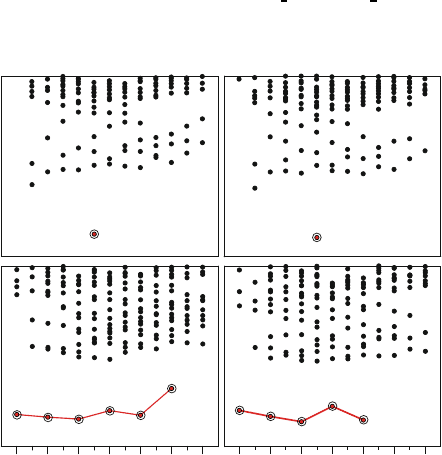
Fig. 16.3. The energy spectra of 10 electrons in the lowest Landau level calculated
on a Haldane sphere with 2Q =28, 29, 26, 25. The open circles and solid lines mark
the lowest energy bands with the fewest composite fermion quasiparticles of n
QH
=1
for 2Q =28in(a), n
QH
=2for2Q =29in(b), n
QE
=1for2Q =26in(c), and
n
QE
=2for2Q =25in(d)
r = r
2
− r
1
being the center-of-mass and relative coordinates, respectively. 200
The energy spectra for the center-of-mass and relative motion of the particles 201
are identical to that of a single particle of mass μ and charge −e.Wehave 202
seen that, as given by (16.6), for the lowest Landau level, the single particle 203
wavefunction is 204
Ψ
0m
(r
1
)=N
m
r
m
1
e
−imφ
e
−r
2
1
/4l
0
2
.
For the relative motion φ is equal to φ
1
−φ
2
, and the interchange of the pair, 205
denoted by P Ψ(r
1
, r
2
)=Ψ(r
2
, r
1
), is accomplished by replacing φ by φ + π. 206
For two identical particles initially at positions r
1
and r
2
in a three dimen- 207
sional space, the amplitude for the path that takes the system from the initial 208
state (r
1
, r
2
) to the same final state (r
1
, r
2
) depends on the angle of rotation 209
φ of the vector r
12
(=r
1
−r
2
). The end points represented by φ = π or 0 corre- 210
spond to exchange or non-exchange processes, and the angle φ is only defined 211
modulo 2π. The angle of rotation φ is not a well-defined quantity in three 212
dimension, but the statistics can not be arbitrary. Under the exchange of two 213
particles, the wavefunction picks up either a plus sign named bosonic statistics 214
or a minus sign named fermionic statistics with no other possibilities. Since 215
two consecutive interchanges must result in the original wavefunction, e
imπ
216
must be equal to either +1 (m is even; bosons) or −1(m is odd; fermions). 217

Uncorrected Proof
BookID 160928 ChapID 16 Proof# 1 - 29/07/09
492 16 The Fractional Quantum Hall Effect
In two dimensions the angle φ is perfectly well-defined for a given tra- 218
jectory. It is possible to keep track of how many times the angle φ winds 219
around the origin. Any two trajectories can not be deformed continuously 220
into one another since any two particles can not go through each other. The 221
space of particle trajectories falls into disconnected pieces that cannot be 222
deformed into one another if |r
ij
| is not allowed to vanish. Each piece has a 223
definite winding number. Therefore, it is not enough to specify the initial and 224
final configurations to characterize a given system completely. In constructing 225
path integrals, the weighting of trajectories can depend on a new parameter θ 226
(defined modulo 2π) through a factor e
iθφ/π
.Forθ =0orθ = π we have the 227
conventional boson or fermion statistics. For the most general case, we have 228
P
12
Ψ(1, 2) = e
iθ
Ψ(1, 2). (16.19)
229
For arbitrary values of θ the particles are called anyons and satisfy a new 230
form of quantum statistics.
7
231
Let us consider a simple Lagrangian describing the relative motion of two 232
interacting particles, the relative position and reduced mass of which are 233
denoted by r[= (r, φ)] and μ, respectively. A simple way to realize anyon 234
statistics is to add a term ¯hβ
˙
φ called Chern–Simons term to the Lagrangian, 235
where β(≡ θ/π)=qΦ/hc is the anyon parameter with 0 ≤ β ≤ 1. While q and 236
Φ are a fictitious charge and flux, θ is the numerical parameter of 0 ≤ θ ≤ 1. 237
For example, if 238
L =
1
2
μ(˙r
2
+ r
2
˙
φ
2
) − V (r)+¯hβ
˙
φ (16.20)
the added (fictitious charge–flux) Chern–Simons term does not affect the clas-
239
sical equations of motions because q and Φ are time independent. However, 240
the canonical angular momentum is given by p
φ
(=
∂L
∂
˙
φ
)=μr
2
˙
φ +¯hβ. Because
241
e
2πip
φ
/¯h
generates rotations of 2π,¯h
−1
p
φ
must have integral eigenvalues . 242
However, the gauge invariant kinetic angular momentum, given by p
φ
− ¯hβ, 243
can take on fractional values, which will result in fractional quantum statistics 244
for the particles. 245
16.6 Chern–Simons Gauge Field 246
Let us consider a two-dimensional system of particles satisfying some partic- 247
ular statistics and described by a Hamiltonian 248
H =
1
2μ
i
p
i
+
e
c
A(r
i
)
2
+
i>j
V (r
ij
). (16.21)
7
A. Lerda, Anyons: Quantum Mechanics of Particles with Fractional Statistics,
Lecture Notes in Physics (Springer, Berlin, 1992) and F. Wilczek, Fractional
Statistics and Anyon Superconductivity (World Scientific, Singapore, 1990).
Uncorrected Proof
BookID 160928 ChapID 16 Proof# 1 - 29/07/09
16.6 Chern–Simons Gauge Field 493
Then, we can change the statistics by attaching to each particle a fictitious 249
charge q and flux tube carrying magnetic flux Φ. The fictitious vector potential 250
a(r
i
) at the position of the ith particle caused by flux tubes, each carrying 251
flux of Φ, on all the other particles at r
j
(= r
i
) is written as 252
a(r
i
)=Φ
j=i
ˆz × r
ij
r
2
ij
. (16.22)
The Chern–Simons gauge field due to the gauge potential a(r
i
) becomes 253
b(r)=Φ
i
δ(r − r
i
)ˆz, (16.23)
254
where r
i
is the position of the ith particle carrying gauge potential a(r
i
). 255
Since no two electrons can occupy the same position and a given electron can 256
never sense the δ-function type gauge field due to other electrons, b(r)hasno 257
effect on the classical equations of motion. 258
In a quantum mechanical system, we rewrite the vector potential a(r)as 259
follows: 260
a(r
i
)=Φ
d
2
r
1
ˆz ×(r − r
1
)
|r −r
1
|
2
ψ
†
(r
1
)ψ(r
1
). (16.24)
Here, ψ
†
(r
1
)ψ(r
1
) denotes the density operator ρ(r
1
) for the electron liquid 261
and the gauge potential a(r) introduces a phase factor into the quantum 262
mechanical wavefunction. 263
Chern–Simons transformation is a singular gauge transformation which 264
transforms an electron creation operator ψ
†
e
(r) into a composite particle 265
creation operator ψ
†
(r) as follows: 266
ψ
†
(r)=ψ
†
e
(r)e
iα
"
d
2
r
arg(r−r
)ψ
†
e
(r
)ψ
e
(r
)
. (16.25)
Here, arg(r − r
) denotes the angle that the vector r − r
makes with the 267
x-axis and α is a gauge parameter. Then, the kinetic energy operator K
e
of 268
an electron is transformed into 269
K
CS
=
1
2μ
d
2
rψ
†
(r)
−i¯h∇ +
e
c
A(r)+
e
c
a(r)
2
ψ(r), (16.26)
where a(r) is the total gauge potential formed at the position r due to the
270
Chern–Simons flux attached to other particles. 271
a(r)=αφ
0
d
2
r
ˆz ×(r − r
)
|r −r
|
2
ψ
†
(r
)ψ(r
).
Hence, the Chern–Simons transformation corresponds to a transformation
272
attaching to each particle a flux tube of fictitious magnetic flux Φ(=αφ
0
) 273

Uncorrected Proof
BookID 160928 ChapID 16 Proof# 1 - 29/07/09
494 16 The Fractional Quantum Hall Effect
and a fictitious charge −e so that the particle could couple to the flux tube 274
attached to other particles. 275
The new Hamiltonian, through Chern–Simons gauge transformation, is 276
obtained by simply replacing
e
c
A(r
i
) in (16.21) by
e
c
A(r
i
)+
e
c
a(r
i
). 277
H
CS
=
1
2μ
d
2
rψ
†
(r)
p +
e
c
A(r)+
e
c
a(r)
2
ψ(r)+
i>j
V (r
ij
). (16.27)
278
The composite fermions obtained in this way carry both electric charge and 279
magnetic flux. The Chern–Simons transformation is a gauge transformation 280
and hence the composite fermion energy spectrum is identical with the orig- 281
inal electron spectrum. Since attached fluxes are localized on electrons and 282
the magnetic field acting on each electron is unchanged, the classical Hamil- 283
tonian of the system is also unchanged. However, the quantum mechanical 284
Hamiltonian includes additional terms describing an additional charge–flux 285
interaction, which arises from the Aharanov–Bohm phase attained when one 286
electron’s path encircles the flux tube attached to another electron. 287
The net effect of the additional Chern–Simons term is to replace the statis- 288
tics parameter θ describing the particle statistics in (16.19) with θ + πΦ
q
hc
. 289
If Φ = p
hc
e
when p is an integer, then θ → θ + πpq/e. For the case of q = e 290
and p =1,θ =0→ θ = π converting bosons to fermions and θ = π → θ =2π 291
converting fermions to bosons. For p = 2, the statistics would be unchanged 292
by the Chern–Simons terms. 293
The Hamiltonian H
CS
contains terms proportional to a
n
(r)(n =0, 1, 2). 294
The a
1
(r) term gives rise to a standard two-body interaction. The a
2
(r)term 295
gives three-body interactions containing the operator 296
Ψ
†
(r)Ψ(r)Ψ
†
(r
1
)Ψ(r
1
)Ψ
†
(r
2
)Ψ(r
2
).
The three-body terms are complicated, and they are frequently neglected.
297
The Chern–Simons Hamiltonian introduced via a gauge transformation is con- 298
siderably more complicated than the original Hamiltonian given by (16.21). 299
Simplification results only when the mean-field approximation is made. This 300
is accomplished by replacing the operator ρ(r) in the Chern–Simons vector 301
potential (16.24) by its mean-field value n
S
, the uniform equilibrium elec- 302
tron density. The resulting mean-field Hamiltonian is a sum of single particle 303
Hamiltonians in which, instead of the external field B,aneffective magnetic 304
field B
∗
= B + αφ
0
n
S
appears. 305
16.7 Composite Fermion Picture 306
The difficulty in trying to understand the fractionally filled Landau level in 307
two dimensional systems comes from the enormous degeneracy that is present 308
in the noninteracting many body states. The lowest Landau level contains N
φ
309

Uncorrected Proof
BookID 160928 ChapID 16 Proof# 1 - 29/07/09
16.7 Composite Fermion Picture 495
states and N
φ
= BS/φ
0
, the number of flux quanta threading the sample of 310
area S. Therefore, N
φ
/N = ν
−1
is equal to the number of flux quanta per 311
electron. Let us think of the ν =1/3 state as an example; it has three flux 312
quanta per electron. If we attach to each electron a fictitious charge q(= −e, 313
the electron charge) and a fictitious flux tube (carrying flux Φ = 2pφ
0
directed 314
opposite to B,wherep is an integer and φ
0
the flux quantum), the net effect 315
is to give us the Hamiltonian described by Eqs.(16.21) and (16.22) and to 316
leave the statistical parameter θ unchanged. The electrons are converted into 317
composite fermions which interact through the gauge field term as well as 318
through the Coulomb interaction. 319
Why does one want to make this transformation, which results in a much 320
more complicated Hamiltonian? The answer is simple if the gauge field a(r
i
) 321
is replaced by its mean value, which simply introduces an effective magnetic 322
field B
∗
= B + b. Here, b is the average magnetic field associated with the 323
fictitious flux. In the mean field approach, the magnetic field due to attached 324
flux tubes is evenly spread over the occupied area S. The mean field composite 325
fermions obtained in this way move in an effective magnetic field B
∗
. Since, 326
for ν =1/3 state, B corresponds to three flux quanta per electron and b 327
corresponds to two flux quanta per electron directed opposite to the original 328
magnetic field B,weseethatB
∗
=
1
3
B. The effective magnetic field B
∗
acting 329
on the composite fermions gives a composite fermion Landau level contain- 330
ing
1
3
N
φ
states, or exactly enough states to accommodate our N particles. 331
Therefore, the ν =1/3 electron Landau level is converted, by the composite 332
fermion transformation, to a ν
∗
= 1 composite fermion Landau level. Now, 333
the ground state is the antisymmetric product of single particle states con- 334
taining N composite fermions in exactly N states. The properties of a filled 335
(composite fermion) Landau level is well investigated in two dimension. The 336
fluctuations about the mean field can be treated by standard many body per- 337
turbation theory. The vector potential associated with fluctuation beyond the 338
mean field level is given by δa(r)=a(r) −a(r). The perturbation to the 339
mean field Hamiltonian contains both linear and quadratic terms in δa(r), 340
resulting in both two body and three body interaction terms. 341
The idea of a composite fermion was introduced initially to represent an 342
electron with an attached flux tube which carries an even number α (= 2p) 343
of flux quanta. In the mean field approximation the composite fermion filling 344
factor ν
∗
is given by the number of flux quanta per electron of the dc field 345
less the composite fermion flux per electron, i.e. 346
ν
∗
−1
= ν
−1
− α. (16.28)
347
We rememb er that ν
−1
is equal to the number of flux quanta of the applied 348
magnetic field B per electron, and α is the (even) number of Chern–Simons 349
flux quanta (oriented oppositely to the applied magnetic field B) attached 350
to each electron in the Chern–Simons transformation. Negative ν
∗
means the 351
effective magnetic field B
∗
seen by the composite fermions is oriented oppo- 352
site to the original magnetic field B. Equation (16.28) implies that when 353
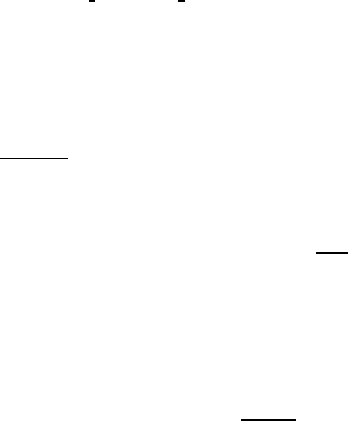
Uncorrected Proof
BookID 160928 ChapID 16 Proof# 1 - 29/07/09
496 16 The Fractional Quantum Hall Effect
ν
∗
= ±1, ±2,... and a nondegenerate mean field composite fermion ground 354
state occurs, then 355
ν =
ν
∗
1+αν
∗
(16.29)
generates, for α = 2, condensed states at ν =1/3, 2/5, 3/7,... and ν =
356
1, 2/3, 3/5,.... These are the most pronounced fractional quantum Hall states 357
observed in experiment. The ν
∗
= 1 states correspond to Laughlin ν =
1
1+α
358
states. If ν
∗
is not an integer, the low lying states contain a number of quasi- 359
particles (N
QP
≤ N ) in the neighboring incompressible state with integral ν
∗
. 360
The mean field Hamiltonian of noninteracting composite fermions is known 361
to give a good description of the low lying states of interacting electrons in 362
the lowest Landau level. 363
It is quite remarkable to note that the mean field picture predicts not only 364
the Jain sequence of incompressible ground states, given by ν =
ν
∗
1+2pν
∗
(with 365
integer p), but also the correct band of low energy states for any value of 366
the applied magnetic field. This is illustrated very nicely for the case of N 367
electrons on a Haldane sphere. In the spherical geometry, one can introduce 368
an effective monopole strength 2Q
∗
seen by one composite fermion. When 369
the monopole strength seen by an electron has the value 2Q,2Q
∗
is given, 370
since the α flux quanta attached to every other composite fermion must be 371
subtracted from the original monopole strength 2Q,by 372
2Q
∗
=2Q − α(N − 1). (16.30)
This equation reflects the fact that a given composite fermion senses the vector
373
potential produced by the Chern–Simons flux on all other particles, but not 374
its own Chern–Simons flux. 375
Now, |Q
∗
| = l
∗
0
plays the role of the angular momentum of the lowest 376
composite fermion shell just as Q = l
0
was the angular momentum of the 377
lowest electron shell. When 2Q is equal to an odd integer (1+α)times(N −1), 378
the composite fermion shell l
∗
0
is completely filled (ν
∗
=1),andanL =0 379
incompressible Laughlin state at filling factor ν =(1+α)
−1
results. When 380
2|Q
∗
| + 1 is smaller than N, quasielectrons appear in the shell l
QE
= l
∗
0
+1. 381
Similarly, when 2|Q
∗
| + 1 is larger than N , quasiholes appear in the shell 382
l
QH
= l
∗
0
. The low-energy sector of the energy spectrum consists of the states 383
with the minimum number of quasiparticle excitations required by the value 384
of 2Q
∗
and N. The first excited band of states will contain one additional 385
quasielectron – quasihole pair. The total angular momentum of these states in 386
the lowest energy sector can be predicted by addition of the angular momenta 387
(l
QH
or l
QE
)ofthen
QH
or n
QE
quasiparticles treated as identical fermions. 388
In Table 16.2 we demonstrate how these allowed L values are found for a 389
ten electron system with 2Q in the range 29 ≥ 2Q ≥ 15. By comparing 390
with numerical results presented in Fig. 16.1, one can readily observe that the 391
total angular momentum multiplets appearing in the lowest energy sector are 392
correctly predicted by this simple mean field Chern–Simons picture. 393