
Quinn J.J., Yi K.-S. Solid State Physics: Principles and Modern Applications
Подождите немного. Документ загружается.

Uncorrected Proof
BookID 160928 ChapID 16 Proof# 1 - 29/07/09
16.11 Correlations in Quantum Hall States 507
17 25
0.0
0.5
V
19 191725
(a) electrons in lowest LL (b) QE's in excited CF LL
(e
2
/)
0
R
R
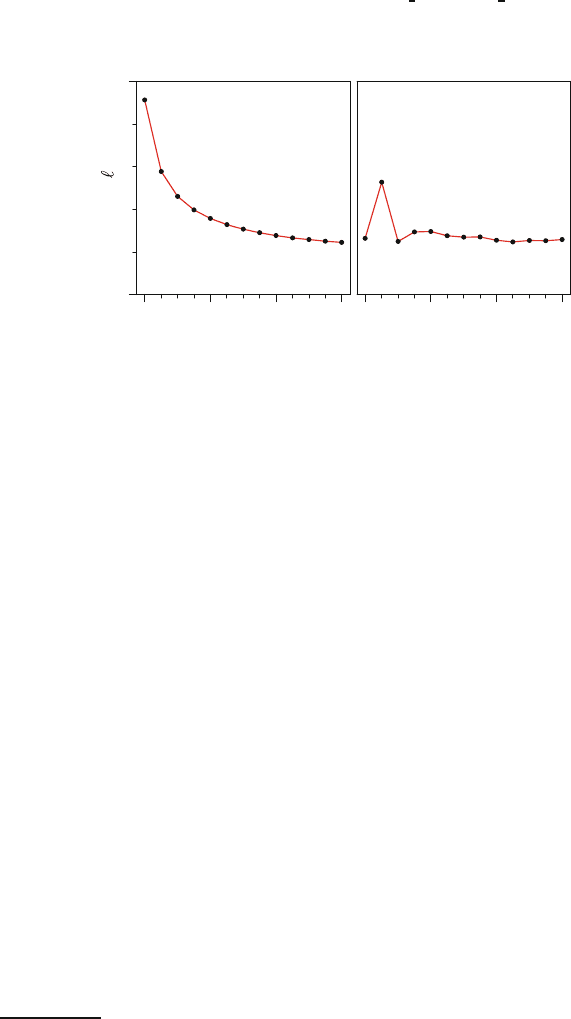
Fig. 16.7. Pseudopotentials as a function of relative pair angular momentum R for
electrons in the lowest Landau level (a) and for quasielectrons in the first excited
composite fermion Landau level (b). l
0
is the magnetic length
ΔV (R)=Uδ
R,3
gives the lowest energy states when P
L
(R =3)iseithera 685
minimum for positive U or a maximum for negative U. 686
The pseudopotential describing the interaction energy of a pair of electrons 687
in the first excited Landau level was shown in Fig. 16.4b. It rises faster than 688
a harmonic potential V
H
(R)forR = 3 and 5, but not for R =1,whereit 689
appears to be harmonic or slightly subharmonic. In this situation, a Laugh- 690
lin correlated state with a minimum value of P
L
(R = 1) will have higher 691
energy than a state in which some increase of P
L
(R = 1) (from its Laughlin 692
value) is made at the expense of P
L
(R = 3), while the sum rules (16.38) and 693
(16.39) are still satisfied. Figure 16.7 illustrates the pseudopotentials V
0
(R) 694
for electrons in the lowest Landau level and V
QE
(R) for composite fermion 695
quasielectrons in the first excited composite fermion Landau level.
14
The pseu- 696
dopotential V
QE
(R) describing the interaction of Laughlin quasiparticles is not 697
superharmonic at all allowed values of R or L
. 698
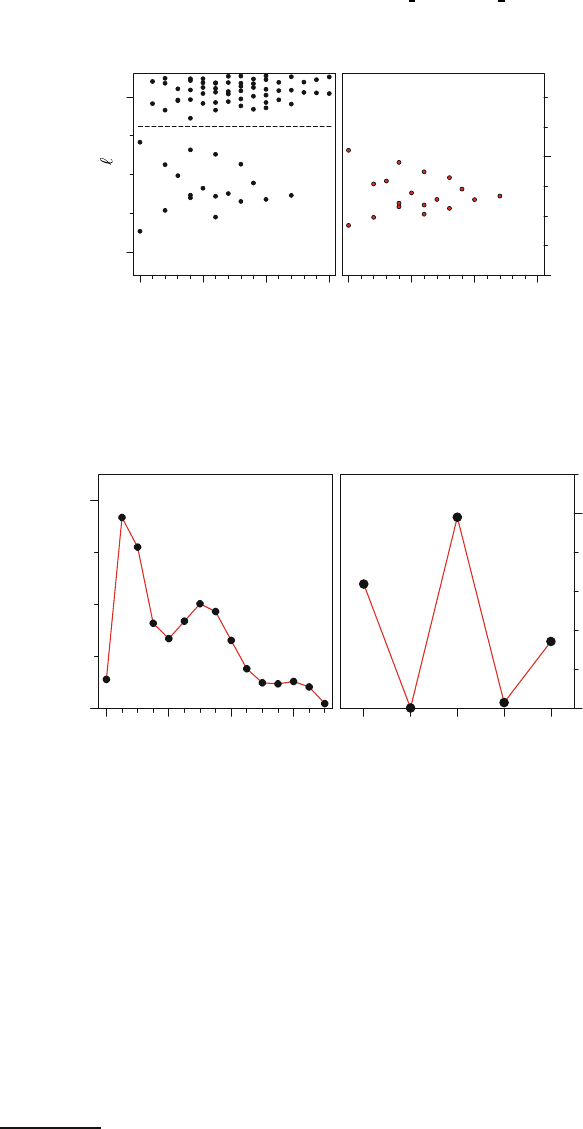
In Fig. 16.8 the low energy spectrum of N = 12 electrons at 2l =29andthe 699
corresponding spectrum for N
QE
= 4 quasielectrons at 2l
QE
=9,whichare 700
obtained in numerical experiments, are shown.
15
The calculation for 2l
QE
=9 701
and N
QE
= 4 is almost trivial in comparison to that of N =12at2l = 29, but 702
the low-energy spectra are in reasonably good agreement, giving us confidence 703
in using V
QP
(R) to describe the composite fermion quasiparticles. 704
In Fig. 16.9 probability functions of pair states P(R)fortheL = 0 ground 705
states of the 12 electron system and the four quasielectron system illustrated 706
14
S.-Y. Lee, V.W. Scarola, J.K. Jain, Phys. Rev. Lett. 87, 256803 (2001).
15
The composite fermion transformation applied to the electrons gives an effective
composite fermion angular momentum l
∗
= l − (N − 1) = 7/2. The lowest com-
posite fermion Landau level can accommodate 2l
∗
+ 1 = 8 of the particles, so
that the first excited composite fermion Landau level contains the remaining four
quasiparticles each of angular momentum l
QE
=9/2.
Uncorrected Proof
BookID 160928 ChapID 16 Proof# 1 - 29/07/09
508 16 The Fractional Quantum Hall Effect
0 5 10 15
L
0.0
0.1
0 5 10 15
L
13.6
13.7
E
(
(a) electrons, N=12, 2
l
=29 (b) QE's,N=4, 2
l
=9
e
2
/)
0
Fig. 16.8. Energy spectra for N = 12 electrons in the lowest Landau level with
2l =29(a)andforN = 4 quasielectrons in the first excited composite fermion
Landau level with 2l =9(b). The energy scales are the same, but the quasielectron
spectrum obtained using V
QE
(R) is determined only up to an arbitrary constant
13579
0.0
0.5
191725
0.0
0.2
(a) electrons, N=12, 2
l
=29 (b) QE's, N=4, 2
l
=9
RR
P
Fig. 16.9. Pair probability functions P(R)fortheL = 0 ground states of the 12
electron system (a) and the four quasielectron system (b) shown in Fig. 16.8
in Fig. 16.8. The electrons are clearly Laughlin correlated avoiding R =1pair 707
states, but the quasielectrons are not Laughlin correlated because they avoid 708
R =3andR = 7 pair states but not R =1state. 709
It is known that, when V
QP
(L
) is not superharmonic, the interacting par- 710
ticles form pairs or larger clusters in order to lower the total energy.
16
These 711
pairing correlations can lead to a nondegenerate incompressible ground state. 712
Standard numerical calculations for N electrons are not very useful for study- 713
ing novel incompressible quantum liquid states at ν =3/8, 3/10, 4/11, and 714
4/13. Convincing numerical results would require values of N too large to diag- 715
onalize directly. However, one can look at states containing a small number 716
16
A. Wojs, J.J. Quinn, Phys. Rev. B 69, 205322 (2004).

Uncorrected Proof
BookID 160928 ChapID 16 Proof# 1 - 29/07/09
16.11 Correlations in Quantum Hall States 509
t3.1 Table 16.3. Some novel family of incompressible quantum liquid states resulting
from pairing of composite fermion quasiparticles in the lowest Landau level
t3.2 ν
QE
2/3 1/2 1/3 ν
QH
2/7 1/4 1/5
t3.3 ν 5/13 3/8 4/11 ν 5/17 3/10 4/13
of quasiparticles of an incompressible quantum liquid state, and use V
QP
(L
) 717
discussed here to obtain the spectrum of quasiparticle states. As an example, 718
Table 16.3 shows a novel family of incompressible states resulting from the 719
scheme of quasiparticle pairing. 720

Uncorrected Proof
BookID 160928 ChapID 16 Proof# 1 - 29/07/09
510 16 The Fractional Quantum Hall Effect
Problems 721
16.1. The many particle wavefunction is written, for ν =1,by 722
Ψ
1
(z
1
,...,z
N
)=A{u
0
(z
1
)u
1
(z
2
) ···u
N−1
(z
N
)},
where A denotes the antisymmetrizing operator. Demonstrate explicitly that
723
Ψ
1
(z
1
, ··· ,z
N
) can be written as follows: 724
Ψ
1
(z
1
,...,z
N
) ∝
11···1
z
1
z
2
···z
N
z
2
1
z
2
2
···z
2
N
.
.
.
.
.
. ···
.
.
.
z
N−1
1
z
N−1
2
···z
N−1
N
e
−
1
4l
2
0
i=1,N
|z
i
|
2
.
16.2. Consider a system of N electrons confined to a Haldane surface of radius
725
R. There is a magnetic monopole of strength 2Qφ
0
at the center of the sphere. 726
(a) Demonstrate that, in the presence of a radial magnetic field B =
2Qφ
0
4πR
2
ˆ
R,
727
the single particle Hamiltonian is given by 728
H
0
=
1
2mR
2
l − ¯hQ
ˆ
R
2
.
Here,
ˆ
R and l are, respectively, a unit vector in the radial direction and
729
the angular momentum operator. 730
(b) Show that the single particle eigenvalues of H
0
are written as 731
ε(Q, l, m)=
¯hω
c
2Q
[l(l +1)− Q
2
].
16.3. Figure 16.4 displays V
QE
(R)andV
QH
(R) obtained from numerical diag- 732
onalization of N (6 ≤ N ≤ 11) electron systems appropriate to quasiparticles 733
of the ν =1/3andν =1/5 Laughlin incompressible quantum liquid states. 734
Demonstrate that V
QP
(R) converges to a rather well defined limit by plotting 735
V
QP
(R) as a function of N
−1
at R =1,3,and5. 736
16.4. Consider a system of N fermions and prove an identity given by 737
ˆ
L
2
+ N (N − 2)
ˆ
l
2
−
i,j
ˆ
L
2
ij
=0.
Here,
ˆ
L is the total angular momentum operator,
ˆ
L
ij
=
ˆ
l
i
+
ˆ
l
j
, and the sum 738
is over all pairs. Hint: One can write out the definitions of
ˆ
L
2
and
i,j
ˆ
L
2
ij
739
and eliminate
ˆ
l
i
·
ˆ
l
j
from the pair of equations. 740
16.5. Demonstrate that the expectation value of square of the pair angular 741
momentum L
ij
summed over all pairs is totally independent of the multiplet 742
α and depends only on the total angular momentum L. 743

Uncorrected Proof
BookID 160928 ChapID 16 Proof# 1 - 29/07/09
16.11 Correlations in Quantum Hall States 511
16.6. Derive the two sum rules involving P
Lα
(L
12
), i.e., the probability that 744
the multiplet |l
N
; Nα contains pairs having pair angular momentum L
12
: 745
1
2
N(N − 1)
L
12
L
12
(L
12
+1)P
Lα
(L
12
)=L(L +1)+N(N −2)l(l +1)
and
746
L
12
P
Lα
(L
12
)=1.
16.7. Show that, for harmonic pseudopotential V
H
(L
12
), the energy of the 747
multiplet |l
N
; Lα is given by 748
E
α
(L)=N
1
2
(N − 1)A + B(N − 2)l(l +1)
+ BL(L +1).

Uncorrected Proof
BookID 160928 ChapID 16 Proof# 1 - 29/07/09
512 16 The Fractional Quantum Hall Effect
Summary 749
In this chapter, we introduce basic concepts commonly used to interpret exper- 750
imental data on the quantum Hall effect. We begin with a description of 751
two dimensional electrons in the presence of a perpendicular magnetic field. 752
The occurrence of incompressible quantum fluid states of a two-dimensional 753
system is reviewed as a result of electron–electron interactions in a highly 754
degenerate fractionally filled Landau level. The idea of harmonic pseudopo- 755
tential is introduced and residual interactions among the quasiparticles are 756
analyzed. For electrons in the lowest Landau level the interaction energy of a 757
pair of particles is shown to be superharmonic at every value of pair angular 758
momenta. 759
The Hamiltonian of an electron (of mass μ) confined to the x-y plane, in the 760
presence of a dc magnetic field B = Bˆz,issimplyH =(2μ)
−1
p +
e
c
A(r)
2
, 761
where A(r)isgivenbyA(r)=
1
2
B(−yˆx + xˆy)inasymmetric gauge. The 762
Schr¨odinger equation (H − E)Ψ(r) = 0 has eigenstates described by 763
Ψ
nm
(r, φ)=e
imφ
u
nm
(r)andE
nm
=
1
2
¯hω
c
(2n +1+m + |m|),
where n and m are principal and angular momentum quantum numbers,
764
respectively, and ω
c
(= eB/μc) is the cyclotron angular frequency. The lowest 765
Landau level wavefunction can be written as Ψ
0m
= N
m
z
|m|
e
−|z|
2
/4l
0
2
where 766
N
m
is the normalization constant and z stands for z(= x − iy)=re
−iφ
. 767
The filling factor ν of a given Landau level is defined by N/N
φ
,sothatν
−1
768
is simply equal to the number of flux quanta of the dc magnetic field per 769
electron. The integral quantum Hall effect occurs when N electrons exactly 770
fill an integral number of Landau levels resulting in an integral value of the 771
filling factor ν. The energy gap (equal to ¯hω
c
) between the filled states and 772
the empty states makes the noninteracting electron system incompressible. 773
A many particle wavefunction of N electrons at filling factor ν = 1 becomes 774
Ψ
1
(z
1
,...,z
N
) ∝ Π
N ≥i>j≥1
z
ij
e
−
1
4l
2
0
k=1,N
|z
k
|
2
.
For filling factor ν =1/n, Laughlin ground state wavefunction is written as
775
Ψ
1/n
(1, 2, ···,N)=
i>j
z
n
ij
e
−
l
|z
l
|
2
/4l
2
0
,
where n is an odd integer.
776
It is convenient to introduce a Haldane sphere at the center of which is 777
located a magnetic monopole and a small number of electrons are confined on 778
its surface. The numerical problem is to diagonalize the interaction Hamilto- 779
nian H
int
=
i<j
V (|r
i
−r
j
|). The calculations give the eigenenergies E as a 780
function of the total angular momentum L. 781
Considering a two dimensional system of particles described by a Hamil- 782
tonian 783

Uncorrected Proof
BookID 160928 ChapID 16 Proof# 1 - 29/07/09
16.11 Correlations in Quantum Hall States 513
H =
1
2μ
i
p
i
+
e
c
A(r
i
)
2
+
i>j
V (r
ij
),
we can change the statistics by attaching to each particle a fictitious charge q
784
and flux tube carrying magnetic flux Φ. The fictitious vector potential a(r
i
) 785
at the position of the ith particle caused by flux tubes, each carrying flux of 786
Φ, on all the other particles at r
j
(=r
i
) is written as a(r
i
)=Φ
j=i
ˆz×r
ij
r
2
ij
. 787
The Chern–Simons gauge field due to the gauge potential a(r
i
) becomes 788
b(r)=Φ
i
δ(r − r
i
)ˆz, where r
i
is the position of the ith particle carrying 789
gauge potential a(r
i
). The new Hamiltonian, through Chern–Simons gauge 790
transformation, is 791
H
CS
=
1
2μ
d
2
rψ
†
(r)
p +
e
c
A(r)+
e
c
a(r)
2
ψ(r)+
i>j
V (r
ij
).
The net effect of the additional Chern–Simons term is to replace the statistics
792
parameter θ with θ + πΦ
q
hc
.IfΦ=p
hc
e
when p is an integer, then θ → 793
θ + πpq/e. For the case of q = e and p = 2, the statistics would be unchanged 794
by the Chern–Simons terms, and the gauge interactions convert the electrons 795
system to the composite fermions which interact through the gauge field term 796
as well as through the Coulomb interaction. In the mean field approach, the 797
composite fermions move in an effective magnetic field B
∗
.Thecomposite 798
fermion filling factor ν
∗
is given by ν
∗
−1
= ν
−1
− α. The mean field picture 799
predicts not only the sequence of incompressible ground states, given by ν = 800
ν
∗
1+2pν
∗
(with integer p), but also the correct band of low energy states for any 801
value of the applied magnetic field. The low lying excitations can be described 802
in terms of the number of quasiparticles n
QE
and n
QH
. 803
In a state containing more than one Laughlin quasiparticles, quasiparti- 804
cles interact with one another through appropriate quasiparticle-quasiparticle 805
pseudopotentials, V
QP−QP
. The total energy can be expressed as 806
E = E
0
+
QP
ε
QP
n
QP
+
1
2
QP,QP
V
QP−QP
(L)n
QP
n
QP
.
If V
QP−QP
(L
) is a “harmonic” pseudopotential of the form V
H
(L
)=A + 807
BL
(L
+ 1) every angular momentum multiplet having the same value of the 808
total angular momentum L has the same energy. We define V
QP−QP
(L
)tobe 809
“superharmonic” (“subharmonic”) at L
=2l −Rif it increases approaching 810
this value more quickly (slowly) than the harmonic pseudopotential appro- 811
priate at L
− 2. For harmonic and subharmonic pseudopotentials, Laughlin 812
correlations do not occur. Since the harmonic pseudopotential introduces 813
no correlations, only the anharmonic part of the pseudopotential ΔV (R)= 814
V (R) − V
H
(R) lifts the degeneracy of the multiplets with a given L. 815

Uncorrected Proof
BookID 160928 ChapID BM Proof# 1 - 29/07/09
A 1
Operator Method for the Harmonic Oscillator 2
Problem 3
Hamiltonian 4
The Hamiltonian of a particle of mass m moving in a one-dimensional 5
harmonic potential is 6
H =
p
2
2m
+
1
2
mω
2
x
2
. (A.1)
The quantum mechanical operators p and x satisfy the commutation relation
7
[p, x]
−
= −ı¯h where ı =
√
−1. The Hamiltonian can be written 8
H =
1
2m
(mωx − ıp)(mω + ıp)+
1
2
¯hω. (A.2)
To see the equivalence of (A.1) and (A.2) one need only multiply out the prod-
9
uct in (A.2) remembering that p and x are operators which do not commute. 10
Equation (A.2) can be rewritten by 11
H =¯hω
#
(mωx − ıp)
√
2m¯hω
(mωx + ıp)
√
2m¯hω
+
1
2
$
. (A.3)
We now define the operator a and its adjoint a
†
by the relations 12
a =
mωx+ıp
√
2m¯hω
(A.4)
a
†
=
mωx−ıp
√
2m¯hω
. (A.5)
These two equations can be solved for the operators x and p to give
13
x =
¯h
2mω
1/2
a
†
+ a
, (A.6)
p = ı
m¯hω
2
1/2
a
†
− a
. (A.7)

Uncorrected Proof
BookID 160928 ChapID BM Proof# 1 - 29/07/09
516 A Operator Method for the Harmonic Oscillator Problem
It follows from the commutation relation satisfied by x and p that 14
a, a
†
−
=1, (A.8)
15
[a, a]
−
=
a
†
,a
†
−
=0. (A.9)
By using the relation
16
[A, BC]
−
= B [A, C]
−
+[A, B]
−
C, (A.10)
it is not difficult to prove that
17
a, a
†
2
−
=2a
†
,
a, a
†
3
−
=3a
†
2
, (A.11)
.
.
.
a, a
†
n
−
= na
†
n−1
.
Here, a
†
and a are called as raising and lowering operators, respectively. 18
From (A.3)–(A.5) it can be seen that 19
H =¯hω
a
†
a +
1
2
. (A.12)
Now, assume that |n>is an eigenvector of H with an eigenvalue ε
n
.Operate 20
on |n>with a
†
, and consider the energy of the resulting state. We can 21
certainly write 22
H
a
†
|n>
= a
†
H|n>+
H, a
†
n>. (A.13)
But we have assumed that H|n>= ε
n
|n>, and we can evaluate the 23
commutator [H, a
†
]. 24
H, a
†
=¯hω
a
†
a, a
†
=¯hωa
†
a, a
†
=¯hωa
†
. (A.14)
Therefore, (A.13) gives
25
Ha
†
|n>=(ε
n
+¯hω) a
†
|n>. (A.15)
Equation (A.15) tells us that if |n>is an eigenvector of H with eigenvalue
26
ε
n
,thena
†
|n>is also an eigenvector of H with eigenvalue ε
n
+¯hω.Exactly 27
the same technique can be used to show that 28
Ha|n>=(ε
n
− ¯hω) a|n>. (A.16)
Thus, a
†
and a act like raising and lowering operators, raising the energy by 29
¯hω or lowering it by ¯hω. 30

Uncorrected Proof
BookID 160928 ChapID BM Proof# 1 - 29/07/09
A Operator Method for the Harmonic Oscillator Problem 517
Ground State 31
Since V (x) ≥ 0 everywhere, the energy must be greater than or equal to zero. 32
Suppose the ground state of the system is denoted by |0 >. Then, by applying 33
the operator a to |0 > we generate a state whose energy is lower by ¯hω, i.e., 34
Ha|0 >=(ε
0
− ¯hω) a|0 >. (A.17)
The only possible way for (A.17) to be consistent with the assumption that
35
|0 > was the ground state is to have a|0 > give zero. Thus, we have 36
a|0 >=0. (A.18)
If we use the position representation where Ψ
0
(x) is the ground state wave- 37
function and p can be represented by p = −ı¯h∂/∂x, (A.18) becomes a simple 38
first-order differential equation 39
∂
∂x
+
mω
¯h
x
Ψ
0
(x)=0. (A.19)
One can see immediately see that the solution of (A.19) is
40
Ψ
0
(x)=N
0
e
−
1
2
α
2
x
2
, (A.20)
where N
0
is a normalization constant, and α
2
=
mω
¯h
. The normalization con- 41
stant is given by N
0
= α
1/2
π
−1/4
. The energy is given by ε
0
=
¯hω
2
,since 42
a
†
a|0 >=0. 43
Excited States 44
We can generate all the excited states by using the operator a
†
to raise the 45
system to the next higher energy level, i.e., if we label the nth excited state 46
by |n>, 47
|1 >∝ a
†
|0 >, ε
1
=¯hω
1+
1
2
,
|2 >∝ a
†
2
|0 >, ε
2
=¯hω
2+
1
2
, (A.21)
.
.
.
|n>∝ a
†
n
|0 >, ε
n
=¯hω
n +
1
2
.
Because a
†
creates one quantum of excitation and a annihilates one, a
†
and 48
a are often called creation and annihilation operators, respectively. 49
If we wish to normalize the eigenfunctions |n>we can write 50
|n>= C
n
a
†
n
|0 >. (A.22)