
Raven P.H., Johnson G.B., Mason K.A. Biology (Ninth Edition)
Подождите немного. Документ загружается.

Apago PDF Enhancer
N
H
O
N
C
H
O
O
C
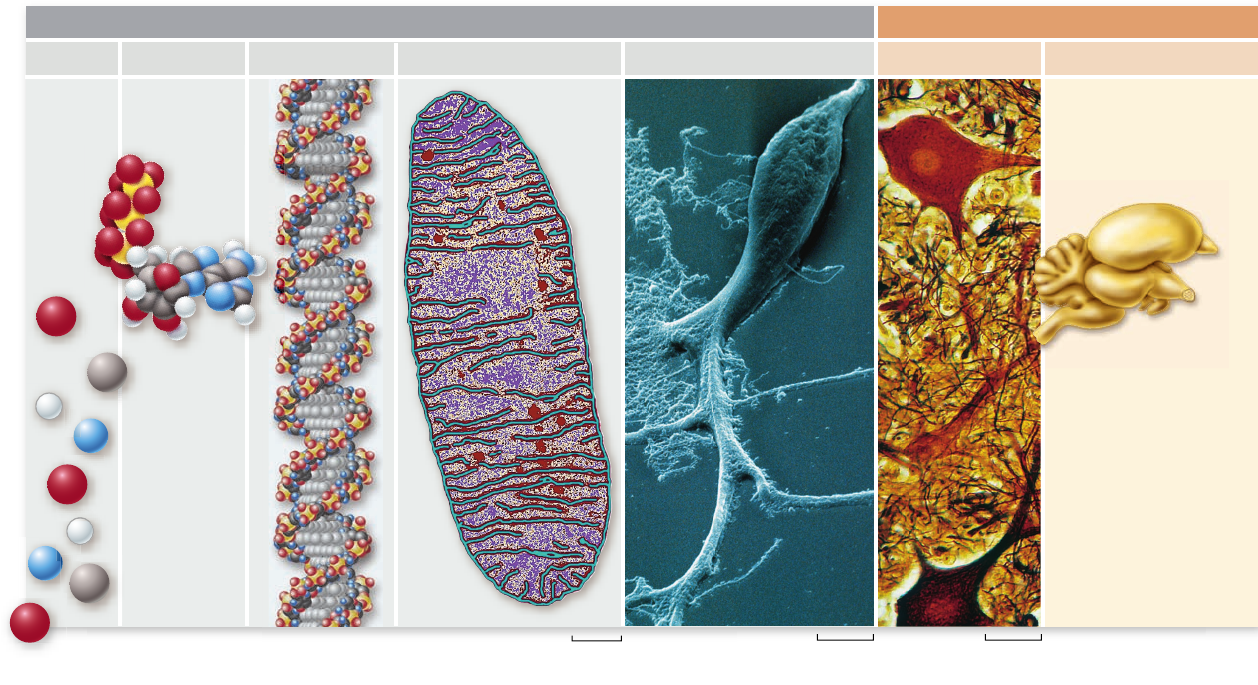
Atoms Molecule Tissue Or
gan Macromolecule Organelle Cell
CELLULAR LEVEL
0.2 µm
0.5 µm 100 µm
and analytical techniques, we have tools available that were for-
merly the stuff of science fiction.
In this text, we attempt to draw a contemporary picture of
the science of biology, as well as provide some history and ex-
perimental perspective on this exciting time in the discipline. In
this introductory chapter, we examine the nature of biology and
the foundations of science in general to put into context the
information presented in the rest of the text.
Biology uni es much of natural science
The study of biology is a point of convergence for the informa-
tion and tools from all of the natural sciences. Biological sys-
tems are the most complex chemical systems on Earth, and
their many functions are both determined and constrained by
the principles of chemistry and physics. Put another way, no
new laws of nature can be gleaned from the study of biology—
but that study does illuminate and illustrate the workings of
those natural laws.
The intricate chemical workings of cells are based on every-
thing we have learned from the study of chemistry. And every
level of biological organization is governed by the nature of en-
ergy transactions learned from the study of thermodynamics. Bi-
ological systems do not represent any new forms of matter, and
yet they are the most complex organization of matter known. The
complexity of living systems is made possible by a constant source
of energy—the Sun. The conversion of this energy source into
organic molecules by photosynthesis is one of the most beautiful
and complex reactions known in chemistry and physics.
The way we do science is changing to grapple with in-
creasingly difficult modern problems. Science is becoming
more interdisciplinary, combining the expertise from a vari-
ety of exciting new fields such as nanotechnology. Biology is
at the heart of this multidisciplinary approach because bio-
logical problems often require many different approaches to
arrive at solutions .
Life de es simple de nition
In its broadest sense, biology is the study of living things—the sci-
ence of life. Living things come in an astounding variety of shapes
and forms, and biologists study life in many different ways. They
live with gorillas, collect fossils, and listen to whales. They read
the messages encoded in the long molecules of heredity and count
how many times a hummingbird’s wings beat each second.
What makes something “alive”? Anyone could deduce that
a galloping horse is alive and a car is not, but why? We cannot say,
“If it moves, it’s alive,” because a car can move, and gelatin can
wiggle in a bowl. They certainly are not alive. Although we can-
not define life with a single simple sentence, we can come up
with a series of seven characteristics shared by living systems:
■ Cellular organization. All organisms consist of one or
more cells. Often too tiny to see, cells carry out the basic
activities of living. Each cell is bounded by a membrane
that separates it from its surroundings.
■ Ordered complexity. All living things are both complex
and highly ordered. Your body is composed of many
different kinds of cells, each containing many complex
2
part
I
The Molecular Basis of Life
rav32223_ch01_001-016.indd 2rav32223_ch01_001-016.indd 2 11/5/09 3:06:36 PM11/5/09 3:06:36 PM
Apago PDF Enhancer
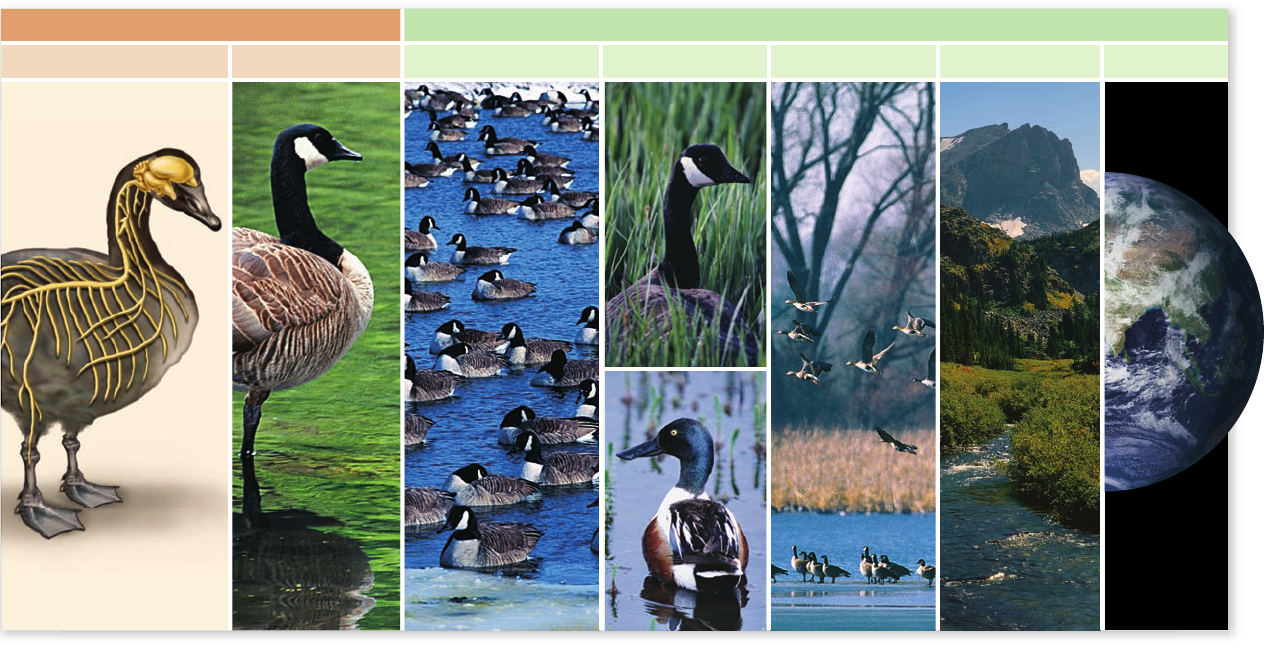
Organ system Organism Population Species Community Ecosystem
ORGANISMAL LEVEL
POPULATIONAL LEVEL
Biosphere
Figure 1.1
Hierarchical organization of living systems.
Life is highly organized from the simplest atoms to complex
multicellular organisms. Along this hierarchy of structure, atoms
form molecules that are used to form organelles, which in turn
form the functional subsystems within cells. Cells are organized
into tissues, and then into organs and organ systems such as the
nervous system pictured. This organization extends beyond
individual organisms to populations, communities, ecosystems, and
nally the entire biosphere.
molecular structures. Many nonliving things may also be
complex, but they do not exhibit this degree of ordered
complexity.
■ Sensitivity. All organisms respond to stimuli. Plants grow
toward a source of light, and the pupils of your eyes
dilate when you walk into a dark room.
■ Growth, development, and reproduction. All organisms
are capable of growing and reproducing, and they all possess
hereditary molecules that are passed to their offspring,
ensuring that the offspring are of the same species.
■ Energy utilization. All organisms take in energy and use
it to perform many kinds of work. Every muscle in your
body is powered with energy you obtain from the food
you eat.
■ Homeostasis. All organisms maintain relatively constant
internal conditions that are different from their
environment, a process called homeostasis.
■ Evolutionary adaptation. All organisms interact with
other organisms and the nonliving environment in ways
that influence their survival, and as a consequence,
organisms evolve adaptations to their environments.
Living systems show hierarchical organization
The organization of the biological world is hierarchical—that
is, each level builds on the level below it.
The Cellular Level.1. At the cellular level ( gure 1.1),
atoms, the fundamental elements of matter, are joined
together into clusters called molecules. Complex
biological molecules are assembled into tiny structures
called organelles within membrane-bounded units we
call cells. The cell is the basic unit of life. Many
indepen dent organisms are composed only of single cells.
Bacteria are single cells, for example. All animals and
plants, as well as most fungi and algae, are multicellular—
composed of more than one cell.
The Organismal Level.2. Cells in complex multicellular
organisms exhibit three levels of organization. The most
basic level is that of tissues, which are groups of similar
cells that act as a functional unit. Tissues, in turn, are
grouped into organs—body structures composed of
several different tissues that act as a structural and
func tional unit. Your brain is an organ composed of nerve
cells and a variety of associated tissues that form protective
coverings and contribute blood. At the third level of
organization, organs are grouped into organ systems. The
nervous system, for example, consists of sensory organs, the
brain and spinal cord, and neurons that convey signals.
chapter
1
The Science of Biology
3www.ravenbiology.com
rav32223_ch01_001-016.indd 3rav32223_ch01_001-016.indd 3 11/5/09 3:07:01 PM11/5/09 3:07:01 PM

Apago PDF Enhancer
The Populational Level.3. Individual organisms can be
categorized into several hierarchical levels within the living
world. The most basic of these is the population—a group
of organisms of the same species living in the same place.
All populations of a particular kind of organism together
form a species, its members similar in appearance and able
to interbreed. At a higher level of biological organization, a
biological community consists of all the populations of
different species living together in one place.
Ecosystem Level. 4. At the highest tier of biological
organization, a biological community and the physical
habitat within which it lives together constitute an
ecological system, or ecosystem. For example, the soil,
water, and atmosphere of a mountain ecosystem interact
with the biological community of a mountain meadow in
many important ways.
The Biosphere. 5. The entire planet can be thought of as
an ecosystem that we call the biosphere.
As you move up this hierarchy, novel properties emerge. These
emergent properties result from the way in which compo-
nents interact, and they often cannot be deduced just from
looking at the parts themselves. Examining individual cells, for
example, gives little hint about the whole animal. You, and all
humans, have the same array of cell types as a giraffe. It is be-
cause the living world exhibits many emergent properties that
it is difficult to define “life.”
The previous descriptions of the common features and
organization of living systems begins to get at the nature of
what it is to be alive. The rest of this book illustrates and ex-
pands on these basic ideas to try to provide a more complete
account of living systems.
Learning Outcomes Review 1.1
Biology is a unifying science that brings together other natural sciences,
such as chemistry and physics, to study living systems. Life does not have
a simple defi nition, but living systems share a number of properties that
together describe life. Living systems can also be organized hierarchically,
from the cellular level to the entire biosphere, with emerging properties
that may exceed the sum of the parts.
■ Can you study biology without studying other sciences?
1.2
The Nature of Science
Learning Outcomes
1. Describe the types of reasoning used by biologists.
2. Demonstrate how to formulate a hypothesis.
Much like life itself, the nature of science defies simple descrip-
tion. For many years scientists have written about the “scien-
tific method” as though there is a single way of doing science.
This oversimplification has contributed to confusion on the
part of nonscientists about the nature of science.
At its core, science is concerned with developing an in-
creasingly accurate understanding of the world around us using
observation and reasoning. To begin with, we assume that natu-
ral forces acting now have always acted, that the fundamental
nature of the universe has not changed since its inception, and
that it is not changing now. A number of complementary ap-
proaches allow understanding of natural phenomena—there is
no one “right way.”
Scientists also attempt to be as objective as possible in
the interpretation of the data and observations they have col-
lected. Because scientists themselves are human, this is not
completely possible, but because science is a collective en-
deav or subject to scrutiny, it is self-correcting. One person’s
results are verified by others, and if the results cannot be re-
peated, they are rejected.
Much of science is descriptive
The classic vision of the scientific method is that observations
lead to hypotheses that in turn make experimentally testable
predictions. In this way, we dispassionately evaluate new ideas
to arrive at an increasingly accurate view of nature. We discuss
this way of doing science later in this chapter, but it is impor-
tant to understand that much of science is purely descriptive: In
order to understand anything, the first step is to describe it
completely. Much of biology is concerned with arriving at an
increasingly accurate description of nature.
The study of biodiversity is an example of descriptive sci-
ence that has implications for other aspects of biology in addi-
tion to societal implications. Efforts are currently underway to
classify all life on Earth. This ambitious project is purely de-
scriptive, but it will lead to a much greater understanding of
biodiversity as well as the effect our species has on biodiversity.
One of the most important accomplishments of molecular
biology at the dawn of the 21st century was the completion of the
sequence of the human genome. Many new hypotheses about hu-
man biology will be generated by this knowledge, and many ex-
periments will be needed to test these hypotheses, but the
determination of the sequence itself was descriptive science.
Science uses both deductive
and inductive reasoning
The study of logic recognizes two opposite ways of arriving at
logical conclusions: deductive and inductive reasoning. Science
makes use of both of these methods, although induction is the
primary way of reasoning in hypothesis-driven science.
Deductive reasoning
Deductive reasoning applies general principles to predict spe-
cific results. More than 2200 years ago, the Greek scientist Era-
tosthenes used Euclidean geometry and deductive reasoning to
accurately estimate the circumference of the Earth (figure 1.2).
Deductive reasoning is the reasoning of mathematics and
4
part
I
The Molecular Basis of Life
rav32223_ch01_001-016.indd 4rav32223_ch01_001-016.indd 4 11/5/09 3:07:08 PM11/5/09 3:07:08 PM
Apago PDF Enhancer
Sunlight
at midday
Well
Light rays
parallel
Height of
obelisk
Distance between
cities = 800 km
Length of
shadow
a
a
Observation
Predictions
Predictions
confirmed
Question
Hypothesis 1
Hypothesis 2
Hypothesis 3
Hypothesis 4
Hypothesis 5
Potential
hypotheses
Remaining
possible
hypotheses
Last remaining
possible
hypothesis
Reject
hypotheses
2 and 3
Reject
hypotheses
1 and 4
Exper iment 1
Hypothesis 2
Hypothesis 3
Hypothesis 5
Hypothesis 5
Experiment 1 Experiment 2 Experiment 3 Experiment 4
Modify hypothesis
Experiment
Experiment
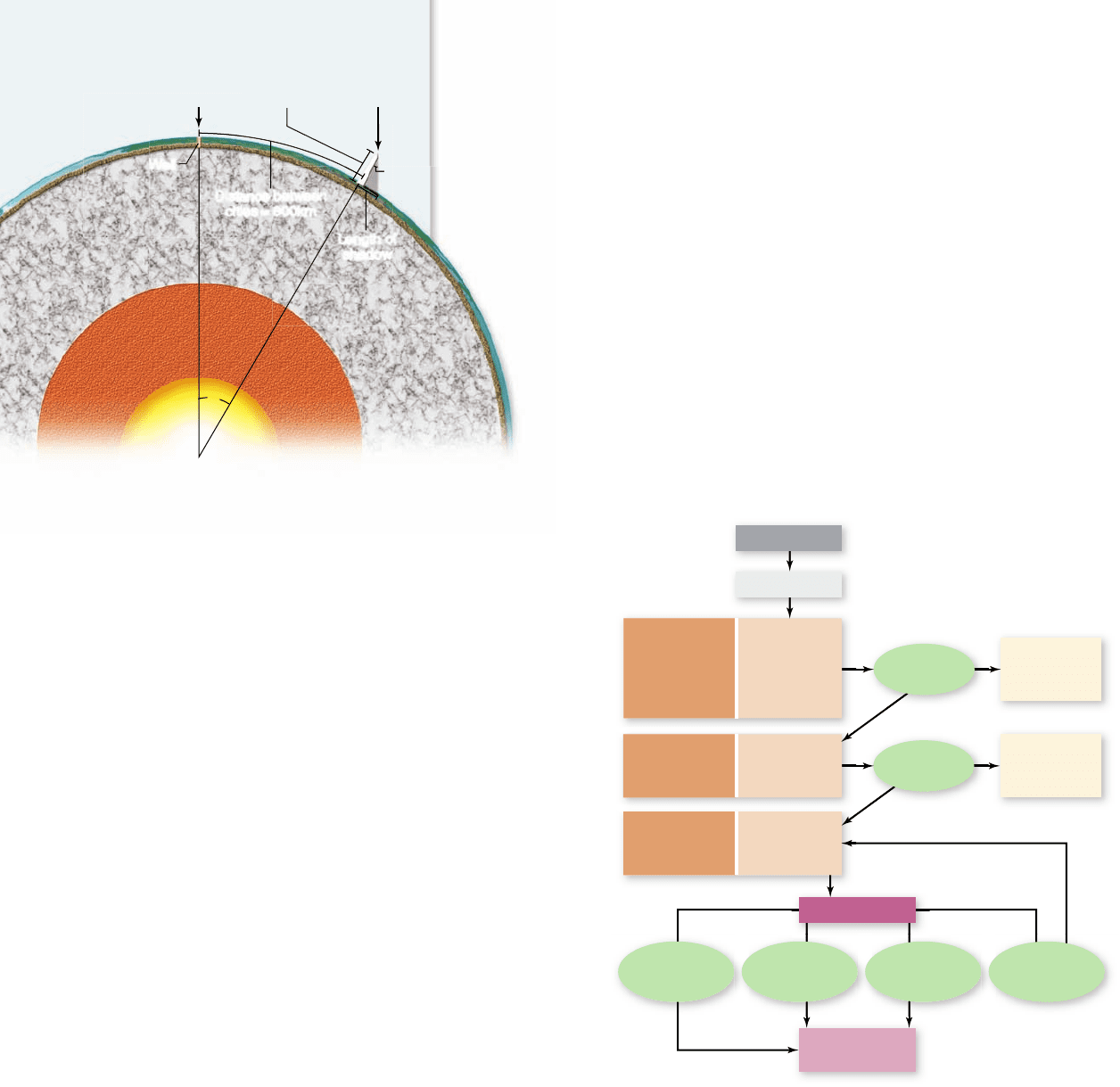
Figure 1.2
Deductive reasoning: how Eratosthenes estimated the
circumference of the earth using deductive reasoning. 1. On a day when sunlight
shone straight down a deep well at Syene in Egypt, Eratosthenes measured the length of the
shadow cast by a tall obelisk in the city of Alexandria, about 800 kilometers (km) away.
2. The shadow’s length and the obelisk’s height formed two sides of a triangle. Using the
recently developed principles of Euclidean geometry, Eratosthenes calculated the angle, a,
to be 7° and 12´, exactly
0 of a circle (360°). 3. If angle a is 0 of a circle, then the distance
between the obelisk (in Alexandria) and the well (in Syene) must be equal to
0 the
circumference of the Earth. 4. Eratosthenes had heard that it was a 50-day camel trip
from Alexandria to Syene. Assuming that a camel travels about 18.5 km per day, he
estimated the distance between obelisk and well as 925 km (using different units of
measure, of course). 5. Eratosthenes thus deduced the circumference of the Earth
to be 50 × 925 = 46,250 km. Modern measurements put the distance from the
well to the obelisk at just over 800 km. Employing a distance of 800 km,
Eratosthenes’s value would have been 50 × 800 = 40,000 km. The actual
circumference is 40,075 km.
Figure 1.3
How science is done. This diagram illustrates
how scienti c investigations proceed. First, scientists make
observations that raise a particular question. They develop a number
of potential explanations (hypotheses) to answer the question. Next,
they carry out experiments in an attempt to eliminate one or more of
these hypotheses. Then, predictions are made based on the
remaining hypotheses, and further experiments are carried out to
test these predictions. The process can also be iterative. As
experimental results are performed, the information can be used to
modify the original hypothesis to t each new observation.
philosophy, and it is used to test the validity of general ideas in
all branches of knowledge. For example, if all mammals by defi-
nition have hair, and you find an animal that does not have hair,
then you may conclude that this animal is not a mammal. A bi-
ologist uses deductive reasoning to infer the species of a speci-
men from its characteristics.
Inductive reasoning
In inductive reasoning, the logic flows in the opposite direc-
tion, from the specific to the general. Inductive reasoning uses
specific observations to construct general scientific principles.
For example, if poodles have hair, and terriers have hair, and ev-
ery dog that you observe has hair, then you may conclude that all
dogs have hair. Inductive reasoning leads to generalizations that
can then be tested. Inductive reasoning first became important to
science in the 1600s in Europe, when Francis Bacon, Isaac New-
ton, and others began to use the results of particular experiments
to infer general principles about how the world operates.
An example from modern biology is the role of homeo-
box genes in development. Studies in the fruit fly, Drosophila
melanogaster, identified genes that could cause dramatic changes
in developmental fate, such as a leg appearing in the place of an
antenna. When the genes themselves were isolated and their
DNA sequence determined, it was found that similar genes
were found in many animals, including humans. This led to the
general idea that the homeobox genes act as switches to control
developmental fate.
Hypothesis-driven science
makes and tests predictions
Scientists establish which general principles are true from
among the many that might be true through the process of sys-
tematically testing alternative proposals. If these proposals
prove inconsistent with experimental observations, they are re-
jected as untrue. Figure 1.3 illustrates the process.
chapter
1
The Science of Biology
5www.ravenbiology.com
rav32223_ch01_001-016.indd 5rav32223_ch01_001-016.indd 5 11/5/09 3:07:10 PM11/5/09 3:07:10 PM
Apago PDF Enhancer
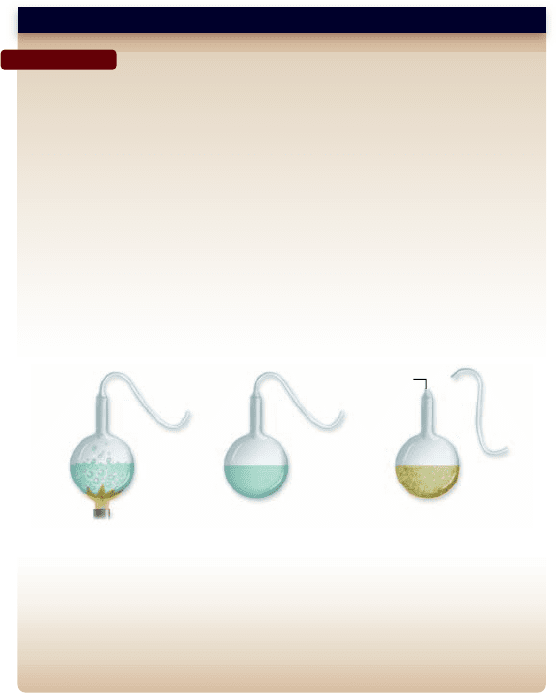
Result: No growth occurs in sterile swan-necked asks. When the neck is
broken o, and the broth is exposed to air, growth occurs.
Conclusion: Growth in broth is of preexisting microorganisms.
SCI ENT I FI C THINKING
Question: What is the source of contamination that occurs in a ask of
nutrient broth left exposed to the air?
Germ Hypothesis: Preexisting microorganisms present in the air
contaminate nutrient broth.
Prediction: Sterilized broth will remain sterile if microorganisms are
prevented from entering ask.
Spontaneous Generation Hypothesis: Living organisms will
spontaneously generate from nonliving organic molecules in broth.
Prediction: Organisms will spontaneously generate from organic
molecules in broth after sterilization.
Test: Use swan-necked asks to prevent entry of microorganisms. To
ensure that broth can still support life, break swan-neck after sterilization.
Flask is sterilized
by boiling the broth.
Unbroken flask
remains sterile.
Broken flask becomes
contaminated after
exposure to germ-laden air.
Broken
neck
of flask
Figure 1.4
Experiment to test spontaneous generation
versus germ hypothesis.
After making careful observations, scientists construct a
hypothesis, which is a suggested explanation that accounts for
those observations. A hypothesis is a proposition that might be
true. Those hypotheses that have not yet been disproved are
retained. They are useful because they fit the known facts, but
they are always subject to future rejection if, in the light of new
information, they are found to be incorrect.
This process can also be iterative, that is, a hypothesis can
be changed and refined with new data. For instance, geneticists
George Beadle and Edward Tatum studied the nature of ge-
netic information to arrive at their “one-gene/one-enzyme”
hypothesis (see chapter 15). This hypothesis states that a gene
represents the genetic information necessary to make a single
enzyme. As investigators learned more about the molecular na-
ture of genetic information, the hypothesis was refined to “one-
gene/one-polypeptide” because enzymes can be made up of
more than one polypeptide. With still more information about
the nature of genetic information, other investigators found
that a single gene can specify more than one polypeptide, and
the hypothesis was refined again.
Testing hypotheses
We call the test of a hypothesis an experiment. Suppose that a
room appears dark to you. To understand why it appears dark, you
propose several hypotheses. The first might be, “There is no light in
the room because the light switch is turned off.” An alternative hy-
pothesis might be, “There is no light in the room because the light-
bulb is burned out.” And yet another hypothesis might be, “I am
going blind.” To evaluate these hypotheses, you would conduct an
experiment designed to eliminate one or more of the hypotheses.
For example, you might test your hypotheses by flipping
the light switch. If you do so and the room is still dark, you have
disproved the first hypothesis: Something other than the set-
ting of the light switch must be the reason for the darkness.
Note that a test such as this does not prove that any of the other
hypotheses are true; it merely demonstrates that the one being
tested is not. A successful experiment is one in which one or
more of the alternative hypotheses is demonstrated to be in-
consistent with the results and is thus rejected.
As you proceed through this text, you will encounter many hy-
potheses that have withstood the test of experiment. Many will con-
tinue to do so; others will be revised as new observations are made by
biologists. Biology, like all science, is in a constant state of change,
with new ideas appearing and replacing or refining old ones.
Establishing controls
Often scientists are interested in learning about processes that
are influenced by many factors, or variables. To evaluate alterna-
tive hypotheses about one variable, all other variables must be
kept constant. This is done by carrying out two experiments in
parallel: a test experiment and a control experiment. In the test
experiment, one variable is altered in a known way to test a par-
ticular hypothesis. In the control experiment, that variable is
left unaltered. In all other respects the two experiments are iden-
tical, so any difference in the outcomes of the two experiments
must result from the influence of the variable that was changed.
Much of the challenge of experimental science lies in de-
signing control experiments that isolate a particular variable
from other factors that might influence a process.
Using predictions
A successful scientific hypothesis needs to be not only valid but
also useful—it needs to tell us something we want to know. A
hypothesis is most useful when it makes predictions because
those predictions provide a way to test the validity of the hypoth-
esis. If an experiment produces results inconsistent with the pre-
dictions, the hypothesis must be rejected or modified. In contrast,
if the predictions are supported by experimental testing, the hy-
pothesis is supported. The more experimentally supported pre-
dictions a hypothesis makes, the more valid the hypothesis is.
As an example, in the early history of microbiology it was
known that nutrient broth left sitting exposed to air becomes con-
taminated. Two hypotheses were proposed to explain this observa-
tion: spontaneous generation and the germ hypothesis. Spontaneous
generation held that there was an inherent property in organic
molecules that could lead to the spontaneous generation of life.
The germ hypothesis proposed that preexisting microorganisms
that were present in the air could contaminate the nutrient broth.
These competing hypotheses were tested by a number of
experiments that involved filtering air and boiling the broth to
kill any contaminating germs. The definitive experiment was
performed by Louis Pasteur, who constructed flasks with curved
necks that could be exposed to air, but that would trap any con-
taminating germs. When such flasks were boiled to sterilize
them, they remained sterile, but if the curved neck was broken
off, they became contaminated (figure 1.4) .
6
part
I
The Molecular Basis of Life
rav32223_ch01_001-016.indd 6rav32223_ch01_001-016.indd 6 11/5/09 3:07:13 PM11/5/09 3:07:13 PM
Apago PDF Enhancer
This result was predicted by the germ hypothesis—that
when the sterile flask is exposed to air, airborne germs are de-
posited in the broth and grow. The spontaneous generation
hypothesis predicted no difference in results with exposure to
air. This experiment disproved the hypothesis of spontaneous
generation and supported the hypothesis of airborne germs un-
der the conditions tested.
Reductionism breaks larger systems
into their component parts
Scientists often use the philosophical approach of reduction-
ism to understand a complex system by reducing it to its work-
ing parts. Reductionism has been the general approach of
biochemistry, which has been enormously successful at unrav-
eling the complexity of cellular metabolism by concentrating
on individual pathways and specific enzymes. By analyzing all
of the pathways and their components, scientists now have an
overall picture of the metabolism of cells.
Reductionism has limits when applied to living systems,
however—one of which is that enzymes do not always behave
exactly the same in isolation as they do in their normal cellular
context. A larger problem is that the complex interworking of
many interconnected functions leads to emergent properties
that cannot be predicted based on the workings of the parts.
For example, an examination of all of the proteins and RNAs
in a ribosome in isolation would not lead to predictions about
the nature of protein synthesis. On a higher level, understand-
ing the physiology of a single Canada goose, would not lead to
predictions about flocking behavior. Biologists are just begin-
ning to come to grips with this problem and to think about
ways of dealing with the whole as well as the workings of the
parts. The emerging field of systems biology focuses on this
different approach.
Biologists construct models
to explain living systems
Biologists construct models in many different ways for a variety
of uses. Geneticists construct models of interacting networks of
proteins that control gene expression, often even drawing car-
toon figures to represent that which we cannot see. Population
biologists build models of how evolutionary change occurs.
Cell biologists build models of signal transduction pathways
and the events leading from an external signal to internal events.
Structural biologists build actual models of the structure of
proteins and macromolecular complexes in cells.
Models provide a way to organize how we think about a
problem. Models can also get us closer to the larger picture
and away from the extreme reductionist approach. The work-
ing parts are provided by the reductionist analysis, but the
model shows how they fit together. Often these models sug-
gest other experiments that can be performed to refine or test
the model.
As researchers gain more knowledge about the actual
flow of molecules in living systems, more sophisticated ki-
netic models can be used to apply information about isolated
enzymes to their cellular context. In systems biology, this
modeling is being applied on a large scale to regulatory net-
works during development, and even to modeling an entire
bacterial cell.
The nature of scienti c theories
Scientists use the word theory in two main ways. The first
meaning of theory is a proposed explanation for some natural
phenomenon, often based on some general principle. Thus, we
speak of the principle first proposed by Newton as the “theory
of gravity.” Such theories often bring together concepts that
were previously thought to be unrelated.
The second meaning of theory is the body of intercon-
nected concepts, supported by scientific reasoning and experi-
mental evidence, that explains the facts in some area of study.
Such a theory provides an indispensable framework for orga-
nizing a body of knowledge. For example, quantum theory in
physics brings together a set of ideas about the nature of the
universe, explains experimental facts, and serves as a guide to
further questions and experiments.
To a scientist, theories are the solid ground of science,
expressing ideas of which we are most certain. In contrast,
to the general public, the word theory usually implies the
opposite—a lack of knowledge, or a guess. Not surprisingly, this
difference often results in confusion. In this text, theory will al-
ways be used in its scientific sense, in reference to an accepted
general principle or body of knowledge.
Some critics outside of science attempt to discredit evolution
by saying it is “just a theory.” The hypothesis that evolution has oc-
curred, however, is an accepted scientific fact—it is support ed by
overwhelming evidence. Modern evolutionary theory is a complex
body of ideas, the importance of which spreads far beyond explain-
ing evolution. Its ramifications permeate all areas of biology, and it
provides the conceptual framework that unifies biology as a science.
Again, the key is how well a hypothesis fits the observations. Evolu-
tionary theory fits the observations very well.
Research can be basic or applied
In the past it was fashionable to speak of the “scientific method”
as consisting of an orderly sequence of logical, either–or steps.
Each step would reject one of two mutually incompatible alter-
natives, as though trial-and-error testing would inevitably lead
a researcher through the maze of uncertainty to the ultimate
scientific answer . If this were the case, a computer would make
a good scientist. But science is not done this way.
As the British philosopher Karl Popper has pointed out,
successful scientists without exception design their experi-
ments with a pretty fair idea of how the results are going to
come out. They have what Popper calls an “imaginative pre-
conception” of what the truth might be. Because insight and
imagination play such a large role in scientific progress, some
scientists are better at science than others—just as Bruce
Springsteen stands out among songwriters or Claude Monet
stands out among Impressionist painters.
Some scientists perform basic research, which is intended
to extend the boundaries of what we know. These individuals
typically work at universities, and their research is usually sup-
ported by grants from various agencies and foundations.
chapter
1
The Science of Biology
7www.ravenbiology.com
rav32223_ch01_001-016.indd 7rav32223_ch01_001-016.indd 7 11/5/09 3:07:14 PM11/5/09 3:07:14 PM
Apago PDF Enhancer
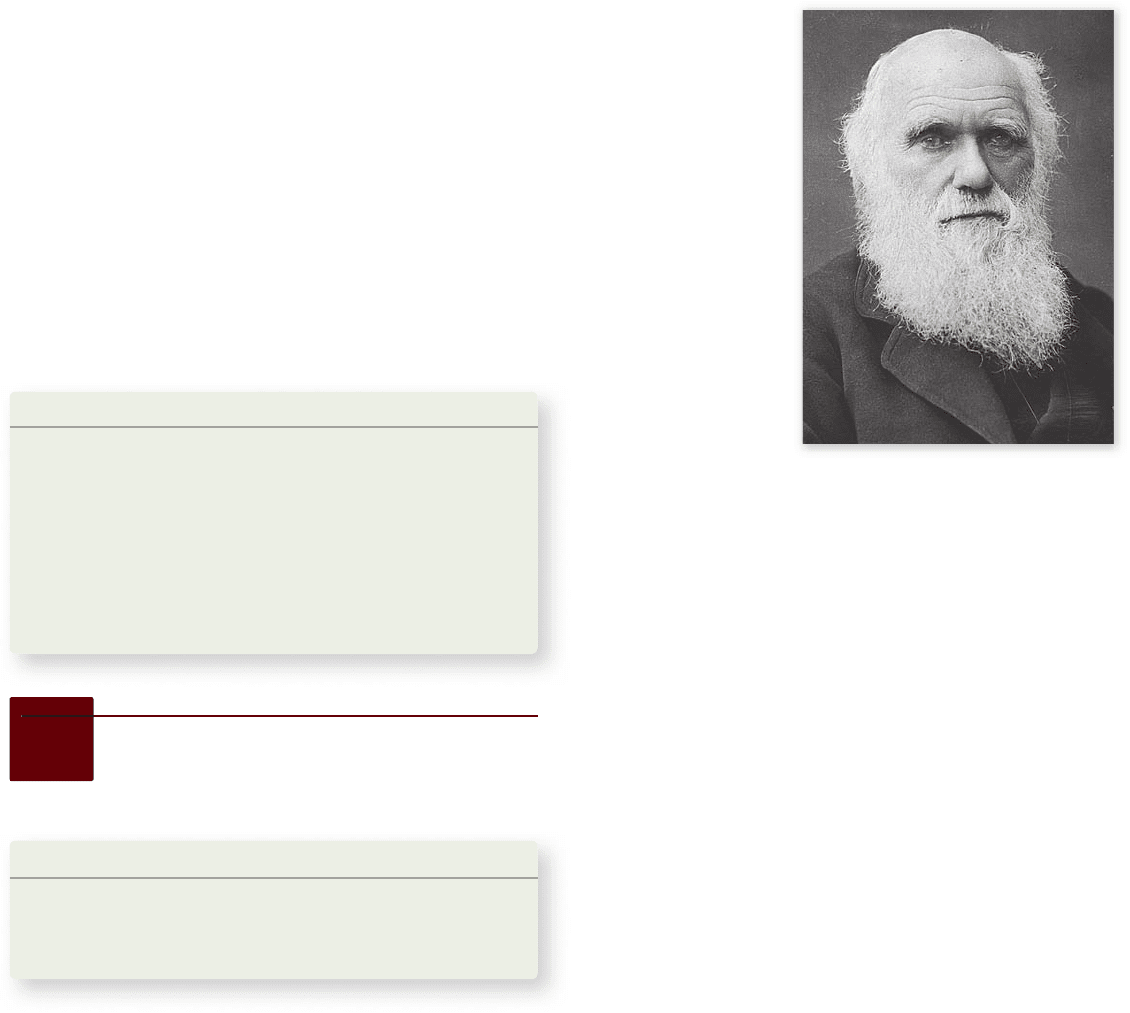
Figure 1.5
Charles
Darwin. This newly
rediscovered photograph
taken in 1881, the year
before Darwin died,
appears to be the last
ever taken of the great
biologist.
The information generated by basic research contributes to
the growing body of scientific knowledge, and it provides the sci-
entific foundation utilized by applied research. Scientists who con-
duct applied research are often employed in some kind of industry.
Their work may involve the manufacture of food additives, the
creation of new drugs, or the testing of environmental quality.
Research results are written up and submitted for publi-
cation in scientific journals, where the experiments and conclu-
sions are reviewed by other scientists. This process of careful
evaluation, called peer review, lies at the heart of modern sci-
ence. It helps to ensure that faulty research or false claims are
not given the authority of scientific fact. It also provides other
scientists with a starting point for testing the reproducibility of
experimental results. Results that cannot be reproduced are not
taken seriously for long.
Learning Outcomes Review 1.2
Much of science is descriptive, amassing observations to gain an accurate
view. Both deductive reasoning and inductive reasoning are used in
science. Scientifi c hypotheses are suggested explanations for observed
phenomena. When a hypothesis has been extensively tested and no
contradictory information has been found, it becomes an accepted theory.
Theories are coherent explanations of observed data, but they may be
modifi ed by new information.
■ How does a scientific theory differ from a hypothesis?
1.3
An Example of Scienti c
Inquiry: Darwin and Evolution
Learning Outcomes
1. Describe Darwin’s theory of evolution by natural
selection.
2. List evidence that supports the theory of evolution.
Darwin’s theory of evolution explains and describes how organ-
isms on Earth have changed over time and acquired a diversity
of new forms. This famous theory provides a good example
of how a scientist develops a hypothesis and how a scientific
theory grows and wins acceptance.
Charles Robert Darwin (1809–1882; figure 1.5) was an
English naturalist who, after 30 years of study and observation,
wrote one of the most famous and influential books of all time.
This book, On the Origin of Species by Means of Natural Selection,
created a sensation when it was published, and the ideas Dar-
win expressed in it have played a central role in the develop-
ment of human thought ever since.
The idea of evolution existed prior to Darwin
In Darwin’s time, most people believed that the different kinds
of organisms and their individual structures resulted from di-
rect actions of a Creator (many people still believe this). Species
were thought to have been specially created and to be un-
changeable over the course of time.
In contrast to these ideas, a number of earlier naturalists
and philosophers had presented the view that living things must
have changed during the history of life on Earth. That is,
evolution has occurred, and living things are now different
from how they began. Darwin’s contribution was a concept he
called natural selection, which he proposed as a coherent, logical
explanation for this process, and he brought his ideas to wide
public attention.
Darwin observed di erences
in related organisms
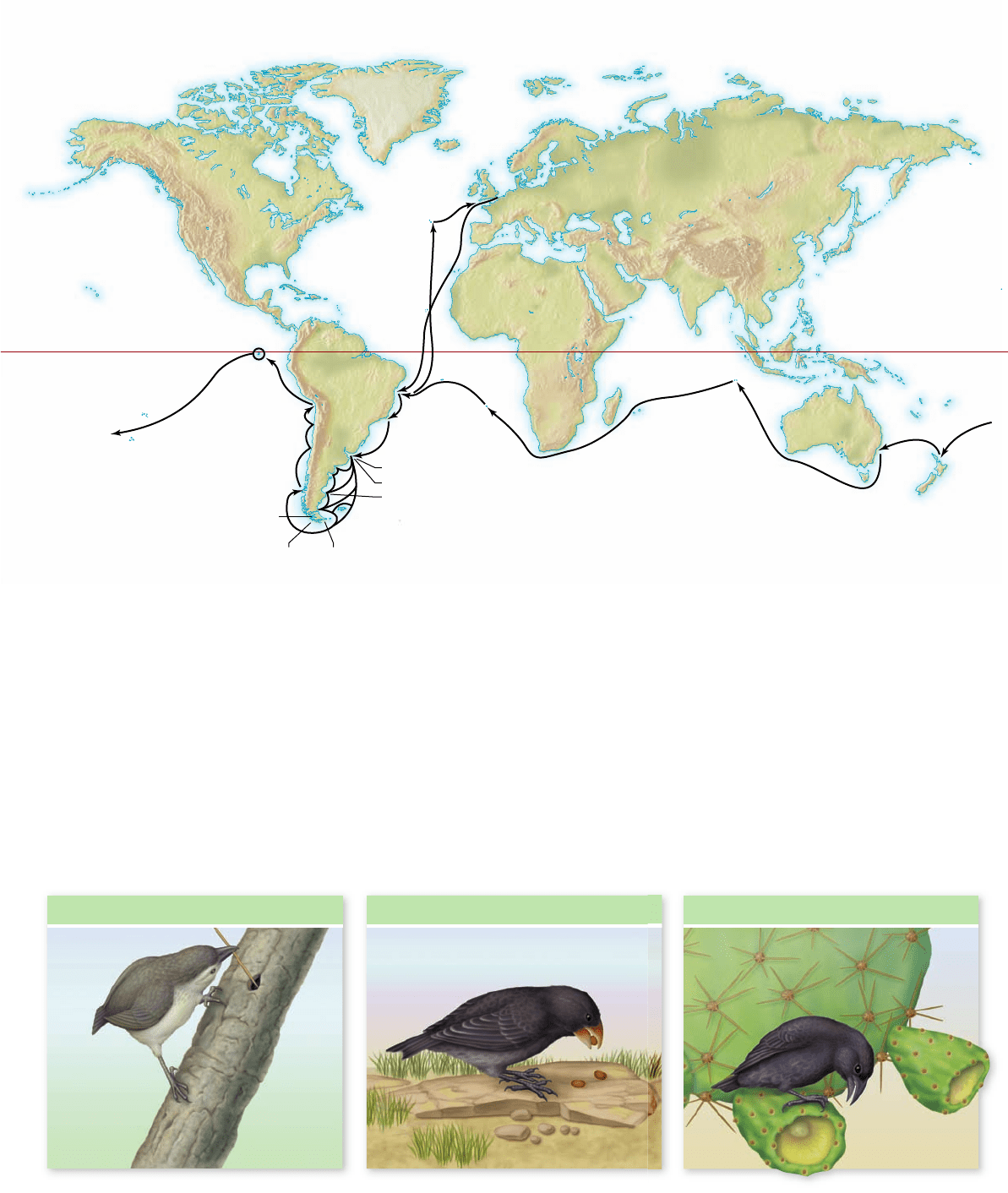
The story of Darwin and his theory begins in 1831, when he
was 22 years old. He was part of a five-year navigational map-
ping expedition around the coasts of South America
(figure 1.6), aboard H.M.S. Beagle. During this long voyage,
Darwin had the chance to study a wide variety of plants and
animals on continents and islands and in distant seas. Darwin
observed a number of phenomena that were of central impor-
tance to his reaching his ultimate conclusion.
Repeatedly, Darwin saw that the characteristics of similar
species varied somewhat from place to place. These geographi-
cal patterns suggested to him that lineages change gradually as
species migrate from one area to another. On the Galápagos
Islands, 960 km (600 miles) off the coast of Ecuador, Darwin
encountered a variety of different finches on the various islands.
The 14 species, although related, differed slightly in appear-
ance, particularly in their beaks (figure 1.7).
Darwin thought it was reasonable to assume that all these
birds had descended from a common ancestor arriving from
the South American mainland several million years ago. Eating
different foods on different islands, the finches’ beaks had
changed during their descent—“descent with modification,” or
evolution. (These finches are discussed in more detail in
chapters 21 and 22.)
8
part
I
The Molecular Basis of Life
rav32223_ch01_001-016.indd 8rav32223_ch01_001-016.indd 8 11/5/09 3:07:14 PM11/5/09 3:07:14 PM
Apago PDF Enhancer
British Isles
Western
Isles
EUROPE
AFRICA
Madagascar
Mauritius
Bourbon Island
Cape of
Good Hope
King George’s
Sound
Hobart
Sydney
AUSTRALIA
New
Zealand
Friendly
Islands
Philippine
Islands
Equator
ASIA
NORTH
ATLANTIC
OCEAN
Cape Verde
Islands
Marquesas
Galápagos
Islands
Valparaiso
Society
Islands
Straits of Magellan
Tierra del FuegoCape Horn
Falkland
Islands
Port Desire
SOUTH
ATLANTIC
OCEAN
Montevideo
Buenos Aires
Rio de Janeiro
St. Helena
Ascension
NORTH
AMERICA
Canary
Islands
Keeling
Islands
SOUTH
AMERICA
Bahia
NORTH
PACIFIC
OCEAN
NORTH
PACIFIC
OCEAN
INDIAN
OCEAN
Woodpecker Finch (Cactospiza pallida) Large Ground Finch (Geospiza magnirostris) Cactus Finch (Geospiza scandens)
Figure 1.7
Three Galápagos nches and what they eat. On the Galápagos Islands, Darwin observed 14 different species of nches
differing mainly in their beaks and feeding habits. These three nches eat very different food items, and Darwin surmised that the different
shapes of their bills represented evolutionary adaptations that improved their ability to eat the foods available in their speci c habitats.
Figure 1.6
The ve-year voyage of H.M.S. Beagle. Most of the time was spent exploring the coasts and coastal islands of South
America, such as the Galápagos Islands. Darwin’s studies of the animals of the Galápagos Islands played a key role in his eventual development
of the concept of evolution by means of natural selection.
In a more general sense, Darwin was struck by the fact that
the plants and animals on these relatively young volcanic islands
resembled those on the nearby coast of South America. If each
one of these plants and animals had been created independently
and simply placed on the Galápagos Islands, why didn’t they re-
semble the plants and animals of islands with similar climates—
such as those off the coast of Africa, for example? Why did they
resemble those of the adjacent South American coast instead?
Darwin proposed natural selection
as a mechanism for evolution
It is one thing to observe the results of evolution, but quite
another to understand how it happens. Darwin’s great achieve-
ment lies in his ability to move beyond all the individual obser-
vations to formulate the hypothesis that evolution occurs
because of natural selection.
chapter
1
The Science of Biology
9www.ravenbiology.com
rav32223_ch01_001-016.indd 9rav32223_ch01_001-016.indd 9 11/5/09 3:07:15 PM11/5/09 3:07:15 PM
Apago PDF Enhancer
2
6
18
54
4
6
8
geometric progression
arithmetic progression
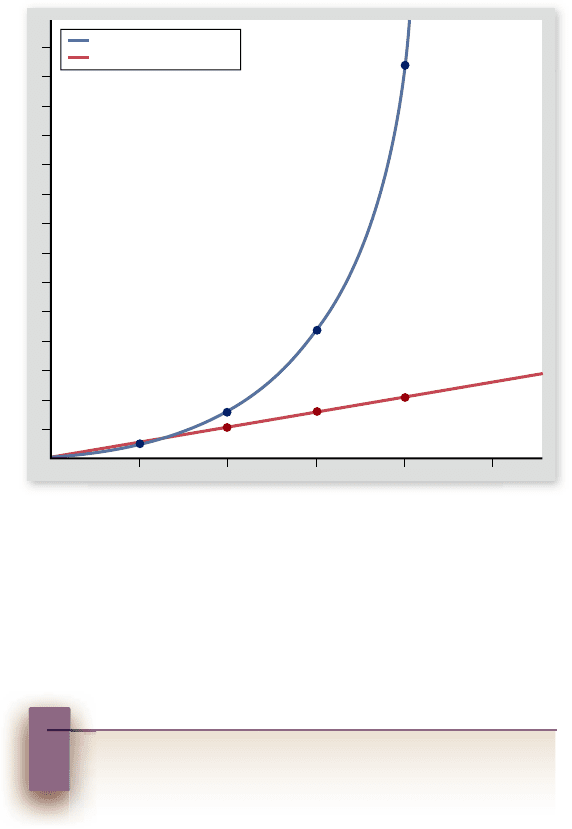
Figure 1.8
Geometric and arithmetic progressions. A
geometric progression increases by a constant factor (for example,
the curve shown increases ×3 for each step), whereas an arithmetic
progression increases by a constant difference (for example, the line
shown increases
+
2 for each step). Malthus contended that the
human growth curve was geometric, but the human food
production curve was only arithmetic.
Inquiry question
In
n
In
n
?
What is the effect of reducing the constant factor by which
the geometric progression increases? Might this effect be
achieved with humans? How?
Darwin and Malthus
Of key importance to the development of Darwin’s insight was
his study of Thomas Malthus’s An Essay on the Principle of Popula-
tion (1798). In this book, Malthus stated that populations of
plants and animals (including human beings) tend to increase
geometrically, while humans are able to increase their food sup-
ply only arithmetically. Put another way, population increases
by a multiplying factor—for example, in the series 2, 6, 18, 54,
the starting number is multiplied by 3. Food supply increases
by an additive factor—for example, the series 2, 4, 6, 8 adds 2 to
each starting number. Figure 1.8 shows the difference that
these two types of relationships produce over time.
Because populations increase geometrically, virtually any
kind of animal or plant, if it could reproduce unchecked, would
cover the entire surface of the world surprisingly quickly. In-
stead, populations of species remain fairly constant year after
year, because death limits population numbers.
Sparked by Malthus’s ideas, Darwin saw that although ev-
ery organism has the potential to produce more offspring than
can survive, only a limited number actually do survive and pro-
duce further offspring. Combining this observation with what he
had seen on the voyage of the Beagle, as well as with his own ex-
periences in breeding domestic animals, Darwin made an impor-
tant association: Individuals possessing physical, behavioral, or
other attributes that give them an advantage in their environ-
ment are more likely to survive and reproduce than those with
less advantageous traits. By surviving, these individuals gain the
opportunity to pass on their favorable characteristics to their off-
spring. As the frequency of these characteristics increases in the
population, the nature of the population as a whole will gradually
change. Darwin called this process selection.
Natural selection
Darwin was thoroughly familiar with variation in domesticated ani-
mals, and he began On the Origin of Species with a detailed discussion
of pigeon breeding. He knew that animal breeders selected certain
varieties of pigeons and other animals, such as dogs, to produce cer-
tain characteristics, a process Darwin called artificial selection.
Artificial selection often produces a great variation in
traits. Domestic pigeon breeds, for example, show much greater
variety than all of the wild species found throughout the world.
Darwin thought that this type of change could occur in nature,
too. Surely if pigeon breeders could foster variation by artificial
selection, nature could do the same—a process Darwin called
natural selection.
Darwin drafts his argument
Darwin drafted the overall argument for evolution by natural
selection in a preliminary manuscript in 1842. After showing
the manuscript to a few of his closest scientific friends, how-
ever, Darwin put it in a drawer, and for 16 years turned to
other research. No one knows for sure why Darwin did not
publish his initial manuscript—it is very thorough and outlines
his ideas in detail .
The stimulus that finally brought Darwin’s hypothesis
into print was an essay he received in 1858. A young English
naturalist named Alfred Russel Wallace (1823–1913) sent the
essay to Darwin from Indonesia; it concisely set forth the hy-
pothesis of evolution by means of natural selection, a hypothe-
sis Wallace had developed independently of Darwin. After
receiving Wallace’s essay, friends of Darwin arranged for a joint
presentation of their ideas at a seminar in London. Darwin then
completed his own book, expanding the 1842 manuscript he
had written so long ago, and submitted it for publication.
The predictions of natural
selection have been tested
More than 120 years have elapsed since Darwin’s death in 1882.
During this period, the evidence supporting his theory has grown
progressively stronger. We briefly explore some of this evidence
here; in chapter 22, we will return to the theory of evolution by
natural selection and examine the evidence in more detail.
The fossil record
Darwin predicted that the fossil record would yield intermedi-
ate links between the great groups of organisms—for example,
between fishes and the amphibians thought to have arisen from
them, and between reptiles and birds. Furthermore, natural se-
lection predicts the relative positions in time of such transitional
forms. We now know the fossil record to a degree that was un-
thinkable in the 19th century, and although truly “intermediate”
10
part
I
The Molecular Basis of Life
rav32223_ch01_001-016.indd 10rav32223_ch01_001-016.indd 10 11/5/09 3:07:20 PM11/5/09 3:07:20 PM
Apago PDF Enhancer
Human Cat Bat Porpoise Horse
Human Rhesus Dog Bird Frog
0 40 30 20 10 60 50 70
Number of Amino Acid Differences in a Hemoglobin Polypeptide
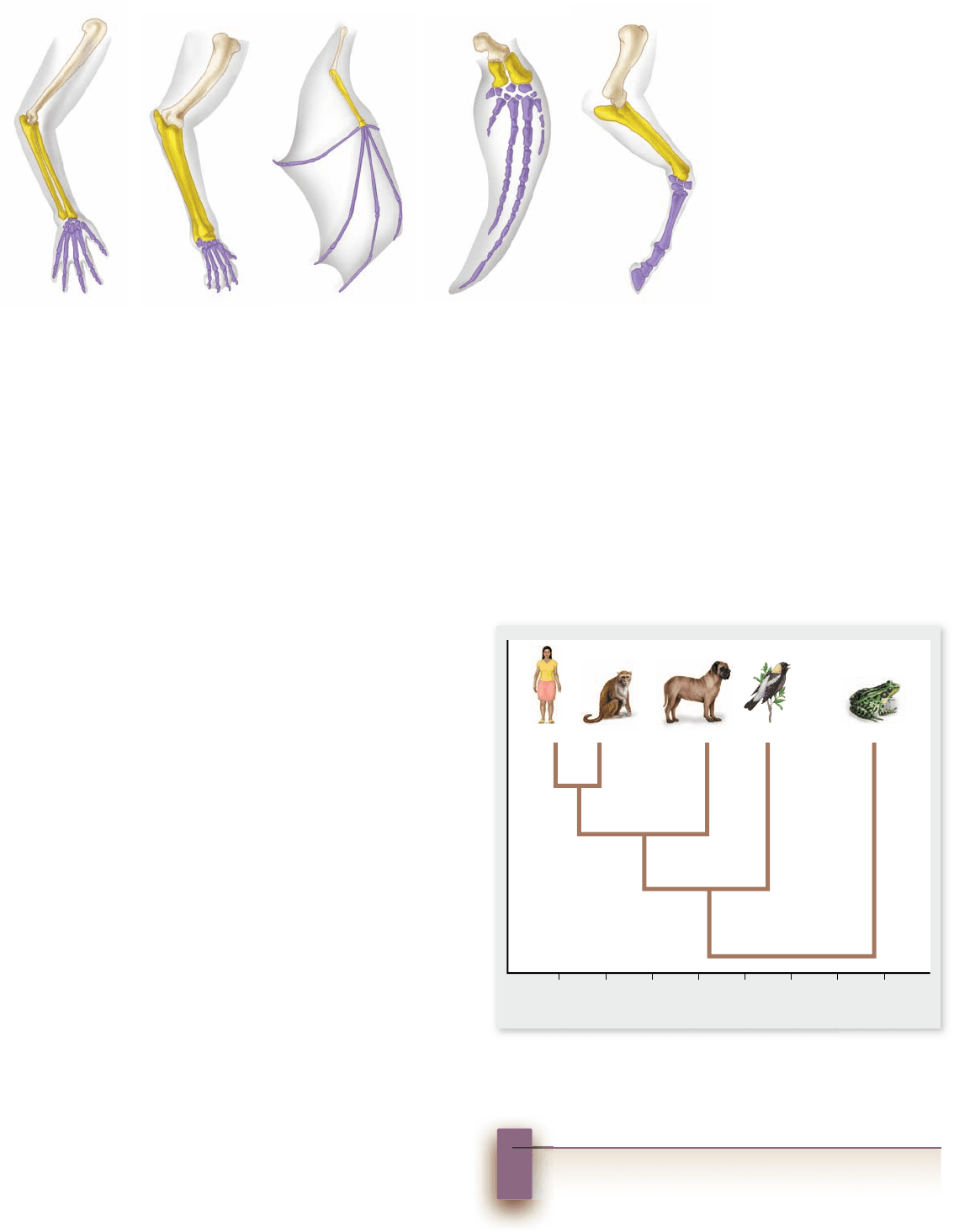
Figure 1.9
Homology
among vertebrate limbs.
The forelimbs of these ve
vertebrates show the ways in
which the relative proportions of
the forelimb bones have changed
in relation to the particular way
of life of each organism.
Figure 1.10
Molecules re ect evolutionary patterns.
Vertebrates that are more distantly related to humans have a greater
number of amino acid differences in the hemoglobin polypeptide.
Inquiry question
In
n
In
n
?
Where do you imagine a snake might fall on the graph? Why?
organisms are hard to determine, paleontologists have found
what appear to be transitional forms and found them at the pre-
dicted positions in time.
Recent discoveries of microscopic fossils have extended
the known history of life on Earth back to about 3.5 billion
years ago (bya). The discovery of other fossils has supported
Darwin’s predictions and has shed light on how organisms have,
over this enormous time span, evolved from the simple to the
complex. For vertebrate animals especially, the fossil record is
rich and exhibits a graded series of changes in form, with the
evolutionary sequence visible for all to see.
The age of the Earth
Darwin’s theory predicted the Earth must be very old, but some
physicists argued that the Earth was only a few thousand years old.
This bothered Darwin, because the evolution of all living things
from some single original ancestor would have required a great
deal more time. Using evidence obtained by studying the rates of
radioactive decay, we now know that the physicists of Darwin’s
time were very wrong: The Earth was formed about 4.5 bya.
The mechanism of heredity
Darwin received some of his sharpest criticism in the area of
heredity. At that time, no one had any concept of genes or how
heredity works, so it was not possible for Darwin to explain
completely how evolution occurs.
Even though Gregor Mendel was performing his experi-
ments with pea plants in Brünn, Austria (now Brno, the Czech
Republic), during roughly the same period, genetics was estab-
lished as a science only at the start of the 20th century. When sci-
entists began to understand the laws of inheritance (discussed in
chapters 12 and 13), this problem with Darwin’s theory vanished.
Comparative anatomy
Comparative studies of animals have provided strong evidence
for Darwin’s theory. In many different types of vertebrates, for
example, the same bones are present, indicating their evolu-
tionary past. Thus, the forelimbs shown in figure 1.9 are all
constructed from the same basic array of bones, modified for
different purposes.
These bones are said to be homologous in the different ver-
tebrates; that is, they have the same evolutionary origin, but they
now differ in structure and function. They are contrasted with
analogous structures, such as the wings of birds and butterflies,
which have similar function but different evolutionary origins.
Molecular evidence
Evolutionary patterns are also revealed at the molecular level.
By comparing the genomes (that is, the sequences of all the
genes) of different groups of animals or plants, we can more
precisely specify the degree of relationship among the groups.
A series of evolutionary changes over time should involve a
continual accumulation of genetic changes in the DNA.
This difference can be seen clearly in the protein he-
moglobin (figure 1.10). Rhesus monkeys, which like humans
chapter
1
The Science of Biology
11www.ravenbiology.com
rav32223_ch01_001-016.indd 11rav32223_ch01_001-016.indd 11 11/5/09 3:07:21 PM11/5/09 3:07:21 PM