
Raven P.H., Johnson G.B., Mason K.A. Biology (Ninth Edition)
Подождите немного. Документ загружается.

Apago PDF Enhancer
60 μm
568 μm
b.
a.
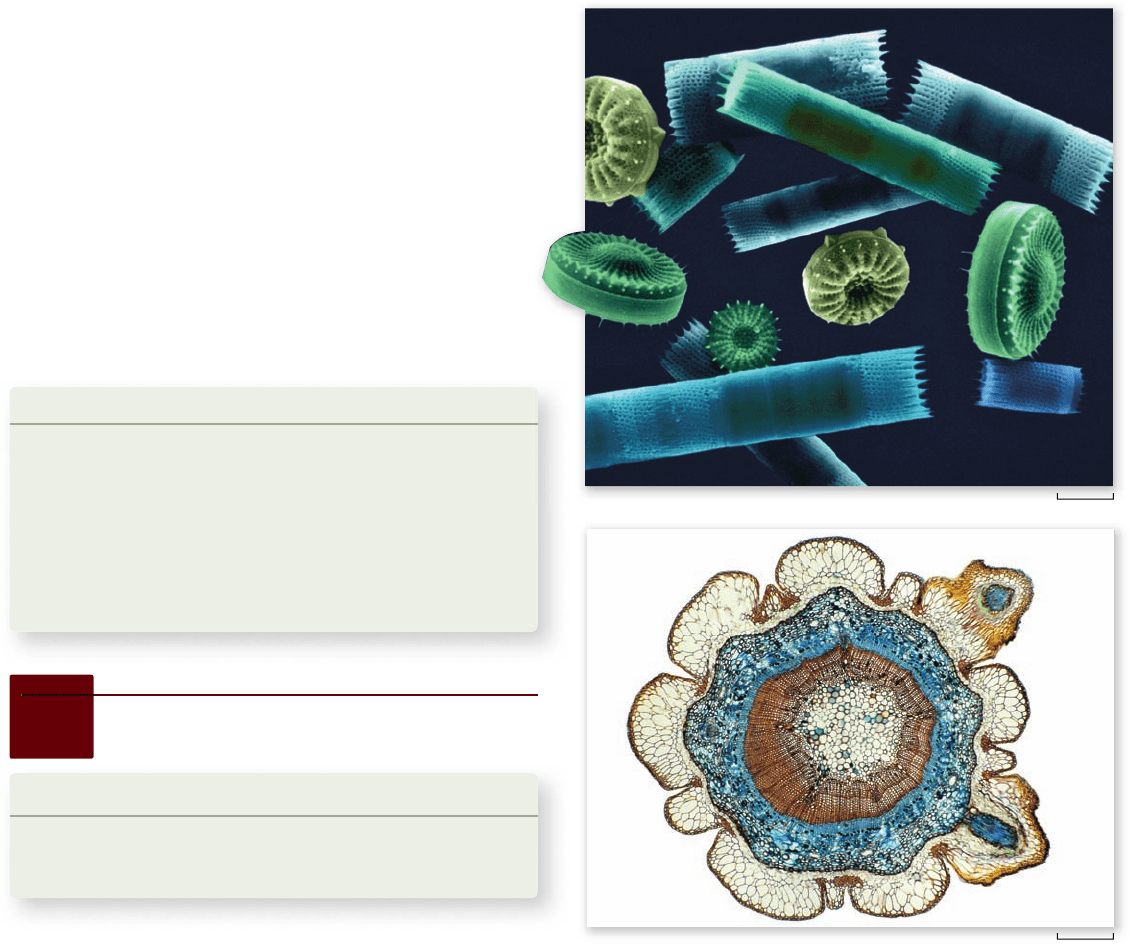
Figure 1.11
Cellular basis of life. All organisms are
composed of cells. Some organisms, including the protists, shown in
part (a) are single-celled. Others, such as the plant shown in cross
section in part (b) consist of many cells.
are primates, have fewer differences from humans in the
146-ami no-acid hemoglobin β-chain than do more distantly
related mammals, such as dogs. Nonmammalian vertebrates,
such as birds and frogs, differ even more.
The sequences of some genes, such as the ones specifying
the hemoglobin proteins, have been determined in many or-
ganisms, and the entire time course of their evolution can be
laid out with confidence by tracing the origins of particular
nucleotide changes in the gene sequence. The pattern of de-
scent obtained is called a phylogenetic tree. It represents the
evolutionary history of the gene, its “family tree.” Molecular
phylogenetic trees agree well with those derived from the
fossil record, which is strong direct evidence of evolution.
The pattern of accumulating DNA changes represents, in a real
sense, the footprints of evolutionary history.
Learning Outcomes Review 1.3
Darwin observed diff erences in related organisms and proposed the
hypothesis of evolution by natural selection to explain these diff erences. The
predictions generated by natural selection have been tested and continue
to be tested by analysis of the fossil record, genetics, comparative anatomy,
and even the DNA of living organisms.
■ Does Darwin’s theory of evolution by natural selection
explain the origin of life?
1.4
Unifying Themes in Biology
Learning Outcomes
1. Describe the unifying themes in biology.
2. Contrast living and nonliving systems.
The study of biology encompasses a large number of different
subdisciplines, ranging from biochemistry to ecology. In all of
these, however, unifying themes can be identified. Among these
are cell theory, the molecular basis of inheritance, the relation-
ship between structure and function, evolution, and the emer-
gence of novel properties.
Cell theory describes the organization
of living systems
As was stated at the beginning of this chapter, all organisms are
composed of cells, life’s basic units (figure 1.11). Cells were dis-
covered by Robert Hooke in England in 1665, using one of the
first microscopes, one that magnified 30 times. Not long after
that, the Dutch scientist Anton van Leeuwenhoek used micro-
scopes capable of magnifying 300 times and discovered an
amazing world of single-celled life in a drop of pond water.
In 1839, the German biologists Matthias Schleiden and
Theodor Schwann, summarizing a large number of observa-
tions by themselves and others, concluded that all living organ-
isms consist of cells. Their conclusion has come to be known as
the cell theory. Later, biologists added the idea that all cells
come from preexisting cells. The cell theory, one of the basic
ideas in biology, is the foundation for understanding the repro-
duction and growth of all organisms.
The molecular basis of inheritance
explains the continuity of life
Even the simplest cell is incredibly complex—more intricate
than any computer. The information that specifies what a cell is
like—its detailed plan—is encoded in deoxyribonucleic acid
(DNA), a long, cablelike molecule. Each DNA molecule is
12
part
I
The Molecular Basis of Life
rav32223_ch01_001-016.indd 12rav32223_ch01_001-016.indd 12 11/9/09 10:43:31 AM11/9/09 10:43:31 AM
Apago PDF Enhancer
Bacteria
Archaea
Animalia
Fungi
Protista
Plantae
Eukarya
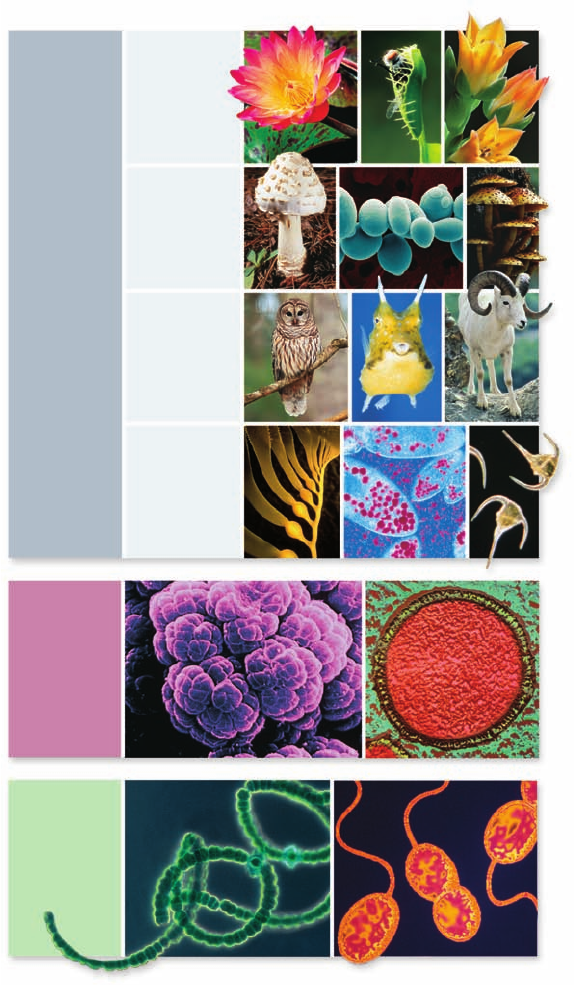
Figure 1.12
The diversity of life. Biologists categorize all
living things into three overarching groups called domains:
Bacteria, Archaea, and Eukarya. Domain Eukarya is composed of
four kingdoms: Plantae, Fungi, Animalia, and Protista.
formed from two long chains of building blocks, called nucle-
otides, wound around each other (see chapter 14) . Four differ-
ent nucleotides are found in DNA, and the sequence in which
they occur encodes the cell’s information. Specific sequences of
several hundred to many thousand nucleotides make up a gene,
a discrete unit of information.
The continuity of life from one generation to the next—
heredity—depends on the faithful copying of a cell’s DNA into
daughter cells. The entire set of DNA instructions that speci-
fies a cell is called its genome. The sequence of the human ge-
nome, 3 billion nucleotides long, was decoded in rough draft
form in 2001, a triumph of scientific investigation.
The relationship between structure
and function underlies living systems
One of the unifying themes of molecular biology is the rela-
tionship between structure and function. Function in mole-
cules, and larger macromolecular complexes, is dependent on
their structure.
Although this observation may seem trivial, it has far-
reaching implications. We study the structure of molecules and
macromolecular complexes to learn about their function. When
we know the function of a particular structure, we can infer the
function of similar structures found in different contexts, such
as in different organisms.
Biologists study both aspects, looking for the relation-
ships between structure and function. On the one hand, this
allows similar structures to be used to infer possible similar
functions. On the other hand, this knowledge also gives clues as
to what kinds of structures may be involved in a process if we
know about the functionality.
For example, suppose that we know the structure of a hu-
man cell’s surface receptor for insulin, the hormone that con-
trols uptake of glucose. We then find a similar molecule in the
membrane of a cell from a different species—perhaps even a
very different organism, such as a worm. We might conclude
that this membrane molecule acts as a receptor for an insulin-
like molecule produced by the worm. In this way, we might be
able to discern the evolutionary relationship between glucose
uptake in worms and in humans.
The diversity of life arises
by evolutionary change
The unity of life that we see in certain key characteristics shared
by many related life-forms contrasts with the incredible diver-
sity of living things in the varied environments of Earth. The
underlying unity of biochemistry and genetics argues that all
life has evolved from the same origin event. The diversity of life
arises by evolutionary change leading to the present biodiver-
sity we see.
Biologists divide life’s great diversity into three great groups,
called domains: Bacteria, Archaea, and Eukarya (figure 1.12). The
domains Bacteria and Archaea are composed of single-celled or-
ganisms (prokaryotes) with little internal structure, and the domain
Eukarya is made up of organisms (eukaryotes) composed of a com-
plex, organized cell or multiple complex cells.
Within Eukarya are four main groups called kingdoms
(figure 1.12). Kingdom Protista consists of all the unicellular
eukaryotes except yeasts (which are fungi), as well as the multi-
cellular algae. Because of the great diversity among the protists,
many biologists feel kingdom Protista should be split into sev-
eral kingdoms.
Kingdom Plantae consists of organisms that have cell walls
of cellulose and obtain energy by photosynthesis. Organisms in
the kingdom Fungi have cell walls of chitin and obtain energy by
secreting digestive enzymes and then absorbing the products they
release from the external environment. Kingdom Animalia con-
tains organisms that lack cell walls and obtain energy by first in-
gesting other organisms and then digesting them internally.
chapter
1
The Science of Biology
13www.ravenbiology.com
rav32223_ch01_001-016.indd 13rav32223_ch01_001-016.indd 13 11/5/09 3:07:25 PM11/5/09 3:07:25 PM
Apago PDF Enhancer
Mus musculus
(animal)
Saccharomyces cerevisiae
(fungus)
Saccharomyces cerevisiae
(fungus)
Mus musculus
(animal)
Arabidopsis
thaliana
(plant)
Arabidopsis
thaliana
(plant)
MEIS
KN
BEL1
MATa1
MATa2
PHO2
HB8
HAT
GL2
PAX6
PEM
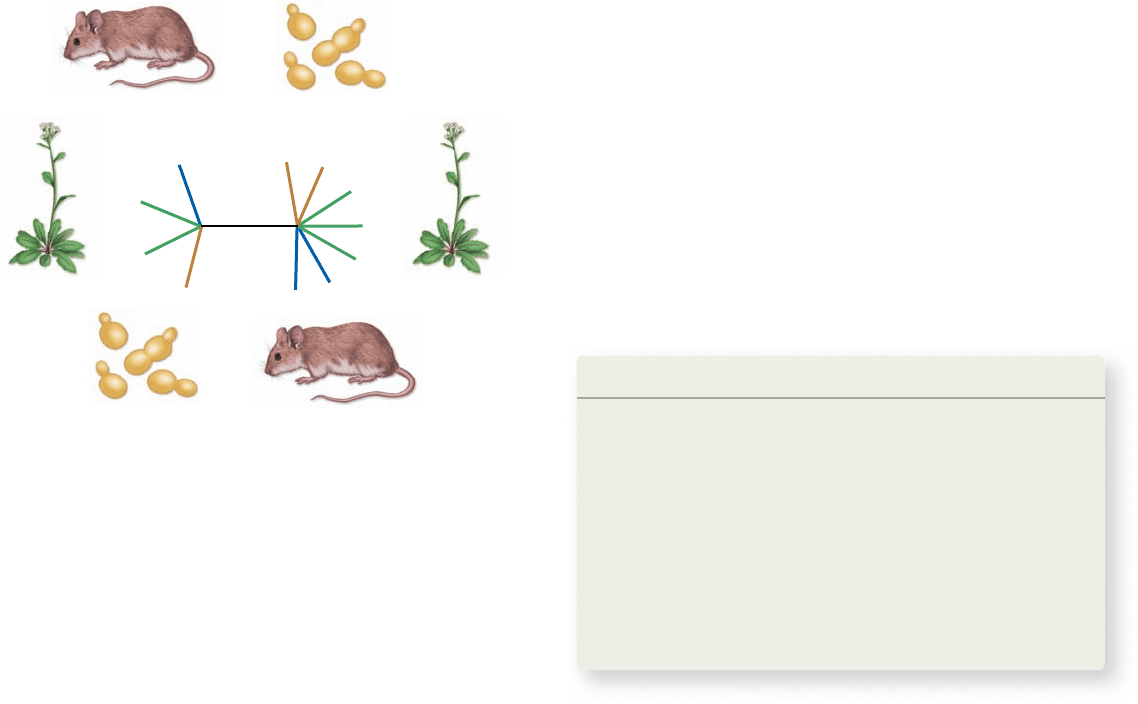
Figure 1.13
Tree of homeodomain proteins.
Homeodomain proteins are found in fungi (brown), plants (green),
and animals (blue). Based on their sequence similarities, these 11
different homeodomain proteins (uppercase letters at the ends of
branches) fall into two groups, with representatives from each
kingdom in each group. That means, for example, the mouse
homeodomain protein PAX6 is more closely related to fungal and
owering plant proteins, such as PHO2 and GL2, than it is to the
mouse protein MEIS.
Evolutionary conservation explains
the unity of living systems
Biologists agree that all organisms alive today have descended
from some simple cellular creature that arose about 3.5 bya.
Some of the characteristics of that earliest organism have been
preserved. The storage of hereditary information in DNA, for
example, is common to all living things.
The retention of these conserved characteristics in a long
line of descent usually reflects that they have a fundamental
role in the biology of the organism—one not easily changed
once adopted. A good example is provided by the homeo domain
proteins, which play critical roles in early development in
eukaryotes. Conserved characteristics can be seen in approxi-
mately 1850 homeodomain proteins, distributed among three
different kingdoms of organisms (figure 1.13). The homeo-
domain proteins are powerful developmental tools that evolved
early, and for which no better alternative has arisen.
Cells are information-processing systems
One way to think about cells is as highly complex nanoma-
chines that process information. The information stored in
DNA is used to direct the synthesis of cellular components, and
the particular set of components can differ from cell to cell.
The way that proteins fold in space is a form of information
that is three-dimensional, and interesting properties emerge
from the interaction of these shapes in macromolecular com-
plexes. The control of gene expression allows differentiation of
cell types in time and space, leading to changes over develop-
mental time into different tissue types—even though all cells in
an organism carry the same genetic information.
Cells also process information that they receive about the
environment. Cells sense their environment through proteins
in their membranes, and this information is transmitted across
the membrane to elaborate signal-transduction chemical path-
ways that can change the functioning of a cell.
This ability of cells to sense and respond to their environ-
ment is critical to the function of tissues and organs in multicel-
lular organisms. A multicellular organism can regulate its
internal environment, maintaining constant temperature, pH,
and concentrations of vital ions. This homeostasis is possible
because of elaborate signaling networks that coordinate the ac-
tivities of different cells in different tissues.
Living systems exist in a nonequilibrium state
A key feature of living systems is that they are open systems
that function far from thermodynamic equilibrium. This has a
number of implications for their behavior. A constant supply of
energy is necessary to maintain a stable nonequilibrium state.
Consider the state of the nucleic acids, and proteins in all of
your cells: at equilibrium they are not polymers, they would all
be hydrolyzed to monomer nucleotides and amino acids. Sec-
ond, nonequilibrium systems exhibit self-organizing properties
not seen in equilibrium systems.
These self-organizing properties of living systems show
up at different levels of the hierarchical organization. At the cel-
lular level, macromolecular complexes such as the spindle nec-
essary for chromosome separatation can self-organize. At the
population level, a flock of birds, a school of fish, or the bacteria
in a biofilm are all also self-organizing. This kind of interacting
behavior of individual units leads to emergent properties that
are not predictable from the nature of the units themselves.
Emergent properties are properties of collections of mol-
ecules, cells, individuals, that are distinct from the categorical
properties that can be described by such statistics as mean and
standard deviation. The mathematics necessary to describe these
kind of interacting systems is nonlinear dynamics. The emerging
field of systems biology is beginning to model biological systems
in this way. The kinds of feedback and feedforward loops that
exist between molecules in cells, or neurons in a nervous system,
lead to emergent behaviors like human consciousness.
Learning Outcomes Review 1.4
Biology is a broad and complex fi eld, but we can identify unifying
themes in this complexity. Cells are the basic unit of life, and they
are information-processing machines. The structures of molecules,
macromolecular complexes, cells, and even higher levels of organization
are related to their functions. The diversity of life can be classifi ed and
organized based on similar features; biologists identify three large
domains that encompass six kingdoms. Living organisms are able to use
energy to construct complex molecules from simple ones, and are thus not
in a state of thermodynamic equilibrium.
■ How do viruses fit into our definitions of living systems?
14
part
I
The Molecular Basis of Life
rav32223_ch01_001-016.indd 14rav32223_ch01_001-016.indd 14 11/5/09 3:07:28 PM11/5/09 3:07:28 PM

Apago PDF Enhancer
Chapter Review
1.1 The Science of Life
Biology uni es much of the natural sciences.
The study of biological systems is interdisciplinary because solutions
require many different approaches to solve a problem.
Life de es simple de nition.
Although life is dif cult to de ne, living systems have seven
characteristics in common. They are composed of one or more cells;
are complex and highly ordered; can respond to stimuli; can grow,
reproduce, and transmit genetic information to their offspring; need
energy to accomplish work; can maintain relatively constant internal
conditions (homeostasis); and are capable of evolutionary adaptation
to the environment.
Living systems show hierarchical organization.
The hierarchical organization of living systems progresses from
atoms to the biosphere. At each higher level, emergent properties
arise that are greater than the sum of the parts.
1.2 The Nature of Science
At its core, science is concerned with understanding the nature
of the world by using observation and reasoning.
Much of science is descriptive.
Science is concerned with developing an increasingly accurate
description of nature through observation and experimentation.
Science uses both deductive and inductive reasoning.
Deductive reasoning applies general principles to predict
speci c results. Inductive reasoning uses speci c observations to
construct general scienti c principles.
Hypothesis-driven science makes and tests predictions.
A hypothesis is constructed based on observations, and it must
generate experimentally testable predictions. Experiments involve
a test in which a variable is manipulated, and a control in which
the variable is not manipulated. Hypotheses are rejected if their
predictions cannot be veri ed by observation or experiment.
Reductionism breaks larger systems into their component parts.
Reductionism attempts to understand a complex system by breaking
it down into its component parts. It is limited because parts may act
differently when isolated from the larger system.
Biologists construct models to explain living systems.
A model provides a way of organizing our thinking about a problem;
models may also suggest experimental approaches.
The nature of scienti c theories.
Scientists use the word theory in two main ways: as a proposed
explanation for some natural phenomenon and as a body of concepts
that explains facts in an area of study.
Research can be basic or applied.
Basic research extends the boundaries of what we know; applied
research seeks to use scienti c ndings in practical areas such as
agriculture, medicine, and industry.
1.3 An Example of Scienti c Inquiry
Darwin’s theory of evolution shows how a scientist develops a
hypothesis and sets forth evidence, as well as how a scienti c theory
grows and gains acceptance.
The idea of evolution existed prior to Darwin.
A number of naturalists and philosophers had suggested living things
had changed during Earth’s history. Darwin’s contribution was the
concept of natural selection.
Darwin observed di erences in related organisms.
During the voyage of the H.M.S. Beagle, Darwin had an opportunity
to observe worldwide patterns of diversity.
Darwin proposed natural selection as a mechanism for evolution.
Darwin noted that species produce many offspring, but only a limited
number survive and reproduce. He observed that the traits of offspring
can be changed by arti cial selection. Darwin proposed that individuals
possessing traits that increase survival and reproductive success
become more numerous in populations over time. This is the essence
of descent with modi cation (natural selection). Alfred Russel Wallace
independently came to the same conclusions from his own studies.
The predictions of natural selection have been tested.
Natural selection has been tested using data from many elds.
Among these are the fossil record; the age of the Earth, determined
by rates of radioactive decay to be 4.5 billion years; genetic
experiments such as those of Gregor Mendel, showing that traits can
be inherited as discrete units; comparative anatomy and the study of
homologous structures; and molecular data that provides evidence
for changes in DNA and proteins over time.
Taken together, these ndings strongly support evolution by natural
selection. No data to conclusively disprove evolution has been found.
1.4 Unifying Themes in Biology
Cell theory describes the organization of living systems.
The cell is the basic unit of life and is the foundation for
understanding growth and reproduction in all organisms.
The molecular basis of inheritance explains the continuity of life.
Hereditary information, encoded in genes found in the DNA
molecule, is passed on from one generation to the next.
The relationship between structure and function underlies
living systems.
The function of macromolecules and their complexes is dictated by and
dependent on their structure. Similarity of structure and function from
one life form to another may indicate an evolutionary relationship.
The diversity of life arises by evolutionary change.
Living organisms appear to have had a common origin from
which a diversity of life arose by evolutionary change. They can
be grouped into three domains comprising six kingdoms based on
their differences.
Evolutionary conservation explains the unity of living systems.
The underlying similarities in biochemistry and genetics support the
contention that all life evolved from a single source.
Cells are information-processing systems.
Cells can sense and respond to environmental changes through
proteins located on their cell membranes. Differential expression of
stored genetic information is the basis for different cell types.
Living systems exist in a nonequilibrium state.
Organisms are open systems that need a constant supply of energy
to maintain their stable nonequilibrium state. Living things are
able to self-organize, creating levels of complexity that may exhibit
emergent properties.
chapter
1
The Science of Biology
15www.ravenbiology.com
rav32223_ch01_001-016.indd 15rav32223_ch01_001-016.indd 15 11/5/09 3:07:29 PM11/5/09 3:07:29 PM

Apago PDF Enhancer
U N DERS TAN D
1. Which of the following is NOT a property of life?
a. Energy utilization c. Order
b. Movement d. Homeostasis
2. The process of inductive reasoning involves
a. the use of general principles to predict a speci c result.
b. the generation of speci c predictions based on a
belief system.
c. the use of speci c observations to develop
general principles.
d. the use of general principles to support a hypothesis.
3. A hypothesis in biology is best described as
a. a possible explanation of an observation.
b. an observation that supports a theory.
c. a general principle that explains some aspect of life.
d. an unchanging statement that correctly predicts some
aspect of life.
4. A scienti c theory is
a. a guess about how things work in the world.
b. a statement of how the world works that is supported by
experimental data.
c. a belief held by many scientists.
d. both a and c.
5. The cell theory states that
a. cells are small.
b. cells are highly organized.
c. there is only one basic type of cell.
d. all living things are made up of cells.
6. The molecule DNA is important to biological systems because
a. it can be replicated.
b. it encodes the information for making a new individual.
c. it forms a complex, double-helical structure.
d. nucleotides form genes.
7. The organization of living systems is
a. linear with cells at one end and the biosphere at the other.
b. circular with cells in the center.
c. hierarchical with cells at the base, and the biosphere at the top.
d. chaotic and beyond description.
8. The idea of evolution
a. was original to Darwin.
b. was original to Wallace.
c. predated Darwin and Wallace.
d. both a and b.
APPLY
1. What is the signi cance of Pasteur’s experiment to test the
germ hypothesis?
a. It proved that heat can sterilize a broth.
b. It demonstrated that cells can arise spontaneously.
c. It demonstrated that some cells are germs.
d. It demonstrated that cells can only arise from other cells.
2. Which of the following is NOT an example of reductionism?
a. Analysis of an isolated enzyme’s function in an
experimental assay
b. Investigation of the effect of a hormone on cell growth
in a Petri dish
c. Observation of the change in gene expression in response
to speci c stimulus
d. An evaluation of the overall behavior of a cell
3. How is the process of natural selection different from that
of arti cial selection?
a. Natural selection produces more variation.
b. Natural selection makes an individual better adapted.
c. Arti cial selection is a result of human intervention.
d. Arti cial selection results in better adaptations.
4. How does the fossil record help support the theory of evolution
by natural selection?
a. It demonstrates that simple organisms predate more
complex organisms.
b. It provides evidence of change in the form of organisms
over time.
c. It shows that diversity existed millions of years ago.
d. Both a and b.
5. The theory of evolution by natural selection is a good example
of how science proceeds because
a. it rationalizes a large body of observations.
b. it makes predictions that have been tested by a variety
of approaches.
c. it represents Darwin’s belief of how life has changed over time.
d. both a and b.
6. In which domain of life would you nd only single-celled
organisms?
a. Eukarya c. Archaea
b. Bacteria d. Both b and c
7. Evolutionary conservation occurs when a characteristic is
a. important to the life of the organism.
b. not in uenced by evolution.
c. reduced to its least complex form.
d. found in more primitive organisms.
S Y N THES IZE
1. Exobiology is the study of life on other planets. In recent years,
scientists have sent various spacecraft out into the galaxy in
search for extraterrestrial life. Assuming that all life shares
common properties, what should exobiologists be looking for as
they explore other worlds?
2. The classic experiment by Pasteur (see gure 1.4) tested the
hypothesis that cells arise from other cells. In this experiment
cell growth was measured following sterilization of broth in a
swan-neck ask or in a ask with a broken neck.
a. Which variables were kept the same in these two
experiments?
b. How does the shape of the ask affect the experiment?
c. Predict the outcome of each experiment based on the
two hypotheses.
d. Some bacteria (germs) are capable of producing heat-
resistant spores that protect the cell and allow it to
continue to grow after the environment cools. How would
the outcome of this experiment have been affected if spore-
forming bacteria were present in the broth?
Review Questions
16
part
I
The Molecular Basis of Life
rav32223_ch01_001-016.indd 16rav32223_ch01_001-016.indd 16 11/5/09 3:07:29 PM11/5/09 3:07:29 PM

Apago PDF Enhancer
A
Chapter
2
The Nature of
Molecules and the
Properties of Water
Chapter Outline
2.1 The Nature of Atoms
2.2 Elements Found in Living Systems
2.3 The Nature of Chemical Bonds
2.4 Water: A Vital Compound
2.5 Properties of Water
2.6 Acids and Bases
Introduction
About 12.5 billion years ago, an enormous explosion probably signalled the beginning of the universe. This explosion started
a process of star building and planetary formation that eventually led to the formation of Earth, about 4.5 billion years ago
(
BYA). Around 3.5 BYA , life began on Earth and started to diversify. To understand the nature of life on Earth, we first need to
understand the nature of the matter that forms the building blocks of all life.
The earliest speculations about the world around us included this most basic question, “What is it made of?” The
ancient Greeks recognized that larger things may be built of smaller parts. This concept was formed into a solid experimental
scientific idea in the early 20th century, when physicists began trying to break atoms apart. From those humble beginnings
to the huge particle accelerators used by the modern physicists of today, the picture of the atomic world emerges as
fundamentally different from the tangible, macroscopic world around us.
To understand how living systems are assembled, we must first understand a little about atomic structure, about
how atoms can be linked together by chemical bonds to make molecules, and about the ways in which these small molecules
are joined together to make larger molecules, until finally we arrive at the structures of cells and then of organisms. Our
study of life on Earth therefore begins with physics and chemistry. For many of you, this chapter will be a review of material
encountered in other courses.
CHAPTER
rav32223_ch02_017-032.indd 17rav32223_ch02_017-032.indd 17 11/9/09 12:02:18 PM11/9/09 12:02:18 PM
Apago PDF Enhancer
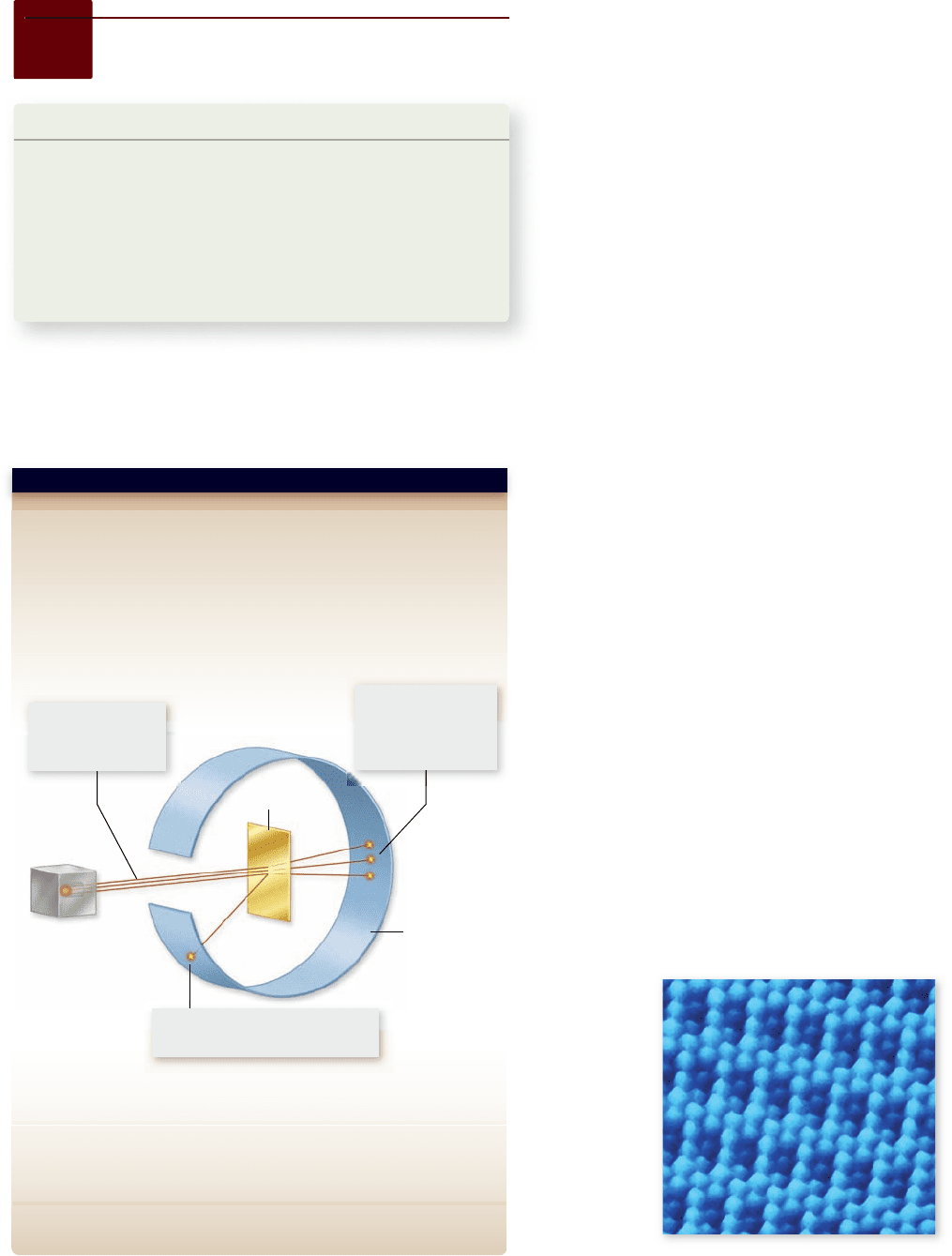
Hypothesis: Atoms are composed of diffuse positive charge with
embedded negative charge (electrons).
Prediction: If alpha particles (
a
), which are helium nuclei, are shot at a
thin foil of gold, the
a
-particles will not be deflected much by the diffuse
positive charge or by the light electrons.
Test:
a
-Particles are shot at a thin sheet of gold foil surrounded by a
detector screen, which shows flashes of light when hit by the particles.
Result: Most particles are not deflected at all, but a small percentage of
particles are deflected at angles of 90° or more.
Conclusion: The hypothesis is not supported. The large deflections
observed led to a view of the atom as composed of a very small central
region containing positive charge (the nucleus) surrounded by electrons.
Further Experiments: How does the Bohr atom with its quantized
energy for electrons extend this model?
SCIENTIFIC THINKING
a-Particle
source
Detector
screen
Gold foil
1. a-Particles are
fired at gold
foil target.
2. Most a-particles
pass through
foil with little or
no deflection.
3. Some a-particles are
deflected by more than 90°.
2.1
The Nature of Atoms
Learning Outcomes
Define element, atomic number, atomic mass, 1.
and isotope.
Describe atomic structure, the relationships of subatomic 2.
particles, and how these relationships determine
chemical properties.
Explain the discrete energy levels in which electrons orbit 3.
the nucleus of an atom.
Any substance in the universe that has mass and occupies space
is defined as matter. All matter is composed of extremely small
particles called atoms. Because of their size, atoms are difficult
to study. Not until early in the 20th century did scientists carry
out the first experiments revealing the physical nature of atoms
(figure 2.1).
Atomic structure includes a central
nucleus and orbiting electrons
Objects as small as atoms can be “seen” only indirectly, by using
complex technology such as tunneling microscopy (figure 2.2) .
We now know a great deal about the complexities of atomic
structure, but the simple view put forth in 1913 by the Danish
physicist Niels Bohr provides a good starting point for under-
standing atomic theory. Bohr proposed that every atom pos-
sesses an orbiting cloud of tiny subatomic particles called
electrons whizzing around a core, like the planets of a miniature
solar system. At the center of each atom is a small, very dense
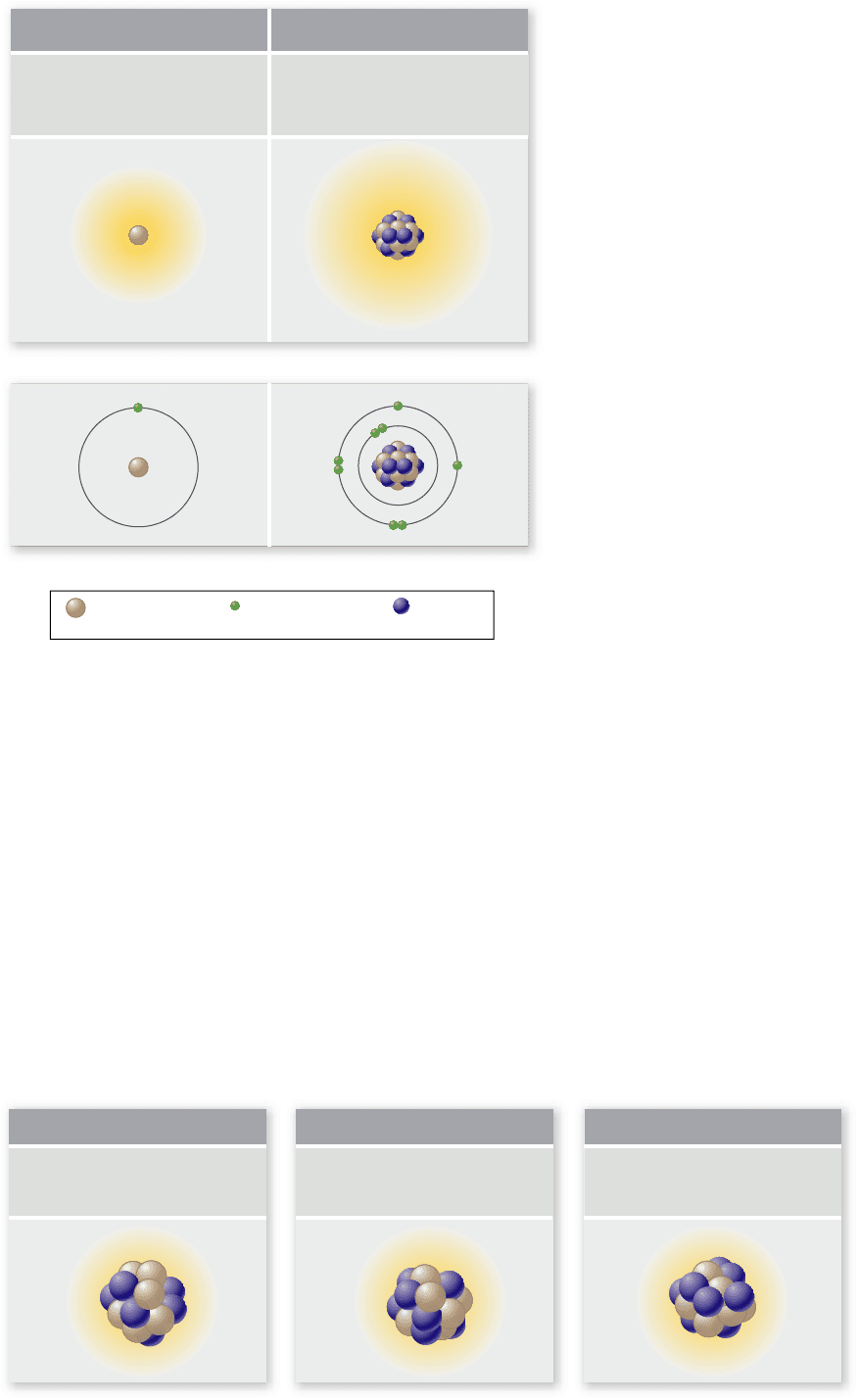
nucleus formed of two other kinds of subatomic particles: pro-
tons and neutrons (figure 2.3).
Atomic number and the elements
Within the nucleus, the cluster of protons and neutrons is held
together by a force that works only over short, subatomic dis-
tances. Each proton carries a positive (+) charge, and each neu-
tron has no charge. Each electron carries a negative (–) charge.
Typically, an atom has one electron for each proton and is, thus,
electrically neutral. Different atoms are defined by the number
of protons, a quantity called the atomic number. The chemical
behavior of an atom is due to the number and configuration of
electrons, as we will see later in this chapter. Atoms with the
same atomic number (that is, the same number of protons) have
the same chemical properties and are said to belong to the same
element. Formally speaking, an element is any substance that
cannot be broken down to any other substance by ordinary
chemical means.
Atomic mass
The terms mass and weight are often used interchangeably, but
they have slightly different meanings. Mass refers to the amount
of a substance, but weight refers to the force gravity exerts on a
substance. An object has the same mass whether it is on the
Earth or the Moon, but its weight will be greater on the Earth
because the Earth’s gravitational force is greater than the Moon’s.
The atomic mass of an atom is equal to the sum of the masses of
Figure 2.2
Scanning tunneling microscope image. The
scanning tunneling microscope is a nonoptical way of imaging that
allows atoms to be visualized. This image shows a lattice of oxygen
atoms (dark blue) on a rhodium crystal (light blue).
Figure 2.1
Rutherford scattering experiment.
Large-angle scattering of α particles led Rutherford to propose
the existence of the nucleus.
18
part
I
The Molecular Basis of Life
rav32223_ch02_017-032.indd 18rav32223_ch02_017-032.indd 18 11/9/09 3:30:01 PM11/9/09 3:30:01 PM
Apago PDF Enhancer
proton electron
(no charge)
neutron
a.
Hydrogen Oxygen
1 Proton
1 Electron
8 Protons
8 Neutrons
8 Electrons
b.
(positive charge) (negative charge)
6 Protons
6 Neutrons
6 Electrons
6 Protons
7 Neutrons
6 Electrons
6 Protons
8 Neutrons
6 Electrons
Carbon-12 Carbon-13 Carbon-14
Figure 2.3
Basic structure of atoms. All atoms have a
nucleus consisting of protons and neutrons, except hydrogen, the
smallest atom, which usually has only one proton and no neutrons
in its nucleus. Oxygen typically has eight protons and eight neutrons
in its nucleus. In the simple “Bohr model” of atoms pictured here,
electrons spin around the nucleus at a relatively far distance.
a. Atoms are depicted as a nucleus with a cloud of electrons (not
shown to scale). b. The electrons are shown in discrete energy levels.
These are described in greater detail in the text.
its protons and neutrons. Atoms that occur naturally on Earth
contain from 1 to 92 protons and up to 146 neutrons.
The mass of atoms and subatomic particles is measured in
units called daltons. To give you an idea of just how small these
units are, note that it takes 602 million million billion (6.02 ×
10
23
) daltons to make 1 gram (g). A proton weighs approximately
1 dalton (actually 1.007 daltons), as does a neutron (1.009 dal-
tons). In contrast, electrons weigh only 1/1840 of a dalton, so
they contribute almost nothing to the overall mass of an atom.
Electrons
The positive charges in the nucleus of an atom are neutralized,
or counterbalanced, by negatively charged electrons, which are
located in regions called orbitals that lie at varying distances
around the nucleus. Atoms with the same number of protons
and electrons are electrically neutral; that is, they have no net
charge, and are therefore called neutral atoms.
Electrons are maintained in their orbitals by their attraction
to the positively charged nucleus. Sometimes other forces over-
come this attraction, and an atom loses one or more electrons. In
other cases, atoms gain additional electrons. Atoms in which the
number of electrons does not equal the number of protons are
known as ions, and they are charged particles. An atom having
more protons than electrons has a net positive charge and is called
a cation. For example, an atom of sodium (Na) that has lost one
electron becomes a sodium ion (Na
+
), with a charge of +1. An
atom having fewer protons than electrons carries a net negative
charge and is called an anion. A chlorine atom (Cl) that has gained
one electron becomes a chloride ion (Cl
–
), with a charge of –1.
Isotopes
Although all atoms of an element have the same number of
protons, they may not all have the same number of neutrons.
Atoms of a single element that possess different numbers of
neutrons are called isotopes of that element.
Most elements in nature exist as mixtures of different iso-
topes. Carbon (C), for example, has three isotopes, all containing six
protons (figure 2.4). Over 99% of the carbon found in nature exists
as an isotope that also contains six neutrons. Because the total mass
of this isotope is 12 daltons (6 from protons plus 6 from neutrons),
it is referred to as carbon-12 and is symbolized
12
C. Most of the rest
of the naturally occurring carbon is carbon-13, an isotope with
seven neutrons. The rarest carbon isotope is carbon-14, with eight
neutrons. Unlike the other two isotopes, carbon-14 is unstable:
This means that its nucleus tends to break up into elements with
lower atomic numbers . This nuclear breakup, which emits a signifi-
cant amount of energy, is called radioactive decay, and isotopes that
decay in this fashion are radioactive isotopes.
Some radioactive isotopes are more unstable than others,
and therefore they decay more readily. For any given isotope,
however, the rate of decay is constant. The decay time is usually
expressed as the half-life, the time it takes for one-half of the
Figure 2.4
The three
most abundant isotopes
of carbon. Isotopes of a
particular element have
different numbers of neutrons.
www.ravenbiology.com
chapter
2
The Nature of Molecules and the Properties of Water
19
rav32223_ch02_017-032.indd 19rav32223_ch02_017-032.indd 19 11/5/09 4:07:27 PM11/5/09 4:07:27 PM
Apago PDF Enhancer
x
y
z
Corresponding Electron OrbitalElectron Shell Diagram
One spherical orbital (1s)
a.
Energy
level K
Corresponding Electron OrbitalsElectron Shell Diagram
One spherical orbital (2s)
b.
Energy
level L
Electron OrbitalsElectron Shell Diagram
c.
Three dumbbell-shaped orbitals (2p)
x
z
y
Neon
atoms in a sample to decay. Carbon-14, for example, often used
in the carbon dating of fossils and other materials, has a half-
life of 5730 years. A sample of carbon containing 1 g of
carbon-14 today would contain 0.5 g of carbon-14 after 5730
years, 0.25 g 11,460 years from now, 0.125 g 17,190 years from
now, and so on. By determining the ratios of the different iso-
topes of carbon and other elements in biological samples and in
rocks, scientists are able to accurately determine when these
materials formed.
Radioactivity has many useful applications in modern biol-
ogy. Radioactive isotopes are one way to label, or “tag,” a specific
molecule and then follow its progress, either in a chemical reac-
tion or in living cells and tissue. The downside, however, is that
the energetic subatomic particles emitted by radioactive sub-
stances have the potential to severely damage living cells, produc-
ing genetic mutations and, at high doses, cell death. Consequently,
exposure to radiation is carefully controlled and regulated. Scien-
tists who work with radioactivity follow strict handling protocols
and wear radiation-sensitive badges to monitor their exposure
over time to help ensure a safe level of exposure.
Electrons determine the chemical
behavior of atoms
The key to the chemical behavior of an atom lies in the number
and arrangement of its electrons in their orbitals. The Bohr
model of the atom shows individual electrons as following dis-
crete, or distinct, circular orbits around a central nucleus. The
trouble with this simple picture is that it doesn’t reflect reality.
Modern physics indicates that we cannot pinpoint the position
of any individual electron at any given time. In fact, an electron
could be anywhere, from close to the nucleus to infinitely far
away from it.
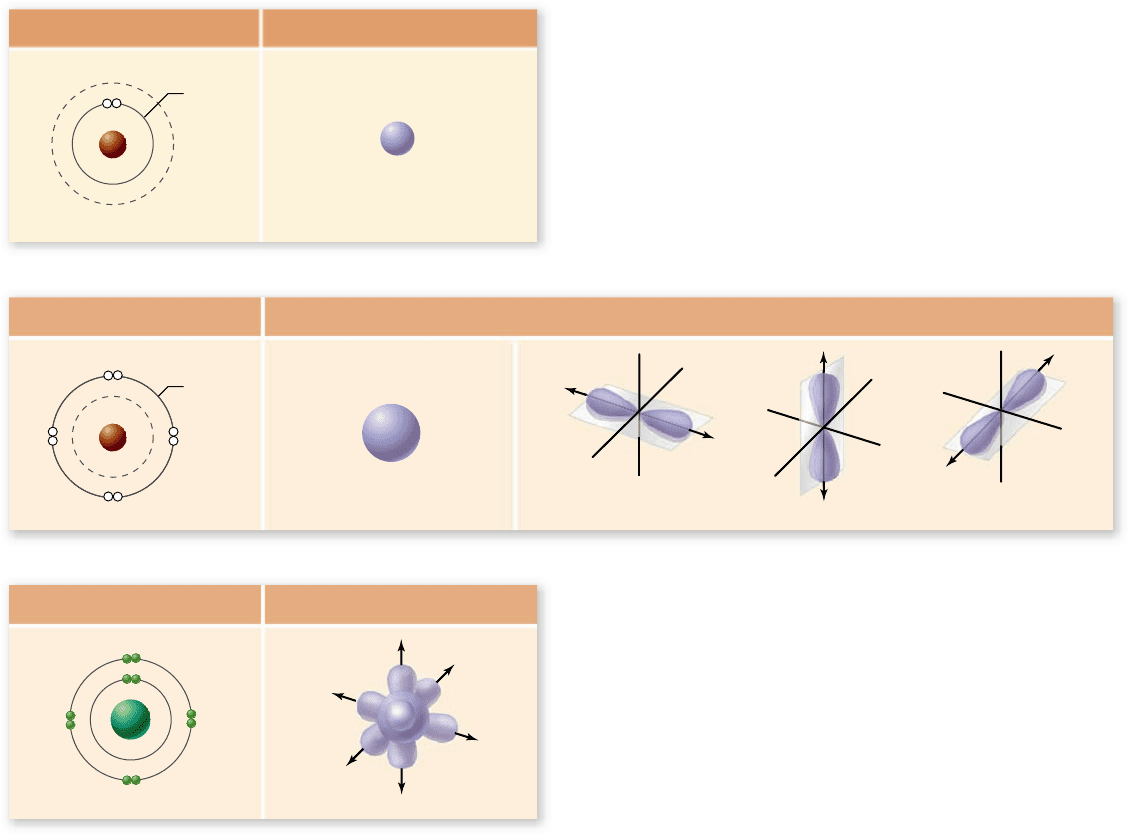
A particular electron, however, is more likely to be in
some areas than in others. An orbital is defined as the area
around a nucleus where an electron is most likely to be found.
These orbitals represent probability distributions for electrons,
that is, regions more likely to contain an electron. Some elec-
tron orbitals near the nucleus are spherical (s orbitals), while
others are dumbbell-shaped (p orbitals) (figure 2.5) . Still other
orbitals, farther away from the nucleus, may have different
shapes. Regardless of its shape, no orbital can contain more
than two electrons.
Almost all of the volume of an atom is empty space. This
is because the electrons are usually far away from the nucleus,
relative to its size. If the nucleus of an atom were the size of a
golf ball, the orbit of the nearest electron would be a mile away.
Consequently, the nuclei of two atoms never come close enough
in nature to interact with each other. It is for this reason that an
atom’s electrons, not its protons or neutrons, determine its
chemical behavior, and it also explains why the isotopes of an
element, all of which have the same arrangement of electrons,
behave the same way chemically.
Figure 2.5
Electron orbitals. a. The lowest energy level, or
electron shell—the one nearest the nucleus—is level K. It is
occupied by a single s orbital, referred to as 1s. b. The next highest
energy level, L, is occupied by four orbitals: one s orbital (referred
to as the 2s orbital) and three p orbitals (each referred to as a 2p
orbital). Each orbital holds two paired electrons with opposite spin.
Thus, the K level is populated by two electrons, and the L level is
populated by a total of eight electrons. c. The neon atom shown has
the L and K energy levels completely lled with electrons and is
thus unreactive.
20
part
I
The Molecular Basis of Life
rav32223_ch02_017-032.indd 20rav32223_ch02_017-032.indd 20 11/5/09 4:07:27 PM11/5/09 4:07:27 PM
Apago PDF Enhancer
Nucleus
Energy
absorbed
Energy
released
N
M
L
K
Nucleus
K
L
M
N
; ;
:
Oxidation Reduction
Atoms contain discrete energy levels
Because electrons are attracted to the positively charged nucle-
us, it takes work to keep them in their orbitals, just as it takes
work to hold a grapefruit in your hand against the pull of grav-
ity. The formal definition of energy is the ability to do work.
The grapefruit held above the ground is said to possess
potential energy because of its position. If you release it, the
grapefruit falls, and its potential energy is reduced. On the
other hand, if you carried the grapefruit to the top of a building,
you would increase its potential energy. Electrons also have a
potential energy that is related to their position. To oppose the
attraction of the nucleus and move the electron to a more dis-
tant orbital requires an input of energy, which results in an
electron with greater potential energy. The chlorophyll that
makes plants green captures energy from light during photo-
synthesis in this way. As you’ll see in chapter 8—light energy
excites electrons in the chlorophyll molecule. Moving an elec-
tron closer to the nucleus has the opposite effect: Energy is
released, usually as radiant energy (heat or light), and the elec-
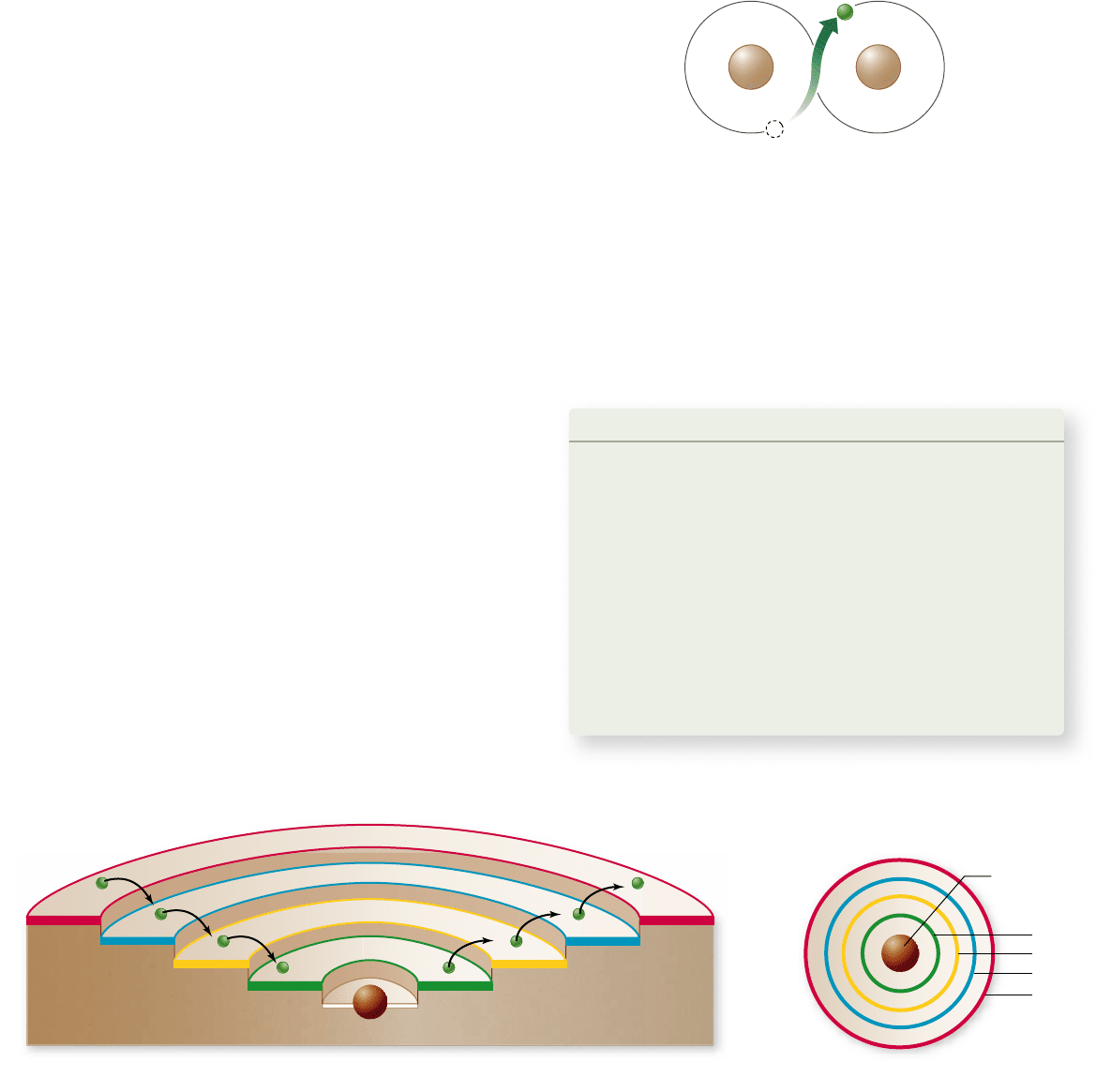
tron ends up with less potential energy (figure 2.6).
One of the initially surprising aspects of atomic structure
is that electrons within the atom have discrete energy levels.
These discrete levels correspond to quanta (sing., quantum),
which means specific amount of energy. To use the grapefruit
analogy again, it is as though a grapefruit could only be raised
to particular floors of a building. Every atom exhibits a ladder
of potential energy values, a discrete set of orbitals at particular
energetic “distances” from the nucleus.
Because the amount of energy an electron possesses is re-
lated to its distance from the nucleus, electrons that are the
same distance from the nucleus have the same energy, even if
they occupy different orbitals. Such electrons are said to occupy
the same energy level. The energy levels are denoted with let-
ters K, L, M, and so on (see figure 2.6 ) . Be careful not to con-
fuse energy levels, which are drawn as rings to indicate an
electron’s energy, with orbitals, which have a variety of three-
dimensional shapes and indicate an electron’s most likely loca-
tion. Electron orbitals are arranged so that as they are filled, this
fills each energy level in successive order. This filling of orbitals
Figure 2.6
Atomic energy levels. Electrons have energy of position. When an atom absorbs energy, an electron moves to a higher
energy level, farther from the nucleus. When an electron falls to lower energy levels, closer to the nucleus, energy is released. The rst two
energy levels are the same as shown in the previous gure.
and energy levels is what is responsible for the chemical reac-
tivity of elements.
During some chemical reactions, electrons are trans-
ferred from one atom to another. In such reactions, the loss of
an electron is called oxidation, and the gain of an electron is
called reduction .
Notice that when an electron is transferred in this way, it
keeps its energy of position. In organisms, chemical energy is
stored in high-energy electrons that are transferred from one
atom to another in reactions involving oxidation and reduction
(described in chapter 7 ). When the processes of oxidation and
reduction are coupled, which often happens, one atom or mol-
ecule is oxidized while another is reduced in the same reaction.
We call these combinations redox reactions.
Learning Outcomes Review 2.1
An atom consists of a nucleus of protons and neutrons surrounded by a cloud
of electrons. For each atom, the number of protons is the atomic number;
atoms with the same atomic number constitute an element. Atoms of a
single element that have diff erent numbers of neutrons are called isotopes.
Electrons, which determine the chemical behavior of an element, are located
about a nucleus in orbitals representing discrete energy levels. No orbital
can contain more than two electrons, but many orbitals may have the same
energy level, and thus contain electrons with the same energy.
■ If the number of protons exceeds the number of
neutrons, is the charge on the atom positive
or negative?
■ If the number of protons exceeds electrons?
www.ravenbiology.com
chapter
2
The Nature of Molecules and the Properties of Water
21
rav32223_ch02_017-032.indd 21rav32223_ch02_017-032.indd 21 11/5/09 4:07:28 PM11/5/09 4:07:28 PM