
Raven P.H., Johnson G.B., Mason K.A. Biology (Ninth Edition)
Подождите немного. Документ загружается.

Apago PDF Enhancer
1
H
3
Li
4
Be
19
K
12
Mg
93
Np
94
Pu
95
Am
96
Cm
97
Bk
98
Cf
99
Es
100
Fm
101
Md
102
No
103
Lr
37
Rb
38
Sr
39
Y
42
Mo
45
Rh
46
Pd
47
Ag
48
Cd
49
In
50
Sn
51
Sb
52
Te
53
I
54
Xe
21
Sc
40
Zr
22
Ti
23
V
24
Cr
25
Mn
27
Co
28
Ni
29
Cu
30
Zn
36
Kr
5
B
6
C
8
O
2
He
55
Cs
56
Ba
72
Hf
73
Ta
74
W
75
Re
76
Os
77
Ir
78
Pt
79
Au
80
Hg
81
Tl
82
Pb
83
Bi
84
Po
85
At
86
Rn
87
Fr
88
Ra
57
La
89
Ac
104 105 106 107 108 109
58
Ce
59
Pr
60
Nd
61
Pm
62
Sm
63
Eu
64
Gd
65
Tb
66
Dy
67
Ho
68
Er
69
Tm
70
Yb
71
Lu
90
Th
91
Pa
92
U
(Lanthanide series)
(Actinide series)
11
Na
20
Ca
41
Nb
43
Tc
44
Ru
26
Fe
13
Al
31
Ga
32
Ge
14
Si
7
N
15
P
33
As
16
S
35
Br
34
Se
9
F
18
Ar
10
Ne
17
Cl
110
Rf Ob
Sg Bh
Hs
Mt Ds
111 112 113 114 115 116 117
Uuu Uub
Uut Uuq
Uup
Uuh
118
Key
1
H
atomic number
chemical symbol
Carbon (C)
Oxygen (O)
Hydrogen (H)
Calcium (Ca)
Phosphorus (P)
Potassium (K)
Sulfur (S)
Sodium (Na)
Chlorine (Cl)
Iron (Fe)
Magnesium (Mg)
Nitrogen (N)
Mg
Fe
S
K
P
Ca
Cl
Na
N
H
C
a.
b.
O
possessing all eight electrons in their outer energy level (two
for helium) are inert , or nonreactive. These elements, which in-
clude helium (He), neon (Ne), argon (Ar), and so on, are termed
the noble gases. In sharp contrast, elements with seven electrons
(one fewer than the maximum number of eight) in their outer
energy level, such as fluorine (F), chlorine (Cl), and bromine
(Br), are highly reactive. They tend to gain the extra electron
needed to fill the energy level. Elements with only one electron
in their outer energy level, such as lithium (Li), sodium (Na),
and potassium (K), are also very reactive. They tend to lose the
single electron in their outer level.
Mendeleev’s periodic table leads to a useful generaliza-
tion, the octet rule, or rule of eight (Latin octo, “eight”): Atoms
tend to establish completely full outer energy levels. For the
main group elements of the periodic table, the rule of eight is
accomplished by one filled s orbital and three filled p orbitals
(figure 2.8). The exception to this is He, in the first row, which
needs only two electrons to fill the 1s orbital. Most chemical
behavior of biological interest can be predicted quite accurately
from this simple rule, combined with the tendency of atoms to
balance positive and negative charges. For instance, you read
earlier that sodium ion (Na
+
) has lost an electron, and chloride
ion (Cl
–
) has gained an electron. In the following section, we
describe how these ions react to form table salt.
Of the 90 naturally occurring elements on Earth, only 12
(C, H, O, N, P, S, Na, K, Ca, Mg, Fe, Cl) are found in living sys-
tems in more than trace amounts (0.01% or higher). These ele-
ments all have atomic numbers less than 21, and thus, have low
atomic masses. Of these 12, the first 4 elements (carbon, hydro-
gen, oxygen, and nitrogen) constitute 96.3% of the weight of
your body. The majority of molecules that make up your body
are compounds of carbon, which we call organic compounds.
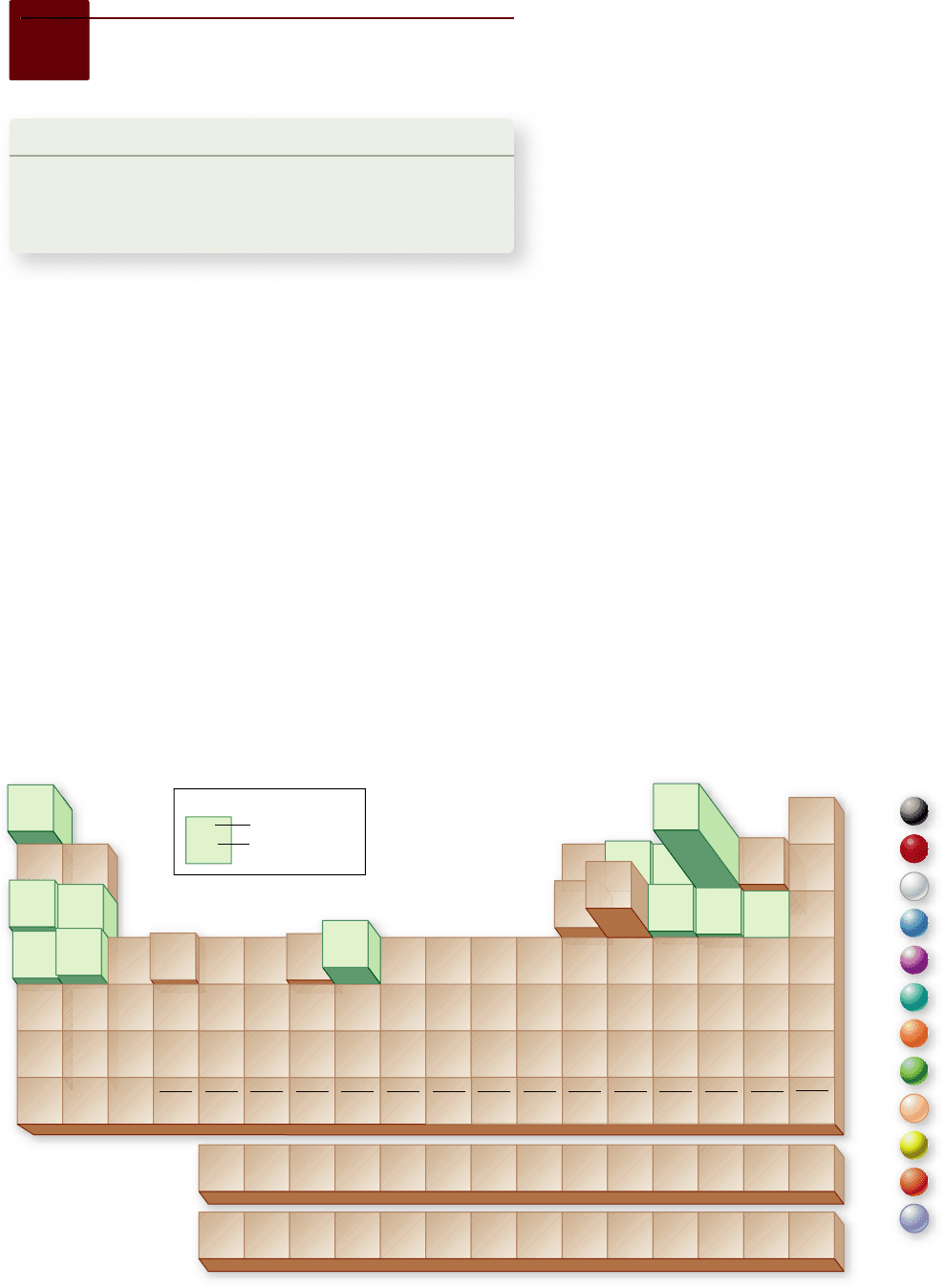
Figure 2.7
Periodic table of the elements. a. In this representation, the frequency of elements that occur in the Earth’s crust is
indicated by the height of the block. Elements shaded in green are found in living systems in more than trace amounts. b. Common elements
found in living systems are shown in colors that will be used throughout the text.
2.2
Elements Found
in Living Systems
Learning Outcomes
Relate atomic structure to the periodic table of 1.
the elements.
List the important elements found in living systems.2.
Ninety elements occur naturally, each with a different number
of protons and a different arrangement of electrons. When the
19th-century Russian chemist Dmitri Mendeleev arranged
the known elements in a table according to their atomic number,
he discovered one of the great generalizations of science: The
elements exhibit a pattern of chemical properties that repeats it-
self in groups of eight. This periodically repeating pattern lent
the table its name: the periodic table of elements (figure 2.7).
The periodic table displays elements
according to atomic number and properties
The eight-element periodicity that Mendeleev found is based
on the interactions of the electrons in the outermost energy
level of the different elements. These electrons are called va-
lence electrons, and their interactions are the basis for the ele-
ments’ differing chemical properties. For most of the atoms
important to life, the outermost energy level can contain no
more than eight electrons; the chemical behavior of an element
reflects how many of the eight positions are filled. Elements
22
part
I
The Molecular Basis of Life
rav32223_ch02_017-032.indd 22rav32223_ch02_017-032.indd 22 11/5/09 4:07:29 PM11/5/09 4:07:29 PM
Apago PDF Enhancer
Na
+
Na
Cl
Sodium atom
Chlorine atom
Na
+
Cl
-
Sodium ion (;)
Chloride ion (:)
Na
+
Na
+
Na
+
Cl
-
Cl
-
Cl
-
Cl
-
Cl
-
a.
b.
NaCl crystal
Nonreactive Reactive
Helium Nitrogen
2 protons
2 neutrons
2 electrons
7 protons
7 neutrons
7 electrons
K
K
L
2;
7;
TABLE 2.1
Bonds and Interactions
Name Basis of Interaction Strength
Covalent bond Sharing of electron pairs Strong
Ionic bond Attraction of opposite charges
Hydrogen bond Sharing of H atom
Hydrophobic interaction Forcing of hydrophobic portions of
molecules together in presence of
polar substances
van der Waals attraction Weak attractions between atoms
due to oppositely polarized
electron clouds
Weak
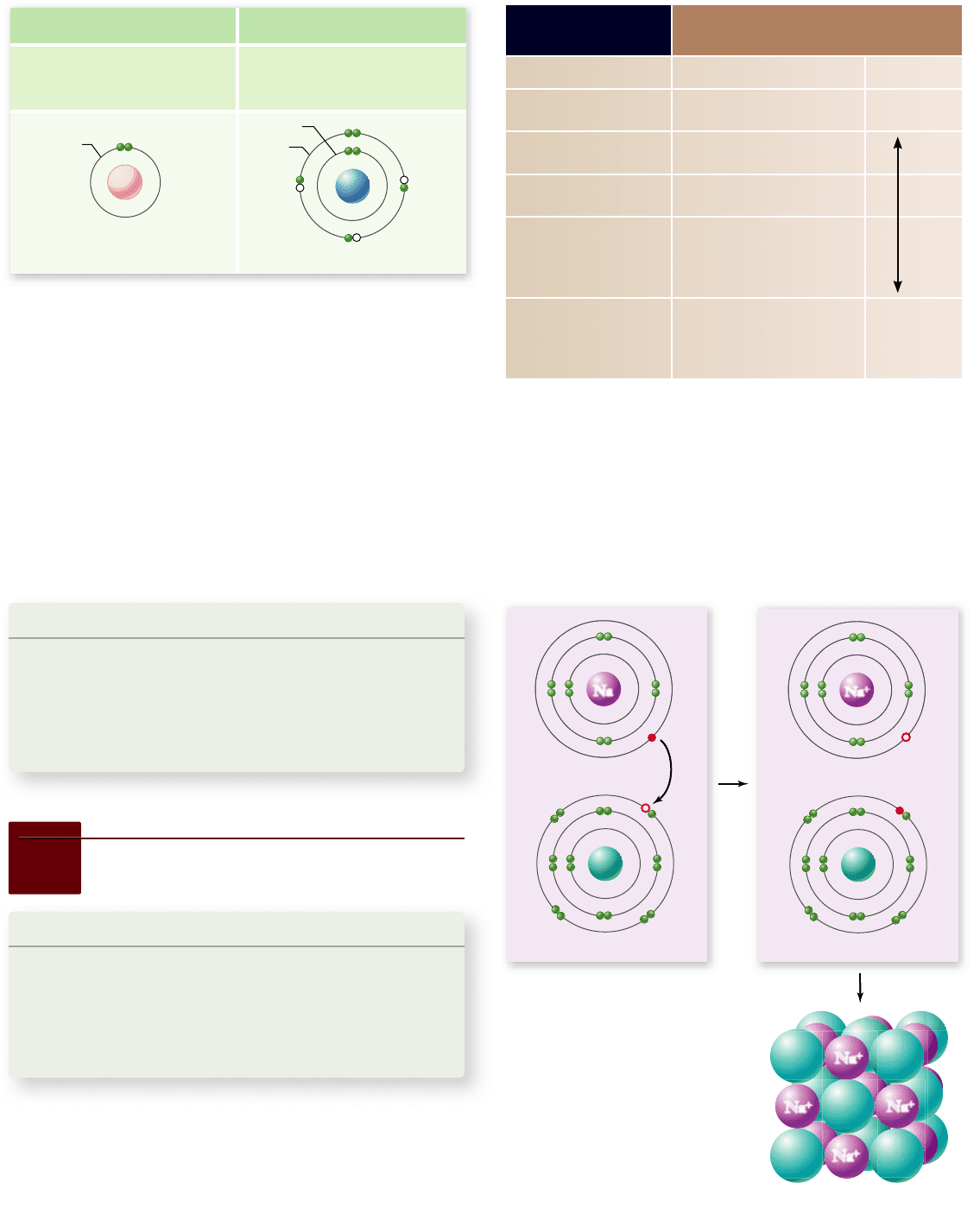
Figure 2.9
The formation of
ionic bonds by sodium chloride.
a. When a sodium atom donates an
electron to a chlorine atom, the
sodium atom becomes a positively
charged sodium ion, and the chlorine
atom becomes a negatively charged
chloride ion. b. The electrostatic
attraction of oppositely charged ions
leads to the formation of a lattice of
Na
+
and Cl
–
.
Figure 2.8
Electron energy levels for helium and
nitrogen. Green balls represent electrons, blue ball represents
the nucleus with number of protons indicated by number of (+)
charges. Note that the helium atom has a lled K shell and is thus
unreactive, whereas the nitrogen atom has ve electrons in the L
shell, three of which are unpaired, making it reactive.
These organic compounds contain primarily these four elements
(CHON), explaining their prevalence in living systems. Some
trace elements, such as zinc (Zn) and iodine (I), play crucial roles
in living processes even though they are present in tiny amounts.
Iodine deficiency, for example, can lead to enlargement of the
thyroid gland, causing a bulge at the neck called a goiter.
Learning Outcomes Review 2.2
The periodic table shows the elements in terms of atomic number and
repeating chemical properties. Only 12 elements are found in signifi cant
amounts in living organisms: C, H, O, N, P, S, Na, K, Ca, Mg, Fe, and Cl.
■ Why are the noble gases more stable than other
elements in the periodic table?
2.3
The Nature of Chemical Bonds
Learning Outcomes
Relate position in the periodic table to the formation 1.
of ions.
Explain how complex molecules can be built from many 2.
atoms by covalent bonds.
Contrast polar and nonpolar covalent bonds.3.
A group of atoms held together by energy in a stable associa-
tion is called a molecule. When a molecule contains atoms of
more than one element, it is called a compound. The atoms in a
molecule are joined by chemical bonds ; these bonds can result
when atoms with opposite charges attract each other (ionic
bonds), when two atoms share one or more pairs of electrons
(covalent bonds), or when atoms interact in other ways
(table 2.1). We will start by examining ionic bonds, which form
when atoms with opposite electrical charges (ions) attract.
Ionic bonds form crystals
Common table salt, the molecule sodium chloride (NaCl), is a
lattice of ions in which the atoms are held together by ionic
bonds (figure 2.9) . Sodium has 11 electrons: 2 in the inner
www.ravenbiology.com
chapter
2
The Nature of Molecules and the Properties of Water
23
rav32223_ch02_017-032.indd 23rav32223_ch02_017-032.indd 23 11/5/09 4:07:29 PM11/5/09 4:07:29 PM
Apago PDF Enhancer
N N
N
2
N
K
N
H H
covalent bond
O
2
O
K
O
H
2
H
J
H
Single covalent bond
hydrogen gas
Double covalent bond
oxygen gas
Triple covalent bond
nitrogen gas
J
O O
energy level (K), 8 in the next level (L), and 1 in the outer (va-
lence) level (M). The single, unpaired valence electron has a
strong tendency to join with another unpaired electron in an-
other atom. A stable configuration can be achieved if the va-
lence electron is lost to another atom that also has an unpaired
electron. The loss of this electron results in the formation of a
positively charged sodium ion, Na
+
.
The chlorine atom has 17 electrons: 2 in the K level, 8 in
the L level, and 7 in the M level. As you can see in the figure, one
of the orbitals in the outer energy level has an unpaired electron
(red circle). The addition of another electron fills that level and
causes a negatively charged chloride ion, Cl
–
, to form.
When placed together, metallic sodium and gaseous chlo-
rine react swiftly and explosively, as the sodium atoms donate
electrons to chlorine to form Na
+
and Cl
–
ions. Because oppo-
site charges attract, the Na
+
and Cl
–
remain associated in an
ionic compound , NaCl, which is electrically neutral. The electri-
cal attractive force holding NaCl together, however, is not di-
rected specifically between individual Na
+
and Cl
–
ions, and no
individual sodium chloride molecules form. Instead, the force
exists between any one ion and all neighboring ions of the op-
posite charge. The ions aggregate in a crystal matrix with a pre-
cise geometry. Such aggregations are what we know as salt
crystals. If a salt such as NaCl is placed in water, the electrical
attraction of the water molecules, for reasons we will point out
later in this chapter, disrupts the forces holding the ions in their
crystal matrix, causing the salt to dissolve into a roughly equal
mixture of free Na
+
and Cl
–
ions.
Because living systems always include water, ions are
more important than ionic crystals. Important ions in bio-
logical systems include Ca
2+
, which is involved in cell signal-
ing, K
+
and Na
+
, which are involved in the conduction of
nerve impulses.
Covalent bonds build stable molecules
Covalent bonds form when two atoms share one or more pairs of
valence electrons. Consider gaseous hydrogen (H
2
) as an ex-
ample. Each hydrogen atom has an unpaired electron and an
unfilled outer energy level; for these reasons, the hydrogen
atom is unstable. However, when two hydrogen atoms are in
close association, each atom’s electron is attracted to both nu-
clei. In effect, the nuclei are able to share their electrons. The
result is a diatomic (two-atom) molecule of hydrogen gas.
The molecule formed by the two hydrogen atoms is sta-
ble for three reasons:
1. It has no net charge. The diatomic molecule formed as a
result of this sharing of electrons is not charged because it
still contains two protons and two electrons.
2. The octet rule is satis ed. Each of the two hydrogen
atoms can be considered to have two orbiting electrons in
its outer energy level. This state satis es the octet rule,
because each shared electron orbits both nuclei and is
included in the outer energy level of both atoms.
3. It has no unpaired electrons. The bond between the
two atoms also pairs the two free electrons.
Unlike ionic bonds, covalent bonds are formed between two
individual atoms, giving rise to true, discrete molecules.
The strength of covalent bonds
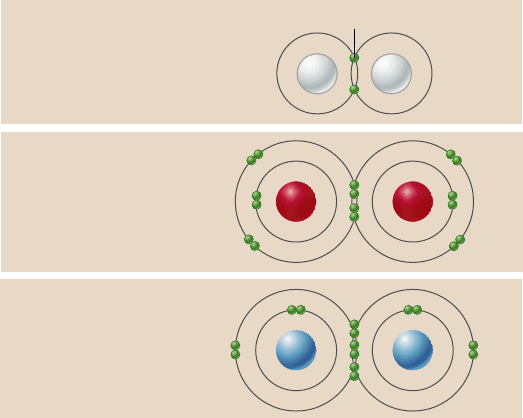
The strength of a covalent bond depends on the number of
shared electrons. Thus double bonds , which satisfy the octet rule
by allowing two atoms to share two pairs of electrons, are stron-
ger than single bonds, in which only one electron pair is shared.
In practical terms, more energy is required to break a double
bond than a single bond. The strongest covalent bonds are triple
bonds, such as those that link the two nitrogen atoms of nitrogen
gas molecules (N
2
).
Covalent bonds are represented in chemical formulas as
lines connecting atomic symbols. Each line between two bond ed
atoms represents the sharing of one pair of electrons. The struc-
tural formulas of hydrogen gas and oxygen gas are H–H and
O=O, respectively, and their molecular formulas are H
2
and O
2
.
The structural formula for N
2
is N≡N.
Molecules with several covalent bonds
A vast number of biological compounds are composed of more
than two atoms. An atom that requires two, three, or four additional
electrons to fill its outer energy level completely may acquire them
by sharing its electrons with two or more other atoms.
For example, the carbon atom (C) contains six electrons,
four of which are in its outer energy level and are unpaired. To
satisfy the octet rule, a carbon atom must form four covalent
bonds. Because four covalent bonds may form in many ways,
carbon atoms are found in many different kinds of molecules.
CO
2
(carbon dioxide), CH
4
(methane), and C
2
H
5
OH (ethanol)
are just a few examples.
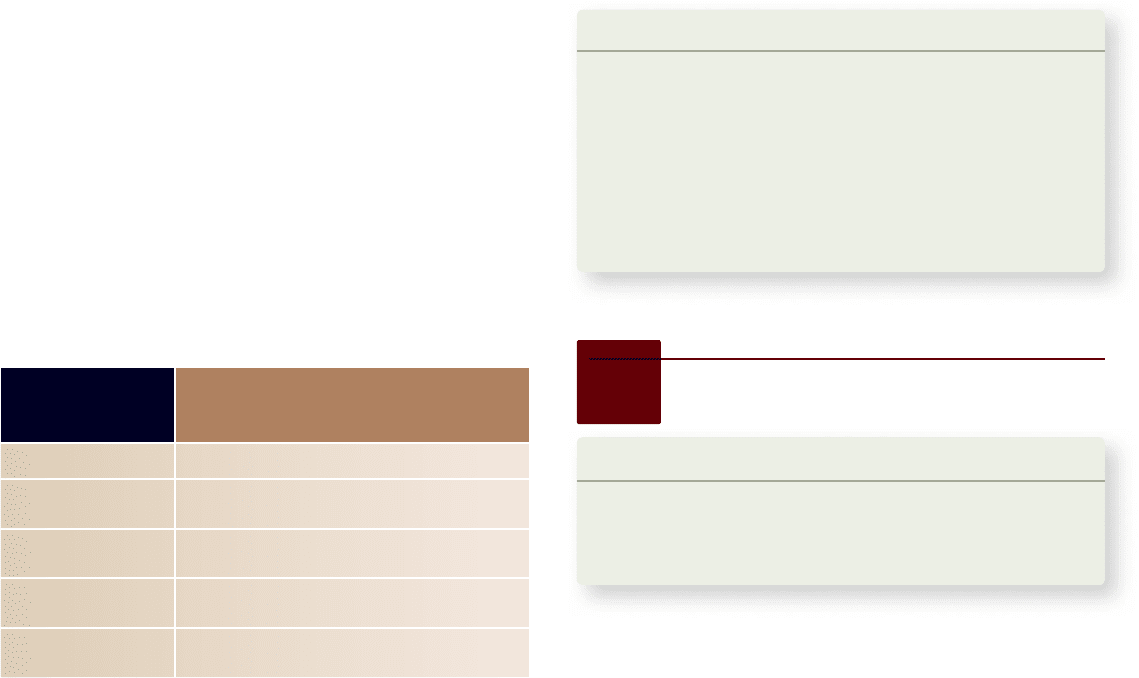
Polar and nonpolar covalent bonds
Atoms differ in their affinity for electrons, a property called
electronegativity. In general, electronegativity increases left to
right across a row of the periodic table and decreases down the
column. Thus the elements in the upper-right corner have the
highest electronegativity.
For bonds between identical atoms, for example, between
two hydrogen or two oxygen atoms, the affinity for electrons is
obviously the same, and the electrons are equally shared. Such
24
part
I
The Molecular Basis of Life
rav32223_ch02_017-032.indd 24rav32223_ch02_017-032.indd 24 11/5/09 4:07:30 PM11/5/09 4:07:30 PM
Apago PDF Enhancer
TABLE 2.2
Relative Electronegativities of
Some Important Atoms
Atom Electronegativity
O 3.5
N 3.0
C 2.5
H 2.1
2.4
Water: A Vital Compound
Learning Outcomes
Relate how the structure of water leads to hydrogen 1.
bonds.
Describe water’s cohesive and adhesive properties.2.
Of all the common molecules, only water exists as a liquid at
the relatively low temperatures that prevail on the Earth’s sur-
face. Three-fourths of the Earth is covered by liquid water
bonds are termed nonpolar. The resulting compounds (H
2
or
O
2
) are also referred to as nonpolar.
For atoms that differ greatly in electronegativity, elec-
trons are not shared equally. The shared electrons are more
likely to be closer to the atom with greater electronegativity,
and less likely to be near the atom of lower electronegativity.
In this case, although the molecule is still electrically neutral
(same number of protons as electrons), the distribution of
charge is not uniform. This unequal distribution results in re-
gions of partial negative charge near the more electronegative
atom, and regions of partial positive charge near the less elec-
tronegative atom. Such bonds are termed polar covalent
bonds, and the molecules polar molecules. When drawing
polar molecules, these partial charges are usually symbolized
by the lowercase Greek letter delta (δ). The partial charge
seen in a polar covalent bond is relatively small—far less than
the unit charge of an ion. For biological molecules, we can
predict polarity of bonds by knowing the relative electronega-
tivity of a small number of important atoms (table 2.2). No-
tice that although C and H differ slightly in electronegativity,
this small difference is negligible, and C–H bonds are consid-
ered nonpolar.
Because of its importance in the chemistry of water, we
will explore the nature of polar and nonpolar molecules in the
following section on water. Water (H
2
O) is a polar molecule
with electrons more concentrated around the oxygen atom.
Chemical reactions alter bonds
The formation and breaking of chemical bonds, which is the
essence of chemistry, is termed a chemical reaction. All chemical
reactions involve the shifting of atoms from one molecule or
ionic compound to another, without any change in the number
or identity of the atoms. For convenience, we refer to the origi-
nal molecules before the reaction starts as reactants, and the
molecules resulting from the chemical reaction as products.
For example:
6H
2
O + 6CO
2
→
C
6
H
12
O
6
+ 6O
2
reactants
→
products
You may recognize this reaction as a simplified form of the photo-
synthesis reaction, in which water and carbon dioxide are com-
bined to produce glucose and oxygen. Most animal life ultimately
depends on this reaction, which takes place in plants. (Photo-
synthetic reactions will be discussed in detail in chapter 8. )
The extent to which chemical reactions occur is influ-
enced by three important factors:
1. Temperature. Heating the reactants increases the rate of
a reaction because the reactants collide with one another
more often. (Care must be taken that the temperature is
not so high that it destroys the molecules.)
Concentration of reactants and products.2. Reactions
proceed more quickly when more reactants are available,
allowing more frequent collisions. An accumulation of
products typically slows the reaction and, in reversible
reactions, may speed the reaction in the reverse direction.
Catalysts.3. A catalyst is a substance that increases the rate
of a reaction. It doesn’t alter the reaction’s equilibrium
between reactants and products, but it does shorten the
time needed to reach equilibrium, often dramatically. In
living systems, proteins called enzymes catalyze almost
every chemical reaction.
Many reactions in nature are reversible. This means that the
products may themselves be reactants, allowing the reaction to
proceed in reverse. We can write the preceding reaction in the
reverse order:
C
6
H
12
O
6
+ 6O
2
→
6H
2
O + 6CO
2
reactants
→
products
This reaction is a simplified version of the oxidation of glucose
by cellular respiration, in which glucose is broken down into
water and carbon dioxide in the presence of oxygen. Virtually
all organisms carry out forms of glucose oxidation; details are
covered later, in chapter 7 .
Learning Outcomes Review 2.3
An ionic bond is an attraction between ions of opposite charge in an ionic
compound. A covalent bond is formed when two atoms share one or more
pairs of electrons. Complex biological compounds are formed in large part
by atoms that can form one or more covalent bonds: C, H, O, and N. A polar
covalent bond is formed by unequal sharing of electrons. Nonpolar bonds
exhibit equal sharing of electrons.
■ How is a polar covalent bond different from an
ionic bond?
www.ravenbiology.com
chapter
2
The Nature of Molecules and the Properties of Water
25
rav32223_ch02_017-032.indd 25rav32223_ch02_017-032.indd 25 11/5/09 4:07:30 PM11/5/09 4:07:30 PM
Apago PDF Enhancer
d
;
d
;
d
:
d
:
;
;
104.5
d
;
d
;
d
:
d
:
a. b.
c.
Bohr Model Ball-and-Stick Model
d
;
d
;
d
:
Space-Filling Model
8p
8n
a. Solid b. Liquid c. Gas
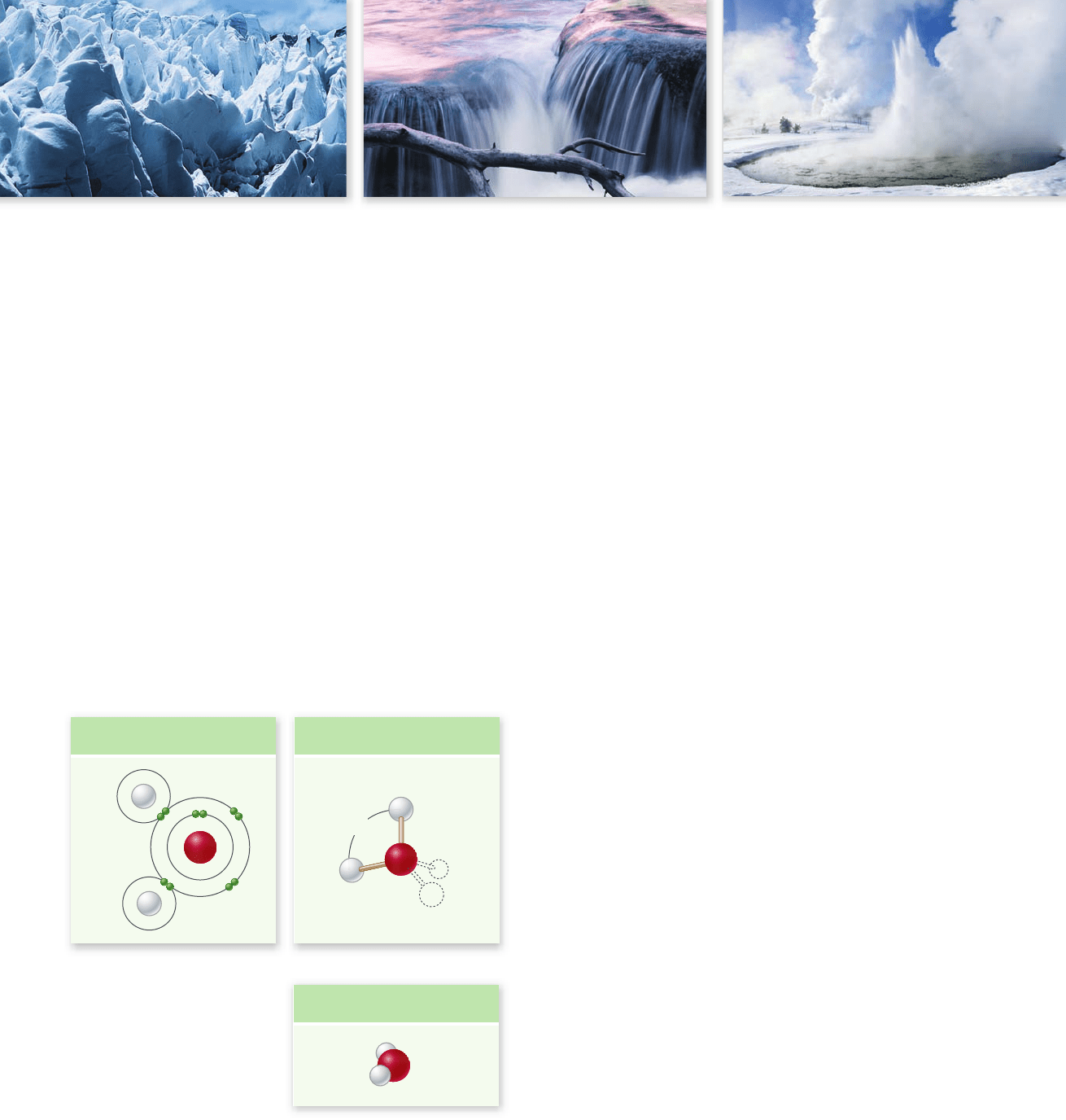
Figure 2.11
Water has a
simple molecular structure.
a. Each water molecule is
composed of one oxygen atom
and two hydrogen atoms. The
oxygen atom shares one electron
with each hydrogen atom.
b. The greater electronegativity
of the oxygen atom makes the water molecule polar: Water carries two
partial negative charges (δ
–
) near the oxygen atom and two partial
positive charges (δ
+
), one on each hydrogen atom. c. Space- lling
model shows what the molecule would look like if it were visible.
Figure 2.10
Water takes many forms. a. When water cools below 0°C, it forms beautiful crystals, familiar to us as snow and ice. b. Ice
turns to liquid when the temperature is above 0°C. c. Liquid water becomes steam when the temperature rises above 100°C, as seen in this hot
spring at Yellowstone National Park.
(figure 2.10) . When life was beginning, water provided a me-
dium in which other molecules could move around and inter-
act, without being held in place by strong covalent or ionic
bonds. Life evolved in water for 2 billion years before spread-
ing to land. And even today, life is inextricably tied to water.
About two-thirds of any organism’s body is composed of water,
and all organisms require a water-rich environment, either in-
side or outside it, for growth and reproduction. It is no acci-
dent that tropical rain forests are bursting with life, while dry
deserts appear almost lifeless except when water becomes tem-
porarily plentiful, such as after a rainstorm.
Water’s structure facilitates hydrogen bonding
Water has a simple molecular structure, consisting of an oxygen
atom bound to two hydrogen atoms by two single covalent
bonds (figure 2.11). The resulting molecule is stable: It satisfies
the octet rule, has no unpaired electrons, and carries no net
electrical charge.
The single most outstanding chemical property of water
is its ability to form weak chemical associations, called hydro-
gen bonds. These bonds form between the partially negative O
atoms and the partially positive H atoms of two water mole-
cules. Although these bonds have only 5–10% of the strength
of covalent bonds, they are important to DNA and protein
structure, and thus responsible for much of the chemical orga-
nization of living systems.
The electronegativity of O is much greater than that of H
(see table 2.2), and so the bonds between these atoms are highly
polar. The polarity of water underlies water’s chemistry and the chem-
istry of life.
If we consider the shape of a water molecule, we see that its
two covalent bonds have a partial charge at each end: δ
–
at the
oxygen end and δ
+
at the hydrogen end. The most stable arrange-
ment of these charges is a tetrahedron (a pyramid with a triangle as
its base ) , in which the two negative and two positive charges are
approximately equidistant from one another. The oxygen atom
lies at the center of the tetrahedron, the hydrogen atoms occupy
two of the apexes (corners), and the partial negative charges oc-
cupy the other two apexes (figure 2.11 b) . The bond angle be-
tween the two covalent oxygen– hydrogen bonds is 104.5°. This
value is slightly less than the bond angle of a regular tetrahedron,
which would be 109.5°. In water, the partial negative charges oc-
cupy more space than the partial positive regions, so the
oxygen–hydrogen bond angle is slightly compressed.
Water molecules are cohesive
The polarity of water allows water molecules to be attracted to
one another: that is, water is cohesive. The oxygen end of each
water molecule, which is δ
–
, is attracted to the hydrogen end,
which is δ
+
, of other molecules. The attraction produces hydro-
gen bonds among water molecules (figure 2.12). Each hydro-
gen bond is individually very weak and transient, lasting on
average only a hundred-billionth (10
–11
) of a second. The cu-
mulative effects of large numbers of these bonds, however, can
be enormous. Water forms an abundance of hydrogen bonds,
which are responsible for many of its important physical prop-
erties (table 2.3).
Water’s cohesion is responsible for its being a liquid, not
a gas, at moderate temperatures. The cohesion of liquid water
is also responsible for its surface tension. Small insects can
walk on water (figure 2.13) because at the air–water interface,
all the surface water molecules are hydrogen-bonded to mole-
cules below them.
26
part
I
The Molecular Basis of Life
rav32223_ch02_017-032.indd 26rav32223_ch02_017-032.indd 26 11/5/09 4:07:31 PM11/5/09 4:07:31 PM
Apago PDF Enhancer
d
;
Hydrogen atom
Hydrogen bond
Oxygen atom
a.
b.
Water molecule
Hydrogen atom
Hydrogen bond
An organic molecule
Oxygen atom
δ
-
δ
-
δ
-
δ
-
δ
-
δ
-
δ
;
d
:
δ
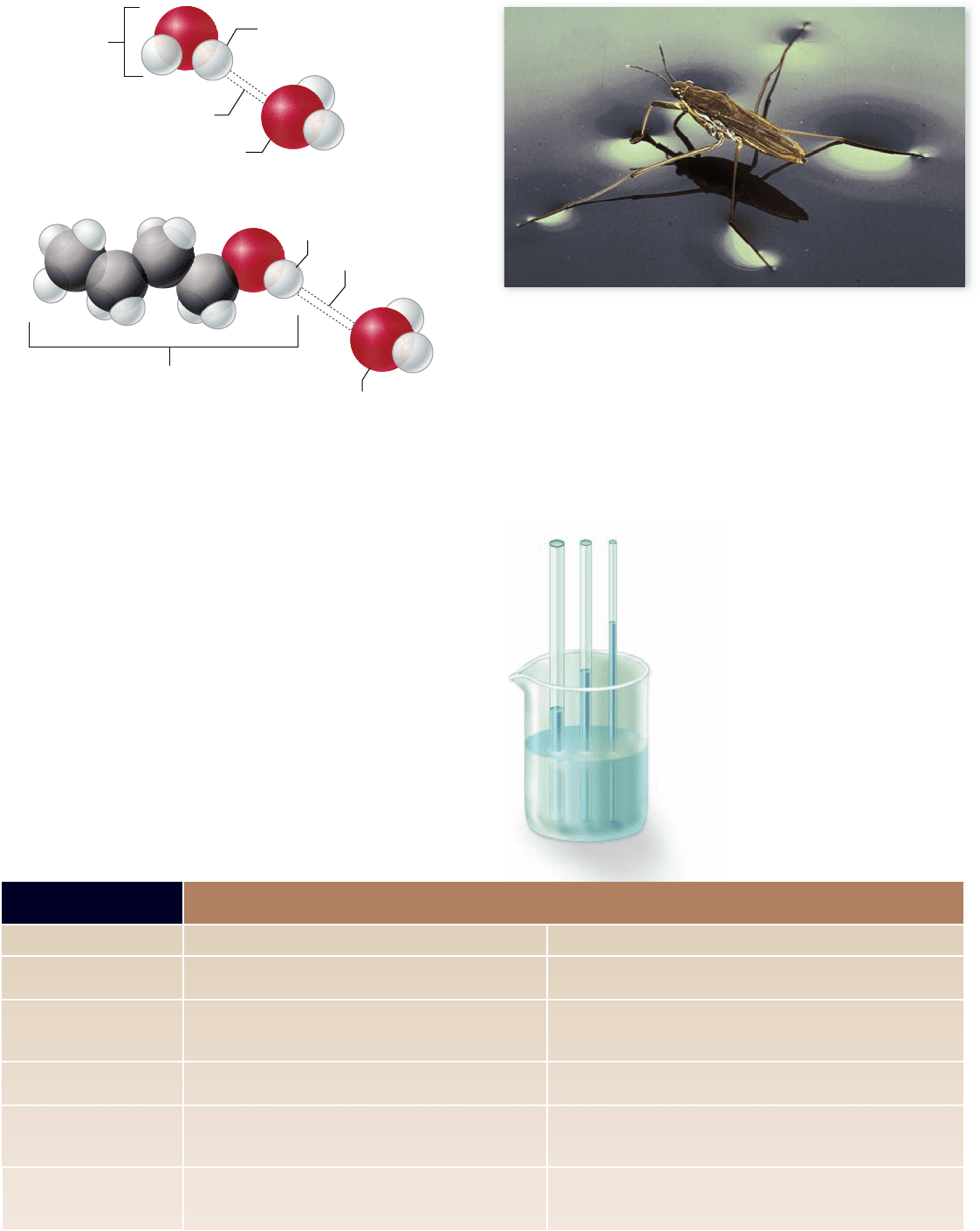
TABLE 2.3
The Properties of Water
Property Explanation Example of Benefi t to Life
Cohesion Hydrogen bonds hold water molecules together. Leaves pull water upward from the roots; seeds swell and germinate.
High speci c heat Hydrogen bonds absorb heat when they break and release heat
when they form, minimizing temperature changes.
Water stabilizes the temperature of organisms and the environment.
High heat of vaporization Many hydrogen bonds must be broken for water to evaporate. Evaporation of water cools body surfaces.
Lower density of ice Water molecules in an ice crystal are spaced relatively far apart
because of hydrogen bonding.
Because ice is less dense than water, lakes do not freeze solid, allowing sh and
other life in lakes to survive the winter.
Solubility Polar water molecules are attracted to ions and polar compounds,
making these compounds soluble.
Many kinds of molecules can move freely in cells, permitting a diverse array of
chemical reactions.
Figure 2.12
Structure of a hydrogen bond. a. Hydrogen bond
between two water molecules. b. Hydrogen bond between an organic
molecule (n-butanol) and water. H in n-butanol forms a hydrogen bond
with oxygen in water. This kind of hydrogen bond is possible any time H
is bound to a more electronegative atom (see table 2.2).
Figure 2.13
Cohesion. Some insects, such as this water
strider, literally walk on water. Because the surface tension of the
water is greater than the force of one foot, the strider glides atop the
surface of the water rather than sinking. The high surface tension of
water is due to hydrogen bonding between water molecules.
Figure 2.14
Adhesion. Capillary
action causes the water within a narrow
tube to rise above the surrounding water
level; the adhesion of the water to the
glass surface, which draws water upward,
is stronger than the force of gravity,
which tends to pull it down. The
narrower the tube, the greater the
surface area available for adhesion for a
given volume of water, and the higher
the water rises in the tube.
Water molecules are adhesive
The polarity of water causes it to be attracted to other polar
molecules as well. This attraction for other polar substances is
called adhesion. Water adheres to any substance with which it
can form hydrogen bonds. This property explains why sub-
stances containing polar molecules get “wet” when they are im-
mersed in water, but those that are composed of nonpolar
molecules (such as oils) do not.
The attraction of water to substances that have electrical
charges on their surface is responsible for capillary action. If a glass
tube with a narrow diameter is lowered into a beaker of water, the
water will rise in the tube above the level of the water in the beaker,
because the adhesion of water to the glass surface, drawing it up-
ward, is stronger than the force of gravity, pulling it downward. The
narrower the tube, the greater the electrostatic forces between the
water and the glass, and the higher the water
rises (figure 2.14).
www.ravenbiology.com
chapter
2
The Nature of Molecules and the Properties of Water
27
rav32223_ch02_017-032.indd 27rav32223_ch02_017-032.indd 27 11/5/09 4:07:32 PM11/5/09 4:07:32 PM

Apago PDF Enhancer
Learning Outcomes Review 2.4
Because of its polar covalent bonds, water can form hydrogen bonds with
itself and with other polar molecules. Hydrogen bonding is responsible for
water’s cohesion, the force that holds water molecules together, and its
adhesion, which is its ability to “stick” to other polar molecules. Capillary
action results from both of these properties.
■ If water were made of C and H instead of H and O, would
it still be cohesive and adhesive?
2.5
Properties of Water
Learning Outcomes
Describe how hydrogen bonding determines many 1.
properties of water.
Explain the relevance of water’s unusual properties for 2.
living systems.
Understand the dissociation products of water.3.
Water moderates temperature through two properties: its high
specific heat and its high heat of vaporization. Water also has
the unusual property of being less dense in its solid form, ice,
than as a liquid. Water acts as a solvent for polar molecules and
exerts an organizing effect on nonpolar molecules. All these
properties result from its polar nature.
Water’s high speci c heat helps
maintain temperature
The temperature of any substance is a measure of how rapidly
its individual molecules are moving. In the case of water, a large
input of thermal energy is required to break the many hydrogen
bonds that keep individual water molecules from moving about.
Therefore, water is said to have a high specific heat, which is
defined as the amount of heat 1 g of a substance must absorb or
lose to change its temperature by 1 degree Celsius (°C). Specific
heat measures the extent to which a substance resists changing
its temperature when it absorbs or loses heat. Because polar sub-
stances tend to form hydrogen bonds, the more polar it is, the
higher is its specific heat. The specific heat of water (1 calorie/
g/°C) is twice that of most carbon compounds and nine times
that of iron. Only ammonia, which is more polar than water and
forms very strong hydrogen bonds, has a higher specific heat
than water (1.23 cal/g/°C). Still, only 20% of the hydrogen
bonds are broken as water heats from 0° to 100°C.
Because of its high specific heat, water heats up more
slowly than almost any other compound and holds its tempera-
ture longer. Because organisms have a high water content, wa-
ter’s high specific heat allows them to maintain a relatively
constant internal temperature. The heat generated by the
chemical reactions inside cells would destroy the cells if not for
the absorption of this heat by the water within them.
Water’s high heat of vaporization
facilitates cooling
The heat of vaporization is defined as the amount of energy
required to change 1 g of a substance from a liquid to a gas. A
considerable amount of heat energy (586 cal) is required to ac-
complish this change in water. As water changes from a liquid
to a gas it requires energy (in the form of heat) to break its
many hydrogen bonds. The evaporation of water from a surface
cools that surface. Many organisms dispose of excess body heat
by evaporative cooling, for example, through sweating in hu-
mans and many other vertebrates.
Solid water is less dense than liquid water
At low temperatures, water molecules are locked into a crystal- like
lattice of hydrogen bonds, forming solid ice (see figure 2.10a ) .
Interestingly, ice is less dense than liquid water because the hy-
drogen bonds in ice space the water molecules relatively far apart.
This unusual feature enables icebergs to float. If water did not
have this property, nearly all bodies of water would be ice, with
only the shallow surface melting every year. The buoyancy of ice
is important ecologically because it means bodies of water freeze
from the top down and not the bottom up. Because ice floats on
the surface of lakes in the winter and the water beneath the ice
remains liquid, fish and other animals keep from freezing.
The solvent properties of water help
move ions and polar molecules
Water molecules gather closely around any substance that bears
an electrical charge, whether that substance carries a full charge
(ion) or a charge separation (polar molecule). For example, su-
crose (table sugar) is composed of molecules that contain polar
hydroxyl (OH ) groups. A sugar crystal dissolves rapidly in water
because water molecules can form hydrogen bonds with indi-
vidual hydroxyl groups of the sucrose molecules. Therefore, su-
crose is said to be soluble in water. Water is termed the solvent, and
sugar is called the solute. Every time a sucrose molecule dissoci-
ates, or breaks away, from a solid sugar crystal, water molecules
surround it in a cloud, forming a hydration shell that prevents it
from associating with other sucrose molecules. Hydration shells
also form around ions such as Na
+
and Cl
–
(figure 2.15).
Water organizes nonpolar molecules
Water molecules always tend to form the maximum possible
number of hydrogen bonds. When nonpolar molecules such as
oils, which do not form hydrogen bonds, are placed in water,
the water molecules act to exclude them. The nonpolar mole-
cules aggregate, or clump together, thus minimizing their dis-
ruption of the hydrogen bonding of water. In effect, they shrink
from contact with water, and for this reason they are referred to
as hydrophobic (Greek hydros, “water,” and phobos, “fearing”).
In contrast, polar molecules, which readily form hydrogen
bonds with water, are said to be hydrophilic (“water-loving”).
The tendency of nonpolar molecules to aggregate in water is
known as hydrophobic exclusion. By forcing the hydrophobic
portions of molecules together, water causes these molecules to
28
part
I
The Molecular Basis of Life
rav32223_ch02_017-032.indd 28rav32223_ch02_017-032.indd 28 11/5/09 4:07:33 PM11/5/09 4:07:33 PM
Apago PDF Enhancer
Hydration shells
Water molecules
Salt crystal
Cl
-
Na
+
Cl
-
d
;
d
;
d
;
d
;
d
;
d
:
d
:
d
:
d
:
d
:
Na
+
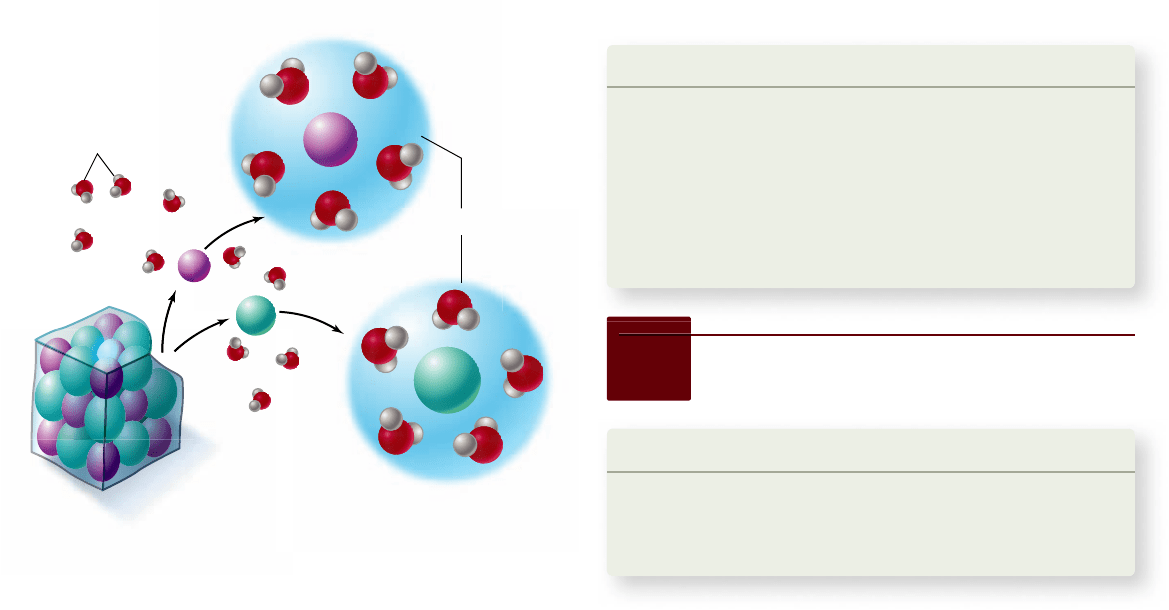
Figure 2.15
Why salt dissolves in water. When a crystal
of table salt dissolves in water, individual Na
+
and Cl
–
ions break
away from the salt lattice and become surrounded by water
molecules. Water molecules orient around Na
+
so that their partial
negative poles face toward the positive Na
+
; water molecules
surrounding Cl
–
orient in the opposite way, with their partial
positive poles facing the negative Cl
–
. Surrounded by hydration
shells, Na
+
and Cl
–
never reenter the salt lattice.
Learning Outcomes
Explain the nature of acids and bases, and their 1.
relationship to the pH scale.
Relate changes in pH to changes in [H2.
+
].
The concentration of hydrogen ions, and concurrently of hy-
droxide ions, in a solution is described by the terms acidity and
basicity, respectively. Pure water, having an [H
+
] of 10
–7
mol/L,
is considered to be neutral, that is, neither acidic nor basic. Re-
call that for every H
+
ion formed when water dissociates, an
OH
–
ion is also formed, meaning that the dissociation of water
produces H
+
and OH
–
in equal amounts.
The pH scale measures hydrogen
ion concentration
The pH scale (figure 2.16) is a more convenient way to express
the hydrogen ion concentration of a solution. This scale defines
pH, which stands for “partial hydrogen,” as the negative loga-
rithm of the hydrogen ion concentration in the solution:
pH = –log [H
+
]
Because the logarithm of the hydrogen ion concentration is
simply the exponent of the molar concentration of H
+
, the pH
equals the exponent times –1. For water, therefore, an [H
+
] of
10
–7
mol/L corresponds to a pH value of 7. This is the neutral
point—a balance between H
+
and OH
–
—on the pH scale. This
balance occurs because the dissociation of water produces equal
amounts of H
+
and OH
–
.
Note that, because the pH scale is logarithmic, a difference
of 1 on the scale represents a 10-fold change in [H
+
]. A solution
with a pH of 4 therefore has 10 times the [H
+
] of a solution with
a pH of 5 and 100 times the [H
+
] of a solution with a pH of 6.
Acids
Any substance that dissociates in water to increase the [H
+
] (and
lower the pH) is called an acid. The stronger an acid is, the
more hydrogen ions it produces and the lower its pH. For ex-
ample, hydrochloric acid (HCl), which is abundant in your
stomach, ionizes completely in water. A dilution of 10
–1
mol/L
of HCl dissociates to form 10
–1
mol/L of H
+
, giving the solution
2.6
Acids and Bases
assume particular shapes. This property can also affect the structure
of proteins, DNA, and biological membranes. In fact, the interac-
tion of nonpolar molecules and water is critical to living systems.
Water can form ions
The covalent bonds of a water molecule sometimes break spon-
taneously. In pure water at 25°C, only 1 out of every 550 mil-
lion water molecules undergoes this process. When it happens,
a proton (hydrogen atom nucleus) dissociates from the mole-
cule. Because the dissociated proton lacks the negatively
charged electron it was sharing, its positive charge is no longer
counterbalanced, and it becomes a hydrogen ion, H
+
. The rest
of the dissociated water molecule, which has retained the shared
electron from the covalent bond, is negatively charged and
forms a hydroxide ion, OH
–
. This process of spontaneous ion
formation is called ionization:
H
2
O
→
OH
–
+ H
+
water hydroxide ion hydrogen ion (proton)
At 25°C, 1 liter (L) of water contains one ten-millionth (or 10
–7
)
mole of H
+
ions. A mole (mol) is defined as the weight of a
substance in grams that corresponds to the atomic masses of all
of the atoms in a molecule of that substance. In the case of H
+
,
the atomic mass is 1, and a mole of H
+
ions would weigh 1 g.
One mole of any substance always contains 6.02 × 10
23
mole-
cules of the substance. Therefore, the molar concentration of
hydrogen ions in pure water, represented as [H
+
], is 10
–7
mol/L.
(In reality, the H
+
usually associates with another water mole-
cule to form a hydronium ion, H
3
O
+
.)
Learning Outcomes Review 2.5
Water has a high specifi c heat so it does not change temperature rapidly,
which helps living systems maintain a near-constant temperature. Water’s
high heat of vaporization allows cooling by evaporation. Solid water is less
dense than liquid water because the hydrogen bonds space the molecules
farther apart. Polar molecules are soluble in a water solution, but water
tends to exclude nonpolar molecules. Water dissociates to form H
+
and OH
–
.
■ How does the fact that ice floats affect life in a lake?
www.ravenbiology.com
chapter
2
The Nature of Molecules and the Properties of Water
29
rav32223_ch02_017-032.indd 29rav32223_ch02_017-032.indd 29 11/5/09 4:07:34 PM11/5/09 4:07:34 PM
Apago PDF Enhancer
Carbonic
acid
(H
2
CO
3
)
Water
(H
2
O)
+
Carbon
dioxide
(CO
2
)
Bicarbonate
ion
(HCO
3
:
)
+
Hydrogen
ion
(H
;
)
+
+
-
+
Amount of base added
1X03X4X5X2X
pH
9
8
7
6
5
4
3
2
1
0
Buffering range
10
:1
Hydrogen Ion
Concentration [H
+
]
Examples of Solutions
Stomach acid, lemon juice
pH Value
10
0
Hydrochloric acid
Acidic
Basic
10
:2
10
:3
Vinegar, cola, beer
10
:4
Tomatoes
10
:5
Black coffee
10
:6
Urine
10
:7
Pure water
10
:8
Seawater
10
:9
Baking soda
10
:10
Great Salt Lake
10
:11
Household ammonia
10
:12
Household bleach
10
:13
10
:14
Sodium hydroxide
0
1
2
3
4
5
6
7
7
8
9
10
11
12
13
14
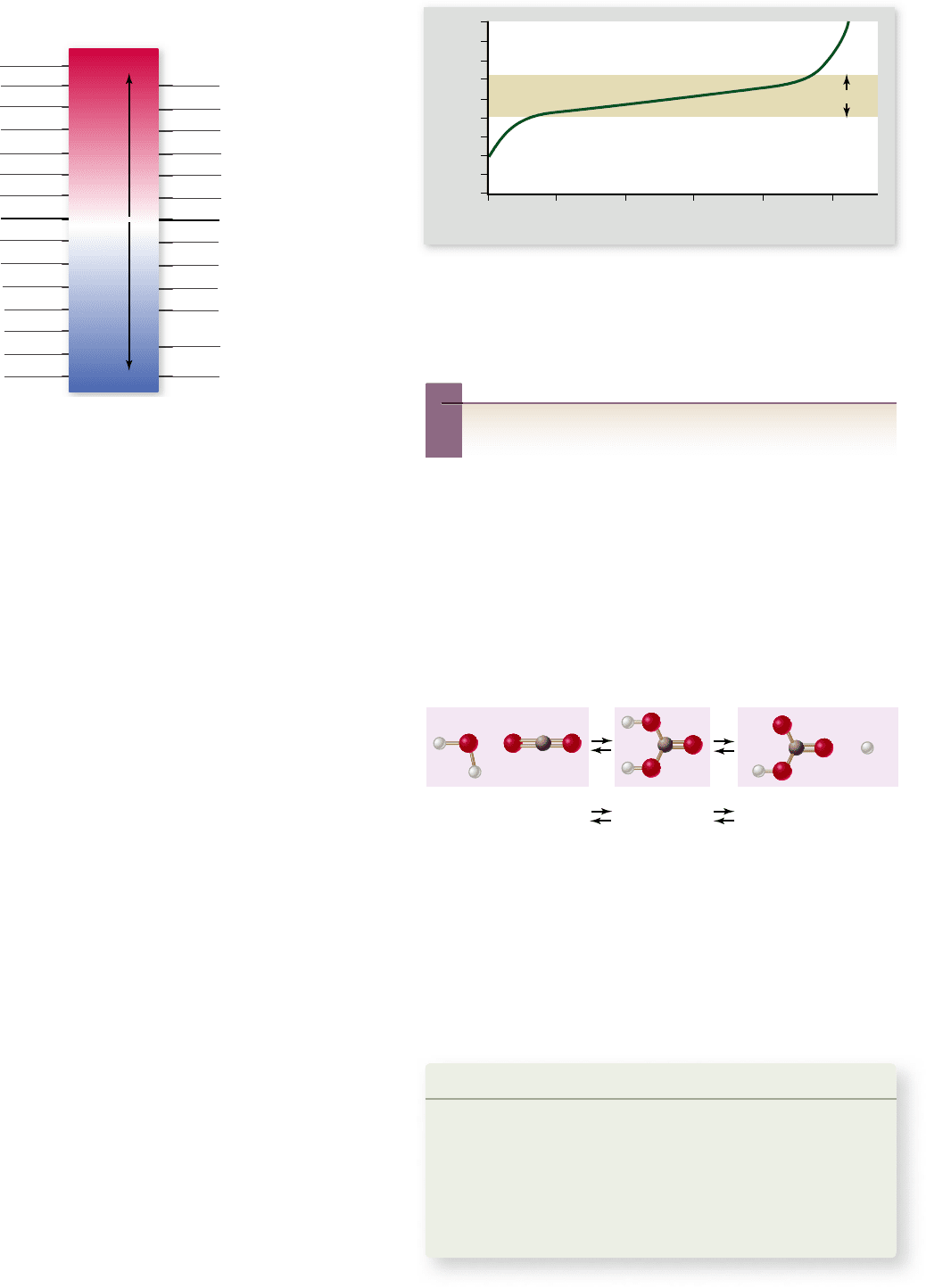
Figure 2.17
Bu ers minimize changes in pH. Adding a base to
a solution neutralizes some of the acid present, and so raises the pH. Thus,
as the curve moves to the right, re ecting more and more base, it also
rises to higher pH values. A buffer makes the curve rise or fall very slowly
over a portion of the pH scale, called the “buffering range” of that buffer.
Inquiry question
?
For this buffer, adding base raises pH more rapidly below
pH 4 than above it. What might account for this behavior?
a pH of 1. The pH of champagne, which bubbles because of the
carbonic acid dissolved in it, is about 2.
Bases
A substance that combines with H
+
when dissolved in water,
and thus lowers the [H
+
], is called a base. Therefore, basic (or
alkaline) solutions have pH values above 7. Very strong bases,
such as sodium hydroxide (NaOH), have pH values of 12 or
more. Many common cleaning substances, such as ammonia
and bleach, accomplish their action because of their high pH.
Bu ers help stabilize pH
The pH inside almost all living cells, and in the fluid surround-
ing cells in multicellular organisms, is fairly close to neutral, 7.
Most of the enzymes in living systems are extremely sensitive
to pH. Often even a small change in pH will alter their shape,
thereby disrupting their activities. For this reason, it is impor-
tant that a cell maintain a constant pH level.
But the chemical reactions of life constantly produce acids
and bases within cells. Furthermore, many animals eat substances
that are acidic or basic. Cola drinks, for example, are moderately
strong (although dilute) acidic solutions. Despite such variations
in the concentrations of H
+
and OH
–
, the pH of an organism is
kept at a relatively constant level by buffers (figure 2.17).
A buffer is a substance that resists changes in pH. Buffers
act by releasing hydrogen ions when a base is added and ab-
sorbing hydrogen ions when acid is added, with the overall ef-
fect of keeping [H
+
] relatively constant.
Within organisms, most buffers consist of pairs of sub-
stances, one an acid and the other a base. The key buffer in
human blood is an acid–base pair consisting of carbonic acid
(acid) and bicarbonate (base). These two substances interact in
a pair of reversible reactions. First, carbon dioxide (CO
2
) and
H
2
O join to form carbonic acid (H
2
CO
3
), which in a second
reaction dissociates to yield bicarbonate ion (HCO
3
–
) and H
+
.
If some acid or other substance adds H
+
to the blood, the
HCO
3
–
acts as a base and removes the excess H
+
by forming
H
2
CO
3
. Similarly, if a basic substance removes H
+
from the
blood, H
2
CO
3
dissociates, releasing more H
+
into the blood.
The forward and reverse reactions that interconvert H
2
CO
3
and HCO
3
–
thus stabilize the blood’s pH.
Figure 2.16
The pH scale. The pH value of a solution
indicates its concentration of hydrogen ions. Solutions with a pH
less than 7 are acidic, whereas those with a pH greater than 7 are
basic. The scale is logarithmic, which means that a pH change of
1 represents a 10-fold change in the concentration of hydrogen ions.
Thus, lemon juice is 100 times more acidic than tomato juice, and
seawater is 10 times more basic than pure water, which has a pH of 7.
The reaction of carbon dioxide and water to form car-
bonic acid is a crucial one because it permits carbon, essential to
life, to enter water from the air. The Earth’s oceans are rich in
carbon because of the reaction of carbon dioxide with water.
In a condition called blood acidosis, human blood, which
normally has a pH of about 7.4, drops to a pH of about 7.1.
This condition is fatal if not treated immediately. The reverse
condition, blood alkalosis, involves an increase in blood pH of
a similar magnitude and is just as serious.
Learning Outcomes Review 2.6
Acid solutions have a high [H
+
] , and basic solutions have a low [H
+
] (and
therefore a high [OH
–
]). The pH of a solution is the negative logarithm of its
[H
+
]. Low pH values indicate acids, and high pH values indicate bases. Even
small changes in pH can be harmful to life. Buff er systems in organisms help
to maintain pH within a narrow range.
■ A change of 2 pH units indicates what change in [H
+
]?
30
part
I
The Molecular Basis of Life
rav32223_ch02_017-032.indd 30rav32223_ch02_017-032.indd 30 11/5/09 4:07:35 PM11/5/09 4:07:35 PM

Apago PDF Enhancer
Chapter Review
2.1 The Nature of Atoms
All matter is composed of atoms (see gure 2.3 ).
Atomic structure includes a central nucleus and orbiting electrons.
Electrically neutral atoms have the same number of protons as
electrons. Atoms that gain or lose electrons are called ions.
Each element is de ned by its atomic number, the number of protons
in the nucleus. Atomic mass is the sum of the mass of protons and
neutrons in an atom. Isotopes are forms of a single element with
different numbers of neutrons, and thus different atomic mass.
Radioactive isotopes are unstable.
Electrons determine the chemical behavior of atoms.
The potential energy of electrons increases as distance from the
nucleus increases. Electron orbitals are probability distributions.
S-orbitals are spherical; other orbitals have different shapes, such as
the dumbbell-shaped p-orbitals.
Atoms contain discrete energy levels.
Energy levels correspond to quanta (sing. quantum) of energy, a
“ladder” of energy levels that an electron may have.
The loss of electrons from an atom is called oxidation. The gain of
electrons is called reduction. Electrons can be transferred from one
atom to another in coupled redox reactions .
2.2 Elements Found in Living Systems
The periodic table displays elements according to atomic number
and properties.
Atoms tend to establish completely full outer energy levels (the octet
rule). Elements with lled outermost orbitals are inert.
Ninety elements occur naturally in the Earth’s crust. Twelve of these
elements are found in living organisms in greater than trace amounts:
C, H, O, N, P, S, Na, K, Ca, Mg, Fe, and Cl.
Compounds of carbon are called organic compounds. The majority of
molecules in living systems are composed of C bound to H, O, and N.
2.3 The Nature of Chemical Bonds
Molecules contain two or more atoms joined by chemical bonds.
Compounds contain two or more different elements.
Ionic bonds form crystals.
Ions with opposite electrical charges form ionic bonds, such as NaCl
(see gure 2.9b).
Covalent bonds build stable molecules.
A molecule formed by a covalent bond is stable because it has no net
charge, the octet rule is satis ed, and it has no unpaired electrons.
Covalent bonds may be single, double, or triple, depending on
the number of pairs of electrons shared. Nonpolar covalent bonds
involve equal sharing of electrons between atoms. Polar covalent
bonds involve unequal sharing of electrons.
Chemical reactions alter bonds.
Temperature, reactant concentration, and the presence of catalysts
affect reaction rates. Most biological reactions are reversible, such as
the conversion of carbon dioxide and water into carbohydrates.
2.4 Water: A Vital Compound
Water’s structure facilitates hydrogen bonding.
Hydrogen bonds are weak interactions between a partially positive H
in one molecule and a partially negative O in another molecule (see
gure 2.11).
Water molecules are cohesive.
Cohesion is the tendency of water molecules to adhere to one
another due to hydrogen bonding. The cohesion of water is
responsible for its surface tension.
Water molecules are adhesive.
Adhesion occurs when water molecules adhere to other polar
molecules. Capillary action results from water’s adhesion to the
sides of narrow tubes, combined with its cohesion.
2.5 Properties of Water
Water’s high speci c heat helps maintain temperature.
The speci c heat of water is high because it takes a considerable
amount of energy to disrupt hydrogen bonds.
Water’s high heat of vaporization facilitates cooling.
Breaking hydrogen bonds to turn liquid water into vapor takes a
lot of energy. Many organisms lose excess heat through evaporative
cooling, such as sweating.
Solid water is less dense than liquid water.
Hydrogen bonds are spaced farther apart in the solid phase of water
than in the liquid phase. As a result, ice oats.
The solvent properties of water help move ions and polar molecules.
Water’s polarity makes it a good solvent for polar substances and
ions. Polar molecules or portions of molecules are attracted to water
(hydrophilic). Molecules that are nonpolar are repelled by water
(hydrophobic). Water makes nonpolar molecules clump together.
Water organizes nonpolar molecules.
Nonpolar molecules will aggregate to avoid water. This maximizes
the hydrogen bonds that water can make. This hydrophobic
exclusion can affect the structure of DNA, proteins and biological
membranes.
Water can form ions.
Water dissociates into H
+
and OH
–
. The concentration of H
+
, shown
as [H
+
], in pure water is 10
–7
mol/L.
2.6 Acids and Bases (see gure 2.16 )
The pH scale measures hydrogen ion concentration.
pH is de ned as the negative logarithm of [H
+
]. Pure water has a pH
of 7. A difference of 1 pH unit means a 10-fold change in [H
+
].
Acids have a greater [H
+
] and therefore a lower pH; bases have a
lower [H
+
] and therefore a higher pH.
Bu ers help stabilize pH.
Carbon dioxide and water react reversibly to form carbonic acid.
A buffer resists changes in pH by absorbing or releasing H
+
. The key
buffer in the human blood is the carbonic acid/bicarbonate pair.
www.ravenbiology.com
chapter
2
The Nature of Molecules and the Properties of Water
31
rav32223_ch02_017-032.indd 31rav32223_ch02_017-032.indd 31 11/9/09 12:02:40 PM11/9/09 12:02:40 PM