
Raven P.H., Johnson G.B., Mason K.A. Biology (Ninth Edition)
Подождите немного. Документ загружается.

Apago PDF Enhancer
Turgor pressure
y
p
= 0.5 MPa
Pressure Potential
y
p
Cell wall
Cell
membrane
Pure water
Wall
pressure
Solute Potential
y
s
Water Potential
y
s
= –0.2 MPa
y
=
y
s
+
y
p
y
cell
= –0.7 MPa + 0.5 MPa = –0.2 MPa
y
solution
= –0.2 MPa (solution has no pressure potential)
y
s
= –0.7 MPa
Sucrose
molecules
a.
b.
c.
+ −
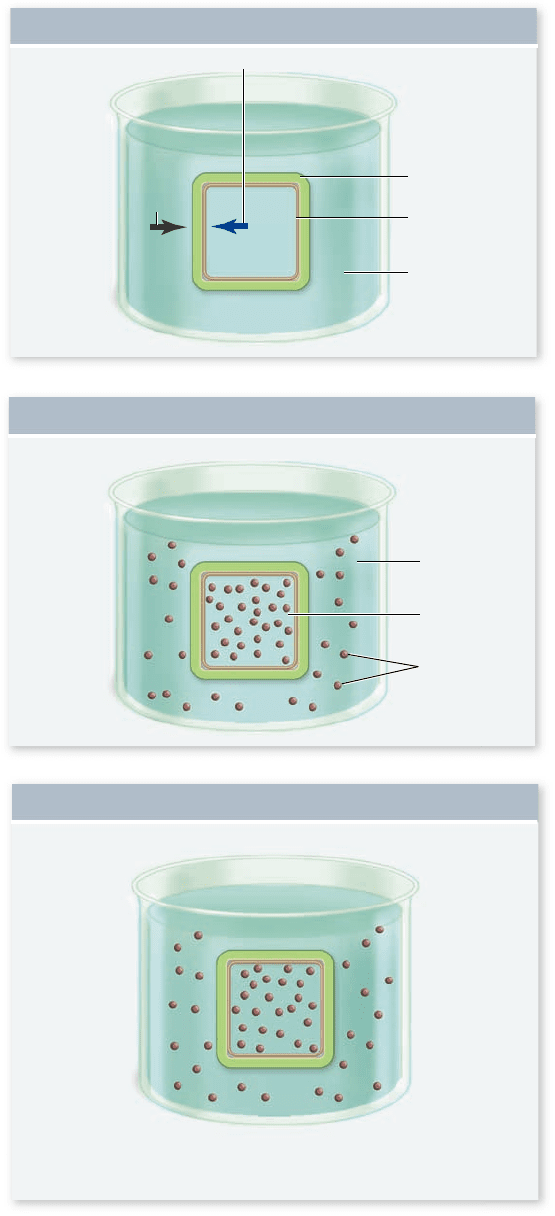
Figure 38.3
Determining water potential. a. Cell walls
exert pressure in the opposite direction of cell turgor pressure.
b. Using the given solute potentials, predict the direction of water
movement based only on solute potential. c. Total water potential is
the sum of Ψ
s
and Ψ
p
. Since the water potential inside the cell
equals that of the solution, there is no net movement of water.
solution. Water potential has two components: (1) physical forces,
such as pressure on a plant cell wall or gravity, and (2) the concen-
tration of solute in each solution.
In terms of physical forces, the contribution of gravity to
water potential is so small that it is generally not included in
calculations unless you are considering a very tall tree. The tur-
gor pressure, resulting from pressure against the cell wall, is
referred to as pressure potential (Ψ
p
). As turgor pressure in-
creases, Ψ
p
increases. A beaker of water containing dissolved
sucrose, however, is not bounded by a cell membrane or a cell
wall. Solutions that are not contained within a vessel or mem-
brane cannot have turgor pressure, and they always have a Ψ
p
of
0 MPa (figure 38.3a).
Water potential also arises from an uneven distribution
of a solute on either side of a membrane, which results in os-
mosis. Applying pressure on the side of the membrane that has
the greater concentration of solute prevents osmosis. The
smallest amount of pressure needed to stop osmosis is propor-
tional to the osmotic or solute potential (Ψ
s
) of the solution
(figure 38.3b). Pure water has a solute potential of zero. As a
solution increases in solute concentration, it decreases in Ψ
s
(< 0 MPa). A solution with a higher solute concentration has a
more negative Ψ
s
.
The total water potential (Ψ
w
) of a plant cell is the sum of
its pressure potential (Ψ
p
) and solute potential (Ψ
s
); it repre-
sents the total potential energy of the water in the cell:
Ψ
w
= Ψ
p
+ Ψ
s
When the Ψ
w
inside the cell equals that of the solution,
there is no net movement of water (figure 38.3c).
When a cell is placed into a solution with a different
Ψ
w
, the tendency is for water to move in the direction that
eventually results in equilibrium—both the cell and the solu-
tion have the same Ψ
w
(figure 38.4). The Ψ
p
and Ψ
s
values
may differ for cell and solution, but the sum (=Ψ
w
) should be
the same.
Aquaporins enhance osmosis
For a long time, scientists did not understand how water moved
across the lipid bilayer of the plasma membrane. Water, how-
ever, was found to move more rapidly than predicted by osmo-
sis alone. We now know that osmosis is enhanced by membrane
water channels called aquaporins, which you first encountered
in chapter 5 (figure 38.5). These transport channels occur in
both plants and animals; in plants, they exist in vacuoles
and plasma membranes and also allow for bulk flow across
the membrane.
At least 30 different genes code for aquaporin-like pro-
teins in Arabidopsis. Aquaporins speed up osmosis, but they do
not change the direction of water movement. They are impor-
tant in maintaining water balance within a cell and in moving
water into the xylem.
Water potential and pressure gradients form a founda-
tion for understanding local and long-distance transport in
plants. The remaining sections of this chapter explore trans-
port within and among different tissues and organs of the
plant in more depth.
772
part
VI
Plant Form and Function
rav32223_ch38_769-785.indd 772rav32223_ch38_769-785.indd 772 11/16/09 12:19:47 PM11/16/09 12:19:47 PM
Apago PDF Enhancer
b.
a.
Cell Initially Introduced into Solution
Solution
y
s
= –0.7 MPa
y
p
=
Cell
y
s
= –0.2 MPa
y
p
= 0.5 MPa
y
solution
= –0.7 MPa
y
cell
=
y
solution
=
–0.7 MPa
Cell at Equilibrium Is Plasmolyzed
Cell wall
Cell membrane
Cell wall
Cell membrane
y
cell
= 0.3 MPa
Cell
y
p
= 0
–0.7 MPa =
y
s
+ 0 MPa
y
s
= –0.7
0 MPa
Cell wall and exterior
Aquaporin
Cytoplasm
Water molecules
Cell membrane
Diffusion
Bulk flow
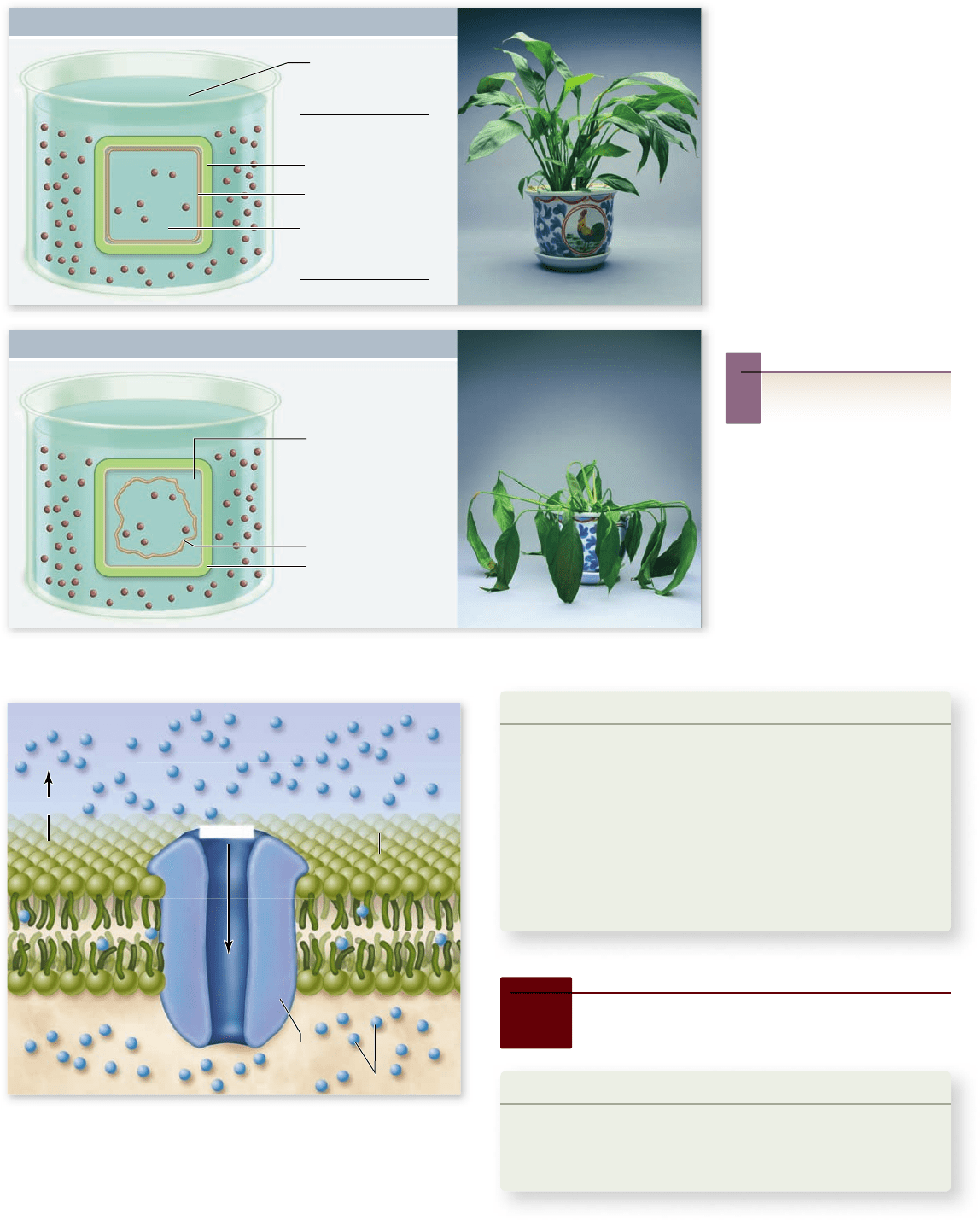
Figure 38.4
Water
potential at equilibrium.
a. This cell initially had a larger
Ψ
w
than the solution surrounding
it. b. At osmotic equilibrium, the
Ψ
w
of the cell and the solution
should be the same. We assume
that the cell is in a very large
volume of solution of constant
concentration. The nal Ψ
w
of
the cell should therefore equal
the initial Ψ
w
of the solution.
When a cell is plasmolyzed,
Ψ
p
= 0. As the cell loses water,
the cell’s solution becomes
concentrated.
Inquiry question
?
What would Ψ
w
, Ψ
s
, and
Ψ
p
of the cell in (a) be at
equilibrium if it had been
placed in a solution with a
Ψ
s
of –0.5?
Figure 38.5
Aquaporins. Aquaporins are water-selective
pores in the plasma membrane that increase the rate of osmosis
because they allow bulk ow across the membrane. They do not
alter the direction of water movement, however.
Learning Outcomes Review 38.1
Transpiration is the evaporation of thin fi lms of water from the stomata,
exerting a lifting force on water in the xylem. Water potential is the sum of
the pressure potential and the solute potential; water moves from an area of
high water potential to an area of low water potential. This diff erence moves
water from the soil into roots, and from the roots to the rest of the plant
body. The vapor pressure gradient between the inside and the outside of a
leaf drives transpiration.
■ Explain how physical pressure and solute concentration
contribute to water potential.
38.2
Water and Mineral Absorption
Learning Outcomes
Explain the function of root hairs.1.
List the three water transport routes through plants.2.
Describe the function of Casparian strips.3.
chapter
38
Transport in Plants
773www.ravenbiology.com
rav32223_ch38_769-785.indd 773rav32223_ch38_769-785.indd 773 11/16/09 12:19:48 PM11/16/09 12:19:48 PM
Apago PDF Enhancer
Soil
Plant
Air
0
–0.5
–1.0
–100
y
w
Water potential (MPa)
Decreasing water potential
The water film that
coats mesophyll
cell walls evaporates.
Rippled cell surfaces
result in higher rate of
transpiration than
smooth cell surfaces.
Smooth
surface
Rippled
surface
Cohesion by
hydrogen bonding
between water
molecules
Adhesion due to polarity
of water molecules
Water exits plant
through stomata.
Water moves up plant
through xylem.
Water
enters
plant
through
roots.
Soil
Symporters contribute
to the
y
w
gradient that
determines the
directional flow of water.
Cytosol
Soil
H
;
Mineral
ions
Water
Symporter
H
2
O
H
2
O
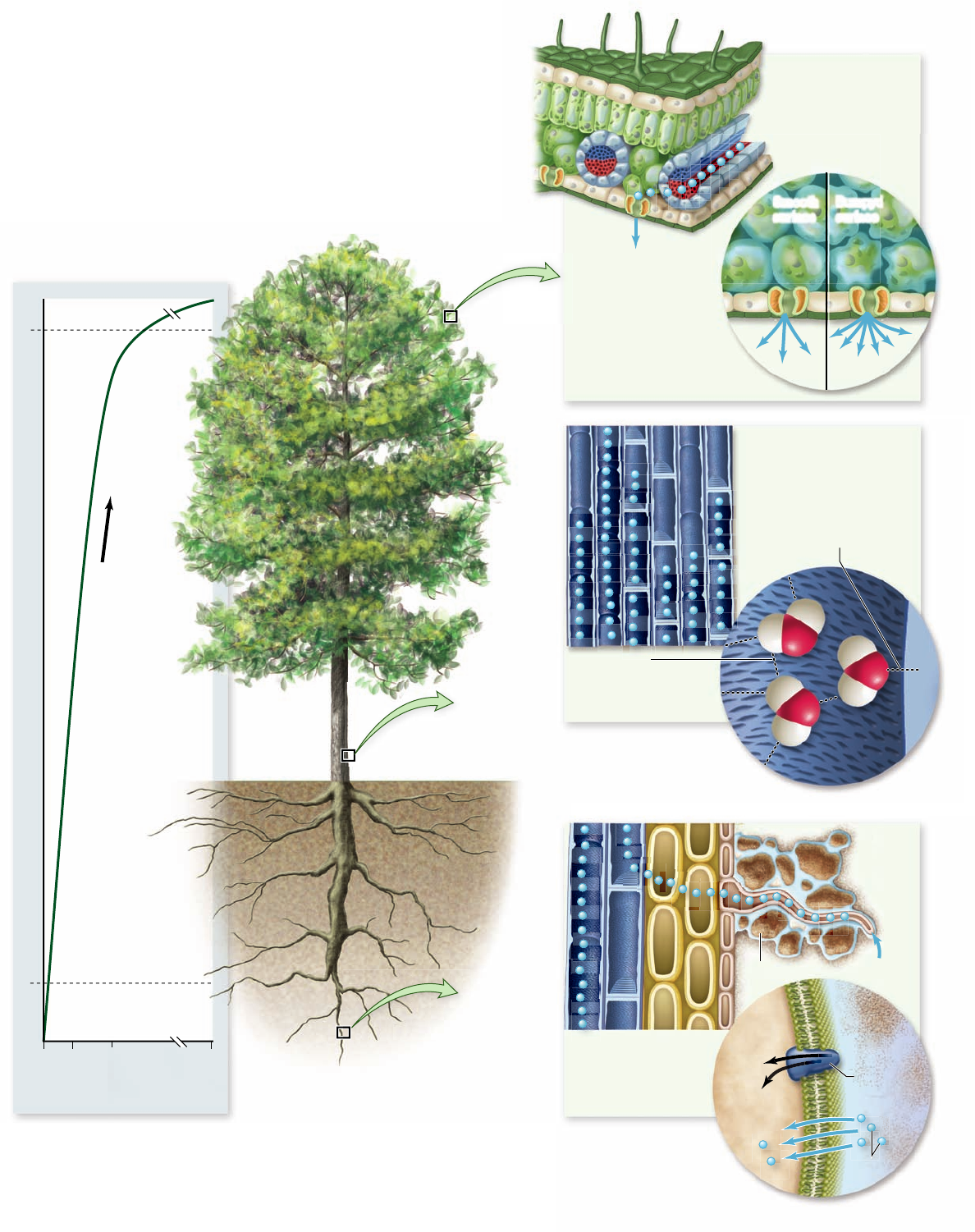
Figure 38.6
Water potential is higher in soil and roots than at the shoot tip. Water evaporating
from the leaves through the stomata causes additional water to move upward in the xylem and also to enter the
plant through the roots. Water potential drops substantially in the leaves due to transpiration.
Most of the water absorbed by the plant comes in through the
region of the root with root hairs (figures 38.6 and 38.7). As
you learned in chapter 36, root hairs are extensions of root epi-
dermal cells located just behind the tips of growing roots.
Surface area for the absorption of water and minerals is
further increased in many species of plants by interacting with
mycorrhizal fungi. These fungi extend the absorptive net far
beyond that of root hairs and are particularly helpful in the
uptake of phosphorous in the soil. Mycorrhizae are discussed in
detail in chapter 31.
774
part
VI
Plant Form and Function
rav32223_ch38_769-785.indd 774rav32223_ch38_769-785.indd 774 11/16/09 12:19:52 PM11/16/09 12:19:52 PM
Apago PDF Enhancer
Cell wall Plasmodesma Plasma membrane
Apoplast route
Symplast route
Transmembrane route
Vacuole
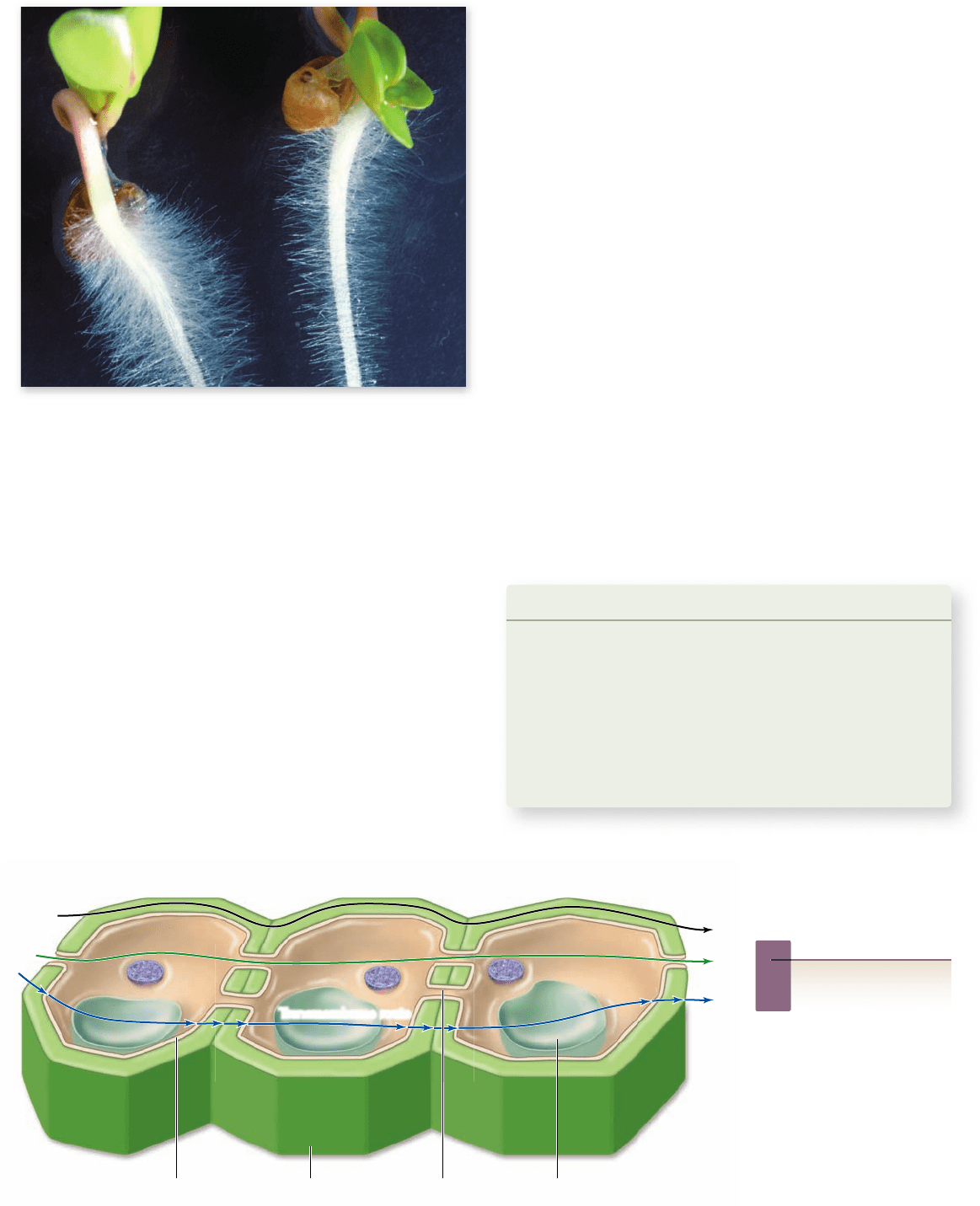
Figure 38.7
Water and minerals move into roots in
regions rich with root hairs.
Figure 38.8
Transport
routes between cells.
Inquiry question
?
Which route would be
the fastest for water
movement? Would this
always be the best way
to move nutrients into
the plant?
cell the greatest amount of control over what substances enter
and leave. These three routes are not exclusive, and molecules
can change pathways at any time, until reaching the endoder-
mis of the root.
Transport through the
endodermis is selective
Eventually, on their journey inward, molecules reach the endo-
dermis. Any further passage through the cell walls is blocked by
the Casparian strips. As described in chapter 36, all cells in the
cylinder of endodermis have connecting walls embedded with
the waterproof material suberin (figure 38.9) . Molecules must
pass through the plasma membranes and protoplasts of the en-
dodermal cells to reach the xylem. The endodermis, with its
unique structure, along with the cortex and epidermis, controls
water and nutrient flow to the xylem to regulate water potential
and helps limit leakage of water out of the root.
Because the mineral ion concentration in the soil water is
usually much lower than it is in the plant, an expenditure of
energy (supplied by ATP) is required for these ions to accumu-
late in root cells. The plasma membranes of endodermal cells
contain a variety of protein transport channels, through which
proton pumps transport specific ions against even larger con-
centration gradients (refer to figure 38.1 ). Once inside the vas-
cular stele, the ions, which are plant nutrients, are transported
via the xylem throughout the plant.
Learning Outcomes Review 38.2
Water and minerals move into the plant from the soil, particularly in the
region rich with root hairs. The three water transport routes are the apoplast
route through the cells walls, the symplast route through plasmodesmata,
and the transmembrane route across cell and vacuole membranes. Casparian
strips force water and nutrients to move through the cell membranes of the
endodermis, allowing selective control.
■ What qualities of the cell membrane allow it to act as a
selective barrier?
Once absorbed through root hairs, water and minerals
must move across cell layers until they reach the vascular tis-
sues; water and dissolved ions then enter the xylem and move
throughout the plant.
Three transport routes exist through cells
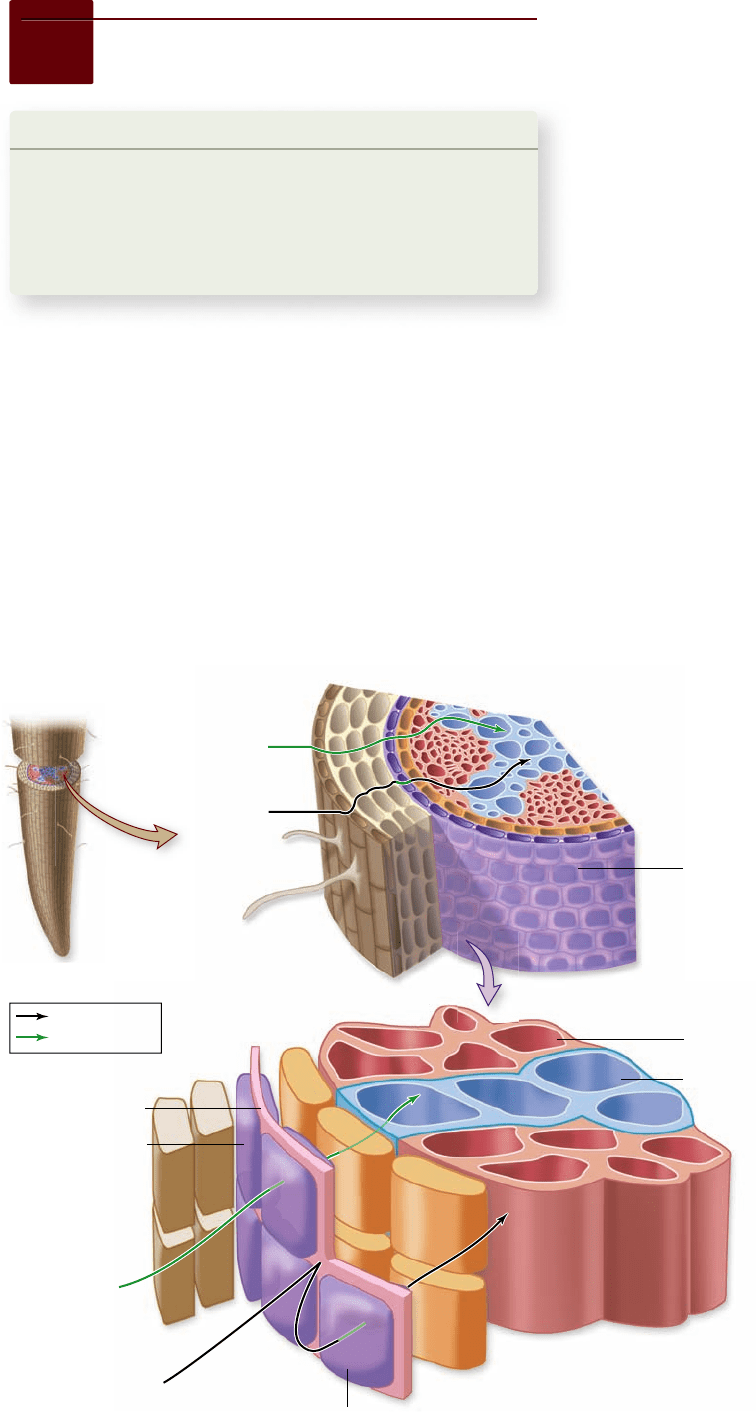
Water and minerals can follow three pathways to the vascular
tissue of the root (figure 38.8). The apoplast route includes
movement through the cell walls and the space between cells.
Transport through the apoplast avoids membrane transport.
The symplast route is the continuum of cytoplasm between
cells connected by plasmodesmata. Once molecules are inside a
cell, they can move between cells through plasmodesmata with-
out crossing a plasma membrane. The transmembrane route
involves membrane transport between cells and also across the
membranes of vacuoles within cells. This route permits each
chapter
38
Transport in Plants
775www.ravenbiology.com
rav32223_ch38_769-785.indd 775rav32223_ch38_769-785.indd 775 11/16/09 12:19:57 PM11/16/09 12:19:57 PM
Apago PDF Enhancer
H
2
O and
minerals
Endodermis
Xylem
Phloem
Casparian strip
Cell membrane
Endodermal cell
apoplastic route
symplastic route
H
2
O and
minerals
H
2
O and
minerals
H
2
O and
minerals
Figure 38.9
The pathways of
mineral transport in roots. Minerals
are absorbed at the surface of the root. In
passing through the cortex, they must
either follow the cell walls and the spaces
between them or go directly through the
plasma membranes and the protoplasts of
the cells, passing from one cell to the next
by way of the plasmodesmata. When they
reach the endodermis, however, their
further passage through the cell walls is
blocked by the Casparian strips, and they
must pass through the membrane and
protoplast of an endodermal cell before
they can reach the xylem.
38.3
Xylem Transport
Learning Outcomes
Describe the environmental conditions in which 1.
guttation occurs.
List the properties of water that cause it to have a high 2.
tensile strength.
Explain how cavitation interrupts water flow.3.
The aqueous solution that passes through the membranes of
endodermal cells enters the plant’s vascular tissues and moves
into the tracheids and vessel members of the xylem. As ions are
actively pumped into the root or move via facilitated diffusion,
their presence increases the water potential and increases tur-
gor pressure in the roots due to osmosis.
Root pressure is present even when
transpiration is low or not occurring
Root pressure, which often occurs at night, is caused by the
continued accumulation of ions in the roots at times when tran-
spiration from the leaves is very low or absent. This accumula-
tion results in an increasingly high ion concentration within
the cells, which in turn causes more water to enter the root hair
cells by osmosis. Ion transport further decreases the Ψ
s
of the
roots. The result is movement of water into the plant and up
the xylem columns despite the absence of transpiration.
Under certain circumstances, root pressure is so strong
that water will ooze out of a cut plant stem for hours or even
days. When root pressure is very high, it can force water up to
the leaves, where it may be lost in a liquid form through a pro-
cess known as guttation. Guttation cannot move water up
great heights or at rapid speeds. It does not take place through
the stomata, but instead occurs through special groups of cells
located near the ends of small veins that function only in this
process. Guttation produces what is more commonly called
dew on leaves.
Root pressure alone, however, is insufficient to explain
xylem transport. Transpiration provides the main force for
moving water and ionic solutes from roots to leaves.
A water potential gradient from roots
to shoots enables transport
Water potential regulates the movement of water through a
whole plant, as well as across cell membranes. Roots are the
entry point. Water moves from the soil into the plant only if
water potential of the soil is greater than in the root. Too
much fertilizer or drought conditions lower the Ψ
w
of the soil
and limit water flow into the plant. Water in a plant moves
along a Ψ
w
gradient from the soil (where the Ψ
w
may be
close to zero under wet conditions) to successively more
negative water potentials in the roots, stems, leaves,
and atmosphere (see figure 38.6) .
776
part
VI
Plant Form and Function
rav32223_ch38_769-785.indd 776rav32223_ch38_769-785.indd 776 11/16/09 12:20:00 PM11/16/09 12:20:00 PM
Apago PDF Enhancer
Pores
Air
bubble
Water
molecule
Blocked
vessel
Direction
of water
flow
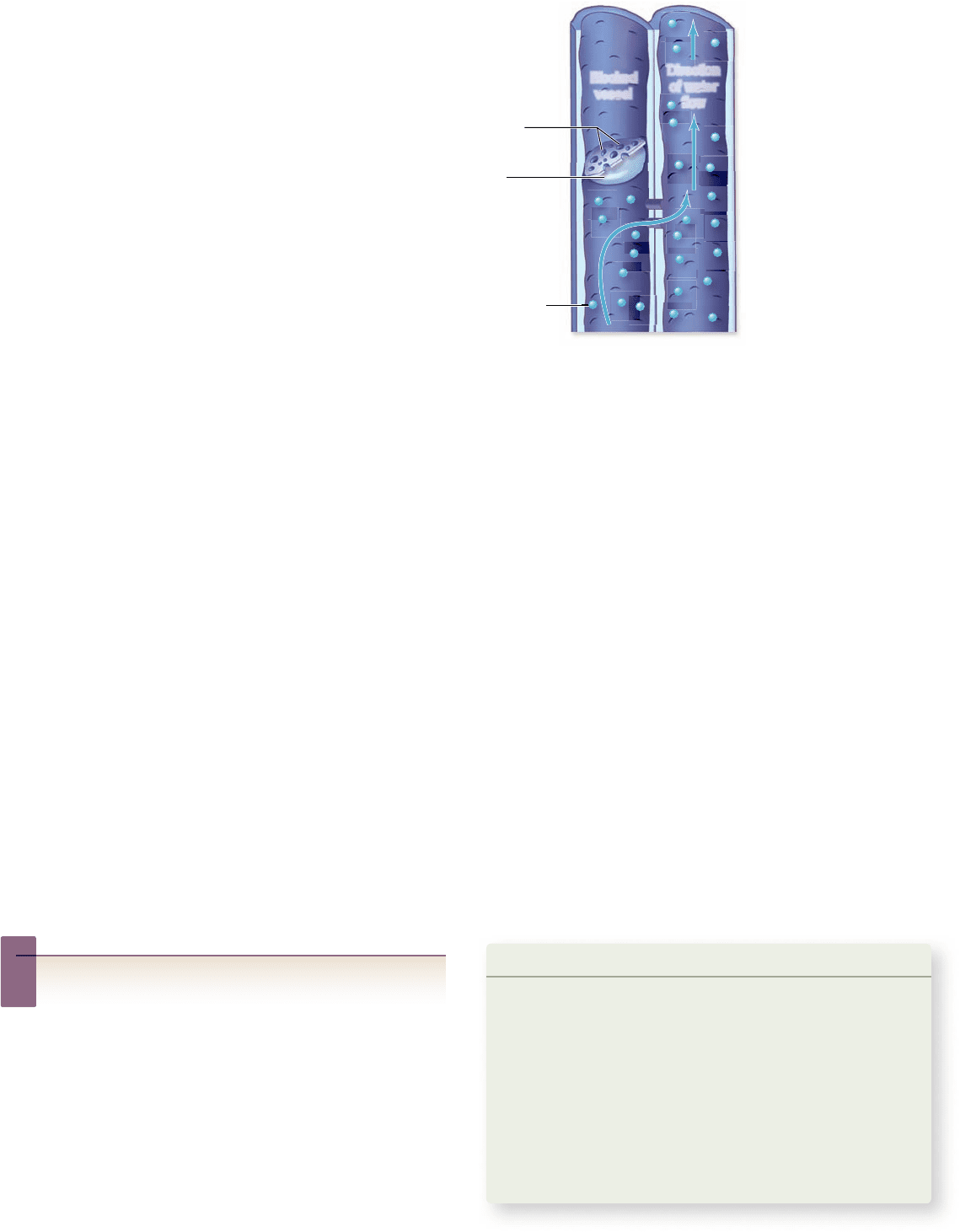
Figure 38.10
Cavitation. An air
bubble can break the
tensile strength of the
water column. Bubbles are
larger than pits and can
block transport to the next
tracheid or vessel. Water
drains to surrounding
tracheids or vessels.
Anatomical adaptations can compensate for the problem
of cavitation, including the presence of alternative pathways
that can be used if one path is blocked. Individual tracheids and
vessel members are connected to other tracheids or vessels by
pits in their walls, and air bubbles are generally larger than
these openings. In this way, bubbles cannot pass through the
pits to further block transport. Freezing or deformation of cells
can also cause small bubbles of air to form within xylem cells,
especially with seasonal temperature changes. Cavitation is one
reason older xylem often stops conducting water.
Mineral transport
Tracheids and vessels are essential for the bulk transport of
minerals. Ultimately, the minerals that are actively transported
into the roots are removed and relocated through the xylem to
other metabolically active parts of the plant. Phosphorus, po-
tassium, nitrogen, and sometimes iron may be abundant in the
xylem during certain seasons. In many plants, this pattern of
ionic concentration helps conserve these essential nutrients,
which may move from mature deciduous parts such as leaves
and twigs to areas of active growth, namely meristem regions.
Keep in mind that minerals that are relocated via the xylem
must move with the generally upward flow through the xylem.
Not all minerals can reenter the xylem conduit once they leave.
Calcium, an essential nutrient, cannot be transported elsewhere
once it has been deposited in a particular plant part. But some
other nutrients can be transported in the phloem.
Learning Outcomes Review 38.3
Guttation occurs when root pressure is high but transpiration is low. It
commonly occurs at night in temperate climates when the air is cool and the
humidity is high. Water’s high tensile strength results from the cohesiveness
of water molecules for each other and adhesiveness to the walls of cells in
the xylem; both of these are eff ects of hydrogen bonding. Cavitation, which
stops water movement, results from a bubble in the water transport system
that breaks cohesion.
■ What controls the rate of transpiration when the
humidity is low?
■ What happens to minerals once they leave the xylem?
Evaporation of water in a leaf creates negative pressure
or tension in the xylem, which literally pulls water up the
stem from the roots. The strong pressure gradient between
leaves and the atmosphere cannot be explained by evapora-
tion alone. As water diffuses from the xylem of tiny, branch-
ing veins in a leaf, it forms a thin film along mesophyll cell
walls. If the surface of the air–water interface is fairly smooth
(flat), the water potential is higher than if the surface be-
comes rippled.
The driving force for transpiration is the humidity gradi-
ent from 100% relative humidity inside the leaf to much less
than 100% relative humidity outside the stomata. Molecules
diffusing from the xylem replace evaporating water molecules.
As the rate of evaporation increases, diffusion cannot replace all
the water molecules. The film is pulled back into the cell walls
and becomes rippled rather than smooth. The change increases
the pull on the column of water in the xylem, and concurrently
increases the rate of transpiration.
Vessels and tracheids accommodate bulk ow
Water has an inherent tensile strength that arises from the
cohesion of its molecules, their tendency to form hydrogen
bonds with one another (see chapter 2). These two factors are
the basis of the cohesion–tension theory of the bulk flow of
water in the xylem. The tensile strength of a column of water
varies inversely with the diameter of the column; that is, the
smaller the diameter of the column, the greater the tensile
strength. Because plant tracheids and vessels are tiny in diam-
eter, the cohesive force of water is stronger than the pull of
gravity. The water molecules also adhere to the sides of the
tracheid or xylem vessels, further stabilizing the long column
of water.
Given that a narrower column of water has greater tensile
strength, it is intriguing that vessels, having diameters that are
larger than tracheids, are found in so many plants. The differ-
ence in diameter has a larger effect on the mass of water in the
column than on the tensile strength of the column. The volume
of liquid moving in a column per second is proportional to r
4
,
where r is the radius of the column, at constant pressure. A
twofold increase in radius would result in a 16-fold increase in
the volume of liquid moving through the column. Given equal
cross-sectional areas of xylem, a plant with larger-diameter ves-
sels can move more water up its stems than a plant with nar-
rower tracheids.
Inquiry question
?
If a mutation increased the radius of a xylem vessel threefold,
how would the movement of water through the plant
be affected?
The effect of cavitation
Tensile strength depends on the continuity of the water col-
umn; air bubbles introduced into the column when a vessel is
broken or cut would cause the continuity and the cohesion to
fail. A gas-filled bubble can expand and block the tracheid or
vessel, a process called cavitation. Cavitation stops water trans-
port and can lead to dehydration and death of part or all of a
plant (figure 38.10).
chapter
38
Transport in Plants
777www.ravenbiology.com
rav32223_ch38_769-785.indd 777rav32223_ch38_769-785.indd 777 11/16/09 12:20:02 PM11/16/09 12:20:02 PM
Apago PDF Enhancer
Slightly inflated balloon
Tied end
Add turgor
pressure (air)
Add thickened inner walls
(overlapping duct tape)
“Stoma”
20 μm
20 μm
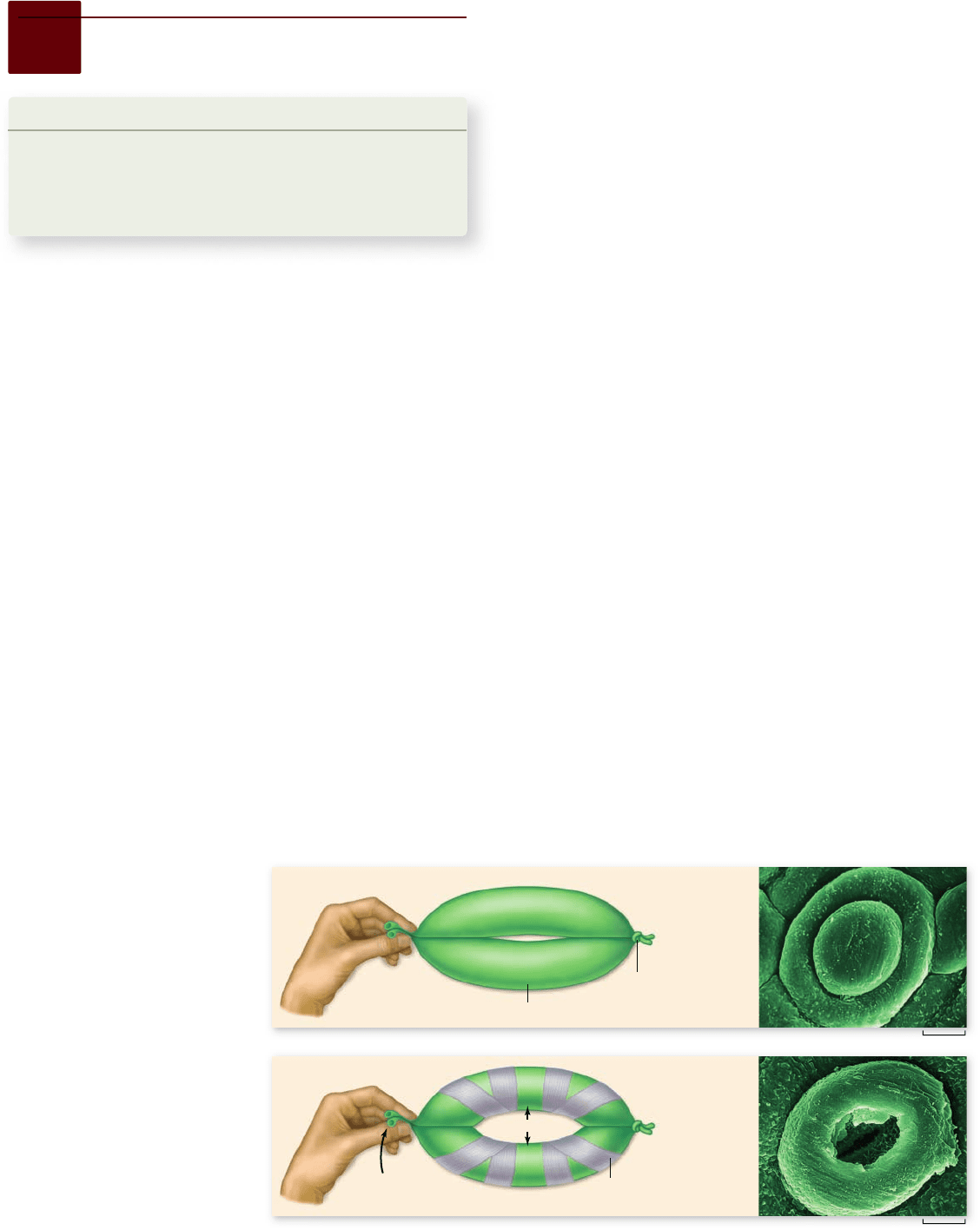
Figure 38.11
Unequal cell
wall thickenings on guard cells
result in the opening of
stomata when the guard
cells expand.
38.4
The Rate of Transpiration
Learning Outcomes
Explain the process by which guard cells regulate the 1.
opening of stomata.
Name the two conflicting requirements that influence 2.
opening and closing of stomata.
More than 90% of the water taken in by the roots of a plant is
ultimately lost to the atmosphere. Water moves from the tips of
veins into mesophyll cells, and from the surface of these cells it
evaporates into pockets of air in the leaf. As discussed in
chapter 36, these intercellular spaces are in contact with the air
outside the leaf by way of the stomata.
Stomata open and close to
balance H
2
O and CO
2
needs
Water is essential for plant metabolism, but it is continuously
being lost to the atmosphere. At the same time, photosynthesis
requires a supply of CO
2
entering the chlorenchyma cells from
the atmosphere. Plants therefore face two somewhat conflicting
requirements: the need to minimize the loss of water to the at-
mosphere and the need to admit carbon dioxide. Structural fea-
tures such as stomata and the cuticle have evolved in response to
one or both of these requirements.
The rate of transpiration depends on weather conditions,
including humidity and the time of day. As stated earlier, tran-
spiration from the leaves decreases at night, when stomata are
closed and the vapor pressure gradient between the leaf and the
atmosphere is less. During the day, sunlight increases the tem-
perature of the leaf, while transpiration cools the leaf through
evaporative cooling.
On a short-term basis, closing the stomata can control water
loss. This occurs in many plants when they are subjected to water
stress. But the stomata must be open at least part of the time so that
CO
2
can enter. As CO
2
enters the intercellular spaces, it dissolves in
water before entering the plant’s cells where it is used in photosyn-
thesis. The gas dissolves mainly in water on the walls of the inter-
cellular spaces below the stomata. The continuous stream of water
that reaches the leaves from the roots keeps these walls moist.
Turgor pressure in guard cells causes
stomata to open and close
The two sausage-shaped guard cells on each side of a stoma
stand out from other epidermal cells not only because of their
shape, but also because they are the only epidermal cells con-
taining chloroplasts. Their distinctive wall construction, which
is thicker on the inside and thinner elsewhere, results in a bulg-
ing out and bowing when they become turgid.
You can make a model of this for yourself by taking two
elongated balloons, tying the closed ends together, and inflat-
ing both balloons slightly. When you hold the two open ends
together, there should be very little space between the two bal-
loons. Now wrap duct tape around both balloons as shown in
figure 38.11 (without releasing any air) and inflate each one a
bit more. Hold the open ends together again. You should now
be holding a roughly doughnut-shaped pair of “guard cells”
with a “stoma” in the middle. Real guard cells rely on the influx
and efflux of water, rather than air, to open and shut.
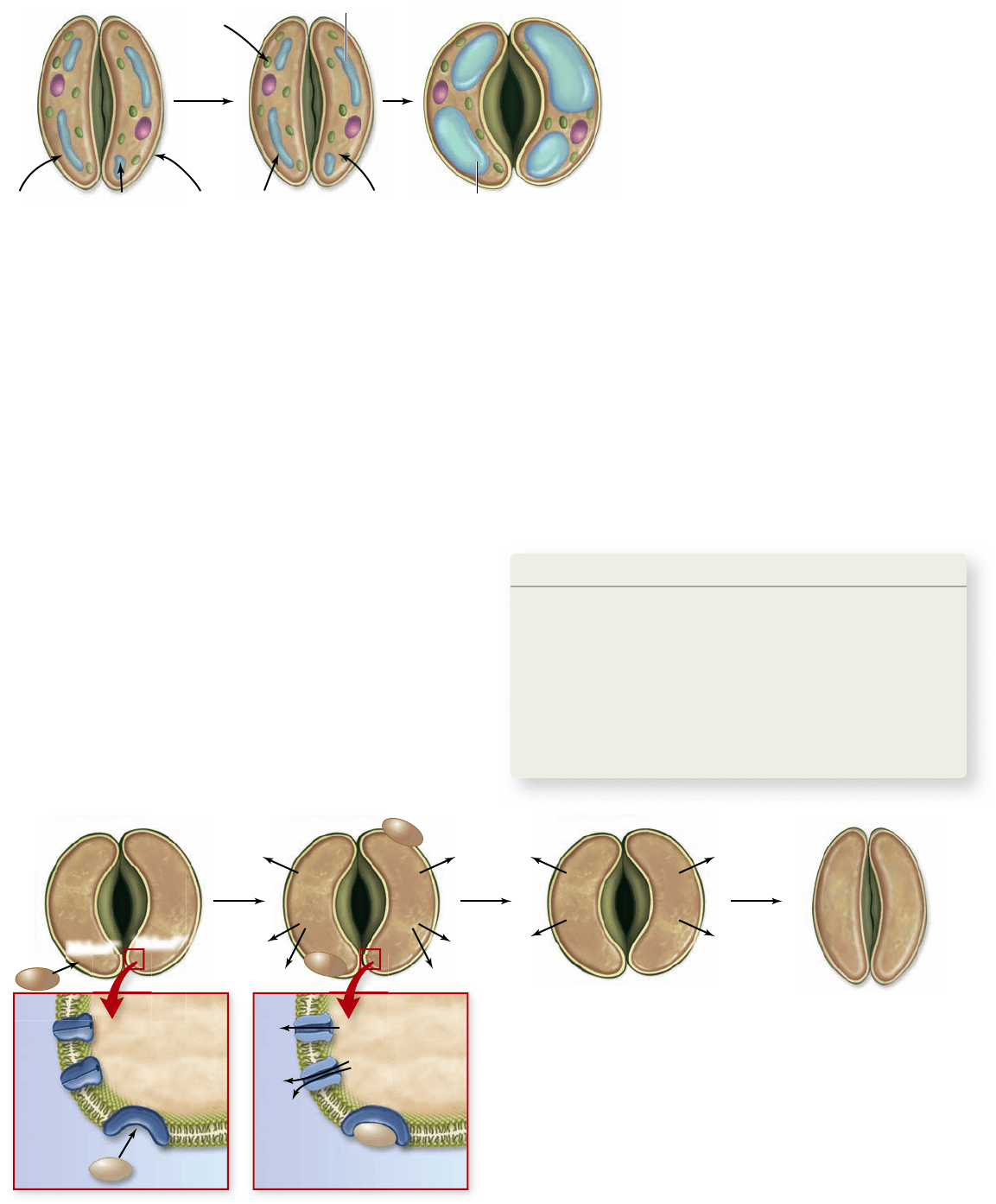
Turgor in guard cells results from the active uptake of po-
tassium (K
+
), chloride (Cl
–
), and malate. As solute concentration
increases, water potential decreases in the guard cells, and water
enters osmotically. As a result, these cells accumulate water and
become turgid, opening the stomata (figure 38.12) . The energy
required to move the ions across the guard cell membranes
comes from the ATP-driven H
+
pump shown in figure 38.1.
The guard cells of many plant species regularly become
turgid in the morning, when photosynthesis occurs, and lose tur-
gor in the evening, regardless of the availability of water. During
the course of a day, sucrose accumulates in the photosynthetic
guard cells. The active pumping of sucrose out of guard cells in
the evening may lead to loss of turgor and close the guard cell.
778
part
VI
Plant Form and Function
rav32223_ch38_769-785.indd 778rav32223_ch38_769-785.indd 778 11/16/09 12:20:03 PM11/16/09 12:20:03 PM
Apago PDF Enhancer
Closed stoma:
flaccid guard cells
Open stoma:
turgid guard cells
K
;
Cl
:
Malate
2
:
H
2
O
H
2
O H
2
O
Vacuole filled with water
Little water in vacuole
C
losed stoma:
flaccid guard cells
O
pen stoma:
turgid guard cells
Cytosol Cytosol
ABA
ABA
ABA
ABA
ABA
H
2
O
H
2
O
H
2
O
K
;
Cl
:
Malate
2
:
H
2
O
H
2
O
H
2
O
H
2
O
H
2
O
H
2
O H
2
O
H
2
O
H
2
O
H
2
O
K
;
K
;
K
;
Cl
:
Cl
:
Cl
:
Malate
2
:
K
;
Cl
:
Malate
2
:
Malate
2
:
Malate
2
:
H
2
O
H
2
O
H
2
O
K
;
Cl
:
Malate
2
:
Figure 38.12
How a stoma opens. When H+ ions are pumped from guard cells,
K+ and Cl- ions move in, and the guard cell turgor pressure increases as water enters by
osmosis. The increased turgor pressure causes the guard cells to bulge, with the thick walls
on the inner side causing each guard cell to bow outward, thereby opening the stoma.
Figure 38.13
Abscisic acid (ABA)
initiates a signaling pathway to close
stomata under drought stress.
Environmental factors a ect
transpiration rates
Transpiration rates increase with temperature and wind velocity
because water molecules evaporate more quickly. As humidity
increases, the water potential difference between the leaf and the
atmosphere decreases, but even at 95% relative humidity in the
atmosphere, the vapor pressure gradient can sustain full transpi-
ration. On a catastrophic level, when a whole plant wilts because
insufficient water is available, the guard cells may lose turgor, and
as a result, the stomata may close. Fluctuations in transpiration
rate are tempered by opening or closing stomata.
Experimental evidence has indicated that several path-
ways regulate stomatal opening and closing. Abscisic acid
(ABA), a plant hormone discussed in chapter 41 , plays a pri-
mary role in allowing K
+
to pass rapidly out of guard cells, caus-
ing the stomata to close in response to drought. ABA binds to
receptor sites in the plasma membranes of guard cells, trigger-
ing a signaling pathway that opens K
+
, Cl
–
, and malate ion
channels. Turgor pressure decreases as water loss follows, and
the guard cells close (figure 38.13) .
CO
2
concentration, light, and tem-
perature also affect stomatal opening. When
CO
2
concentrations are high, the guard cells
of many plant species are triggered to de-
crease the stomatal opening. Additional CO
2
is not needed at such times, and water is con-
served when the guard cells are closed.
Blue light regulates stomatal open-
ing. This helps increase turgor to open the
stomata when sunlight increases the evapo-
rative cooling demands. K
+
transport against
a concentration gradient is promoted by
light. Blue light in particular triggers proton
(H
+
) transport, creating a proton gradient
that drives the opening of K
+
channels.
The stomata may close when the tem-
perature exceeds 30° to 34°C and water rela-
tions are unfavorable. To ensure sufficient gas
exchange, these stomata open when it is dark and the temperature
has dropped. Some plants are able to collect CO
2
at night in a mod-
ified form to be utilized in photosynthesis during daylight hours. In
chapter 9, you learned about Crassulacean acid metabolism (CAM) ,
which occurs in succulent plants such as cacti. In this process, sto-
mata open and CO
2
is taken in at night and stored in organic com-
pounds. These compounds are decarboxylated during the day,
providing a source of CO
2
for fixation when stomata are closed.
CAM plants are able to conserve water in dry environments.
Learning Outcomes Review 38.4
When guard cells of the stomata actively take up ions, their water potential
decreases and they take up water by osmosis. When they become turgid they
change shape, creating an opening in the stoma. Stomata close when a plant
is under water stress, but they open when carbon dioxide is needed and
transpiration does not cause excess water loss. Transpiration rates increase
with high wind velocity, high temperatures, and low humidity.
■ Why is it critical that carbon dioxide dissolve in water
upon entering plants?
chapter
38
Transport in Plants
779www.ravenbiology.com
rav32223_ch38_769-785.indd 779rav32223_ch38_769-785.indd 779 11/16/09 12:20:07 PM11/16/09 12:20:07 PM
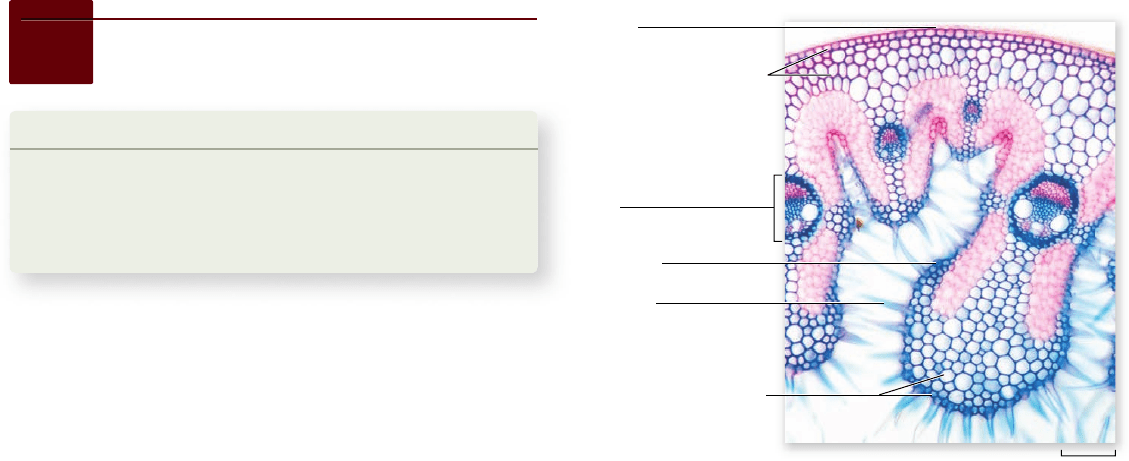
Apago PDF Enhancer
Cuticle
Upper multiple epidermis
Vein
Trichome
Guard cell
Lower multiple epidermis
250 µm
Figure 38.14
Anatomical protection from drought in
leaves. Deeply embedded stomata, extensive trichomes, and
multiple layers of epidermis minimize water loss in this leaf, shown
in cross section.
38.5
Water-Stress Responses
Learning Outcomes
List three drought adaptations in plants.1.
Describe the negative effects of flooding on plant growth.2.
Outline three ways in which a plant may deal with a 3.
salty environment.
Because plants cannot simply move on when water availability
or salt concentrations change, adaptations have evolved to al-
low plants to cope with environmental fluctuations, including
drought, flooding, and changing salinity.
Plant adaptations to drought include
strategies to limit water loss
Many mechanisms for controlling the rate of water loss have
evolved in plants. Regulating the opening and closing of stomata
provides an immediate response. Morphological adaptations pro-
vide longer term solutions to drought periods. For example, for
some plants dormancy occurs during dry times of the year; another
mechanism involves loss of leaves, limiting transpiration. Decidu-
ous plants are common in areas that periodically experience severe
drought. In a broad sense, annual plants conserve water when con-
ditions are unfavorable simply by going into “dormancy” as seeds.
Thick, hard leaves often with relatively few stomata—and
frequently with stomata only on the lower side of the leaf—lose
water far more slowly than large, pliable leaves with abundant sto-
mata. Leaves covered with masses of wooly- looking trichomes
(hairs) reflect more sunlight and thereby reduce the heat load on
the leaf and the demand for transpiration for evaporative cooling.
Plants in arid or semiarid habitats often have their sto-
mata in crypts or pits in the leaf surface (figure 38.14). Within
these depressions, the water surface tensions are altered, reduc-
ing the rate of water loss.
Plant responses to ooding include short-term
hormonal changes and long-term adaptations
Plants can also receive too much water, in which case they ulti-
mately “drown.” Flooding rapidly depletes available oxygen in
the soil and interferes with the transport of minerals and carbo-
hydrates in the roots. Abnormal growth often results. Hormone
levels change in flooded plants; ethylene, a hormone associated
with suppression of root elongation, increases, while gibberel-
lins and cytokinins, which enhance growth of new roots, usually
decrease (see chapter 41). Hormonal changes contribute to the
abnormal growth patterns.
Oxygen deprivation is among the most significant prob-
lems because it leads to decreased cellular respiration. Standing
water has much less oxygen than moving water. Generally,
standing-water flooding is more harmful to a plant (riptides ex-
cluded). Flooding that occurs when a plant is dormant is much
less harmful than flooding when it is growing actively.
Physical changes that occur in the roots as a result of oxygen
deprivation may halt the flow of water through the plant. Paradoxi-
cally, even though the roots of a plant may be standing in water, its
leaves may be drying out. Plants can respond to flooded conditions
by forming larger lenticels (which facilitate gas exchange) and ad-
ventitious roots that reach above flood level for gas exchange.
Whereas some plants survive occasional flooding, others
have adapted to living in fresh water. One of the most frequent
adaptations among plants to growing in water is the formation of
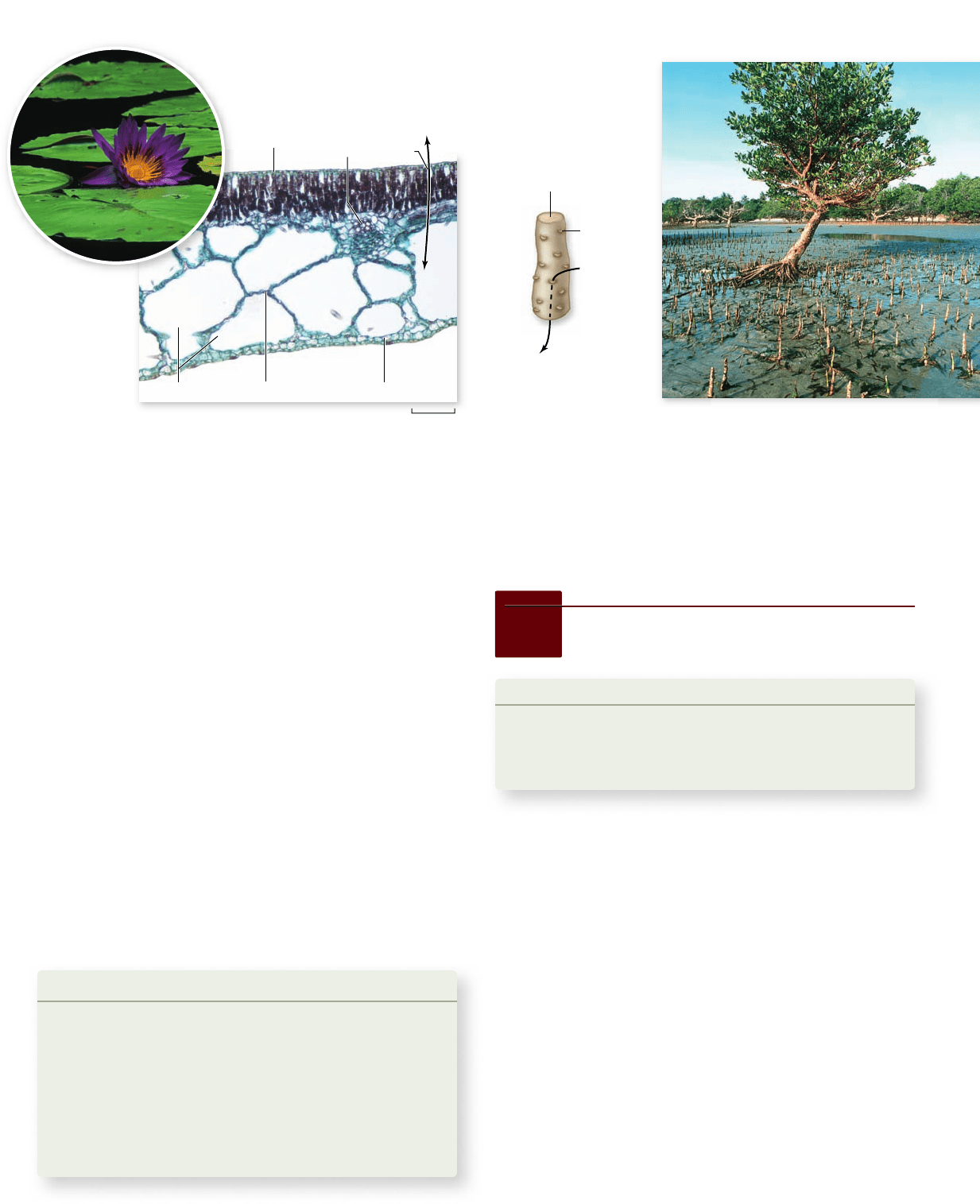
aerenchyma, loose parenchymal tissue with large air spaces in it
(figure 38.15) . Aerenchyma is very prominent in water lilies and
many other aquatic plants. Oxygen may be transported from the
parts of the plant above water to those below by way of passages in
the aerenchyma. This supply of oxygen allows oxidative respira-
tion to take place even in the submerged portions of the plant.
Some plants normally form aerenchyma, whereas oth-
ers, subject to periodic flooding, can form it when necessary.
In corn, increased ethylene due to flooding induces aeren-
chyma formation.
Plant adaptations to high salt concentration
include elimination methods
The algal ancestors of plants adapted to a freshwater environment
from a saltwater environment before the “move” onto land. This
adaptation involved a major change in controlling salt balance.
Growth in salt water
Plants such as mangroves that grow in areas normally flooded
with salt water must not only provide a supply of oxygen to
their submerged parts, but also control their salt balance. The
salt must be excluded, actively secreted, or diluted as it enters.
The black mangrove (Avicennia germinans) has long, spongy,
air-filled roots that emerge above the mud. These roots, called
780
part
VI
Plant Form and Function
rav32223_ch38_769-785.indd 780rav32223_ch38_769-785.indd 780 11/16/09 12:20:09 PM11/16/09 12:20:09 PM
Apago PDF Enhancer
a.
b.
Gas exchange
Stoma Vein
Upper epidermis
of leaf
Air spaces Aerenchyma Lower epidermis of leaf
1000 µm
Section of
pneumatophore
Lenticel
O
2
O
2
transported
to submerged
portions of plants
Figure 38.16
How mangroves get oxygen to their
submerged parts. The black mangrove (Avicennia germinans)
grows in areas that are commonly ooded, and much of each plant is
usually submerged. However, modi ed roots called pneumatophores
supply the submerged portions of the plant with oxygen because
these roots emerge above the water and have large lenticels. Oxygen
diffuses into the roots through the lenticels, passes into the abundant
aerenchyma, and moves to the rest of the plant.
Figure 38.15
Aerenchyma. This tissue facilitates gas
exchange in aquatic plants. a. Water lilies oat on the surface of
ponds, collecting oxygen and then transporting it to submerged
portions of the plant. b. Large air spaces in the leaves of the water
lily add buoyancy. The specialized parenchyma tissue that forms
these open spaces is called aerenchyma. Gas exchange occurs
through stomata found only on the upper surface of the leaf.
pneumatophores (see chapter 36), have large lenticels on their
above-water portions through which oxygen enters; it is then
transported to the submerged roots (figure 38.16). In addition,
the succulent leaves of some mangrove species contain large
quantities of water, which dilute the salt that reaches them.
Many plants that grow in such conditions also either secrete
large quantities of salt or block salt uptake at the root level.
Growth in saline soil
Soil salinity is increasing, often caused by salt accumulation
from irrigation. Currently 23% of the world’s cultivated land
has high levels of saline that reduce crop yield. The low water
potential of saline soils results in water-stressed crops. Some
plants, called halophytes (salt lovers), can tolerate soils with
high salt concentrations. Mechanisms for salt tolerance are be-
ing studied with the goal of breeding more salt-tolerant plants.
Some halophytes produce high concentrations of organic mol-
ecules within their roots to alter the water potential gradient
between the soil and the root so that water flows into the root.
Learning Outcomes Review 38.5
Adaptations to drought include dormancy, leaf loss, leaves that minimize
water loss, and stomata that lie in depressions. When plants are exposed
to fl ooding, oxygen deprivation leads to lower cellular respiration rates,
impedance of mineral and carbohydrate transport, and changes in hormone
levels. If a plant is exposed to a salty environment, it may exclude the salt
from uptake, secrete it after it has been taken up, or dilute it.
■ Why are flooded plants in danger of oxygen deprivation
when photosynthesis produces oxygen?
38.6
Phloem Transport
Learning Outcomes
Define translocation.1.
List the substances found in plant sap. 2.
Explain the pressure-flow hypothesis.3.
Most carbohydrates manufactured in leaves and other green parts
are distributed through the phloem to the rest of the plant. This
process, known as translocation , provides suitable carbohydrate
building blocks for the roots and other actively growing regions of
the plant. Carbohydrates concentrated in storage organs such as
tubers, often in the form of starch, are also converted into trans-
portable molecules, such as sucrose, and moved through the phlo-
em. In this section we discuss the ways by which carbohydrate- and
nutrient-rich fluid, termed sap, is moved through the plant body.
Organic molecules are transported
up and down the plant
The movement of sugars and other substances can be followed in
phloem using radioactive labels (figure 38.17) . Radioactive carbon
dioxide (
14
CO
2
) can be incorporated into glucose as a result of
photo synthesis. Glucose molecules are used to make the disaccha-
ride sucrose, which is transported in the phloem. Such studies have
shown that sucrose moves both up and down in the phloem.
chapter
38
Transport in Plants
781www.ravenbiology.com
rav32223_ch38_769-785.indd 781rav32223_ch38_769-785.indd 781 11/16/09 12:20:10 PM11/16/09 12:20:10 PM