
Raven P.H., Johnson G.B., Mason K.A. Biology (Ninth Edition)
Подождите немного. Документ загружается.

Apago PDF Enhancer
b.
a.
Phloem
fluid
Stylet
Phloem
400 μm
25 μm
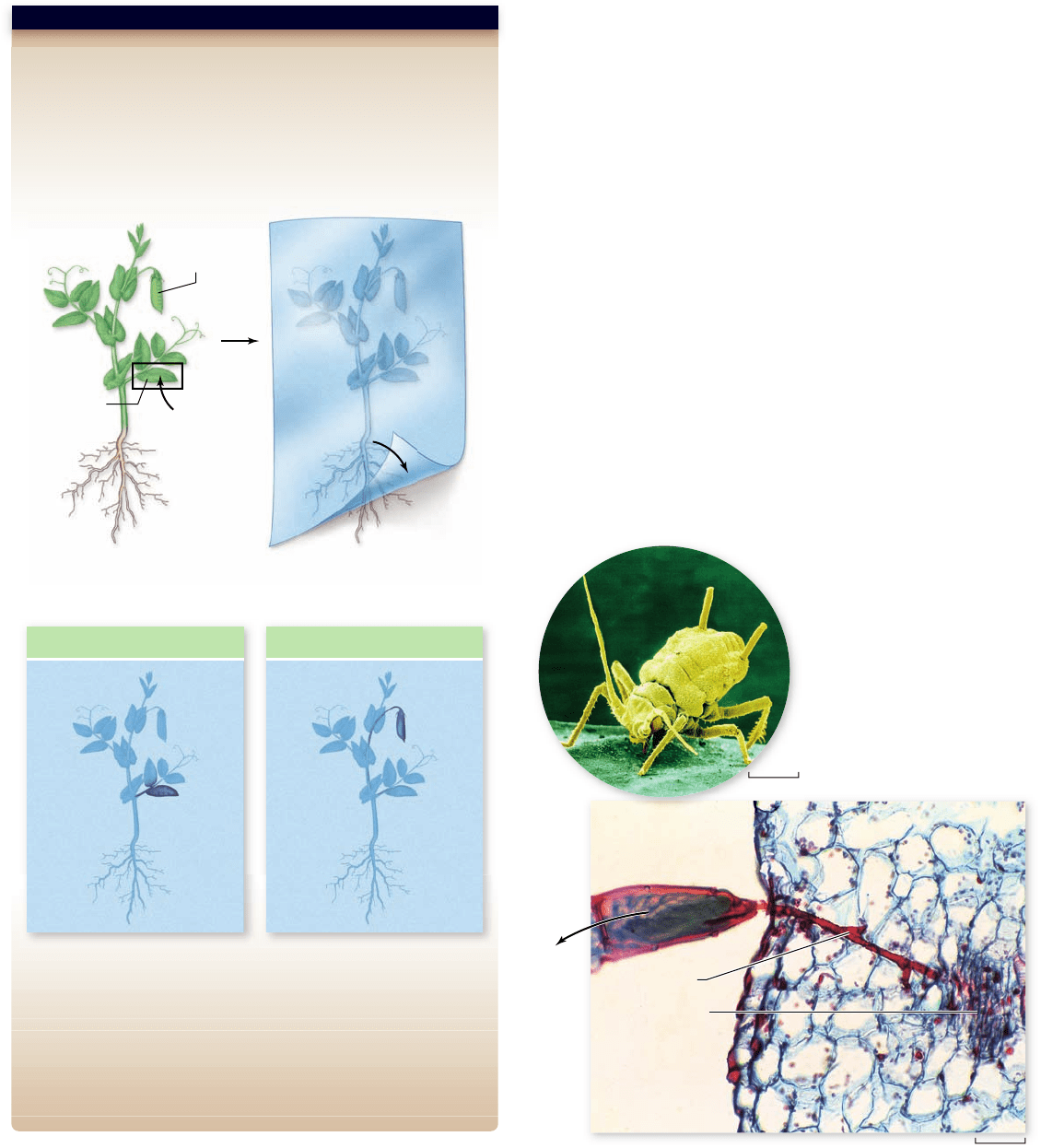
Hypothesis: As pea embryos develop in a pod, sugars will be
transported through the phloem to the developing embryos.
Prediction: Radioactively labeled sugars will accumulate in developing
pea embryos.
Test: Expose a healthy pea leaf to radioactive carbon dioxide (
14
CO
2
).
Place photographic film over the entire plant at 1 and 12 hours after
treatment and develop film.
Result: After 1 hour the radioactivity is concentrated near the application
site. After 12 hours the radioactivity is concentrated in the developing embryo.
Conclusion: The
14
CO
2
is incorporated into sugars during photosynthesis
and transported to the developing embryo in the pod.
Further Experiments: Carrots take two years to flower. During the first
season an underground root, the ‘carrot’, develops and sugars are stored
to be used for reproduction the next year. How could you test the
hypothesis that sugars are transported to the developing storage root
during the first season of growth for a carrot plant?
SCIENTIFIC THINKING
Film
Developing
pea pod
Healthy
leaf
At 1 Hour At 12 Hours
14
CO
2
Figure 38.17
Sucrose ow in phloem during
fruit development.
Aphids, a group of insects that extract plant sap for food,
have been valuable tools in understanding translocation. Aphids
thrust their stylets (piercing mouthparts) into phloem cells of
leaves and stems to obtain the abundant sugars there. When a
feeding aphid is removed by cutting its stylet, the liquid from
the phloem continues to flow through the detached mouthpart
and is thus available in pure form for analysis (figure 38.18). The
liquid in the phloem, when evaporated, contains 10 to 25% of
dry-weight matter, almost all of which is sucrose. Using aphids
to obtain the critical samples and radioactive tracers to mark
them, plant biologists have demonstrated that substances in
phloem can move remarkably fast, as much as 50 to 100 cm/h.
Phloem also transports plant hormones, and as will be ex-
plored in chapter 41, environmental signals can result in the
rapid translocation of hormones in the plant. Recent evidence
also indicates that mRNA can move through the phloem, pro-
viding a previously unknown mechanism for long-distance
communication among cells. In addition, phloem carries other
molecules, such as a variety of sugars, amino acids, organic ac-
ids, proteins, and ions.
Turgor pressure di erences
drive phloem transport
The most widely accepted model of how carbohydrates in solu-
tion move through the phloem has been called the pressure–
flow theory. Dissolved carbohydrates
flow from a source and are released
at a sink, where they are uti-
lized. Carbohydrate sources
include photosynthetic tis-
sues, such as the mesophyll
of leaves. Food-storage tis-
sues, such as the cortex of
roots, can be either sources
Figure 38.18
Feeding on phloem. a. Aphids, including
this individual shown on the edge of a leaf, feed on the food-rich
contents of the phloem, which they extract through (b) their
piercing mouthparts, called stylets. When an aphid is separated
from its stylet and the cut stylet is left in the plant, the phloem uid
oozes out of it and can then be collected and analyzed.
782
part
VI
Plant Form and Function
rav32223_ch38_769-785.indd 782rav32223_ch38_769-785.indd 782 11/16/09 12:20:16 PM11/16/09 12:20:16 PM
Apago PDF Enhancer
Shoot tip: sink
Leaf: source
Root: sink
Active transport
of sucrose out of
phloem, into growth
areas (sinks)
Passive transport
of sucrose and
water
Active transport
of sucrose out of
phloem, into growth
areas (sinks)
Xylem
Phloem
Water molecule
Some water passively follows sucrose into phloem
Active transport of
sucrose into phloem
Photosynthesizing cell
Sucrose molecule
water (passive transport)
sucrose (passive transport)
sucrose (active transport)
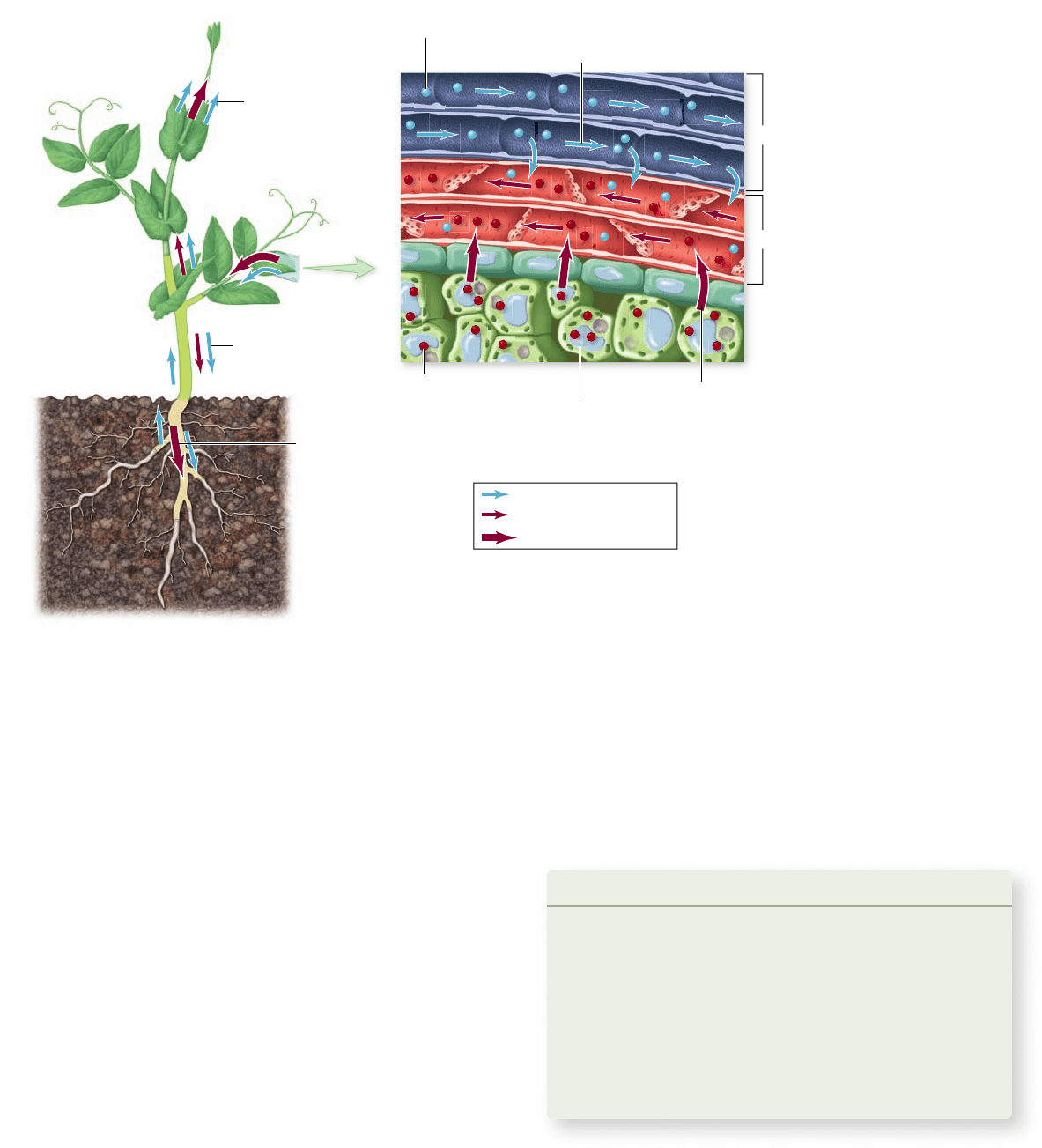
Figure 38.19
Diagram of mass ow.
In this diagram, red dots
represent sucrose
molecules and blue dots
symbolize water
molecules. After moving
from the mesophyll cells
of a leaf or another part of
the plant into the
conducting cells of the
phloem, the sucrose
molecules are transported
to other parts of the plant
by mass ow and unloaded
where they are required.
or sinks. Sinks also occur at the growing tips of roots and stems
and in developing fruits. Also, because sources and sinks can
change through time as needs change, the direction of phloem
flow can change.
In a process known as phloem loading, carbohydrates
(mostly sucrose) enter the sieve tubes in the smallest veins at the
source. Some sucrose travels from mesophyll cells to the com-
panion and sieve cells via the symplast (see figure 38.8). Much of
the sucrose arrives at the sieve cell through apoplastic transport
and is moved across the membrane via a sucrose and H
+
sym-
porter (see chapter 5). This energy-requiring step is driven by a
proton pump (see figure 38.1). Companion cells and parenchyma
cells adjacent to the sieve tubes provide the ATP energy to drive
this transport. Unlike vessels and tra cheids, sieve cells must be
alive to participate in active transport.
Bulk flow occurs in the sieve tubes without additional en-
ergy requirements. Because of the difference between the water
potential in the sieve tubes and in the nearby xylem cells, water
flows into the sieve tubes by osmosis. Turgor pressure in the
sieve tubes thus increases, and this pressure drives the fluid
throughout the plant’s system of sieve tubes. At the sink, su-
crose and hormones are actively removed from the sieve tubes,
and water follows by osmosis. The turgor pressure at the sink
drops, causing a mass flow from the stronger pressure at the
source to the weaker pressure at the sink (figure 38.19) . Most of
the water at the sink then diffuses back into the xylem, where it
may either be recirculated or lost through transpiration.
Transport of sucrose and other carbohydrates within sieve
tubes does not require energy. But the pressure needed to drive
the movement is created through energy-dependent loading
and unloading of these substances from the sieve tubes.
Learning Outcomes Review 38.6
Translocation is the movement of dissolved carbohydrates and other
substances from one part of the plant to another through the phloem. Sap
in the phloem contains sucrose and other sugars, hormones, mRNA, amino
acids, organic acids, proteins, and ions. According to the pressure-fl ow
hypothesis, carbohydrates are loaded into sieve tubes, creating a diff erence
in water potential. As a result, water enters the tubes and creates pressure
to move fl uid through the phloem.
■ What is the key difference between the fluid in xylem
and the fluid in phloem?
chapter
38
Transport in Plants
783www.ravenbiology.com
rav32223_ch38_769-785.indd 783rav32223_ch38_769-785.indd 783 11/16/09 12:20:21 PM11/16/09 12:20:21 PM

Apago PDF Enhancer
38.1 Transport Mechanisms (see gure 38.2)
Local changes result in long-distance movement of materials.
Properties of water
, osmosis, and cellular activities predict the
directions of water movement.
Water potential regulates movement of water through the plant (see
gures 38.3 and 38.4).
The major force for water transport in a plant is the pulling of water
by transpiration. Cohesion, adhesion, and osmosis all contribute to
water movement.
Water potential is the sum of pressure potential and solute potential.
Water moves from an area of high water potential to an area of low
water potential.
Aquaporins enhance osmosis (see gure 38.5).
Aquaporins are water channels in plasma membranes that allow water
to move across the membrane more quickly.
38.2 Water and Mineral Absorption
Root hairs and mycorrhizal fungi can increase the surface area for
absorption of water and minerals.
Three transport routes exist through cells.
The apoplast route is through cell walls and spaces between cells.
The symplast route is through the cytoplasm and between cells
via plasmodesmata. The transmembrane route is also through the
cytoplasm, but across membranes, where entry and exit of substances
can be controlled.
Transport through the endodermis is selective.
Casparian strips in the endoderm force water and nutrients to move
across the cell membranes, allowing selective ow of water and
nutrients to the xylem.
38.3 Xylem Transport
Root pressure is present even when transpiration is low or
not occurring.
Root pressure results from the active transport of ions into the
root cells, which causes water to move in through osmosis.
Guttation occurs when water is forced out of a plant as a result of
high root pressure.
Water has a high tensile strength due to its cohesive and adhesive
properties, which are related to hydrogen bonding.
A water potential gradient from roots to shoots enables transport.
Water moves into plants when the soil water potential is greater than
that of roots. Evaporation of water from leaves creates a negative
water potential that pulls water upward through the xylem.
Vessels and tracheids accommodate bulk ow.
The volume of water that can be transported by a xylem vessel
or tracheid is a function of its diameter. As diameter decreases,
tensile strength increases; however, a larger volume of water can be
transported through a tube with a larger radius.
Cavitation occurs when a gas bubble forms in a water column and
water movement ceases.
38.4 The Rate of Transpiration
Stomata open and close to balance H
2
O and CO
2
needs.
More than 90% of the water absorbed by the roots is lost by
evaporation through stomata. Stomata must open to take up carbon
dioxide for photosynthesis and to allow evaporation for transpiration
and cooling for the leaf (see gure 39.12).
Turgor pressure in guard cells causes stomata to open and close.
Stomata open when the turgor pressure of guard cells increases
due to the uptake of ions. The turgid guard cells change shape and
create an opening between them. Stomata close when guard cells lose
turgor pressure and become accid.
Environmental factors a ect transpiration rates.
Transpiration rates increase as temperature and wind velocity
increase and as humidity decreases. Stomata close at high
temperatures or when carbon dioxide concentrations increase.
38.5 Water-Stress Responses
Plant adaptations to drought include strategies to limit water loss.
Plant adaptations to minimize water loss include closing stomata,
becoming dormant, altering leaf characteristics to minimize water
loss, and losing leaves.
Plant responses to ooding include short-term hormonal changes and
long-term adaptations.
Flooding reduces oxygen availability for cellular respiration,
results in abnormal growth, and reduces the ef ciency of transport
mechanisms.
Plants adapted to wet environments exhibit a variety of strategies,
including lenticels, adventitious roots such as pneumatophores, and
aerenchyma tissue to ensure oxygen for submerged parts.
Plant adaptations to high salt concentration include
elimination methods.
Plants found in saline waters may exclude, secrete, or dilute salts that
have been taken up.
Halophytes can take up water from saline soils by decreasing the water
potential of their roots with high concentrations of organic molecules.
39.6 Phloem Transport
Organic molecules are transported up and down the plant.
Movement of organic nutrients from leaves to other parts of the
plant through the phloem is called translocation.
The sap that moves through phloem contains sugars, plant
hormones, mRNA, and other substances. Carbohydrates must be
actively transported into the sieve tubes.
Turgor pressure di erences drive phloem transport.
At the carbohydrate source, such as a photosynthetic leaf,
active transport of sugars into the phloem causes a reduction in
water potential.
As water moves into the phloem, turgor pressure drives the
contents to a sink, such as a nonphotosynthetic tissue, where the
sugar is unloaded.
Chapter Review
784
part
VI
Plant Form and Function
rav32223_ch38_769-785.indd 784rav32223_ch38_769-785.indd 784 11/16/09 12:20:24 PM11/16/09 12:20:24 PM

Apago PDF Enhancer
UNDERSTAND
1. Which of the following is an active transport mechanism?
a. Proton pump c. Symport
b. Ion channel d. Osmosis
2. The water potential of a plant cell is the
a. sum of the membrane potential and gravity.
b. difference between membrane potential and gravity.
c. sum of the pressure potential and solute potential.
d. difference between pressure potential and solute potential.
3. Hydrogen bonding between water molecules results in
a. submersion. c. evaporation.
b. adhesion. d. cohesion.
4. Water movement through cell walls is
a. apoplastic. c. both a and b
b. symplastic. d. neither a nor b
5. Casparian strips are found in the root
a. cortex. c. endodermis.
b. dermal tissue. d. xylem.
6. The formation of an air bubble is the xylem is called
a. agitation. c. adhesion.
b. cohesion. d. cavitation.
7. Guttation is most likely to be observed on
a. cold winter day. c. warm sunny day.
b. cool summer night. d. warm cloudy day.
8. Stomata open when guard cells
a. take up potassium. c. take up sugars.
b. lose potassium. d. lose sugars.
9. Which of the following is not an adaptation to a high saline
environment?
a. Secretion of salts
b. Lowering of root water potential
c. Exclusion of salt
d. Production of pneumatophores
10. A plant must expend energy to drive
a. transpiration.
b. translocation.
c. both transpiration and translocation.
d. neither transpiration nor translocation.
APPLY
1. Which of the following statements is inaccurate?
a. Water moves to areas of low water potential.
b. Xylem transports materials up the plant while phloem
transports materials down the plant.
c. Water movement in the xylem is largely due to the
cohesive and adhesive properties of water.
d. Water movement across membranes is often due
to differences in solute concentrations.
2. If you could override the control mechanisms that open stomata
and force them to remain closed, what would you expect
to happen to the plant?
a. Sugar synthesis would likely slow down.
b. Water transport would likely slow down.
c. Both a and b could be the result of keeping stomata closed.
d. Neither a nor b would be the result of keeping
stomata closed.
3. What will happen if a cell with a solute potential of –0.4 MPa
and a pressure potential of 0.2 MPa is placed in a chamber lled
with pure water that is pressurized with 0.5 MPa?
a. Water will ow out of the cell.
b. Water will ow into the cell.
c. The cell will be crushed.
d. The cell will explode.
4. If you were able to remove the aquaporins from cell membranes,
which of the following would be the likely consequence?
a. Water would no longer move across membranes.
b. Plants would no longer be able to control the direction
of water movement across membranes.
c. The potassium symport would no longer function.
d. Turgor pressor would increase.
5. What would be the consequence of removing the
Casparian strip?
a. Water and mineral nutrients would not be able to reach
the xylem.
b. There would be less selectivity as to what passed into
the xylem.
c. Water and mineral nutrients would be lost from the xylem
back into the soil.
d. Water and mineral nutrients would no longer be able
to pass through the cell walls of the endodermis.
SYNTHESIZE
1. If you fertilize your houseplant too often, you may nd that it
looks wilted even when the soil is wet. Explain what has
happened in terms of water potential.
2. How could you detect a plant with a mutation in a gene for an
important aquaporin protein?
3. Contrast water transport mechanisms in plants with those
in animals.
4. Measurements of tree trunk diameters indicate that the trunk
shrinks during the day, with shrinkage occurring in the upper
part of the trunk before it occurs in the lower part. Explain how
these observations support the hypothesis that water is pulled
through the trunk as a result of transpiration.
5. A carrot is a biennial plant. In the rst year of growth, the seed
germinates and produces a plant with a thick storage root. In
the second year, a shoot emerges from the storage root and
produces a ower stalk. Following fertilization, seeds are
formed to start the life cycle again. Draw a carrot plant during
the spring, summer, and fall of the two years of its life cycle and
indicate the carbohydrate sources and sinks in each season.
Review Questions
ONLINE RESOURCE
www.ravenbiology.com
Understand, Apply, and Synthesize—enhance your study with
animations that bring concepts to life and practice tests to assess
your understanding. Your instructor may also recommend the
interactive eBook, individualized learning tools, and more.
chapter
38
Transport in Plants
785www.ravenbiology.com
rav32223_ch38_769-785.indd 785rav32223_ch38_769-785.indd 785 11/16/09 12:20:25 PM11/16/09 12:20:25 PM

Apago PDF Enhancer
V
CHAPTER
Chapter
39
Plant Nutrition
and Soils
Chapter Outline
39.1 Soils: The Substrates on Which Plants Depend
39.2 Plant Nutrients
39.3 Special Nutritional Strategies
39.4 Carbon–Nitrogen Balance
and Global Change
39.5 Phytoremediation
Introduction
Vast energy inputs are required for the building and ongoing growth of a plant. In this chapter, you’ll learn what inputs,
besides energy from the Sun, a plant needs to survive. Plants, like animals, need various nutrients to remain healthy. The
lack of an important nutrient may slow a plant’s growth or make the plant more susceptible to disease or even death. Plants
acquire these nutrients mainly through photosynthesis and from the soil. In addition to contributing nutrients, the soil
hosts bacteria and fungi that aid plants in obtaining nutrients in a usable form. Getting sufficient nitrogen is particularly
problematic because plants cannot directly convert atmospheric nitrogen into amino acids. A few plants are able to capture
animals and secrete digestive juices to make nitrogen available for absorption.
rav32223_ch39_786-801.indd 786rav32223_ch39_786-801.indd 786 11/16/09 1:17:02 PM11/16/09 1:17:02 PM
Apago PDF Enhancer
Leaf
litter and
plant life
Topsoil
Subsoil
Bedrock
Partially
decomposed
organic matter
Well decomposed
organic matter
Minerals leaching
from rocks and
accumulating
from above
Weathered
bedrock
material
Soil particle
1. Soil particles tend to
have a negative charge.
2. Positive ions are
attracted to soil particles.
3. Negative ions stay in
solution surrounding
roots, creating a charge
gradient that tends to
“pull” positive ions out
of the root cells.
4. Active transport is
required to acquire and
maintain K
;
and other
positive ions in the root.
Root hair
Water
ATP
;
;
;
;
;
;
;
;
;
;
;
;
;
;
;
;
:
:
:
:
:
:
:
:
:
:
:
:
:
:
:
:
:
:
:
:
;
;
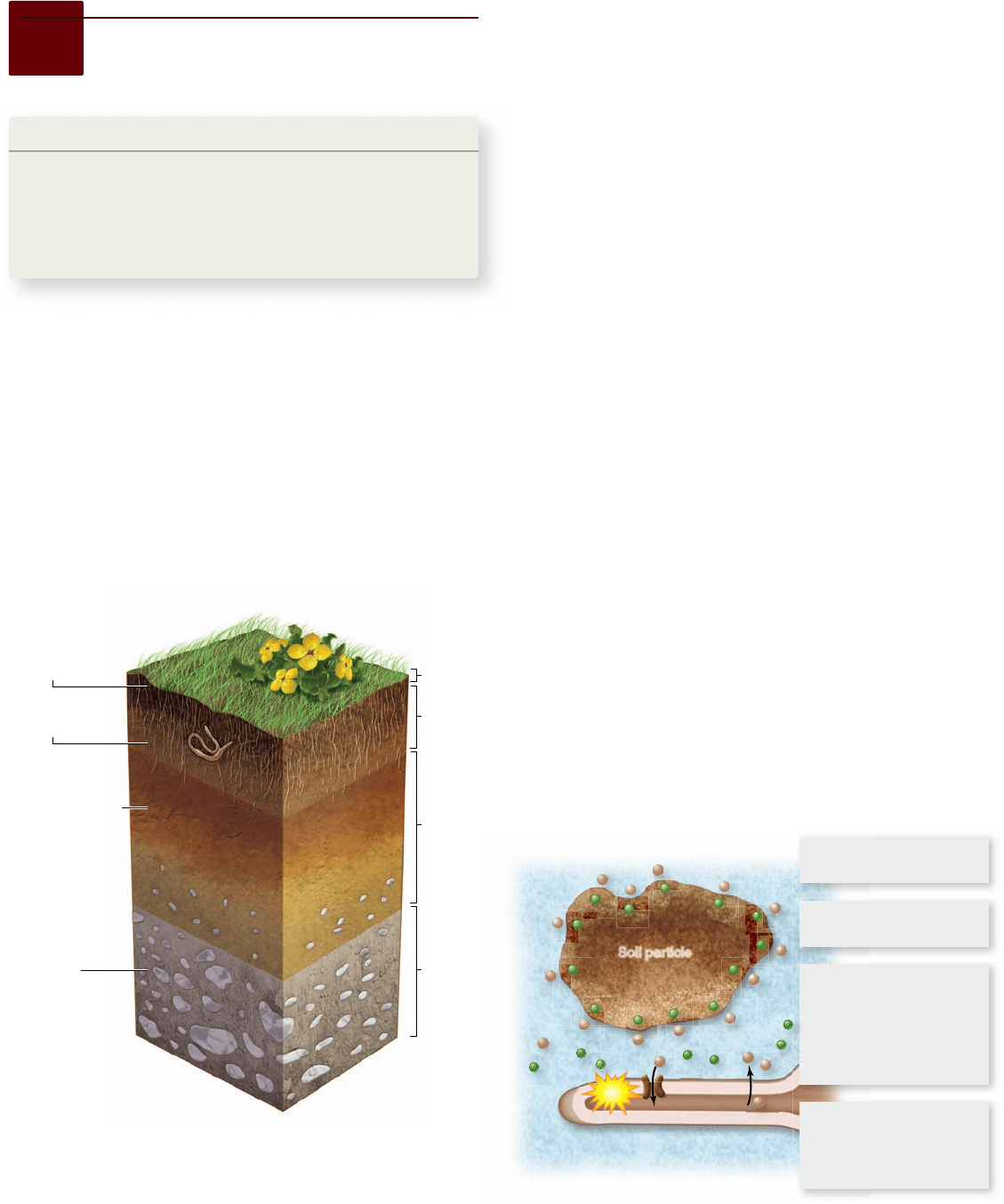
Figure 39.1
Most roots grow in the topsoil. Leaf litter and
animal remains cover the uppermost layer in soil called topsoil. Topsoil
contains organic matter, such as roots, small animals, humus, and
mineral particles of various sizes. Subsoil lies underneath the topsoil
and contains larger mineral particles and relatively little organic
matter. Beneath the subsoil are layers of bedrock, the raw material
from which soil is formed over time and through weathering.
Figure 39.2
Role of soil charge in transport. Active
transport is required to move positively charged ions into a
root hair.
occurring elements (see chapter 2). Most elements are found in
the form of inorganic compounds called minerals; most rocks
consist of several different minerals.
The soil is also full of microorganisms that break down
and recycle organic debris. For example, about 5 metric tons of
carbon is tied up in the organisms present in the soil under a
hectare of wheat land in England—an amount that approxi-
mately equals the weight of 100 sheep!
Most roots are found in topsoil (figure 39.1) , which is a
mixture of mineral particles of varying size (most less than
2 mm in diameter), living organisms, and humus. Topsoils are
characterized by their relative amounts of sand, silt, and clay.
Soil composition determines the degree of water and nutrient
binding to soil particles. Sand binds molecules minimally, but
clay adsorbs (binds) water and nutrients quite tightly.
Water and mineral availability is
determined by soil characteristics
Only minerals that are dissolved in water in the spaces or pores
among soil particles are available for uptake by roots. Both
mineral and organic soil particles tend to have negative charges,
so they attract positively charged molecules and ions. The neg-
atively charged anions stay in solution, creating a charge gradi-
ent between the soil solution and the root cells, so that positive
ions would normally tend to move out of the cells. Proton
pumps move H
+
out of the root to form a strong membrane
potential (≈ –160 mV). The strong electrochemical gradient
then causes K
+
and other ions to enter via ion channels. Some
ions, especially anions, use cotransporters (figure 39.2) . The
membrane potential maintained by the root, as well as the wa-
ter potential difference inside and outside the root, affects root
transport. (Water potential is described in chapter 38.)
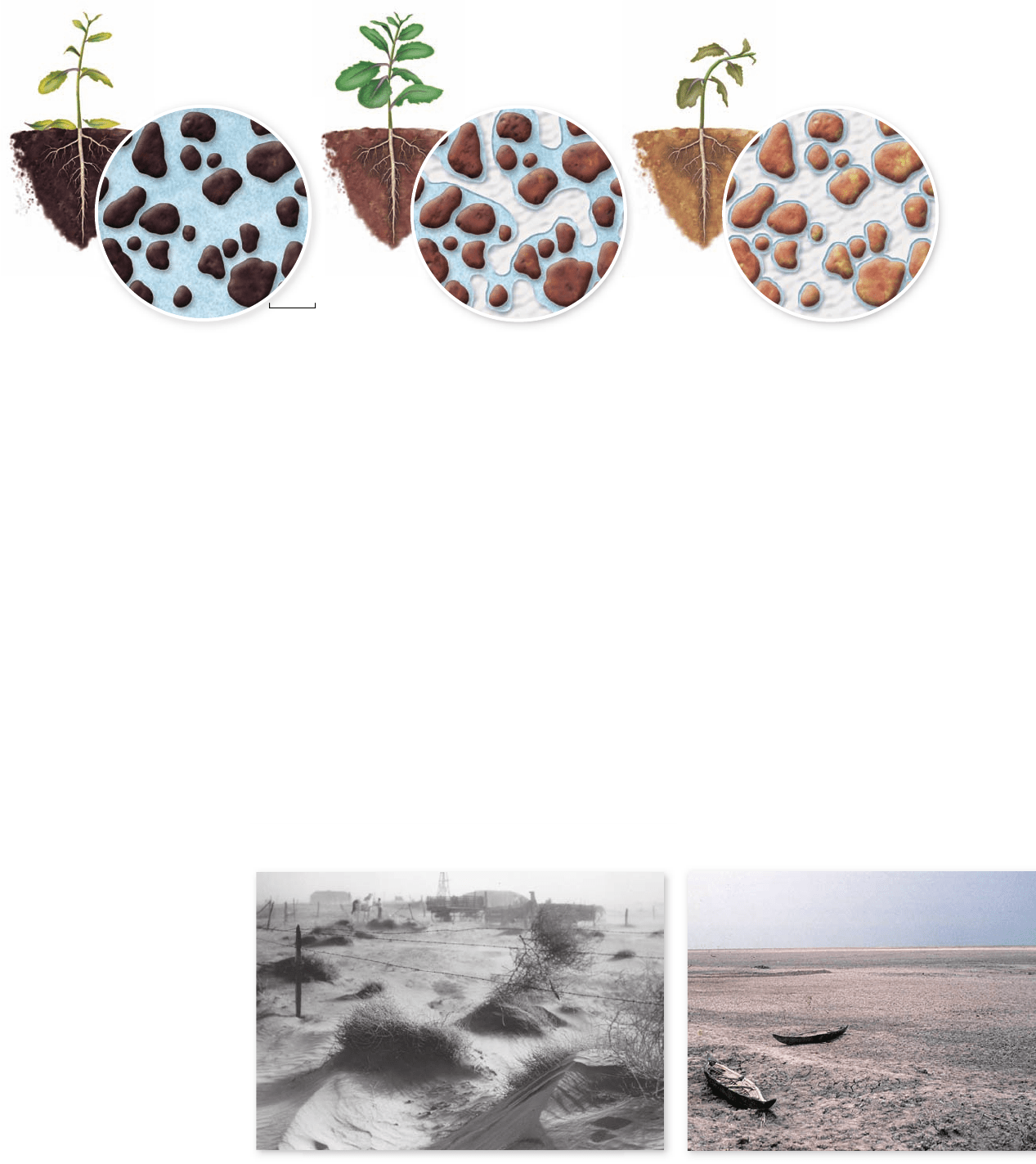
About half of the total soil volume is occupied by pores,
which may be filled with air or water, depending on moisture
39.1
Soils: The Substrates on Which
Plants Depend
Learning Outcomes
List the three main components of topsoil.1.
Explain how the charge of soil particles can affect the 2.
relative balance of positively and negatively charged
molecules and ions in the soil water.
Describe cultivation approaches that can reduce soil erosion.3.
Much of the activity that supports plant life is hidden within
the soil. Soil is the highly weathered outer layer of the Earth’s
crust. It is composed of a mixture of ingredients, which may
include sand, rocks of various sizes, clay, silt, humus (partially
decomposed organic matter), and various other forms of min-
eral and organic matter. Pore spaces containing water and air
occur between the particles of soil.
Soil is composed of minerals, organic matter,
water, air, and organisms
The mineral fraction of soils varies according to the composi-
tion of the rocks. The Earth’s crust includes about 92 naturally
chapter
39
Plant Nutrition and Soils
787www.ravenbiology.com
rav32223_ch39_786-801.indd 787rav32223_ch39_786-801.indd 787 11/16/09 1:17:06 PM11/16/09 1:17:06 PM
Apago PDF Enhancer
a. b. c.
50 µm
a. b.
Figure 39.3
Water and air ll pores among soil particles. a. Without some space for air circulation in the soil, roots cannot
respire. b. A balance of air and water in the soil is essential for root growth. c. Too little water decreases the soil water potential and prevents
transpiration in plants.
Figure 39.4
Soil
degradation. a. Drought and
poor farming practices led to
wind erosion of farmland in the
southwestern Great Plains of
the United States in the 1930s.
b. Draining marshland in Iraq
resulted in a salty desert.
the soil are adversely affected. Up to 50 billion tons of topsoil
have been lost from fields in the United States in a single year.
Whenever the vegetative cover of soil is disrupted,
such as by plowing and harvesting, erosion by water and
wind increases—sometimes dramatically, as was the case in
the 1930s in the southwestern Great Plains of the United
States. This region became known as the “Dust Bowl” when
a combination of poor farming practices and several years
of drought made the soil particularly susceptible to wind
erosion (figure 39.4a) .
New approaches to cultivation are aimed at reducing soil
loss. Intercropping (mixing crops in a field), conservation till-
age, and not plowing fall crop detritis under (no-till) are all
erosion-prevention measures. Conservation tillage includes
minimal till and even no-till approaches to farming.
Overuse of fertilizers in agriculture, lawns, and gardens
can cause significant water pollution and its associated negative
effects, such as overgrowth of algae in lakes (see chapter 58).
Maintaining nutrient levels in the soil and preventing nutrient
runoff into lakes, streams, and rivers improves crop growth and
minimizes ecosystem damage.
conditions (figure 39.3) . Some of the soil water is unavailable to
plants. In sandy soil, for example, a substantial amount of water
drains away immediately due to gravity. Another fraction of the
water is held in small soil pores, which are generally less than
about 50 μm in diameter. This water is readily available to plants.
When this water is depleted through evaporation or root uptake,
the plant wilts and will eventually die unless more water is added
to the soil. However, as plants deplete water near the roots, the
soil water potential decreases. This helps to move more water
toward the roots since the soil water further away has a higher
water potential.
Soils have widely varying composition, and any particular
soil may provide more or fewer plant nutrients. In addition, the
soil’s acidity and salinity, described shortly, can affect the avail-
ability of nutrients and water.
Cultivation can result in soil loss
and nutrient depletion
When topsoil is lost because of erosion or poor landscaping,
both the water-holding capacity and the nutrient relationships of
788
part
VI
Plant Form and Function
rav32223_ch39_786-801.indd 788rav32223_ch39_786-801.indd 788 11/16/09 1:17:08 PM11/16/09 1:17:08 PM
Apago PDF Enhancer
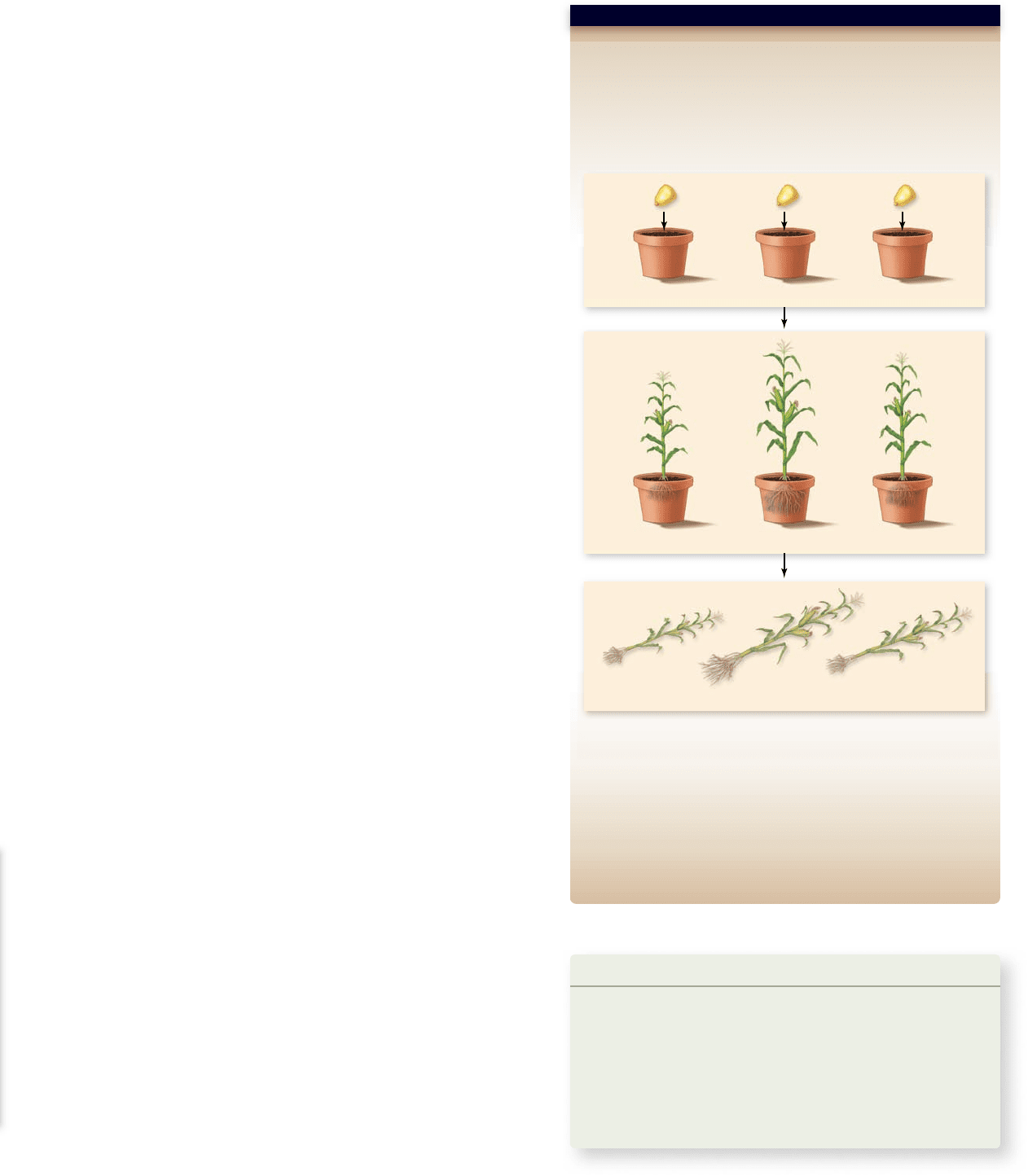
Hypothesis: Acidic or basic soils inhibit the growth of corn plants.
Prediction: Plants grown in soil with neutral pH will be more vigorous
than those grown at high or low pH.
Test: Sow equal numbers of corn kernels in identical pots with soil
adjusted to pH values of 6.0, 7.0, and 8.0. Allow plants to grow and, after
16 weeks, measure the biomass.
Result: Corn plant biomass is highest in pots with pH 7.0 soil and lowest
in pH 6.0 soil.
Conclusion: The hypothesis is supported. Soil pH inuences plant
growth. Among the pH levels tested, the best for plant growth was 7.0.
Acidic soil resulted in the lowest growth.
Further Experiments: How could you test the hypothesis that soil pH
aects mineral uptake and that changes in mineral uptake were
responsible for dierences in plant growth?
SCI ENT I FI C THINKING
pH 6.0 pH 7.0
Put potting soil in three pots and adjust pH.
At 16 weeks, wash soil off roots, dry plants, and weigh.
Grow plants for 16 weeks.
pH 8.0
One approach, site-specific farming, uses variable-rate
fertilizer applicators guided by a computer and the global
positioning system (GPS). Variable-rate application relies on
information about local soil nutrient levels, based on analy-
sis of soil samples. Another approach, integrated nutrient
management, maximizes nutritional inputs using “green ma-
nure” (such as alfalfa tilled back into the soil), animal ma-
nure, and inorganic fertilizers. Green manures and animal
manure have the advantage of releasing nutrients slowly as
they are broken down by decomposer organisms, so that nu-
trients may be utilized before leaching away. Sustainable ag-
riculture integrates these conservation approaches.
pH and salinity a ect water
and mineral availability
Anything that alters water pressure differences or ionic gradi-
ent balance between soil and roots can affect the ability of
plants to absorb water and nutrients. Acid soils (having low
pH) and saline soils (high in salts) can present problems for
plant growth .
Acid soils
The pH of a soil affects the release of minerals from weather-
ing rock. For example, at low pH aluminum, which is toxic to
many plants, is released from rocks. Furthermore, aluminum
can also combine with other nutrients and make them inac-
cessible to plants.
Most plants grow best at a neutral pH, but about 26% of
the world’s arable land is acidic. In the tropical Americas, 68%
of the soil is acidic. Aluminum toxicity in acid soils in Colom-
bian fields can reduce maize (corn) yield fourfold (figure 39.5).
Breeding efforts in Colombia are producing aluminum-
tolerant plants, and crop yields have increased 33%. In a few
test fields, the yield increases have been as high as 70% com-
pared with that for nontolerant plants. The ability of plants to
take up toxic metals can also be employed to clean up polluted
soil, a topic explored later in this chapter.
Salinity
The accumulation of salt ions, usually Na
+
and Cl
–
, in soil alters
water potential, leading to the loss of turgor in plants. Approxi-
mately 23% of all arable land has salinity levels that limit plant
growth. Saline soil is most common in dry areas where salts are
introduced through irrigation. In such areas, precipitation is
insufficient to remove the salts, which gradually accumulate in
the soil.
One of the more dramatic examples of soil salinity oc-
curs in the “cradle of civilization,” Mesopotamia. The region
once called the Fertile Crescent for its abundant agriculture is
now largely a desert. Desertification was accelerated in south-
ern Iraq. In the 1990s, most of 20,000 km
2
of marshlands was
drained by redirecting water flow with dams, turning the
marshes into a salty desert (see figure 39.4b). The dams were
destroyed later, allowing water to enter the marshlands once
again. Recovery of the marshlands is not guaranteed, but in
areas where the entering water has lowered the salinity there
is hope.
Learning Outcomes Review 39.1
Topsoil is composed of mineral particles, living organisms, and humus. Roots
use proton pumps to move protons (H
+
) out of the root and into the soil.
The result is an electrochemical gradient that causes positive mineral ions
to enter the root through ion channels. The loss of topsoil by erosion can be
reduced by intercropping, planting crop mixtures, conservation tillage, and
no-till farming.
■ In what way would alkaline soil affect plant nutrition?
Figure 39.5
Soil pH a ects plant growth.
chapter
39
Plant Nutrition and Soils
789www.ravenbiology.com
rav32223_ch39_786-801.indd 789rav32223_ch39_786-801.indd 789 11/16/09 1:17:11 PM11/16/09 1:17:11 PM

Apago PDF Enhancer
product of photosynthesis and an atmospheric component that
also moves through the stomata. Oxygen is used in cellular res-
piration to support growth and maintenance in the plant.
CO
2
and light energy are not sufficient, however, for the
synthesis of all the molecules a plant needs. Plants require a num-
ber of inorganic nutrients as well. Some of these are macronutri-
ents, which plants need in relatively large amounts, and others
are micronutrients, required in trace amounts (table 39.1) .
Plants require nine macronutrients
and seven micronutrients
The nine macronutrients are carbon, oxygen, and hydrogen—the
three elements found in all organic compounds—plus nitrogen
(essential for amino acids), potassium, calcium, magnesium (the
39.2
Plant Nutrients
Learning Outcomes
Distinguish between macronutrients and micronutrients.1.
Explain how scientists determine the nutritional needs 2.
of plants.
Describe the goal of food fortification research.3.
The major source of plant nutrition is the fixation of atmospheric
carbon dioxide (CO
2
) into simple sugars using the energy of the
Sun. CO
2
enters through the stomata; oxygen (O
2
) is a waste
TABLE 39.1
Essential Nutrients in Plants
Element
Principal Form
in Which Element
Is Absorbed
Approximate
Percent of
Dry Weight Examples of Important Functions
MACRONUTRIENTS
Carbon CO
2
44 Major component of organic molecules
Oxygen O
2
, H
2
O 44 Major component of organic molecules
Hydrogen H
2
O 6 Major component of organic molecules
Nitrogen NO
3
–
, NH
4
+
1–4
Component of amino acids, proteins, nucleotides, nucleic acids, chlorophyll, coenzymes, enzymes
Potassium K
+
0.5–6
Protein synthesis, operation of stomata
Calcium Ca
2+
0.2–3.5
Component of cell walls, maintenance of membrane structure and permeability; activates some enzymes
Magnesium Mg
2
+
0.1–0.8
Component of chlorophyll molecule, activates many enzymes
Phosphorus H
2
PO
4
–
, HPO
4
–
0.1–0.8
Component of ADP and ATP, nucleic acids, phospholipids, several coenzymes
Sulfur SO
4
2
–
0.05–1
Components of some amino acids and proteins, coenzyme A
MICRONUTRIENTS (CONCENTRATIONS in ppm)
Chlorine Cl
–
100–10,000
Osmosis and ionic balance
Iron Fe
2
+
, Fe
3
+
25–300
Chlorophyll synthesis, cytochromes, nitrogenase
Manganese Mn
2+
15–800
Activator of certain enzymes
Zinc Zn
2
+
15–100
Activator of many enzymes; active in formation of chlorophyll
Boron BO
3
–
, B
4
O
7
–
, or
H
2
BO
3
–
5–75
Possibly involved in carbohydrate transport, nucleic acid synthesis
Copper Cu
2
or Cu
+
4–30
Activator or component of certain enzymes
Molybdenum MoO
4
–
0.1–5
Nitrogen xation, nitrate reduction
790
part
VI
Plant Form and Function
rav32223_ch39_786-801.indd 790rav32223_ch39_786-801.indd 790 11/16/09 1:17:13 PM11/16/09 1:17:13 PM
Apago PDF Enhancer
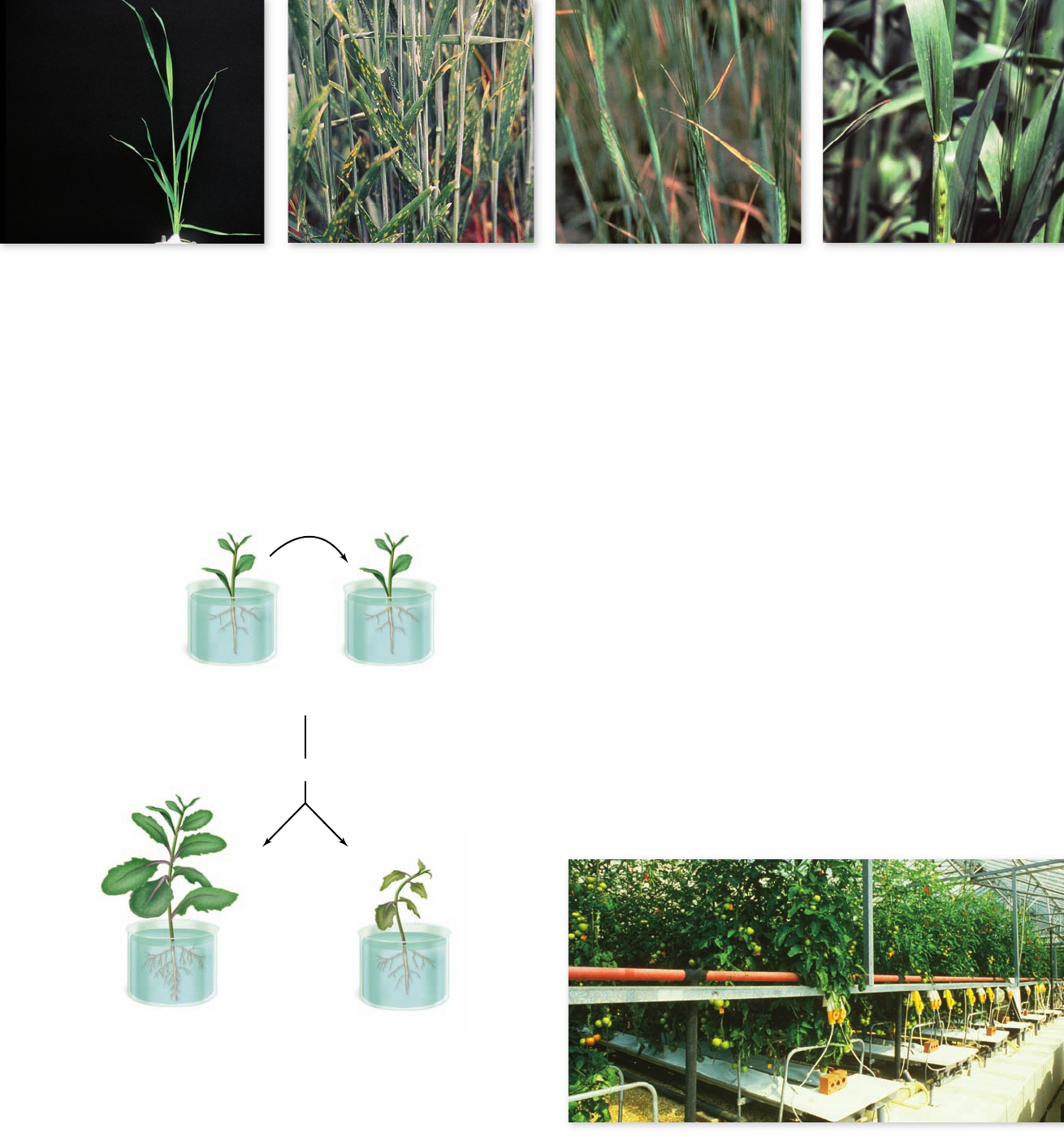
a. b. c. d.
Complete
nutrient
solution
Solution lacking
one suspected
essential nutrient
Transplant
Monitor growth
Normal growth
Suspected
nutrient is
not essential
Abnormal growth
Suspected
nutrient is
essential
Figure 39.6
Mineral de ciencies in plants. a. Leaves of a healthy wheat plant. b. Chlorine-de cient plants with necrotic leaves
(leaves with patches of dead tissue). c. Copper-de cient plant with dry, bent leaf tips. d. Zinc-de cient plant with stunted growth and chlorosis
(loss of chlorophyll) in patches on leaves. The agricultural implications of de ciencies such as these are obvious; a trained observer can
determine the nutrient de ciencies affecting a plant simply by inspecting it.
center of the chlorophyll molecule), phosphorus, and sulfur. Each
of these nutrients approaches or, in the case of carbon, may greatly
exceed 1% of the dry weight of a healthy plant.
The seven micronutrient elements—chlorine, iron, man-
ganese, zinc, boron, copper, and molybdenum—constitute from
Figure 39.7
Identifying nutritional requirements of
plants. A seedling is rst grown in a complete nutrient solution.
The seedling is then transplanted to a solution that lacks one
nutrient thought to be essential. The growth of the seedling is
studied for the presence of symptoms indicative of abnormal
growth, such as discolored leaves or stunting. If the seedling’s
growth is normal, the nutrient that was left out may not be
essential; if the seedling’s growth is abnormal, the nutrient that is
lacking is essential for growth.
Figure 39.8
Hydroponics. Soil provides nutrients and
support, but both of these functions can be replaced in hydroponic
systems. Here, tomato plants are suspended in the air, and the roots
rotate through a nutrient bath.
less than one to several hundred parts per million in most
plants. A deficiency of any one can have severe effects on plant
growth (figure 39.6) . The macronutrients were generally dis-
covered in the last century, but the micronutrients have been
detected much more recently as technology developed to iden-
tify and work with such small quantities.
Nutritional requirements are assessed by growing plants in
hydroponic cultures in which the plant roots are suspended in
aerated water containing nutrients. For the purposes of testing,
the solutions contain all the necessary nutrients in the right pro-
portions, but with certain known or suspected nutrients left out.
The plants are then allowed to grow and are studied for altered
growth patterns and leaf coloration that might indicate a need for
the missing element (figure 39.7) . To give an idea of how small the
needed quantities of micronutrients may be, the standard dose of
molybdenum added to seriously deficient soils in Australia
amounts to about 34 g (about one handful) per hectare (a square
100 meters on a side—about 2.5 acres), once every 10 years!
Most plants grow satisfactorily in hydroponic cultures, if
the roots are properly aerated. The method, although expensive,
is occasionally practical for commercial purposes (figure 39.8) .
Analytical chemistry has made it much easier to test plant mate-
rial for levels of different molecules.
chapter
39
Plant Nutrition and Soils
791www.ravenbiology.com
rav32223_ch39_786-801.indd 791rav32223_ch39_786-801.indd 791 11/16/09 1:17:20 PM11/16/09 1:17:20 PM