
Riendeau A Roger E. Brief History of Canada
Подождите немного. Документ загружается.


A BRIEF HISTORY OF CANADA
190
Company to Canada was completed in 1870, Governor Musgrave
appointed a delegation to negotiate union with Canada. To join Con-
federation, British Columbia demanded that Canada assume the colo-
ny’s $1 million debt, implement responsible government, undertake a
public works program, and complete a road linking the isolated region
to the rest of the country. Negotiating on behalf of the Dominion gov-
ernment, George-Étienne Cartier did not merely agree to these demands
but also gave British Columbia control over Crown land within the
province and promised the construction of a railroad linkage with
Canada to be completed within 10 years. The ambitious promise of a
railroad in particular silenced any talk of annexation, and British
Columbia became Canada’s sixth province on July 20, 1871.
With its transcontinental ambitions realized, Canada could focus
more attention on luring the remaining Atlantic holdouts into Confed-
eration. Despite hosting the original Confederation conference at Char-
lottetown in 1864, Prince Edward Island had rejected union with
Canada because of its dissatisfaction with the proposed fi nancial terms
and its preference for the prospect of economic union with the United
States. Prince Edward Island hoped to negotiate a reciprocity agree-
ment with the United States in return for the continued right of Amer-
ican fi shermen to operate in island waters. Fearing the possible loss of
Prince Edward Island to the Americans, Prime Minister Macdonald in
1869 offered the province more generous fi nancial terms than had been
proposed fi ve years previously, in addition to improved transportation
and communication linkages with the mainland and assistance in buy-
ing out the remaining British absentee landowners who still dominated
the island. Although the offer was not immediately accepted, by the
early 1870s failure to negotiate a free trade agreement with the Ameri-
cans, continued economic stagnation, and the threat of provincial
bankruptcy as a result of overly ambitious railway-building schemes
induced Prince Edward Island to reconsider. Thus, on July 1, 1873,
Prince Edward Island became Canada’s seventh province.
The transcontinental territorial expansion of the Dominion of Can-
ada (excluding Newfoundland) was completed in July 1880 when Brit-
ain, which had claimed ownership of the Arctic archipelago by virtue
of discovery and exploration, transferred the northern region to Canada
(Waite 1971). The scattered colonies of British North America had
evolved into the second-largest nation in the world, and the challenge
ahead for Canada was to unite politically, economically, and socially
this vast domain extending from the Atlantic to the Pacifi c and to the
Arctic Oceans.

191
The Emergence of National Party Politics
The establishment of a national constitution and territorial expansion
across the continent profoundly changed the nature and scope of poli-
tics in the former British North American colonies. Whereas political
life before Confederation had featured localized factionalism and mini-
mal interaction between colonial administrations, the creation of a
national government in 1867 focused politics on Ottawa and its rela-
tions to the provincial capitals. When chosen by Lord Monck, Canada’s
fi rst governor-general, to serve as interim prime minister until the fi rst
national election could be held in the late summer of 1867, Macdonald
expressed a desire for a truly national government unencumbered by
partisan political division. Accordingly, his fi rst Cabinet was a coalition
of representatives from different regions, cultures, religions, and eco-
nomic interests. Nevertheless, the politically crafty Macdonald could
not resist the temptation to follow the long-standing political tradition
of awarding the more powerful positions in the government and the
federal bureaucracy to his supporters and favorites. So, as differing
concepts of national development began to emerge, various political
factions that existed prior to Confederation soon coalesced into two
major parties—the Conservatives and the Liberals—with representa-
tion and organization throughout the nation.
During the fi rst national election campaign of 1867, the nascent
Conservative Party led by Macdonald was successful in presenting itself
as the architect and defender of a highly centralized federal union
which was essential to fulfi ll its ambitious plan of nation-building
“from sea to sea.” The promise to link British Columbia to Canada by
a railway within 10 years refl ected the Conservative devotion to trans-
continental expansion expeditiously and at whatever cost. Macdonald
understood that the key to accomplishing his nation-building goals and
to sustaining Conservative hegemony was to consolidate the political
partnership between the Anglo business community and the French-
Canadian leaders, embodied in his enduring alliance with Cartier that
had been instrumental in the achievement of Confederation. Macdon-
ald continued to rely on Cartier as his chief political lieutenant until his
death in 1873. Afterward, Macdonald turned to Hector Langevin and
then Adolphe Chapleau to help deliver a solid bloc of Quebec seats into
the Conservative fold. The partnership of Macdonald and Cartier began
a political convention that has generally continued to the present: a
prime minister, whether English-speaking or French-speaking, collabo-
rates with a lieutenant who represents the other major linguistic group
in order to ensure broad-based support for the governing party.
NATION-BUILDING ASPIRATIONS AND STRATEGIES

A BRIEF HISTORY OF CANADA
192
Meanwhile, the opposition Liberal Party was emerging out of a
loosely knit collection of discontented provincial reform remnants ral-
lying around George Brown, who had left the Great Coalition with
Macdonald and Cartier once Confederation became a certainty. Brown’s
narrow defeat in the wake of dubious Conservative election tactics in
1867 resulted in his resignation as Liberal leader and his eventual
replacement by Alexander Mackenzie. Mackenzie lacked the dynamism
of Brown or Macdonald to unite his party; moreover, the Liberals
remained only tenuously connected to one another by a common
antipathy toward the Conservatives and their nation-building strategy,
rather than by a common philosophy or policy platform. Besides
launching persistent attacks on alleged government corruption and
waste, Mackenzie’s Liberals came to stand for a more gradual and fi s-
cally conservative course of transcontinental expansion and support for
more provincial rights. Indeed, the narrow Liberal defeat at the hands
of the Conservatives in the second general election in 1872 refl ected
the ambivalence and uncertainty of the Canadian people regarding the
appropriate course of national development.
Macdonald’s Conservatives were reelected on the promise to build
a railway to the Pacifi c. Since the estimated $100 million cost of the
railway link to the Pacifi c was considered beyond the resources of
public enterprise, the Canadian government offered a subsidy of $30
million and 50 million acres of primarily western land to any private
company that could undertake this ambitious project. In the ensuing
competition for the railway-building charter, the Montreal-based
Canadian Pacifi c Railway Company emerged victorious over Toronto
interests, which not only accused the government of regional favorit-
ism but also charged that its bidding rival was fi nancially controlled
by the Northern Pacifi c Railway Company in the United States. Even
more serious allegations emerged in 1873 that the favored Montreal
group, headed by steamship magnate Sir Hugh Allan, had contributed
over $300,000 to the Conservative Party’s reelection campaign of the
previous year, with Macdonald and Cartier being the chief benefi cia-
ries. As the incriminating evidence of fi nancial kickbacks mounted
and Conservative support in Parliament wavered, Macdonald and his
Cabinet resigned rather than risk defeat by a motion of nonconfi dence
in the government. In accordance with parliamentary convention, the
governor-general called upon Mackenzie as leader of the opposition
to form a new government, the fi rst Liberal administration in the
young nation’s history. Capitalizing on the public outrage over the
so-called Pacifi c Scandal, Prime Minister Mackenzie dissolved Parlia-

193
ment and led his Liberal Party to a decisive victory in the election of
1874.
From the outset, the Mackenzie government was plagued by continu-
ing internal party dissension and a coinciding worldwide economic
depression. Even in power, the Liberals functioned more like a coalition
of factions upholding regional interests than like a national political
party with a transcontinental vision. Emphasizing the fi nancial hard-
ships arising from the depression of 1873, Mackenzie postponed the
contracted railway to the Pacifi c in favor of building the line in sections
to link with major Canadian waterways and American tracks. Whereas
the Conservative strategy was to collaborate with the business commu-
nity to build a complete east-west line in advance of settlement, the
more cautious and economy-minded Liberals approached railway con-
struction as a public enterprise to be undertaken only where settlement
warranted. Thus, the Intercolonial Railway was completed to Halifax in
1876, while short lines were built running eastward from Winnipeg and
westward from Lake Superior, connected in between by the Dawson
Road and water routes that required some 70 portages. Responding to
British Columbia’s secession threats, the Mackenzie government imme-
diately built a section of railway linking the Pacifi c Coast to the interior
mountains and linked the province to eastern Canada by a telegraph line
and a wagon road. This policy was particularly appealing to Ontario,
which was far more interested in expansion into the North-West Terri-
tories than into the more remote Pacifi c region (Waite 1971).
Liberal economic hopes also rested on a renewal of the Reciprocity
Treaty of 1854, allowing the free trade of natural products between the
United States and Canada. Having attacked Macdonald for his failure to
secure reciprocity, the Liberal government sent Senator George Brown
to Washington to negotiate a trade agreement in 1874. However, strong
protectionist sentiment in the U.S. Senate rejected reciprocity, leaving
the Liberals without a viable commercial policy. In the face of mount-
ing fi nancial diffi culties, the free trade Liberals resorted to cutting gov-
ernment expenses and raising tariffs in order to generate suffi cient
revenue (Masters 1983).
Although its economic policies were a failure, the Liberal administra-
tion took advantage of public reaction to the Pacifi c Scandal to achieve
political and constitutional reforms that advanced Canadian democracy
and nationhood. In order to minimize corruption and voting irregulari-
ties, the secret ballot was introduced, election dates and procedures
were standardized across the country, candidates were required to
record election expenses, and taverns were closed on election day.
NATION-BUILDING ASPIRATIONS AND STRATEGIES

A BRIEF HISTORY OF CANADA
194
Other efforts at democratization included the elimination of dual rep-
resentation, which had hitherto allowed a politician to represent simul-
taneously a federal and a provincial parliamentary seat; and the extension
of the franchise effectively to all males (except for Native peoples),
whether they held property or not. In 1875, Minister of Justice Edward
Blake established the Supreme Court of Canada to review Canadian laws
and to reduce appeals from the Canadian courts to the Judicial Commit-
tee of the Privy Council in Britain. The Judicial Committee continued to
be the court of fi nal appeal for nearly three-quarters of a century. Fur-
thermore, Blake engineered the withdrawal of the governor-general’s
power to disallow legislation without consulting the Canadian Parlia-
ment, thereby reducing him to an executive fi gurehead before the prime
minister and the Cabinet. Although the Liberal reforms expanded Can-
ada’s powers of self-government, they were overshadowed by economic
policies that failed to unite and strengthen the nation.
The National Policy
Widespread disenchantment with the Liberals renewed Conservative
prospects for returning to power. But Macdonald realized that he would
have to offer voters an appealing alternative to secure victory in the
election of 1878. Macdonald succeeded in capturing the public imagi-
nation with the Conservative Party platform—called the National
Policy, consisting of a protective tariff to stimulate Canadian industry,
the completion of a transcontinental railway network, and the settle-
ment of the West. Although the three strategic objectives of the
National Policy originated prior to Confederation, Macdonald seized
the opportunity to package them into an integrated nation-building
scheme with a patriotic name. Indeed, the National Policy would
remain the fundamental strategy of Canadian economic development
for more than half a century (Fawke 1957; Brown 1964).
Macdonald reasoned that if the United States would not agree to
reciprocity of trade, then Canada would counter with “reciprocity of
tariffs.” Accordingly, the National Policy was offi cially inaugurated in
1879 when the Macdonald government raised customs duties on a wide
range of manufactured and agricultural imports to unprecedented lev-
els in a deliberate effort to encourage Canadians to buy domestic over
foreign products. By increasing the cost of imports by as much as 35
percent, higher tariffs enabled Canadian manufacturers, mostly con-
centrated in the emerging industrial centers around Montreal and
Toronto, to become more competitive with their much larger counter-

195
parts in the United States and Britain. Besides boosting infant domestic
industry, higher tariffs encouraged foreign capital investment, espe-
cially by inducing American companies to establish branch plants in
Canada in order to surmount the tariff barrier. Whereas future genera-
tions would lament Canada’s precarious dependence on foreign invest-
ment, Canadians in the late 19th century welcomed American branch
plants as a source of tax revenue for government and factory jobs for
people who were increasingly opting for or considering immigration to
the United States.
However, higher tariffs also made the cost of buying manufactured
goods in Canada more expensive, particularly for farmers who exported
most of their products and thus could not benefi t from the higher prices
in the Canadian market. Adding to the suffering of farmers was the ten-
dency for their exports to be undermined in foreign markets by retalia-
tory tariffs. For the most part, farmers found little consolation in the
claim that protecting domestic industry would eventually expand the
market for their products in Canada and would enable them to enjoy the
benefi ts of the nation’s greater wealth and prosperity. The National
Policy would remain a source of agrarian discontent in Canada.
With the passing of the cyclical depression and the revival of world
trade in the late 1870s, the most immediate impact of the higher cus-
toms duties was to increase government revenue, which had hitherto
been the primary purpose of Canadian tariff policy. While Alexander
Galt’s tariffs of 1858–59 were responsive to the demands of embryonic
Canadian industry, his policy was more urgently motivated by the need
to raise revenue to bail out government-supported railway enterprises.
Two decades later, the link between tariffs and railways was renewed
with greater emphasis in Macdonald’s National Policy. The building of
a transcontinental railway was essential to unite the country physically,
to fulfi ll the promise made to British Columbia, to mobilize military
forces to defend Canadian territory, and to develop an independent and
interdependent national economy based on an exchange of western
agriculture and eastern industry.
More favorable economic conditions encouraged a private syndicate
of investors led by George Stephen, president of the Bank of Montreal;
Donald Smith, governor of the Hudson’s Bay Company; and J. J. Hill,
an American railway promoter, to reconstitute the Canadian Pacifi c
Railway Company (CPR) in 1880. Because British investors were reluc-
tant to risk their capital in this ambitious railway project that reminded
them of the losses of the Grand Trunk Railway, the CPR became for the
most part a Canadian enterprise centered on Montreal. In a sense, the
NATION-BUILDING ASPIRATIONS AND STRATEGIES

A BRIEF HISTORY OF CANADA
196
building of a transcontinental railway offered Montreal the prospect of
renewing its links with the vast fur-trading domain of the North West
Company, and thereby reviving the old commercial empire of the St.
Lawrence. The CPR also intensifi ed the rivalry between Montreal and
Toronto, which were vying for metropolitan dominance in Canada
(Innis 1971; Berton 1970, 1974).
In return for building a railway from central Canada to the Pacifi c
Coast within 10 years, the Canadian government granted the CPR the
sections of line already completed (nearly 750 miles of track worth an
estimated $31 million), a subsidy of $25 million, and 25 million acres
of prime western land (which was eventually sold for more than $100
million). In addition, the CPR was granted a tax exemption on its con-
struction materials and railway property, along with a 20-year monop-
oly of traffi c in western Canada. This monopoly meant that no
competing line could be built to the border to link up with American
systems until the CPR’s east-west traffi c was well-established. The Lib-
eral opposition vehemently attacked the Conservatives for this “act of
insane recklessness” and for their unparalleled extravagance in award-
ing the CPR contract.
Certainly, the challenge of completing the longest railway line then
existing in the world, spanning over 3,000 miles through such treach-
erous terrain as the rugged Canadian Shield and the towering Pacifi c
mountain ranges, severely strained the fi nancial and human resources
of a nation of little more than 4 million people. By comparison, the
United States had had a population of 40 million when it had com-
pleted its fi rst transcontinental line two decades earlier. Nonetheless,
the CPR project proceeded vigorously under the management of Amer-
ican engineer William Van Horne, who demonstrated his reputation for
driving his construction crew as mercilessly as he drove himself. Van
Horne was determined to build a superior quality railroad that would
endure and to complete it at a mercurial pace in order to satisfy the
demands of the investors and to ward off the competition of the North
Pacifi c Railway, the American transcontinental line under construction
to the south. Furthermore, the progress of construction was plagued by
what Van Horne called “engineering impossibilities,” including laying
tracks along the sides of mountains, blasting tunnels through rocks,
and bridging swift mountain rivers. Consequently, construction costs
escalated well beyond the original estimates. When Stephen could not
raise suffi cient money from the sale of stock and from private capital,
the CPR turned to the Canadian government for an additional $38.5
million in subsidies and $35 million in loans. CPR requests for more

197
government support triggered such stormy debates in Parliament that
by March 1885 even Prime Minister Macdonald despaired that his
“national dream” had become a fi nancial nightmare.
With the most diffi cult section through the Pacifi c mountains still to
be completed and the CPR syndicate hovering on the brink of bank-
ruptcy with little hope for further government assistance, Louis Riel
ironically came to the rescue. In response to the outbreak of the North-
West Rebellion, a military expedition was transported by the CPR from
Ottawa to Winnipeg in six days, certainly a profound contrast to the
three-month journey that the Wolseley expedition had to endure to
quell the fi rst Riel uprising in 1870. This spectacular demonstration of
the value of the railway convinced the Canadian Parliament to allocate
funds to complete the transcontinental line. On November 7, 1885,
Donald Smith drove in the last spike of the transcontinental railway at
the village of Craigellachie in the Selkirk Mountains of British Colum-
bia to make Macdonald’s national dream a reality. Nine days later,
Macdonald’s nemesis, Riel, was hanged in a Regina jail, likely unaware
of the paradox that his act of treason in leading the North-West Rebel-
lion had helped to unite the nation against which he fought.
With the completion of the CPR in 1885, following the implementa-
tion of the protective tariff policy in 1879, Macdonald’s National Policy
appeared to be taking shape as planned. The protective tariff was stim-
ulating eastern industry, which not only could supply manufactured
goods for western farmers but also could employ a growing urban
population that would constantly need their agricultural produce. The
railway could transport settlers and manufactures to the West and prai-
rie agricultural products to eastern markets. But the realization of such
an integrated national economy from coast to coast depended upon
settlement of the West, the third strategic objective of the National
Policy. Without a populated West, there would be limited east-west
trade and thus insuffi cient traffi c to sustain the CPR in which the Cana-
dian government had invested so heavily.
The groundwork for western settlement was laid in the Manitoba Act
of 1870, which stipulated that all ungranted land within the new prov-
ince (as well as the remaining North-West Territories) was retained by
the federal government to be administered “for the purposes of the
Dominion.” Following practices in the American West in order to
appeal to prospective immigrants from there, the Canadian government
divided land into townships of six square miles, and each township was
further subdivided into 36 sections of one square mile or 640 acres.
Once it had fulfi lled its land grant commitments to the Hudson’s Bay
NATION-BUILDING ASPIRATIONS AND STRATEGIES

A BRIEF HISTORY OF CANADA
198
Company and the Canadian Pacifi c Railway Company, the government
sought to encourage settlement by passing the Dominion Lands Act in
1872. The act provided each family or 21-year-old male a free grant of
one quarter section (160 acres) in return for payment of a $10 registra-
tion fee, residence on the land for three years, cultivation of 30 acres,
and the erection of a permanent dwelling. A settler who met these obli-
gations qualifi ed to purchase an adjoining quarter section at a reason-
able price. The government was optimistic that its policy of free land
grants would attract a multitude of western settlers whose presence
would stimulate widespread commercial and industrial development.
To maintain law and order in the West, the Macdonald government
on the eve of the Pacifi c Scandal organized the North-West Mounted
Police (later the Royal North-West Mounted Police and now the Royal
Canadian Mounted Police, or RCMP). Modeled after the Royal Irish
Constabulary and the American cavalry, this federal police force of 300
men arrived in 1874 to establish a network of posts, including Fort
Macleod, Fort Edmonton, Fort Calgary, and other strategic points
throughout the North-West Territories. Dressed in their distinct bright
scarlet tunics that reminded the Native peoples of the British redcoats
whom they had long ago learned to trust, the Mounties patrolled an
area the size of western Europe. They drove out American whiskey
traders who had been exploiting the Natives, discouraged the tribes
from fi ghting among themselves, and helped to preserve peaceful rela-
tions not only between Natives and settlers but also between ranchers
and homesteaders. The Mounties were also instrumental generally in
preparing the Native peoples for the dramatic changes in their lives
resulting from the coming of white settlement and especially in assist-
ing with the peaceful movement of various tribes onto the reservations
(Macleod 1978).
The more orderly settlement of the Canadian West, in contrast to the
violence and warfare that plagued the American western frontier, can
also be attributed to a series of seven “Indian treaties” negotiated from
1871 to 1877. Adhering to the Royal Proclamation of 1763, which pro-
hibited settlers from occupying territory that the Native peoples had
not surrendered to the Crown, the Canadian government recognized
that it had to negotiate treaties before settlement could proceed. The
underlying objective of government policy was to relocate Natives on
segregated reserves, to encourage them to adopt an agricultural way of
life, and to convert them to Christianity in the hope that they would be
assimilated into Canadian society. In accordance with these treaties,
the federal government acquired legal control of Native ancestral land
199
in northwestern Ontario and the western prairies in return for annui-
ties, reserves, and freedom to hunt on Crown lands. Although both
parties negotiated in good faith, differences in language, culture, and
customs inevitably led to confusion over the nature and meaning of the
treaties. Whereas the government maintained that it had purchased the
land once and for all time, some Native leaders with no concept of
property ownership believed that they had agreed to accept gifts in
return for the temporary and mutual use of the land. Amid such funda-
mental misinterpretations and misunderstandings, aboriginal rights
would emerge as a controversial issue in 20th-century Canadian poli-
tics (Miller 1997).
To facilitate the assimilation of the Native peoples through the
reserve system, the federal government passed the fi rst Indian Act in
1876. The act and its subsequent amendments not only controlled all
aspects of Native life but also viewed Native peoples as special wards of
the state without the privileges of full citizenship. During the treaty
negotiations, the government neglected to inform Native leaders of the
degree to which this legislation would govern the lives of their people.
In 1880 the federal government also established the Department of
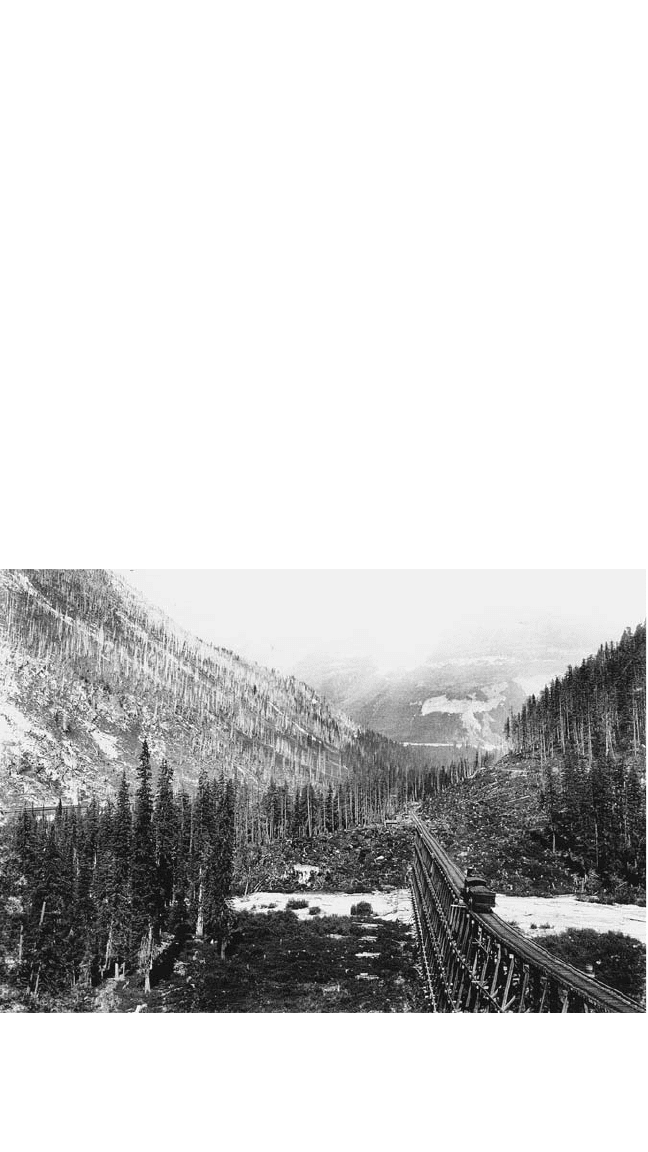
The greatest challenge in the construction of the Canadian Pacifi c Railroad in the 1880s was
cutting through the massive Canadian Shield and the Western Cordilleras, as illustrated by
the Selkirk Mountain range in British Columbia.
(S. J. Thompson, Library and Archives Canada/
PA-051352)
NATION-BUILDING ASPIRATIONS AND STRATEGIES