
Riendeau A Roger E. Brief History of Canada
Подождите немного. Документ загружается.


A BRIEF HISTORY OF CANADA
200
Indian Affairs with appointed agents who endeavored to promote
“Canadianization” by suppressing such traditional practices as the
Plains Indians’ sun dance or the Pacifi c Coast Indians’ potlatch. The
department’s chief vehicle for assimilation was enfranchisement, a legal
process by which a person of good character, free of debt, and fl uent in
English or French agreed to relinquish Indian status and the right to
live in the reserve community in return for full British citizenship,
including the right to vote. Under this policy, Indian women who mar-
ried non-Indians (whites, Métis, or Indians not governed by the Indian
Act) automatically lost their Indian status under the Indian Act. In the
fi nal analysis, the aboriginal rights movement would gain momentum
as the 20th century progressed because relatively few Indian men vol-
untarily chose to leave behind their reserves and be absorbed into the
general society.
The concerted efforts by the federal government and the CPR to
promote western settlement, which included an active campaign to
recruit European immigrants as well as American homesteaders, fell
short of expectations (Eagle 1989). The infl ux of young farmers from
Ontario helped to increase the population of Manitoba from 25,000 in
1871 to 152,000 in 1891, while the remainder of the prairies attracted
approximately 50,000 settlers during the same period. But these results
paled by comparison to the millions of settlers who continued to pour
into the American West where land was considered to be more desir-
able in terms of location and climate, even if more expensive to acquire.
Furthermore, the recurring periods of depressions that affl icted the
Western world from 1873 to 1896 were highlighted by declining com-
modity prices, which limited interest in the great prairie wheatlands of
Canada.
The slow progress of western settlement seriously undermined the
effectiveness of Macdonald’s National Policy. Although the transconti-
nental railway was built, the east-west traffi c was insuffi cient to warrant
the huge public investment. While tariffs stimulated some industrial
development in central Canada, the anticipated interprovincial trade
did not materialize. Instead of promoting unity, the National Policy
tended to provoke the divisive forces that were rising up to challenge
Macdonald’s concept of nationhood.

201
12
THE CLASH OF
NATIONALISMS AND
THE RESURGENCE OF
REGIONALISM (1867–1896)
D
espite Prime Minister Macdonald’s formidable nation-building
accomplishments, disappointment over the unfulfi lled promises
of Confederation was pervasive by the mid-1880s. Slow or uneven eco-
nomic growth inspired alternative strategies to Macdonald’s National
Policy that urged closer ties with either Britain or the United States. But
imperial federation and continental union proved to be expressions of
nationalism that failed to capture the public imagination because they
offered the prospect of a return to a form of colonialism or they could
not accommodate Canada’s regional or cultural diversities. Moreover,
in the wake of growing resentment toward apparently inadequate or
restrictive federal government policies, new allegiances to the fl edgling
nation could readily be subverted by enduring loyalties to the longer-
established provinces or regions. The Maritimes and the West protested
the domination of central Canada; Ontario challenged federal efforts to
limit provincial power; and Quebec resorted to assertions of provincial
autonomy in defense of a renewed cultural nationalism.
The Imperialist and Continentalist Alternatives
The Canadian economy after Confederation continued to be dependent
on the export market for natural resources, particularly grain, timber,
and fi sh. Recurring slumps in world trade from 1873 to 1896 led to
falling prices and contracting markets for these staple exports, which
could not be offset by new agricultural prospects in the West and the
growth of domestic industry in central Canada stimulated by the

A BRIEF HISTORY OF CANADA
202
National Policy. Compounding the sense of economic failure was the
more dynamic pace of development in the United States, where mil-
lions of European immigrants poured in to take advantage of a greater
range of opportunity than Canada could offer. Likewise, discontented
Canadians could not resist the lure of the southern republic as
Maritimers joined the New England fi shing fl eets, French Canadians
found employment in the mill towns of New England, Ontario farmers
sought homesteads in the American West, and generally skilled indus-
trial and railway workers found a demand for their services in cities
along the Atlantic seaboard. While an estimated 1.2 million immigrants
arrived in Canada from 1871 to 1891, over 1.5 million people left the
country for the United States. During this period, a high rate of natural
increase allowed the population of Canada to grow from 3.7 million to
4.8 million. Minuscule by American standards, this rate of population
growth also lagged behind pre-Confederation levels.
In response to these troubling circumstances, some prominent
English-speaking Protestants, fondly recalling the blessings of imperial
trade preferences in the fi rst half of the 19th century, contended that
Canadian nationhood could be best served by reinforcement of the Brit-
ish connection that had loosened during the free trade era. The advo-
cates of this perspective did not want to return to colonialism, but
rather they were dedicated to securing Canadian political independence
from the United States through economic, cultural, and military inte-
gration with the world’s mightiest empire. This nationalist spirit was
expressed as early as 1868 by the Canada First movement, which could
have been more appropriately known as English Canada First or Ontario
First. Its adherents envisaged a Canadian nationality invigorated not
only by the struggle to overcome the northern climate and rugged land-
scape but also by a belief in the inherent superiority of the Anglo-Saxon
race. Indeed, Canada Firsters supported the agitation against the Métis
during the Red River uprising of 1869–70 and helped to provoke the
reaction against French Catholics in Quebec that swept Ontario in the
aftermath of Riel’s execution of Thomas Scott. Although Canada First
had disintegrated as a political movement by 1875, its divisive brand of
nationalism, which pitted English-speaking Canadians against French-
speaking Canadians and Natives against whites, would continue to
fl ourish within the imperial unity movement of the 1880s.
Canadian interest in imperial unity corresponded with Britain’s
renewed commitment to its overseas empire in the last quarter of the
19th-century. The “little Englandism” of the mid-Victorian era, which
had provided the impetus for Canadian nationhood, gave way to a new

203
imperialism in response to the rise of Germany and the United States as
viable challengers to Britain’s economic and military supremacy (Berger
1970). After British imperialists founded the Imperial Federation
League in 1884, Canadian supporters of the movement formed a branch
within three years. Imperialists on both sides of the Atlantic hoped that
this consolidation of the British Empire on the basis of a centralized
federation would open the way for mutual trade opportunities and
military assistance, in addition to spreading the virtues of Anglo-Saxon
civilization—the “white man’s burden,” according to Rudyard
Kipling—to the “backward” societies of Asia, Africa, and the Pacifi c
Islands. Pillars of the English-speaking Protestant community, like
Colonel George Taylor Denison, a former Canada Firster who had
fought against the Fenians and Louis Riel; Principal George Munro
Grant of Queen’s University in Kingston; George Parkin, who would
serve as principal of Upper Canada College in Toronto; and Stephen
Leacock, the renowned humorist, believed that the unity of the Anglo-
Saxon race would enable Canada not only to enjoy economic prosper-
ity and a greater sense of power in the world but also to overcome
persistent ethnic tensions, provincialism, and the threat of American
domination. While little of the imperialist agenda actually found its
way into the realm of public policy, this nationalist sentiment would
remain pervasive and infl uential, particularly in Ontario and the Mari-
times, well into the 20th century.
That Britain would abandon free trade for a restored system of colo-
nial preferences was never more than a dream of the more ardent impe-
rialists in the late 19th century. A more realistic possibility was the
renewal of reciprocity with the United States. After the United States
cancelled the Reciprocity Treaty in 1866, the Canadian government
made periodic overtures to revive the free trade agreement. The fi rst
opportunity came with the meeting of a Joint High Commission in
Washington, D.C., convened in 1871 to settle outstanding disputes
between the United States and Britain arising mainly out of the Ameri-
can Civil War. The United States demanded compensation for damage
infl icted by southern ships, notably the Alabama, that were built in Brit-
ish ports. Moreover, the Americans wanted a restoration of the rights
that they had lost with the end of the Reciprocity Treaty to fi sh in the
territorial waters of the Maritime Provinces and Newfoundland and to
use their ports freely. Britain and the United States were also engaged
in a boundary dispute involving the possession of San Juan Island in
the Portland Channel separating Vancouver Island from the mainland.
Canada not only sought compensation for damages caused by the
THE CLASH OF NATIONALISMS AND THE RESURGENCE OF REGIONALISM

A BRIEF HISTORY OF CANADA
204
Fenian raids launched from American soil but also hoped to exchange
the fi shing rights for reciprocity.
Although Macdonald was appointed one of the British commission-
ers to represent Canadian interests, the other members of the imperial
delegation were more concerned with restoring Britain’s diplomatic
relations with the United States. The resulting Treaty of Washington
referred the Alabama claims and the San Juan Island dispute to interna-
tional arbitration, which eventually settled both issues in favor of the
United States. When the United States refused to deal with the Fenian
claims, Britain decided to leave the matter out of the treaty and to com-
pensate Canada instead. The treaty also gave the Americans the right to
navigate freely on the St. Lawrence River in perpetuity and to fi sh in
Canadian territorial waters for 10 years in return for a cash payment,
which turned out to be $5.5 million. While Canada also received the
right to navigate freely on Lake Michigan and three remote rivers in
Alaska as well as free entry of Maritime fi sh into the American market,
the much desired reciprocity agreement never materialized. Northern
protectionist sentiment in the United States proved to be too strong,
and the British negotiators did not want to risk the whole diplomatic
accord by pressing further for reciprocity. Disappointed at Britain’s
willingness to sacrifi ce Canadian interests for the sake of American
friendship, Macdonald reluctantly signed the treaty (Waite 1971).
Nevertheless, the signing of the Treaty of Washington was an
important moment in Canadian history in two respects. First, it marked
the beginning of a series of events over the next six decades that would
strengthen Canada’s resolve to wrest control of its foreign policy from
Britain. The appointment of the fi rst Dominion high commissioner in
1880 to give Canada a greater voice in imperial policy was an outcome
of the Treaty of Washington. Second, and of more immediate signifi -
cance, Macdonald’s signature on the treaty represented American dip-
lomatic recognition of Canada as a distinct transcontinental nation in
North America. Besides easing the tensions between Canada and the
United States, the treaty established the principle of arbitration as a
means of resolving international confl icts. This more cordial atmo-
sphere enabled Britain to complete its military withdrawal from North
America and rendered this prospect less perilous for Canada. For its
part, the United States had to foresake its ambition to conquer Canada
by force, but Britain’s withdrawal from the continent increased Ameri-
can confi dence in the prospect that its northern neighbor would even-
tually abandon its dubious experiment in nationhood and accept the
natural triumph of American manifest destiny.

205
After they came close to securing reciprocity while in power in 1874,
the Liberals in opposition continued their free trade crusade as an alter-
native to the National Policy, which was failing to stimulate external
markets for staple producers—farmers, loggers, and fi shermen—while
the protective tariff on manufactured goods added to their costs of pro-
duction. The majority of Liberals led by Edward Blake (who succeeded
Mackenzie in 1880) favored a return to the Reciprocity Treaty of 1854,
which was restricted to natural products. Even Macdonald’s Conserva-
tives agreed that such a policy of restricted reciprocity with the United
States could be complementary to the National Policy. In 1887 Mac-
donald tried unsuccessfully to use the renegotiation of the fi sheries
clauses of the Treaty of Washington as an opportunity to renew reci-
procity on the same basis as the treaty of 1854. However, if they were
interested at all, the Americans preferred either unrestricted reciproc-
ity, which involved the free exchange of manufactured goods in addi-
tion to natural products, or continental union, which would include
not only the removal of all tariff barriers but also a sharing of internal
revenue taxes and a common tariff policy against other countries. Rich-
ard Cartwright, former minister of fi nance in the Mackenzie adminis-
tration during the 1870s, was the leading proponent of continental
union within the Liberal Party. In Canada and the Canadian Question, a
political tract for the election campaign of 1891, Goldwin Smith
mounted an eloquent argument in support of continental union as the
means to open up the natural north-south trade directions, to foster the
unity of North America’s Anglo-Saxon community, and to assimilate
French Canadians. Macdonald, Blake, and other opponents countered
that continental union was a prelude to political union and the loss of
national independence.
In the general election of 1891, Wilfrid Laurier, who had succeeded
Blake as Liberal leader four years earlier, campaigned for unrestricted
reciprocity as a compromise to the positions of Blake and Cartwright.
In leading the Conservative defense of the National Policy, Macdonald
attempted to equate unrestricted reciprocity with annexation and the
breakup of the British Empire. He appealed to imperialist sentiment
with his popular campaign slogans: “The Old Flag, The Old Policy, The
Old Leader” and “A British subject I was born, and a British subject I
will die.” Among the voters, the key issue of the election pitted staple
producers, who supported the various manifestations of reciprocity,
against the manufacturers, who favored continued industrial protec-
tionism. The result was a Conservative victory by a narrow margin that
refl ected the divisions and uncertainties within the country. Three
THE CLASH OF NATIONALISMS AND THE RESURGENCE OF REGIONALISM

A BRIEF HISTORY OF CANADA
206
months after the election, Macdonald died at 76 years of age, leaving
the nation that he was so instrumental in building over the previous
quarter of a century to continue to debate whether its destiny lay in an
imperialist, a continentalist, or an autonomous direction.
Regional Protest and Provincial Rights
Macdonald also left behind a nation mired in the regional and cultural
confl icts that had troubled his administration from the outset. The
Maritime Provinces, which had been so reluctant to be part of
Confederation, continually lamented the limited and inequitable ben-
efi ts that political union conferred upon them. On July 1, 1867, many
Maritime communities marked Confederation and the beginning of
Canadian nationhood by fl ying fl ags at half-mast. Nova Scotians in par-
ticular resented the high-handed and undemocratic methods that had
been used to impose Confederation on them (Forbes 1983). Accordingly,
in the inaugural Dominion elections of 1867, Nova Scotia’s voters
seized the opportunity to elect opponents of Confederation to 18 of the
19 seats in the federal Parliament and 36 of the 38 seats in the provin-
cial legislature. A resolution to repeal the union was subsequently
introduced in the Nova Scotia legislature, and Joseph Howe led a del-
egation to London to appeal to the imperial authority to release the
province from the “bondage” of Confederation. Since Britain wanted to
reduce rather than increase its North American commitments, the
Colonial Offi ce refused even to meet with Howe, let alone consider his
request to reintegrate Nova Scotia into the empire. While other anti-
Confederation supporters favored either independence or annexation
to the United States, Howe preferred to negotiate better terms for Nova
Scotia within the federal union. In 1869, he agreed to Prime Minister
Macdonald’s offer of a position in the federal Cabinet and a larger
annual subsidy for Nova Scotia. Some Nova Scotians were dismayed by
Howe’s conversion to Canadian federalism, and although the opposi-
tion to Confederation soon subsided, a legacy of resentment remained
in the province. By yielding to Nova Scotia’s demands, the federal gov-
ernment also set a precedent for the renegotiation of its future fi scal
relations with the provinces.
By the 1880s anti-Confederation sentiment in Nova Scotia was inten-
sifi ed by the perception that the National Policy served the interests of
central Canada at the expense of the Maritime Provinces. In reality, the
Maritime economy was undergoing major structural changes that were
unrelated to government policy. Maritime commerce, shipping, and

207
shipbuilding suffered as the wooden sailing vessels gave way to iron-
hulled steamships and as the West Indies trade declined in global
importance. But because the adverse consequences of these changes
became more evident in the wake of the recessions that recurred from
1873 to 1896, Maritimers tended to blame Confederation and the
National Policy for their economic woes. They could point to the fact
that the building of the Intercolonial Railway did not open up the mar-
kets of central Canada or bring western traffi c to Atlantic ports. Fur-
thermore, the protective tariffs of the National Policy not only failed to
stimulate Maritime industry by comparison to central Canada but also
incited Americans to retaliate by imposing higher duties on Maritime
fi sh, leading to a devastating decline in the export market. When the
ruling Conservative Party of Nova Scotia appealed to its federal coun-
terpart in Ottawa for fi nancial assistance in the early 1880s, Prime
Minister Macdonald was too preoccupied with building the Canadian
Pacifi c Railway.
In 1886 the Liberal administration of W. S. Fielding, which had
come to power two years earlier on a wave of anti-Confederation senti-
ment, responded to further federal government refusal to negotiate
better fi nancial terms by introducing a resolution in the Nova Scotia
legislature favoring the province’s withdrawal from Confederation.
Fielding also appealed to the other Maritime Provinces to secede in
order to form an independent Maritime nation. If such a union proved
to be unsuccessful, then Nova Scotia favored a return to its original
status as a British colony. Both New Brunswick and Prince Edward
Island doubted the feasibility of Maritime union, and Nova Scotia’s
secession threats subsided when the federal government agreed to
lower freight rates and to provide generous fi nancial assistance for rail-
way building in the province.
Meanwhile, Newfoundland stubbornly resisted union with the rest
of Canada, despite a generous fi nancial offer from the Dominion gov-
ernment and an active campaign waged by the supporters of Confed-
eration in the province from 1865 to 1869. The provincial outlook was
oriented toward the north Atlantic world, particularly Britain, and the
island had little communication or economic connection with main-
land Canada. Bolstered by the repeal movement in Nova Scotia, oppo-
nents of Confederation successfully argued during the provincial
election of 1869 that union with Canada offered no tangible advantage
to the island’s fi shing economy. Recurring slumps in the cod-fi shing
and seal-hunting industries in the 1870s and 1880s prompted New-
foundland to consider union with Canada and reciprocity with the
THE CLASH OF NATIONALISMS AND THE RESURGENCE OF REGIONALISM
A BRIEF HISTORY OF CANADA
208
United States as viable alternatives to British colonialism. Confedera-
tion prospects were further undermined when the Canadian govern-
ment intervened to persuade the British government to veto a reciprocal
trade agreement that the Newfoundland government had successfully
negotiated with the United States in 1890. Even when Newfoundland
reluctantly made overtures to join the Confederation in 1895, the
Canadian government remained uncertain about the feasibility of
assuming responsibility for such a fi nancially hard-pressed province.
Accordingly, talks broke down, and it would take more than half a
century before Newfoundland and Canada would reach an agreement
on Confederation.
Resentment toward Confederation as a manifestation of central
Canadian imperialism was even stronger in the West. The Red River
uprising led by Louis Riel represented not only the native Métis resolve
to preserve their seminomadic way of life based on the buffalo hunt in
the face of the advancing agricultural settlement frontier but also
incipient western protest against eastern domination. After the Riel
uprising and the creation of Manitoba, the federal government offered
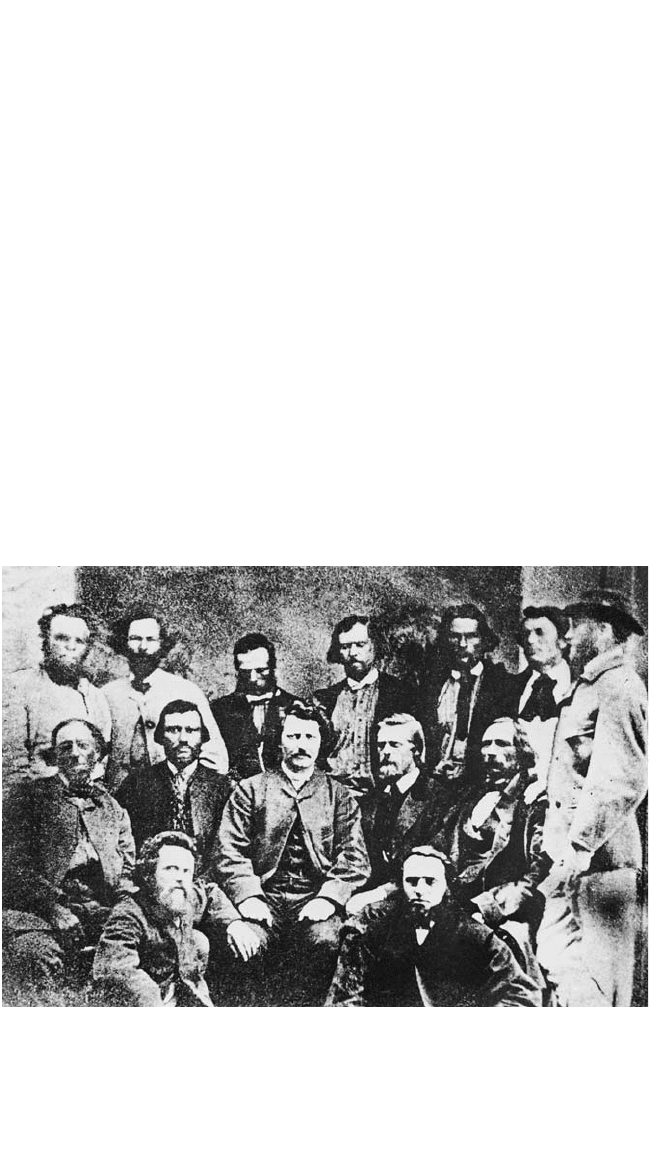
Louis Riel (1844–85), seated, surrounded by his Métis associates at Red River ca. 1869. Riel
epitomized Canadian cultural division inasmuch as he was branded as a traitor and murderer
in English Protestant Ontario but was celebrated as a patriot and martyr in French Catholic
Quebec.
(Glenbow Archives, Calgary NA-1039-1)

209
the Métis of the Red River region land grants of 240 acres in recognition
of their status as descendants of the original inhabitants. Rather than
contend with the growing number of agricultural settlers, mostly from
Ontario, many of the Métis sold their land in Manitoba during the
1870s and moved northwest to the Saskatchewan River region, where
they joined other compatriots who enjoyed the traditional way of life
based on the river lot and the buffalo hunt. By the mid-1880s, however,
both the Métis who departed for Saskatchewan and the agrarian settlers
of Manitoba would have reason to be dissatisfi ed with the development
policies of the federal government (Stanley 1960, 1974).
In Manitoba, discontent arose primarily over the CPR monopoly,
which prohibited competitive railway lines from being built in the West
until at least 1905. After the CPR established its freight rate schedule in
1883, western producers complained about having to pay shipping
costs that were over three times more than those incurred by their
counterparts in central or eastern Canada. To overcome the lack of
transportation competition, which enabled the CPR to charge whatever
the market would bear on the prairies, the Manitoba government char-
tered new railways that would link up with American lines. When the
federal government repeatedly disallowed these provincial charters,
Manitoba threatened to secure American fi nancial and military support
to build a railway from Winnipeg to the border. Accordingly, the fed-
eral government bought out the CPR monopoly in 1888 and decided
not to block the construction of a new railway line operated by the
American Northern Pacifi c Company. While the new railway line did
not signifi cantly lower freight rates, the incident did rally western sup-
port against the federal government.
The provision within the Manitoba Act that assigned ownership of
provincial public lands to the Dominion government would also
become a chronic source of federal-provincial confl ict. Not only did
Manitoba object to being deprived of the revenue derived from the sale
or lease of its public land, but also ownership of these lands involved
the federal government in a boundary dispute with Ontario. Prior to
Confederation, neither the Hudson’s Bay Company nor the province of
Upper Canada had much interest in establishing the precise boundary
between their respective holdings. But after the purchase of Rupert’s
Land from the Hudson’s Bay Company in 1870, the governments of
Canada and Ontario had two reasons to concern themselves with own-
ership of the 144,000 square miles of territory northwest of Lake Supe-
rior. Valuable timber and mineral rights were not only at stake but also
opposing concepts of federal-provincial relations.
THE CLASH OF NATIONALISMS AND THE RESURGENCE OF REGIONALISM