
Riendeau A Roger E. Brief History of Canada
Подождите немного. Документ загружается.


A BRIEF HISTORY OF CANADA
240
shot down the notorious “Red Baron” von Richthofen. Canadians were
engaged in the Atlantic Coastal Patrol, which evolved into the Royal
Canadian Navy after the war. By the end of the war, some 625,000
Canadian men and women were mobilized for the armed forces, over
two-thirds of whom served overseas. The toll of Canadian casualties
included upwards of 60,000 killed in action (comparable to the losses
suffered by the United States) and more than 200,000 wounded. The
Canadian fi ghting effort was truly remarkable for a country of only 8
million people.
While the Canadian armed forces were distinguishing themselves on
the battlefi eld, the civilian population on the home front was geared up
for a level of war production that would have a profound and lasting
effect on the national economy. With the extraordinary demand for
food by European allies, the export of Canadian agricultural products,
meat, and livestock soared beyond all expectations. The amount of
prairie wheatland under cultivation almost doubled, while grain prices
rose over 50 percent. The German blockade of the Baltic region
increased the need for Canadian lumber and wood pulp. European
munitions factories consumed more and more minerals, especially base
metals such as copper, lead, zinc, and nickel, leading to the opening of
new deposits and the development of new methods for processing low-
grade ores. Under the pressure of war, Canada expanded its range of
manufacturing output, particularly in the realm of heavy industry,
including ammunition, weaponry, steel ships, and aircraft frames. With
one-third of its manufacturing capacity absorbed in munitions produc-
tion, Canada emerged from World War I as a major industrial state.
The expansion of agriculture and industry so overwhelmed the east-
west trading system that, for the moment, the building of three trans-
continental railway networks appeared justifi ed.
Organizing the nation’s resources for wartime production required
an unprecedented degree of government intervention in the economic
and social spheres. Munitions production was brought under the direc-
tion of a Shell Committee established by the minister of the militia, Sir
Sam Hughes. When Hughes was accused of corruption, patronage, and
profi teering in 1915, the committee was replaced by the Imperial Muni-
tions Board acting under the British Ministry of Munitions. As rising
wartime demand led to shortages of basic commodities such as food
and fuel and to price infl ation—which increased the cost of living by
about 50 percent from 1915 to 1918—the Canadian government was
compelled to impose a system of rationing. Among the public agencies
established to regulate the production, sale, distribution, and consump-

241
tion of a variety of essential products and raw materials were the War
Purchasing Commission and Munitions Resources Commission in
1915, the Cost of Living Commission in 1916, the Food Control Board
and the Fuel Control Board in 1917, and the War Trade Board in 1918.
Of enduring signifi cance was the government effort to control wheat
production and marketing through the formation of the Board of Grain
Supervisors in 1917, which became the Canada Wheat Board in the fol-
lowing year. Likewise, the federal government’s decision to take over
major Canadian railways except for the CPR in 1916 was a prelude to
the formation of the Canadian National Railway (CNR) system by 1920.
The most enduring intrusion of government into the lives of its citi-
zens, however, resulted from the fi nancial burdens imposed by World
War I. The traditional sources of federal government revenue, customs
duties on imports and the sale of bonds primarily in the London mar-
ket, proved insuffi cient to conduct the war effort. Consequently, as a
result of a sustained campaign appealing to patriotism, the government
sold over $2 billion worth of “victory bonds” over the duration of the
war. During the war, New York replaced London as the main market
for Canadian securities. The federal government also invaded the fi eld
of direct taxation, which had hitherto been left to the provinces, with
the imposition of a business profi ts tax in 1916 and the fi rst national
income tax in 1917. The federal government promised that its levy of 3
percent for a family earning more than $3,000 or an individual earning
more than $1,500 was merely a temporary wartime measure.
Even more critical than the government’s monetary requirements
was the need for human resources. As the war progressed, Canada
experienced a shortage of “manpower” not only to serve in the armed
forces but also to work on farms and in factories and offi ces. So the
country called upon its great reservoir of “womanpower” (Strong-Boag
1994; Prentice 1996). About 2,500 women made a signifi cant contribu-
tion on the battlefront by serving in a nursing capacity in the Canadian
Army Medical Corps; 56 women died while in the service of Canada.
Women also served the country through voluntary organizations such
as the Imperial Order of Daughters of the Empire (IODE), the Red
Cross, the Young Women’s Christian Association (YWCA), and the
Canadian Patriotic Fund, incorporated by the federal government in
1914 to assist families of soldiers overseas. The demands of recruiting
and war production created labor shortages that allowed women to
enter the workforce to fi ll offi ce positions and factory jobs previously
held by men. Employers actually found it advantageous to employ
women, not only because of their capabilities but also because they
THE CONFIRMATION OF NATIONHOOD

A BRIEF HISTORY OF CANADA
242
were paid less than half the wages that men earned. But labor unions
objected to women joining their ranks because they were considered to
be merely temporary, cheap workers. An important consequence of the
active involvement of women in the war effort and the workforce was
the extension of voting rights by federal and provincial legislation
passed during and immediately following the war.
The Conscription Crisis
The shortage of recruits for enlistment in military service jeopardized not
only the war effort but also national unity. In his New Year’s message for
1916, Prime Minister Borden promised that Canada would contribute
500,000 soldiers to the war effort, well over double the number of
recruits who had already enlisted. But the drain on human resources
resulting from brutal trench warfare on the European battlefi eld had
already dampened enthusiasm for the war, which was refl ected in the
steadily dwindling monthly recruitment fi gures. Moreover, farm produc-
tion and the expanding munitions industry competed with the armed
forces for human resources. By the end of 1916, enlistments were still
70,000 short of Borden’s goal, and controversy was brewing over relative
contributions to the war effort. Rough estimates indicated that volunteers
were nearly one-half British-born, about one-third native-born English-
speaking Canadians, while French Canadians and non-Anglo-Saxon
immigrants equally comprised the remainder of the recruits. Differential
rates of enlistment intensifi ed imperialist passions and prejudices, while
provoking a renewed defensive nationalism within the French-Canadian
community (Armstrong 1974; Granatstein and Hitsman 1985).
The reluctance of French Canadians to participate more actively in
the war effort was partly related to their North American cultural out-
look. Long cut off from their ancestral homeland, French Canadians
did not share a strong emotional attachment to France or Britain.
Canada was their homeland, and many French Canadians saw no rea-
son to become entangled in Britain’s imperialistic war. Moreover,
French Canadians were discouraged by the superior attitude and unin-
formed prejudice of Minister of Militia and Defense Hughes, who pre-
sided over the recruitment, organization, and training of
French-Canadian volunteers with little consideration for their distinct
language and culture. Few French-speaking offi cers were appointed,
particularly in the higher ranks, and the chief recruiting offi cer in Que-
bec was an English Protestant clergyman. Other than the Royal 22nd
Battalion, better known as the “Vandoos,” which served with distinc-
243
tion on the battlefi eld, no French-speaking regiments were formed, and
English remained the sole language of the Canadian armed forces.
The question of language was aggravated by the revival of the sepa-
rate schools controversy. On the eve of World War I, the substantial
French-speaking population that had settled in northern and eastern
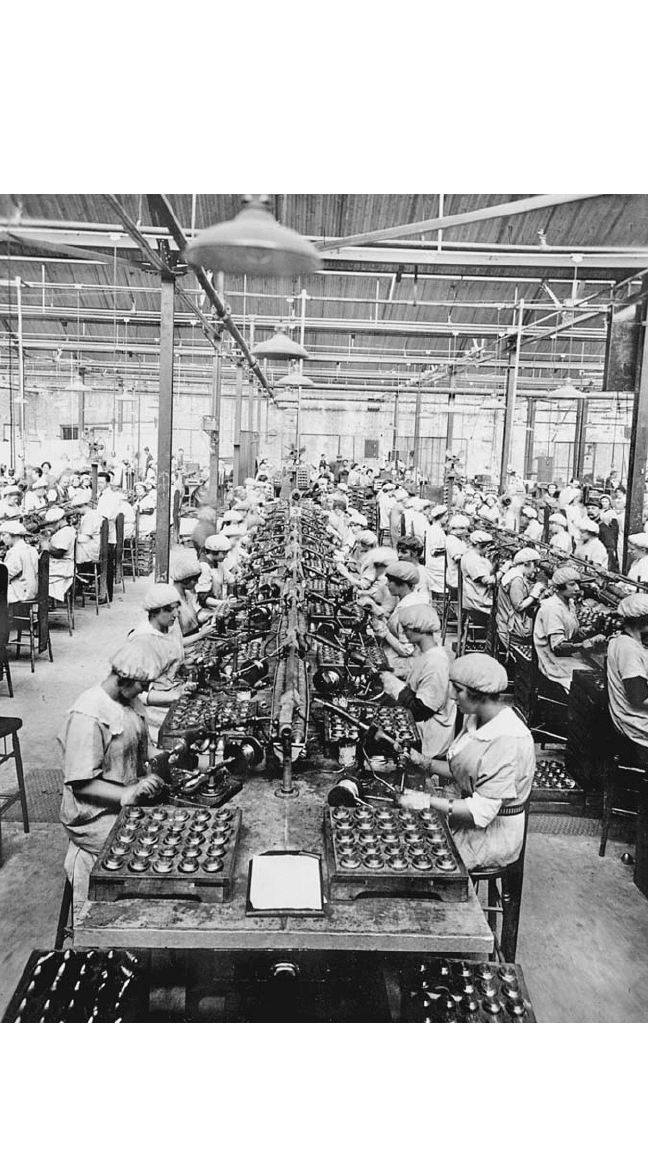
In a prelude to economic liberation, women solder fuses at British Munitions Company Limited,
in Verdun, Quebec, during World War I to alleviate the shortage of manpower.
(Department of
National Defence/Library and Archives Canada C-018734)
THE CONFIRMATION OF NATIONHOOD

A BRIEF HISTORY OF CANADA
244
Ontario near the Quebec border had built up a system of state-sup-
ported separate schools in which French was a major language of
instruction. Opposition to French language schools arose from the
Orange Order, which believed that the English language was essential
to imperial unity, and from the Irish Catholics seeking to control the
separate school system by favoring religious but not bilingual educa-
tion. In 1913 Regulation 17 of the Ontario Department of Education
made English the offi cial language of education and restricted the use
of French as the language of instruction to the fi rst two years of elemen-
tary school while permitting French as a subject of study for one hour
a day. French-Canadian outrage was most vehemently expressed by
Henri Bourassa who compared Ontarians to the Germans, remarking
that it was not necessary to go to Europe to fi ght tyranny, since the
enemy lived next door. Reinforcing French-Canadian alienation, the
Manitoba Education Act of 1916 overturned the bilingual clause of the
Laurier-Greenway compromise by abolishing French as the language of
instruction within the provincial school system. By then, Bourassa was
openly condemning the war, and riots had erupted in the wake of
recruitment efforts in some Quebec communities.
The anti-French sentiments expressed in the schools controversies
and the recruitment campaigns were symptomatic of the prevailing cli-
mate of nativism and cultural repression fostered by wartime patriotism.
The federal government used the War Measures Act to control the
movement of “enemy aliens,” which meant that all German or Austro-
Hungarian immigrants were viewed with suspicion and threatened with
internment; by the end of the war, 83,000 alleged German and Austrian
sympathizers were interned in camps. Public antipathy toward Germany
led to the town of Berlin, Ontario, being renamed Kitchener in 1917.
As Canadian casualties mounted overseas and the system of volun-
tary enlistments could not keep up with the demand for troop rein-
forcements, Borden concluded that conscription was imperative. The
Military Service Act introduced in July 1917 made military service com-
pulsory for all able-bodied British subjects from 20 to 45 years of age,
with the exception of those in vital industries, those who were consci-
entious objectors, and those to whom service would pose “serious
hardship.” Prime Minister Borden hoped to avoid dividing the nation
on the issue of compulsory service by forming a coalition government
with both Conservative and Liberals in his Cabinet. Laurier realized
that to support Borden might mean sacrifi cing Quebec to his rival,
Bourassa, whereas to oppose conscription and a coalition government
would risk alienating many English-speaking members of the Liberal

245
Party. Laurier declined Borden’s offer to form an alliance and decided
to lead the campaign against conscription.
While opposition to conscription was most passionate and at times
violent in Quebec, farmers and industrial workers in English Canada had
reason to object to compulsory military service. Farmers who were
already hard pressed for help were reluctant to sacrifi ce their sons into
the armed forces, while workers saw military conscription as a prelude to
compulsory industrial service that would limit their labor mobility and
rights. Both groups demanded “conscription of wealth” in the form of
higher taxes and government control of business to ensure that the entre-
preneurs who were benefi ting from a booming war economy made their
sacrifi ces. Opposition also came from pacifi st groups such as Quakers,
Mennonites, and the Canadian Women’s Peace Party. Nevertheless, the
Military Service Act passed through Parliament on the strength of both
Conservative and Liberal support but at the expense of national unity.
To enforce conscription, Borden proceeded with his plan to form a
coalition government and then to call a national election. While Laurier
remained in opposition, a large contingent of English-speaking Liber-
als, particularly in Ontario and the West, followed Clifford Sifton to
join Borden in a Union government in October 1917. In preparation for
an election, the government passed the Military Voters Act, which
extended the franchise to all men and women in the armed forces and
denied it to conscientious objectors. Furthermore, the War Times Elec-
tion Act gave the right to vote to the widows, wives, sisters, and adult
daughters of Canadians serving overseas while disenfranchising citi-
zens from enemy countries who had been naturalized since 1902. The
rationale behind these legislative measures was that the enfranchised
would be inclined to vote for the Conservatives while the disenfran-
chised had tended to vote for the Liberals. During the election cam-
paign, Borden sought to secure more votes by promising to exempt
farmers’ sons from conscription. When the government reneged on this
pledge after the election, thousands of farmers staged an angry demon-
stration in Ottawa, further indicating that opposition to compulsory
military service extended beyond the French protest.
Bolstered by campaign rhetoric that claimed that voting for Laurier’s
fragmented Liberals amounted to support for Germany, Borden’s
Union government predictably carried every province but Quebec in
the federal election of December 1917. That the Liberals won 62 out
of 65 seats in Quebec but only 20 out of 140 in the rest of the country
highlighted the depth of ethnic division between English and French
Canada incited by conscription. The implementation of conscription
THE CONFIRMATION OF NATIONHOOD

A BRIEF HISTORY OF CANADA
246
triggered more protest demonstrations and riots in Quebec, including
one in the provincial capital on Easter weekend of 1918 during which
four people died. Ultimately, only about one-quarter of the 100,000
Canadian soldiers recruited through conscription reached the Euro-
pean front by the end of the war in November 1918. Thus, while the
conscription crisis was short-lived in military terms, its political and
social legacy would prove to be enduring.
New Economic Directions in the Roaring Twenties
At the end of World War I, Canadians expected to reap the rewards of
having fought so courageously to “make the world safe for democracy.”
However, their optimism was immediately dampened by the outbreak
of the Spanish infl uenza epidemic of 1918–19, which killed some 21
million people worldwide, including 50,000 in Canada. Indeed, almost
as many Canadians died from this “silent enemy,” which was almost
certainly brought back home by returning soldiers, as had been killed
overseas during World War I. The epidemic, which overtaxed all med-
ical facilities and personnel, brought not only death but also social and
economic disruption. In an effort to control the spread of the disease,
municipal and provincial governments closed all but necessary services
and enacted laws to quarantine affl icted families and communities as
well as to enforce the wearing of gauze masks in public. Business suf-
fered from the lack of demand for products or the lack of healthy work-
ers to meet production needs (Brown and Cook 1974). The Canadian
government responded to the crisis by establishing the Department of
Health in 1919.
Canadians were further plagued by postwar economic instability.
The renewed demand for consumer goods in the wake of the reabsorp-
tion of over half a million war veterans into civilian life raised the cost
of living by 1919 to double the level it had been fi ve years earlier. But
as the demand for war supplies declined and wheat prices dropped by
more than half, infl ation gave way to recession in 1920. Looking upon
the recession as an inevitable cyclical slump accentuated by the transi-
tion from wartime to peacetime production from which the free enter-
prise economy would naturally recover, the federal government
responded by merely restricting immigration and inaugurating a pro-
gram for assisting the provinces in the provision of relief to unem-
ployed urban workers. The return of prosperity by 1923 seemed to
confi rm this laissez-faire faith in the unlimited prospects of the Cana-
dian economy based upon the National Policy (Fawke 1957).

247
As in the past, wheat production fi gured prominently in the eco-
nomic boom that prevailed for the remainder of the 1920s. War-rav-
aged Europe still needed food supplies, and postrevolution Russia was
temporarily in decline as a grain-exporting nation. With prices recover-
ing to within two-thirds of the wartime peak, western farmers extended
the agrarian frontier into the semidesert regions of southwestern Sas-
katchewan and southeastern Alberta and as far north as the Peace River
valley. The 1928 crop, which proved to be the largest on record, estab-
lished Canada as the leading wheat-exporting nation in the world.
Western farmers benefi ted from reduced railway freight rates that
helped to make the price of Canadian wheat attractive in European
countries. Indeed, the 1920s proved to be the high tide of Canadian
railway transportation, not only because of the organization of the CNR
system but also because the CNR and its private competitor, the CPR,
spent over $700 million to build branch lines, improve passenger ser-
vice, and modernize equipment. Although Canadian railways became
renowned for their comfortable and luxurious passenger service, wheat
shipments from western fi elds to eastern grain elevators and markets
remained the backbone of the transcontinental system. This postwar
wheat boom, however, would not be the economic catalyst that its pre-
war predecessor had been, primarily because Canadian farmers were
increasingly competing with other wheat-growing countries, such as
Argentina, Australia, and a rejuvenated Soviet Union, for a shrinking
world market.
Furthermore, the Canadian government was no longer as committed
to the centralized economic direction embodied in the National Policy.
Indeed, by the 1920s the original purposes of Confederation had been
achieved: a fl ood of settlers had fi lled the vacant lands of the West, a
vast transcontinental transportation network was complete, and a pro-
tective tariff had stimulated a substantial manufacturing industry.
Although immigration resumed in 1923, the federal government no
longer undertook extensive advertising and recruitment campaigns.
The age of free land grants had passed, and immigrants to the west had
to purchase farms. Thousands of immigrants still came to complete the
settlement of the western prairies during the 1920s, but the infl ux
never reached the levels of the prewar wheat boom. The majority of the
approximately 1 million immigrants who came to Canada during the
decade tended to settle in the expanding urban centers, where they
became part of the growing industrial workforce.
Postwar immigration continued the trend toward multiculturalism
initiated by the prewar infl ux of non-British and non-French people. By
THE CONFIRMATION OF NATIONHOOD

A BRIEF HISTORY OF CANADA
248
1931 the Canadian population was less than 52 percent British, a little
over 28 percent French, and 20 percent “other.” In other words, ethnic
groups other than English and French had increased by three-quarters
since the turn of the 20th century. These new ethnic groups were still
a distinct minority, but they continued to raise concerns about the
changing character of Canadian society.
The greatest developments in the postwar Canadian economy were
not in wheat farming on the western prairies but in the extraction and
processing of pulpwood, minerals, and hydroelectric power from the
northern resource frontier (Zaslow 1988). The ample softwood timber
stands of the Canadian Shield and the Western Cordilleras sustained a
pulp and paper industry that made Canada the world’s leading exporter
of newsprint by the end of the 1920s. With much of its own softwood
timber stands depleted, the United States offered a lucrative market for
Canadian newsprint to sustain its mass-produced daily newspapers,
magazines, advertising copy, and cardboard packaging. At fi rst, unpro-
cessed pulpwood was converted into paper in American factories. But
as the decade progressed, American entrepreneurs found that the avail-
ability of cheap hydroelectric power and good transportation facilities
made it more economical to establish branch plant paper mills in
Canada. Added incentives came from the provincial governments of
Ontario, Quebec, and British Columbia, which strategically restricted
the export of pulpwood, while providing a welcoming environment for
the establishment of branch plants. By the end of the decade, three
giant companies—International Paper Paper Co., Abitibi Paper Co.,
and Canadian Power and Paper Co.—controlled more than half the
pulp production, and Americans owned and controlled more than one-
third of Canada’s pulp production.
The United States also needed Canadian base metals to produce con-
sumer goods such as automobiles, radios, and electrical appliances. As
prices for base metals such as copper, zinc, lead, and nickel rose high
enough to encourage northern exploration and to reopen some mines
with lower-grade ores, American capital was vital to fi nance purchases
of complex and expensive mining equipment. Canada’s greatest mining
ventures during the 1920s included the gold and copper operations of
Noranda Mines in Quebec; the copper and zinc operations of the Hud-
son Bay Mining and Smelting in Flin Flon, Manitoba; and the Interna-
tional Nickel Company of Canada (INCO) of Sudbury, Ontario, which
controlled 90 percent of world nickel production. The discovery of oil
and natural gas in the Turner Valley south of Calgary in 1914 heralded
Alberta’s future role as a major energy producer.

249
Mining and the pulp and paper industry stimulated and were stimu-
lated by the development and use of hydroelectric power. The numer-
ous rivers and lakes of the Canadian Shield were harnessed to produce
cheap and effi cient supplies of electricity for home lighting and for
manufacturing goods such as appliances, automobile parts, and chemi-
cals. Realizing the importance of hydroelectric power in the process of
industrialization and urbanization, the provincial governments and the
business community accepted public ownership as the most economi-
cal means of maintaining an effi cient power supply.
In addition to the new staples, new technology relating to transpor-
tation and communication contributed to the prosperity and growth of
the 1920s (Thompson 1985). The advent of the automobile and the
industry that it spawned had a spectacular impact on the Canadian
economy. By the end of the 1920s, more than 1.2 million automotive
vehicles (cars, trucks, buses, and motorcycles) were in operation on
Canadian roads, about triple the number at the beginning of the decade.
About three-quarters of these vehicles were manufactured by branch
plants of the “big three” American companies—Ford, Chrysler, and
General Motors—which had absorbed most of their smaller Canadian
competitors. The more automated American giants could make mass-
produced and less expensive models, such as the popular Ford Model
T, which sold for under $400. At such a reasonable price, the automo-
bile evolved from a play toy of the rich into a necessity of life that one
out of every two Canadian families owned.
The automobile revolutionized the Canadian landscape of the 1920s
as the railway had done in the 1850s. Road-building became more
important than ever, particularly in the cities, where asphalt-paved
streets became more commonplace. By the end of the 1920s, Canada
had more than 75,000 miles of roads, 10,000 miles of which were paved
in asphalt. The automobile and better roads boosted the tourism indus-
try by encouraging ownership of summer cottages and facilitating
travel to northern vacation lands, particularly for Americans. By the
end of the 1920s, some 4 million American visitors were spending over
$300 million a year in Canada, as they enjoyed the unspoiled beauty of
the vast natural landscape. Increased automobile travel also stimulated
factories that manufactured tires and spare parts as well as service sta-
tions and petroleum refi neries.
Aviation also expanded greatly in the 1920s as veteran World War
I pilots, using surplus war planes, opened up the northern resource
frontier. They fl ew geologists, prospectors, equipment, and minerals
into remote areas, in addition to providing supplies and services for
THE CONFIRMATION OF NATIONHOOD