
Riendeau A Roger E. Brief History of Canada
Подождите немного. Документ загружается.


A BRIEF HISTORY OF CANADA
250
isolated settlements. Communications were also improved by the pop-
ularization of the telephone, originally invented in 1875 by Alexander
Graham Bell, a Canadian. The greatest communications invention of
the era, however, was the radio, which became the most popular enter-
tainment medium. In 1920 Montreal radio station XWA (later CFCF)
relayed the fi rst scheduled broadcast in North America. The radio also
accelerated the rise in popularity of spectator sports, highlighted by the
fi rst broadcast of Hockey Night in Canada by Foster Hewitt in 1923.
Despite these pioneer efforts, more than three-quarters of the radio
programs to which Canadians were listening by the end of the decade
originated from the more powerful American border stations. This pro-
gramming, along with the rising American fi lm industry, was beginning
to exert a pervasive infl uence on Canadian culture. In effect, while the
hearts of Canadians were still closely tied to the British Empire, their
minds were increasingly being Americanized.
The changing orientation of Canadian life mirrored the new direction
of the Canadian economy. Unlike wheat, which moved from west to east
for shipment to the British market, the new extractive staples, including
minerals, pulpwood, and hydroelectric power, traveled more along
north-to-south lines, since their main markets were in the United States.
While Britain remained the chief market for the older products of farm-
ing and the forest, the new staple exports helped to make the United
States Canada’s leading trading partner by the early 1920s. Furthermore,
whereas the expansion and settlement of the western agrarian frontier
and its integration into a transcontinental and transatlantic economic
framework had been directed almost exclusively by the federal govern-
ment, the development of the northern resource frontier and its integra-
tion into a “continental” economy was largely driven by provincial
governments. In effect, the “new continentalism” was further shifting the
balance of power and responsibility from the federal to the provincial
governments. The lack of a new national economic strategy, the rise of
provincial power, and the uneven distribution of prosperity among
regions contributed to the outburst of discontent directed toward the
federal government and the two traditional political parties.
Renewed Regional Protest and New Political Challengers
Postwar political unrest was complicated by confl icting demands and
expectations that divided city from country and east from west. In the
cities, industrial workers who had generally cooperated with govern-
ment and business during the war responded to postwar infl ation by

251
staging a series of strikes in 1918 and 1919 to support their demands
for better wages, working conditions, and job security. Buoyed by the
doubling of union membership during the war, the labor movement, in
typical Canadian fashion, remained divided over the most effective
strategy for overcoming the power of big business. While the more
conservative trade unions, which were dominant in eastern Canada,
preferred strategic labor action to bolster collective bargaining rights,
the industrial unions, which were stronger in the West, were adopting
a more radical political course. Labor organizers from the Prairie
Provinces and British Columbia, inspired by the supposed triumph of
the working class over ruling capitalist oppression in the Russian
Revolution of 1917, met in Calgary in March 1919 to form a branch of
One Big Union (OBU), an offspring of the radical American-based
International Workers of the World (IWW). Advocating the formation
of a socialist state, which they believed would be more responsive to
the needs of the working class, the delegates at the Calgary convention
called for a general strike to take place simultaneously in many western
cities and ultimately to spread across Canada. Their reasoning was that
government and industry would inevitably be forced to capitulate when
confronted with a complete withdrawal of the services of labor. Two
months after the Calgary convention, the theory was put to the test in
Winnipeg (Bercuson 2003).
Metalworkers’ and builders’ unions in Winnipeg launched a strike
that was supported by other unionized workers including police offi -
cers, fi refi ghters, telephone and telegraph operators, and delivery per-
sonnel, virtually closing down the city. The predominantly British-born
union leaders called for a total general strike and created a committee
to regulate the activities of more than 30,000 strikers and to maintain
essential services in the city. Comparing this strike committee with its
apparent dictatorial powers to the Bolsheviks who had staged the Rus-
sian Revolution in 1917, Winnipeg business and political leaders coun-
tered by forming the Citizens’ Committee of One Thousand to maintain
public utilities during the strike. Despite the outbreak of sympathy
strikes across the country, the six-week confrontation at Winnipeg was
actually losing momentum and workers were drifting back to their jobs
when Arthur Meighen, minister of justice and soon-to-be prime minis-
ter, ordered the Royal North-West Mounted Police to arrest the strike
leaders. A few days later, the workers organized a protest demonstra-
tion in downtown Winnipeg during which violence erupted between
police and strikers, resulting in one death and one serious injury. The
infamous Bloody Saturday ended with the dispersal of workers and the
THE CONFIRMATION OF NATIONHOOD

A BRIEF HISTORY OF CANADA
252
establishment of military control of the city. The strike committee soon
called off the strike without having achieved any of its goals.
In retrospect, the Winnipeg General Strike was hardly the Communist-
inspired conspiracy to usurp Canadian democracy that government and
business leaders feared, although the tendency of strike leaders to utter
the idealistic rhetoric of the Russian Revolution without understanding or
appreciating its autocratic outcomes distorted public perceptions of the
nature of the labor movement. In fact, the Winnipeg General Strike was a
major setback for the labor movement, as union membership declined by
one-third to a low of a quarter-million by the mid-1920s. Throughout the
decade, business sought to limit trade union effectiveness through wage
cuts, industrial consolidation, and improved technology and managerial
methods. In retaliation, workers staged a series of strikes, most of which
ended in violence and total failure. Moreover, organized labor remained
divided between the conservative Trades and Labor Congress (TLC),
which favored craft unions, and the All-Canadian Congress of Labour
(ACCL), created in 1927 to promote industrial unionism. Labor, how-
ever, did make some inroads in Canadian politics as J. S. Woodsworth,
one of the arrested leaders of the Winnipeg General Strike, was elected to
the federal parliament in 1921, while three other arrested leaders were
elected to the Manitoba legislature even though they were serving prison
sentences at the time.
In addition to labor strife, the postwar period also featured renewed
agrarian unrest. Long-standing dissatisfaction with high tariffs, freight
rates, and interest rates on bank loans and mortgages led farmers in
both eastern and western Canada to conclude that Liberal and Conser-
vative government policies were too biased in favor of the interests of
big business, particularly manufacturers and fi nancial institutions.
Infl uenced by the earlier Grange and Populist movements in the United
States, Canadian farmers resorted to political organization on a national
and a provincial basis in order to secure adequate government repre-
sentation of agricultural interests (Morton 1967; MacPherson 1979).
In 1918 the Canadian Council of Agriculture, the national associa-
tion of farmers organized eight years earlier, adopted a political pro-
gram called the New National Policy, which included the following
demands: tariff reduction, particularly on manufactured goods; higher
taxes on profi ts and incomes rather than on land; public ownership of
utilities in the realms of transportation and power; continuation of
cooperative marketing strategies as embodied in the wartime Wheat
Board; political reforms to enhance democracy, notably abolition of the
Senate and direct legislation through such methods as the initiative and

253
referendum; and social reforms like old-age pensions and mothers’
allowances. Encouraged by the victory of the United Farmers of Ontario
under the leadership of E. C. Drury in the provincial election of 1919,
the Canadian Council of Agriculture launched the National Progressive
Party in the following year. With Manitoba farmer Thomas A. Crerar as
its leader and the New National Policy as its political platform, the Pro-
gressives became the most successful third party in the nation’s history
by winning 65 seats in rural Ontario and the Prairie Provinces in the
federal election of 1921. By comparison, the incumbent Conservatives,
led by Arthur Meighen, who had succeeded Borden in the previous
year, were reduced to 50 seats, mostly in Ontario. Laurier’s successor
as Liberal leader, William Lyon Mackenzie King, grandson and name-
sake of the notorious leader of the Upper Canada Rebellion of 1837,
formed a minority government by taking 116 out of 235 seats. The
Liberals swept all 65 seats in Quebec, as Meighen suffered the wrath of
French-Canadian voters for his role as author of the conscription bill
four years earlier (Graham 1968).
The electoral success of the Progressive Party, bolstered by the vic-
tories of the United Farmers of Alberta and the United Farmers of
Manitoba in the provincial elections of 1921 and 1922, respectively,
marked the pinnacle of agrarian political strength in Canada. But the
challenge of preserving rural values and agricultural interests in an
increasingly urban and industrial age would prove to be daunting. The
United Farmers of Ontario were out of power by 1923, while the Pro-
gressive Party was bitterly divided from the outset over how most effec-
tively to exert its newly won infl uence in the House of Commons. The
moderate Manitoba wing of the party headed by Crerar believed that
the Progressives should support the minority Liberal government in
return for its pledge to make signifi cant concessions to farmers. King
convinced Crerar that, in their policy positions regarding tariffs, taxa-
tion, and social reform, Progressives were merely “Liberals in a hurry.”
The radical Alberta wing of the Progressive Party headed by Henry
Wise Wood was opposed to engaging in party politics and advocated
group government whereby farmers would cooperate with other inter-
est groups to achieve mutual goals. As a result of this division in the
ranks, the Progressives declined to serve as the Offi cial Opposition,
Crerar resigned as leader in 1922 to be replaced by Robert Forke, and
the so-called “ginger group” led by Wise Wood had seceded from the
party by 1924.
The fragmented Progressives could only manage to retain 24 seats in
the federal election of 1925, while the Conservatives mounted a come-
THE CONFIRMATION OF NATIONHOOD

A BRIEF HISTORY OF CANADA
254
back and emerged with a plurality of 116 seats versus 101 for the Liber-
als. Since no party could command a majority of the 245 seats in the
House of Commons, King asserted his constitutional right to continue
to govern provided that he could retain the support of the Progressives.
By lowering tariffs and introducing an old-age pensions scheme (which
the Senate eventually rejected), King was able to keep the Progressives
on the Liberal side for six months. But the postponement of the prom-
ised return of natural resources to the Prairie Provinces alienated the
Progressives, and a customs scandal relating to liquor smuggling in the
United States where Prohibition was in force resulted in a crisis of con-
fi dence in the Liberal administration. To avoid losing a decisive vote in
the House of Commons, King exercised his constitutional right to ask
Governor-General Julian Bying to dissolve Parliament and to call a new
election. Bying responded by asserting his constitutional right to deny
King’s request and called upon Conservative leader Arthur Meighen to
form a government. Unable to secure suffi cient Progressive support, the
Meighen administration was defeated by a motion of nonconfi dence
within three days to earn the distinction as the shortest government in
national history.
The King-Bying constitutional crisis became a major issue in the
federal election of 1926. To defl ect attention away from the customs
scandal, King took advantage of the prevailing interest in national
autonomy, accusing the governor-general of attempting to perpetuate
colonialism by refusing to take the advice of his elected representatives
and charging Meighen with jeopardizing responsible government by
taking power unconstitutionally. Regardless of the merits of his argu-
ment, King succeeded in leading the Liberals to a majority victory
mostly at the expense of the disintegrating Progressives, who were
reduced to nine parliamentary seats. Although Progressivism ceased to
be a force in national politics as many of its moderates were absorbed
into the Liberal Party, the agrarian movement remained active in west-
ern provincial politics, particularly in Alberta, where the United Farm-
ers remained in power until 1935. Despite its short-lived national
prominence, the Progressive Party deserves credit for pressuring the
federal government into fi nally transferring control of natural resources
to the three Prairie Provinces in 1930, thereby bringing down the cur-
tain on the original National Policy.
While the Progressives were serving as the voice of agrarian protest
in the West, the Maritime Rights movement was expressing that
region’s relative economic decline and its consequent disillusionment
with the Confederation (Forbes 1983). When Nova Scotia and New

255
Brunswick entered Confederation in 1867, they were assigned nearly
one-fi fth of the seats in the House of Commons. But by 1925, the par-
liamentary representation of the three Maritime Provinces, including
Prince Edward Island, was reduced to one-eighth, largely as a result of
regional depopulation. Workers and manufacturers had left for central
Canada and the United States in search of better economic opportuni-
ties. Besides a chronic lack of natural resources, the region suffered
from postwar economic change: the wartime boom at the ports of
Halifax and Saint John had subsided, the decline of shipbuilding and
railway construction reduced the demand for iron and steel, the con-
version to hydroelectric power and oil limited the market for Cape
Breton coal, lower tariffs no longer offered suffi cient protection to
Maritime industry, and the price of fi sh was steadily dropping as
advances in refrigeration made meat a dietary staple.
The infl uential entrepreneurs and professionals who led the Mari-
time Rights movement encouraged the regional electorate to vote over-
whelmingly against the governing party in the federal elections of 1921
and 1925. In particular, this amorphous movement demanded increased
annual subsidies for the Maritime Provinces and greater tariff protec-
tion to revive the region’s steel and coal industries. When the Liberals
returned to power in 1926, King attempted to defuse the Maritime
rights movement by establishing a royal commission under the direc-
tion of Sir Arthur Rae Duncan to investigate regional grievances. In its
report in 1927, the Duncan Commission typically recommended
increased federal subsidies for the Maritime Provinces and their strug-
gling industries. The federal government did raise provincial subsidies,
but any hope that it would undertake initiatives to promote regional
development were dashed by the onset of the Great Depression.
The Achievement of National Autonomy
While national unity was being severely tested on the home front,
Canada’s distinguished performance on the battlefi elds of Europe dur-
ing World War I was enhancing its stature within the world community
of self-governing states (Preston 1970). Canada entered the war clearly
subordinate to the British government, which felt no obligation to con-
sult its dominions about war strategy or even to keep them informed
on developments in international relations. But as Britain became more
reliant on military support from its self-governing colonies, it became
increasingly diffi cult to ignore their demands for a greater voice in
imperial affairs. For this reason, the British military command aban-
THE CONFIRMATION OF NATIONHOOD

A BRIEF HISTORY OF CANADA
256
doned its original plan to absorb Canadian recruits and agreed to the
formation of a distinct Canadian Corps. But the Canadian Corps
remained under British command, which meant that the Canadian gov-
ernment had no share in the decisions relating to its deployment.
Borden continued to press for “fuller information” and “consultation
respecting general policy in war operations,” but Canadian-born
Colonial Secretary Bonar Law was “not able to see any way in which
this could be practically done.” The acute and urgent recruitment crisis
that led to the decision to impose conscription in 1917 gave the British
government a will to fi nd a way.
To persuade them to intensify their war effort, the Dominion prime
ministers were invited to join the British cabinet to form an Imperial
War Cabinet that would be responsible for the general direction of war
strategy and foreign policy. Furthermore, the Imperial War Confer-
ence, meeting simultaneously with the Imperial War Cabinet in 1917,
passed Resolution XI recognizing the equality of the Dominions with
one another and with Britain “as autonomous nations of an Imperial
Commonwealth.” About the same time, the Canadian Corps, following
its success at Vimy Ridge, was placed under the command of General
Arthur Currie, the fi rst Canadian commander of the armed forces.
Thus, Canada emerged from World War I with an ability to exert con-
trol over its armed forces and to exercise genuine infl uence in relevant
matters of imperial foreign policy.
Canada’s evolution from colony to nation was further advanced by
the postwar peace settlement (Eayrs 1964; Stacey 1977, 1981). The
British government embarked upon the peacemaking process on the
assumption that the allied great powers would play the major role,
while the smaller states and the Dominions would be consulted only on
matters directly affecting them. However, Borden insisted that Canada’s
signifi cant contribution to the Allied war effort entitled it to separate
representation at the peace conference in Versailles in 1919. Ultimately,
the Dominions won the right to sign the Treaty of Versailles, and Bor-
den also secured the right of the Canadian Parliament to approve the
treaty prior to imperial ratifi cation. In the continuing battle for inde-
pendent national status, Canada won a seat on the new League of
Nations and the International Labour Organization, despite the Ameri-
can objection that admission of the Dominions was advantageous to
Britain. Yet Canada was adamant in its objection to a system of collec-
tive security proposed in Article X of the League of Nations Covenant,
which bound member nations to come to each other’s aid in the event
of foreign aggression against them. Although unsuccessful in modifying
257
or eliminating the provision, which U.S. president Woodrow Wilson
regarded as the cornerstone of the league, Canada clearly articulated an
isolationist suspicion of European entanglements that would become
the basis for North American foreign policy for the next two decades.
To reduce the possibility of being dragged into another European
war, Canada continued to seek even greater autonomy within the Brit-
ish Empire during the 1920s. After greatly advancing the cause of
Canadian autonomy over the previous nine years, Borden retired in
1920 and his successor, Meighen, maintained the same interest in the
development of a common imperial foreign policy based on mutual and
continuous consultation between Britain and the Dominions as free
and equal partners of the Commonwealth.
When he came to power in 1921, Prime Minister King adopted a
cautious approach to foreign policy in order to maintain national unity.
He was keenly aware of the divisive effects of Canada’s involvement in
international affairs and the damage done to his political party before
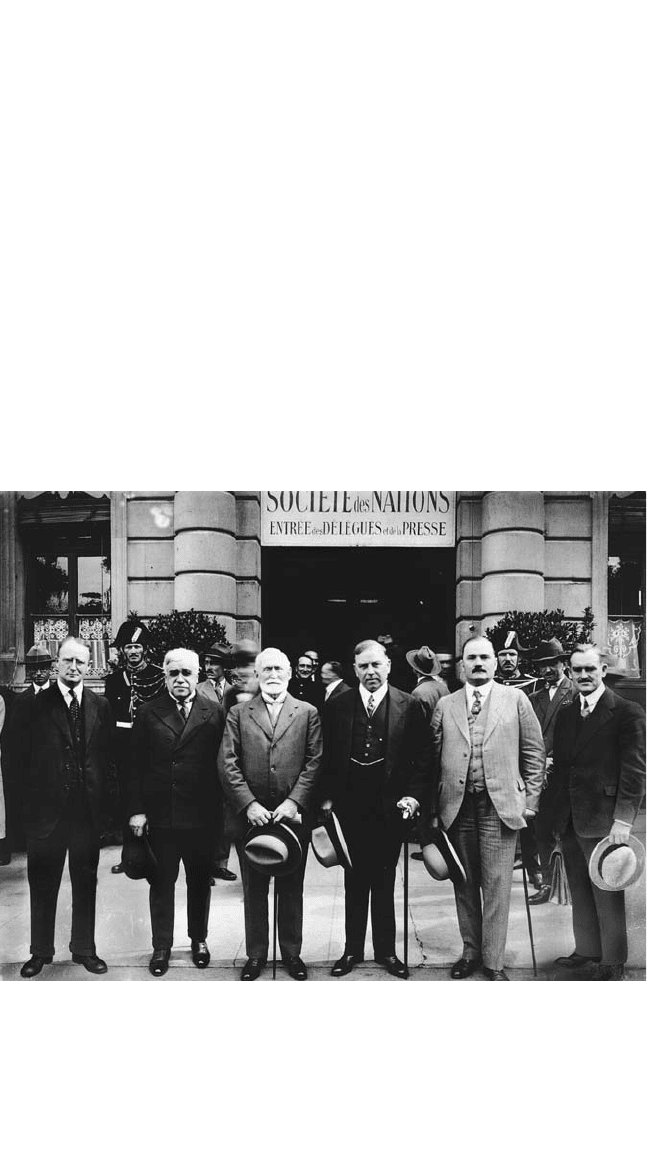
Growing autonomy in world affairs is refl ected in the Canadian delegation at the League
of Nations (left to right): O. D. Skelton, Philippe Roy, Raoul Dandurand, Prime Minister W. L.
Mackenzie King, Charles Dunning, W. A. Riddell. Mackenzie King (1874–1950) served as prime
minister for more than 22 years, the longest tenure in the British Empire.
(Library and Archives
Canada C-009055)
THE CONFIRMATION OF NATIONHOOD

A BRIEF HISTORY OF CANADA
258
and during World War I. Consequently, he did not share the faith that
Borden and Meighen had in the prospects that Canada could exert suf-
fi cient control over its foreign policy within a common imperial frame-
work. Wishing to maintain the imperial tie but suspicious that Britain
wanted only to use its self-governing colonies to enhance its own
power, King was determined to free Canada from the last traces of colo-
nial restraint and to complete its evolution toward full national status.
The diffi culty of shaping a common imperial foreign policy became
apparent during the Chanak crisis of 1922. When British troops sta-
tioned in Chanak, Turkey, to guard the neutral zone between the
Mediterranean Sea and the Black Sea came under siege by Turkish
nationalists, the imperial government appealed to the Dominions for
reinforcements. King was upset that Canada had not been appropriately
consulted about events in Turkey until they reached the crisis stage,
and he remained unconvinced that becoming involved in this distant
confl ict was in Canada’s interest. To the imperial request, he replied
that “only Parliament could decide,” and unfortunately for Britain, or
perhaps fortunately for Canada, the House of Commons was not in ses-
sion. By contrast, Opposition leader Meighen insisted that Canada
should have responded: “Ready, aye, ready we stand by you.” The crisis
was soon resolved by the Treaty of Lausanne, which prompted King to
declare that, because it had not been a party to this agreement, Canada
would not be bound by it. In effect, Canada had succeeded in avoiding
foreign entanglements and in discrediting the notion of a common
imperial foreign policy.
The demise of imperial unity in diplomatic affairs was completed by
the signing of the Halibut Treaty of 1923, an agreement between Can-
ada and the United States relating to fi shing rights on the Pacifi c coast.
While negotiations were conducted entirely by Canadian minister of
marines and fi sheries Ernest Lapointe, the British ambassador in Wash-
ington expected to sign the treaty in keeping with imperial tradition.
But the Canadian government insisted that Lapointe alone should sign
the treaty, a decision the British government did not dispute. For the
fi rst time, Canada had assumed responsibility for concluding a formal
treaty with a foreign power on its own behalf. The Imperial Conference
later that year formally abandoned the idea of a common imperial for-
eign policy and affi rmed the right of the Dominions to conclude treaties
with foreign states. Canada’s power to control its international relations
would be confi rmed in 1927 when Vincent Massey took up residence
in Washington as the fi rst Canadian-appointed foreign minister, and
the United States reciprocated by opening a legation in Ottawa. Other

259
The Statute of
Westminster, 1931
AN ACT to give effect to certain resolutions passed by Imperial
Conferences held in the years 1926 and 1930. [2 George V. Chapter 4]
11th December, 1931
WHEREAS the delegates to His Majesty’s Governments in the
United Kingdom, the Dominion of Canada, the Commonwealth of
Australia, the Dominion of New Zealand, the Union of South Africa,
the Irish Free State and Newfoundland, at Imperial Conferences
holden at Westminster in the years of our Lord nineteen hundred
and twenty-six and nineteen hundred and thirty did concur in making
the declarations and resolutions set forth in the Reports of the said
Conferences:
And whereas it is meet and proper to set out by way of preamble
to this Act that, inasmuch as the Crown is the symbol of the free
association of the members of the British Commonwealth of Nations,
and as they are united by a common allegiance to the Crown. . . .
NOW, THEREFORE, BE IT ENACTED by the King’s Most
Excellent Majesty, by and with the advice and consent of the Lords
Spiritual and Temporal, and Commons, in this present Parliament
assembled, and by the authority of the same, as follows: — . . .
2. 1. The Colonial Laws Validity Act, 1865, shall not apply to any
law made after the commencement of this Act by the Parliament of
a Dominion. 2. No law and no provision of any law made after the
commencement of this Act by the Parliament of a Dominion shall
be void or inoperative on the ground that it is repugnant to the
law of England, or to the provisions of any existing or future Act
of Parliament of the United Kingdom . . . and the powers of the
Parliament of a Dominion shall include the power to repeal or amend
any such Act, order, rule or regulation in so far as the same is part
of the law of the Dominion.
3. It is hereby declared and enacted that the Parliament of a Dominion
has full power to make laws having extra-territorial operation.
4. No Act of Parliament of the United Kingdom passed after the
commencement of this Act shall extend or be deemed to extend, to
a Dominion as part of the law of that Dominion, unless it is expressly
declared in that Act that that Dominion has requested, and con-
sented to, the enactment thereof. . . .
THE CONFIRMATION OF NATIONHOOD