
Riendeau A Roger E. Brief History of Canada
Подождите немного. Документ загружается.


A BRIEF HISTORY OF CANADA
210
The distribution of powers outlined in the British North America
Act was clearly designed to keep the provinces subordinate to the fed-
eral government. Macdonald’s Conservatives sought to keep the prov-
inces weak by invoking the power of disallowance whenever provincial
legislation confl icted with federal enactments or generally interfered
with the interests of the national government. The Liberal Party
adopted the position that the federal government should resort to its
power of disallowance only when the provinces exceeded their consti-
tutional jurisdiction. The provincial governments countered with the
argument that Confederation was a compact between the provinces and
the Dominion whereby the provinces had voluntarily delegated certain
powers to the federal government, which could be altered by mutual
consent. Opponents of this “compact theory” of Confederation main-
tained that the British North America Act was a statute of a superior
legislature rather than an agreement among provinces (Cook 1969).
The strongest challenge to Macdonald’s centralist views of Confed-
eration fi ttingly came from Canada’s most populated and affl uent prov-
ince. Oliver Mowat, the Liberal premier of Ontario from 1872 to 1896,
like his predecessor Edward Blake, claimed that his province was a
partner rather than a satellite of the federal government. Mowat saw in
the Ontario-Manitoba boundary question an opportunity to reinforce
the dominance of his province within the Confederation. When the
federal government unilaterally awarded the disputed territory west of
Thunder Bay to Lake of the Woods to Manitoba in 1881, Ontario
appealed the decision to the Judicial Committee of the Privy Council,
which ruled in the province’s favor three years later.
In another landmark case, Hodge v. The Queen, the Judicial Commit-
tee in 1884 upheld Ontario’s Act Respecting Licensing Duties, which
the federal government had disallowed, because liquor licensing was a
local matter and the provinces had full authority in their own realm of
legal jurisdiction. Provincial power was further enhanced by yet
another Ontario challenge over the role of the lieutenant governor as
primarily a servant of the federal government. In 1892 the Judicial
Committee ruled that the lieutenant governor as a representative of the
Crown in Canada had the same relationship with the province as the
governor-general had with the federal government. Ontario was also at
the forefront of a series of Judicial Committee decisions, notably Russell
v. The Queen in 1882 and the Local Prohibition case in 1896, which
resulted in provincial power over property and civil rights taking
supremacy over federal authority for peace, order, and good govern-
ment. In effect, the Judicial Committee ruled that federal residuary

211
power could exceed beyond the matters enumerated in Section 91 of
the British North America Act only in times of extreme emergencies,
thereby nullifying the centralizing intentions of Confederation.
Growing provincial power, however, did not translate into greater
unity of the provinces, as demonstrated during the fi rst Interprovincial
Conference that convened at Quebec in 1887 to reconsider the basis of
Confederation. The Conservative premiers of Prince Edward Island and
British Columbia declined to attend, while four of the fi ve premiers
who did meet were Liberals. Dismissing the gathering as a Liberal Party
conspiracy, Macdonald declined an invitation to send federal represen-
tatives. With few interests in common, the provinces were united only
in attacking federal government policies. While Ontario and Quebec
were divided by cultural sentiments, they were mutually suspicious of
the smaller provinces’ demand for more federal subsidies that invari-
ably would mean higher taxation for central Canadians. Maritime com-
plaints regarding tariffs or Manitoba’s railway freight rate problems
were also of little concern to Ontario and Quebec. Although it high-
lighted the lack of national unity after two decades of Confederation,
the meeting was ultimately signifi cant for inaugurating a new vehicle
for political decision-making in Canada as interprovincial conferences
evolved into federal-provincial conferences.
Cultural Confl ict and Minority Rights
In Quebec, concern over provincial rights was complicated by the
thorny question of minority rights. Quebec actively supported provin-
cial rights as a strategy to preserve racial and religious privileges within
the province but did not hesitate to call upon the federal government
to nullify provincial measures that failed to protect the French minority
in other provinces. The dilemma created by this position became appar-
ent in 1871 when the New Brunswick government amended the Schools
Act to introduce a non-sectarian system of education that would no
longer provide public support for “separate” parish schools offering
French language and Catholic religious instruction. Despite pressure
from Acadian and Irish Catholics, the federal government refused to
intervene on two grounds. First, while the British North America Act
recognized denominational schools that had existed by law before
Confederation, those in New Brunswick existed only by custom, and
thus the new provincial act was not depriving Catholics of any legal
rights. Second, the federal government was reluctant to intervene in
education, a matter that was clearly under provincial jurisdiction
THE CLASH OF NATIONALISMS AND THE RESURGENCE OF REGIONALISM

A BRIEF HISTORY OF CANADA
212
according to the act. George-Étienne Cartier and other Quebec political
leaders agreed with Macdonald that federal intervention to alter exist-
ing provincial education laws would set a dangerous precedent (Silver
1982; Linteau, Durocher, and Robert 1983).
The New Brunswick school dispute following upon the heels of the
Red River uprising awakened the Quebec clergy to the fate of the grow-
ing population of French Catholics outside of the province. From the
mid-19th to the early 20th century approximately 100,000 young
French Canadians left Quebec every decade to seek more favorable
economic opportunities either in the United States or elsewhere in
Canada. In response to this exodus as well as to the imperialist and
continentalist appeals for the unity of the Anglo-Saxon race, the ultra-
montane movement within the clergy sought to make Quebec the cen-
ter of French Catholicism in North America, championing the cause of
expatriates wherever they formed a community, holding their loyalty to
the homeland, and occasionally attracting them back within its borders.
The ultramontanes, therefore, believed that it was imperative to main-
tain the Catholic Church and the French language not only as instru-
ments of cultural nationalism but also as barriers against the subversive
ideas of Protestantism or modern secular thought. In their Programme
catholique of 1871, the ultramontanes condemned the doctrine of
separation of church and state, boldly claiming that the state was sub-
ordinate to the church and the pope was the supreme authority in civil
and religious matters. The Programme catholique further declared that
the Catholic Church had the right to intervene directly in politics and
to brand as a sin a vote for a candidate who did not uphold the interests
of religion as defi ned by the Quebec bishops. The lack of a dominant
fi gure like Cartier to rally the forces of French Catholicism to the side
of the Liberals, along with the anti-Catholic and anti-French attitude
that prevailed within the Ontario wing of the party, drove the French
clergy to support the Conservative Party despite the prominence of the
Protestant extremist Orange Order within its ranks. While Macdonald
appreciated the electoral value of this uneasy “holy” alliance, he and his
party would have reason to regret this political fortune when the
North-West Rebellion erupted in 1885.
Farther west along the Saskatchewan River, the Métis and the Native
tribes were discovering that they could not escape the encroachment of
agricultural settlement. Once again, the government system of square
survey ignored the boundaries of the long and narrow river-lot farms
and brought their titles into question. Once again, the federal govern-
ment ignored the demands of the inhabitants for recognition of their

213
land claims, for fulfi lment of the Indian Treaty obligations, and for local
self-government with representation in the national Parliament. And
once again, the Métis, with the initial support of white settlers who were
also upset over Ottawa’s indifference to western grievances, turned to
Louis Riel to lead their struggle against a government that apparently
had learned little from the political turmoil 15 years previously.
Riel had lived in exile mostly in the United States since he fl ed Red
River in 1870. He returned briefl y to be elected and reelected to Parlia-
ment, and in 1874 he mysteriously managed to sign the members’ reg-
ister in Ottawa. In 1875 Riel was granted a general amnesty on the
condition that he remain in exile for another fi ve years. During his
years in exile, Riel’s religious obsessions caused him to spend time in a
mental asylum, and he became convinced that God had chosen him to
serve as “prophet of the New World.” So, when approached to lead the
western protest against an eastern-dominated national government in
1884, Riel believed that his divine mission was about to be fulfi lled.
At fi rst, Riel sought political change by peaceful means, helping to
draft a petition demanding more generous treatment of Indians, more
favorable land terms for both whites and Métis, local control of natural
resources, lower tariffs, a railway to Hudson Bay as an alternative to the
CPR, responsible government for the North-West Territories, and west-
ern representation in Ottawa. In the face of government inaction, Riel
and his Métis followers grew increasingly impatient and adopted a more
confrontational approach. As he had done at Red River 15 years earlier,
Riel established a provisional government with himself as president in
March 1885. This action and subsequent talk of violence alienated many
of his white supporters, while Riel’s growing religious fanaticism turned
the Catholic Church against him (Stanley 1960, 1974).
Within an atmosphere of rising tensions, Riel’s renewal of armed resis-
tance against the Canadian government was ignited on March 26, 1885,
by a clash at Duck Lake between a force of the Northwest Mounted Police
(NWMP) and a band of Métis led by Gabriel Dumont, whom Riel had
appointed as military commander of the resistance movement. Dumont’s
victory not only forced the NWMP to abandon Fort Carlton and retreat to
Prince Albert but also encouraged Cree chiefs Poundmaker and Big Bear
to mount Indian attacks at Battleford and Frog Lake, respectively. News
of these skirmishes aroused the federal government to dispatch an expe-
ditionary force of more than 5,000 troops to the West via the partially
completed Canadian Pacifi c Railway. The speedy arrival of this force
under the command of Major General Frederick Middleton highlighted
the value of the transcontinental railway and helped to discourage a larger
THE CLASH OF NATIONALISMS AND THE RESURGENCE OF REGIONALISM

A BRIEF HISTORY OF CANADA
214
Indian uprising, thereby localizing the rebellion. After three weeks of
fi erce fi ghting, Riel was defeated and captured in the decisive battle at
Batoche, the headquarters of his provisional government, on May 15,
1885. Dumont fl ed to the United States, while Poundmaker and Big Bear
continued to resist briefl y before surrendering.
Unlike his fi rst uprising, which occurred within a political vacuum,
Riel’s second act of armed resistance was clearly a revolt against a consti-
tuted authority. The Canadian government proved to be far more deci-
sive in suppressing the North-West Rebellion than in preventing its
outbreak in the fi rst place. The vast majority of Plains Indians who hon-
ored their treaty promises not to take up arms against the state were
rewarded with gifts and supplies, while the relatively few who partici-
pated in the rebellion were dealt with harshly by the courts. In the sub-
sequent trials, 125 Indians and Métis were prosecuted, and eight Indians
were publicly hanged to demonstrate the government’s determination to
resist challenges to its authority. For his part in leading the rebellion, Riel
was charged with treason and fought all of his lawyers’ efforts to have
him acquitted by reason of insanity. After one hour of jury deliberation,
Riel was found guilty and was sentenced to execution by hanging.
In the process, the leader of western protest against eastern domina-
tion and the defender of Native rights against encroaching white “civi-
lization” also became the catalyst for ethnic and religious passions that
had been smoldering uneasily since the Red River uprising. English
Protestant Ontario, still remembering him as the murderer of Thomas
Scott and an obstacle to provincial aspirations to annex the West,
demanded Riel’s execution. On the other hand, French Catholic Que-
bec, hailing Riel as a defender of cultural and minority rights in the
West, called upon the federal government to pardon him. Appeals for
clemency came from all parts of Canada and the United States as well
as from Britain and France. After several delays, including a legal appeal
to the Judicial Committee of the Privy Council and further investiga-
tions of Riel’s sanity, Macdonald concluded that “Riel must swing” in
order to keep Ontario loyal to the Conservatives and to herald the tri-
umph of Canadian law and order in the West. These motives were vital
to the success of his National Policy. Bolstered by the support of his
French-Canadian lieutenants, Hector Langevin and Adolphe Chapleau,
Macdonald was willing to gamble that his party’s strength in Quebec
would hold fi rm. As it turned out, Riel’s execution in November 1885
would profoundly transform the political landscape of Quebec.
Both Wilfrid Laurier, a rising federal Liberal politician, and Honoré
Mercier, leader of the Quebec Liberal Party, seized the opportunity to

215
capitalize on Riel’s “martyrdom.” Laurier declared at a mass rally
attended by over 50,000 people on the Champs de Mars in Montreal:
“Had I been born on the banks of the Saskatchewan, I myself would
have shouldered a musket” (Dafoe 1922, 2). Within two years, Laurier
was leader of the federal Liberals, and a little over a decade later, he
would become the fi rst French-Canadian prime minister. At the same
rally, Mercier condemned the federal Conservatives as the party of
English Canada, and particularly of Ontario Protestant bigotry. Indeed,
the demise of the Conservative Party in Quebec in the 1890s can be
traced back to the bitterness aroused by Riel’s execution.
Mercier endeavored to revive the long-standing Rouge notion, all but
discredited by persistent ultramontane attacks during the 1870s, that
only an autonomous Quebec government could adequately represent
French-Canadian interests within the Confederation. Mercier allied his
Liberal supporters with dissident Conservatives to form the Parti
National, which would emphasize French Canada fi rst, reminiscent of
the Canada First movement’s focus on the interests of English Protes-
tant Ontario (Silver 1982). In the provincial election of 1886, Mercier
led the Parti National to a narrow victory, and as premier of Quebec, he
set out to win the confi dence of the ultramontane clergy by cultivating
his image as defender of the Catholic religion and French-Canadian
rights. In 1888 the Quebec legislature passed the Jesuit Estates Act,
which was primarily intended to compensate the Jesuit Order for prop-
erty seized by the Crown after the British Conquest. To settle the rival
claims of the Jesuits and the Catholic hierarchy in Quebec, the provin-
cial government called upon the pope to arbitrate.
Predictably, Protestant Ontario, led by Conservative member of Par-
liament D’Alton McCarthy, objected vehemently to papal intervention
in Canadian affairs and demanded that the federal government use its
powers of disallowance. However, Macdonald refused to intervene in a
provincial matter that would generate more ethnic and religious antag-
onism, so McCarthy’s motion of disallowance was decisively defeated.
With strong support from the Protestant Orange and Masonic Orders,
McCarthy formed the Equal Rights Association, which advocated a
Canadian nationality based on one language (English), one culture
(British), and one faith (Protestantism). After being burned in effi gy in
Quebec for sacrifi cing Riel to the English Protestants, Macdonald found
himself vilifi ed in Ontario for conspiring with French Catholics.
To build up support for the Equal Rights Association, McCarthy took
his anti-Catholic and anti-French campaign to Manitoba in 1889, where
he urged the Liberal government of Thomas Greenway to abolish
THE CLASH OF NATIONALISMS AND THE RESURGENCE OF REGIONALISM
A BRIEF HISTORY OF CANADA
216
separate Catholic schools and French language rights, both of which
had been guaranteed in the Manitoba Act of 1870. In response to the
rhetoric of McCarthy and the Equal Rights Association as well as to the
steady decline in the size of the French Catholic community relative to
the English Protestant population, the provincial legislature passed the
Manitoba Schools Act in 1890. The act discontinued government fi nan-
cial support for separate schools in favor of a uniform, state-funded,
secular education system administered by a newly created Department
of Education. The same session of the legislature abolished French as an
offi cial language, contrary to Section 23 of the Manitoba Act.
Disappointed Catholics in French and English Canada urged the
federal government to use its general power to disallow provincial leg-
islation or its specifi c power to pass remedial legislation to protect
minority education rights under Section 93 of the British North Amer-
ica Act. Macdonald adopted the same cautious strategy that had served
him well in the New Brunswick school question of 1871. The Manitoba
school question differed from the New Brunswick dispute in the sense
that the federal government was being called upon to defend rights that
were constitutionally guaranteed.
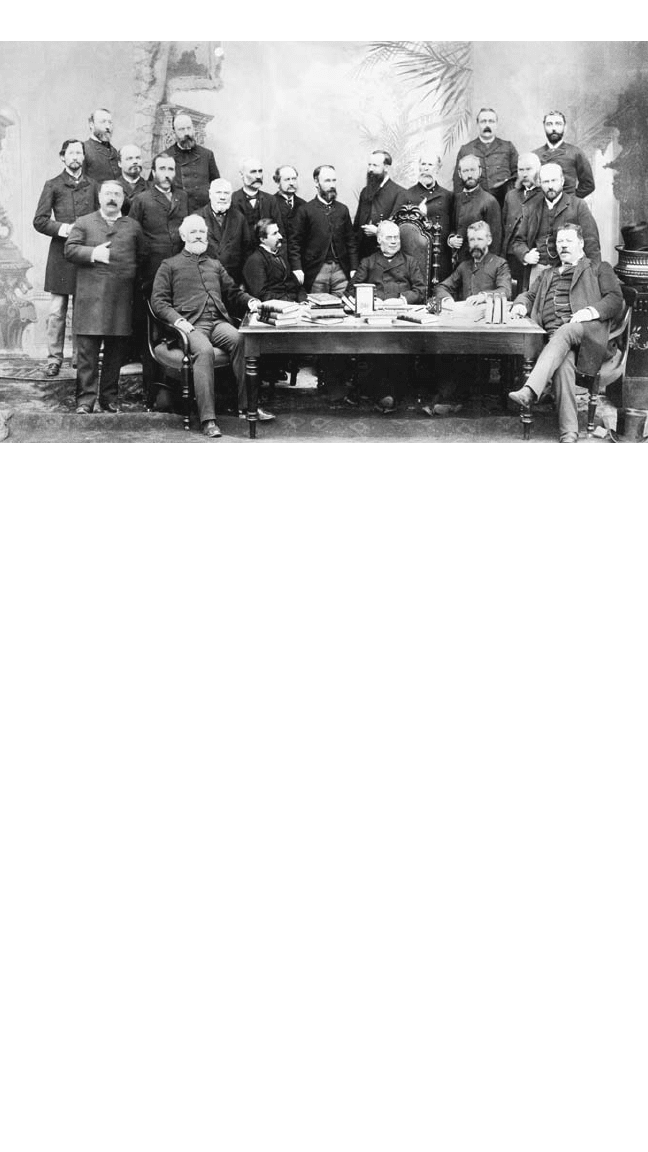
The fi rst Interprovincial Conference at Quebec City in 1887, with Ontario premier Oliver
Mowat in the chair, Quebec premier Honoré Mercier sitting to his right, and Nova Scotia
Premier W. S. Fielding sitting to his left. Fielding would later make the transformation from an
anti-Confederationist to a cabinet minister in the Laurier government.
(Library and Archives
Canada C-011583)

217
Nevertheless, Macdonald remained determined to avoid a federal-
provincial clash over a volatile political issue that could infl ict serious
electoral damage on his party. His strategy was to let the courts decide.
While the Supreme Court of Canada upheld the right of Catholics to
have state-supported separate schools, the Judicial Committee of the
Privy Council reversed this decision and ruled in favor of the Manitoba
government’s position. In another legal case, the Privy Council ruled
that the federal government had the constitutional right to pass reme-
dial legislation to protect minority rights, even though the Manitoba
law had been ruled constitutionally valid (Cook 1969).
When remedial legislation was fi nally introduced to Parliament in
1896, it fell victim to the disintegration of the ruling Conservatives, who
had gone through four leadership changes in the fi ve years since Macdon-
ald’s death. Macdonald’s successors as prime minister—John J. Abbott
(1891–92), John S. Thompson (1892–94), Mackenzie Bowell (1894–96),
and Charles Tupper (1896)—were either unable or were not in offi ce long
enough to build a party consensus on the issue. In the end, the remedial
bill was stalled by prolonged debate until the fi ve-year term of Parliament
expired. The Manitoba schools question thus became a major issue in the
federal election of 1896. The divided and disorganized Conservatives
expressed support for remedial legislation when campaigning in Quebec
but denied that the bill would ever become law when campaigning in
English-speaking Canada. The Liberals under the leadership of Wilfrid
Laurier were able to shift the focus of the Manitoba schools question from
minority rights to provincial rights. In this way, Laurier could challenge
the political authority of the ultramontane Catholic clergy without
appearing to abandon the interests of his native Quebec. In the fi nal
analysis, Quebec’s historic shift from the Conservative to the Liberal fold
was decisive in securing a narrow victory for Laurier, thus giving Canada
its fi rst French-speaking and Catholic prime minister.
Charles Tupper’s defeat after slightly more than two months at the
head of the Conservative government bestowed on him the ignoble dis-
tinction of serving the shortest term of any Canadian prime minister.
More important, the general election of 1896 marked the end of the Con-
servative ascendancy in national politics, an era dominated by Sir John A.
Macdonald. Laurier would emerge as the heir to Macdonald as a master
strategist in the complex politics of cultural division, regional protest,
and national unity. His 15-year reign as prime minister would be marked
by a reversal of national economic fortunes, the rise of the Liberal politi-
cal ascendancy, and the growing diversifi cation of Canadian society, all
trends that would continue throughout the 20th century.
THE CLASH OF NATIONALISMS AND THE RESURGENCE OF REGIONALISM

218
13
THE WHEAT BOOM AND
NATIONAL EXPANSION
(1896–1914)
I
n 1904, Prime Minister Wilfrid Laurier predicted: “The nineteenth
century was the century of the United States, the twentieth century
will be the century of Canada.” Laurier’s confi dence was buoyed by
the remarkable prosperity that Canada was enjoying since he came to
power in 1896 and which it would continue to experience with only
brief interruptions during the fi rst three decades of the 20th century. As
much as Laurier may have believed that his government’s policies were
responsible for the turnaround in Canada’s fortunes, the reality was that
Macdonald’s National Policy was fi nally fulfi lling its promise. Just as the
National Policy had faltered because of the slow progress of western
settlement, so it fl ourished in the wake of the extraordinary infl ux of
immigrants to the prairies, which triggered the so-called wheat boom
from 1896 to 1914. Accordingly, the late 19th-century pessimism and
doubt about Canada’s survival gave way to a new sense of optimism and
confi dence that inspired a greater interest in external relations. In the
process, renewed controversies over contributions to imperial defense
and commercial reciprocity with the United States led to the downfall
of the Laurier government.
Western Settlement and the
Triumph of the National Policy
The settlement of the Canadian West after 1896 was stimulated by the
reversal of the same external factors that had previously been impedi-
ments. The revival of world trade was marked by a rise in the demand
for agricultural products and other raw materials to supply the growing
cities and factories in Britain and western Europe. The price of wheat,

219
for example, quadrupled from 1891 to 1921, thereby making farming a
more profi table venture. Furthermore, as the American western frontier
reached the limits of its expansion by the end of the 19th century, the
cheap and fertile land of the Canadian prairies became known as the
“last, best west” (Brown and Cook 1974).
The prospect of developing the Canadian West was enhanced by
improvements in agricultural techniques and technology that enabled
settlers to cope with the natural limitations of climate. The application
and refi nement of “dry” farming techniques helped to overcome the
relatively low rainfall of the prairies. The advent of the chilled steel
plough facilitated cutting through the hard prairie sod, while improved
harrows and seed drills as well as tractors and threshers made it pos-
sible to work large farms effectively. Perhaps the greatest advance was
Marquis wheat, a high-yielding strain that could mature in less than
100 days, thereby reducing the hazards of a late spring or an early
autumn frost and extending the farming frontier to the northern areas
of Alberta and Saskatchewan. As a result, Canadian wheat exports
increased from barely 2 million bushels in 1896 to over 150 million
bushels in 1921.
As the wheatlands of western Canada became more attractive to set-
tlers, the federal government embarked upon an ambitious immigra-
tion policy administered by Minister of the Interior Clifford Sifton, who
had migrated from Ontario to Manitoba during the 1880s. Believing
that agriculture was the backbone of the Canadian economy, Sifton
organized vigorous publicity campaigns in Britain, the United States,
and continental Europe promoting the unparalleled opportunities of
farming in the “Wondrous West,” as one of his many pamphlets was
entitled. While government agents recruited immigrants with an offer
of a quarter section (160 acres) of free land under the Dominion Lands
policy, the Hudson’s Bay Company and the Canadian Pacifi c Railway
were willing to sell their favorably located holdings at reasonable prices
because more people meant more business. The response was over-
whelming as from 1896 to 1914 upwards of 2.5 million immigrants
came to Canada, with about 1 million of them settling on the western
prairies. Accordingly, Canada’s population expanded from 4.8 million
in 1891 to 8.8 million in 1921 while the population of the West, includ-
ing Manitoba, the North-West Territories, and British Columbia, grew
from little more than 250,000 to over 2 million during the same period
(Fawke 1957).
In response to this growth, western settlers pressured the federal
government to grant provincial status to the North-West Territories.
THE WHEAT BOOM AND NATIONAL EXPANSION