
Riendeau A Roger E. Brief History of Canada
Подождите немного. Документ загружается.


A BRIEF HISTORY OF CANADA
230
factories and mills and which was already home to the majority of the
more than 1 million French Canadians living in the United States by
1900. Furthermore, the Catholic clergy discouraged emigration from
the province, preferring instead to encourage the colonization of north-
ern Quebec (Silver 1997).
A limited French Catholic presence and rising concerns about cul-
tural homogeneity of a growing population shaped the emerging
schools question in the North-West Territories. The North-West Ter-
ritories Act of 1875 allowed both Protestants and Catholics to establish
schools and to share in public funds for education. The act also allowed
the use of both English and French as languages of instruction. By the
1890s, however, French had been reduced to the language of instruc-
tion only in the early years of the declining Catholic school system.
Bowing to pressure from Henri Bourassa, grandson of Louis-Joseph
Papineau and emerging as the leading French-Canadian nationalist in
Quebec, Laurier included an educational clause in the Autonomy Bills
of 1905 restoring the original separate school system of the North-West
Territories and incorporating it into the newly created provinces of
Alberta and Saskatchewan. Widespread Anglo-Protestant protest, high-
lighted by Sifton’s resignation, prompted Laurier to negotiate a com-
promise resolution similar to that achieved in the case of the Manitoba
School Question. While Sifton felt uneasy enough about Laurier’s han-
dling of the issue to refuse to return to the Cabinet, Bourassa denounced
the compromise as an infringement on rights previously enjoyed by
French-Canadian Catholics in the West. He further argued that they
should have the same rights that English Protestants in Quebec were
granted at the time of Confederation. The controversy over western
schools soon subsided as Bourassa and other French-Canadian nation-
alists essentially abandoned any hope of spreading their cultural infl u-
ence to the West and focused on coping with the social and economic
impact of urbanization and industrialization in Quebec. But the cul-
tural bitterness incited by the schools questions would not be forgotten,
especially as the controversy over Canada’s imperial defense commit-
ments further aroused nationalist passions in the general election of
1911 (Brown and Cook 1974).
External Relations and National Unity
The prosperity of the wheat boom era also prompted a reconsideration
of Canada’s national status in light of changing relations with Britain
and the United States. Canada was a self-governing nation in the realm

231
of domestic affairs, but it remained a colony in matters of international
relations. Accordingly, the Dominion could only negotiate with other
countries under the auspices of the British government, which con-
ducted diplomatic relations for the empire as a whole. This continuing
colonial status was not disputed at the time of Confederation because
the new nation wanted to maintain the security of imperial defense,
which appeared vital in the wake of Anglo-American tensions during
the 1860s. The expectation was that, as in the colonial era, Britain
would maintain an imperial garrison as the fi rst line of defense and that
the Canadian militia would supply auxiliary forces (Preston 1970;
Stacey 1977). In 1870, Prime Minister Macdonald surmised that,
because of Canada’s weakness in the face of an overtly expansionist
southern neighbor, “It will be a century before we are strong enough to
walk alone.”
Obviously disagreeing with Macdonald, the British government
decided to withdraw its garrisons from Canada in 1870–71, leaving the
naval base at Halifax as the only British military presence. Disappoint-
ment over this decision was magnifi ed by the Treaty of Washington in
1871, which demonstrated the precariousness of dependence on the
imperial authority to act on Canada’s behalf. The indignation over the
apparent British willingness to sacrifi ce Canadian interests in order to
maintain American friendship, however, was tempered by the realiza-
tion that the struggling young Dominion was still heavily reliant on
imperial economic and military support. Therefore, for the fi rst three
decades of nationhood, Canada was in the ambivalent position of wish-
ing to maintain the security of the imperial tie while aspiring to greater
control over national affairs.
The rise of imperialist sentiments during the 1880s and 1890s
renewed British interest in closer relations with its self-governing colo-
nies, of which Canada was the largest and oldest. Joseph Chamberlain,
who was appointed colonial secretary in 1895, became the leading
advocate of more centralized administration of the British Empire in
order to enhance its strength and unity in world trade and defense.
Certainly, the underlying assumptions of imperial unity—Anglo-Saxon
superiority and identity with a glorious empire rather than an obscure
colony—were appealing to many English-speaking Canadians. More-
over, the Canadian government actively participated in the Colonial
Conferences associated with Queen Victoria’s Golden Jubilee in 1887
and Diamond Jubilee in 1897, and Ottawa hosted another meeting of
colonial premiers and British cabinet leaders in 1894. Laurier could
also point to the measure of imperial preference included in his tariff
THE WHEAT BOOM AND NATIONAL EXPANSION

A BRIEF HISTORY OF CANADA
232
policy of 1897 as a manifestation of Canada’s willingness to play a key
supporting role within a reconstituted British Empire. However, Can-
ada was reluctant to undertake commitments that would ultimately
compromise national independence. For this reason, Laurier rejected
Chamberlain’s proposals for an imperial council that would reduce
Canada’s legislative autonomy and for a specifi c fi nancial pledge in sup-
port of the British navy.
Although Laurier recognized that when Britain was at war, Canada
was legally obliged to follow, he was determined that Canada should be
the sole judge of the commitment to be made to imperial defense (Page
1987). The outbreak of the Boer War in South Africa in 1899 brought
the issue to a head. Chamberlain saw the clash between the British
Cape Colony and the rebel Boers, descendants of the original Dutch
settlers in the republics of Transvaal and the Orange Free State, as an
opportunity to demonstrate to potential European adversaries that Brit-
ain could call upon military support and unity from its self-governing
colonies. Canadian imperialists responded enthusiastically to the pros-
pect of sending troops overseas to fi ght alongside British forces. The
governor-general, Lord Minto, and the British-appointed commander
of the Canadian militia, Major General Edward Hutton, assumed that
Canada would heed the call to arms and had no diffi culty enlisting
English-speaking recruits.
While expressing sympathy for the British military effort, Laurier
repudiated Minto and Hutton by insisting that the Canadian Parliament
still had to decide on the nature and extent of the nation’s commitment
to imperial defense. Laurier was acutely aware of the imminent prob-
lem of national unity aroused by the Boer War. French Canadians were
opposed to participation in a distant imperial war that posed no appar-
ent threat to Canadian security. Prime Minister Macdonald had used
this same argument to reject a British request for Canadian troops to
participate in a military expedition to the Sudan in 1885. Furthermore,
French Canadians tended to identify with the Boers’ struggle for libera-
tion from their imperial oppressors. In response to imperialist accusa-
tions of disloyalty to Britain, French Canadians insisted that they were
merely affi rming a truly Canadian nationalism.
The Laurier government compromised by sending a voluntary force
of 1,000 men to serve under the British command, stipulating that this
decision should not be “construed as a precedent for future action.” By
the end of the Boer War in 1902, another 6,300 Canadians had volun-
teered under private auspices or through direct recruitment on behalf
of the British government. Laurier’s policy was attacked by English

233
imperialists as an abdication of Canadian responsibility and by French
nationalists as submission to British pressure. Bourassa resigned his
parliamentary seat in protest and became Laurier’s leading nationalist
adversary in French Canada. The passionate rhetoric on both sides
eventually ran its course, and the controversy did not prevent Laurier
from achieving a decisive victory in the national election of 1900. Nev-
ertheless, the Boer War controversy gave the fi rst indication that Can-
ada’s involvement on the world stage would be an additional source of
internal cultural confl ict (Brown and Cook 1974).
During the Colonial Conference of 1902, Laurier continued to
oppose Chamberlain’s plan for greater imperial unity in defense and
government and to press for the revival of imperial trade preferences as
an alternative to a proposed customs union. Although Laurier agreed to
regular Canadian participation in further meetings to be known as
Imperial Conferences convened at four-year intervals, he was con-
cerned that such consultation with Britain on foreign affairs would
involve Canada in implied commitments without commensurate infl u-
ence over decisions. For the Imperial Conferences to be truly consulta-
tive, Laurier believed, Canada should be granted greater control over its
foreign relations. But Britain resolutely refused to impair the unity of
imperial diplomacy. The liability of diplomatic subordination for Can-
ada once again became apparent during the Alaska boundary dispute.
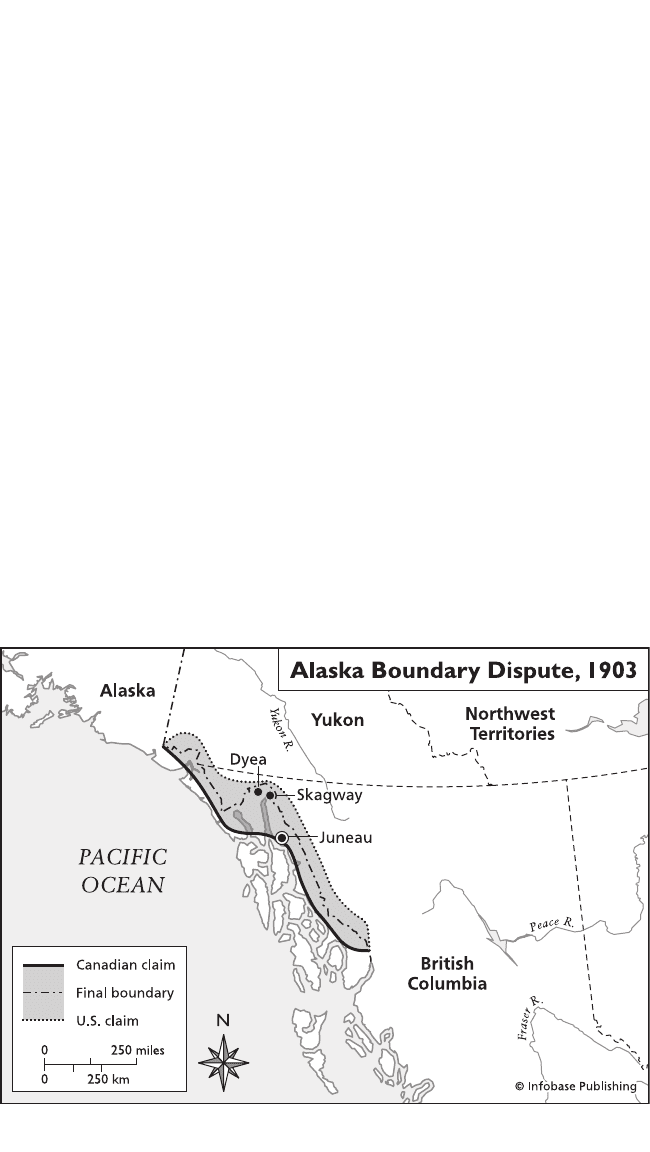
The Klondike gold rush precipitated a dispute over the boundary
between Canada and Alaska, which had never been clearly established
when the United States purchased the territory from Russia in 1867.
While the major goldfi elds were defi nitely within Canadian territory,
access to them from the Pacifi c Ocean was not as certain. At the center
of the dispute was control over the main entrance to the Yukon and the
Klondike River district, the port of Skagway and the inlet leading to it
known as Lynn Canal, both located in the panhandle or coastal strip.
The boundary claims of both countries included Skagway and the head
of the Lynn Canal, thereby allowing them to control the lucrative trade
generated by the gold rush. In the wake of U.S. president Theodore
Roosevelt’s threat to send in American troops, the dispute dragged on
until 1903 when it was referred to a joint commission of six offi cials.
While Roosevelt appointed three representatives who had publicly
opposed any compromise, the British government appointed two Cana-
dians and the Lord Chief Justice of England, Lord Alverston. As was the
case with the Treaty of Washington, Britain appeared to put Anglo-
American friendship ahead of the Canadian claims inasmuch as Lord
Alverston voted with the U.S. members of the commission. Thus, the
THE WHEAT BOOM AND NATIONAL EXPANSION
A BRIEF HISTORY OF CANADA
234
Alaska boundary dispute revived anti-American sentiments and dem-
onstrated Canada’s need to control its own external relations (Thomp-
son and Randall 2002).
The establishment of a Department of External Relations and an Inter-
national Joint Commission in 1909 were noteworthy, albeit limited, steps
in that direction. While the responsibility for policy-making remained
with the British Foreign Offi ce, the new department assumed some of the
administrative functions relating to the Canadian government’s growing
relations with other countries, principally Britain and the United States.
Designed to facilitate direct Canadian-American negotiations on mutual
problems, the commission consisted of three Canadian representatives,
appointed by the Crown on the recommendation of the Canadian gov-
ernment, in addition to the three American delegates. The responsibili-
ties of the commission included the international waterways, boundaries,
and any other matter raised by the governments of the two countries. The
absence of a British delegate among the Canadian contingent represented
a signifi cant departure from the bodies that had negotiated the Treaty of
Washington and the Alaska boundary dispute.
Canada’s relations with Britain and the United States became the
focus of the national election of 1911. Imperial relations were compli-
cated by the escalating rivalry for European naval supremacy between
Britain and Germany. As the threat of war mounted, Britain renewed its

235
appeal for colonial contributions to the imperial naval fl eet. Instead of
a direct contribution of money to the Royal Navy over which Canada
would have no infl uence, Laurier preferred to build a distinctly Cana-
dian naval force. Accordingly, in 1910 he introduced the Naval Service
Bill to establish a naval college to train offi cers and a Canadian navy
consisting of fi ve cruisers and six destroyers that could be placed under
British command in the event of war.
What Laurier thought would be a suitable compromise for a contro-
versial national and international issue turned out to satisfy neither the
imperialists nor the French-Canadian nationalists. While the imperial-
minded Conservatives favored the development of a national naval
force in the long run, they ridiculed the “tin pot navy” as a disgrace to
Canada’s role within the empire and called for an immediate response
that included a direct fi nancial contribution to the British fl eet as it
prepared for war. At the same time, Bourassa led the French-Canadian
opposition to the bill on the grounds that the proposed Canadian navy
would only encourage British militarism, which would inevitably draw
Canada into European confl icts. Although the intense opposition from
both sides did not prevent the comfortable Liberal majority in Parlia-
ment from easily passing the bill, the controversy would come back to
haunt Laurier in the national election of the following year.
Further dividing the nation was the renewed controversy over reci-
procity with the United States, a policy that had been the goal of the
Canadian government since the termination of the original agreement
in 1866 (Masters 1983). Responding to yet another American rejection
of reciprocity in 1897, Laurier boldly declared: “There will be no more
pilgrimages to Washington.” The subsequent economic boom, which
redeemed the high-tariff National Policy, rendered reciprocity less
urgent than it had appeared in the last third of the 19th century. By
1910, however, the United States had become more interested in free
trade with Canada, partly in response to the growing north-south trade
fueled by the opening of the northern resource frontier. The settlement
of the long-standing fi sheries dispute by the International Court that
same year had also helped to build goodwill between the two North
American neighbors. When the American government formally offered
to negotiate reciprocity, Laurier saw an opportunity to appease western
agrarian agitation against national economic policies.
Western farmers had been especially persistent in their demands for
lower freight rates and tariffs. The Laurier Liberals attempted to address
the former grievance through the Crow’s Nest Pass agreement of 1897,
in which the federal government awarded the CPR a subsidy to build a
THE WHEAT BOOM AND NATIONAL EXPANSION
A BRIEF HISTORY OF CANADA
236
branch line to Nelson, British Columbia, in return for lowering freight
rates between the West and central Canada. As far as the tariff was
concerned, farmers resented having to buy their agricultural imple-
ments and other manufactured goods in a closed protected market and
to sell their wheat in an open competitive market. To exert pressure on
government, the farmers organized various provincial or regional Grain
Growers’ Associations and in 1909 formed the Canadian Council of
Agriculture. The council’s demand for tariff reform convinced Laurier
that he could make signifi cant political gains by balancing the National
Policy with reciprocity (Fawke 1957).
Early in 1911, the Canadian and American governments concluded
a trade agreement that in effect renewed the Reciprocity Treaty of 1854.
The proposal provided for the free entry of Canadian natural products
into the United States, while American manufacturers benefi ted from a
lower Canadian tariff. The two countries agreed to implement free
trade through concurrent legislation rather than by a treaty so that
Canada could avoid seeking British approval. But while reciprocity
passed through the U. S. Congress, the agreement encountered vigor-
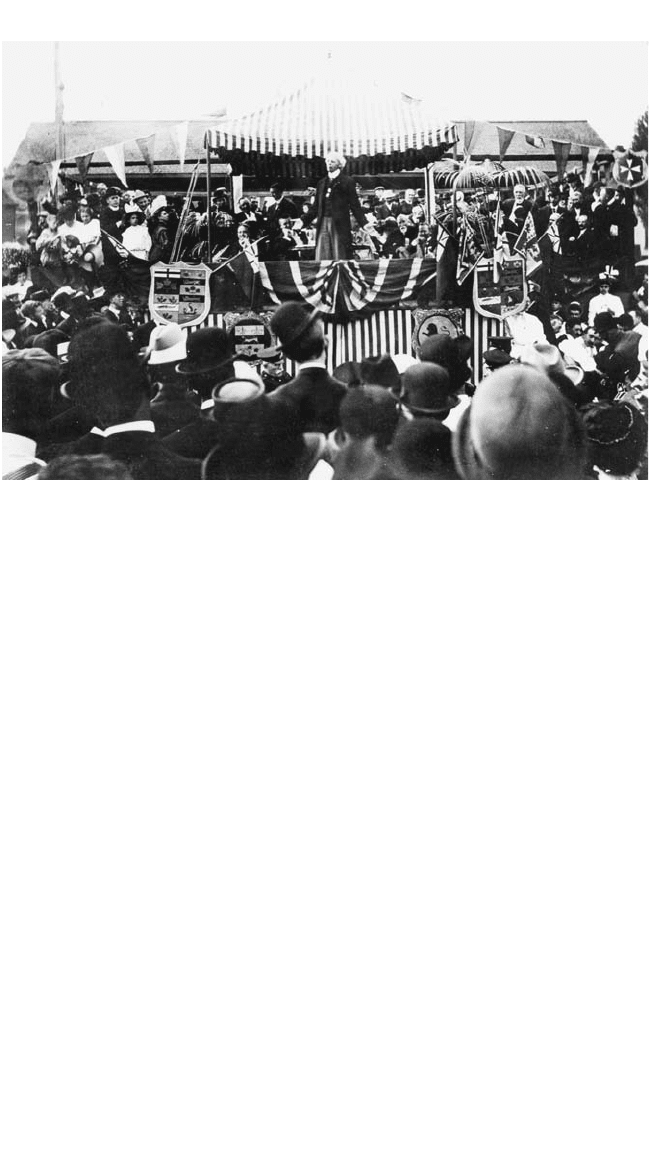
Shown here campaigning in Berlin (Kitchener), Ontario, in 1908, Sir Wilfrid Laurier (1841–
1919) was Canada’s fi rst French-Canadian prime minister. His service as prime minister from
1896 to 1911 remains Canada’s longest unbroken tenure in that offi ce.
(Library and Archives
Canada C-000463).

237
ous opposition in the Canadian Parliament. A group of Liberals led by
Clifford Sifton abandoned Laurier and sided with the Conservatives,
who feared that the achievement of reciprocity would prolong the 15-
year Liberal ascendancy. Outside of Parliament, the Canadian Manufac-
turers Association along with powerful railway, banking, and
commercial interests that were ardent supporters of the National Policy
waged an emotional campaign that associated reciprocity with disloy-
alty to the imperial tie, the threat of American annexation, and the
lingering bitterness over the Alaska boundary dispute. The Canadian
opponents of reciprocity were helped by the rhetoric of American sup-
porters of the agreement such as the speaker of the House of Represen-
tatives who proclaimed: “I am for it, because I hope to see the day when
the American fl ag will fl oat over every square foot of the British North
American possessions clear to the North Pole” (Masters 1983, 18).
Thus, Laurier became trapped in a nationalist cross fi re during the
national election campaign of 1911. In Ontario, Laurier was branded as
a continentalist amid the Conservatives’ rallying cry, “No Truck or
Trade with the Yankees”; he also incurred the imperialist wrath over
his handling of the naval controversy. Yet in Quebec, Laurier was
accused of being too much of an imperialist for his authorship of the
Naval Service Bill. As the Liberals went down to defeat at the hands of
the Conservatives led by Robert Borden, it became apparent that Lau-
rier was an unwitting victim of the prosperity of the age and an evolv-
ing sense of nationalism. The east-west trading system of the National
Policy was working effectively, thereby rendering interest in north-
south traffi c less pressing. Moreover, the question of Canada’s survival
was giving way to an assertion of national confi dence that was increas-
ingly suspicious of foreign domination and entanglements. Canada’s
stature within the international community would be put to the test
with the outbreak of World War I.
THE WHEAT BOOM AND NATIONAL EXPANSION

238
14
THE CONFIRMATION
OF NATIONHOOD (1914–1931)
C
anada made an impressive debut on the world stage during World
War I. The outstanding performance of Canadian soldiers on the
battlefi elds of Europe and the continued expansion of the national
economy in support of the war effort further advanced the cause of
Dominion autonomy. On the other hand, national unity suffered in
the wake of the conscription crisis of 1917, which sparked a clash of
nationalisms between the English and French cultural communities
and altered the course of Canadian electoral politics. During the mostly
prosperous 1920s, the balance of the Canadian economy clearly shifted
from agriculture to industry with the further expansion of manufactur-
ing and the northern resource frontier. The uneven distribution of the
benefi ts of post-war growth and prosperity, however, contributed to the
revival of regional discontent expressed through the Winnipeg General
Strike of 1919 and the rise of the western Progressive Party and the
Maritime rights movement. Determined to shape a distinct sense of
Canadianism that was free of imperialism and sensitive to continen-
talism, the Liberals under Mackenzie King continued the quest for
national autonomy and the reconstitution of the British Empire into
a Commonwealth of Nations, ultimately achieved by the Statute of
Westminster in 1931.
The Great War
As Europe drifted toward war, the Borden administration was faced
with the same question of imperial defense that had contributed to
Wilfrid Laurier’s defeat. Convinced that a military crisis existed over-
seas, Prime Minister Robert Borden introduced a new Naval Aid Bill in
1912 that abandoned Laurier’s plan for a Canadian navy in favor of an
emergency contribution of $35 million to cover the cost of three battle-

239
ships to be built and equipped in Britain. Apart from this emergency
aid, Borden expected that any permanent defense measures would be
contingent upon a greater Canadian voice in deciding imperial foreign
policy. Despite strong opposition in Quebec, Borden’s Naval Bill passed
the House of Commons, only to be blocked by the Liberal-dominated
Senate in 1913. But before the naval question could be settled, the long-
anticipated war erupted in Europe.
When Britain declared war in response to Germany’s invasion of
neutral Belgium in August 1914, Canada, as part of the empire, was
automatically at war. Initially, support for the war effort was virtually
unanimous as both English and French Canada recognized that the
defeat of Britain and France by Germany would severely jeopardize
Canadian growth and security. Few Canadians questioned the recruit-
ment propaganda and newspaper reports that depicted the war in terms
of a struggle between democracy and tyranny. Without opposition,
Parliament passed the War Measures Act, which gave the federal gov-
ernment broad emergency powers to suspend civil liberties and to
regulate any aspect of society or the economy deemed essential for the
conduct of the war. The early enthusiasm for the war effort and the
acceptance of sweeping state power was also based on the assumption
that the war would be a short-lived skirmish resulting in a decisive
Allied victory (Brown and Cook 1974).
Within the fi rst two months of the war, Canada’s standing army of
only 3,000 was reinforced by more than 30,000 volunteers to form the
Canadian Expeditionary Force, which became the First Canadian
Infantry Division. The First Division was thrust into unimagined trench
warfare and had to withstand the fi rst poisonous chlorine gas attacks
outside the small Belgian town of Ypres in 1915. Ultimately, four divi-
sions were organized into a distinct Canadian Corps that distinguished
itself in battle after battle on the western front, notably the Somme in
1916 and Passchendaele and Vimy Ridge in 1917. The Canadian Corps
was also instrumental in the fi nal, successful Allied attack, especially
during “Canada’s hundred days” from August 4 to November 11, 1918,
when troops broke through the fortifi ed Hindenburg Line and pushed
across the Belgian border to reach Mons on Armistice Day.
Thousands of other Canadians served with distinction in the British
and Allied armies. Canadians were among the leading “aces” who
engaged in man-to-man air combat in the service of the Royal Flying
Corps, the forerunner of the Royal Air Force. For example, the legendary
Billy Bishop was credited with shooting down 72 German fi ghters,
earning him the coveted Victoria Cross, while Ray Brown reputedly
THE CONFIRMATION OF NATIONHOOD