
Riendeau A Roger E. Brief History of Canada
Подождите немного. Документ загружается.


A BRIEF HISTORY OF CANADA
330
justice from Quebec, Pierre Elliot Trudeau, to assume the role as party
leader and prime minister in April 1968.
Trudeaumania and the Just Society
The youthful, fl amboyant, and decisive image projected by the new
prime minister inspired a popular enthusiasm that was dubbed
“Trudeaumania.” Trudeau’s vision of the “just society” held out the
promise of a revised Canadian constitution that would guarantee per-
sonal and political liberties, protect minority rights, and offer greater
opportunities for underrepresented or less privileged regions and social
groups. He also envisioned a renewed federalism based not only on a
strong central government capable of standing up to the provinces but
also on the institutionalization of bilingualism, in order to give French
Canada a major role to play in national politics. To Canadians weary of
the political chaos of minority government, federal-provincial confl ict,
and regional polarization, Trudeau rekindled hopes for a new era of
national unity and social justice. Consequently, in the election of June
1968, the Liberals won a clear majority, while Social Credit was com-
pletely eliminated from federal politics, although its legacy lived on in
Caouette’s Créditistes. For the next 16 years, Trudeau, like Macdonald,
Laurier, and King before him, would dominate and defi ne Canadian
politics (Clarkson and McCall 1990, 1994).
The Trudeau administration appeared determined to convert the
rhetoric of the “just society” into reality. In 1969 Prime Minister
Trudeau asserted that “to build and maintain a strong and united coun-
try, it is essential that both French- and English-speaking Canadians
should be able to feel at home in all parts of the country, and that their
rights as members of our major language groups should be respected by
the federal government.” According to the Offi cial Languages Act,
based upon a recommendation of the Royal Commission on Bilingual-
ism and Biculturalism, English and French were to be coequal lan-
guages of the federal civil service, the Crown agencies, and the federal
courts. The act further stipulated that full federal services would be
available in both languages in areas where a minority of either group
constituted at least 10 percent of the population. With the exception of
a small group of vocal opponents in the West led by Diefenbaker, most
Canadians accepted the policy of bilingualism on principle. But over
the years, practical efforts to introduce institutional bilingualism
received little support and aroused much criticism among English-
speaking Canadians who, in view of the growing trend toward unilin-
331
gualism in Quebec, complained that they had become the victims of
unfair treatment.
The Royal Commission on Bilingualism and Biculturalism also stud-
ied the cultural contributions of non-French and non-British ethnic
minorities, who comprised 27 percent of Canada’s population of 21.5
million in 1971 (as compared to 21 percent of 14 million in 1951). The
changing racial composition of Canadian society was largely the prod-
uct of government immigration policy. In 1962 the Diefenbaker admin-
istration made immigration regulations consistent with its Bill of Rights,
which two years earlier had rejected discrimination by reason of race,
national origin, color, religion, and gender. The Pearson administration
further revised immigration regulations in 1966–67 to eliminate any
discriminatory provisions; to restrict the admission of sponsored
dependents and nondependent relatives; and to base selection on a
point system employing such criteria as education and training, occu-
pational demand, age, personal qualities, and linguistic capacity. Whereas
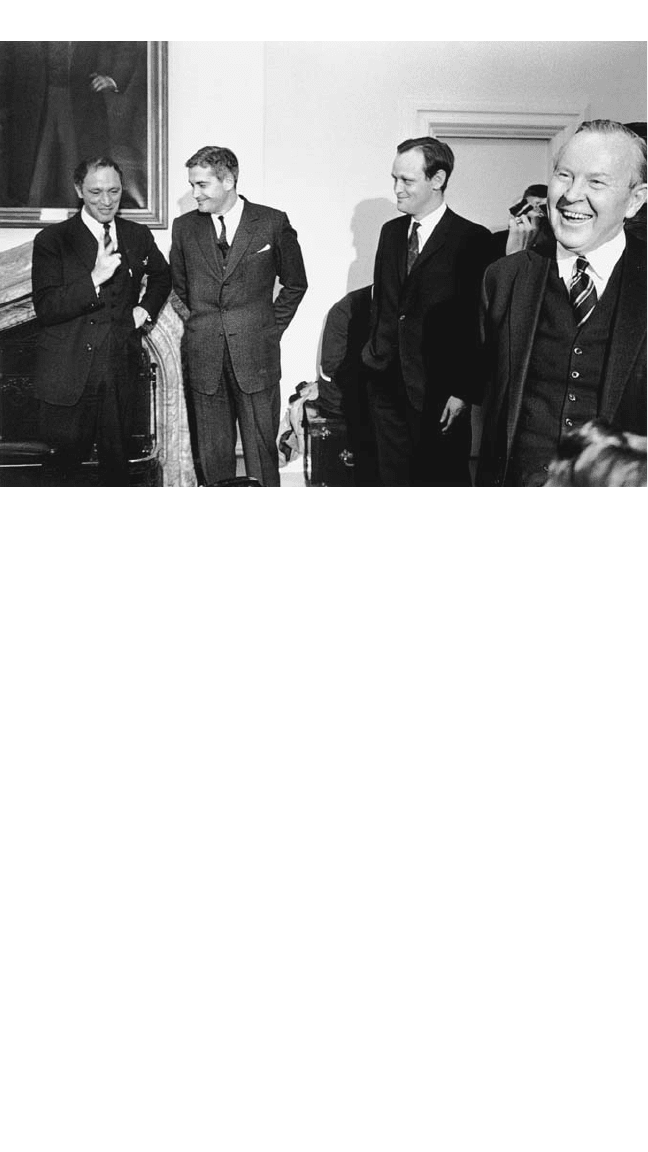
Prime Minister Lester Pearson (1897–1972) (right) meets with members of his Liberal cabinet
who will become future prime ministers (left to right): Pierre Trudeau (1919–2000), John Turner
(1929– ), and Jean Chrétien (1934– ). Trudeau went on to serve as prime minister for
more than 15 years, longer than any other French-Canadian and the third-longest tenure in
Canadian political history, behind King and Macdonald.
(Duncan Cameron/Library and Archives
Canada/PA-117107)
THE SEARCH FOR NATIONAL UNITY

A BRIEF HISTORY OF CANADA
332
prior to these regulations almost 90 percent of immigrants were of
European origin, by the early 1970s about half came from other regions,
including the West Indies, Africa, South America, and Asia.
To alleviate concerns that biculturalism relegated all other ethnic
groups to second-class status, Prime Minister Trudeau proclaimed in
1971: “A policy of multiculturalism within a bilingual framework com-
mends itself to the government as the most suitable means of assuring
the cultural freedom of Canadians” (Palmer 1975, 136). Canada’s cul-
tural mosaic would not only be recognized and celebrated but also sup-
ported through government grants for some of the activities of ethnic
groups. Four provinces with substantial ethnic populations—Ontario,
Manitoba, Saskatchewan, and Alberta—subsequently initiated their
own multicultural policies. As various ethnic groups competed for gov-
ernment support, critics of multiculturalism soon began to dismiss it as
an insidious scheme to buy votes.
The Trudeau government also advocated “the full, free and non-dis-
criminatory participation of the Indian people in Canadian society”
(Canada 1969, 5) in its White Paper on Indian Policy issued in 1969.
Minister of Indian Affairs Jean Chrétien called for the end of the Depart-
ment of Indian Affairs, the repeal of the Indian Act, the elimination of
reserves, and the transfer of many federal responsibilities for Indian
affairs to the provinces. Legally and administratively, Indians would
eventually become like other Canadians. The overwhelmingly critical
Native response was summed up in Harold Cardinal’s book The Unjust
Society, which referred to the White Paper as “a thinly-disguised pro-
gramme of extermination through assimilation” (Cardinal 1969, 140).
Despite imposing a form of colonialism, the Indian Act at least recog-
nized the special constitutional status of the Native peoples, without
which they would be absorbed into mainstream Canadian society.
Responding to sustained Native pressure, the government retracted the
White Paper proposals in 1971. Inadvertently, the White Paper along
with the Trudeau government’s refusal to negotiate Native land claims
for the approximately one-half of the country that was not already under
treaty sparked a dramatic increase in the scope and intensity of political
organization and activism among Canada’s Native peoples. From 1968
to 1971, four organizations in particular emerged to strengthen the
resolve of Native peoples to defi ne their own destiny: the National
Indian Brotherhood (reorganized in 1981 as the Assembly of First
Nations); the Canadian Métis Society (renamed the Native Council of
Canada in 1970); the Indian Brotherhood of the Northwest Territories
(renamed Dene Nation in 1978); and the Inuit Tapirisat of Canada.

333
Women were also emerging as an organized political force and as
major economic contributors, as reported by the Royal Commission on
the Status of Women in 1970. Chaired by former CBC news commenta-
tor Florence Bird, the commission presented 167 recommendations on
such matters as employment equity, educational opportunities, and
family law, including the decriminalization of abortion. The commis-
sion reported that after World War II an increasing number of women
pursued a career after marriage or returned to work after raising their
children, despite social pressure to surrender their jobs to returning
servicemen or to remain occupied in the home. By 1970 married
women accounted for more than one-third of the labor force (as com-
pared to one-quarter in 1951), but they were concentrated in white-col-
lar jobs at the lower end of the pay scale. Although some improvements
were being made, women were still underrepresented in professional
and managerial occupations, political institutions, and higher educa-
tion, in addition to being subject to a range of discriminatory policies
in both the private and public sector. The Trudeau government
responded immediately by creating new offi ces and procedures to deal
with women’s rights, including a portfolio for the status of women in
the federal Cabinet, and by amending federal statutes to remove sec-
tions that were discriminatory to women, notably the Canada Labour
Code. Nevertheless, dissatisfaction with government progress in imple-
menting the commission’s recommendations led to the formation in
1971 of the National Action Committee on the Status of Women, which
went on to become the largest umbrella organization of women’s
groups in Canada (Prentice 1996).
The “just society” was greatly concerned with the problems of pov-
erty and deprivation. The federal government devised a more system-
atic and integrated approach to the problem of regional economic
disparities with the establishment of the Department of Regional Eco-
nomic Expansion (DREE) in 1969. The chief purpose of DREE was to
help create employment opportunities by providing either grants to
individual fi rms willing to invest in new or expanded manufacturing
plants or support for the development of local infrastructure as well as
social facilities and services. To provide “individual development cou-
pled with adequate income support,” the Trudeau government in 1971
introduced a new unemployment insurance scheme that substantially
expanded both eligibility for benefi ts and levels of support. In effect,
unemployment insurance was integrated into the welfare system inas-
much as it became a regular means of income support in the poorer
areas of the Atlantic Provinces and Quebec. For all its good intentions,
THE SEARCH FOR NATIONAL UNITY

A BRIEF HISTORY OF CANADA
334
this scheme would be constantly criticized for its steadily rising cost
and its negative effects on work incentive (Bothwell, Drummond, and
English 1989).
By the early 1970s, Canadians were becoming more conscious of the
adverse effects of dynamic urban and industrial development on their
physical environment. Although concerns about the “greenhouse
effect,” the depletion of the ozone layer, the pollution of air and water,
the destruction of the tropical rain forests, the management of rapidly
accumulating disposable waste, the hazards of acid rain, and the con-
servation of natural resources and wilderness areas were largely global
in scope, Canadians demanded that their federal, provincial, and local
governments be more responsive to environmental protection. Accord-
ingly, the Trudeau administration established the Department of the
Environment in 1971, and two years later, the Federal Environmental
Assessment Review Offi ce (FEARO) was formed to monitor the bio-
physical and social impact of major projects on environmental quality
in Canada. Within a few years, all of the provinces had established their
own departments of the environment and had implemented environ-
mental protection and assessment legislation. Although Canadians
would continually debate the adequacy of government responses to
environmental issues, the ecological health and well-being of the nation
became fi rmly embedded in the public agenda.
The wave of Trudeaumania and the enthusiasm for the just society
that had launched Trudeau into power in 1968 subsided considerably by
the time he sought reelection in 1972. The minute margin of victory
suggested that many Canadians disagreed with the Liberal campaign
slogan “The Land Is Strong.” Trudeau had to account for a faltering
economy, this time characterized by a unique concurrence of rising
unemployment and infl ation, which economists dubbed “stagfl ation”
(stagnation/infl ation). That Trudeau did not give this problem the atten-
tion that many voters thought it deserved was widely interpreted as
further evidence of his growing arrogance and remoteness. Western
Canada, where enthusiasm for Trudeaumania ranged from lukewarm to
skeptical in 1968, felt thoroughly alienated four years later. Prairie farm-
ers believed that the Liberal government lacked appreciation for wheat-
growing, the family farm, and rail transportation. They agreed with
others in English Canada that Trudeau had been too preoccupied with
bilingualism and rising Quebec nationalism. The Liberals lost almost all
of their support in the West and a signifi cant amount in Ontario, mainly
to the Conservatives and, to a lesser extent, the NDP. Under the leader-
ship of David Lewis, the NDP launched an effective attack on “corporate

335
welfare bums,” benefi ciaries of the government’s policy of granting gen-
erous tax concessions to large corporations. The resulting 31 seats not
only represented a high-water mark for the NDP or CCF at the federal
level but also gave the labor-socialist alliance the balance of power in
Parliament. In the fi nal analysis, the land was not as strong as Trudeau
believed because he did not fully appreciate the powerful forces of cul-
tural and regional division that were reasserting themselves.
The Quiet Revolution in Quebec
The dramatic transformation of Quebec politics and society during the
1960s and 1970s provided the most serious challenge to national unity
(Linteau, Durocher, and Robert 1991). The fl oodgates of change broke
open shortly after the death of Premier Maurice Duplessis in 1959. For
the previous 15 years, Duplessis and his Union Nationale party had
governed Quebec as a feudal lord rules over his fi efdom. While the
province experienced accelerated urban and industrial growth compa-
rable to neighboring Ontario or the eastern United States, Duplessis
implemented social and economic policies that either reinforced tradi-
tional values or were unresponsive to the modern realities of Quebec
life. His administration became notorious for its political and electoral
corruption that helped Union Nationale maintain its grip on power.
Duplessis also refused to revise an outdated electoral distribution sys-
tem that blatantly favored rural over urban areas. Whereas some urban
ridings had upwards of 100,000 voters, many rural ridings, which
tended to vote Union Nationale, had fewer than 10,000 voters.
Furthermore, Duplessis was reluctant to extend education and social
services out of a concern that they would undermine the role of the
Catholic Church. Instead, he preferred to subsidize church-sponsored
schools and social agencies in order to maintain the support of the
Catholic hierarchy. The provincial government consistently refused to
accept federal assistance to fi nance education and social programs on
the grounds that it was an infringement on provincial rights and auton-
omy. Economic development strategy focused on inviting foreign capi-
tal to exploit the enormous natural resources of the province. Labor
unions and legislation to improve working conditions and to protect
worker rights were suppressed, often to placate foreign investors. Labor
unions, social activists, and other critics of the Duplessis government
tended to be branded and persecuted as communists.
By the 1950s growing opposition to the conservatism of Duplessis
was led by a new French-Canadian middle class linked to the practical
THE SEARCH FOR NATIONAL UNITY

A BRIEF HISTORY OF CANADA
336
and social sciences as well as to business and administration. Pierre
Trudeau was among these “radical” liberal critics of the Duplessis
regime who demanded more state intervention to provide better educa-
tional opportunities, more housing facilities, improved health care,
higher welfare benefi ts, and equitable labor laws. As the traditional par-
ish organization disintegrated under the impact of urbanization and
industrialization, it was no longer practical to expect the church to
fulfi ll fundamental socioeconomic needs. Only the state had the
resources and capacity to undertake the complete modernization of
Quebec (McRoberts 1999; Mann 2002). Without the dynamic leader-
ship of Duplessis, Union Nationale proved powerless to resist the forces
of change, and the victory of the Liberals under Jean Lesage in the pro-
vincial election of 1960 ushered in an era of political, social, and eco-
nomic reform that became known as the Quiet Revolution (la Révolution
tranquille).
The new Lesage administration was determined to enhance the
province’s capacity to control its own economic development. Most of
Quebec’s industry was controlled by English-speaking Canadians or
Americans, and the province was not well-endowed with private
investment capital or entrepreneurial initiative. In an effort to reverse
this tendency, Minister of Natural Resources René Lévesque persuaded
Lesage to nationalize private electricity companies and to merge them
with the Crown corporation Hydro Quebec. This giant corporation
standardized hydro rates across the province, coordinated investments
in this key energy sector, integrated the electrical system, stimulated
industrial development, and inspired greater French-Canadian enter-
prise. Another success story was the creation in 1965 of the Caisse de
dépot et placement du Québec, which successfully administered the
Quebec Pension Plan and went on to become one of the largest fi nan-
cial institutions in North America. The Lesage government also estab-
lished the Société générale de fi nancement to assist small companies
experiencing fi nancial diffi culty. Maîtres chez nous (masters of our
own house) was the prevailing philosophy behind government initia-
tives to promote a more dynamic French participation in the Quebec
economy.
In 1961 the average French Canadian annually earned about 40 per-
cent less than his English-speaking counterpart in Quebec. To help
bridge this gap and to promote economic progress necessitated reform
of the province’s archaic education system, which was severely strained
by the baby-boom generation reaching adolescence. The Lesage admin-
istration, therefore, appointed the Royal Commission of Enquiry on

337
Education in the Province of Quebec, which recommended a sweeping
program of reform in 1962 designed to assert state control over a sector
in which the Catholic Church had played a powerful role and to equip
the youth of Quebec with the knowledge and skills demanded by the
modern occupations. The secularization of Quebec education was high-
lighted by the establishment of the fi rst provincial Department of Edu-
cation in 1964, almost nine decades after neighboring Ontario had
done so. The new department undertook to create and supervise a com-
prehensive system of primary and secondary education that was acces-
sible to the entire population and to overhaul the school curriculum.
The traditional focus on the humanities subjects as preparation for the
medical and legal professions or the clergy gave way to greater empha-
sis on a wide range of scientifi c, technical, and commercial studies. By
the end of the decade, Quebec’s universities and colleges were produc-
ing their share of economists, managers, engineers, scientists, and other
skilled professionals for industry and commerce.
In the social sphere, the government invested heavily in the fi eld of
health care, including participation in the federal-provincial hospital
insurance program, and inaugurated the Quebec Pension Plan in 1965.
To improve labor relations, the government revised the labor code and
gave most public-sector workers the right to strike. Political reforms
included measures to curb political patronage and electoral corruption,
changes to the electoral map to provide better representation for urban
areas, and the reorganization of municipal government to promote fi s-
cal stability.
The philosophy of maîtres chez nous applied not only to economic
development but also to Quebec’s relations with the federal govern-
ment. After creating a Department of Federal-Provincial Affairs with
himself as minister, Lesage forced the federal government to accept
Quebec’s withdrawal from several cost-sharing programs and to com-
pensate the province for them. Unlike Duplessis, who rejected federal-
provincial programs as an intrusion on provincial rights, Lesage
demanded greater provincial control in the provision of these pro-
grams. In his struggles with the federal government, Lesage was seek-
ing not only a further extension of provincial rights but also more
money. Indeed, reform proved to be costly as the Quebec budget nearly
tripled between 1960 and 1966. Insisting that the federal government
was fi nancially starving the provinces, Lesage demanded that more of
the tax revenue that it collected should be handed over to Quebec.
These federal-provincial quarrels raised the question of the place of
Quebec and French Canadians in the Confederation.
THE SEARCH FOR NATIONAL UNITY

A BRIEF HISTORY OF CANADA
338
Although the Liberal reforms were long overdue, many rural and
small-town Québécois in particular found them to be too expensive and
too much too soon. In the provincial election of 1966, the Union Natio-
nale under Daniel Johnson won a majority of seats despite a signifi cantly
lower popular vote than the Liberals. To the disappointment of Quebec
conservatives, Johnson did not signifi cantly alter the Liberal reforms. In
fact, he demanded even greater provincial autonomy based on linguistic
equality of Canada’s two major ethnic communities or “nations”—“mas-
ter of our destiny in Quebec and equal partners in running the affairs of
the country.” Accordingly, Johnson argued for constitutional reform
that would involve a redistribution of intergovernmental powers and
responsibilities to recognize Quebec as an “associate state.” When Prime
Minister Trudeau asserted in 1968 that he would pursue linguistic
equality without any reduction to federal authority, the battle lines
began to be drawn between the forces of Quebec sovereignty and cen-
tralized federalism (Linteau, Durocher, and Robert 1991).
The question of sovereignty appeared peripheral to the nationalist
aspirations of Quebec through most of the 1960s. Since 1963 the Front
de libération du Québec (FLQ), a revolutionary fringe group dedicated
to the establishment of an independent and socialist Quebec, had been
involved in petty criminal and terrorist activity that did not generate
signifi cant popular support. French President Charles de Gaulle seemed
to lend support to the cause of independence with his notorious cry of
Vive le Québec libre during the Expo 67 celebration in Montreal. The
sovereignty movement gained more political credibility in 1968 when
the widely respected journalist and former Liberal cabinet minister
René Lévesque formed the Parti Québécois (PQ), a union of two “sepa-
ratist” movements that had previously enjoyed limited albeit enthusias-
tic support. In the provincial election of 1970, the PQ or Péquistes, as
they were commonly known, secured almost one-quarter of the popu-
lar vote but only seven seats in the legislature.
The noteworthy support for the PQ in its inaugural election, how-
ever, was overshadowed by the infamous October Crisis of 1970.
Within a span of fi ve days, rival groups of FLQ members kidnapped
James Cross, a British trade representative, and Pierre Laporte, a cabi-
net minister in the recently elected Liberal government. When Laporte
was subsequently found murdered, Premier Robert Bourassa requested
the assistance of the Canadian Armed Forces to supplement the Quebec
police. Prime Minister Trudeau responded by invoking the War Mea-
sures Act, which gave the federal government emergency powers to
deal with a declared state of “apprehended insurrection.” Under this
339
unprecedented peace-time use of the War Measures Act, the FLQ was
banned, normal civil liberties were suspended, and about 500 people
were detained and arrested on the mere suspicion of being sympathetic
to the terrorists (all were later released without being charged). Cross
was returned safely, and the crisis passed within three months, but
controversy lingered. While the federal response received overwhelm-
ing public support outside of Quebec, French-Canadian nationalists
and civil libertarians throughout Canada were highly critical of such an
extreme measure being adopted for supposedly political purposes in a
liberal democracy (Bothwell, Drummond, and English 1989).
Despite the criticism, neither Trudeau nor Bourassa appeared to suf-
fer politically for their response to the October Crisis. Trudeau retained
his strong support in Quebec, which enabled him to survive the federal
election of 1972. Bourassa’s Liberals swept the provincial election of
1973, winning 102 seats, while the Union Nationale was reduced to
two seats and political oblivion. The PQ managed to increase its popu-
lar vote to slightly over 30 percent, yet won only six seats. For the
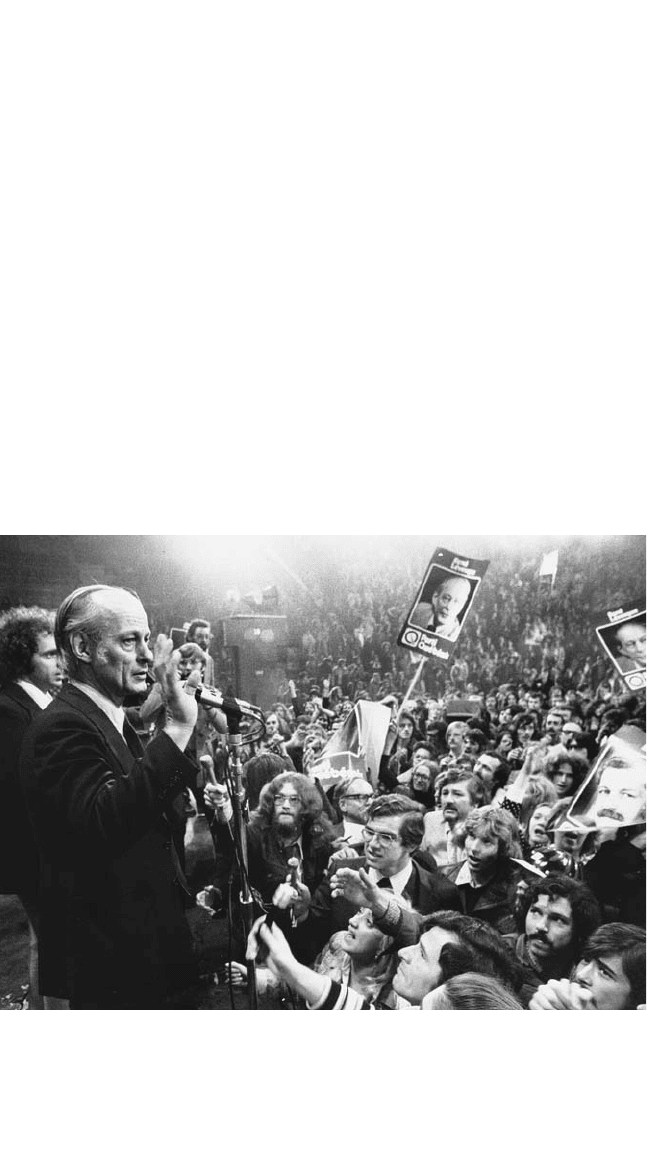
A former journalist and Quebec Liberal Cabinet Minister, René Levesque (1922–87) founded
the separatist Parti Québécois in 1968 and shocked English Canada with his election victory in
1976. His concept of sovereignty association continues to threaten national unity three decades
later.
(Duncan Cameron/Library and Archives Canada/PA-115039)
THE SEARCH FOR NATIONAL UNITY