
Riendeau A Roger E. Brief History of Canada
Подождите немного. Документ загружается.


A BRIEF HISTORY OF CANADA
340
moment, the rest of Canada could breathe a sigh of relief, as the “safe”
Liberals appeared well entrenched and the cause of separatism or sov-
ereignty seemed to be languishing.
Nevertheless, the persistence of Quebec nationalism arising from the
Quiet Revolution represented a major obstacle to the quest for national
unity. In retrospect, the 1960s marked the pinnacle of Canadian opti-
mism and confi dence that this goal was fully achievable. The centennial
celebration in 1967 was an occasion to refl ect upon signifi cant histori-
cal accomplishments, which inspired a sense of national pride and hope
for even greater prosperity and unity. By electing Pierre Trudeau to lead
the nation into its second century, Canadians expected to move beyond
the stifl ing political confl icts of minority government and regionalism
to forge a new consensus that would represent the modernity and
diversity of their evolving society. When Trudeau’s vision of the “just
society” failed to meet their expectations, voters accorded him the same
fate as they had John Diefenbaker a decade earlier. Trudeau, however,
would prove to be more opportunistic in responding to a second
chance.

341
19
CONFLICT AND
CONFRONTATION IN THE
AGE OF ANXIETy
(1972–1984)
F
rom the early 1970s to the mid-1980s, Canadians worried more
about the economy than they had at any time since the Great
Depression of the 1930s. Stagfl ation marked by the simultaneous occur-
rence of high rates of unemployment and infl ation slowed down eco-
nomic and population growth, which in turn intensifi ed confl ict among
regions, levels of government, and social classes. Although much of
Canada’s economic diffi culties were related to the troubled state of
world affairs, Canadians expected, in part because they were promised,
decisive action on the part of their federal and provincial governments,
which were all too ready to blame each other for the nation’s ills. The
lightning rod for popular discontent was Pierre Trudeau, who adeptly
took advantage of national anxieties over economic uncertainty, west-
ern alienation, and the Quebec sovereignty threat to maintain his domi-
nance over Canadian political life.
The Uncertainty of Stagfl ation
Although they continued to enjoy an enviable standard of living during
the 1970s and early 1980s, Canadians became increasingly concerned,
at times obsessed, about their economic prospects. Much of this eco-
nomic anxiety was related to the high expectations of a postwar gen-
eration, perceiving that the country was not maintaining a growth rate
to which it had become accustomed. For example, the rise in Canada’s
population from 21.6 million in 1971 to 24.3 million in 1981 repre-
sented only about a 12 percent increase, as compared to 30 percent
between 1951 and 1961 and 18 percent between 1961 and 1971. This

A BRIEF HISTORY OF CANADA
342
slower rate of population growth was largely the result of a steadily
declining birthrate. From the peak levels reached at the end of the
1950s, the annual birthrate dropped by almost half and the number of
births by about one-third by the early 1970s. Canadians were marrying
at a later age and were waiting longer to have children, mainly because
women were entering the workforce in greater numbers and had access
to better contraceptive measures. Consequently, the postbaby-boom
generation (those born after 1965) became known as the “baby bust”
(Norrie and Owram 2002).
However, Canada continued to be a magnet for immigrants, particu-
larly from less-developed or Third World countries. Approximately 1.4
million immigrants arrived in Canada during the 1970s, about the same
number as during the 1960s. Concerned about the country’s economic
capacity to continue to accommodate high levels of immigration, the
federal government produced a Green Paper on Immigration Policy in
1975 as a prelude to the adoption of a new Immigration Act. For the
fi rst time, the fundamental objectives of Canadian immigration policy
were specifi ed. These objectives included the promotion of Canada’s
demographic, economic, social, and cultural goals; family reunion;
nondiscrimination; the fulfi llment of Canada’s international obligations
in relation to refugees; and cooperation between all levels of govern-
ment in assisting newcomers to adapt to Canadian society. To achieve
better control over the continuing infl ux of immigrants, the govern-
ment also introduced annual admission ceilings based on one- to three-
year projections of desired immigration levels. By the early 1980s, the
annual immigration ceiling was set at 125,000 while, in fact, the num-
ber of newcomers reaching Canada was less than 100,000. Among the
main determinants of immigration intake was the availability of
employment opportunities.
Indeed, the threat or reality of unemployment remained at the fore-
front of public anxiety about the economy during the 1970s and early
1980s. In the quarter-century after World War II, Canadians had
become accustomed to annual average rates of unemployment that
fl uctuated from 3 percent to 5 percent of the labor force, except during
the recession of the late 1950s and early 1960s when the average rate
fl uctuated from 5 percent to 7 percent. After 1970, however, the
national unemployment rate seldom dipped below 7 percent in spite of
Canada’s success in increasing total employment faster than any other
major industrial nation. Of course, cyclical recessions in the early
1970s and 1980s raised the usual but unfounded fear of a return to the
conditions of the 1930s. While the national unemployment rate did

343
approach 13 percent in December 1982, the highest recorded level
since the Great Depression, the duration of the crisis was short-lived,
and its impact was moderated by substantial government assistance to
the unemployed. Aside from the cyclical downturns, unemployment
levels tended to be higher than expected largely because of the rapid
growth of the labor force that had to absorb the postwar baby-boom
population and a greater number of women.
Furthermore, the Canadian economy had undergone substantial
structural changes since the 1960s. By 1980 half of Canadian workers
were employed in the service sector, including government, schools,
hospitals, the retail trade, fi nancial institutions, and the communica-
tions industry; three out of 10 were employed in manufacturing, con-
struction, and transportation; one out of 20 worked in agriculture; and
one in 50 was employed in forestry, mining, fi shing, or trapping. This
complete reversal of the Canadian economy from the time of Confed-
eration meant that many workers faced painful adjustments that occa-
sionally resulted in unemployment. A worker’s prospects could also be
adversely affected by the profound regional inequalities in Canadian
development, notably in the Maritimes and the northern frontiers. In
the fi nal analysis, Canadians in the 1970s and early 1980s felt no
greater sense of job insecurity than had their predecessors, but as crea-
tures of the affl uent society, they tended to be less tolerant of economic
uncertainty.
The threshold of economic insecurity was no doubt heightened by
chronic infl ation. In the postwar years, the annual rate of infl ation in
Canada remained relatively stable at an average of about 2 percent until
the mid-1960s. In the wake of the Vietnam War as well as rising con-
sumer demand and wage settlements, prices generally rose by 4 percent
or 5 percent annually until 1972. The cost of living jumped to 9 percent
in 1973 as crop failures in several countries drove food prices up by 17
percent, while the international cartel known as the Organization of
Petroleum Exporting Countries (OPEC) quadrupled the world price of
oil. In 1979 OPEC again raised the price of oil to more than 10 times
the pre–1973 levels. Such a steep rise in the price of one of the key
commodities of an industrialized and motorized society had the effect
of making double-digit infl ation a fact of life. The annual infl ation rate
reached a postwar high of 12.5 percent in 1981 before gradually begin-
ning to subside.
Although it was a worldwide phenomenon, the infl ationary spiral
was also aggravated by the responses of business, labor, and govern-
ment (Bothwell, Drummond, and En glish 1989). Some businesses took
CONFLICT AND CONFRONTATION IN THE AGE OF ANXIETY

A BRIEF HISTORY OF CANADA
344
advantage of the expectation of higher prices to increase their profi ts,
while unions demanded higher wages to meet the escalating cost of liv-
ing. In both cases, the consumer had to bear the consequent costs, and
the diminished purchasing power often resulted in reduced demand for
goods and services, which in turn contributed to layoffs and prolonged
unemployment. Under popular pressure to take decisive action, the
federal government with the cooperation of the provinces attempted
with limited success to “wrestle infl ation to the ground,” in Prime Min-
ister Trudeau’s words, through an elaborate scheme of price and wage
controls from 1975 to 1978. The Bank of Canada’s decision to fi ght
infl ation by reducing the rate of growth in the money supply in 1975
resulted in a sharp rise in interest rates, which reached 20 percent in
1981, about four times higher than they had been 15 years earlier.
Indeed, confused by the dilemma of which enemy to attack, unemploy-
ment or infl ation, the federal government adopted a contradictory
series of expansionary and restrictive fi scal and monetary policies.
Combating unemployment required higher levels of the government
expenditure, which had the infl ationary effects of driving up budget
defi cits and interest rates. To fi ght infl ation meant cutting government
expenditures, which had the depressing effects of increasing unemploy-
ment and public assistance payments while lowering tax revenues.
Rather than raise taxes or reduce expenditures, the federal government
resorted to borrowing more at historically high rates of interest, thereby
prolonging infl ation with massive budget defi cits. In the end, govern-
ment seemed powerless to respond effectively to workers who had lost
or feared the loss of their jobs, farmers or businesses facing bankruptcy,
and homeowners unable to renew their mortgages. The ineffective gov-
ernment responses to economic problems further alienated the postwar
generation, which had come to expect that politicians would fulfi ll
their promises and grandiose visions.
Deciding that a plurality, however small, entitled him to form a gov-
ernment after the election of 1972, Prime Minister Trudeau proceeded
strategically to cultivate the parliamentary support of the NDP and
Créditistes and ultimately to win back voter support. To appease the
NDP, the government greatly expanded public spending on social pro-
grams, including higher old-age pension and family allowance benefi ts
in 1973. Appealing to economic nationalists among both the Liberals
and the NDP, the Trudeau administration established the Foreign
Investment Review Agency (FIRA) in 1974. FIRA was empowered to
screen most takeovers and transfers of ownership to foreign interests or
among them, to oversee direct foreign investment in new enterprises,
345
and to monitor foreign expansion into any new and unrelated areas of
business in order to determine whether they were of “signifi cant ben-
efi t” to Canada. Although it immediately satisfi ed NDP demands, FIRA
over the years would inspire more criticism from economic nationalists
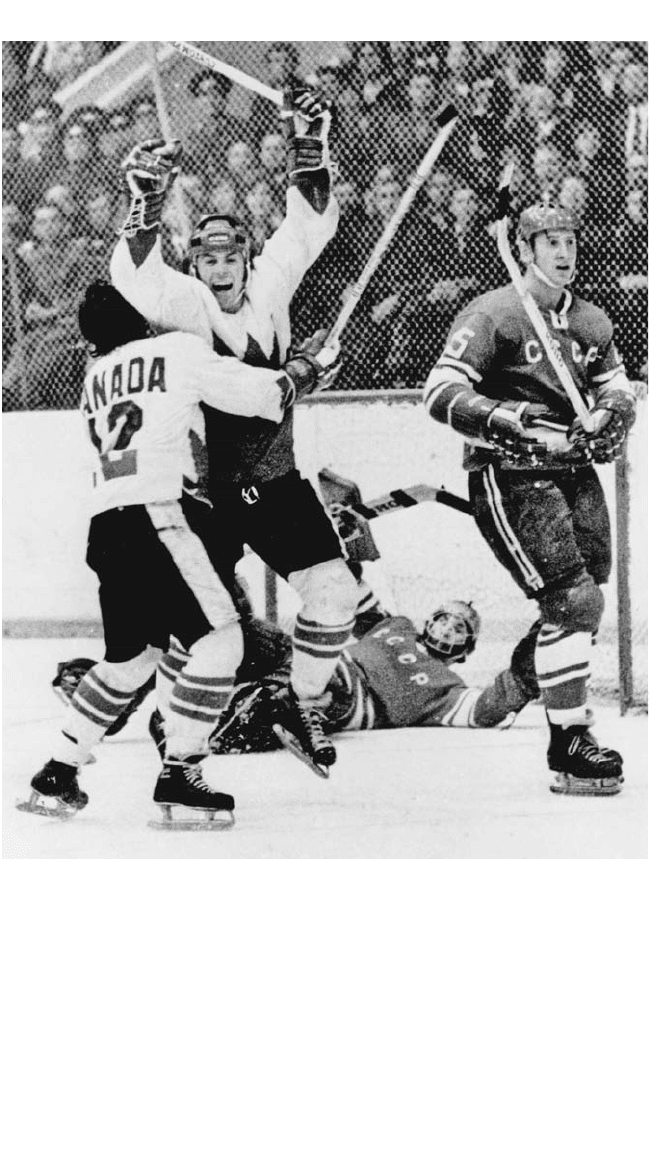
Paul Henderson celebrates with Yvan Cournoyer after scoring a dramatic last-minute winning
goal to reaffi rm Canadian hockey supremacy against the Soviet Union in 1972. Political
analysts even credit the euphoria generated by Canada’s hockey triumph with saving the
Trudeau government from electoral defeat a few days later.
(Toronto Star/Frank Lennon)
CONFLICT AND CONFRONTATION IN THE AGE OF ANXIETY

A BRIEF HISTORY OF CANADA
346
than from foreign investors. To win support in central Canada, the
government promised to keep rapidly increasing oil prices substantially
below world levels by developing a national energy policy based on the
exploitation of the huge Athabaska tar sands deposits in northern
Alberta, the creation of a national oil company, and the construction of
a natural gas pipeline up the Mackenzie River valley in the Northwest
Territories. The goal of the national energy policy was Canadian self-
suffi ciency in oil by the end of the 1970s.
The Liberals’ uneasy partnership with the NDP ended in 1974 with
the defeat of the government budget on a parliamentary motion of non-
confi dence. The subsequent election campaign focused on the Conser-
vatives’ promise of wage and price controls to fi ght infl ation. A
relentless attack on Robert Stanfi eld’s ill-conceived scheme resulted in
the Liberals regaining a parliamentary majority. That the Liberals won
only fi ve out of 45 seats in the Prairie Provinces, however, did not bode
well for the challenges that were forthcoming.
After ridiculing the Conservative scheme of wage and price controls,
the Trudeau administration adopted a policy of voluntary wage
restraint. Organized labor was in no mood to cooperate, arguing that
wage settlements had lagged behind infl ation and corporate profi ts in
recent years, and thus substantial raises were in order. In addition to
infl ationary pressures, labor militancy was spurred on by the doubling
of union membership since the mid-1960s. More than 37 percent of
nonagricultural workers were members of unions by the mid-1970s,
compared to about 30 percent a decade earlier. Most of the newly orga-
nized unions were white-collar and service workers, especially those in
the public sector, where the newly won right to strike led to highly
unpopular work stoppages. For example, postal workers, air traffi c
controllers, and teachers demanded wage increases that ranged from 20
percent to 80 percent. Such pay demands would invariably lead to
higher taxes in the public sector and higher prices in the private sector,
thereby fueling the infl ation that had precipitated the wage claims in
the fi rst place.
Under pressure from business and industry, which maintained that
high wage demands undermined the competitiveness of Canadian
products in the American market, and from the majority of workers
who were unorganized and thus did not receive increases that kept up
with the rising cost of living, the Trudeau government felt compelled
to reverse its policy in 1975. The Anti-Infl ation Board (AIB) was estab-
lished with the authority not only to roll back excessive prices and
wages but also to control the profi ts and dividends of larger fi rms. The

347
effectiveness of the AIB controls proved to be inconclusive and the
bureaucratic costs associated with this extraordinary state planning of
the economy convinced the business community to join labor in urging
an end to the unpopular program in 1978 (Norrie and Owram 2002).
Western Alienation and the New Energy Frontier
Meanwhile, the Trudeau administration proceeded with its promised
national energy policy designed to shelter Canadians from the impact
of world oil-price increases. A Crown corporation known as Petro-
Canada (also referred to as Petrocan) began operation in 1975 to
engage in energy research and development, to acquire imported oil
supplies, and to explore and develop alternative sources of petroleum
such as the Athabaska tar sands. The construction of a pipeline to carry
gas from the Mackenzie Delta to southern Canada was postponed in
1974 pending Justice Thomas Berger’s inquiry into the impact of the
project on the northern Yukon and the Mackenzie Valley. His 1977
report, Northern Frontier, Northern Homeland, concluded that while a
pipeline from the Mackenzie Delta down the Mackenzie Valley to
Alberta was feasible, it would cause irreparable damage to the delicate
environment of the region and thus would have an adverse impact on
the Native population. Accordingly, the Berger Report recommended
against the construction of a pipeline across the northern Yukon and
urged a 10-year delay in the development of the Mackenzie Valley pipe-
line. In the early 1980s, a pipeline was built only halfway up the valley
to Norman Wells.
The Berger Report called on Canadian governments to settle Native
land claims before proceeding with northern resource development.
The report specifi cally advanced the growing Native rights movement
by eloquently depicting the North as a distinct homeland for the Native
people rather than merely a resource frontier for southern Canada, and
by setting the precedent that the Native people should be consulted on
major resource development plans. The federal government had already
begun to accept the legitimacy of claims to aboriginal rights in the wake
of a Supreme Court ruling on the Nishga land claim in northern British
Columbia in 1973. Signifi cant agreements on land claims were reached
with the Inuit and Cree in northern Quebec in 1975 to open the way
for the development of Hydro Quebec’s James Bay project and with the
Inuit in the Northwest Territories and Labrador.
Progress was also made on claims to aboriginal nationhood, which
began in the early 1970s. The Dene people of the western Northwest
CONFLICT AND CONFRONTATION IN THE AGE OF ANXIETY

A BRIEF HISTORY OF CANADA
348
Territories laid claim to their substantial holdings and declared their
right to self-determination in 1975. The following year, the Inuit Tapir-
isat of Canada proposed the creation of Nunavut (meaning “our land”)
as a distinct region in the central and eastern Northwest Territories,
where the Inuit comprise the majority of the population. The new juris-
diction would administer justice, education, housing, land-use plan-
ning, and wildlife management. In his initial response to this proposal,
Prime Minister Trudeau insisted that special status was as much out of
the question for the aboriginal people as it was for Quebec. Neverthe-
less, the proposed division was endorsed by the Native majority in the
Legislative Assembly of the Northwest Territories in 1979 and by a ter-
ritory government plebiscite held in 1982. Later that year, the federal
government accepted the proposal in principle. The Dene and Métis
people of the western district also devised a plan to create their own
jurisdiction called Denendeh (an Athapaskan word meaning “land of
the people”). Despite this signifi cant progress, Native self-determina-
tion would remain an elusive dream (Dickason 2002).
Besides focusing attention on Native relations, the energy concerns
of the 1970s brought the federal government into deeper confl ict with
western Canada. The Prairie Provinces had become a veritable Liberal
wasteland under Trudeau’s leadership. Initially, “Trudeauphobia” was
the dominant reaction of Prairie farmers frustrated by the mounting
wheat surpluses and sagging prices on the world market. Western farm-
ers blamed Trudeau for failing to take appropriate remedial measures,
and they never forgave him for responding to them in a moment of
mutual exasperation: “Why should I sell your wheat?” The intensity of
western alienation, however, reached new heights over the issue of
national oil pricing in the wake of the dramatic OPEC increases.
Through the transcontinental pipeline system, Alberta supplied oil
to the area west of the Ottawa River, while the eastern provinces
depended on foreign sources of supply, which up to 1973 had been
cheaper than the domestic product. The initial response to the OPEC
price increases was that Canada, as a petroleum-rich country with sup-
posedly a “900-year supply,” merely needed to reduce its oil imports
and to rely on its natural resources. However, further assessment
revealed that the size of the national oil reserves had been greatly exag-
gerated. Moreover, most of the country’s reserves were located in the
West far from the largest concentration of population, or in the North
where the high cost of exploration and extraction could not provide
immediate relief from the world price increases.

349
As part of its national energy policy, the Trudeau government in
1973 devised a two-price system designed to cushion the Atlantic Prov-
inces, the economically weakest region of Canada, and Quebec, the
politically most volatile province, from the shock of OPEC increases.
To keep the domestic price of oil lower than the export price, the gov-
ernment levied an export tax on oil, the proceeds of which would help
to subsidize the prices paid by the fi ve eastern provinces. The federal
government justifi ed its policy by maintaining that oil and natural gas
reserves belonged to Canadians as a whole and that Ottawa had an
obligation to moderate increases in the domestic price on behalf of the
governments of the consuming provinces. Rejecting this argument, the
governments of the oil-producing provinces—principally Alberta but
also Saskatchewan and British Columbia—countered that the national
energy policy interfered with their constitutional right to control their
natural resources. Western energy producers felt entitled to seek the
world price for their resources, which were in great demand in the
United States. Curiously, their free market outlook contrasted with the
demand of western wheat farmers for more government support. The
western-based oil companies further argued that higher prices were
necessary to encourage aggressive exploration, new discoveries, conser-
vation of existing resources, and generally future Canadian self-suffi -
ciency. That Alberta used its rising energy revenues to expand its
Heritage Fund for investment in future industrial development infuri-
ated the poorer provinces, which would have to draw on even larger
equalization payments from the federal government to afford the higher
domestic prices.
After two years of acrimonious dispute and negotiation, the federal
government and the energy-producing provinces reached a compro-
mise pricing policy. Although the domestic price of oil would be kept
consistently below the world price, it would be adjusted upward peri-
odically to give the producing provinces higher revenues and the oil
companies suffi cient profi ts to encourage new exploration and develop-
ment. Tensions subsided over the next four years as the domestic price
rose to within 15 percent of the world price. But another upsurge of
OPEC prices in the wake of the Iranian Revolution in 1979 renewed the
federal-provincial confl icts over energy pricing in Canada and substan-
tially drove up the cost of federal oil subsidies to the eastern provinces.
By then, the Trudeau government was struggling with escalating bud-
getary defi cits and dwindling popular support, which did not bode well
for it in the upcoming federal election.
CONFLICT AND CONFRONTATION IN THE AGE OF ANXIETY