
Seybold J.S. Introduction to RF Propagation
Подождите немного. Документ загружается.


and 60 GHz). See Chapter 6 for detailed information on modeling atmospheric
losses.
The probabilistic losses must have a fade margin in the link budget and a
corresponding probability that the fade margin is exceeded. The complement
of that probability is the link availability due to that particular phenomenon.
For instance, in this example, the probability of a rain fade exceeding 15 dB is
0.1% (corresponding to the link availability of 0.999). If the rain fade does
exceed that value, it is assumed that the link will be temporarily unavailable.
The chosen probability must be within acceptable limits for the application
being considered. The allowable path loss is given by the sum (in dB) of the
free-space loss, the budgeted fade margin, and any miscellaneous losses.
For this example, the path loss is given by
4.5.3 Receiver Gain
The receiver gain is equal to the antenna gain less any radome loss, cable or
waveguide loss (receiver loss), polarization loss, and pointing loss.
An allocation for loss due to impedance mismatch between the antenna and
the receiver may also be included as a line item in this section (see Section
3.2.5 for details).
The polarization loss is due to the axial ratios of the transmit and receive
antennas and their relative orientation. The polarization loss, discussed in
Section 3.5.2, is estimated using the worst-case conditions and then treated as
a constant since it is not usually large and since it will remain fixed for a given
geometry.
For this link budget, the net receive gain is given by
The receive signal level is the EIRP minus the path loss, plus the receiver gain:
The received signal level is
RSL dBm dB dB dBm=-+=-27 135 17 91
RSL EIRP PL=-+G
RdB
G
RdB
= --- -=32 2 2 02 1 268..dB
GG L L LL
RdB RxdB RadomedB WGdB Pol Pt
=- - --
PL log dB
dB
d=-
()()
++ =20 1 4 30 0 5 135p .
PL FSL FM
dB dB dB miscdB
L=++
82 COMMUNICATION SYSTEMS AND THE LINK BUDGET

4.5.4 Link Margin
The result of a link calculation may be the expected received signal level
(RSL), the signal-to-noise ratio (SNR), the carrier-to-noise ratio (CNR), or
the bit energy to noise PSD ratio (E
b
/N
0
). If the RSL is determined, it can be
compared to the minimum detectable signal (MDS), or the system threshold.
For the link in Figure 4.4, the system threshold is subtracted from the RSL
plus the interference margin to determine the link margin.
An experienced designer can often compute a link budget that is within a frac-
tion of a dB of measured results.
The transceiver designer’s objective is to close the link for the specified dis-
tance and required availability as efficiently as possible, whereas the link
designer’s task is to use an existing transceiver to satisfy a specific communi-
cation requirement. The link designer may then trade off availability for link
distance.
4.5.5 Signal-to-Noise Ratio
If the signal-to-noise ratio is required for the link budget, it can be computed
as follows. The receiver noise is given by
For this example, the noise power is
The signal-to-noise ratio can then be computed using the RSL and the noise
floor.
If the received SNR had been specified rather than the RSL, the link margin
would be computed by subtracting the required receive SNR from the pre-
dicted SNR.
For digital communication systems, the E
b
/N
0
of the received signal is the
determining factor on signal detection and the bit error rate (BER). The
required E
b
/N
0
for a given BER is provided by the modem designer and must
be met or exceeded by the receiver designer if satisfactory performance is to
be achieved.The bit-energy-to-noise-density ratio can be determined from the
signal-to-noise ratio if the data rate and symbol rate are known. The noise
spectral density is the total noise power divided by the noise equivalent band-
SNR RSL dB
dBm dBm
=-=N 16
N
dBm
dBm=- + + =-174 60 7 93
NkTBF
NBF
dBm
dBm dB
log
dBm log
=
()
=- +
()
+
10
174 10
0
RSL TH dB+
()
-=M
INT Rx
39.
DETAILED LINK BUDGET 83
width. If the noise equivalent bandwidth is not known, but the symbol rate is,
then the noise-equivalent bandwidth can be approximated by the symbol rate,
R
s
, in symbols per second.
Noise density can then be expressed as
The energy per bit can be determined by dividing the signal power by the bit
rate*:
where R
b
is the bit rate in bits per second. Thus,
The appropriate value to use for the bit rate is sometimes a source of confu-
sion. Due to the use of digital coding, the bit rate in the channel may be higher
than the data bit rate at the baseband output of the modem. The bit rate used
in the above calculation is the actual data bit rate, not the channel bit rate.
This is because the required E
b
/N
0
for the modem is specified based on the
output data rate, which can be achieved using various channel rates by means
of different modulation and coding schemes. Therefore the link designer need
not even know what modulation or coding the modem is using.
4.6 SUMMARY
In order to characterize the expected performance of a communication system
for a given link, a link budget can be prepared, which is a complete account-
ing of the system performance and the expected channel impairments. By com-
puting the expected receive signal level and comparing it to the system
threshold, a link margin is found, which is a measure of the robustness of the
link.
The path loss section of a link budget represents the largest source of loss
in the link.As used herein, path loss refers to the free-space loss and any other
propagation impairments that affect the received signal level. In addition to
the free-space loss, the path loss section of the link budget typically includes
atmospheric losses, transmitter antenna pointing loss, and multipath. Some of
EN
S
N
B
R
b
b
0
=
ESR
bb
=
NNB
0
=
BR
s
ª
84 COMMUNICATION SYSTEMS AND THE LINK BUDGET
* The bit rate is equal to the symbol rate multiplied by the number of bits per symbol.
these losses are deterministic (based on range), whereas others such as rain
are probabilistic. For the probabilistic losses, a fade margin is included in the
link budget, which has an associated probability of not being exceeded. This
results in an availability value for that impairment being attached to the link
budget.
The receiver noise level is a function of the receiver noise figure, miscella-
neous losses in the receiver, and sometimes losses within the atmosphere. The
thermal noise in the receiver is computed using Boltzmann’s constant, the
standard noise temperature, the system noise figure, and the noise equivalent
bandwidth. Certain types of interference may also be treated as noise sources.
Most link budgets include a term to allow for some signal-to-noise degrada-
tion due to interference.
REFERENCES
1. B. Sklar, Digital Communications Fundamentals and Applications, 2nd ed., Prentice-
Hall, Upper Saddle River, NJ, 2001, pp. 286–290.
2. F. G. Stremler, Introduction to Communication Systems, 3rd ed., Addison-Wesley,
Reading, MA, 1992, pp. 188–208.
3. F. G. Stremler, Introduction to Communication Systems, 3rd ed., Addison-Wesley,
Reading, MA, 1992, p. 197.
4. J. G. Proakis and M. Salehi, Communication Systems Engineering, 2nd ed., Prentice-
Hall, Upper Saddle River, NJ, 2002, p. 190.
5. S. C. Cripps, RF Power Amplifiers for Wireless Communications, Artech House,
Norwood, MA, 1999, Chapter 7.
6. R. E. Zeimer and R. L. Peterson, Introduction to Digital Communication, 2nd ed.,
Prentice-Hall, Upper Saddle River, NJ, 2001, pp. 79–82.
7. R. E. Zeimer and R. L. Peterson, Introduction to Digital Communication, 2nd ed.,
Prentice-Hall, Upper Saddle River, NJ, 2001, pp. 155–168.
EXERCISES
1. Consider a receiver with a 4-dB noise figure and a 2-MHz bandwidth. If a
carrier-to-noise ratio of 15dB is required for acceptable BER (bit error
rate) performance, what carrier (signal) strength is required at the receiver?
At what point would this signal be measured or referenced?
2. In the preceding problem, if the transmitter at the other end of the com-
munications link is 2 km away, both the transmitter and receiver use a 4-dB
antenna, and the frequency is 800MHz, what is the minimum required
transmit power?
3. Given a receiver with a 100-kHz bandwidth and an effective noise tem-
perature of 600 K, what is the noise power level at the input to the receiver?
Give the units with your answer.
EXERCISES 85
4. Given a symmetrical line-of-sight communication link with a minimum
detectable signal of -90dBw, a transmit power of +10 dBw, antenna gain of
28 dB, and frequency of 10 GHz, mounted on a 100-ft tower, what is the
maximum communication distance (neglecting all sources of interference
or fading)?
5. Consider a point-to-point communication link operating at 38 GHz, using
35-dB dish antennas at each end. The radome loss is 2 dB at each end, and
a 10-dB fade margin is required to allow for rain fades. If the transmit power
is -10 dBm, the receiver noise figure is 7 dB, the bandwidth is 50 MHz, and
the link distance is 1.2 km, what is the signal-to-noise ratio at the receiver
in dB? Assume that free-space loss applies.
6. Consider a communication link operating at 28 GHz, using 30-dB dish
antennas at each end. A 10-dB fade margin is required to allow for rain
fades. If the transmit power is 0 dBm, the receiver noise figure is 7 dB, the
bandwidth is 50 MHz, and the required carrier-to-noise ratio for reliable
operation is 12 dB, find the following:
(a) The required received signal level.
(b) The allowable path loss.
(c) The maximum allowable range.
Assume that free-space loss applies.
86 COMMUNICATION SYSTEMS AND THE LINK BUDGET

87
Introduction to RF Propagation, by John S. Seybold
Copyright © 2005 by John Wiley & Sons, Inc.
CHAPTER 5
Radar Systems
5.1 INTRODUCTION
Radar is an acronym for radio detection and ranging. So far the subject has
been one-way communication links, with the assumption that the reverse link
is identical. While distinct from a classical communication system, radar uses
electromagnetic wave propagation and communication technology to perform
distance, angle, and/or velocity measurements on targets of interest. Early
radar was designed to detect large objects at a distance, such as aircraft or
vessels. The first radars were pulse-mode radars using crude angle measure-
ment techniques. As development continued, split antenna apertures were
used to sense the direction of the returning wavefront (monopulse radar), pro-
viding greater angular accuracy.Another key development was the use of filter
banks to detect the Doppler shift on the return signal which provided the oper-
ator with target velocity information. Modern imaging radars can also provide
information on target size and sometimes target identification by using pulse
compression and other range resolution techniques as well as synthetic aper-
ture processing. Contemporary systems also map the earth’s surface and
provide detailed weather information. A radar “target” may be an aircraft,
vehicle, vessel, weather front, or terrain feature, depending upon the applica-
tion. This chapter provides a general overview of radar operation, primarily
from the RF propagation standpoint. For a more in-depth treatment, consult
the references.
Consider the radar configuration shown in Figure 5.1, where, the trans-
mitter and receiver are co-located and share one antenna (monostatic radar)
and the received signal is a reflection from a distant object. A pulse of RF
energy is transmitted and then the receiver listens for the return, similar to
sonar. The strength of the return signal depends upon the transmitted power,
the distance to the reflecting target, and its electrical size or reflectivity.
The radar receiver determines the distance to the target by measuring the
time delay between transmission and reception of the reflected pulse. By
measuring the phase front (angle of arrival) of the returning signal, the radar
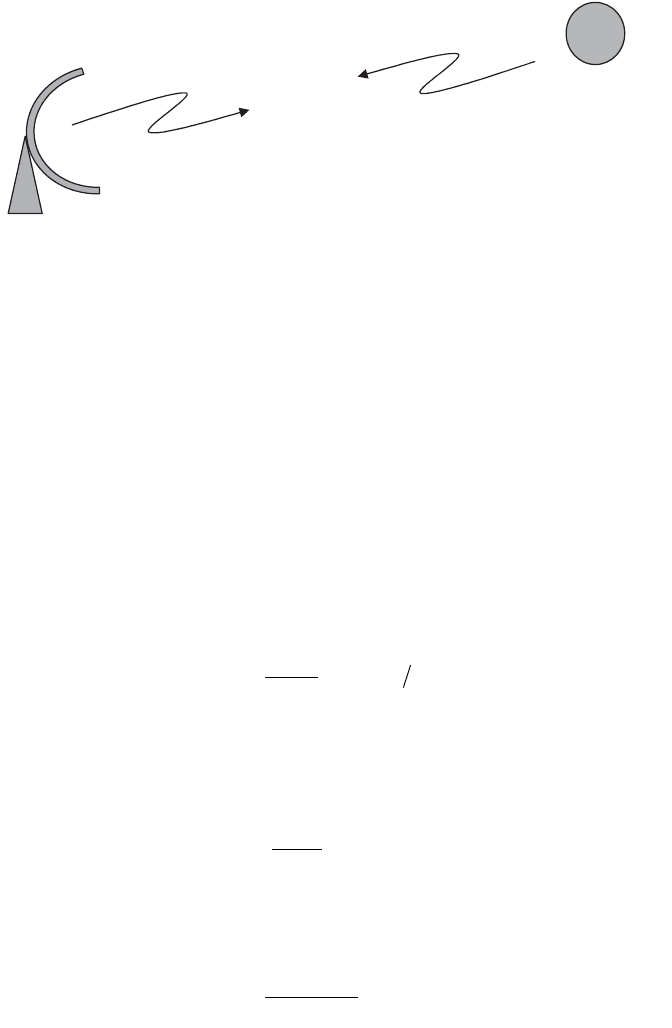
can also estimate the location of the target in azimuth and elevation within its
beamwidth.
5.2 THE RADAR RANGE EQUATION
The radar range equation is used to determine the received radar signal
strength, or signal-to-noise ratio. It can be used to estimate the maximum
distance at which a target of a given size can be detected by the radar. The
development of the radar range equation is straightforward based on the
material from the earlier chapters. The power density at a distance, d, is given
by
(5.1)
The power available at the output of an antenna in this power density field is
the product of the power density at that point and the antenna’s effective area
(also called the capture area):
(5.2)
Substituting the expression for antenna gain (3.3) yields the Friis free-space
loss equation:
(5.3)
Or the path loss can be expressed as
P
PGG
d
R
TT R
=
()
l
p
2
2
2
4
watts
P
PG
d
A
R
TT
e
=◊
4
2
p
watts
S
d
=
EIRP
4
watts m
2
p
2
88 RADAR SYSTEMS
Transmit and
receive antenna
Transmitted
signal
Reflected
signal
Reflecting target,
apparent size
Figure 5.1 Typical radar and target configuration.

(5.4)
Instead of a receive antenna effective area, in radar, the return signal strength
is determined by the radar cross section (RCS) of the “target.” The RCS is a
measure of the electrical or reflective area of a reflector. It may or may not
correlate with the physical size of the object. It is a function of the object’s
shape, composition, orientation, and possibly size. The RCS is expressed in m
2
,
or dBsm (10log(RCS in m
2
)) and the symbol for target RCS is s
t
. Since the
RCS is an intrinsic property of the target or reflector, it does not depend on
the range or distance from which it is viewed. It may, however, vary with the
frequency and the polarization of the radar wave and with the aspect angle
from which it is viewed.
When measuring the RCS of a given target, there is oftentimes debate as
to whether the average RCS should be computed by averaging the RCS in m
2
or in dBsm. Averaging in dBsm corresponds to the geometric average of the
m
2
values. Each technique has its advantages and for log-normal RCS distri-
butions, the two are mathematically related [1].
The strength of the reflected signal is determined from the power
density at the target by replacing the receive antenna capture area with the
RCS.
(5.5)
The power density back at the radar receiver from the reflected signal is
(5.6)
When multiplied by the effective area of the radar antenna, this becomes the
received power.
(5.7)
By solving (3.3) for A
e
and substituting into (5.7), the expression for the
received power can be written in terms of the antenna gains. For a monosta-
tic radar, G
T
= G
R
.
(5.8)
P
PGG
d
R
TT Rt
=
()
sl
p
2
3
4
4
watts
P
PG A
d
R
TTte
=
()
s
p4
2
4
watts
S
PG
dd
R
TTt
=◊
s
pp4
1
4
22
watts m
2
P
PG
d
refl
TT
t
=◊
4
2
p
s watts
L
P
P
GG
d
R
T
TR
==
()
l
p
2
2
4
THE RADAR RANGE EQUATION 89
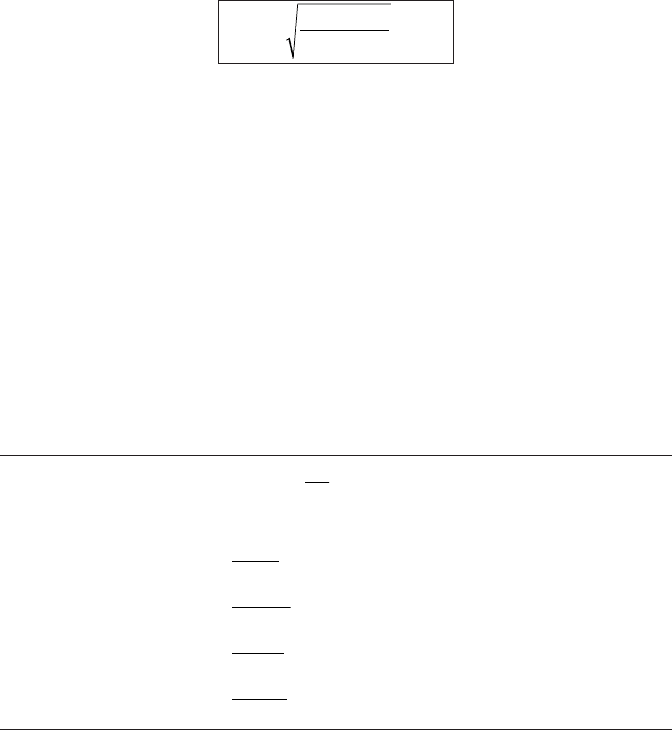
Using the minimum detectable receive power, one can solve the radar equa-
tion for d and find the maximum distance at which detection is possible. In
radar, it is customary to use R for range instead of d for distance, so
(5.9)
This is called the radar range equation. It provides an estimate of the maximum
radar detection range for a given target RCS. The maximum range is propor-
tional to the transmit power, antenna gain, and target RCS and inversely pro-
portional to the minimum required receive power and the radar frequency.
The RCS as used here is a mean or median value. It is common for the RCS
of real targets to fluctuate considerably as the target orientation and the radar-
target geometry vary. This fluctuation can considerably degrade the perform-
ance of the radar receiver. In fact, modeling of RCS fluctuations and the design
of optimal detectors for different RCS statistics is a rich field of study with
many books and articles dedicated to the subject [2–9]. Table 5.1 gives approx-
imate expressions for the RCS of several standard calibration targets as a func-
tion of dimensions and wavelength. With the exception of the sphere, even
these targets have RCS’s that vary considerably with aspect angle.
R
PG
P
Tt
R
max
min
m=
()
22
3
4
4
sl
p
90 RADAR SYSTEMS
TABLE 5.1 Maximum RCS for Some Calibration Targets from Refs. 10 and 11
Sphere: s=pr
2
if l< For larger wavelengths, the RCS is in
either the Mie or the Rayleigh region
and more complex expressions apply.
Cylinder Normal (broadside) incidence
Dihedral (diplane):
Trihedral (square):
Flat rectangular plate: Normal incidence
s
p
l
=
4
22
2
lw
s
p
l
=
12
4
2
w
s
p
l
=
8
22
2
hw
s
p
l
=
2
2
rh
r
16.
Example 5.1. Consider a radar system with the following parameters:
f = 2 GHz Transmitter frequency (l=0.15m)
P
T
= 1 W Peak transmitter power (P
T
= 0 dBW)
G
T
= G
R
= 18 dB Antenna gains
R = 2 km Range to target
B = 50 kHz Receiver bandwidth
F = 5 dB Receiver noise figure
s
t
= 1m
2
Target radar cross section

What is the SNR at the receiver?
The received signal level is
This can be computed in dBW as
The receiver noise power is N = kT
0
BF or
and the SNR is
䊐
Note that the received power is inversely proportional to R
4
, so doubling the
distance reduces the signal level by 12 dB.The round-trip path loss is not equal
to 3 dB (or 6 dB) more than the one-way path loss. It is double the one-way
loss in dB (i.e., the round-trip path loss is equal to the one-way path loss
squared).
To determine the signal-to-noise ratio at the receiver, the noise-equivalent
bandwidth of the receiver must be known. Since conventional pulse radar
works by transmitting a short RF pulse and measuring the time delay of the
return, the receiver bandwidth will be matched to the transmitted pulse. In this
case, the bandwidth of the matched filter receiver is often approximated by
1/t, where t is the pulse width (this is used as the noise-equivalent bandwidth
in noise calculations). The noise floor of the radar receiver can then be esti-
mated by applying (4.9):
The pulse width, t, also determines the range resolution of the radar. The
approximate range resolution of a radar system is given by
(5.10)
Dr
c
=
t
2
NkT F=
0
1
t
PR N dB
dBm
-=65.
N dBm Hz log dB-Hz + 5 dB
N dBm
dBm
dBm
=- +
()
=-
174 10 50 000
122
,
P
P
R
R
= +++
+
()
-
()
-
()
=- -
018180
20 0 15 30 4 40 2000
145 5 115 5
dBW dB dB dBsm
log dBsm log log dB-m
dBW or dBm
4
.
..
p
P
PGG
d
R
TT Rt
=
()
sl
p
2
3
4
4
THE RADAR RANGE EQUATION 91