
Seybold J.S. Introduction to RF Propagation
Подождите немного. Документ загружается.


specular reflection with a 180-degree phase shift. This is a worst-case analysis,
which provides a good upper bound on the predicted path loss. It is note-
worthy that this path-loss expression is independent of the wavelength.
The exact ground-bounce expression is seldom used since the geometry is
rarely precise enough to locate the peaks and nulls accurately. The recom-
mended approach is to compute the free-space loss and the approximate
ground-bounce path loss and use whichever gives greater loss.
(8.14)
The crossover point is defined as the distance at which the 1/d
4
approximation
and free-space loss are equal. It is sometimes helpful to determine where the
crossover point occurs and then use the approximation for ranges greater than
the crossover range and free-space loss otherwise.The crossover point is found
by equating the approximate ground-bounce path loss (8.13), and the free-
space loss and solving for d.
(8.15)
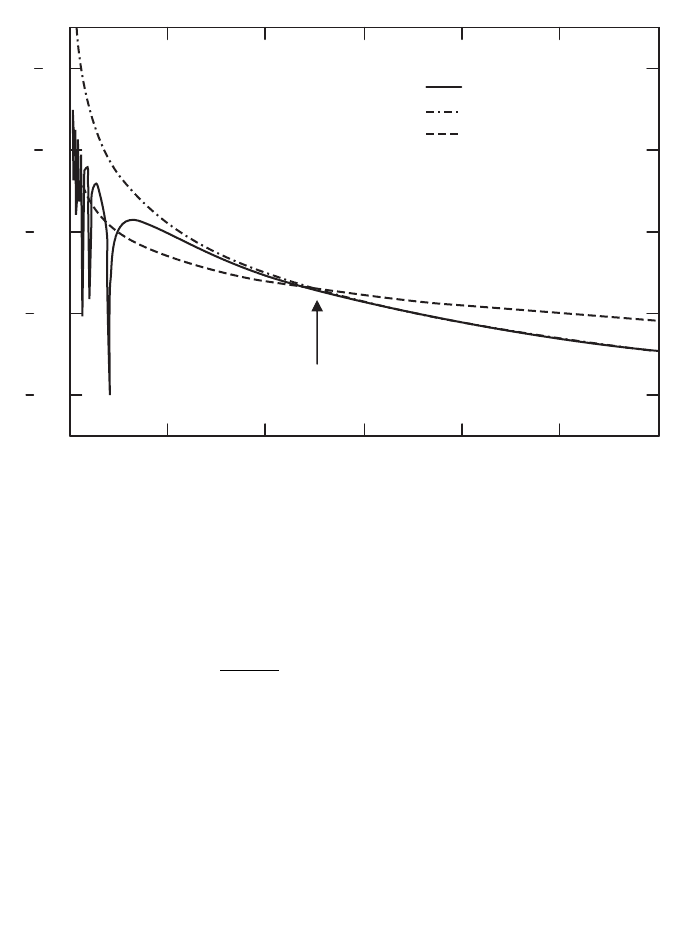
The computed crossover range for the plot in Figure 8.5 is 12.6 km, which
is consistent with the curves shown. By first computing the crossover point,
one can immediately determine which path loss expression applies to a given
situation.
Example 8.1. Consider the following point-to-point communications link:
What is the predicted path loss for this link?
Since no antenna gains are given, normalized gains (i.e., gain = 0dB) for
transmit and receive are used. The first step is to compute the free-space loss
using antenna gain values of unity:
FSL
FSL dB
=
Ê
Ë
ˆ
¯
=-
20
4
110 5
log
.
l
pd
hh
d
f
TR
==
=
==
()
10
4
2015
m
km
GHz ml .
d
hh
x
tr
=
4p
l
hh
d
d
tr
()
=
Ê
Ë
ˆ
¯
2
4
2
4
l
p
P
P
GG
hh
d
GG
d
R
T
TR
tr T R
=
()
()
Ê
Ë
Á
ˆ
¯
˜
min ,
2
4
2
2
4
l
p
172 FADING AND MULTIPATH CHARACTERIZATION
Since d >> h
t
and d >> h
r
and in fact, dl>>h
t
h
r
, the 1/d
4
approximation can
be used:
So the approximated path loss is less loss than free-space loss, and the free-
space result should be used: PL =-110.5 dB.
If instead of 4 km, d is 40 km, then
and
So in this case, the path loss from the (h
t
h
r
)
2
/d
4
approximation would be used.
䊐
In summary, when operating over a flat reflective surface, the path loss may
be more or less than that predicted by free-space loss. The 6-dB improvement
L
mp
=-144 1.dB
FSL dB=-130 5.
L
hh
d
mp
tr
@
()
=¥ =-
-
2
4
11
3 91 10 104 1..dB
GROUND-BOUNCE MULTIPATH 173
0 5 10 15 20 25 30
140
120
100
80
60
Ground Bounce
Approximation
Free-Space Loss
Effect of Specular Reflection for G=1
Distance (km)
Path Loss (dB)
Crossover
Poin
t
Figure 8.5 Comparison of free-space loss, ground-bounce loss, and the ground-bounce
loss approximation, for h
t
= 100m, h
r
= 3m, and l=0.3 m.
cannot be ensured unless operating under very controlled conditions, such as
a radar instrumentation range. For large distances, the path loss is proportional
to (h
t
h
r
)
2
/d
4
and is not a function of the wavelength. One may compute the loss
both ways and use the method that predicts the greatest path loss or deter-
mine the crossover point and use free-space loss for ranges less than the
crossover range and the (h
t
h
r
)
2
/d
4
approximation for ranges greater than the
crossover range.
A similar expression for the ground-bounce path loss over a curved reflec-
tive surface can also be developed. One such derivation is presented in Ref.
2. The curved reflective formulation applies to links that operate near the
earth’s surface and close to the horizon. For most applications, the flat reflec-
tive surface formulation is adequate.
8.2.1 Surface Roughness
When determining if ground reflection is likely to be significant, a means of
quantifying the smoothness (flatness) of the reflecting surface is required. The
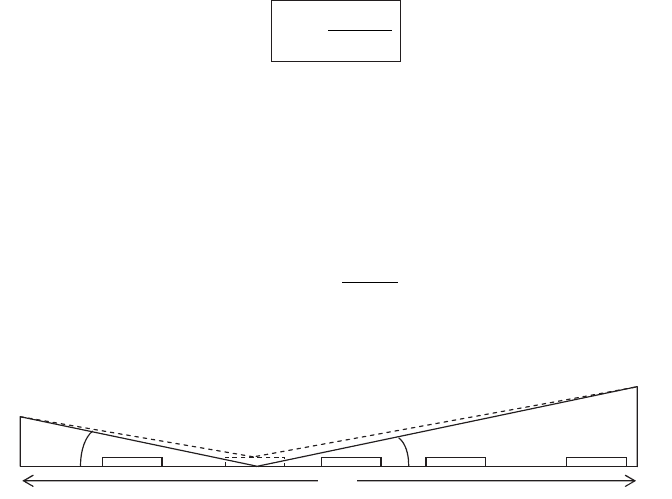
Rayleigh criterion provides a metric of surface roughness. The Rayleigh rough-
ness is derived based on the terrain variation (Dh) that will provide a 90-degree
phase shift at the receiver between a reflection at a terrain peak versus a reflec-
tion from a terrain valley at the same distance (see Figure 8.6). The Rayleigh
criterion is given by [3]
(8.16)
where
l is the wavelength
q is the grazing angle of the reflection
From the geometry shown in Figure 8.6, it can be determined that
where
sin q
()
=
+hh
d
rt
H
R
=
()
l
q8 sin
174 FADING AND MULTIPATH CHARACTERIZATION
h
t
h
r
D
h
d
q
q
Figure 8.6 Geometry of surface roughness.

h
r
is the receiver height
h
t
is the transmitter height
d is the communication distance
The Rayleigh criterion can then be expressed as [3]
(8.17)
When the extent of the terrain features, Dh, is less than H
R
, the surface can be
treated as being smooth. Thus the amount of terrain variation that is tolera-
ble is proportional to the wavelength and the distance traversed and inversely
proportional to the height of the antennas above the surface. When a reflec-
tive surface is rough, meaning that the extent of the terrain features, Dh,is
much larger than H
R
, then the reflections from the surface will be diffuse and
are characterized as scattering rather than reflection.
8.2.2 Fresnel Zones
Consider the point-to-point link depicted in Figure 8.7. The vector TR is the
line of sight between the transmitter and the receiver and the link distance is
d
1
+ d
2
.
If there is a diffraction point at P, the signal TPR will combine with TR at
R. TPR traverses a slightly greater distance than TR and therefore will have
a different phase.
The direct and reflected/diffracted path lengths can be expressed as
So the path-length difference is
If h << d
1
, and h << d
2
, then the binomial expansion can be used:
D= + + + - -dh dhdd
1
22
2
22
12
TR
TPR
=+
=+++
dd
dh dh
12
1
22
2
22
H
d
hh
R
rt
=
+
()
l
8
GROUND-BOUNCE MULTIPATH 175
d
1
d
2
h
T
P
R
Figure 8.7 Fresnel zone geometry.

Making the appropriate substitutions in the equation for D, yields
or
The corresponding phase difference is
where
so
(8.18)
The Fresnel–Kirchhoff diffraction parameter is often used to shorten the nota-
tion in Fresnel zone analyses and is defined as
(8.19)
If the diffraction point is below the line of sight (LOS), then h is negative
and n will also be negative. When the diffraction point is located on the
LOS, h and n are both equal to zero. If the blockage is the horizon, then
the “h and n equal zero” case corresponds to the maximum LOS
distance.
The cases where D=nl/2, where n is an integer, can be found by setting
f=np in (8.18), which yields the following equation:
nh
dd
dd
l=
+
Ê
Ë
ˆ
¯
2
12
12
n
l
=
+
()
h
dd
dd
2
12
12
f
p
l
=◊
+
Ê
Ë
ˆ
¯
2
2
2
12
12
hdd
dd
D=
+
Ê
Ë
ˆ
¯
hdd
dd
2
12
12
2
f
p
l
=
2 D
D= +
h
d
h
d
2
1
2
2
22
D= + + + - -d
h
d
d
h
d
dd
1
2
1
2
2
2
12
22
dh d
h
d
1
22
1
2
1
2
1
2
+@ +
Ê
Ë
Á
ˆ
¯
˜
176 FADING AND MULTIPATH CHARACTERIZATION
Thus
The destructive reflection/diffraction points can then be identified by defining
a term, h
n
, such that
(8.20)
Reflectors/diffraction at h
n
for odd values of n will cause destructive interfer-
ence. Since the difference in path lengths is on the order of l, the reflected/dif-
fracted signal may be as strong as the direct signal and cause cancellation.
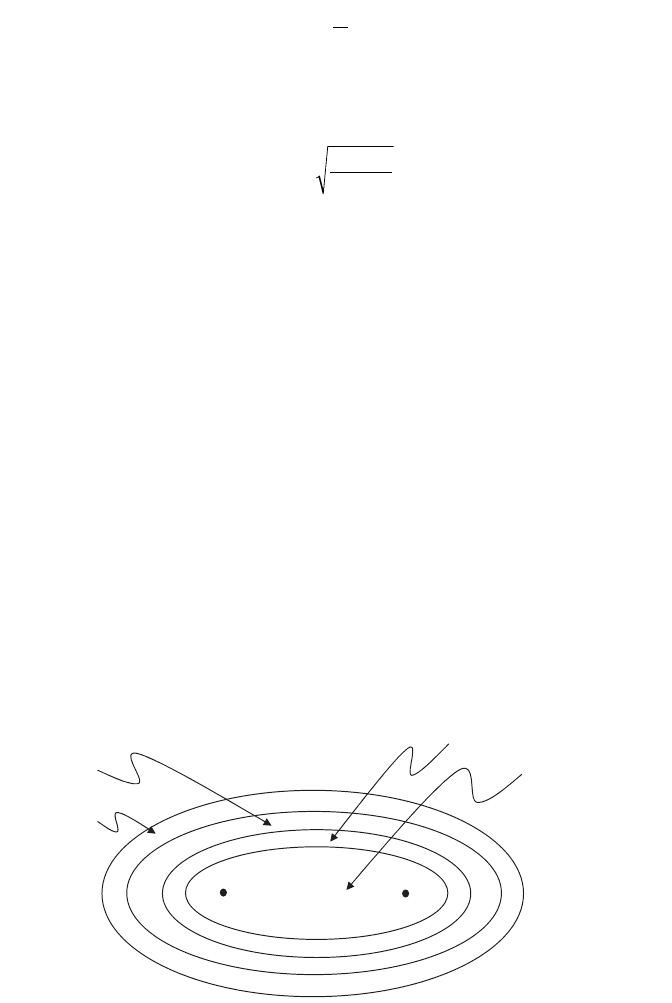
The equation for h
n
defines a sequence of ellipsoids with the transmit and
receive antennas as the foci. Diffractors or reflectors at the odd-numbered
Fresnel zone boundaries will cause destructive interference. Figure 8.8 shows
a diagram of the Fresnel zones defined by a point-to-point link. Note that this
diagram is two-dimensional, whereas the actual Fresnel zones are three-
dimensional ellipsoids. For large h or small d
1
and d
2
, the antenna pattern may
attenuate the undesired signal. For omnidirection (vertical) antennas, there
may be attenuation of the undesired signal in elevation, but not in azimuth.
From the preceding analysis, it is clear that any reflectors/diffractors within
the field of view should not be near an odd Fresenel zone boundary to avoid
signal loss. It is also important that the first Fresnel zone be clear of obstruc-
tions because this can seriously degrade the available signal energy. Due to
Huygen’s principle, covered in the next section, the diffracted electromagnetic
energy that fills the shadow at the receive end of the link reduces the energy
that arrives at the receiver. If the first Fresnel zone is not clear, then free-space
loss does not apply and an adjustment term must be included. For most appli-
h
ndd
dd
n
=
+
l
12
12
f
p
n=
2
2
GROUND-BOUNCE MULTIPATH 177
A
B
Third Fresnel
Zone
Fourth Fresnel
Zone
Second Fresnel Zone
First Fresnel Zone
Figure 8.8 Fresnel zones between a transmitter and receiver.
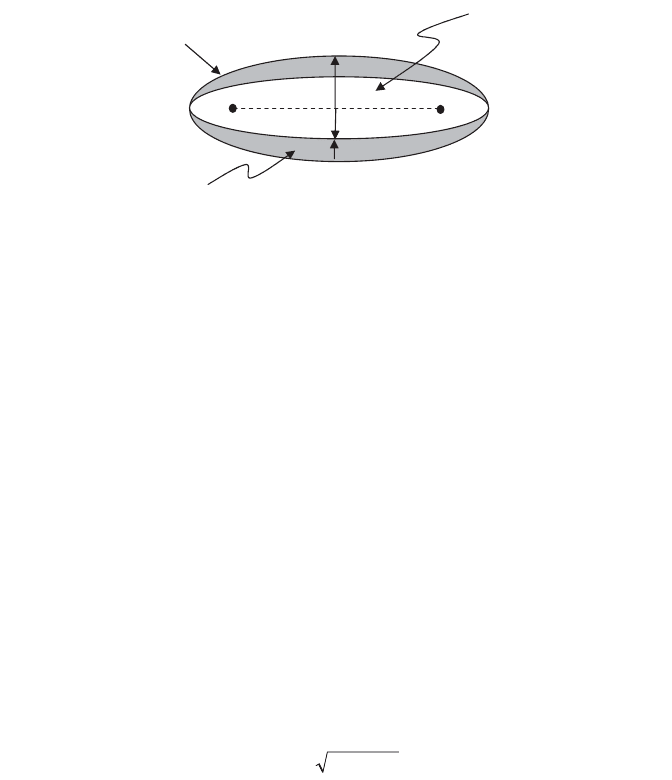
cations, having 60% of first Fresnel zone clear is sufficient. The 60% clear
applies to the radius of the ellipsoid as shown in Figure 8.9. At the 0.6h point,
the Fresnel–Kirchhoff diffraction parameter is n =-0.8* and the resulting dif-
fraction loss will be 0 dB [4]. The quantification of diffraction loss is discussed
in Section 8.2.4.
Example 8.2. Consider a point-to-point communication system, with d = 1km
and f = 28 GHz. If there is a building present, 300 m from one end of the link,
how far must it be (in elevation or height) from the LOS to not impede trans-
mission? (That is, find 60% of the first Fresnel zone radius at 300 m.)
The parameters for determination of the Fresnel zone radius at 300 m are
when eqn (8.20) is applied, the resulting expression for the Fresnel zone radii
is:
So the rooftop must be at least 0.9 m below the LOS to keep the first Fresnel
zone 60% clear. It is also important that the rooftop not be near one of the odd
Fresnel zone boundaries to prevent destructive interference from reflections.
䊐
It should be emphasized again that reflectors or diffractors near the odd
Fresnel zone boundaries produce destructive interference and should be
avoided. In addition, blockage within the first Fresnel zone may result in
reduced energy at the receiver.
hn
n
=◊2 247.
dd
12
300 700
0 107
==
=
,
.l m
178 FADING AND MULTIPATH CHARACTERIZATION
A
B
h
0.6
h
0.4
h
First Fresnel
Zone Ellipsoid
Maximum
Allowable
Blockage
Keep Clear
Figure 8.9 Fresnel zone blockage geometry.
*
n
is negative since the blockage is below the LOS, i.e. the LOS is not obstructed.
8.2.3 Diffraction and Huygen’s Principle
Diffraction is the physical phenomenon whereby an electromagnetic wave can
propagate over or around objects that obscure the line of sight. Diffraction
has the effect of filling in shadows, so that some amount of electromagnetic
energy will be present in the shadowed region. The easiest way to view the
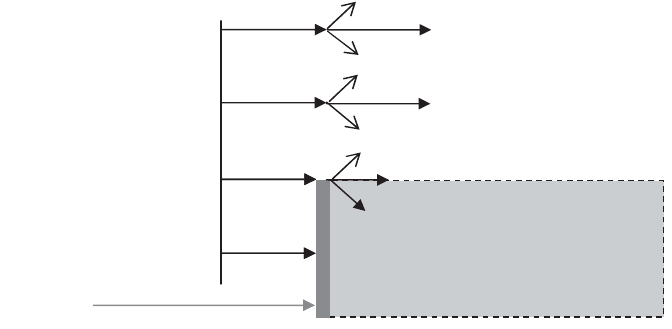
effect of diffraction is in terms of Huygen’s Principle. Huygen’s Principle states
that each point on a wavefront acts as the source of a secondary “wavelet”
and all of these “wavelets” combine to produce a new wavefront in the direc-
tion of propagation [4–6]. This is illustrated in Figure 8.10.
The “wavelets” from a plane wave generate a plane wave (propagate it) if
the extent of the wave front is infinite. If an object blocks part of the wave
front, then the “wavelets” near the blockage are not counterbalanced, and
radiation in directions other than that of the plane wave will occur. This is dif-
fraction, which causes partial filling of shadows. Regardless of whether the
blockage is conductive or nonconductive, the diffraction still occurs. If the
blockage is nonconductive, it must not pass any of the RF energy for the dif-
fraction analysis to be valid. The same effect can occur when a signal source
is beyond the earth’s horizon.While the line of sight is blocked, a small amount
of RF energy will be diffracted over the surface and will appear at the receiver.
8.2.4 Quantifying Diffraction Loss
Accurate modeling of losses due to diffraction is very challenging for all but
the most basic geometries. One such basic geometry is the knife-edge diffrac-
tor, sometimes called a wedge diffractor. This effect has been mathematically
characterized and can be used to provide an estimate of the diffraction loss
for a single knife edge. The effect of a plane wave incident on a perpendicu-
lar conductive barrier can be divided into three shadow regions as shown in
GROUND-BOUNCE MULTIPATH 179
Reduced wave strength in
direction of propagation
Shadow region is
partially illuminated
Wavefront
Physical blockage
Figure 8.10 Illustration of Huygen’s Principle and diffraction.
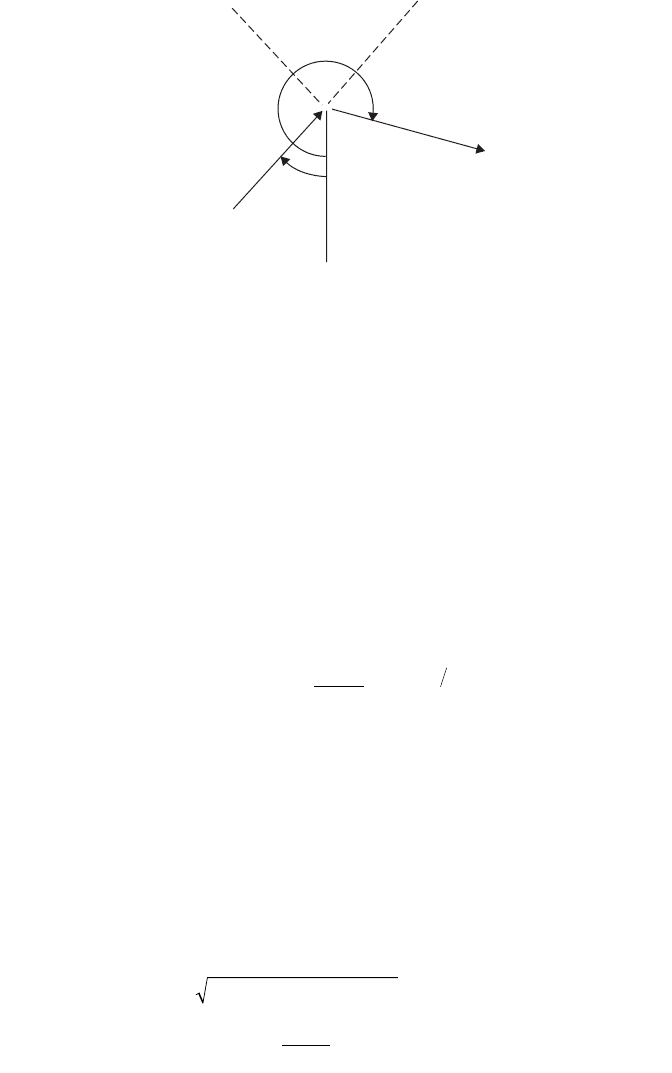
Figure 8.11 [7]. Region I contains direct, reflected, and diffracted rays, region
II contains direct and diffracted rays only, and region III contains diffracted
rays only. This explains why a knife edge that is below the line of sight may
still affect the received wave.
The analysis in this section is based on a conductive barrier. These results
are often applied to scenarios where the barriers are not conductive; however,
they may not be as precise, depending upon the reflection properties of the
barrier. The knife-edge diffracting point may be above, below, or directly on
the line of sight between the transmitter and receiver. The electric field due to
the diffracted path is given by the diffraction integral,
where E
0
is the electric field at the receiver based on free-space loss only and
n is the Fresnel–Kirchhoff diffraction parameter defined earlier. Evaluation of
the diffraction integral is usually done numerically or graphically [8]. Lee [9]
provides an approximation to the diffraction integral.
(8.21a)
(8.21b)
(8.21c)
(8.21d)
(8.21e)
L
r
=
Ê
Ë
ˆ
¯
≥20
0 225
24log
.
,.
n
ndB
L
r
=---
()
()
££20 0 4 0 1184 0 38 0 1 1 2 4
2
log . . . . , .nndB
Le
r
=
()
££
-
20 0 5 0 1
095
log . ,
. n
ndB
L
r
=-
()
-££20 05 062 1 0log . . ,nndB
L
r
=£-01dB, n
EF E
j
edt
d
jt
=
()
=
+
()
-
()()
•
Ú
n
p
0
2
0
1
2
2
180 FADING AND MULTIPATH CHARACTERIZATION
Reflected field
shadow boundary
Incident field
shadow boundary
II
I
I
III
III
Conducting
half-plane
P (r,f)
r
f
f¢
-•
Figure 8.11 Shadow boundaries for diffraction by an infinite conducting half-plane.
(Figure 12.12 from Ref. 7, courtesy of Wiley.)

Figure 8.12 is a plot of the diffraction loss as a function of the Fresnel–
Kirchhoff diffraction parameter, n. Be aware that some authors define the
Fresnel–Kirchhoff diffraction parameter with the opposite sign from that used
herein. In that case the sign must be reversed to use the plot in Figure 8.12 or
incorrect results will be obtained. When n is equal to zero, the first Fresnel
zone is 50% blocked and the corresponding signal loss is 6 dB.
Example 8.3. Consider a communication link comprised of two 150-MHz
hand-held radios separated by 1 km as shown in Figure 8.13. The barrier
between the two radios runs perpendicular to the line of sight and is 5 m below
the line of sight. Assume that the barrier is a thin, solid fence that is 200m
from one end of the link. How much additional path loss (beyond free-space
loss) can be expected due to the diffraction from the fence?
GROUND-BOUNCE MULTIPATH 181
Figure 8.12 Loss due to diffraction. (Figure 7 from Ref. 10, courtesy of ITU.)