
Seybold J.S. Introduction to RF Propagation
Подождите немного. Документ загружается.

As Dd goes to zero, the summation converges to a Reimann sum, which can
then be treated as an integral. To avoid confusion with the differential opera-
tor, the variable, d, is changed to r:
(8.23)
This equation can be solved numerically for any value of d
max
. Note that M(r)
is a function of r.
The value of s
L
depends on the nature of the terrain. A reasonable fit to
the Okumura data is
s
Lc c
ffA=
()()
-
()
+065 13
2
. log . log
P
d
rQ
Mr
dr
cell
L
d
=-
()
Ê
Ë
ˆ
¯
Ú
1
2
2
0
max
max
s
P
d
Pr rdr
P
d
Q
Mr
rdr
P
d
rdr Q
Mr
rdr
cell ring
d
cell
L
d
cell
d
d
L
d
=
()( )
=-
()
Ê
Ë
ˆ
¯
È
Î
Í
˘
˚
˙
=-
()
Ê
Ë
ˆ
¯
Ú
Ú
ÚÚ
1
2
2
1
2
2
0
2
0
2
0
2
0
2
p
p
s
s
max
max
max
max
max
max
max
max
12434
Pd Q
Md
P
d
Pd dd
ring
L
cell ring
()
=-
()
Ê
Ë
ˆ
¯
È
Î
Í
˘
˚
˙
=
()( )
Â
1
1
2
2
s
p
p
max
D
192 FADING AND MULTIPATH CHARACTERIZATION
d
D
d
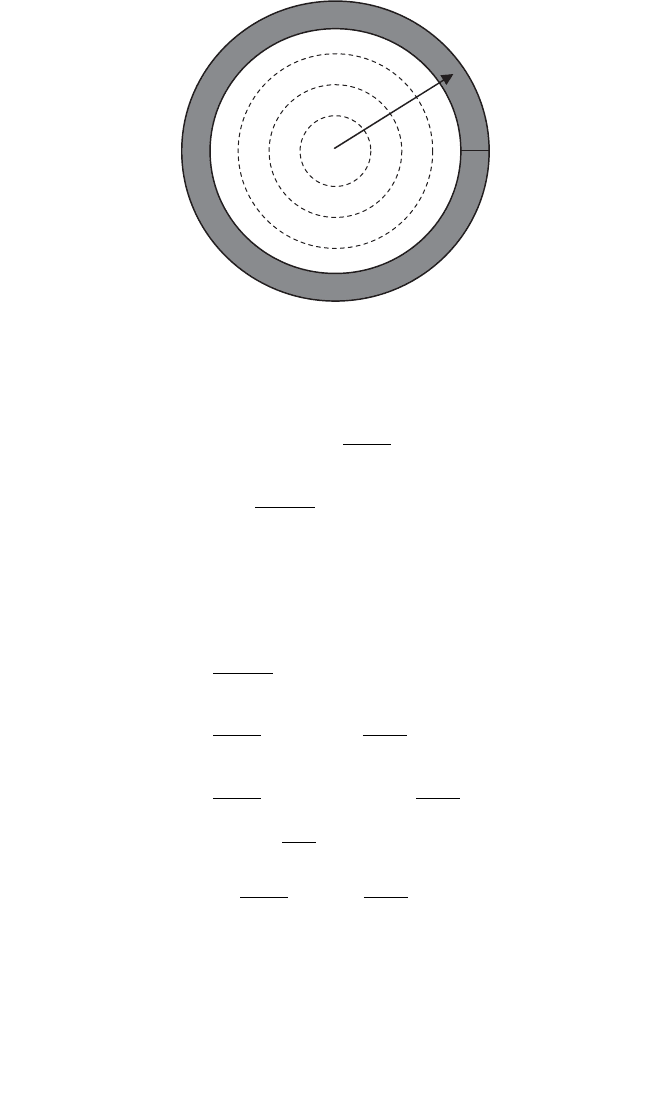
Figure 8.20 Coverage area divided into concentric rings for computing availability
over the entire cell.
where
A = 5.2 (urban)
A = 6.2 (suburban)
f
c
is in MHz
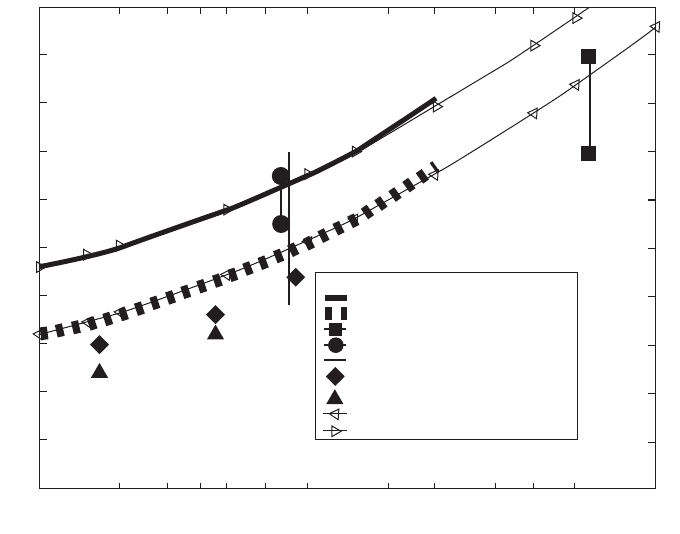
Figure 8.21 from Ref. 17 provides a summary of different measurements of
location variability.
8.4 SMALL-SCALE FADING
Small-scale fading encompasses all of the fading that can occur with very small
(on the order of one wavelength) changes in the relative position of the trans-
mitter and receiver and, sometimes, reflectors in the environment. The phe-
nomenon of small-scale fading is attributed to the summation of multiple
reflected signals arriving with different delays (phases) and amplitudes. The
net effect is treated as having a Gaussian random variable for both the in-
phase and quadrature components of the received signal. This is equivalent to
SMALL-SCALE FADING 193
+
+
+
+
+
+
12
11
10
9
8
7
6
5
4
3
2
100 200 300 400 500 700 1000 2000 3000 5000 7000 10000 20000
Frequency [MHz]
Egli
Okumura Suburban – Rolling Hills
Okumura Urban
Reudink
Ott
Black
Ibrahim 2
km
Ibrahim 9 km
Urban Empirical Model
Suburban Empirical Model
Standard deviation s
L
Figure 8.21 Summary of measured location variability values (Figure 9.10 from Ref.
17, courtesy of Wiley.)
a Rayleigh (or Ricean) density function for the amplitude and a uniform prob-
ability density function for the phase. When the entire signal is comprised of
reflected signals, a Rayleigh density function is used. If, on the other hand,
there is a single dominant component, such as a line-of-sight path or a large
specular reflection in the presence of multiple smaller-strength reflections, a
Ricean probability density function is applicable. Appendix A discusses both
the Rayleigh and Ricean probability density functions and provides examples
of their application.
Small-scale fading is categorized by its spectral properties (flat or fre-
quency-selective) and its rate of variation (fast or slow). The spectral pro-
perties of the channel are determined by the amount of delay on the various
reflected signals that arrive at the receiver. This effect is called delay spread
and causes spreading and smearing of the signal in time. The temporal prop-
erties of the channel (i.e., the speed of variation) are caused by relative motion
in the channel and the concomitant Doppler shift. This is called Doppler
spread and causes spreading or smearing of the signal spectrum. These param-
eters are interpreted relative to the signal that is in use; that is, the way a
channel is characterized depends upon the relationship between the channel
properties and the signal properties. It is important to recognize that the spec-
tral properties of the channel and the rate of variation are independent. This
will become clear in the following sections.
8.4.1 Delay Spread
The direct path (if one exists) is the shortest path between the transmitter and
receiver. Any multipaths will have traveled greater distances and will there-
fore be delayed in time relative to the direct signal.Thus the reflected signal(s)
will not align with the direct signal, and the cumulative signal will be smeared
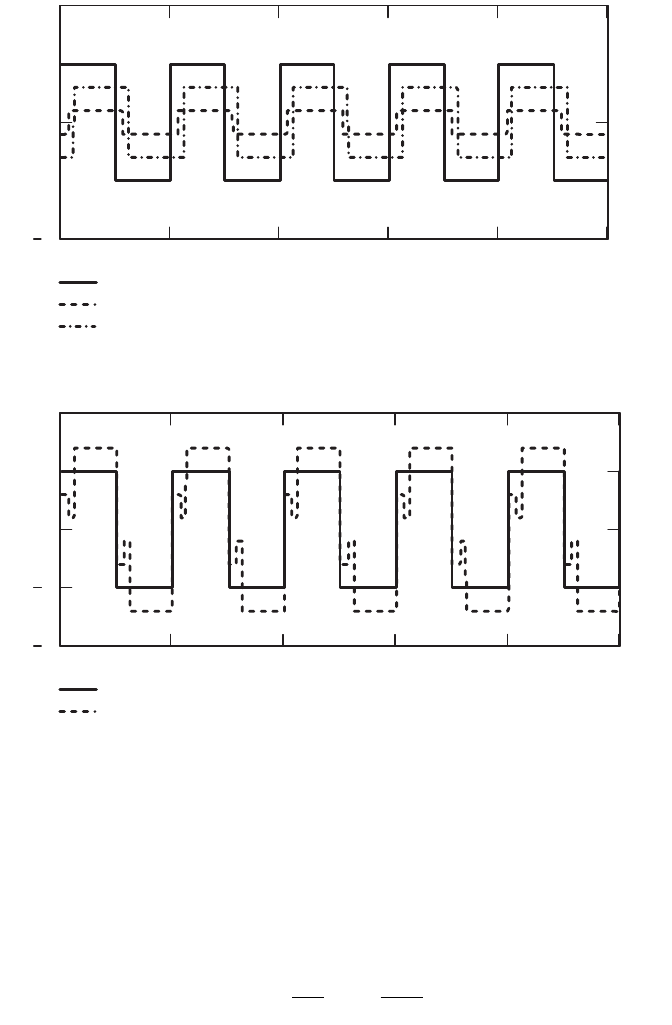
in time. This is called delay spread and is illustrated in Figure 8.22.
There are many metrics of multipath delay spread effects [19]. The mean
excess (average) delay consists of a weighted average (first moment) of the
power delay profile (magnitude-squared of the channel impulse response).The
rms delay spread is the rms value (second moment) of the power delay profile,
denoted by s
t
. The rms delay spread is one of the more widely used charac-
terizations of delay spread and is used with the exponentially decaying impulse
response in indoor propagation modeling (Chapter 9). The delay window is
the width of middle portion of the power delay profile that contains a certain
percentage of the energy in the profile.The delay interval (excess delay spread)
is the length of time between the two farthest separated points of where the
impulse response drops to given power level. The correlation bandwidth is
defined as the bandwidth over which a given level of correlation of the trans-
fer function is met. The averaged power delay profile can be thought of as the
square of the spatially averaged (over a few wavelengths) impulse response
for the channel for a given time period. In this text, only the maximum and
the rms delay spread are used.
194 FADING AND MULTIPATH CHARACTERIZATION
It is desirable to have the maximum delay spread to be small relative to the
symbol interval of a digital communication signal. An analogous requirement
is that the coherence bandwidth be greater than the signal bandwidth. Coher-
ence bandwidth is defined as the bandwidth over which the channel can be
considered flat with linear phase. Flat frequency response with linear phase
implies no signal distortion. The coherence bandwidth is often approximated
as
(8.24)
depending upon the flatness required and the channel’s spectral shape.
B
c
tt
ª
1
5
1
50ss
to
SMALL-SCALE FADING 195
0 0.01 0.02 0.03 0.04 0.05
2
0
2
Direct Signal
1st Reflection
2nd Reflection
0 0.01 0.02 0.03 0.04
0.05
2
1
0
1
2
Direct Signal
Total Signal
Figure 8.22 Illustration of the effect of multipath delay spread on received symbols.

If the signal bandwidth is less than the coherence bandwidth, B < B
c
, then
the channel is considered wideband or flat (flat fading). Otherwise, it is called
a narrowband channel (selective fading). Flat fading causes the amplitude of
the received signal to vary, but the spectrum of the signal remains in tact. The
remedy for flat fading is to determine the allowable outage time and then use
the Rayleigh pdf to determine the required fade margin to meet the require-
ment. For selective fading, some modulations are relatively tolerant of fre-
quency dropouts, whereas in other cases an equalizer may be used.
Example 8.6. Given a digital communication system with a symbol rate
of 50,000 symbols per second, what is an acceptable amount of rms delay
spread?
For digital communication systems, the signal bandwidth is often approxi-
mated by the symbol rate,
So,
which is then set equal to the coherence bandwidth
which implies
So the rms delay spread should ideally be less than or equal to 4 ms.
Another approach is simply consider the symbol time,
Then to have a delay spread that is significantly less than T, s
t
<< T, a value
of about one-tenth of the symbol period can be used:
Thus a value of rms delay spread of 2–4 ms should be acceptable. 䊐
Example 8.7. Given the communication system and the environment shown
in Figure 8.23, if all of the buildings are good reflectors and both the trans-
mitter and receiver are using wide-angle antennas, what is the maximum
expected delay spread value? Base on that value, what is the highest symbol
s
t
= 2ms
RT
s
=ƪ50 000 20, baud ms
s
t
=
()
=1 250 4kHz ms
B
ct
=
()
15s
B ª 50 kHz
BR
S
ª
196 FADING AND MULTIPATH CHARACTERIZATION
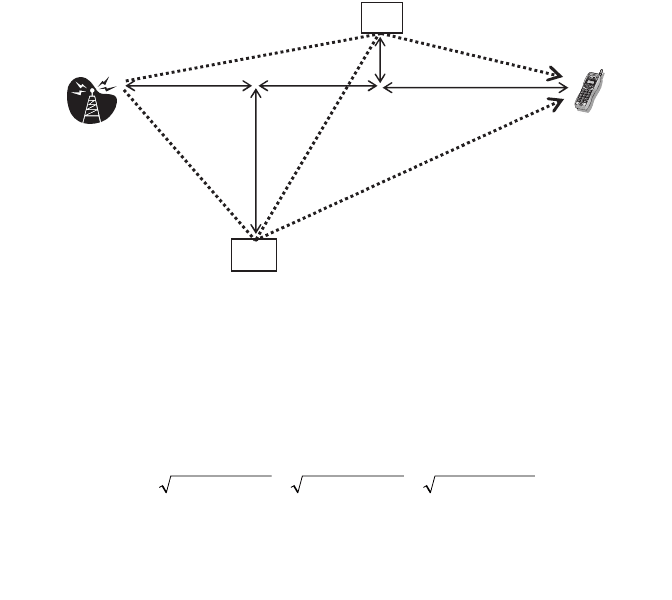
rate that you would recommend? Assume that there is no equalizer present
and that both ends of the link are at the same height.
The direct path is 200 m and the longest reflected path bounces off of both
buildings (i.e., Tx to A to B to Rx). The multireflection path is
or
Since the direct path is 200 m, the excess path length for the worst-case mul-
tireflection path is 35.2 m, which corresponds to a worst-case delay spread
value of 117 ns. If this is equal to 10% or less of a symbol duration, then the
multipath delay spread will be tolerable. Thus the minimum symbol time is
1.17 ms, which corresponds to a maximum symbol rate of 852 ksps. Note that
for this problem the maximum delay spread rather than the rms delay spread
was used since the specific geometry of the reflectors was well-defined. 䊐
It is interesting to contrast the effect of delay spread with the signal fades
that occur due to Fresnel zone boundary interference. The reflection points
from the Fresnel zone computation resulted in time shifts on the order of the
period of the carrier.The reflection points of concern for delay spread are gen-
erally much farther removed since they result in time shifts on the order of
the symbol interval. When delay spread is a factor, the effects of carrier can-
cellation are incorporated into the multipath fade statistics (i.e., averaged in)
and are not treated separately. Stated another way, if the magnitude of the
multipath delay is sufficient to cause delay spread on the signal, then it is too
large to permit meaningful characterization of carrier cancellation effects, and
these effects are treated statistically.
d
mr
= 235 2.m
d
mr
=+++++2500 1600 2500 2500 100 10000 m
SMALL-SCALE FADING 197
10 m
40 m
100 m
50 m
50 m
A
B
Figure 8.23 Communication link with multipath reflectors.
8.4.2 Doppler Spread
Relative motion between the transmitter and receiver imparts a Doppler shift
on the signal, where the entire signal spectrum is shifted in frequency. When
multipath is combined with relative motion, the electromagnetic wave may
may experience both positive and negative Doppler shift, smearing or spread-
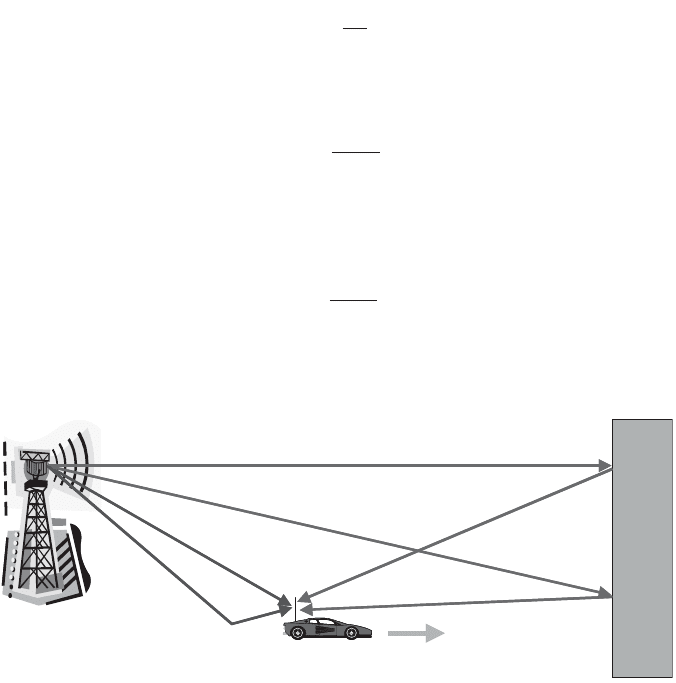
ing the signal in frequency. This effect is called Doppler spread. Figure 8.24
shows how this spreading could occur in an urban mobile telecommunications
environment. In this figure, as the car moves to the right, the reflections from
in front of the vehicle will have a positive Doppler shift and the signal
from the tower will have negative Doppler shift. The magnitude of the
Doppler shifts depends upon the geometry of the signal path (or reflection
as shown). A related parameter, called coherence time, is defined as the time
duration over which the signal amplitude will be highly correlated (close to
constant):
(8.25)
where f
m
is the maximum Doppler shift that is encountered:
(8.26)
and Dn
Rel
is the maximum relative velocity.
The coherence time is sometimes taken to be
(8.27)
T
f
c
m
@
0 423.
f
m
=
Dn
l
Rel
T
f
c
m
@
1
198 FADING AND MULTIPATH CHARACTERIZATION
More –ve Doppler
–ve Doppler
+ve Doppler
Less +ve Doppler
Figure 8.24 Illustration of how doppler spreading can occur.

If the signal bandwidth is much larger than twice the maximum Doppler shift,
the channel is called a slow-fading channel and the effects of Doppler spread
are negligible. A similar requirement is
(i.e., the symbol time is less than the coherence time of the channel). Thus the
speed characterization of small-scale fading (fast or slow) depends upon the
relationship between the Doppler bandwidth and the signal bandwidth, or
equivalently the relationship between the coherence time and the symbol
time. For a fast-fading channel, the receiver must be able to tolerate fades
within a symbol, which makes amplitude-dependent modulations such as
QAM a poor choice. For a slow-fading channel, however, the channel can be
assumed constant over a symbol interval so amplitude modulations can be
used. Note that a slow-fading channel may still experience very deep fades,
which may last for one or more symbol durations. This can be addressed by
using extra link margin and fast AGC, by increasing the modem interleaver
depth to span the fades, by using short frame lengths and data retransmission,
or by other methods.
8.4.3 Channel Modeling
The impulse response of the channel may be modeled as a time-varying
impulse response h(t
1
, t). If the channel is time-varying and linear and has
multipath present, it can be modeled by a delay-Doppler-spread function,
also called a scattering function. The scattering function consists of the sum
of delayed, attenuated, and Doppler-shifted versions of the signal [19].
In a slow-fading channel the amplitude of the signal remains relatively con-
stant over a symbol interval, and therefore the channel response can be treated
as being time-invariant over the symbol. With this restriction, t
1
is fixed and a
time-invariant impulse response can be used. The received signal is then com-
puted as the transmitted signal convolved with the channel impulse response:
The impulse response must be causal (no output before the input is applied)
and thus h(t) is equal to zero for t < 0. Automatic gain control (AGC) at the
receiver can be used to stabilize the receive signal level by adjusting the
receiver gain at a rate slower than the symbol rate yet faster than the fade
rate. If the channel is frequency-selective, this impulse response is used to
model the channel, and it is then possible to synthesize an equalizing filter to
eliminate the multipath distortion. Since channels generally vary over time,
adaptive equalizers are used, which change in response to changes in the
channel. Some equalizers use a special training sequence embedded within the
signal, and others adapt based on the signal characteristics alone.
rt st ht
()
=
() ()
*
TT
Sym c
<
SMALL-SCALE FADING 199
In a fast-fading channel, the signal amplitude will change during a
symbol. In this case, the detector must be designed to accommodate the rapid
amplitude variations. If a rapid-response AGC was used, the effect would be
to track out any amplitude modulation component of the signal as well. Such
channels are good candidates for phase modulation, but amplitude or
phase/amplitude (QAM) modulations will not perform well. If the fast-fading
channel is frequency-selective, the receiver must be able to tolerate the
frequency distortion since equalization cannot generally be performed fast
enough.
Orthogonal frequency division multiplexing (OFDM) can be used to
combat fast fading and frequency-selective fading. OFDM uses multiple car-
riers, each operating at a reduced symbol rate to mitigate the effects of delay
spread and selective fading. The longer symbol times make fast fading less of
an issue, and redundancy over the carrier frequency reduces the effect of any
frequency dropouts.
Table 8.1 shows the relationships between the different classes of small-
scale fading and provides some comments on mitigation of the effects and lim-
itations on the modulation that can be used.
8.4.4 The Probabilistic Nature of Small-Scale Fading
The probability of various fade depths depend upon the characteristics of the
multipath environment. When there are a sufficient number of reflections
present and they are adequately randomized (in both phase and amplitude),
it is possible to use probability theory to analyze the underlying probability
density functions (pdf’s) and thereby determine the probability that a given
fade depth will be exceeded. For the non-LOS case, where all elements of the
received signal are reflections or diffraction components and no single com-
ponent is dominant, the analysis draws on the central limit theorem to argue
that the in-phase and quadrature components of the received signal will be
independent, zero-mean Gaussian random variables with equal variance. In
this case, the pdf of the received signal envelope will be a Rayleigh random
variable. Using the Rayleigh pdf, the analyst can then determine the proba-
bility of any given fade depth being exceeded. It is also possible to optimize
the system detection and coding algorithms for Rayleigh fading rather than
for AWGN.
Example 8.8. Given a non-LOS communication link that experiences
Rayleigh fading, what is the probability of a 12-dB or greater fade?
When considering fade depth, the fade is measured relative to the mean
signal value, so the parameters for the Rayleigh are all relative and the
absolute values are not required. The expression for the probability of a fade
of x dB is obtained by integrating the Rayleigh pdf (Appendix A) from zero
amplitude (the minimum value of the Rayleigh random variable) to the fade
point:
200 FADING AND MULTIPATH CHARACTERIZATION

SMALL-SCALE FADING 201
TABLE 8.1 Relationship Between Different Small-Scale Fading Characterizations
Delay Spread Effects Comments Doppler Effects Comments
Slow T
c
> T
s
AGC is helpful, amplitude Flat B
c
> B
s
No need to equalize.
Fading Correlation time is information can be Correlation bandwidth
greater than a preserved. Can use PSK exceeds the signal
symbol interval. or QAM. bandwidth.
Frequency- B
c
< B
s
Can equalize.
Selective Correlation bandwidth
is less than the signal
bandwidth.
Fast T
c
< T
s
ACG cannot eliminate Flat B
c
> B
s
No need to equalize.
Fading Correlation time is amplitude variations, Correlation bandwidth
greater than a amplitude information exceeds the signal
symbol interval. is lost. Can use PSK, but bandwidth.
not QAM. Frequency- B
c
< B
s
Cannot usually equalize.
Selective Correlation bandwidth
is less than the signal
bandwidth.