
Seybold J.S. Introduction to RF Propagation
Подождите немного. Документ загружается.

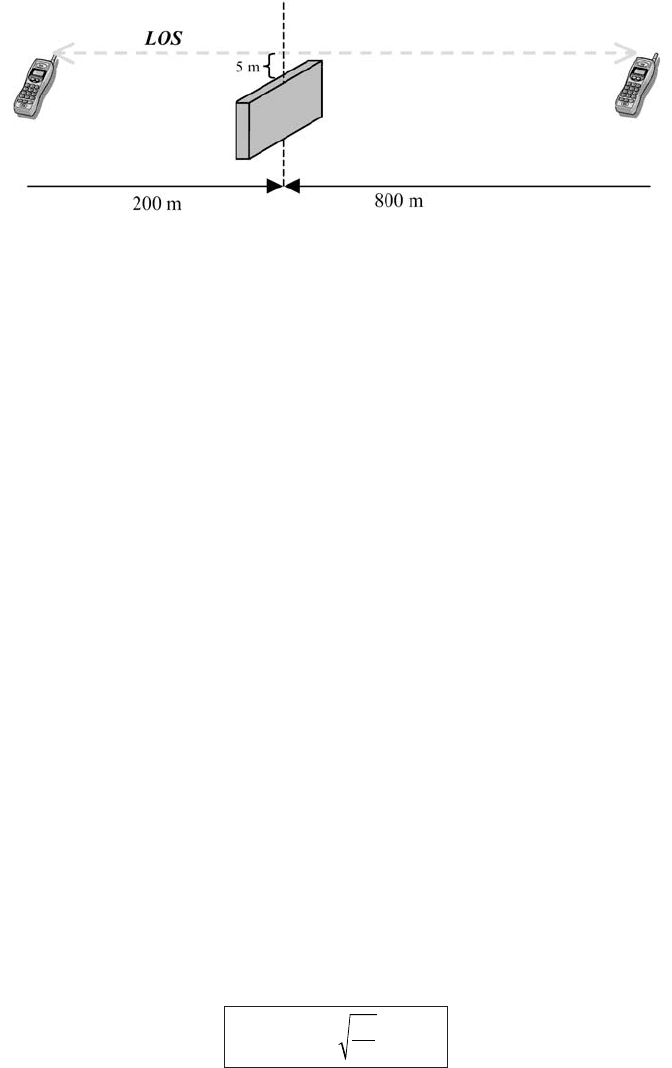
Since the blockage is below the line of sight, the values of h and v are neg-
ative. The following parameters are known:
Using the expression for the Fresnel–Kirchhoff diffraction parameter, (8.19),
yields
From the plot in Figure 8.12, the diffraction loss can be estimated as 0.75 or
-2.5 dB, or the Lee approximation to the diffraction integral can be used
directly to get
䊐
Unfortunately, most blockages encountered in the real world are not well-
modeled by a single knife-edge diffractor. The multiple knife-edge diffraction
model given in Ref. 11 can be used, but Rappaport indicates that it tends to
oversimplify the geometry and produce somewhat optimistic results. Another
option is the rounded-surface diffraction model, where the diffraction is
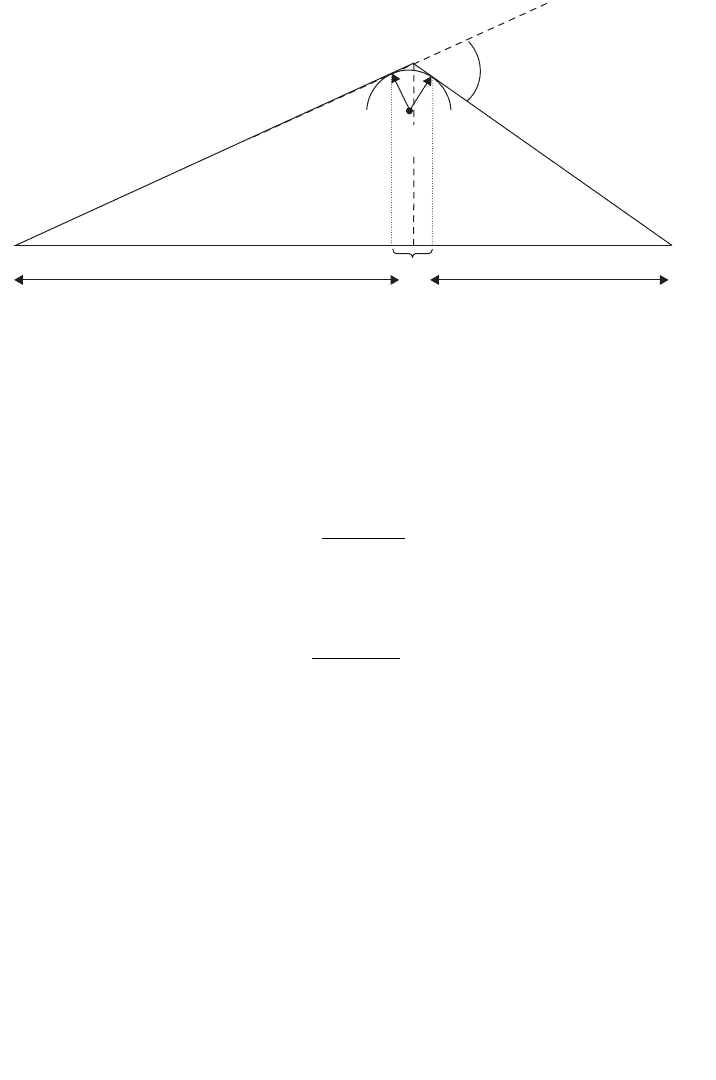
treated as a broadside cylinder as shown in profile in Figure 8.14 [12–15].
The diffraction from a rounded hilltop or surface is determined by com-
puting the knife-edge diffraction for the equivalent height, h, and then com-
puting the excess diffraction loss, L
ex
, due to the rounded surface. The first step
is to determine the radius, r, of the cylinder that circumscribes the actual dif-
fraction points on the obstacle. Then the extent of the diffraction surface, D
S
,
can be found. The expression for the excess diffraction loss is
(8.22)
L
r
ex
=-11 7. a
p
l
dB
L
r
=-
()
=-20 05 062 26log . . .n dB
n=-0 395.
h
dd
=- =
==
52
200 800
12
mm
mm
,
,
l
182 FADING AND MULTIPATH CHARACTERIZATION
Figure 8.13 Knife-edge diffraction geometry for Example 8.3.
where
and r is estimated by
It is important to note that the excess loss and the knife-edge diffraction loss
are actually expressed as gains. That is to say, a negative loss is indeed a loss,
not a gain in signal strength.
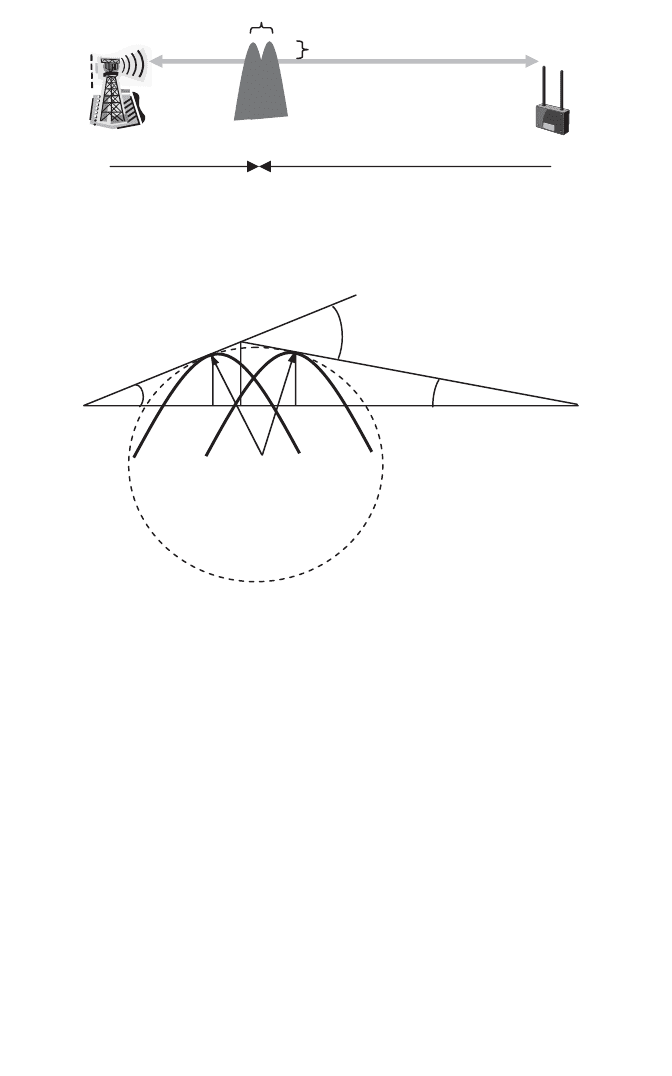
Example 8.4. Consider a point-to-multipoint communications link operating
at 5 GHz over a distance of 1 km shown in Figure 8.15a. There is a pair of
narrow hilltops in between the transmitter and receiver, located 300 m from
from the transmitter. Find the total diffraction loss if the hilltops are 10 m apart
and 3 m above the line of sight.
The individual hilltops are approximated as pointed conductive wedges or
knife edges. From the problem statement and the geometry shown in Figure
8.15b, the following observations can be made:
BB m AB m
ab m CB cb m
==
===
10 695
295 3
,
,
r
Ddd
dd
s
=
+
()
2
12
1
2
2
2
a
an
l
=
+
()
È
Î
Í
˘
˚
˙
dd
dd
12
12
2
GROUND-BOUNCE MULTIPATH 183
d
1
d
2
h
a
r
D
S
T
P
R
Figure 8.14 Geometry for rounded-surface diffraction model.
From this information, the angles b and g can be found
and from basic geometry, the angle, a, is found to be
Now it is possible to determine the value of h = ED, by first solving the fol-
lowing set of equations for bD:
ED ab bD
ED AB bD
=
()
+
()
=
()
+-
[]
()
tan
tan
g
b 10
abg=+= ∞0 826.
bg=∞ =∞0 243 0 583., .
184 FADING AND MULTIPATH CHARACTERIZATION
(a)
(b)
300 m
700
m
3
m
10 m
a
A
B
C
D
E
b
g
c
b
a
O
Figure 8.15 Diffraction geometry for the double-hill blockage problem. (a) Pictorial
diagram for Example 8.4. (b) Geometric diagram for Example 8.4.

Equating these expressions and solving for bD yields
or
from which the value of
can be deduced.
The next step is to determine r, the radius of the circle that is tangential to
ae at point c and to AE and point C:
The interior angle of the circle,
/
cOC
can be determined by looking at the inte-
rior angles of the quadrangle ceCO. The result is that
The cord of this angle is
Thus cOC is an isosolicles triangle with the equal sides being of length r.
Solving for r yields
The one remaining parameter needed to compute the diffraction loss is the
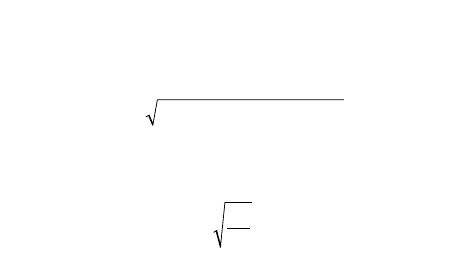
Fresnel–Kirchhoff diffraction parameter. Using
and
h = 303.m
l=
==
=
006
297 98
1
2
.
.
m
aD m
AD = 702.02 m
d
d
r =
-
()
=
bd 2
cos 90
m
a 2
694
cC bB m==10
cOC = = 0.826a∞
r ==Oc OC
ED m==h 303.
bD m= 298.
bD
AB ab
=
()
+
()
-
()
()
+
()
tan tan
tan tan
bg
gb
10
GROUND-BOUNCE MULTIPATH 185
yields
Thus the basic knife-edge diffraction loss is
The excess diffraction loss is then determined as
where a must, of course, be expressed in radians. Therefore the signal at the
receiver will be about 47.4 dB lower than it would be for the unobstructed
case. This represents a very deep fade, which is to be expected when a 5-GHz
signal is blocked by two hilltops. 䊐
For scenarios where the blockage is not well-modeled as a narrow edge of
a perfect conductor, the analysis should include the effects of nonideal reflec-
tion/diffraction and account for any penetration of the blockage. Such analy-
sis is best treated using the uniform theory of diffraction [16], which is beyond
the scope of this text. The UTD permits a variety of shapes, surface textures,
and conductivities to be treated. The use of knife-edge diffraction is often suf-
ficient for simple geometries or cases where the specific geometry and mate-
rial properties are not known with high confidence. When geometry and
material specifics are well known, the problem can be treated using the UTD,
often in the context of an advanced modeling program. For many RF propa-
gation applications, however, generalized statistical models (such as log-
normal shadowing covered in the next section) are sufficient.
According to Lee [14], the diffraction loss will be slightly greater for hori-
zontal polarization than for vertical polarization. Thus the wave in the shadow
region for a veritcal polarization signal will be stronger than that of a hori-
zontal polarization signal, all else being equal. In the case of circular polar-
ization, this means that the wave in the shadow region will be elliptically
polarized (i.e., the axial ratio will be increased).
8.3 LARGE-SCALE OR LOG-NORMAL FADING
The first step in prediction of the path loss is to determine the median path
loss. Several procedures for estimating the median path loss were presented
in Chapter 7 and in Section 8.2. The second step is to determine the large-
scale fading about that median path loss. Large-scale fading is generally attrib-
L
r
ex
=- =-11 7 32 2..a
p
l
dB
L
r
=---
()
()
=-20 0 4 0 1184 0 38 0 1 15 2
2
log . . . . .n dB
n=1 2095.
186 FADING AND MULTIPATH CHARACTERIZATION
utable to blockage (diffraction), which is sometimes called shadowing. In the
case where there is a fair amount of blockage, there may be several diffrac-
tion paths to the receiver.These paths are multiplicative, which means that the
effects are additive if considered in dB. If there are a sufficient number of dif-
fraction points and/or multireflection paths on the path to the receiver, the
Central Limit Theorem may be invoked to justify using a Gaussian random
variable to represent the path loss. This is in fact what is frequently done, par-
ticularly in cellular telephony. The result is called log-normal fading, since the
fading follows a normal distribution in dB (the log domain). For this reason,
large-scale fading is modeled as a log-normal random variable. The mean path
loss is the same as the median path loss (since for a normal pdf, the mean and
median are identical). Thus, only a variance is required to characterize the log-
normal fading. This variance is called the location variability and is denoted
by s
L
.
The probability of a log-normal fade is used to determine the percentage
of annular area that is covered at a fixed range from the transmitter. Figure
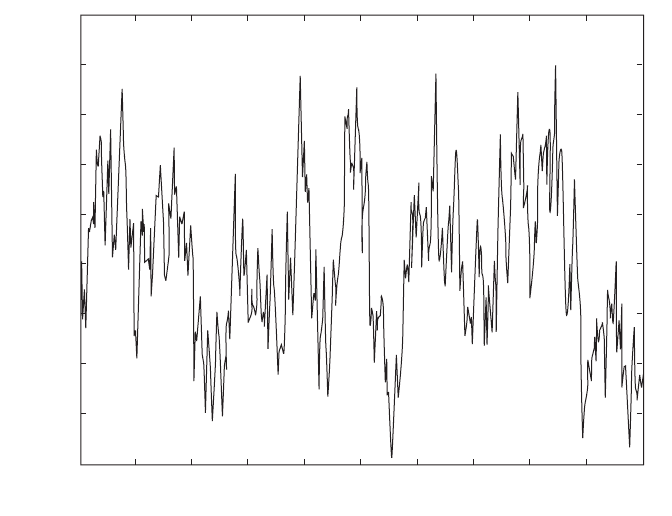
8.16 shows the variation of RSL with position for a fixed distance, d, as the
cell perimeter is traversed. The effects of the normal pdf can be envisioned
from this plot.
LARGE-SCALE OR LOG-NORMAL FADING 187
25
20
15
10
5
0
–5
–10
–15
–20
050
100 150 200 250 300 350 400 450 500
Distance [m]
Signal level relative to median [dB]
Figure 8.16 Received signal levels relative to the median signal level in a shadowing
environment. (Figure 9.2 from Ref. 17, courtesy of Wiley.)
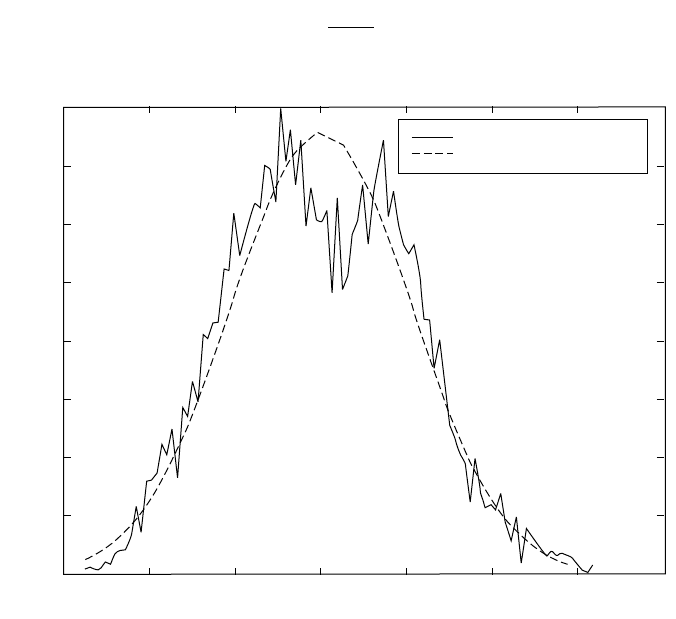
Figure 8.17 shows the histogram and how it compares with the normal pdf.
This provides some insight into the validity of log-normal fading models.
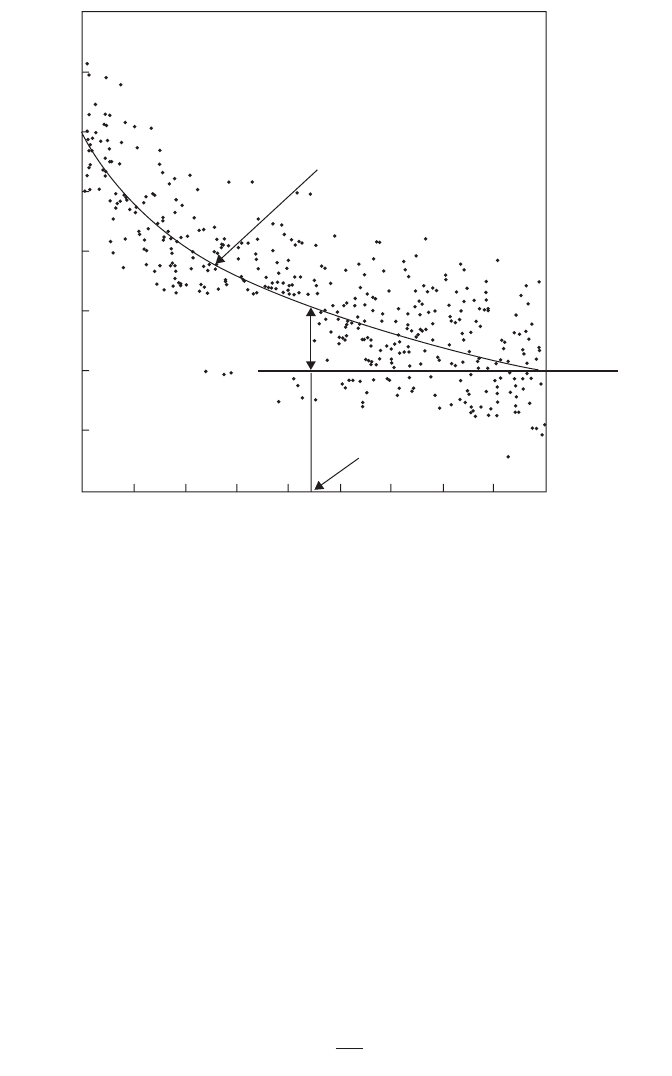
Figure 8.18 shows a representative plot of path loss measurements. This plot
shows the variation of the path loss at any given distance.
Example 8.5. For a given communication system, 90% coverage is desired at
the fringe (edge) of the coverage cell. Assume plane earth propagation plus
a 20-dB allocation for clutter loss, use s
L
= 6 dB for the shadowing location
variability,
h
m
= 1.5 m, h
b
= 30 m
and use a maximum allowable path loss of 140 dB. Determine the shadowing
fade margin and the distance at which it occurs (i.e., the cell radius). Repeat
the problem if s
L
= 8dB.
The expression for the path loss is
L
hh
d
LL
m
b
clutter s
dB
()
=-
Ê
Ë
Á
ˆ
¯
˜
++10
22
4
log
188 FADING AND MULTIPATH CHARACTERIZATION
0.04
0.035
0.025
0.015
0.005
0.03
0.02
0.01
0
–30 –20 –10 0 10 20 30 40
Shadowing Level [dB]
Probability Density
Measured
Normal Distribution
Figure 8.17 Histogram of measured shadowing loss compared to a normal pdf. (Figure
9.3 from Ref. 17, courtesy of Wiley.)
where L
S
is the loss due to shadowing and can be expressed as
with z being a Gaussian random variable. The probability of an outage is
which can be rewritten as
Since the shadowing pdf is normal and zero mean, the standard normal
random variable is
z
L
S
L
=
s
PPLLLL
outage S Max PL clutter
=>--
()
PPLL
outage Max
=
()
>
()
dB
Lz
sL
=s
LARGE-SCALE OR LOG-NORMAL FADING 189
–60
–70
–80
–90
–100
–110
–120
–130
–140
1000 2000 3000 4000 5000 6000 7000 8000 9000 10000
Distance from Base Station [m]
Maximum Cell
Range
Maximum
Acceptable
Path Loss
Median
Path Loss
Fade
Margin, z dB
Total Path Loss [–dB]
Figure 8.18 Total path loss versus distance from the transmitter in a shadowing envi-
ronment. (Figure 9.4 from Ref. 17, courtesy of Wiley.)

which yields
The net fade margin for the link that can be allocated to shadowing is set equal
to the shadowing loss,
and the maximum allowable path loss is
The shadowing fade margin (based on the probability of a shadowing fade) is
The value of s
L
is known; and from a Q table (see Table A.1) at p = 0.1, z can
be found to be 1.28. Thus the required shadowing margin to ensure 90% cov-
erage when s
L
= 6 dB is
and the maximum allowable path loss is 112.3 dB, so
which yields a cell radius of
If instead of s
L
= 6, s
L
= 8 dB is used, then
and
Ld hh d
PL L m b
()
=- -=-
()
+
()
-
140 1 28 20 20 40
10 24
33 06
. log log
.
.
s
1234
1244344
d = 43.km
20 112 3
2
log .
hh
d
ab
Ê
Ë
ˆ
¯
=
L
S
= 77.dB
Lz
SL
=s
Ld L
PL s
()
=-120
ML L L d L
S Max PL clutter
== -
()
+
()
PPz
LLL
PQ
LLL
PPQ
LLL
Q
L
outage
Max PL clutter
L
outage
Max PL clutter
L
erage outage
Max PL clutter
L
S
L
=>
--
Ê
Ë
ˆ
¯
=
--
Ê
Ë
ˆ
¯
=- =-
--
Ê
Ë
ˆ
¯
=-
Ê
Ë
ˆ
¯
s
s
ss
cov
11 1
190 FADING AND MULTIPATH CHARACTERIZATION
䊐
In summary, use 1 - p, the probability of a shadowing fade, and a Q table to
look up z; then z times s
L
, the shadowing location variability, gives the numer-
ical value of L
S
, the required shadowing fade margin for the link.
By computing the available link margin as a function of distance, it is pos-
sible to generate a curve of the percent coverage versus distance for a given
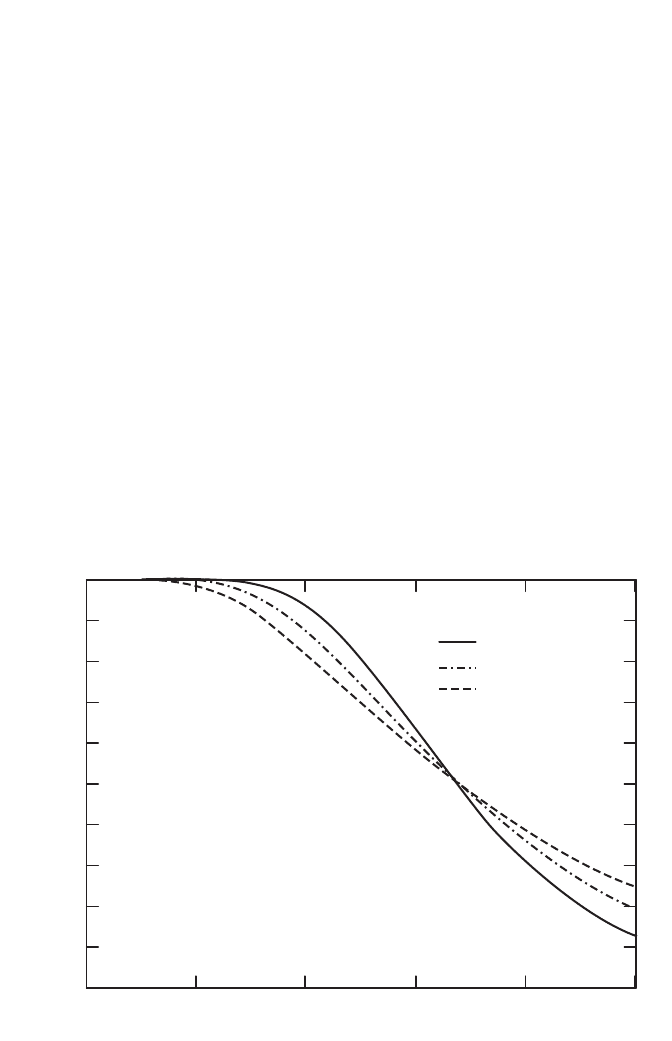
location variability. This is shown in Figure 8.19. Note that the curves all cross
at the 50% point as expected since at 50% implies that the probability of being
above or below the median is the same regardless of the location variability
and the path loss is equal to the median.
Instead of computing the percent coverage at the edge of the cell, one can
average over all of the cell area. This can be accomplished by simply comput-
ing the coverage over a series of narrow concentric rings and then summing
them up [18], where it is implicitly assumed that the coverage area is circular.
This is shown conceptually in Figure 8.20. The area of each ring is 2pdDd. Each
ring area is multiplied by its corresponding coverage probability, and then they
are added and divided by the total area to get the overall cell coverage
probability:
d = 37.km
LARGE-SCALE OR LOG-NORMAL FADING 191
0 2000 4000 6000 8000 1
.
10
4
0
10
20
30
40
50
60
70
80
90
100
Sigma = 6 dB
Sigma = 8 dB
Sigma = 10 dB
Percent Coverage vs. Distance
Distance (m)
Percent Coverage
Figure 8.19 Percent coverage versus distance for log-normal fading.