
Seybold J.S. Introduction to RF Propagation
Подождите немного. Документ загружается.


(slightly less than free-space loss). In the case of propagation around corners
or through walls, N = 40 is used. For long paths, the reflected path(s) may inter-
fere, resulting in N = 40 being used here as well.
Example 9.1. Consider application of a 5.2-GHz wireless LAN in an office
building. If the longest link is 100 m, what is the maximum path loss? How
much additional path loss will exist between floors? Is the interfloor loss suf-
ficient to permit frequency re-use?
From the power loss coefficient values given in Table 9.1, for an office build-
ing the value of N is found to be
The floor penetration loss factor for a single floor from Table 9.2 is
For d = 100 m, the expected path loss is then given by
where
f = 5200 MHz
N = 31
d = 100
Lf = 16
Thus the expression for the maximum expected total path loss is
so
and
The 16-dB difference when penetrating a floor would probably not be suffi-
cient to permit frequency re-use between adjacent floors without a significant
risk of interference. This analysis assumed that the adjacent floor receiver
would also be 100 m from the transmitter. In practice, the receiver on the adja-
L
total
= 108 dB on the same floor
L
total
= 12 dB between two floors
L
total
=
()
+
()
-20 5200 31 100 12
10 10
log log
LfNdLf
total
=
()
+
()
+-20 28
10 10
log log dB
Lf = 16 dB
N = 31
212 INDOOR PROPAGATION MODELING
cent floor may be closer than 100 m, it could be situated just above or below
the transmitter. 䊐
The ITU site-general indoor propagation model includes provisions for mod-
eling the expected delay spread. As discussed in Chapter 8, delay spread rep-
resents a time-varying, smearing effect (in time) on the desired signal and can
be characterized by a power delay profile. Based on the ITU model, the
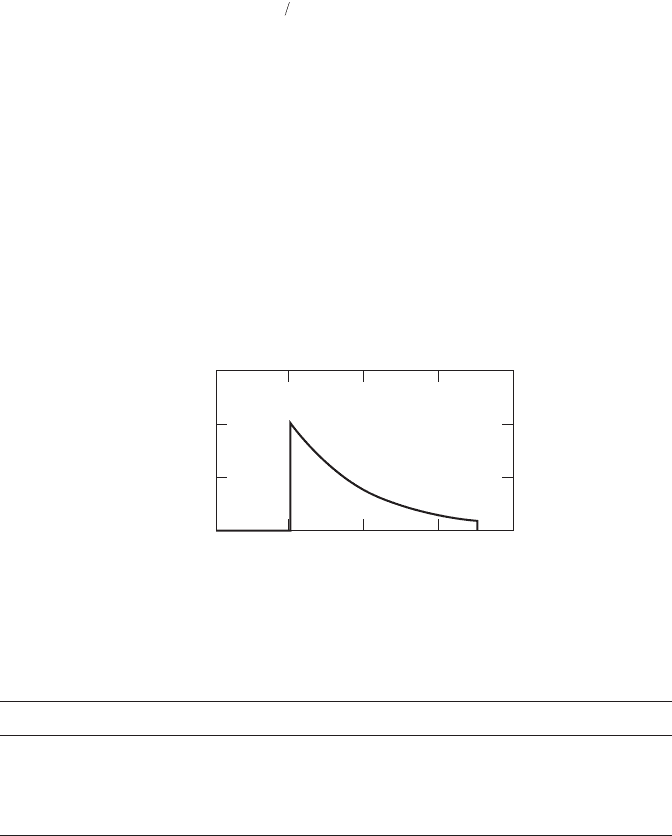
impulse response of the channel may be modeled as
where
S is the rms delay spread
t
max
is the maximum delay (obviously t
max
>> S)
A plot of this impulse response function is shown in Figure 9.1.Table 9.3 shows
some typical values of rms delay spread at 2.4 and 5.2 GHz [3].
The rms delay spread characteristics of the indoor environment need to be
considered by the communication system designer, and there is little that the
ht e t t
ht
tS
()
=<<
()
=
-
for
otherwise
0
0
max
THE INDOOR ENVIRONMENT 213
1.5
0.5
1
0
–1 0 1 2 3
t (microsec)
Indoor Channel Impulse Response
h(t)
Figure 9.1 Representative indoor channel impulse response using the ITU model
(S = 1 ms, t
max
= 2.5ms).
TABLE 9.3 Typical RMS Delay Spread Parameters at 1.9 and 5.2 GHz
Frequency Environment Often Median Rarely
1.9 GHz Residential 20 ns 70 ns 150 ns
1.9 GHz Office 35ns 100 ns 460 ns
1.9 GHz Commercial 55 ns 150 ns 500 ns
5.2 GHz Office 45ns 75 ns 150 ns
Source: Table 5 from Ref. 3, courtesy of ITU.

network designer can do beyond simply repositioning transmitters and
receivers to avoid any unacceptable delay spread.
9.3.4 The Log-Distance Path Loss Model
The log-distance path loss model is another site-general model [4] and it is
given by
(9.2)
where
PL(d
0
) is the path loss at the reference distance, usually taken as (theore-
tical) free-space loss at 1 m
N/10 is the path loss distance exponent
X
s
is a Gaussian random variable with zero mean and standard deviation
of s dB
The log-distance path loss model is a modified power law with a log-normal
variability, similar to log-normal shadowing. Some “typical” values from Ref.
4 are given in Table 9.4.
Example 9.2. Consider an example similar to one used before before, the
application of a 1.5-GHz wireless LAN in an office building. If the longest hop
is 100 m, what is the maximum path loss if 95% coverage is desired?
The table for the log-distance path loss model indicates
N = 30
LPLdN ddX
total S
=
()
+◊
()
+
0100
log dB
214 INDOOR PROPAGATION MODELING
TABLE 9.4 Typical Log-Distance Path Model Parameter Measurements
Building Frequency (MHz) N s (dB)
Retail stores 914 22 8.7
Grocery store 914 18 5.2
Office, hard partition 1500 30 7.0
Office, soft partition 900 24 9.6
Office, soft partition 1900 26 14.1
Textile/Chemical 1300 20 3.0
Textile/Chemical 4000 21 7.0/9.7
Paper/Cereals 1300 18 6.0
Metalworking 1300 16/33 5.8/6.8
a
Multiple entries are presumably from measurements at different times or facilities.
Source: Table 4.6 from Ref. 4, courtesy of Prentice-Hall.
The hard partition office building data at 1.5 GHz indicate
From the Q function table (Table A.1), p = 0.05 occurs when z @ 1.645:
so, the fade depth X
s
is 11.5 dB.
The predicted path loss is
And finally,
For comparison, the free-space loss at this frequency and distance is 76 dB. 䊐
Other indoor propagation models include (a) the Ericsson multiple break-
point model [4], which provides an empirical worst-case attenuation versus
distance curve, and (b) the attenuation factor model [4], which is similar in
form to the log-distance model. There are a variety of empirical models for
indoor propagation loss, most of which are modified power law. Any model
used should either be optimized for the particular application if possible, or
otherwise, additional margin included in the design. Rappaport [4] indicates
that most log-distance indoor path loss models have about a 13-dB standard
deviation, which suggests that a ±26-dB (two-sigma) variation about the pre-
dicted path loss would not be unusual.
Empirical path loss prediction models should be used to determine a high-
level design. Once the design is complete, field measurements or an actual
deployment serve as the final determination of a model’s applicability to a
given building. A good static design must still include sufficient margin for the
environmental dynamics. Depending upon the bandwidth and data rate, delay-
spread effects may also need to be considered. As a rule, the delay spread
effects are considered by the modem or equipment designer and not by the
individual who lays out the network, since the mitigation is best handled at
the equipment level.
L
total
=++ =36 60 11 5 107 5..dB
LdNddX d
d
Ndd
total s
=
()
+◊
()
+=
()
=-
()
+
()
+
()
=
()
=
()
=
PL where m
PL dB
dB
00 0
0
0
1
20 20 4 20 1 36
30 100 60
log ,
log log log
log log
lp
zX
S
=s
s=70.
THE INDOOR ENVIRONMENT 215
9.4 SUMMARY
In many ways, an indoor propagation channel is more hostile than a typical
outdoor channel. Lack of a line of sight, heavy attenuation, diffraction by
objects in the propagation path, and multipath all contribute to impairing a
system’s ability to communicate over an RF channel. In addition, the close
proximity of interference sources and rapid variations in the channel make
definitive or deterministic channel characterization difficult, if not impossible.
There are two general classes of indoor propagation models: site-specific and
site-general. The site-general models tend to be the more widely used models
since site-specific models require a fairly static environment and considerable
detail about the building layout and construction.
Two popular site-general models are discussed in this chapter: the ITU
model and a log-distance model presented by Rappaport. The ITU model is
a modified power law that uses empirical building data to predict the path loss.
The ITU model also provides a model for the impulse response of the indoor
channel to account for delay spread, again using empirical data. The log-
distance model is a combination of a modified power law and a log-normal
fading model that also uses empirical data. As with all models like these, it is
best to ultimately take field measurements to verify that the model is accu-
rately characterizing the environment. If it is found to not be representative,
the model can be fine-tuned using the collected data.
REFERENCES
1. S. C. Cripps, RF Power Amplifiers for Wireless Communications, Artech House,
Norwood, MA, 1999, Chapter 7.
2. D. Dobkin, Indoor propagation issues for wireless LANs, RF Design Magazine,
September 2002, pp. 40–46.
3. ITU-R Recommendations, Propagation Data and Prediction Methods for the
Planning of Indoor Radiocommunication Systems and Radio Local Area Networks
in the Frequency range 900MHz to 100 GHz, ITU-R P.1238-2, Geneva, 2001.
4. T. S. Rappaport, Wireless Communications Principles and Practice, 2nd ed., Prentice-
Hall, Upper Saddle River, NJ, 2002, pp. 161–166.
5. H. Hashemi, The indoor radio propagation channel, Proceedings of the IEEE, Vol.
81, No. 7, July 1993, pp. 943–968.
6. J. Kivinen, X. Zhoa, and P. Vainikainen, Empirical characterization of wideband
indoor radio channel at 5.3 GHz, IEEE Transactions on Antennas and Propagation,
Vol. 49, No. 8, August 2001, pp. 1192–1203.
EXERCISES
1. What is the median expected path loss at 100m in an office building if the
frequency is 1.9GHz? Use the ITU indoor propagation model.
216 INDOOR PROPAGATION MODELING
2. Generate a plot of the path loss for problem 1 versus the probability of that
path loss occurring.
3. Repeat problem 1 using the log-distance model and assume that 98%
coverage is required at the fringe (i.e., at d = 100m) and that the building
contains soft partitions.
4. Consider an indoor communications link operating at 900 MHz in an office
building with hard partitions. If the link distance is 38 m, what minimum
and maximum path loss may be encountered? Use the log-distance path
model and values at the 99th percentile (i.e., what is the minimum and
maximum loss that will be encountered with a 99% probability).
5. Considering the rms delay spread parameters given in Table 9.3, what is the
highest practical symbol rate that can be employed without incorporating
equalization into the modem. Explain your reasoning.
EXERCISES 217

218
Introduction to RF Propagation, by John S. Seybold
Copyright © 2005 by John Wiley & Sons, Inc.
CHAPTER 10
Rain Attenuation of Microwave and
Millimeter-Wave Signals
10.1 INTRODUCTION
A key performance metric for most communication systems is the availabil-
ity—that is, the percentage of time that the link is providing communications
at or below the specified bit error rate. There are a number of factors that
impact the availability, including hardware reliability, interference, and fading.
As discussed in earlier chapters, there are a variety of sources of excess path
attenuation, including atmospheric absorption, diffraction, multipath effects
(including atmospheric scintillation), shadowing, foliage, and attenuation by
hydrometeors. Of these, the fades caused by rain (hydrometeor) attenuation
can be a major limiting factor of link availability or link distance. This is par-
ticularly true at millimeter-wave frequencies where the fade depths can be
severe. Rain fades start to become a concern above 5 GHz and, by 20–30 GHz,
can be a significant factor depending upon the link distance and the geographic
location.
The amount link margin allocated to rain fades, the communication link dis-
tance, and the local climate all factor into determination of the rain availabil-
ity. Rain availability is essentially the percentage of time that the available rain
fade margin is not exceeded. It is important that the rain fade margin not be
used for other margins unless the other factor is exclusive of rain. There is
always the temptation to argue that the rain margin is not being used most of
the time, so it can be used to compensate for other link budget shortfalls. The
problem with this reasoning is that the rain fade margin may not be available
when needed, resulting in rain availability below the intended value.
A considerable body of data and work exists for characterizing the statisti-
cal impact of rain [1–4]. There has also been work done on theoretical support
for the empirical rain attenuation models [5–7]. Even so, the area of rain fade
modeling is not considered a mature field. The statistics vary considerably by
location, time of year and even from year-to-year. There are also a variety of
types of rain, which have different effects. Rain fades are very frequency-
dependent, and results at one frequency must be carefully adjusted if they are
applied at a different frequency [8, 9]. The primary motivation for scaling rain
attenuation results over frequency is if a significant body of data exists for the
geographical area of interest at a frequency other than the operating frequency
and one wishes to scale the loss to the operating frequency. Knowledge of the
physic involved forms the underpinnings of the frequency scaling. It is also pos-
sible to scale attenuation data from one polarization to another [8].
This chapter provides the details of two well-known models, the Crane
global model and the ITU model, and their application to terrestrial links. The
details of applying the models to satellite links and slant paths are presented
in Chapter 11. Central to understanding the application of rain fade analysis
is the concept of link availability and how it relates to the link budget. In
general, a communications link designer must decide (or be told) what per-
centage of time the link must be operational. This availability is then allocated
between the various sources that can cause link outages, including rain fades,
interference, and hardware failures. Once a rain availability allocation is deter-
mined, the rain fade models can be applied to determine what level of fade
will not be exceeded with probability equal to the rain availability allocation.
That rain fade value is then incorporated into the link budget, and the result-
ing link budget can be used to determine either the maximum link distance or
some other key parameter such as the required transmit power.
Once a model has been implemented, it is possible to parameterize the
results on any of a number of key parameters for performing trade studies.
Once such parameterization is to plot the total clear-air link margin versus link
distance and then superimpose a curve of the rain fade depth versus link dis-
tance for a given availability, frequency, and polarization. Such a link distance
chart provides a very concise assessment of the possible link performance. It is
also possible to plot the availability versus link distance for a given link gain,
frequency, and polarization. Link distance charts are discussed in Section 10.4.
It is sometimes of interest to determine the link availability when all of the
other parameters are known. An example of this might be deploying a com-
mercial system in a particular climate at a fixed distance. The operator would
like to have a good estimate of the probability of a rain outage. This can be
determined by using the availability function of the ITU model and is pre-
sented in detail in Section 10.5.
This chapter concludes with a brief discussion of the cross-polarization
effect of rain and the effects of other types of precipitation.
10.2 LINK BUDGET
The principal limitation on millimeter-wave link availability is precipitation.
While the hardware designer cannot account for rain, the link or network
planner can and must, by incorporating sufficient margin into the link design.
LINK BUDGET 219

Detailed rain attenuation models coupled with extensive rain statistics
permit the link designer to trade link distance for availability for a given
system.
The estimated maximum link distance is based on system gain, antenna
gain, and propagation effects. The gains and the propagation effects must be
known with high confidence for a statistical rain fade analysis to be meaning-
ful, especially at high availabilities.
System gain, as used here, is defined as the maximum average transmit
power minus the receiver sensitivity (in dB).
(10.1)
The link gain is the system gain plus the sum of the transmit and receive
antenna gains in dB.
(10.2)
The so-called “typical” specification values for these parameters cannot be
used in these calculations, and in fact even the three-sigma values for these
parameters are not accurate enough if the desired availability is greater than
about 99%. For instance, commercial antennas may have a published “typical”
gain, but the actual antenna gain must be verified, because it will likely deviate
from the typical value. Higher confidence in the parameter values is required
and in fact it may be necessary to measure each individual unit. The designer
may also want to de-rate the link gain by a dB or two for mutual interference
and other factors. The adjusted link gain is defined as the link gain minus all
other sources of fading and loss except rain.
Once the system has been characterized, the free-space loss equation can
be applied:
The maximum theoretical, free-space link distance is achieved when the link
gain is equal to the free-space loss, L(d) = G
L
. For a given link distance, d,
G
L
- L(d) gives the available fade margin, which can be allocated to overcome
rain fades or other link impairments.
Figure 10.1 shows what a typical millimeter-wave communication system
link budget might look like. The rain-fade entry is a fade margin that is com-
puted using a rain model for the desired availability and geographical loca-
tion and the link distance.
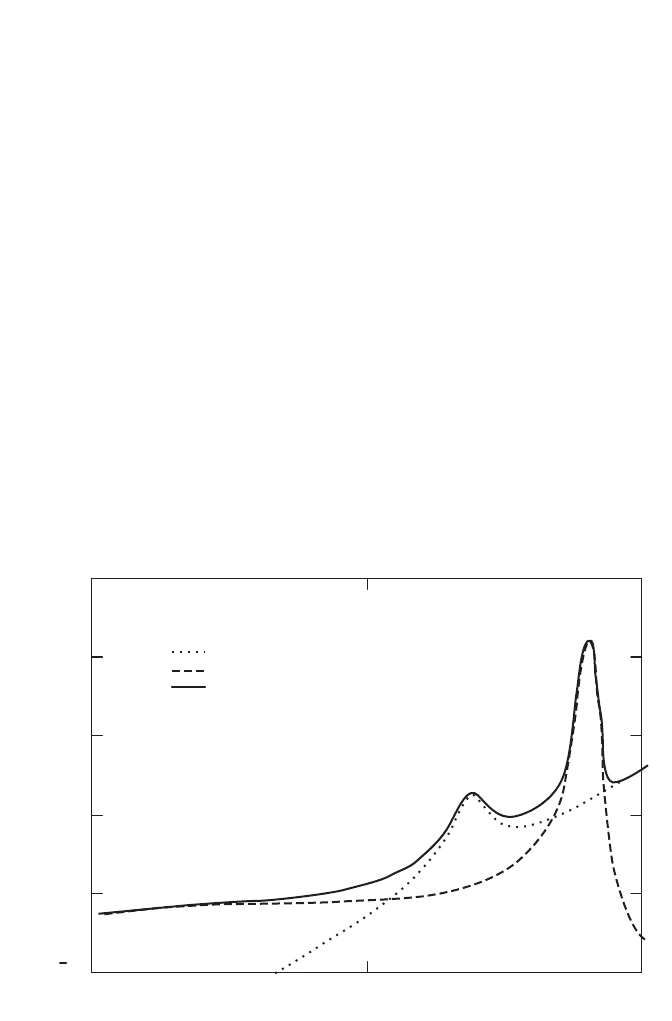
A plot of the predicted specific attenuation (loss in dB/km) due to atmos-
pheric absorption versus frequency was provided in Figure 6.4 and is presented
here in Figure 10.2. The total amount of absorption loss is determined by
multiplying the specific attenuation at the operating frequency by the link
distance.
Ld d
()
=
()()
20 4log lp dB
GG G P G R
L S Ant T Ant thresh
=+ = - -22
max
dB
GP R
S T thresh
=-
max
dB
220 RAIN ATTENUATION OF MICROWAVE AND MILLIMETER-WAVE SIGNALS
LINK BUDGET 221
Tx power
Tx loss
Tx antenna gain
Radome loss
EIRP
Path loss (FSL)
Alignment error
Rain fade
Multipath
Atmospheric loss
Interference
Total path losses
Total Rx gain
Sensitivity
Net margin
RSL
Radome loss
Rx antenna gain
Rx loss
20 dBm
52.5 dBm
–1.5 dB
–2 dB
–125 dB
–2 dB
–2 dB
–1 dB
–1 dB
–95.6 dBm
–96.0 dBm
0.4 dB
–2 dB
36 dB
33 dB
–181.1 dB
–0.13 dB
–51 dB
36 dB
freq =
d = 1.1 km
38.6 GHz
lambda =
PL =
Gamma =
0.007772
–125.001
0.12 dB/km
Link gain =
Adjusted link gain =
181.5
176.4
Figure 10.1 Typical link budget for a millimeter-wave communication link.
110
Frequency (GHz)
Specific Attenuation (dB/km)
100
1
.
10
3
0.01
0.1
1
10
100
water vapor
dry air
total
Specific Attenuation
Figure 10.2 ITU atmospheric attenuation prediction.