
Seybold J.S. Introduction to RF Propagation
Подождите немного. Документ загружается.

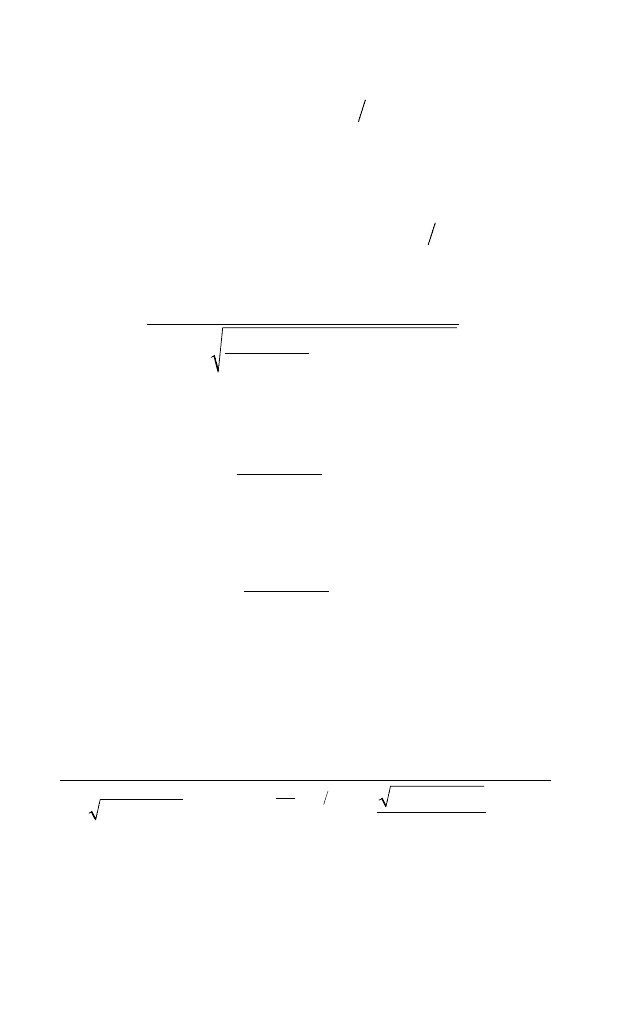
Step 3: Calculate the horizontal projection of L
sl
.
Step 4: Find the 0.01% rainfall rate for rain region K from Table 10.2.
Step 5: Calculate the specific attenuation for the frequency, polarization, and
rain rate.
Step 6: Compute the horizontal reduction factor.
Step 7: Compute the vertical adjustment factor.
Since z>q,
Since latitude > 36,
and
Step 8: Compute the effective path length
Step 9: Compute the 0.01% fade depth.
A
001
7 75 4 971 38 52
.
.. .=◊ = dB
L
E
=◊=3 925 1 267 4 971.. .km
v
e
001
180
40 9 1 0
2
1
1 40 9 31 1
3 925 7 75
30
045
1 267
.
.
sin .
..
.
.=
+∞
()
-
Ê
Ë
Á
ˆ
¯
˜
◊
-
Ê
Ë
Á
ˆ
¯
˜
=
-◊ +
()
Ê
Ë
Á
ˆ
¯
˜
p
c=0
L
R
=
◊
()
=
427 074
40 9
3 925
..
cos .
.km
z=
-
◊
Ê
Ë
ˆ
¯
=
-
tan
.
..
.
1
37 0
427 074
51 28 degrees
r
e
001
2427
1
1078
427 411
20
0381
0 695
.
.
.
..
.
.=
+
◊
--
()
=
-◊
g
R
=
()
=0 072 42 7 75
1 082
..
.
dB km
R
001
42
.
= mm h
L
G
=
()
=565 409 427. cos . . km
262 SATELLITE COMMUNICATIONS

Step 10: Compute the fade depth for 0.1% probability.
For these locations and angles,
and the expression for the 0.1% fade is
Thus the uplink rain fade can be expected to exceed 14.8 dB 0.1% of the
year.
Using a similar approach for the downlink, yields
The central angle is
from which the slant range is found,
and then the elevation angle to the satellite can be determined
The 20-GHz regression coefficients are
for circular polarization, the regression coefficients are
The 0.01% attenuation is
And finally the 0.1% fade depth is 16.85 dB.
Thus the downlink rain fade can be expected to exceed 16.85 dB 0.1%
of the year. In this case, the uplink and downlink fades are comparable. The
A
001
43 25
.
.= dB
k ==0 072 1 083., .a
k
k
HH
VV
==
==
0 075 1 099
0 069 1 065
., .
., .
a
a
q
DL
= 57 7. degrees
r
sDL
= 36 850,km
y
DL
= 27 7. degrees
Ll
Ll
ee
ss
==
==
26 80
090
degrees degrees
degrees degrees
,
,
A
01
0 655 0 033 0 1 0 045 38 52 0 1 0 1 40 9
38 52
01
001
14 8
.
. . ln . . ln . . sin .
.
.
.
.=
Ê
Ë
ˆ
¯
=
-+
()
-
()
--
()
∞
()()
dB
b=0
RAIN FADES 263

30-GHz uplink has slightly less attenuation even though it has the lower ele-
vation angle.This is due to the more moderate rain region in New York.The
rain in Miami is heavy enough to cause the lower-frequency (20-GHz)
downlink at the greater elevation angle to still have a slightly larger rain
fade.
To determine the overall link availability, the weather in Miami and New
York are treated as independent. Furthermore, it is clear that if either end
fades out, the link will drop. The probability of the link being out is one
minus the probability of both links being operational, which, since they are
independent, is simply the product of their probabilities.
䊐
11.7.2 Crane Rain Attenuation Model for Satellite Paths
The Crane global model [10, 11] is similar to the ITU model in that it also
employs the concept of rain regions for determining expected rain rates and
that the attenuation is a function of the range rate. It differs in that the data
are slightly different and the attenuation model is considerably different.
Crane provides rain data for a variety of rain probabilities, but does not use
an availability adjustment factor like the ITU model. Even so, experience
shows that the models generally produce results that are in reasonably close
agreement.
The process of determining the linear regression coefficients for the
specific attenuation due to rain is the same as for the ITU. In fact, the same
coefficients are used. The difference is that the specific rain rate for the
desired availability must be used. The rain rates versus probability are given
in Table 10A.4 for each of the Crane rain regions.
For ground-to-space links, the height of the rain cell must be taken into
account, just as it is with the ITU model. Crane uses rain cell height data that
are a function of latitude and probability [12]. As seen in Table 11.2, for 30
degrees latitude, the rain heights are
Crane gives a procedure for doing a logarithmic interpolation over
availability [13]:
(11.26)
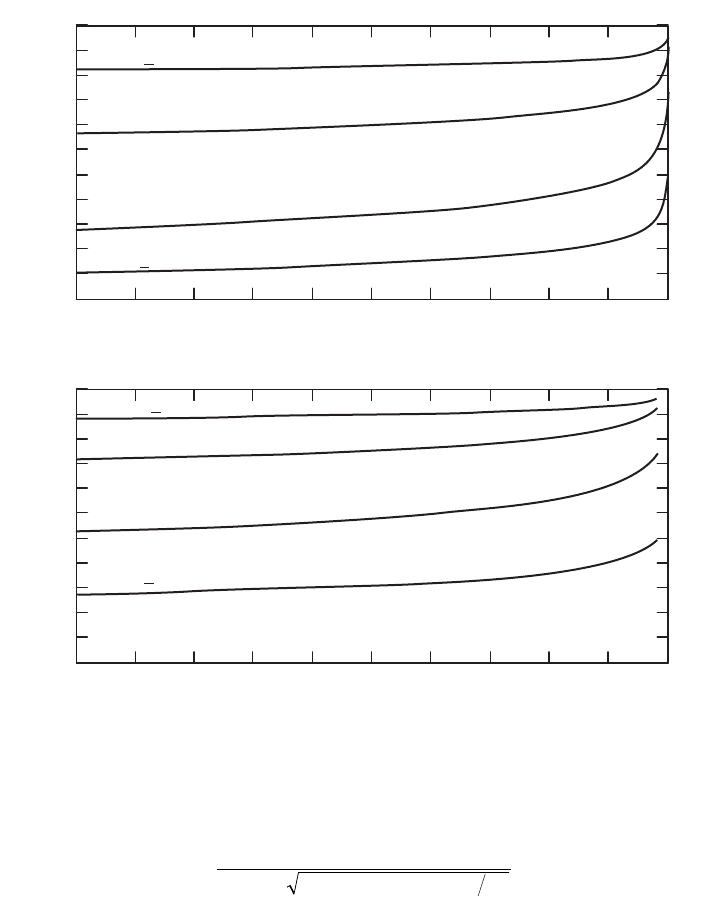
Figure 11.6 shows the interpolated rain cell height for several different lati-
tudes. For other latitudes, values from Table 11.2 should be used in (11.26).
Hp h
hh
p
R
()
=+
-
()
()
1
001 1
0 001ln .
ln
hp
1
394 1==.%km for
hp
001
5 35 0 001==..%km for
PPP
outage UL DL
=- = ¥
-
1 1 999 10 0 002
3
.~.
264 SATELLITE COMMUNICATIONS

RAIN FADES 265
TABLE 11.2 Crane Model Rain Cell Heights for
Different Latitudes
Latitude, North
Rain Height (km)
or South (deg) 0.001% 1%
£2 5.3 4.6
4 5.31 4.6
6 5.32 4.6
8 5.34 4.59
10 5.37 4.58
12 5.4 4.56
14 5.44 4.53
16 5.47 4.5
18 5.49 4.47
20 5.5 4.42
22 5.5 4.37
24 5.49 4.3
26 5.46 4.2
28 5.41 4.09
30 5.35 3.94
32 5.28 3.76
34 5.19 3.55
36 5.1 3.31
38 5 3.05
40 4.89 2.74
42 4.77 2.45
44 4.64 2.16
46 4.5 1.89
48 4.35 1.63
50 4.2 1.4
52 4.04 1.19
54 3.86 1
56 3.69 0.81
58 3.5 0.67
60 3.31 0.51
62 3.14 0.5
64 2.96 0.5
66 2.8 0.5
68 2.62 0.5
≥70 2.46 0.5
Source: Table 4.1 from Ref. 12, courtesy of John Wiley & Sons.
The approximate path length in rain is then
(11.27)
where
H
R
is the effective rain cell height
H
S
is the effective station height
z is the elevation angle
R
e
is the 4/3 earth radius, 8500 km
d
HH
HHR
RS
RSe
ª
-
()
()
+
()
+-
()
2
2
2
tan tanzz
266 SATELLITE COMMUNICATIONS
99 99.1 99.2 99.3 99.4 99.5 99.6 99.7 99.8 99.9 100
0
0.5
1
1.5
2
2.5
3
3.5
4
4.5
5
5.5
Crane Rain Cell Height vs. Availability
Availability (%)
Rain Cell Height (km)
99.95 99.955 99.96 99.965 99.97 99.975 99.98 99.985 99.99 99.995 100
0
0.5
1
1.5
2
2.5
3
3.5
4
4.5
5
5.5
Crane Rain Cell Height vs. Availability
Availability (%)
Rain Cell Height (km)
<2
∞
36
∞
50
∞
>70
∞
<2
∞
36
∞
50
∞
>70
∞
Figure 11.6 Rain cell height versus availability at 30 degrees latitude, for the Crane
global model.

The expression for terrestrial path rain attenuation is employed to determine
the horizontal path attenuation.
(11.28)
and
(11.29)
where d(RR) is a function of the rain rate,
(11.30)
d is link distance in km,
(11.31)
and
(11.32)
The total slant-path attenuation due to rain is then given by
(11.33)
where
(11.34)
The overall attenuation on an earth–space path ends up being a function of
the rain rate (availability), frequency and elevation angle, just as it does with
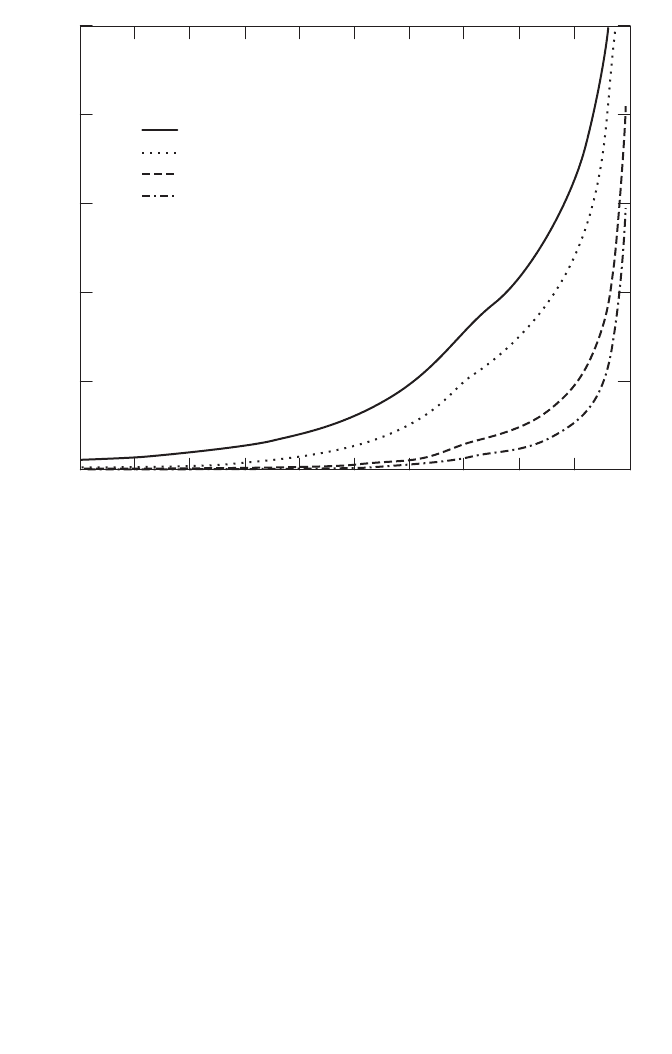
the ITU model. Figure 11.7 shows plots of the expected rain attenuation on
an earth–space path versus availability, for several elevation angles and
operating frequencies using the Crane model in rain region E.
When applying the Crane global model to slant paths with elevation angles
less than about 10 degrees, depending upon the availability and the rain cell
height, it is possible to compute a slant-path distance, d, that is greater than
22.5 km. Since this is beyond the valid range of the Crane model, the values
for Atten(RR,d) and hence A
s
are invalid. This can lead to bogus attenuation
L HR RHH HH HR
se eR S R S Se
=-
()()
+-
()
+-- +
()()
2
222
2sin sinzz
A
L
d
Atten
S
=
zRR=◊ -
()()
a 0 026 0 03..ln
y
RR
RR
RR=◊
-
()
()
+-
()
È
Î
Í
˘
˚
˙
a
d
083 017
026 003
..ln
..ln
d RR RR
()
=-
()
38 06. . ln km
Atten k RR
e
y
ee e
z
dB
RR d
yRR
zd
zRR RR
=◊
-
+
-
()
◊
È
Î
Í
˘
˚
˙
()
<<
◊
()
◊
◊
()
-
()
a
d
d
d
1
22 5
083 017..ln
,
. km
Atten k RR e y d RR
y
=◊ -
()
<<
()
◊
a
d
d10dB km,
RAIN FADES 267
estimates that can increase as the availability decreases. The author has found
that a viable work around for this circumstance is to replace Atten(RR,d) by
Atten(RR,22.5) in the expression for A
s
whenever d > 22.5 km.
Example 11.4. A ground station must communicate with a high-flying aircraft
with 99.9% rain availability. The aircraft is flying at 50,000ft and may appear
at elevation angles as low as 15 degrees. What fade margin should be used if
the ground station is located in Southern California and the frequency of oper-
ation is 10 GHz?
The aircraft altitude ensures that it will be flying above any heavy rainfall,
so this problem may be treated as a satellite rain attenuation problem. South-
ern California is in Crane rain region F and it is assumed that the latitude is
32 degrees, that the earth station altitude is near sea level, and that circular
polarization is used.
The regression coefficients for circular polarization at 10 GHz are readily
found to be
k ==0 009485 1 270., .a
268 SATELLITE COMMUNICATIONS
90 91 92 93 94 95 96 97 98 99 100
0
10
20
30
40
50
5 Deg El Crane-E
15 Deg El Crane-E
30 Deg El Crane-E
85 Deg El Crane-E
Rain Attenuation on an Earth-Space Path
Availability
Rain Attenuation (dB)
Figure 11.7 Rain attenuation values versus availability for different elevation angles
at 30 GHz using the Crane model in rain region E, at 30 degrees latitude.

using values from Table 10A.2 and t=45 degrees for circular polarization.
The 99.9% rain rate is found in Table 10A.4:
The rain height is found by interpolating values from Table 11.2 for 32 degrees:
The path distance in rain is given by
The next step is to compute d(RR):
Since d >d(RR), the horizontal path attenuation is given by
where
and
The resulting attenuation is then
The total slant-path attenuation due to rain for 99.9% availability is then given
by
where
A
L
d
Atten
s
=
Atten = 245.dB
y = 0 2175.
z =-0 0305.
Atten k RR
e
y
ee e
z
yRR
zd
zRR RR
=◊
-
+
-
()
◊
È
Î
Í
˘
˚
˙
◊
()
◊
◊
()
-
()
a
d
d
1
083 017..ln
dB
d 53 2799..
()
= km
d ª
-
()
()
+
()
+-
()
=
2 4 27 0
15 15 2 4 27 0 8500
15 87
2
.
tan tan .
.km
H
R
01 376
528 376
0 001
01 427.% .
..
ln .
ln . .
()
=+
-
()
()
= km
RR = 53.mmh
RAIN FADES 269
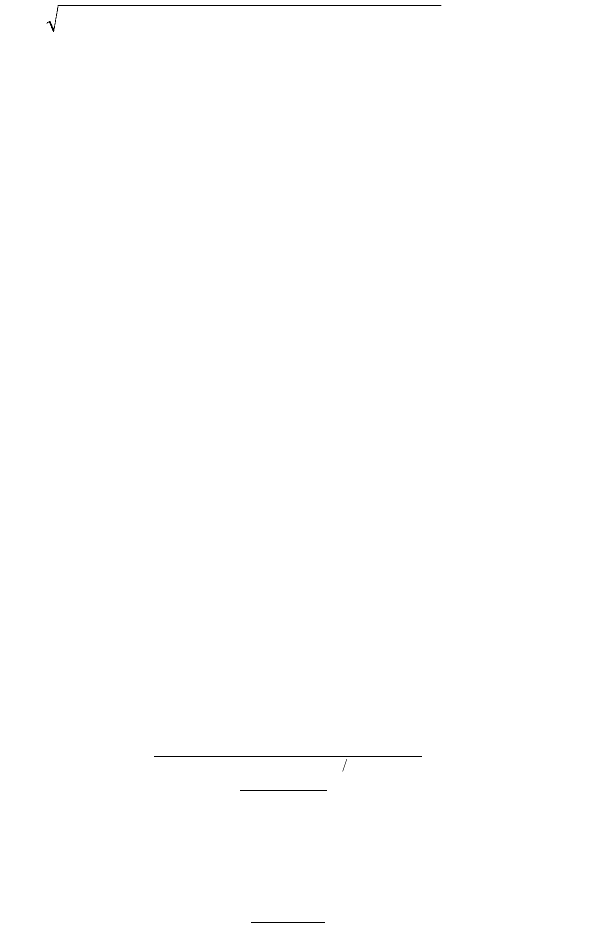
The result is
It is clear that the dry climate in California combined with a lower frequency
considerably reduces the impact of rain on link operation. 䊐
11.7.3 The DAH Rain Attenuation Model
The DAH rain attenuation model, developed by Dissanayake, Allnut, and
Haidara [14, 15] and also sometimes called the USA model, is a modification
of the ITU model presented earlier. The essential difference of the DAH
model is that it accounts for the fact that rain is nonhomogeneous in both the
vertical and horizontal directions. The DAH model can be implemented using
the following 10-step procedure [14].
Step 1: Compute the freezing height of the rain (analogous to the rain height
for the ITU model) using the station latitude, f.
(11.35a)
(11.35b)
Step 2: Determine the slant path below the freezing rain using the same pro-
cedure as the ITU model.
For q<5 degrees,
(11.36a)
Otherwise,
(11.36b)
where
q is the elevation angle
h
s
is the station height ASL in km
L
hh
s
Rs
=
-
()
()
sin q
km
L
hh
hh
R
s
fr s
fr s
e
=
-
()
()
+
-
()
Ê
Ë
ˆ
¯
+
()
2
2
2
12
sin sinqq
km
h
fr
=- -
()
≥∞5 0 0 075 23 23.. ,ff
h
fr
=∞<<∞50 23, f
A
S
= 246.dB
L HR RHH HH HR
Se eR S R S Se
=+
()()
+-
()
+-- +
()()
2
222
2sin sinzz
270 SATELLITE COMMUNICATIONS
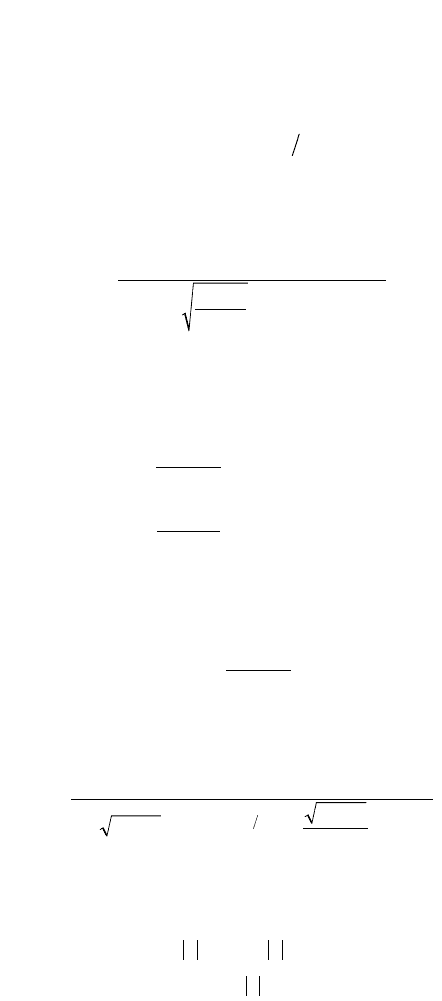
Step 3: Determine the horizontal projection of the slant-path length, just as
was done for the ITU model.
(11.37)
Step 4: Determine the specific attenuation due to rain for 0.01% availability
and the desired frequency and polarization, the same as for the ITU model.
(11.38)
Step 5: Compute the horizontal path adjustment factor for 0.01% of the time
using the same expression as was used for the ITU model.
(11.39)
where L
G
is in km and f is in GHz.
Step 6: Calculate the adjusted rainy path length.
(11.40a)
(11.40b)
where
(11.41)
Step 7: Compute the vertical adjustment factor analogous to the ITU model.
(11.42)
where
(11.43a)
(11.43b)
cf=≥∞036for
cf f=- <∞36 36for
rv
e
L
f
RR
001
1
2
1
1311 045
.
sin .
=
+
()
-
()
-
Ê
Ë
Á
ˆ
¯
˜
-+
()()
q
g
qc
z=
-
Ê
Ë
Á
ˆ
¯
˜
-
tan
.
1
001
hh
Lrh
fr s
g
L
hh
r
fr s
=
-
()
£
sin q
zqfor
L
Lrh
r
g
=
()
>
001.
cos q
zqfor
rh
L
f
e
GR
L
G
001
2
1
1078 0381
.
..
=
+--
()
-
g
g
R
kR=
()
001.
a
dB km
LL
Gs
=
()
cos q
RAIN FADES 271