
Seybold J.S. Introduction to RF Propagation
Подождите немного. Документ загружается.


242 RAIN ATTENUATION OF MICROWAVE AND MILLIMETER-WAVE SIGNALS
TABLE 10A.1 Linear Regression Coefficients for Determination of Specific
Attenuation Due to Rain as a Function of Polarization
Frequency (GHz) k
H
k
V
a
H
a
V
1 0.0000387 0.0000352 0.912 0.880
2 0.000154 0.000138 0.963 0.923
4 0.000650 0.000591 1.121 1.075
6 0.00175 0.00155 1.308 1.265
7 0.00301 0.00265 1.332 1.312
8 0.00454 0.00395 1.327 1.310
10 0.0101 0.00887 1.276 1.264
12 0.0188 0.0168 1.217 1.200
15 0.0367 0.0335 1.154 1.128
20 0.0751 0.0691 1.099 1.065
25 0.124 0.113 1.061 1.030
30 0.187 0.167 1.021 1.000
35 0.263 0.233 0.979 0.963
40 0.350 0.310 0.939 0.929
45 0.442 0.393 0.903 0.897
50 0.536 0.479 0.873 0.868
60 0.707 0.642 0.826 0.824
70 0.851 0.784 0.793 0.793
80 0.975 0.906 0.769 0.769
90 1.06 0.999 0.753 0.754
100 1.12 1.06 0.743 0.744
120 1.18 1.13 0.731 0.732
150 1.31 1.27 0.710 0.711
200 1.45 1.42 0.689 0.690
300 1.36 1.35 0.688 0.689
400 1.32 1.31 0.683 0.684
Source: Table 1 from Ref. 10, courtesy of the ITU.
APPENDIX 10A: DATA FOR RAIN ATTENUATION MODELS

DATA FOR RAIN ATTENUATION MODELS 243
TABLE 10A.2 Interpolated Regression Coefficients for 1–40 GHz
f(GHz) k
H
a
H
k
V
a
V
1 3.87 ¥ 10
-5
0.912 3.52 ¥ 10
-5
0.88
2 1.54 ¥ 10
-4
0.963 1.38 ¥ 10
-4
0.923
3 3.576 ¥ 10
-4
1.055 3.232 ¥ 10
-4
1.012
4 6.5 ¥ 10
-4
1.121 5.91 ¥ 10
-4
1.075
5 1.121 ¥ 10
-3
1.224 1.005 ¥ 10
-3
1.18
6 1.75 ¥ 10
-3
1.308 1.55 ¥ 10
-3
1.265
7 3.01 ¥ 10
-3
1.332 2.65 ¥ 10
-3
1.312
8 4.54 ¥ 10
-3
1.327 3.95 ¥ 10
-3
1.31
9 6.924 ¥ 10
-3
1.3 6.054 ¥ 10
-3
1.286
10 0.01 1.276 8.87E-3 1.264
11 0.014 1.245 0.012 1.231
12 0.019 1.217 0.017 1.2
13 0.024 1.194 0.022 1.174
14 0.03 1.173 0.027 1.15
15 0.037 1.154 0.034 1.128
16 0.043 1.142 0.039 1.114
17 0.05 1.13 0.046 1.101
18 0.058 1.119 0.053 1.088
19 0.066 1.109 0.061 1.076
20 0.075 1.099 0.069 1.065
21 0.084 1.091 0.077 1.057
22 0.093 1.083 0.085 1.05
23 0.103 1.075 0.094 1.043
24 0.113 1.068 0.103 1.036
25 0.124 1.061 0.113 1.03
26 0.135 1.052 0.123 1.024
27 0.147 1.044 0.133 1.017
28 0.16 1.036 0.144 1.011
29 0.173 1.028 0.155 1.006
30 0.187 1.021 0.167 1
31 0.201 1.012 0.179 0.992
32 0.216 1.003 0.192 0.985
33 0.231 0.995 0.205 0.977
34 0.247 0.987 0.219 0.97
35 0.263 0.979 0.233 0.963
36 0.279 0.971 0.247 0.956
37 0.296 0.962 0.262 0.949
38 0.314 0.954 0.278 0.942
39 0.332 0.947 0.294 0.935
40 0.35 0.939 0.31 0.929

244 RAIN ATTENUATION OF MICROWAVE AND MILLIMETER-WAVE SIGNALS
TABLE 10A.3 ITU Rainfall Rates
a
for Different Probabilities and Rain Regions
Percentage
of Time (%) A B C D E F G H J K L M N P Q
1.0 <0.1 0.5 0.7 2.1 0.6 1.7 3 2 8 1.5 2 4 5 12 24
0.3 0.8 2 2.8 45 2.4 4.5 7 4 13 4.2 7 11 15 34 49
0.1 2 3 5 8 6 8 12 10 20 12 15 22 35 65 72
0.03 5 6 9 13 12 15 20 18 28 23 33 40 65 105 96
0.01 8 12 15 19 22 28 30 32 35 42 60 63 95 145 115
0.003 14 21 26 29 41 54 45 55 45 70 105 95 140 200 142
0.001 22 32 42 42 70 78 65 83 55 100 150 120 180 250 170
a
Rainfall intensity exceeded (mm/h).
Source: Table 1 from Ref. 11, courtesy of the ITU.
DATA FOR RAIN ATTENUATION MODELS 245
TABLE 10A.4 Crane Rain Rates for Different Probabilities and Rain Regions
Percent A B B1 B2 C D1 D2 D3 E F G H
of Year RR RR RR RR RR RR RR RR RR RR RR RR
5 0 0.2 0.1 0.2 0.3 0.2 0.3 0 0.2 0.1 1.8 1.1
3 0 0.3 0.2 0.4 0.6 0.6 0.9 0.8 1.8 0.1 3.4 3.3
2 0.1 0.5 0.4 0.7 1.1 1.2 1.5 2 3.3 0.2 5 5.8
1 0.2 1.2 0.8 1.4 1.8 2.2 3 4.6 7 0.6 8.4 12.4
0.5 0.5 2 1.5 2.4 2.9 3.8 5.3 8.2 12.6 1.4 13.2 22.6
0.3 1.1 2.9 2.2 3.4 4.1 5.3 7.6 11.8 18.4 2.2 17.7 33.1
0.2 1.5 3.8 2.9 4.4 5.2 6.8 9.9 15.2 24.1 3.1 22 43.5
0.1 2.5 5.7 4.5 6.8 7.7 10.3 15.1 22.4 36.2 5.3 31.3 66.5
0.05 4 8.6 6.8 10.3 11.5 15.3 22.2 31.6 50.4 8.5 43.8 97.2
0.03 5.5 11.6 9 13.9 15.6 20.3 28.6 39.9 62.4 11.8 55.8 125.9
0.02 6.9 14.6 11.3 17.6 19.9 25.4 34.7 47 72.2 15 66.8 152.4
0.01 9.9 21.1 16.1 25.8 29.5 36.2 46.8 61.6 91.5 22.2 90.2 209.3
0.005 13.8 29.2 22.3 35.7 41.4 49.2 62.1 78.7 112 31.9 118 283.4
0.003 17.5 36.1 27.8 43.8 50.6 60.4 75.6 93.5 130 41.4 140.8 350.3
0.002 20.9 41.7 32.7 50.9 58.9 69 88.3 106.6 145.4 50.4 159.6 413.9
0.001 28.1 52.1 42.6 63.8 71.6 86.6 114.1 133.2 176 70.7 197 542.6
Source: Table 3.1 from Ref. 2, courtesy of John Wiley & Sons.

246
Introduction to RF Propagation, by John S. Seybold
Copyright © 2005 by John Wiley & Sons, Inc.
CHAPTER 11
Satellite Communications
11.1 INTRODUCTION
There are numerous applications of satellite systems, including remote sensing
(SAR, IR, visual), communication links for telephone, aircraft, and military
purposes, mobile communications such as satphones, Iridium, and so on, direct
broadcast satellite TV, navigation systems such as GPS, and communication
eavesdropping for intelligence collection. While each of these objectives have
their own unique requirements, all satellite systems share certain characteris-
tics and operate in the same kind of environment. It is also essential that all
man-made satellites be able to communicate with their terrestrial control sta-
tions regardless of their primary mission.
Satellite communication links entail a signal traversing the entire
atmosphere and therefore can suffer significantly due to atmospheric factors,
depending upon the frequency. In addition, the distances involved are consid-
erable, so the free-space loss is much larger than it is for terrestrial links. The
costs of reaching orbit dictates that satellite aperture size and transmit power
are at a premium, making reliable link design a challenge.
In this chapter, many of the channel impairments that have been previously
discussed are revisited and it is shown how they are applied to satellite com-
munication links. First the various types of satellite orbits and their charac-
teristics are briefly examined, followed by determination of the range to the
satellite. Computation of the actual line-of-sight or slant-range distance to the
satellite is somewhat complicated by the curvature of the earth. Once the dis-
tance to the satellite has been determined and the free-space loss calculated,
other link impairments must be considered. These include atmospheric atten-
uation (gaseous absorption, rain, clouds, and fog), and ionospheric effects. A
considerable amount of time is spent on the atmospheric absorption and rain
attenuation, even though they have been covered in earlier chapters. This is
for two reasons: (a) At the frequencies of interest for most satellite links, rain
and atmospheric attenuation can be significant, and (b) The computation of
these losses is somewhat different than for the terrestrial case.
The unique aspects of antennas for satellite communications are discussed,
including sky noise and radome effects. It is also imperative that a satellite link
analysis takes into account the fact that many of the atmospheric losses are
absorptive in nature and therefore raise the apparent receiver noise floor, by
effectively increasing the sky temperature. This often-overlooked effect can
cause errors of several dB in computing link performance for low-noise
receivers.
Scintillation is a form of fast fading that can be attributed to multipath from
variations in the ionosphere or the troposphere. While the mechanisms of
these two types of scintillation are different, the effect on the communication
link is similar: A variation in signal strength that may cause tracking, detec-
tion, and AGC problems. Tropospheric scintillation can be problematic for
nearly horizontal paths, but is rarely a concern for satellite paths. Tropospheric
scintillation is due to variations in temperature and humidity and can apply to
frequencies as high as 30 GHz. Since the lower atmosphere is usually hori-
zontally stratified, this effect is most pronounced at low elevation angles [1].
Ionospheric scintillation only affects signals below 10 GHz, but is not sensitive
to elevation angle. Other ionospheric phenomena that are of concern for satel-
lite links include propagation delay, dispersion, and Faraday rotation.
Foliage can also be a significant signal attenuator. In some cases the losses
due to foliage are so large that the designer simply treats them as blockages.
In the case of a mobile system, this results in brief outages or reduced data
throughput. For static systems, this approach renders some locations unsuit-
able. A prime example of this is that North American homes with large trees
blocking their line of sight to the southwestern sky cannot receive Direct TV.
11.2 SATELLITE ORBITS
Satellite orbits are loosely grouped into four categories: low earth orbit
(LEO), medium earth orbit (MEO), geosynchronous orbit (GEO), and high
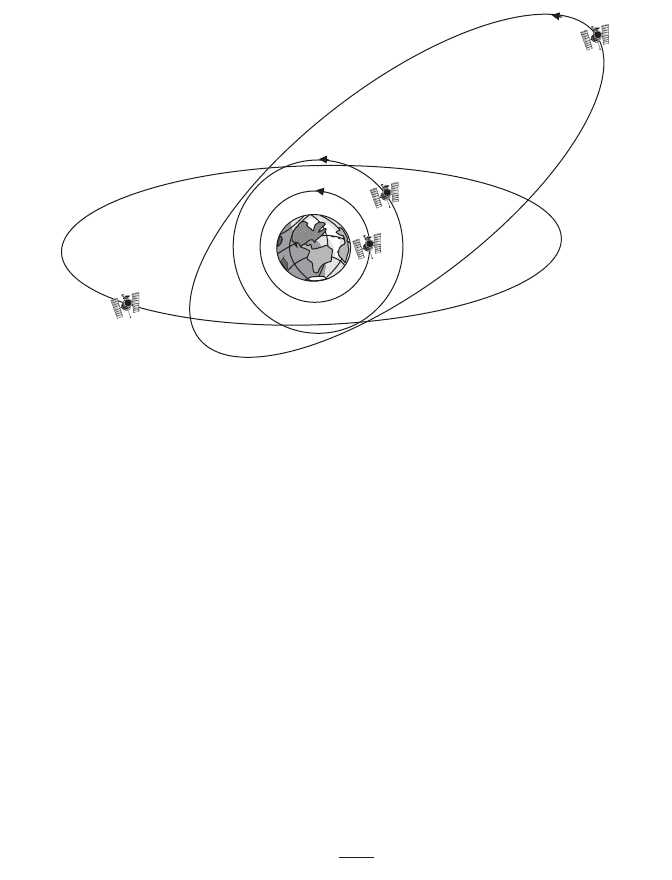
earth orbit (HEO). Figure 11.1 shows the relationships among the different
orbits [2].
The corresponding orbital altitudes (above the earth’s surface) are
LEO, 500–900 km
MEO, 5000–12,000 km
GEO, 36,000 km*
HEO, 50,000 km
These definitions are not universal and may be applied rather casually. HEO
satellites have an elliptical orbit, which may be very near the earth at its low
SATELLITE ORBITS 247
* More precisely, 35,786km from Ref. 2, pp. 19 and 35.
point (perigee) and will have a period greater than one sidereal day (23.9344 h,
one earth rotation). HEO is often used for scientific applications.
Geosynchronous satellite orbits have an orbital period of exactly one side-
real day and move about in a relatively small angular window, depending upon
the orbital inclination. If a geosynchronous orbit has an inclination angle of
zero relative to the equator, then the satellite will remain directly above the
earth’s equator and appear virtually stationary from the earth’s surface. This
special case of geosynchronous orbit is called geostationary orbit (GSO). GEO
(and GSO) satellites have little or no relative motion, while all others pass
through the sky and produce significant Doppler shift on any electromagnetic
waves that are transmitted to or received from the earth.
With the exception of geostationary satellites, the free-space loss will vary
with time as the satellite orbits the earth. The direction and magnitude of the
Doppler shift will also vary with time as the satellite passes overhead. The
Doppler shift depends upon the frequency of operation and is given by
(11.1)
where f
0
is the center frequency and v
r
is the relative velocity between the
satellite and the earth terminal.
While geostationary satellites have the advantage of minimal Doppler shift,
the corresponding higher orbital altitude produces a much longer time delay
and greater free-space loss than the lower orbits. Geosynchronous satellites,
while not stationary, tend to move at a lower rate (relative to the earth) than
LEOs, MEOs, and HEOs, which relaxes the Doppler and angular tracking
requirements. The time delay can be a concern for satellite communications,
f
vf
c
d
r
=
0
248 SATELLITE COMMUNICATIONS
HEO
LE
O
ME
O
GEO
Figure 11.1 Satellite orbits.
especially for HEOs and GEOs. For GEO orbits where the round trip is
72,000 km, the corresponding delay is approximately 240 ms. The greater path
loss and signal delay for GEO satellites relative to LEOs and MEOs are
somewhat offset by the reduced tracking requirements.
11.3 SATELLITE OPERATING FREQUENCY
Satellite communications occur from frequencies of tens of MHz, to 40 GHz
and beyond. The higher frequencies permit much greater bandwidth, which
permits greater data flow and can reduce power requirements. This is a
significant consideration as bandwidth demands increase and the electro-
magnetic spectrum becomes more crowded. Higher frequencies also permit
greater antenna gain for a given aperture size. Conversely, lower frequencies
have less propagation losses (gaseous, clouds, rain) as well as less free-space
loss and are better able to penetrate buildings and foliage. Any regulatory
restrictions in the geographic areas covered by the satellite must also be taken
into account. Thus the choice of operating frequencies includes many
considerations.
A recent trend has been toward ka-band satellites, which use 30-GHz uplink
and 20.2-GHz downlink frequencies. The wide separation in frequency makes
transmit-to-receive isolation easier to attain. The reason for this migration to
higher frequencies is spectral crowding, antenna aperture size restrictions, and
an improved understanding of rain attenuation in the ka band due in large
part to the ACTS experiment [3]. Higher frequency (and satellite power) is
what has made direct broadcast television possible. It was not that long
ago that having satellite TV required a fairly large C-band antenna in the
backyard.
Literally on the opposite end of the spectrum are the amateur radio satel-
lites (more correctly, satellite payloads because they usually piggy back on
a larger satellite). The amateur satellites often use 140-MHz uplinks and
30-MHz downlinks, or 440-MHz uplinks and 145-MHz downlinks.The primary
motivation for these frequency selections is the wide availability and low cost
of amateur equipment in these bands. This permits the satellite to service the
largest possible segment of the amateur community. All amateur satellites
are LEOs because the path loss of the higher orbits would make low-cost
communications very difficult. By using LEOs, low-power and omnidirection
antennas can be used to communicate (albeit briefly) from one ground station
to another. Leo satellites also permit worldwide usage.
11.4 SATELLITE PATH FREE-SPACE LOSS
The largest path loss element in a satellite link is of course the free-space loss,
which is a function of the distance between the ground station and the
satellite and the frequency or wavelength. The distance to the satellite is a
SATELLITE PATH FREE-SPACE LOSS 249
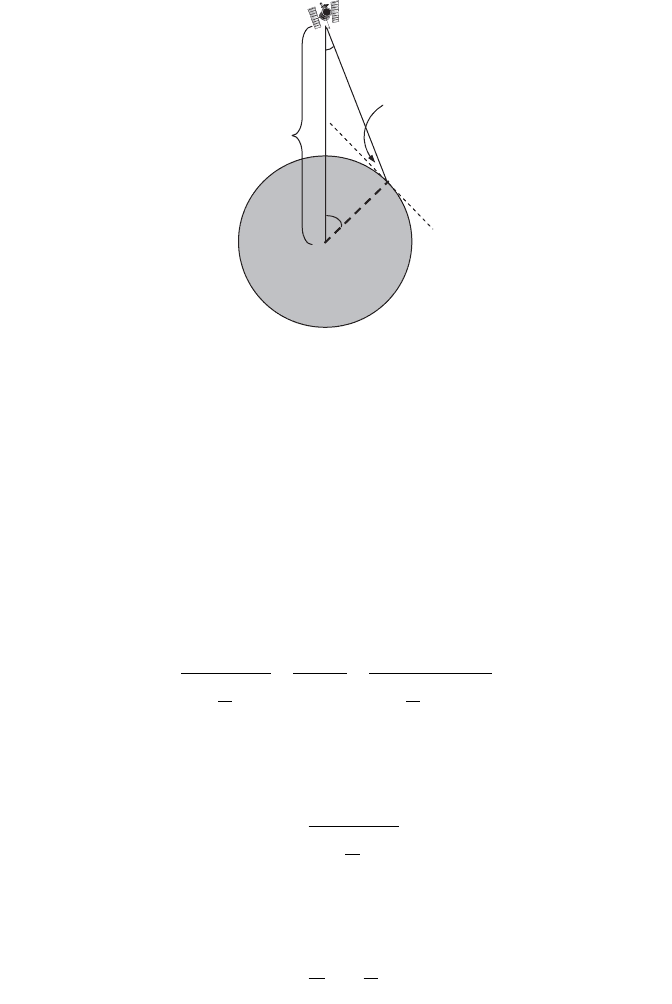
function of the satellite altitude and elevation angle at which it is viewed
(due to the earth’s curvature) [4]. Figure 11.2 shows the geometry, where
r
e
is the earth’s radius (6378km)
h is the satellite height above the center of the earth
q is the elevation angle at which the satellite appears
The law of sines provides the relationships needed to solve for r
s
:
so
(11.2)
where the central angle is given by
(11.3)
If the elevation angle, q, is not known, the central angle can be found using
the expression [4]
y
p
qq=+
Ê
Ë
ˆ
¯
Ê
Ë
ˆ
¯
-
-
cos sin
1
2
r
h
e
r
h
s
=
()
+
Ê
Ë
ˆ
¯
sin
sin
y
p
q
2
hr r
se
sin
sin
sin
p
q
yp
qy
22
+
Ê
Ë
ˆ
¯
=
()
=
--
Ê
Ë
ˆ
¯
250 SATELLITE COMMUNICATIONS
r
e
h
r
s
q
y
Figure 11.2 Satellite slant-path geometry.
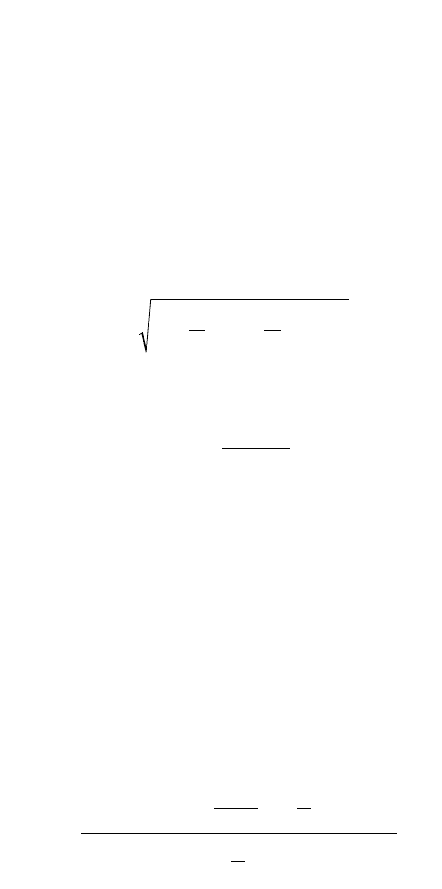
(11.4)
where
L
e
is the earth station latitude
l
e
is the earth station longitude
L
s
is the subsatellite latitude
l
s
is the subsatellite longitude
With the central angle known, the slant-path distance and elevation angle are
readily found using
(11.5)
and
(11.6)
Alternatively, one may use the slant range to the satellite (if known) and its
height, to solve for the elevation angle using the law of cosines. Note that the
actual earth radius is used in this calculation, not the 4/3’s approximation [4].
The 4/3’s earth approximation is only appropriate for terrestrial paths that are
nearly horizontal and simply aids in finding the radio horizon. The effect of
refraction on the elevation angle is negligible for slant paths with elevation
angles greater than 2–3 degrees [5].
In the case of a GEO satellite, the height is fixed, so the communication
distance becomes a function of the elevation angle, which is, in turn, a
function of the location (latitude, longitude) of the earth terminal. With
h
GEO
= 42,242 km,
(11.7)
This distance is then used in the Friss free-space loss equation to determine
the free-space path loss to the satellite.
Example 11.1. What is the elevation angle and path distance between a
geostationary satellite and its earth terminal if the earth terminal is located at
20 degrees latitude? You may assume that the satellite and earth station are
at the same longitude, -90 degrees.
r
h
r
h
s
GEO
e
GEO
=
+
Ê
Ë
ˆ
¯
Ê
Ë
ˆ
¯
-
Ê
Ë
ˆ
¯
+
Ê
Ë
ˆ
¯
-
sin cos sin
sin
1
2
2
p
p
qq
q
cos
sin
q
y
()
=
()
h
r
s
rh
r
h
r
h
s
ee
=+
Ê
Ë
ˆ
¯
-
Ê
Ë
ˆ
¯
()
12
2
cos y
cos cos cos cos sin siny
()
=
() ()
-
()
+
() ()
LLll LL
esse es
SATELLITE PATH FREE-SPACE LOSS 251