
Seybold J.S. Introduction to RF Propagation
Подождите немного. Документ загружается.

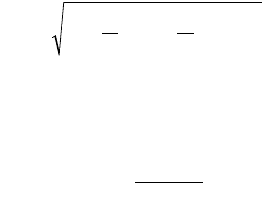
The earth station is at 20 degrees latitude and the geostationary satellite is
by definition at 0 degrees latitude, so y=20 degrees in Figure 11.2. It is known
that h = 42,242 km and r
e
= 6378 km, so
implies that r
s
= 36,314 km. Using this value for r
s
, the elevation angle can now
be determined from
which yields q=66.6 degrees. 䊐
11.5 ATMOSPHERIC ATTENUATION
When considering atmospheric absorption on a slant path, the variation of the
atmosphere with altitude must be considered. While temperature, pressure,
and water vapor content may be constant for terrestrial paths over limited dis-
tances, a slant path will cross a continuum of conditions as it passes up through
the atmosphere. Mathematically, this can be treated as if the atmosphere
were made up of discrete layers. When the slant path completely exits the
troposphere such as for an earth-to-space link, the attenuation estimate may
be based on the entire columnar oxygen and water vapor content of the
atmosphere. In this case, the total length of the path is no longer a factor in
computing atmospheric loss, since only the length of the segment that is within
the atmosphere contributes to the attenuation.
The ITU provides a detailed model, called the line-by-line model for deter-
mining the specific attenuation of the atmosphere [6]. The most accurate esti-
mate of slant-path attenuation is obtained by integrating the results of the ITU
line-by-line specific attenuation over altitude [6]. Because of its complexity, it
is not often employed in practice, but instead a curve fit, also provided in Ref.
6, is used to predict the specific attenuation with less than a 15% error. For
most applications, this simplified calculation presented in Ref. 6 is sufficient.
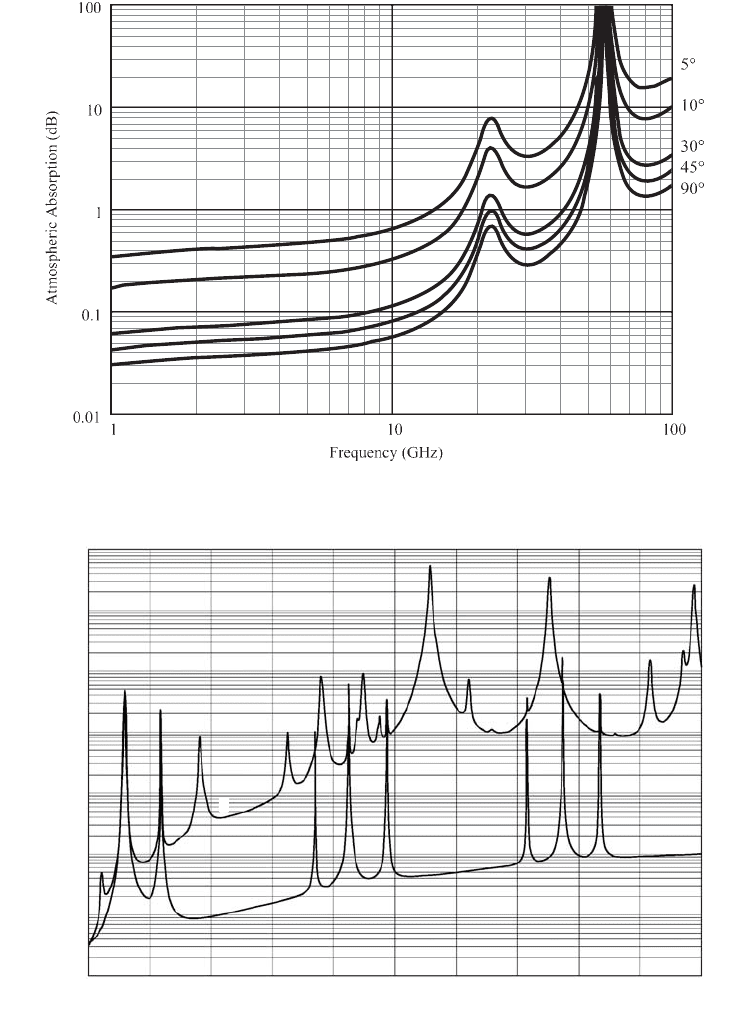
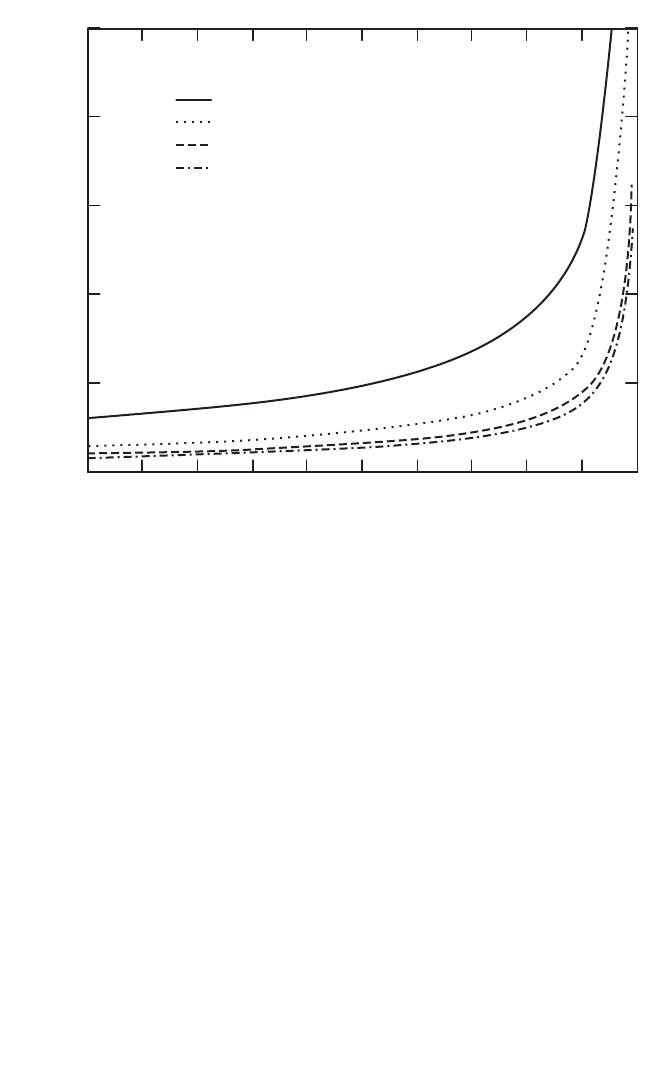
Figure 11.3 shows a plot of the slant-path attenuation versus frequency for
several elevation angles that was generated using the simplified approach. The
simplified approach uses standard atmosphere specific attenuations, equiva-
lent heights, and the elevation angle of the path to provide an estimate of total
attenuation that is within 10% of the more detailed computation. This method
is valid for elevation angles between 5 and 90 degrees, ground station altitudes
between 0 and 2 km, and frequencies that are more than 500 MHz away from
the centers of the resonance lines (shown in Figure 11.4). The path attenua-
tion is given by
cos
sin
q
y
()
=
()
h
r
s
rh
r
h
r
h
s
ee
=+
Ê
Ë
ˆ
¯
-
Ê
Ë
ˆ
¯
()
12
2
cos y
252 SATELLITE COMMUNICATIONS
ATMOSPHERIC ATTENUATION 253
Figure 11.3 Atmospheric absorption for an earth–space path.
10
5
10
4
10
3
10
2
10
–1
10
–2
2
0 100 200 300 400 500 600 700 800 900 1000
5
2
5
2
5
2
5
2
5
2
5
10
1
Frequency, f(GHz)
Zenith attenuation (dB)
A
B
Figure 11.4 Zenith attenuation due to atmospheric gases. Curve A: Mean global ref-
erence atmosphere (7.5 g/m
3
at sea level). Curve B: Dry atmosphere. (Figure 3 from
Ref. 6, courtesy of the ITU.

(11.8)
The specific attenuations for oxygen and water vapor (g
0
and g
w
, respectively)
are the same values used for terrestrial links from Figure 10.1, q is the eleva-
tion angle, and h
0
and h
w
are the equivalent oxygen and water vapor heights,
respectively.
For 1 £ f £ 56.7GHz,
For 56.7 < f < 63.3GHz,
For 63.3 £ f < 98.5GHz,
For 98.5 £ f £ 350GHz,
The equivalent water vapor height is given by
for f £ 350 GHz.
This method is valid for ground terminal altitudes of 2 km and below. For
slant paths to high-altitude aircraft or satellites, the entire troposphere is
traversed and the expected attenuation varies only with the geographical
location (environmental conditions) and frequency.Therefore the atmospheric
loss does not depend on the actual link distance.
Example 11.2. Determine the gaseous absorption on a 20-degree slant path
to a satellite if the frequency is 20GHz. Assume standard atmospheric param-
eters and that the ground station is at sea level.
h
fff
w
=+
-
()
+
+
-
()
+
+
-
()
+
Ï
Ì
Ó
¸
˝
˛
165 1
161
22 23 2 91
333
183 3 4 58
190
325 1 3 34
222
.
.
..
.
..
.
..
km
hff
f
0
362
2
5 542 1 76414 10 3 05354 10
6 815
118 75 0 321
=- ¥+ ¥ +
-
()
+
--
.. .
.
..
km
hf
ff
ff
f
0
362
42 2
0 039581 1 19751 10 9 14810 10
1 0 028687 2 07858 10
90 6
60
=
-¥+¥
-+◊
È
Î
Í
˘
˚
˙
+
-
()
--
-
.. .
..
.
km
h
0
10= km
hfff
f
0
23253
2
5 386 3 32734 10 1 87185 10 3 52087 10
83 26
60 1 2
=- ¥+ ¥ - ¥
+
-
()
+
-- -
.. . .
.
.
km
A
hh
ww
=
+
()
00
gg
qsin
dB
254 SATELLITE COMMUNICATIONS
The easiest method to determine the expected attenuation is to interpolate
between the 10- and 30-degree curves in Figure 11.3. By interpolating, the
attenuation can be estimated to be about 1.4 dB for the entire path. 䊐
11.6 IONOSPHERIC EFFECTS
The ionosphere has many effects on electromagnetic waves, which apply
primarily below 10 GHz and are pronounced below 1 GHz. The effects of the
ionosphere correlate with sun spot activity and the diurnal cycle. Possible
effects include: fading, which can be significant (20 dB or more); depolarization
or Faraday rotation, time delay; and dispersion (differential time delay). Table
11.1 provides a summary of ionospheric effects for several frequencies at a
30-degree elevation angle.
Faraday rotation is an angular rotation of the polarization vector. For cir-
cular polarization, the only impact is to change the angle between the two sets
of polarization axes, which can degrade the cross-polarization isolation and
increase the cross-polarization loss if the antennas are not perfectly circularly
polarized. This is only significant in systems that have a significant axial ratio
loss to begin with (see Chapter 3 for more details). The relative insensitivity
of circular polarization to Faraday rotation is one reason circular polarization
is often used in satellite communications, particularly below 10 GHz. If linear
polarization is used, for maximum energy transfer the antenna polarization
axes must be aligned, which can be difficult for space communication even
without the effect of Faraday rotation.
Propagation delay may be important in some time critical systems such as
navigation or GPS. If two carriers are available, however, it is possible to use
the 1/f
2
relationship to estimate the additional propagation delay and remove
it. This is done with GPS receivers that use both the L1 and L2 frequencies.
This was one of the techniques that military GPS used to outperform civilian
GPS. Recent changes to the GPS satellite constellation and operating doctrine
have made dual frequency operation and the accompanying delay correction
available to civilian systems as well.
It is interesting that most of the refraction values in the table are on the
order of minutes and seconds, not degrees. Only at the HF frequencies is the
refraction significant enough to bend the rays back to earth. The remaining
effects are negligible below 1 GHz, with the exception of scintillation.
11.7 RAIN FADES
As discussed in Chapter 10, hydrometeors can cause attenuation, scattering,
and depolarization of electromagnetic waves. Rain cell models such as Crane
or ITU are employed to predict the rain fade depth that will occur with a given
RAIN FADES 255

256 SATELLITE COMMUNICATIONS
TABLE 11.1 Ionospheric Effects for Several Different Frequencies at 30-Degree Elevation Angle
Frequency
Effect Dependence 0.1 GHz 0.25 GHz 0.5 GHz 1 GHz 3 GHz 10 GHz
Faraday rotation 1/f
2
30 rotations 4.8 rotations 1.2 rotations 108° 12° 1.1°
Propagation delay 1/f
2
25 ms4ms1ms 0.25 ms 0.028 ms 0.0025 ms
Refraction 1/f
2
<1° <0.16° <2.4¢<0.6¢<4.2≤<0.36≤
Variation in the 1/f
2
20¢ 3.2¢ 48≤ 12≤ 1.32≤ 0.12≤
direction of arrival
(rms)
Absorption (auroral ª1/f
2
5 dB 0.8 dB 0.2 dB 0.05 dB 6 ¥ 10
-3
dB 5 ¥ 10
-4
dB
and/or polar cap)
Absorption (mid- 1/f
2
<1dB <0.16 dB <0.04 dB <0.01 dB <0.001 dB <1 ¥ 10
-4
dB
latitude)
Dispersion 1/f
3
0.4 ps/Hz 0.026ps/Hz 0.0032 ps/Hz 0.0004 ps/Hz 1.5 ¥ 10
-5
ps/Hz 4 ¥ 10
-7
ps/Hz
Scintillation
a
See Rec. See Rec. See Rec. See Rec. >20 dB ª10 dB ª4dB
ITU-R P.531 ITU-R P.531 ITU-R P.531 ITU-R P.531 Peak-to-peak Peak-to-peak Peak-to-peak
a
Values observed near the geomagnetic equator during the early night-time hours (local time) at equinox under conditions of high sunspot number.
Source: Table 1 from Ref. 1 courtesy of the ITU.

probability. The depth of a rain fade is correlated with rain rate and highly
correlated with the transmit frequency. The rain fade depth, duration, and fre-
quency of occurrence are highly dependent upon geographical location and
even at a given location can vary considerably year-to-year. The modeling of
rain fades for satellite links is similar to that for terrestrial links, albeit a little
more complex, since the model must account for the variation in rain density
with altitude. Rain statistics (for terrestrial or satellite links) tend to be cyclo-
stationary on a month-to-month basis, meaning that the statistics for a partic-
ular month are consistent from year-to-year, but the statistics from one month
to the next are not.
11.7.1 ITU Rain Attenuation Model for Satellite Paths
The amount of fading due to rain is a function of the frequency and is highly
correlated with rain rate. By using rain statistics for a given region, it is possi-
ble to determine the probability that a given fade depth will be exceeded. The
rain availability of a communication link is the complement of the probabil-
ity of the link fade margin being exceeded. The ITU [7] provides global rain
statistics by dividing the earth into rain regions and assigning a rain rate to
each region along with the probability of that rain rate being exceeded. The
ITU model used here employs only the 0.01% rain statistics and then applies
an adjustment factor to the predicted rain fade depth for other probabilities.
For ground-to-space and ground-to-airborne links, the statistical height of
the rain cell must be taken into account [1, 8]. The assumption is that for
ground-to-airborne links, the airborne platform altitude is above the tropo-
sphere. When this assumption holds, the slant-path rain attenuation is no
longer a function of the link distance. The latest ITU recommendation [8] ref-
erences a text file of rain cell height data as a function of latitude and longi-
tude. A less accurate, but nonetheless widely employed, method of computing
the expected rain cell height as a function of latitude and the rainfall rate is
to use the expression from an earlier recommendation [9]. For latitudes less
than 36 degrees, the rain cell height is assumed to be 4 km. For higher latitudes,
the rain cell height is taken to be
(11.9)
In central Florida then, the nominal rain cell height is 3.6 km.
The ITU [1] gives a 10-step procedure for computing the rain attenuation
on a satellite path. That procedure is paraphrased here.
Step 1: Determine the rain height, h
R
.
Step 2: Determine the length of the slant path that is below the top of the rain
cell.
For q<5°,
h
R
=- - ∞
()
4 0 075 36. latitude
RAIN FADES 257
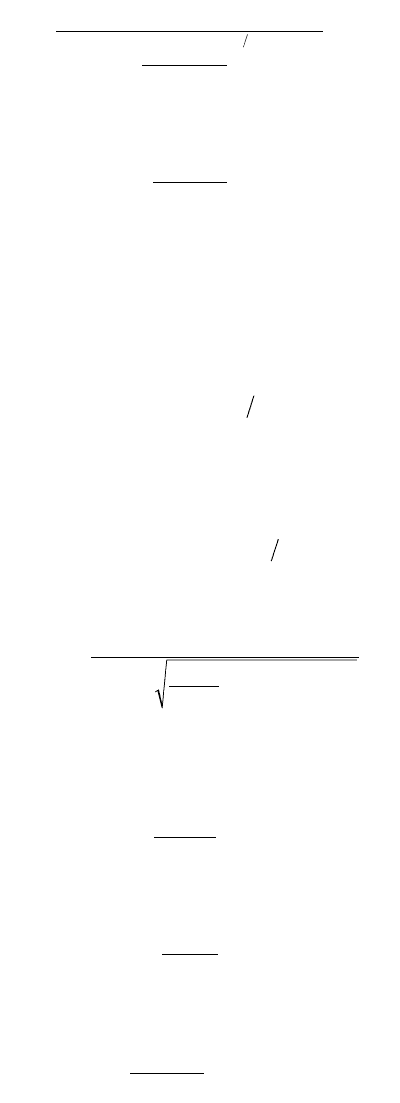
(11.10)
Otherwise,
(11.11)
where h
s
is the surface height where the antenna is located.
Step 3: Calculate the horizontal projection of L
sl
,
(11.12)
Step 4: Find the 0.01% rainfall rate for the location. For Florida, rain region N,
(11.13)
Step 5: Calculate the specific attenuation for the desired frequency, polariza-
tion, and rain rate using the interpolated linear regression coefficients that
are found from (10.3) and (10.4).
(11.14)
Step 6: Compute the horizontal reduction factor, r
0.01
for 0.01% of the time.
(11.15)
where L
G
is in km and f is in GHz.
Step 7: Calculate the vertical adjustment factor v
0.01
for 0.01% of the time.
(11.16)
For z> q,
(11.17)
Otherwise,
(11.18)
hh
Rs
-
()
()
sin q
km
L
Lr
R
G
=
()
001.
cos q
km
z=
-
Ê
Ë
ˆ
¯
-
tan
.
1
001
hh
Lr
Rs
G
degrees
r
L
f
e
GR
L
G
001
2
1
1078 0381
.
..
=
+--
()
-
g
g
R
kR=
()
001.
a
dB km
R
001
95
.
= mm h
LL
Gsl
=
()
cos q
L
hh
sl
Rs
=
-
()
()
sin q
km
L
hh
hh
R
sl
Rs
Rs
e
=
-
()
()
+
-
()
Ê
Ë
ˆ
¯
+
()
2
2
2
12
sin sinqq
km
258 SATELLITE COMMUNICATIONS
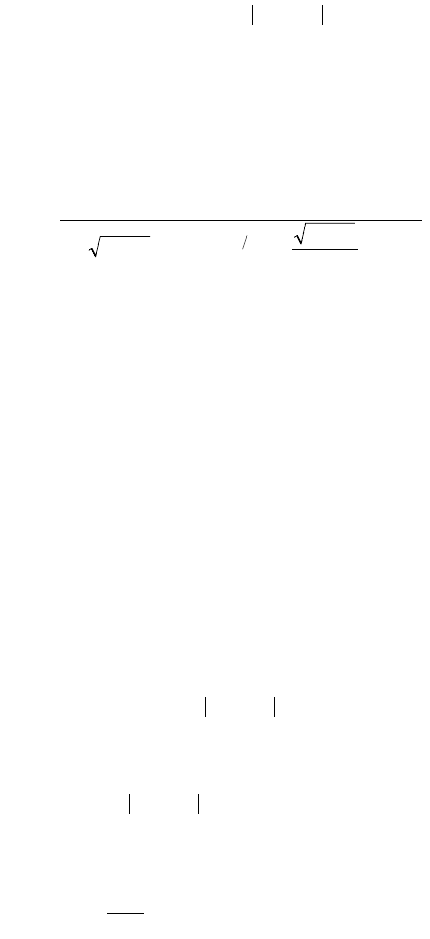
If latitude < 36 degrees,
Otherwise,
Then,
(11.19)
Step 8: The effective path length is then computed as
(11.20)
Step 9: The 0.01% rain fade depth is next computed from
(11.21)
Step 10: To determine the maximum fade depths for other probabilities in the
range from 0.001% to 5%, the availability adjustment factor is applied.
If p ≥ 1% or if |latitude| ≥ 36 degrees,
(11.22)
If p < 1% and |latitude| < 36 degrees and q>25 degrees,
(11.23)
Otherwise,
(11.24)
The maximum fade is then given by
(11.25)
The overall expected attenuation on an earth–space path ends up being a func-
tion of the rain rate (availability), frequency, and elevation angle only. Figure
11.5 shows plots of the expected rain attenuation on an earth–space path
versus availability, for several elevation angles and operating frequencies using
AA
p
p
pAp
=
Ê
Ë
ˆ
¯
-+
()
---
()()()(
001
0 655 0 033 0 045 1
001
001
.
. . ln . ln sin
.
.
bq
b=- - ∞
()
+-
()
0 005 36 1 8 4 25. . . sinlatitude q
b=- -
()
0 005 36. latitude
b=0
AL
RE001.
=g dB
LLv
ER
=
001.
km
v
e
L
f
RR
001
1
2
1
1311 045
.
sin .
=
+
()
-
()
-
Ê
Ë
Á
ˆ
¯
˜
-+
()()
q
g
q c
c=0
c= -36 degrees latitude
RAIN FADES 259
the ITU model in rain region N. As the required availability increases, so does
the amount of rain-fade margin that is needed.
Example 11.3. Consider a geostationary satellite that uses a 30-GHz uplink
and a 20-GHz downlink. If the uplink is located in New York City, the down-
link is in Miami and the satellite is at 90 degrees longitude, determine the
99.9% fade margin for both the downlink and the uplink if circular polariza-
tion is used. What is the overall probability of a communications outage?
First, the satellite and ground station locations are used to determine the
elevation angles to the satellite. New York is in rain region K, its latitude is
approximately 40 degrees, and its longitude is about 74 degrees. For the uplink,
then the earth lat/long parameters are;
the satellite lat/long parameters are;
Ll
ss
==090degrees degrees,
Ll
ee
==40 74deg , degrees rees
260 SATELLITE COMMUNICATIONS
90 91 92 93 94 95 96 97 98 99 100
0
10
20
30
40
50
5 Deg El ITU-N
15 Deg El ITU-N
45 Deg El ITU-N
85 Deg El ITU-N
Rain Attenuation on Earth-Space Path
Availabilit
y
Rain Attenuation (dB)
Figure 11.5 Required rain attenuation margin values versus availability for different
elevation angles at 30 GHz using the ITU model in rain region N, at 30 degrees
latitude.

and, using (11.4),
Next, the uplink slant range is found using (11.5):
The elevation angle is determined using (11.6),
so
Using information from Table 10A.2, the specific attenuation regression coef-
ficients for the uplink are
Using the uplink elevation angle of 40.9 degrees and a tilt angle of 45 degrees
for circular polarization, the regression coefficients for the uplink are found
from (10.3) and (10.4) to be
Next, the 10-step procedure is applied.
Step 1: Find the rain height.
Step 2: Determine the length of the slant path that is below the rain height.
L
sl
=
-
()
()
=
37 0
40 9
565
.
sin .
.km
h
R
=- - ∞
()
=4 0 075 36 3 7..latitude km
k
kk
kk
k
UL
HV
UL
HH VV
=
+
=
=
+
=
2
0 177
2
1 011
.
.a
aa
k
k
HH
VV
==
==
0 187 1 021
0 167 1 0
., .
., .
a
a
q
UL
= 40 9. degrees
cos
, sin .
,
.q
()
=
()
=
42 378 42 6
37 930
076
r
sUL
=+
Ê
Ë
ˆ
¯
-
Ê
Ë
ˆ
¯
()
=42 378 1
6 378
42 378
2
6 378
42 378
42 6 37 930
22
,
,
,
,
,
cos . , km
y
UL
= 42 6. degrees
RAIN FADES 261