
Seybold J.S. Introduction to RF Propagation
Подождите немного. Документ загружается.

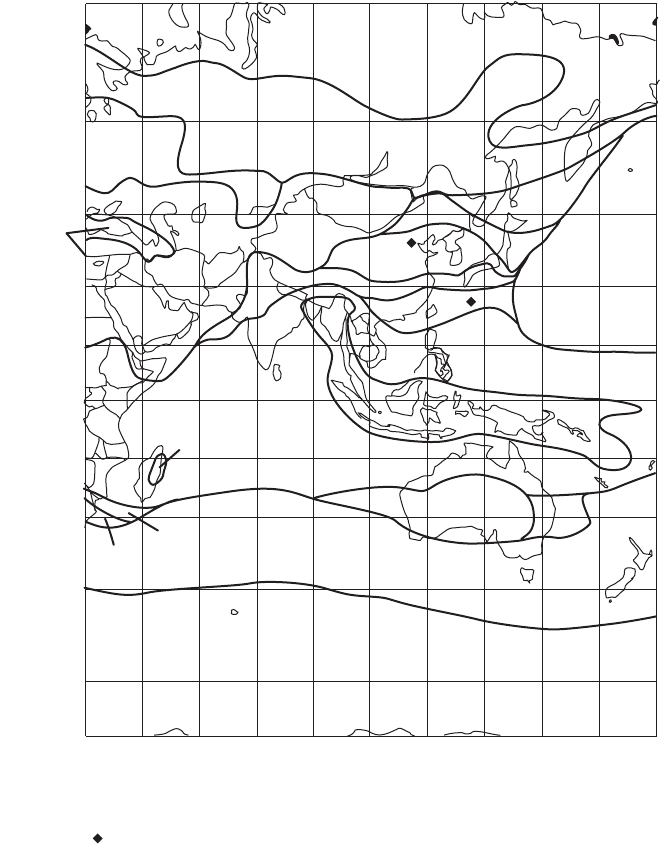
232 RAIN ATTENUATION OF MICROWAVE AND MILLIMETER-WAVE SIGNALS
D2
D3
A
D1
60
30
0
–30
–60
30 60 90 120 150 180
Longitude (deg)
Path locations for rain attenuation measurements
Latitude (deg)
A
B1
B2
B2
C
F
D2
D1
E
G
G
H
F
D3
H
D2
F
C
Figure 10.9 Crane rain regions for Asia. (Figure 3.4 from Ref. 2, courtesy of John
Wiley & Sons.)
and
So,
Recall that the ITU model predicted 34.3 dB for this link in Example 10.1. 䊐
Atten dB= 43 9.
zRR
z
y
=◊ -
()()
=-
=-
a 0 0226 0 03
0 12266
0 189
..ln
.
.
y
RR
RR
RR=◊
-
()
()
+-
()
È
Î
Í
˘
˚
˙
a
d
083 017
026 003
..ln
..ln
RAIN FADES 233
TABLE 10.3 Crane Rain Rate Data
Availability A B B1 B2 C D1 D2 D3 E F G H
0.99 0.2 1.2 0.8 1.4 1.8 2.2 3.0 4.6 7.0 0.6 8.4 12.4
0.999 2.5 5.7 4.5 6.8 7.7 10.3 15.1 22.4 36.2 5.3 31.3 66.5
0.9999 9.9 21.1 16.1 25.8 29.5 36.2 46.8 61.6 91.5 22.2 90.2 209.3
0.99995 13.8 29.2 22.3 35.7 41.4 49.2 62.1 78.7 112 31.9 118 283.4
0.99999 28.1 52.1 42.6 63.8 71.6 86.6 114.1 133.2 176 70.7 197 542.6
Source: Table 3.1 from Ref. 2, courtesy of John Wiley & Sons.
1·10
3
100
10
1
0.1
95 96 97 98 99 100
Availability (%)
Interpolation
Data Points
Rain Rate (mm/hr)
Crane Region E Rain Rates
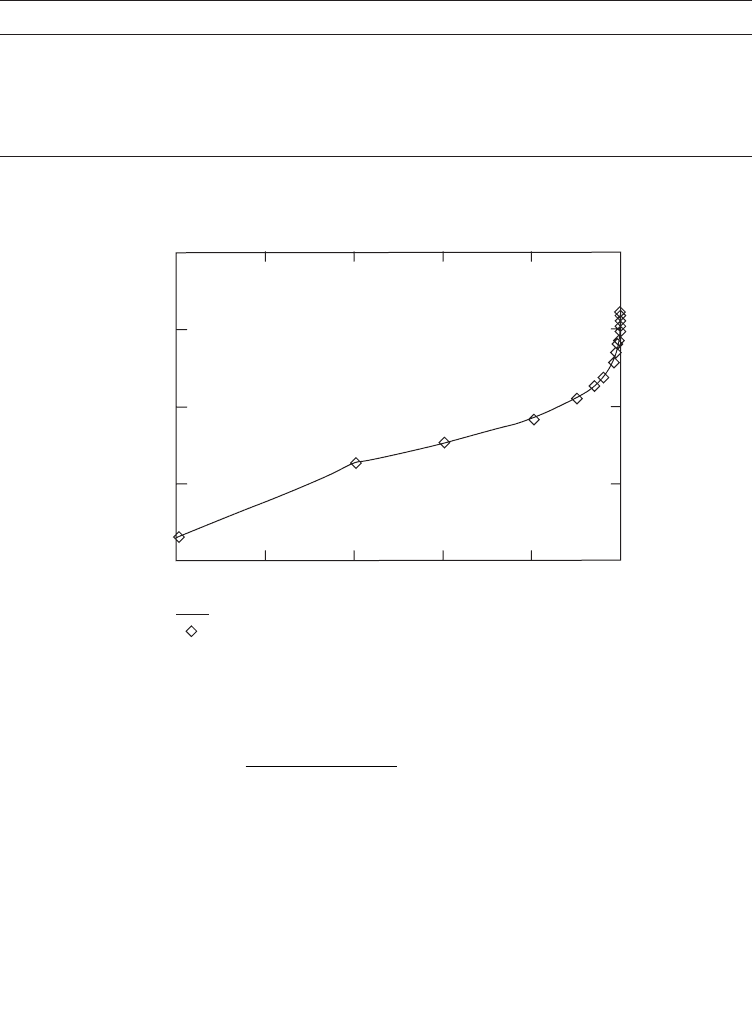
Figure 10.10 Crane rain rate data points for region E and the corresponding loga-
rithmically interpolated curve.
10.3.4 Other Rain Models
There are other rain models available. Some are proprietary and cover limited
geographical area. Others are optimized for certain applications. The ITU has
adopted an updated model [12], which uses the same attenuation computa-
tion, but provides for a much different method for determining the rain sta-
tistics. The model uses data files indexed by latitude and longitude to provide
a more precise estimate of rain statistics than the rain region concept.
Prior to the Crane global model, Crane developed the two-component
model and the revised two-component model, which are both presented in
Ref. 2. These models take into account the volume cell and the debris region
of a rain event separately and then combine the results. They have, in large
part, been superseded by the Crane global model. Both of the two-component
models are more involved to implement than the global model.
10.3.5 Rain Attenuation Model Comparison
It is difficult to make generalizations concerning the predicted attenuations
from the ITU and Crane global models. Sometimes one or the other will
predict more attenuation, sometimes by a significant margin, but on the whole
they are fairly consistent. In industry, customers frequently have strong pref-
erences for one model or the other. It is also sometimes the case that a par-
ticular model must be used to facilitate comparisons with competing products.
10.3.6 Slant Paths
The details of applying the rain models to slant paths that exit the troposphere
are presented in Chapter 11, “Satellite Communications.” For terrestrial slant
paths, simply using the appropriate value of q in the expressions for a and k
is all that is required. When considering slant paths that exit the troposphere,
the statistics of the rain cell height must be incorporated into the model. For
heavy rain associated with thunderstorms (convective rain), the rain cells tend
to be concentrated, or of limited extent and height. At lower rain rates the
rain may exist at much higher elevations and over considerable distances
(stratiform rain). The height statistics become important for long paths at high
elevation angles and are treated differently than the terrestrial paths.
10.4 THE LINK DISTANCE CHART
The link distance chart is a concise way to convey information on rain fades
and margins. The link distance chart consists of a plot of the available fade
margin (G
L
- L(d)) versus link distance [17]. Note that the available fade
margin is a monotonically decreasing function with distance due to the free-
space loss and any clear-air atmospheric loss. Next, a curve of rain fade depth
234 RAIN ATTENUATION OF MICROWAVE AND MILLIMETER-WAVE SIGNALS
versus distance is superimposed for each rain region of interest, resulting in a
family of curves for the system. The point where the curves intersect defines
the maximum link distance for that availability. This is the point where the
available margin is exactly equal to the predicted rain-fade depth. Of course
the designer may choose to use a different independent variable; for example,
if the link distance were fixed, transmitter power, receiver sensitivity, or
antenna gain might be used for the independent variable (x axis).
Example 10.3. Consider a 38-GHz terrestrial millimeter-wave link with
180 dB of link gain using vertical polarization. What are the maximum five-
nines (99.999%) availability link distances for Arizona and Florida?
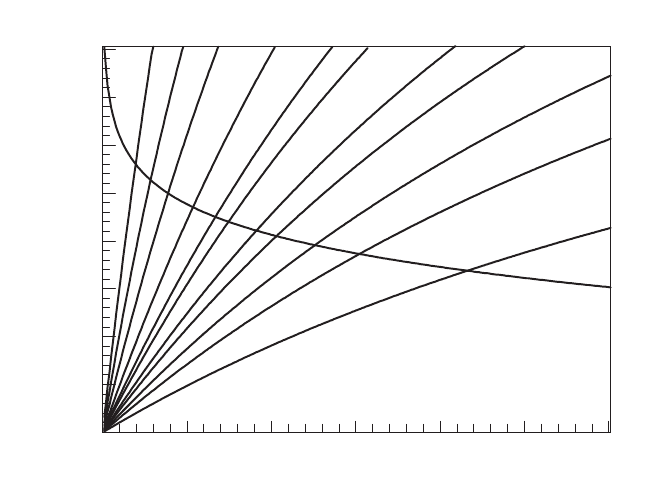
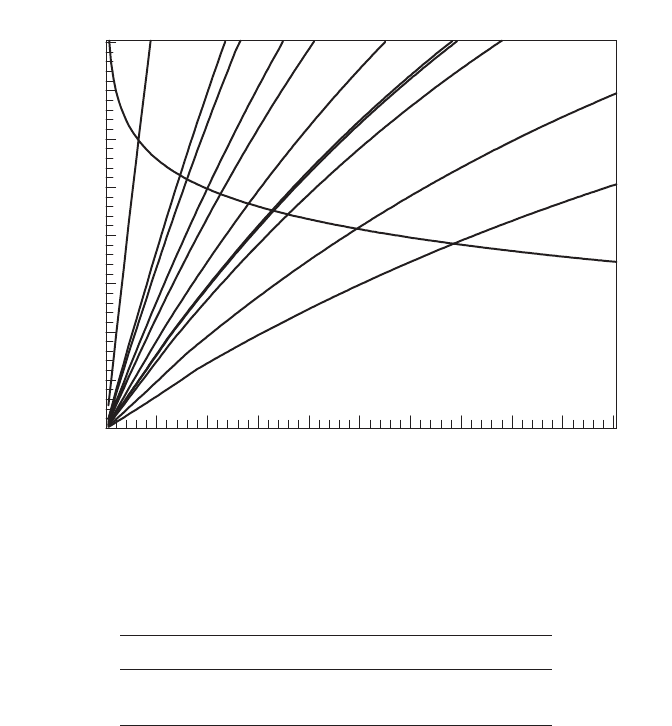
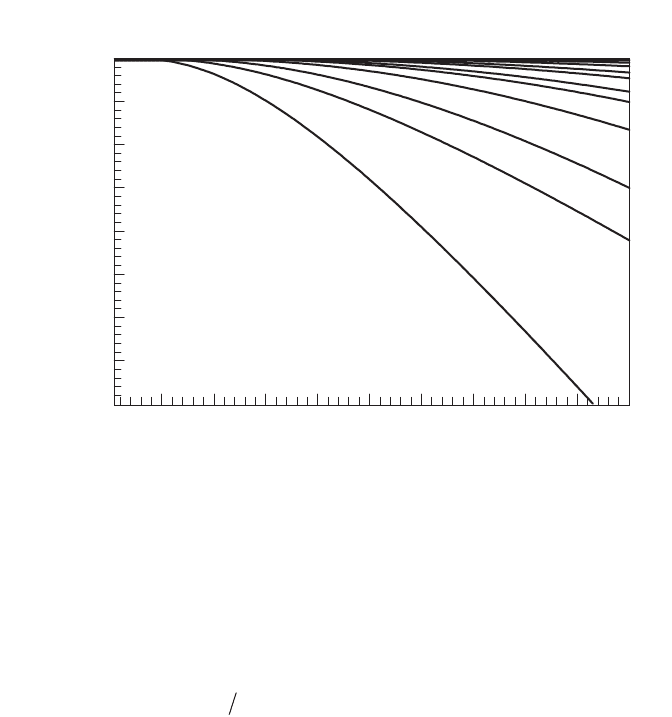
Figure 10.11 is the link distance chart for this system using the ITU model,
while Figure 10.12 is the link distance chart using the Crane global model.
Noting that Florida is in ITU region N and Crane region E and that Arizona
is in ITU region E and Crane region F, the results are summarized in Table
10.4. Both link distance charts use the adjusted link gain (i.e., include atmos-
pheric loss), so that the plotted margin is available for rain. It is interesting to
note that in one case (Florida) the ITU model is more conservative, while the
Crane model is more conservative in Arizona.This relationship between these
two models at this geographical location may not hold for all frequencies or
availabilities/distances.
THE LINK DISTANCE CHART 235
0
10
20
30
40
50
60
70
80
0.
02.55.07.5 10.0 12.5 15.0
Availability = 0.99999, ITU Data, ITU Model, Frequency = 38 GHz
System Gain = 180 dB, Vertical Polarization
Required/Available Rain Margin (dB)
Link Distance in km
A
B
C
D
E
F
H
K
M
N
P
Gain = 180 dB
Figure 10.11 Link distance chart using the ITU model and data.
It is important to note that the Crane global model is only validated up to
22.5-km link distance, whereas the latest ITU model is valid to 60 km. Since
the Crane global model is a curve fit, unpredictable results will be obtained if
distances greater than 22.5 km are used.
There are other possible sources of link outages besides rain fades, includ-
ing hardware failures, interference, physical obstructions, and changes in
antenna aim point. These should all be considered when planning availability.
It is noteworthy that four- or five-nines availability requires large data sets to
achieve high confidence on the statistics. Also note that four-nines is approx-
imately 53 minutes per year of link outage and five-nines is approximately 5
minutes per year.
236 RAIN ATTENUATION OF MICROWAVE AND MILLIMETER-WAVE SIGNALS
0
10
20
30
40
50
60
70
80
0 1 2 3 4 5 6 7 8 910
Availability = 0.99999, Crane Data, Crane Model, Frequency = 38 GHz
System Gain = 180 dB, Vertical Polarization
Required/Available Rain Margin (dB)
Link Distance in km
A
B1
B2
C
D1
D2
D3
E
F
G
H
Gain = 180 dB
Figure 10.12 Link distance chart using the Crane global model and data.
TABLE 10.4 Link Distance Results for Arizona and
Florida
Model Arizona Florida
ITU 4.56 km 1.42 km
Crane 3.31 km 1.60 km
10.5 AVAILABILITY CURVES
The availability adjustment factor in the ITU model may be used to produce
curves of availability versus link distance for a given link gain. The available
margin for each distance is used in the appropriate adjustment equation, (10.8)
or (10.9), depending upon the latitude.
This equation can then be iteratively solved for p and the availability is 100 -
p. This is valuable in answering the question of how much availability can be
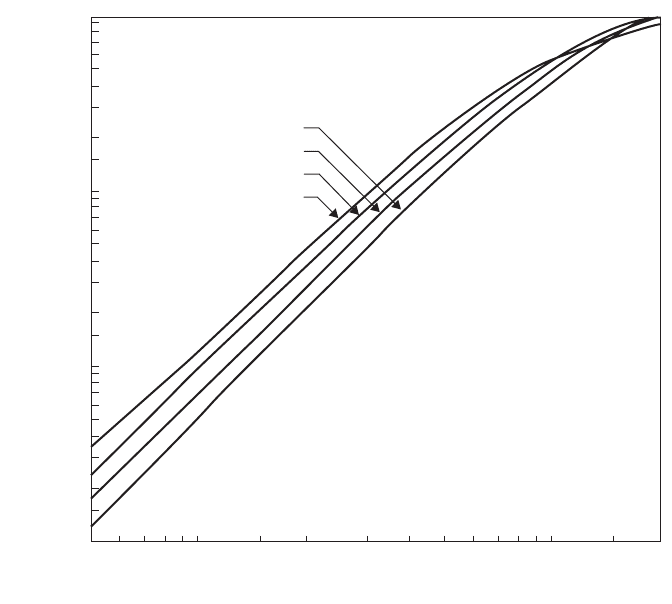
achieved with a given system and link distance. Figure 10.13 shows an example
of an availability curve for the same vertically polarized, 180-dB system used
earlier. Note that the curves do not exceed five-nines, since that is the confi-
dence limit of the ITU model (and the Crane model as well).
10.6 OTHER PRECIPITATION
Other forms of precipitation such as snow, sleet, and fog may also cause some
attenuation of an electromagnetic wave, depending upon the frequency. The
varying nature of sleet makes it difficult to definitively model. The easiest
approach is to simply treat the sleet as if it were rainfall. This may result in
Avail margin Atten_ . . . log
.001
0 12 0 546 0 043=-+
()()
pp
OTHER PRECIPITATION 237
0.99800
0.99825
0.99850
0.99875
0.99900
0.99925
0.99950
0.99975
1.00000
1 2 3 4 5 6 7 8 910
Availability vs Link Distance
ITU Data (ITU Model), Vertical Polarization
System Gain = 180 dB, Frequency = 38 GHz
Estimated Availability
Link Distance in km
A
B
C
D
E
F
H
K
M
N
P
Figure 10.13 Availability curve for a typical millimeter-wave link.
slightly overestimating the expected attenuation. A similar situation exists for
snowfall. At frequencies below the visible light range, the primary factor in
snow attenuation will be the moisture content. It is likely that the attenuation
to either sleet or snow will never reach the same level as the attenuation for
rainfall at that same location. Therefore, planning the communications link
based on the expected rainfall will likely provide more than enough margin
for snow and sleet.
The effect of fog and clouds on electromagnetic waves becomes progres-
sively more significant as the frequency increases. The ITU provides a model
for cloud and fog attenuation between 5 and 200 GHz [18]. The model con-
sists of computing a specific attenuation based on the liquid water density in
the atmosphere and a specific attenuation coefficient, K
l
, that is a function of
frequency and temperature. Figure 10.14 shows plots of the specific attenua-
tion coefficient versus frequency for several different temperatures. The ref-
erence also provides the equation for reproducing this plot in whatever detail
is required. The expression for the specific attenuation due to fog or clouds is
238 RAIN ATTENUATION OF MICROWAVE AND MILLIMETER-WAVE SIGNALS
20°C
10°C
0°C
–8°C
10
5
2
1
0.5
0.2
0.1
0.01
0.02
0.01
5 10 20 50 100 200
Frequency (GHz)
Specific attenuation coefficient, K
l
((dB/km) / (g/m
3
)
Figure 10.14 Specific attenuation coefficient for computing the specific attenuation
due to clouds or fog. (Figure 1 from Ref. 18, courtesy of the ITU.)

(10.15)
where
g
c
is the specific attenuation within the fog or cloud
K
l
is the specific attenuation coefficient from Figure 10.13
M is the liquid water vapor density in the fog or cloud
For cloud attenuation, the curve for 0°C should be used. The values for liquid
water vapor density are ideally determined by local measurement. Historical
data are available from the ITU in data files and are summarized in the maps
in Ref. 18. Typical values of water vapor density are 0.05 g/m
3
for medium fog
(300-m visibility) and 0.5 g/m
3
for thick fog (50-m visibility).
Example 10.4. What is the expected attenuation due to fog on a 15-km path
for a 30-GHz communication system? Assume that the ambient temperature
is 10°C and that the fog is heavy.
The specific attenuation at 30 GHz and 10°C is 0.63 (dB/km)/(g/m
3
). For
heavy fog, use M = 0.5 g/m
3
. The predicted specific attenuation is computed to
be 0.315 dB/km. On a 15-km path, the overall attenuation due to the fog will
therefore be 4.7 dB. 䊐
10.7 CROSS-POLARIZATION EFFECTS
In addition to the attenuation of electromagnetic waves, rain and other pre-
cipitation tend to cause depolarization of the wave.This can be a concern when
orthogonal polarizations are used for frequency re-use. It is possible to achieve
between 20 and 35 dB of link-to-link isolation by using orthogonal polariza-
tions. The isolation will be reduced by rain and by ground and atmospheric
multipath. For this reason, few systems depend heavily on cross-polarization
isolation for link isolation and frequency re-use. The ITU [8] gives a proce-
dure for estimating the reduction is cross-polarization isolation in rain and
multipath.
10.8 SUMMARY
When high availability is of interest, key system parameters must be known
with confidence. While rain is the principal limitation of millimeter-wave
link availability, other factors such as hardware failures should not be
ignored. Once the rain availability requirement is determined, rain models can
be used to determine the fade depth that will not be exceeded with that
probability.
g
cl
KM= dB km
SUMMARY 239
Rain fade probabilities can be calculated using the ITU, Crane global, or
other models. While the Crane global and ITU models are distinct, they used
much of the same raw data in their development and they provide reasonably
consistent results. The ITU model is validated for links as long as 60 km,
whereas the Crane model is validated up to 22.5 km.
The adjusted link gain of a communication link, minus the free-space loss,
gives the available rain fade margin. The distance at which the predicted rain
fade equals the rain fade margin is the maximum link distance for the chosen
availability. Using the ITU model, it is also possible to solve for availability
versus distance.
Note that it is possible to use the Crane model with ITU rain rates and vice
versa, but there is no significant advantage to doing so other than perhaps to
compare the models with identical data or compare the data using identical
models.
REFERENCES
1. Special issue on Ka-band propagation effects on earth-satellite links, Proceedings
of the IEEE, Vol. 85, No. 6, June 1997.
2. R. K. Crane, Electromagnetic Wave Propagation Through Rain, John Wiley & Sons,
New York, 1996.
3. R. K. Crane, Propagation Handbook for Wireless Communication System Design,
CRC Press LLC, Boca Raton, FL, 2003.
4. R. K. Crane, Prediction of attenuation by rain, IEEE Transactions on Communi-
cations, Vol. 28, No. 9, September, 1980, pp. 1717–1733.
5. D. A. de Wolf, H. W. J. Russchenberg, and L. P. Ligthart, Simplified analysis of line-
of-sight propagation through rain at 5–90 GHz, IEEE Transactions on Antennas
and Propagation, Vol. 40, No. 8, Augurst, 1992, pp. 912–919.
6. D. A. de Wolf and A. J. Zwiesler, Rayleigh–Mie approximation for line-of-sight
propagation through rain at 5–90 GHz, IEEE Transactions on Antennas and Prop-
agation, Vol. 44, No. 3, March, 1996, pp. 273–279.
7. D. A. de Wolf, H. W. J. Russchenberg, and L. P. Ligthart, Attenuation of co- and
cross-polarized electric fields of waves through a layer of dielectric spheroids, IEEE
Transactions on Antennas and Propagation, Vol. 39, No. 2, February, 1991, pp.
204–210.
8. ITU-R Recommendations, Propagation data and prediction methods required for
the design of terrestrial line-of-sight systems, ITU-R P.530-9, Geneva, 2001.
9. J. Goldhirsh, B. H. Musiani, and W. J. Vogel, Cumulative fade distributions and fre-
quency scaling techniques at 20GHz from the advanced communications technol-
ogy satellite and at 12 GHz from the digital satellite system, Proceedings of the
IEEE, Vol. 85, No. 6, June, 1997, pp. 910–916.
10. ITU-R Recommendations, Specific attenuation model for rain for use in prediction
methods, ITU-R P.838-1, Geneva, 1999.
11. ITU-R Recommendations, Characteristics of precipitation for propagation model-
ling, ITU-R P.837-1, Geneva, 1994.
240
RAIN ATTENUATION OF MICROWAVE AND MILLIMETER-WAVE SIGNALS
12. ITU-R Recommendations, characteristics of precipitation for propagation model-
ling, ITU-R P.837-3, Geneva, 2001.
13. T. Pratt, C. W. Bostian, and J. E. Allnutt, Satellite Communications, 2nd ed., John
Wiley & Sons, New York, 2003, p. 318.
14. T. Pratt, C. W. Bostian, and J. E. Allnutt, Satellite Communications, 2nd ed., John
Wiley & Sons, New York, 2003, pp. 510–511.
15. R. K. Crane, Electromagnetic Wave Propagation Through Rain, John Wiley & Sons,
New York, 1996, p. 147.
16. R. K. Crane, Electromagnetic Wave Propagation Through Rain, John Wiley & Sons,
New York, 1996, p. 114.
17. J. S. Seybold, Performance prediction for fixed microwave data links, RF Design
Magazine, May 2002, pp. 58–66.
18. ITU-R Recommendations, Attenuation due to clouds and fog, IRU-R P.840-3,
Geneva, 1999.
EXERCISES
1. What is the reference rainfall rate and the specific attenuation due to rain
for a 99.99% availability link in Chicago, IL? Compute for vertical, hori-
zontal, and circular polarization.
2. Compute the expected 99.9% fade depth for a 28-GHz link operating in
Atlanta, Georgia. Assume that the link distance is 2 km. Compute for both
vertical and horizontal polarization using the ITU model.
3. Compute the expected 99.995% fade depth for a 20-GHz link operating in
Orlando, Florida. Assume that the link distance is 2km. Compute for both
vertical and horizontal polarization using the Crane model.
4. What is the 99.999% rain fade depth for a 28-GHz point-to-point link oper-
ating in Seattle, WA? Assume that the path is 4 km and horizontal and that
circular polarization is used.
(a) Using the ITU model
(b) Using the Crane model
5. What is the 99% rain fade depth for a 42-GHz, circularly polarized link
operating in Boston, MA if the link distance is 2 km and the path is sloped
at 3 degrees?
EXERCISES 241