
Seybold J.S. Introduction to RF Propagation
Подождите немного. Документ загружается.


[2–4]. Table 1.2 shows the nominal band designations and the official radar
band designations in Region 2 as determined by international agreement
through the International Telecommunications Union (ITU).
RF propagation modeling is still a maturing field as evidenced by the vast
number of different models and the continual development of new models.
Most propagation models considered in this text, while loosely based on
physics, are empirical in nature. Wide variation in environments makes
definitive models difficult, if not impossible, to achieve except in the simplest
of circumstances, such as free-space propagation.
2 INTRODUCTION
TABLE 1.2 Frequency Band Designations
Label Nominal Frequency Range ITU—Region 2
HF 3–30 MHz
VHF 30–300 MHz 138–145, 216–225 MHz
UHF 300–1000 MHz 420–450, 890–942 MHz
L 1–2 GHz 1215–1400 MHz
S 2–4 GHz 2.3–2.5, 2.7–3.7 GHz
C 4–8 GHz 5.25–5.925 GHz
X 8–12 GHz 8.5–10.68 GHz
Ku 12–18 GHz 13.4–14, 15.7–17.7 GHz
K 18–27 GHz 24.05–24.25 GHz
Ka 27–40 GHz 33.4–36 GHz
R 26.5–40 GHz
Q 33–50 GHz
V 40–75 GHz
W 75–110 GHz
TABLE 1.1 Frequency Band Designations
Band Designation Frequency Range
Extremely low frequency ELF <3 kHz
Very low frequency VLF 3–30 kHz
Low frequency LF 30–300 kHz
Medium frequency MF 300 kHz–3 MHz
High frequency HF 3–30 MHz
Very high frequency VHF 30–300 MHz
Ultra-high frequency UHF 300 MHz–3 GHz
Super-high frequency SHF 3–30 GHz
Extra-high frequency EHF 30–300 GHz

1.2 MODES OF PROPAGATION
Electromagnetic wave propagation is described by Maxwell’s equations, which
state that a changing magnetic field produces an electric field and a changing
electric field produces a magnetic field. Thus electromagnetic waves are able
to self-propagate. There is a well-developed theory on the subtleties of
electromagnetic waves that is beyond the requirements of this book [5–7]. An
introduction to the subject and some excellent references are provided in the
second chapter. For most RF propagation modeling, it is sufficient to visual-
ize the electromagnetic wave by a ray (the Poynting vector) in the direction
of propagation. This technique is used throughout the book and is discussed
further in Chapter 2.
1.2.1 Line-of-Sight Propagation and the Radio Horizon
In free space, electromagnetic waves are modeled as propagating outward
from the source in all directions, resulting in a spherical wave front. Such a
source is called an isotropic radiator and in the strictest sense, does not exist.
As the distance from the source increases, the spherical wave (or phase) front
converges to a planar wave front over any finite area of interest, which is how
the propagation is modeled. The direction of propagation at any given point
on the wave front is given by the vector cross product of the electric (E) field
and the magnetic (H) field at that point. The polarization of a wave is defined
as the orientation of the plane that contains the E field. This will be discussed
further in the following chapters, but for now it is sufficient to understand that
the polarization of the receiving antenna should ideally be the same as the
polarization of the received wave and that the polarization of a transmitted
wave is the same as that of the antenna from which it emanated.*
This cross product is called the Poynting vector. When the Poynting vector is
divided by the characteristic impedance of free space, the resulting vector gives
both the direction of propagation and the power density.
The power density on the surface of an imaginary sphere surrounding the
RF source can be expressed as
(1.1)
where d is the diameter of the imaginary sphere, P is the total power at the
source, and S is the power density on the surface of the sphere in watts/m
2
or
S
P
d
=
4
2
p
Wm
2
PE H= ✕
MODES OF PROPAGATION 3
* Neglecting any environmental effects.
equivalent. This equation shows that the power density of the electromagnetic
wave is inversely proportional to d
2
. If a fixed aperture is used to collect the
electromagnetic energy at the receive point, then the received power will also
be inversely proportional to d
2
.
The velocity of propagation of an electromagnetic wave depends upon the
medium. In free space, the velocity of propagation is approximately
The velocity of propagation through air is very close to that of free space, and
the same value is generally used. The wavelength of an electromagnetic wave
is defined as the distance traversed by the wave over one cycle (period) and
is generally denoted by the lowercase Greek letter lambda:
(1.2)
The units of wavelength are meters or another measure of distance.
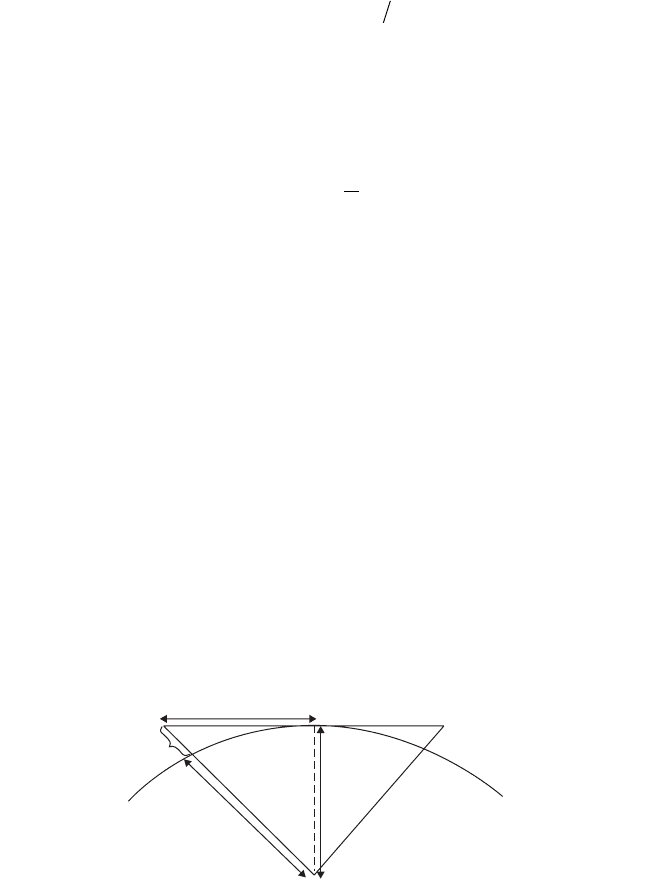
When considering line-of-sight (LOS) propagation, it may be necessary to
consider the curvature of the earth (Figure 1.1). The curvature of the earth
is a fundamental geometric limit on LOS propagation. In particular, if the
distance between the transmitter and receiver is large compared to the height
of the antennas, then an LOS may not exist. The simplest model is to treat the
earth as a sphere with a radius equivalent to the equatorial radius of the earth.
From geometry
So
and
drhh
2
2=+
()
dr rh
22
2
+=+
()
l=
c
f
c =¥310
8
ms
4 INTRODUCTION
h
r
r
d
Idealized
Earth Surface
Figure 1.1 LOS propagation geometry over curved earth.
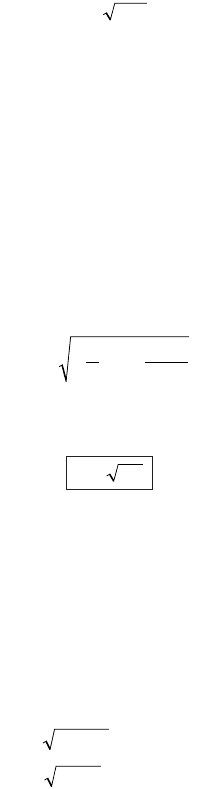
(1.3)
since rh >> h
2
.
The radius of the earth is approximately 3960 miles at the equator. The
atmosphere typically bends horizontal RF waves downward due to the varia-
tion in atmospheric density with height. While this is discussed in detail later
on, for now it is sufficient to note that an accepted means of correcting for this
curvature is to use the “4/3 earth approximation,” which consists of scaling the
earth’s radius by 4/3 [8]. Thus
and
or
(1.4)
where d is the distance to the “radio horizon” in miles and h is in feet
(5280 ft = 1mi). This approximation provides a quick method of determining
the distance to the radio horizon for each antenna, the sum of which is the
maximum LOS propagation distance between the two antennas.
Example 1.1. Given a point-to-point link with one end mounted on a 100-ft
tower and the other on a 50-ft tower, what is the maximum possible (LOS)
link distance?
So the maximum link distance is approximately 24 miles. 䊐
1.2.2 Non-LOS Propagation
There are several means of electromagnetic wave propagation beyond LOS
propagation. The mechanisms of non-LOS propagation vary considerably,
based on the operating frequency. At VHF and UHF frequencies, indirect
propagation is often used. Examples of indirect propagation are cell phones,
pagers, and some military communications. An LOS may or may not exist for
these systems. In the absence of an LOS path, diffraction, refraction, and/or
multipath reflections are the dominant propagation modes. Diffraction is the
d
d
1
2 100 14 1
250 10
=◊ @
=◊=
. miles
miles
2
dh@ 2
d
h
@ 2
4
3
3960
5280
r = 5280 miles
drh@ 2
MODES OF PROPAGATION 5
phenomenon of electromagnetic waves bending at the edge of a blockage,
resulting in the shadow of the blockage being partially filled-in. Refraction is
the bending of electromagnetic waves due to inhomogeniety in the medium.
Multipath is the effect of reflections from multiple objects in the field of
view, which can result in many different copies of the wave arriving at the
receiver.
The over-the-horizon propagation effects are loosely categorized as sky
waves, tropospheric waves, and ground waves. Sky waves are based on ionos-
pheric reflection/refraction and are discussed presently. Tropospheric waves
are those electromagnetic waves that propagate through and remain in the
lower atmosphere. Ground waves include surface waves, which follow the
earth’s contour and space waves, which include direct, LOS propagation as
well as ground-bounce propagation.
1.2.2.1 Indirect or Obstructed Propagation While not a literal defini-
tion, indirect propagation aptly describes terrestrial propagation where the
LOS is obstructed. In such cases, reflection from and diffraction around build-
ings and foliage may provide enough signal strength for meaningful commu-
nication to take place. The efficacy of indirect propagation depends upon the
amount of margin in the communication link and the strength of the diffracted
or reflected signals. The operating frequency has a significant impact on the
viability of indirect propagation, with lower frequencies working the best. HF
frequencies can penetrate buildings and heavy foliage quite easily. VHF and
UHF can penetrate building and foliage also, but to a lesser extent. At the
same time, VHF and UHF will have a greater tendency to diffract around or
reflect/scatter off of objects in the path. Above UHF, indirect propagation
becomes very inefficient and is seldom used.When the features of the obstruc-
tion are large compared to the wavelength, the obstruction will tend to reflect
or diffract the wave rather than scatter it.
1.2.2.2 Tropospheric Propagation The troposphere is the first (lowest)
10 km of the atmosphere, where weather effects exist. Tropospheric propaga-
tion consists of reflection (refraction) of RF from temperature and moisture
layers in the atmosphere. Tropospheric propagation is less reliable than ionos-
pheric propagation, but the phenomenon occurs often enough to be a concern
in frequency planning. This effect is sometimes called ducting, although
technically ducting consists of an elevated channel or duct in the atmosphere.
Tropospheric propagation and ducting are discussed in detail in Chapter 6
when atmospheric effects are considered.
1.2.2.3 Ionospheric Propagation The ionosphere is an ionized plasma
around the earth that is essential to sky-wave propagation and provides the
basis for nearly all HF communications beyond the horizon. It is also impor-
tant in the study of satellite communications at higher frequencies since the
signals must transverse the ionosphere, resulting in refraction, attenuation,
6 INTRODUCTION
depolarization, and dispersion due to frequency dependent group delay and
scattering.
HF communication relying on ionospheric propagation was once the
backbone of all long-distance communication. Over the last few decades,
ionospheric propagation has become primarily the domain of shortwave
broadcasters and radio amateurs. In general, ionospheric effects are consid-
ered to be more of a communication impediment rather than facilitator, since
most commercial long-distance communication is handled by cable, fiber, or
satellite. Ionospheric effects can impede satellite communication since the
signals must pass through the ionosphere in each direction. Ionospheric prop-
agation can sometimes create interference between terrestrial communica-
tions systems operating at HF and even VHF frequencies, when signals from
one geographic area are scattered or refracted by the ionosphere into another
area. This is sometimes referred to as skip.
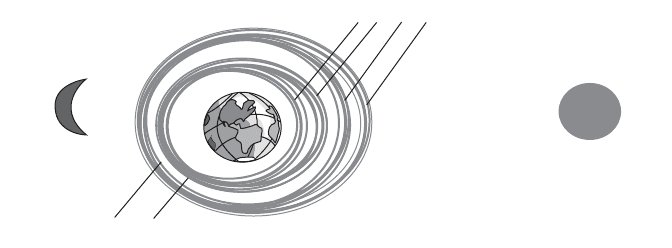
The ionosphere consists of several layers of ionized plasma trapped in
the earth’s magnetic field (Figure 1.2) [9, 10]. It typically extends from 50 to
2000 km above the earth’s surface and is roughly divided into bands (appar-
ent reflective heights) as follows:
D 45–55 miles
E 65–75 miles
F1 90–120 miles
F2 200 miles (50–95 miles thick)
The properties of the ionosphere are a function of the free electron density,
which in turn depends upon altitude, latitude, season, and primarily solar
conditions.
Typically, the D and E bands disappear (or reduce) at night and F1 and F2
combine. For sky-wave communication over any given path at any given time
there exists a maximum usable frequency (MUF) above which signals are no
longer refracted, but pass through the F layer. There is also a lowest usable
MODES OF PROPAGATION 7
F
Moon Sun
D
D E F1 F2
Figure 1.2 The ionospheric layers during daylight and nighttime hours.
frequency (LUF) for any given path, below which the D layer attenuates too
much signal to permit meaningful communication.
The D layer absorbs and attenuates RF from 0.3 to 4 MHz. Below 300 kHz,
it will bend or refract RF waves, whereas RF above 4 MHz will be passed un-
affected. The D layer is present during daylight and dissipates rapidly after
dark. The E layer will either reflect or refract most RF and also disappears
after sunset. The F layer is responsible for most sky-wave propagation (reflec-
tion and refraction) after dark.
Faraday rotation is the random rotation of a wave’s polarization vector as
it passes through the ionosphere. The effect is most pronounced below about
10 GHz. Faraday rotation makes a certain amount of polarization loss on satel-
lite links unavoidable. Most satellite communication systems use circular
polarization since alignment of a linear polarization on a satellite is difficult
and of limited value in the presence of Faraday rotation.
Group delay occurs when the velocity of propagation is not equal to c for
a wave passing through the ionosphere. This can be a concern for ranging
systems and systems that reply on wide bandwidths, since the group delay does
vary with frequency. In fact the group delay is typically modeled as being
proportional to 1/f
2
. This distortion of wideband signals is called dispersion.
Scintillation is a form of very rapid fading, which occurs when the signal
attenuation varies over time, resulting in signal strength variations at the
receiver.
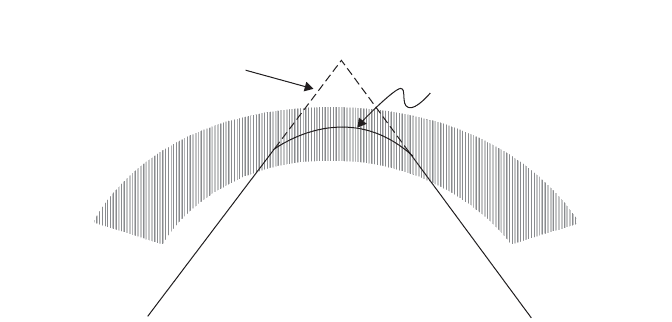
When a radio wave reaches the ionosphere, it can be refracted such that it
radiates back toward the earth at a point well beyond the horizon. While the
effect is due to refraction, it is often thought of as being a reflection, since that
is the apparent effect. As shown in Figure 1.3, the point of apparent reflection
is at a greater height than the area where the refraction occurs.
8 INTRODUCTION
Apparent Reflected
Ray Path
Apparent
Reflection
Point
Actual Refracted
Ray Path
Ionosphere
Figure 1.3 Geometry of ionospheric “reflection.”
1.2.3 Propagation Effects as a Function of Frequency
As stated earlier, RF propagation effects vary considerably with the frequency
of the wave. It is interesting to consider the relevant effects and typical appli-
cations for various frequency ranges.
The very low frequency (VLF) band covers 3–30kHz. The low frequency
dictates that large antennas are required to achieve a reasonable efficiency. A
good rule of thumb is that the antenna must be on the order of one-tenth of
a wavelength or more in size to provide efficient performance. The VLF band
only permits narrow bandwidths to be used (the entire band is only 27 kHz
wide). The primarily mode of propagation in the VLF range is ground-wave
propagation. VLF has been successfully used with underground antennas for
submarine communication.
The low-(LF) and medium-frequency (MF) bands, cover the range from
30kHz to 3 MHz. Both bands use ground-wave propagation and some sky wave.
While the wavelengths are smaller than the VLF band, these bands still require
very large antennas. These frequencies permit slightly greater bandwidth than
the VLF band. Uses include broadcast AM radio and the WWVB time refer-
ence signal that is broadcast at 60 kHz for automatic (“atomic”) clocks.
The high-frequency (HF), band covers 3–30 MHz. These frequencies
support some ground-wave propagation, but most HF communication is via
sky wave. There are few remaining commercial uses due to unreliability, but
HF sky waves were once the primary means of long-distance communication.
One exception is international AM shortwave broadcasts, which still rely on
ionospheric propagation to reach most of their listeners.The HF band includes
citizens’ band (CB) radio at 27 MHz. CB radio is an example of poor frequency
reuse planning.While intended for short-range communication, CB signals are
readily propagated via sky wave and can often be heard hundreds of miles
away. The advantages of the HF band include inexpensive and widely avail-
able equipment and reasonably sized antennas, which was likely the original
reason for the CB frequency selection. Several segments of the HF band
are still used for amateur radio and for military ground and over-the-horizon
communication.
The very high frequency (VHF) and ultra-high frequency (UHF) cover fre-
quencies from 30 MHz to 3 GHz. In these ranges, there is very little ionospheric
propagation, which makes them ideal for frequency reuse. There can be tro-
pospheric effects, however, when conditions are right. For the most part, VHF
and UHF waves travel by LOS and ground-bounce propagation. VHF and
UHF systems can employ moderately sized antennas, making these frequen-
cies a good choice for mobile communications. Applications of these fre-
quencies include broadcast FM radio, aircraft radio, cellular/PCS telephones,
the Family Radio Service (FRS), pagers, public service radio such as police
and fire departments, and the Global Positioning System (GPS). These bands
are the region where satellite communication begins since the signals can
penetrate the ionosphere with minimal loss.
MODES OF PROPAGATION 9
The super-high-frequency (SHF) frequencies include 3–30GHz and use
strictly LOS propagation. In this band, very small antennas can be employed,
or, more typically, moderately sized directional antennas with high gain.Appli-
cations of the SHF band include satellite communications, direct broadcast
satellite television, and point-to-point links. Precipitation and gaseous absorp-
tion can be an issue in these frequency ranges, particularly near the higher end
of the range and at longer distances.
The extra-high-frequency (EHF) band covers 30–300GHz and is often
called millimeter wave. In this region, much greater bandwidths are available.
Propagation is strictly LOS, and precipitation and gaseous absorption are a
significant issue.
Most of the modeling covered in this book is for the VHF, UHF, SHF, and
lower end of the EHF band. VHF and UHF work well for mobile communi-
cations due to the reasonable antenna sizes, minimal sensitivity to weather,
and moderate building penetration. These bands also have limited over-
the-horizon propagation, which is desirable for frequency reuse. Typical ap-
plications employ vertical antennas (and vertical polarization) and involve
communication through a centrally located, elevated repeater.
The SHF and EHF bands are used primarily for satellite communication
and point-to-point communications. While they have greater susceptibility to
environmental effects, the small wavelengths make very high gain antennas
practical.
Most communication systems require two-way communications.This can be
accomplished using half-duplex communication where each party must wait
for a clear channel prior to transmitting. This is sometimes called carrier-
sensed multiple access (CSMA) when done automatically for data communi-
cations, or push-to-talk (PTT) in reference to walkie-talkie operation. Full
duplex operation can be performed when only two users are being serviced
by two independent communication channels, such as when using frequency
duplexing.* Here each user listens on the other user’s transmit frequency. This
approach requires twice as much bandwidth but permits a more natural form
of voice communication. Other techniques can be used to permit many users
to share the same frequency allocation, such as time division multiple access
(TDMA) and code division multiple access (CDMA).
1.3 WHY MODEL PROPAGATION?
The goal of propagation modeling is often to determine the probability of sat-
isfactory performance of a communication system or other system that is
dependent upon electromagnetic wave propagation. It is a major factor
in communication network planning. If the modeling is too conservative,
excessive costs may be incurred, whereas too liberal of modeling can result in
10 INTRODUCTION
* Sometimes called two-frequency simplex.
unsatisfactory performance. Thus the fidelity of the modeling must fit the
intended application.
For communication planning, the modeling of the propagation channel is
for the purpose of predicting the received signal strength at the end of the
link. In addition to signal strength, there are other channel impairments
that can degrade link performance. These impairments include delay spread
(smearing in time) due to multipath and rapid signal fading within a symbol
(distortion of the signal spectrum). These effects must be considered by the
equipment designer, but are not generally considered as part of communica-
tion link planning. Instead, it is assumed that the hardware has been ade-
quately designed for the channel. In some cases this may not hold true and a
communication link with sufficient receive signal strength may not perform
well. This is the exception rather than the norm however.
1.4 MODEL SELECTION AND APPLICATION
The selection of the model to be used for a particular application often turns
out to be as much art (or religion) as it is science. Corporate culture may
dictate which models will be used for a given application. Generally, it is a
good idea to employ two or more independent models if they are available
and use the results as bounds on the expected performance. The process of
propagation modeling is necessarily a statistical one, and the results of a prop-
agation analysis should be used accordingly.
There may be a temptation to “shop” different models until one is found that
provides the desired answer. Needless to say, this can lead to disappointing per-
formance at some point in the future. Even so, it may be valuable for certain
circumstances such as highly competitive marketing or proposal development.
It is important that the designer not be lulled into placing too much confidence
in the results of a single model, however, unless experience shows it to be a reli-
able predictor of the propagation channel that is being considered.
1.4.1 Model Sources
Many situations of interest have relatively mature models based upon large
amounts of empirical data collected specifically for the purpose of character-
izing propagation for that application. There are also a variety of proprietary
models based on data collected for very specific applications. For more widely
accepted models, organizations like the International Telecommunications
Union (ITU) provide recommendations for modeling various types of propa-
gation impairments. While these models may not always be the best suited for
a particular application, their wide acceptance makes them valuable as a
benchmark.
There exist a number of commercially available propagation modeling soft-
ware packages. Most of these packages employ standard modeling techniques.
MODEL SELECTION AND APPLICATION 11