
Seybold J.S. Introduction to RF Propagation
Подождите немного. Документ загружается.

In addition, some may include proprietary models. When using such packages,
it is important that the user have an understanding of what the underlying
models are and the limitations of those models.
1.5 SUMMARY
In free space, the propagation loss between a transmitter and receiver is
readily predicted. In most applications however, propagation is impaired by
proximity to the earth, objects blocking the LOS and/or atmospheric effects.
Because of these impairments, the fundamental characteristics of RF propa-
gation generally vary with the frequency of the electromagnetic wave being
propagated. The frequency spectrum is grouped into bands, which are desig-
nated by abbreviations such as HF, VHF, and so on. Letter designations of the
bands are also used, although the definitions can vary.
Propagation of electromagnetic waves may occur by ground wave, tropos-
pheric wave, or sky wave. Most contemporary communication systems use
either direct LOS or indirect propagation, where the signals are strong enough
to enable communication by reflection, diffraction, or scattering. Ionospheric
and tropospheric propagation are rarely used, and the effects tend to be
treated as nuisances rather than a desired means of propagation.
For LOS propagation, the approximate distance to the apparent horizon
can be determined using the antenna height and the 4/3’s earth model.
Propagation effects tend to vary with frequency, with operation in different
frequency bands sometimes requiring the designer to address different
phenomena. Modeling propagation effects permits the designer to tailor the
communication system design to the intended environment.
REFERENCES
1. J. D. Parsons, The Mobile Radio Propagation Channel, 2nd ed., John Wiley & Sons,
West Sussex, UK, 2000, Table 1.1.
2. M. I. Skolnik, Introduction to Radar Systems, 3rd ed., McGraw-Hill, New York,
2001, Table 1.1, p. 12.
3. L. W. Couch II, Digital and Analog Communication Systems, 6th ed., Prentice-Hall,
Upper Saddle River, NJ, 2001, Table 1.2.
4. ITU Recommendations, Nomenclature of the frequency and wavelength bands
used in telecommunications, ITU-R V.431-6.
5. M. A. Plonus, Applied Electromagnetics, McGraw-Hill, New York, 1978.
6. S. Ramo, J. R. Whinnery, and T. Van Duzer, Fields and Waves in Communication
Electronics, 2nd ed., John Wiley & Sons, New York, 1984.
7. S. V. Marshall and G. G. Skitek, Electromagnetic Concepts & Applications, 2nd ed.,
Prentice-Hall, Englewood Cliffs, NJ, 1987.
12
INTRODUCTION
8. M. I. Skolnik, Introduction to Radar Systems, 3rd ed., McGraw-Hill, New York,
2001, p. 496.
9. L. W. Couch II, Digital and Analog Communication Systems, 6th ed., Prentice-Hall,
Upper Saddle River, NJ, 2001, pp. 12–16.
10. The ARRL Handbook for Radio Amateurs, ARRL, Newington, CT, 1994,
pp. 22-1–22-15.
EXERCISES
1. Determine the following;
(a) What is the wavelength of an 800-MHz signal?
(b) What is the wavelength of a 1.9-GHz signal?
(c) What is the wavelength of a 38-GHz signal?
(d) What is the frequency of a 10-m amateur radio signal?
(e) What effect would the ionosphere have on signals at each of the
preceding frequencies?
2. What is the power density of a 1-kW signal radiated from an isotropic
radiator, at a distance of 10 km?
3. Determine the following;
(a) What is the distance to the horizon as viewed from a height of 1 m and
from 10 m?
(b) What is the distance to the radio horizon for the same heights
(c) What is the maximum LOS communication distance (i.e., neglecting
any ground-wave or ionospheric propagation) between two systems,
one with the antenna mounted 1 m above the ground and the other with
the antenna mounted 10 m above the ground?
EXERCISES 13

14
Introduction to RF Propagation, by John S. Seybold
Copyright © 2005 by John Wiley & Sons, Inc.
CHAPTER 2
Electromagnetics and RF Propagation
2.1 INTRODUCTION
This chapter provides a brief review of electromagnetic theory. While not
exhaustive, it provides sufficient background and review for understanding the
material in later chapters. The discussions include the concepts of electric and
magnetic fields, the wave equation, and electromagnetic wave polarization.
The physics behind reflection and refraction of electromagnetic waves is dis-
cussed and used to make some generalizations about RF ground reflections.
There are two orthogonal time-varying fields that comprise an electromag-
netic plane wave: electric and magnetic. Each has its own distinct properties;
when related by the wave equation, they form the mathematical basis for elec-
tromagnetic wave propagation. Prior to examining the wave equation and its
implications for electromagnetic wave propagation, it is worthwhile to take a
brief look at static electric and magnetic fields.
2.2 THE ELECTRIC FIELD
The unit of electric charge is the coulomb. The electric field is generated by
an electric charge and is defined as the vector force exerted on a unit charge
and is usually denoted by E. Thus the units of electric field are newtons per
coulomb, which is equivalent to volts per meter.* The electric field is depend-
ent upon the amount of flux, or the flux density and the permittivity, e, of the
material:
ED=e
* In SI units, a volt is equal to a kg·m
2
/(A·s
2
), a coulomb is equal to an A·s, and a newton is a
kg·m/s
2
.
The flux density vector is defined as a vector that has the same direction as
the E field and whose strength is proportional to the charge that generates the
E field. The units of the flux density vector are coulombs per square meter.
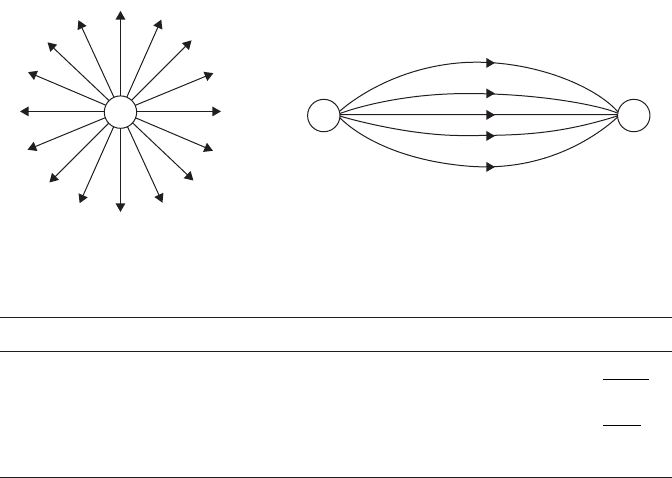
The E field and the flux density vectors originate at positive charges and ter-
minate on negative charges or at infinity as shown in Figure 2.1.
Gauss’s Law states that the total charge within an enclosed surface is equal
to the integral of the flux density over that surface.This can be useful for math-
ematically solving field problems when there is symmetry involved.The classic
field problems are the electric field from a point charge, an infinite line charge
and an infinite plane or surface charge. These are shown in Table 2.1.
2.2.1 Permittivity
Since the electric or E field depends not only on the flux density, but also on
the permittivity of the material or environment through which the wave is
propagating, it is valuable to have some understanding of permittivity. Per-
mittivity is a property that is assigned to a dielectric (conductors do not
support static electric fields). The permittivity is a metric of the number of
bound charges in a material [1] and has units of farads per meter. For mathe-
matical tractability, uniform (homogeneous) and time-invariant permittivity is
assumed throughout this chapter. Permittivity is expressed as a multiple of the
permittivity of free space, e
0
. This term is called the relative permittivity, e
r
,or
the dielectric constant of the material.
THE ELECTRIC FIELD 15
+
–+
Flux lines have magnitude
proportional to the charge and
direction from positive charge to
negative charge or infinity
Figure 2.1 Diagram of E field and flux density vectors about an electric charge.
TABLE 2.1 Electric Field Intensity for Classic E-Field Geometries
E Field Source Symmetry Field Intensity
Point charge Spherical
Infinite line charge Cylindrical
Infinite surface charge Planar E = Qzˆ
Er=
Q
r2pe
ˆ
Er=
Q
r4
2
pe
ˆ

with
Table 2.2 gives some representative values of dielectric constant for some
common materials.
e
0
12
8 854 10=¥
-
.Fm
eee=
r 0
16 ELECTROMAGNETICS AND RF PROPAGATION
* This is a bending of the E field vector, which is different than the bending of the propagation
vector that occurs when a wave is incident on a dielectric boundary.
TABLE 2.2 Relative Permittivity of Some Common
Materials
Material Relative Permittivity
Vacuum 1
Air 1.0006
Polystyrene 2.7
Rubber 3
Bakelite 5
Quartz 5
Lead glass 6
Mica 6
Distilled water 81
Source: Plonus [2], courtesy of McGraw-Hill.
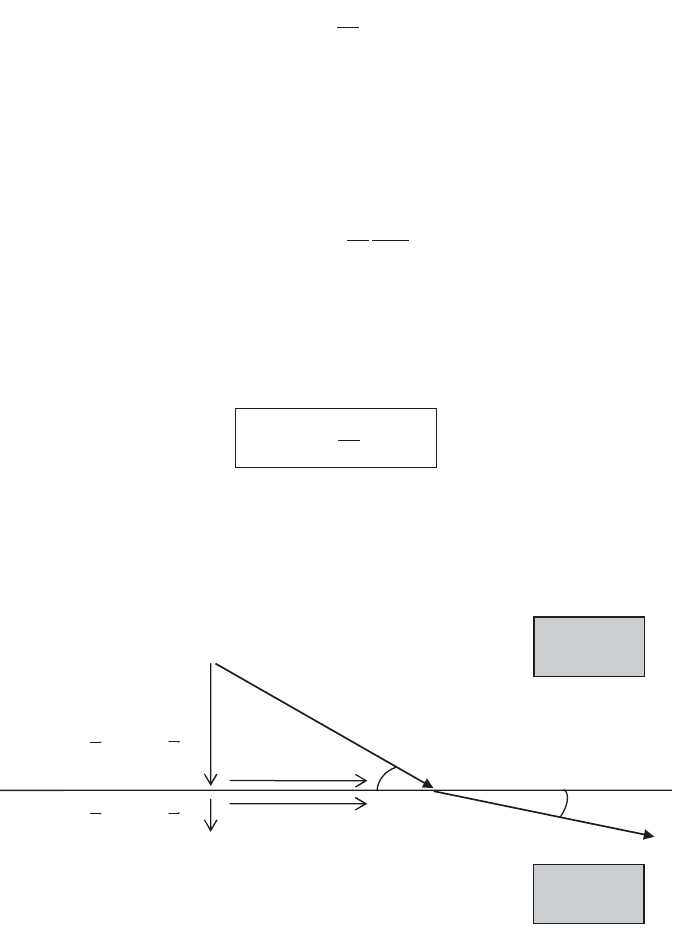
The boundary between two dissimilar dielectrics will bend or refract an
electric field vector.* This is due to the fact that the component of the flux
density vector that is normal to the boundary is constant across the boundary,
while the parallel component of the electric field is constant at the boundary.
This is shown in Figure 2.2 where the N and T subscripts denote the normal
and tangential components of the electric field vector and flux density vectors
relative to the dielectric boundary, respectively. The subtleties of why this
occurs is treated in the references [3, 4]. Thus
and
Since
it is apparent that
DD
NN12
=
f
2
1
22
=
()
-
tan
rr
EE
NT
f
1
1
11
=-
()
-
tan
rr
EE
NT
Using the fact that
and substituting into the expression for f
2
, yields
(2.1)
Thus the angle or direction of the E field in the second dielectric can be written
in terms of the components of the E field in the first dielectric and the ratio
of the dielectric constants. Taking the derivation one step further, the ratio of
E
N1
to E
T1
is the tangent of f
1
,so
(2.2)
This expression shows that, as one might expect, electric fields that are normal
or parallel to a dielectric boundary (f
1
= 0 or 90°) are not refracted and the
amount of refraction depends upon the dielectric constants of both materials
and the grazing angle.
f
e
e
f
2
1
2
1
=
()
Ê
Ë
ˆ
¯
-
tan tan
1
f
e
e
2
1
2
1
1
1
=
Ê
Ë
Á
ˆ
¯
˜
-
tan
r
r
E
E
N
T
EE
TT12
=
rr
EE
NN2
2
1
1
=
e
e
THE ELECTRIC FIELD 17
E
1
Dielectric
1
e = e
1
Dielectric
2
e = e
2
E
T1
E
T2
E
N1
= e
1
D
N1
f
1
f
2
E
2
E
N2
= e
2
D
N2
Figure 2.2 Behavior of an electric field vector at a dielectric boundary.
2.2.2 Conductivity
Materials that have free electrons available are called conductors. Conductors
are characterized by their conductivity, s, or by the reciprocal of the conduc-

tivity, which is the resistivity, r.The units of conductivity are siemens per meter,
and the units of resistivity are ohm-meters. Materials with very low conduc-
tivity are called insulators. A perfect dielectric will have zero conductivity,
while most real-world materials will have both a dielectric constant and a non-
zero conductivity. As the conductivity of the dielectric material increased, the
dielectric becomes more lossy. When considering the effect of nonideal mate-
rials on electromagnetic waves, the permittivity can be expressed as a complex
number that is a function of the dielectric constant, the conductivity, and the
frequency of the wave. This is discussed further in Section 2.4.2.
A static electric field cannot exist in a conductor, because the free electrons
will move in response to the electric field until it is balanced. Thus, when an
electric field is incident on a conductor, enough free electrons will move to the
surface of the conductor to balance the incident electric field, resulting in a
surface charge on the conductor. This phenomenon is central to the operation
of a capacitor [6].
2.3 THE MAGNETIC FIELD
Static magnetic fields can be generated by steady (or linearly increasing)
current flow or by magnetic materials. The magnetic field has both strength
and direction, so it is denoted by a vector, B. In a manner similar to the elec-
tric field, the magnetic field can be divided into magnetic flux density (H) and
magnetic field strength (B). The unit of magnetic field strength is amperes per
18 ELECTROMAGNETICS AND RF PROPAGATION
TABLE 2.3 Some Representative Values for Conductivity for Various Materials
Ranging from Conductors to Insulators (From [5], courtesy of McGraw-Hill)
Conductors Insulators
Material Conductivity (S/m) Material Conductivity (S/m)
Silver 6.1 ¥ 10
7
Wet earth ~10
-3
Copper 5.7 ¥ 10
7
Silicon 3.9 ¥ 10
-4
Gold 4.1 ¥ 10
7
Distilled water ~10
-4
Aluminum 3.5 ¥ 10
7
Dry earth ~10
-5
Tungsten 1.8 ¥ 10
7
Rock ~10
-6
Brass 1.1 ¥ 10
7
Bakelite ~10
-9
Iron ~10
7
Glass ~10
-12
Nichrome 10
6
Rubber ~10
-15
Mercury 10
6
Mica ~10
-15
Graphite 10
5
Wax ~10
-17
Carbon 3 ¥ 10
7
Quartz ~10
-17
Germanium 2.3
Seawater 4
Source: Plonus [5], courtesy of McGraw-Hill.
meter (A/m), and the unit of magnetic flux density is webers per square meter
(Wb/m
2
) or teslas. For nonmagnetic materials, the magnetic field and the mag-
netic flux density are linearly related by, m, the permeability of the material.
The units of material permeability are henries per meter where the henry is
the unit of inductance. One henry equals one weber per ampere. The perme-
ability is expressed as a relative permeability, m
r
, times the permeability of free
space m
0
,so
where
The magnetic flux is proportional to current flow, while the magnetic field
depends on both the current flow and the permeability of the material. The
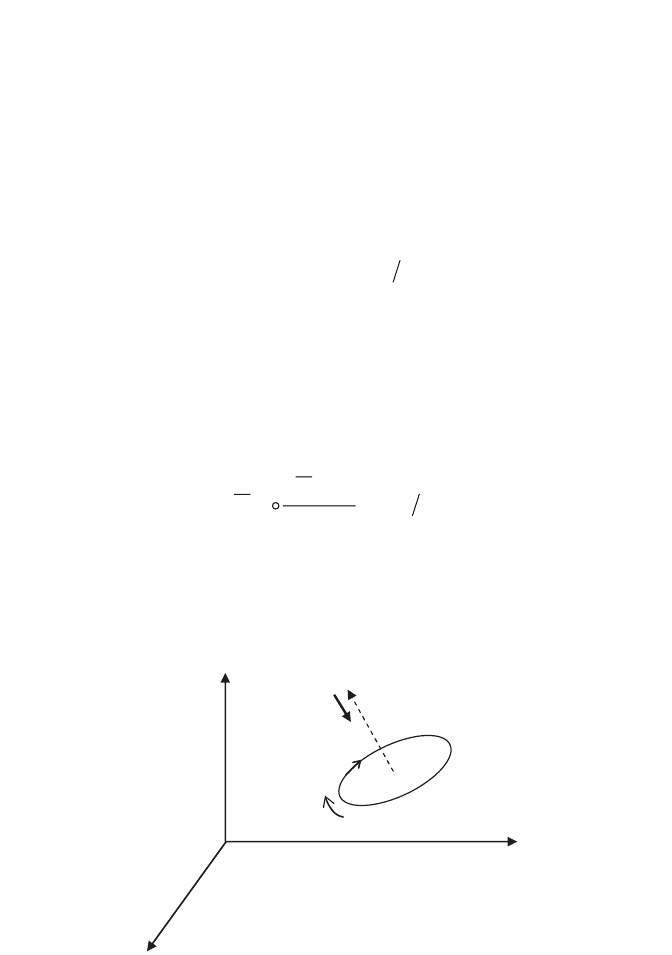
Biot–Savart Law (alternately known as Ampere’s Law) quantifies the rela-
tionship between electrical current and magnetic flux. In order to have a steady
current flow, a closed circuit is required. Figure 2.3 shows a representative
geometry. The integral form of the Biot–Savart Law is
which says that the magnetic field is equal to the line integral of the current
crossed with the vector from the current loop to the point of interest and
scaled by 4p times the separation squared.
H
Idl a
R
R
=
¥
Ú
ˆ
4
2
p
Am
mp
0
7
410=¥
-
Hm
mmm=
r0
BH=m
THE MAGNETIC FIELD 19
y
x
z
dl
I
R
H
Figure 2.3 Geometry of a current loop and the resulting magnetic field.

When a magnetic field is incident on a boundary between magnetic mate-
rials, the relevant equations are
and
where J
S
is the surface current density vector at the boundary.
For the purposes of this book the conductive and dielectric properties are
of primary interest, and it will usually be assumed that the magnetic perme-
ability of the materials being considered is unity (m
r
= 1) unless otherwise
specified.
2.4 ELECTROMAGNETIC WAVES
Maxwell’s equations form the basis of electromagnetic wave propagation.
The essence of Maxwell’s equations are that a time-varying electric field
produces a magnetic field and a time-varying magnetic field produces an elec-
tric field. A time-varying magnetic field can be generated by an accelerated
charge.
In this book the focus is on plane waves, since plane waves represent elec-
tromagnetic radiation at a distance from the source and when there are no
interfering objects in the vicinity. In a strict sense, all real waves are spherical,
but at a sufficient distance from the source, the spherical wave can be very
well approximated by a plane wave with linear field components, over a limited
extent. When using plane waves, the electric field, magnetic field, and direc-
tion of propagation are all mutually orthogonal. By using the propagation
direction vector to represent the plane wave, the visualization and analysis of
plane-wave propagation is greatly simplified. This is called ray theory and is
used extensively in later chapters. Ray theory is very useful in far-field (plane-
wave analysis), but is not universally applicable in near-field situations. The
relationship between the time-varying electric and magnetic fields is expressed
mathematically for uniform plane waves as
The differential form of Maxwell’s equations are used to derive the wave equa-
tion [7], which is expressed in one dimension as
—¥ =-
—¥ =
E
H
t
H
E
t
m
∂
∂
e
∂
∂
HH J
TTS12
-=
BB
NN12
=
20 ELECTROMAGNETICS AND RF PROPAGATION
This partial differential equation is the fundamental relationship that governs
the propagation of electromagnetic waves. The velocity of propagation for the
electromagnetic wave is determined from the wave equation and is a function
of the permittivity and permeability of the medium.
(2.3)
When expressed in terms of the relative permittivity and permeability, the
equation for the velocity of propagation becomes
Using the values of m
0
and e
0
in this expression yields
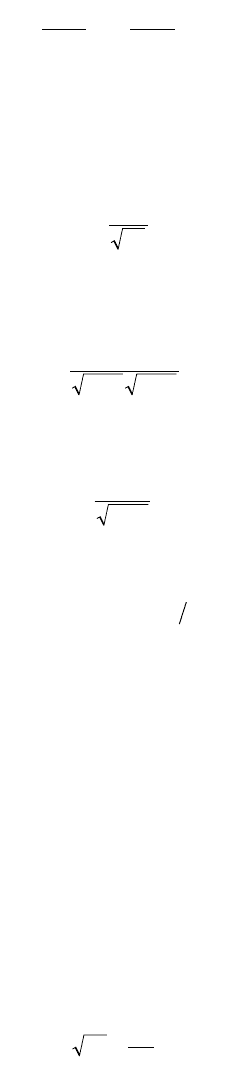
(2.4)
where
Thus the velocity of propagation is equal to the velocity of light in free space
divided by the square root of the product of the relative permittivity and
permeability.
An electromagnetic plane wave traveling in the positive z direction can be
described by the following equations:
where
and k is the wave number,
(2.5)
k ==
-
wme
p
l
2
1
m
Ez Ee Ee
Hz Ee Ee
x
jkz jkz
y
jkz jkz
()
=+
()
=+
-
-
12
12
h
Pz E zH z
xy
()
=
() ()
c =¥2 998 10
8
.ms
vc
rr
=
1
me
v
rr
=
1
00
me me
v =
1
me
∂
∂
me
∂
∂
2
2
2
2
E
t
E
z
xx
=
ELECTROMAGNETIC WAVES 21