
Seybold J.S. Introduction to RF Propagation
Подождите немного. Документ загружается.

Note that a factor of e
-jwt
has been suppressed in the expressions for E
x
and
H
y
.
2.4.1 Electromagnetic Waves in a Perfect Dielectric
The form of electromagnetic waves in a uniform lossless dielectric is identical
to the form in free space with the exception of the value of permittivity. Thus
by simply multiplying the free-space electric field component by the dielectric
constant of the material, the expression for the plane wave in the dielectric is
obtained. In each case, the relative permeability is assumed to be equal to one.
2.4.2 Electromagnetic Waves in a Lossy Dielectric or Conductor
In a practical sense, most materials lie on a continuum of properties. The char-
acterization of a material as a conductor or dielectric is based on the domi-
nant property of the material. For lossy dielectrics, the permittivity or dielectric
constant is given by
(2.6)
where s is the conductivity of the dielectric. Thus the dielectric constant is a
complex value with the imaginary part representing the loss characteristics of
the material. The loss tangent is defined as s/(we¢) and represents the ratio of
conductive current to displacement current in the material. A material can be
considered low loss if the loss tangent is less than 0.1, and it is considered high
loss if the loss tangent is greater than 10.
2.4.3 Electromagnetic Waves in a Conductor
When a static electric field is incident on a conductor, the free charges in the
conductor simply move to cancel the electric field. In the case of an electro-
magnetic wave, however, the incident field is changing, so the currents in the
conductor are also changing, which produces an electromagnetic wave. Thus
an electromagnetic wave can exist within a conductor, although it will be con-
centrated near the surface. By incorporating the complex permittivity into the
wave equation, it is clear that the complex part of the permittivity produces
a real value in the exponent, which causes the wave strength to decay with
distance as it penetrates the conducting material. To see this, consider the
complex wave number,
(2.7a)
or
k
j
==¢-
Ê
Ë
ˆ
¯
-
wme wme
s
we
1
1
m
ee
s
we
=¢ -
¢
Ê
Ë
ˆ
¯
1
j
22 ELECTROMAGNETICS AND RF PROPAGATION
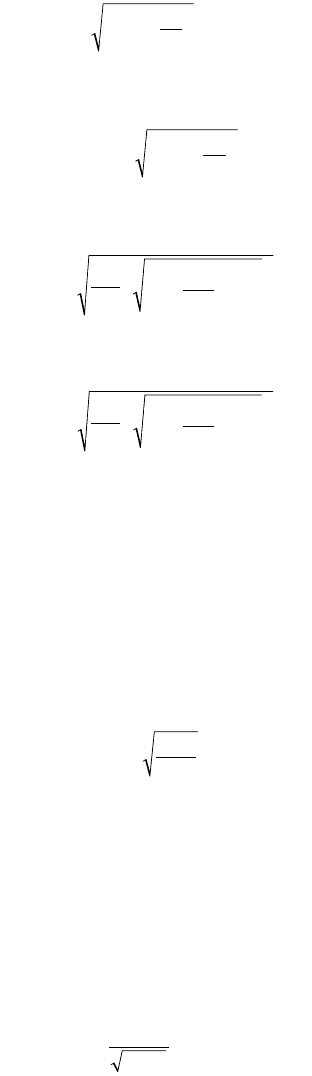
(2.7b)
The wave number can then be separated into real and imaginary parts [8]:
(2.8)
The expression for a, the attenuation constant can be shown to be
(2.9a)
and the expression for b, the phase constant is
(2.9b)
Thus, when an electromagnetic wave is incident on a conductive material, it
penetrates the material according to the following equations [9]:
Thus the real part of the exponent is called the attenuation constant, and it
causes the amplitude of the wave to attenuate with distance (z). For relatively
good conductors, the conductivity will be large and a can be approximated as
(2.10)
Since the wave is attenuated as it penetrates the conductor, it is useful to be
able to provide a quick characterization of how deep the electromagnetic wave
will penetrate into the conductive material.The attenuation constant is a func-
tion of the frequency of the wave, the conductivity of the material (as well as
the permeability), and the distance traversed in the conducting material. The
distance where the amplitude of the incident wave is attenuated by a factor
of e
-1
is called the skin depth. The skin depth is found by setting ad = 1 and
solving for d. The result is
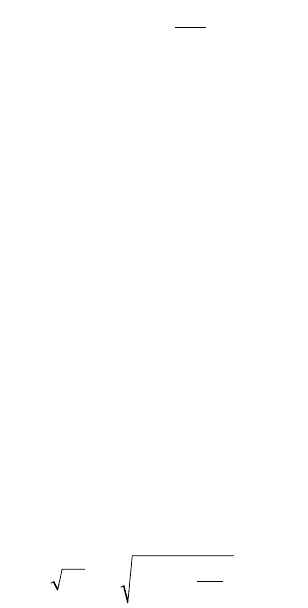
(2.11)
d
pms
=
1
f
m
a
wms
@
2
Ez Ee Ee
Hz Ee Ee
x
aj z aj z
y
aj z aj z
()
=+
()
=+
-+
()
+
()
-+
()
+
()
12
12
bb
bb
h
bw
me
s
we
=
¢
+
¢
Ê
Ë
ˆ
¯
+
Ê
Ë
Á
ˆ
¯
˜
2
11
2
aw
me
s
we
=
¢
+
¢
Ê
Ë
ˆ
¯
-
Ê
Ë
Á
ˆ
¯
˜
2
11
2
jk j j
j
=+ = ¢-
¢
Ê
Ë
ˆ
¯
-
abwme
s
w
m
1
k
j
=¢-
¢
Ê
Ë
ˆ
¯
-
wme
s
w
m
1
ELECTROMAGNETIC WAVES 23
The skin depth is frequently used to provide an assessment of the depth of the
electromagnetic wave into a conductor. This can be useful, for example, when
determining the required thickness of electromagnetic shielding.
2.5 WAVE POLARIZATION
The polarization of an electromagnetic wave is defined as the orientation of
plane in which the electric field resides. Antenna polarization is defined as the
polarization of the wave that it transmits. The simplest polarization to envi-
sion is linear, which is usually either vertical or horizontal polarization, but it
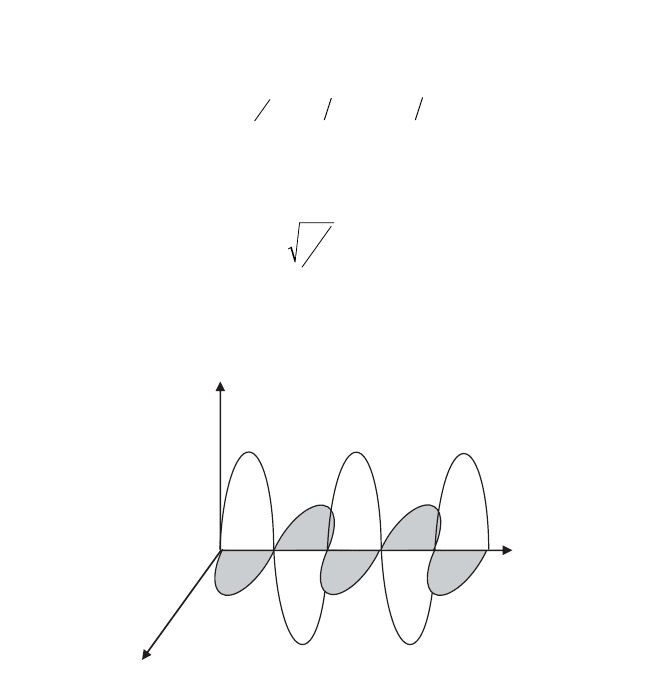
can be defined for other orientations (Figure 2.4).
The vector cross product between the electrical and magnetic fields gives a
vector in the direction of propagation. This is called the Poynting vector and
can be defined as either
or
where Z
0
is the characteristic impedance (or intrinsic impedance) of the
medium, which is given by
which can also be expressed as
Z
0
=
m
e
ohms
SEH=¥
1
2
0
Z Wm
2
SEH=¥
24 ELECTROMAGNETICS AND RF PROPAGATION
H
y
E
x
S
z
Figure 2.4 Conceptual diagram of linear polarization.

(2.12)
Thus the second formulation of the Poynting vector gives the power density
in watts per square meter. The concept of power density is discussed further
in later chapters.
Another type of polarization is circular, which is a special case of elliptical
polarization. This is covered in more detail in the following chapter on anten-
nas, but for now it is sufficient to note that elliptical polarization consists of
the sum of two orthogonal, linearly polarized waves (usually vertical and hor-
izontal) that are 90 degrees out of phase. The sign of the 90-degree phase dif-
ference sets the direction of the polarization, right hand or left hand. The axial
ratio is defined as the ratio of the major axis of the ellipse to the minor axis.
For circular polarization, the axial ratio is unity (0 dB). Chapter 3 provides
more information on axial ratio.
In previous sections the effect of the material boundaries on magnetic and
electric fields was discussed. The angle of incidence* of the electric and mag-
netic field along with the ratio of relative permittivity and permeability deter-
mine what the net effect of the material boundary will be. For this reason, the
polarization of the wave as well as the angle of incidence (or the grazing angle)
and material properties must be known in order to predict the effect of the
boundary on the magnitude and direction of the resulting wave. This has inter-
esting implications for elliptical polarization, where the sense of the linear
polarizations are rotating. In this case, it is possible that some material bound-
aries may actually disperse or (linearly) polarize the incident wave rather than
simply refracting and reflecting it.
2.6 PROPAGATION OF ELECTROMAGNETIC WAVES AT
MATERIAL BOUNDARIES
For the purposes of RF propagation, the effect of the interaction of a plane
wave with other surfaces such as knife-edge diffractors (see Chapter 8) or the
ground are of considerable interest. In this chapter the effect of a plane wave
incident on a flat (smooth) surface of either a perfect dielectric or a perfect
conductor is characterized from a theoretical standpoint. The lossy-dielectric
case is not treated in detail because the development is somewhat tedious and
the material properties are not usually that well known in the environments
of interest. In addition, the real-world problem of irregular surfaces and
nonhomogeneous materials is not readily treated mathematically and for the
Z
r
r
0
377=
m
e
ohms
PROPAGATION OF ELECTROMAGNETIC WAVES AT MATERIAL BOUNDARIES 25
* The angle of incidence is defined as the angle relative to the surface normal. For work in this
text, the grazing angle (the angle relative to the surface) is usually of greater interest and for that
reason is used throughout. The conversion of the equations found in the electromagnetic litera-
ture is straightforward.
purpose of RF propagation analysis is generally treated using empirical data
about the materials and/or surfaces in question.
When an electromagnetic wave is incident on a surface, some of the energy
will be reflected and/or scattered and some will be absorbed/refracted. Scat-
tering is reflection from sharp edges or irregular surfaces and is not treated in
this chapter, since extensive detail about the surface is required to do so and
a statistical characterization is usually preferred. When a wave is incident on
a material surface, some of the energy will (generally) enter the material and
the rest will be reflected. Of the energy that enters the material, some of it
may be absorbed due to the conductivity of the material and the rest propa-
gates into the material (is refracted).With the exception of circumstances such
as penetrating walls or windows, the reflected component is of primary inter-
est to the analyst.
2.6.1 Dielectric to Dielectric Boundary
The analysis of the reflection and refraction of an electromagnetic wave at a
material boundary is based on applying appropriate boundary conditions to
the plane-wave equation. One interesting and useful approach to this analy-
sis is to treat the problem as a transmission line system [9]. By so doing, the
details of the analysis can be concisely incorporated into a relatively few
number of equations. This approach is used in the following development. An
important subtlety of refraction of electromagnetic waves is that the refrac-
tion is taken to be the change in the direction of wave propagation, whereas
for static electric and magnetic fields the refraction is taken as the change in
the direction of the flux lines.
Prior to looking at the impact of electromagnetic waves on material bound-
aries, it is important to define the polarization angle relative to the plane of
incidence, since the boundary effects are acting on the electric field portion of
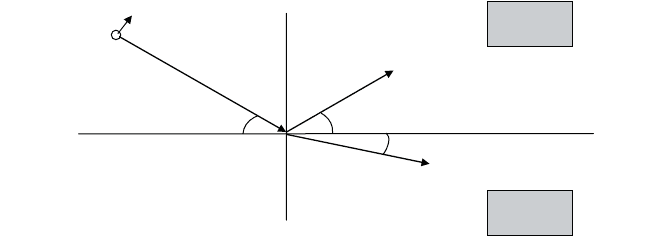
the wave since the materials considered herein are nonmagnetic. Figure 2.5
shows an electromagnetic wave incident on a boundary between two materi-
26 ELECTROMAGNETICS AND RF PROPAGATION
S
1
Dielectric
1
e
=
e
1
Dielectric
2
e
=
e
2
f
1
f
2
S
2
f
1
'
E
x
.
H
y
Figure 2.5 Diagram of a TM electromagnetic wave incident on a material boundary.
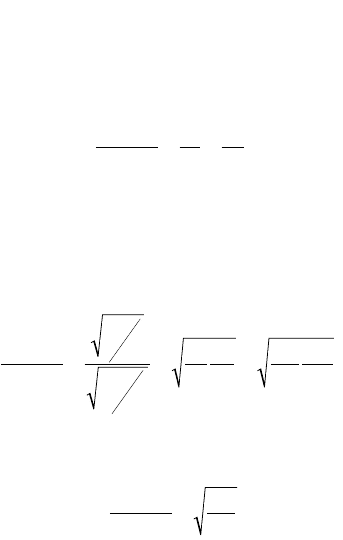
als. The electric field component of S
1
is designated by the small arrow, and
the magnetic field is shown coming out of the page by the circle with the dot
inside. This is formally called a transverse magnetic or TM wave, since the mag-
netic field is normal to the plane of incidence and the electric field is contained
in the plane of incidence.The plane of incidence is defined as the plane formed
by the propagation direction vector, S
1
, and the material boundary. A more
familiar example of a TM wave would be a vertically polarized wave incident
on a horizontal surface. A transverse electric or TE wave would have the elec-
tric field coming out of the paper and the magnetic field pointing downward
from S
1
. A TE wave would correspond to a horizontally polarized wave inci-
dent on a horizontal surface or material boundary.
Figure 2.5 shows how, in general, an electromagnetic wave that is incident
on a material boundary will have both a reflected and a refracted or trans-
mitted component. This separation of the incident wave is treated by using
the concept of a reflection and a transmission coefficient. It can be shown [10]
that for a smooth, flat surface, the angle of reflection is equal to the grazing
angle.
Snell’s law of refraction from optics provides another convenient
relationship,*
(2.13)
where v
2
and v
1
are the propagation velocities in materials 2 and 1, respec-
tively, and n
1
and n
2
are the refraction indexes (n = c/v) of materials 1 and 2,
respectively. This may be expressed in terms of permittivity and permeability
as
For most cases of interest, the relative permeability is unity and
(2.14)
cos
cos
q
q
e
e
2
1
2
1
()
()
=
r
r
cos
cos
q
q
m
e
m
e
e
e
m
m
e
e
m
m
2
1
1
1
21
2
2
1
1
2
2
1
1
2
()
()
===
r
r
r
r
cos
cos
q
q
2
1
2
1
1
2
()
()
==
v
v
n
n
¢=ff
11
PROPAGATION OF ELECTROMAGNETIC WAVES AT MATERIAL BOUNDARIES 27
* It should be noted that electromagnetic texts define the angle of incidence to the normal vector
at the surface rather than relative to the surface. The use of grazing angle is better suited toward
the applications of RF analysis, but results in some of the equations being different from those in
an electromagnetics book.
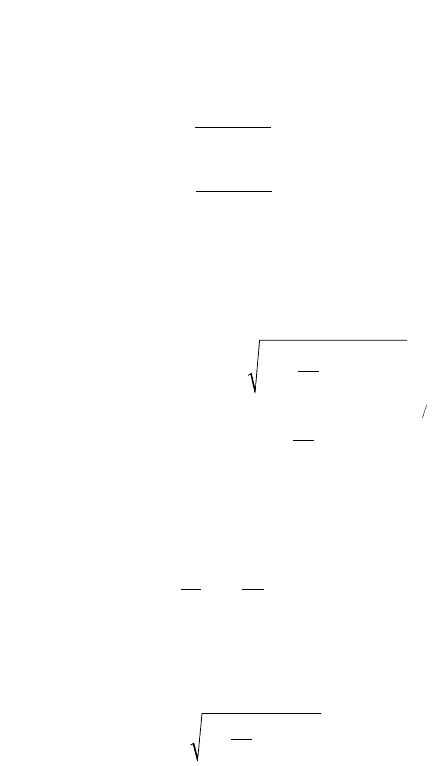
Note that (2.14) is different from (2.2). The difference is that (2.2) applies to
the bending of the E field lines, whereas (2.14) applies to the direction of prop-
agation, which is orthogonal to the E field. Put another way, f is the angle of
incidence of the electric field lines, and q is the angle of incidence of the direc-
tion of travel of a wave. This is a subtle but important distinction.
The interaction of an electromagnetic wave with a boundary between two
materials can be treated as a transmission line problem. The goal is to deter-
mine the reflection coefficient, r, and the transmission coefficient, t.The
expressions are slightly different depending upon the nature of the materials
and the sense of the wave polarization. Referring to Figure 2.5, for flat sur-
faces, it will always be the case that the angle of departure for the reflected
part of the wave will be equal to the grazing angle,
In addition, the following relationships hold:
(2.15)
(2.16)
where Z
L
is the effective wave impedance of the second material, which
is a function of the grazing angle and the propagation velocities in each
material.
(2.17)
(2.18)
Since the definition of the propagation velocity is given by (2.3), the follow-
ing substitution can be made in (2.17) and (2.18):
Either of the expressions for effective wave impedance may be used to deter-
mine the angle of the transmitted portion of the incident wave.
(2.19)
q
e
e
q
2
1
1
2
1
1=-
()
È
Î
Í
˘
˚
˙
-
cos sin
2
v
v
2
1
2
1
2
Ê
Ë
ˆ
¯
=
e
e
TE: csc cos
2
ZZ Z
v
v
L
=
()
=-
Ê
Ë
ˆ
¯
()
È
Î
Í
˘
˚
˙
-
222
2
1
2
1
12
1qq
TM: sin cos
2
ZZ Z
v
v
L
=
()
=-
Ê
Ë
ˆ
¯
()
222
2
1
2
1
1qq
t=
+
2
1
Z
ZZ
L
Lz
r=
-
+
ZZ
ZZ
Lz
Lz
1
1
ff
11
=¢
28 ELECTROMAGNETICS AND RF PROPAGATION
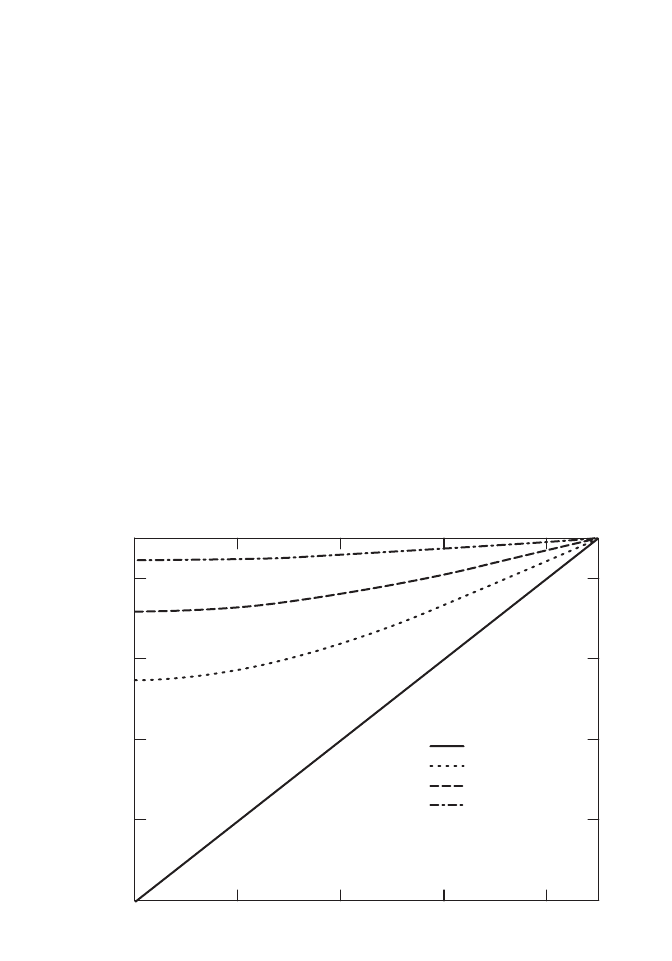
A plot of the transmission angle versus grazing angle for several values of e
2
/e
1
is given in Figure 2.6.The expression for the wave impedances in the first mate-
rial are, of course, dependent upon the polarization and given by
(2.20)
(2.21)
The reflection and transmission coefficients for an electromagnetic wave
incident on a perfect dielectric can now be calculated. Figure 2.7 shows plots
of the reflection and transmission coefficients for the wave incident on a
perfect dielectric. The values of, e
r
may be interpreted as the ratio e
2
/e
1
or as
simply e
r2
if the first material is free space. Several interesting observations can
be made from these plots: The transmission coefficient minus the reflection
coefficient is always equal to one, it is possible for the transmission coefficient
to exceed one since the electric field will be stronger in the second material
(if it has the higher dielectric constant), and when the dielectric constants of
the two materials are equal, there is no reflection and total transmission of the
wave as expected.
It is also noteworthy that there is a point for TM waves (i.e., vertical polar-
ization) where the reflection coefficient crosses zero. The angle where this
occurs is called the critical angle, and at that point there is total transmission
of the wave and no reflection. The critical angle occurs when Z
L
= Z
z1
, which
gives
TE: csc
1
ZZ
z11
=
()
q
TM: sin
1
ZZ
z11
=
()
q
PROPAGATION OF ELECTROMAGNETIC WAVES AT MATERIAL BOUNDARIES 29
020406080
0
20
40
60
80
e
r
= 1
e
r
= 3
e
r
= 10
e
r
= 100
Transmission Angle in the Dielectric
Grazing Angle (deg)
Transmission Angle (deg)
Figure 2.6 Transmission angle into a dielectric as a function of grazing angle and e
2
/e
1
.
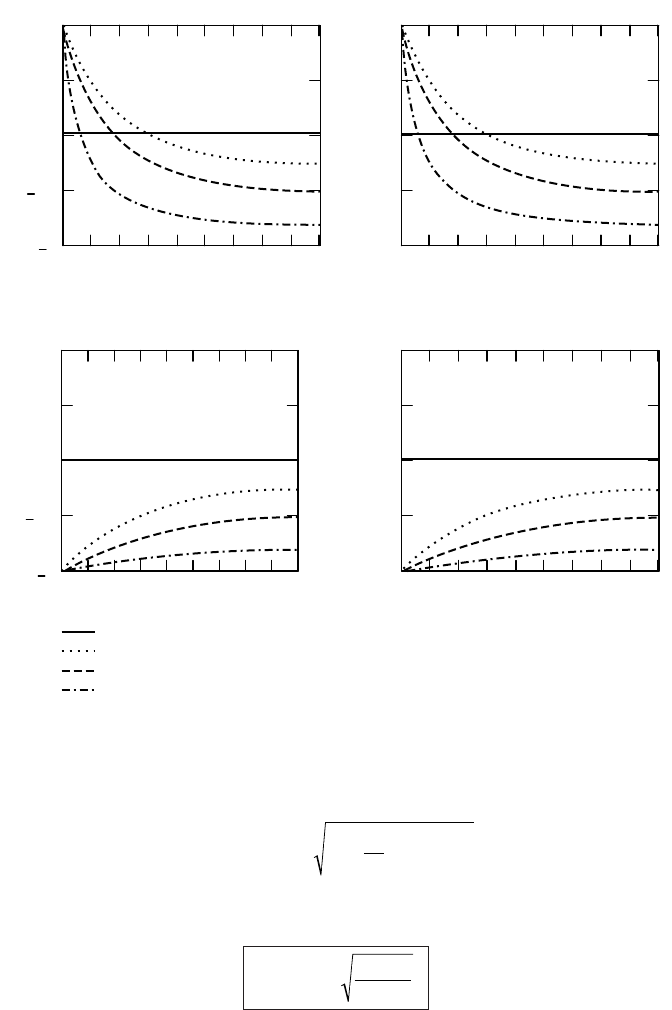
(2.22)
Next, recalling the fact that m
1
=m
2
and Z = (m/e)
1/2
, it can be shown that*
(2.23)
q
e
ee
c
=
+
Ê
Ë
Á
ˆ
¯
˜
-
sin
1
1
12
ZZ
v
v
cc12
2
1
2
2
1sin cosqq
()
=-
Ê
Ë
ˆ
¯
()
30 ELECTROMAGNETICS AND RF PROPAGATION
0 102030405060708090
1
0.5
0
0.5
1
TM Reflection Coefficient
Grazing Angle (deg)
Reflection Coefficient
0 102030405060708090
0
0.5
1
1.5
2
TM Transmission Coefficient
Grazing Angle (deg)
Transmission Coefficient
0 102030405060708090
1
0.5
0
0.5
1
e
r
= 1
e
r
= 3
e
r
= 10
e
r
= 100
TE Reflection Coefficient
Grazing Angle (deg)
Reflection Coefficient
0 102030405060708090
0
0.5
1
1.5
2
TE Transmission Coefficient
Grazing Angle (deg)
Transmission Coefficient
Figure 2.7 Transmission and reflection coefficients as a function of grazing angle for
different values of e
2
/e
1
at a boundary between perfect dielectrics.
* Here again the definition of critical angle here is relative to horizontal, so this expression differs
from that given in Ref. 11 and other EM texts.
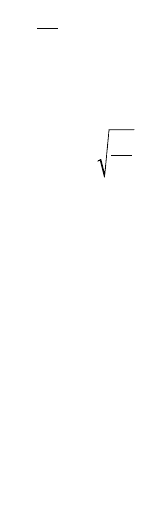
The critical angle exists for TM waves regardless of whether e
2
/e
1
is greater
than or less than one. Since this effect only occurs for TM waves, it can be used
to separate out the TM component from a circularly (or randomly) polarized
wave upon reflection. Thus this angle is also called the polarizing angle or
sometimes the Brewster angle, particularly in radar work.
It is also interesting to note that in the case where e
2
/e
1
< 1, it is possible for
the transmission coefficient to equal zero. This occurs when Z
L
goes to zero,
or when
or
(2.24)
This only occurs when the wave is traversing a boundary between dielectrics
in the direction of the larger dielectric constant.This angle represents the point
where there is no transmission and the wave is totally reflected.
2.6.2 Dielectric-to-Perfect Conductor Boundaries
For a wave in a dielectric that is incident on a perfect conductor, the resulting
reflection and transmission coefficients are
as expected. Thus a vertically polarized wave will undergo a 180-degree phase
shift upon reflection, whereas a horizontally polarized wave does not experi-
ence a phase shift. Thus reflection of off perfectly conductive smooth ground
has the interesting effect of converting right-hand circular polarization to left-
hand circular polarization and vice versa.
2.6.3 Dielectric-to-Lossy Dielectric Boundary
When considering the effects of a lossy-dielectric boundary on an electro-
magnetic wave, the complex permittivity can be used in the prior expressions
to determine the reflection and transmission coefficients. The resulting coeffi-
cients will be complex and thus will have both a magnitude and a phase. The
resulting reflected and transmitted components of the wave will be at same
TM:
TE:
=0
r
r
t
=-
=
1
1
q
e
e
=
Ê
Ë
Á
ˆ
¯
˜
-
cos
1
2
1
10
1
2
2
-
()
=
e
e
qcos
PROPAGATION OF ELECTROMAGNETIC WAVES AT MATERIAL BOUNDARIES 31