
Seybold J.S. Introduction to RF Propagation
Подождите немного. Документ загружается.

angles as those predicted in previous sections, whereas the amplitudes and
phases will be modified based on the material properties. In practical RF prop-
agation problems, it is rare that the surface material is sufficiently smooth
and the properties sufficiently understood to permit a detailed analysis of the
surface interaction. Thus the predicted interaction is usually handled empiri-
cally. There are some exceptions, including RF modeling software, where
assumptions are applied to the reflecting surface and numerical techniques
used to accommodate the surface irregularities. Another case where an exact
analysis may be practical is interaction with a pane of glass. If the material
properties are known, then the analysis is straightforward.
2.7 PROPAGATION IMPAIRMENT
There are a variety of phenomena that occur when an electromagnetic wave
is incident on a surface. These phenomena depend upon the polarization of
the wave, the geometry of the surface, the material properties of the surface,
and the characteristics of the surface relative to the wavelength of the elec-
tromagnetic wave.
Reflection: Whenever an electromagnetic wave is incident on a smooth
surface (or certain sharp edges), a portion of the wave will be reflected.
This reflection can be thought of as specular, where the grazing angle
and reflection angle are equal.
Scattering: Scattering occurs when an electromagnetic wave is incident on
a rough or irregular surface. When a wave is scattered, the resulting
reflections occur in many different directions.When looked at on a small
scale, the surface can often be analyzed as a collection of flat or sharp
reflectors. The determination of when a surface is considered rough is
usually based on the Rayleigh roughness criterion, which is discussed in
Chapter 8.
Diffraction: Diffraction occurs when the path of an electromagnetic wave
is blocked by an obstacle with a relatively sharp edge (as compared to
the wavelength of the wave). The effect of diffraction is to fill in the
shadow that is generated by the blockage.
Refraction: Is the alteration of the direction of travel of the wave as the
transmitted portion enters the second material (i.e., penetrates the
surface).
Absorption: Anytime that an electromagnetic wave is present in a material
other than free space, there will be some loss of strength with distance
due to ohmic losses.
Depolarization: As shown previously, the effects of transmission and reflec-
tion depend upon the orientation of the incident wave’s polarization rel-
ative to the plane of incidence. This can have the effect of altering the
32 ELECTROMAGNETICS AND RF PROPAGATION
polarization of the transmitted and reflected wave, particularly if the inci-
dent wave is circularly or elliptically polarized.
2.8 GROUND EFFECTS ON CIRCULAR POLARIZATION
Since it is possible for either diffraction or ground reflection to affect vertical
and horizontal polarization differently, it is worthwhile to examine the impact
such impairments have on a circularly polarized signal.
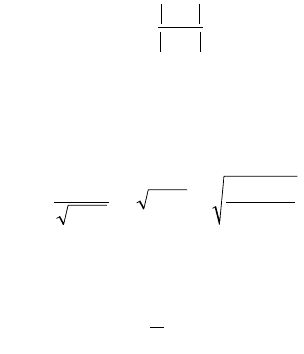
A circularly polarized wave (RHCP or LHCP) can be represented as the
sum of two orthogonal linearly polarized waves. The polarization vectors are
orthogonal to each other, and the respective signals are also orthogonal in
phase. For ideal circular polarization, the components will be of equal ampli-
tude and 90 degrees out of phase. For real-world antennas, however, the polar-
ization is actually elliptical (circular is a special case of elliptical polarization).
Thus the two vectors are not of equal amplitude. The axial ratio is defined as
the voltage ratio of the major axis to the minor axis of the polorization ellipse
(Chapter 3). The axial ratio of the transmitted wave is given by
(2.25)
The transmit antenna axial ratio is a specified parameter of the transmit
antenna, nominally 1–3 dB.
The transmitted wave can be represented as
where the (normalized) transmitted power is
and the resulting axial ratio is AR
t
.
Let the path gain (i.e., total path loss) for the horizontal and vertical com-
ponents be designated as G
H
and G
V
, respectively. Since the path introduces
loss (reduction in amplitude), each of these gains will be a very small number.
Since the orientation of the transmit antenna polarization ellipse is
unknown, it is assumed that the major axis is parallel to whichever linear polar-
ization experiences the greatest gain (least loss) to get a worst-case assess-
ment. Thus the power gains applied to each component of the transmitted
wave are
PE
t
=
1
2
2
E
E
AR
jARE
AR
AR
t
t
t
t
t
=+
Ê
Ë
ˆ
¯
+1
2
AR
E
E
t
=
maj
min
GROUND EFFECTS ON CIRCULAR POLARIZATION 33
(2.26)
The axial ratio of the received wave is
(2.27)
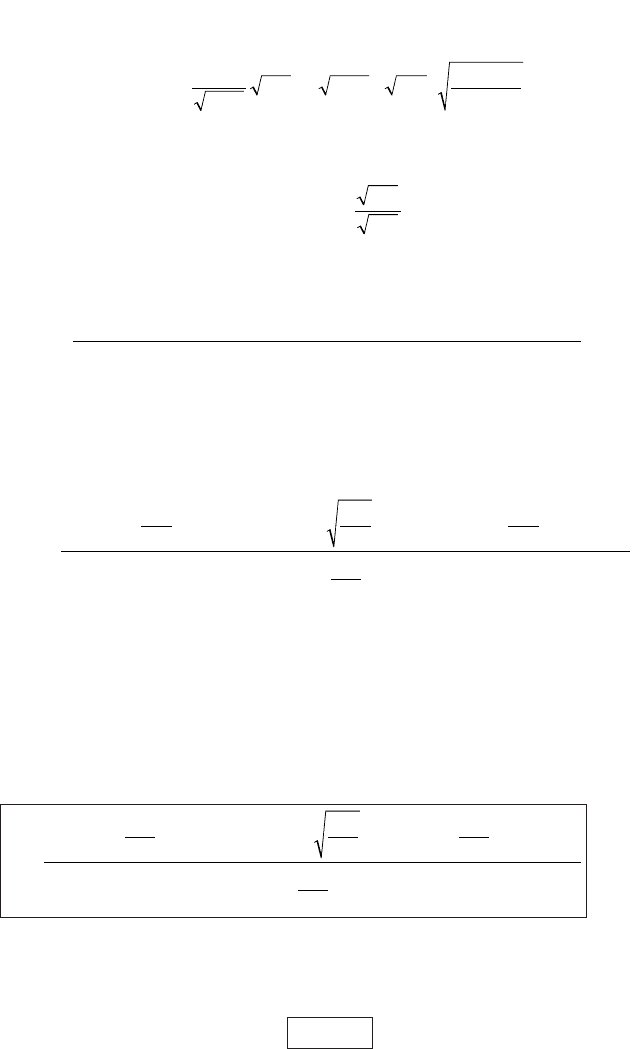
The polarization loss factor at the receive antenna is given by [12]
(2.28)
where q is the difference between the polarization tilt angles, taken to be 90
degrees for the worst case. Making the apparent substitutions, the expression
for the polarization loss factor becomes
(2.29)
The transmit and receive antennas are identical, so
and
(2.30)
The overall loss that is applied to the transmitted EIRP to determine the
received power level is
(2.31)
LFG
A
=
F
AR
G
G
AR AR
G
G
AR
G
G
AR
AR
G
G
AR
A
B
A
B
A
B
A
B
=
+
Ê
Ë
ˆ
¯
+
()
+--
Ê
Ë
ˆ
¯
-
()
+
Ê
Ë
ˆ
¯
+
()
114 11
21 1
222 22
22
AR AR AR
tr
==
F
AR
G
G
AR AR
G
G
AR AR
G
G
AR
AR
G
G
AR
t
A
B
rt
A
B
rt
A
B
r
t
A
B
r
=
+
Ê
Ë
ˆ
¯
+
()
+--
Ê
Ë
ˆ
¯
-
()
+
Ê
Ë
ˆ
¯
+
()
114 11
21 1
22 22
22
F
AR AR AR AR AR AR
AR AR
wrwr wr
wr
=
+
()
+
()
++-
()
-
()
()
+
()
+
()
11 4 11 2
21 1
22 22
22
cos q
AR AR
G
G
wt
A
B
=
GGG
GGG
E
E
AR
GjAREG
AR
AR
AHV
BHV
w
t
BtA
t
t
=
()
=
()
=+
Ê
Ë
ˆ
¯
+
max
min
,
,
1
2
34 ELECTROMAGNETICS AND RF PROPAGATION
To verify this expression, setting the antenna axial ratios equal to one and
taking the limit as G
B
goes to zero yields L = G
A
/2. This is the expected result,
analogous to transmitting perfect linear polarization and receiving with a
perfect circularly polarized antenna.
2.9 SUMMARY
In this chapter the basics of electromagnetic theory were briefly reviewed, fol-
lowed by a discussion of electromagnetic waves and how they behave in dif-
ferent materials. Of particular interest in RF propagation is the interaction of
an electromagnetic wave with a boundary between two dielectrics or between
a dielectric and a conductor. Using an analysis similar to transmission line
theory, expressions for the reflection coefficient, transmission coefficient, and
transmission angle were developed. The polarization of an electromagnetic
wave is defined as the orientation of the plane that contains the electric field
component of the wave. The polarizations of most interest are linear: (usually
vertical or horizontal) and elliptical or circular polarization, which can be
expressed as a linear combination of vertically and horizontally polarized
waves with appropriate phase.
The interaction of electromagnetic waves with a material boundary is a
strong function of the orientation of the polarization vector relative to the
plane of incidence. Two key cases are defined: transverse magnetic or TM,
where the electric field is contained in the plane of incidence and the mag-
netic field is transverse to the plane of incidence and transverse electric or TE,
where the magnetic field is contained in the plane of incidence and the elec-
tric field is transverse to the plane of incidence. These two polarizations are
analogous to vertically and horizontally polarized wave intersecting a hori-
zontal boundary (such as the earth’s surface).
The effect of a material boundary on an electromagnetic wave is a function
not only of the orientation of the polarization vector of the wave, but also of
the angle of incidence (grazing angle) and the properties of both materials.
In the case of two dielectrics, the dielectric constants determine to a large
extent the effect that the boundary will have on the wave. When a wave is
incident from a dielectric to a conductor, the wave will only slightly penetrate
the conductor and the majority of the wave will be reflected.
Due to the dependence of transmission and reflection on the polarization
of the wave, a circularly polarized wave will, in general, become depolarized
when reflected off of a material boundary. The effect of terrestrial interactions
on an elliptically polarized wave is examined and an expression for the result-
ing polarization loss, taking into account the axial ratio of the transmitting and
receiving antennas, is developed.
SUMMARY 35
REFERENCES
1. M. A. Plonus, Applied Electromagnetics, McGraw-Hill, New York, 1978, p. 124.
2. M. A. Plonus, Applied Electromagnetics, McGraw-Hill, New York, 1978, Table 1.1,
p. 3.
3. M. A. Plonus, Applied Electromagnetics, McGraw-Hill, New York, 1978, pp.
32–35.
4. S. V. Marshall and G. G. Skitek, Electromagnetic Concepts & Applications, 2nd ed.,
Prentice-Hall, Englewood Cliffs, NJ, 1987, pp. 141–143.
5. M. A. Plonus, Applied Electromagnetics, McGraw-Hill, New York, 1978, Table 2.1,
p. 62.
6. M. A. Plonus, Applied Electromagnetics, McGraw-Hill, New York, 1978, Chapter 6.
7. S. Ramo, J. R. Whinnery, and T. Van Duzer, Fields and Waves in Communication
Electronics, 2nd ed., John Wiley & Sons, New York, 1984, p. 131.
8. S. Ramo, J. R. Whinnery, and T. Van Duzer, Fields and Waves in Communication
Electronics, 2nd ed., John Wiley & Sons, New York, 1984, p. 280.
9. S. Ramo, J. R. Whinnery, and T. Van Duzer, Fields and Waves in Communication
Electronics, 2nd ed., John Wiley & Sons, New York, 1984, Chapter 6.
10. S. Ramo, J. R. Whinnery, and T. Van Duzer, Fields and Waves in Communication
Electronics, 2nd ed., John Wiley & Sons, New York, 1984, pp. 302–303.
11. S. Ramo, J. R. Whinnery, and T. Van Duzer, Fields and Waves in Communication
Electronics, 2nd ed., John Wiley & Sons, New York, 1984, p. 308.
12. J. S. Hollis, T. J. Lyon, and L. Clayton, Microwave Antenna Measurements, 2nd ed.,
Scientific Atlanta, Atlanta, GA, 1970, Chapter 3.
EXERCISES
1. Find the electric field vector (direction and intensity) for the following;
(a) At a distance of 1 m from a 5-C point charge, if the medium is
polystyrene.
(b) At a distance of 0.5m from an infinite line charge of 2 C, if the medium
is distilled water.
(c) At a distance of 2 m from an infinite plane charge of 1 C in air.
(d) At a distance of 20m from an infinite plane charge of 1 C in air.
2. Determine the angle of refraction of an electric field that that is incident
on a body of calm water at an angle of 30 degrees relative to the horizon.
The electric field originates in air, and the water may be considered pure
and treated as distilled water.
3. Find the magnetic field vector at a distance of 1 m from a conductor carry-
ing a 1-A current. The conductor is oriented vertically in free space, with
the current flowing in the positive z direction.
4. Consider a vertically polarized electromagnetic wave in air, with a fre-
quency of 10MHz. If the wave is incident on a flat, horizontal surface
36 ELECTROMAGNETICS AND RF PROPAGATION
of polystyrene, find the magnitude and angle of both the reflected and
refracted portion of the wave?
5. Repeat problem 4 if the wave is horizontally polarized.
6. Consider a 100-MHz wave in free space.
(a) If the wave is incident on a flat copper sheet, what is the skin depth?
(b) If the copper sheet is to be used for shielding and 97% of the electro-
magnetic wave must be blocked by the shield, how thick should the
copper sheet be?
7. What is the worst-case polarization loss factor if a wave is transmitted from
an antenna with a 2-dB axial ratio and received by an antenna with a
2.5-dB axial ratio? Assume that there is no distortion introduced by the
medium between the two antennas.
EXERCISES 37

38
Introduction to RF Propagation, by John S. Seybold
Copyright © 2005 by John Wiley & Sons, Inc.
CHAPTER 3
Antenna Fundamentals
3.1 INTRODUCTION
Every wireless system must employ an antenna to radiate and receive elec-
tromagnetic energy. The antenna is the transducer between the system and
free space and is sometimes referred to as the air interface. While a compre-
hensive treatment of the subject of antennas is beyond the scope of this work,
it is helpful to develop an intuitive understanding about how they operate and
provide a few examples of different antenna architectures. There are some
useful rules of thumb for relating antenna parameters to antenna size and
shape. For many types of antennas it is possible to estimate the gain from the
physical dimensions or from knowledge of the antenna beamwidths.
A fundamental principle of antennas, called reciprocity, states that antenna
performance is the same whether radiation or reception is considered [1]. The
implication of this principle is that antenna parameters may be measured
either transmitting or receiving. The principle of reciprocity means that esti-
mates of antenna gain, beamwidth, and polarization are the same for both
transmit and receive. This principle is used freely in this text as well as in most
works on antennas.
3.2 ANTENNA PARAMETERS
A useful abstraction in the study of antennas is the isotropic radiator, which
is an ideal antenna that radiates (or receives) equally in all directions, with a
spherical pattern. The isotropic radiator is also sometimes called an omni-
directional antenna, but this term is usually reserved for an antenna that radi-
ates equally in all directions in one plane, such as a whip antenna, which
radiates equally over azimuth angles but varies with elevation. The power
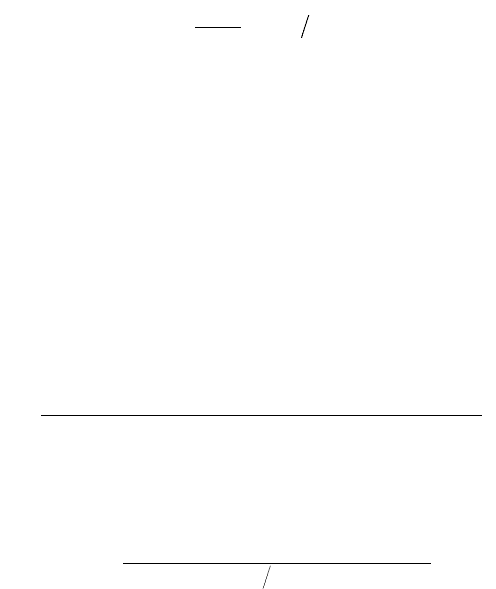
density, S, due to an isotropic radiator is a function only of the distance, d,
from the antenna and can be expressed as the total power divided by the area
of a sphere with radius d.
(3.1)
That is, the power is uniformly distributed over the sphere. Thus for an
isotropic radiator, the power density at a given range is constant over all angles
and is equal to the average power density at that range.
3.2.1 Gain
For a real antenna, there will be certain angles of radiation, which provide
greater power density than others (when measured at the same range). The
directivity of an antenna is defined as the ratio of the radiated power density
at distance, d, in the direction of maximum intensity to the average power
density over all angles at distance, d. This is equivalent to the ratio of the peak
power density at distance d, to the average power density at d:
Thus an isotropic antenna has a directivity of D = 1. When the antenna losses
are included in the directivity, this becomes the antenna gain
where
P
T
is the power applied to the antenna terminals
4pd
2
is the surface area of a sphere with radius d
h is the total antenna efficiency, which accounts for all losses in the antenna,
including resistive and taper* losses (h=h
T
h
R
)
Antenna gain can be described as the power output, in a particular direction,
compared to that produced in any direction by an isotropic radiator. The gain
is usually expressed in dBi, decibels relative to an ideal isotropic radiator.
3.2.2 Effective Area
An aperture antenna is one that uses a two-dimensional aperture such as a
horn or a parabolic reflector (as opposed to a wire antenna). The gain of an
G
d
Pd
T
=◊h
p
Power density at in max direction
4
2
D
d
d
=
Power density at in direction of maximum power
Mean power density at
S
P
d
=
4
2
p
Wm
2
ANTENNA PARAMETERS 39
* Taper loss is the inefficiency that is introduced when nonuniform illumination of the aperture
is used. Nonuniform aperture illumination is used to control radiation pattern sidelobes, similar
to windowing in spectral analysis and digital filtering [2, 3].

aperture antenna, such as a parabolic reflector, can be computed using an
effective area, or capture area, which is defined as
(3.2)
where A
p
is the physical area of the antenna and h is the overall efficiency of
the antenna (generally ranging from 50% to 80%).The expression for the gain
of an aperture antenna is
(3.3)
If only the physical dimensions of the antenna are known, one may assume
an efficiency of about 0.6 and estimate the gain reasonably well for most
antennas using the above expression.
Example 3.1. Given a circular aperture antenna with a 30-cm diameter, what
is the antenna gain at 39 GHz?
A 30-cm-diameter circular aperture has a physical area of 0.0707 m
2
.Assum-
ing an aperture efficiency of 60% yields
Using the expression for antenna gain and the wavelength of 7.69 mm yields
which, expressed as decibels relative to an isotropic radiator, is 10 log(9005),
or 39.5 dBi of gain. 䊐
If the physical dimensions of an aperture antenna are not known, but the
azimuth and elevation 3-dB beamwidths, q
AZ
and q
EL
, are known, the gain can
be estimated using the following rule of thumb:
where the 3-dB beamwidths are expressed in degrees [4].
The effective or capture area of a linear antenna, such as a vertical whip, a
dipole, or a beam, does not have the same physical significance as it does for
an aperture antenna. For example, a center-fed, half-wave dipole has an effec-
tive capture area of 0.119l
2
[5]. Instead of effective area, the concept of effec-
tive height is employed for linear antennas [6]. The effective height of an
antenna is the height that, when multiplied by the incident electric field, results
in the voltage that would actually be measured from the antenna.
G
AZ EL
@
26 000,
qq
G = 9005
A
e
= 0 0424
2
.m
G
A
e
=
4
2
p
l
AA
ep
=h m
2
40 ANTENNA FUNDAMENTALS

or
where V is the voltage measured at the antenna terminals and E is the mag-
nitude of the incident electric field.
Another way to view the effective height is by considering the average of
the normalized current distribution over the length of the antenna and multi-
plying that value by the physical length of the antenna.
(3.4)
Using this information, the effective area of a linear antenna can be found.
The current distribution over a half-wave dipole is nearly sinusoidal [7]
and for a very short dipole (l < 0.1l) it is approximately triangular, with the
peak current occurring at the center and zero current at each end.
The relationship between the effective height and the effective area is given
by
(3.5)
where
A
e
is the effective area in square meters
h
e
is the effective height in meters
Z
o
is the intrinsic impedance of free space, 377 ohms
R
r
is the radiation resistance of the antenna in ohms
Example 3.2. Determine the effective height and the effective area of a half-
wave dipole at 500 MHz.
A half-wave dipole for 500 MHz has a physical length of
For a half-wave dipole, the current distribution is
l
c
==
1
2 500
03
MHz
m.
A
hZ
R
e
eo
r
=
2
4
Ix I x
()
=
()
0
sin p
h
I
Ixdx
e
l
=
()
Ú
1
0
0
hVE
e
= m
VhE
e
= volts
ANTENNA PARAMETERS 41