
Smith R., Minton R. Calculus
Подождите немного. Документ загружается.

P1: OSO/OVY P2: OSO/OVY QC: OSO/OVY T1: OSO
MHDQ256-Ch01 MHDQ256-Smith-v1.cls December 6, 2010 20:21
LT (Late Transcendental)
CONFIRMING PAGES
1-17 SECTION 1.3
..
Computation of Limits 63
where the last equality holds if x = 0 (which is the case in the limit as x → 0). So, we
have
lim
x→0
√
x +2 −
√
2
x
= lim
x→0
1
√
x +2 +
√
2
=
1
√
2 +
√
2
=
1
2
√
2
.
So that we are not restricted to discussing only the algebraic functions (i.e., those that
can be constructed by using addition, subtraction, multiplication, division, exponentiation
and by taking nth roots), we state the following result now, without proof.
THEOREM 3.4
For any real number a,wehave
(i) lim
x→a
sin x = sina, (iii) if p is a polynomial and lim
x→p(a)
f (x) = L,
(ii) lim
x→a
cos x = cosa and then lim
x→a
f (p(x)) = L.
Notice that Theorem 3.4 says that limits of the sine and cosine functions are found
simply by substitution. A more thorough discussion of functions with this property (called
continuity) is found in section 1.4.
EXAMPLE 3.6 Evaluating a Limit of a Trigonometric Function
Evaluate lim
x→0
sin
x
3
+ π
2
.
Solution By Theorem 3.4 part (i) and part (iii), we have
lim
x→0
sin
x
3
+ π
2
= sin
π
2
= 1.
So much for limits that we can compute using elementary rules. Many limits can
be found only by using more careful analysis, often requiring an indirect approach. For
instance, consider the problem in example 3.7.
EXAMPLE 3.7 A Limit of a Product That Is Not the Product of the Limits
Evaluate lim
x→0
(x cot x).
Solution Your first reaction might be to say that this is a limit of a product and so,
must be the product of the limits:
lim
x→0
(x cot x) =
lim
x→0
x
lim
x→0
cot x
This is incorrect!
= 0 ·? = 0, (3.5)
y
x
q
q
pp
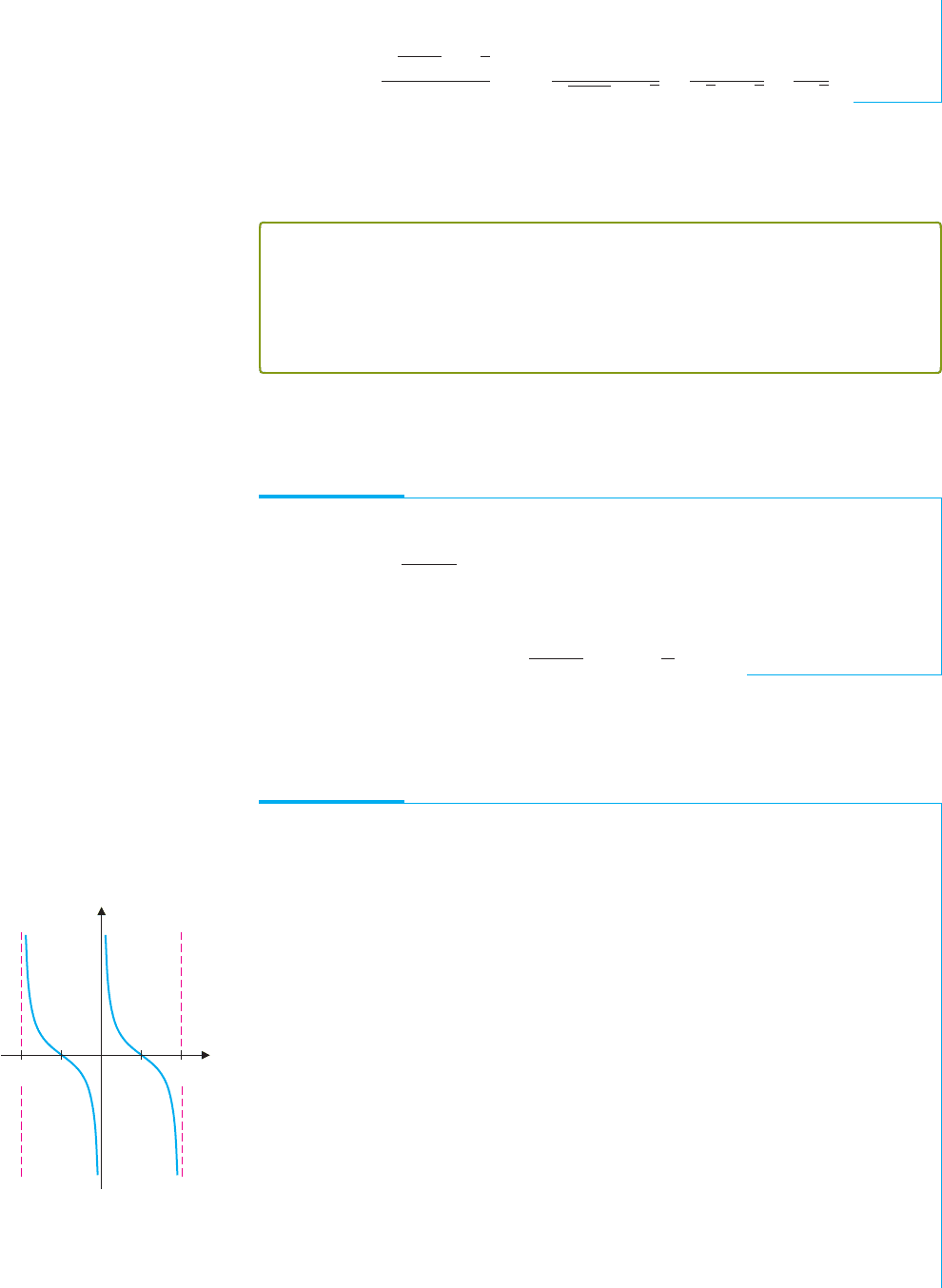
FIGURE 1.16
y = cot x
where we’ve written a “?” since you probably don’t know what to do with lim
x→0
cot x.
Since the first limit is 0, do we really need to worry about the second limit? The problem
here is that we are attempting to apply the result of Theorem 3.1 in a case where the
hypotheses are not satisfied. Specifically, Theorem 3.1 says that the limit of a product is
the product of the respective limits when all of the limits exist. The graph in Figure 1.16
suggests that lim
x→0
cot x does not exist. You should compute some function values, as
well, to convince yourself that this is in fact the case. Since equation (3.5) does not hold
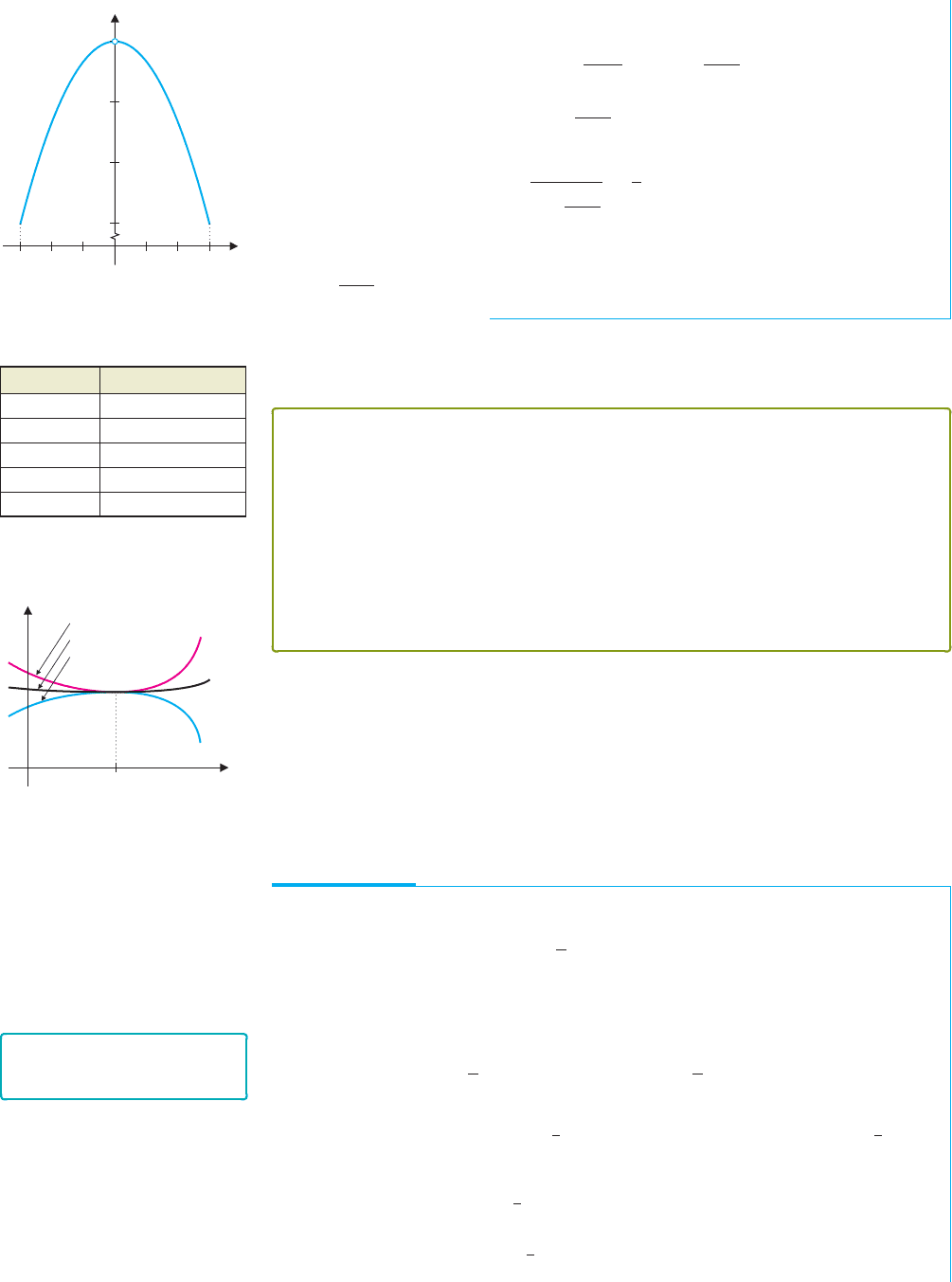
and since none of our rules seem to apply here, we draw a graph (see Figure 1.17 on the
following page) and compute some function values. Based on these, we conjecture that
lim
x→0
(x cot x) = 1,
P1: OSO/OVY P2: OSO/OVY QC: OSO/OVY T1: OSO
MHDQ256-Ch01 MHDQ256-Smith-v1.cls December 6, 2010 20:21
LT (Late Transcendental)
CONFIRMING PAGES
64 CHAPTER 1
..
Limits and Continuity 1-18
which is definitely not 0, as you might have initially suspected. You can also think about
this limit as follows:
lim
x→0
(x cot x) = lim
x→0
x
cos x
sin x
= lim
x→0
x
sin x
cos x
=
lim
x→0
x
sin x
lim
x→0
cos x
=
lim
x→0
cos x
lim
x→0
sin x
x
=
1
1
= 1,
since lim
x→0
cos x = 1 and where we have used the conjecture we made in example 2.6
that lim
x→0
sin x
x
= 1. (We verify this last conjecture in section 2.6, using the Squeeze
Theorem, which follows.)
x
0.97
0.98
0.99
1
0.30.3
y
FIGURE 1.17
y = x cot x
x x cot x
±0.1 0.9967
±0.01 0.999967
±0.001 0.99999967
±0.0001 0.9999999967
±0.00001 0.999999999967
At this point, we introduce a tool that will help us determine a number of important limits.
THEOREM 3.5 (Squeeze Theorem)
Suppose that
f (x) ≤ g(x) ≤ h(x)
for all x in some interval (c, d), except possibly at the point a ∈ (c, d) and that
lim
x→a
f (x) = lim
x→a
h(x) = L,
for some number L. Then, it follows that
lim
x→a
g(x) = L, also.
The proof of Theorem 3.5 is given in Appendix A, since it depends on the precise
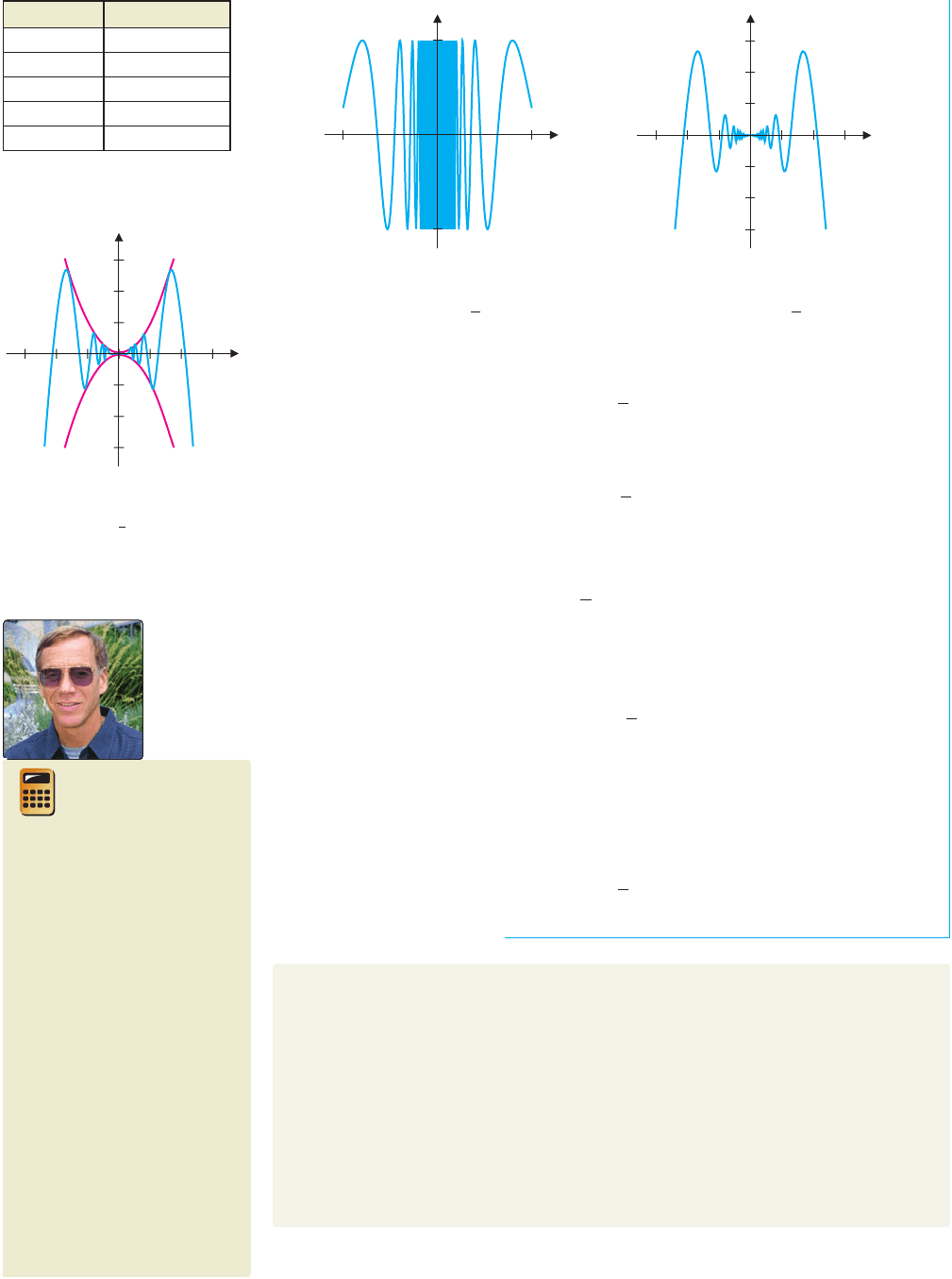
definition of limit found in section 1.6. However, if you refer to Figure 1.18, you should
clearly see that if g(x) lies between f (x) and h(x), except possibly at a itself and both f (x)
and h(x) have the same limit as x → a, then g(x) gets squeezed between f (x) and h(x)
and therefore should also have a limit of L. The challenge in using the Squeeze Theorem
is in finding appropriate functions f and h that bound a given function g from below and
above, respectively, and that have the same limit as x → a.
x
a
y
y f(x)
y g(x)
y h(x)
FIGURE 1.18
The Squeeze Theorem
REMARK 3.2
The Squeeze Theorem also
applies to one-sided limits.
EXAMPLE 3.8 Using the Squeeze Theorem to Verify the Value of a Limit
Determine the value of lim
x→0
x
2
cos
1
x
.
Solution Your first reaction might be to observe that this is a limit of a product and
so, might be the product of the limits:
lim
x→0
x
2
cos
1
x
=
?
lim
x→0
x
2
lim
x→0
cos
1
x
.
This is incorrect! (3.6)
However, the graph of y = cos
1
x
found in Figure 1.19 suggests that cos
1
x
oscillates back and forth between −1 and 1. Further, the closer x gets to 0, the more
rapid the oscillations become. You should compute some function values, as well, to
convince yourself that lim
x→0
cos
1
x
does not exist. Equation (3.6) then does not hold and
since none of our rules seem to apply here, we draw a graph and compute some function
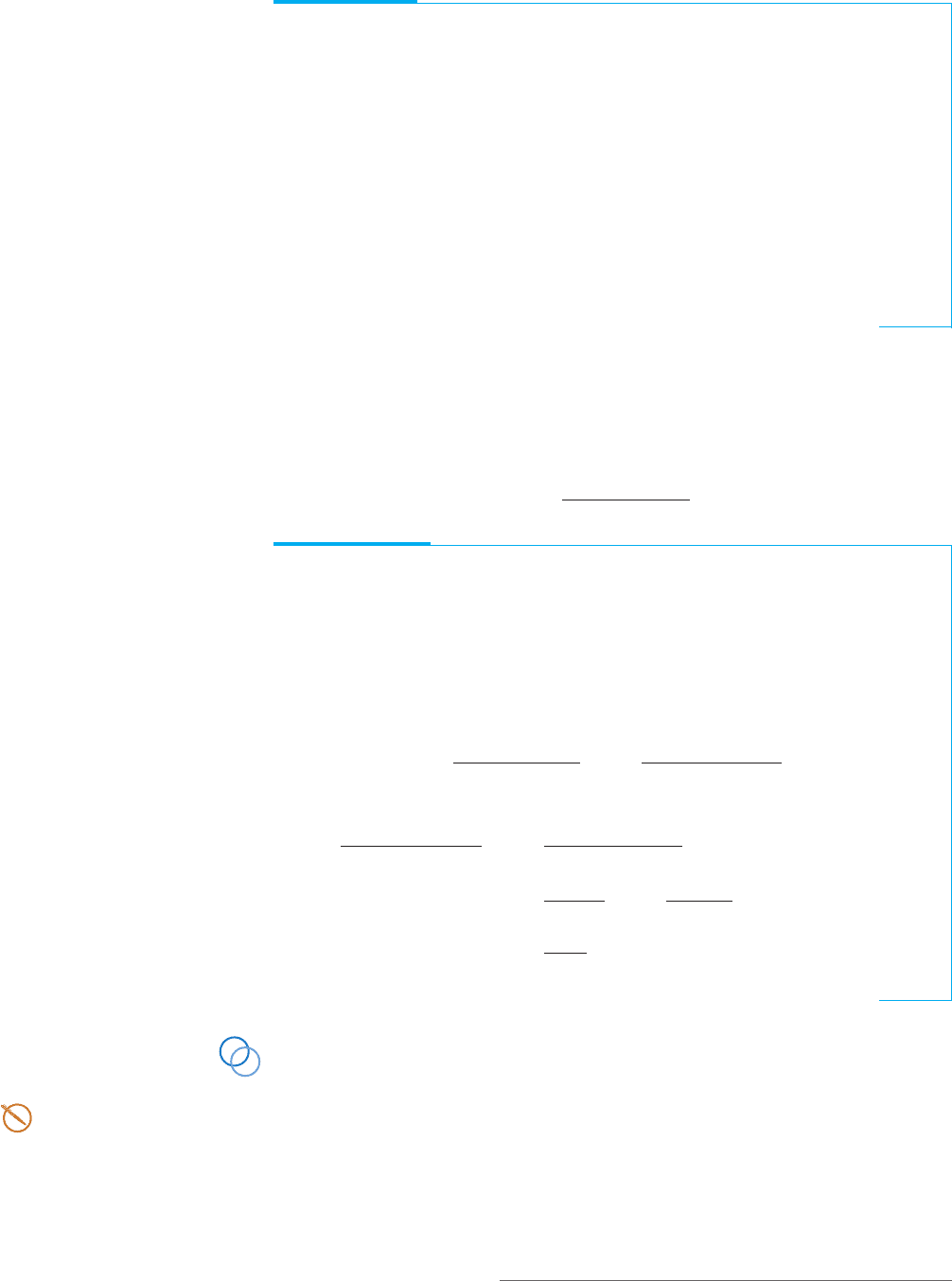
values. The graph of y = x
2
cos
1
x
appears in Figure 1.20 and a table of function
values is shown in the margin.
P1: OSO/OVY P2: OSO/OVY QC: OSO/OVY T1: OSO
MHDQ256-Ch01 MHDQ256-Smith-v1.cls December 6, 2010 20:21
LT (Late Transcendental)
CONFIRMING PAGES
1-19 SECTION 1.3
..
Computation of Limits 65
y
x
0.20.2
1
1
y
x
0.03
0.03
0.30.3
FIGURE 1.19
y = cos
1
x
FIGURE 1.20
y = x
2
cos
1
x
The graph and the table of function values suggest the conjecture
lim
x→0
x
2
cos
1
x
= 0,
which we prove using the Squeeze Theorem. First, we need tofind functions f and h such that
f (x) ≤ x
2
cos
1
x
≤ h(x),
for all x = 0 and where lim
x→0
f (x) = lim
x→0
h(x) = 0. Recall that
−1 ≤ cos
1
x
≤ 1, (3.7)
for all x = 0. If we multiply (3.7) through by x
2
(notice that since x
2
≥ 0, this
multiplication preserves the inequalities), we get
−x
2
≤ x
2
cos
1
x
≤ x
2
,
for all x = 0. We illustrate this inequality in Figure 1.21. Further,
lim
x→0
(−x
2
) = 0 = lim
x→0
x
2
.
So, from the Squeeze Theorem, it now follows that
lim
x→0
x
2
cos
1
x
= 0,
also, as we had conjectured.
BEYOND FORMULAS
To resolve the limit in example 3.8, we could not apply the rules for limits contained
in Theorem 3.1. So, we used an indirect method to find the limit. This tour de force
of graphics plus calculation followed by analysis is sometimes referred to as the Rule
of Three. (This general strategy for attacking new problems suggests that one look at
problemsgraphically, numerically and analytically.)Inthecase of example3.8,the first
two elements of this “rule” (the graphics in Figure 1.20 and the accompanying table
of function values) suggest a plausible conjecture, while the third element provides
us with a careful mathematical verification of the conjecture. In what ways does this
sound like the scientific method?
x x
2
cos (1/x)
±0.1 −0.008
±0.01 8.6 ×10
−5
±0.001 5.6 ×10
−7
±0.0001 −9.5 × 10
−9
±0.00001 −9.99 ×10
−11
0.3 0.3
0.03
0.03
y x
2
y
x
y x
2
FIGURE 1.21
y = x
2
cos
1
x
, y = x
2
and
y =−x
2
Functions are often defined by different expressions on different intervals. Such
piecewise-defined functions are important and we illustrate such a function in example 3.9.
TODAY IN
MATHEMATICS
Michael Freedman (1951– )
An American mathematician who
first solved one of the most
famous problems in mathematics,
the four-dimensional Poincar
´
e
conjecture. A winner of the Fields
Medal, the mathematical
equivalent of the Nobel Prize,
Freedman says, “Much of the
power of mathematics comes
from combining insights from
seemingly different branches of
the discipline. Mathematics is not
so much a collection of different
subjects as a way of thinking. As
such, it may be applied to any
branch of knowledge.” Freedman
finds mathematics to be an open
field for research, saying that, “It
isn’tnecessary to be an old hand in
an area to make a contribution.”
P1: OSO/OVY P2: OSO/OVY QC: OSO/OVY T1: OSO
MHDQ256-Ch01 MHDQ256-Smith-v1.cls December 6, 2010 20:21
LT (Late Transcendental)
CONFIRMING PAGES
66 CHAPTER 1
..
Limits and Continuity 1-20
EXAMPLE 3.9 A Limit for a Piecewise-Defined Function
Evaluate lim
x→0
f (x), where f is defined by
f (x) =
x
2
+ 2 cos x +1, for x < 0
sec x − 4, for x ≥ 0
.
Solution Since f is defined by different expressions for x < 0 and for x ≥ 0, we must
consider one-sided limits. We have
lim
x→0
−
f (x) = lim
x→0
−
(x
2
+ 2 cos x +1) = 2cos0 +1 = 3,
by Theorem 3.4. Also, we have
lim
x→0
+
f (x) = lim
x→0
+
(sec x − 4) = sec0 −4 = 1 −4 =−3.
Since the one-sided limits are different, we have that lim
x→0
f (x) does not exist.
We end this section with an example of the use of limits in computing velocity. In
section 2.1, we see that for an object moving in a straight line, whose position at time t is
given by the function f (t), the instantaneous velocity of that object at time t = 1 (i.e., the
velocity at the instant t = 1, as opposed to the average velocity over some period of time)
is given by the limit
lim
h→0
f (1 +h) − f (1)
h
.
EXAMPLE 3.10 Evaluating a Limit Describing Velocity
Suppose that the position function for an object at time t (seconds) is given by
f (t) = t
2
+ 2 (feet).
Find the instantaneous velocity of the object at time t = 1.
Solution Given what we have just learned about limits, this is now an easy problem to
solve. We have
lim
h→0
f (1 +h) − f (1)
h
= lim
h→0
[(1 + h)
2
+ 2] −3
h
.
While we can’t simply substitute h = 0 (why not?), we can write
lim
h→0
[(1 + h)
2
+ 2] −3
h
= lim
h→0
(1 + 2h + h
2
) − 1
h
Expanding the squared term.
= lim
h→0
2h + h
2
h
= lim
h→0
h(2 +h)
h
= lim
h→0
2 + h
1
= 2.
Canceling factors of h.
So, the instantaneous velocity of this object at time t = 1 is 2 feet per second.
EXERCISES 1.3
WRITING EXERCISES
1. Given your knowledge of the graphs of polynomials, explain
why equations (3.1) and (3.2) and Theorem 3.2 are obvious.
2. In one or two sentences, explain the Squeeze Theorem. Use
a real-world analogy (e.g., having the functions represent the
locations of three people as they walk) to indicate why it
is true.
3. Piecewise functions must be carefully interpreted.
In example 3.9, explain why lim
x→1
f (x) = e −4 and
lim
x→−2
f (x) = 5 + 2cos(2), but we need one-sided limits to
evaluate lim
x→0
f (x).
4. In example 3.8, explain why it is not enough to say that since
lim
x→0
x
2
= 0, lim
x→0
x
2
cos(1/x) = 0.
P1: OSO/OVY P2: OSO/OVY QC: OSO/OVY T1: OSO
MHDQ256-Ch01 MHDQ256-Smith-v1.cls December 6, 2010 20:21
LT (Late Transcendental)
CONFIRMING PAGES
1-21 SECTION 1.3
..
Computation of Limits 67
Inexercises1–28, evaluatetheindicated limit,if itexists. Assume
that lim
x→0
sin x
x
1.
1. lim
x→0
(x
2
− 3x + 1) 2. lim
x→2
3
√
2x + 1
3. lim
x→0
tan(x
2
) 4. lim
x→2
x − 5
x
2
+ 4
5. lim
x→3
x
2
− x − 6
x − 3
6. lim
x→1
x
2
+ x − 2
x
2
− 3x + 2
7. lim
x→2
x
2
− x − 2
x
2
− 4
8. lim
x→1
x
3
− 1
x
2
+ 2x − 3
9. lim
x→0
sin x
tan x
10. lim
x→0
tan x
x
11. lim
x→0
x cos(−2x +1)
x
2
+ x
12. lim
x→0
x
2
csc
2
x
13. lim
x→0
√
x + 4 − 2
x
14. lim
x→0
2x
3 −
√
x + 9
15. lim
x→1
x − 1
√
x − 1
16. lim
x→4
x
3
− 64
x − 4
17. lim
x→1
1
x − 1
−
2
x
2
− 1
18. lim
x→0
2
x
−
2
|x|
19. lim
x→0
1 − cos
2
x
1 − cos x
20. lim
x→0
sin|x|
x
21. lim
x→2
f (x), where f (x) =
2x if x < 2
x
2
if x ≥ 2
22. lim
x→−1
f (x), where f (x) =
x
2
+ 1ifx < −1
3x + 1ifx ≥−1
23. lim
x→−1
f (x), where f (x) =
⎧
⎨
⎩
2x + 1ifx < −1
3if−1 < x < 1
2x + 1ifx > 1
24. lim
x→1
f (x), where f (x) =
⎧
⎨
⎩
2x + 1ifx < −1
3if−1 < x < 1
2x + 1ifx > 1
25. lim
h→0
(2 + h)
2
− 4
h
26. lim
h→0
(1 + h)
3
− 1
h
27. lim
x→2
sin(x
2
− 4)
x
2
− 4
28. lim
x→0
tan3x
5x
............................................................
29. Use numerical and graphical evidence to conjecture the
value of lim
x→0
x
2
sin(1/x). Use the Squeeze Theorem to
prove that you are correct: identify the functions f and h,
show graphically that f (x) ≤ x
2
sin(1/x) ≤ h(x) and justify
lim
x→0
f (x) = lim
x→0
h(x).
30. Why can’t you use the Squeeze Theorem as in exercise 29 to
prove that lim
x→0
x
2
sec(1/x) = 0? Explorethis limitgraphically.
31. UsetheSqueezeTheoremtoprovethat lim
x→0
+
[
√
x cos
2
(1/x)] = 0.
Identify the functions f and h, show graphically that
f (x) ≤
√
x cos
2
(1/x) ≤ h(x) for all x > 0 and justify
lim
x→0
+
f (x) = 0 and lim
x→0
+
h(x) = 0.
32. Suppose that f (x) is bounded: that is, there exists a constant
M such that |f (x)|≤M for all x. Use the Squeeze Theorem
to prove that lim
x→0
x
2
f (x) = 0.
............................................................
In exercises 33–36, use the given position function f (t)tofind
the velocity at time t a.
33. f (t) = t
2
+ 2, a = 2 34. f (t) = t
2
+ 2, a = 0
35. f (t) = t
3
, a = 0 36. f (t) = t
3
, a = 1
............................................................
37. Given that lim
x→0
+
1 − cos x
x
2
=
1
2
, quickly evaluate
lim
x→0
+
√
1 − cos x
x
.
38. Given that lim
x→0
sin x
x
= 1, quickly evaluate lim
x→0
1 − cos
2
x
x
2
.
39. Suppose f (x) =
g(x)ifx < a
h(x)ifx > a
for polynomials g(x) and
h(x).Explainwhy lim
x→a
−
f (x) = g(a)anddetermine lim
x→a
+
f (x).
40. Explain how to determine lim
x→a
f (x)ifg and h are polynomials
and f (x) =
⎧
⎨
⎩
g(x)ifx < a
c if x = a
h(x)ifx > a
.
41. Evaluate each limit and justify each step by citing the appro-
priate theorem or equation.
(a) lim
x→2
(x
2
− 3x + 1) (b) lim
x→0
x − 2
x
2
+ 1
42. Evaluate each limit and justify each step by citing the appro-
priate theorem or equation.
(a) lim
x→−1
[(x + 1) sin x] (b) lim
x→1
x cos x
tan x
............................................................
In exercises 43–46, use lim
x→a
f (x) 2, lim
x→a
g(x) −3 and
lim
x→a
h(x) 0 to determine the limit, if possible.
43. lim
x→a
[2 f (x) − 3g(x)] 44. lim
x→a
[3 f (x)g(x)]
45. lim
x→a
[
f (x)
]
2
g(x)
46. lim
x→a
2 f (x)h(x)
f (x) +h(x)
............................................................
In exercises 47 and 48, compute the limit for p(x) x
2
− 1.
47. lim
x→0
p(p(p(p(x)))) 48. lim
x→0
p(3 + 2p(x − p(x)))
............................................................
49. Findalltheerrors in the followingincorrect string ofequalities:
lim
x→0
1
x
= lim
x→0
x
x
2
= lim
x→0
x lim
x→0
1
x
2
= 0·? = 0.
50. Findalltheerrorsinthefollowingincorrectstringofequalities:
lim
x→0
sin2x
x
=
0
0
= 1.
51. Give an example of functions f and g such that
lim
x→0
[ f (x)+g(x)]exists,but lim
x→0
f (x)and lim
x→0
g(x)donotexist.
52. Give an example of functions f and g such that
lim
x→0
[ f (x) · g(x)] exists, but at least one of lim
x→0
f (x) and
lim
x→0
g(x) does not exist.

P1: OSO/OVY P2: OSO/OVY QC: OSO/OVY T1: OSO
MHDQ256-Ch01 MHDQ256-Smith-v1.cls December 6, 2010 20:21
LT (Late Transcendental)
CONFIRMING PAGES
68 CHAPTER 1
..
Limits and Continuity 1-22
53. If lim
x→a
f (x) exists and lim
x→a
g(x) does not exist, is it always true
that lim
x→a
[ f (x) + g(x)] does not exist? Explain.
54. Is the following true or false? If lim
x→0
f (x) does not exist, then
lim
x→0
1
f (x)
does not exist. Explain.
55. Assume that lim
x→a
f (x) = L. Use Theorem 3.1 to prove that
lim
x→a
[ f (x)]
3
= L
3
. Also, show that lim
x→a
[ f (x)]
4
= L
4
.
56. Use mathematical induction to prove that lim
x→a
[ f (x)]
n
= L
n
,
for any positive integer n.
57. The greatest integer function is denoted by f (x) = [x] and
equals the greatest integer that is less than or equal to x. Thus,
[2.3] = 2, [−1.2] =−2 and [3] = 3. In spite of this last fact,
show that lim
x→3
[x] does not exist.
58. Investigate the existence of (a) lim
x→1
[x], (b) lim
x→1.5
[x],
(c) lim
x→1.5
[2x] and (d) lim
x→1
(x − [x]).
APPLICATIONS
59. Suppose a state’s income tax code states the tax liability on x
dollars of taxable income is given by
T (x) =
0.14x if 0 ≤ x < 10,000
1500 + 0.21x if 10,000 ≤ x
.
Compute lim
x→0
+
T (x); why is this good? Compute lim
x→10,000
T (x);
why is this bad?
60. Suppose a state’s income tax code states that tax liability is
12% on the first $20,000 of taxable earnings and 16% on
the remainder. Find constants a and b for the tax function
T (x) =
a + 0.12x if x ≤ 20,000
b +0.16(x − 20,000) if x > 20,000
such that lim
x→0
+
T (x) = 0 and lim
x→20,000
T (x) exists. Why is it
important for these limits to exist?
EXPLORATORY EXERCISES
1. The value x = 0 is called a zero of multiplicity n (n ≥ 1)
for the function f if lim
x→0
f (x)
x
n
exists and is nonzero but
lim
x→0
f (x)
x
n−1
= 0. Show that x = 0 is a zero of multiplicity 2
for x
2
, x = 0 is a zero of multiplicity 3 for x
3
and x = 0is
a zero of multiplicity 4 for x
4
. For polynomials, what does
multiplicity describe? The reason the definition is not as
straightforward as we might like is so that it can apply to non-
polynomial functions, as well. Find the multiplicity of x = 0
for f (x) = sin x; f (x) = x sin x; f (x) = sinx
2
. If you know
that x = 0 is a zero of multiplicity m for f (x) and multiplicity
n for g(x), what can you say about the multiplicity of x = 0
for f (x) + g(x)? f (x) · g(x)? f (g(x))?
2. We have conjectured that lim
x→0
sin x
x
= 1. Using graphical and
numerical evidence, conjecture the value of lim
x→0
sin2x
x
and
lim
x→0
sincx
x
for various values of c. Given that lim
x→0
sincx
cx
= 1,
for any constant c = 0, prove that your conjecture is correct.
Then evaluate lim
x→0
sincx
sinkx
and lim
x→0
tancx
tankx
for numbers c and
k = 0.
1.4 CONTINUITY AND ITS CONSEQUENCES
When told that a machine has been in continuous operation for the past 60 hours, most of us
would interpret this to mean that the machine has been in operation all of that time, without
any interruption at all, even for a moment. Likewise, we say that a function is continuous
on an interval if its graph on that interval can be drawn without interruption, that is, without
lifting the pencil from the paper.
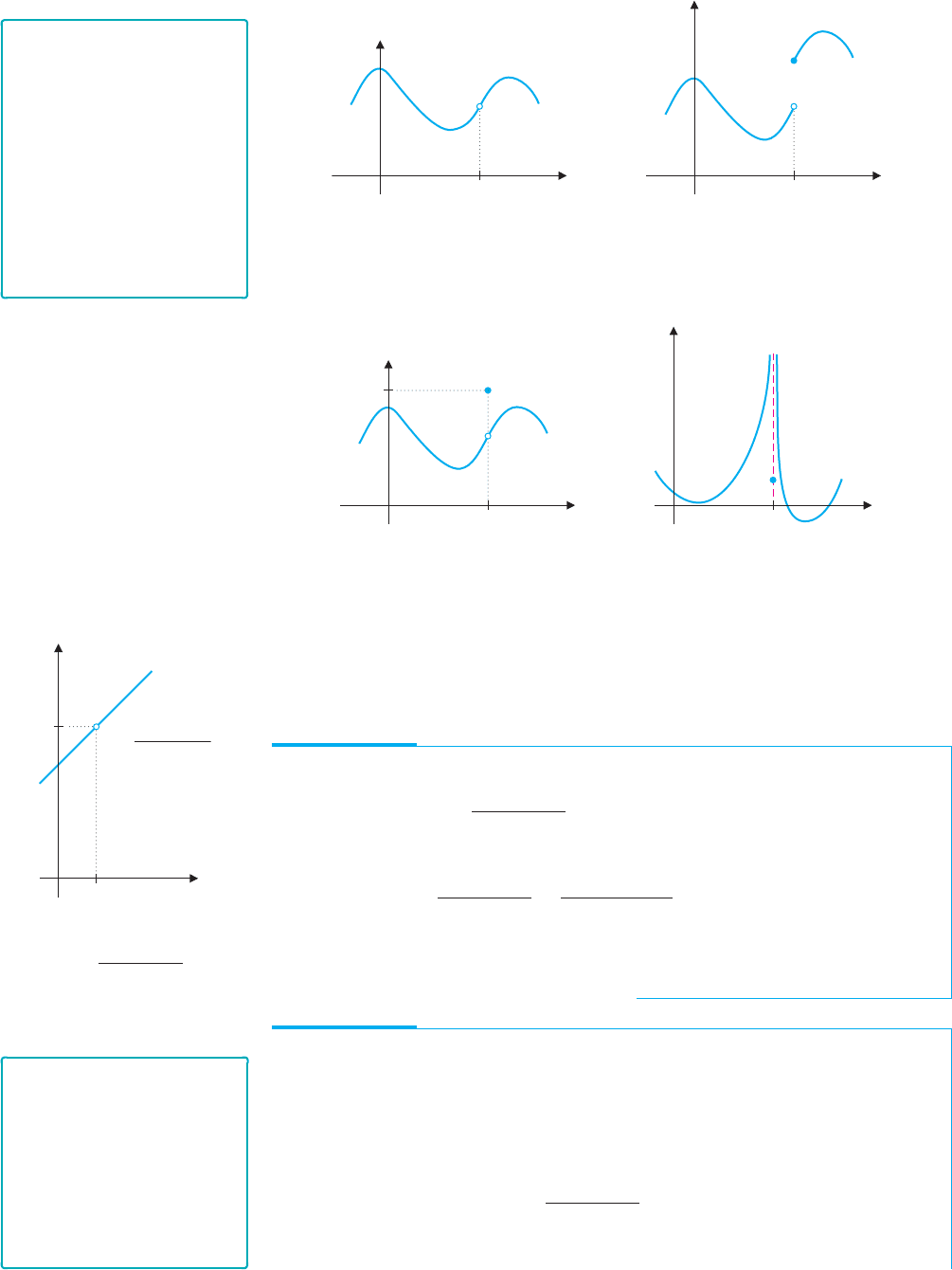
First, look at each of the graphs shownin Figures 1.22a–1.22d to determine what keeps
the function from being continuous at the point x = a.
This suggests the following definition of continuity at a point.
DEFINITION 4.1
For a function f defined on an open interval containing x = a, we say that f is
continuous at a when
lim
x→a
f (x) = f (a).
Otherwise, f is said to be discontinuous at x = a.
P1: OSO/OVY P2: OSO/OVY QC: OSO/OVY T1: OSO
MHDQ256-Ch01 MHDQ256-Smith-v1.cls December 6, 2010 20:21
LT (Late Transcendental)
CONFIRMING PAGES
1-23 SECTION 1.4
..
Continuity and Its Consequences 69
y
x
a
y
x
a
FIGURE 1.22a
f (a) is not defined (the graph
has a hole at x = a).
FIGURE 1.22b
f (a) is defined, but lim
x→a
f (x) does
not exist (the graph has a jump at
x =a).
y
x
a
f(a)
y
x
a
FIGURE 1.22c
lim
x→a
f (x) exists and f (a) is defined,
but lim
x→a
f (x) = f (a) (the graph has
a hole at x = a).
FIGURE 1.22d
lim
x→a
f (x) does not exist (the
function “blows up” as x
approaches a).
For most purposes, it is best for you to think of the intuitive notion of continuity
that we’ve outlined above. Definition 4.1 should then simply follow from your intuitive
understanding of the concept.
REMARK 4.1
For f to be continuous at
x = a, the definition says that
(i) f (a) must be defined,
(ii) the limit lim
x→a
f (x) must exist
and
(iii) the limit and the value of f
at the point must be the same.
Further, this says that a function
is continuous at a point exactly
when you can compute its limit
at that point by simply
substituting in.
EXAMPLE 4.1 Finding Where a Rational Function Is Continuous
Determine where f (x) =
x
2
+ 2x − 3
x −1
is continuous.
y
x
x
2
2x 3
x 1
y
4
1
FIGURE 1.23
y =
x
2
+ 2x − 3
x − 1
Solution Note that
f (x) =
x
2
+ 2x − 3
x −1
=
(x − 1)(x + 3)
x −1
Factoring the numerator.
= x + 3, for x = 1. Canceling common factors.
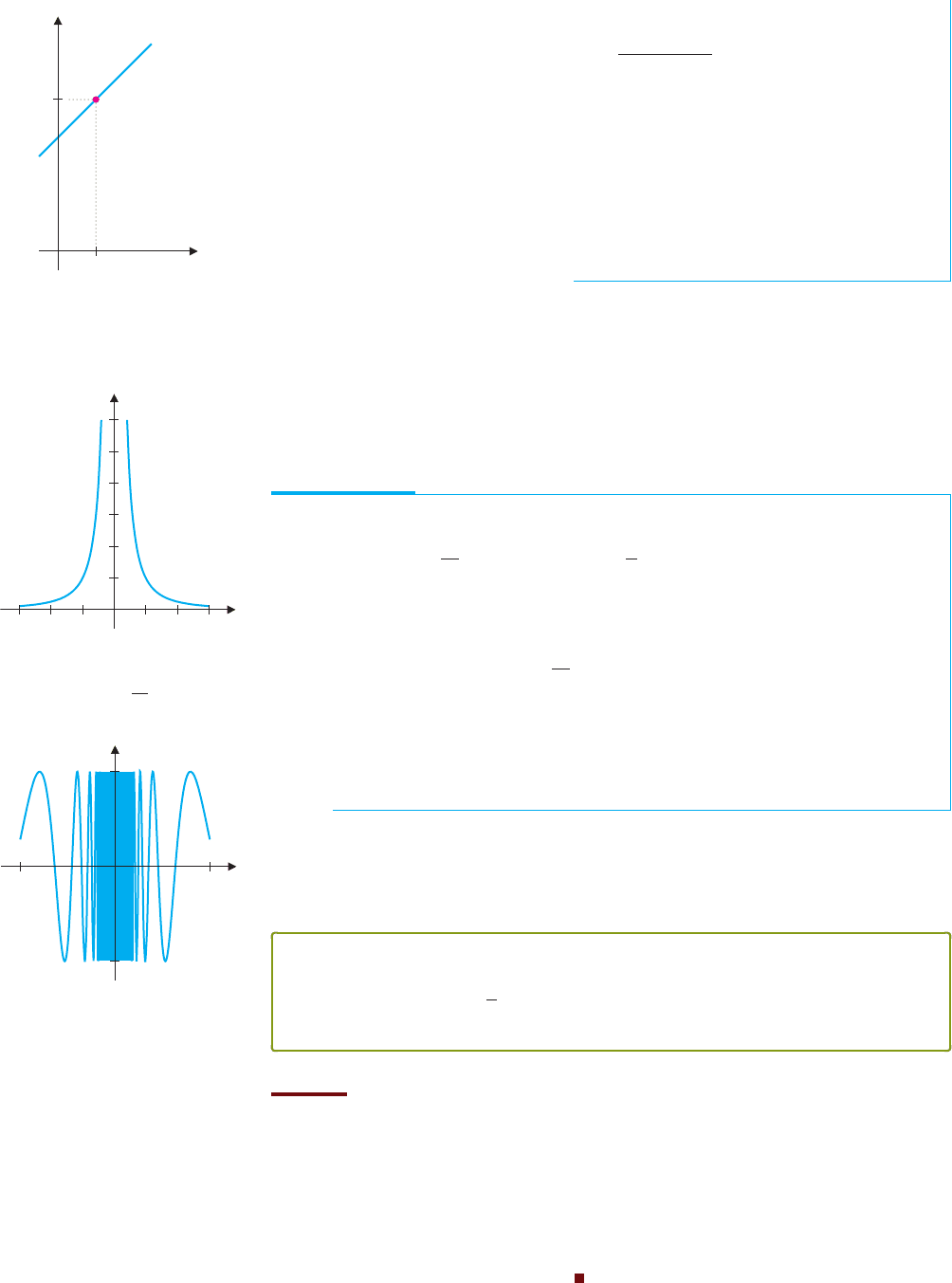
This says that the graph of f is a straight line, but with a hole in it at x = 1, as indicated
in Figure 1.23. So, f is continuous for x = 1.
EXAMPLE 4.2 Removing a Hole in the Graph
Extend the function from example 4.1 to make it continuous everywhere by redefining it
at a single point.
REMARK 4.2
You should be careful not to
confuse the continuity of a
function at a point with its
simply being defined there. A
function can be defined at a
point without being continuous
there. (Look back at
Figures 1.22b, 1.22c and
1.22d.)
Solution In example 4.1, we saw that the function is continuous for x = 1 and it is
undefined at x = 1. So, suppose we just go ahead and define it, as follows. Let
g(x) =
⎧
⎨
⎩
x
2
+ 2x − 3
x −1
, if x = 1
a, if x = 1,
for some real number a.
P1: OSO/OVY P2: OSO/OVY QC: OSO/OVY T1: OSO
MHDQ256-Ch01 MHDQ256-Smith-v1.cls December 6, 2010 20:21
LT (Late Transcendental)
CONFIRMING PAGES
70 CHAPTER 1
..
Limits and Continuity 1-24
Notice that g(x) is defined for all x and equals f (x) for all x = 1. Here, we have
lim
x→1
g(x) = lim
x→1
x
2
+ 2x − 3
x −1
= lim
x→1
(x + 3) = 4.
Observe that if we choose a = 4, we now have that
lim
x→1
g(x) = 4 = g(1)
and so, g is continuous at x = 1.
y
x
y g(x)
4
1
FIGURE 1.24
y = g(x)
Note that the graph of g isthe same as the graph of f seen in Figure 1.23, except that
we now include the point (1, 4). (See Figure 1.24.) Also, note that there’s a very simple
way to write g(x). (Think about this.)
Note that in example 4.2, for any choice of a other than a = 4, g is discontinuous at
x = 1. When we can remove a discontinuity by redefining the function at that point, we
call the discontinuity removable. Not all discontinuities are removable, however. Carefully
examine Figures 1.22b and 1.22c and convince yourself that the discontinuity in Figure
1.22c is removable, while the one in Figures 1.22b and 1.22d are nonremovable. Briefly, a
function f has a nonremovable discontinuity at x = a if lim
x→a
f (x) does not exist.
EXAMPLE 4.3 Functions That Cannot Be Extended Continuously
Show that (a) f (x) =
1
x
2
and (b) g(x) = cos
1
x
cannot be extended to a function that
is continuous everywhere.
Solution (a) Observe from Figure 1.25a (also, construct atable of function values) that
lim
x→0
1
x
2
does not exist.
Hence, no matter how we might define f (0), f will not be continuous at x = 0.
y
x
33
2
4
FIGURE 1.25a
y =
1
x
2
y
x
0.20.2
1
1
FIGURE 1.25b
y = cos (1/x)
(b) Similarly, observe that lim
x→0
cos(1/x) does not exist, due to the endless oscillation
of cos(1/x)asx approaches 0. (See Figure 1.25b.) Again, notice that since the limit
does not exist, there is no way to redefine the function at x = 0 to make it continuous
there.
From your experience with the graphs of some common functions, the following result
should come as no surprise.
THEOREM 4.1
All polynomials are continuous everywhere. Additionally, sin x and cos x are
continuous everywhere,
n
√
x is continuous for all x, when n is odd and for x > 0,
when n is even.
PROOF
We have already established (in Theorem 3.2) that for any polynomial p(x) and any real
number a,
lim
x→a
p(x) = p(a),
from which it follows that p is continuous at x = a. The rest of the theorem follows from
Theorems 3.3 and 3.4 in a similar way.
P1: OSO/OVY P2: OSO/OVY QC: OSO/OVY T1: OSO
MHDQ256-Ch01 MHDQ256-Smith-v1.cls December 6, 2010 20:21
LT (Late Transcendental)
CONFIRMING PAGES
1-25 SECTION 1.4
..
Continuity and Its Consequences 71
From these very basic continuous functions, we can build a large collection of contin-
uous functions, using Theorem 4.2.
THEOREM 4.2
Suppose that f and g are continuous at x = a. Then all of the following are true:
(i) ( f ± g) is continuous at x = a,
(ii) ( f · g) is continuous at x = a and
(iii) ( f/g) is continuous at x = a if g(a) = 0.
Simply put, Theorem 4.2 says that a sum, differenceor product of continuous functions
is continuous, while the quotient of two continuous functions is continuous at any point at
which the denominator is nonzero.
PROOF
(i) If f and g are continuous at x = a, then
lim
x→a
[ f (x) ± g(x)] = lim
x→a
f (x) ± lim
x→a
g(x) From Theorem 3.1.
= f (a) ± g(a) Since f and g are continuous at a.
= ( f ± g)(a),
by the usual rules of limits. Thus, ( f ± g) is also continuous at x = a.
Parts (ii) and (iii) are proved in a similar way and are left as exercises.
EXAMPLE 4.4 Continuity for a Rational Function
Determine where f is continuous, for f (x) =
x
4
− 3x
2
+ 2
x
2
− 3x − 4
.
y
x
10510 5
150
100
50
50
100
150
FIGURE 1.26
y =
x
4
− 3x
2
+ 2
x
2
− 3x − 4
Solution Here, f is a quotient of two polynomial (hence continuous) functions. The
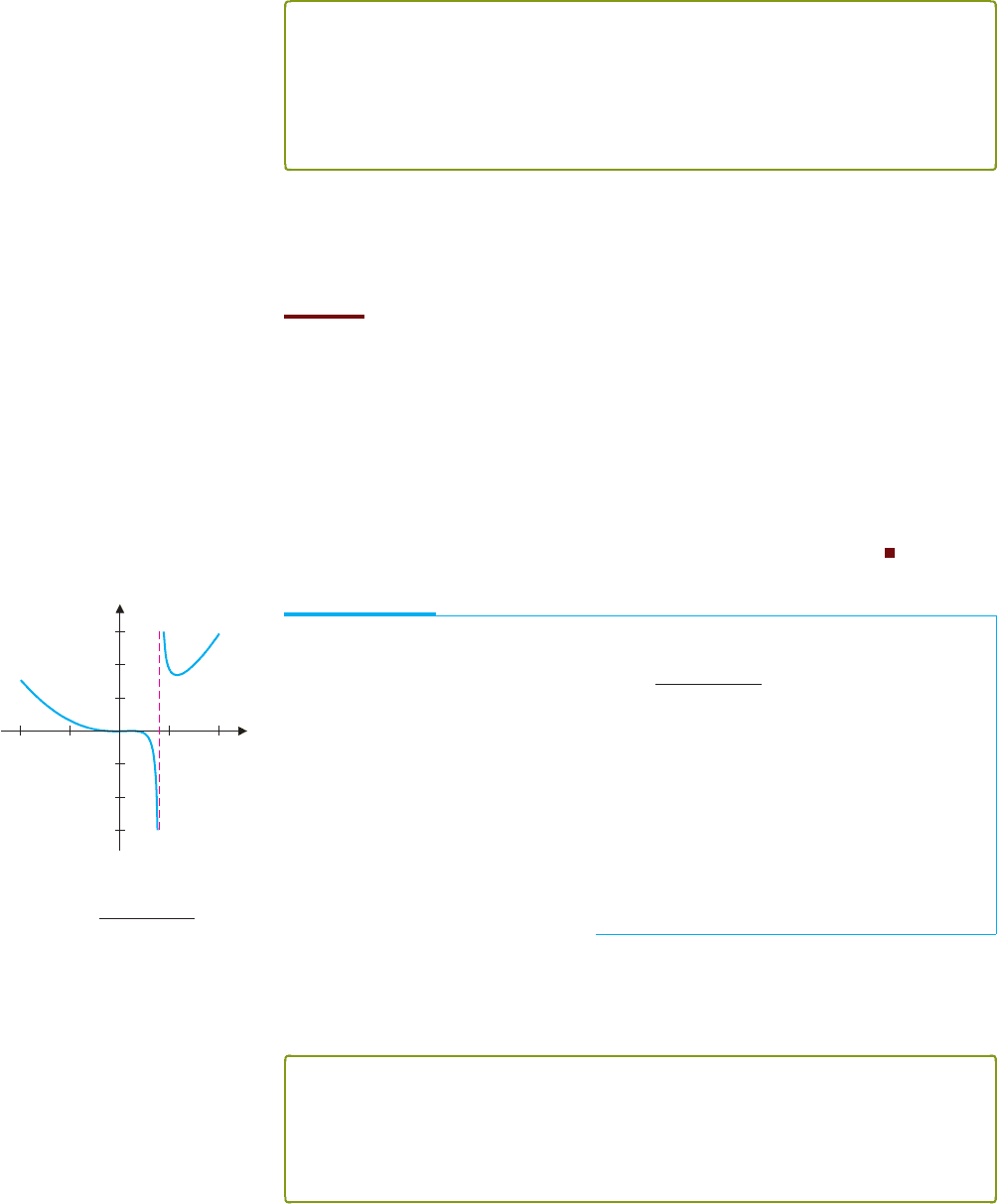
computer-generated graph of the function indicated in Figure 1.26 suggests a vertical
asymptote at around x = 4, but appears to be continuous everywhere else. From
Theorem 4.2, f will be continuous at all x where the denominator is not zero, that is,
where
x
2
− 3x − 4 = (x +1)(x −4) = 0.
Thus, f is continuous for x =−1, 4. (Think about why you didn’t see anything
peculiar about the graph at x =−1.)
With the addition of the result in Theorem 4.3, we will have all the basic tools needed
to establish the continuity of most elementary functions.
THEOREM 4.3
Suppose that lim
x→a
g(x) = L and f is continuous at L. Then,
lim
x→a
f (g(x)) = f
lim
x→a
g(x)
= f (L).
A proof of Theorem 4.3 is given in Appendix A.
P1: OSO/OVY P2: OSO/OVY QC: OSO/OVY T1: OSO
MHDQ256-Ch01 MHDQ256-Smith-v1.cls December 6, 2010 20:21
LT (Late Transcendental)
CONFIRMING PAGES
72 CHAPTER 1
..
Limits and Continuity 1-26
Notice that this says that if f is continuous, then we can bring the limit “inside.”
This should make sense, since as x → a, g(x) → L and so, f (g(x)) → f (L), since f is
continuous at L.
COROLLARY 4.1
Suppose that g is continuous at a and f is continuous at g(a). Then, the composition
f ◦ g is continuous at a.
PROOF
From Theorem 4.3, we have
lim
x→a
( f ◦ g)(x) = lim
x→a
f (g(x)) = f
lim
x→a
g(x)
= f (g(a)) = ( f ◦ g)(a).
Since g is continuous at a.
EXAMPLE 4.5 Continuity for a Composite Function
Determine where h(x) = cos(x
2
− 5x + 2) is continuous.
Solution Note that
h(x) = f (g(x)),
where g(x) = x
2
− 5x + 2 and f (x) = cos x. Since both f and g are continuous for all
x, h is continuous for all x, by Corollary 4.1.
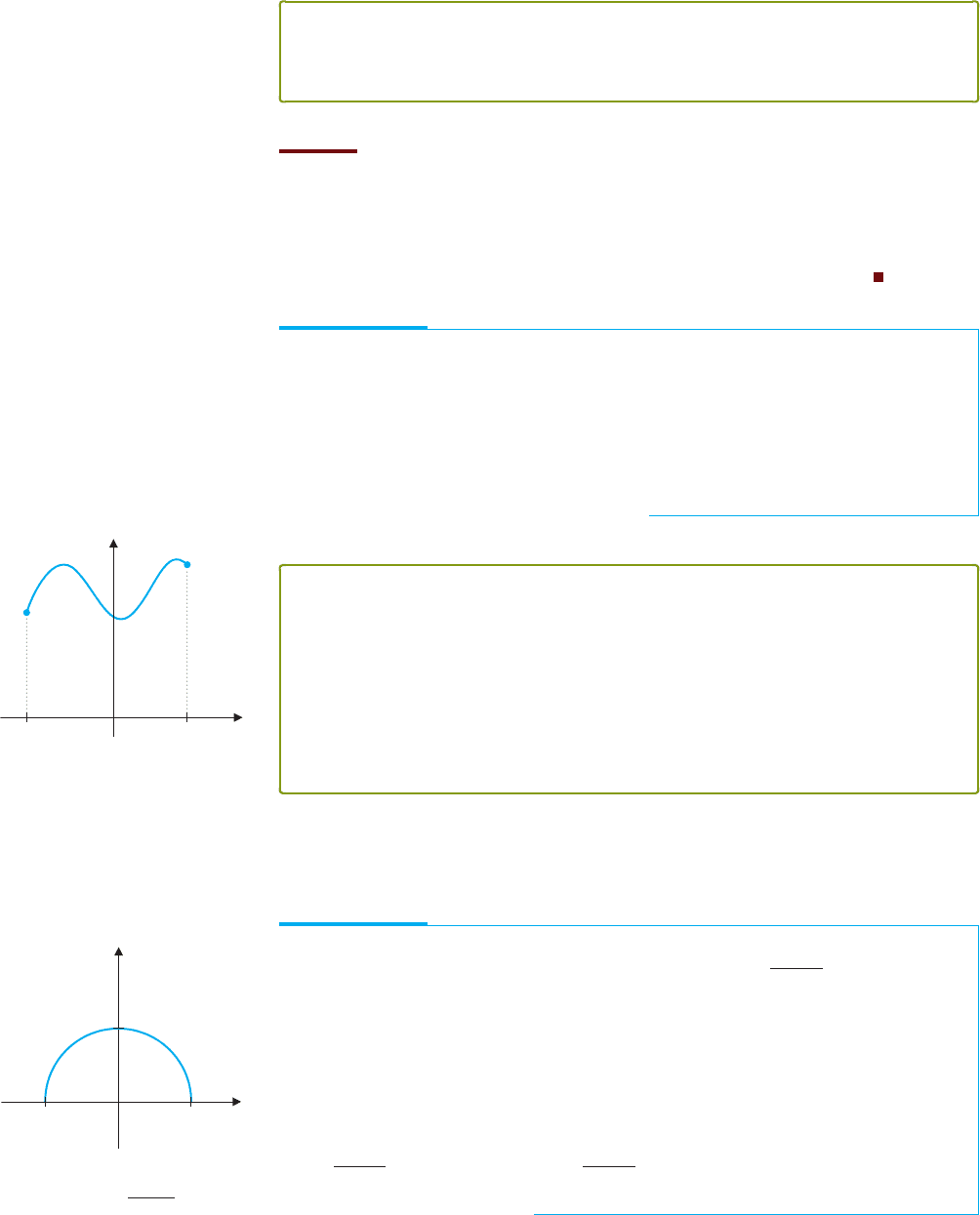
y
x
ba
FIGURE 1.27
f continuous on [a, b]
y
x
22
2
FIGURE 1.28
y =
√
4 − x
2
DEFINITION 4.2
If f is continuous at every point on an open interval (a, b), we say that f is
continuous on (a, b). Following Figure 1.27, we say that f is continuous on the
closed interval [a, b], if f is continuous on the open interval (a, b) and
lim
x→a
+
f (x) = f (a) and lim
x→b
−
f (x) = f (b).
Finally, if f is continuous on all of (−∞, ∞), we simply say that f is continuous.
(That is, when we don’t specify an interval, we mean continuous everywhere.)
Formanyfunctions,it’s asimplematterto determinetheintervalsonwhichthe function
is continuous. We illustrate this in example 4.6.
EXAMPLE 4.6 Continuity on a Closed Interval
Determine the interval(s) where f is continuous, for f (x) =
√
4 − x
2
.
Solution First, observe that f is defined only for −2 ≤ x ≤ 2. Next, note that f is the
composition of two continuous functions and hence, is continuous for all x for which
4 − x
2
> 0. We show a graph of the function in Figure 1.28. Since
4 − x
2
> 0
for −2 < x < 2, we have that f is continuous for all x in the interval (−2, 2),
by Theorem 4.1 and Corollary 4.1. Finally, we test the endpoints to see that
lim
x→2
−
√
4 − x
2
= 0 = f (2) and lim
x→−2
+
√
4 − x
2
= 0 = f (−2), so that f is continuous
on the closed interval [−2, 2].