
Smith R., Minton R. Calculus
Подождите немного. Документ загружается.

P1: OSO/OVY P2: OSO/OVY QC: OSO/OVY T1: OSO
MHDQ256-Ch01 MHDQ256-Smith-v1.cls December 6, 2010 20:21
LT (Late Transcendental)
CONFIRMING PAGES
1-37 SECTION 1.5
..
Limits Involving Infinity; Asymptotes 83
In example 5.8, we apply our rule of thumb to a common limit problem.
EXAMPLE 5.8 Finding Slant Asymptotes
Evaluate lim
x→∞
4x
3
+ 5
−6x
2
− 7x
and find any slant asymptotes.
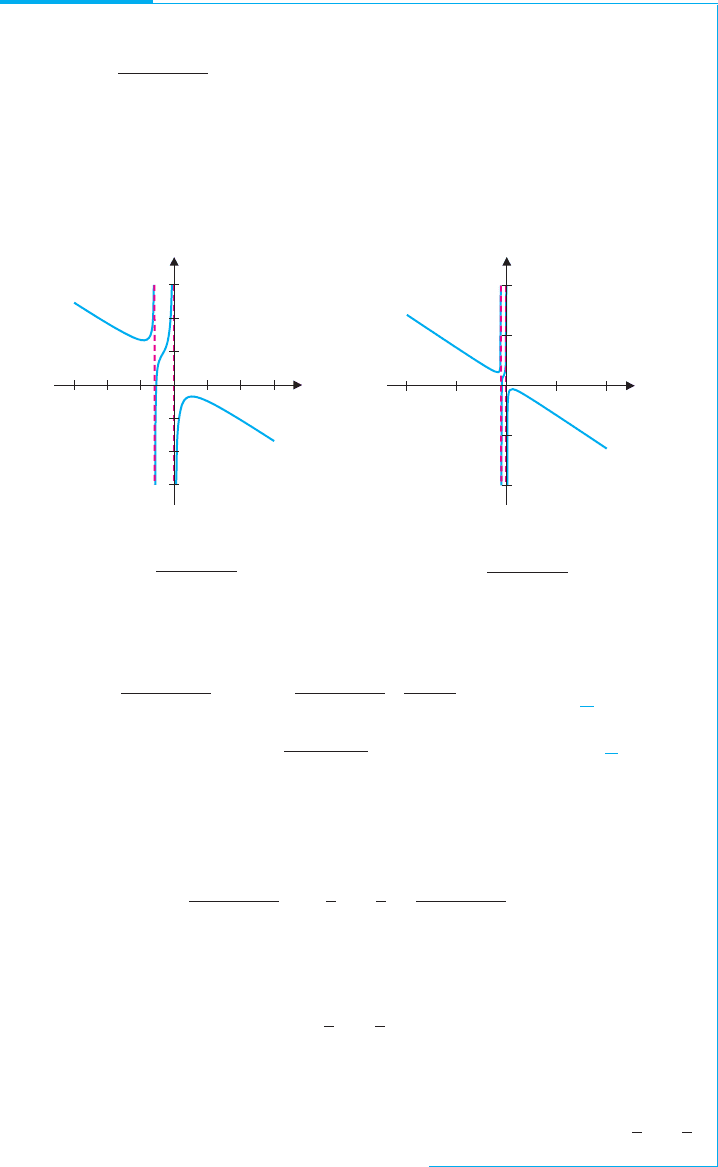
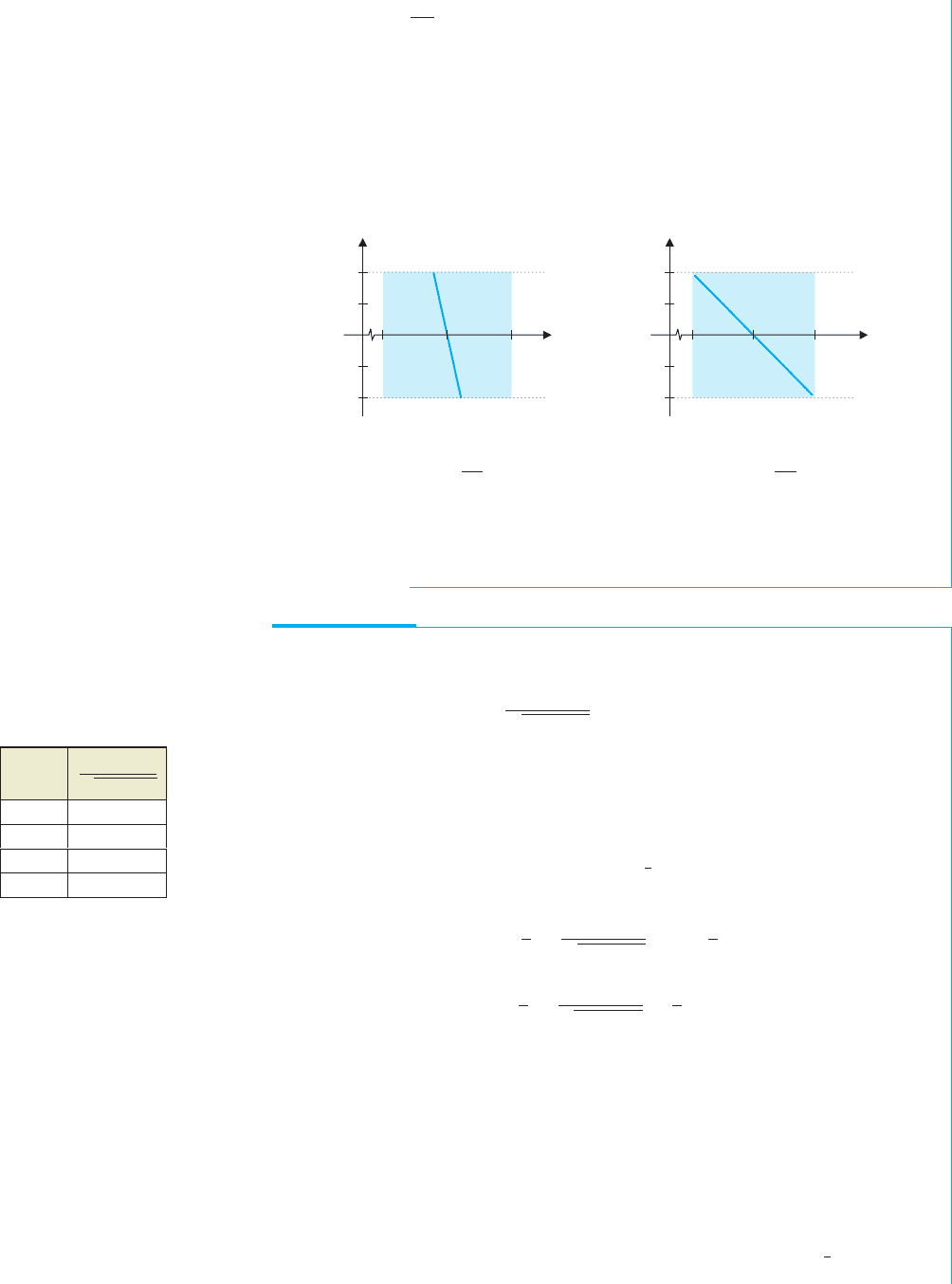
Solution As usual, we first examine a graph. (See Figure 1.40a.) Note that here, the
graph appears to tend to −∞ as x →∞. Further, observe that outside of the interval
[−2, 2], the graph looks very much like a straight line. If we look at the graph in a
somewhat larger window, this linearity is even more apparent. (See Figure 1.40b.)
y
x
66
6
6
y
x
2020
20
20
FIGURE 1.40a
y =
4x
3
+ 5
−6x
2
− 7x
FIGURE 1.40b
y =
4x
3
+ 5
−6x
2
− 7x
Using our rule of thumb, we have
lim
x→∞
4x
3
+ 5
−6x
2
− 7x
= lim
x→∞
4x
3
+ 5
−6x
2
− 7x
·
(1/x
2
)
(1/x
2
)
Multiply numerator and
denominator by
1
x
2
.
= lim
x→∞
4x + 5/x
2
−6 − 7/x
Multiply through by
1
x
2
.
=−∞,
since as x →∞, the numerator tends to ∞ and the denominator tends to −6.
To further explain the behavior seen in Figure 1.40b, we perform a long division:
4x
3
+ 5
−6x
2
− 7x
=−
2
3
x +
7
9
+
5 + 49/9x
−6x
2
− 7x
.
Since the third term in this expansion tends to 0 as x →∞, the function values
approach those of the linear function
−
2
3
x +
7
9
,
as x →∞. For this reason, we say that the graph has a slant (or oblique) asymptote.
That is, instead of approaching a vertical or horizontal line, as happens with vertical or
horizontal asymptotes, the graph is approaching the slanted straight line y =−
2
3
x +
7
9
.
(This is the behavior we’re seeing in Figure 1.40b.)
In example 5.9, we consider a model of the size of an animal’s pupils. Recall that in
bright light, pupils shrink to reduce the amount of light entering the eye, while in dim light,
pupils dilate to allow in more light. (See the chapter introduction.)
P1: OSO/OVY P2: OSO/OVY QC: OSO/OVY T1: OSO
MHDQ256-Ch01 MHDQ256-Smith-v1.cls December 6, 2010 20:21
LT (Late Transcendental)
CONFIRMING PAGES
84 CHAPTER 1
..
Limits and Continuity 1-38
EXAMPLE 5.9 Finding the Size of an Animal’s Pupils
Suppose that the diameter of an animal’s pupils is given by f (x) mm, where x is the
intensity of light on the pupils. If f (x) =
160x
−0.4
+ 90
4x
−0.4
+ 15
, find the diameter of the pupils
with (a) minimum light and (b) maximum light.
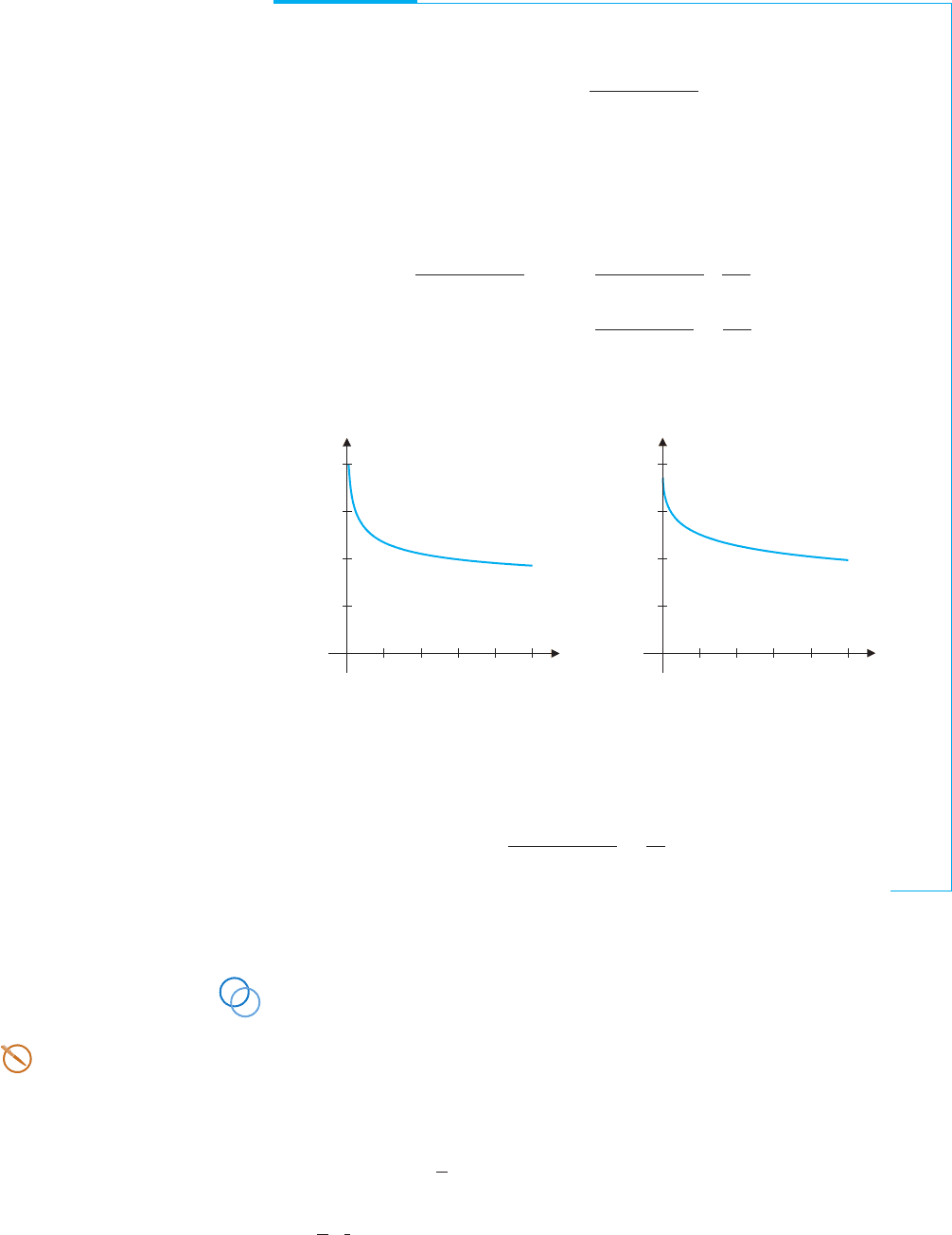
Solution Since f (0) is undefined, we consider the limit of f (x)asx → 0
+
(since x
cannot be negative). A computer-generated graph of y = f (x) with 0 ≤ x ≤ 10 is
shown in Figure 1.41a. It appears that the y-values approach 20 as x approaches 0. We
multiply numerator and denominator by x
0.4
to eliminate the negative exponents, so that
lim
x→0
+
160x
−0.4
+ 90
4x
−0.4
+ 15
= lim
x→0
+
160x
−0.4
+ 90
4x
−0.4
+ 15
·
x
0.4
x
0.4
= lim
x→0
+
160 + 90x
0.4
4 + 15x
0.4
=
160
4
= 40 mm.
This limit does not seem to match our graph. However, in Figure 1.41b, we have
zoomed in so that 0 ≤ x ≤ 0.1, making a limit of 40 look more reasonable.
y
x
5
10
15
20
102468
y
x
10
20
30
40
0.02 0.10.080.060.04
FIGURE 1.41a
y = f (x)
FIGURE 1.41b
y = f (x)
For part (b), we consider the limit as x tends to ∞. From Figure 1.41a, it
appears that the graph has a horizontal asymptote at a value somewhat below y = 10.
We compute the limit
lim
x→∞
160x
−0.4
+ 90
4x
−0.4
+ 15
=
90
15
= 6mm.
So, the pupils have a limiting size of 6 mm, as the intensity of light tends to ∞.
EXERCISES 1.5
WRITING EXERCISES
1. It may seem odd that we use ∞ in describing limits but do not
count ∞ as a real number. Discuss the existence of ∞:isita
number or a concept?
2. In example 5.7, we dealt with the “indeterminate form”
∞
∞
.
Thinking of a limit of ∞ as meaning “getting very large” and
a limit of 0 as meaning “getting very close to 0,” explain why
the following are indeterminate forms:
∞
∞
,
0
0
, ∞−∞, and
∞·0. Determine what the following nonindeterminate forms
represent: ∞+∞, −∞−∞, ∞+0 and 0/∞.
3. On your computer or calculator,graph y = 1/(x − 2) and look
for the horizontal asymptote y = 0 and the vertical asymptote
x = 2. Many computers will draw a vertical line at x = 2 and
willshowthe graph completely flattening out at y = 0 for large
x’s.Isthisaccurate?misleading?Mostcomputerswillcompute
the locations of points for adjacent x’s and try to connect the
points with a line segment. Why might this result in a vertical
line at the location of a vertical asymptote?
4. Many students learn that asymptotes are lines that the graph
gets closer and closer to without ever reaching. This is true for
many asymptotes, but not all. Explain why vertical asymptotes

P1: OSO/OVY P2: OSO/OVY QC: OSO/OVY T1: OSO
MHDQ256-Ch01 MHDQ256-Smith-v1.cls December 6, 2010 20:21
LT (Late Transcendental)
CONFIRMING PAGES
1-39 SECTION 1.5
..
Limits Involving Infinity; Asymptotes 85
are never crossed. Explain why horizontal or slant asymp-
totes may, in fact, be crossed any number of times; draw one
example.
In exercises 1–4, determine (a) lim
x→a
−
f (x), (b) lim
x→a
f (x) and
(c) lim
x→a
f (x) (answer as appropriate, with a number, ∞, −∞ or
does not exist).
1. f (x) =
1 − 2x
x
2
− 1
, a = 1 2. f (x) =
1 − 2x
x
2
− 1
, a =−1
3. f (x) =
x − 4
x
2
− 4x + 4
, a = 2 4. f (x) =
1 − x
(x + 1)
2
, a =−1
............................................................
In exercises 5–20, determine each limit (answer as appropriate,
with a number, ∞, −∞ or does not exist).
5. lim
x→−2
x
2
+ 2x − 1
x
2
− 4
6. lim
x→−1
−
(x
2
− 2x − 3)
−2/3
7. lim
x→0
cot x 8. lim
x→π/2
x sec
2
x
9. lim
x→∞
x
3
− 2
3x
2
+ 4x − 1
10. lim
x→∞
−x
√
4 + x
2
11. lim
x→−∞
−x
√
4 + x
2
12. lim
x→∞
2x
2
− 1
4x
3
− 5x − 1
13. lim
x→∞
2x
2
− x + 1
4x
2
− 3x − 1
14. lim
x→∞
2x − 1
x
2
+ 4x + 1
15. lim
x→0
+
3 − 2/x
2 + 1/x
16. lim
x→∞
3 − 2/x
2 + 1/x
17. lim
x→∞
3x + sin x
4x − cos 2x
18. lim
x→∞
2x
2
sin x
x
2
+ 4
19. lim
x→π/2
+
tan x − x
tan
2
x + 3
20. lim
x→∞
sin x − x
sin
2
x + 3x
............................................................
In exercises 21–28, determine all horizontal and vertical
asymptotes. For each vertical asymptote, determine whether
f (x) → ∞ or f (x) → −∞ on either side of the asymptote.
21. (a) f (x) =
x
4 − x
2
(b) f (x) =
x
2
4 − x
2
22. (a) f (x) =
x
√
4 + x
2
(b) f (x) =
x
√
4 − x
2
23. f (x) =
3x
2
+ 1
x
2
− 2x − 3
24. f (x) =
1 − x
x
2
+ x − 2
25. f (x) = cot(1 − cos x) 26. f (x) =
tan x
1 − sin 2x
27. f (x) =
4sin x
x
28. f (x) = sin
x
2
+ 4
x
2
− 4
............................................................
In exercises 29–32, determine all vertical and slant asymptotes.
29. y =
x
3
4 − x
2
30. y =
x
2
+ 1
x − 2
31. y =
x
3
x
2
+ x − 4
32. y =
x
4
x
3
+ 2
............................................................
33. Suppose that the size of the pupil of a certain animal is given
by f (x) (mm), where x is the intensity of the light on the pupil.
If f (x) =
80x
−0.3
+ 60
2x
−0.3
+ 5
, find the size of the pupil with no light
and the size of the pupil with an infinite amount of light.
34. Repeat exercise 33 with f (x) =
80x
−0.3
+ 60
8x
−0.3
+ 15
.
35. Modify the functions in exercise 33 to find a function f such
that lim
x→0
+
f (x) = 8 and lim
x→∞
f (x) = 2.
36. Find a function of the form f (x) =
20x
−0.4
+ 16
g(x)
such that
lim
x→0
+
f (x) = 5 and lim
x→∞
f (x) = 4.
............................................................
In exercises37–40, use graphical and numerical evidence to con-
jecture a value for the indicated limit.
37. lim
x→∞
x cos(1/x)
x − 2
38. lim
x→∞
x sin(1/x)
x + 3
39. lim
x→−1
x − cos (π x)
x + 1
40. lim
x→0
+
x
cos x − 1
............................................................
In exercises 41 and 42, use graphical and numerical evidence to
conjecture the value of the limit. Then, verify your conjecture
by finding the limit exactly.
41. lim
x→∞
(
4x
2
− 2x + 1 −2x) (Hint: Multiply and divide by the
conjugate expression:
√
4x
2
− 2x + 1 +2x and simplify.)
42. lim
x→∞
(
5x
2
+ 4x + 7 −
5x
2
+ x + 3) (See the hint for
exercise 41.)
............................................................
43. Suppose that f (x) is a rational function f (x) =
p(x)
q(x)
with
the degree of p(x) greater than the degree of q(x). Determine
whether y = f (x) has a horizontal asymptote.
44. Suppose that f (x) is a rational function f (x) =
p(x)
q(x)
with the
degree (largest exponent) of p(x) less than the degree of q(x).
Determine the horizontal asymptote of y = f (x).
45. Suppose that f (x) is a rational function f (x) =
p(x)
q(x)
. If
y = f (x) has a slant asymptote y = x + 2, how does the
degree of p(x) compare to the degree of q(x)?
46. Suppose that f (x) is a rational function f (x) =
p(x)
q(x)
. If
y = f (x) has a horizontal asymptote y = 2, how does the
degree of p(x) compare to the degree of q(x)?
47. Find a quadratic function q(x) such that f (x) =
x
2
− 4
q(x)
has
one horizontal asymptote y =−
1
2
and exactly one vertical
asymptote x = 3.
48. Find a quadratic function q(x) such that f (x) =
x
2
− 4
q(x)
has
one horizontal asymptote y = 2 and two vertical asymptotes
x =±3.
49. Find a function g(x) such that f (x) =
x
3
− 3
g(x)
has no vertical
asymptotes and a slant asymptote y = x.
50. Find a function g(x) such that f (x) =
x − 4
g(x)
has two horizon-
tal asymptotes y =±1 and no vertical asymptotes.
P1: OSO/OVY P2: OSO/OVY QC: OSO/OVY T1: OSO
MHDQ256-Ch01 MHDQ256-Smith-v1.cls December 6, 2010 20:21
LT (Late Transcendental)
CONFIRMING PAGES
86 CHAPTER 1
..
Limits and Continuity 1-40
In exercises 51–56, label the statement as true or false (not
always true) for real numbers a and b.
51. If lim
x→∞
f (x) = a and lim
x→∞
g(x) = b, then
lim
x→∞
[ f (x) + g(x)] = a + b.
52. If lim
x→∞
f (x) = a and lim
x→∞
g(x) = b, then lim
x→∞
f (x)
g(x)
=
a
b
.
53. If lim
x→∞
f (x) =∞and lim
x→∞
g(x) =∞, then
lim
x→∞
[ f (x) − g(x)] = 0.
54. If lim
x→∞
f (x) =∞and lim
x→∞
g(x) =∞, then
lim
x→∞
[ f (x) + g(x)] =∞.
55. If lim
x→∞
f (x) = a and lim
x→∞
g(x) =∞, then lim
x→∞
f (x)
g(x)
= 0.
56. If lim
x→∞
f (x) =∞and lim
x→∞
g(x) =∞, then lim
x→∞
f (x)
g(x)
= 1.
............................................................
57. It is very difficult to find simple statements in calculus that are
always true; this is one reason that a careful development of
the theory is so important. Youmay haveheardthe simple rule:
to find the vertical asymptotes of f (x) =
g(x)
h(x)
, simply set the
denominator equal to 0 [i.e.,solve h(x) = 0]. Give an example
where h(a) = 0 but there is not a vertical asymptote at x = a.
58. (a) State and prove a result analogous to Theorem 5.2 for
lim
x→−∞
p
n
(x), for n odd.
(b) State and prove a result analogous to Theorem 5.2 for
lim
x→−∞
p
n
(x), for n even.
.............................................................
In exercises 59 and 60, determine all vertical and horizontal
asymptotes.
59. f (x) =
⎧
⎪
⎪
⎪
⎪
⎪
⎪
⎨
⎪
⎪
⎪
⎪
⎪
⎪
⎩
4x
x − 4
if x < 0
x
2
x − 2
if 0 ≤ x < 4
cos x
x + 1
if x ≥ 4
60. f (x) =
⎧
⎪
⎪
⎪
⎪
⎨
⎪
⎪
⎪
⎪
⎩
x + 3
x
2
− 4x
if x < 0
cos x + 1if0≤ x < 2
x
2
− 1
x
2
− 7x + 10
if x ≥ 2
APPLICATIONS
61. Suppose an object with initial velocity v
0
= 0 ft/s and (con-
stant) mass m slugs is accelerated by a constant force F
pounds for t seconds. According to Newton’s laws of mo-
tion, the object’s speed will be v
N
= Ft/m. According to
Einstein’s theory of relativity, the object’s speed will be
v
E
= Fct/
√
m
2
c
2
+ F
2
t
2
, where c is the speed of light. Com-
pute lim
t→∞
v
N
and lim
t→∞
v
E
.
62. After an injection, the concentration of a drug in a muscle
varies according to a function of time f (t). Suppose that t is
measured in hours and f (t) =
t
√
t
2
+1
. Find the limit of f (t),
both as t → 0 and t →∞, and interpret both limits in terms
of the concentration of the drug.
63. Ignoring air resistance, the maximum height reached by a
rocketlaunchedwithinitialvelocityv
0
ish =
v
2
0
R
19.6R − v
2
0
m/s,
where R is the radius of the earth. In this exercise, weinterpret
thisasafunctionofv
0
.Explainwhythedomainofthisfunction
must be restricted to v
0
≥ 0. There is an additional restriction.
Find the (positive) value v
e
such that h is undefined. Sketch a
possible graph of h with 0 ≤ v
0
<v
e
and discuss the signif-
icance of the vertical asymptote at v
e
. (Explain what would
happen to the rocket if it is launched with initial velocity v
e
.)
Explain why v
e
is called the escape velocity.
64.
According to Einstein’s theory of relativity, the mass of an
object traveling at speed v is given by m = m
0
/
1 −v
2
/c
2
,
where c is the speed of light (about 9.8 × 10
8
ft/s). Compute
lim
v→0
m and explain why m
0
is called the “rest mass.” Compute
lim
v→c
−
m and discuss the implications. (What would happen if
you were traveling in a spaceship approaching the speed of
light?) How much does the mass of a 192-pound man (m
0
= 6)
increase at the speed of 9000 ft/s (about 4 times the speed of
sound)?
EXPLORATORY EXERCISES
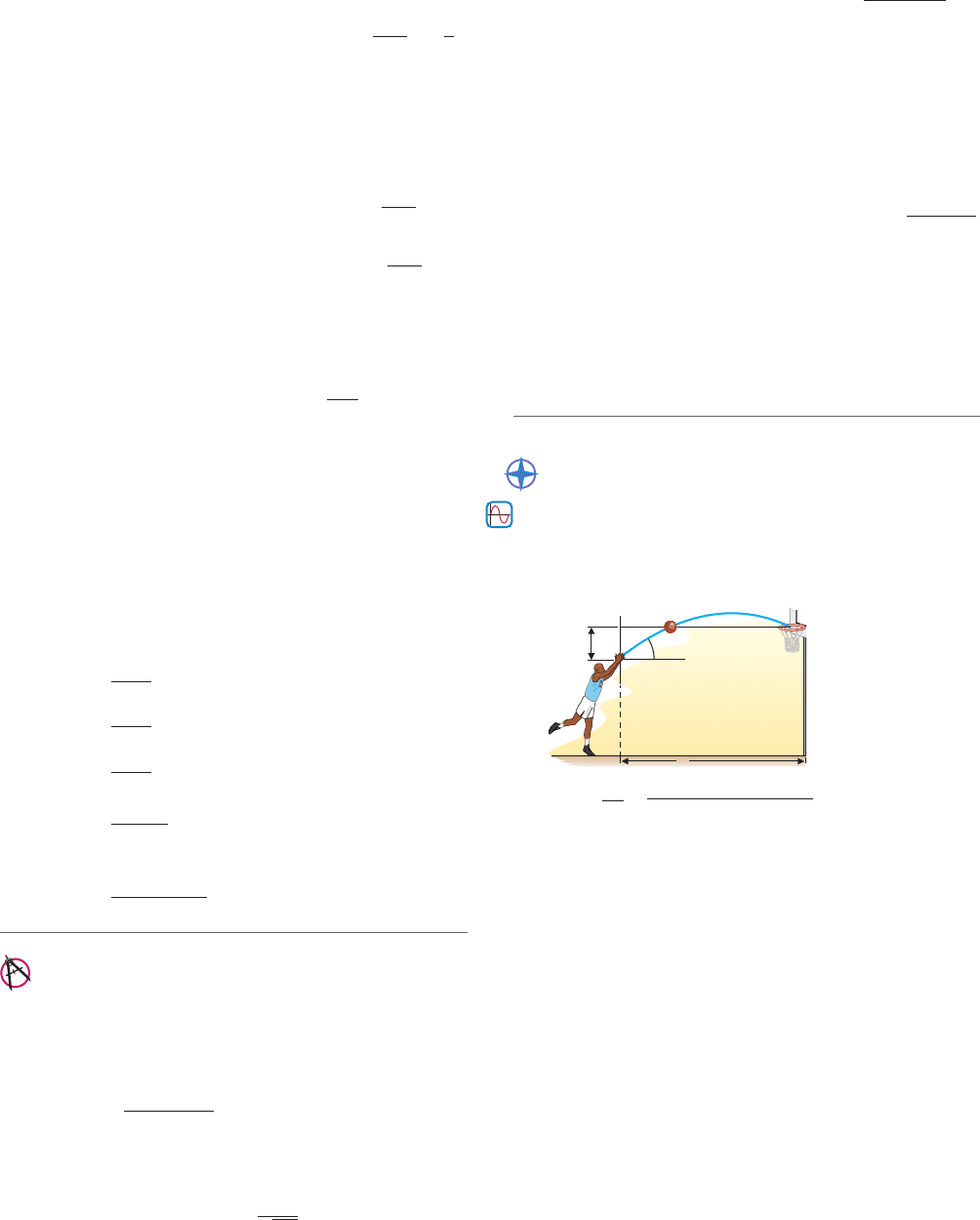
1. Suppose you are shooting a basketball from a (horizontal) dis-
tance of L feet, releasing the ball from a location h feet below
the basket. To get a perfect swish, it is necessary that the ini-
tial velocity v
0
and initial release angle θ
0
satisfy the equation
u
0
h
L
10
v
0
=
√
gL/
2cos
2
θ
0
(tanθ
0
− h/L). For a free throw, take
L = 15 ft, h = 2ftandg = 32 ft/s
2
and graph v
0
as a function
of θ
0
. What is the significance of the two vertical asymptotes?
Explaininphysical termswhattypeofshotcorrespondsto each
vertical asymptote. Estimate the minimum value of v
0
(call it
v
min
). Explain why it is easier to shoot a ball with a small
initial velocity. There is another advantage to this initial veloc-
ity. Assume that the basket is 2 ft in diameter and the ball is
1 ft in diameter. For a free throw, L = 15 ft is perfect. What is
the maximum horizontal distance the ball could travel and still
go in the basket (without bouncing off the backboard)? What
is the minimum horizontal distance? Call these numbers L
max
and L
min
. Find the angle θ
1
corresponding to v
min
and L
min
and
the angle θ
2
corresponding to v
min
and L
max
. The difference
|θ
2
− θ
1
| is the angular margin of error. Peter Brancazio has
shown that the angular margin of error for v
min
is larger than
for any other initial velocity.
2. A different type of limit at infinity that will be very im-
portant to us is the limit of a sequence. Investigating the
area under a parabola in Chapter 4, we will compute the
P1: OSO/OVY P2: OSO/OVY QC: OSO/OVY T1: OSO
MHDQ256-Ch01 MHDQ256-Smith-v1.cls December 6, 2010 20:21
LT (Late Transcendental)
CONFIRMING PAGES
1-41 SECTION 1.6
..
Formal Definition of the Limit 87
following approximations:
2(3)
6(1)
= 1,
3(5)
6(4)
= 0.625,
4(7)
6(9)
≈
0.519,
5(9)
6(16)
≈ 0.469 and so on. Do you see a pattern? If
we name our approximations a
1
, a
2
, a
3
and a
4
, verify that
a
n
=
(n + 1)(2n + 1)
6n
2
. The area under the parabola is the limit
of these approximations as n gets larger and larger. Find the
area. In Chapter 9, we will need to find limits of the following
sequences. Estimate the limit of
(a) a
n
=
2(n + 1)
2
− 3(n + 1) +4
n
2
+ 3n + 4
,
(b) a
n
= (1 +1/n)
n
and
(c) a
n
=
n
3
+ 2
n!
.
1.6 FORMAL DEFINITION OF THE LIMIT
Recall that we write
lim
x→a
f (x) = L,
if f (x) gets closer and closer to L as x gets closer and closer to a. Although intuitive, this
description is imprecise, since we do not have a precise definition for what it means to be
“close.” In this section, however, we will make this more precise and you will begin to see
how mathematical analysis (that branch of mathematics of which the calculus is the most
elementary study) works.
Studying more advanced mathematics without an understanding of the precise defi-
nition of limit is somewhat akin to studying brain surgery without bothering with all that
background work in chemistry and biology. In medicine, it has only been through a careful
examination of the microscopic world that a deeper understanding of our own macroscopic
world has developed. Likewise, in mathematical analysis, it is through an understanding of
the microscopic behavior of functions (such as the precise definition of limit) that a deeper
understanding of the mathematics will come about.
HISTORICAL
NOTES
Augustin Louis Cauchy
(1789–1857) A French
mathematician who brought rigor
to mathematics, including a
modern definition of the limit.
(The ε–δ formulation shown in
this section is due to Weierstrass.)
Cauchy was one of the most
prolific mathematicians in history,
making important contributions
to number theory, linear algebra,
differential equations, astronomy,
optics and complex variables. A
difficult man to get along with, a
colleague wrote, “Cauchy is mad
and there is nothing that can be
done about him, although right
now, he is the only one who
knows how mathematics should
be done.”
We begin with the careful examination of an elementary example. You should certainly
believe that
lim
x→2
(3x + 4) = 10.
If asked to explain the meaning of this particular limit to a fellow student, you would
probably repeat the intuitive explanation we have used so far: that as x gets closer and
closer to 2, (3x + 4) gets arbitrarily close to 10. That is, we should be able to make (3x +4)
as close as we like to 10, just by making x sufficiently close to 2. But can we actually do
this? For instance, can we force (3x + 4) to be within distance 1 of 10? To see what values
of x will guarantee this, we write an inequality that says that (3x +4) is within 1 unit of 10:
|(3x + 4) − 10| < 1.
Eliminating the absolute values, we see that this is equivalent to
−1 < (3x + 4) − 10 < 1
or −1 < 3x − 6 < 1.
Since we need to determine how close x must be to 2, we want to isolate x −2, instead of
x. So, dividing by 3, we get
−
1
3
< x − 2 <
1
3
or |x − 2| <
1
3
. (6.1)
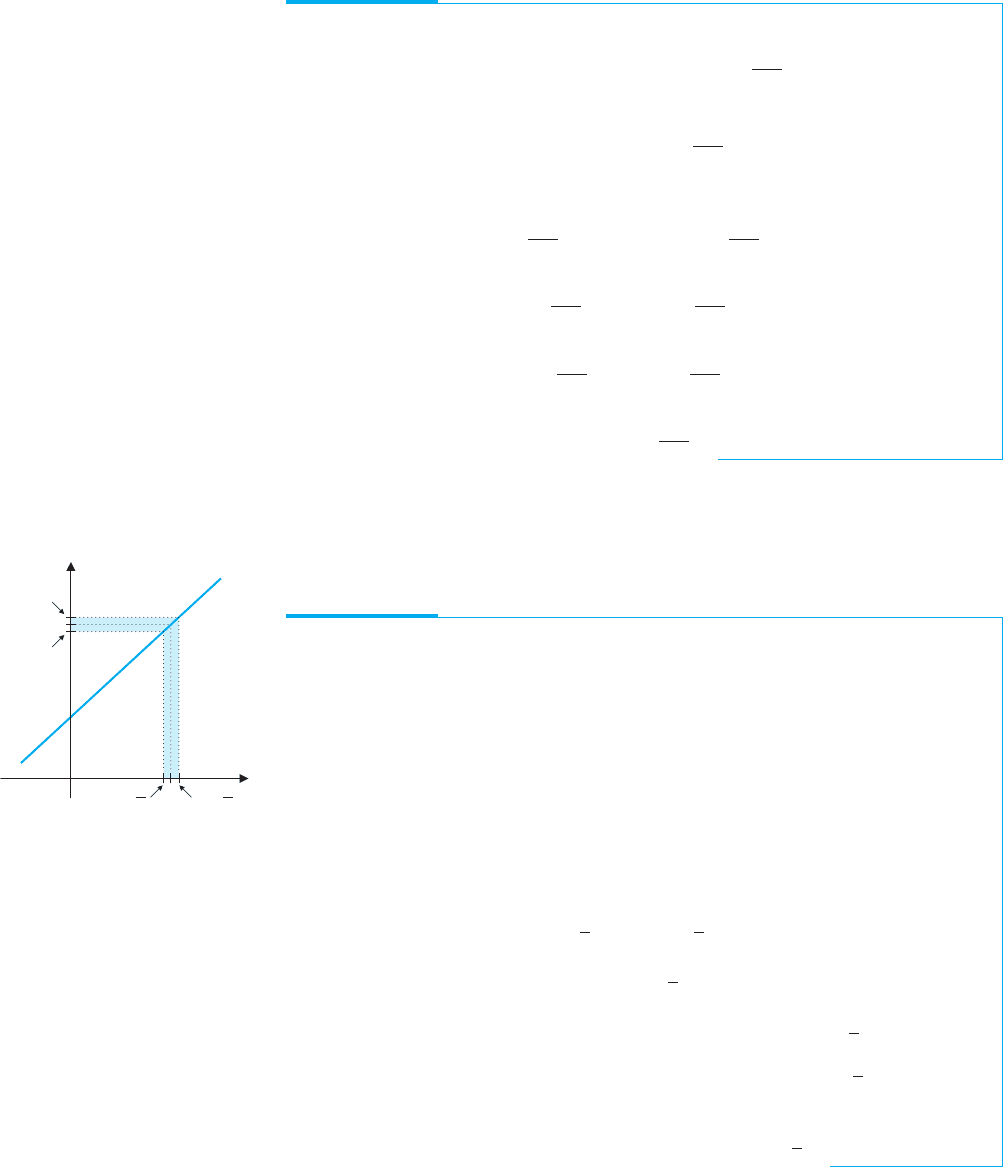
Reversingthestepsthatleadtoinequality(6.1),weseethatif x iswithindistance
1
3
of 2,then
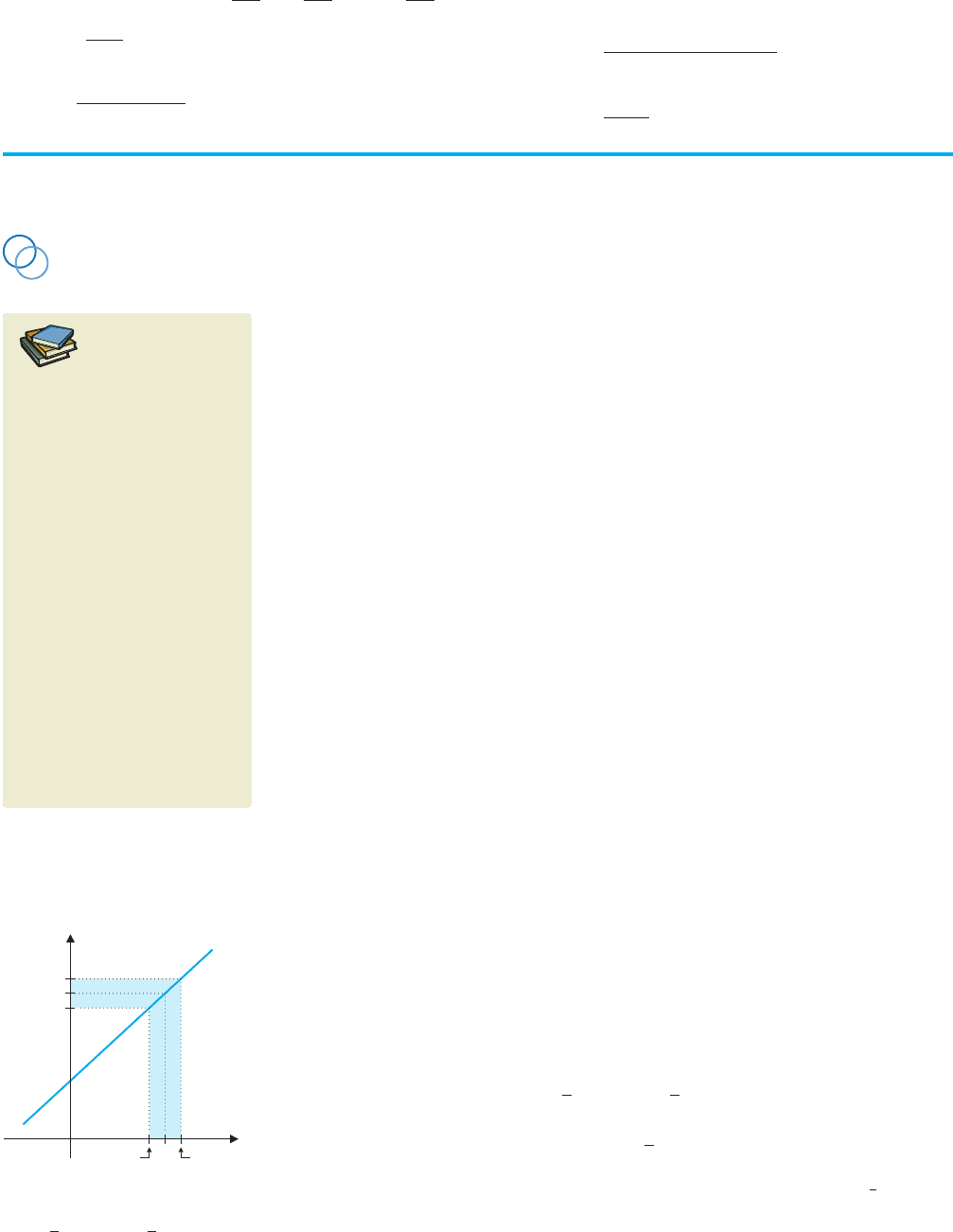
(3x + 4)willbe withinthe specifieddistance (1)of 10.(See Figure1.42foragraphicalinter-
pretationofthis.)So, doesthisconvinceyou thatyoucanmake(3x +4)asclose asyouwant
to 10? Probably not, but if you used a smaller distance, perhaps you’d be more convinced.
y
x
2 W 2 W
2
9
10
11
y 3x 4
FIGURE 1.42
2 −
1
3
< x < 2 +
1
3
guarantees
that |(3x + 4) −10| < 1.
P1: OSO/OVY P2: OSO/OVY QC: OSO/OVY T1: OSO
MHDQ256-Ch01 MHDQ256-Smith-v1.cls December 6, 2010 20:21
LT (Late Transcendental)
CONFIRMING PAGES
88 CHAPTER 1
..
Limits and Continuity 1-42
EXAMPLE 6.1 Exploring a Simple Limit
Find the values of x for which (3x + 4) is within distance
1
100
of 10.
Solution We want
|(3x + 4) − 10| <
1
100
.
Eliminating the absolute values, we get
−
1
100
< (3x + 4) − 10 <
1
100
or −
1
100
< 3x − 6 <
1
100
.
Dividing by 3 yields −
1
300
< x − 2 <
1
300
,
which is equivalent to |x − 2| <
1
300
.
Whileweshowedinexample6.1thatwecanmake(3x +4)reasonablycloseto10,how
close do we need to be able to make it? The answer is arbitrarily close, as close as anyone
would ever demand. We can accomplish this by repeating the arguments in example 6.1,
this time for an unspecified distance, call it ε (epsilon, where ε>0).
EXAMPLE 6.2 Verifying a Limit
Show that we can make (3x +4) within any specified distance ε>0 of 10 (no matter
how small ε is), just by making x sufficiently close to 2.
y
x
2
10 ´
10
10 ´
y 3x 4
´
3
2
´
3
2
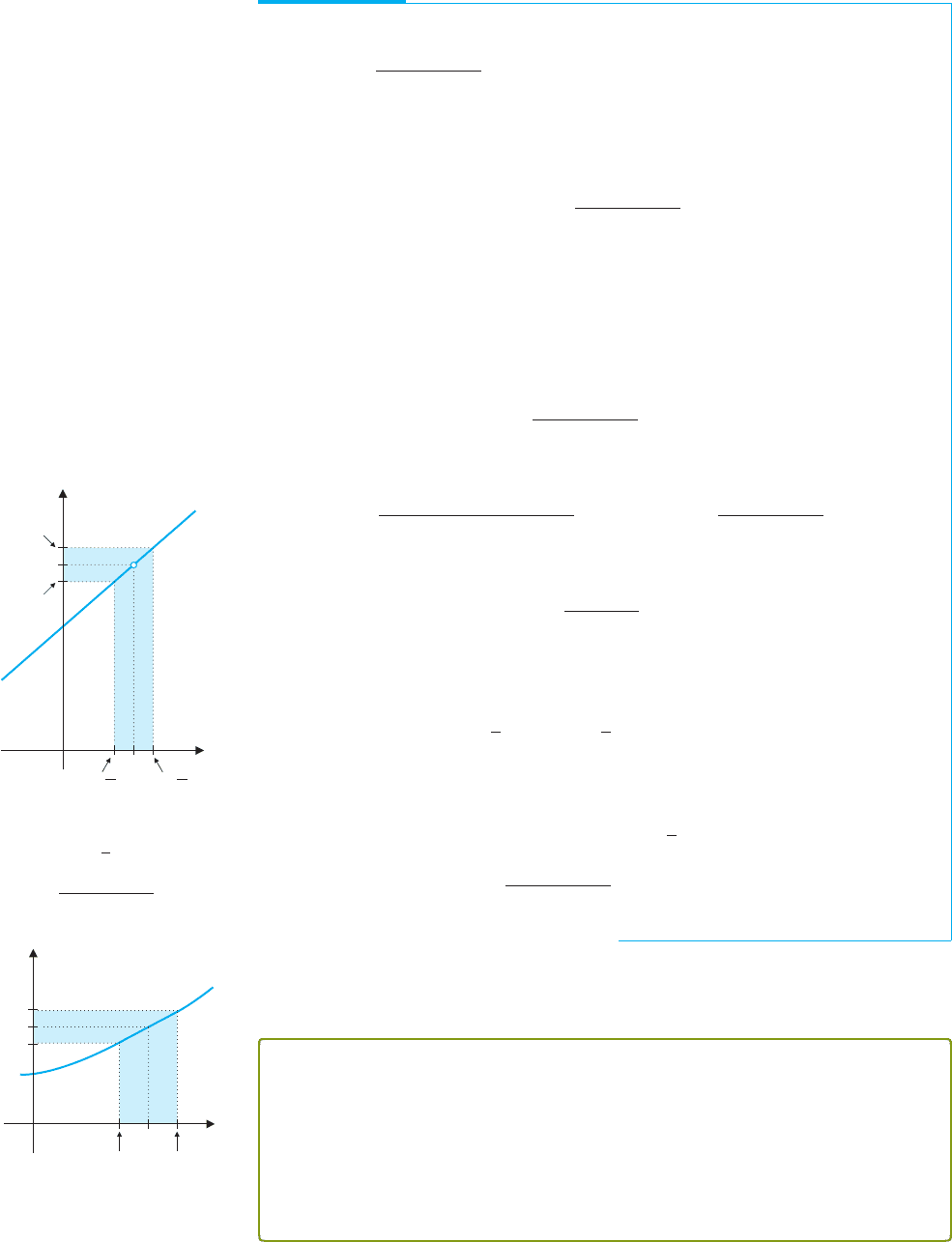
FIGURE 1.43
The range of x-values that keep
|(3x + 4) −10| <ε
Solution The objective is to determine the range of x-values that will guarantee that
(3x + 4) stays within ε of 10. (See Figure 1.43 for a sketch of this range.) We have
|(3x + 4) − 10| <ε,
which is equivalent to −ε<(3x +4) −10 <ε
or −ε<3x −6 <ε.
Dividing by 3, we get −
ε
3
< x − 2 <
ε
3
or |x − 2| <
ε
3
.
Notice that each of the preceding steps is reversible, so that |x − 2| <
ε
3
also implies
that |(3x + 4) − 10| <ε. This says that as long as x is within distance
ε
3
of 2, (3x + 4)
will be within the required distance ε of 10. That is,
|(3x + 4) − 10| <εwhenever|x − 2| <
ε
3
.
Take a moment or two to recognize what we’ve done in example 6.2. By using an
unspecified distance, ε, we have verified that we can indeed make (3x + 4) as close to 10
as might be demanded (i.e., arbitrarily close; just name whatever ε>0 you would like),
simply by making x sufficiently close to 2. Further, we have explicitly spelled out what
“sufficiently close to 2” means in the context of the present problem. Thus, no matter how
close we are asked to make (3x + 4) to 10, we can accomplish this simply by taking x to
be in the specified interval.
P1: OSO/OVY P2: OSO/OVY QC: OSO/OVY T1: OSO
MHDQ256-Ch01 MHDQ256-Smith-v1.cls December 6, 2010 20:21
LT (Late Transcendental)
CONFIRMING PAGES
1-43 SECTION 1.6
..
Formal Definition of the Limit 89
Next, we examine this more precise notion of limit in the case of a function that is not
defined at the point in question.
EXAMPLE 6.3 Proving That a Limit Is Correct
Prove that lim
x→1
2x
2
+ 2x − 4
x −1
= 6.
Solution It is easy to use the usual rules of limits to establish this result. It is yet
another matter to verify that this is correct using our new and more precise notion of
limit. In this case, we want to know how close x must be to 1 to ensure that
f (x) =
2x
2
+ 2x − 4
x −1
is within an unspecified distance ε>0of6.
First, notice that f is undefined at x = 1. So, we seek a distance δ (delta, δ>0),
such that if x is within distance δ of 1, but x = 1 (i.e., 0 < |x − 1| <δ), then this
guarantees that | f (x) −6| <ε.
Notice that we have specified that 0 < |x − 1| to ensure that x = 1. Further,
| f (x) −6| <εis equivalent to
−ε<
2x
2
+ 2x − 4
x −1
− 6 <ε.
Finding a common denominator and subtracting in the middle term, we get
−ε<
2x
2
+ 2x − 4 −6(x −1)
x −1
<ε or −ε<
2x
2
− 4x + 2
x −1
<ε.
Since the numerator factors, this is equivalent to
−ε<
2(x − 1)
2
x −1
<ε.
Since x = 1, we can cancel two of the factors of (x − 1) to yield
−ε<2(x −1) <ε
or −
ε
2
< x − 1 <
ε
2
,
Dividing by 2.
which is equivalent to |x − 1| <ε/2. So, taking δ = ε/2 and working backward, we see
that requiring x to satisfy
0 < |x − 1| <δ=
ε
2
will guarantee that
2x
2
+ 2x − 4
x −1
− 6
<ε.
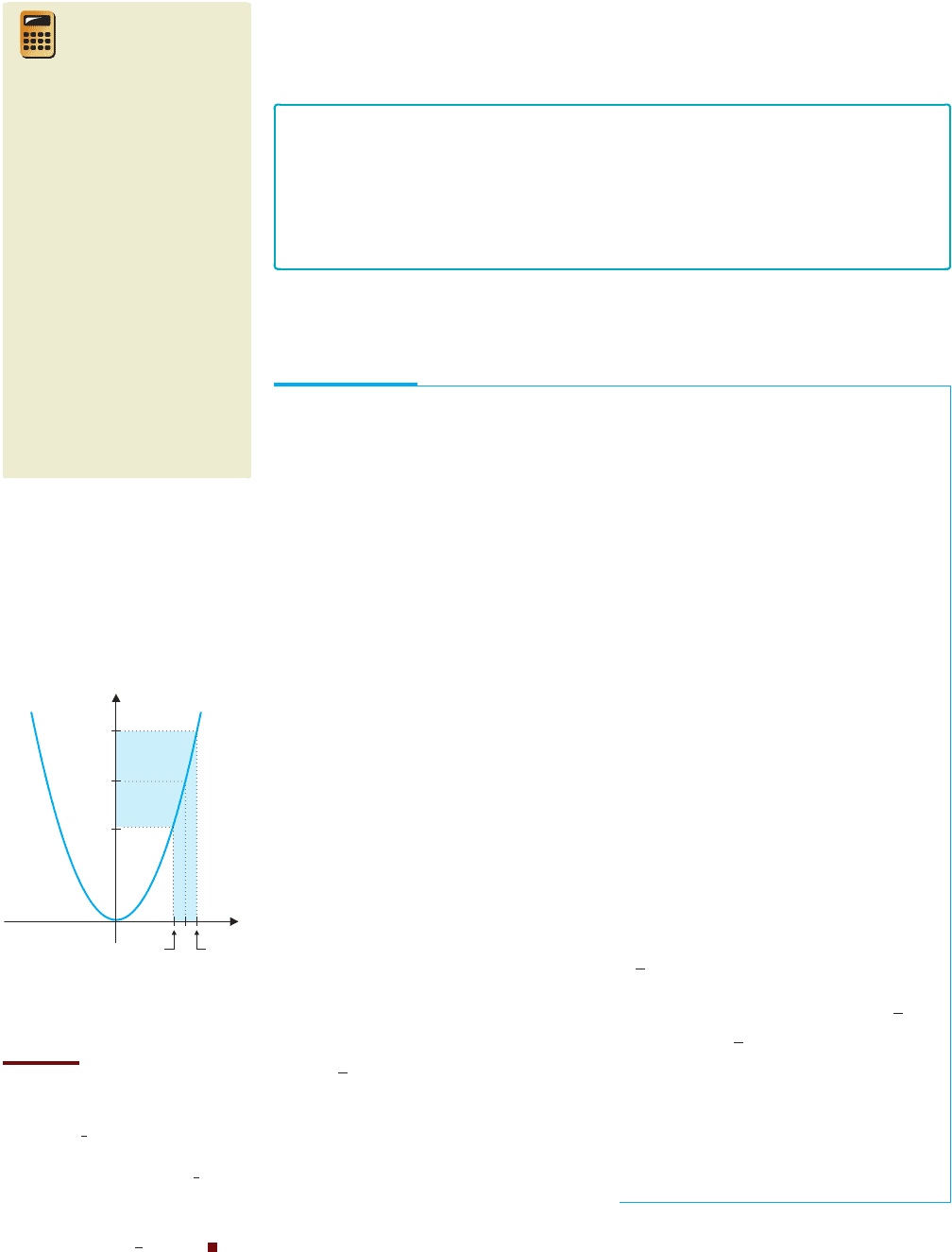
We illustrate this graphically in Figure 1.44.
y
x
y f(x)
6
1
´
2
1
´
2
1
6 ´
6 ´
FIGURE 1.44
0 < |x −1| <
ε
2
guarantees that
6 − ε<
2x
2
+ 2x − 4
x − 1
< 6 +ε.
y
y f(x)
x
L
L
´
L
´
a
a d a d
FIGURE 1.45
a − δ<x < a + δ guarantees that
L − ε< f (x) < L + ε.
What we have seen so far motivates us to make the following general definition, illus-
trated in Figure 1.45.
DEFINITION 6.1 (Precise Definition of Limit)
For a function f defined in some open interval containing a (but not necessarily at a
itself), we say
lim
x→a
f (x) = L,
if given any number ε>0, there is another number δ>0, such that 0 < |x − a| <δ
guarantees that | f (x) − L| <ε.
P1: OSO/OVY P2: OSO/OVY QC: OSO/OVY T1: OSO
MHDQ256-Ch01 MHDQ256-Smith-v1.cls December 6, 2010 20:21
LT (Late Transcendental)
CONFIRMING PAGES
90 CHAPTER 1
..
Limits and Continuity 1-44
Notice that example 6.2 amounts to an illustration of Definition 6.1 for lim
x→2
(3x + 4).
There, we found that δ = ε/3 satisfies the definition.
REMARK 6.1
We want to emphasize that this formal definition of limit is not a new idea. Rather, it
is a more precise mathematical statement of the intuitive notion of limit that we
introduced in section 1.2. Also, we should in all honesty point out that it is rather
difficult to explicitly find δ as a function of ε, for all but a few simple examples.
Despite this, learning how to work through the definition, even for a small number of
problems, will shed considerable light on a deep concept.
Example 6.4, although only slightly more complex than the last several problems,
provides an unexpected challenge.
TODAY IN
MATHEMATICS
Paul Halmos (1916–2006) A
Hungarian-born mathematician
who earned a reputation as one
of the best mathematical writers
ever. For Halmos, calculus did not
come easily, with understanding
coming in a flash of inspiration
only after a long period of hard
work. “I remember standing at
the blackboard in Room 213 of
the mathematics building with
Warren Ambrose and suddenly I
understood epsilons. I understood
what limits were, and all of that
stuff that people had been drilling
into me became clear. ...I could
prove the theorems. That
afternoon I became a
mathematician.’’
y
y x
2
x
4 ´
4
4 ´
2
2 d 2 d
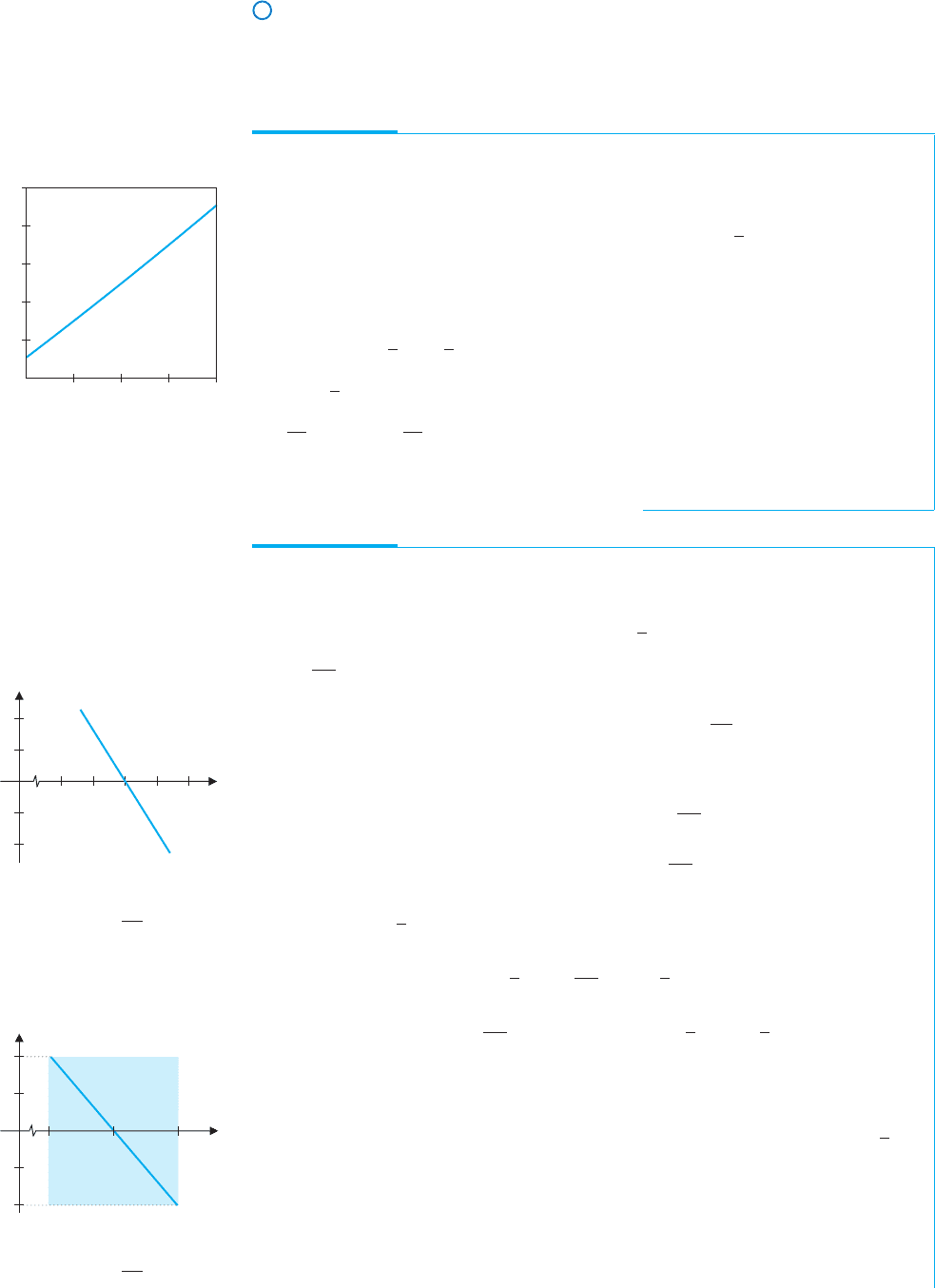
FIGURE 1.46
0 < |x −2| <δguarantees that
|x
2
− 4| <ε.
EXAMPLE 6.4 Using the Precise Definition of Limit
Use Definition 6.1 to prove that lim
x→2
x
2
= 4.
Solution If this limit is correct, then given any ε>0, there must be a δ>0 for which
0 < |x − 2| <δguarantees that
|x
2
− 4| <ε.
Notice that
|x
2
− 4|=|x + 2||x − 2|. Factoring the difference (6.2)
of two squares
Since we’re interested only in what happens near x = 2, we assume that x lies in the
interval [1, 3]. In this case, we have
|x + 2|≤5,
Since x ∈ [1, 3].
and so, from (6.2),
|x
2
− 4|=|x + 2||x − 2|
≤ 5|x −2|. (6.3)
Finally, if we require that
5|x − 2| <ε, (6.4)
then we will also have from (6.3) that
|x
2
− 4|≤5|x −2| <ε.
Of course, (6.4) is equivalent to
|x − 2| <
ε
5
.
In view of this, we now have two restrictions: that |x −2| < 1 and that |x − 2| <
ε
5
. To
ensure that both restrictions are met, we choose δ = min
1,
ε
5
i.e., the minimum
PROOF
Let ε>0 be arbitrary. Define
δ = min{1,
ε
5
}.If0< |x −2| <δ,
then |x − 2| < 1, −1 < x < 3 and
|x + 2| < 5. Also, |x − 2| <
ε
5
.
Then,
|(x
2
+ 1) −5|=|x
2
− 4|
=|x − 2||x + 2| <
ε
5
· 5 = ε.
of1 and
ε
5
. Working backward (see the margin), we get that for this choice of δ,
0 < |x − 2| <δ
will guarantee that
|x
2
− 4| <ε,
as desired. We illustrate this in Figure 1.46.
The work presented in the text above shows how to determine a value for δ. The formal
proof for the limit should follow the steps shown in the margin.
P1: OSO/OVY P2: OSO/OVY QC: OSO/OVY T1: OSO
MHDQ256-Ch01 MHDQ256-Smith-v1.cls December 6, 2010 20:21
LT (Late Transcendental)
CONFIRMING PAGES
1-45 SECTION 1.6
..
Formal Definition of the Limit 91
Exploring the Definition of Limit Graphically
Asyou can see from example6.4,finding a δ fora given ε is not alwayseasily accomplished.
However, we can explore the definition graphically for any function. First, we reexamine
example 6.4 graphically.
EXAMPLE 6.5 Exploring the Precise Definition of Limit Graphically
Explore the precise definition of limit graphically, for lim
x→2
x
2
= 4.
Solution In example 6.4, we discovered that for δ = min
1,
ε
5
,
0 < |x − 2| <δimplies that |x
2
− 4| <ε.
This says that (for ε ≤ 5) if we draw a graph of y = x
2
and restrict the x-values to lie in
the interval
2 −
ε
5
, 2 +
ε
5
,thenthey-values will lie in the interval (4 −ε, 4 +ε).
Take ε =
1
2
, for instance. If we draw the graph in the window defined by
2 −
1
10
≤ x ≤ 2 +
1
10
and 3.5 ≤ y ≤ 4.5, then the graph will not run off the top or
bottom of the screen. (See Figure 1.47.) Of course, we can draw virtually the same
picture for any given value of ε, since we have an explicit formula for finding δ given ε.
For most limit problems, we are not so fortunate.
2.1
x
y
1.951.9 2 2.05
3.7
3.5
3.9
4.1
4.3
4.5
FIGURE 1.47
y = x
2
y
x
0.5
0.5
1 1.5 2 2.5 3
FIGURE 1.48a
y = sin
π x
2
y
x
2 – d 2 + d2
0.5
0.5
FIGURE 1.48b
y = sin
π x
2
EXAMPLE 6.6 Exploring the Definition of Limit
for a Trigonometric Function
Graphically find a δ>0 corresponding to (a) ε =
1
2
and (b) ε = 0.1 for
lim
x→2
sin
π x
2
= 0.
Solution This limit seems plausible enough. After all, sin
2π
2
= 0 and f (x) = sin x
is a continuous function. However, the point is to verify this carefully. Given any ε>0,
we want to find a δ>0, for which
0 < |x − 2| <δ guarantees that
sin
π x
2
− 0
<ε.
Note that since we have no algebra for simplifying sin
π x
2
, we cannot accomplish this
symbolically. Instead, we’ll try to graphically find δ’s corresponding to the specific ε’s
given. (a) For ε =
1
2
, we would like to find a δ>0 for which if 0 < |x −2| <δ, then
−
1
2
< sin
π x
2
− 0 <
1
2
.
Drawing the graph of y = sin
π x
2
with 1 ≤ x ≤ 3 and −
1
2
≤ y ≤
1
2
,weget
Figure 1.48a.
If you trace along a calculator or computer graph, you will notice that the graph
stays on the screen (i.e., the y-values stay in the interval [−0.5, 0.5]) for
x ∈ [1.666667, 2.333333]. Thus, we have determined experimentally that for ε =
1
2
,
δ = 2.333333 −2 = 2 − 1.666667 = 0.333333
will work. (Of course, any value of δ smaller than 0.333333 will also work.) To
illustrate this, we redraw the last graph, but restrict x to lie in the interval [1.67, 2.33].
(See Figure 1.48b.) In this case, the graph stays in the window over the entire range of
displayed x-values. (b) Taking ε = 0.1, we look for an interval of x-values that will
P1: OSO/OVY P2: OSO/OVY QC: OSO/OVY T1: OSO
MHDQ256-Ch01 MHDQ256-Smith-v1.cls December 6, 2010 20:21
LT (Late Transcendental)
CONFIRMING PAGES
92 CHAPTER 1
..
Limits and Continuity 1-46
guarantee that sin
π x
2
stays between −0.1 and 0.1. We redraw the graph from
Figure 1.48a, with the y-range restricted to the interval [−0.1, 0.1]. (See Figure 1.49a.)
Again, tracing along the graph tells us that the y-values will stay in the desired range for
x ∈ [1.936508, 2.063492]. Thus, we have experimentally determined that
δ = 2.063492 −2 = 2 − 1.936508 = 0.063492
will work here. We redraw the graph using the new range of x-values (see Figure 1.49b),
noting that the graph remains in the window for all values of x in the indicated interval.
y
x
1.7 2 2.3
0.1
0.1
y
x
2 – d 2 + d2
0.1
0.1
FIGURE 1.49a
y = sin
π x
2
FIGURE 1.49b
y = sin
π x
2
It is important to recognize that we are not proving that the above limit is correct.
To prove this requires us to symbolically find a δ for every ε>0. The idea here is to use
these graphical illustrations to become more familiar with the definition and with what δ
and ε represent.
x
x
2
2x
√
x
3
4x
2
0.1 1.03711608
0.01 1.0037461
0.001 1.00037496
0.0001 1.0000375
EXAMPLE 6.7 Exploring the Definition of Limit
Where the Limit Does Not Exist
Determine whether or not lim
x→0
x
2
+ 2x
√
x
3
+ 4x
2
= 1.
Solution We first construct a table of function values. From the table alone, we might
be tempted to conjecture that the limit is 1. However, we would be making a huge error,
as we have not considered negative values of x or drawn a graph. Figure 1.50a shows
the default graph drawn by our computer algebra system. In this graph, the function
values do not quite look like they are approaching 1 as x → 0 (at least as x → 0
−
).
We now investigate the limit graphically for ε =
1
2
. Here, we need to find a δ>0 for
which 0 < |x| <δguarantees that
1 −
1
2
<
x
2
+ 2x
√
x
3
+ 4x
2
< 1 +
1
2
or
1
2
<
x
2
+ 2x
√
x
3
+ 4x
2
<
3
2
.
We try δ = 0.1 to see if this is sufficiently small. So, we set the x-range to the interval
[−0.1, 0.1] and the y-range to the interval [0.5, 1.5] and redraw the graph in this
window. (See Figure 1.50b.) Notice that no points are plotted in the window for any
x < 0. According to the definition, the y-values must lie in the interval (0.5, 1.5) for all
x in the interval (−δ, δ), except possibly for x = 0. Further, you can see that δ = 0.1
clearly does not work since x =−0.05 lies in the interval (−δ,δ), but
f (−0.05) ≈−0.981 is not in the interval (0.5, 1.5). You should convince yourself that
no matter how small you make δ, there is an x in the interval (−δ, δ) such that
f (x) /∈ (0.5, 1.5). (In fact, notice that for all x’s in the interval (−1, 0), f (x) < 0.) That
is, there is no choice of δ that makes the defining inequality true for ε =
1
2
. Thus, the
conjectured limit of 1 is incorrect.