
Smith R., Minton R. Calculus
Подождите немного. Документ загружается.

P1: OSO/OVY P2: OSO/OVY QC: OSO/OVY T1: OSO
MHDQ256-Ch15 MHDQ256-Smith-v1.cls January 6, 2011 10:53
LT (Late Transcendental)
CONFIRMING PAGES
15-27 SECTION 15.3
..
Independence of Path and Conservative Vector Fields 1003
In exercises 43–46, find the surface area extending from the
given curve in the xy-plane to the given surface.
43. Above the quarter-circle of radius 2 centered atthe origin from
(2, 0, 0) to (0, 2, 0) up to the surface z = x
2
+ y
2
44. Above the portion of y = x
2
from (0, 0, 0) to (2, 4, 0) up to the
surface z = x
2
+ y
2
45. Above the line segment from (2, 0, 0) to (−2, 0, 0) up to the
surface z = 4 − x
2
− y
2
46. Above the line segment from (1, 1, 0) to (−1, 1, 0) up to the
surface z =
x
2
+ y
2
............................................................
47. Prove Theorem 2.1 in the case of a curve in three dimensions.
48. Prove Theorem 2.2.
49. Prove Theorem 2.4.
50. Prove Theorem 2.5.
51. If C has parametric equations x = x(t), y = y(t), z = z(t),
a ≤ t ≤ b, for differentiable functions x, y and z, show that
C
F · T ds =
b
a
[F
1
(x, y, z) x
(t) + F
2
(x, y, z) y
(t) +
F
3
(x, y, z)z
(t)]dt, which is the work line integral
C
F · dr.
52. If the two-dimensional vector n is normal (perpendicular
to the tangent) to the curve C at each point and
F(x, y) =F
1
(x, y), F
2
(x, y), show that
C
F · n ds =
C
F
1
dy − F
2
dx.
APPLICATIONS
In exercises 53–62, use the formulas m
C
ρds, ¯x
1
m
C
xρds,
¯y
1
m
C
yρds, I
C
w
2
ρds.
53. Compute the mass m of a wire with density ρ(x, y) = x in the
shape of y = x
2
, 0 ≤ x ≤ 3.
54. Compute the mass m of a wire with density ρ(x, y) = xy in
the shape of y = 4 − x
2
, 0 ≤ x ≤ 2.
55. Compute the center of mass (
¯
x,
¯
y) of the wire of exercise 53.
Show that the center of mass is not located at a point on the
wire.
56. Compute the center of mass (
¯
x,
¯
y) of the wire of exercise 54.
Show that the center of mass is not located at a point on the
wire.
57. Compute the moment of inertia I for rotating the wire of exer-
cise 53 about the y-axis. Here, w is the distance from the point
(x, y)tothey-axis.
58. Compute the moment of inertia I for rotating the wire of exer-
cise 54 about the x-axis. Here, w is the distance from the point
(x, y)tothex-axis.
59. Compute the moment of inertia I for rotating the wire of exer-
cise 53 about the line y = 9. Here, w is the distance from the
point (x, y)toy = 9.
60. Compute the moment of inertia I for rotating the wire of exer-
cise 54 about the line x = 2. Here, w is the distance from the
point (x, y)tox = 2.
61. Compute the mass m of the helical spring x = cos 2t,
y = sin 2t, z = t, 0 ≤ t ≤ π, with density ρ = z
2
.
62. Repeat exercise 61 with density ρ = x
2
.
............................................................
63. If T (x, y) is the temperature function, the line inte-
gral
C
(−k∇T) ·n ds gives the rate of heat loss across
C.ForT (x, y) = 60e
y/50
and C the rectangle with sides
x =−20, x = 20, y =−5and y = 5, computetherateofheat
loss. Explain in terms of the temperature function why the in-
tegral is 0 along two sides of C.
EXPLORATORY EXERCISE
1. Look carefully at the solutions to integrals of the form
C
2xdx,
b
a
2xdx,
C
3y
2
dy and
d
c
3y
2
dy for variouscurves
C. Formulate a rule for evaluating line integrals of the form
C
f (x) dx and
C
g(y)dy. If the curve C is a closed curve
(e.g.,asquareoracircle),evaluatethelineintegrals
C
f (x) dx
and
C
g(y)dy.
15.3 INDEPENDENCE OF PATH AND CONSERVATIVE
VECTOR FIELDS
As you’ve seen, there are a lot of steps needed to evaluate a line integral. First, you must
parameterize the curve, rewrite the line integral as a definite integral and then evaluate the
resulting definite integral.While this process is often unavoidable, we nowconsider a group
of line integrals that are the same along every curve connecting the given endpoints and
show a simple way to evaluate these.
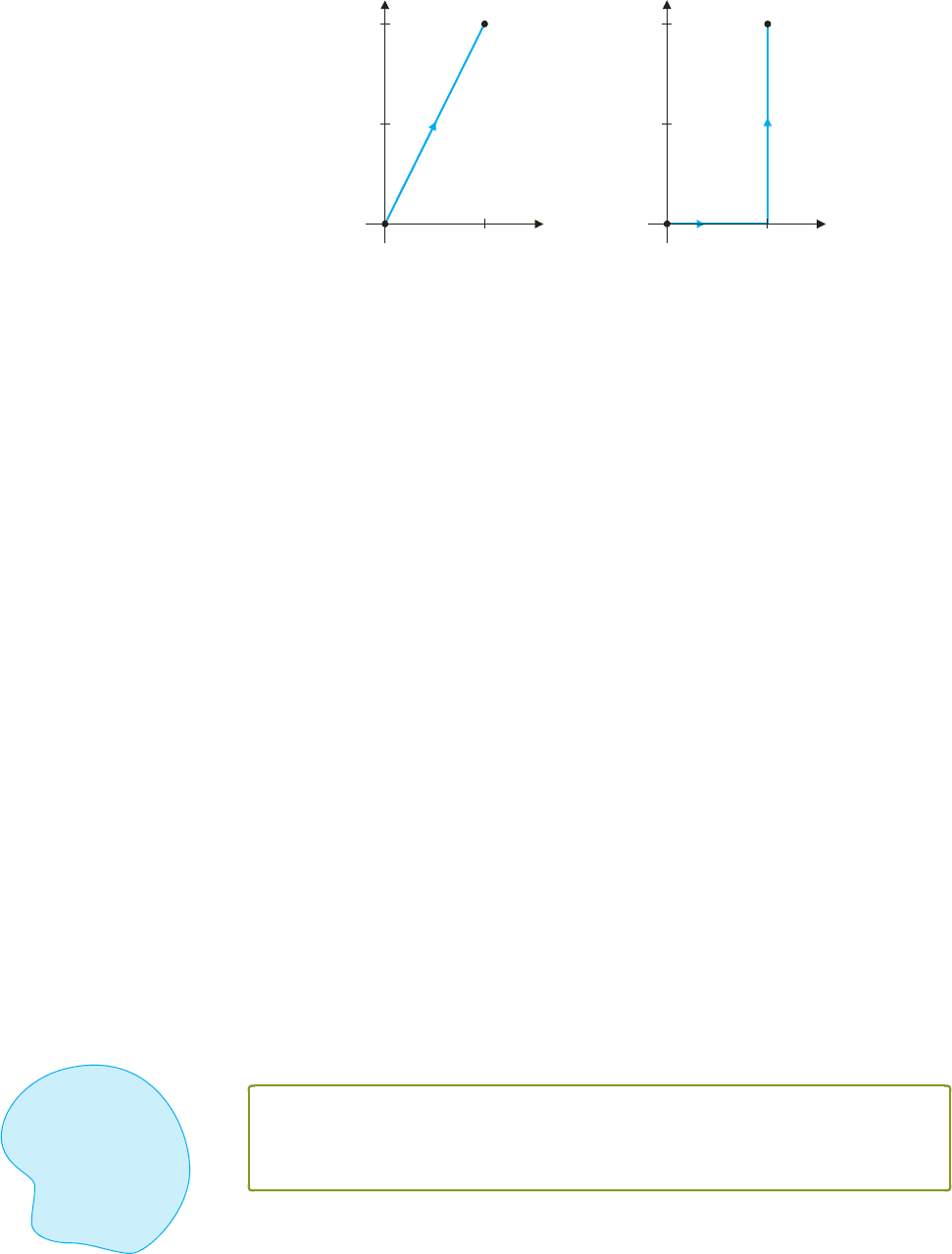
We begin with a simple observation. Consider the line integral
C
1
F · dr, where
F(x, y) =2x, 3y
2
andC
1
isthestraightlinesegmentjoiningthetwopoints(0,0)and(1,2).
P1: OSO/OVY P2: OSO/OVY QC: OSO/OVY T1: OSO
MHDQ256-Ch15 MHDQ256-Smith-v1.cls January 6, 2011 10:53
LT (Late Transcendental)
CONFIRMING PAGES
1004 CHAPTER 15
..
Vector Calculus 15-28
y
1
x
1
2
C
1
y
1
1
2
C
2
x
FIGURE 15.22a FIGURE 15.22b
The path C
1
The path C
2
(See Figure 15.22a.) To parameterize the curve, we take x = t and y = 2t, for 0 ≤ t ≤ 1.
We then have
C
1
F · dr =
C
1
2x, 3y
2
·dx, dy
=
C
1
2xdx+3y
2
dy
=
1
0
[2t +12t
2
(2)]dt = 9,
where we have left the details of the final (routine) calculation to you. For the same vector
field F(x, y), consider now
C
2
F · dr, where C
2
is made up of the horizontal line segment
from (0, 0) to (1, 0) followed by the vertical line segment from (1, 0) to (1, 2). (See
Figure 15.22b.) In this case, we have
C
2
F · dr =
C
2
2x, 3y
2
·dx, dy
=
1
0
2xdx+
2
0
3y
2
dy = 9,
where we have again left the final details to you. Look carefully at these two line integrals.
Although the integrands are the same and the endpoints of the two curves are the same, the
curves followed are quite different. You should try computing this line integral over several
additional curves from (0, 0) to (1, 2). You will find that each line integral has the same
value: 9. This integral is an example of one that is the same along every curve from (0, 0)
to (1, 2).
R
FIGURE 15.23a
Connected region
Let C be any piecewise-smooth curve, traced out by the endpoint of the vector-valued
function r(t), for a ≤ t ≤ b. In this context, we usually refer to a curve connecting two
given points as a path. We say that the line integral
C
F · dr is independent of path in
the domain D if the integral is the same for every path contained in D that has the same
beginning and ending points. Before we see when this happens, we need a definition.
DEFINITION 3.1
A region D ⊂ R
n
(for n ≥ 2) is called connected if every pair of points in D can be
connected by a piecewise-smooth curve lying entirely in D.
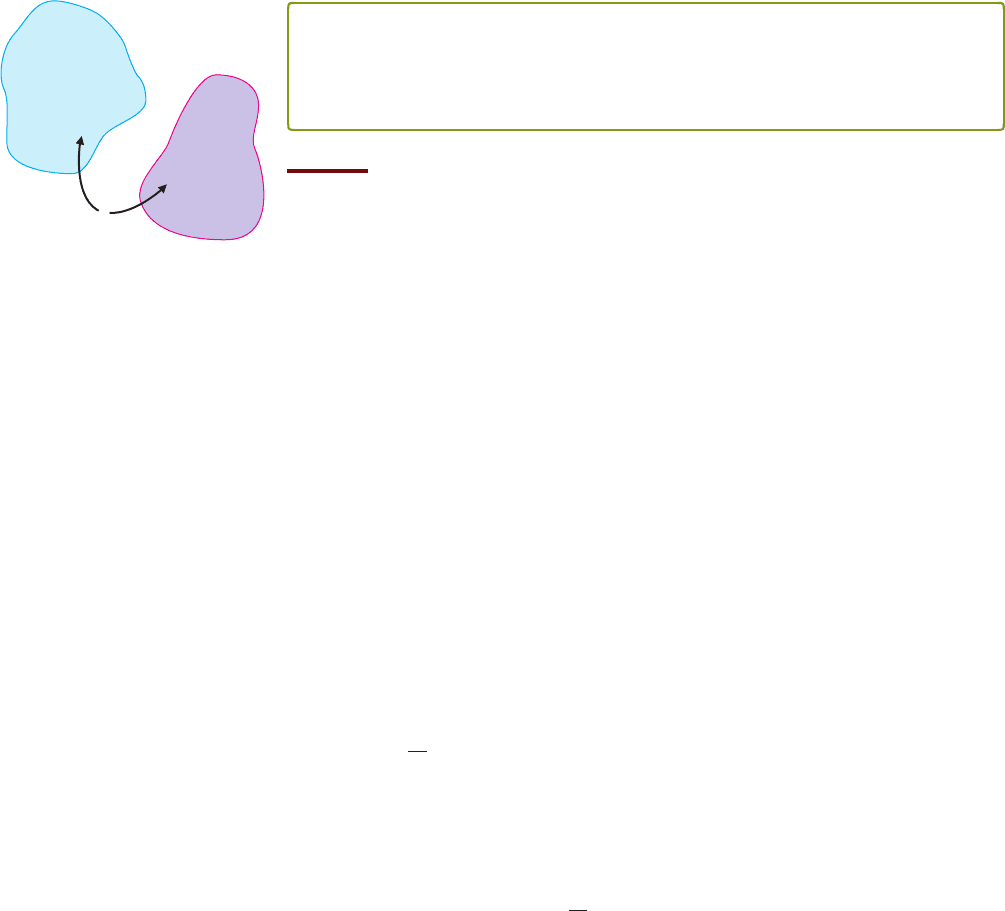
In Figure 15.23a, we show a region in R
2
that is connected and in Figure 15.23b, we
indicate a region that is not connected. We are now in a position to provea result concerning
integrals that are independent of path. While we state and prove the result for line integrals
in the plane, the result is valid in any number of dimensions.
P1: OSO/OVY P2: OSO/OVY QC: OSO/OVY T1: OSO
MHDQ256-Ch15 MHDQ256-Smith-v1.cls January 6, 2011 10:53
LT (Late Transcendental)
CONFIRMING PAGES
15-29 SECTION 15.3
..
Independence of Path and Conservative Vector Fields 1005
R
FIGURE 15.23b
Not connected
THEOREM 3.1
Suppose that the vector field F(x, y) =M(x, y), N(x, y) is continuous on the open,
connected region D ⊂ R
2
. Then, the line integral
C
F(x, y) ·dr is independent of
path in D if and only if F is conservative on D.
PROOF
Recall that a vector field F is conservative whenever F =∇f , for some scalar function f
(called a potential function for F). There are several things to prove here.
First, suppose that F is conservative on D, with F(x, y) =∇f (x, y). Then
F(x, y) =M(x, y), N(x, y)=∇f (x, y) =f
x
(x, y), f
y
(x, y)
and so, we must have
M(x, y) = f
x
(x, y) and N(x, y) = f
y
(x, y).
Let A(x
1
, y
1
) and B(x
2
, y
2
) be any two points in D and let C be any smooth path from A to
B, lying in D and defined parametrically by C: x = g(t), y = h(t), where t
1
≤ t ≤ t
2
.(You
can extend this proof to any piecewise-smooth path in the obvious way.) Then, we have
C
F (x, y) · dr =
C
M(x, y)dx + N(x, y)dy
=
C
f
x
(x, y) dx + f
y
(x, y) dy
=
t
2
t
1
[ f
x
(g(t), h(t))g
(t) + f
y
(g(t), h(t))h
(t)] dt. (3.1)
Notice that since f
x
and f
y
were assumed to be continuous, we have by the chain rule that
d
dt
[ f (g(t), h(t))] = f
x
(g(t), h(t))g
(t) + f
y
(g(t), h(t))h
(t),
which is the integrand in (3.1). By the Fundamental Theorem of Calculus, we now have
C
F (x, y) · dr =
t
2
t
1
[ f
x
(g(t), h(t))g
(t) + f
y
(g(t), h(t))h
(t)] dt
=
t
2
t
1
d
dt
[ f (g(t), h(t))]dt
= f (g(t
2
), h(t
2
)) − f (g(t
1
), h(t
1
))
= f (x
2
, y
2
) − f (x
1
, y
1
).
Inparticular, this says that the value of the integraldepends only on thevalueof the potential
function at the two endpoints of the curve and not on the particular path followed. That is,
the line integral is independent of path, as desired.
Next, suppose that
C
F(x, y) ·dr is independent of path in D. We now must show that
F is conservative on D. For any points (u,v) and (x
0
, y
0
) ∈ D, define the function
f (u,v) =
(u,v)
(x
0
,y
0
)
F(x, y) ·dr.
(Weare using thevariablesu and v, since the variables x and y inside the integralare dummy
variables and cannot be used both inside and outside the line integral.) Notice that since the
line integral is independent of path in D, we need not specify a path over which to integrate.
(Since D is connected, there is always a path lying in D that connects the points.) Further,
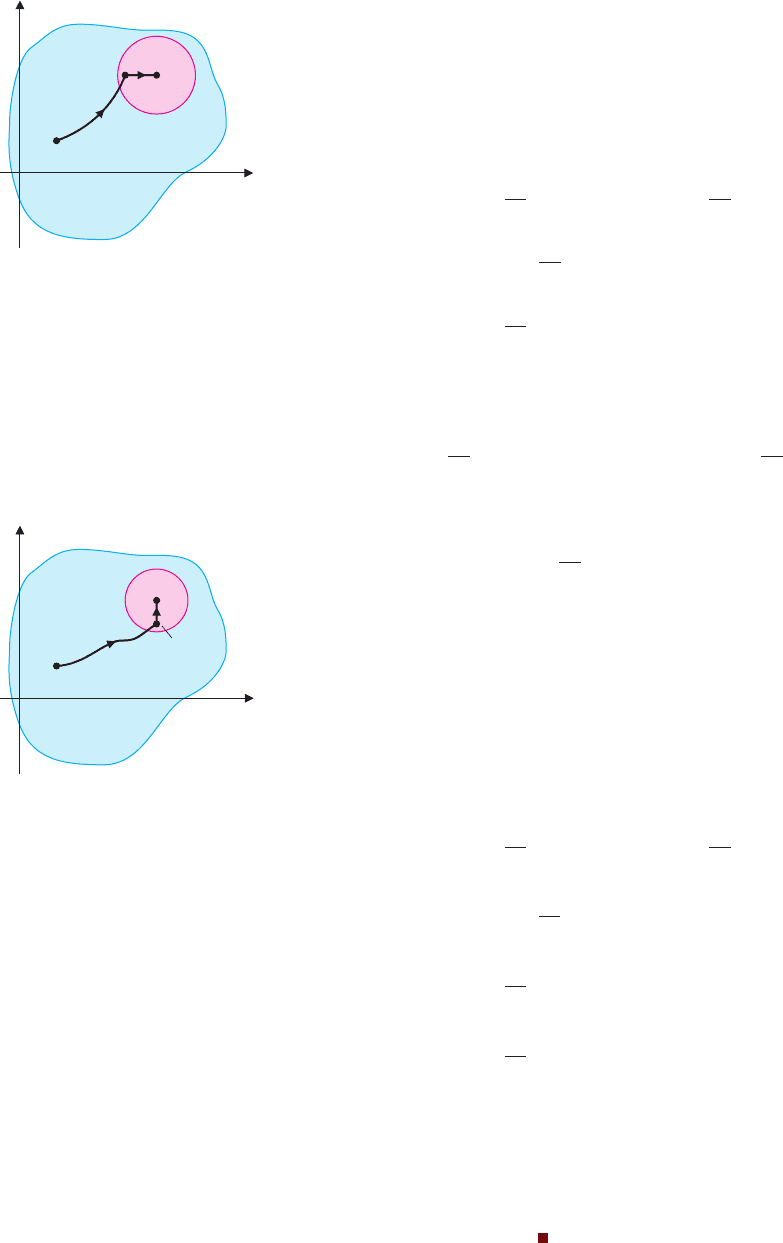
since D is open, there is a disk centered at (u,v) and lying completely inside D. Pick any
point(x
1
,v) inthe disk with x
1
< u andlet C
1
beanypath from(x
0
, y
0
)to(x
1
,v) lyingin D.
P1: OSO/OVY P2: OSO/OVY QC: OSO/OVY T1: OSO
MHDQ256-Ch15 MHDQ256-Smith-v1.cls January 6, 2011 10:53
LT (Late Transcendental)
CONFIRMING PAGES
1006 CHAPTER 15
..
Vector Calculus 15-30
So, in particular, if we integrate over the path consisting of C
1
followed by the horizontal
path C
2
indicated in Figure 15.24, we must have
f (u,v) =
(x
1
,v)
(x
0
,y
0
)
F(x, y) ·dr +
(u,v)
(x
1
,v)
F(x, y) ·dr. (3.2)
y
x
(x
1
, v)
(u, v)
(x
0
, y
0
)
C
1
C
2
D
FIGURE 15.24
First path
Observe that the first integral in (3.2) is independent of u. So, taking the partial derivative
of both sides of (3.2) with respect to u,weget
f
u
(u,v) =
∂
∂u
(x
1
,v)
(x
0
,y
0
)
F(x, y) ·dr +
∂
∂u
(u,v)
(x
1
,v)
F(x, y) ·dr
= 0 +
∂
∂u
(u,v)
(x
1
,v)
F(x, y) ·dr
=
∂
∂u
(u,v)
(x
1
,v)
M(x, y)dx + N(x, y)dy.
Notice that on the second portion of the indicated path, y is a constant and so, dy = 0. This
gives us
f
u
(u,v) =
∂
∂u
(u,v)
(x
1
,v)
M(x, y)dx + N(x, y)dy =
∂
∂u
(u,v)
(x
1
,v)
M(x, y)dx.
Finally, from the second form of the Fundamental Theorem of Calculus, we have
f
u
(u,v) =
∂
∂u
(u,v)
(x
1
,v)
M(x, y)dx = M(u,v). (3.3)
Similarly, pick any point (u, y
1
) in the disk centered at (u,v) with y
1
<vand let C
1
be any
path from (x
0
, y
0
)to(u, y
1
) lying in D. Then, integrating over the path consisting of C
1
followed by the vertical path C
2
indicated in Figure 15.25, we find that
f (u,v) =
(u,y
1
)
(x
0
,y
0
)
F(x, y) ·dr +
(u,v)
(u,y
1
)
F(x, y) ·dr. (3.4)
In this case, the first integral is independent of v. So, differentiating both sides of (3.4) with
respect to v,wehave
f
v
(u,v) =
∂
∂v
(u,y
1
)
(x
0
,y
0
)
F(x, y) ·dr +
∂
∂v
(u,v)
(u,y
1
)
F(x, y) ·dr
= 0 +
∂
∂v
(u,v)
(u,y
1
)
F(x, y) ·dr
=
∂
∂v
(u,v)
(u,y
1
)
M(x, y)dx + N(x, y)dy
=
∂
∂v
(u,v)
(u,y
1
)
N(x, y)dy = N(u,v), (3.5)
by the second form of the Fundamental Theorem of Calculus, where we have used the fact
that on the second part of the indicated path, x is a constant, so that dx = 0. Replacing u
and v by x and y, respectively, in (3.3) and (3.5) establishes that
F(x, y) =M(x, y), N(x, y)=f
x
(x, y), f
y
(x, y)=∇f (x, y),
so that F is conservative in D.
y
x
(u, y
1
)
(u, v)
(x
0
, y
0
)
C
1
C
2
D
FIGURE 15.25
Second path
Notice that in the course of the first part of the proof of Theorem 3.1, we also provedthe
following result, which corresponds to the Fundamental Theorem of Calculus for definite
integrals.

P1: OSO/OVY P2: OSO/OVY QC: OSO/OVY T1: OSO
MHDQ256-Ch15 MHDQ256-Smith-v1.cls January 6, 2011 10:53
LT (Late Transcendental)
CONFIRMING PAGES
15-31 SECTION 15.3
..
Independence of Path and Conservative Vector Fields 1007
THEOREM 3.2 (Fundamental Theorem for Line Integrals)
Suppose that F(x, y) =M(x, y), N(x, y) is continuous in the open, connected
region D ⊂ R
2
and that C is any piecewise-smooth curve lying in D, with initial point
(x
1
, y
1
) and terminal point (x
2
, y
2
). Then, if F is conservative on D, with
F(x, y) =∇f (x, y), we have
C
F(x, y) ·dr = f (x, y)
(x
2
,y
2
)
(x
1
,y
1
)
= f (x
2
, y
2
) − f (x
1
, y
1
).
You should quickly recognize the advantages presented by Theorem 3.2. For a conser-
vative vector field, you don’t need to parameterize the path to compute a line integral; you
need only find a potential function and then simply evaluate the potential function at the
endpoints of the curve. We illustrate this in example 3.1.
EXAMPLE 3.1 A Line Integral That Is Independent of Path
Show that for F(x, y) =2xy − 3, x
2
+ 4y
3
+ 5, the line integral
C
F(x, y) ·dr is
independent of path. Then, evaluate the line integral for any curve C with initial point at
(−1, 2) and terminal point at (2, 3).
Solution From Theorem 3.1, the line integral is independent of path if and only if the
vector field F(x, y) is conservative. So, we look for a potential function for F, that is, a
function f (x, y) for which
F(x, y) =2xy − 3, x
2
+ 4y
3
+ 5=∇f (x, y) =f
x
(x, y), f
y
(x, y).
Of course, this occurs when
f
x
= 2xy − 3 and f
y
= x
2
+ 4y
3
+ 5. (3.6)
Integrating the first of these two equations with respect to x (note that we might just as
easily integrate the second one with respect to y), we get
f (x, y) =
(2xy − 3)dx = x
2
y − 3x + g(y), (3.7)
where g(y) is some arbitrary function of y alone. (Recall that we get an arbitrary
function of y instead of a constant of integration, since we are integrating a function of x
and y with respect to x.) Differentiating with respect to y,weget
f
y
(x, y) = x
2
+ g
(y).
Setting this equal to the expression for f
y
in (3.6), we get
x
2
+ g
(y) = x
2
+ 4y
3
+ 5,
so that
g
(y) = 4y
3
+ 5.
Integrating with respect to y gives us
g(y) = y
4
+ 5y + c.
We now have from (3.7) that
f (x, y) = x
2
y − 3x + y
4
+ 5y + c
P1: OSO/OVY P2: OSO/OVY QC: OSO/OVY T1: OSO
MHDQ256-Ch15 MHDQ256-Smith-v1.cls January 6, 2011 10:53
LT (Late Transcendental)
CONFIRMING PAGES
1008 CHAPTER 15
..
Vector Calculus 15-32
is a potential function for F(x, y), for any constant c. Now that we have found a
potential function, we have by Theorem 3.2 that for any path from (−1, 2) to (2, 3),
C
F(x, y) ·dr = f (x, y)
(2,3)
(−1,2)
= [2
2
(3) − 3(2) + 3
4
+ 5(3) +c] − [2 + 3 + 2
4
+ 5(2) +c]
= 71.
Notice that when we evaluated the line integral in example 3.1, the constant c in the
expression for the potential function dropped out. For this reason, we usually take the
constant to be zero when we write down a potential function.
We consider a curve C to be closed if its two endpoints are the same. That is, for a
plane curve C defined parametrically by
C ={(x, y)|x = g(t), y = h(t), a ≤ t ≤ b},
C is closed if (g(a), h(a)) = (g(b), h(b)). Theorem 3.3 provides us with an important con-
nection between conservative vector fields and line integrals along closed curves.
THEOREM 3.3
Suppose that F(x, y) is continuous in the open, connected region D ⊂ R
2
. Then F is
conservative on D if and only if
C
F(x, y) ·dr = 0 for every piecewise-smooth
closed curve C lying in D.
PROOF
Suppose that
C
F(x, y) ·dr = 0 for every piecewise-smooth closed curve C lying in D.
Take any two points P and Q lying in D and let C
1
and C
2
be any two piecewise-smooth
curves from P to Q that lie in D, as indicated in Figure 15.26a. (Note that since D is
connected, there always exist such curves.) Then, the curve C consisting of C
1
followed by
−C
2
is a piecewise-smooth closed curve lying in D, as indicated in Figure 15.26b. It now
follows that
0 =
C
F(x, y) ·dr =
C
1
F(x, y) ·dr +
−C
2
F(x, y) ·dr
=
C
1
F(x, y) ·dr −
C
2
F(x, y) ·dr, From Theorem 2.5
so that
C
1
F(x, y) ·dr =
C
2
F(x, y) ·dr.
Since C
1
and C
2
were any two piecewise-smooth curves from P to Q, we have that
C
F(x, y) ·dr is independent of path and so, F is conservativeby Theorem 3.1. The second
half of the theorem (that F conservative implies
C
F(x, y) ·dr = 0 for every piecewise-
smooth closed curve C lying in D) is a simple consequence of Theorem 3.2 and is left as
an exercise.
y
x
C
2
C
1
D
P
Q
FIGURE 15.26a
Curves C
1
andC
2
y
x
C
2
C
1
D
P
Q
FIGURE 15.26b
The closed curve formed by
C
1
∪ (−C
2
)
You have already seen that line integrals need not be independent of path. Said differ-
ently, not all vector fields are conservative. In view of this, it would be helpful to have a
simple way of deciding whether or not a line integral is independent of path before going
through the process of trying to construct a potential function.
Note that by Theorem 3.1, if F(x, y) =M(x, y), N(x, y) is continuous on the open,
connected region D and the line integral
C
F(x, y) ·dr is independent of path, then F must
be conservative. That is, there is a function f (x, y) for which F(x, y) =∇f (x, y), so that
M(x, y) = f
x
(x, y) and N(x, y) = f
y
(x, y).

P1: OSO/OVY P2: OSO/OVY QC: OSO/OVY T1: OSO
MHDQ256-Ch15 MHDQ256-Smith-v1.cls January 6, 2011 10:53
LT (Late Transcendental)
CONFIRMING PAGES
15-33 SECTION 15.3
..
Independence of Path and Conservative Vector Fields 1009
Differentiating the first equation with respect to y and the second equation with respect to
x,wehave
M
y
(x, y) = f
xy
(x, y) and N
x
(x, y) = f
yx
(x, y).
Notice now that if M
y
and N
x
are continuous in D, then the mixed second partial derivatives
f
xy
(x, y) and f
yx
(x, y) must be equal in D, by Theorem 3.1 in Chapter 13. We must then
have that
M
y
(x, y) = N
x
(x, y),
for all (x, y)inD. As it turns out, if we further assume that D is simply-connected (that is,
that every closed curve in D encloses only points in D), then the converse of this result is
also true [i.e.,
C
F(x, y) ·dr is independent of path whenever M
y
= N
x
in D]. We illustrate
a simply-connected region in Figure 15.27a and a region that is not simply-connected in
Figure 15.27b. You can think about simply-connected regions as regions that have no holes.
We can now state the following result.
THEOREM 3.4
Suppose that M(x, y) and N(x, y) have continuous first partial derivatives on a
simply-connected region D. Then,
C
M(x, y)dx + N(x, y)dy is independent of
path in D if and only if M
y
(x, y) = N
x
(x, y) for all (x, y)inD.
We have already proved that independence of path implies that M
y
(x, y) = N
x
(x, y)
for all (x, y)inD. We postpone the proof of the second half of the theorem until our
presentation of Green’s Theorem in section 15.4.
EXAMPLE 3.2 Testing a Line Integral for Independence of Path
Determine whether or not the line integral
C
(e
2x
+ x sin y)dx + (x
2
cos y)dy is
independent of path.
R
FIGURE 15.27a
Simply-connected
R
FIGURE 15.27b
Not simply-connected
Solution In this case, we have
M
y
=
∂
∂y
(e
2x
+ x sin y) = x cos y
and N
x
=
∂
∂x
(x
2
cos y) = 2x cos y,
so that M
y
= N
x
. By Theorem 3.4, the line integral is thus not independent of path.
Beforemovingon to three-dimensional vectorfields,wepauseto summarize the results
we have developed for two-dimensional vector fields.
CONSERVATIVE VECTOR FIELDS
Let F(x, y) =M(x, y), N(x, y), where we assume that M(x, y) and N(x, y)have
continuous first partial derivatives on an open, simply-connected region D ⊂ R
2
. The
following five statements are equivalent, meaning that for a given vector field, either
all five statements are true or all five statements are false.
1. F(x, y) is conservative on D.
2. F(x, y) is a gradient field in D (i.e., F(x, y) =∇f (x, y), for some potential
function f, for all (x, y) ∈ D).
3.
C
F · dr is independent of path in D.
4.
C
F · dr = 0 for every piecewise-smooth closed curve C lying in D.
5. M
y
(x, y) = N
x
(x, y), for all (x, y) ∈ D.

P1: OSO/OVY P2: OSO/OVY QC: OSO/OVY T1: OSO
MHDQ256-Ch15 MHDQ256-Smith-v1.cls January 6, 2011 10:53
LT (Late Transcendental)
CONFIRMING PAGES
1010 CHAPTER 15
..
Vector Calculus 15-34
All we have said about independence of path and conservative vector fields can be
extended to higher dimensions, although the test for when a line integral is independent of
path becomes slightly more complicated. For a three-dimensional vector field F(x, y, z),
we say that F is conservative on a region D whenever there is a scalar function f (x, y, z)
for which
F(x, y, z) =∇f (x, y, z), for all (x, y, z) ∈ D.
As in two dimensions, f is called a potential function for the vector field F. You can
construct a potential function for a conservative vector field in three dimensions in much
the same way as you did in two dimensions. We illustrate this in example 3.3.
EXAMPLE 3.3 Showing That a Three-Dimensional Vector Field
Is Conservative
Show that the vector field F(x, y, z) =4xe
z
, cos y, 2x
2
e
z
is conservative on R
3
,by
finding a potential function f.
Solution We need to find a potential function f (x, y, z) for which
F(x, y, z) =4xe
z
, cos y, 2x
2
e
z
=∇f (x, y, z)
=f
x
(x, y, z), f
y
(x, y, z), f
z
(x, y, z).
This will occur if and only if
f
x
= 4xe
z
, f
y
= cos y and f
z
= 2x
2
e
z
. (3.8)
Integrating the first of these equations with respect to x,wehave
f (x, y, z) =
4xe
z
dx = 2x
2
e
z
+ g(y, z),
where g(y, z) is an arbitrary function of y and z alone. Note that since y and z are treated
as constants when integrating or differentiating with respect to x, we add an arbitrary
function of y and z (instead of an arbitrary constant) after a partial integration with
respect to x. Differentiating this expression with respect to y,wehave
f
y
(x, y, z) = g
y
(y, z) = cos y,
from the second equation in (3.8). Integrating g
y
(y, z) with respect to y now gives us
g(y, z) =
cos ydy= sin y + h(z),
where h(z) is an arbitrary function of z alone. Notice that here, we got an arbitrary
function of z alone, since we were integrating g(y, z) (a function of y and z alone) with
respect to y. This now gives us
f (x, y, z) = 2x
2
e
z
+ g(y, z) = 2x
2
e
z
+ sin y + h(z).
Differentiating this last equation with respect to z yields
f
z
(x, y, z) = 2x
2
e
z
+ h
(z) = 2x
2
e
z
,
from the third equation in (3.8). This gives us that h
(z) = 0, so that h(z) is a constant.
(We’ll choose it to be 0.) We now have that a potential function for F(x, y, z)is
f (x, y, z) = 2x
2
e
z
+ sin y
and so, F is conservative on R
3
.

P1: OSO/OVY P2: OSO/OVY QC: OSO/OVY T1: OSO
MHDQ256-Ch15 MHDQ256-Smith-v1.cls January 6, 2011 10:53
LT (Late Transcendental)
CONFIRMING PAGES
15-35 SECTION 15.3
..
Independence of Path and Conservative Vector Fields 1011
We summarize the main results for line integrals for three-dimensional vector fields in
Theorem 3.5.
THEOREM 3.5
Suppose that the vector field F(x, y, z) is continuous on the open, connected region
D ⊂ R
3
. Then, the line integral
C
F(x, y, z) ·dr is independent of path in D if and
only if the vector field F is conservative on D; that is, F(x, y, z) =∇f (x, y, z), for all
(x, y, z)inD, for some scalar function f (a potential function for F). Further, for any
piecewise-smooth curve C lying in D, with initial point (x
1
, y
1
, z
1
) and terminal point
(x
2
, y
2
, z
2
), we have
C
F(x, y, z) ·dr = f (x, y, z)
(x
2
,y
2
,z
2
)
(x
1
,y
1
,z
1
)
= f (x
2
, y
2
, z
2
) − f (x
1
, y
1
, z
1
).
EXERCISES 15.3
WRITING EXERCISES
1. You have seen two different methods of determining whether
a line integral is independent of path: one in example 3.1 and
the other in example 3.2. If you have reason to believe that a
lineintegralwillbeindependent of path, explainwhich method
you would prefer to use.
2. In the situation of exercise 1, if you doubt that a line integral is
independent of path, explain which method you would prefer
to use. If you haveno evidenceas to whether the line integral is
or isn’t independent of path, explain which method you would
prefer to use.
3. In section 15.1, we introduced conservative vector fields and
stated that some calculations simplified when the vector field
is conservative. Discuss one important example of this.
4. Ourdefinitionofindependenceofpathappliesonlytolineinte-
grals of the form
C
F · dr. Explain why an arc length line inte-
gral
C
fdswould not be independent of path (unless f = 0).
In exercises 1–12, determine whether F is conservative on R
2
or
R
3
. If it is, find a potential function f .
1. F(x, y) =2xy − 1, x
2
2. F(x, y) =3x
2
y
2
, 2x
3
y − y
3. F(x, y) =
1
y
− 2x, y −
x
y
2
4. F(x, y) =sin y − x, x cos y
5. F(x, y) =e
xy
− 1, xe
xy
6. F(x, y) =e
y
− 2x, xe
y
− x
2
y
7. F(x, y) =ye
xy
, xe
xy
+ cos y
8. F(x, y) =y cos xy − 2xy, x cos xy − x
2
9. F(x, y, z) =z
2
+ 2xy, x
2
+ 1, 2xz − 3
10. F(x, y, z) =y
2
− x, 2xy + sin z, y cos z
11. F(x, y, z) =y
2
z
2
+ xe
−2x
, y
y
2
+ 1 + 2xyz
2
, 2xy
2
z
12. F(x, y, z) =2xe
yz
− tan
−1
x, x
2
+ e
yz
, x
2
ye
yz
............................................................
In exercises 13–18, show that the line integral is independent of
path in R
2
or R
3
and use a potential function to evaluate the
integral.
13.
C
2xydx + (x
2
− 1)dy, where C runs from (1, 0) to (3, 1)
14.
C
3x
2
y
2
dx + (2x
3
y − 4) dy, where C runs from (1, 2) to
(−1, 1)
15.
C
ye
xy
dx + (xe
xy
− 2y)dy, where C runsfrom (1, 0)to (0, 4)
16.
C
(2xe
x
2
− 2y)dx + (2y − 2x)dy, where C runs from (1, 2)
to (−1, 1)
17.
C
(z
2
+ 2xy)dx + x
2
dy + 2xzdz, where C runsfrom(2,1,3)
to (4, −1, 0)
18.
C
(2x cos z − x
2
)dx + (z − 2y) dy + (y − x
2
sin z)dz,
where C runs from (3, −2, 0) to (1, 0,π)
............................................................
In exercises 19–30, evaluate
C
F ·dr.
19. F(x, y) =x
2
+ 1, (y
2
− 1)
2
, C is the top half-circle from
(−4, 0) to (4, 0)
20. F(x, y) =x
2
e
x
− 2xe
x
2
, sin y cos
2
y, C is the portion of the
parabola y = x
2
from (−2, 4) to (2, 4)
21. F(x, y, z) =
x, y, z
x
2
+ y
2
+ z
2
, C runs from (1, 3, 2) to (2, 1, 5)
22. F(x, y, z) =
x, y, z
x
2
+ y
2
+ z
2
, C runs from (2, 0, 0) to (0, 1, −1)
23. F(x, y) =3x
2
y + 1, 3xy
2
, C is the bottom half-circle from
(1, 0) to (−1, 0)
P1: OSO/OVY P2: OSO/OVY QC: OSO/OVY T1: OSO
MHDQ256-Ch15 MHDQ256-Smith-v1.cls January 6, 2011 10:53
LT (Late Transcendental)
CONFIRMING PAGES
1012 CHAPTER 15
..
Vector Calculus 15-36
24. F(x, y) =4xy − 2x, 2x
2
− x, C is the portion of the
parabola y = x
2
from (−2, 4) to (2, 4)
25. F(x, y) =y
2
e
xy
2
− y, 2xye
xy
2
− x − 1, C is the line seg-
ment from (2, 3) to (3, 0)
26. F(x, y) =2ye
2x
+ y
3
, e
2x
+ 3xy
2
, C is the line segment
from (4, 3) to (1, −3)
27. F(x, y, z) =
y
1+x
2
y
2
− ze
xz
,
x
1+x
2
y
2
−
1
1+y
,
√
z − xe
xz
, C is
the line segment from (0, 1, 2) to (1, 1, 4).
28. F(x, y, z) =
yz
x
− cos(x − z),
xz
y
+
2
y
,
xy
z
+ cos(x − z)
,
C is the line segment from (1, 2, 1) to (2, 1, 2).
29. F(x, y) =
1
y
− e
2x
, 2x −
x
y
2
, C is the circle (x − 5)
2
+
(y + 6)
2
= 16, oriented counterclockwise
30. F(x, y) =2y −
√
y/x, 3x −
√
x/y, C is the ellipse
4(x − 4)
2
+ 9(y − 4)
2
= 36, oriented counterclockwise
............................................................
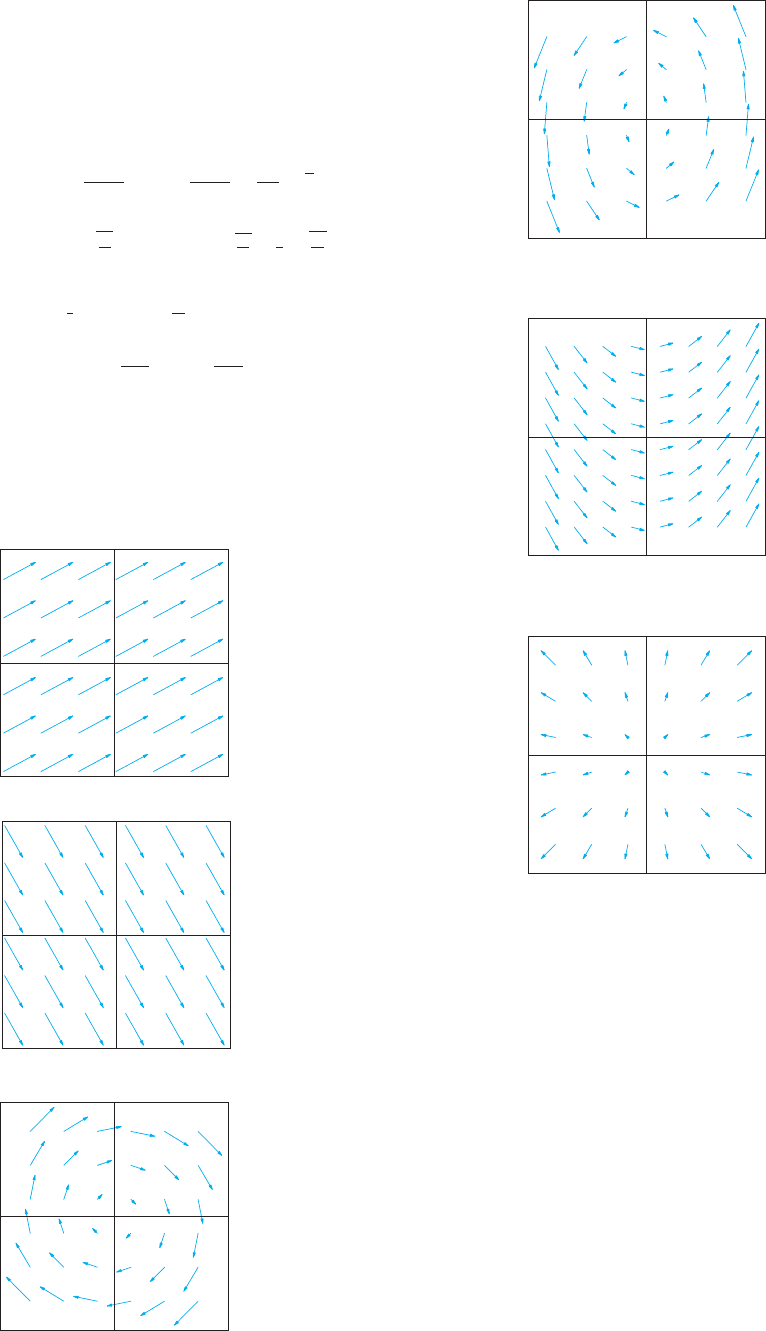
In exercises 31–36, use the graph to determine whether or
not the vector field is conservative in the region. (Hint: Use
Theorem 3.3.)
31.
x
y
32.
x
y
33.
y
x
34.
y
x
35.
y
x
36.
y
x
............................................................
In exercises 37–40, show that the line integral is not indepen-
dent of path by finding two paths that give different values of
the integral.
37.
C
ydx− xdy, where C goes from (−2, 0) to (2, 0)
38.
C
2dx + xdy, where C goes from (1, 4) to (2, −2)
39.
C
ydx− 3 dy, where C goes from (−2, 2) to (0, 0)
40.
C
y
2
dx + x
2
dy, where C goes from (0, 0) to (1, 1)
............................................................
In exercises 41–44, label each statement as True or False and
briefly explain.
41. If F is conservative, then
C
F · dr = 0.
42. If
C
F · dr is independent of path, then F is conservative.