
Smith R., Minton R. Calculus
Подождите немного. Документ загружается.


P1: OSO/OVY P2: OSO/OVY QC: OSO/OVY T1: OSO
MHDQ256-Ch15 MHDQ256-Smith-v1.cls January 6, 2011 10:53
LT (Late Transcendental)
CONFIRMING PAGES
15-7 SECTION 15.1
..
Vector Fields 983
EXAMPLE 1.6 Using a Differential Equation to Construct Flow Lines
Construct the flow lines for the vector field y, −x.
Solution From (1.1), the flow lines are solutions of the differential equation
dy
dx
=−
x
y
.
From our discussion in section 8.2, this differential equation is separable and can be
solved as follows. We first rewrite the equation as
y
dy
dx
=−x.
Integrating both sides with respect to x gives us
y
dy
dx
dx =−
xdx,
so that
y
2
2
=−
x
2
2
+ k.
Multiplying both sides by 2 and replacing the constant 2k by c,wehave
y
2
=−x
2
+ c
or x
2
+ y
2
= c.
That is, for any choice of the constant c > 0, the solution corresponds to a circle
centered at the origin. The vector field and the flow lines are then exactly as plotted in
Figures 15.6a and 15.6b.
In example 1.7, we illustrate the use of Euler’s method for constructing an approximate
flow line.
EXAMPLE 1.7 Using Euler’s Method to Approximate Flow Lines
Use Euler’s method with h = 0.05 to approximate the flow line for the vector field
2, 1 +2xy passing through the point (0, 1), for 0 ≤ x ≤ 1.
Solution Recall that for the differential equation y
= f (x, y) and for any given value
of h, Euler’s method produces a sequence of approximate values of the solution function
y = y(x) corresponding to the points x
i
= x
0
+ih, for i = 1, 2,.... Specifically,
starting from an initial point (x
0
, y
0
), where y
0
= y(x
0
), we construct the approximate
values y
i
≈ y(x
i
), where the y
i
’s are determined iteratively from the equation
y
i+1
= y
i
+ hf(x
i
, y
i
), i = 0, 1, 2,....
Since the flow line must pass through the point (0, 1), we start with x
0
= 0 and y
0
= 1.
Further, here we have the differential equation
dy
dx
=
1 + 2xy
2
=
1
2
+ xy = f (x, y).
In this case (unlike example 1.6), the differential equation is not separable and you do
not know how to solve it exactly. For Euler’s method, we then have
y
i+1
= y
i
+ hf(x
i
, y
i
) = y
i
+ 0.05
1
2
+ x
i
y
i
,
P1: OSO/OVY P2: OSO/OVY QC: OSO/OVY T1: OSO
MHDQ256-Ch15 MHDQ256-Smith-v1.cls January 6, 2011 10:53
LT (Late Transcendental)
CONFIRMING PAGES
984 CHAPTER 15
..
Vector Calculus 15-8
with x
0
= 0, y
0
= 1. For the first two steps, we have
y
1
= y
0
+ 0.05
1
2
+ x
0
y
0
= 1 + 0.05(0.5) = 1.025,
x
1
= 0.05,
y
2
= y
1
+ 0.05
1
2
+ x
1
y
1
= 1.025 + 0.05(0.5 + 0.05125) = 1.0525625
and x
2
= 0.1. Continuing in this fashion, we get the sequence of approximate values
indicated in the following table.
x
i
y
i
x
i
y
i
x
i
y
i
0 1 0.35 1.2344 0.70 1.6577
0.05 1.025 0.40 1.2810 0.75 1.7407
0.10 1.0526 0.45 1.3316 0.80 1.8310
0.15 1.0828 0.50 1.3866 0.85 1.9293
0.20 1.1159 0.55 1.4462 0.90 2.0363
0.25 1.1521 0.60 1.5110 0.95 2.1529
0.30 1.1915 0.65 1.5813 1.00 2.2801
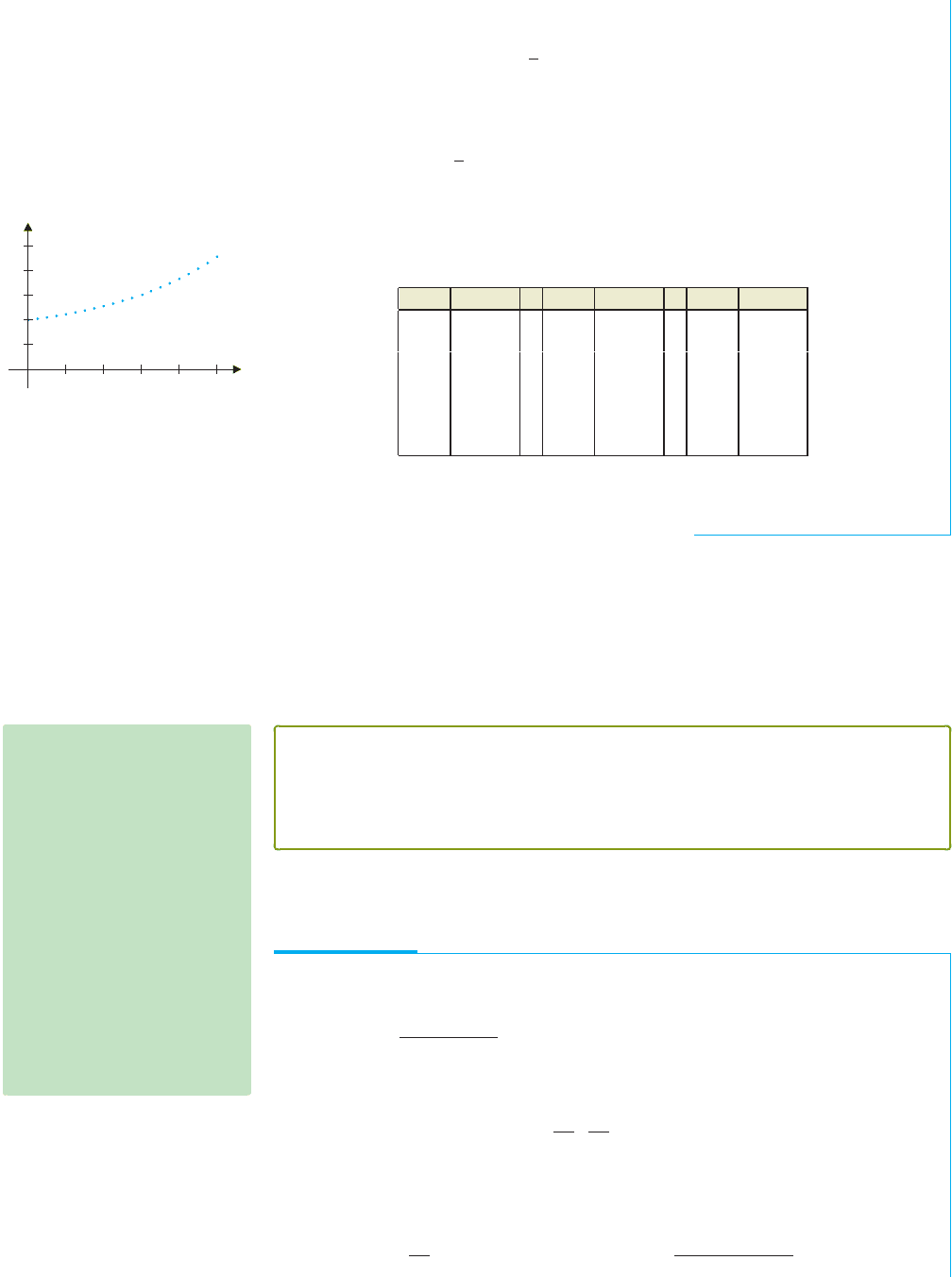
A plot of these points is shown in Figure 15.8. Compare this path to the top curve
(also through the point (0, 1)) shown in Figure 15.7b.
y
0.2 0.4 0.6 0.8 1
2.5
2
1.5
1
0.5
x
FIGURE 15.8
Approximate flow line through (0, 1)
An important type of vector field with which we already have some experience is the
gradient field, where the vector field is the gradient of some scalar function. Because of
the importance of gradient fields, there are a number of terms associated with them. In
Definition 1.2, we do not specify the number of independent variables, since the terms can
be applied to functions of two, three or more variables.
DEFINITION 1.2
For any scalar function f, the vector field F =∇f is called the gradient field for the
function f. We call f a potential function for F. Whenever F =∇f on a region R, for
some scalar function f, we say that F is a conservative vector field on R.
NOTES
If you read about conservative
vector fields and potentials in
some applied areas (such as
physics and engineering), you will
sometimes see the function − f
referred to as the potential
function. This is a minor
difference in terminology, only. In
this text (as is traditional in
mathematics), we will
consistently refer to f as the
potential function. Rest assured
that everything we say here about
conservative vector fields is also
true in these applications areas.
Finding the gradient field corresponding to a given scalar function is a simple matter.
EXAMPLE 1.8 Finding Gradient Fields
Find the gradient fields corresponding to the functions (a) f (x, y) = x
2
y − e
y
and
(b) g(x, y, z) =
1
x
2
+ y
2
+ z
2
, and use a CAS to sketch the fields.
Solution For (a), we have
∇ f (x, y) =
∂ f
∂x
,
∂ f
∂y
=2xy, x
2
− e
y
.
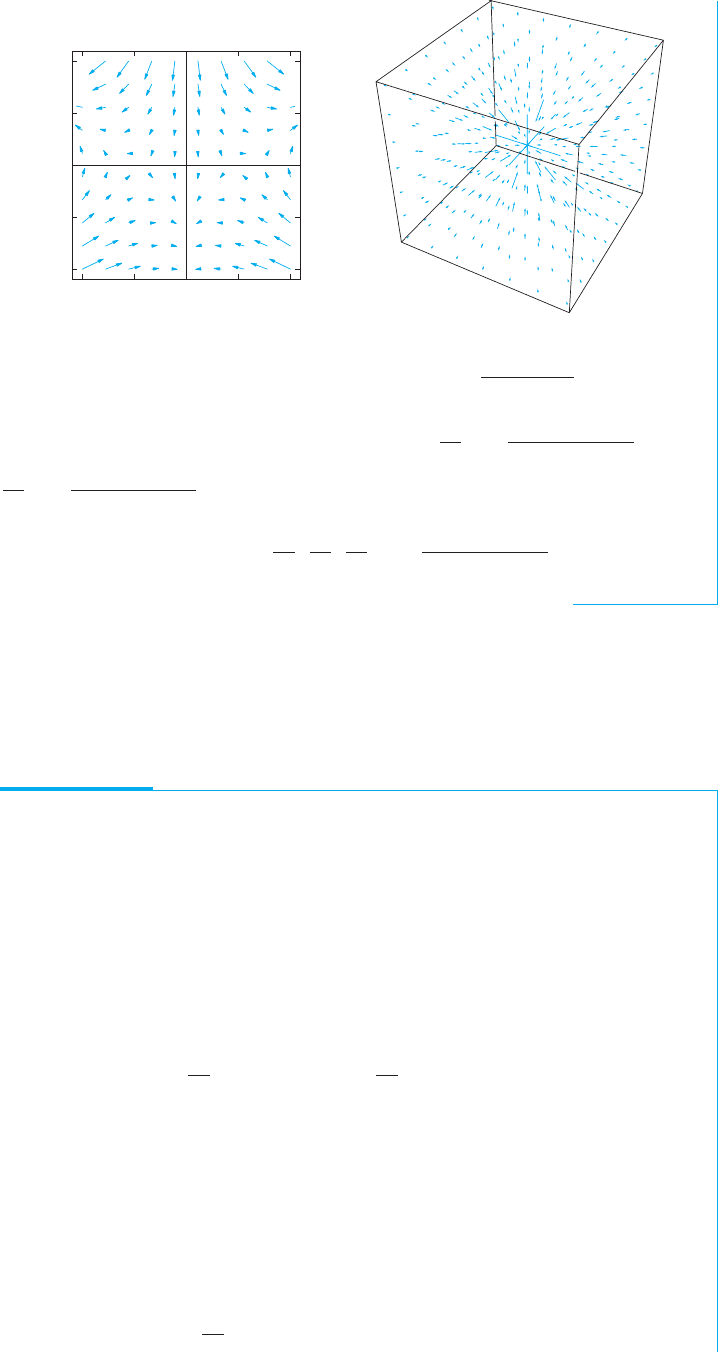
A computer-generated graph of ∇ f (x, y) is shown in Figure 15.9a.
(b) For g(x, y, z) = (x
2
+ y
2
+ z
2
)
−1
,wehave
∂g
∂x
=−(x
2
+ y
2
+ z
2
)
−2
(2x) =−
2x
(x
2
+ y
2
+ z
2
)
2
,
P1: OSO/OVY P2: OSO/OVY QC: OSO/OVY T1: OSO
MHDQ256-Ch15 MHDQ256-Smith-v1.cls January 6, 2011 10:53
LT (Late Transcendental)
CONFIRMING PAGES
15-9 SECTION 15.1
..
Vector Fields 985
2
2 10 1 2
1
0
1
2
y
x
FIGURE 15.9a FIGURE 15.9b
∇(x
2
y − e
y
)
∇
1
x
2
+ y
2
+ z
2
and by symmetry (think about this!), we conclude that
∂g
∂y
=−
2y
(x
2
+ y
2
+ z
2
)
2
and
∂g
∂z
=−
2z
(x
2
+ y
2
+ z
2
)
2
. This gives us
∇g(x, y, z) =
∂g
∂x
,
∂g
∂y
,
∂g
∂z
=−
2x, y, z
(x
2
+ y
2
+ z
2
)
2
.
A computer-generated graph of ∇g(x, y, z) is shown in Figure 15.9b.
You will discover that many calculations involving vector fields simplify dramatically
if the vector field is a gradient field (i.e., if the vector field is conservative). To take full
advantageof these simplifications, you will need to be able to construct a potential function
thatgenerates a givenconservativefield. The technique introduced in example1.9 will work
for most of the examples in this chapter.
EXAMPLE 1.9 Finding Potential Functions
Determine whether each of the following vector fields is conservative. If it is, find a
corresponding potential function f (x, y): (a) F(x, y) =2xy − 3, x
2
+ cos y and
(b) G(x, y) =3x
2
y
2
− 2y, x
2
y − 2x.
Solution The idea here is to try to construct a potential function. In the process
of trying to do so, we may instead recognize that there is no potential function for
the given vector field. For (a), if f (x, y) is a potential function for F(x, y), we have that
∇ f (x, y) = F(x, y) =2xy − 3, x
2
+ cos y,
so that
∂ f
∂x
= 2xy − 3 and
∂ f
∂y
= x
2
+ cos y. (1.2)
Integrating the first of these two equations with respect to x and treating y as a constant,
we get
f (x, y) =
(2xy − 3)dx = x
2
y − 3x + g(y). (1.3)
Here, we have added an arbitrary function of y alone, g(y), rather than a constant of
integration, because any function of y is treated as a constant when integrating with
respect to x. Differentiating the expression for f (x, y) with respect to y gives us
∂ f
∂y
(x, y) = x
2
+ g
(y) = x
2
+ cos y,
P1: OSO/OVY P2: OSO/OVY QC: OSO/OVY T1: OSO
MHDQ256-Ch15 MHDQ256-Smith-v1.cls January 6, 2011 10:53
LT (Late Transcendental)
CONFIRMING PAGES
986 CHAPTER 15
..
Vector Calculus 15-10
from (1.2). This gives us g
(y) = cos y, so that
g(y) =
cos ydy= sin y + c.
From (1.3), we now have
f (x, y) = x
2
y − 3x + sin y + c,
where c is an arbitrary constant. Since we have been able to construct a potential
function, the vector field F(x, y) is conservative.
(b) Again, we assume that there is a potential function g for G(x, y) and try to
construct it. In this case, we have
∇g(x, y) = G(x, y) =3x
2
y
2
− 2y, x
2
y − 2x,
so that
∂g
∂x
= 3x
2
y
2
− 2y and
∂g
∂y
= x
2
y − 2x. (1.4)
Integrating the first equation in (1.4) with respect to x,wehave
g(x, y) =
(3x
2
y
2
− 2y)dx = x
3
y
2
− 2yx + h(y),
where h is an arbitrary function of y. Differentiating this with respect to y,wehave
∂g
∂y
(x, y) = 2x
3
y − 2x + h
(y) = x
2
y − 2x,
from (1.4). Solving for h
(y), we get
h
(y) = x
2
y − 2x − 2x
3
y + 2x = x
2
y − 2x
3
y,
which is impossible, since h(y) is a function of y alone. We then conclude that there is
no potential function for G(x, y) and so, the vector field is not conservative.
REMARK 1.1
To find a potential function, you
can either integrate
∂ f
∂x
with
respect to x or integrate
∂ f
∂y
with
respect to y. Before choosing
which one to integrate, think
about which integral will be
easier to compute. In
section 15.3, we introduce a
simple method for determining
whether or not a vector field is
conservative.
Coulomb’s law states that the electrostatic force on a charge q
0
due to a charge q is
given by F =
qq
0
r
2
u, where r is the distance (in cm) between the charges and u is a unit
vector from q to q
0
. The unit of charge is esu and F is measured in dynes. The electrostatic
field E is defined as the force per unit charge, so that
E =
F
q
0
=
q
r
2
u.
In example 1.10, we compute the electrostatic field for an electric dipole.
EXAMPLE 1.10 Electrostatic Field of a Dipole
Find the electrostatic field due to a charge of +1 esu at (1, 0) and a charge of −1 esu at
(−1, 0).
Solution The distance r from (1, 0) to an arbitrary point (x, y)is
(x − 1)
2
+ y
2
and
a unit vector from (1, 0) to (x, y)is
1
r
x − 1, y. The contribution to E from (1, 0) is
then
1
r
2
x − 1, y
r
=
x − 1, y
[(x − 1)
2
+ y
2
]
3/2
. Similarly, the contribution to E from the
P1: OSO/OVY P2: OSO/OVY QC: OSO/OVY T1: OSO
MHDQ256-Ch15 MHDQ256-Smith-v1.cls January 6, 2011 10:53
LT (Late Transcendental)
CONFIRMING PAGES
15-11 SECTION 15.1
..
Vector Fields 987
negative charge at (−1, 0) is
−1
r
2
x + 1, y
r
=
−x + 1, y
[(x + 1)
2
+ y
2
]
3/2
. Adding the two
terms, we get the electrostatic field
E =
x − 1, y
[(x − 1)
2
+ y
2
]
3/2
−
x + 1, y
[(x + 1)
2
+ y
2
]
3/2
.
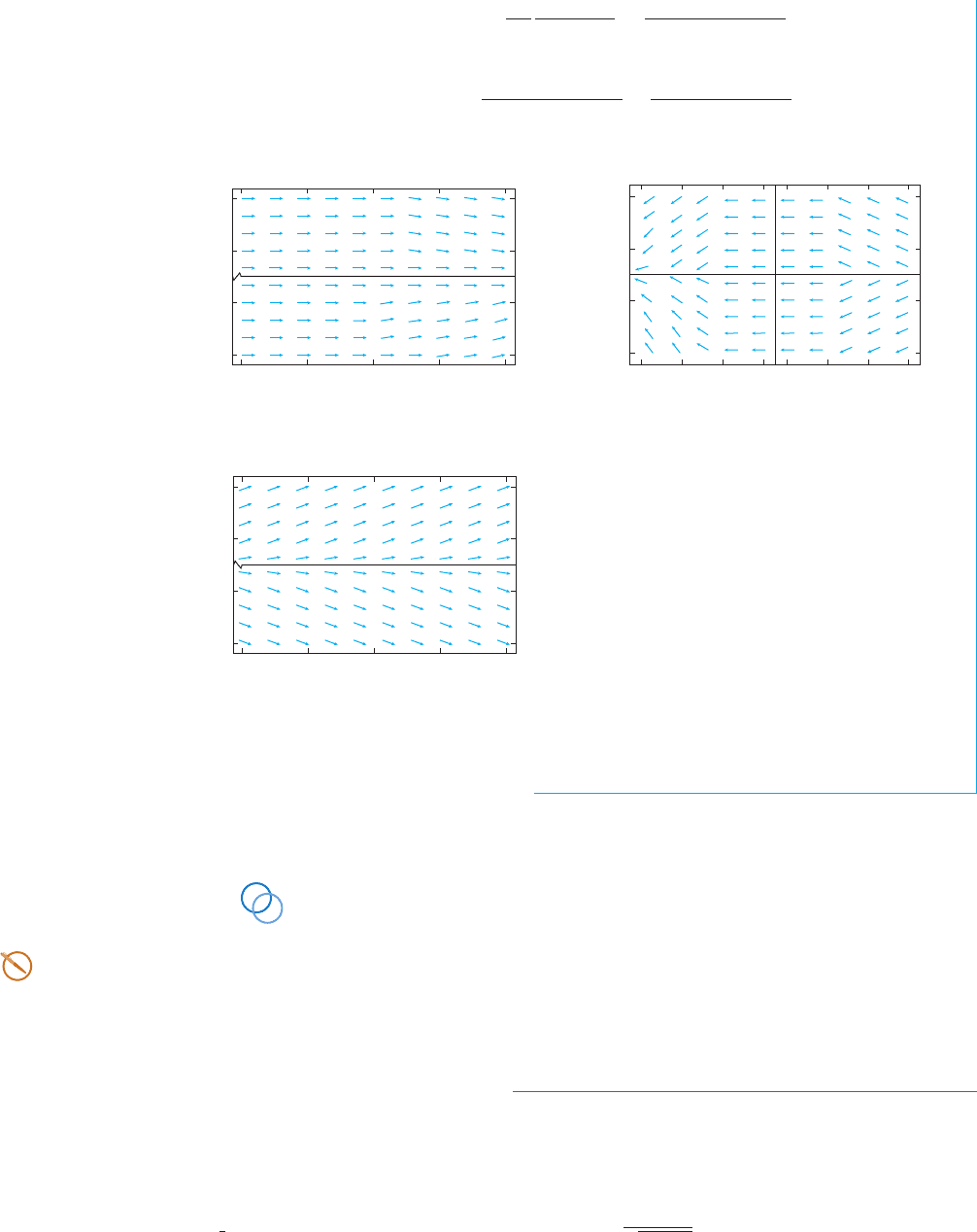
A computer-generated graph of this vector field is shown in Figures 15.10a to 15.10c.
0.4
1.6 1.5 1.4 1.3 1.2
0.2
0
0.2
0.4
y
x
0.4
0.8 0.4 0.2 0.4 0.6 0.8
0.2
0
0.2
0.4
y
x
0.6 0.2
FIGURE 15.10a FIGURE 15.10b
0.4
1.2 1.3 1.4 1.5 1.6
0.2
0
0.2
0.4
y
x
FIGURE 15.10c
Notice that the field lines point away from the positive charge at (1, 0) and toward
the negative charge at (−1, 0).
EXERCISES 15.1
WRITING EXERCISES
1. Compare hand-drawn sketches of the vector fields y, −xand
10y, −10x. In particular, describe which graph is easier to
interpret. Computer-generatedgraphs of these vectorfields are
identical when the software “scales” the vector field by divid-
ing out the 10. It may seem odd that computers don’t draw
accurate graphs, but explain why the software programmers
might choose to scale the vector fields.
2. Thegravitationalforcefield isanexampleofan“inversesquare
law.” That is, the magnitude of the gravitational force is in-
versely proportional to the square of the distance from the
origin. Explain why the
3
2
exponent in the denominator of
example 1.4 is correct for an inverse square law.
3. Explain why each vector in a vector field graph is tangent
to a flow line. Explain why this means that a flow line can
be visualized by joining together a large number of small
(scaled) vector field vectors.
4. In example 1.9(b), explain why the presence of the x’s in
the expression for g
(y) proves that there is no potential
function.
In exercises 1–10, sketch the vector field by hand.
1. F(x, y) =−y, x
2. F(x, y) =
−y, x
x
2
+ y
2
3. F(x, y) =0, x
2
4. F(x, y) =2x, 0
P1: OSO/OVY P2: OSO/OVY QC: OSO/OVY T1: OSO
MHDQ256-Ch15 MHDQ256-Smith-v1.cls January 6, 2011 10:53
LT (Late Transcendental)
CONFIRMING PAGES
988 CHAPTER 15
..
Vector Calculus 15-12
5. F(x, y) =−(x −1)i +(y − 2)j
6. F(x, y) =−i +(y − 2)j
7. F(x, y, z) =0, z, 1
8. F(x, y, z) =2, 0, 0
9. F(x, y, z) =
x, y, z
x
2
+ y
2
+ z
2
10. F(x, y, z) =
x, y, z
x
2
+ y
2
+ z
2
............................................................
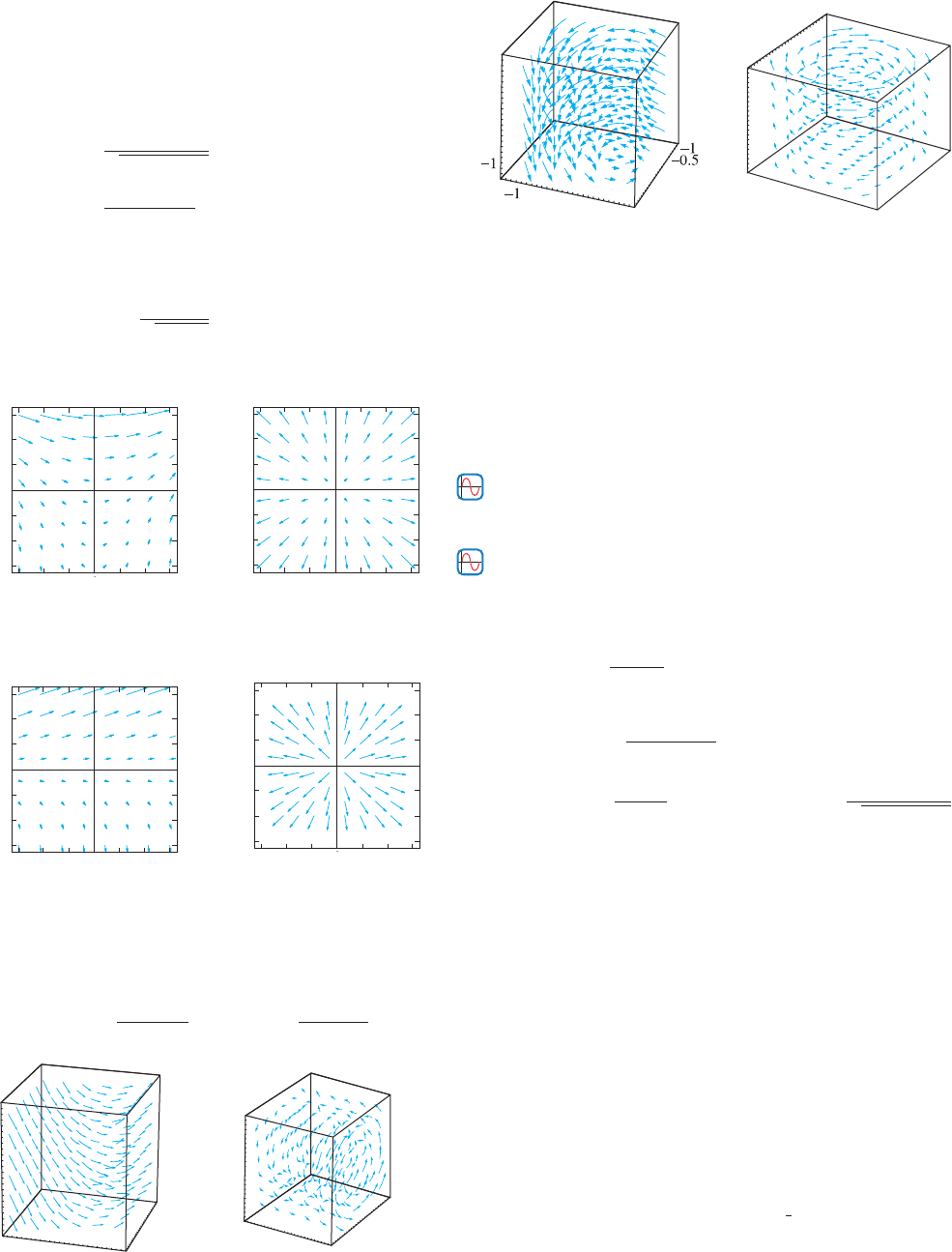
11. Match the vector fields F
1
–F
4
with graphs A–D.
F
1
(x, y) =
x, y
x
2
+ y
2
, F
2
(x, y) =x, y,
F
3
(x, y) =e
y
, x, F
4
(x, y) =e
y
, y
1.5
1.5 0 1.5
0
1.5
y
x
1.5
1.5 0 1.5
0
1.5
y
x
GRAPH A GRAPH B
1.5
1.5 0 1.5
0
1.5
y
x
1.5
1.5 0 1.5
0
1.5
y
x
GRAPH C GRAPH D
12. Match the vector fields F
1
–F
4
with graphs A–D.
F
1
(x, y, z) =1, x, y, F
2
(x, y, z) =1, 1, y,
F
3
(x, y, z) =
y, −x, 0
2 − z
, F
4
(x, y, z) =
z, 0, −x
2 − y
.
1
x
z
y
0
0
1
0.5
0.5
1
0.5
0.5
1
1
0
1
0.5
1
1
0
0
0
1
x
z
0.5
1
1
1
y
GRAPH A GRAPH B
1
0.5
x
1
0
z
1
0
0
y
1
0
−1
−1
−1
1
1
−0.5
0.5
0
0
y
z
x
GRAPH C GRAPH D
............................................................
In exercises 13–16, sketch the vector field, find equations for the
flow lines and sketch several flow lines on top of the vector field.
13. 2, cos x 14. x
2
, 2
15. y, x 16. e
y
, x
............................................................
17. Sketch the vector field 4x, 3x
2
y − 2xy
2
and several flow
lines. What is unusual about the flow lines that connect to
the point (0, 1)?
18. Repeat exercise 17 for the vector field 2x, xy
2
− 2x
3
.
In exercises 19–28, find the gradient field corresponding to f.
19. f (x, y) = x
2
+ y
2
20. f (x, y) = ln(x
2
+ y
2
)
21. f (x, y) =
x
2
+ y
2
22. f (x, y) = sin(x
2
+ y
2
)
23. f (x, y) = xe
−xy
24. f (x, y) = (x + y) sin
−1
x
25. f (x, y, z) =
x
2
+ y
2
+ z
2
26. f (x, y, z) = x
2
y + yz
27. f (x, y, z) =
x
2
y
x
2
+ z
2
28. f (x, y, z) =
2x
x
2
+ y
2
+ z
2
............................................................
In exercises 29–40, determine whether or not the vector field is
conservative on R
2
or R
3
. If it is, find a potential function.
29. y, x 30. 2, y
31. y, −x 32. y, 1
33. (x −2xy)i + (y
2
− x
2
)j 34. (x
2
− y)i + (x − y)j
35. y sin xy, x sin xy 36. y cos x, sin x − y
37. 4x − z, 3y + z, y − x 38. z
2
+ 2xy, x
2
− z, 2xz − 1
39. y
2
z
2
− 1, 2xyz
2
, 4z
3
40. z
2
+ 2xy, x
2
+ 1, 2xz − 3
............................................................
In exercises 41–46, find equations for the flow lines.
41. 2y, 3x
2
42.
1
y
, 2x
43. yi + xe
y
j 44. e
−x
i + 2xj
45. y, y
2
+ 1 46. 2, y
2
+ 1
............................................................
P1: OSO/OVY P2: OSO/OVY QC: OSO/OVY T1: OSO
MHDQ256-Ch15 MHDQ256-Smith-v1.cls January 6, 2011 10:53
LT (Late Transcendental)
CONFIRMING PAGES
15-13 SECTION 15.1
..
Vector Fields 989
In exercises 47–54, use the notation r x, y and
r r
x
2
y
2
.
47. Show that ∇(r) =
r
r
. 48. Show that ∇(r
2
) = 2r.
49. Find ∇(r
3
).
50. Use exercises 47–49 to conjecture the value of ∇(r
n
), for any
positive integer n. Prove that your answer is correct.
51. Show that
1, 1
r
is not conservative.
52. Show that
−y, x
r
2
is conservative on the domain y > 0by
finding a potential function. Show that the potential function
can be thought of as the polar angle θ.
53. Thecurrent ina wire produces a magnetic field B =
k−y, x
r
2
.
Draw a sketch showing a wire and its magnetic field.
54. Showthat
r
r
n
=
x, y
(x
2
+ y
2
)
n/2
isconservative,foranyintegern.
............................................................
55. Suppose that f (x), g(y) and h(z) are continuous functions.
Show that f (x), g(y), h(z) is conservative, by finding a po-
tential function.
56. Show that k
1
, k
2
is conservative, for constants k
1
and k
2
.
APPLICATIONS
57. A two-dimensional force acts radially away from the origin
with magnitude 3. Write the force as a vector field.
58. A two-dimensional force acts radially toward the origin with
magnitude equal to the square of the distance from the origin.
Write the force as a vector field.
59. A three-dimensional force acts radially toward the origin with
magnitude equal to the square of the distance from the origin.
Write the force as a vector field.
60. A three-dimensional force acts radially away from the z-axis
(parallel to the xy-plane) with magnitude equal to the cube of
the distance from the z-axis. Write the force as a vector field.
61. Derive the electrostatic field for positive charges q at (−1, 0)
and (1, 0) and negative charge −q at (0, 0).
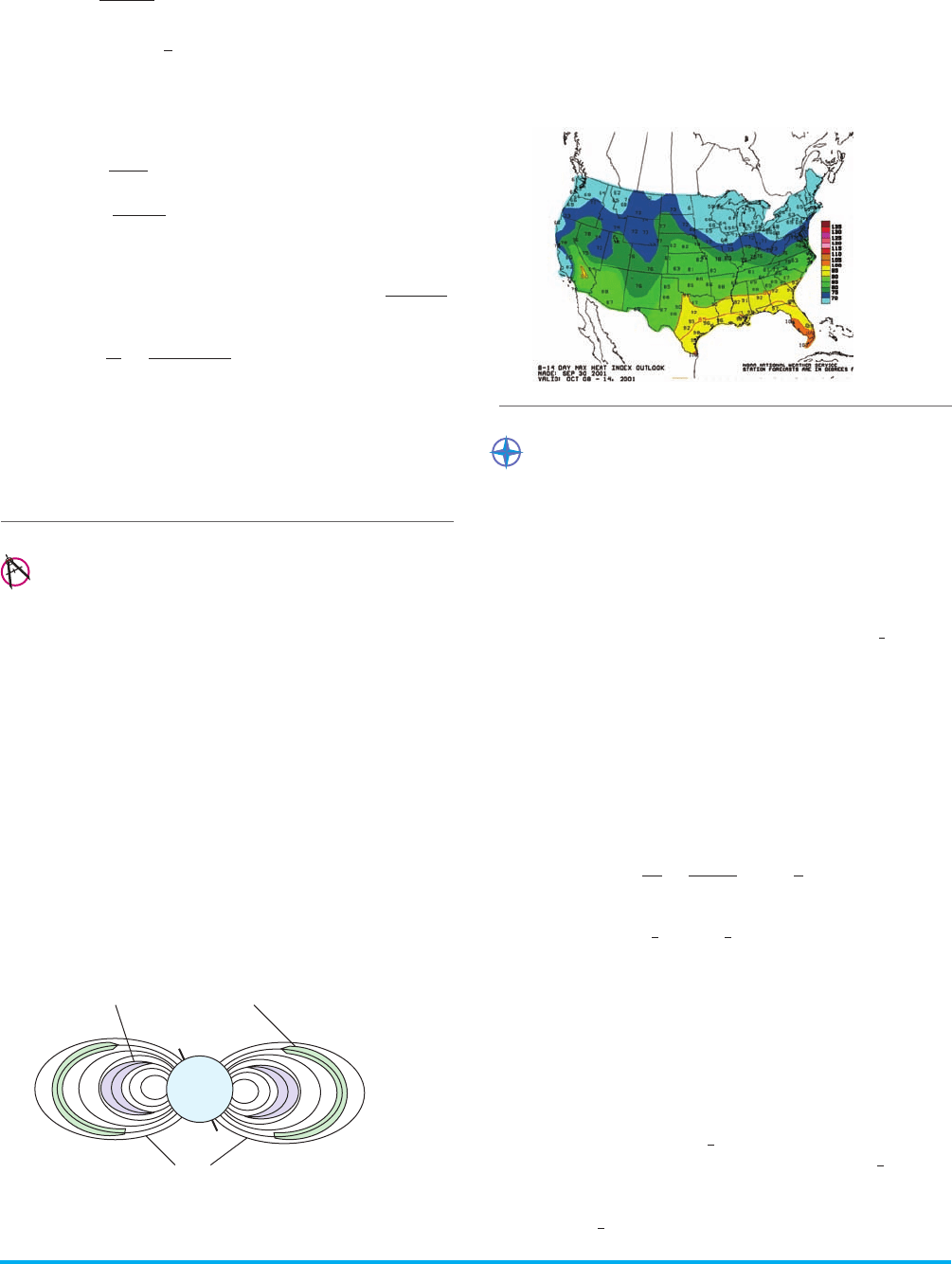
62. The figure shows the magnetic field of the Earth. Compare this
to the electrostatic field of a dipole shown in example 1.10.
Magnetic field lines
Outer Van
Allen belt
Inner Van
Allen belt
63. If T (x, y, z)givesthetemperatureatposition (x, y, z) in space,
the velocity field for heat flow is given by F =−k∇T for a
constant k > 0. This is known as Fourier’s law. Use this vec-
tor field to determine whether heat flows from hot to cold or
vice versa. Would anything change if the law were F = k∇T?
64. An isotherm is a curve on a map indicating areas of constant
temperature. Given Fourier’s law (exercise 63), determine the
angle between the velocity field for heat flow and an isotherm.
EXPLORATORY EXERCISES
1. Show that the vector field F(x, y) =y, xhas potential func-
tion f (x, y) = xy. The curves f (x, y) = c for constants c are
called equipotential curves. Sketch equipotential curves for
several constants (positive and negative). Find the flow lines
for this vector field and show that the flow lines and equipo-
tential curves intersect at right angles. This situation is com-
mon. To further develop these relationships, show that the po-
tential function and the flow function g(x, y) =
1
2
(y
2
− x
2
)
are both solutions of Laplace’s equation ∇
2
u = 0 where
∇
2
u = u
xx
+ u
yy
.
2. In example 1.5, we graphed the flow lines for the vector field
2, 1 +2xyand mentionedthat finding equations for theflow
lineswasbeyondwhat’s been presentedin thetext.We develop
a method for finding the flow lines here by solving linear or-
dinary differential equations. We will illustrate this for an
easier vector field, x, 2x − y. First, note that if x
(t) = x and
y
(t) = 2x − y, then
dy
dx
=
2x − y
x
= 2 −
y
x
.
The flow lines will be the graphs of functions y(x) such
that y
(x) = 2 −
y
x
,ory
+
1
x
y = 2. The left-hand side of the
equation should look a little like a product rule. Our main
goal is to multiply by a term called an integrating factor,
to make the left-hand side exactly a product rule derivative.
It turns out that for the equation y
+ f (x)y = g(x), an in-
tegrating factor is e
f (x) dx
. In the present case, for x > 0, we
have e
1/xdx
= e
ln x
= x. (We havechosen the integration con-
stant to be 0 to keep the integrating factor simple.) Multiply
both sides of the equation by x and show that xy
+ y = 2x.
Show that xy
+ y = (xy)
. From (xy)
= 2x, integrate to get
xy = x
2
+ c,ory = x +
c
x
.Tofind a flowline passing through
the point (1, 2), show that c = 1 and thus, y = x +
1
x
. To find a
flow line passing through the point (1, 1), show that c = 0 and
thus, y = x. Sketch the vector field and highlight the curves
y = x +
1
x
and y = x.
P1: OSO/OVY P2: OSO/OVY QC: OSO/OVY T1: OSO
MHDQ256-Ch15 MHDQ256-Smith-v1.cls January 6, 2011 10:53
LT (Late Transcendental)
CONFIRMING PAGES
990 CHAPTER 15
..
Vector Calculus 15-14
FIGURE 15.11
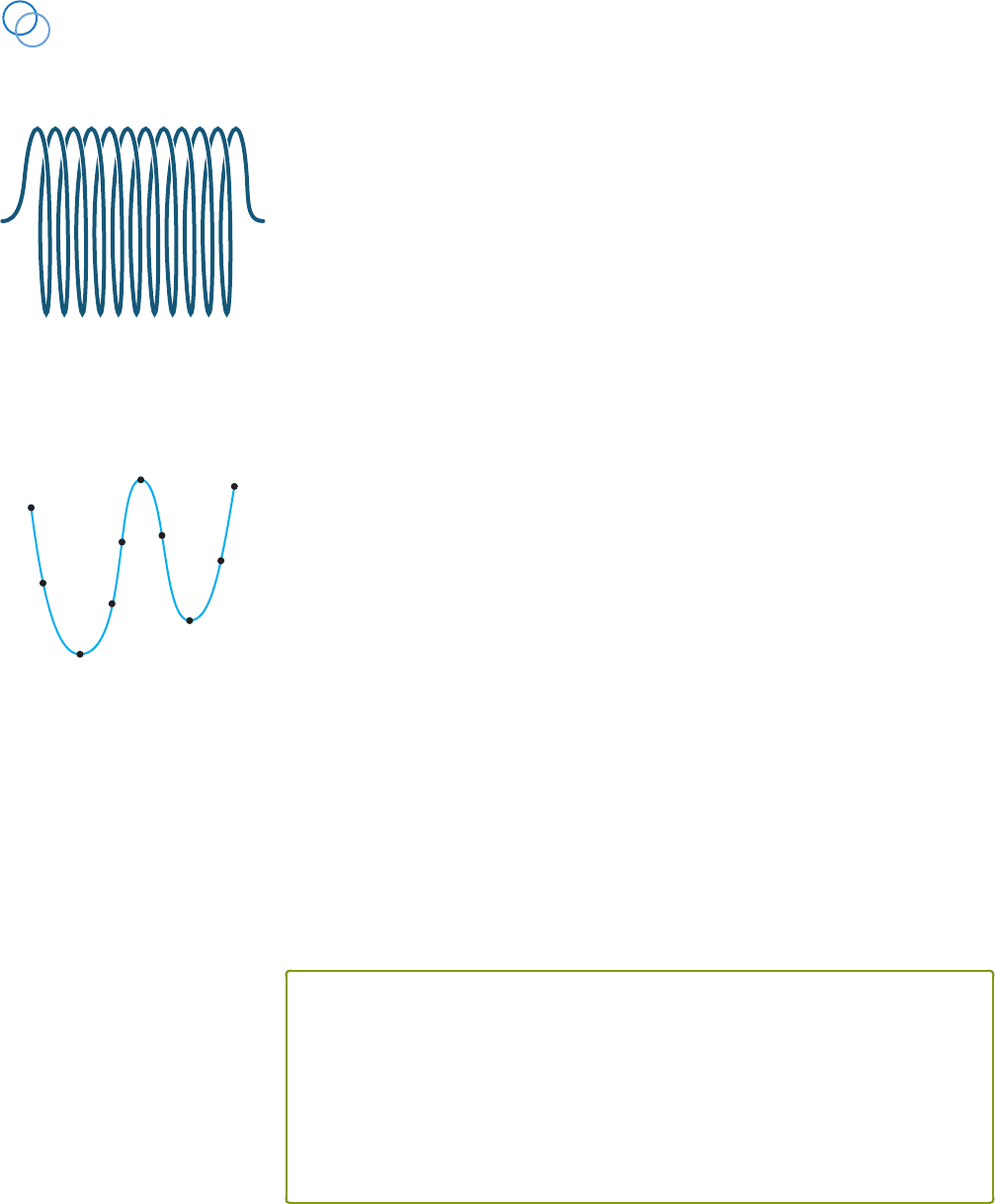
A helical spring
15.2 LINE INTEGRALS
Insection5.6,weshowedthatfora thinrodwithvariablemassdensity,ρ(x),extendingfrom
x = a to x = b, the mass of the rod is given by
b
a
ρ(x)dx. However, to find the mass of a
three-dimensionalobject,suchasthehelicalspringin Figure15.11, wemustextendthisidea
to three dimensions. Here, the density function has the form ρ(x, y, z) (where ρ is measured
in units of mass per unit length). We assume that the object is in the shape of a curve C that
is oriented, which means that there is a direction to the curve. We assume that C starts at the
point (a, b, c) and ends at (d, e, f ). We first partition the curve into n pieces with endpoints
(a, b, c) = (x
0
, y
0
, z
0
), (x
1
, y
1
, z
1
), (x
2
, y
2
, z
2
),...,(x
n
, y
n
, z
n
) = (d, e, f ), as indicated in
Figure 15.12. We denote the point (x
i
, y
i
, z
i
)byP
i
and the section of the curve C extending
from P
i−1
to P
i
by C
i
for each i = 1, 2,...,n. Note that if the segment C
i
is small enough,
we can consider the density to be constant on C
i
. In this case, the mass of this segment
would simply be the product of the density and the length of C
i
. For some point (x
∗
i
, y
∗
i
, z
∗
i
)
on C
i
, we approximate the density on C
i
by ρ(x
∗
i
, y
∗
i
, z
∗
i
). The mass of the section C
i
is
then approximately
ρ(x
∗
i
, y
∗
i
, z
∗
i
)s
i
,
(x
n
, y
n
, z
n
)
(x
0
, y
0
, z
0
)
(x
2
, y
2
, z
2
)
(x
1
, y
1
, z
1
)
FIGURE 15.12
Partitioned curve
where s
i
represents the arc length of C
i
. The mass m of the entire object is then approxi-
mately the sum of the masses of the n segments,
m ≈
n
i=1
ρ(x
∗
i
, y
∗
i
, z
∗
i
)s
i
.
You should expect that this approximation will improve as we divide the curve into more
and more segments that are shorter and shorter in length. Finally, taking the norm of the
partition P to be the maximum of the arc lengths s
i
(i = 1, 2,...,n), we have
m = lim
P→0
n
i=1
ρ(x
∗
i
, y
∗
i
, z
∗
i
)s
i
, (2.1)
provided the limit exists and is the same for every choice of the evaluation points
(x
∗
i
, y
∗
i
, z
∗
i
)(i = 1, 2,...,n).
Note that (2.1) looks like the limit of a Riemann sum (an integral). As it turns out, this
limit arises naturally in numerous applications. We pause now to give this limit a name and
identify some useful properties.
DEFINITION 2.1
The line integral of f (x, y, z) with respect to arc length along the oriented curve C
in three-dimensional space, written
C
f (x, y, z) ds, is defined by
C
f (x, y, z) ds = lim
P→0
n
i=1
f (x
∗
1
, y
∗
i
, z
∗
i
)s
i
,
provided the limit exists and is the same for all choices of evaluation points.
We define line integrals of functions f (x, y) of two variables along an oriented curve C
in the xy-plane in a similar way. If we can representthe curve C using parametric equations,
Theorem 2.1 allows us to evaluate the line integral as a definite integral of a function of one
variable.

P1: OSO/OVY P2: OSO/OVY QC: OSO/OVY T1: OSO
MHDQ256-Ch15 MHDQ256-Smith-v1.cls January 6, 2011 10:53
LT (Late Transcendental)
CONFIRMING PAGES
15-15 SECTION 15.2
..
Line Integrals 991
THEOREM 2.1 (Evaluation Theorem)
Suppose that f (x, y, z) is continuous in a region D containing the curve C and that C
is described parametrically by (x(t), y(t), z(t)), for a ≤ t ≤ b, where x(t), y(t) and
z(t) have continuous first derivatives. Then,
C
f (x, y, z) ds =
b
a
f (x(t), y(t), z(t))
[x
(t)]
2
+ [y
(t)]
2
+ [z
(t)]
2
dt.
Suppose that f (x, y) is continuous in a region D containing the curve C and that C is
described parametrically by (x(t), y(t)), for a ≤ t ≤ b, where x(t) and y(t)have
continuous first derivatives. Then
C
f (x, y) ds =
b
a
f (x(t), y(t))
[x
(t)]
2
+ [y
(t)]
2
dt.
PROOF
Weprovetheresultforthe caseof acurveintwodimensionsand leavethethree-dimensional
case as an exercise. From Definition 2.1 (adjusted for the two-dimensional case), we have
C
f (x, y) ds = lim
P→0
n
i=1
f (x
∗
i
, y
∗
i
)s
i
, (2.2)
where s
i
represents the arc length of the section of the curve C between (x
i−1
, y
i−1
)
and (x
i
, y
i
). Choose t
0
, t
1
,...,t
n
so that x(t
i
) = x
i
and y(t
i
) = y
i
, for i = 0, 1,...,n. We
approximate the arc length of such a smallsection of the curve by the straight-line distance:
s
i
≈
(x
i
− x
i−1
)
2
+ (y
i
− y
i−1
)
2
.
Further, since x(t) and y(t) have continuous first derivatives, we have by the Mean Value
Theorem (as in the derivation of the arc length formula in section 10.3), that
s
i
≈
(x
i
− x
i−1
)
2
+ (y
i
− y
i−1
)
2
≈
[x
(t
∗
i
)]
2
+ [y
(t
∗
i
)]
2
t
i
,
for some t
∗
i
∈ (t
i−1
, t
i
). Together with (2.2), this gives us
C
f (x, y) ds = lim
P→0
n
i=1
f (x(t
∗
i
), y(t
∗
i
))
[x
(t
∗
i
)]
2
+ [y
(t
∗
i
)]
2
t
i
=
b
a
f (x(t), y(t))
[x
(t)]
2
+ [y
(t)]
2
dt.
A curve C is called smooth if it satisfies the hypotheses of Theorem 2.1 and one
additional condition. Specifically, C is smooth if it can be described parametrically
by x = x(t), y = y(t) and z = z(t), for a ≤ t ≤ b, where x(t), y(t) and z(t) all have
continuous first derivatives and [x
(t)]
2
+ [y
(t)]
2
+ [z
(t)]
2
= 0 on the interval [a, b].
Similarly, a plane curve is smooth if it can be parameterized by x = x(t) and y = y(t), for
a ≤ t ≤ b, where x(t) and y(t) have continuous first derivatives and [x
(t)]
2
+ [y
(t)]
2
= 0
on the interval [a, b].
Notice that for curvesin space, Theorem 2.1 says essentially that the arc length element
ds can be replaced by
ds =
[x
(t)]
2
+ [y
(t)]
2
+ [z
(t)]
2
dt. (2.3)
The term
[x
(t)]
2
+ [y
(t)]
2
+ [z
(t)]
2
in the integral should be very familiar, having been
present in our integral representations of both arc length and surface area. Likewise, for
curves in the plane, the arc length element is
ds =
[x
(t)]
2
+ [y
(t)]
2
dt. (2.4)
P1: OSO/OVY P2: OSO/OVY QC: OSO/OVY T1: OSO
MHDQ256-Ch15 MHDQ256-Smith-v1.cls January 6, 2011 10:53
LT (Late Transcendental)
CONFIRMING PAGES
992 CHAPTER 15
..
Vector Calculus 15-16
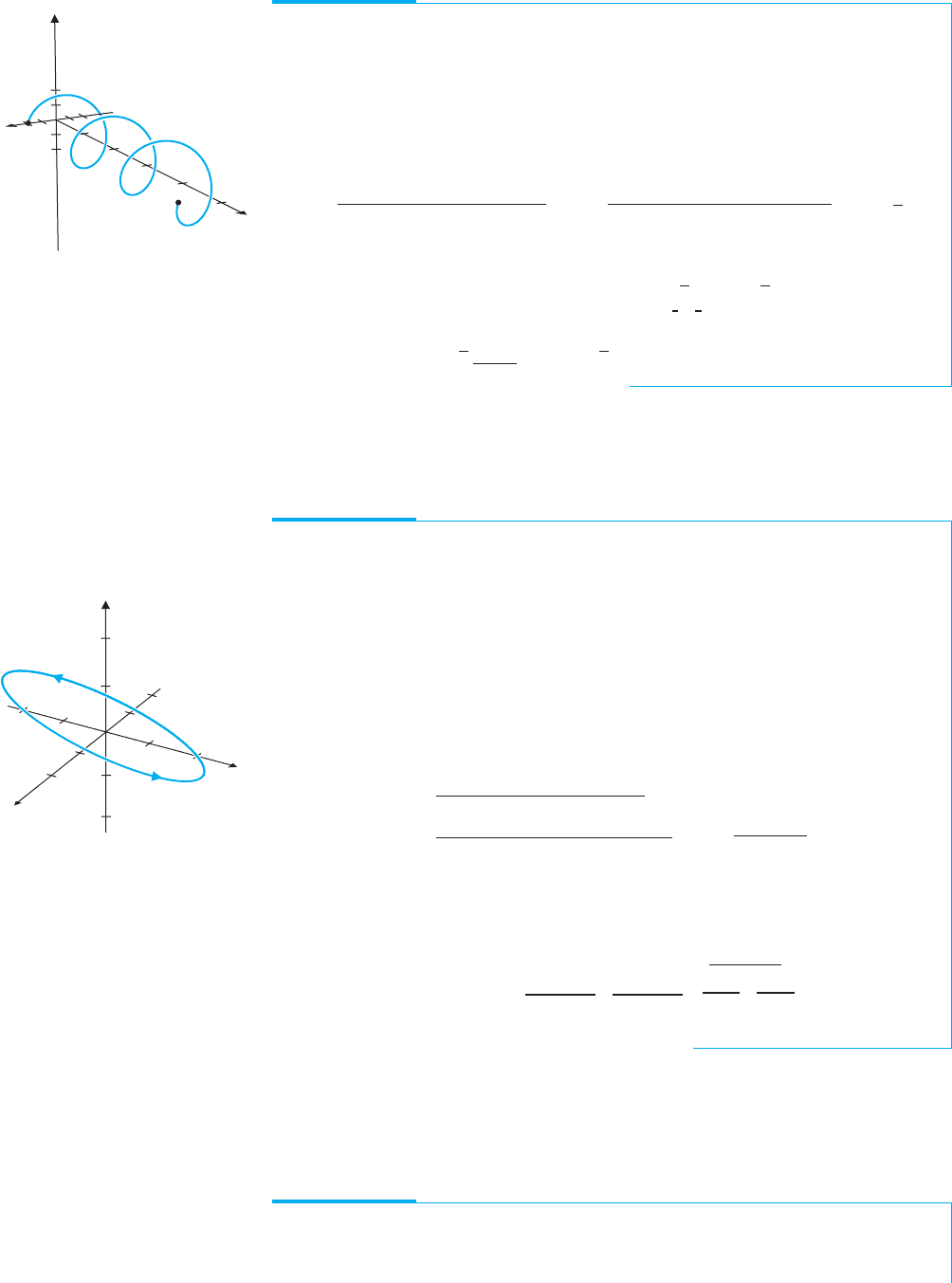
EXAMPLE 2.1 Finding the Mass of a Helical Spring
Find the mass of a spring in the shape of the helix defined parametrically by
x = 2cost, y = t, z = 2sin t, for 0 ≤ t ≤ 6π, with density ρ(x, y, z) = 2y.
y
x
2
8
16
2
2
z
FIGURE 15.13
The helix x = 2cost, y = t,
z = 2 sin t, 0 ≤ t ≤ 6π
Solution A graph of the helix is shown in Figure 15.13. The density is
ρ(x, y, z) = 2y = 2t,
and from (2.3), the arc length element ds is given by
ds =
[x
(t)]
2
+ [y
(t)]
2
+ [z
(t)]
2
dt =
(−2sin t)
2
+ (1)
2
+ (2 cost)
2
dt =
√
5dt,
where we have used the identity 4sin
2
t +4cos
2
t = 4. By Theorem 2.1, we have
mass =
C
ρ(x, y, z)ds =
6π
0
2t
ρ(x, y, z)
√
5dt
ds
= 2
√
5
6π
0
tdt
= 2
√
5
(6π)
2
2
= 36π
2
√
5.
We should note that most line integrals of the type defined in Definition 2.1 are too
complicated to evaluate exactly and will need to be approximated with some numerical
method, as in example 2.2.
EXAMPLE 2.2 Evaluating a Line Integral with Respect to Arc Length
Evaluate the line integral
C
(2x
2
− 3yz)ds, where C is the curve defined
parametrically by x = cost, y = sint, z = cost with 0 ≤ t ≤ 2π.
Solution A graph of C is shown in Figure 15.14. The integrand is
f (x, y, z) = 2x
2
− 3yz = 2 cos
2
t −3sint cost.
From (2.3), the arc length element is given by
ds =
[x
(t)]
2
+ [y
(t)]
2
+ [z
(t)]
2
dt
=
(−sint)
2
+ (cos t)
2
+ (−sin t)
2
dt =
1 + sin
2
tdt,
where we have used the identity sin
2
t +cos
2
t = 1. By Theorem 2.1, we now have
C
(2x
2
− 3yz)ds =
2π
0
(2cos
2
t −3sint cost)
2x
2
− 3yz
1 + sin
2
tdt
ds
≈ 6.9922,
where we approximated the last integral numerically.
z
y
x
1
1
1
FIGURE 15.14
The curve x = cos t, y = sint,
z = cos t with 0 ≤ t ≤ 2π
In example 2.3, you must find parameteric equations for the (two-dimensional) curve
before evaluating the line integral. Also, you will discover an important fact about the
orientation of the curve C.
EXAMPLE 2.3 Evaluating a Line Integral with Respect to Arc Length
Evaluate the line integral
C
2x
2
yds, where C is (a) the portion of the parabola y = x
2
from (−1, 1) to (2, 4) and (b) the portion of the parabola y = x
2
from (2, 4) to (−1, 1).