
Smith R., Minton R. Calculus
Подождите немного. Документ загружается.

P1: OSO/OVY P2: OSO/OVY QC: OSO/OVY T1: OSO
MHDQ256-Ch15 MHDQ256-Smith-v1.cls January 6, 2011 10:53
LT (Late Transcendental)
CONFIRMING PAGES
15-47 SECTION 15.5
..
Curl and Divergence 1023
Both the curl and divergence are generalizations of the notion of derivative that are
applied to vector fields. Both directly measure important physical quantities related to a
vector field F(x, y, z).
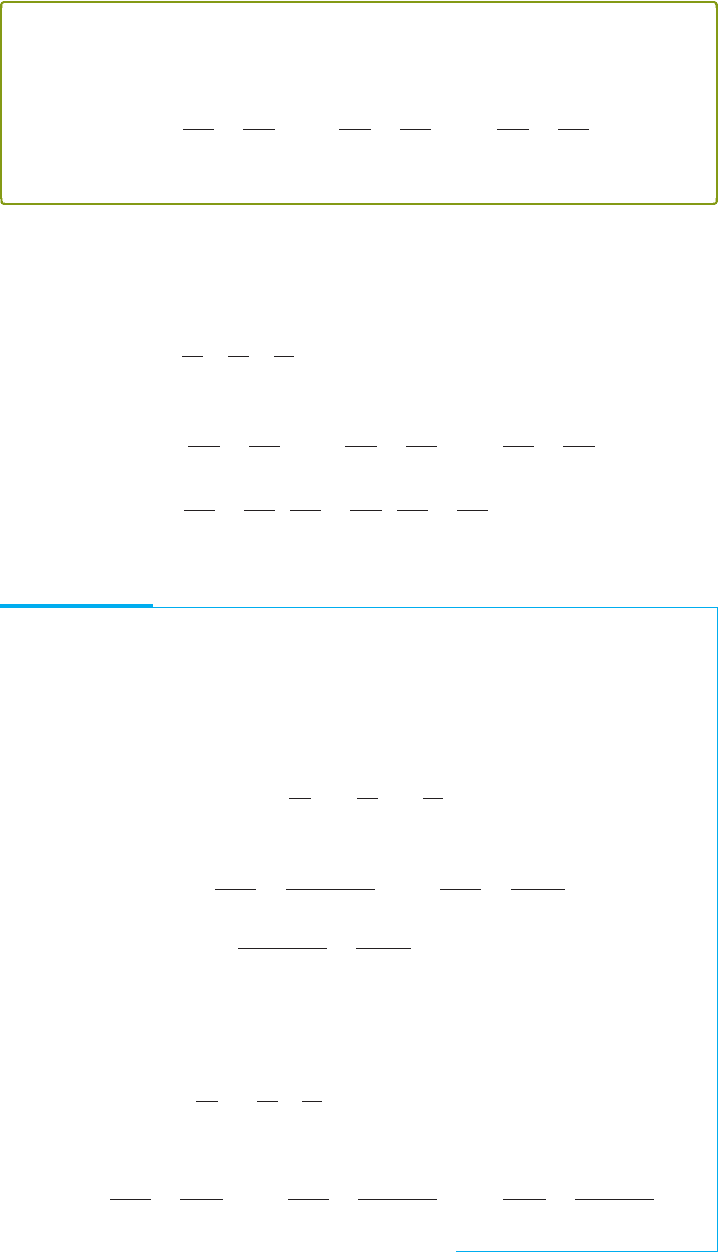
DEFINITION 5.1
The curl of the vector field F(x, y, z) =F
1
(x, y, z), F
2
(x, y, z), F
3
(x, y, z) is the
vector field
curl F =
∂ F
3
∂y
−
∂ F
2
∂z
i +
∂ F
1
∂z
−
∂ F
3
∂x
j +
∂ F
2
∂x
−
∂ F
1
∂y
k,
defined at all points at which all the indicated partial derivatives exist.
An easy way to remember curl F is to use cross product notation, as follows. Notice
that using a determinant, we can write
∇×F =
ijk
∂
∂x
∂
∂y
∂
∂z
F
1
F
2
F
3
=
∂ F
3
∂y
−
∂ F
2
∂z
i −
∂ F
3
∂x
−
∂ F
1
∂z
j +
∂ F
2
∂x
−
∂ F
1
∂y
k
=
∂ F
3
∂y
−
∂ F
2
∂z
,
∂ F
1
∂z
−
∂ F
3
∂x
,
∂ F
2
∂x
−
∂ F
1
∂y
= curl F, (5.1)
whenever all of the indicated partial derivatives are defined.
EXAMPLE 5.1 Computing the Curl of a Vector Field
Compute curl F for (a) F(x, y, z) =x
2
y, 3x − yz, z
3
and
(b) F(x, y, z) =x
3
− y, y
5
, e
z
.
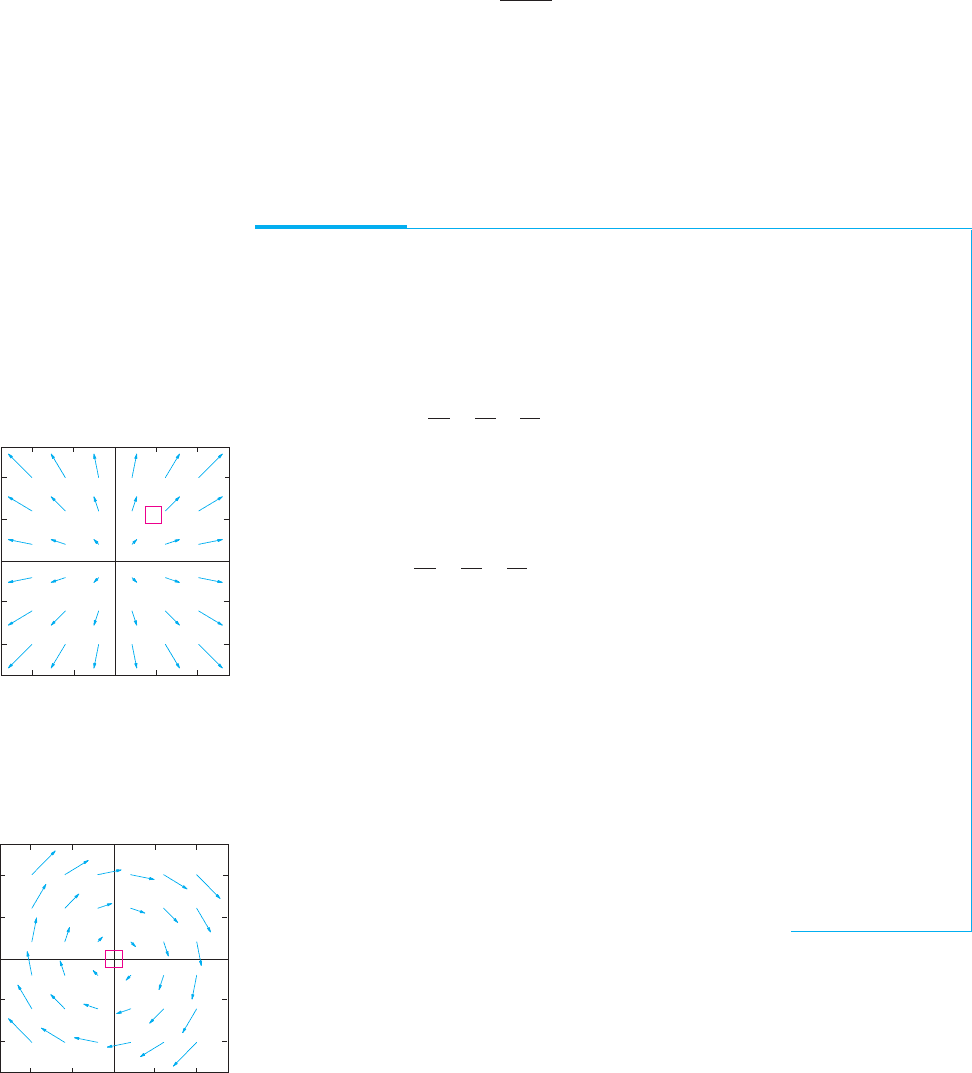
Solution Using the cross product notation in (5.1), we have that for (a):
curl F =∇×F =
ijk
∂
∂x
∂
∂y
∂
∂z
x
2
y 3x − yz z
3
=
∂(z
3
)
∂y
−
∂(3x − yz)
∂z
i −
∂(z
3
)
∂x
−
∂(x
2
y)
∂z
j
+
∂(3x − yz)
∂x
−
∂(x
2
y)
∂y
k
= (0 + y)i −(0 −0)j +(3 − x
2
)k =y, 0, 3 − x
2
.
Similarly, for part (b), we have
curl F =∇×F =
ijk
∂
∂x
∂
∂y
∂
∂z
x
3
− yy
5
e
z
=
∂(e
z
)
∂y
−
∂(y
5
)
∂z
i −
∂(e
z
)
∂x
−
∂(x
3
− y)
∂z
j +
∂(y
5
)
∂x
−
∂(x
3
− y)
∂y
k
= (0 −0)i −(0 −0)j +(0 +1)k =0, 0, 1.
P1: OSO/OVY P2: OSO/OVY QC: OSO/OVY T1: OSO
MHDQ256-Ch15 MHDQ256-Smith-v1.cls January 6, 2011 10:53
LT (Late Transcendental)
CONFIRMING PAGES
1024 CHAPTER 15
..
Vector Calculus 15-48
Notice that in part (b) of example 5.1, the only term that contributes to the curl is
the term −y in the i-component of F(x, y, z). This illustrates an important property of the
curl. Terms in the i-component of the vector field involving only x will not contribute to
the curl, nor will terms in the j-component involving only y nor terms in the k-component
involving only z. You can use these observations to simplify some calculations of the curl.
For instance, notice that
curlx
3
, sin
2
y,
z
2
+ 1 + x
2
=curl0, 0, x
2
=∇×0, 0, x
2
=0, −2x, 0.
The simplification discussed above gives an important hint about what the curl measures,
since the variables must get “mixed up” to produce a nonzero curl. Example 5.2 provides
a clue as to the meaning of the curl of a vector field.
EXAMPLE 5.2 Interpreting the Curl of a Vector Field
Compute the curl of (a) F(x, y, z) = xi + yj and (b) G(x, y, z) = yi − xj, and interpret
each graphically.
4
4 20 2 4
2
0
2
4
y
x
FIGURE 15.37a
Graph of x, y, 0
4
4 20 2 4
2
0
2
4
y
x
FIGURE 15.37b
Graph of y, −x, 0
Solution For (a), we have
∇×F =
ijk
∂
∂x
∂
∂y
∂
∂z
xy0
=0 −0, −(0 −0), 0 −0=0, 0, 0.
For (b), we have
∇×G =
ijk
∂
∂x
∂
∂y
∂
∂z
y −x 0
=0 −0, −(0 −0), −1 −1=0, 0, −2.
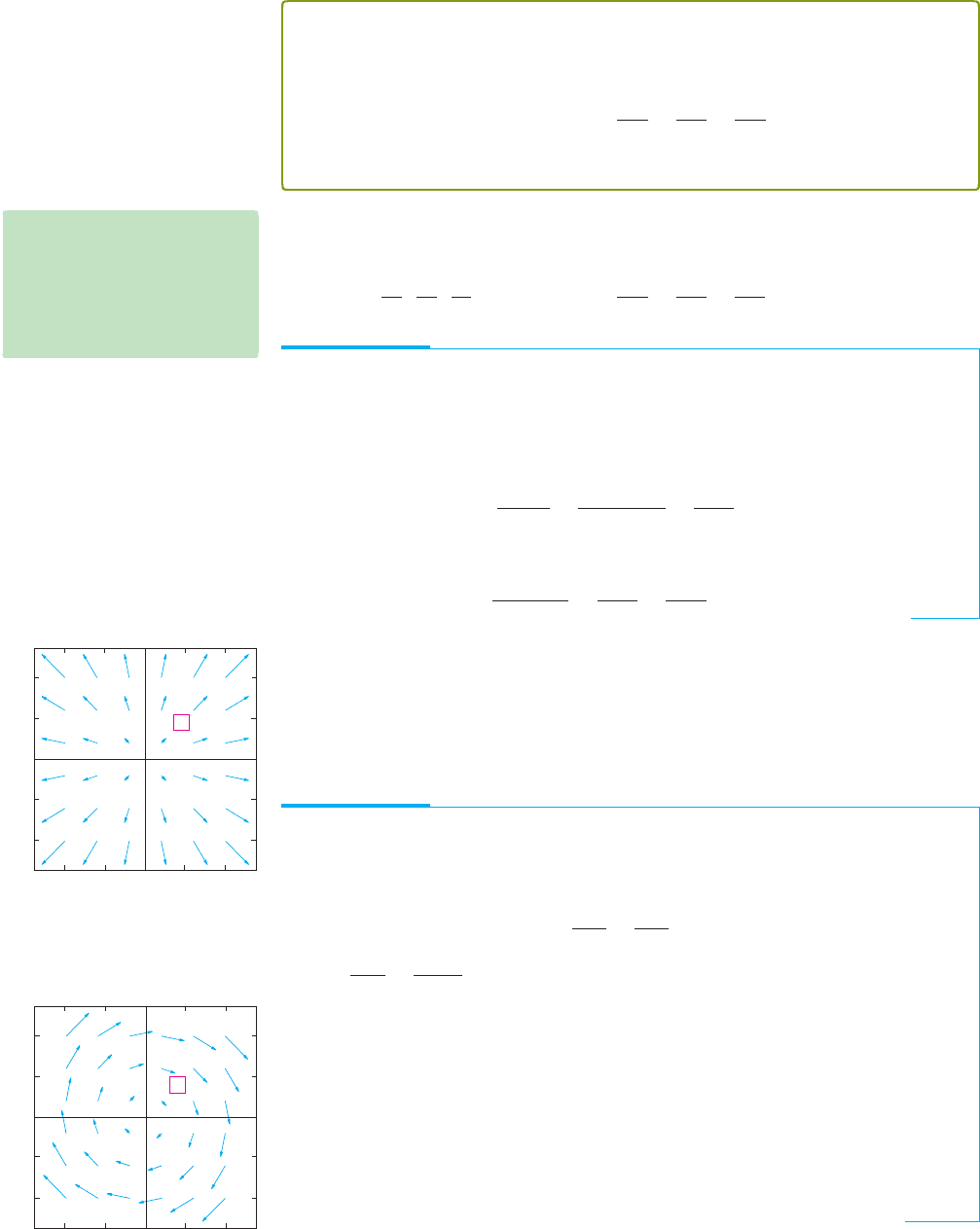
Graphs of the vector fields F and G in two dimensions are shown in Figures 15.37a and
15.37b, respectively. It is helpful to think of each of these vector fields as the velocity
field for a fluid in motion across the xy-plane. In this case, the vectors indicated in the
graph of the velocity field indicate the direction of flow of the fluid. For the vector field
x, y, 0, observe that the fluid flows directly away from the origin, so that the box
shown would flow away from the origin with no rotation; in (a), we found that
curl F = 0. By contrast, the vector field y, −x, 0 indicates a clockwise rotation of the
fluid. The box would rotate about its center of mass, corresponding to the nonzero curl
computed in (b). In particular, notice that if you curl the fingers of your right hand so
that your fingertips point in the direction of the flow, your thumb will point into the
page, in the direction of −k, which has the same direction as
curly, −x, 0=∇×y, −x, 0=−2k.
As we will see through our discussion of Stokes’ Theorem in section 15.8,
∇×F(x, y, z) provides a measure of the tendency of the fluid flow to rotate about an
axis parallel to ∇×F(x, y, z). If ∇×F = 0, we say that the vector field is irrotational at
that point. (That is, the fluid does not tend to rotate near the point.)
We noted earlier that there is no contribution to the curl of a vector field F(x, y, z) from
terms in the i-component of F that involve only x, nor from terms in the j-component of
F involving only y nor terms in the k-component of F involving only z. By contrast, these
terms make important contributions to the divergence of a vector field, the other major
vector operation introduced in this section.
P1: OSO/OVY P2: OSO/OVY QC: OSO/OVY T1: OSO
MHDQ256-Ch15 MHDQ256-Smith-v1.cls January 6, 2011 10:53
LT (Late Transcendental)
CONFIRMING PAGES
15-49 SECTION 15.5
..
Curl and Divergence 1025
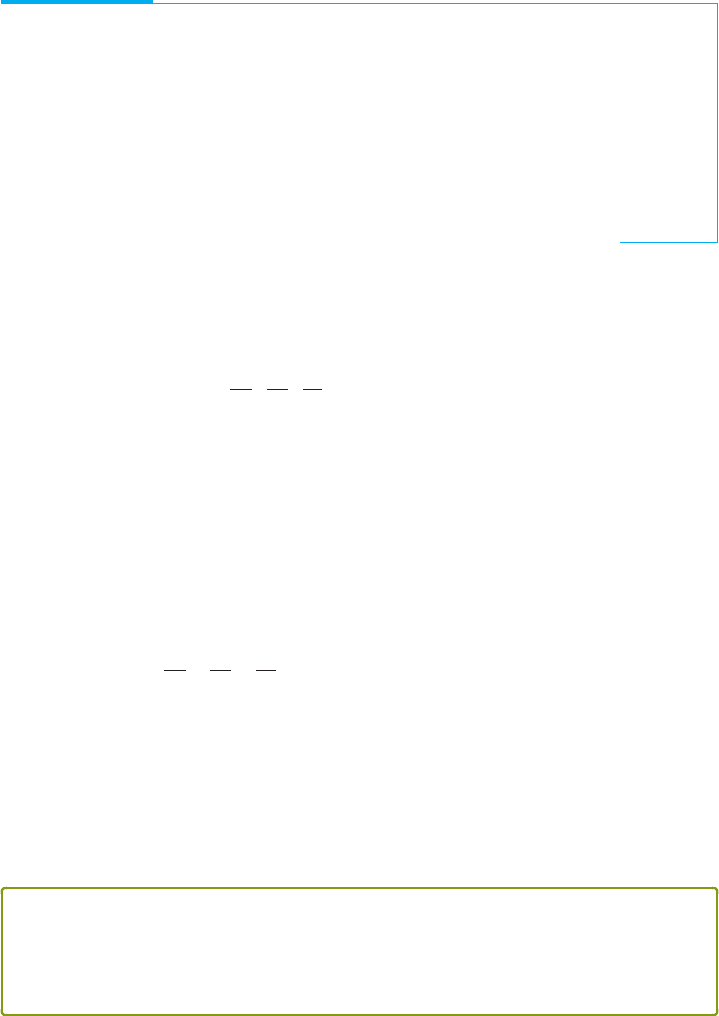
DEFINITION 5.2
The divergence of the vector field F(x, y, z) =F
1
(x, y, z), F
2
(x, y, z), F
3
(x, y, z)
is the scalar function
divF(x, y, z) =
∂ F
1
∂x
+
∂ F
2
∂y
+
∂ F
3
∂z
,
defined at all points at which all the indicated partial derivatives exist.
NOTES
Take care to note that, while the
curl of a vector field is another
vector field, the divergence of a
vector field is a scalar function.
While we wrote the curl using cross product notation, note that we can write the
divergence of a vector field using dot product notation, as follows:
∇·F =
∂
∂x
,
∂
∂y
,
∂
∂z
·F
1
, F
2
, F
3
=
∂ F
1
∂x
+
∂ F
2
∂y
+
∂ F
3
∂z
= divF(x, y, z). (5.2)
EXAMPLE 5.3 Computing the Divergence of a Vector Field
Compute div F for (a) F(x, y, z) =x
2
y, 3x − yz, z
3
and
(b) F(x, y, z) =x
3
− y, z
5
, e
y
.
Solution For (a), we have from (5.2) that
divF =∇·F =
∂(x
2
y)
∂x
+
∂(3x − yz)
∂y
+
∂(z
3
)
∂z
= 2xy − z + 3z
2
.
For (b), we have from (5.2) that
divF =∇·F =
∂(x
3
− y)
∂x
+
∂(z
5
)
∂y
+
∂(e
y
)
∂z
= 3x
2
+ 0 +0 = 3x
2
.
Notice that in part (b) of example 5.3 the only term contributing to the divergence is
the x
3
term in the i-component of F. Further, observe that in general, the divergence of
F(x, y, z) is not affected by terms in the i-component of F that do not involve x, terms in
the j-component of F that do not involve y or terms in the k-component of F that do not
involve z. Returning to the two-dimensional vector fields of example 5.2, we can develop a
graphical interpretation of the divergence.
EXAMPLE 5.4 Interpreting the Divergence of a Vector Field
Compute the divergence of (a) F(x, y) = xi + yj and (b) F(x, y) = yi − xj and
interpret each graphically.
Solution For (a), we have ∇·F =
∂(x)
∂x
+
∂(y)
∂y
= 2. For (b), we have
∇·F =
∂(y)
∂x
+
∂(−x)
∂y
= 0. Graphs of the vector fields in (a) and (b) are shown in
Figures 15.38a and 15.38b, respectively. Notice the boxes that we have superimposed
on the graph of each vector field. If F(x, y) represents the velocity field of a fluid in
motion, try to use the graphs to estimate the net flow of fluid into or out of each box. For
y, −x, the fluid is rotating in circular paths, so that the velocity of any particle on a
given circle centered at the origin is a constant. This suggests that the flow into the box
should equal the flow out of the box and the net flow is 0, which you’ll notice is also the
value of the divergence of this velocity field. By contrast, for the vector field x, y,
notice that the arrows coming into the box are shorter than the arrows exiting the box.
This says that the net flow out of the box is positive (i.e., there is more fluid exiting the
box than entering the box). Notice that in this case, the divergence is positive.
4
4 20 2 4
2
0
2
4
y
x
FIGURE 15.38a
Graph of x, y
4
4 20 2 4
2
0
2
4
y
x
FIGURE 15.38b
Graph of y, −x
We’ll show in section 15.7 (using the Divergence Theorem) that the divergence of
a vector field at a point (x, y, z) corresponds to the net flow of fluid per unit volume
out of a small box centered at (x, y, z). If ∇·F(x, y, z) > 0, more fluid exits the box
P1: OSO/OVY P2: OSO/OVY QC: OSO/OVY T1: OSO
MHDQ256-Ch15 MHDQ256-Smith-v1.cls January 6, 2011 10:53
LT (Late Transcendental)
CONFIRMING PAGES
1026 CHAPTER 15
..
Vector Calculus 15-50
than enters (as illustrated in Figure 15.38a) and we call the point (x, y, z)asource. If
∇·F(x, y, z) < 0, more fluid enters the box than exits and we call the point (x, y, z)a
sink. If ∇·F(x, y, z) = 0, throughout some region D, then we say that the vector field F is
source-free or incompressible.
We have now used the “del” operator ∇ for three different derivative-like operations.
The gradient of a scalar function f is the vector field ∇ f , the curl of a vector field F is the
vector field ∇×F and the divergence of a vector field F is the scalar function ∇·F.Pay
special attention to the different roles of scalar and vector functions in these operations. An
analysis of the possible combinations of these operations will give us further insight into
the properties of vector fields.
EXAMPLE 5.5 Vector Fields and Scalar Functions
Involving the Gradient
If f (x, y, z) is a scalar function and F(x, y, z) is a vector field, determine whether each
operation is a scalar function, a vector field or undefined: (a) ∇×(∇ f ),
(b) ∇×(∇·F), (c) ∇·(∇ f ).
Solution Examine each of these expressions one step at a time, working from the
inside out. In (a), ∇ f is a vector field, so the curl of ∇ f is defined and gives a vector
field. In (b), ∇·F is a scalar function, so the curl of ∇·F is undefined. In (c), ∇ f is a
vector field, so the divergence of ∇ f is defined and gives a scalar function.
We can say moreabout the two operations definedin example 5.5 parts (a) and (c). If f
has continuous second-order partial derivatives, then ∇ f =f
x
, f
y
, f
z
and the divergence
of the gradient is the scalar function
∇·(∇ f ) =
∂
∂x
,
∂
∂y
,
∂
∂z
·f
x
, f
y
, f
z
= f
xx
+ f
yy
+ f
zz
.
This combination of second partial derivatives arises in many important applications in
physics and engineering. We call ∇·(∇ f ) the Laplacian of f and typically use the short-
hand notation
∇·(∇ f ) =∇
2
f = f
xx
+ f
yy
+ f
zz
or f =∇
2
f .
Using the same notation, the curl of the gradient of a scalar function f is
∇×(∇ f ) =
ijk
∂
∂x
∂
∂y
∂
∂z
f
x
f
y
f
z
=f
zy
− f
yz
, f
xz
− f
zx
, f
yx
− f
xy
=0, 0, 0,
assuming the mixed partial derivatives are equal. (We’ve seen that this occurs whenever all
of the second-order partial derivatives are continuous in some open region.) Recall that if
F =∇f , then we call F a conservativefield. The result ∇×(∇ f ) = 0 proves Theorem 5.1,
which gives us a simple way for determining when a given three-dimensional vector field
is not conservative.
THEOREM 5.1
Suppose that F(x, y, z) =F
1
(x, y, z), F
2
(x, y, z), F
3
(x, y, z) is a vector field whose
components F
1
, F
2
and F
3
have continuous first-order partial derivatives throughout
an open region D ⊂ R
3
.IfF is conservative on D, then ∇×F = 0.
We can use Theorem 5.1 to determine that a given vector field is not conservative, as
we illustrate in example 5.6.
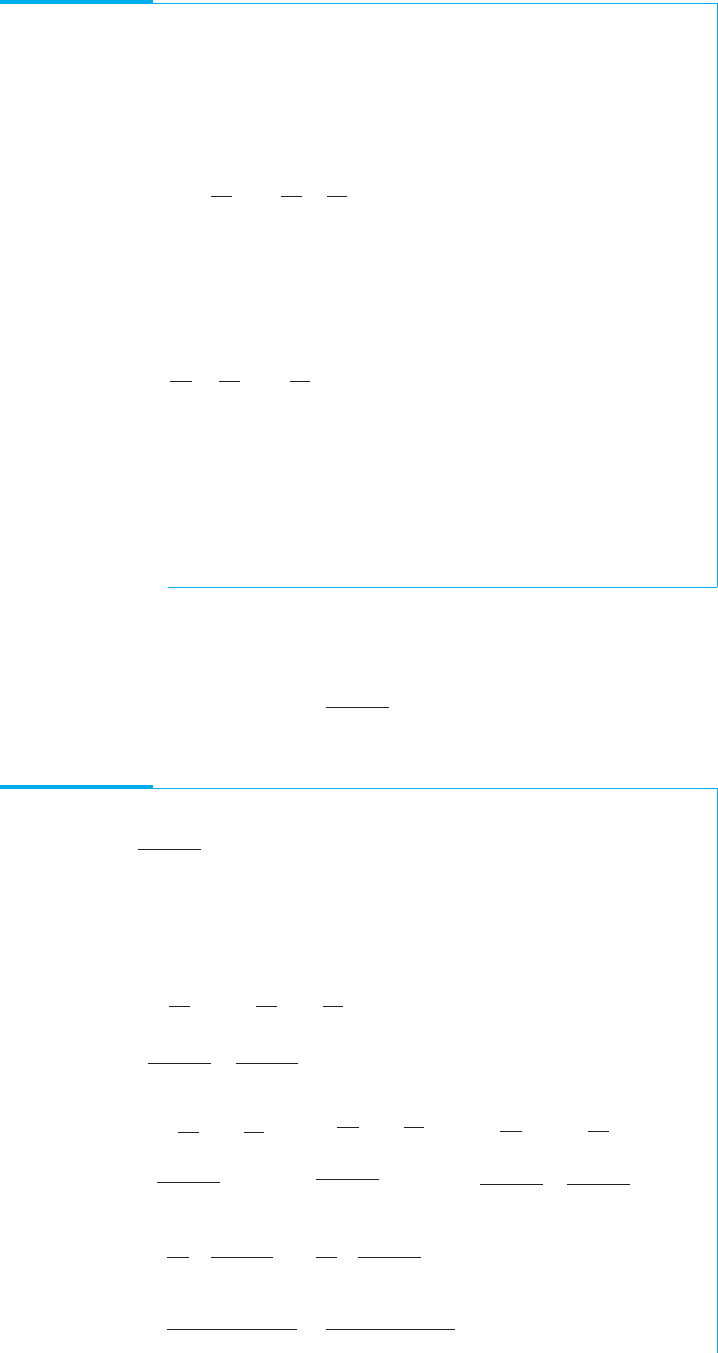
P1: OSO/OVY P2: OSO/OVY QC: OSO/OVY T1: OSO
MHDQ256-Ch15 MHDQ256-Smith-v1.cls January 6, 2011 10:53
LT (Late Transcendental)
CONFIRMING PAGES
15-51 SECTION 15.5
..
Curl and Divergence 1027
EXAMPLE 5.6 Determining When a Vector Field Is Conservative
Use Theorem 5.1 to determine whether the following vector fields are conservative:
(a) F =cos x − z, y
2
, xz and (b) F =2xz, 3z
2
, x
2
+ 6yz.
Solution For (a), we have
∇×F =
ijk
∂
∂x
∂
∂y
∂
∂z
cos x − zy
2
xz
=0 −0, −1 − z, 0 −0 = 0
and so, by Theorem 5.1, F is not conservative on R
3
.
For (b), we have
∇×F =
ij k
∂
∂x
∂
∂y
∂
∂z
2xz 3z
2
x
2
+ 6yz
=6z − 6z, 2x −2x, 0 −0=0.
Notice that in this case, Theorem 5.1 does not tell us whether or not F is conservative.
However, you might notice that
F(x, y, z) =2xz, 3z
2
, x
2
+ 6yz=∇(x
2
z + 3yz
2
).
Since we have found a potential function for F, we now see that it is indeed a
conservative field.
Given example 5.6, you might be wondering whether or not the converse of Theo-
rem 5.1 is true. That is, if ∇×F = 0, must it follow that F is conservative? The answer to
this is, “NO.” We had an important clue to this in example 4.5. There, we saw that for the
two-dimensional vector field F(x, y) =
1
x
2
+ y
2
−y, x,
C
F(x, y) ·dr = 2π, for every
simple closed curve C enclosing the origin. We follow up on this idea in example 5.7.
EXAMPLE 5.7 An Irrotational Vector Field That Is Not Conservative
For F(x, y, z) =
1
x
2
+ y
2
−y, x, 0, show that ∇×F = 0 throughout the domain of F,
but that F is not conservative.
Solution First, notice that
∇×F =
ijk
∂
∂x
∂
∂y
∂
∂z
−y
x
2
+ y
2
x
x
2
+ y
2
0
= i
∂
∂y
∂
∂z
x
x
2
+ y
2
0
− j
∂
∂x
∂
∂z
−y
x
2
+ y
2
0
+ k
∂
∂x
∂
∂y
−y
x
2
+ y
2
x
x
2
+ y
2
= k
∂
∂x
x
x
2
+ y
2
+
∂
∂y
y
x
2
+ y
2
= k
(x
2
+ y
2
) − 2x
2
(x
2
+ y
2
)
2
+
(x
2
+ y
2
) − 2y
2
(x
2
+ y
2
)
2
= 0,

P1: OSO/OVY P2: OSO/OVY QC: OSO/OVY T1: OSO
MHDQ256-Ch15 MHDQ256-Smith-v1.cls January 6, 2011 10:53
LT (Late Transcendental)
CONFIRMING PAGES
1028 CHAPTER 15
..
Vector Calculus 15-52
so that F is irrotational at every point at which it’s defined (i.e., everywhere but on the
line x = y = 0, that is, the z-axis). However, in example 4.5, we already showed that
C
F(x, y, z) ·dr = 2π, for every simple closed curve C lying in the xy-plane and
enclosing the origin. Given this, it follows from Theorem 3.3 that F cannot be
conservative, since if it were, we would need to have
C
F(x, y, z) ·dr = 0 for every
piecewise-smooth closed curve C lying in the domain of F.
Notethatinexample5.7,thevectorfieldinquestionhadasingularity(i.e.,apointwhere
one or more of the components of the vector field blowup to ∞) at everypoint on the z-axis.
Even though the curves we considered did not pass through any of these singularities, they
in some sense “enclosed” the z-axis. This is enough to make the converse of Theorem 5.1
false.As it turns out, the converse is true if we add some additional hypotheses. Specifically,
we can say the following.
THEOREM 5.2
Suppose that F(x, y, z) =F
1
(x, y, z), F
2
(x, y, z), F
3
(x, y, z) is a vector field whose
components F
1
, F
2
and F
3
have continuous first partial derivatives throughout all of
R
3
. Then, F is conservative if and only if ∇×F = 0.
Notice that half of this theorem is already known from Theorem 5.1. Also, notice that
we required that the components of F have continuous first partial derivatives throughout
all of R
3
(a requirement that was not satisfied by the vector field in example 5.7). The other
half of the theorem requires the additional sophistication of Stokes’ Theorem and we will
prove a more general version of this in section 15.8.
CONSERVATIVE VECTOR FIELDS
We can now summarize a number of equivalent properties for three-dimensional
vector fields. Suppose that F(x, y, z) =F
1
(x, y, z), F
2
(x, y, z), F
3
(x, y, z) is a
vector field whose components F
1
, F
2
and F
3
have continuous first partial derivatives
throughout all of R
3
. Then the following are equivalent:
1. F(x, y, z) is conservative.
2.
C
F · dr is independent of path.
3.
C
F · dr = 0 for every piecewise-smooth closed curve C.
4. ∇×F = 0.
5. F(x, y, z) is a gradient field (F =∇f for some potential function f ).
We close this section by rewriting Green’s Theorem in terms of the curl and divergence.
First, suppose that F(x, y) =M(x, y), N(x, y), 0is a vector field, for some functions
M(x, y) and N(x, y). Suppose that R is a region in the xy-plane whose boundary curve C is
piecewise-smooth, positively oriented, simple and closed and that M and N are continuous
and have continuous first partial derivatives in some open region D, where R ⊂ D. Then,
from Green’s Theorem, we have
R
∂ N
∂x
−
∂ M
∂y
dA =
C
Mdx + Ndy.
Notice that the integrand of the double integral,
∂ N
∂x
−
∂ M
∂y
, is the k component of ∇×F.
Further, since dz = 0 on any curve lying in the xy-plane, we have
C
Mdx + Ndy =
C
F · dr.
P1: OSO/OVY P2: OSO/OVY QC: OSO/OVY T1: OSO
MHDQ256-Ch15 MHDQ256-Smith-v1.cls January 6, 2011 10:53
LT (Late Transcendental)
CONFIRMING PAGES
15-53 SECTION 15.5
..
Curl and Divergence 1029
Thus, we can write Green’s Theorem in the form
C
F · dr =
R
(∇×F) ·k dA.
We generalize this to Stokes’ Theorem in section 15.8.
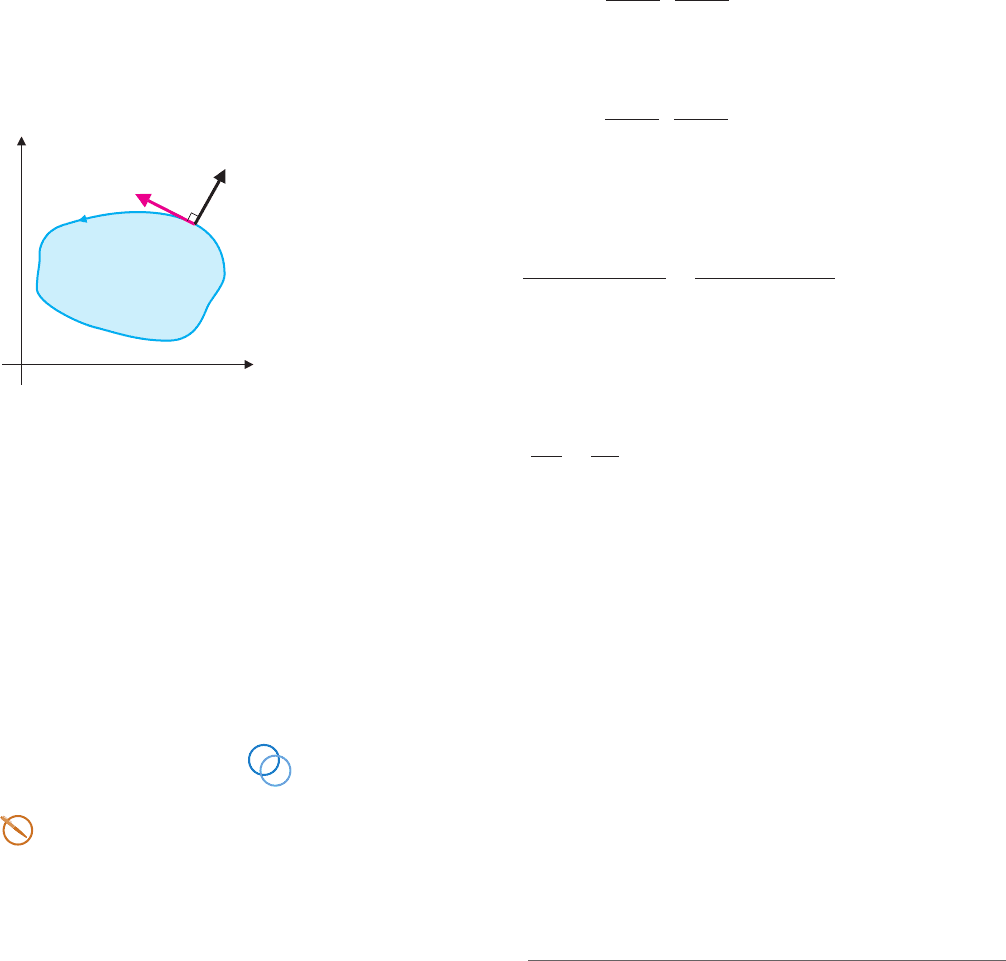
To take Green’s Theorem in yet another direction, suppose that F and R are as just
defined and suppose that C is traced out by the endpoint of the vector-valued function
r(t) =x(t), y(t), 0, for a ≤ t ≤ b, where x(t) and y(t) have continuous first derivatives
for a ≤ t ≤ b. Recall that the unit tangent vector to the curve is given by
T(t) =
x
(t)
r
(t)
,
y
(t)
r
(t)
, 0
It’s then easy to verify that the exterior unit normal vector to C at any point (i.e., the unit
normal vector that points out of R)isgivenby
n(t) =
y
(t)
r
(t)
,
−x
(t)
r
(t)
, 0
y
T(t)
n(t)
R
C
x
FIGURE 15.39
Unit tangent and exterior unit
normal vectors to R
(See Figure 15.39.) Now, from Theorem 2.1, we have
C
F ·n ds =
b
a
(F ·n)(t)r
(t)dt
=
b
a
M(x(t), y(t))y
(t)
r
(t)
−
N(x(t), y(t))x
(t)
r
(t)
r
(t)dt
=
b
a
[M(x(t), y(t))y
(t) dt − N(x(t), y(t))x
(t) dt]
=
C
M(x, y)dy − N (x, y)dx
=
R
∂ M
∂x
+
∂ N
∂y
dA,
from Green’s Theorem. Finally, recognize that the integrand of the double integral is the
divergence of F and this gives us another vector form of Green’s Theorem:
C
F ·n ds =
R
∇·F(x, y) dA. (5.3)
This form of Green’s Theorem is generalized to the Divergence Theorem in section 15.7.
EXERCISES 15.5
WRITING EXERCISES
1. Suppose that ∇×F =2, 0, 0. Describe the direction in
which an object with velocity field F would rotate. Discuss
how the rotation compares to that of an object with velocity
field 20, 0, 0.
2. If ∇·F > 0 at a point P and F is the velocity field of a fluid,
explain why the word source is a good choice for what’s hap-
pening at P. Explain why sink is a good word if ∇·F < 0.
3. You now have two ways of determining whether or not a vec-
tor field is conservative on a region, try to find the potential
function or see whether the curl equals 0. If you have reason to
believe that the vector field is conservative, explain which test
you prefer.
4. Suppose that a vector field F near a point P has circular flow
lines about P. Give two reasons why F is not conservative in a
region containing P.
In exercises 1–12, find the curland divergenceof the givenvector
field.
1. x
2
i − 3xyj2.y
2
i + 4x
2
yj
3. 2xzi −3yk4.x
2
i − 3xyj + xk
P1: OSO/OVY P2: OSO/OVY QC: OSO/OVY T1: OSO
MHDQ256-Ch15 MHDQ256-Smith-v1.cls January 6, 2011 10:53
LT (Late Transcendental)
CONFIRMING PAGES
1030 CHAPTER 15
..
Vector Calculus 15-54
5. xy, yz, x
2
6. xe
z
, yz
2
, x + y
7. x
2
, y − z, xe
xy
8. y, sin(x
2
y), 3z + y
9. 3y/z,
√
xz, x cos y 10. y
2
, x
2
e
z
, cos xy
11. 2xz, y + z
2
, e
z/y
2
12. xy
2
,
3y
2
z
2
+x
, 2x − zy
3
............................................................
In exercises 13–26, determine whether the given vector field is
conservative and/or incompressible on R
3
.
13. 2x, 2yz
2
, 2y
2
z 14. 2xy, x
2
− 3y
2
z
2
, 1 −2zy
3
15. 3yz, x
2
, x cos y 16. y
2
, x
2
e
z
, cos xy
17. sin z, z
2
e
yz
2
, x cos z + 2yze
yz
2
18. 2xycos z, x
3
cos z − 3y
2
z, −x
2
y sin z − y
3
19.
z
2
− 3ye
3x
, z
2
− e
3x
, 2z
√
xy
20. 2xz, 3y, x
2
− y 21. xy
2
, 3xz, 4 − zy
2
22. x, y, 1 − 3z 23. 4x, 3y
3
, e
z
24. sin x, 2y
2
,
3
√
z
25. −2xy, z
2
cos yz
2
− x
2
, 2yz cos yz
2
26. e
y
, xe
y
+ z
2
, 2yz − 1
............................................................
27. Label each expression as a scalar quantity, a vector quantity or
undefined, if f is a scalar function and F is a vector field.
a. ∇·(∇ f ) b. ∇×(∇·F) c. ∇(∇×F)
d. ∇(∇·F) e. ∇×(∇ f )
28. Label each expression as a scalar quantity, a vector quantity or
undefined, if f is a scalar function and F is a vector field.
a. ∇(∇ f ) b. ∇·(∇·F) c. ∇·(∇×F)
d. ∇×(∇F) e. ∇×(∇×(∇×F))
29. Prove that ∇·(∇×F) = 0 for any vector field F whose com-
ponents have continuous second partial derivatives.
30. Prove that ∇×(∇ f ) = 0 for any function f with continuous
second partial derivatives.
............................................................
In exercises 31–36, let r x, y, z, r ||r|| and f a scalar
function.
31. Prove that ∇×r = 0 and ∇·r = 3.
32. Prove that ∇·(rr) = 4r.
33. Prove that ∇ f (r) = f
(r)
r
r
.
34. Prove that ∇
2
f (r) = f
(r) +
1
r
f
(r).
35. Prove that ∇·( f (r)r) = 3 f (r) +r f
(r).
36. Prove that ∇×( f (r)r) = 0.
............................................................
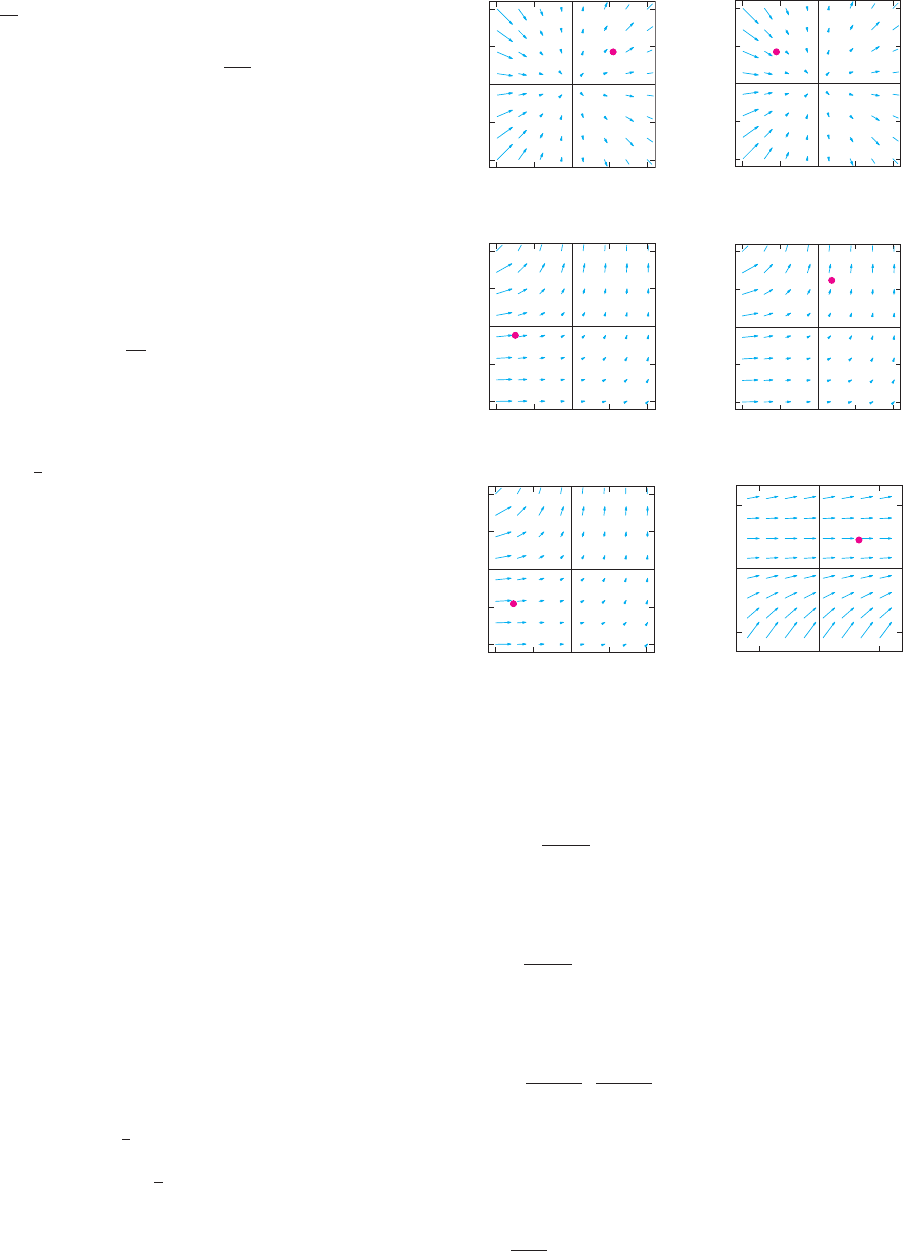
In exercises 37–42, conjecture whether the divergence at point
P is positive, negative or zero.
37.
2
2 10 1 2
1
0
1
2
y
x
P
38.
2
2 10 1 2
1
0
1
2
y
x
P
39.
2
2 10 1 2
1
0
1
2
y
x
P
40.
2
2 10 1 2
1
0
1
2
y
x
P
41.
2
2 10 1 2
1
0
1
2
y
x
P
42.
1
10 1
0
1
y
x
P
............................................................
In exercises 43–46, let F represent a velocity field of a fluid and
imagine a paddle wheel placed in the fluid at various points near
the origin. Sketch a graph of F.
43. If F =
0,
1
1 + x
2
, 0
, explain why the paddle wheel would
start spinning. Compute ∇×F and label the fluid flow as ro-
tational or irrotational. How does this compare to the motion
of the paddle wheel?
44. If F =
1
1 + x
2
, 0, 0
, explain why the paddle wheel would
not start spinning. Compute ∇×F and label the fluid flow as
rotational or irrotational. How does this compare tothe motion
of the paddle wheel?
45. If F =
y
x
2
+ y
2
,
−x
x
2
+ y
2
, 0
, compute the curl. Does the
paddle wheel move? spin?
46. If F =
y, 0, 0
, compute the curl. Does the paddle wheel
move? spin?
............................................................
47. Graph
r
||r||
3
for r =x, y, z and compute its divergence. Are
you surprised?
P1: OSO/OVY P2: OSO/OVY QC: OSO/OVY T1: OSO
MHDQ256-Ch15 MHDQ256-Smith-v1.cls January 6, 2011 10:53
LT (Late Transcendental)
CONFIRMING PAGES
15-55 SECTION 15.5
..
Curl and Divergence 1031
48. Compute ∇·
r
||r||
n
for any positive integer n.
49. If the k-component,
∂ F
2
∂x
−
∂ F
1
∂y
, of the curl of F is positive
everywhere,useGreen’sTheoremtoshowthatthereisaclosed
curve C such that
C
F · dr = 0.
50. If the j-component,
∂ F
1
∂z
−
∂ F
3
∂x
, of the curl of F is positive
everywhere, show that there is a closed curve C such that
C
F · dr = 0.
51. For a vector field F(x, y) =F
1
(x, y), F
2
(x, y) and closed
curve C with normal vector n (that is, n is perpendicu-
lar to the tangent vector to C at each point), show that
C
F · n ds =
R
∇·F dA =
C
F
1
dy − F
2
dx.
52. If T (x, y, t) is the temperature function at position (x, y)
at time t, heat flows across a curve C at a rate given by
C
(−k∇T) ·n ds, for some constant k > 0. At steady-state,
this rate is zero and the temperature function can be written
as T (x, y). In this case, use Green’s Theorem to show that
∇
2
T = 0.
53. If ∇
2
f = 0, show that ∇ f is both incompressible and
irrotational.
54. If F and G are irrotational, provethat F × G is incompressible.
55. Compute the Laplacian f for
(a) f (x, y, z) =
x
2
+ y
2
+ z
2
.
(b) f (x, y, z) =
1
x
2
+ y
2
+ z
2
.
56. Find all positive integers n for which r
n
= 0.
57. Show that
e
−x
2
/y
x
,
1 − e
−x
2
/y
2y
, 0
is conservative for
x > 0, y > 0. What can you say about its potential function?
58. (a) Give an example of a vector field F such that ∇·F is a
positive function of y only. (b) Give an example of a vector
field F such that ∇×F is a function of x only.
59. Gauss’ law states that ∇·E =
ρ
0
. Here, E is an electrostatic
field, ρ is the charge density and
0
is the permittivity. If
E has a potential function −φ, derive Poisson’s equation
∇
2
φ =−
ρ
0
.
60. For two-dimensional fluid flow, if v =v
x
(x, y),v
y
(x, y) is
the velocity field, thenv has a stream function g if
∂g
∂x
=−v
y
and
∂g
∂y
= v
x
. Show that if v has a stream function and the
components v
x
and v
y
have continuous partial derivatives, then
∇·v = 0.
61. For v =2xy, −y
2
+ x,showthat∇·v = 0 and find astream
function g.
62. For v =xe
xy
− 1, 2 − ye
xy
, show that ∇·v = 0 and find a
stream function g.
63. If F and G are vector fields, prove that
∇·(F ×G) = G ·(∇×F) − F · (∇×G).
64. If F = f ∇g, for continuously differentiable scalar functions
f and g, show that (∇×F) ·F = 0.
65. If F is a vector field, prove that
∇×(∇×F) =∇(∇·F) −∇
2
F.
66. If A is a constant vector and r =x, y, z, prove that
∇×(A ×r) = 2A.
............................................................
In exercises 67 and 68, let R be a region in the xy-plane bounded
by a positively oriented smooth curve C.
67. Prove Green’s first identity: For C = ∂ R,
R
f ∇
2
gdA=
C
f (∇g) ·n ds −
R
(∇ f ·∇g)dA.
[Hint: Use the vectorform of Green’s Theorem in (5.3) applied
to F = f ∇g.]
68. Prove Green’s second identity: For C = ∂ R,
R
( f ∇
2
g − g∇
2
f ) dA =
C
( f ∇g − g∇ f ) ·n ds.
(Hint: Use Green’s first identity from exercise 67.)
............................................................
69. If f is a scalar function and F a vector field, show that
∇·( f F) =∇f · F + f (∇·F).
70. If f is a scalar function and F a vector field, show that
∇×( f F) =∇f × F + f (∇×F).
71. Show that if G =∇×H, for some vector field H with contin-
uous partial derivatives, then ∇·G = 0.
72. Show the converse of exercise 71; that is, if ∇·G = 0,
then G =∇×H for some vector field H.
Hint: Let
H (x, y, z) =
0,
x
0
G
3
(u, y, z) du, −
x
0
G
2
(u, y, z) du
.
73. For F =
1
y
2
+1
, 6y, 2, −5 ≤ y ≤ 5, find the curl of maximun
magnitude.
74. For F =2x −2xy
2
, 6y
2
− x
2
y, x
2
+ cos y, find the diver-
gence of maximum absolute value.
EXPLORATORY EXERCISES
1. In some calculusand engineering books, you will find the vec-
tor identity
∇×(F ×G) = (G ·∇)F −G(∇·F)
−(F ·∇)G + F(∇·G).
Which two of the four terms on the right-hand side look like
they should be undefined? Writeout the left-hand side as com-
pletely as possible, group it into four terms, identify the two
familiar terms on the right-hand side and then define the un-
usual terms on the right-hand side. (Hint: The notation makes
sense as a generalization of the definitions in this section.)
2. Prove the vector formula
∇×(∇×F) =∇(∇·F) −∇
2
F.
P1: OSO/OVY P2: OSO/OVY QC: OSO/OVY T1: OSO
MHDQ256-Ch15 MHDQ256-Smith-v1.cls January 6, 2011 10:53
LT (Late Transcendental)
CONFIRMING PAGES
1032 CHAPTER 15
..
Vector Calculus 15-56
As in exercise 1, a major part of the problem is to decipher an
unfamiliar notation.
3. Maxwell’s laws relate an electric field E(t) to a magnetic
field H(t). In a region with no charges and no current,
the laws state that ∇·E = 0, ∇·H = 0, ∇×E =−μH
t
and
∇×H = μE
t
. From these laws, prove that
∇×(∇×E) =−μ
2
E
tt
and ∇×(∇×H) =−μ
2
H
tt
.
15.6 SURFACE INTEGRALS
Whether it is the ceiling of the Sistine Chapel, the dome of a college library or the massive
roofof the Toronto SkyDome,domes are impressivearchitectural structures, in part because
of their lack of visible support. Architects must be certain that the weight is properly
supported and so, must first calculate the mass of a dome.
You have already seen how to use double integrals to compute the mass of a two-
dimensional lamina and triple integrals to find the mass of a three-dimensional solid. How-
ever, a dome is a three-dimensional structure more like a thin shell (a surface) than a solid.
We hope you’re one step ahead of us on this one: if you don’t know how to find the mass of
a dome exactly, you can approximate its mass by slicing it into a number of small sections
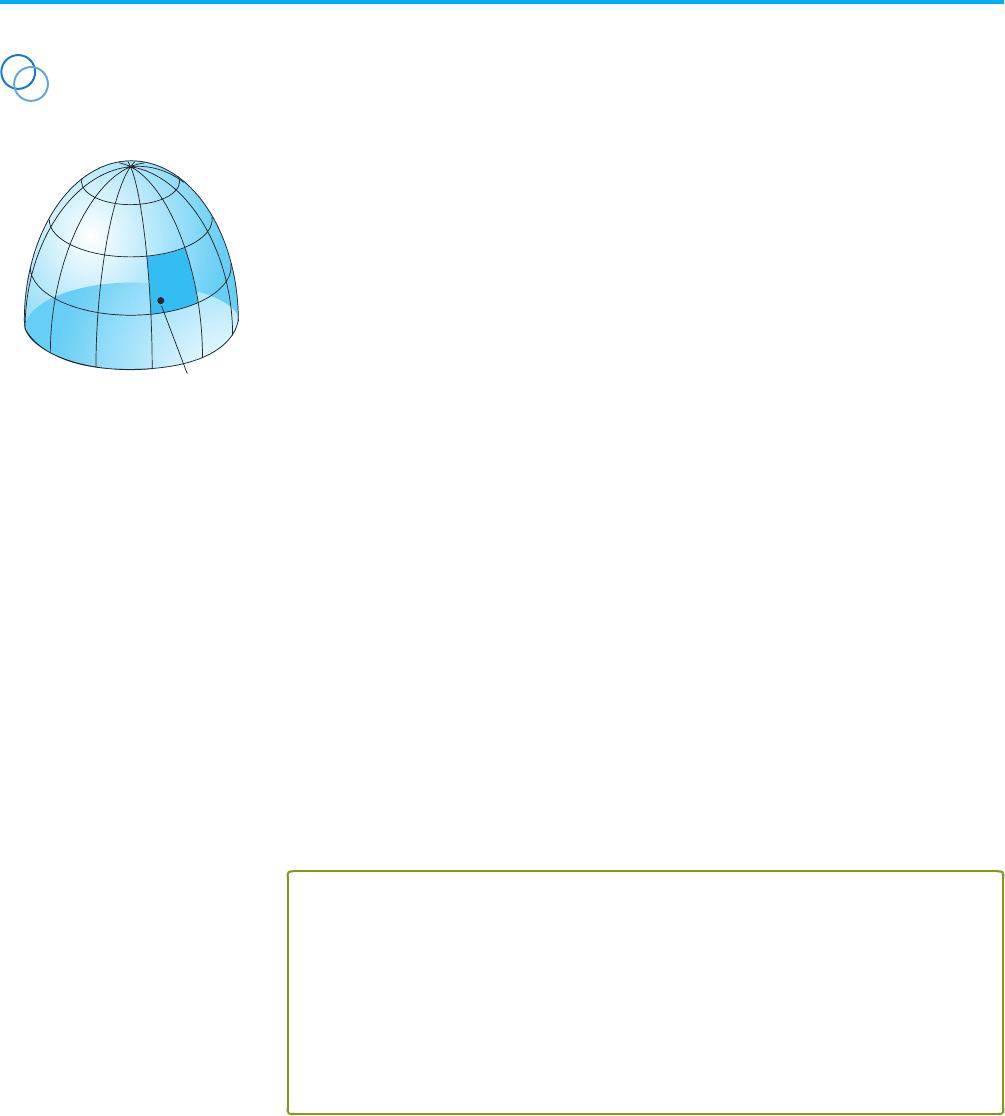
and estimating the mass of each section. In Figure 15.40, we show a curved surface that has
been divided into a number of sections. If the sections are small enough, then the density
of each piece will be approximately constant.
S
i
(x
i
, y
i
, z
i
)
FIGURE 15.40
Partition of a surface
So, first subdivide (partition) the surface into n smaller pieces, S
1
, S
2
,...,S
n
. Next,
let ρ(x, y, z) be the density function (measured in units of mass per unit area). Further, for
each i = 1, 2,...,n, let (x
i
, y
i
, z
i
) be a point on the section S
i
and let S
i
be the surface
area of S
i
. The mass of the section S
i
is then given approximately by ρ(x
i
, y
i
, z
i
)S
i
. The
total mass m of the surface is given approximately by the sum ofthese approximate masses,
m ≈
n
i=1
ρ(x
i
, y
i
, z
i
)S
i
.
You should expect that the exact mass is given by the limit of these sums as the size of the
pieces gets smaller and smaller. We define the diameter of a section S
i
to be the maximum
distance between any two points on S
i
and the norm of the partition P as the maximum
of the diameters of the S
i
’s. Then we have that
m = lim
P→0
n
i=1
ρ (x
i
, y
i
, z
i
)S
i
.
This limit is an example of a new type of integral, the surface integral, which is the focus
of this section.
DEFINITION 6.1
The surface integral of a function g(x, y, z) over a surface S ⊂ R
3
, written
S
g(x, y, z)dS,isgivenby
S
g(x, y, z)dS = lim
P→0
n
i=1
g(x
i
, y
i
, z
i
)S
i
,
provided the limit exists and is the same for all choices of the evaluation points
(x
i
, y
i
, z
i
).
Notice how our development of the surface integral parallels our development of the
line integral. Whereas the line integral extended a single integral over an interval to an
integral over a curve in three dimensions, the surface integral extends a double integral over
a two-dimensional region to an integral over a surface in three dimensions.