
Smith R., Minton R. Calculus
Подождите немного. Документ загружается.

P1: OSO/OVY P2: OSO/OVY QC: OSO/OVY T1: OSO
MHDQ256-Ch15 MHDQ256-Smith-v1.cls January 6, 2011 10:53
LT (Late Transcendental)
CONFIRMING PAGES
15-17 SECTION 15.2
..
Line Integrals 993
y
1 22 1
1
2
3
4
x
y
1 212
1
2
3
4
x
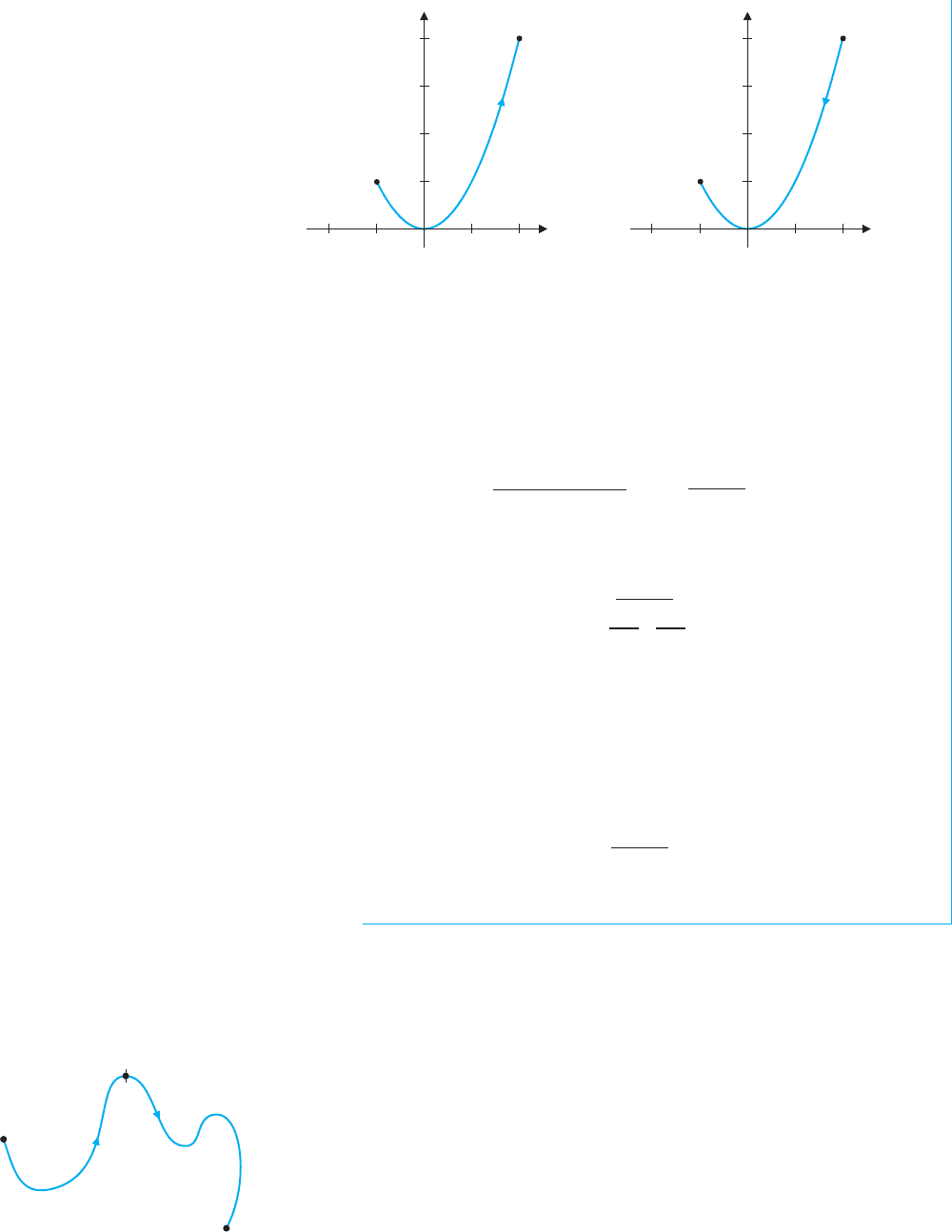
FIGURE 15.15a FIGURE 15.15b
y = x
2
from (−1, 1) to (2, 4) y = x
2
from (2, 4) to (−1, 1)
Solution (a) A sketch of the curve is shown in Figure 15.15a. Taking x = t as the
parameter (since the curve is already written explicitly in terms of x), we can write
parametric equations for the curve as x = t and y = t
2
, for −1 ≤ t ≤ 2. Using this, the
integrand becomes 2x
2
y = 2t
2
t
2
= 2t
4
and from (2.4), the arc length element is
ds =
[x
(t)]
2
+ [y
(t)]
2
dt =
1 + 4t
2
dt.
The integral is now written as
C
2x
2
yds=
2
−1
2t
4
2x
2
y
1 + 4t
2
dt
ds
≈ 45.391,
where we have again evaluated the integral numerically (although in this case a good
CAS can give you an exact answer).
(b) The curve is the same as in part (a), except that the orientation is backward.
(See Figure 15.15b.) In this case, we represent the curve with the parametric equations
x =−t and y = t
2
, for −2 ≤ t ≤ 1. Observe that everything else in the integral
remains the same and we have
C
2x
2
yds=
1
−2
2t
4
1 + 4t
2
dt ≈ 45.391,
as before.
C
1
C
C
2
FIGURE 15.16
C = C
1
∪C
2
Notice that in example 2.3, the line integral was the same no matter which orientation
we took for the curve. It turns out that this is true in general for all line integrals defined by
Definition 2.1 (i.e., line integrals with respect to arc length).
Notice that Theorem 2.1 requires the curve C to be smooth. Although many curves of
interest are not smooth, we can extend the result of Theorem 2.1 to the case where C is a
union of a finite number of smooth curves:
C = C
1
∪C
2
∪···∪C
n
,
where each of C
1
, C
2
,...,C
n
is smooth and where the terminal point of C
i
is the same as
the initial point of C
i+1
, for i = 1, 2,...,n − 1. We call sucha curve C piecewise-smooth.
Notice that if C
1
and C
2
are oriented curves and the endpoint of C
1
is the same as the initial
point of C
2
, then the curve C
1
∪C
2
is an oriented curve with the same initial point as C
1
and the same endpoint as C
2
. (See Figure 15.16.) The results in Theorem 2.2 should not
P1: OSO/OVY P2: OSO/OVY QC: OSO/OVY T1: OSO
MHDQ256-Ch15 MHDQ256-Smith-v1.cls January 6, 2011 10:53
LT (Late Transcendental)
CONFIRMING PAGES
994 CHAPTER 15
..
Vector Calculus 15-18
seem surprising. Here, for an oriented curve C in two or three dimensions, the curve −C
denotes the same curve as C, but with the opposite orientation.
THEOREM 2.2
Suppose that f (x, y, z) is a continuous function in some region D containing the
oriented curve C. Then, if C is piecewise-smooth, with C = C
1
∪C
2
∪···∪C
n
,
where C
1
, C
2
,...,C
n
are all smooth and where the terminal point of C
i
is the same
as the initial point of C
i+1
, for i = 1, 2,...,n −1, we have
(i)
−C
f (x, y, z) ds =
C
f (x, y, z) ds
and (ii)
C
f (x, y, z) ds =
C
1
f (x, y, z) ds +
C
2
f (x, y, z) ds +···+
C
n
f (x, y, z) ds.
We leave the proof of the theorem as an exercise. Notice that a corresponding result
will hold in two dimensions. We use part (ii) of Theorem 2.2 in example 2.4.
EXAMPLE 2.4 Evaluating a Line Integral over
a Piecewise-Smooth Curve
Evaluate the line integral
C
(3x − y)ds, where C is the line segment from (1, 2) to
(3, 3), followed by the portion of the circle x
2
+ y
2
= 18 traversed from (3, 3)
clockwise around to (3, −3).
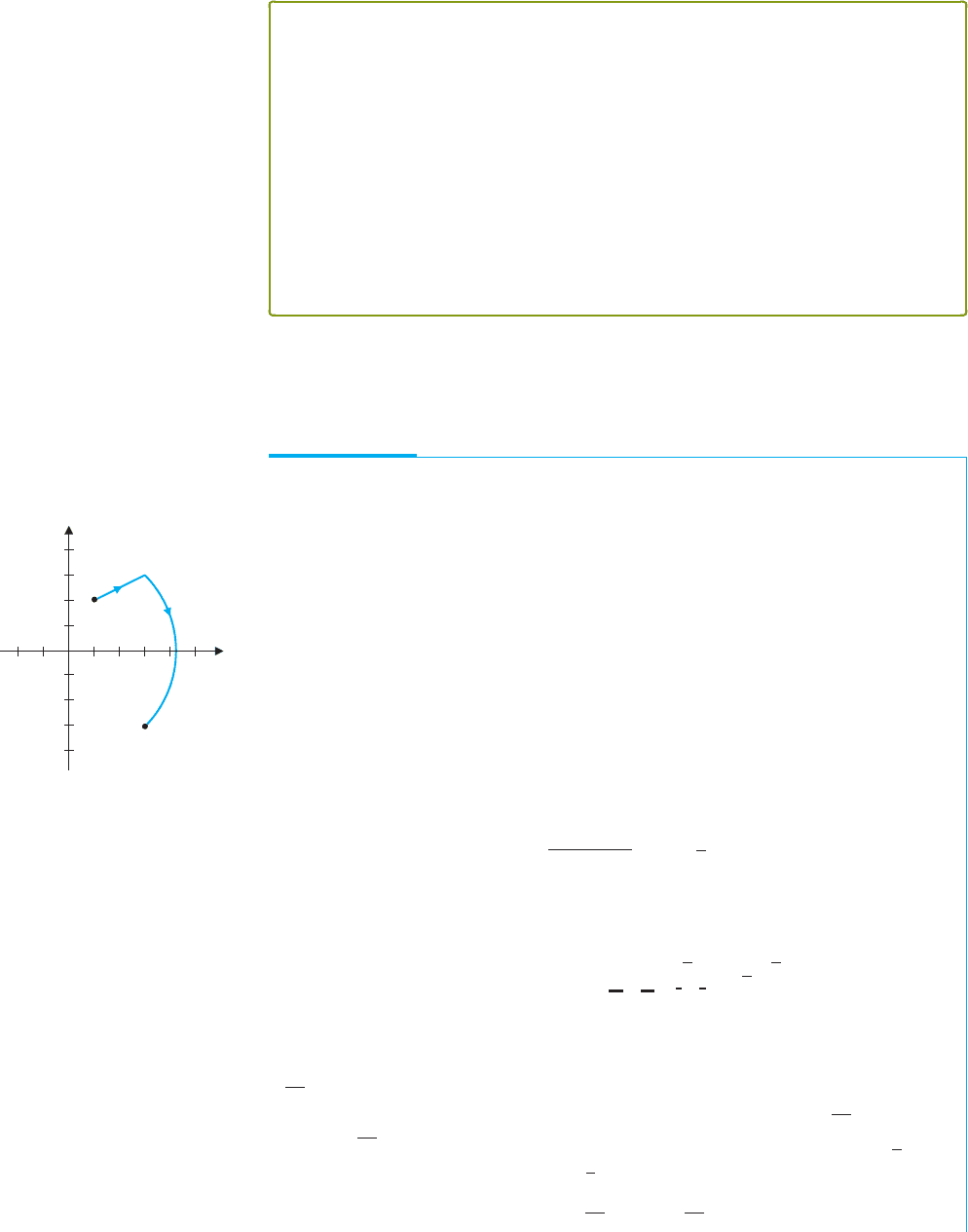
y
x
242
2
4
4
2
C
2
C
1
FIGURE 15.17
Piecewise-smooth curve
Solution A graph of the curve is shown in Figure 15.17. Notice that we’ll need to
evaluate the line integral separately over the line segment C
1
and the quarter-circle C
2
.
Further, although C is not smooth, it is piecewise-smooth, since C
1
and C
2
are both
smooth. We can write C
1
parametrically as x = 1 +(3 − 1)t = 1 +2t and
y = 2 +(3 −2)t = 2 + t, for 0 ≤ t ≤ 1. Also, on C
1
, the integrand is given by
3x − y = 3(1 + 2t) −(2 +t) = 1 +5t
and from (2.4), the arc length element is
ds =
(2)
2
+ (1)
2
dt =
√
5dt.
Putting this together, we have
C
1
f (x, y) ds =
1
0
(1 + 5t)
f (x, y)
√
5dt
ds
=
7
2
√
5. (2.5)
Next, for C
2
, the usual parametric equations for a circle of radius r oriented
counterclockwise are x(t) = r cost and y(t) = r sint. In the present case, the radius is
√
18 and the curve is oriented clockwise, which means that y(t) has the opposite sign
from the usual orientation. So, parametric equations for C
2
are x(t) =
√
18cos t and
y(t) =−
√
18sin t. Notice, too, that the initial point (3, 3) corresponds to t =−
π
4
and
the endpoint (3, −3) corresponds to t =
π
4
. Finally, on C
2
, the integrand is
3x − y = 3
√
18cos t +
√
18sin t
P1: OSO/OVY P2: OSO/OVY QC: OSO/OVY T1: OSO
MHDQ256-Ch15 MHDQ256-Smith-v1.cls January 6, 2011 10:53
LT (Late Transcendental)
CONFIRMING PAGES
15-19 SECTION 15.2
..
Line Integrals 995
and the arc length element is
ds =
−
√
18sin t
2
+
−
√
18cos t
2
dt =
√
18dt,
where we have again used the fact that sin
2
t +cos
2
t = 1. This gives us
C
2
f (x, y) ds =
π/4
−π/4
3
√
18cos t +
√
18sin t
f (x, y)
√
18dt
ds
= 54
√
2. (2.6)
Combining the integrals over the two curves, we have from (2.5) and (2.6) that
C
f (x, y) ds =
C
1
f (x, y) ds +
C
2
f (x, y) ds =
7
2
√
5 + 54
√
2.
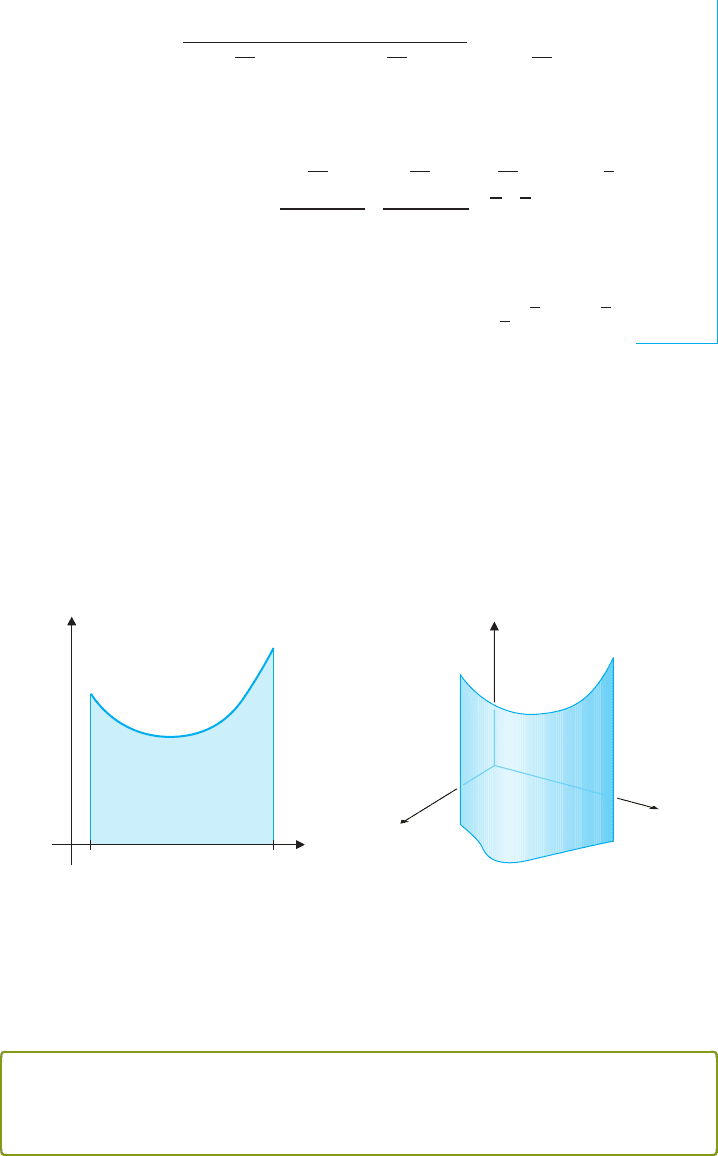
Next, we develop a geometric interpretation of the line integral. Recall that for
f (x) ≥ 0,
b
a
f (x) dx measures the area under the curve y = f (x) on the interval [a, b],
shaded in Figure 15.18a. Likewise, if f (x, y) ≥ 0,
C
f (x, y) ds measures the surface area
of the shaded surface indicated in Figure 15.18b. (Look at the sums defining the line inte-
gral to see why this makes sense.) In general,
b
a
f (x) dx measures signed area [positive if
f (x) > 0andnegativeif f (x) < 0]andthelineintegral
C
f (x, y) ds measuresthe(signed)
surface area of the surface formed by vertical segments from the xy-plane to the graph of
z = f (x, y).
y
a b
y f(x)
x
x
y
z
C
z f(x, y)
FIGURE 15.18a FIGURE 15.18b
b
a
f (x) dx
C
f (x, y)ds
Theorem2.3, whose proofweleaveasastraightforwardexercise,givessome geometric
significance to line integrals in both two and three dimensions.
THEOREM 2.3
For any piecewise-smooth curve C (in two or three dimensions),
C
1ds gives the arc
length of the curve C.
Recall that if a constant force f is exerted to move an object a distance d in a straight
line, the work done is given by W = f · d. In section 5.6, we extended this to a variable
force f (x) applied to an object as it moves in a straight line from x = a to x = b, where
the work done by the force is given by
W =
b
a
f (x) dx.

P1: OSO/OVY P2: OSO/OVY QC: OSO/OVY T1: OSO
MHDQ256-Ch15 MHDQ256-Smith-v1.cls January 6, 2011 10:53
LT (Late Transcendental)
CONFIRMING PAGES
996 CHAPTER 15
..
Vector Calculus 15-20
We now extend this idea to find the work done as an object moves along a curve in three
dimensions. Here, force vectors are given by the values of vector fields (force fields) and we
want to compute the work done on an object by a force field F(x, y, z), as the object moves
alongacurveC.WebeginbypartitioningthecurveC inton segmentsC
1
, C
2
,...,C
n
.Notice
that on each segment C
i
(i = 1, 2,...,n), if the segment is small and F is continuous, then
F will be nearly constant on C
i
and so, we can approximate F by its value at some point
(x
∗
i
, y
∗
i
, z
∗
i
)onC
i
. The work done along C
i
(call it W
i
) is then approximately the same as
the product of the component of the force F(x
∗
i
, y
∗
i
, z
∗
i
) in the direction of the unit tangent
vector T(x, y, z)toC at (x
∗
i
, y
∗
i
, z
∗
i
) and the distance traveled. That is,
W
i
≈ F(x
∗
i
, y
∗
i
, z
∗
i
) · T(x
∗
i
, y
∗
i
, z
∗
i
)s
i
,
where s
i
is the arc length of the segment C
i
.Now,ifC
i
can be represented parametrically
by x = x(t), y = y(t) and z = z(t), for a ≤ t ≤ b, and assuming that C
i
is smooth, we have
W
i
≈ F(x
∗
i
, y
∗
i
, z
∗
i
) · T(x
∗
i
, y
∗
i
, z
∗
i
)s
i
=
F(x
∗
i
, y
∗
i
, z
∗
i
) ·x
(t
∗
i
), y
(t
∗
i
), z
(t
∗
i
)
[x
(t
∗
i
)]
2
+ [y
(t
∗
i
)]
2
+ [z
(t
∗
i
)]
2
[x
(t
∗
i
)]
2
+ [y
(t
∗
i
)]
2
+ [z
(t
∗
i
)]
2
t
= F(x
∗
i
, y
∗
i
, z
∗
i
) ·x
(t
∗
i
), y
(t
∗
i
), z
(t
∗
i
)t,
where (x
∗
i
, y
∗
i
, z
∗
i
) = (x(t
∗
i
), y(t
∗
i
), z(t
∗
i
)). Next, if
F(x, y, z) =F
1
(x, y, z), F
2
(x, y, z), F
3
(x, y, z),
we have
W
i
≈F
1
(x
∗
i
, y
∗
i
, z
∗
i
), F
2
(x
∗
i
, y
∗
i
, z
∗
i
), F
3
(x
∗
i
, y
∗
i
, z
∗
i
)·x
(t
∗
i
), y
(t
∗
i
), z
(t
∗
i
)t.
Adding together the approximations of the work done over the various segments of C,we
have that the total work done is approximately
W ≈
n
i=1
F
1
(x
∗
i
, y
∗
i
, z
∗
i
), F
2
(x
∗
i
, y
∗
i
, z
∗
i
), F
3
(x
∗
i
, y
∗
i
, z
∗
i
)·x
(t
∗
i
), y
(t
∗
i
), z
(t
∗
i
)t.
Finally, taking the limit as the norm of the partition of C approaches zero, we arrive at
W = lim
P→0
n
i=1
F(x
∗
i
, y
∗
i
, z
∗
i
) ·x
(t
∗
i
), y
(t
∗
i
), z
(t
∗
i
)t
= lim
P→0
n
i=1
[F
1
(x
∗
i
, y
∗
i
, z
∗
i
)x
(t
∗
i
)t + F
2
(x
∗
i
, y
∗
i
, z
∗
i
)y
(t
∗
i
)t
+ F
3
(x
∗
i
, y
∗
i
, z
∗
i
)z
(t
∗
i
)t]
=
b
a
F
1
(x(t), y(t), z(t))x
(t) dt +
b
a
F
2
(x(t), y(t), z(t))y
(t) dt
+
b
a
F
3
(x(t), y(t), z(t))z
(t) dt. (2.7)
We now define line integrals corresponding to each of the three integrals in (2.7).
In Definition 2.2, the notation is the same as in Definition 2.1, with the added terms
x
i
= x
i
− x
i−1
, y
i
= y
i
− y
i−1
and z
i
= z
i
− z
i−1
.

P1: OSO/OVY P2: OSO/OVY QC: OSO/OVY T1: OSO
MHDQ256-Ch15 MHDQ256-Smith-v1.cls January 6, 2011 10:53
LT (Late Transcendental)
CONFIRMING PAGES
15-21 SECTION 15.2
..
Line Integrals 997
DEFINITION 2.2
The line integral of f (x, y, z) with respect to x along the oriented curve C in
three-dimensional space is defined by
C
f (x, y, z) dx = lim
P→0
n
i=1
f (x
∗
i
, y
∗
i
, z
∗
i
)x
i
,
provided the limit exists and is the same for all choices of evaluation points.
Likewise, we define the line integral of f (x, y, z) with respect to y along C by
C
f (x, y, z) dy = lim
P→0
n
i=1
f (x
∗
i
, y
∗
i
, z
∗
i
)y
i
and the line integral of f (x, y, z) with respect to z along C by
C
f (x, y, z) dz = lim
P→0
n
i=1
f (x
∗
i
, y
∗
i
, z
∗
i
)z
i
.
In each case, the line integral is defined whenever the corresponding limit exists and
is the same for all choices of evaluation points.
If we have a parametric representation of the curve C, then we can rewrite each
line integral as a definite integral. The proof of Theorem 2.4 is very similar to that of
Theorem 2.1 and we leave it as an exercise.
THEOREM 2.4 (Evaluation Theorem)
Suppose that f (x, y, z) is continuous in a region D containing the curve C and that C
is described parametrically by x = x(t), y = y(t) and z = z(t), where t ranges from
t = a to t = b and x(t), y(t) and z(t) have continuous first derivatives. Then,
C
f (x, y, z) dx =
b
a
f (x(t), y(t), z(t)) x
(t) dt,
C
f (x, y, z) dy =
b
a
f (x(t), y(t), z(t)) y
(t) dt and
C
f (x, y, z) dz =
b
a
f (x(t), y(t), z(t)) z
(t) dt.
Before returning to the calculation of work, we will examine some simpler examples.
Unlike line integrals with respect to arc length, we find in example 2.5 that line integrals
with respect to x, y or z change sign when the orientation of the curve changes.
EXAMPLE 2.5 Calculating a Line Integral in Space
Compute the line integral
C
(4xz + 2y)dx, where C is the line segment (a) from
(2, 1, 0) to (4, 0, 2) and (b) from (4, 0, 2) to (2, 1, 0).
Solution First, parametric equations for C for part (a) are
x = 2 + (4 − 2)t = 2 +2t,
y = 1 +(0 −1)t = 1 − t and
z = 0 +(2 −0)t = 2t,
P1: OSO/OVY P2: OSO/OVY QC: OSO/OVY T1: OSO
MHDQ256-Ch15 MHDQ256-Smith-v1.cls January 6, 2011 10:53
LT (Late Transcendental)
CONFIRMING PAGES
998 CHAPTER 15
..
Vector Calculus 15-22
for 0 ≤ t ≤ 1. The integrand is then
4xz + 2y = 4(2 +2t)(2t) + 2(1 − t) = 16t
2
+ 14t + 2
and the element dx is given by
dx = x
(t) dt = 2 dt.
From the Evaluation Theorem, the line integral is now given by
C
(4xz + 2y)dx =
1
0
(16t
2
+ 14t + 2)
4xz+2y
(2)dt
dx
=
86
3
.
For part (b), you can use the fact that the line segment connects the same two points as
in part (a), but in the opposite direction. The same parametric equations will then work,
with the single change that t will run from t = 1tot = 0. This gives us
C
(4xz + 2y)dx =
0
1
(16t
2
+ 14t + 2)(2)dt =−
86
3
,
where you should recall that reversing the limits of integration changes the sign of the
integral.
Theorem 2.5 corresponds to Theorem 2.2 for line integrals with respect to arc length,
but pay special attention to the minus sign in part (i). We state the result for line integrals
with respect to x, with corresponding results holding true for line integrals with respect to
y or z, as well. We leave the proof as an exercise.
THEOREM 2.5
Suppose that f (x, y, z) is a continuous function in some region D containing the
oriented curve C. Then, the following hold.
(i) If C is piecewise-smooth, then
−C
f (x, y, z) dx =−
C
f (x, y, z) dx.
(ii) If C = C
1
∪C
2
∪···∪C
n
, where C
1
, C
2
,...,C
n
are all smooth and the
terminal point of C
i
is the same as the initial point of C
i+1
, for i = 1, 2,...,
n − 1, then
C
f (x, y, z) dx =
C
1
f (x, y, z) dx +
C
2
f (x, y, z) dx +···+
C
n
f (x, y, z) dx.
NOTES
As a convenience, we will usually
write
C
f (x, y, z) dx +
C
g(x, y, z) dy
+
C
h(x, y, z) dz
=
C
f (x, y, z) dx + g(x, y, z)dy
+h(x, y, z) dz.
Line integrals with respect to x, y and z can be very simple when the curve C consists
of line segments parallel to the coordinate axes, as we see in example 2.6.
EXAMPLE 2.6 Calculating a Line Integral in Space
Compute
C
4xdy+ 2ydz, where C consists of the line segment from (0, 1, 0) to
(0, 1, 1), followed by the line segment from (0, 1, 1) to (2, 1, 1) and followed by the line
segment from (2, 1, 1) to (2, 4, 1).
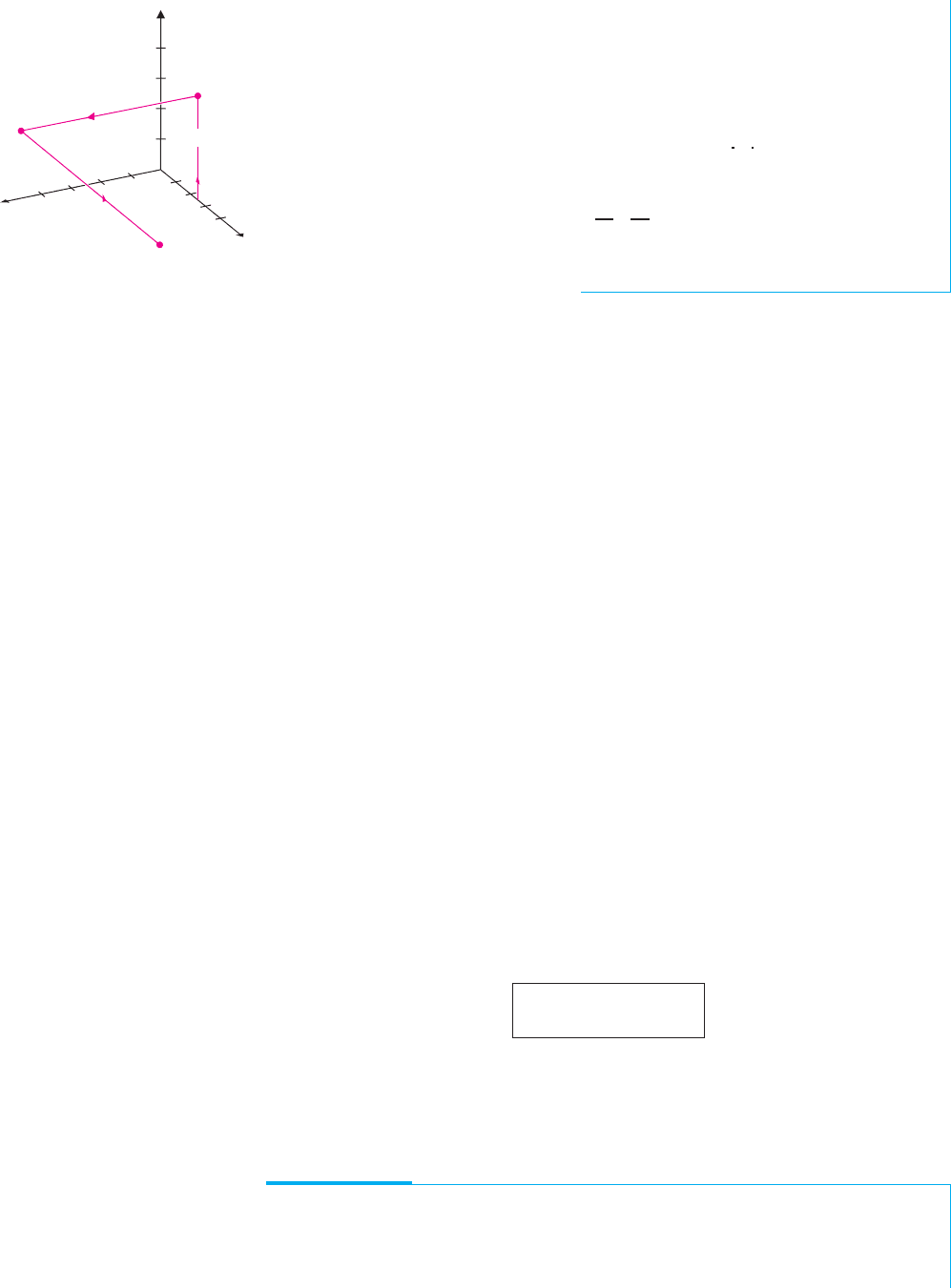
Solution We show a sketch of the curves in Figure 15.19. Parametric equations for
the first segment C
1
are x = 0, y = 1 and z = t with 0 ≤ t ≤ 1. On this segment, we
have dy = 0 dt and dz = 1 dt. On the second segment C
2
, parametric equations are
x = 2t, y = 1 and z = 1 with 0 ≤ t ≤ 1. On this segment, we have dy = dz = 0 dt.
On the third segment, parametric equations are x = 2, y = 3t +1 and z = 1 with
P1: OSO/OVY P2: OSO/OVY QC: OSO/OVY T1: OSO
MHDQ256-Ch15 MHDQ256-Smith-v1.cls January 6, 2011 10:53
LT (Late Transcendental)
CONFIRMING PAGES
15-23 SECTION 15.2
..
Line Integrals 999
0 ≤ t ≤ 1. On this segment, we have dy = 3 dt and dz = 0 dt. Putting this all together,
we have
C
4xdy+ 2ydz=
C
1
4xdy+ 2ydz+
C
2
4xdy+ 2ydz+
C
3
4xdy+ 2ydz
=
1
0
[4(0)
4x
(0)
y
(t)
+ 2(1)
2y
(1)
z
(t)
]dt +
1
0
[4(2t)
4x
(0)
y
(t)
+ 2(1)
2y
(0)
z
(t)
]dt
+
1
0
[4(2)
4x
(3)
y
(t)
+2(3t + 1)
2y
(0)
z
(t)
]dt
=
1
0
26dt = 26.
x
y
z
(2, 1, 1)
(2, 4, 1)
C
1
C
2
O
C
3
(0, 1, 1)
FIGURE 15.19
The path C
Notice that a line integral will be zero if the integrand simplifies to 0 or if the variable
of integration is constant along the curve. For instance, if z is constant on some curve, then
the change in z (given by dz) will be 0 on that curve.
Recall that our motivation for introducing line integrals with respect to the three
coordinate variables was to compute the work done by a force field while mov-
ing an object along a curve. From (2.7), the work performed by the force field
F(x, y, z) =F
1
(x, y, z), F
2
(x, y, z), F
3
(x, y, z) along the curve defined parametrically
by x = x(t), y = y(t), z = z(t), for a ≤ t ≤ b,isgivenby
W =
b
a
F
1
(x(t), y(t), z(t))x
(t) dt +
b
a
F
2
(x(t), y(t), z(t))y
(t) dt
+
b
a
F
3
(x(t), y(t), z(t))z
(t) dt,
which we can rewrite using Theorem 2.4, to obtain
W =
C
F
1
(x, y, z)dx +
C
F
2
(x, y, z)dy +
C
F
3
(x, y, z)dz.
Since we use r = xi + yj + zk, we define
dr = dxi + dyj +dzk or dr =dx, dy, dz.
For a vector field F(x, y, z) =F
1
(x, y, z), F
2
(x, y, z), F
3
(x, y, z), we now define the line
integral
C
F(x, y, z)·dr =
C
F
1
(x, y, z)dx + F
2
(x, y, z)dy + F
3
(x, y, z)dz
=
C
F
1
(x, y, z)dx +
C
F
2
(x, y, z)dy +
C
F
3
(x, y, z)dz.
In the case where F(x, y, z) is a force field, the work done by F in moving a particle along
the curve C can be written simply as
W =
C
F(x, y, z) ·dr. (2.8)
Notice how the different parts of
C
F(x, y, z) ·dr correspond to our knowledge of work.
The only way in which the x-component of force affects the work done is when the object
movesinthex-direction(i.e.,whendx = 0).Similarly,they-componentof forcecontributes
to the work only when dy = 0 and the z-component of force contributes to the work only
when dz = 0.
EXAMPLE 2.7 Computing Work
Compute the work done by the force field F(x, y, z) =4y, 2xz, 3y acting on an object
as it moves along the helix defined parametrically by x = 2 cost, y = 2sint and
z = 3t, from the point (2, 0, 0) to the point (−2, 0, 3π ).
P1: OSO/OVY P2: OSO/OVY QC: OSO/OVY T1: OSO
MHDQ256-Ch15 MHDQ256-Smith-v1.cls January 6, 2011 10:53
LT (Late Transcendental)
CONFIRMING PAGES
1000 CHAPTER 15
..
Vector Calculus 15-24
Solution From (2.8), the work is given by
W =
C
F(x, y, z)·dr =
C
4ydx+ 2xzdy + 3ydz.
We have already provided parametric equations for the curve, but not the range of
t-values. Notice that (2, 0, 0) corresponds to t = 0 and (−2, 0, 3π) corresponds to
t = π. Substituting in for x, y, z and dx =−2sintdt, dy = 2costdtand dz = 3dt,
we have
W =
C
4ydx+ 2xzdy + 3ydz
=
π
0
[4(2sin t)
4y
(−2sin t)
x
(t)
+ 2(2cos t)(3t)
2xz
(2cos t)
y
(t)
+ 3(2sin t)
3y
(3)
z
(t)
]dt
=
π
0
(−16sin
2
t +24t cos
2
t +18sint)dt = 36 −8π +6π
2
,
where the details of the integration are left to the reader.
4
4 20 2 4
2
0
2
4
y
x
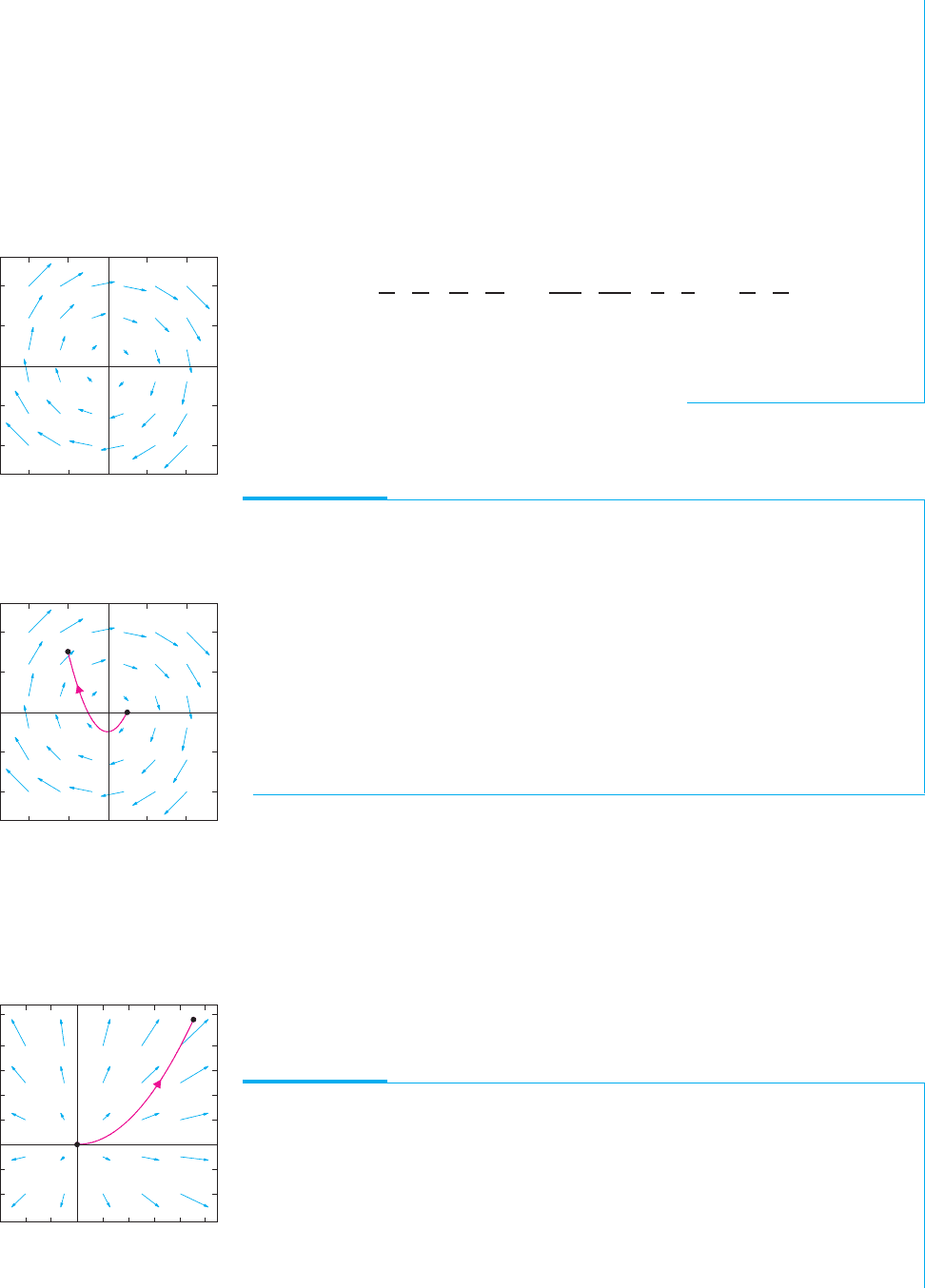
FIGURE 15.20
F(x, y) =y, −x
4
4 20 2 4
2
0
2
4
y
x
FIGURE 15.21
F(x, y) =y, −x and
x = t, y = t
2
− 1, −2 ≤ t ≤ 1
We compute the work performed by a two-dimensional vector field in the same way as
we did in three dimensions, as we illustrate in example 2.8.
EXAMPLE 2.8 Computing Work
Compute the work done by the force field F(x, y) =y, −x acting on an object as it
moves along the parabola y = x
2
− 1 from (1, 0) to (−2, 3).
Solution From (2.8), the work is given by
W =
C
F(x, y) ·dr =
C
ydx− xdy.
Here, we use x = t and y = t
2
− 1 as parametric equations for the curve, with t ranging
from t = 1tot =−2. In this case, dx = 1 dt and dy = 2tdtand the work is
W =
C
ydx− xdy=
−2
1
[(t
2
− 1)(1) −(t)(2t)]dt =
−2
1
(−t
2
− 1) dt = 6.
A careful look at example 2.8 graphically will show us an important geometric in-
terpretation of the work line integral. A computer-generated graph of the vector field
F(x, y) =y, −x is shown in Figure 15.20. Thinking of F(x, y) as describing the ve-
locity field for a fluid in motion, notice that the fluid is rotating clockwise. In Figure 15.21,
we superimpose the curve x = t, y = t
2
− 1, −2 ≤ t ≤ 1, onto the vector field F(x, y).
Notice that an object moving along the curve from (1, 0) to (−2, 3) is generally moving in
the same direction as that indicated by the vectors in the vector field. If F(x, y) represents a
forcefield,thenthe force pushes an object movingalong C, adding energyto itandtherefore
doing positive work. If the curve were oriented in the opposite direction, the force would
oppose the motion of the object, thereby doing negative work.
EXAMPLE 2.9 Determining the Sign of a Line Integral Graphically
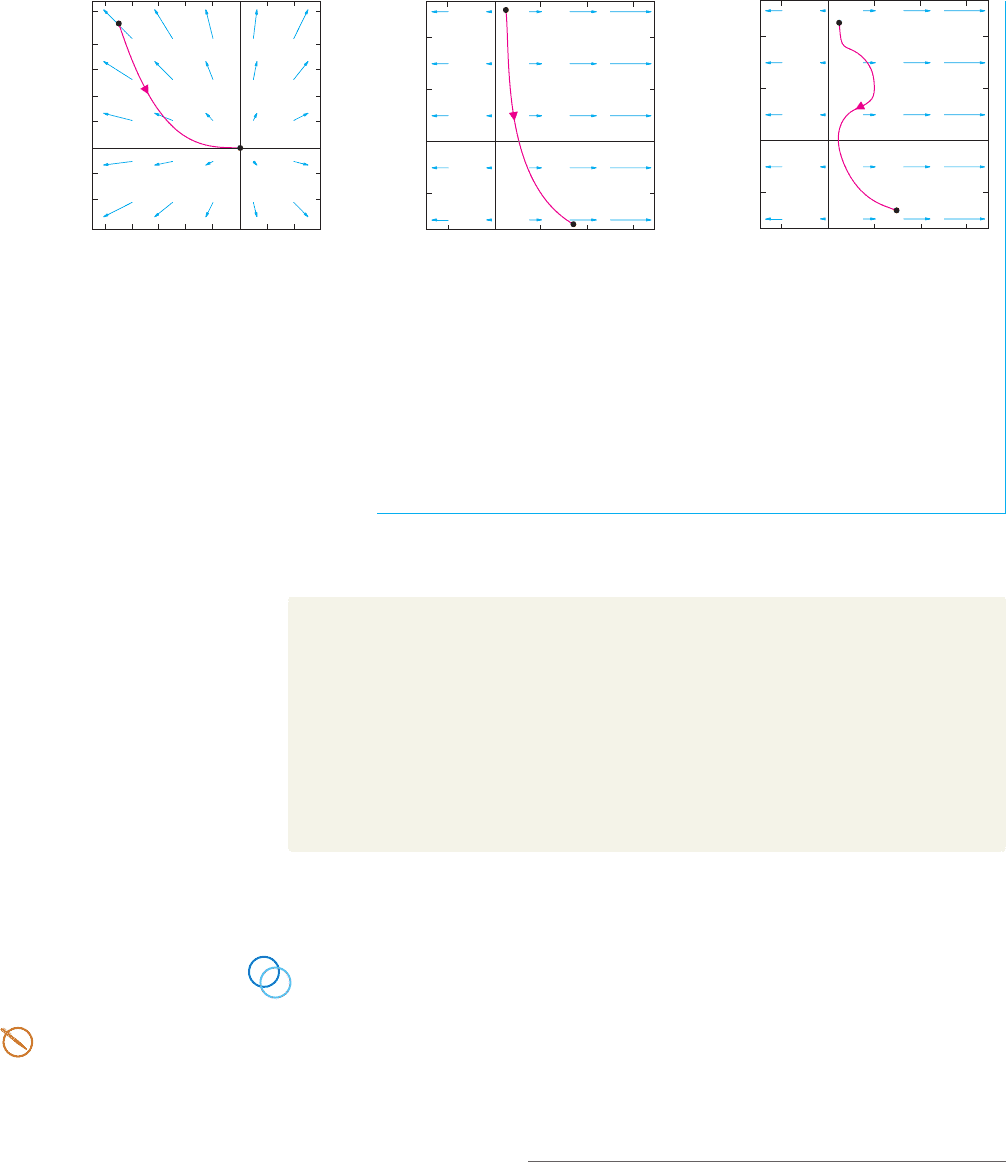
In each of the following graphs, an oriented curve is superimposed onto a vector field
F(x, y). Determine whether
C
F(x, y) ·dr is positive or negative.
2
2 1012345
1
0
1
2
3
4
5
y
x
FIGURE A
Solution In Figure A, the curve is oriented in the same direction as the vectors, so
the force is making a positive contribution to the object’s motion. The work done by the
force is then positive. In Figure B, the curve is oriented in the opposite direction as
the vectors, so that the force is making a negative contribution to the object’s motion.
The work done by the force is then negative. In Figure C, the force field vectors are purely
P1: OSO/OVY P2: OSO/OVY QC: OSO/OVY T1: OSO
MHDQ256-Ch15 MHDQ256-Smith-v1.cls January 6, 2011 10:53
LT (Late Transcendental)
CONFIRMING PAGES
15-25 SECTION 15.2
..
Line Integrals 1001
2
5 4 3 2 10 1 2
1
0
1
2
3
4
5
y
x
20 2 4 6
2
0
2
4
y
x
20 2 4 6
2
0
2
4
y
x
FIGURE B FIGURE C FIGURE D
horizontal. Since both the curve and the force vectors point to the right, the work is
positive. Finally, in Figure D, the force field is the same as in Figure C, but the curve is
more complicated. Since the force vectors are horizontal and do not depend on y, the
work done as the object moves to the right is exactly canceled when the object doubles
back to the left. Comparing the initial and terminal points, the object has made a net
movement to the right (the same direction as the vector field), so that the work done is
positive.
BEYOND FORMULAS
Several different line integrals are defined in this section. To keep them straight, always
think of dx as an increment (small change) in x, dy as an increment in y and so on. In
particular, ds represents an increment in arc length (distance) along the curve, which
is why the arc length formula plays a role in the Evaluation Theorem. In applications,
the dx, dy and dz line integrals are useful when the quantity being measured (such as
a force) can be broken down into separate x, y and z components. By contrast, the ds
line integral is applied to the measurement of a quantity as we move along the curve
in three dimensions.
EXERCISES 15.2
WRITING EXERCISES
1. It is important to understand why
C
fds=
−C
fds. Think
of f as being a density function and the line integral as giv-
ing the mass of an object. Explain why the integrals must be
equal.
2. Forexample2.3,part(a),adifferentset ofparametricequations
is x =−t and y = t
2
, with t running from t = 1tot =−2. In
light of the Evaluation Theorem, explain why we couldn’t use
these parametric equations.
3. Explain in words why Theorem 2.5(i) is true. In particular,
explain in terms of approximating sums why the integrals in
Theorem 2.5(i) have opposite signs but the integrals in Theo-
rem 2.2(i) are the same.
4. In example 2.9, we noted that the force vectors in Figure D are
horizontal and independent of y. Explain why this allows us to
ignore the vertical component of the curve. Also, explain why
the work would be the same for any curve with the same initial
and terminal points.
In exercises 1–14, evaluate the line integral
C
fds.
1. f (x, y) = 2x, C is the line segment from (1, 2) to (3, 5)
2. f (x, y) = 2xy, C is the line segment from (1, 2) to (−1, 0)
3. f (x, y, z) = 4z, C is the line segment from (1, 0, 1) to
(2, −2, 2)
P1: OSO/OVY P2: OSO/OVY QC: OSO/OVY T1: OSO
MHDQ256-Ch15 MHDQ256-Smith-v1.cls January 6, 2011 10:53
LT (Late Transcendental)
CONFIRMING PAGES
1002 CHAPTER 15
..
Vector Calculus 15-26
4. f (x, y, z) = xz, C is the line segment from (2, 1, 0) to
(2, 0, 2)
5. f (x, y) = 3x, C is the quarter-circle x
2
+ y
2
= 4 from (2, 0)
to (0, 2)
6. f (x, y) = 3x − y, C is the quarter-circle x
2
+ y
2
= 9 from
(0, 3) to (3, 0)
7. f (x, y) = 3xy, C is the portion of y = x
2
from (0, 0) to (2, 4)
8. f (x, y) = 2x, C is the portion of y = x
2
from (−2, 4) to (2, 4)
9. f (x, y) = 3x, C is the line segment from (0, 0) to (1, 0), fol-
lowed by the quarter-circle to (0, 1)
10. f (x, y) = 2y, C is the portion of y = x
2
from (0, 0) to
(2, 4), followed by the line segment to (3, 0)
11. f (x, y, z) = xz, C is the portion of y = x
2
in the plane z = 2
from (1, 1, 2) to (2, 4, 2).
12. f (x, y, z) = z, C is the intersection of x
2
+ y
2
= 4 and z = 0
(oriented clockwise as viewed from above)
13. f (x, y, z) = xy, C is the intersection of x
2
+ y
2
= 4 with
x + z = 4 (oriented clockwise as viewed from above)
14. f (x, y, z) = xz
2
, C is the intersection of x
2
+ y
2
+ z
2
= 4
with z = y + 2 (oriented clockwise as viewed from above)
............................................................
In exercises 15–28, evaluate the line integral.
15.
C
2xe
x
dx, where C is the line segment from (0, 2) to (2, 6)
16.
C
4y
1 + y
2
dy, where C is the line segment from (2, 0) to
(1, 3)
17.
C
2ydx, where C is the quarter-circle x
2
+ y
2
= 4 from (2, 0)
to (0, 2)
18.
C
3xydy, where C is the quarter-circle x
2
+ y
2
= 4 from
(0, 2) to (−2, 0)
19.
C
3y
2
dx, where C is the half-ellipse x
2
+ 4y
2
= 4 from (0,
1) to (0, −1) with x ≥ 0
20.
C
(4x
2
+ y
2
)dy, where C is the ellipse 4x
2
+ y
2
= 4 oriented
counterclockwise
21.
C
4x
2
+ ydx, where C is the portion of y = x
2
from (2, 4)
to (0, 0)
22.
C
4x
2
+ ydy, where C is the portion of y = x
2
from (2, 4)
to (0, 0)
23.
C
(e
√
x−2y
)dy, where C is the portion of x = y
2
from (1, 1) to
(4, 2)
24.
C
[3y + sin(x + 2)]dx, where C is the portion of x = y
2
from
(1, 1) to (1, −1)
25.
C
sin(x
2
+ z) dy,where C is theportion of y = x
2
inthe plane
z = 2 from (1, 1, 2) to (2, 4, 2)
26.
C
(2y
2
+ e
x
2
+y
2
)dx, C is the intersection of x
2
+ y
2
= 4 and
z = 0 (oriented clockwise as viewed from above)
27.
C
(x
2
+ y
4
)dy, C is the portion of y = e
x
from (0, 1) to
(2, e
2
)
28.
C
(x
2
+ 1)dy, C is the portion of y = tan
−1
x from (0, 0) to
(1, π/4).
............................................................
In exercises 29–36, compute the work done by the force field F
along the curve C.
29. F(x, y) =2x, 2y, C is the line segment from (3, 1) to (5, 4)
30. F(x, y) =2y, −2x, C is the line segmentfrom(4, 2) to (0, 4)
31. F(x, y) =y
2
+ x, y
2
+ 2, C is the quarter-circle from (4, 0)
to (0, 4)
32. F(x, y) =2y + x
2
, x
2
− 2x, C is the upper half-circle from
(−3, 0) to (3, 0)
33. F(x, y) =xe
y
, e
x
+ y
2
, C is the portion of y = x
2
from
(0, 0) to (1, 1)
34. F(x, y) =x
2
e
y
, ye
x
, C is the portion of y = x
3
from (0, 0)
to (1, 1)
35. F(x, y, z) =y, 0, z, C is the triangle from (0, 0, 0) to
(2, 1, 2) to (2, 1, 0) to (0, 0, 0)
36. F(x, y, z) =xy, 3z, 1, C is the helix x = cost, y = sin t,
z = 2t from (1, 0, 0) to (0, 1,π)
............................................................
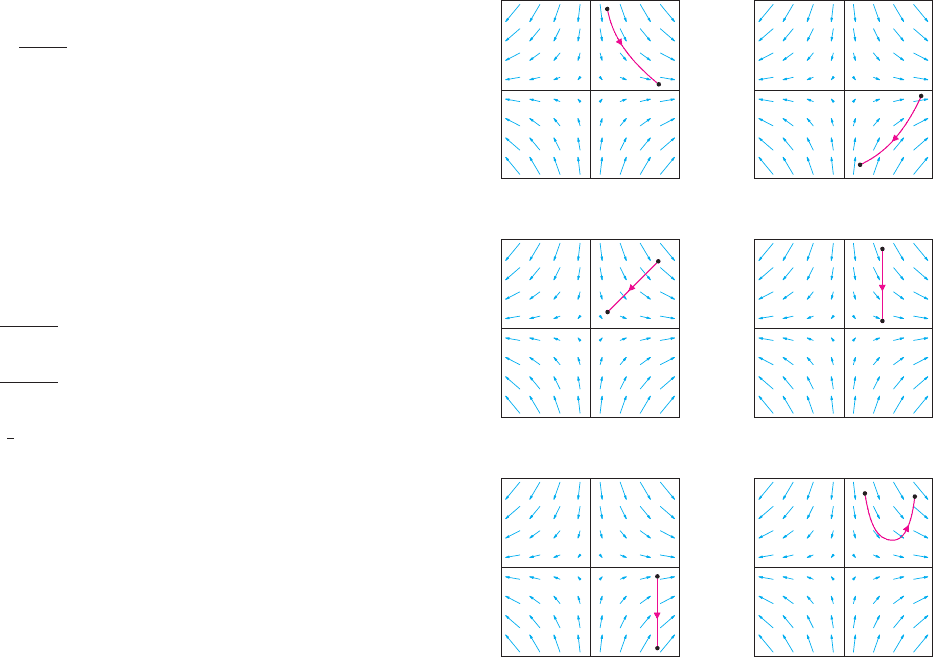
In exercises37–42, use the graph to determine whether the work
done is positive, negative or zero.
37.
y
x
38.
x
y
39.
x
y
40.
x
y
41.
x
y
42.
x
y
............................................................