
Smith R., Minton R. Calculus
Подождите немного. Документ загружается.


P1: OSO/OVY P2: OSO/OVY QC: OSO/OVY T1: OSO
MHDQ256-Ch15 MHDQ256-Smith-v1.cls January 6, 2011 10:53
LT (Late Transcendental)
CONFIRMING PAGES
15-37 SECTION 15.3
..
Independence of Path and Conservative Vector Fields 1013
43. If F is conservative, then
C
F · dr = 0 for any closed curve C.
44. If F is conservative, then
C
F · dr is independent of path.
............................................................
45. Let F(x, y) =
1
x
2
+ y
2
−y, x. Find a potential function f for
F and carefully note any restrictions on the domain of f. Let C
be the unit circle and show that
C
F · dr = 2π. Explain why
the Fundamental Theorem for Line Integrals does not apply
to this calculation. Quickly explain how to compute
C
F · dr
over the circle (x − 2)
2
+ (y − 3)
2
= 1.
46. Finish the proof of Theorem 3.3 by showing that if F is
conservative in an open, connected region D ⊂ R
2
, then
C
F · dr = 0 for all piecewise-smooth closed curves C lying
in D.
47. Determine whether or not each region is simply-connected.
(a) {(x, y): x
2
+ y
2
< 2} (b) {(x, y): 1 < x
2
+ y
2
< 2}
48. Determine whether or not each region is simply-connected.
(a) {(x, y): 1 < x < 2} (b) {(x, y): 1 < x
2
< 2}
APPLICATIONS
49. The Coulomb force for a unit charge at the origin and charge q
at point P
1
=(x
1
, y
1
, z
1
)isF=
kq
r
2
ˆ
r, where r =
x
2
+y
2
+z
2
and
ˆ
r =
x, y, z
r
. Show that the work done by F to move the
charge q from P
1
to P
2
= (x
2
, y
2
, z
2
) is equal to
kq
r
1
−
kq
r
2
,
where r
1
=
x
2
1
+ y
2
1
+ z
2
1
and r
2
=
x
2
2
+ y
2
2
+ z
2
2
.
50. Interpret the result of exercise 49 in the case where (a) P
1
is
closer to the origin than P
2
. (Is the work positive or negative?
Why does this make sense physically?) (b) P
2
is closer to the
origin than P
1
and (c) P
1
and P
2
are the same distance from
the origin.
51. The work done to increase the temperature of a gas from T
1
to T
2
and increase its pressure from P
1
to P
2
is given by
C
RT
P
dP − RdT
. Here, R is a constant, T is tempera-
ture, P is pressure and C is the path of (P, T ) values as the
changes occur. Compare the work done along the following
two paths. (a) C
1
consists of the line segment from (P
1
, T
1
)
to (P
1
, T
2
), followed by the line segment to (P
2
, T
2
); (b) C
2
consists of the line segment from (P
1
, T
1
)to(P
2
, T
1
), followed
by the line segment to (P
2
, T
2
).
52. Based on your answers in exercise 51, is the force field in-
volved in changing the temperature and pressure of the gas
conservative?
53. A vector field F satisfies F =∇φ (where φ is continuous) at
every point except P, where it is undefined. Suppose that C
1
is a small closed curve enclosing P, C
2
is a large closed curve
enclosing C
1
and C
3
is a closed curve that does not enclose P.
(See the figure.) Given that
C
1
F · dr = 0, explain why
C
2
F ·
dr =
C
3
F · dr = 0.
P
C
2
C
3
C
1
54. The circulation of a fluid with velocity field v around the
closed path C is defined by =
C
v · dr. For inviscid flow,
d
dt
=
C
v · dv. Show that in this case
d
dt
= 0. This is
known as Kelvin’s Circulation Theorem and explains why
small whirlpools in a stream stay coherent and move for peri-
ods of time.
EXPLORATORY EXERCISES
1. For closed curves, we can take advantage of portions of a line
integralthat will equalzero.Forexample,if C is a closedcurve,
explain why you can simplify
C
(x + y
2
)dx + (y
2
+ x)dy
to
C
y
2
dx + xdy. In general, explain why the f (x)
and g(y) terms can be dropped in the line integral
C
( f (x) + y
2
)dx + (x + g(y)) dy. Describe which other
terms can be dropped in the line integral over a closed curve.
Use the example
C
(x
3
+ y
2
+ x
2
y
2
+ cos y)dx
+(y
2
+ 2xy − x sin y + x
3
y)dy
to help organize your thinking.
2. In this exercise, we explore a basic principle of physics called
conservation of energy. Start with the work integral
C
F · dr,
wherethepositionfunctionr(t)isacontinuouslydifferentiable
function of time. Substitute Newton’s second law: F = m
dv
dt
and dr = r
(t) dt = v dt and show that
C
F · dr = K . Here,
K is kinetic energy defined by K =
1
2
mv
2
and K is the
change of kinetic energy from the initial point of C to the ter-
minal point of C. Next, assume that F is conservative with
F =−∇f , where the function f represents potential energy.
Show that
C
F · dr =− f where f equals the change in
potentialenergyfrom the initial point of C to the terminal point
ofC.Concludethatunderthesehypotheses(conservativeforce,
continuous acceleration) the net change in energy K + f
equals 0. Therefore, K + f is constant.
P1: OSO/OVY P2: OSO/OVY QC: OSO/OVY T1: OSO
MHDQ256-Ch15 MHDQ256-Smith-v1.cls January 6, 2011 10:53
LT (Late Transcendental)
CONFIRMING PAGES
1014 CHAPTER 15
..
Vector Calculus 15-38
15.4 GREEN’S THEOREM
HISTORICAL
NOTES
George Green (1793–1841)
English mathematician who
discovered Green’s Theorem.
Green was self-taught, receiving
only two years of schooling before
going to work in his father’s
bakery at age 9. He continued to
work in and eventually took over
the family mill while teaching
himself mathematics. In 1828, he
published an essay in which he
gave potential functions their
name and applied them to the
study of electricity and
magnetism. This little-read essay
introduced Green’s Theorem and
the so-called Green’s functions
used in the study of partial
differential equations. Green was
admitted to Cambridge University
at age 40 and published several
papers before his early death
from illness. The significance of his
original essay remained unknown
until shortly after his death.
Inthis section, wedevelop a connection between certain line integralsaround a closed curve
in the plane and double integrals over the region enclosed by the curve. At first glance, you
might think this a strange and abstract connection, one that only a mathematician could care
about. Actually,the reverseis true; Green’s Theorem is a significant result with far-reaching
implications.It is of fundamentalimportanceintheanalysis of fluid flowsandinthetheories
of electricity and magnetism.
Before stating the main result, we briefly define some terminology. Recall that for a
plane curve C defined parametrically by
C ={(x, y)|x = g(t), y = h(t), a ≤ t ≤ b},
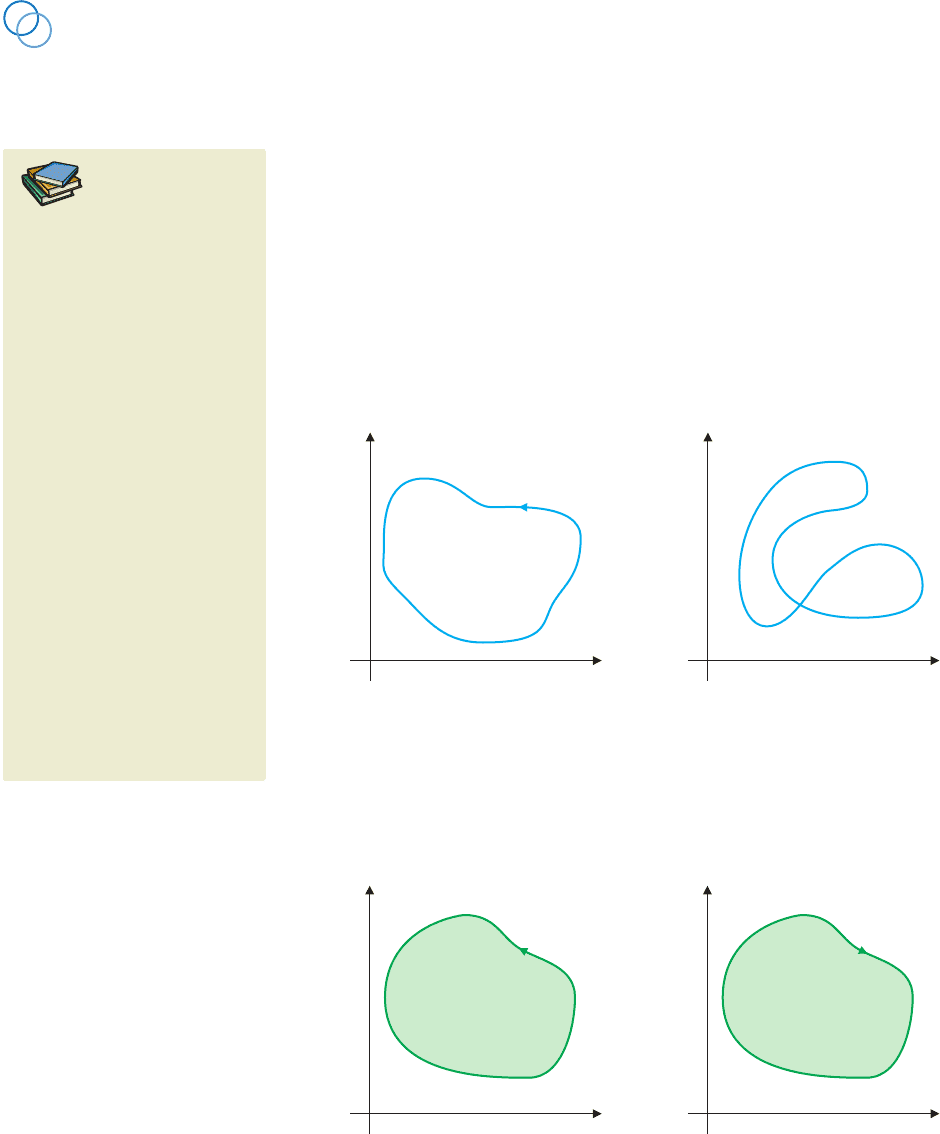
C is closed if its two endpoints are the same, i.e., (g(a), h(a)) = (g(b), h(b)). A curve C is
simple if it does not intersect itself, except at the endpoints. We illustrate a simple closed
curve in Figure 15.28a and a closed curve that is not simple in Figure 15.28b.
y
x
C
y
x
C
FIGURE 15.28a FIGURE 15.28b
Simple closed curve Closed, but not simple curve
We say that a simple closed curve C has positive orientation if the region R enclosed by C
stays to the left of C, as the curve is traversed (as in Figure 15.29a). A curve has negative
orientation if the region R stays to the right of C (as in Figure 15.29b).
y
x
C
R
y
x
C
R
FIGURE 15.29a FIGURE 15.29b
Positive orientation Negative orientation
We use the notation
C
F(x, y) ·dr
to denote a line integral along a simple closed curve C oriented in the positive direction.
We can now state the main result of the section.
P1: OSO/OVY P2: OSO/OVY QC: OSO/OVY T1: OSO
MHDQ256-Ch15 MHDQ256-Smith-v1.cls January 6, 2011 10:53
LT (Late Transcendental)
CONFIRMING PAGES
15-39 SECTION 15.4
..
Green’s Theorem 1015
THEOREM 4.1 (Green’s Theorem)
Let C be a piecewise-smooth, simple closed curve in the plane with positive
orientation and let R be the region enclosed by C, together with C. Suppose that
M(x, y) and N(x, y) are continuous and have continuous first partial derivatives in
some open region D, with R ⊂ D. Then,
C
M(x, y)dx + N(x, y)dy =
R
∂ N
∂x
−
∂ M
∂y
dA.
You can find a general proof of Green’s Theorem in a more advanced text. We prove it
here only for a special case.
y
a b
x
A
R
B
C
2
: y g
2
(x)
C
1
: y g
1
(x)
FIGURE 15.30a
The region R
PROOF
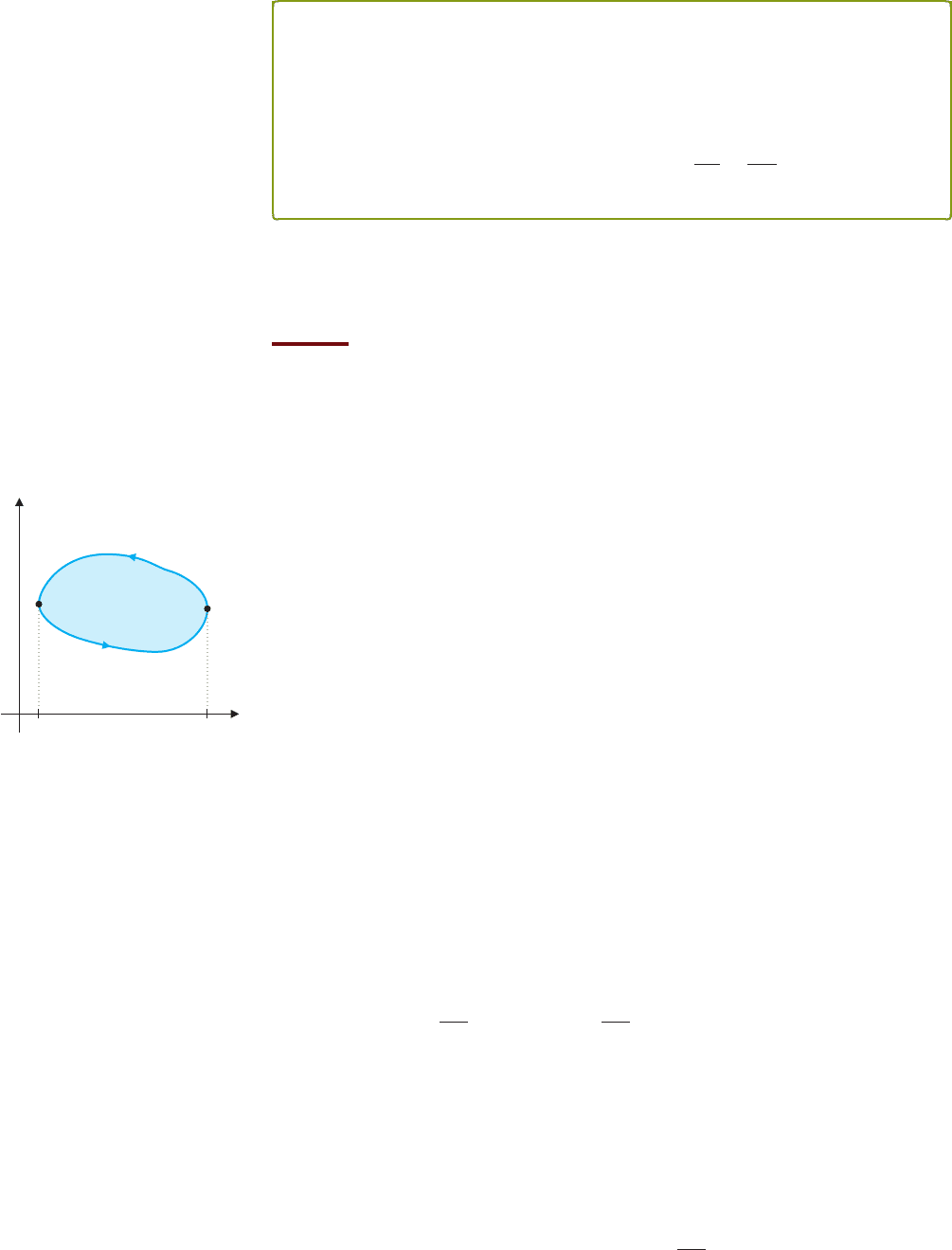
Here, we assume that the region R can be written in the form
R ={(x, y)|a ≤ x ≤ b and g
1
(x) ≤ y ≤ g
2
(x)},
where g
1
(x) ≤ g
2
(x), for all x in [a, b], g
1
(a) = g
2
(a) and g
1
(b) = g
2
(b), as illustrated in
Figure 15.30a. Notice that we can divide C into the two pieces indicated in Figure 15.30a:
C = C
1
∪C
2
,
where C
1
is the bottom portion of the curve, defined by
C
1
={(x, y)|a ≤ x ≤ b, y = g
1
(x)}
and C
2
is the top portion of the curve, defined by
C
2
={(x, y)|a ≤ x ≤ b, y = g
2
(x)},
where the orientation is as indicated in the figure. From the Evaluation Theorem for line
integrals (Theorem 2.4), we then have
C
M(x, y)dx =
C
1
M(x, y)dx +
C
2
M(x, y)dx
=
b
a
M(x, g
1
(x))dx −
b
a
M(x, g
2
(x))dx
=
b
a
[M(x, g
1
(x)) − M(x, g
2
(x))]dx, (4.1)
where the minus sign in front of the second integral comes from our traversing C
2
“back-
ward” (i.e., from right to left). On the other hand, notice that we can write
R
∂ M
∂y
dA =
b
a
g
2
(x)
g
1
(x)
∂ M
∂y
dydx
=
b
a
M(x, y)
y=g
2
(x)
y=g
1
(x)
dx
By the Fundamental
Theorem of Calculus
=
b
a
[M(x, g
2
(x)) − M(x, g
1
(x))]dx.
Together with (4.1), this gives us
C
M(x, y)dx =−
R
∂ M
∂y
dA. (4.2)
P1: OSO/OVY P2: OSO/OVY QC: OSO/OVY T1: OSO
MHDQ256-Ch15 MHDQ256-Smith-v1.cls January 6, 2011 10:53
LT (Late Transcendental)
CONFIRMING PAGES
1016 CHAPTER 15
..
Vector Calculus 15-40
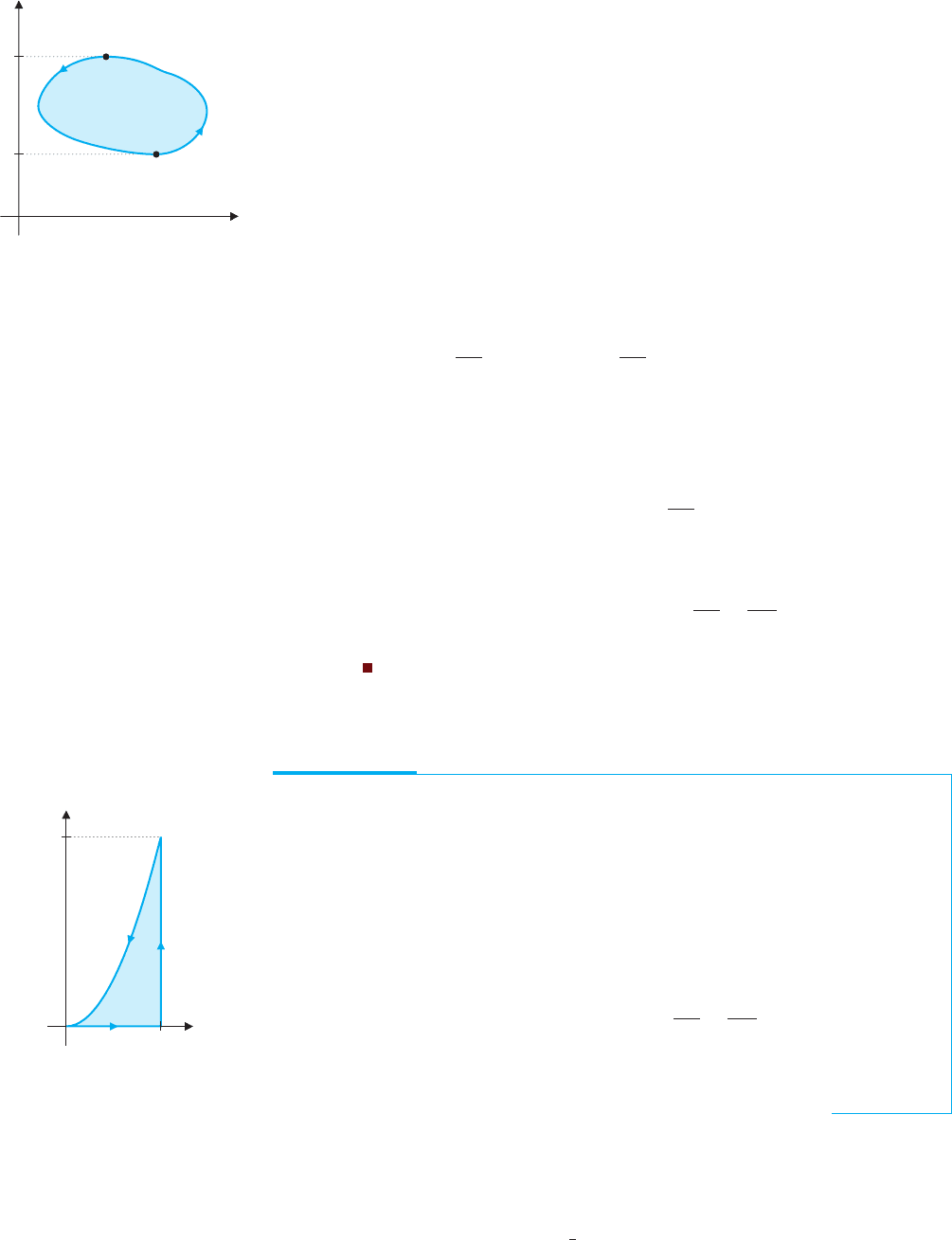
We now assume that we can also write the region R in the form
R ={(x, y)|c ≤ y ≤ d and h
1
(y) ≤ x ≤ h
2
(y)},
y
x
E
R
D
C
4
: x h
2
(y)
C
3
: x h
1
(y)
c
d
FIGURE 15.30b
The region R
where h
1
(y) ≤ h
2
(y) for all y in [c, d], h
1
(c) = h
2
(c) and h
1
(d) = h
2
(d). Here, we write
C = C
3
∪C
4
, as illustrated in Figure 15.30b. In this case, notice that we can write
C
N(x, y)dy =
C
3
N(x, y)dy +
C
4
N(x, y)dy
=−
d
c
N(h
1
(y), y) dy +
d
c
N(h
2
(y), y) dy
=
d
c
[N(h
2
(y), y) − N(h
1
(y), y)] dy, (4.3)
where the minus sign in front of the first integral accounts for our traversing C
3
“backward”
(in this case, from top to bottom). Further, notice that
R
∂ N
∂x
dA =
d
c
h
2
(y)
h
1
(y)
∂ N
∂x
dx dy
=
d
c
[N(h
2
(y), y) − N(h
1
(y), y)] dy.
Together with (4.3), this gives us
C
N(x, y)dy =
R
∂ N
∂x
dA. (4.4)
Adding together (4.2) and (4.4), we have
C
M(x, y)dx + N(x, y)dy =
R
∂ N
∂x
−
∂ M
∂y
dA,
as desired.
AlthoughthesignificanceofGreen’sTheoremliesintheconnectionitprovidesbetween
line integrals and double integrals in more theoretical settings, we illustrate the result in
example 4.1 by using it to simplify the calculation of a line integral.
EXAMPLE 4.1 Using Green’s Theorem
Use Green’s Theorem to rewrite and evaluate
C
(x
2
+ y
3
)dx +3xy
2
dy, where C
consists of the portion of y = x
2
from (2, 4) to (0, 0), followed by the line segments
from (0, 0) to (2, 0) and from (2, 0) to (2, 4).
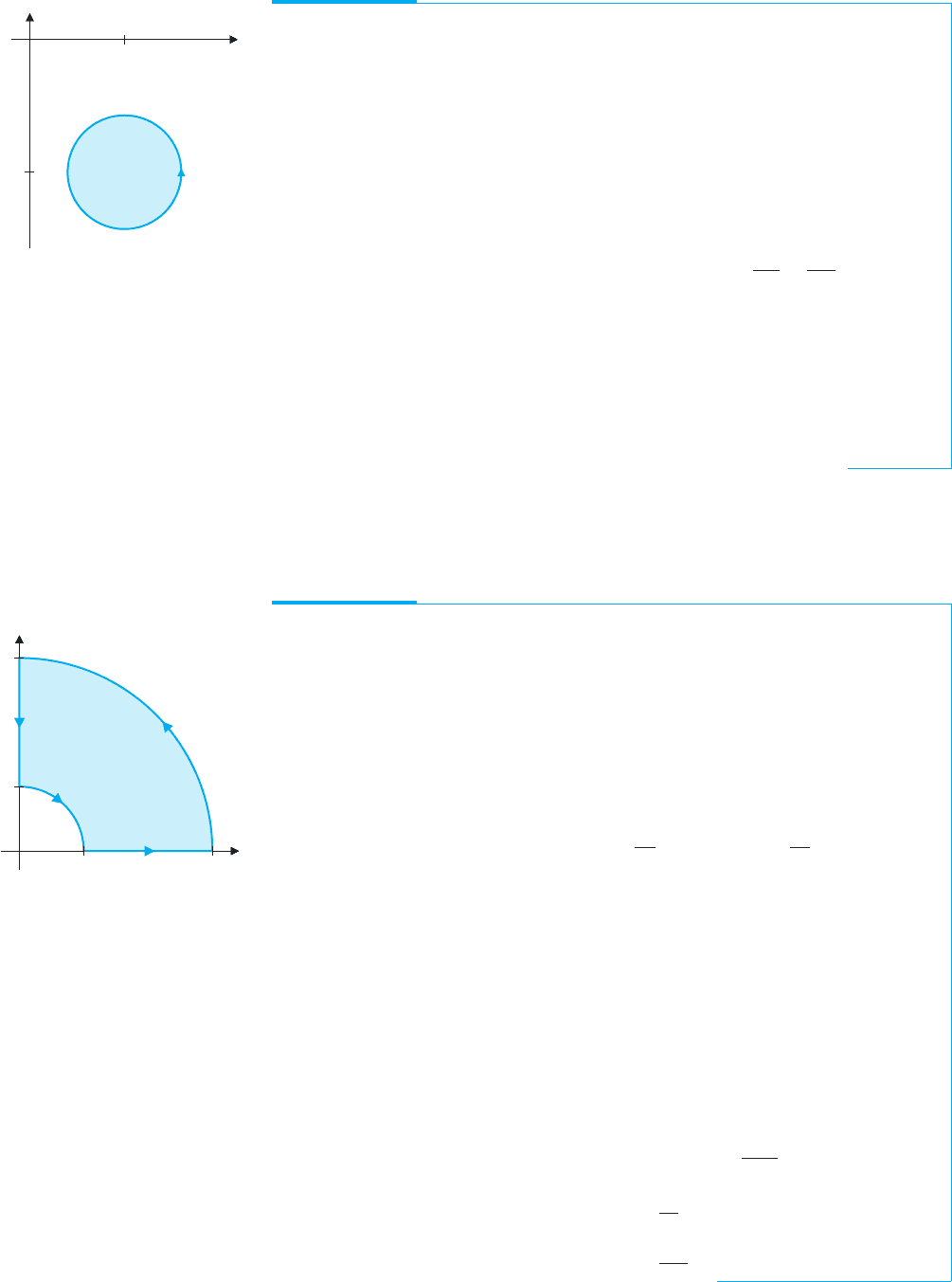
Solution We indicate the curve C and the enclosed region R in Figure 15.31. Notice
that C is a piecewise-smooth, simple closed curve with positive orientation. Further, for
M(x, y) = x
2
+ y
3
and N(x, y) = 3xy
2
, M and N are continuous and have continuous
first partial derivatives everywhere. Green’s Theorem then says that
C
(x
2
+ y
3
)dx +3xy
2
dy =
R
∂ N
∂x
−
∂ M
∂y
dA
=
R
(3y
2
− 3y
2
)dA = 0.
y
2
4
x
C
R
FIGURE 15.31
The region R
Notice that in example 4.1, since the integrand of the double integral was zero, eval-
uating the double integral was far easier than evaluating the line integral directly. There is
another simple way of thinking of the line integral in example 4.1. Notice that you can write
this as
C
F(x, y) ·dr, where F(x, y) =x
2
+ y
3
, 3xy
2
. Notice further that F is conserva-
tive [with potential function f (x, y) =
1
3
x
3
+ xy
3
] and so, by Theorem 3.3 in section 15.3,
the line integral of F over any piecewise-smooth, closed curve must be zero.
P1: OSO/OVY P2: OSO/OVY QC: OSO/OVY T1: OSO
MHDQ256-Ch15 MHDQ256-Smith-v1.cls January 6, 2011 10:53
LT (Late Transcendental)
CONFIRMING PAGES
15-41 SECTION 15.4
..
Green’s Theorem 1017
EXAMPLE 4.2 Evaluating a Challenging Line Integral
with Green’s Theorem
Evaluate the line integral
C
(7y − e
sin x
)dx +[15x − sin(y
3
+ 8y)]dy, where C is the
circle of radius 3 centered at the point (5, −7), as shown in Figure 15.32.
y
5
7
x
C
R
FIGURE 15.32
The region R
Solution First, notice that it will be virtually impossible to evaluate the line integral
directly. (Think about this some, but don’t spend too much time on it!) However, taking
M(x, y) = 7y − e
sin x
and N(x, y) = 15x − sin(y
3
+ 8y), notice that M and N are
continuous and have continuous first partial derivatives everywhere. So, we may apply
Green’s Theorem, which gives us
C
(7y − e
sin x
)dx +[15x − sin(y
3
+ 8y)]dy =
R
∂ N
∂x
−
∂ M
∂y
dA
=
R
(15 − 7)dA
= 8
R
dA = 72π,
where
R
dA is simply the area inside the region R,
R
dA = π(3)
2
= 9π.
If you look at example 4.2 critically, you might suspect that the integrand was chosen
carefullyso thattheline integralwasimpossible to evaluatedirectly,butsothatthe integrand
ofthe double integralwastrivial.That’strue:we did cook up the problem simply to illustrate
the power of Green’s Theorem. Example 4.3 is far less contrived.
EXAMPLE 4.3 Using Green’s Theorem to Evaluate a Line Integral
Evaluate the line integral
C
(e
x
+ 6xy)dx + (8x
2
+ sin y
2
)dy, where C is the
positively-oriented boundary of the region bounded by the circles of radii 1 and 3,
centered at the origin and lying in the first quadrant, as indicated in Figure 15.33.
y
1 3
3
1
x
C
R
FIGURE 15.33
The region R
Solution Notice that since C consists of four distinct pieces, evaluating the line
integral directly by parameterizing the curve is probably not a good choice. On the other
hand, since C is a piecewise-smooth, simple closed curve, we have by Green’s Theorem
that
C
(e
x
+ 6xy)dx + (8x
2
+ sin y
2
)dy =
R
∂
∂x
(8x
2
+ sin y
2
) −
∂
∂y
(e
x
+ 6xy)
dA
=
R
(16x − 6x)dA =
R
10xdA,
where R is the region between the two circles and lying in the first quadrant. Notice that
this is easy to compute using polar coordinates, as follows:
C
(e
x
+ 6xy)dx + (8x
2
+ sin y
2
)dy =
R
10 x
r cos θ
dA
rdrdθ
=
π/2
0
3
1
(10r cosθ)rdrdθ
=
π/2
0
cosθ
10r
3
3
r=3
r=1
dθ
=
10
3
(3
3
− 1
3
)sin θ
π/2
0
=
260
3
.
P1: OSO/OVY P2: OSO/OVY QC: OSO/OVY T1: OSO
MHDQ256-Ch15 MHDQ256-Smith-v1.cls January 6, 2011 10:53
LT (Late Transcendental)
CONFIRMING PAGES
1018 CHAPTER 15
..
Vector Calculus 15-42
You should notice that in example 4.3, Green’s Theorem is not a mere convenience;
rather, it is a virtual necessity. Evaluating the line integral directly would prove to be a very
significant challenge. (Go ahead and try it to see what we mean.)
Green’s Theorem provides us with a wealth of interesting observations. One of these is
as follows. Suppose that C is a piecewise-smooth, simple closed curve enclosing the region
R. Then, taking M(x, y) = 0 and N(x, y) = x,wehave
C
xdy=
R
∂ N
∂x
−
∂ M
∂y
dA =
R
dA,
which is simply the area of the region R. Alternatively, noticethat if we take M(x, y) =−y
and N(x, y) = 0, we have
C
−ydx=
R
∂ N
∂x
−
∂ M
∂y
dA =
R
dA,
which is again the area of R. Putting these last two results together, we also have
R
dA =
1
2
C
xdy− ydx. (4.5)
We illustrate this in example 4.4.
y
x
C
R
FIGURE 15.34
Elliptical region R
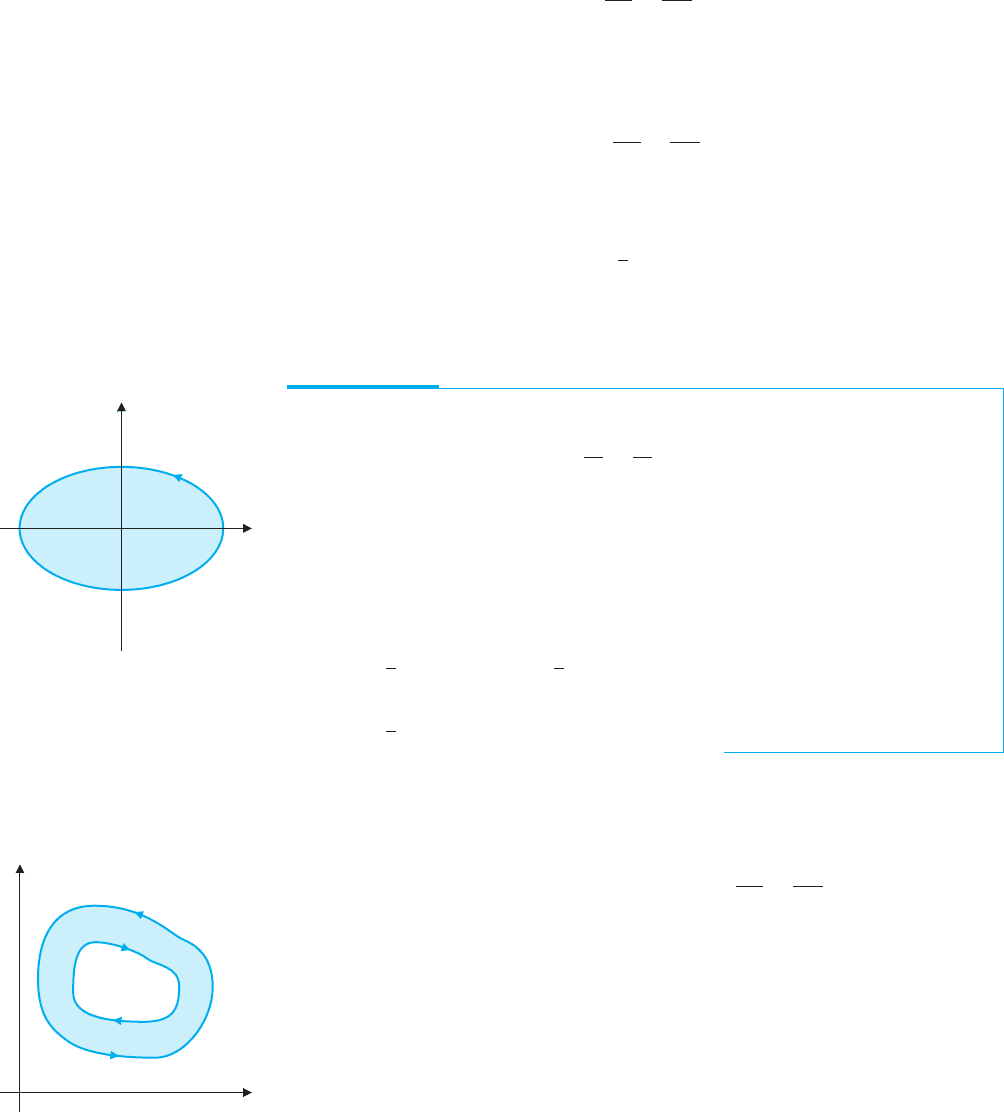
EXAMPLE 4.4 Using Green’s Theorem to Find Area
Find the area enclosed by the ellipse
x
2
a
2
+
y
2
b
2
= 1.
Solution First, observe that the ellipse corresponds to the simple closed curve C
defined parametrically by
C ={(x, y)|x = a cos t, y = b sint, 0 ≤ t ≤ 2π},
where a, b > 0. You should also observe that C is smooth and positively oriented. (See
Figure 15.34.) From (4.5), we have that the area A of the ellipse is given by
A =
1
2
C
xdy− ydx =
1
2
2π
0
[(a cost)(b cost) − (b sint)(−a sint)]dt
=
1
2
2π
0
(abcos
2
t +ab sin
2
t) dt = πab.
y
x
C
1
C
2
R
FIGURE 15.35a
Region with a hole
For simplicity, we often will use the notation ∂R to refer to the boundary of the region
R, oriented in the positive direction. Using this notation, the conclusion of Green’s Theorem
is written as
∂ R
M(x, y)dx + N(x, y)dy =
R
∂ N
∂x
−
∂ M
∂y
dA.
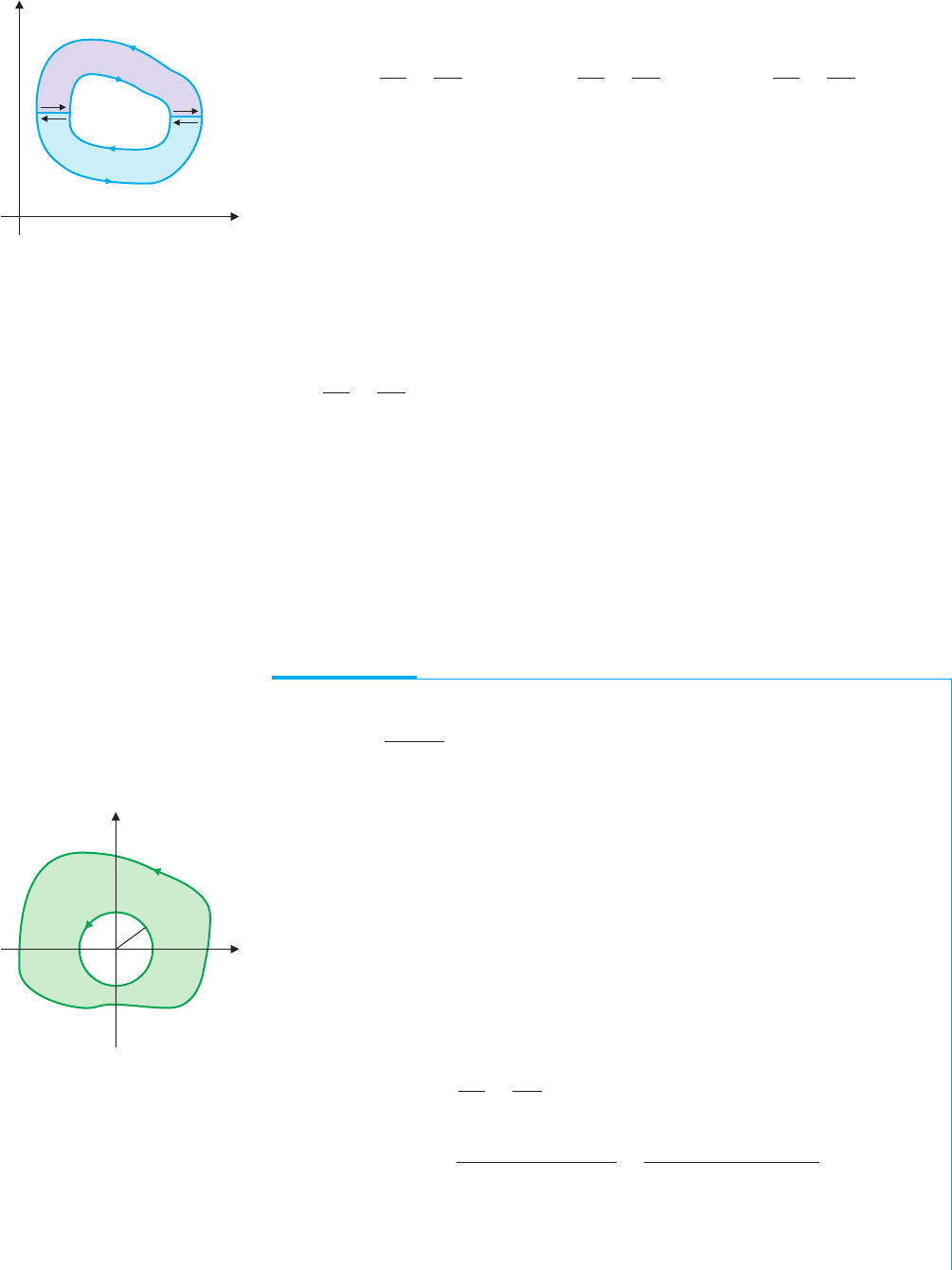
We can extend Green’s Theorem to the case where a region is not simply-connected (i.e.,
where the region has one or more holes). We must emphasize that when dealing with such
regions, the integration is taken over the entire boundary of the region (not just the outer-
most portion of the boundary!) and that the boundary curve is traversed in the positive
direction, always keeping the region to the left. For instance, for the region R illustrated in
Figure 15.35a with a single hole, notice that the boundary of R,∂R, consists of two separate
curves,C
1
and C
2
, where C
2
is traversed clockwise, in order to keep the orientation positive
on all of the boundary. Since the region is not simply-connected, we may not apply Green’s
Theorem directly. Rather, we first make two horizontal slits in the region, as indicated in
Figure 15.35b, dividing R into the two simply-connected regions R
1
and R
2
. Notice that
P1: OSO/OVY P2: OSO/OVY QC: OSO/OVY T1: OSO
MHDQ256-Ch15 MHDQ256-Smith-v1.cls January 6, 2011 10:53
LT (Late Transcendental)
CONFIRMING PAGES
15-43 SECTION 15.4
..
Green’s Theorem 1019
we can then apply Green’s Theorem in each of R
1
and R
2
separately. Adding the double
integrals over R
1
and R
2
gives us the double integral over all of R.Wehave
R
∂ N
∂x
−
∂ M
∂y
dA =
R
1
∂ N
∂x
−
∂ M
∂y
dA +
R
2
∂ N
∂x
−
∂ M
∂y
dA
=
∂ R
1
M(x, y)dx + N(x, y)dy
+
∂ R
2
M(x, y)dx + N(x, y)dy.
Further, since the line integrals over the common portions of ∂ R
1
and ∂ R
2
(i.e., the slits)
are traversed in the opposite direction (one way on ∂ R
1
and the other on ∂ R
2
), the line
integrals over these portions will cancel out, leaving only the line integrals over C
1
and C
2
.
This gives us
R
∂ N
∂x
−
∂ M
∂y
dA =
∂ R
1
M(x, y)dx + N(x, y)dy +
∂ R
2
M(x, y)dx + N(x, y)dy
=
C
1
M(x, y)dx + N(x, y)dy +
C
2
M(x, y)dx + N(x, y)dy
=
C
M(x, y)dx + N(x, y)dy.
y
x
C
1
C
2
R
2
R
1
FIGURE 15.35b
R = R
1
∪ R
2
This says that Green’s Theorem also holds for regions with a single hole. Of course, we
can repeat the preceding argument to extend Green’s Theorem to regions with any finite
number of holes.
y
x
a
R
C
C
1
FIGURE 15.36
The region R
EXAMPLE 4.5 An Application of Green’s Theorem
For F(x, y) =
1
x
2
+ y
2
−y, x, show that
C
F(x, y) ·dr = 2π, for every simple closed
curve C enclosing the origin.
Solution Let C be any simple closed curve enclosing the origin and let C
1
be the
circle of radius a > 0, centered at the origin (and positively oriented), where a is taken
to be sufficiently small so that C
1
is completely enclosed by C, as illustrated in
Figure 15.36. Further, let R be the region bounded between the curves C and C
1
(and
including the curves themselves). Applying our extended version of Green’s Theorem
in R,wehave
C
F(x, y) ·dr −
C
1
F(x, y) ·dr
=
∂ R
F(x, y) ·dr
=
R
∂ N
∂x
−
∂ M
∂y
dA
=
R
(1)(x
2
+ y
2
) − x(2x)
(x
2
+ y
2
)
2
−
(−1)(x
2
+ y
2
) + y(2y)
(x
2
+ y
2
)
2
dA
=
R
0dA = 0.

P1: OSO/OVY P2: OSO/OVY QC: OSO/OVY T1: OSO
MHDQ256-Ch15 MHDQ256-Smith-v1.cls January 6, 2011 10:53
LT (Late Transcendental)
CONFIRMING PAGES
1020 CHAPTER 15
..
Vector Calculus 15-44
This gives us
C
F(x, y) ·dr =
C
1
F(x, y) ·dr.
Now, we chose C
1
to be a circle because we can easily parameterize a circle and then
evaluate the line integral around C
1
explicitly. Notice that C
1
can be expressed
parametrically by x = a cos t, y = a sin t, for 0 ≤ t ≤ 2π. Noting that on C
1
,
x
2
+ y
2
= a
2
, this leaves us with an integral that we can easily evaluate, as follows:
C
F(x, y) ·dr =
C
1
F(x, y) ·dr =
C
1
1
a
2
−y, x·dr
=
1
a
2
C
1
− ydx+ xdy
=
1
a
2
2π
0
(−a sint)(−a sint) +(a cos t)(a cost)dt
=
2π
0
dt = 2π.
Notice that without Green’s Theorem, proving a result such as that developed in
example 4.5 would be elusive.
Now that we have Green’s Theorem, we are in a position to prove the second half of
Theorem 3.4. For convenience, we restate the theorem here.
THEOREM 4.2
Suppose that M(x, y) and N(x, y) have continuous first partial derivatives on a
simply-connected region D. Then,
C
M(x, y)dx + N(x, y)dy is independent of
path if and only if M
y
(x, y) = N
x
(x, y) for all (x, y)inD.
PROOF
Recall that in section 15.3, we proved the first part of the theorem: that if
C
M(x, y)dx + N(x, y)dy is independent of path, then it follows that
M
y
(x, y) = N
x
(x, y) for all (x, y)inD. We now prove that if M
y
(x, y) = N
x
(x, y)
for all (x, y)inD, then it follows that the line integral is independent of path. Let S be
any piecewise-smooth closed curve lying in D.IfS is simple and positively oriented, then
since D is simply-connected, the region R enclosed by S is completely contained in D,so
that M
y
(x, y) = N
x
(x, y) for all (x, y)inR. From Green’s Theorem, we now have that
S
M(x, y)dx + N(x, y)dy =
R
∂ N
∂x
−
∂ M
∂y
dA = 0.
That is, for every piecewise-smooth, simple closed curve S lying in D,wehave
S
M(x, y)dx + N(x, y)dy = 0. (4.6)
If S is not simple, then it intersects itself one or more times, creating twoor more loops, each
one of which is a simple closed curve. Since the line integral of M(x, y)dx + N(x, y)dy
over each of these is zero by (4. 6), it also follows that
S
M(x, y)dx + N(x, y)dy = 0.
It now follows from Theorem 3.3 that F(x, y) =M(x, y), N(x, y) must be conservative
in D. Finally, it follows from Theorem 3.1 that
C
M(x, y)dx + N(x, y)dy is independent
of path.

P1: OSO/OVY P2: OSO/OVY QC: OSO/OVY T1: OSO
MHDQ256-Ch15 MHDQ256-Smith-v1.cls January 6, 2011 10:53
LT (Late Transcendental)
CONFIRMING PAGES
15-45 SECTION 15.4
..
Green’s Theorem 1021
BEYOND FORMULAS
Green’s Theorem is the first of three theorems in this chapter that relate different types
of integrals. The alternatives given in these results can be helpful both computationally
and theoretically. Example 4.2 shows how we can evaluate a difficult line integral by
evaluating the equivalent (and simpler) double integral. Perhaps surprisingly, the use
of Green’s Theorem in example 4.5 is probably more important in applications. The
theoretical result can be applied to any relevant problem and results like example 4.5
can sometimes provide important insight into general processes.
EXERCISES 15.4
WRITING EXERCISES
1. Given a line integral to evaluate, briefly describe the circum-
stances under which you should think about using Green’s
Theorem to replace the line integral with a double integral.
Comment on the properties of the curve C and the functions
involved.
2. In example 4.1, Green’s Theorem allowed us to quickly show
thatthe line integralequals 0. Following the example,wenoted
thatthis wasthe line integralfor a conservative force field. Dis-
cuss which method (Green’s Theorem, conservative field) you
would recommend trying first to determine whether a line in-
tegral equals 0.
3. Equation (4.5) shows how to compute area as a line integral.
Using example 4.3 as a guide, explain why we wrote the area
as
1
2
C
xdy− ydx instead of
C
xdyor
C
−ydx.
4. Suppose that you drive a car to a variety of places for shop-
ping and then return home. If your path formed a simple closed
curve, explain how you could use (4.5) to estimate the area en-
closed by your path. (Hint: If x, y represents position, what
does x
, y
represent?)
In exercises 1–4, evaluate the indicated line integral (a) directly
and (b) using Green’s Theorem.
1.
C
(x
2
− y) dx + y
2
dy, where C is the circle x
2
+ y
2
= 1
oriented counterclockwise
2.
C
(y
2
+ x)dx + (3x +2xy) dy, where C is the circle
x
2
+ y
2
= 4 oriented counterclockwise
3.
C
x
2
dx − x
3
dy, where C is the square from (0, 0) to (0, 2)
to (2, 2) to (2, 0) to (0, 0)
4.
C
(y
2
− 2x)dx + x
2
dy, where C is the square from (0, 0) to
(1, 0) to (1, 1) to (0, 1) to (0, 0)
............................................................
In exercises5–20, use Green’s Theorem to evaluatethe indicated
line integral. (Curves are oriented positively unless stated.)
5.
C
xe
2x
dx − 3x
2
ydy, where C is the rectangle from (0, 0) to
(3, 0) to (3, 2) to (0, 2) to (0, 0)
6.
C
ye
2x
dx + x
2
y
2
dy, where C is the rectangle from (−2, 0)
to (3, 0) to (3, 2) to (−2, 2) to (−2, 0)
7.
C
x
x
2
+ 1
− y
dx + (3x − 4tan y/2)dy, where C is the
portion of y = x
2
from (−1, 1) to (1, 1), followed by the por-
tion of y = 2 − x
2
from (1, 1) to (−1, 1)
8.
C
(xy − e
2x
)dx + (2x
2
− 4y
2
)dy, where C is formed by
y = x
2
and y = 8 − x
2
oriented clockwise
9.
C
(tan x − y
3
)dx + (x
3
− sin y)dy, where C is the circle
x
2
+ y
2
= 2
10.
C
√
x
2
+ 1 − x
2
y
dx + (xy
2
− y
5/3
)dy, where C is the
circle x
2
+ y
2
= 4 oriented clockwise
11.
C
F ·dr, where F =x
3
− y, x + y
3
and C is formed by
y = x
2
and y = x
12.
C
F ·dr, where F =y
2
+ 3x
2
y, xy + x
3
and C is formed
by y = x
2
and y = 2x
13.
C
F ·dr, where F =
e
x
2
− y, e
2x
+ y
and C is formed by
y = 1 − x
2
and y = 0
14.
C
F ·dr, where F =x
2
e
xy
+ y, x
2
+ e
y
and C is formed by
y = x
2
and y = 4
15.
C
x
2
dx + 2xdy+ (z − 2) dz, where C is the triangle from
(0, 0, 2) to (2, 2, 2) to (4, 0, 2) to (0, 0, 2)
16.
C
[y
3
− ln(x + 1)] dx +
x − y
2
+ 3x
dy, where C is
formed by x = y
2
and x = 1
17.
C
(y sec
2
x − 2e
y
)dx + (tan x − 4y
2
)dy, where C is formed
by x = 4 − y
2
and x = 0
18.
C
(zx −2y
3
)dx + x
3
zdy+ z
4
dz, where C is x
2
+ y
2
= 4in
the plane z = 2
19.
C
F ·dr, where F =
−ze
x
2
+z
2
, e
y
2
+z
2
, xe
x
2
+z
2
and C is
x
2
+ z
2
= 1 in the plane y = 0
20.
C
F ·dr, where F =
−xe
z
+ y
2
z,
√
x
2
+ z
2
, 4xy − z
4
and
C is formed by z = 1 − x
2
and z = 0 in the plane y = 2
............................................................

P1: OSO/OVY P2: OSO/OVY QC: OSO/OVY T1: OSO
MHDQ256-Ch15 MHDQ256-Smith-v1.cls January 6, 2011 10:53
LT (Late Transcendental)
CONFIRMING PAGES
1022 CHAPTER 15
..
Vector Calculus 15-46
In exercises 21–26, use a line integral to compute the area of the
given region.
21. The ellipse 4x
2
+ y
2
= 16 22. The ellipse 4x
2
+ y
2
= 4
23. The region bounded by y = x
2
and y = 4
24. The region bounded by y = x
2
and y = 2x
25. The region bounded by x
2/3
+ y
2/3
= 1. (Hint: Let x = cos
3
t
and y = sin
3
t)
26. The region bounded by x
2/5
+ y
2/5
= 1
............................................................
27. Use Green’s Theorem to show that the center of mass of the
region bounded by the positive curve C with constant den-
sity is givenby
¯
x =
1
2A
C
x
2
dy and
¯
y =−
1
2A
C
y
2
dx,where
A is the area of the region.
28. Use the result of exercise 27 to find the center of mass of the
region in exercise 26, assuming constant density.
29. Use the result of exercise 27 to find the center of mass of the
region bounded by the curve traced out by t
3
− t, 1 −t
2
, for
−1 ≤ t ≤ 1, assuming constant density.
30. Use the result of exercise 27 to find the center of mass of the
region bounded by the curve traced out by t
2
− t, t
3
− t, for
0 ≤ t ≤ 1, assuming constant density.
31. Use Green’s Theorem to provethe change of variables formula
R
dA =
S
∂(x, y)
∂(u,v)
du dv,
where x = x(u,v)and y = y(u,v) are functions with continu-
ous partial derivatives.
32. For F =
1
x
2
+ y
2
−y, x and C any circle of radius r > 0 not
containing the origin, show that
C
F · dr = 0.
............................................................
In exercises 33–37, use the technique of example 4.5 to evaluate
the line integral.
33.
C
F ·dr, where F =
x
x
2
+ y
2
,
y
x
2
+ y
2
and C is any posi-
tively oriented simple closed curve enclosing the origin
34.
C
F ·dr, where F =
y
2
− x
2
(x
2
+ y
2
)
2
,
−2xy
(x
2
+ y
2
)
2
and C is any
positively oriented simple closed curve enclosing the origin
35.
C
F ·dr, where F =
x
3
x
4
+ y
4
,
y
3
x
4
+ y
4
and C is any posi-
tively oriented simple closed curve enclosing the origin
36.
C
F ·dr, where F =
y
2
x
x
4
+ y
4
,
−x
2
y
x
4
+ y
4
and C is any posi-
tively oriented simple closed curve enclosing the origin
37.
C
F ·dr, where F =
−y + 1, x
4x
2
+ (y − 1)
2
and C is any positively
oriented simple closed curve enclosing (0, 1)
............................................................
38. Where is F(x, y) =
2x
x
2
+ y
2
,
2y
x
2
+ y
2
defined? Show that
M
y
= N
x
everywhere the partial derivatives are defined. If C
is a simple closed curve enclosing the origin, does Green’s
Theorem guarantee that
C
F ·dr = 0? Explain.
39. For the vector field of exercise 38, show that
C
F ·dr is the
same for all closed curves enclosing the origin.
40. If F(x, y) =
2x
x
2
+ y
2
,
2y
x
2
+ y
2
and C is a simple closed
curve in the fourth quadrant, does Green’s Theorem guarantee
that
C
F ·dr = 0? Explain.
41. Let C
1
be the line segment from (0, 1) to (0,0) and C
the triangle from (0, 0) to (1, 1) to (0, 1) to (0, 0). For
F =2xe
x
3
, 4x −tan y, compute
C
F · dr and
C
1
F · dr.
Then compute
C
2
F · dr, where C
2
is the bent segment from
(0, 0) to (1, 1) to (0, 1).
42. Compute
C
(4x − y)dx + (e
3y
− x
2
y)dy, where C is three
sides of a square from (2, 0) to (2, 2) to (0, 2) to (0, 0).
EXPLORATORY EXERCISE
1. Evaluate
C
F · dr, where
F =
−y
(x
2
+ y
2
)
2
,
x
(x
2
+ y
2
)
2
and C is the circle x
2
+ y
2
= a
2
. Use the result and Green’s
Theorem to show that
R
−2
(x
2
+ y
2
)
2
dA diverges, where R is
the disk x
2
+ y
2
≤ 1.
15.5 CURL AND DIVERGENCE
We haveseen how Green’s Theorem relates the line integral of a function over the boundary
of a plane region R to the double integral of a related function over the region R.In
some cases, the line integral is easier to evaluate, while in other cases, the double integral is
easier. More significantly, Green’sTheorem providesuswith a connection between physical
quantities measured on the boundary of a plane region with related quantities in the interior
of the region. The goal of the rest of the chapter is to extend Green’s Theorem to results
that relate triple integrals, double integrals and line integrals. The first step is to understand
the vector operations of curl and divergence introduced in this section.