
Smith R., Minton R. Calculus
Подождите немного. Документ загружается.

P1: OSO/OVY P2: OSO/OVY QC: OSO/OVY T1: OSO
MHDQ256-Ch14 MHDQ256-Smith-v1.cls January 5, 2011 10:17
LT (Late Transcendental)
CONFIRMING PAGES
14-73 CHAPTER 14
..
Review Exercises 973
Review Exercises
1. Whenusing a double integral to computevolume,the choice of
integration variables and order is determined by the geometry
of the region.
2.
R
f (x, y)dA gives the volume between z = f (x, y) and the
xy-plane.
3. When using a double integral to compute area, the choice of
integration variables and order is determined by the geometry
of the region.
4. A line through the center of mass ofa region dividesthe region
into subregions of equal area.
5. If R is bounded by a circle,
R
f (x, y)dA should be computed
using polar coordinates.
6. The surface area of a region is approximately equal to the area
of the projection of the region into the xy-plane.
7. A triple integral in rectangular coordinates has three possible
orders of integration.
8. The choice of coordinate systems for a triple integral is deter-
mined by the function being integrated.
9. Ifaregionora function involves x
2
+ y
2
,youshould use cylin-
drical coordinates.
10. For a triple integral in spherical coordinates, the order of inte-
gration does not matter.
11. Transforming a double integral in xy-coordinates to one in
uv-coordinates, you need formulas for u and v in terms of x
and y.
In exercises 1 and 2, compute the Riemann sum for the given
function and region, a partition with n equal-sized rectangles
and the given evaluation rule.
1. f (x, y) = 5x − 2y, 1 ≤ x ≤ 3, 0 ≤ y ≤ 1, n = 4, evaluate at
midpoint
2. f (x, y) = 4x
2
+ y, 0 ≤ x ≤ 1, 1 ≤ y ≤ 3, n = 4, evaluate at
midpoint
............................................................
In exercises 3–10, evaluate the double integral.
3.
R
(4x +9x
2
y
2
)dA,where R ={(x, y)|0 ≤ x ≤ 3, 1 ≤ y ≤ 2}
4.
R
2e
4x+2y
dA, where R ={(x, y)|0 ≤ x ≤ 1, 0 ≤ y ≤ 1}
5.
R
e
−x
2
−y
2
dA, where R ={(x, y)|1 ≤ x
2
+ y
2
≤ 4}
6.
R
2xydA, where R is bounded by y = x, y = 2 − x and
y = 0
7.
1
−1
2x
x
2
(2xy − 1) dy dx
8.
1
0
2
2x
(3y
2
x + 4) dydx
9.
R
xydA, where R is bounded by r = 2 cos θ
10.
R
sin(x
2
+ y
2
)dA, where R is bounded by x
2
+ y
2
= 4
............................................................
In exercises 11 and 12, approximate the double integral.
11.
R
4xydA, where R is bounded by y = x
2
− 4 and y = ln x
12.
R
6x
2
ydA, where R is bounded by y = cos x and y = x
2
− 1
............................................................
In exercises 13–24, compute the volume of the solid.
13. Bounded by z = 1 − x
2
, z = 0, y = 0 and y = 1
14. Bounded by z = 4 − x
2
− y
2
, z = 0, x = 0, x + y = 1 and
y = 0
15. Between z = x
2
+ y
2
and z = 8 − x
2
− y
2
16. Under z = e
√
x
2
+y
2
and inside x
2
+ y
2
= 4
17. Bounded by x + 2y + z = 8 and the coordinate planes
18. Bounded by x + 5y + 7z = 1 and the coordinate planes
19. Bounded by z =
x
2
+ y
2
and z = 4
20. Bounded by x =
y
2
+ z
2
and x = 2
21. Between z =
x
2
+ y
2
and x
2
+ y
2
+ z
2
= 4
22. Inside x
2
+ y
2
+ z
2
= 4z and below z = 1
23. Under z = 6 − x
2
− y
2
, above z = 0 and inside x
2
+ y
2
= 1
24. Under z = x and inside r = cosθ
............................................................
In exercises 25 and 26, change the order of integration.
25.
2
0
x
2
0
f (x, y)dydx
26.
2
0
4
x
2
f (x, y)dydx
............................................................
In exercises 27 and 28, convert to polar coordinates and evaluate
the integral.
27.
2
0
√
4−x
2
−
√
4−x
2
2xdydx
28.
2
0
√
4−x
2
0
2
x
2
+ y
2
dydx
............................................................

P1: OSO/OVY P2: OSO/OVY QC: OSO/OVY T1: OSO
MHDQ256-Ch14 MHDQ256-Smith-v1.cls January 5, 2011 10:17
LT (Late Transcendental)
CONFIRMING PAGES
974 CHAPTER 14
..
Multiple Integrals 14-74
Review Exercises
In exercises 29–32, find the mass and center of mass.
29. The lamina bounded by y = 2x, y = x and x = 2,
ρ(x, y) = 2x
30. The lamina bounded by y = x, y = 4 − x and y = 0,
ρ(x, y) = 2y
31. The solid bounded by z = 1 − x
2
, z = 0, y = 0, y + z = 2,
ρ(x, y, z) = 2
32. The solid bounded by x =
y
2
+ z
2
, x = 2,ρ(x, y, z) = 3x
............................................................
In exercises 33 and 34, use a double integral to find the area.
33. Bounded by y = x
2
, y = 2 − x and y = 0
34. One leaf of r = sin4θ
............................................................
In exercises 35 and 36, find the average value of the function on
the indicated region.
35. f (x, y) = x
2
, region bounded by y = 2x, y = x and x = 1
36. f (x, y) =
x
2
+ y
2
, region bounded by x
2
+ y
2
= 1, x = 0,
y = 0
............................................................
In exercises 37–42, evaluate or estimate the surface area.
37. The portion of z = 2x + 4y between y = x, y = 2 and x = 0
38. The portion of z = x
2
+ 6y between y = x
2
and y = 4
39. The portion of z = xy inside x
2
+ y
2
= 8, in the first octant
40. The portion of z = sin(x
2
+ y
2
) inside x
2
+ y
2
= π
41. The portion of z =
x
2
+ y
2
below z = 4
42. The portion of x + 2y + 3z = 6 in the first octant
............................................................
In exercises 43–50, set up the triple integral
Q
f (x, y, z) dV in
an appropriate coordinate system. If f (x, y, z) is given, evaluate
the integral.
43. f (x, y, z) = z(x + y),
Q ={(x, y, z)|0 ≤ x ≤ 2, −1 ≤ y ≤1, −1 ≤ z ≤ 1}
44. f (x, y, z) = 2xye
yz
,
Q ={(x, y, z)|0 ≤ x ≤ 2, 0 ≤ y ≤ 1, 0 ≤ z ≤ 1}
45. f (x, y, z) =
x
2
+ y
2
+ z
2
, Q is above z =
x
2
+ y
2
and
below x
2
+ y
2
+ z
2
= 4.
46. f (x, y, z) = 3x, Q is the region below z =
x
2
+ y
2
, above
z = 0 and inside x
2
+ y
2
= 4.
47. Q is bounded by x + y + z = 6, z = 0, y = x, y = 2 and
x = 0.
48. Q is the region below z =
4 − x
2
− y
2
, above z = 0 and in-
side x
2
+ y
2
= 1.
49. Q is the region below z =
4 − x
2
− y
2
and above z = 0.
50. Q is the region below z = 6 − x − y, above z = 0 and inside
x
2
+ y
2
= 8.
............................................................
In exercises 51–54, evaluate the integral after changing coordi-
nate systems.
51.
1
0
√
2−x
2
x
√
x
2
+y
2
0
e
z
dzdydx
52.
√
2
0
√
4−y
2
y
2
0
4zdzdxdy
53.
1
−1
√
1−x
2
0
√
2−x
2
−y
2
√
x
2
+y
2
x
2
+ y
2
+ z
2
dzdydx
54.
2
−2
√
4−y
2
0
√
4−x
2
−y
2
0
dzdx dy
............................................................
In exercises 55–60, write the given equation in (a) cylindrical
and (b) spherical coordinates.
55. y = 3 56. x
2
+ y
2
= 9
57. x
2
+ y
2
+ z
2
= 4 58. y = x
59. z =
x
2
+ y
2
60. z = 4
............................................................
In exercises 61–66, sketch the graph.
61. r = 4 62. ρ = 4 63. θ =
π
4
64. φ =
π
4
65. r = 2cosθ 66. ρ = 2 sec φ
............................................................
In exercises 67 and 68, find a transformation from a rectangular
region S in the uv-plane to the region R.
67. R bounded by y = 2x − 1, y = 2x + 1, y = 2 − 2x and
y = 4 −2x
68. R inside x
2
+ y
2
= 9, outside x
2
+ y
2
= 4 and in the second
quadrant
............................................................
In exercises 69 and 70, evaluate the double integral.
69.
R
e
y−2x
dA, where R is given in exercise 67
70.
R
(y + 2x)
3
dA, where R is given in exercise 67
............................................................
In exercises 71 and 72, find the Jacobian of the given trans-
formation.
71. x = u
2
v, y = 4u + v
2
72. x = 4u − 5v, y = 2u + 3v

P1: OSO/OVY P2: OSO/OVY QC: OSO/OVY T1: OSO
MHDQ256-Ch14 MHDQ256-Smith-v1.cls January 5, 2011 10:17
LT (Late Transcendental)
CONFIRMING PAGES
14-75 CHAPTER 14
..
Review Exercises 975
Review Exercises
EXPLORATORY EXERCISES
1. Let S be a sphere of radius R centered at the origin. Different
types of symmetry produce different simplifications in integra-
tion. If f (x, y, z) =−f (−x, y, z), show that
S
fdV = 0.
If f (x, y, z) =−f (x, −y, z), show that
S
fdV = 0.
If f (x, y, z) =−f (−x, −y, z), show that
S
fdV = 0.
If f (x, y, z) =−f (−x, −y, −z), what, if anything,
can be said about
S
fdV? Next, suppose that
f (a, b, c) = f (x, y, z) whenever a
2
+ b
2
+ c
2
= x
2
+ y
2
+z
2
.
Show that
S
f (x, y, z)dV = 4π
R
0
ρ
2
g(ρ) dρ for some
function g. (State the relationship between g and f.) If f can
be written in cylindrical coordinates as f (r,θ,z) = g(r), for
some continous function g, simplify
S
fdV as much as
possible.
2. Let S be the solid bounded above by z =
R
2
− x
2
− y
2
and below by z =
x
2
+ y
2
. Set up and simplify as much
as possible
S
fdV in each of the following cases:
(a) f (x, y, z) =−f (−x, y, z);(b) f (x, y, z) =−f (x, −y, z);
(c) f (x, y, z) =−f (−x, −y, z);
(d) f (x, y, z) =−f (−x, −y, −z); (e) f (r,θ,z) = g(r), for
somefunction g and (f) f (ρ,φ,θ) = g(ρ), for some function g
This page intentionally left blank
P1: OSO/OVY P2: OSO/OVY QC: OSO/OVY T1: OSO
MHDQ256-Ch15 MHDQ256-Smith-v1.cls January 6, 2011 10:53
LT (Late Transcendental)
CONFIRMING PAGES
CHAPTER
15
Vector Calculus
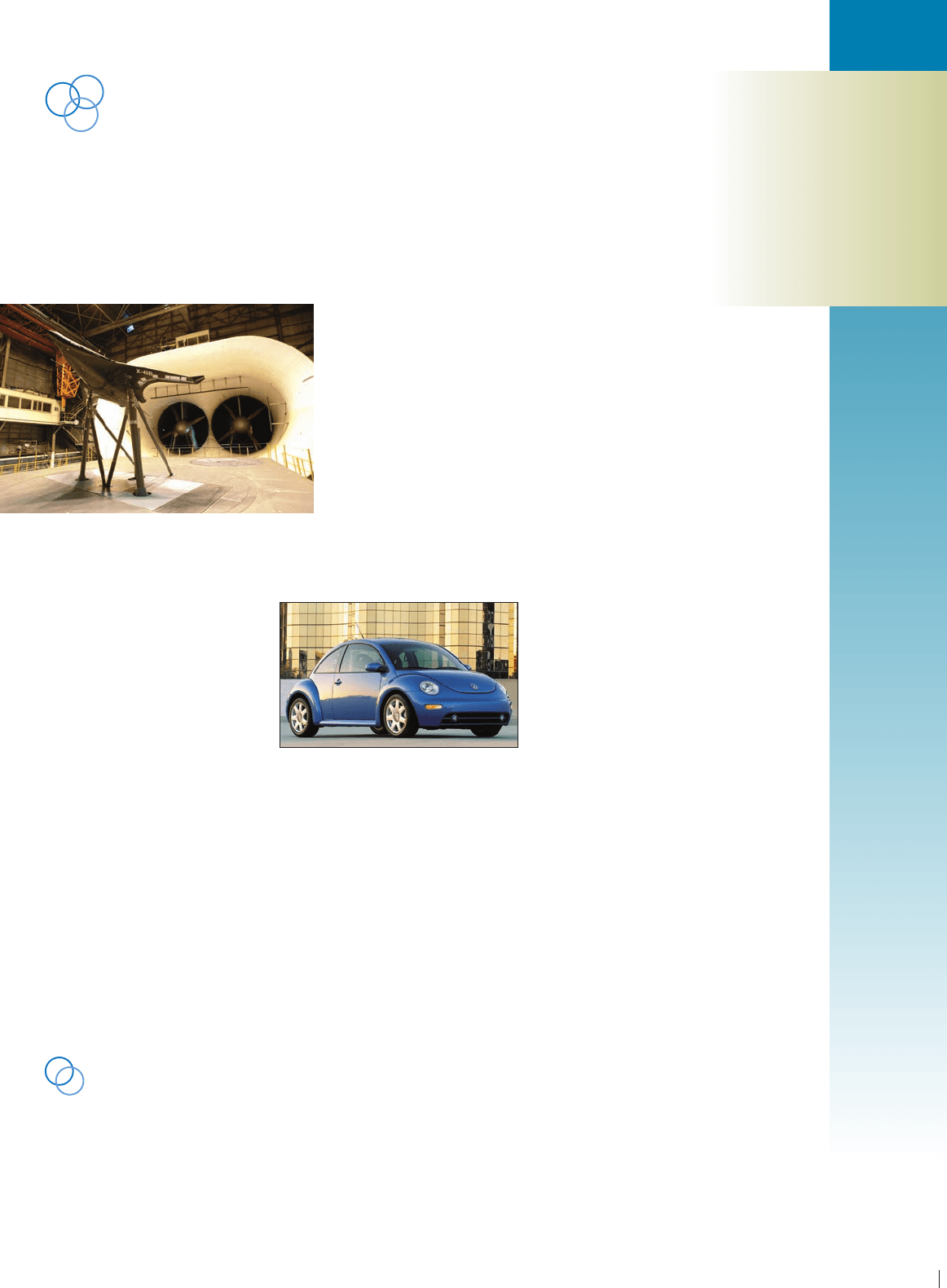
The Volkswagen Beetle was one of the most beloved and recognizable
cars of the 1950s, 1960s and 1970s. So, Volkswagen’s decision to release
a redesigned Beetle in 1998 created quite a stir in the automotive world.
The new Beetle resembles the classic Beetle, but has been modernized
to improve fuel efficiency, safety, handling and overall performance. The
calculus that we introduce in this chapter will provide you with some of
the basic tools necessary for designing and analyzing automobiles, air-
craft and other types of complex machinery.
Engineers have identified many important principles of aerodynam-
ics, but the design of a complicated structure like a car still has an element
of trial and error. Before high-speed computers were available, engineers
built small-scale or full-scale models of new designs and tested them in a
wind tunnel. Unfortunately, such models don’t always provide adequate
information and can be prohibitively ex-
pensive to build.
The new Beetle
Today, mathematical models are
used to accurately simulate wind tunnel
tests. A computer simulation of a wind
tunnel must keep track of the air veloc-
ity at each point on and around a car. A
function assigning a vector (e.g., a veloc-
ity vector) to each point in space is called
a vector field, which we introduce in sec-
tion 15.1. Additional mathematical concepts that are crucial for a study of fluid
mechanics and other important applications are developed in this chapter.
In the case of the redesigned Beetle, computer simulations resulted in nu-
merous improvements over the original. One measure of a vehicle’s aerodynamic
efficiency is its drag coefficient (with a lower drag coefficient corresponding to
a more aerodynamic vehicle). The original Beetle has a drag coefficient of 0.46
(as reported by Robertson and Crowe in Engineering Fluid Mechanics), while
a (quite aerodynamic) 1985 Chevrolet Corvette has a drag coefficient of 0.34.
According to Volkswagen, the new Beetle boasts a drag coefficient of 0.38, rep-
resenting a considerable reduction in air drag from the original Beetle, through
careful engineering and detailed mathematical analysis.
15.1 VECTOR FIELDS
To analyze the flight characteristics of an airplane, engineers use wind tunnel tests
toprovideinformationabouttheflowof air overthewingsandaroundthe fuselage.
To model such a test mathematically, we need to be able to describe the velocity
977
P1: OSO/OVY P2: OSO/OVY QC: OSO/OVY T1: OSO
MHDQ256-Ch15 MHDQ256-Smith-v1.cls January 6, 2011 10:53
LT (Late Transcendental)
CONFIRMING PAGES
978 CHAPTER 15
..
Vector Calculus 15-2
ofthe air atvariouspoints.So, we need todefineafunction that assignsavectortoeachpoint
in space. Such a function would have both a multidimensional domain (like the functions
of Chapters 13 and 14) and a multidimensional range (like the vector-valued functions
introduced in Chapter 12). We call such a function a vector field. Although vector fields in
higher dimensions can be very useful, we will focus here on vector fields in two and three
dimensions.
DEFINITION 1.1
A vector field in the plane is a function F(x, y) mapping points in R
2
into the set of
two-dimensional vectors V
2
. We write
F(x, y) =f
1
(x, y), f
2
(x, y)= f
1
(x, y)i + f
2
(x, y)j,
for scalar functions f
1
(x, y) and f
2
(x, y). In space, a vector field is a function
F(x, y, z) mapping points in R
3
into the set of three-dimensional vectors V
3
. In this
case, we write
F(x, y, z) =f
1
(x, y, z), f
2
(x, y, z), f
3
(x, y, z)
= f
1
(x, y, z)i + f
2
(x, y, z)j + f
3
(x, y, z)k,
for scalar functions f
1
(x, y, z), f
2
(x, y, z) and f
3
(x, y, z).
To describe a two-dimensional vector field graphically, we draw a collection of the
vectors F(x, y) for various points (x, y) in the domain, in each case drawing the vector so
that its initial point is located at (x, y). We illustrate this in example 1.1.
EXAMPLE 1.1 Plotting a Vector Field
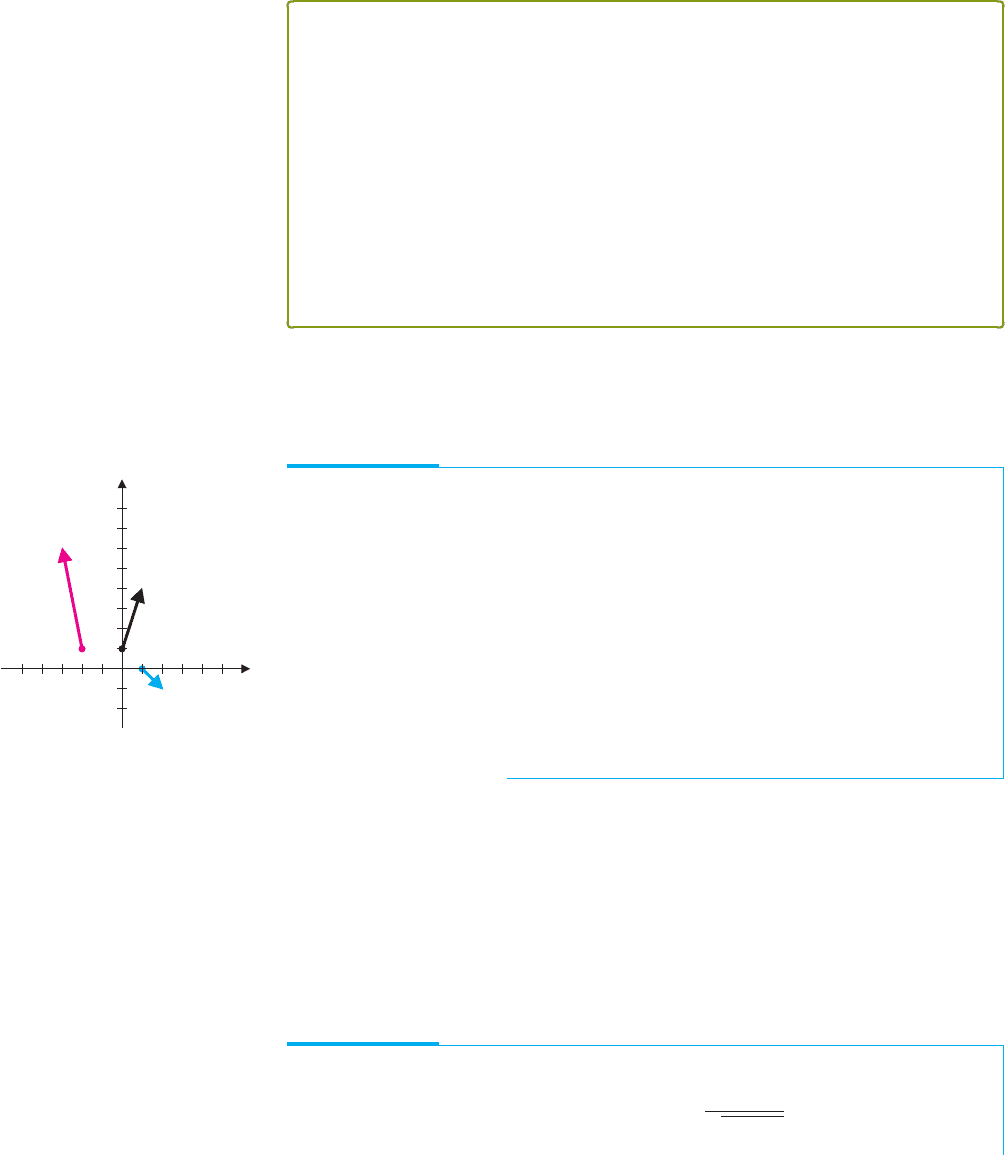
For the vector field F(x, y) =x + y, 3y − x, evaluate (a) F(1, 0), (b) F(0, 1) and
(c) F(−2, 1). Plot each vector F(x, y) using the point (x, y) as the initial point.
y
x
F(2, 1)
F(1, 0)
F(0, 1)
FIGURE 15.1
Values of F(x, y)
Solution (a) Taking x = 1 and y = 0, we have F(1, 0) =1 +0, 0 −1=1, −1.
In Figure 15.1, we have plotted the vector 1, −1 with its initial point located at the
point (1, 0), so that its terminal point is located at (2, −1).
(b) Taking x = 0 and y = 1, we have F(0, 1) =0 +1, 3 −0=1, 3.In
Figure 15.1, we have also indicated the vector 1, 3, taking the point (0, 1) as its initial
point, so that its terminal point is located at (1, 4).
(c) With x =−2 and y = 1, we have F(−2, 1) =−2 + 1, 3 +2=−1, 5.In
Figure 15.1, the vector −1, 5 is plotted by placing its initial point at (−2, 1) and its
terminal point at (−3, 6).
Graphing vector fields poses something of a problem. Notice that the graph of a
two-dimensional vector field would be four-dimensional (i.e., two independent variables
plus two dimensions for the vectors). However, we can visualize many of the important
properties of a vector field by plotting a number of values of the vector field as we had
started to do in Figure 15.1. In general, by the graph of the vector field F(x, y), we mean
a two-dimensional graph with vectors F(x, y), plotted with their initial point located at
(x, y), for a variety of points (x, y). Many graphing calculators and computer algebra
systems have commands to graph vector fields.
EXAMPLE 1.2 Graphing Vector Fields
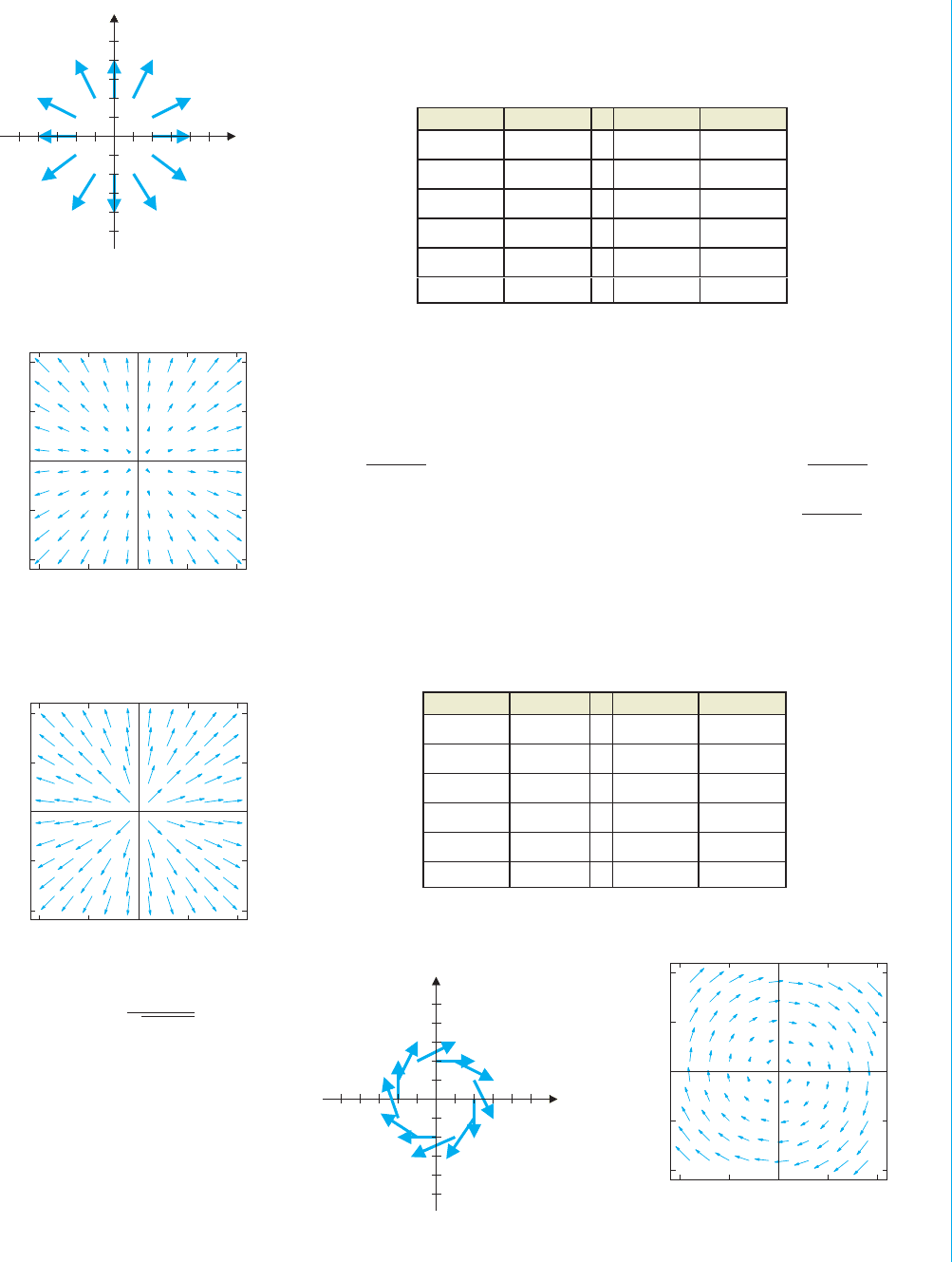
Graph the vector fields F(x, y) =x, y, G(x, y) =
x, y
x
2
+ y
2
and H(x, y) =y, −x
and identify any patterns.
P1: OSO/OVY P2: OSO/OVY QC: OSO/OVY T1: OSO
MHDQ256-Ch15 MHDQ256-Smith-v1.cls January 6, 2011 10:53
LT (Late Transcendental)
CONFIRMING PAGES
15-3 SECTION 15.1
..
Vector Fields 979
y
x
FIGURE 15.2a
F(x, y) =x, y
2
2 10 1 2
1
0
1
2
y
x
FIGURE 15.2b
F(x, y) =x, y
Solution First choose a variety of points (x, y), evaluate the vector field at these
points and plot the vectors using (x, y) as the initial point. Notice that in the following
table we have chosen points on the axes and in each of the four quadrants.
(x, y) x, y (x, y) x, y
(2, 0) 2, 0 (−2, 1) −2, 1
(1, 2) 1, 2 (−2, 0) −2, 0
(2, 1) 2, 1 (−1, −2) −1, −2
(0, 2) 0, 2 (0, −2) 0, −2
(−1, 2) −1, 2 (1, −2) 1, −2
(−2, −1) −2, −1 (2, −1) 2, −1
The vectors indicated in the table are plotted in Figure 15.2a. A computer-generated
plot of the vector field is shown in Figure 15.2b. Notice that the vectors drawn here have
not been drawn to scale, in order to improve the readability of the graph.
In both plots, notice that the vectors all point away from the origin and increase in
length as the initial points get farther from the origin. In fact, the initial point (x, y) lies
a distance
x
2
+ y
2
from the origin and the vector x, y has length
x
2
+ y
2
. So, the
length of each vector corresponds to the distance from its initial point to the origin.
Notice that G(x, y) is the same as F(x, y) except for the division by
x
2
+ y
2
, which is
the magnitude of the vector x, y. Thus, for each (x, y), G(x, y) has the same direction
as F(x, y), but is a unit vector. A computer-generated plot of G(x, y) is shown in
Figure 15.2c.
2
2 10 1 2
1
0
1
2
y
x
FIGURE 15.2c
G(x, y) =
x, y
x
2
+ y
2
We compute some sample vectors for H(x, y) in the following table and plot these
in Figure 15.3a.
(x, y) y, −x (x, y) y, −x
(2, 0) 0, −2 (−2, 1) 1, 2
(1, 2) 2, −1 (−2, 0) 0, 2
(2, 1) 1, −2 (−1, −2) −2, 1
(0, 2) 2, 0 (0, −2) −2, 0
(−1, 2) 2, 1 (1, −2) −2, −1
(−2, −1) −1, 2 (2, −1) −1, −2
y
x
2
2 10 1 2
1
0
1
2
y
x
FIGURE 15.3a FIGURE 15.3b
H(x, y) =y, −x H(x, y) =y, −x
P1: OSO/OVY P2: OSO/OVY QC: OSO/OVY T1: OSO
MHDQ256-Ch15 MHDQ256-Smith-v1.cls January 6, 2011 10:53
LT (Late Transcendental)
CONFIRMING PAGES
980 CHAPTER 15
..
Vector Calculus 15-4
A computer-generated plot of H(x, y) is shown in Figure 15.3b. If you think of
H(x, y) as representing the velocity field for a fluid in motion, the vectors suggest a
circular rotation of the fluid. Also, notice that the vectors are not of constant size. As for
F(x, y), the length of the vector y, −x is
x
2
+ y
2
, which is the distance from the
origin to the initial point (x, y).
Although the ideas in example 1.2 are very important, most vector fields are too com-
plicated to effectively draw by hand. Example 1.3 illustrates how to relate the component
functions of a vector field to its graph.
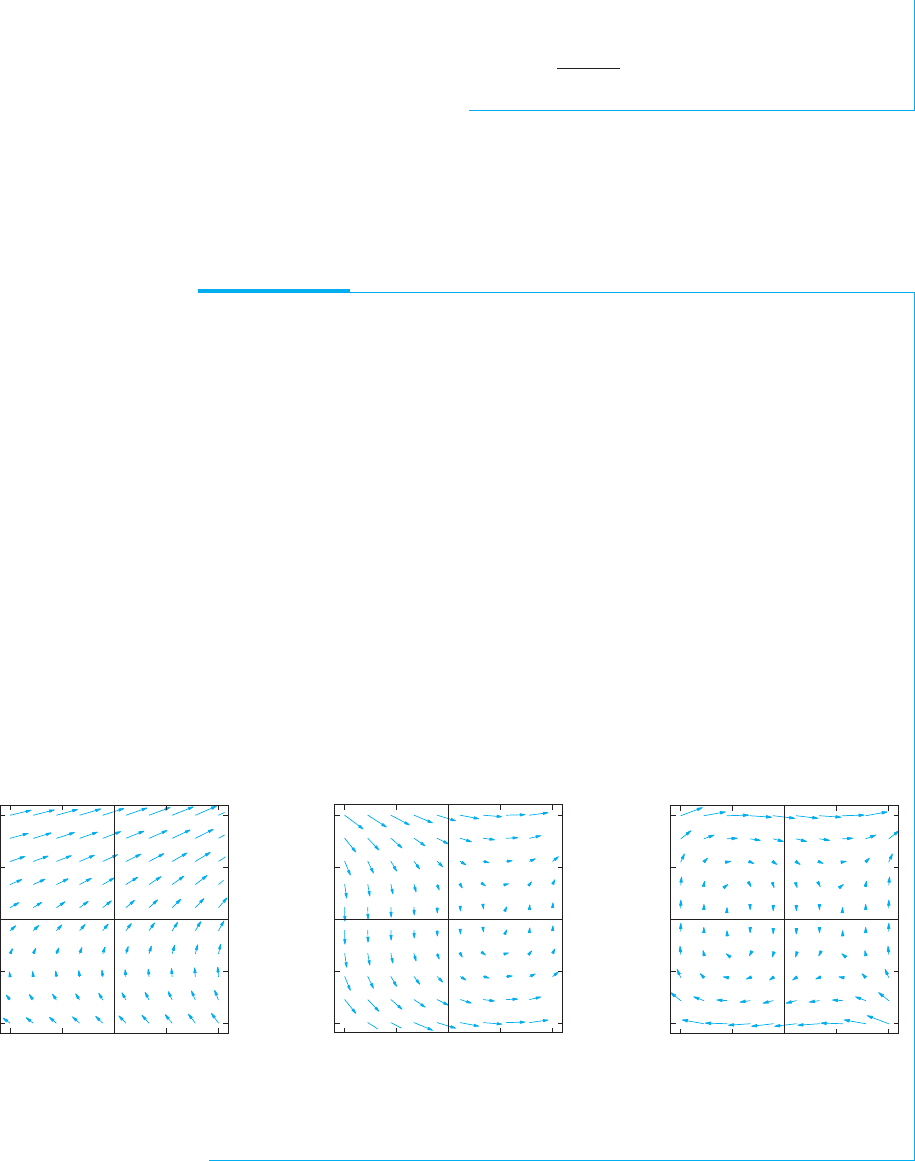
EXAMPLE 1.3 Matching Vector Fields to Graphs
Match the vector fields F(x, y) =y
2
, x − 1, G(x, y) =y + 1, e
x/6
and
H(x, y) =y
3
, x
2
− 1 to the graphs shown.
Solution It helps to look for special features of the components of the vector fields
and try to locate these in the graphs. For instance, the first component of F(x, y)is
y
2
≥ 0, so the vectors F(x, y) will never point to the left. Graphs A and C both have
vectors with negative first components (in the fourth quadrant), so Graph B must be the
graph of F(x, y). The vectors in Graph B also have small vertical components near
x = 1, where the second component of F(x, y) equals zero. Similarly, the second
component of G(x, y)ise
x/6
> 0, so the vectors G(x, y) will always point upward.
Graph A is the only one of these graphs with this property. Further, the vectors in Graph
A are almost vertical near y =−1, where the first component of G(x, y) equals zero.
Observe that the first component of H(x, y)isy
3
, which is negative for y < 0 and
positive for y > 0. The vectors then point to the left for y < 0 and to the right for
y > 0, as seen in Graph C. Finally, the vectors in Graph C have small vertical
components near x = 1 and x =−1, where the second component of H(x, y)
equals zero.
2
2 10 1 2
1
0
1
2
y
x
2
2 10 1 2
1
0
1
2
y
x
2
2 10 1 2
1
0
1
2
y
x
GRAPH A GRAPH B GRAPH C
As you might imagine, vector fields in space are typically more difficult to sketch than
vector fields in the plane, but the idea is the same. That is, pick a variety of representative
points and plot the vector F(x, y, z) with its initial point located at (x, y, z). Unfortunately,
the difficulties associated with representing three-dimensional vectors on two-dimensional
paper reduce the usefulness of these graphs.
P1: OSO/OVY P2: OSO/OVY QC: OSO/OVY T1: OSO
MHDQ256-Ch15 MHDQ256-Smith-v1.cls January 6, 2011 10:53
LT (Late Transcendental)
CONFIRMING PAGES
15-5 SECTION 15.1
..
Vector Fields 981
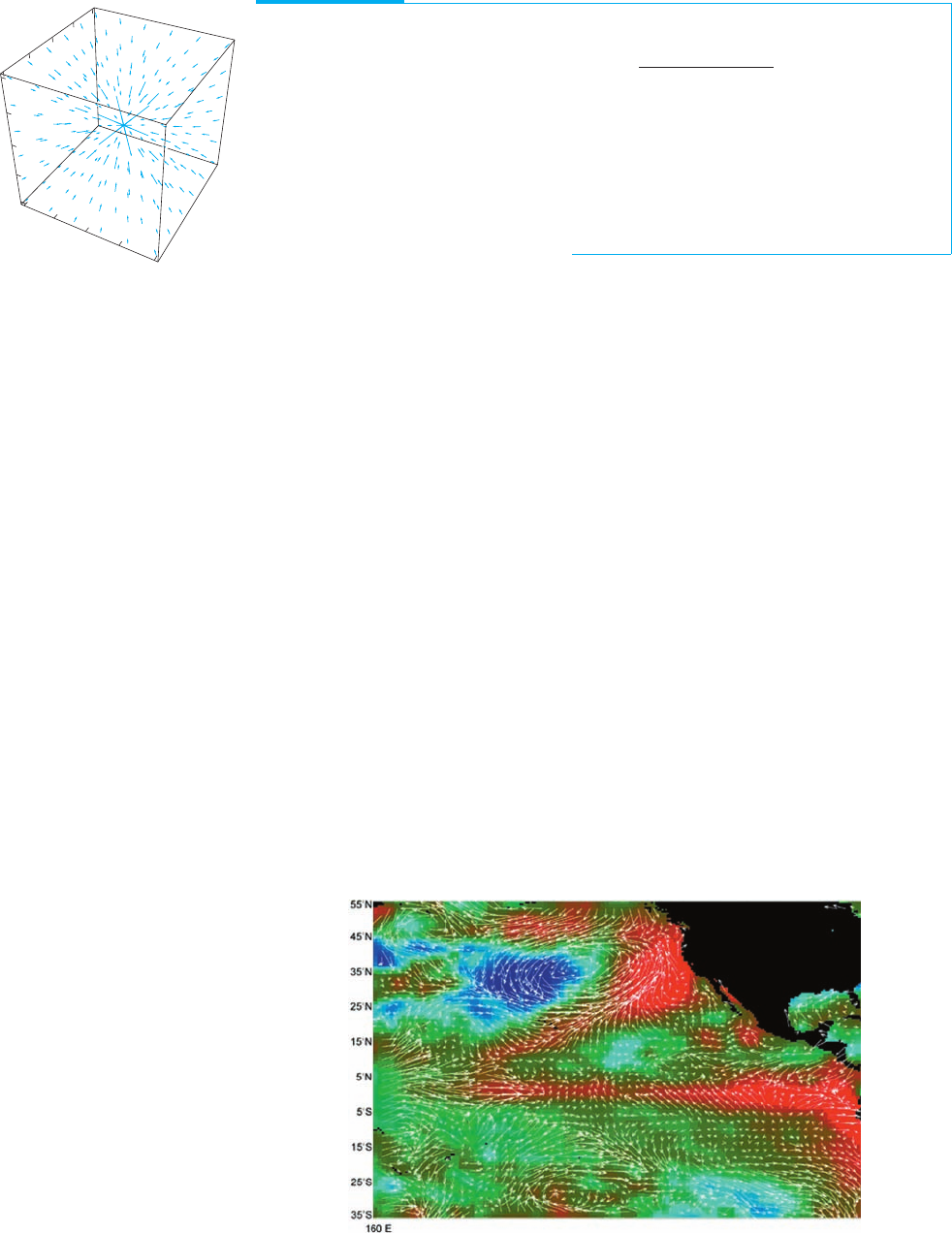
EXAMPLE 1.4 Graphing a Vector Field in Space
Use a CAS to graph the vector field F(x, y, z) =
−x, −y, −z
(x
2
+ y
2
+ z
2
)
3/2
.
Solution In Figure 15.4, we show a computer-generated plot of the vector field
F(x, y, z).
4
4
4
0
0
0
4
4
4
x
z
y
FIGURE 15.4
Gravitational force field
Notice that the vectors all point toward the origin, getting larger near the origin
(where the field is undefined). You should get the sense of an attraction to the origin that
gets stronger the closer you get. In fact, you might have recognized that F(x, y, z)
describes the gravitational force field for an object located at the origin or the electrical
field for a charge located at the origin.
Ifthe vectorfield graphedinFigure 15.4 representsaforce field,thenthegraph suggests
thatan object acted on bythis force field will bedrawntowardthe origin. However, this does
not mean that a given object must move in a straight path toward the origin. For instance,
an object with initial position (2, 0, 0) and initial velocity 0, 2, 0 will spiral in toward the
origin. To determine the path followed by an object, we need additional information. Notice
that in many cases, we can think of velocity as not explicitly depending on time, but instead
depending on location. For instance, imagine watching a mountain stream with waterfalls
and whirlpools that don’t change (significantly) over time. In this case, the motion of a leaf
dropped into the stream would depend on where you drop the leaf, rather than when you
drop the leaf. This says that the velocity of the stream is a function of location. That is, the
velocity of any particle located at the point (x, y) in the stream can be described by a vector
field F(x, y) =f
1
(x, y), f
2
(x, y), called the velocity field. The path of any given particle
startingatthepoint(x
0
, y
0
)isthenthecurvetracedoutbyx(t), y(t),where x(t)and y(t)are
the solutions of the differential equations x
(t) = f
1
(x(t), y(t)) and y
(t) = f
2
(x(t), y(t)),
with initial conditions x(t
0
) = x
0
and y(t
0
) = y
0
. In these cases, we can use the velocity
field to construct flow lines, which indicate the path followed by a particle starting at a
given point.
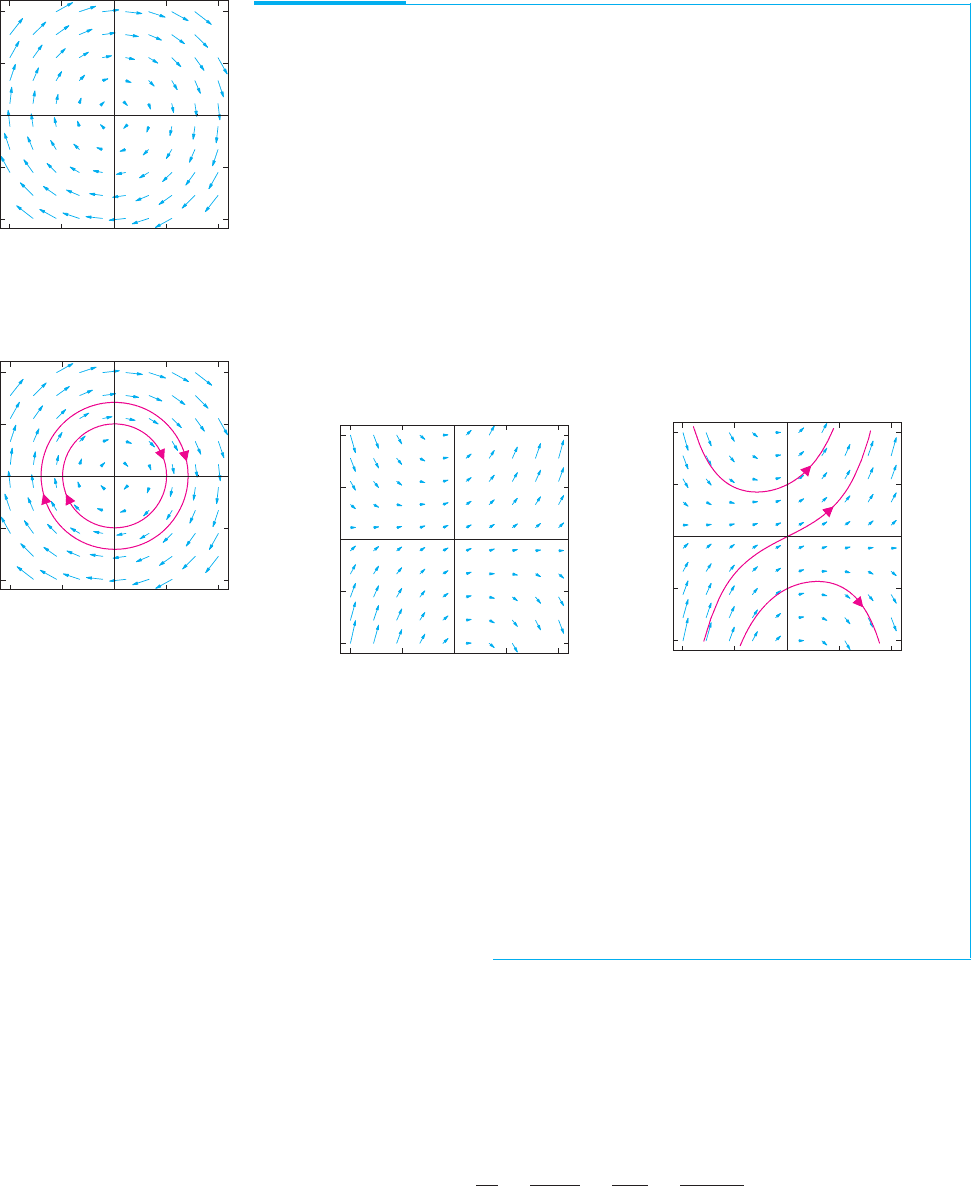
One way to visualize the velocity field for a given process is to plot a number of
velocity vectors at a single instant in time. Figure 15.5 shows the velocity field of Pacific
Ocean currents in March 1998. The graph is color-coded for temperature, with a band of
water swinging up from South America to the Pacific northwest representing “El Ni˜no.”
The velocity field provides information about how the warmer and cooler areas of ocean
water are likely to change. Since El Ni˜no is associated with significant climate changes, an
understanding of its movement is critically important.
FIGURE 15.5
Velocity field for Pacific Ocean currents (March 1998)
P1: OSO/OVY P2: OSO/OVY QC: OSO/OVY T1: OSO
MHDQ256-Ch15 MHDQ256-Smith-v1.cls January 6, 2011 10:53
LT (Late Transcendental)
CONFIRMING PAGES
982 CHAPTER 15
..
Vector Calculus 15-6
EXAMPLE 1.5 Graphing Vector Fields and Flow Lines
Graph the vector fields y, −x and 2, 1 +2xy and for each, sketch-in approximate
flow lines through the points (0, 1), (0, −1) and (1, 1).
2
2 10 1 2
1
0
1
2
y
x
FIGURE 15.6a
y, −x
2
2 10 1 2
1
0
1
2
y
x
FIGURE 15.6b
Flow lines: y, −x
Solution We previously graphed the vector field y, −x in example 1.2 and show a
computer-generated graph of the vector field in Figure 15.6a. Notice that the plotted
vectors nearly join together as concentric circles. In Figure 15.6b, we have
superimposed circular paths that stay tangent to the velocity field and pass through the
points (0, 1), (0, −1) and (1, 1). (Notice that the first two of these paths are the same.) It
isn’t difficult to verify that the flow lines are indeed circles, as follows. Observe that a
circle of radius a centered at the origin with a clockwise orientation (as indicated) can
be described by the endpoint of the vector-valued function r(t) =a sint, a cos t. The
velocity vector r
(t) =a cost, −a sin tgives a tangent vector to the curve for each t.If
we eliminate the parameter, the velocity field for the position vector r =x, y is given
by T =y, −x, which is the vector field we are presently plotting.
2
2 10 1 2
1
0
1
2
y
x
2
2 10 1 2
1
0
1
2
y
x
FIGURE 15.7a FIGURE 15.7b
2, 1 +2xy Flow lines: 2, 1 +2xy
We show a computer-generated graph of the vector field 2, 1 +2xy in
Figure 15.7a, which suggests some parabolic-like paths. In Figure 15.7b, we sketch two
of these paths through the points (0, 1) and (0, −1). However, the vectors in Figure 15.7a
also indicate some paths that look more like cubics, such as the path through (0, 0)
sketched in Figure 15.7b. In this case, though, it’s more difficult to determine equations
for the flow lines. As it turns out, these are neither parabolic nor cubic. We’ll explore
this further in the exercises.
A good sketch of a vector field allows us to visualize at least some of the flow lines.
However, even a great sketch can’t replace the information available from an exact equa-
tion for the flow lines. We can solve for an equation of a flow line by noting that if
F(x, y) =f
1
(x, y), f
2
(x, y) is a velocity field and x(t), y(t) is the position function,
then x
(t) = f
1
(x, y) and y
(t) = f
2
(x, y). By the chain rule, we have
dy
dx
=
dy/dt
dx/dt
=
y
(t)
x
(t)
=
f
2
(x, y)
f
1
(x, y)
. (1.1)
Equation (1.1) is a first-order differential equation for the unknown function y(x). We refer
you to section 8.2, where we developed a technique for solving one group of differen-
tial equations, called separable equations. In section 8.3, we presented a method (Euler’s
method) for approximating the solution of any first-order differential equation passing
through a given point.