
Smith R., Minton R. Calculus
Подождите немного. Документ загружается.


P1: OSO/OVY P2: OSO/OVY QC: OSO/OVY T1: OSO
MHDQ256-Ch15 MHDQ256-Smith-v1.cls January 6, 2011 10:53
LT (Late Transcendental)
CONFIRMING PAGES
15-67 SECTION 15.6
..
Surface Integrals 1043
45. F =y, −x, z, S is the portion of z =
x
2
+ y
2
below z = 3
(n downward)
46. F =0, 1, y, S is the portion of z =−
x
2
+ y
2
inside
x
2
+ y
2
= 4(n upward)
47. F =xy, y
2
, z, S is the boundary of the unit cube with
0 ≤ x ≤ 1, 0 ≤ y ≤ 1, 0 ≤ z ≤ 1(n outward)
48. F =y, z, 0, S is the boundary of the box with 0 ≤ x ≤ 2,
0 ≤ y ≤ 3, 0 ≤ z ≤ 1(n outward)
49. F =1, 0, z, S is the boundary of the region bounded above
by z = 4 − x
2
− y
2
and below by z = 1(n outward)
50. F =x, y, z, S is the boundary of the region between z = 0
and z =−
4 − x
2
− y
2
51. F =x, y, z, S is the torus (4 + 2cosv)cosu, (4 +2 cos v)
sinu, 2 sin v (n outward)
52. F =y, x, 0, S is the portion of z = x
2
+ y
2
above the trian-
gle with vertices (0, 0), (0, 1), (1, 1) (n downward)
53. F =y, 0, 2, S is the boundary of the region bounded above
byz =
8 − x
2
− y
2
andbelowby z =
x
2
+ y
2
(n outward)
54. F =3, z, y, S is the boundary of the region between
z = 8 −2x − y and z =
x
2
+ y
2
and inside x
2
+ y
2
= 1
(n outward)
............................................................
In exercises 55–62, evaluate the surface integral.
55.
S
zdS, where S is the portion of x
2
+ y
2
= 1 with x ≥ 0 and
z between z = 1 and z = 2
56.
S
yz dS, where S is the portion of x
2
+ y
2
= 1 with x ≥ 0
and z between z = 1 and z = 4 − y
57.
S
(y
2
+ z
2
)dS, where S is the portion of the paraboloid
x = 9 − y
2
− z
2
in front of the yz-plane
58.
S
(y
2
+ z
2
)dS, where S is the hemisphere x =
4 − y
2
− z
2
59.
S
x
2
dS, where S is the portion of the paraboloid y = x
2
+ z
2
to the left of the plane y = 1
60.
S
(x
2
+ z
2
)dS, where S is the hemisphere y =
√
4 − x
2
− z
2
61.
S
4xdS, where S is the portion of y = 1 − x
2
with y ≥ 0 and
between z = 0 and z = 2
62.
S
(x
2
+ z
2
)dS, where S is the portion of y =
√
4 − x
2
be-
tween z = 1 and z = 4
............................................................
63. (a) Explain the following result geometrically. The flux inte-
gralof F(x, y, z) =x, y, zacrossthe cone z =
x
2
+ y
2
is 0.
(b) In geometric terms, determine whether the flux in-
tegral of F(x, y, z) =x, y, z across the hemisphere
z =
1 − x
2
− y
2
is 0.
64. Rework exercise 29 by cutting and unfolding the torus into a
rectangle.
65. (a) For the cone z = c
x
2
+ y
2
(where c > 0), show that
in spherical coordinates tanφ =
1
c
. Then show that para-
metric equations are x =
u cos v
√
c
2
+ 1
, y =
u sin v
√
c
2
+ 1
and
z =
cu
√
c
2
+ 1
.
(b) Find the surface area of the portion of z = c
x
2
+ y
2
below z = 1.
66. (a) Find the flux of x, y, z across the portion of z =
c
x
2
+ y
2
below z = 1. Explain in physical terms why this
answer makes sense. (b) Find the flux of x, y, z across the
entire cone z
2
= c
2
(x
2
+ y
2
).
67. (a) Find the flux of x, y, 0 across the portion of
z = c
x
2
+ y
2
belowz = 1. (b)Find the limitas c approaches
0 of the flux. Explain in physical terms why this answer makes
sense.
68. (a) Find the flux of x, y, z across the portion of
z =
c
2
− x
2
− y
2
above z = 0.
(b) Find the limit of the flux as c approaches 0. Explain in
physical terms why this answer makes sense.
69. Show that on the sphere ρ = c, dS = c
2
sinφ dA (c > 0).
70. Show that on the cone φ = c, dS = ρ sincdA(0 < c <π).
APPLICATIONS
In exercises 71–74, find the mass and center of mass of the object
corresponding to the given surface and mass density.
71. The portion of the plane 3x + 2y + z = 6 inside the cylinder
x
2
+ y
2
= 4,ρ(x, y, z) = x
2
+ 1
72. The portion of the plane x + 2y + z = 4 above the region
bounded by y = x
2
and y = 1,ρ(x, y, z) = y
73. The hemisphere z =
1 − x
2
− y
2
,ρ(x, y, z) = 1 + x
74. The portion of the paraboloid z = x
2
+ y
2
inside the cylinder
x
2
+ y
2
= 4,ρ(x, y, z) = z
EXPLORATORY EXERCISE
1. If x = 3sinu cosv, y = 3cosu and z = 3 sin u sinv, show
that x
2
+ y
2
+ z
2
= 9. Explain why this equation doesn’t
guarantee that the parametric surface defined is the entire
sphere, but it does guarantee that all points on the surface
are also on the sphere. In this case, the parametric surface
is the entire sphere. To verify this in graphical terms, sketch
a picture showing geometric interpretations of the “spher-
ical coordinates” u and v. To see what problems can oc-
cur, sketch the surface defined by x = 3 sin
u
2
u
2
+ 1
cosv,
y = 3 cos
u
2
u
2
+ 1
and z = 3 sin
u
2
u
2
+ 1
sinv.Explain why you
P1: OSO/OVY P2: OSO/OVY QC: OSO/OVY T1: OSO
MHDQ256-Ch15 MHDQ256-Smith-v1.cls January 6, 2011 10:53
LT (Late Transcendental)
CONFIRMING PAGES
1044 CHAPTER 15
..
Vector Calculus 15-68
do not get the entire sphere. To see a more subtle example
of the same problem, sketch the surface x = cos u coshv,
y = sinh v, z = sinu coshv. Use identities to show that
x
2
− y
2
+ z
2
= 1 and identify the surface. Then sketch the
surface x = cosu coshv, y = cosu sinhv, z = sinu and use
identities to show that x
2
− y
2
+ z
2
= 1. Explain why the sec-
ond surface is not the entire hyperboloid. Explain inwords and
pictures exactly what the second surface is.
15.7 THE DIVERGENCE THEOREM
Recall that at the end of section 15.5, we had rewritten Green’s Theorem in terms of the
divergence of a two-dimensional vector field. We had found there (see equation 5.3) that
C
F · n ds =
R
∇·F(x, y) dA.
Here, R is a regionin the xy-plane enclosed by a piecewise-smooth,positively oriented, sim-
ple closed curve C. Further, F(x, y) =M(x, y), N(x, y), 0, where M(x, y) and N(x, y)
are continuous and have continuous first partial derivatives in some open region D in the
xy-plane, with R ⊂ D.
We can extend this two-dimensional result to three dimensions in exactly the way you
might expect. That is, for a solid region Q ⊂ R
3
bounded by the surface ∂Q,wehave
∂
Q
F · n dS =
Q
∇·F(x, y, z) dV.
This result (referred to as the Divergence Theorem or Gauss’ Theorem) has great sig-
nificance in a variety of settings. If F represents the velocity field of a fluid in motion, the
Divergence Theorem says that the total flux of the velocity field across the boundary of the
solid is equal to the triple integral of the divergence of the velocity field over the solid.
Q
Q
z
y
x
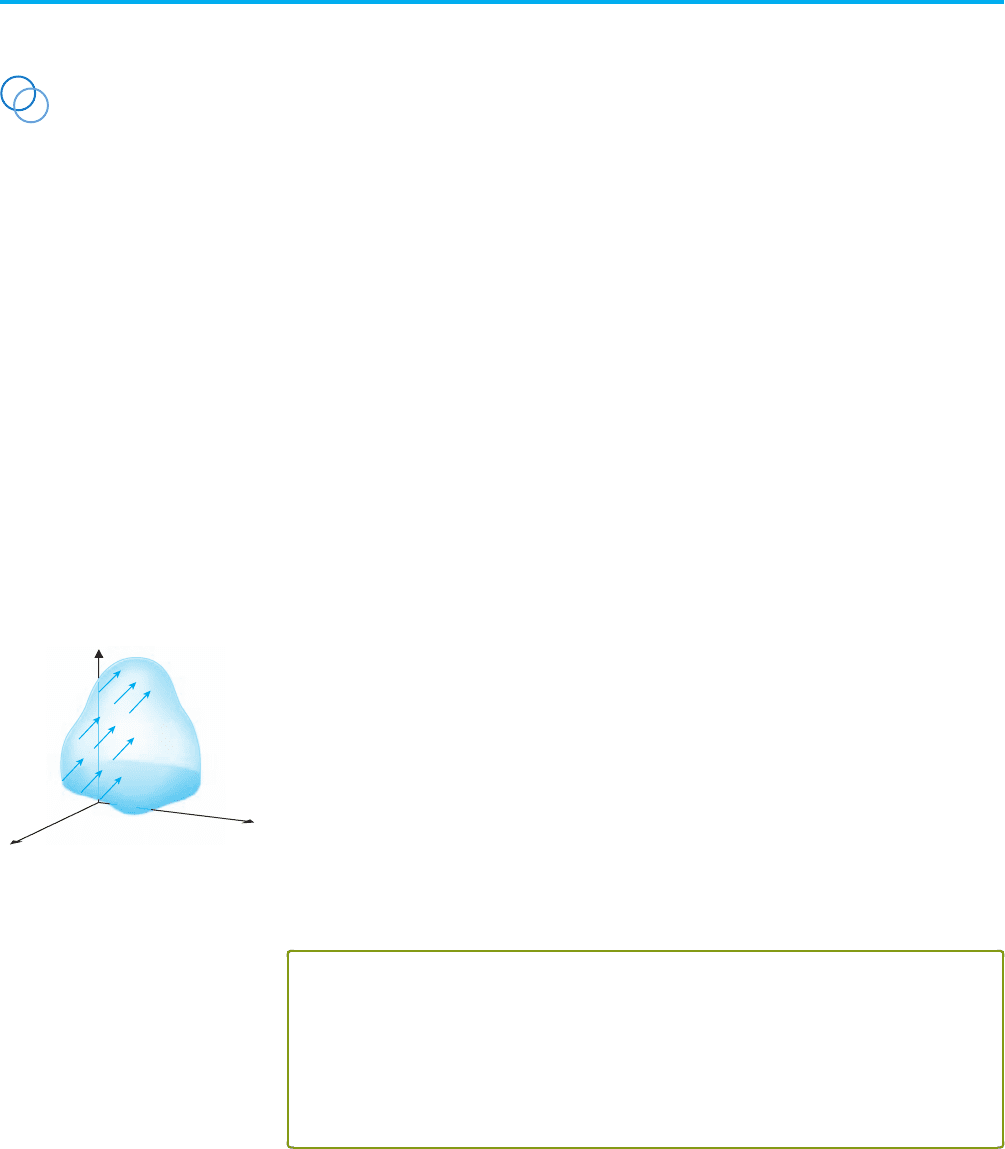
FIGURE 15.48
Flow of fluid across ∂Q
In Figure 15.48, the velocity field F of a fluid is shown superimposed on a solid Q
bounded by the closed surface ∂Q. Observe that there are two ways to compute the rate of
change of the amount of fluid inside of Q. One way is to calculate the fluid flow into or
out of Q across its boundary, which is given by the flux integral
∂
Q
F · n dS. On the other
hand, instead of focusing on the boundary, we can consider the accumulation or dispersal
of fluid at each point in Q. As we’ll see, this is given by ∇·F, whose value at a given point
measures the extent to which that point acts as a source or sink of fluid. To obtain the total
change in the amount of the fluid in Q, we “add up” all of the values of ∇·F in Q, giving
us the triple integral of ∇·F over Q. Since the flux integral and the triple integral both give
the net rate of change of the amount of fluid in Q, they must be equal.
We now state and prove the result.
THEOREM 7.1 (Divergence Theorem)
Suppose that Q ⊂ R
3
is bounded by the closed oriented surface ∂Q and that n(x, y, z)
denotes the exterior unit normal vector to ∂Q. Then, if the components of F(x, y, z)
have continuous first partial derivatives in Q,wehave
∂
Q
F ·n dS =
Q
∇·F(x, y, z) dV.
Although we have stated the theorem in the general case, we prove the result only for
the case where the solid Q is fairly simple. A proof for the general case can be found in a
more advanced text.
P1: OSO/OVY P2: OSO/OVY QC: OSO/OVY T1: OSO
MHDQ256-Ch15 MHDQ256-Smith-v1.cls January 6, 2011 10:53
LT (Late Transcendental)
CONFIRMING PAGES
15-69 SECTION 15.7
..
The Divergence Theorem 1045
PROOF
For F(x, y, z) =M(x, y, z), N(x, y, z), P(x, y, z), the divergence of F is
∇·F(x, y, z) =
∂ M
∂x
+
∂ N
∂y
+
∂ P
∂z
.
We then have that
Q
∇·F(x, y, z) dV =
Q
∂ M
∂x
dV +
Q
∂ N
∂y
dV +
Q
∂ P
∂z
dV. (7.1)
Further, we can write the flux integral as
∂
Q
F · n dS =
∂
Q
M(x, y, z)i ·n dS +
∂
Q
N(x, y, z)j ·n dS
+
∂
Q
P(x, y, z)k ·n dS. (7.2)
Looking carefully at (7.1) and (7.2), observe that the theorem will follow if we can show
that
Q
∂ M
∂x
dV =
∂
Q
M(x, y, z)i ·n dS, (7.3)
Q
∂ N
∂y
dV =
∂
Q
N(x, y, z)j ·n dS (7.4)
and
Q
∂ P
∂z
dV =
∂
Q
P(x, y, z)k ·n dS. (7.5)
As you might imagine, the proofs of (7.3), (7.4) and (7.5) are all virtually identical (and
all fairly long). Consequently, we prove only one of these three equations here. In order to
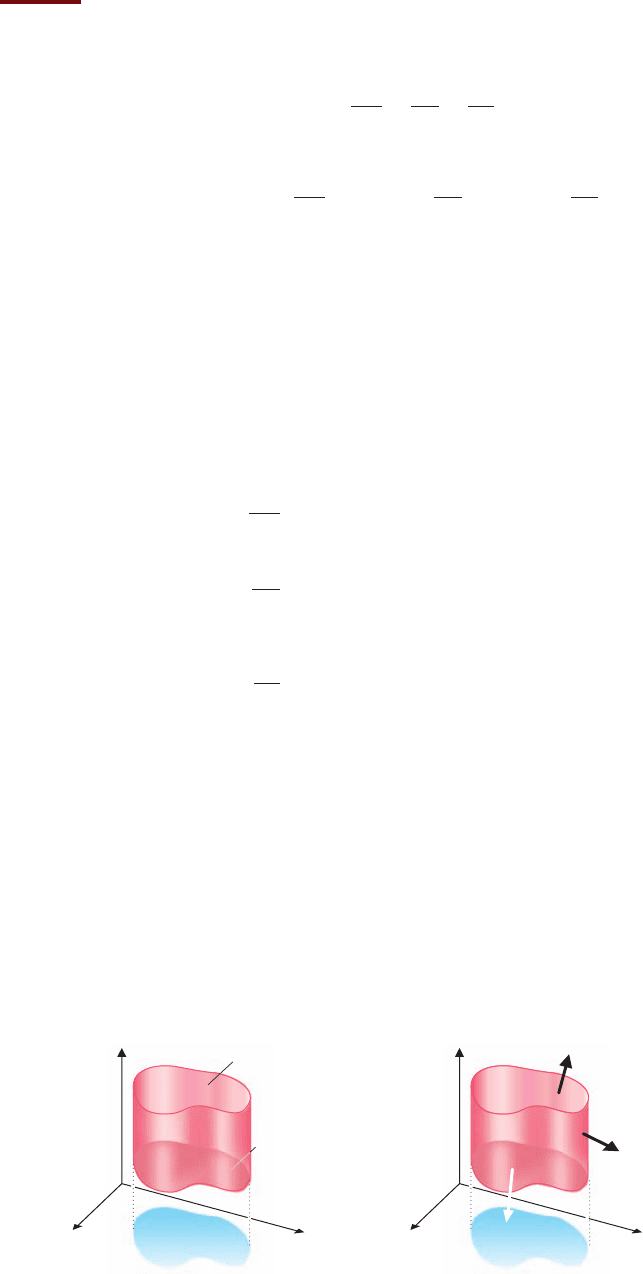
prove (7.5), we assume that we can describe the solid Q as follows:
Q ={(x, y, z)|g(x, y) ≤ z ≤ h(x, y), for (x, y) ∈ R},
where R is some region in the xy-plane, as illustrated in Figure 15.49a. Now, notice from
Figure 15.49a that there are three distinct surfaces that make up the boundary of Q.In
Figure 15.49b, we have labeled these surfaces S
1
(the bottom surface), S
2
(the top surface)
and S
3
(the lateral surface), where we have also indicated exterior normal vectors to each
of the surfaces.
R
Q
z
z h(x, y)
z g(x, y)
y
x
R
S
3
S
2
S
1
z
y
x
S
2
FIGURE 15.49a FIGURE 15.49b
The solid Q The surfaces S
1
, S
2
and S
3
and
several exterior normal vectors

P1: OSO/OVY P2: OSO/OVY QC: OSO/OVY T1: OSO
MHDQ256-Ch15 MHDQ256-Smith-v1.cls January 6, 2011 10:53
LT (Late Transcendental)
CONFIRMING PAGES
1046 CHAPTER 15
..
Vector Calculus 15-70
Notice that on the lateral surface S
3
, the k component of the exterior unit normal n is
zero and so, the flux integral of P(x, y, z)k over S
3
is zero. This gives us
∂
Q
P(x, y, z)k ·n dS =
S
1
P(x, y, z)k ·n dS +
S
2
P(x, y, z)k ·n dS. (7.6)
In order to prove the result, we need to rewrite the two integrals on the right side of (7.6) as
double integrals over the region R in the xy-plane. First, you must notice that on the surface
S
1
(the bottom surface), the exterior unit normal n points downward (i.e., it has a negative
k component). Now, S
1
is defined by
S
1
={(x, y, z)|z = g(x, y), for (x, y) ∈ R}.
If we define k
1
(x, y, z) = z − g(x, y), then the exterior unit normal on S
1
is given by
n =
−∇k
1
∇k
1
=
g
x
(x, y)i + g
y
(x, y)j −k
[g
x
(x, y)]
2
+ [g
y
(x, y)]
2
+ 1
and
k · n =
−1
[g
x
(x, y)]
2
+ [g
y
(x, y)]
2
+ 1
,
since the unit vectors i, j and k are all mutually orthogonal. We now have
S
1
P(x, y, z)k ·n dS =−
S
1
P(x, y, z)
[g
x
(x, y)]
2
+ [g
y
(x, y)]
2
+ 1
dS
=−
R
P(x, y, g(x, y))
[g
x
(x, y)]
2
+ [g
y
(x, y)]
2
+ 1
·
[g
x
(x, y)]
2
+ [g
y
(x, y)]
2
+ 1 dA
=−
R
P(x, y, g(x, y)) dA, (7.7)
thanks to the two square roots canceling out one another. In a similar way, notice that
on S
2
(the top surface), the exterior unit normal n points upward (i.e., it has a positive k
component). Since S
2
corresponds to the portion of the surface z = h(x, y) for (x, y) ∈ R,
if we take k
2
(x, y) = z − h(x, y), we have that on S
2
,
n =
∇k
2
∇k
2
=
−h
x
(x, y)i −h
y
(x, y)j +k
[h
x
(x, y)]
2
+ [h
y
(x, y)]
2
+ 1
and so,
k · n =
1
[h
x
(x, y)]
2
+ [h
y
(x, y)]
2
+ 1
.
We now have
S
2
P(x, y, z) k ·n dS =
S
2
P(x, y, z)
[h
x
(x, y)]
2
+ [h
y
(x, y)]
2
+ 1
dS
=
R
P(x, y, h(x, y))
[h
x
(x, y)]
2
+ [h
y
(x, y)]
2
+ 1
·
[h
x
(x, y)]
2
+ [h
y
(x, y)]
2
+ 1 dA
=
R
P(x, y, h(x, y)) dA. (7.8)
P1: OSO/OVY P2: OSO/OVY QC: OSO/OVY T1: OSO
MHDQ256-Ch15 MHDQ256-Smith-v1.cls January 6, 2011 10:53
LT (Late Transcendental)
CONFIRMING PAGES
15-71 SECTION 15.7
..
The Divergence Theorem 1047
Putting together (7.6), (7.7) and (7.8) gives us
∂
Q
P(x, y, z)k ·n dS =
S
1
P(x, y, z) k ·n dS +
S
2
P(x, y, z)k ·n dS
=
R
P(x, y, h(x, y)) dA −
R
P(x, y, g(x, y)) dA
=
R
[P(x, y, h(x, y)) − P(x, y, g(x, y))] dA
=
R
h(x,y)
g(x,y)
∂ P
∂z
dzdA
By the Fundamental
Theorem of Calculus
=
Q
∂ P
∂z
dV,
which proves (7.5). With appropriate assumptions on Q, we can similarly prove (7.3) and
(7.4). This proves the theorem for the special case where the solid Q can be described as
indicated.
z
x
y
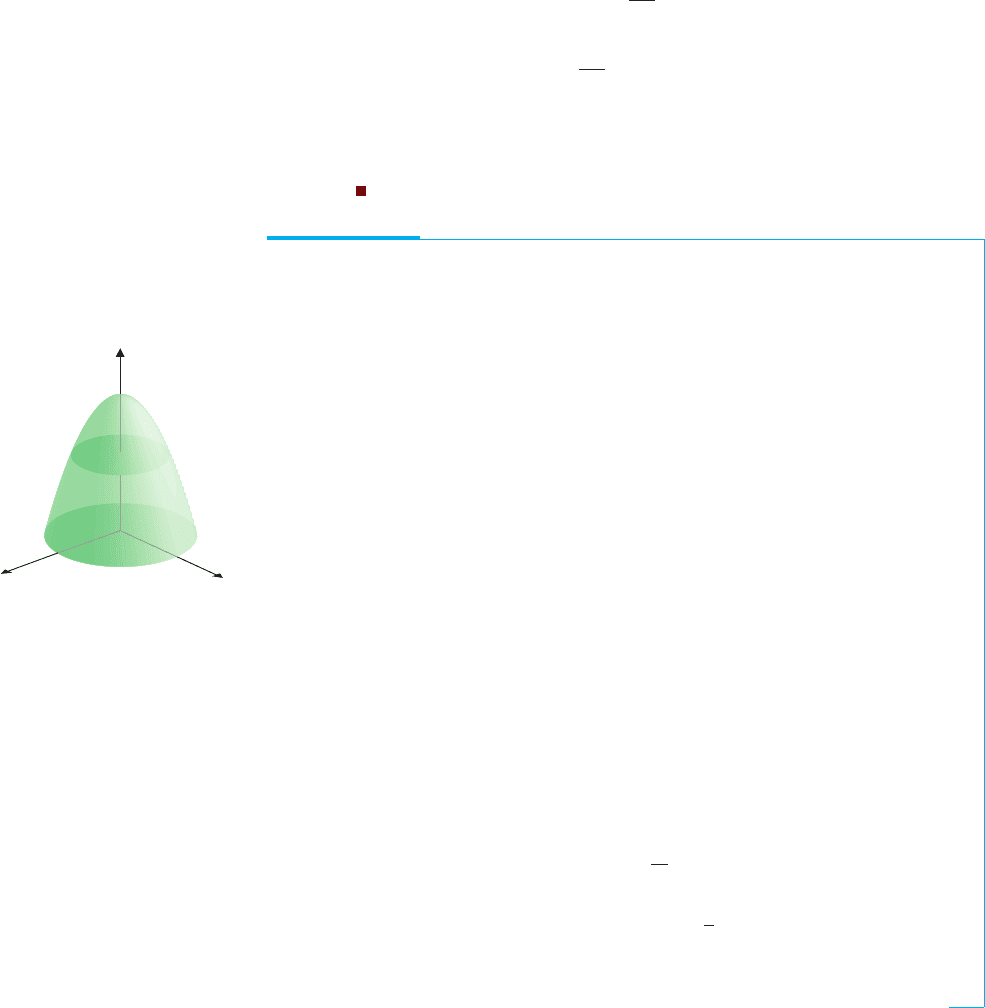
z 4 x
2
y
2
Q
FIGURE 15.50
The solid Q
EXAMPLE 7.1 Applying the Divergence Theorem
Let Q be the solid bounded by the paraboloid z = 4 − x
2
− y
2
and the xy-plane. Find
the flux of the vector field F(x, y, z) =x
3
, y
3
, z
3
over the surface ∂Q.
Solution We show a sketch of the solid in Figure 15.50. Notice that to compute
the flux directly, we must consider the two different portions of ∂Q (the surface of the
paraboloid and its base in the xy-plane) separately. Alternatively, observe that the
divergence of F is given by
∇·F(x, y, z) =∇·x
3
, y
3
, z
3
=3x
2
+ 3y
2
+ 3z
2
.
From the Divergence Theorem, we now have that the flux of F over ∂Q is given by
∂
Q
F · n dS =
Q
∇·F(x, y, z) dV
=
Q
(3x
2
+ 3y
2
+ 3z
2
)dV.
If we rewrite the triple integral in cylindrical coordinates, we get
∂
Q
F · n dS =
Q
(3x
2
+ 3y
2
+ 3z
2
)dV
= 3
2π
0
2
0
4−r
2
0
(r
2
+ z
2
)rdzdrdθ
= 3
2π
0
2
0
r
2
z +
z
3
3
z=4−r
2
z=0
rdrdθ
= 3
2π
0
2
0
r
3
(4 − r
2
) +
1
3
(4 − r
2
)
3
r
dr dθ
= 96π,
where we have left the details of the final integrations as a straightforward exercise.
Notice that in example 7.1, we used the Divergence Theorem to replace a very messy
surface integral calculation by a comparatively simple triple integral. In example 7.2, we

P1: OSO/OVY P2: OSO/OVY QC: OSO/OVY T1: OSO
MHDQ256-Ch15 MHDQ256-Smith-v1.cls January 6, 2011 10:53
LT (Late Transcendental)
CONFIRMING PAGES
1048 CHAPTER 15
..
Vector Calculus 15-72
prove a general result regarding the flux of a certain vectorfield overany surface, something
we would be unable to do without the Divergence Theorem.
EXAMPLE 7.2 Proving a General Result with the Divergence Theorem
Prove that the flux of the vector field F(x, y, z) =3y cos z, x
2
e
z
, x sin y is zero over
any closed oriented surface ∂Q enclosing a solid region Q.
Solution Notice that in this case, the divergence of F is
∇·F(x, y, z) =∇·3y cos z, x
2
e
z
, x sin y
=
∂
∂x
(3y cos z) +
∂
∂y
(x
2
e
z
) +
∂
∂z
(x sin y) = 0.
From the Divergence Theorem, we then have that the flux of F over ∂Q is given by
∂
Q
F · n dS =
Q
∇·F(x, y, z) dV
=
Q
0dV = 0,
for any solid region Q ⊂ R
3
.
In section 4.4, we saw that for a function f (x) of a single variable, if f is continuous
on the interval [a, b] then the average value of f on [a, b]isgivenby
f
ave
=
1
b −a
b
a
f (x) dx.
Similarly, when f (x, y, z) is a continuous function on the region Q ⊂ R
3
(bounded by the
surface ∂Q), the average value of f on Q is given by
f
ave
=
1
V
Q
f (x, y, z) dV,
where V is the volume of Q. Further, by continuity, there must be a point P(a, b, c) ∈ Q at
which f equals its average value, that is, where
f (P) =
1
V
Q
f (x, y, z) dV.
This says that if F(x, y, z) has continuous first partial derivatives on Q, then (div)F is
continuous on Q and so, there is a point P(a, b, c) ∈ Q for which
(∇·F)
P
=
1
V
Q
∇·F(x, y, z) dV
=
1
V
∂
Q
F(x, y, z) ·n dS,
by the Divergence Theorem. Finally, observe that since the surface integral represents
the flux of F over the surface ∂Q, then (∇·F)|
P
represents the flux per unit volume
over ∂Q.

P1: OSO/OVY P2: OSO/OVY QC: OSO/OVY T1: OSO
MHDQ256-Ch15 MHDQ256-Smith-v1.cls January 6, 2011 10:53
LT (Late Transcendental)
CONFIRMING PAGES
15-73 SECTION 15.7
..
The Divergence Theorem 1049
In particular, for any point P
0
(x
0
, y
0
, z
0
) in the interior of Q (i.e., in Q, but not on ∂Q),
let S
a
be the sphere of radius a, centered at P
0
, where a is sufficiently small so that S
a
lies
completely inside Q. From the preceding discussion, there must be some point P
a
in the
interior of S
a
for which
(∇·F)
P
a
=
1
V
a
S
a
F(x, y, z) ·n dS,
where V
a
is the volume of the sphere (V
a
=
4
3
πa
3
). Finally, taking the limit as a → 0, we
have by the continuity of ∇·F that
(∇·F)
P
0
= lim
a→0
1
V
a
S
a
F(x, y, z)·n dS
or
div F(P
0
) = lim
a→0
1
V
a
S
a
F(x, y, z)·n dS. (7.9)
In other words, the divergence of a vector field at a point P
0
is the limiting value of the
flux per unit volume over a sphere centered at P
0
, as the radius of the sphere tends to
zero.
In the case where F represents the velocity field for a fluid in motion, (7.9) provides
us with an important interpretation of the divergence of a vector field. In this case, if
div F(P
0
) > 0, then the flux per unit volume at P
0
is positive. From (7.9), this means that
for a sphere S
a
of sufficientlysmall radius centered at P
0
, the net (outward) flux through the
surface of S
a
is positive. For an incompressible fluid (such as a liquid), this says that more
fluid is passing out through the surface of S
a
than is passing in through the surface, which
can happen only if there is a source somewhere in S
a
, where additional fluid is coming into
the flow. Likewise, if div F(P
0
) < 0, there must be a sphere S
a
for which the net (outward)
flux through the surface of S
a
is negative. This says that more fluid is passing in through
the surface than is flowing out. Once again, for an incompressible fluid, this can occur
only if there is a sink somewhere in S
a
, where fluid is leaving the flow. For this reason, in
incompressible fluid flow, a point where div F(P) > 0 is called a source and a point where
div F(P) < 0 is called a sink. Notice that for an incompressible fluid flow with no sources
or sinks, we must have that div F(P) = 0 throughout the flow.
EXAMPLE 7.3 Finding the Flux of an Inverse Square Field
Show that the flux of an inverse square field over every closed surface enclosing the
origin is a constant.
Solution Suppose that S is a closed surface forming the boundary of the solid region
Q, where the origin lies in the interior of Q and suppose that F is an inverse square field.
That is,
F(x, y, z) =
c
r
3
r,
where r =x, y, z, r=
x
2
+ y
2
+ z
2
and c is a constant. Before you rush to apply
the Divergence Theorem, notice that F is not continuous in Q, since F is undefined at
the origin and so, we cannot apply the theorem in Q. Notice, though, that if we could

P1: OSO/OVY P2: OSO/OVY QC: OSO/OVY T1: OSO
MHDQ256-Ch15 MHDQ256-Smith-v1.cls January 6, 2011 10:53
LT (Late Transcendental)
CONFIRMING PAGES
1050 CHAPTER 15
..
Vector Calculus 15-74
somehow exclude the origin from the region, then we could apply the theorem. A very
common method of doing this is to “punch out” a sphere S
a
of radius a centered at the
origin, where a is sufficiently small that S
a
is completely contained in the interior of Q.
(See Figure 15.51.) That is, if we define Q
a
to be the set of all points inside Q,but
outside of S
a
(so that Q
a
corresponds to Q, where the sphere S
a
has been “punched
out”), we can now apply the Divergence Theorem on Q
a
. Before we do that, notice that
the boundary of Q
a
consists of the two surfaces S and S
a
.Wenowhave
Q
a
∇·F dV =
S
F ·n dS +
S
a
F ·n dS.
S
O
S
a
z
n
n
y
x
FIGURE 15.51
The region Q
a
We leave it as an exercise to show that for any inverse square field, ∇·F = 0. This now
gives us
S
F ·n dS =−
S
a
F ·n dS. (7.10)
Since the integral on the right side of (7.10) is taken over a sphere centered at the origin,
we should be able to easily calculate it. You need to be careful, though, to note that the
exterior normals here point out of Q
a
and so, the normal on the right side of (7.10) must
point toward the origin. That is,
n =−
1
r
r =−
1
a
r,
since r=a on S
a
. We now have from (7.10) that
S
F ·n dS =−
S
a
c
a
3
r ·
−
1
a
r
dS
=
c
a
4
S
a
r ·r dS
=
c
a
4
S
a
r
2
dS
=
c
a
2
S
a
dS =
c
a
2
(4πa
2
) = 4πc, Since r=a
since
S
a
dS simply gives the surface area of the sphere, 4πa
2
. Notice that this says that
over any closed surface enclosing the origin, the flux of an inverse square field is a
constant: 4πc.
The principle derived in example 7.3 is called Gauss’ Law for inverse square fields
and has many important applications, notably in the theory of electricity and magnetism.
The method we used to derive Gauss’ Law, where we punched out a sphere surrounding
the discontinuity of the integrand, is a common technique used in applying the Divergence
Theorem to a variety of important cases where the integrand is discontinuous. In particular,
suchapplications to discontinuous vectorfields are quiteimportantinthefield of differential
equations.
We close the section with a straightforward application of the Divergence Theorem to
show that the flux of a magnetic field across a closed surface is always zero.

P1: OSO/OVY P2: OSO/OVY QC: OSO/OVY T1: OSO
MHDQ256-Ch15 MHDQ256-Smith-v1.cls January 6, 2011 10:53
LT (Late Transcendental)
CONFIRMING PAGES
15-75 SECTION 15.7
..
The Divergence Theorem 1051
EXAMPLE 7.4 Finding the Flux of a Magnetic Field
Use the Divergence Theorem and Maxwell’s equation ∇·B = 0 to show that
S
B · n dS = 0 for any closed surface S.
Solution Applying the Divergence Theorem to
S
B · n dS and using ∇·B = 0, we
have
S
B ·n dS =
Q
∇·B dV = 0.
Observe that this result says that the flux of a magnetic field over any closed surface
is zero.
EXERCISES 15.7
WRITING EXERCISES
1. If F is the velocityfield of a fluid, explain what F ·n represents
and then what
∂ Q
F · n dS represents.
2. IfF is thevelocityfield of afluid, explain what ∇·F represents
and then what
Q
∇·F dV represents.
3. Use your answers to exercises 1 and 2 to explain in physical
terms why the Divergence Theorem makes sense.
4. For fluid flowing through a pipe, give one example each of a
source and a sink.
In exercises 1–4, verify the Divergence Theorem by computing
both integrals.
1. F =2xz, y
2
, −xz, Q is the filled-in cube 0 ≤ x ≤ 1, 0 ≤
y ≤ 1, 0 ≤ z ≤ 1
2. F =x, y, z, Q is the ball x
2
+ y
2
+ z
2
≤ 1
3. F =xz, zy, 2z
2
,Q isboundedby z = 1 − x
2
− y
2
and z = 0
4. F =x
2
, 2y, −x
2
, Q is the tetrahedron bounded by
x + 2y + z = 4 and the coordinate planes
............................................................
In exercises 5–12, use the Divergence Theorem to compute
∂Q
F ·n dS, where n is the outward unit normal.
5. Q is bounded by x + y + 2z = 2 (first octant) and the coordi-
nate planes, F =2x − y
2
, 4xz − 2y, xy
3
.
6. Q is bounded by 4x + 2y − z = 4(z ≤ 0) and the coordinate
planes, F =x
2
− y
2
z, x sin z, 4y
2
.
7. Q is the rectangular box 0 ≤ x ≤ 2, 1 ≤ y ≤ 2, −1 ≤ z ≤ 2,
F =y
3
− 2x, e
xz
, 4z.
8. Q is bounded by z =
x
2
+ y
2
and z = 4,
F =y
3
, x + z
2
, z + y
2
.
9. Q is bounded by z = x
2
+ y
2
and z = 4,
F =x
3
, y
3
− z, xy
2
.
10. Q is bounded by z =
x
2
+ y
2
, z = 1 and z = 2,
F =x
3
, x
2
z
2
, 3y
2
z.
11. Q is bounded by x
2
+ y
2
= 4, z = 1 and z = 8 − y,
F =y
2
z, 2y − e
z
, sin x.
12. Q is bounded by z =−
4 − x
2
− y
2
and z = 0,
F =x
3
, y
3
, z
3
.
............................................................
In exercises13–16, compute
∂Q
F ·n dS, using the easiest method
available.
13. Q is the filled-in cube −1 ≤ x ≤ 1, −1 ≤ y ≤ 1,
−1 ≤ z ≤ 1,
(a) F =4y
2
, 3z − cos x, z
3
− x
(b) F =(x
2
− 1)e
√
x
2
+y
2
, 2(y
2
− 1)z, 4zx
3
14. Q is bounded by z = 4 − x
2
− y
2
, z = 1 and z = 0,
(a) F =z
3
, x
2
y, y
2
z
(b) F =ze
√
x
2
+y
2
+z
2
, (x
2
+ y
2
+ z − 4)z sin y,
−2xze
√
x
2
+y
2
+z
2
15. Q is bounded by x
2
+ y
2
= 1, z = 0 and z = 1,
(a) F =x − y
3
, x
2
sin z, 3z
(b) F =x − 1, y, (z
2
− z)
√
e
z
+ 1
16. Q is bounded by z =
1 − x
2
− y
2
and z = 0,
(a) F =x
3
, y
3
, z
3
(b) F =3xy
2
e
√
xy
, −3x
2
ye
√
xy
, z
............................................................
In exercises 17–28, find the outward flux of F over ∂Q.
17. Q is bounded by z =
x
2
+ y
2
and z =
2 − x
2
− y
2
,
F =x
2
, z
2
− x, y
3
.

P1: OSO/OVY P2: OSO/OVY QC: OSO/OVY T1: OSO
MHDQ256-Ch15 MHDQ256-Smith-v1.cls January 6, 2011 10:53
LT (Late Transcendental)
CONFIRMING PAGES
1052 CHAPTER 15
..
Vector Calculus 15-76
18. Q is bounded by z =
x
2
+ y
2
and z =
8 − x
2
− y
2
,
F =3xz
2
, y
3
, 3zx
2
.
19. Q is bounded by z =
x
2
+ y
2
, x
2
+ y
2
= 1 and z = 0,
F =y
2
, x
2
z, z
2
.
20. Q is bounded by z = x
2
+ y
2
and z = 8 − x
2
− y
2
,
F =3y
2
, 4x
3
, 2z − x
2
.
21. Q is bounded by x
2
+ z
2
= 1, y = 0 and y = 1,
F =xz
4
, ye
x
2
+z
2
+ 2yx
2
z
2
, zx
4
.
22. Q is bounded by y
2
+ z
2
= 4, x = 1 and x = 8 − y,
F =xy, xy − e
z
, sin x.
23. Q is bounded by x = y
2
+ z
2
and x = 4,
F =(x −4) sin (x − y
2
− z
2
), y, z.
24. Q is bounded by y = 4 − x
2
− z
2
and the xz-plane,
F =z
2
x, y sin
√
x
2
+ z
2
, zx
2
.
25. Q is bounded by 3x + 2y + z = 6 and the coordinate planes,
F =y
2
x, 4x
2
sin z, 3.
26. Q is bounded by x +2y + 3z = 12 and the coordinate planes,
F =−2xye
x
2
+y
2
, xye
x
2
+y
2
, z.
27. Q is bounded by z = 1 − x
2
, z =−3, y =−2 and y = 2,
F =e
x
, y
3
, x
3
y
2
.
28. Q is bounded by z = 1 − x
2
, z = 0, y = 0 and x + y = 4,
F =y
3
, x
2
− z, z
2
.
............................................................
29. (a) Find the outward flux of x, 0, 0 across the torus
(c +a cosv) cos u, (c +a cosv) sin u, a sinv, c > a.
(b) Use part (a) to find the volume of the torus.
30. (a) Find the outward flux of 0, 0, z across the boundary of
the solid bounded by x
2
+ y
2
− z
2
= 4, z = 0 and z = 2.
(b) Use part (a) to find the volume of the solid.
31. Prove Green’s first identity in three dimensions:
Q
f ∇
2
gdV =
∂
Q
f (∇g) ·n dS −
Q
(∇ f ·∇g)dV.
(Hint: Use the Divergence Theorem applied to F = f ∇g.)
32. Prove Green’s second identity in three dimensions:
Q
( f ∇
2
g − g∇
2
f ) dV =
∂
Q
( f ∇g − g∇ f ) ·n dS.
(Hint: Use Green’s first identity from exercise 31.)
APPLICATIONS
33. Coulomb’s law for an electrostatic field applied to a point
charge q at the origin gives us E(r) = q
r
r
3
, where r =r.
Let Q be bounded by the sphere x
2
+ y
2
+ z
2
= a
2
for some
constanta > 0. Showthattheoutwardfluxof E over ∂Q equals
4πq. Discuss the factthat theflux does not depend on the value
of a.
34. Show that for any inverse square field (see example 7.3), the
divergence is undefined at the center but is 0 elsewhere.
............................................................
Exercises 35–38 use Gauss’ Law ∇·E
ρ
0
for an electric field
E, charge density ρ and permittivity
0
.
35. If S is a closed surface, show that the total charge q enclosed
by S satisfies q =
0
S
E · n dS.
36. Let E be the electric field for an infinite line charge on the
z-axis. Assume that E has the form E = c
ˆ
r = c
x, y, 0
x
2
+ y
2
, for
some constant c and let the charge density ρ (with respect to
length on the z-axis) be a constant.
(a) If S is a portion of the cylinder x
2
+ y
2
= 1 with height h,
argue that q = ρh.
(b) Use the results of exercise 35 and part (a) to find c in terms
of ρ and
0
.
37. Let E be the electric field for an infinite plane of charge den-
sity ρ. Assume that E has the form E =
0, 0,
cz
|z|
, for some
constant c > 0.
(a) If S is a portion of the cylinder x
2
+ y
2
= 1 with height h
extending above and below the xy-plane, argue that
q = 2πρ.
(b) Use the technique of exercise 36 to determine the
constant c.
38. The integral form of Gauss’ Law is
S
E · n dS =
q
0
, where
E is an electric field, q is the total charge enclosed by S and
0
is the permittivity constant. Use equation (7.1) to derive the
differential form of Gauss’ Law: ∇·E =
ρ
0
, where ρ is the
charge density.
EXPLORATORY EXERCISE
1. In this exercise, we develop the continuity equation, one of
the most important results in vector calculus. Suppose that
a fluid has density ρ (a scalar function of space and time)
and velocity v. Argue that the rate of change of the mass
m of the fluid contained in a region Q can be written as
dm
dt
=
Q
∂ρ
∂t
dV . Next, explain why the only way that the
mass can change is for fluid to cross the boundary of Q (∂Q).
Argue that
dm
dt
=−
∂
Q
(ρv) ·n dS.In particular, explain why
the minus sign in front of the surface integral is needed. Use
the Divergence Theorem to rewrite this expression as a triple
integral over Q. Explain why the two triple integrals must be
equal. Since the integration is taken over arbitrary solids Q,
the integrands must be equal to each other. Conclude that the
continuity equation holds:
∇·(ρv) +
∂ρ
∂t
= 0.