
Smith R., Minton R. Calculus
Подождите немного. Документ загружается.

P1: OSO/OVY P2: OSO/OVY QC: OSO/OVY T1: OSO
MHDQ256-Ch15 MHDQ256-Smith-v1.cls January 6, 2011 10:53
LT (Late Transcendental)
CONFIRMING PAGES
15-77 SECTION 15.8
..
Stokes’ Theorem 1053
15.8 STOKES’ THEOREM
Recall that, after introducing the curl in section 15.5, we observed that for a piecewise
smooth, positively oriented, simple closed curve C in the xy-plane enclosing the region R,
we could rewrite Green’s Theorem in the vector form
C
F · dr =
R
(∇×F) ·k dA, (8.1)
where F(x, y) is a vector field of the form F(x, y) =M(x, y), N(x, y), 0. In this section,
wegeneralizethisresult to the case of a vectorfielddefinedonasurfacein three dimensions.
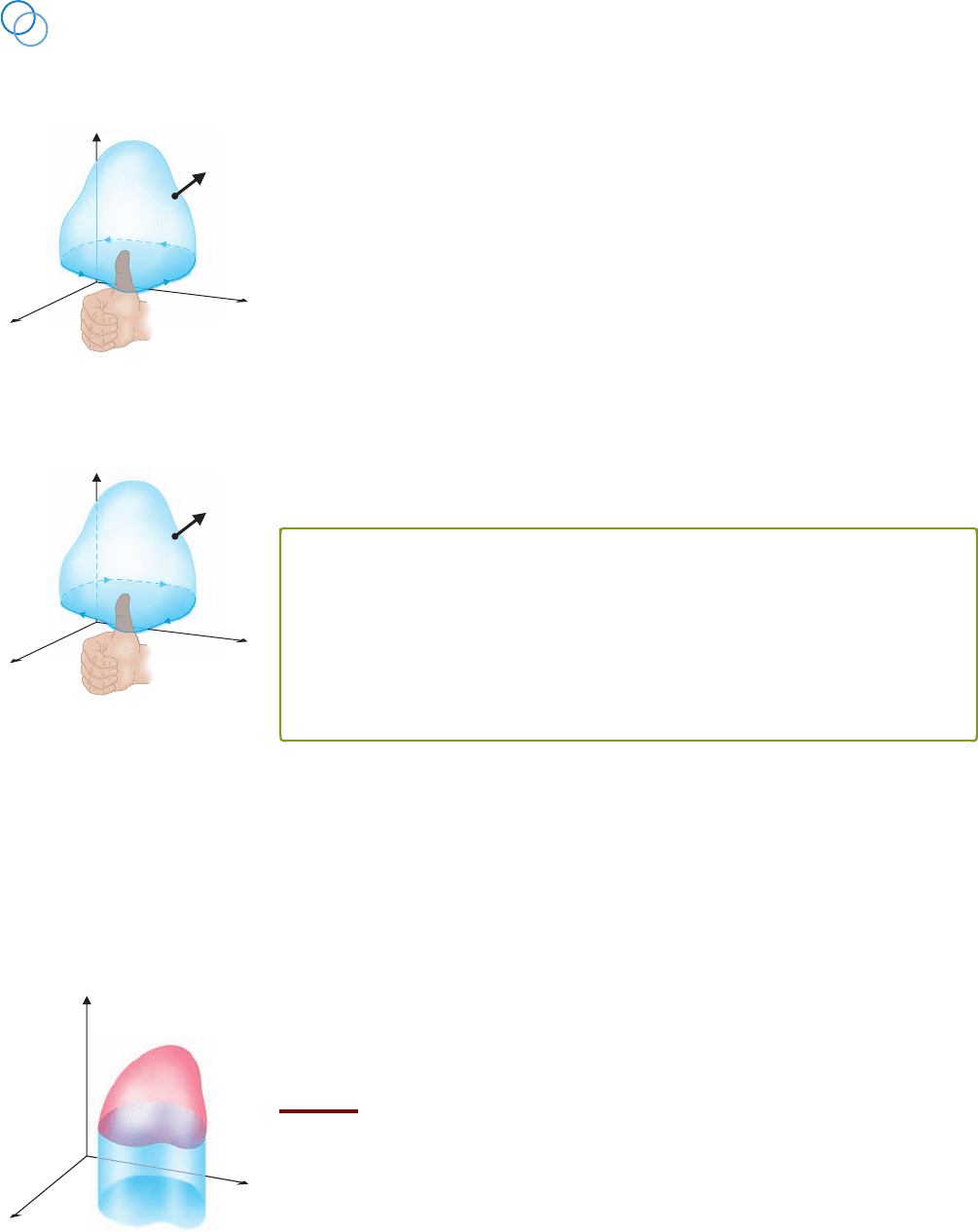
Supposethat S is an orientedsurfacewithunit normal vectorn.IfS is bounded bythe simple
closed curve C, we determine the orientation of C using a right-hand rule like the one used
to determine the direction of a cross product of two vectors. Align the thumb of your right
hand so that it points in the direction of one of the unit normals to S. Then if you curl your
fingers, they will indicate the positive orientation on C, as indicated in Figure 15.52a. If
the orientation of C is opposite that indicated by the curling of the fingers on your right
hand, as shown in Figure 15.52b, we say that C has negative orientation. The vector form
of Green’s Theorem in (8.1) generalizes as follows.
S
C
z
n
y
x
FIGURE 15.52a
Positive orientation
S
C
z
y
x
n
FIGURE 15.52b
Negative orientation
THEOREM 8.1 (Stokes’ Theorem)
Suppose that S is an oriented, piecewise-smooth surface with unit normal vector n,
bounded by the simple closed, piecewise-smooth boundary curve ∂S having positive
orientation. Let F(x, y, z) be a vector field whose components have continuous first
partial derivatives in some open region containing S. Then,
∂ S
F(x, y, z)·dr =
S
(∇×F)·n dS. (8.2)
Notice right away that the vector form of Green’s Theorem (8.1) is a special case
of (8.2), as follows. If S is simply a region in the xy-plane, then a unit normal to the
surface at every point on S is the vector n = k. Further, dS = dA (i.e., the surface area
of the plane region is simply the area) and (8.2) simplifies to (8.1). The proof of Stokes’
Theorem for the special case considered below hinges on Green’s Theorem and the chain
rule.
One important interpretation of Stokes’ Theorem arises in the case where F represents
a force field. Note that in this case, the integral on the left side of (8.2) corresponds to the
work done by the force field F as the point of application moves along the boundary of S.
Likewise, the right side of (8.2) represents the net flux of the curl of F over the surface S.
A general proof of Stokes’ Theorem can be found in more advanced texts. We prove it here
only for a special case of the surface S.
PROOF (Special Case)
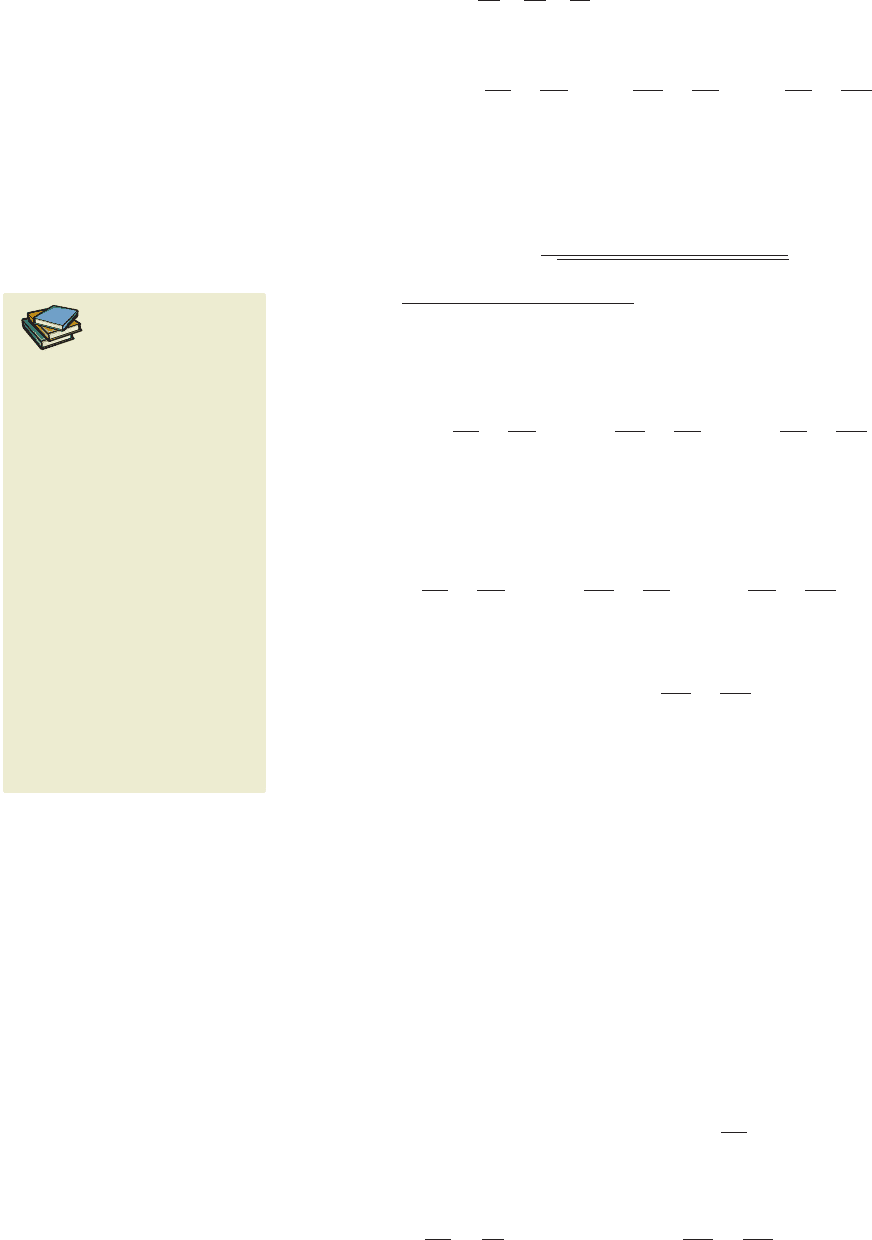
We consider here the special case where S is a surface of the form
S ={(x, y, z)|z = f (x, y), for (x, y) ∈ R},
where R is a region in the xy-plane with piecewise-smooth boundary ∂R, where f (x, y) has
continuous first partial derivatives and for which ∂R is the projection of the boundary of the
surface ∂S onto the xy-plane. (See Figure 15.53.)
S
O
∂S
R
z
y
x
∂R
FIGURE 15.53
The surface S and its projection R
onto the xy-plane
P1: OSO/OVY P2: OSO/OVY QC: OSO/OVY T1: OSO
MHDQ256-Ch15 MHDQ256-Smith-v1.cls January 6, 2011 10:53
LT (Late Transcendental)
CONFIRMING PAGES
1054 CHAPTER 15
..
Vector Calculus 15-78
Let F(x, y, z) =M(x, y, z), N(x, y, z), P(x, y, z). We then have
∇×F =
ijk
∂
∂x
∂
∂y
∂
∂z
MNP
=
∂ P
∂y
−
∂ N
∂z
i +
∂ M
∂z
−
∂ P
∂x
j +
∂ N
∂x
−
∂ M
∂y
k.
Note that a normal vector at any point on S is given by
m =−f
x
(x, y), − f
y
(x, y), 1
and so, we orient S with the unit normal vector
n =
− f
x
(x, y), − f
y
(x, y), 1
[ f
x
(x, y)]
2
+ [ f
y
(x, y)]
2
+ 1
.
HISTORICAL
NOTES
George Gabriel Stokes
(1819–1903) English
mathematician who published
important results in the field of
hydrodynamics. Many of Stokes’
results, including what are now
known as the Navier-Stokes
equations, were independently
developed but duplicated
previously published European
results. (Due to the lasting
bitterness over the
Newton-Leibniz calculus dispute,
the communication of results
between Europe and England was
minimal.) Stokes had a long list of
publications, including a paper in
which he named and explained
fluorescence.
Since dS =
[ f
x
(x, y)]
2
+ [ f
y
(x, y)]
2
+ 1 dA,wenowhave
S
(∇×F)·n dS
=
R
−
∂ P
∂y
−
∂ N
∂z
f
x
−
∂ M
∂z
−
∂ P
∂x
f
y
+
∂ N
∂x
−
∂ M
∂y
z=f (x,y)
dA.
Equation (8.2) is now equivalent to
∂ S
Mdx+ Ndy+ Pdz
=
R
−
∂ P
∂y
−
∂ N
∂z
f
x
−
∂ M
∂z
−
∂ P
∂x
f
y
+
∂ N
∂x
−
∂ M
∂y
z=f (x,y)
dA. (8.3)
We will now show that
∂ S
M(x, y, z) dx =−
R
∂ M
∂y
+
∂ M
∂z
f
y
z=f (x,y)
dA. (8.4)
Suppose that the boundary of R is described parametrically by
∂ R ={(x, y)|x = x(t), y = y(t), a ≤ t ≤ b}.
Then, the boundary of S is described parametrically by
∂ S ={(x, y, z)|x = x(t), y = y(t), z = f (x(t), y(t)), a ≤ t ≤ b}
and we have
∂ S
M(x, y, z) dx =
b
a
M(x(t), y(t), f (x(t), y(t)))x
(t) dt.
Now, notice that for m(x, y) = M(x, y, f (x, y)), this gives us
∂ S
M(x, y, z) dx =
b
a
m(x(t), y(t))x
(t) dt =
∂ R
m(x, y)dx. (8.5)
From Green’s Theorem, we know that
∂ R
m(x, y)dx =−
R
∂m
∂y
dA. (8.6)
However, from the chain rule,
∂m
∂y
=
∂
∂y
M(x, y, f (x, y)) =
∂ M
∂y
+
∂ M
∂z
f
y
z=f (x,y)
.
P1: OSO/OVY P2: OSO/OVY QC: OSO/OVY T1: OSO
MHDQ256-Ch15 MHDQ256-Smith-v1.cls January 6, 2011 10:53
LT (Late Transcendental)
CONFIRMING PAGES
15-79 SECTION 15.8
..
Stokes’ Theorem 1055
Putting this together with (8.5) and (8.6) gives us
∂ S
M(x, y, z) dx =−
R
∂m
∂y
dA =−
R
∂ M
∂y
+
∂ M
∂z
f
y
z=f (x,y)
dA,
which is (8.4). Similarly, you can show that
∂ S
N(x, y, z) dy =
R
∂ N
∂x
+
∂ N
∂z
f
x
z=f (x,y)
dA (8.7)
and
∂ S
P(x, y, z) dz =
R
∂ P
∂x
f
y
−
∂ P
∂y
f
x
z=f (x,y)
dA. (8.8)
Putting together (8.4), (8.7) and (8.8) now gives us (8.3), which proves Stokes’ Theorem
for this special case of the surface.
z
y
x
C
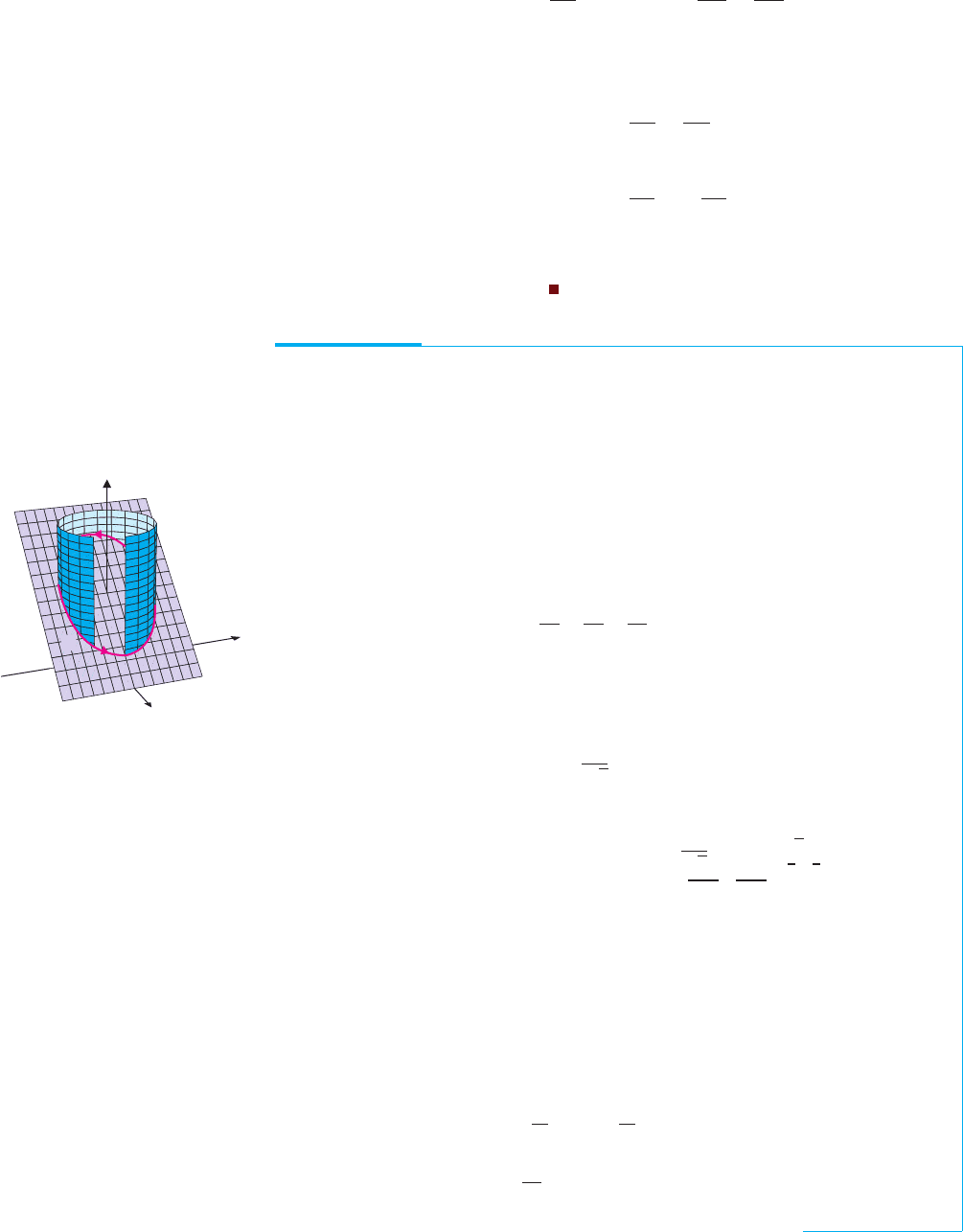
FIGURE 15.54
Intersection of the plane and the
cylinder producing the curve C
EXAMPLE 8.1 Using Stokes’ Theorem to Evaluate a Line Integral
Evaluate
C
F · dr, for F(x, y, z) =−y, x
2
, z
3
, where C is the intersection of the
circular cylinder x
2
+ y
2
= 4 and the plane x + z = 3, oriented so that it is traversed
counterclockwise when viewed from high up on the positive z-axis.
Solution First, notice that C is an ellipse, as indicated in Figure 15.54. Unfortunately,
C is rather difficult to parameterize, which makes the direct evaluation of the line
integral somewhat challenging. Instead, we can use Stokes’ Theorem to evaluate the
integral. First, we calculate the curl of F:
∇×F =
ijk
∂
∂x
∂
∂y
∂
∂z
−yx
2
z
3
= (2x + 1)k.
Notice that on the surface S, consisting of the portion of the plane x + z = 3 enclosed
by C, we have the unit normal vector
n =
1
√
2
1, 0, 1.
From Stokes’ Theorem, we now have
C
F ·dr =
S
(∇×F)·n dS =
R
1
√
2
(2x + 1)
(∇×F)·n
√
2dA
dS
,
where R is the disk of radius 2, centered at the origin (i.e., the projection of S onto the
xy-plane). Introducing polar coordinates, we have
C
F ·dr =
R
(2x + 1)dA =
2π
0
2
0
(2r cosθ + 1)rdrdθ
=
2π
0
2
0
(2r
2
cosθ +r)dr dθ
=
2π
0
2
r
3
3
cosθ +
r
2
2
r=2
r=0
dθ
=
2π
0
16
3
cosθ + 2
dθ = 4π,
where we have left the final details of the calculation to the reader.
P1: OSO/OVY P2: OSO/OVY QC: OSO/OVY T1: OSO
MHDQ256-Ch15 MHDQ256-Smith-v1.cls January 6, 2011 10:53
LT (Late Transcendental)
CONFIRMING PAGES
1056 CHAPTER 15
..
Vector Calculus 15-80
EXAMPLE 8.2 Using Stokes’ Theorem to Evaluate a Surface Integral
Evaluate
S
(∇×F) ·n dS, where F(x, y, z) =e
z
2
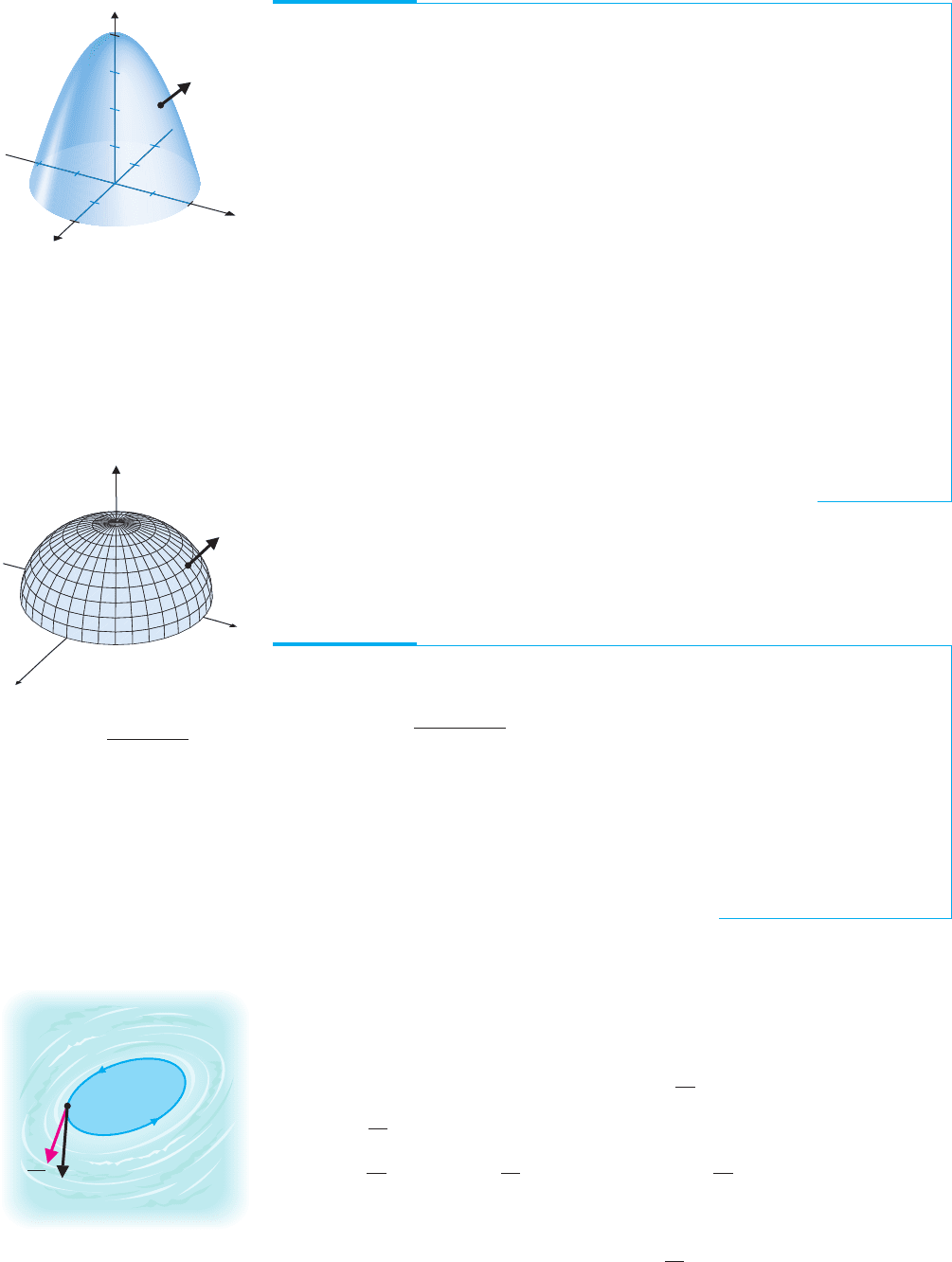
, 4z − y, 8x sin y and where S is the
portion of the paraboloid z = 4 − x
2
− y
2
above the xy-plane, oriented so that the unit
normal vectors point to the outside of the paraboloid, as indicated in Figure 15.55.
2
2
y
x
4
z
n
FIGURE 15.55
z = 4 − x
2
− y
2
Solution Notice that the boundary curve is simply the circle x
2
+ y
2
= 4 lying in the
xy-plane. By Stokes’ Theorem, we then have
S
(∇×F) ·n dS =
∂ S
F(x, y, z) ·dr
=
∂ S
e
z
2
dx + (4z − y)dy + 8x sin ydz.
Now, we can parameterize ∂S by x = 2cos t, y = 2sint, z = 0, 0 ≤ t ≤ 2π. This says
that on ∂S,wehavedx =−2sin t, dy = 2cost and dz = 0. In view of this, we have
S
(∇×F) ·n dS =
∂S
e
z
2
dx + (4z − y)dy + 8x sin ydz
=
2π
0
{e
0
(−2sin t) + [4(0) −2 sint](2cos t)}dt = 0,
where we leave the (straightforward) details of the calculation to you.
In example 8.3, we consider the same surface integral as in example 8.2, but over a
different surface. Although the surfaces are different, they have the same boundary curve,
so that they must have the same value.
z
y
x
2
2
n
FIGURE 15.56
z =
4 − x
2
− y
2
EXAMPLE 8.3 Using Stokes’ Theorem to Evaluate a Surface Integral
Evaluate
S
(∇×F) ·n dS, where F(x, y, z) =e
z
2
, 4z − y, 8x sin y and where S is the
hemisphere z =
4 − x
2
− y
2
, oriented so that the unit normal vectors point to the
outside of the hemisphere, as indicated in Figure 15.56.
Solution Notice that although this is not the same surface as in example 8.2, the two
surfaces have the same boundary curve, the circle x
2
+ y
2
= 4 lying in the xy-plane,
and the same orientation. Just as in example 8.2, we then have
S
(∇×F) ·n dS = 0.
C
dr
dt
F
FIGURE 15.57
The surface S in a fluid flow
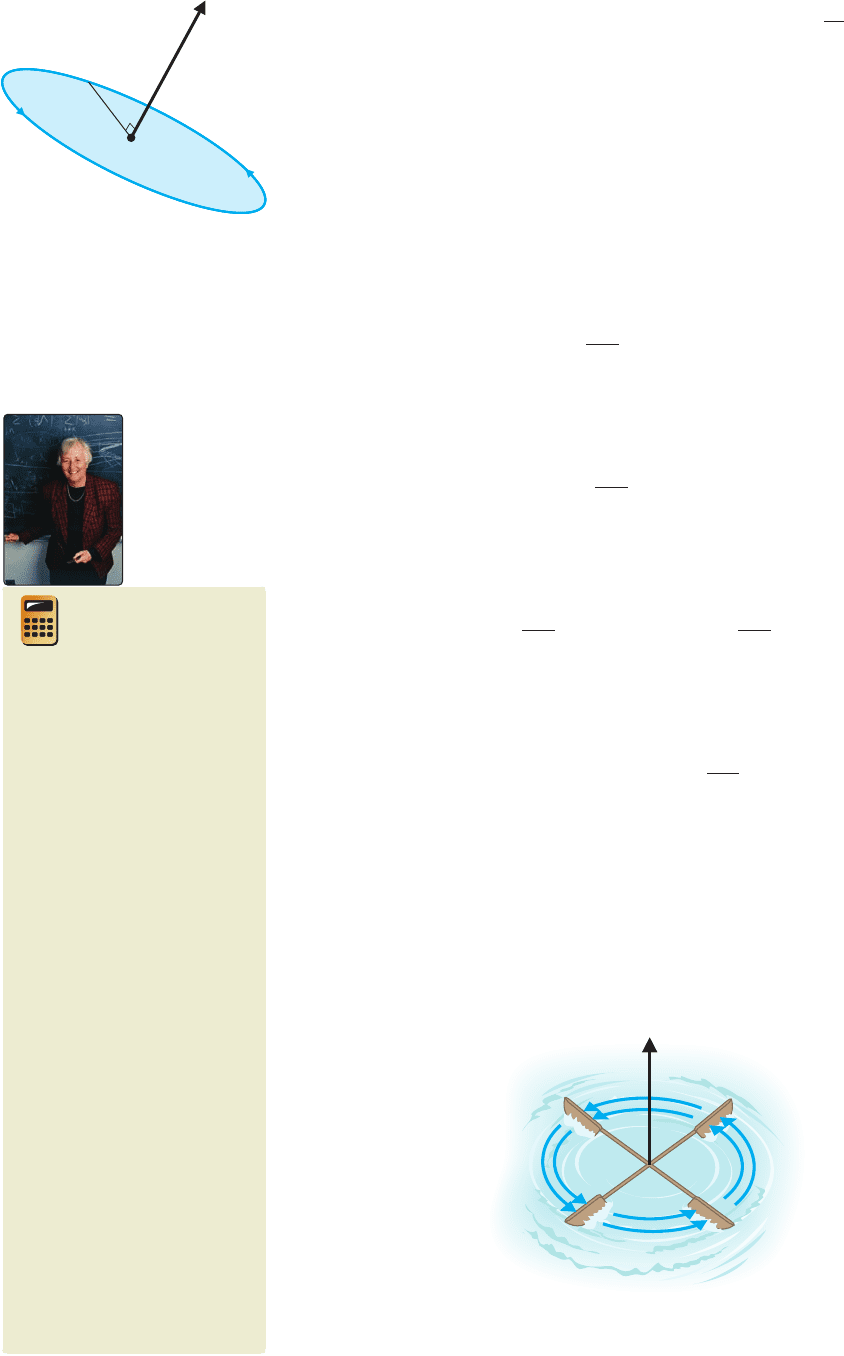
Much as we used the Divergence Theorem in section 15.7 to give an interpretation
of the meaning of the divergence of a vector field, we can use Stokes’ Theorem to give
some meaning to the curl of a vector field. Suppose once again that F(x, y, z) represents
the velocity field for a fluid in motion and let C be an oriented closed curve in the domain
of F, traced out by the endpoint of the vector-valued function r(t) for a ≤ t ≤ b. Notice
that the closer the direction of F is to the direction of
dr
dt
, the larger its component is in the
direction of
dr
dt
. (See Figure 15.57.) In other words, the closer the direction of F is to the
direction of
dr
dt
, the larger F ·
dr
dt
will be. Now, recall that
dr
dt
points in the direction of the
unit tangent vector along C. Then, since
C
F · dr =
b
a
F ·
dr
dt
dt,
P1: OSO/OVY P2: OSO/OVY QC: OSO/OVY T1: OSO
MHDQ256-Ch15 MHDQ256-Smith-v1.cls January 6, 2011 10:53
LT (Late Transcendental)
CONFIRMING PAGES
15-81 SECTION 15.8
..
Stokes’ Theorem 1057
it follows that the closer the direction of F is to the direction of
dr
dt
along C, the larger
C
F · dr will be. This says that
C
F · dr measures the tendency of the fluid to flow
around or circulate around C. For this reason, we refer to
C
F · dr as the circulation of F
around C.
a
S
a
C
a
n
(x
0
, y
0
, z
0
)
FIGURE 15.58
The disk S
a
For any point (x
0
, y
0
, z
0
) in the fluid flow, let S
a
be a disk of radius a centered at
(x
0
, y
0
, z
0
), with unit normal vector n, as indicated in Figure 15.58 and let C
a
be the
(positively oriented) boundary of S
a
. Then, by Stokes’ Theorem, we have
C
a
F · dr =
S
a
(∇×F) ·n dS. (8.9)
Notice that the average value of a function f on the surface S
a
is given by
f
ave
=
1
πa
2
S
a
f (x, y, z) dS.
Further, if f is continuous on S
a
, there must be some point P
a
on S
a
at which f equals its
average value, that is, where
f (P
a
) =
1
πa
2
S
a
f (x, y, z) dS.
In particular, if the velocity field F has continuous first partial derivatives throughout S
a
,
then it follows from equation (8.9) that for some point P
a
on S
a
,
(∇×F)(P
a
) · n =
1
πa
2
S
a
(∇×F) ·n dS =
1
πa
2
C
a
F · dr. (8.10)
Notice that the expression on the far right of (8.10) corresponds to the circulation of F
around C
a
per unit area. Taking the limit as a → 0, we have by the continuity of curl F that
(∇×F)(x
0
, y
0
, z
0
) · n = lim
a→0
1
πa
2
C
a
F · dr. (8.11)
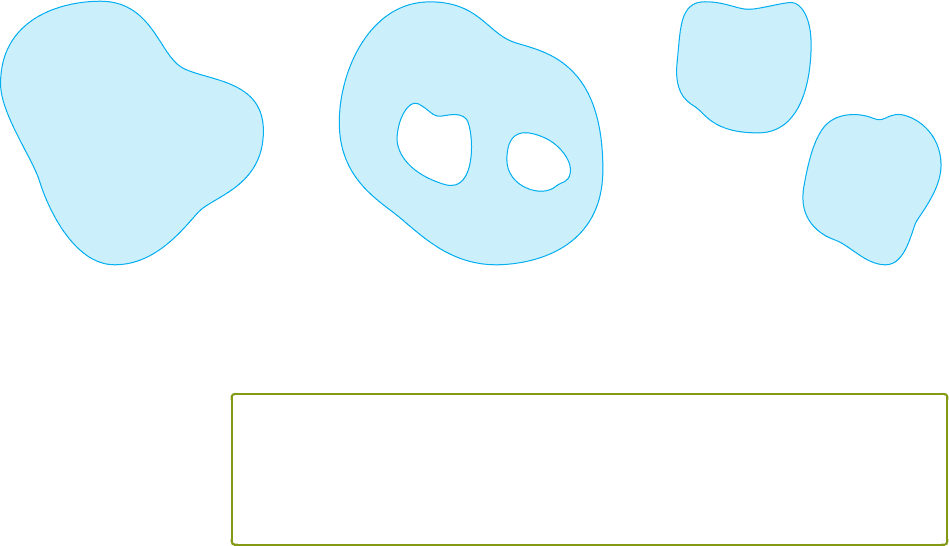
Readequation(8.11)verycarefully.Noticethatitsaysthatatanygivenpoint,thecomponent
of curl F in the direction of n is the limiting value of the circulation per unit area around
circles of radius a centered at that point (and normal to n), as the radius a tends to zero. In
thissense,(∇×F) ·n measures the tendencyofthefluidtorotateaboutanaxisalignedwith
the vector n. You can visualize this by thinking of a small paddle wheel with axis parallel
to n, which is immersed in the fluid flow. (See Figure 15.59.) Notice that the circulation per
unit area is greatest (so that the paddle wheel moves fastest) when n points in the direction
of ∇×F.
TODAY IN
MATHEMATICS
Cathleen Synge Morawetz
(1923– ) A Canadian
mathematician whose work on
transonic flows greatly influenced
the design of air foils. With similar
methods, she made fundamental
contributions to a variety of
physically important questions
about wave propagation. Her
mother was a mathematics
teacher for a few years and her
father, John Lighton Synge, was
Ireland’s most distinguished
mathematician of the twentieth
century. However, her
mathematics career was almost
derailed by World War II and a
culture in which she felt that, “It
really was considered very bad
form for a woman to be overly
ambitious.” Fortunately, she
overcame both social and
mathematical obstacles with a
work ethic that would not let a
problem go until it was solved.
She has served as Director of the
Courant Institute and President of
the American Mathematical
Society, and is a winner of the
United States’ National Medal of
Science.
n
FIGURE 15.59
Paddle wheel
P1: OSO/OVY P2: OSO/OVY QC: OSO/OVY T1: OSO
MHDQ256-Ch15 MHDQ256-Smith-v1.cls January 6, 2011 10:53
LT (Late Transcendental)
CONFIRMING PAGES
1058 CHAPTER 15
..
Vector Calculus 15-82
If ∇×F = 0 at every point in a fluid flow, we say that the flow is irrotational, since
the circulation about every point is zero. In particular, notice that if the velocity field F is a
constant vector throughout the fluid flow, then
curl F =∇×F = 0,
everywhere in the fluid flow and so, the flow is irrotational. Physically, this says that there
are no eddies in such a flow.
Notice, too, that by Stokes’ Theorem, if curl F = 0 at every point in some open region
D, then we must have that for every simple closed curve C that is the boundary of an
oriented surface contained in D,
C
F · dr = 0.
In other words, the circulation is zero around every such curve C lying in the region D.It
turns out that by suitably restricting the type of regions D ⊂ R
3
we consider, we can show
that the circulation is zero around every simple closed curve contained in D. (The converse
of this is also true. That is, if
C
F · dr = 0, for every simple closed curve C contained in the
region D, then we must have that curl F = 0 at every point in D.) To obtain this result, we
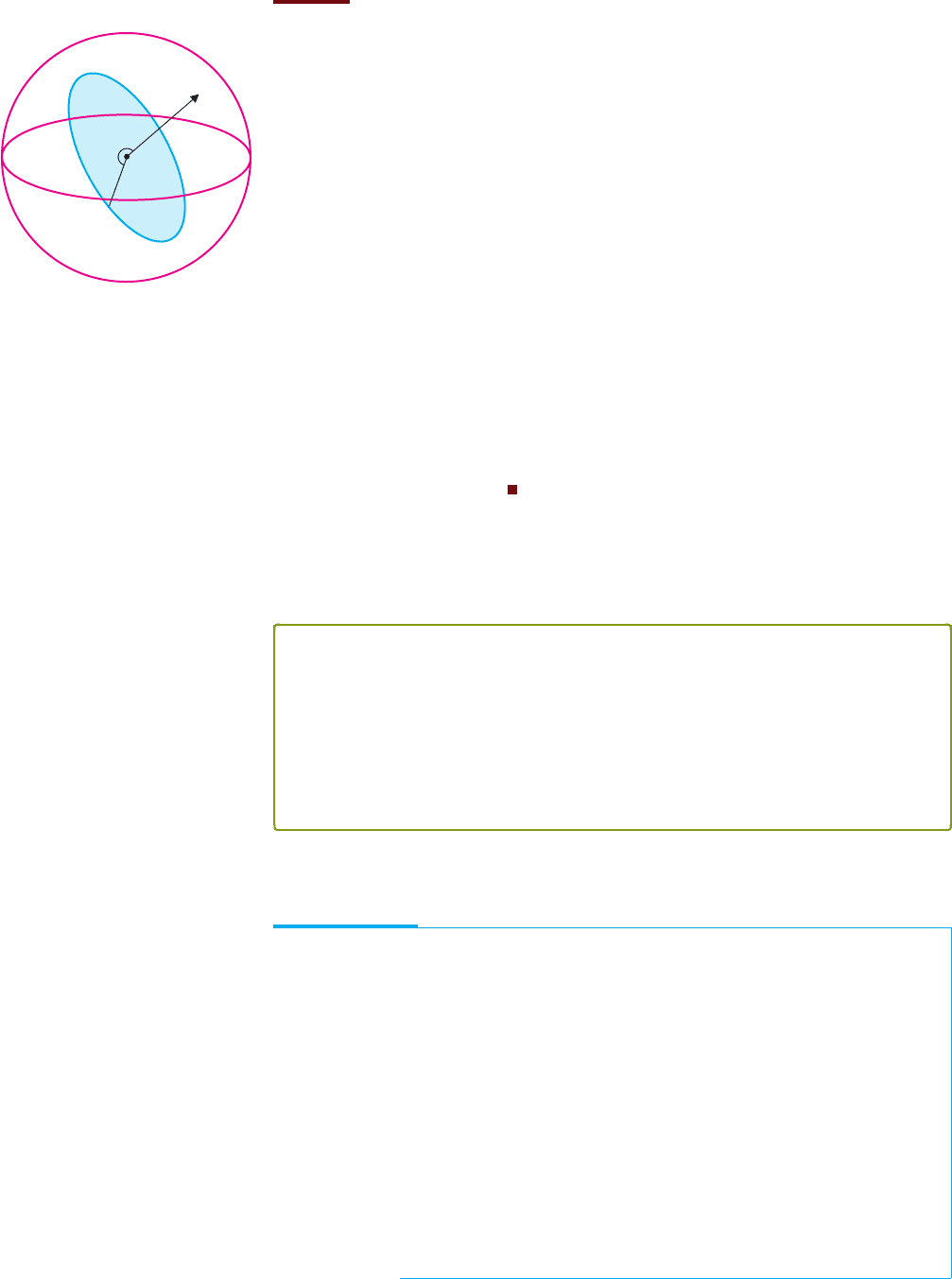
consider regions in space that are simply-connected. Recall that in the plane a region is said
to be simply-connected whenever every closed curve contained in the region encloses only
points in the region (that is, the region contains no holes). In three dimensions, the situation
is slightly more complicated. A region D in R
3
is called simply-connected whenever every
simple closed curve C lying in D can be continuously shrunk to a point without crossing
the boundary of D. For instance, notice that the interior of a sphere or a rectangular box
is simply-connected, but a solid with a hole drilled through it is not simply-connected.
Be careful not to confuse connected with simply-connected. Recall that a connected re-
gion is one where every two points contained in the region can be connected with a path
that is completely contained in the region. We illustrate connected and simply-connected
two-dimensional regions in Figures 15.60a to 15.60c. We can now state the complete
theorem.
FIGURE 15.60a FIGURE 15.60b FIGURE 15.60c
Connected and simply-connected Connected but not simply-connected Simply-connected but not connected
THEOREM 8.2
Suppose that F(x, y, z) is a vector field whose components have continuous first
partial derivatives throughout the simply-connected open region D ⊂ R
3
. Then,
curl F = 0 in D if and only if
C
F · dr = 0, for every simple closed curve C
contained in the region D.
P1: OSO/OVY P2: OSO/OVY QC: OSO/OVY T1: OSO
MHDQ256-Ch15 MHDQ256-Smith-v1.cls January 6, 2011 10:53
LT (Late Transcendental)
CONFIRMING PAGES
15-83 SECTION 15.8
..
Stokes’ Theorem 1059
PROOF (Necessity)
We have already suggested that when curl F = 0 in an open, simply-connected region
D, it can be shown that
C
F · dr = 0, for every simple closed curve C contained in the
region D (although the proof is beyond the level of this text). Conversely, suppose now
that
C
F · dr = 0 for every simple closed curve C contained in the region D and assume
that curl F = 0 at some point (x
0
, y
0
, z
0
) ∈ D. Since the components of F have continuous
first partial derivatives, curl F must be continuous in D and so, there must be a sphere
of radius a
0
> 0, contained in D and centered at (x
0
, y
0
, z
0
), throughout whose interior S,
curl F = 0 and curl F (x, y, z) ·curlF(x
0
, y
0
, z
0
) > 0. (Note that this is possible since
curl F is continuous and curl F (x
0
, y
0
, z
0
) · curlF(x
0
, y
0
, z
0
) > 0.) Let S
a
be the disk of
radius a < a
0
centered at (x
0
, y
0
, z
0
) and oriented by the unit normal vector n having
the same direction as curl F (x
0
, y
0
, z
0
). Notice that since a < a
0
, S
a
will be completely
contained in S as illustrated in Figure 15.61. If C
a
is the boundary of S
a
, then we have by
Stokes’ Theorem that
C
a
F · dr =
S
a
(∇×F) ·n dS > 0,
since n was chosen to be parallel to ∇×F(x
0
, y
0
, z
0
). This contradicts the assumption that
C
F · dr = 0, for every simple closed curve C contained in the region D. It now follows
that curl F = 0 throughout D.
a
S
a
∇ F(x
0
, y
0
, z
0
)
(x
0
, y
0
, z
0
)
FIGURE 15.61
The disk S
a
Recall that we had observed earlier that a vector field is conservative in a given region
if and only if
C
F · dr = 0, for every simple closed curve C contained in the region.
Theorem 8.2 has then established the following results.
THEOREM 8.3
Suppose that F(x, y, z) has continuous first partial derivatives in a simply-connected
open region D. Then, the following statements are equivalent.
(i) F is conservative in D. That is, for some scalar function f (x, y, z), F =∇f ;
(ii)
C
F · dr is independent of path in D;
(iii) F is irrotational (i.e., curl F = 0)inD; and
(iv)
C
F · dr = 0, for every simple closed curve C contained in D.
We close this section with a simple application of Stokes’ Theorem.
EXAMPLE 8.4 Finding the Flux of a Magnetic Field
Use Stokes’ Theorem and Maxwell’s equation ∇·B = 0 to show that the flux of a
magnetic field B across a surface S satisfying the hypotheses of Stokes’ Theorem equals
the circulation of A around ∂S, where B =∇×A.
Solution The flux of B across S is given by
S
B · n dS. Since ∇·B = 0, it follows
from exercise 72 in section 15.5 that there exists a vector field A such that B =∇×A.
We can now rewrite the flux of B across S as
S
(∇×A) ·n dS. Applying Stokes’
Theorem gives us
S
B ·n dS =
S
(∇×A) ·n dS =
∂S
A ·dr.
You should recognize the line integral on the right side as the circulation of A around
∂S, as desired.

P1: OSO/OVY P2: OSO/OVY QC: OSO/OVY T1: OSO
MHDQ256-Ch15 MHDQ256-Smith-v1.cls January 6, 2011 10:53
LT (Late Transcendental)
CONFIRMING PAGES
1060 CHAPTER 15
..
Vector Calculus 15-84
EXERCISES 15.8
WRITING EXERCISES
1. Describe circumstances (e.g., example 8.1) in which the sur-
face integral of Stokes’ Theorem will be simpler than the line
integral.
2. Describe circumstances (e.g., example 8.2) in which the line
integral of Stokes’ Theorem will be simpler than the surface
integral.
3. The surfaces in example 8.2 and 8.3 have the same boundary
curve C. Explain why all surfaces above the xy-plane with the
boundary C will share the same value of
S
(∇×F ) ·n dS.
What would change if the surface were below the xy-plane?
4. Explain why part (iv) of Theorem 8.3 follows immediately
from part (ii). Explain why parts (ii) and (iii) follow immedi-
ately from part (i).
In exercises 1–4, verify Stokes’ Theorem by computing both
integrals.
1. S is the portion of z = 4 − x
2
− y
2
above the xy-plane,
F =zx, 2y, z
3
.
2. S is the portion of z = 1 − x
2
− y
2
above the xy-plane,
F =x
2
z, xy, xz
2
.
3. S is the portion of z =
4 − x
2
− y
2
above the xy-plane,
F =2x − y, yz
2
, y
2
z.
4. S is the portion of z =
1 − x
2
− y
2
above the xy-plane,
F =2x, z
2
− x, xz
2
.
............................................................
In exercises 5–12, use Stokes’ Theorem to compute
S
(∇×F)·n dS.
5. S is the portion of the tetrahedron bounded by
x + y + 2z = 2 and the coordinate planes with z > 0, n up-
ward, F =zy
4
− y
2
, y − x
3
, z
2
.
6. S is the portion of the tetrahedron bounded by
x + y + 4z = 8 and the coordinate planes with z > 0, n up-
ward, F =y
2
, y + 2x, z
2
.
7. S is the portion of z = 1 − x
2
− y
2
above the xy-plane with n
upward, F =
zx
2
, ze
xy
2
− x, x ln y
2
.
8. S is the portion of z =
4 − x
2
− y
2
above the xy-plane with
n upward, F =
zx
2
, ze
xy
2
− x, x ln y
2
.
9. S is the portion of the tetrahedron in exercise 5 with y > 0,
n to the right, F =zy
4
− y
2
, y − x
3
, z
2
.
10. S is the portion of y = x
2
+ z
2
with y ≤ 2, n to the left,
F =
xy, 4xe
z
2
, yz + 1
.
11. S is the portion of the cone z =
x
2
+ y
2
below the sphere
x
2
+ y
2
+ z
2
= 2, n downward,
F =
x
2
+ y
2
, ze
x
2
+y
2
, e
x
2
+z
2
.
12. S is the portion of the unit cube 0 ≤ x ≤ 1, 0 ≤ y ≤ 1,
0 ≤ z ≤ 1 with z < 1, n downward,
F =xyz, 4x
2
y
3
− z, 8 cos xz
2
.
............................................................
In exercises 13–20, use Stokes’ Theorem to evaluate
C
F · dr.
13. C is the boundary of the portion of the paraboloid
y = 4 − x
2
− z
2
with y > 0, n to the right,
F =x
2
z, 3cos y, 4z
3
.
14. C is the boundary of the portion of the paraboloid x = y
2
+ z
2
with x ≤ 4, n to the back, F =yz, y − 4, 2xy.
15. C is the boundary of the portion of z = 4 − x
2
− y
2
above the
xy-plane, oriented upward, F =
x
2
e
x
− y,
y
2
+ 1, z
3
.
16. C is the triangle from (0, 1, 0) to (0, 0, 4) to (2, 0, 0),
F =x
2
+ 2xy
3
z, 3x
2
y
2
z − y, x
2
y
3
.
17. C is the intersection of z = x
2
+ y
2
and z = 8 − y, oriented
clockwise from above, F =
2x
2
, 4y
2
, e
8z
2
.
18. C is the intersection of x
2
+ y
2
= 1 and z = x − y, oriented
clockwise from above, F =cos x
2
, sin y
2
, tan z
2
.
19. C is the intersection of z = 4 − x
2
− y
2
and x
2
+ z
2
= 1
with y > 0, oriented clockwise as viewed from the right,
F =
x
2
+ 3y, cos y
2
, z
3
.
20. C is the intersection of z = x
2
+ y
2
− 4 and z = y − 1,
oriented clockwise as viewed from above,
F =sin x
2
, y
3
, z lnz − x.
............................................................
In exercises 21–24, compute
S
(∇×F)·n dS or
C
F · dr,
whichever is easier.
21. S is the portion of the cone z =
x
2
+ y
2
inside the cylinder
x
2
+ y
2
= 2, n downward.
(a) F =
zx, x
2
+ y
2
, z
2
− y
2
(b) F =xe
x
− xy, 3y
2
, sin z − xy
22. S is the portion of the cube 0 ≤ x ≤ 2, 0 ≤ y ≤ 2, 0 ≤ z ≤ 2
with y < 2, n downward at bottom.
(a) F =
x
2
, y
3
+ x, 3y
2
cos z
(b) F =z
2
e
y−2
, e
√
x
2
+z
2
, z(y − 2)
23. S is the boundary of the solid bounded by the hyperboloid
x
2
+ y
2
− z
2
= 4, z = 0 and z = 2 with z < 2, n downward
at bottom.
(a) F =
2y − x cos x,
y
2
+ 1, e
−z
2
(b) F =z
2
y, x − z,
x
2
+ y
2

P1: OSO/OVY P2: OSO/OVY QC: OSO/OVY T1: OSO
MHDQ256-Ch15 MHDQ256-Smith-v1.cls January 6, 2011 10:53
LT (Late Transcendental)
CONFIRMING PAGES
15-85 SECTION 15.9
..
Applications of Vector Calculus 1061
24. S is the boundary of the solid bounded by x + 2y + z = 4,
x
2
+ y
2
= 1 and z = 0 and inside x
2
+ y
2
= 1, n downward
at bottom.
(a) F =
e
x
2
− y, 4y
3
, 3z
2
+ 5
(b) F =x
2
y, y
2
x, xy − x
............................................................
25. Show that
C
( f ∇ f )·dr = 0 for any simple closed curve C
and differentiable function f .
26. Show that
C
( f ∇g + g∇ f )·dr = 0 for any simple closed
curve C and differentiable functions f and g.
27. LetF(x, y) =M(x, y), N(x, y)beavectorfieldwhosecom-
ponents M and N have continuous first partial derivatives in
all of R
2
. Show that ∇·F = 0 if and only if
C
F ·n ds = 0 for
all simple closed curves C.(Hint: Use a vector form of Green’s
Theorem.)
28. Under the assumptions of exercise 27, show that
C
F · n ds is path-independent in R
3
if and only if
C
F · n ds = 0 for all simple closed curves C.
29. Under the assumptions of exercise 27, show that ∇·F = 0if
and only if F has a stream function g, i.e., a function g such
that M = g
y
and N =−g
x
.
30. Combine the results of exercises 27–29 to state a two-variable
theorem analogous to Theorem 8.3.
31. If S
1
and S
2
are surfaces that satisfy the hypotheses of Stokes’
Theorem and that share the same boundary curve, under what
circumstances can you conclude that
S
1
(∇×F)·n dS =
S
2
(∇×F)·n dS?
32. Give an example where the two surface integrals of exercise 31
are not equal.
33. Use Stokes’ Theorem to verify that
C
( f ∇g)·dr =
S
(∇ f ×∇g)·n dS,
where C is the positively oriented boundary of the oriented
surface S.
34. UseStokes’Theoremtoverifythat
C
( f ∇g + g∇ f ) ·dr = 0,
where C is the positively oriented boundary of some oriented
surface S.
EXPLORATORY EXERCISES
1. The circulation of a vector field F around the curve C is de-
fined by
C
F · dr. Show that the curl ∇×F(0, 0, 0) is in the
same direction as the normal to the plane in which the circula-
tion per unit area around the origin is a maximum as the area
around the origin goes to 0. Relate this to the interpretation of
the curl given in section 15.5.
2. The Fundamental Theorem of Calculus can be viewed as re-
lating the values of the function on the boundary of a region
(interval) to the sum of the derivative values of the function
within the region. Explain what this statement means and then
explain why the same statement can be applied to Theorem
3.2, Green’s Theorem, the Divergence Theorem and Stokes’
Theorem. In each case, carefully state what the “region” is,
what its boundary is and what type derivative is involved.
15.9 APPLICATIONS OF VECTOR CALCULUS
Throughsections15.1to15.8,wehavedevelopedapowerfulsetoftoolsforanalyzingvector
quantities. You can now compute flux integrals and line integrals for work and circulation,
and you have the Divergence Theorem and Stokes’ Theorem to relate these quantities to
one another. To this point in the text, we haveemphasized the conceptual and computational
aspects of vector analysis. In this section, we present a small selection of applications from
fluid mechanics and electricity and magnetism. As you work through the examples in this
section, notice that we are using vector calculus to derive general results that canbe applied
to any specific vector field that you may run across in an application.
Our first example is similar to example 7.4, which concerns magnetic fields. Here, we
also apply Stokes’ Theorem to derive a second result.
EXAMPLE 9.1 Finding the Flux of a Velocity Field
Suppose that the velocity field v of a fluid has a vector potential w, that is, v =∇×w.
Show that v is incompressible and that the flux of v across any closed surface is 0. Also,
show that if a closed surface S is partitioned into surfaces S
1
and S
2
(that is, S = S
1
∪ S
2
and S
1
∩ S
2
=∅), then the flux of v across S
1
is the additive inverse of the flux of v
across S
2
.
Solution To show that v is incompressible, note that ∇·v =∇·(∇×w) = 0,
since the divergence of the curl of any vector field is zero. Next, suppose that the closed

P1: OSO/OVY P2: OSO/OVY QC: OSO/OVY T1: OSO
MHDQ256-Ch15 MHDQ256-Smith-v1.cls January 6, 2011 10:53
LT (Late Transcendental)
CONFIRMING PAGES
1062 CHAPTER 15
..
Vector Calculus 15-86
surface S is the boundary of the solid Q. Then from the Divergence Theorem, we have
S
v ·n dS =
Q
∇·v dV =
Q
0dV = 0.
Finally, since S = S
1
∪ S
2
and S
1
∩ S
2
=∅,wehave
S
1
v ·n dS +
S
2
v ·n dS =
S
v ·n dS = 0,
so that
S
1
v ·n dS =−
S
2
v ·n dS.
The general result shown in example 9.1 also has practical implications for computing
integrals. One use of this result is given in example 9.2.
EXAMPLE 9.2 Computing a Surface Integral Using the Complement
of the Surface
Find the flux of the vector field ∇×F across S, where
F =e
x
2
− 2xy, sin y
2
, 3yz − 2x and S is the portion of the cube
0 ≤ x ≤ 1, 0 ≤ y ≤ 1, 0 ≤ z ≤ 1 above the xy-plane.
Solution We have several options for computing
S
(∇×F) ·n dS. Notice that the
surface S consists of five faces of the cube, so five separate surface integrals would be
required to compute it directly. We could use Stokes’ Theorem and rewrite it as
C
F · dr, where C is the square boundary of the open face of S. However, this would
require four line integrals involving a complicated vector field F. Example 9.1 gives us a
third option: the flux over the entire cube is zero, so that the flux over S is the additive
inverse of the flux over the missing side of the cube. Notice that the (outward) normal
vector for this side is n =−k, and the curl of F is given by
∇×F =
ijk
∂
∂x
∂
∂y
∂
∂z
e
x
2
− 2xy sin y
2
3yz − 2x
= i(3z − 0) − j(−2 − 0) + k(0 + 2x) = 3zi +2j +2xk.
So,
(∇×F) ·n = (3zi +2j +2xk) · (−k) =−2x
and dS = dA. Taking S
2
as the bottom face of the cube, we now have that the flux is
given by
S
(∇×F)·n dS =−
S
2
(∇×F)·n dS =−
R
−2xdA=
1
0
1
0
2xdxdy= 1.
One very important use of the DivergenceTheorem and Stokes’ Theorem is in deriving
certain fundamental equations in physics and engineering. The technique we use here to
derive the heat equation is typical of the use of these theorems. In this technique, we start
with two different descriptions of the same quantity and use the vector calculus to draw
conclusions about the functions involved.
For the heat equation, we analyze the amount of heat per unit time leaving a solid
Q. Recall from example 6.7 that the net heat flow out of Q is given by
S
(−k∇T ) · n dS,
where S is a closed surface bounding Q, T is the temperature function, n is the outward
unit normal and k is a constant (called the heat conductivity). Alternatively, physics tells us