
Smith R., Minton R. Calculus
Подождите немного. Документ загружается.


P1: OSO/OVY P2: OSO/OVY QC: OSO/OVY T1: OSO
MHDQ256-Ch15 MHDQ256-Smith-v1.cls January 6, 2011 10:53
LT (Late Transcendental)
CONFIRMING PAGES
15-87 SECTION 15.9
..
Applications of Vector Calculus 1063
that the total heat within Q equals
Q
ρσTdV, where ρ is the (constant) density and σ is
the specific heat of the solid. From this, it follows that the heat flow out of Q is given by
−
d
dt
Q
ρσTdV
. Notice that the negative sign is needed to giveus the heat flowout of
theregionQ. Ifthe temperature function T has a continuous partial derivativewith respect to
t, we can bring the derivative inside the integral and write this as −
Q
ρσ
∂T
∂t
dV.
Equating these two expressions for the heat flow out of Q,wehave
S
(−k∇T ) · n dS =−
Q
ρσ
∂T
∂t
dV. (9.1)
EXAMPLE 9.3 Deriving the Heat Equation
Use the Divergence Theorem and equation (9.1) to derive the heat equation
∂T
∂t
= α
2
∇
2
T , where α
2
=
k
ρσ
and ∇
2
T =∇·(∇T) is the Laplacian of T.
Solution Applying the Divergence Theorem to the left-hand side of equation (9.1),
we have
Q
∇·(−k∇T) dV =−
Q
ρσ
∂T
∂t
dV.
Combining the preceding two integrals, we get
0 =
Q
−k∇·(∇T ) dV +
Q
ρσ
∂T
∂t
dV
=
Q
−k∇
2
T + ρσ
∂T
∂t
dV. (9.2)
Observe that the only way for the integral in (9.2) to be zero for every solid Q is for the
integrand to be zero. (Think about this carefully; you can let Q be a small sphere around
any point you like.) That is,
0 =−k∇
2
T + ρσ
∂T
∂t
or ρσ
∂T
∂t
= k∇
2
T.
Finally, dividing both sides by ρσ gives us
∂T
∂t
=
k
ρσ
∇
2
T = α
2
∇
2
T,
as desired.
We next derive a fundamental result in the study of fluid dynamics, diffusion theory
and electricity and magnetism. We consider a fluid that has density function ρ (in general,
ρ is a scalar function of space and time). We also assume that the fluid has velocity field
v and that there are no sources or sinks. Since the total mass of fluid contained in a given
region Q is given by the triple integral m =
Q
ρ(x, y, z, t)dV , the rate of change of the
mass is given by
dm
dt
=
d
dt
⎡
⎣
Q
ρ(x, y, z, t)dV
⎤
⎦
=
Q
∂ρ
∂t
(x, y, z, t)dV, (9.3)

P1: OSO/OVY P2: OSO/OVY QC: OSO/OVY T1: OSO
MHDQ256-Ch15 MHDQ256-Smith-v1.cls January 6, 2011 10:53
LT (Late Transcendental)
CONFIRMING PAGES
1064 CHAPTER 15
..
Vector Calculus 15-88
assuming that the density function has a continuous partial derivative with respect to t,so
that we can bring the derivative inside the integral. Now, look at the same problem in a
different way. In the absence of sources or sinks, the only way for the mass inside Q to
change is for fluid to cross the boundary ∂Q. That is, the rate of change of mass is the
additive inverse of the flux of the velocity field across the boundary of Q. (You will be asked
in the exercises to explain the negative sign. Think about why it needs to be there!) So, we
also have
dm
dt
=−
∂
Q
(ρv) ·n dS. (9.4)
Giventhesealternativerepresentationsoftherateofchangeofmass,wederivethecontinuity
equation in example 9.4.
EXAMPLE 9.4 Deriving the Continuity Equation
Use the Divergence Theorem and equations (9.3) and (9.4) to derive the continuity
equation: ∇·(ρv) +
∂ρ
∂t
= 0.
Solution We start with equal expressions for the rate of change of mass in a generic
solid Q, given in (9.3) and (9.4). We have
Q
∂ρ
∂t
(x, y, z, t)dV =−
∂
Q
(ρv) ·n dS.
Applying the Divergence Theorem to the right-hand side gives us
Q
∂ρ
∂t
(x, y, z, t)dV =−
Q
∇·(ρv)dV.
Combining the two integrals, we have
0 =
Q
∇·(ρv)dV +
Q
∂ρ
∂t
(x, y, z, t)dV
=
Q
∇·(ρv) +
∂ρ
∂t
dV.
Since this equation must hold for all solids Q, the integrand must be zero. That is,
∇·(ρv) +
∂ρ
∂t
= 0,
which is the continuity equation, as desired.
Bernoulli’s Theorem is often used to explain the lift force of a curved airplane wing.
This result relates thespeed and pressure in asteady fluid flow. (Here, steady means that the
fluid’s velocity, pressure etc., do not change with time.) The starting point for our derivation
is Euler’s equation for steady flow. In this case, a fluid moves with velocity u and vorticity
w through a medium with density ρ and the speed is given by u =u. We consider the
case where there is an external force, such as gravity, with a potential function φ and where
the fluid pressure is given by the scalar function p. Since the flow is steady, all quantities
are functions of position (x, y, z), but not time. In this case, Euler’s equation states that
w × u +
1
2
∇u
2
=−
1
ρ
∇p −∇φ. (9.5)
Bernoulli’s Theorem then says that
1
2
u
2
+ φ +
p
ρ
is constant along flow lines. A more
precise formula is given in the derivation in example 9.5.
P1: OSO/OVY P2: OSO/OVY QC: OSO/OVY T1: OSO
MHDQ256-Ch15 MHDQ256-Smith-v1.cls January 6, 2011 10:53
LT (Late Transcendental)
CONFIRMING PAGES
15-89 SECTION 15.9
..
Applications of Vector Calculus 1065
EXAMPLE 9.5 Deriving Bernoulli’s Theorem
Use Euler’s equation (9.5) to derive Bernoulli’s Theorem.
Solution Recall that the flow lines are tangent to the velocity field. So, to compute the
component of a vector function along a flow line, you start by finding the dot product of
the function with velocity. In this case, we take Euler’s equation and find the dot product
of each term with u.Weget
u · (w × u) + u ·
1
2
∇u
2
=−u ·
1
ρ
∇p
− u ·∇φ
or u · (w ×u) +u ·
1
2
∇u
2
+ u ·(∇φ) + u ·
1
ρ
∇p = 0.
Notice that u · (w × u) = 0, since the cross product w ×u is perpendicular to u. All
three remaining terms are gradients, so factoring out the scalar functions involved, we
have
u ·∇
1
2
u
2
+ φ +
p
ρ
= 0.
This says that the component of ∇
1
2
u
2
+ φ +
p
ρ
along u is zero. So, the directional
derivative of
1
2
u
2
+ φ +
p
ρ
is zero in the direction of the tangent to the flow lines. This
gives us Bernoulli’s Theorem, that
1
2
u
2
+ φ +
p
ρ
is constant along flow lines.
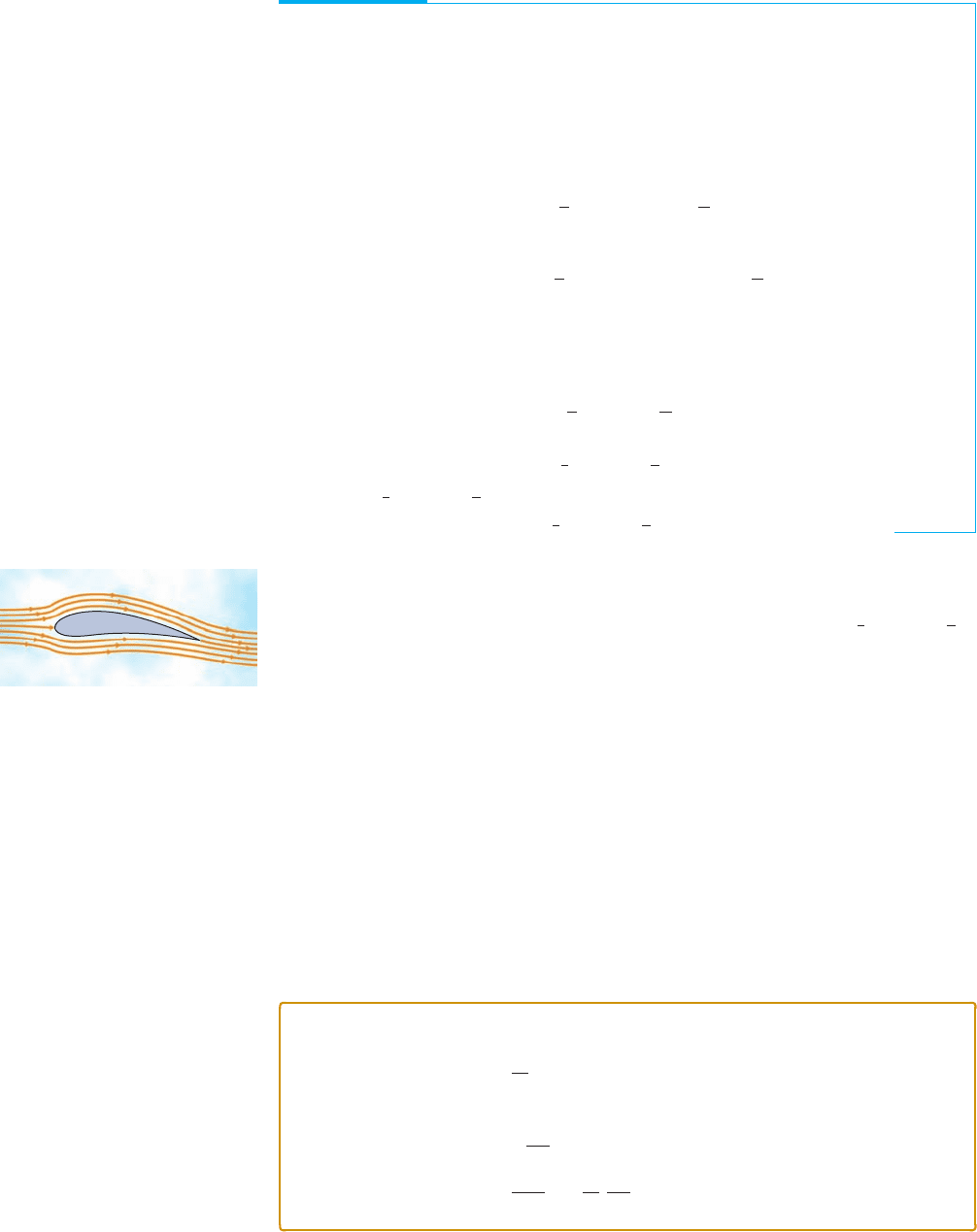
FIGURE 15.62
Cross section of a wing
Consider now what Bernoulli’s Theorem means in the case of steady airflow around an
airplane wing. Since the wing is curved on top (as in Figure 15.62), the air flowing across
the top must have a greater speed. From Bernoulli’s Theorem, the quantity
1
2
u
2
+ φ +
p
ρ
is
constant along flow lines, so an increase in speed must be compensated for by a decrease
in pressure. Due to the lower pressure on top, the wing experiences a lift force. Of course,
airflow around an airplane wing is more complicated than this. The interaction of the air
with the wing itself (the boundary layer) is quite complicated and determines many of the
flight characteristics of a wing. Still, Bernoulli’s Theorem gives us some insight into why
a curved wing produces a lift force.
Maxwell’s equations are a set of four equations relating the fundamental vector fields
of electricity and magnetism. From these equations, you can derive many more important
relationships. Taken together, Maxwell’s equations give a concise statement of the fun-
damentals of electricity and magnetism. The equations can be written in different ways,
depending on whether the integral or differential form is given and whether magnetic or
polarizable media are included. Also, you may find that different texts refer to these equa-
tions by different names. Listed below are Maxwell’s equations in differential form in the
absence of magnetic or polarizable media.
MAXWELL’S EQUATIONS
∇·E =
ρ
0
(Gauss’ Law for electricity)
∇·B = 0 (Gauss’ Law for magnetism)
∇×E =−
∂B
∂t
(Faraday’s Law of induction)
∇×B =
1
0
c
2
J +
1
c
2
∂E
∂t
(Ampere’s Law)
In these equations, E represents an electrostatic field, B is the corresponding magnetic
field,
0
is the permittivity, ρ is the charge density, c is the speed of light and J is the current
P1: OSO/OVY P2: OSO/OVY QC: OSO/OVY T1: OSO
MHDQ256-Ch15 MHDQ256-Smith-v1.cls January 6, 2011 10:53
LT (Late Transcendental)
CONFIRMING PAGES
1066 CHAPTER 15
..
Vector Calculus 15-90
density. In example 9.6, we derive a simplified version of the differential form of Ampere’s
law. The hypothesis in this case is a common form for Ampere’s law: the line integral of a
magnetic field around a closed path is proportional to the current enclosed by the path.
EXAMPLE 9.6 Deriving Ampere’s Law
In the case where E is constant and I represents current, use the relationship
C
B ·dr =
1
0
c
2
I to derive Ampere’s law: ∇×B =
1
0
c
2
J.
S
C
z
y
x
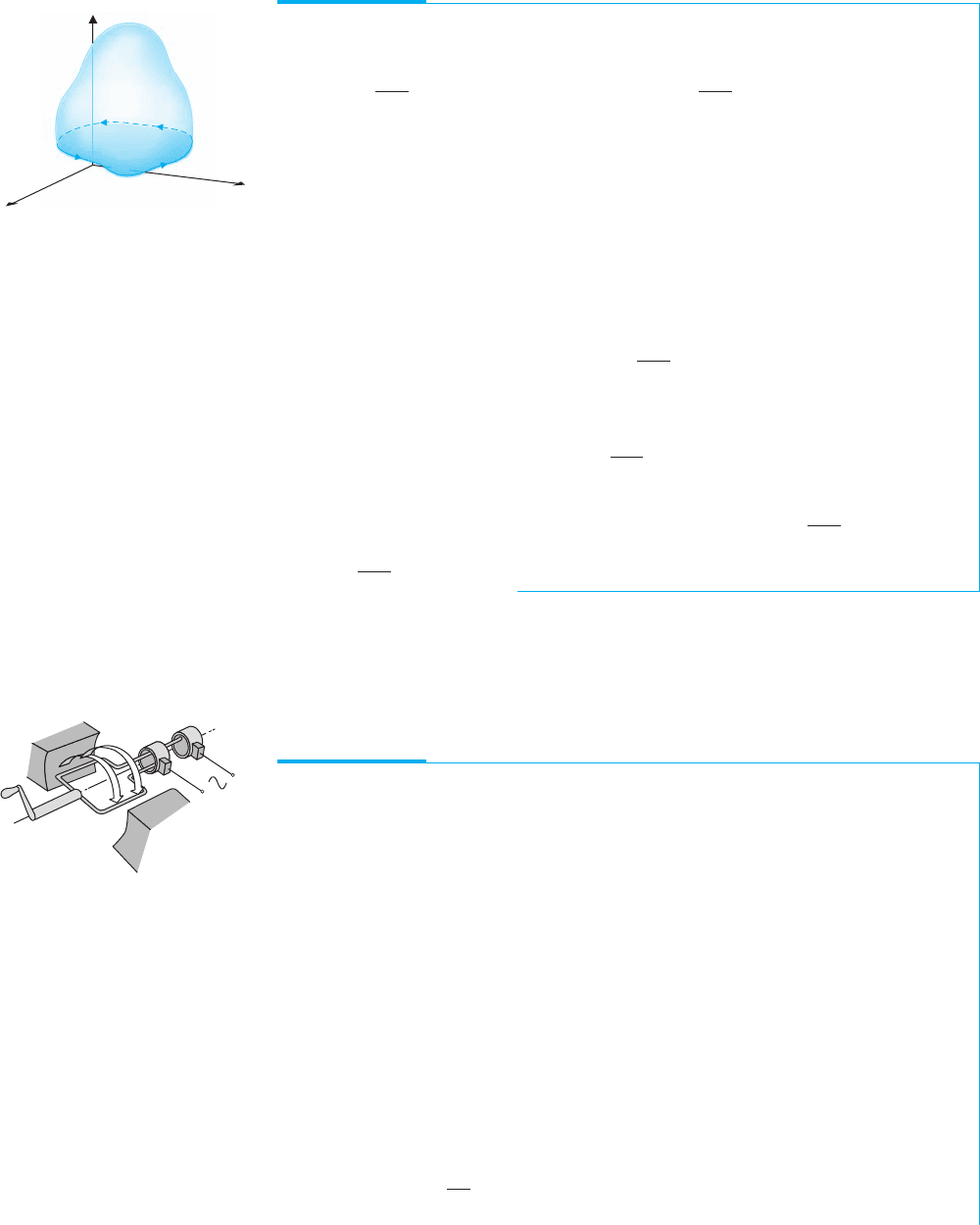
FIGURE 15.63
Positive orientation
Solution Let S be any capping surface for C, that is, any positively oriented two-sided
surface bounded by C. (See Figure 15.63.) The enclosed current I is then related to the
current density by I =
S
J · n dS. By Stokes’ Theorem, we can rewrite the line integral
of B as
C
B · dr =
S
(∇×B) ·n dS.
Equating the two expressions, we now have
S
(∇×B) ·n dS =
1
0
c
2
S
J · n dS,
from which it follows that
S
∇×B −
1
0
c
2
J
· n dS = 0.
Since this holds for all capping surfaces S, it must be that ∇×B −
1
0
c
2
J = 0 or
∇×B =
1
0
c
2
J, as desired.
In our final example, we illustrate one of the uses of Faraday’s law. In an AC generator,
the turning of a coil in a magnetic field produces a voltage. In terms of the electric field
E, the voltage generated is given by
C
E · dr, where C is a closed curve. As we see in
example 9.7, Faraday’s law relates this to the magnetic flux function φ =
S
B · n dS.
Sinusoidal
voltage output
A voltage proportional to
the rate of change of the
area facing the magnetic
field is generated in the
coil. This is an example
of Faraday's law.
The mechanical energy input to
a generator turns the coil in the
magnetic field.
EXAMPLE 9.7 Using Faraday’s Law to Analyze
the Output of a Generator
An AC generator produces a voltage of 120sin(120π t) volts. Determine the magnetic
flux φ.
Solution The voltage is given by
C
E · dr = 120sin (120πt).
Applying Stokes’ Theorem to the left-hand side, we have
S
(∇×E) ·n dS =
C
E · dr = 120sin (120πt).
Applying Faraday’s law to the left-hand side, we have
S
−
∂B
∂t
· n dS =
S
(∇×E) ·n dS = 120sin(120πt).

P1: OSO/OVY P2: OSO/OVY QC: OSO/OVY T1: OSO
MHDQ256-Ch15 MHDQ256-Smith-v1.cls January 6, 2011 10:53
LT (Late Transcendental)
CONFIRMING PAGES
15-91 SECTION 15.9
..
Applications of Vector Calculus 1067
Assuming that the integrand is continuous and we can bring the derivative outside, we get
−
d
dt
S
(B · n)dS = 120sin(120πt).
Writing this in terms of the magnetic flux φ,wehave
−
d
dt
φ = 120sin(120πt)
or
φ
(t) =−120 sin (120πt).
Integrating this gives us
φ(t) =
1
π
cos(120π t) +c,
for some constant c.
EXERCISES 15.9
WRITING EXERCISES
1. Give an example of a fluid with velocity field with zero flux as
in example 9.1.
2. Give an example of a fluid with velocity field with nonzero flux.
3. In the derivation of the continuity equation, explain why it is
important to assume no sources or sinks.
4. From Bernoulli’s Theorem, if all otherthings are equal andthe
density ρ increases, in what way does velocity change?
1. Rework example 9.2 by computing
C
F · dr.
2. Rework example 9.2 by directly computing
S
(∇×F) ·n dS.
............................................................
In exercises 3–8, use Gauss’ Law for electricity and the relation-
ship q
Q
ρ dV.
3. For E =yz, xz, xy, find the total charge in the hemisphere
z =
R
2
− x
2
− y
2
.
4. For E =2xy, y
2
, 5x, find the total charge in the hemisphere
z =
R
2
− x
2
− y
2
.
5. For E =4x − y, 2y + z, 3xy, find the total charge in the
hemisphere z =
R
2
− x
2
− y
2
.
6. For E =2xz
2
, 2yx
2
, 2zy
2
, find the total charge in the hemi-
sphere z =
R
2
− x
2
− y
2
.
7. For E =2xy, y
2
, 5xy, find the total charge in the cone
z =
x
2
+ y
2
below z = 4.
8. For E =4x − y, 2y + z, 3xy, find the total charge in the
solid bounded by z = R − x
2
− y
2
and z = 0.
............................................................
In exercises 9–12, find the flux of ∇×F across S as easily as
possible.
9. S is the portion of the cube 0 ≤ x ≤ 2, 0 ≤ y ≤ 2, 0 ≤ z ≤ 2,
with x > 0, n is upward at the top,
F =
√
x
2
+ 4, e
−y
2
+ zy
2
, tan z − x
3
y.
10. S is the portion of z = 4 − x
2
− y
2
with z > 0, n is upward,
F =z
2
cos(x + z), y
3
− 4x sin y, e
z
2
+ xyz.
11. S is the portion of y = x
2
+ z
2
with y < 4, n is to the left,
F =x
2
e
3x
, y
2
, xy
2
−
√
z + 4.
12. S is the boundary of the solid bounded by
x
2
+ y
2
− z
2
= 4,z = 0andz = 2,with0 ≤ z < 2,nisdown-
ward, F =4y − yx
2
, xy
2
+ yz
2
, xz + cos z
2
.
............................................................
13. Faraday showed that
C
E · dr =−
dφ
dt
, where
φ =
S
B · n dS, for any capping surface S (that is, any pos-
itively oriented open surface with boundary C). Use this to
show that ∇×E =−
∂B
∂t
. What mathematical assumption
must be made?
14. If an electric field E is conservative with potential
function −φ, use Gauss’ Law of electricity to show that Pois-
son’s equation must hold: ∇
2
φ =−
ρ
0
.
15. Use Maxwell’s equation and J = ρv to derive the continuity
equation. (Hint: Start by computing ∇·J.) What mathematical
assumption must be made?
16. For a magnetic field B, Maxwell’s equation ∇·B = 0 implies
that B =∇×A for some vector field A. Show that the flux
of B across an open surface S equals the circulation of A
around the closed curve C, where C is the positively oriented
boundary of S.
17. Let I be the current crossing an open surface S, so that
I =
S
J · n dS. Given that I =
C
B · dr (where C is the pos-
itively oriented boundary of S), show that J =∇×B.
18. Using the same notation as in exercise 17, start with
I =
S
J · n dS and J =∇×B and show that I =
C
B · dr.
............................................................
In exercises 19–22, use the electrostatic force E
q
4π
0
r
3
r
for a charge q at the origin, where r x, y, z and
r
x
2
y
2
z
2
.
19. If S is a closed surface not enclosing the origin, show that
S
E · n dS = 0.

P1: OSO/OVY P2: OSO/OVY QC: OSO/OVY T1: OSO
MHDQ256-Ch15 MHDQ256-Smith-v1.cls January 6, 2011 10:53
LT (Late Transcendental)
CONFIRMING PAGES
1068 CHAPTER 15
..
Vector Calculus 15-92
20. Showthat
S
E · n dS =
q
0
, for any closed surface S enclosing
the origin.
21. If S is the sphere x
2
+ y
2
+ z
2
= R
2
, show directly that
S
E · n dS =
q
0
.
22. If S is the sphere x
2
+ y
2
+ z
2
= 4, explain why the Diver-
gence Theorem cannot be applied to
S
E · n dS. Will the flux
change if the radius of the sphere changes?
............................................................
23. Assume that
S
D · n dS = q, for any closed surface S, where
D =
0
E istheelectricfluxdensityand q is the chargeenclosed
by S. Show that ∇·D = Q, where Q is the charge density sat-
isfying q =
R
QdV.
24. Let S be the portion of the unit cube 0 ≤ x ≤ 1,
0 ≤ y ≤ 1, 0 ≤ z ≤ 1 with z > 0(n upward at the top)
and F =e
x
2
+ z
2
, xz
3
, 3z
2
. Compute
S
F · n dS and
S
(∇×F) ·n dS.
25. Letu beascalarfunctionwithcontinuoussecondpartialderiva-
tives. Define the normal derivative
∂u
∂n
=∇u · n. Show that
S
∂u
∂n
dS =
Q
∇
2
udV.
26. Suppose that u is a harmonic function (that is, ∇
2
u = 0). Show
that
S
∂u
∂n
dS = 0.
27. If the heat conductivity k is not constant, our derivation of the
heat equation is no longer valid. If k = k(x, y, z), show that
the heat equation becomes k∇
2
T +∇k ·∇T = σρ
∂T
∂t
.
28. If h has continuous partial derivatives and S is
a closed surface enclosing a solid Q, show that
S
(h∇h) · n dS =
Q
(h∇
2
h +∇h ·∇h)dV.
29. Suppose that f and g are both harmonic (that is,
∇
2
f =∇
2
g = 0)and f = g onaclosedsurfaceS,whereS en-
closes a solid Q. Use the result of exercise28, with h = f − g,
to show that f = g in Q.
Review Exercises
WRITING EXERCISES
The following list includes terms that are defined and theorems that
arestatedin this chapter. Foreach term or theorem,(1) givea precise
definition or statement, (2) state in general terms what it means and
(3) describe the types of problems with which it is associated.
Vector field Velocity field Flow lines
Gradient field Potential function Conservative field
Curl Divergence Laplacian
Line integral Work line integral Path independence
Green’s Theorem Surface integral Flux integral
Divergence Theorem Stokes’ Theorem Heat equation
Continuity equation Bernoulli’s Theorem Maxwell’s equations
TRUE OR FALSE
State whether each statement is true or false and briefly explain
why. If the statement is false, try to “fix it” by modifying the given
statement to a new statement that is true.
1. The graph of a vector field shows vectors F(x, y) for all points
(x, y).
2. The antiderivative of a vector field is called the potential
function.
3. If the flow lines of F(x, y) are straight lines, then
∇×F(x, y) = 0.
4. F is conservative if and only if ∇×F = 0.
5. The line integral
C
fdsequals the amount of work done by f
along C.
6. If ∇×F = 0, then the work done by F along any path is 0.
7. If the curve C is split into pieces C
1
and C
2
, then
C
1
F · dr =−
C
2
F · dr.
8. Green’s Theorem cannot be applied to a region with a hole.
9. When using Green’s Theorem, positive orientation means
counterclockwise.
10. When converting a surface integral to a double integral, you
must replace z with a function of x and y.
11. A flux integral is always positive.
12. The Divergence Theorem applies only to three-dimensional
solids without holes.
13. By Stokes’ Theorem, the flux of ∇×F across two nonclosed
surfaces sharing the same boundary is the same.
In exercises 1 and 2, sketch several vectors in the velocity field
by hand and verify your sketch with a CAS.
1. x, −y 2. 0, 2y
............................................................
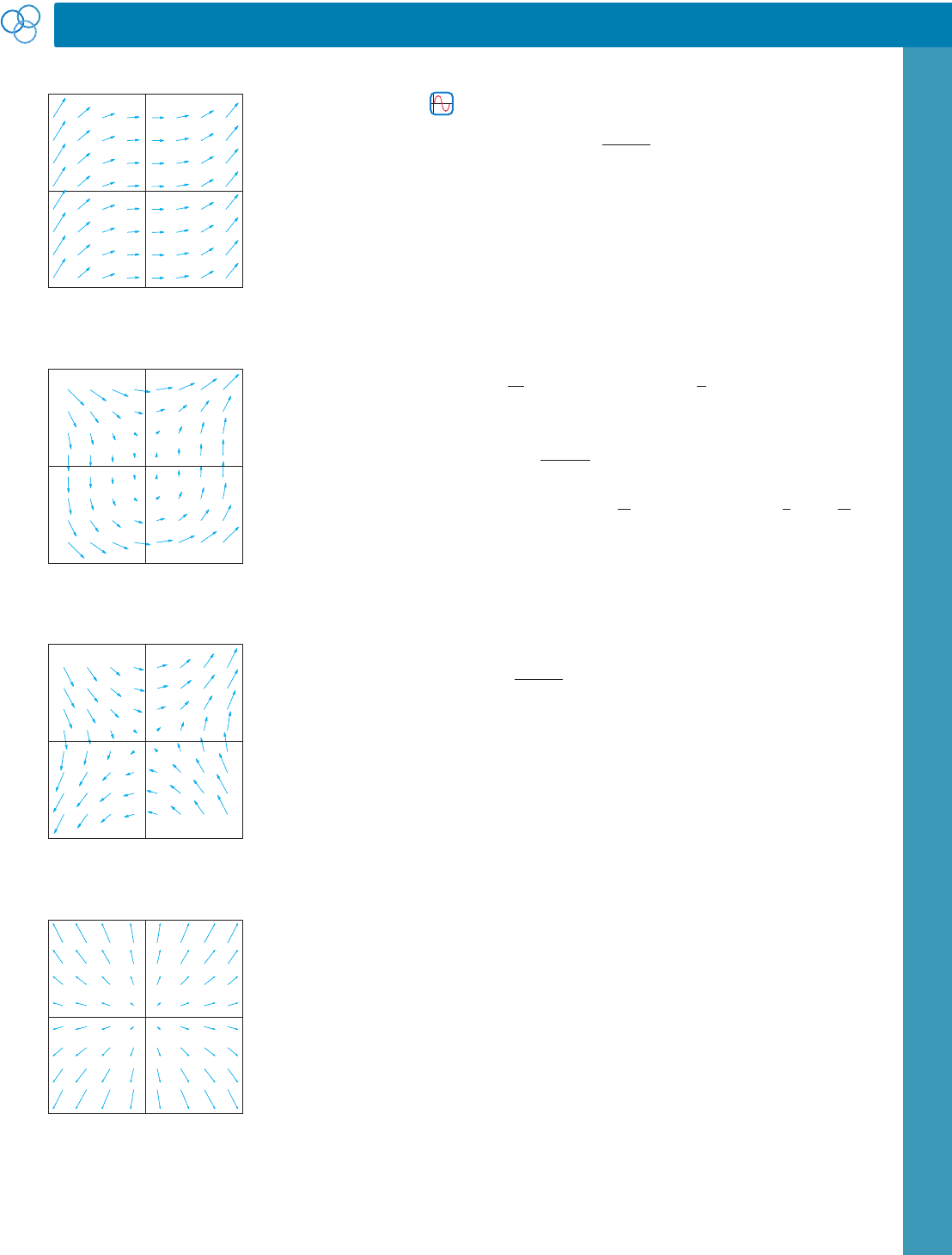
3. Match the vector fields with their graphs.F
1
(x, y)=sin x, y,
F
2
(x, y) =sin y, x, F
3
(x, y) =y
2
, 2x, F
4
(x, y) =3, x
2
P1: OSO/OVY P2: OSO/OVY QC: OSO/OVY T1: OSO
MHDQ256-Ch15 MHDQ256-Smith-v1.cls January 6, 2011 10:53
LT (Late Transcendental)
CONFIRMING PAGES
15-93 CHAPTER 15
..
Review Exercises 1069
Review Exercises
y
x
GRAPH A
y
x
GRAPH B
x
y
GRAPH C
x
y
GRAPH D
4. Find the gradient field corresponding to f . Use a CAS to
graph it.
(a) f (x, y) = ln
x
2
+ y
2
(b) f (x, y) = e
−x
2
−y
2
............................................................
In exercises 5–8, determine whether or not the vector field is
conservative. If it is, find a potential function.
5. y −2xy
2
, x − 2yx
2
+ 1 6. y
2
+ 2e
2y
, 2xy + 4xe
2y
7. 2xy − 1, x
2
+ 2xy 8. y cos xy − y, x cos xy − x
............................................................
In exercises 9 and 10, find equations for the flow lines.
9.
y,
2x
y
10.
3
x
, y
............................................................
In exercises 11 and 12, use the notation r x, y and
r r
x
2
y
2
.
11. Show that ∇(lnr) =
r
r
2
. 12. Show that ∇
1
r
=−
r
r
3
.
............................................................
In exercises 13–18, evaluate the line integral.
13.
C
3ydx, where C is the line segment from (2, 3) to (4, 3)
14.
C
(x
2
+ y
2
)ds, where C is the half-circle x
2
+ y
2
= 16 from
(4, 0) to (−4, 0) with y ≥ 0
15.
C
x
2
+ y
2
ds, where C is the circle x
2
+ y
2
= 9, oriented
clockwise
16.
C
(x − y)ds , where C is the portion of y = x
3
from (1, 1) to
(−1, −1)
17.
C
2xdx,whereC istheupperhalf-circlefrom(2,0)to(−2, 0),
followed by the line segment to (2, 0)
18.
C
3y
2
dy, where C is the portion of y = x
2
from (−1, 1) to
(1, 1), followed by the line segment to (−1, 1)
............................................................
In exercises 19–22, compute the work done by the force F along
the curve C.
19. F(x, y) =x, −y, C is the circle x
2
+ y
2
= 4 oriented
counterclockwise
20. F(x, y) =y, −x, C is the circle x
2
+ y
2
= 4 oriented
counterclockwise
21. F(x, y) =2, 3x, C is the quarter-circle from (2, 0) to (0, 2),
followed by the line segment to (0, 0)
22. F(x, y) =y, −x, C is the square from (−2, 0) to (2, 0) to
(2, 4) to (−2, 4)to(−2, 0)
............................................................
P1: OSO/OVY P2: OSO/OVY QC: OSO/OVY T1: OSO
MHDQ256-Ch15 MHDQ256-Smith-v1.cls January 6, 2011 10:53
LT (Late Transcendental)
CONFIRMING PAGES
1070 CHAPTER 15
..
Vector Calculus 15-94
Review Exercises
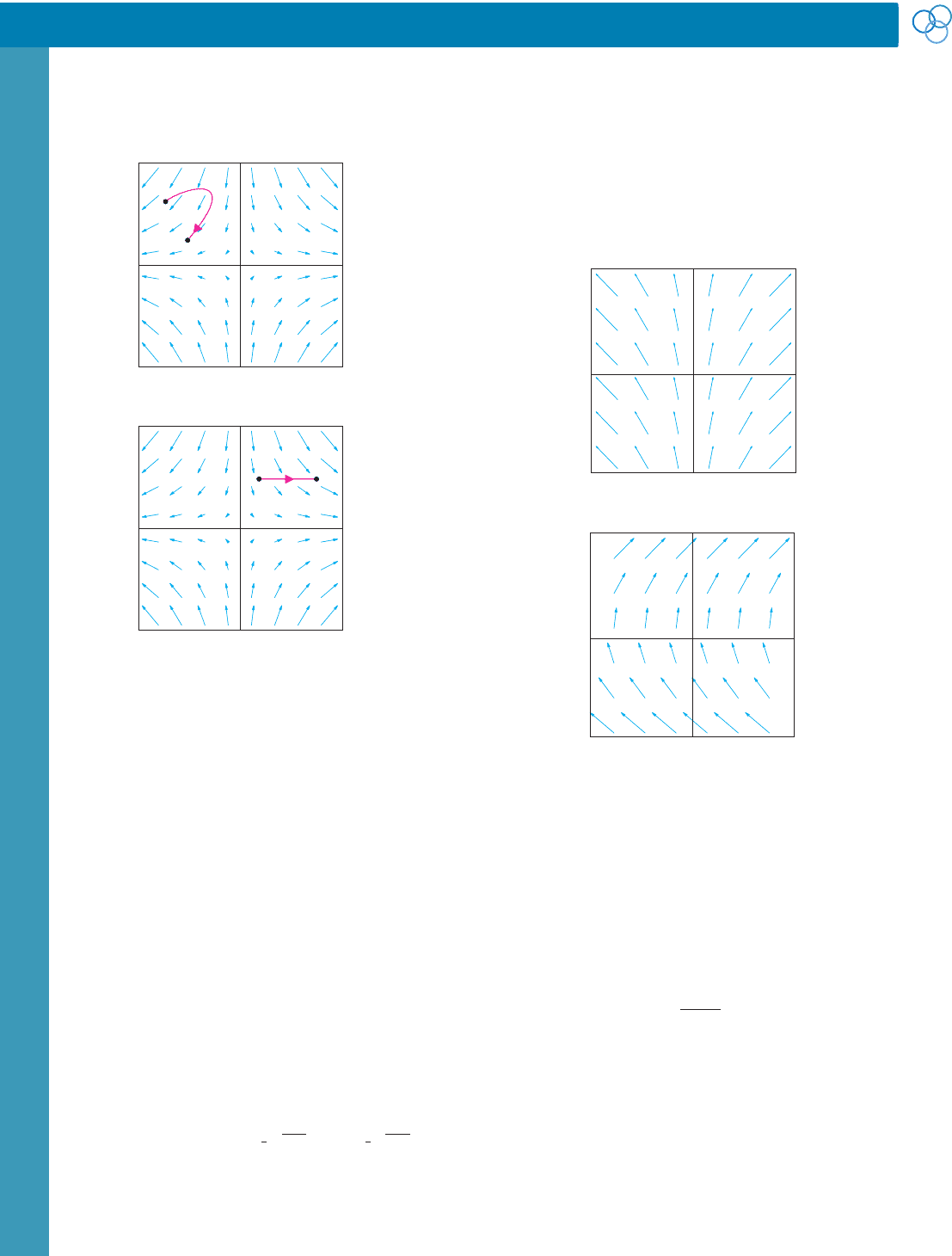
In exercises 23 and 24, use the graph to determine whether the
work done is positive, negative or zero.
23.
y
x
24.
y
x
............................................................
In exercises 25 and 26, find the mass of the indicated object.
25. A spring in the shape of cos3t, sin 3t, 4t, 0 ≤ t ≤ 2π,
ρ (x, y, z) = 4
26. The portion of z = x
2
+ y
2
under z = 4 with ρ (x, y) = 12
............................................................
In exercises 27 and 28, show that the integral is independent of
path and evaluate the integral.
27.
C
(3x
2
y − x)dx + x
3
dy, where C runs from (2, −1) to (4, 1)
28.
C
(y
2
− x
2
)dx + (2xy + 1)dy, where C runs from (3, 2) to
(1, 3)
............................................................
In exercises 29–32, evaluate
C
F ·dr.
29. F(x, y) =2xy + y sin x + e
x+y
, e
x+y
− cos x + x
2
, C is the
quarter-circle from (0, 3) to (3, 0)
30. F(x, y) =2y + y
3
+
1
2
√
y/x, 3xy
2
+
1
2
√
x/y , C is the top
half-circle from (1, 3) to (3, 3)
31. F(x, y, z) =2xy, x
2
− y, 2z, C runs from (1, 3, 2) to
(2, 1, −3)
32. F(x, y, z) =yz − x, xz − y, xy − z, C runs from (2, 0, 0) to
(0, 1, −1)
............................................................
In exercises 33 and 34, use the graph to determine whether or
not the vector field is conservative.
33.
x
y
34.
x
y
............................................................
In exercises 35–40, use Green’s Theorem to evaluate the indi-
cated line integral.
35.
C
F · dr, where F =x
3
− y, x + y
3
and C is formed by
y = x
2
and y = x, oriented positively.
36.
C
F · dr, where F =y
2
+ 3x
2
y, xy + x
3
and C is formed
by y = x
2
and y = 2x, oriented positively.
37.
C
tan x
2
dx + x
2
dy, where C is the triangle from (0, 0) to
(1, 1) to (2, 0) to (0, 0).
38.
C
x
2
ydx+ ln
1 + y
2
dy, where C is the triangle from (0, 0)
to (2, 2) to (0, 2) to (0, 0).
39.
C
F · dr, where F =3x
2
, 4y
3
− z, z
2
and C is formed by
z = y
2
and z = 4, oriented positively in the yz-plane.
40.
C
F · dr, where F =4y
2
, 3x
2
, 8zand C is x
2
+ y
2
= 4, ori-
ented positively in the plane z = 3.
............................................................
P1: OSO/OVY P2: OSO/OVY QC: OSO/OVY T1: OSO
MHDQ256-Ch15 MHDQ256-Smith-v1.cls January 6, 2011 10:53
LT (Late Transcendental)
CONFIRMING PAGES
15-95 CHAPTER 15
..
Review Exercises 1071
Review Exercises
In exercises 41 and 42, use a line integral to compute the area
of the given region.
41. The ellipse 4x
2
+ 9y
2
= 36
42. The region bounded by y = sin x and the x-axis for 0 ≤ x ≤ π
............................................................
In exercises 43–46, find the curl and divergence of the given
vector field.
43. x
3
i − y
3
j 44. y
3
i − x
3
j
45. 2x, 2yz
2
, 2y
2
z
46. 2xy, x
2
− 3y
2
z
2
, 1 −2zy
3
............................................................
In exercises 47–50, determine whether the given vector field is
conservative and/or incompressible.
47. 2x − y
2
, z
2
− 2xy, xy
2
48. y
2
z, x
2
− 3z
2
y, z
3
− y
49. 4x − y, 3 − x, 2 −4z
50. 4, 2xy
3
, z
4
− x
............................................................
In exercises 51 and 52, conjecture whether the divergence at
point P is positive, negative or zero.
51.
P
y
x
52.
P
y
x
............................................................
In exercises 53 and 54, sketch a graph of the parametric surface.
53. x = u
2
, y = v
2
, z = u + 2v
54. x = (3 +2cos u)cosv, y = (3 +2cosu) sin v, z = 2 cosv
............................................................
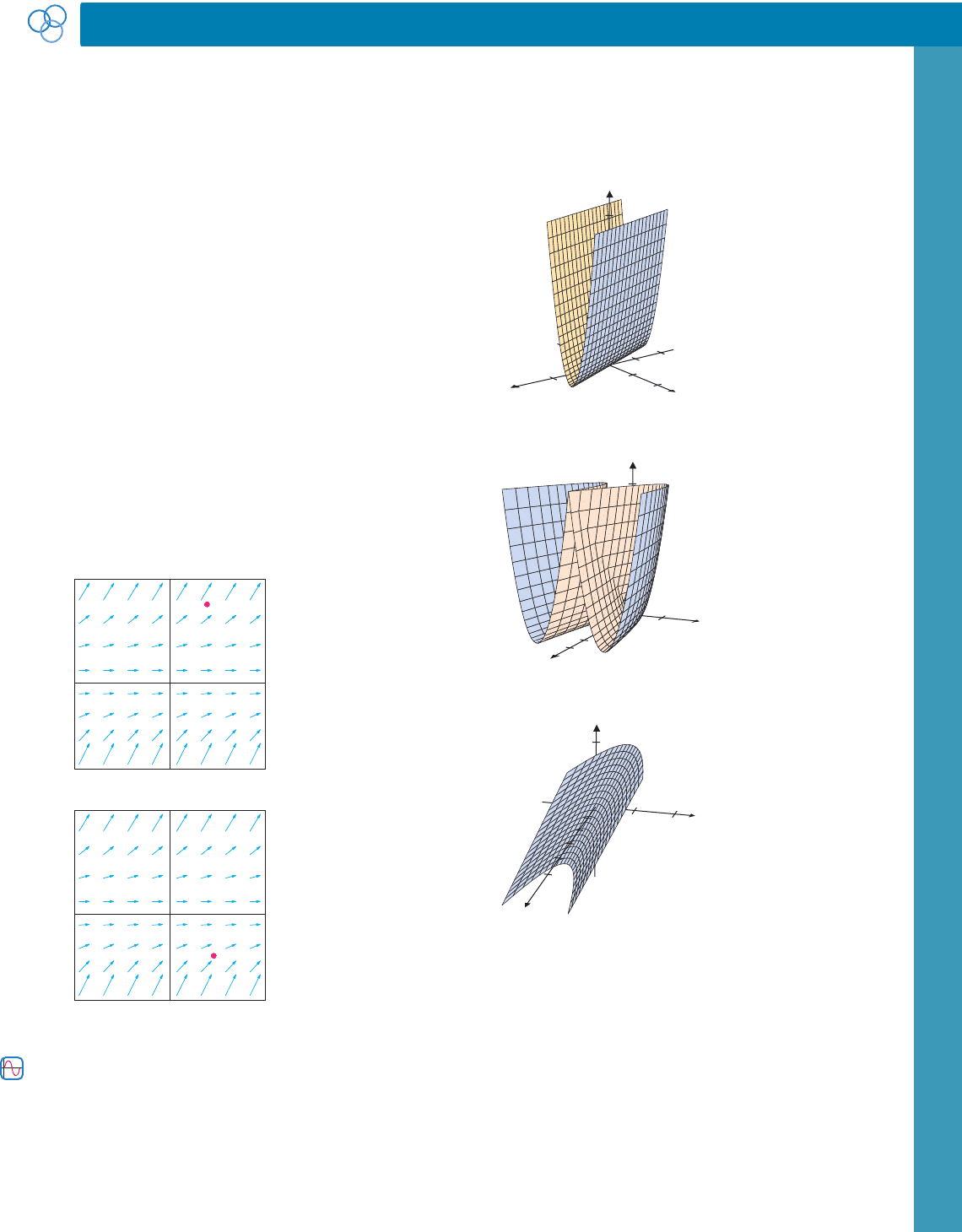
55. Match the parametric equations with the surfaces.
(a) x = u
2
, y = u + v, z = v
2
(b) x = u
2
, y = u + v, z = v
(c) x = u, y = u + v, z = v
2
z
y
x
4
10
25
SURFACE A
z
x
y
25
25
5
SURFACE B
z
x
y
4
25
5
10
SURFACE C
56. Find a parametric representation of x
2
+ y
2
+ z
2
= 9.
............................................................
In exercises 57 and 58, find the surface area.
57. The portion of the paraboloid z = x
2
+ y
2
between the cylin-
ders x
2
+ y
2
= 1 and x
2
+ y
2
= 4
58. The portion of the paraboloid z = 9 − x
2
− y
2
between the
cylinders x
2
+ y
2
= 1 and x
2
+ y
2
= 4
............................................................

P1: OSO/OVY P2: OSO/OVY QC: OSO/OVY T1: OSO
MHDQ256-Ch15 MHDQ256-Smith-v1.cls January 6, 2011 10:53
LT (Late Transcendental)
CONFIRMING PAGES
1072 CHAPTER 15
..
Vector Calculus 15-96
Review Exercises
In exercises 59–64, evaluate the surface integral
S
f (x, y, z) dS.
59.
S
(x − y)dS, where S is the portion of the plane
3x + 2y + z = 12 in the first octant
60.
S
(x
2
+ y
2
)dS where S is the portion of y = 4 − x
2
above the
xy-plane, y ≥ 0 and below z = 2
61.
S
(4x + y + 3z) dS, where S is the portion of the plane
4x + y + 3z = 12 inside x
2
+ y
2
= 1
62.
S
(x − z)dS,where S istheportionofthecylinderx
2
+ z
2
= 1
above the xy-plane between y = 1 and y = 2
63.
S
yz dS, where S is the portion of the cone y =
√
x
2
+ z
2
to
the left of y = 3
64.
S
(x
2
+ z
2
)dS, where S is the portion of the paraboloid
x = y
2
+ z
2
behind the plane x = 4
............................................................
In exercises 65 and 66, find the mass and center of mass of the
solid.
65. The portion of the paraboloid z = x
2
+ y
2
below the plane
z = 4,ρ(x, y, z) = 2
66. The portion of the cone z =
x
2
+ y
2
below the plane
z = 4,ρ(x, y, z) = z
............................................................
In exercises 67–70, use the Divergence Theorem to compute
∂
Q
F ·n dS.
67. Q is bounded by x + 2y + z = 4 (first octant) and the coordi-
nate planes, F =y
2
z, y
2
− sin z, 4y
2
.
68. Q is the cube −1 ≤ x ≤ 1, −1 ≤ y ≤ 1, −1 ≤ z ≤ 1,
F =4x, 3z, 4y
2
− x.
69. Q is bounded by z = 1 − y
2
, z = 0, x = 0 and x + z = 4,
F =2xy, z
3
+ 7yx, 4xy
2
.
70. Q is bounded by z =
√
4 − x
2
, z = 0, y = 0 and
y + z = 6, F =y
2
, 4yz, 2xy.
............................................................
In exercises 71 and 72, find the flux of F over ∂Q.
71. Q is bounded by z =
x
2
+ y
2
, x
2
+ y
2
= 4 and z = 0,
F =xz, yz, x
2
− z.
72. Q is bounded by z = x
2
+ y
2
and z = 2 − x
2
− y
2
,
F =4x, x
2
− 2y, 3z + x
2
.
............................................................
In exercises 73–76, use Stokes’ Theorem, if appropriate, to com-
pute
S
(∇×F)·n dS.
73. S is the portion of the tetrahedron bounded by x + y + 2z = 2
and the coordinate planes in front of the yz-plane,
F =zy
4
− y
2
, y − x
3
, z
2
.
74. S is the portion of z = x
2
+ y
2
below z = 4,
F =z
2
− x, 2y, z
3
xy.
75. S is the portion of the cone z =
x
2
+ y
2
below
x + 2y + 3z = 24, F =4x
2
, 2ye
2y
,
√
z
2
+ 1.
76. S is the portion of the paraboloid y = x
2
+ 4z
2
to the left of
y = 8 − z, F =xe
3x
, 4y
2/3
, z
2
+ 2.
............................................................
In exercises 77 and 78, useStokes’ Theoremto evaluate
C
F ·dr.
77. C is the triangle from (0, 1, 0) to (1, 0, 0) to (0, 0, 20),
F =2xycos z, y
2
+ x
2
cos z, z − x
2
y sin z.
78. C is the square from (0, 0, 2) to (1, 0, 2) to (1, 1, 2) to (0, 1, 2),
F =x
3
+ yz, y
2
, z
2
.
EXPLORATORY EXERCISE
1. In exploratory exercise 2 of section 15.1, we developed a tech-
nique for finding equations for flow lines of certain vector
fields. The field 2, 1 +2xy from example 1.5 is such a vec-
tor field, but the calculus is more difficult. First, show that the
differential equation is y
− xy =
1
2
and show that an integrat-
ing factor is e
−x
2
/2
. The flow lines come from equations of
the form y = e
x
2
/2
1
2
e
−x
2
/2
dx + ce
x
2
/2
. Unfortunately, there
is no elementary function equal to
1
2
e
−x
2
/2
dx. It can help to
write this in the form y = e
x
2
/2
x
0
1
2
e
−u
2
/2
du + ce
x
2
/2
. In this
form, show that c = y(0). In example 1.5, the curve passing
through (0, 1) is y = e
x
2
/2
x
0
1
2
e
−u
2
/2
du + e
x
2
/2
. Graph this
function and compare it to the path shown in Figure 15.7b.
Find an equation for and plot the curve through (0, −1). To
find the curve through (1, 1), change the limits of integra-
tion and rewrite the solution. Plot this curve and compare to
Figure 15.7b.