
Smith R., Minton R. Calculus
Подождите немного. Документ загружается.

P1: OSO/OVY P2: OSO/OVY QC: OSO/OVY T1: OSO
MHDQ256-Ch01 MHDQ256-Smith-v1.cls December 6, 2010 20:21
LT (Late Transcendental)
CONFIRMING PAGES
1-57 SECTION 1.7
..
Limits and Loss-of-Significance Errors 103
BEYOND FORMULAS
Inexamples7.5–7.7,we demonstratedcalculations thatsufferedfromcatastrophicloss-
of-significance errors. In each case, we showed how we could rewrite the expression
to avoid this error. We have by no means exhibited a general procedure for recognizing
and repairing such errors. Rather, we hope that by seeing a few of these subtle errors,
and by seeing how to fix even a limited number of them, you will become a more
skeptical and intelligent user of technology.
EXERCISES 1.7
WRITING EXERCISES
1. Caution is important in using technology. Equally important is
redundancy. This property is sometimes thought to be a nega-
tive (wasteful, unnecessary), but its positive role is one of the
lessons of this section. By redundancy, we mean investigating
a problem using graphical, numerical and symbolic tools. Why
is it important to use multiple methods?
2. When computing limits, should you always look at a graph?
compute function values? do symbolic work? an ε−δ proof?
Prioritize the techniques in this chapter.
3. The limit lim
h→0
f (a + h) − f (a)
h
is important in Chapter 2. For
a specific function and specific a, we could compute a table of
values of the fraction for smaller values of h. Why should we
be wary of loss-of-significance errors?
4. We rationalized the numerator in example 7.7. The old rule
of rationalizing the denominator is intended to minimize com-
putational errors. To see why you might want the square root
in the numerator, suppose that you can get only one decimal
place of accuracy, so that
√
3 ≈ 1.7. Compare
6
1.7
to
6
√
3
and
then compare 2(1.7) to
6
√
3
. Which of the approximations could
you do in your head?
In exercises 1–12, (a) use graphics and numerics to conjecture
a value of the limit. (b) Find a computer or calculator graph
showing a loss-of-significance error. (c) Rewrite the function to
avoid the loss-of-significance error.
1. lim
x→∞
x
√
4x
2
+ 1 − 2x
2. lim
x→−∞
x
√
4x
2
+ 1+2x
3. lim
x→∞
√
x
√
x + 4 −
√
x + 2
4. lim
x→∞
x
2
√
x
4
+ 8 − x
2
5. lim
x→∞
x
√
x
2
+ 4 −
√
x
2
+ 2
6. lim
x→∞
x
√
x
3
+8−x
3/2
7. lim
x→0
1 − cos 2x
12x
2
8. lim
x→0
1 − cos x
x
2
9. lim
x→0
1 − cos x
3
x
6
10. lim
x→0
1 − cos x
4
x
8
11. lim
x→∞
x
4/3
3
x
2
+ 1 −
3
x
2
− 1
12. lim
x→∞
x
2/3
3
√
x + 4 −
3
√
x − 3
............................................................
In exercises 13 and 14, compare the limits to show that small
errors can have disastrous effects.
13. lim
x→1
x
2
+ x − 2
x − 1
and lim
x→1
x
2
+ x − 2.01
x − 1
14. lim
x→2
x − 2
x
2
− 4
and lim
x→2
x − 2
x
2
− 4.01
............................................................
15. Compare f (x) = sin π x and g(x) = sin 3.14x for x = 1
(radian), x = 10, x = 100 and x = 1000.
16. For exercise 1, follow the calculation of the function for
x = 10
5
as it would proceed for a machine computing with
a 10-digit mantissa. Identify where the round-off error occurs.
............................................................
In exercises 17and 18, comparethe exact answer to one obtained
by a computer with a six-digit mantissa.
17. (1.000003 −1.000001) ×10
7
18. (1.000006 −1.000001) ×10
7
............................................................
19. If you have access to a CAS, test it on the limits of exam-
ples 7.1, 7.6 and 7.7. Based on these results, do you think that
your CAS does precise calculations or numerical estimates?
EXPLORATORY EXERCISES
1. Just as we are subject to round-off error in using calculations from
a computer, so are we subject to errors in a computer-generated
graph. After all, the computer has to compute function values be-
fore it can decide where toplot points. On your computer or calcu-
lator, graph y = sinx
2
(a disconnected graph—or point plot—is
preferable). You should see the oscillations you expect from the
sine function, but with the oscillations getting faster as x gets
larger. Shift your graphing window to the right several times. At
some point, the plot will become very messy and almost unread-
able. Depending on your technology, you may see patterns in the
plot. Are these patterns real or an illusion? To explain what is
P1: OSO/OVY P2: OSO/OVY QC: OSO/OVY T1: OSO
MHDQ256-Ch01 MHDQ256-Smith-v1.cls December 6, 2010 20:21
LT (Late Transcendental)
CONFIRMING PAGES
104 CHAPTER 1
..
Limits and Continuity 1-58
going on, recall that a computer graph is a finite set of pixels, with
each pixel representing one x and one y. Suppose the computer is
plotting points at x = 0, x = 0.1, x = 0.2 and so on. The y-values
would then be sin0
2
, sin0.1
2
, sin0.2
2
and so on. Investigate what
will happen between x = 15 and x = 16. Compute all the points
(15, sin 15
2
), (15.1, sin 15.1
2
)andsoon. Ifyouweretographthese
points, what pattern would emerge? To explain this pattern, argue
that there is approximately half a period of the sine curve miss-
ing between each point plotted. Also, investigate what happens
between x = 31 and x = 32.
Review Exercises
WRITING EXERCISES
The following list includes terms that are defined and theorems that
arestatedin this chapter. Foreach term or theorem,(1) givea precise
definition or statement, (2) state in general terms what it means and
(3) describe the types of problems with which it is associated.
Secant line Limit Infinite limit
One-sided limit Continuous Loss-of-significance
Removable Horizontal error
discontinuity asymptote Slant asymptote
Vertical asymptote Squeeze Theorem Intermediate Value
Method of bisections Length of line Theorem
Slope of curve segment
TRUE OR FALSE
State whether each statement is true or false and briefly explain
why. If the statement is false, try to “fix it” by modifying the given
statement to make a new statement that is true.
1. In calculus, problems are often solved by first approximating
the solution and then improving the approximation.
2. If f (1.1) = 2.1, f (1.01) = 2.01 and soon, then lim
x→1
f (x) = 2.
3. lim
x→a
[ f (x) · g(x)] = [lim
x→a
f (x)][lim
x→a
g(x)]
4. lim
x→a
f (x)
g(x)
=
lim
x→a
f (x)
lim
x→a
g(x)
5. If f (2) = 1 and f (4) = 2,then there exists an x between 2 and
4 such that f (x) = 0.
6. For any polynomial p(x), lim
x→∞
p(x) =∞.
7. If f (x) =
p(x)
q(x)
for polynomials p and q with q(a) = 0, then
f has a vertical asymptote at x = a.
8. Small round-off errors typically have only small effects on a
calculation.
9. lim
x→a
f (x) = L if and only if lim
x→a
f (x) =
√
L.
In exercises 1 and 2, numerically estimate the slope of y f (x)
at x a.
1. f (x) = x
2
− 2x, a = 2
2. f (x) = sin2x, a = 0
............................................................
In exercises 3 and 4, numerically estimate the length of the curve
using (a) n 4 and (b) n 8 line segments and evenly spaced
x-coordinates.
3. f (x) = sin x, 0 ≤ x ≤
π
4
4. f (x) = x
2
− x, 0 ≤ x ≤ 2
............................................................
In exercises 5–10, use numerical and graphical evidence to con-
jecture the value of the limit.
5. lim
x→0
tan (x
3
)
x
2
6. lim
x→1
x
2
− 1
cosπ x +1
7. lim
x→−2
x + 2
|x + 2|
8. lim
x→0
tan
1
x
9. lim
x→−∞
√
x
2
+ 4
3x + 1
10. lim
x→∞
4x
2
+ x − 1
√
x
4
+ 6
............................................................
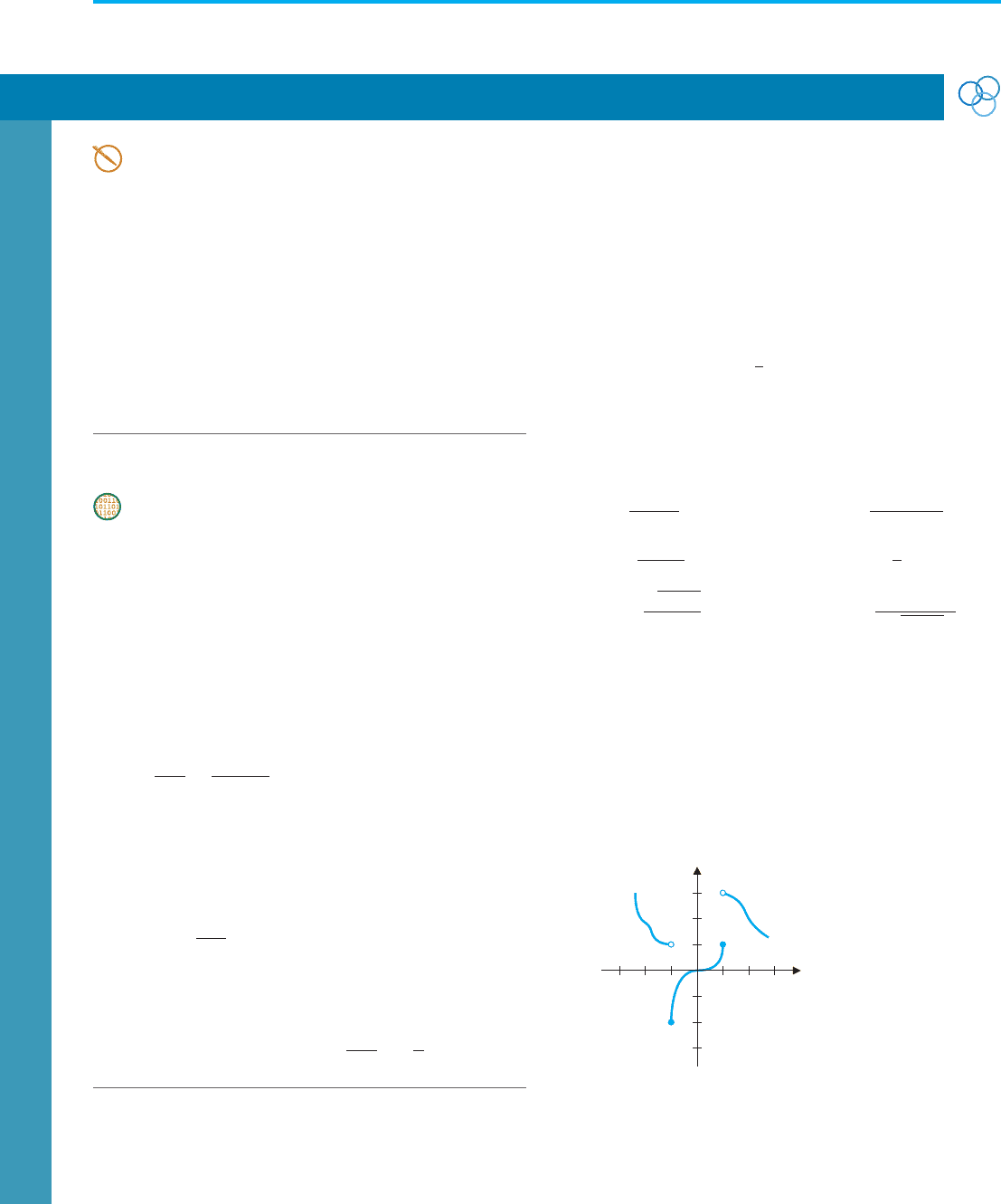
In exercises 11 and 12, identify the limits from the graph of f .
11. (a) lim
x→−1
−
f (x) (b) lim
x→−1
+
f (x)
(c) lim
x→−1
f (x) (d) lim
x→0
f (x)
12. (a) lim
x→1
−
f (x) (b) lim
x→1
+
f (x)
(c) lim
x→1
f (x) (d) lim
x→2
f (x)
y
x
3
3
33
............................................................

P1: OSO/OVY P2: OSO/OVY QC: OSO/OVY T1: OSO
MHDQ256-Ch01 MHDQ256-Smith-v1.cls December 6, 2010 20:21
LT (Late Transcendental)
CONFIRMING PAGES
1-59 CHAPTER 1
..
Chapter 1 Review Exercises 105
Review Exercises
13. Identify the discontinuities in the function graphed above.
14. Sketch a graph of a function f with f (−1) = 0,
f (0) = 0, lim
x→1
−
f (x) = 1 and lim
x→1
+
f (x) =−1.
............................................................
In exercises 15–34, evaluate the limit. Answer with a number,
∞, −∞ or does not exist.
15. lim
x→2
x
2
− x − 2
x
2
− 4
16. lim
x→1
x
2
− 1
x
2
+ x − 2
17. lim
x→0
x
2
+ x
√
x
4
+ 2x
2
18. lim
x→0
x
3
+ 2x
2
√
x
8
+ 4x
4
19. lim
x→0
(2 + x)sin(1/x) 20. lim
x→0
sin x
2
x
2
21. lim
x→2
f (x), where f (x) =
3x − 1ifx < 2
x
2
+ 1ifx ≥ 2
22. lim
x→1
f (x), where f (x) =
2x + 1ifx < 1
x
2
+ 1ifx > 1
23. lim
x→0
3
√
1 + 2x − 1
x
24. lim
x→1
x − 1
√
10 − x − 3
25. lim
x→0
cot(x
2
) 26. lim
x→1
tan
x
x
2
− 2x + 1
27. lim
x→∞
x
2
− 4
3x
2
+ x + 1
28. lim
x→∞
2x
√
x
2
+ 4
29. lim
x→π/2
−tan
2
x 30. lim
x→3
x
2
− 2x − 3
x
2
+ 6x + 9
31. lim
x→−∞
2x
x
2
+ 3x − 5
32. lim
x→−2
2x
x
2
+ 3x + 2
33. lim
x→0
sin x
|sin x|
34. lim
x→0
2x −|x|
|3x|−2x
............................................................
35. Use the Squeeze Theorem to prove that lim
x→0
2x
3
x
2
+ 1
= 0.
36. Use the Intermediate Value Theorem to verify that
f (x) = x
3
− x − 1 has a zero in the interval [1, 2]. Use the
method of bisections to find an interval of length 1/32 that
contains a zero.
............................................................
In exercises 37–40, find all x’s at which f is continuous.
37. f (x) =
x − 1
x
2
+ 2x − 3
38. f (x) =
x + 1
x
2
− 4
39. f (x) =
⎧
⎨
⎩
sin x if x < 0
x
2
if 0 ≤ x ≤ 2
4x − 3ifx > 2
40. f (x) = x cot x
............................................................
In exercises 41–44, find all intervals of continuity.
41. f (x) =
x + 2
x
2
− x − 6
42. f (x) =
2x
√
3x − 4
43. f (x) = sin(1 +cos x) 44. f (x) =
x
2
− 4
............................................................
In exercises 45–52, determine all vertical, horizontal and slant
asymptotes.
45. f (x) =
x + 1
x
2
− 3x + 2
46. f (x) =
x + 2
x
2
− 2x − 8
47. f (x) =
x
2
x
2
− 1
48. f (x) =
x
3
x
2
− x − 2
49. f (x) =
x
3
x
2
+ x + 1
50. f (x) =
2x
2
x
2
+ 4
51. f (x) =
3
cos x − 1
52. f (x) =
cos x − 1
x + 3
............................................................
In exercises 53 and 54, (a) use graphical and numerical evi-
dence to conjecture a value for the indicated limit. (b) Find
a computer or calculator graph showing a loss-of-significance
error. (c) Rewrite the function to avoid the loss-of-significance
error.
53. lim
x→0
1 − cos x
2x
2
54. lim
x→∞
x
x
2
+ 1 − x
EXPLORATORY EXERCISES
1. For f (x) =
2x
2
− 2x − 4
x
2
− 5x + 6
, do the following. (a) Find all val-
ues of x at which f is not continuous. (b) Determine which
value in (a) is a removable discontinuity. For this value, find
the limit of f as x approaches this value. Sketch a portion of
the graph of f near this x-value showing the behavior of the
function. (c) For the value in part (a) that is not removable,
find the two one-sided infinite limits and sketch the graph of
f near this x-value. (d) Find lim
x→∞
f (x) and lim
x→−∞
f (x) and
sketch the portion of the graph of f corresponding to these
values. (e) Connect the pieces of your graph as simply as pos-
sible.Ifavailable,compareyourgraph toacomputer-generated
graph.
2. Let f (t) represent the price of an autograph of a famous per-
son at time t (years after 2000). Interpret each of the following
(independently) in financial terms: (a) horizontal asymptote
y =1000,(b)verticalasymptoteatt = 10, (c) lim
t→4
−
f (t) = 500
and lim
t→4
+
f (t) = 800 and (d) lim
t→8
f (t) = 950.
This page intentionally left blank

P1: OSO/OVY P2: OSO/OVY QC: OSO/OVY T1: OSO
MHDQ256-Ch02 MHDQ256-Smith-v1.cls December 8, 2010 18:21
LT (Late Transcendental)
CONFIRMING PAGES
CHAPTER
2
Differentiation
The marathon is one of the most famous running events, covering
26 miles and 385 yards. The 2004 Olympic marathon was won by
Stefano Baldini of Italy in a time of 2:10:55. Using the familiar for-
mula “rate equals distance divided by time,” we can compute Baldini’s
average speed of
26 +
385
1760
2 +
10
60
+
55
3600
≈ 12.0 mph.
This says that Baldini averaged less than 5 minutes per mile for over 26 miles!
However, the 100-meter sprint was won by Justin Gatlin of the United States in
9.85 seconds, while the 200-meter sprint was won by Shawn Crawford of the
United States in 19.79 seconds. Average speeds for these runners were
100
1610
9.85
3600
≈ 22.7 mph and
200
1610
19.79
3600
≈ 22.6 mph.
Since these speeds are much faster than that of the marathon runner, the winners
of these events are often called the “World’s Fastest Human.”
An interesting connection can be made with a thought experiment. If the same
person ran 200 meters in 19.79 seconds with the first 100 meters covered in 9.85
seconds, compare the average speeds for the first and second 100 meters. In the
second 100 meters, the distance run is 200 − 100 = 100 meters and the time is
19.79 − 9.85 = 9.94 seconds. The average speed is then
200 − 100
19.79 − 9.85
=
100
9.94
≈ 10.06 m/s ≈ 22.5 mph.
Notice that the speed calculation in m/s is the same calculation we would use for
theslope between the points(9.85, 100) and (19.79, 200). The connection between
slope and speed (and other quantities of interest) is explored in this chapter.
2.1 TANGENT LINES AND VELOCITY
A traditional slingshot is essentially a rock on the end of a string, which you rotate
around in a circular motion and then release. When you release the string, in which
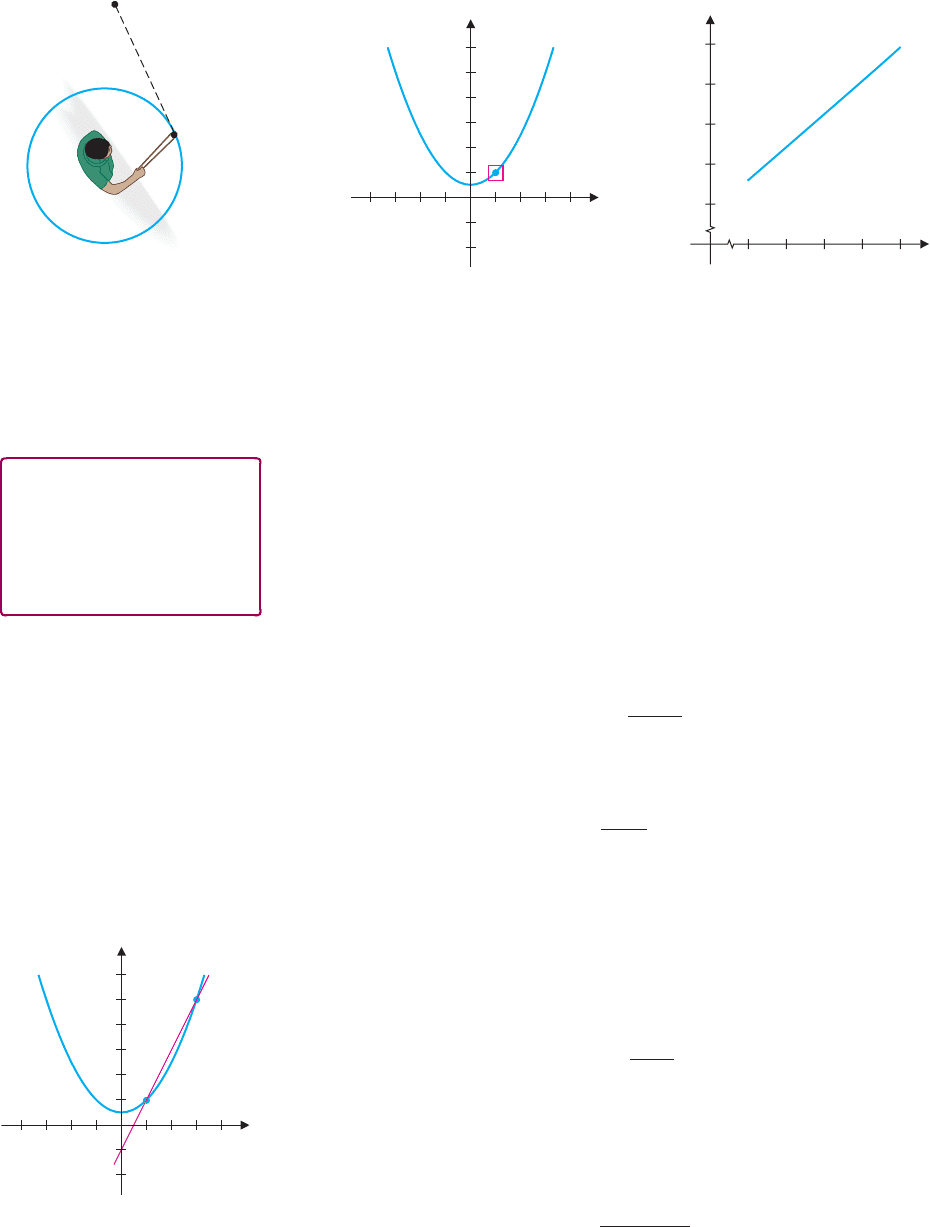
direction will the rock travel? An overhead view of this is illustrated in Figure 2.1
(onthe followingpage). Manypeople mistakenlybelievethat the rock will followa
107
P1: OSO/OVY P2: OSO/OVY QC: OSO/OVY T1: OSO
MHDQ256-Ch02 MHDQ256-Smith-v1.cls December 8, 2010 18:21
LT (Late Transcendental)
CONFIRMING PAGES
108 CHAPTER 2
..
Differentiation 2-2
y
x
4
(1, 2)
4
8
12
4224
y
x
1.8
1.9
2.0
2.1
2.2
0.92 0.96 1.00 1.04 1.08
FIGURE 2.2
y = x
2
+ 1
FIGURE 2.3
y = x
2
+ 1
curved path, but Newton’s first law of motion tells us that the path as viewed from above
is straight. In fact, the rock follows a path along the tangent line to the circle at the point
of release. Our aim in this section is to extend the notion of tangent line to more general
curves.
P
Point
of
release
FIGURE 2.1
Path of rock
CAUTION
Be aware that the “axes”
indicated in Figure 2.3 do not
intersect at the origin. We
provide them only as a guide as
to the scale used to produce the
figure.
To make our discussion more concrete, suppose that we want to find the tangent line to
the curve y = x
2
+ 1 at the point (1, 2). (See Figure 2.2.) The tangent line hugs the curve
near the point of tangency. In other words, like the tangent line to a circle, this tangent
line has the same direction as the curve at the point of tangency. Observe that if we zoom
in sufficiently far, the graph appears to approximate that of a straight line. In Figure 2.3,
we show the graph of y = x
2
+ 1 zoomed in on the small rectangular box indicated in
Figure 2.2. We now choose two points from the curve—for example, (1, 2) and (3, 10)—
and compute the slope of the line joining these two points. Such a line is called a secant
line and we denote its slope by m
sec
:
m
sec
=
10 − 2
3 − 1
= 4.
An equation of the secant line is then determined by
y − 2
x −1
= 4,
so that
y = 4(x − 1) + 2.
As can be seen in Figure 2.4a, the secant line doesn’t look very much like a tangent
line.
y
x
4
4
8
12
4224
FIGURE 2.4a
Secant line joining (1, 2) and
(3, 10)
Refining this procedure, we take the second point a little closer to the point of tangency,
say (2, 5). This gives the slope of the secant line as
m
sec
=
5 − 2
2 − 1
= 3
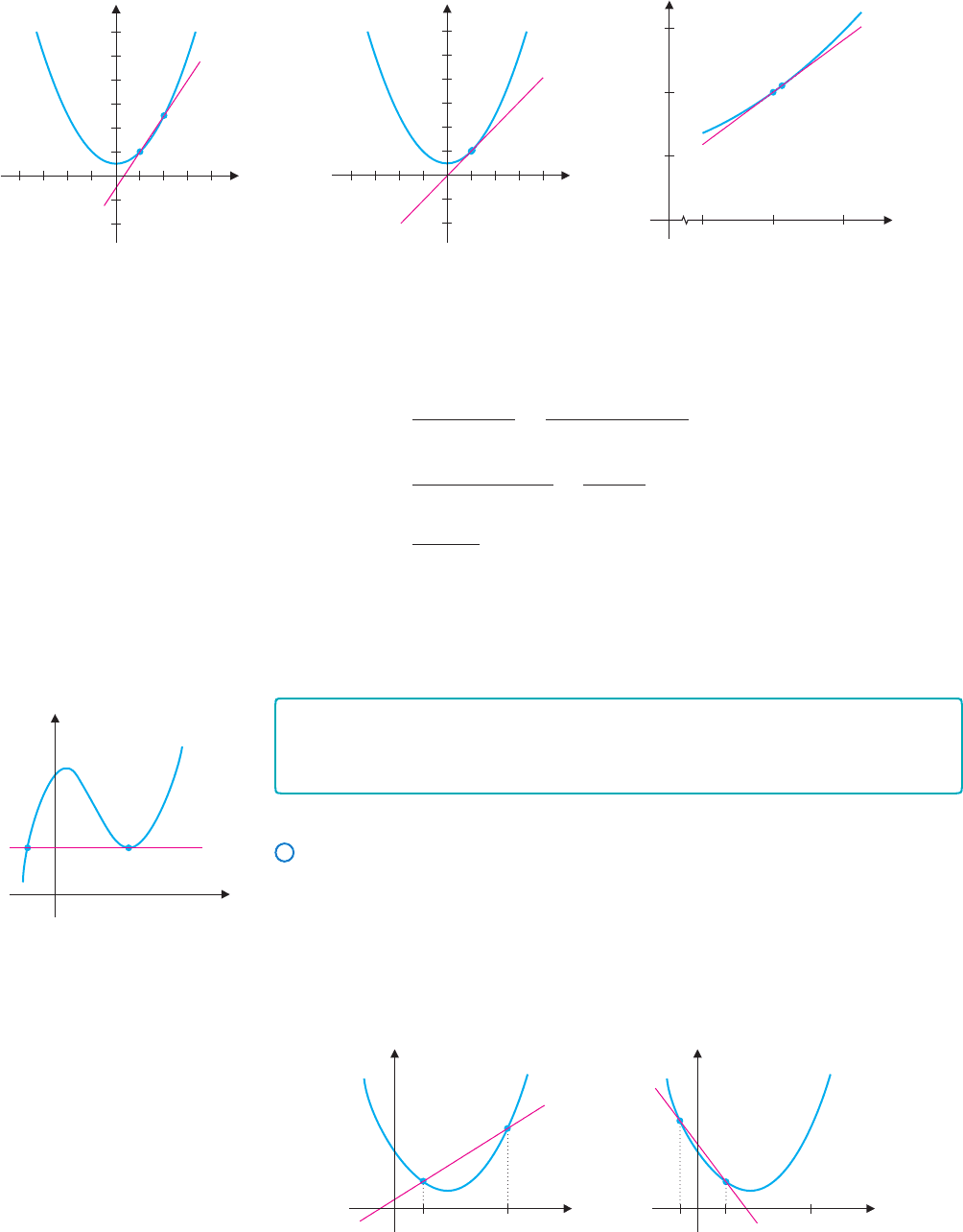
and an equation of this secant line as y = 3(x − 1) +2. As seen in Figure 2.4b, this looks
much more like a tangent line, but it’s still not quite there. Choosing our second point
much closer to the point of tangency, say (1.05, 2.1025), should give us an even better
approximation. In this case, we have
m
sec
=
2.1025 − 2
1.05 − 1
= 2.05
and an equation of this secant line is y = 2.05(x −1) +2. As can be seen in Figure 2.4c,
the secant line looks very much like a tangent line, even when zoomed in quite far, as in
Figure 2.4d. We continue this process by computing the slope of the secant line joining
(1,2) and the unspecified point (1 +h, f (1 +h)), for some valueof h closeto 0 (buth = 0).
P1: OSO/OVY P2: OSO/OVY QC: OSO/OVY T1: OSO
MHDQ256-Ch02 MHDQ256-Smith-v1.cls December 8, 2010 18:21
LT (Late Transcendental)
CONFIRMING PAGES
2-3 SECTION 2.1
..
Tangent Lines and Velocity 109
y
x
4
4
8
12
4224
y
x
1
2
3
0.6 1.0 1.4
FIGURE 2.4c
Secant line joining (1, 2) and
(1.05, 2.1025)
FIGURE 2.4d
Close-up of secant line
The slope of this secant line is
m
sec
=
f (1 +h) −2
(1 + h) −1
=
[(1 + h)
2
+ 1] −2
h
=
(1 + 2h + h
2
) − 1
h
=
2h + h
2
h
Multiply out and cancel.
=
h(2 +h)
h
= 2 + h.
Factor out common h and cancel.
y
x
4
4
8
12
4224
FIGURE 2.4b
Secant line joining (1, 2) and (2, 5)
Notice that as h approaches 0, the slope of the secant line approaches 2, which we define
to be the slope of the tangent line.
REMARK 1.1
We should make one more observation before moving on to the general case of
tangent lines. Unlike the case for a circle, tangent lines may intersect a curve at more
than one point, as seen in Figure 2.5.
y
x
y f(x)
FIGURE 2.5
Tangent line intersecting a curve
at more than one point
The General Case
To find the slope of the tangent line to y = f (x)atx = a, first pick two points on the
curve. One point is the point of tangency, (a, f (a)). Call the x-coordinate of the second
point x = a + h, for some small number h (h = 0), the corresponding y-coordinate is then
y = f (a + h). It is natural to think of h as being positive, as shown in Figure2.6a, although
h can also be negative, as shown in Figure 2.6b.
y
x
a a h
y
x
a h a
FIGURE 2.6a
Secant line (h > 0)
FIGURE 2.6b
Secant line (h < 0)
P1: OSO/OVY P2: OSO/OVY QC: OSO/OVY T1: OSO
MHDQ256-Ch02 MHDQ256-Smith-v1.cls December 9, 2010 19:59
LT (Late Transcendental)
CONFIRMING PAGES
110 CHAPTER 2
..
Differentiation 2-4
The slope of the secant line through the points (a, f (a)) and (a + h, f (a + h)) is
given by
m
sec
=
f (a + h) − f (a)
(a + h) −a
=
f (a + h) − f (a)
h
. (1.1)
Noticethattheexpressionin(1.1)(calledadifference quotient)givestheslope ofthesecant
line for anysecond point we might choose (i.e., for any h = 0). Recall that in order to obtain
an improved approximation to the tangent line, we take the second point closer to the point
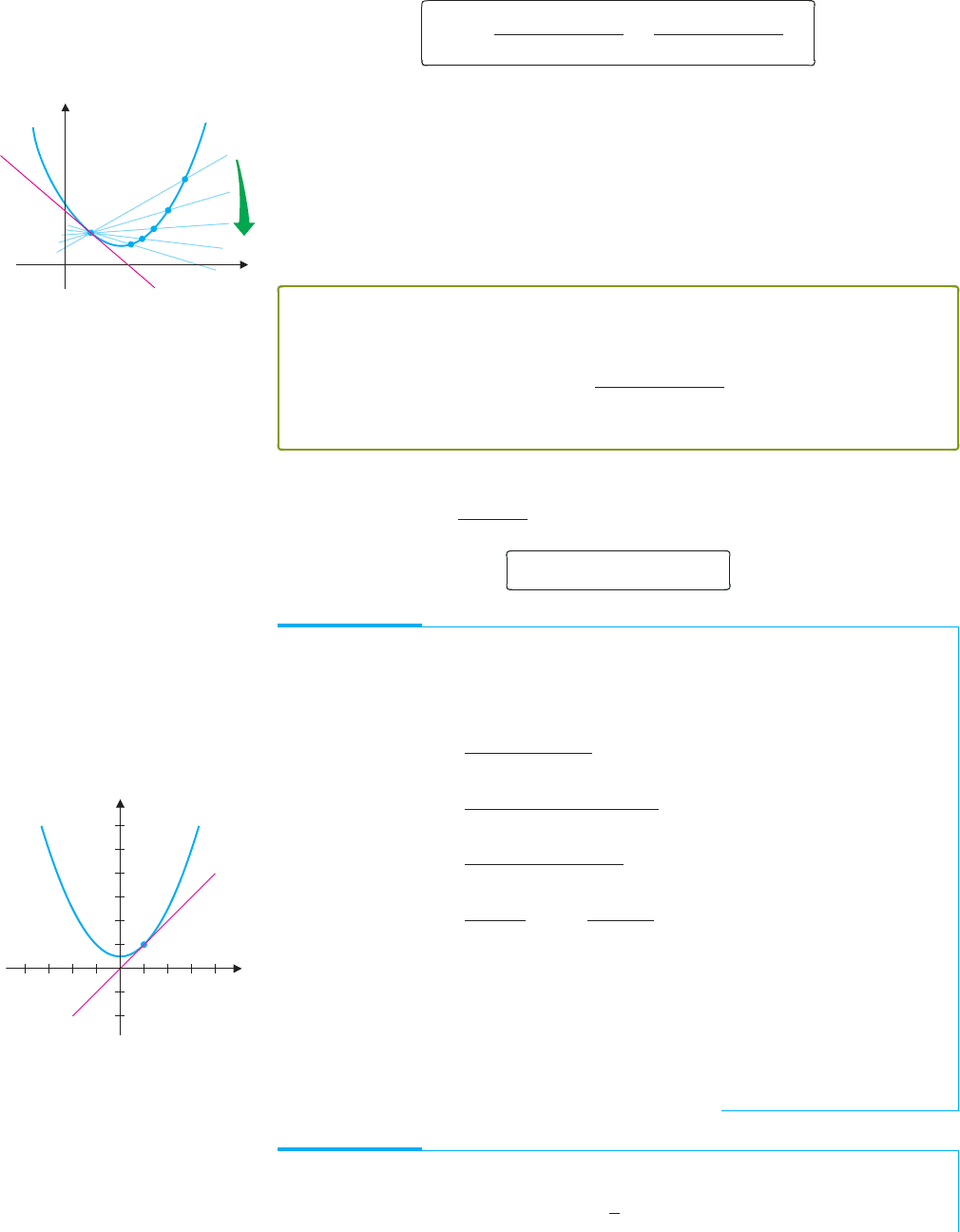
of tangency, which in turn makes h closer to 0. We illustrate this process in Figure 2.7,
where we have plotted a number of secant lines for h > 0. Notice that as the point Q
approaches the point P (i.e., as h → 0), the secant lines approach the tangent line at P.
y
x
P
Q
FIGURE 2.7
Secant lines approaching the
tangent line at the point P
We define the slope of the tangent line to be the limit of the slopes of the secant lines
in (1.1) as h tends to 0, whenever this limit exists.
DEFINITION 1.1
The slope m
tan
of the tangent line to y = f (x)atx = a is given by
m
tan
= lim
h→0
f (a + h) − f (a)
h
, (1.2)
provided the limit exists.
The tangent line is then the line passing through the point (a, f (a)) with slope m
tan
,
with equation given by
y − f (a)
x −a
= m
tan
or
y = m
tan
(x − a) + f (a).
Equation of tangent line
EXAMPLE 1.1 Finding the Equation of a Tangent Line
Find an equation of the tangent line to y = x
2
+ 1atx = 1.
y
x
⫺4
4
8
12
42⫺2⫺4
FIGURE 2.8
y = x
2
+ 1 and the tangent line
at x = 1
Solution We compute the slope using (1.2):
m
tan
= lim
h→0
f (1 +h) − f (1)
h
= lim
h→0
[(1 + h)
2
+ 1] −(1
2
+ 1)
h
= lim
h→0
1 + 2h + h
2
+ 1 −2
h
Multiply out and cancel.
= lim
h→0
2h + h
2
h
= lim
h→0
h(2 +h)
h
Factor out common h and cancel.
= lim
h→0
(2 + h) = 2.
Notice that the point corresponding to x = 1 is (1, 2) and the line with slope 2 through
the point (1, 2) has equation
y = 2(x − 1) + 2ory = 2x.
Note how closely this corresponds to the secant lines computed earlier. We show a
graph of the function and this tangent line in Figure 2.8.
EXAMPLE 1.2 Tangent Line to the Graph of a Rational Function
Find an equation of the tangent line to y =
2
x
at x = 2.
P1: OSO/OVY P2: OSO/OVY QC: OSO/OVY T1: OSO
MHDQ256-Ch02 MHDQ256-Smith-v1.cls December 8, 2010 18:21
LT (Late Transcendental)
CONFIRMING PAGES
2-5 SECTION 2.1
..
Tangent Lines and Velocity 111
Solution From (1.2), we have
m
tan
= lim
h→0
f (2 +h) − f (2)
h
= lim
h→0
2
2 + h
− 1
h
Since f (2 + h) =
2
2 +h
.
= lim
h→0
2 − (2 + h)
(2 + h)
h
= lim
h→0
2 − 2 − h
(2 + h)
h
Add fractions and multiply out.
= lim
h→0
−h
(2 + h)h
= lim
h→0
−1
2 + h
=−
1
2
.
Cancel h’s.
The point corresponding to x = 2 is (2, 1), since f (2) = 1. An equation of the tangent
line is then
y =−
1
2
(x − 2) + 1.
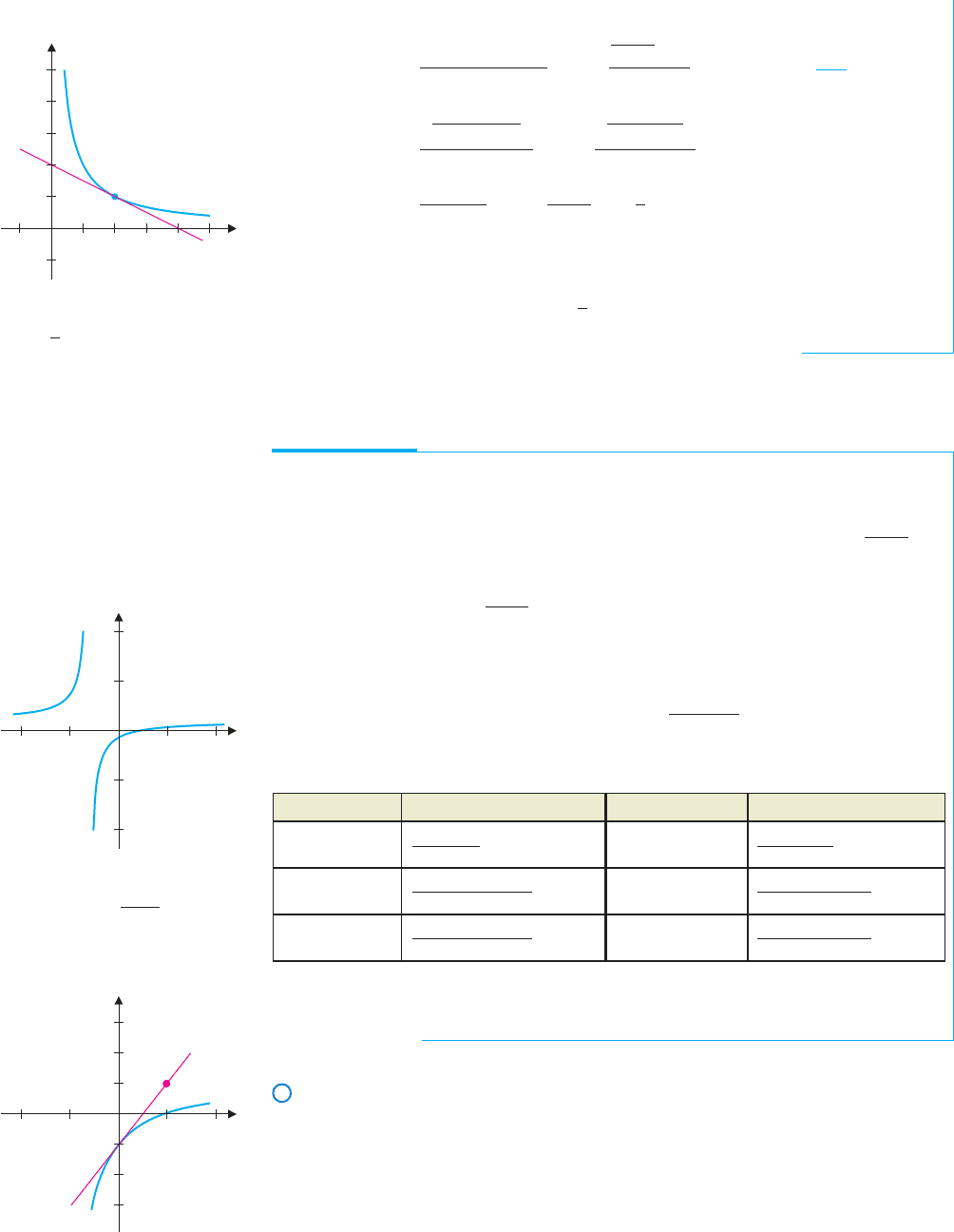
We show a graph of the function and this tangent line in Figure 2.9.
In cases where we cannot (or cannot easily) evaluate the limit for the slope of the
tangent line, we can approximate the limit numerically. We illustrate this in example 1.3.
y
x
512341
1
1
2
3
4
5
FIGURE 2.9
y =
2
x
and tangent line at (2, 1)
x
424 2
y
10
5
5
10
FIGURE 2.10a
y =
x − 1
x + 1
x
212 1
y
3
1
2
2
1
3
FIGURE 2.10b
Tangent line
EXAMPLE 1.3 Graphical and Numerical Approximation
of Tangent Lines
Graphically and numerically approximate the slope of the tangent line to y =
x −1
x +1
at
x = 0.
Solution A graph of y =
x −1
x +1
is shown in Figure 2.10a. We sketch the tangent line
at the point (0, −1) in Figure 2.10b, where we have zoomed in to provide better detail.
To approximate the slope, we estimate the coordinates of one point on the tangent line
other than (0, −1). In Figure 2.10b, it appears that the tangent line passes through the
point (1, 1). An estimate of the slope is then m
tan
≈
1 − (−1)
1 − 0
= 2. To approximate the
slope numerically, we choose several points near (0, −1) and compute the slopes of the
secant lines. For example, rounding the y-values to four decimal places, we have
Second Point m
sec
Second Point m
sec
(1, 0)
0 − (−1)
1 − 0
= 1
(−0.5, −3)
−3 − (−1)
−0.5 − 0
= 4
(0.1, −0.8182)
−0.8182 − (−1)
0.1 − 0
= 1.818
(−0.1, −1.2222)
−1.2222 − (−1)
−0.1 − 0
= 2.222
(0.01, −0.9802)
−0.9802 − (−1)
0.01 − 0
= 1.98
(−0.01, −1.0202)
−1.0202 − (−1)
−0.01 − 0
= 2.02
In both columns, as the second point gets closer to (0, −1), the slope of the secant
line gets closer to 2. A reasonable estimate of the slope of the tangent line at the point
(0, −1) is then 2.
Velocity
We often describe velocity as a quantity determining the speed and direction of an object.
Observe that if your car did not have a speedometer, you could determine your speed using
the familiar formula
distance = rate × time. (1.3)
Using (1.3), you can find the rate (speed) by simply dividingthe distance by the time. While
the rate in (1.3) refers to average speed over a period of time, we are interested in the speed
at a specific instant. The following story should indicate the difference.

P1: OSO/OVY P2: OSO/OVY QC: OSO/OVY T1: OSO
MHDQ256-Ch02 MHDQ256-Smith-v1.cls December 8, 2010 18:21
LT (Late Transcendental)
CONFIRMING PAGES
112 CHAPTER 2
..
Differentiation 2-6
During traffic stops, police officers frequently ask drivers if they know how fast they
were going. Consider the following response from an overzealous student, who might
answer that during the past, say, 3 years, 2 months, 7 days, 5 hours and 45 minutes, they’ve
driven exactly 45,259.7 miles, so that their speed was
rate =
distance
time
=
45,259.7 miles
27,917.75 hours
≈ 1.62118 mph.
Of course, most police officers would not be impressed with this analysis, but, why is
it wrong? While there’s nothing wrong with formula (1.3) or the arithmetic, it’s reasonable
to argue that unless the student was in his or her car during this entire 3-year period, the
results are invalid.
Suppose that the driver substitutes the following argument instead: “I left home at
6:17
P.M. and by the time you pulled me over at 6:43 P.M., I had driven exactly 17 miles.
Therefore, my speed was
rate =
17 miles
26 minutes
·
60 minutes
1 hour
≈ 39.2 mph,
well under the posted 45-mph speed limit.”
While this is a much better estimate of the velocity than the 1.6 mph computed previ-
ously, it’s still an average velocity using too long of a time period.
More generally, suppose that the function s(t) gives the position at time t of an object
moving along a straight line. That is, s(t) gives the displacement (signed distance) from a
fixed reference point, so that s(t) < 0 means that the object is located |s(t)| away from the
reference point, but in the negative direction. Then, for two times a and b (where a < b),
s(b) −s(a) givesthe signed distance between positions s(a) and s(b). The average velocity
v
avg
is then given by
v
avg
=
signed distance
time
=
s(b) −s(a)
b −a
. (1.4)
EXAMPLE 1.4 Finding Average Velocity
The position of a car after t minutes driving in a straight line is given by
s(t) =
1
2
t
2
−
1
12
t
3
, 0 ≤ t ≤ 4,
where s is measured in miles and t is measured in minutes. Approximate the velocity at
time t = 2.
Solution Averaging over the 2 minutes from t = 2tot = 4, we get from (1.4) that
v
avg
=
s(4) − s(2)
4 − 2
≈
2.6667 − 1.3333
2
≈ 0.6667 mile/minute
≈ 40 mph.
Of course, a 2-minute-long interval is rather long, given that cars can speed up and slow
down a great deal in 2 minutes. We get an improved approximation by averaging over
just one minute:
v
avg
=
s(3) − s(2)
3 − 2
≈
2.25 − 1.3333
1
≈ 0.91667 mile/minute
≈ 55 mph.
While this latest estimate is certainly better than the first one, we can do better. As we
make the time interval shorter and shorter, the average velocity should be getting closer
and closer to the velocity at the instant t = 2. It stands to reason that, if we compute the