
Smith R., Minton R. Calculus
Подождите немного. Документ загружается.


P1: OSO/OVY P2: OSO/OVY QC: OSO/OVY T1: OSO
MHDQ256-Ch02 MHDQ256-Smith-v1.cls December 8, 2010 18:21
LT (Late Transcendental)
CONFIRMING PAGES
2-7 SECTION 2.1
..
Tangent Lines and Velocity 113
average velocity over the time interval [2, 2 +h] (where h > 0) and then let h → 0, the
resulting average velocities should be getting closer and closer to the velocity at the
instant t = 2.
We have
v
avg
=
s(2 + h) −s(2)
(2 + h) −2
=
s(2 + h) −s(2)
h
.
A sequence of these average velocities is displayed in the accompanying table, for
h > 0, with similar results if we allow h to be negative. It appears that the average
velocity is approaching 1 mile/minute (60 mph), as h → 0.
This leads us to make the following definition.
DEFINITION 1.2
If s(t) represents the position of an object relative to some fixed location at time t
as the object moves along a straight line, then the instantaneous velocity at time
t = a is given by
v(a) = lim
h→0
s(a + h) −s(a)
(a + h) −a
= lim
h→0
s(a + h) −s(a)
h
, (1.5)
provided the limit exists. The speed is the absolute value of the velocity.
h
s(2 h) − s(2)
h
1.0 0.9166666667
0.1 0.9991666667
0.01 0.9999916667
0.001 0.999999917
0.0001 1.0
0.00001 1.0
NOTES
(i) Notice that if (for example) t is
measured in seconds and s(t)is
measured in feet, then velocity
(average or instantaneous) is
measured in feet per second (ft/s).
(ii) When used without
qualification, the term velocity
refers to instantaneous velocity.
EXAMPLE 1.5 Finding Average and Instantaneous Velocity
Suppose that the height of a falling object t seconds after being dropped from a height
of 64 feet is given by s(t) = 64 −16t
2
feet. Find the average velocity between times
t = 1 and t = 2; the average velocity between times t = 1.5 and t = 2; the average
velocity between times t = 1.9 and t = 2 and the instantaneous velocity at time t = 2.
Solution The average velocity between times t = 1 and t = 2is
v
avg
=
s(2) − s(1)
2 − 1
=
64 − 16(2)
2
− [64 −16(1)
2
]
1
=−48 (ft/s).
The average velocity between times t = 1.5 and t = 2is
v
avg
=
s(2) − s(1.5)
2 − 1.5
=
64 − 16(2)
2
− [64 −16(1.5)
2
]
0.5
=−56 (ft/s).
The average velocity between times t = 1.9 and t = 2is
v
avg
=
s(2) − s(1.9)
2 − 1.9
=
64 − 16(2)
2
− [64 −16(1.9)
2
]
0.1
=−62.4 (ft/s).
The instantaneous velocity is the limit of such average velocities. From (1.5), we
have
v(2) = lim
h→0
s(2 + h) −s(2)
(2 + h) −2
= lim
h→0
[64 − 16(2 + h)
2
] − [64 − 16(2)
2
]
h
= lim
h→0
[64 − 16(4 + 4h + h
2
)] − [64 − 16(2)
2
]
h
Multiply out and cancel.
= lim
h→0
−64h − 16h
2
h
= lim
h→0
−16h(h + 4)
h
Factor out common h and cancel.
= lim
h→0
[−16(h + 4)] =−64 ft/s.
Recall that velocity indicates both speed and direction. In this problem, s(t) measures
the height above the ground. So, the negative velocity indicates that the object is
moving in the negative (or downward) direction. The speed of the object (that is, the
absolute value of the velocity) at the 2-second mark is then 64 ft/s.
P1: OSO/OVY P2: OSO/OVY QC: OSO/OVY T1: OSO
MHDQ256-Ch02 MHDQ256-Smith-v1.cls December 8, 2010 18:21
LT (Late Transcendental)
CONFIRMING PAGES
114 CHAPTER 2
..
Differentiation 2-8
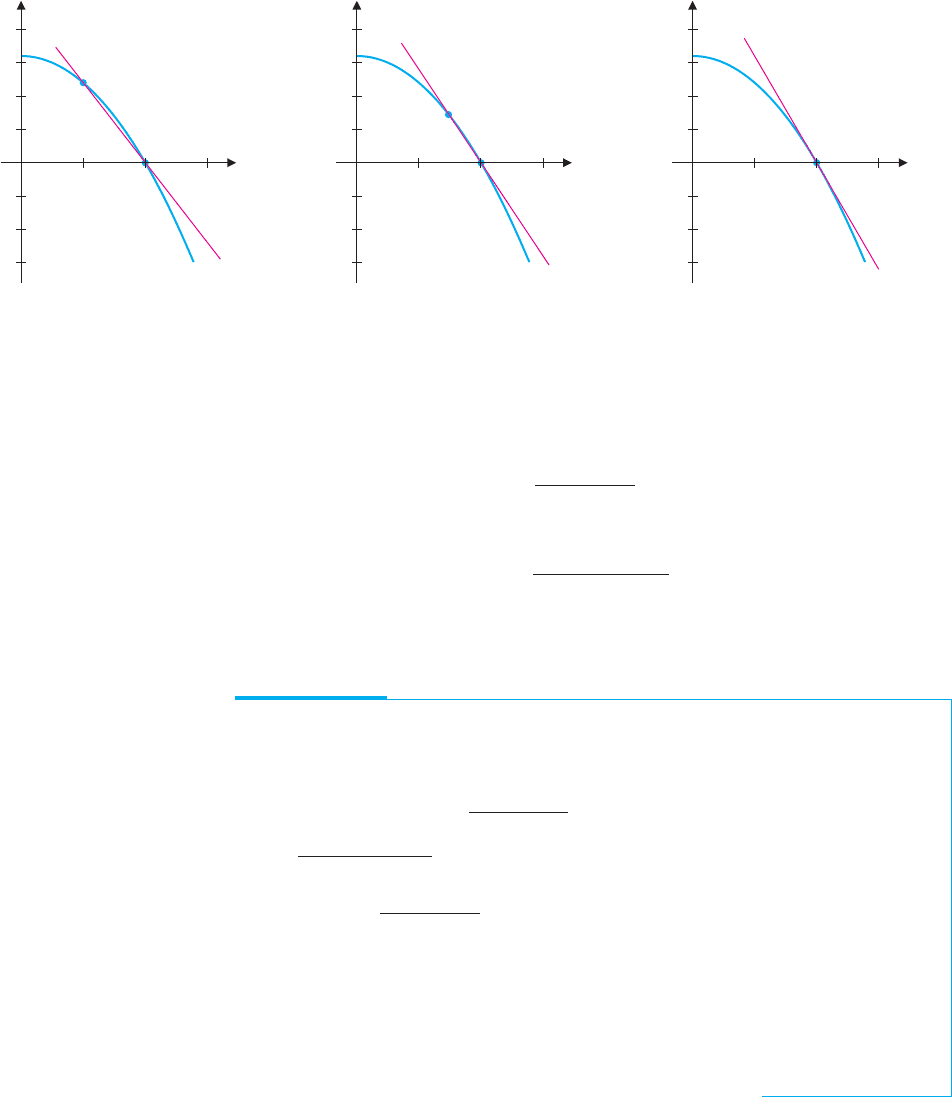
Observethat the formulas for instantaneous velocity (1.5) and for the slope of a tangent
line (1.2) are identical. To make this connection stronger, we graph the position function
s(t) = 64 −16t
2
for 0 ≤ t ≤ 3, from example 1.5. The averagevelocity between t = 1 and
t = 2 corresponds to the slope of the secant line between the points at t = 1 and t = 2. (See
Figure 2.11a.) Similarly, the average velocity between t = 1.5 and t = 2 gives the slope
of the corresponding secant line. (See Figure 2.11b.) Finally, the instantaneous velocity at
time t = 2 corresponds to the slope of the tangent line at t = 2. (See Figure 2.11c.)
t
20
40
60
80
60
40
20
132
s
t
20
40
60
80
60
40
20
132
s
t
20
40
60
80
60
40
20
132
s
FIGURE 2.11a
Secant line between t = 1
and t = 2
FIGURE 2.11b
Secant line between t = 1.5
and t = 2
FIGURE 2.11c
Tangent line at t = 2
Velocity is a rate (more precisely, the instantaneous rate of change of position with
respect to time). In general, the average rate of change of a function f between x = a and
x = b (a = b)isgivenby
f (b) − f (a)
b −a
.
The instantaneous rate of change of f at x = a is given by
lim
h→0
f (a + h) − f (a)
h
,
provided the limit exists. The units of the instantaneous rate of change are the units of f
divided by (or “per”) the units of x. You should recognize this limit as the slope of the
tangent line to y = f (x)atx = a.
EXAMPLE 1.6 Interpreting Rates of Change
If the function f gives the population of a city in millions of people t years after
January 1, 2000, interpret each of the following quantities, assuming that they
equal the given numbers. (a)
f (2) − f (0)
2
= 0.34, (b) f (2) − f (1) = 0.31 and
(c) lim
h→0
f (2 +h) − f (2)
h
= 0.3.
Solution Since
f (b) − f (a)
b −a
is the average rate of change of the function f between
a and b, expression (a) tells us that the average rate of change of f between a = 0 and
b = 2 is 0.34. That is, the city’s population grew at an average rate of 0.34 million
people per year between 2000 and 2002. Similarly, expression (b) is the average rate of
change between a = 1 and b = 2, so that the city’s population grew at an average rate
of 0.31 million people per year in 2001. Finally, expression (c) gives the instantaneous
rate of change of the population at time t = 2. As of January 1, 2002, the city’s
population was growing at a rate of 0.3 million people per year.
You hopefully noticed that we tacked the phrase “provided the limit exists” onto the
end of the definitions of the slope of a tangent line, the instantaneous velocity and the
P1: OSO/OVY P2: OSO/OVY QC: OSO/OVY T1: OSO
MHDQ256-Ch02 MHDQ256-Smith-v1.cls December 8, 2010 18:21
LT (Late Transcendental)
CONFIRMING PAGES
2-9 SECTION 2.1
..
Tangent Lines and Velocity 115
instantaneous rate of change. This was important, since these defining limits do not always
exist, as we see in example 1.7.
y
x
y 兩x兩
Slope 1
Slope 1
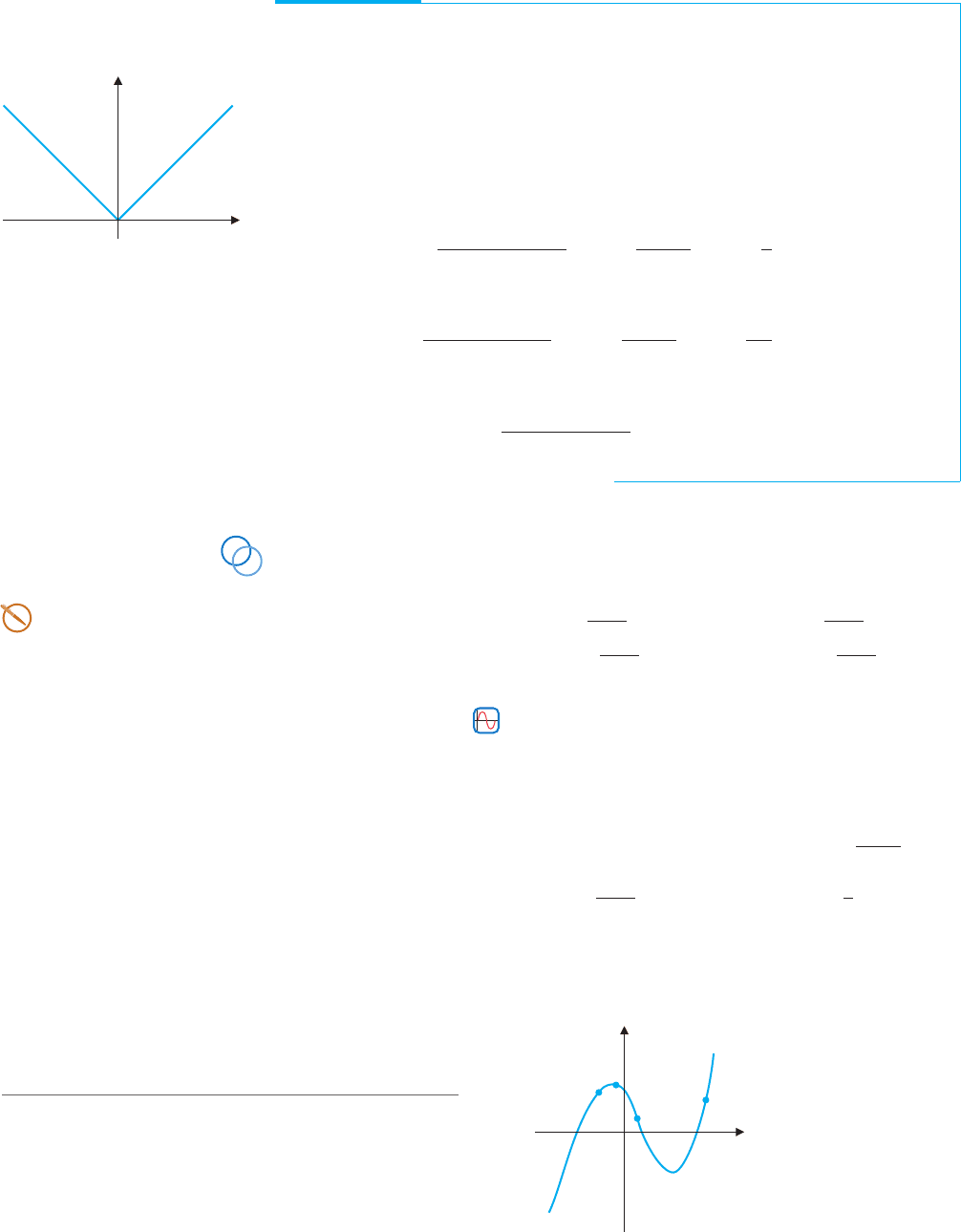
FIGURE 2.12
y =|x|
EXAMPLE 1.7 A Graph with No Tangent Line at a Point
Determine whether there is a tangent line to the graph of y =|x| at x = 0.
Solution From the graph in Figure 2.12, notice that no matter how far we zoom in on
(0, 0), the graph continues to look like Figure 2.12. (This is one reason why we left
off the scale on Figure 2.12.) This indicates that the tangent line does not exist. Further,
if h is any positive number, the slope of the secant line through (0, 0) and (h, |h|)is1.
However, the secant line through (0, 0) and (h, |h|) for any negative number h has slope
−1. Defining f (x) =|x|and considering one-sided limits, if h > 0, then |h|=h, so that
lim
h→0
+
f (0 +h) − f (0)
h
= lim
h→0
+
|h|−0
h
= lim
h→0
+
h
h
= 1.
On the other hand, if h < 0, then |h|=−h (remember that if h < 0, −h > 0), so that
lim
h→0
−
f (0 +h) − f (0)
h
= lim
h→0
−
|h|−0
h
= lim
h→0
−
−h
h
=−1.
Since the one-sided limits are different, we conclude that
lim
h→0
f (0 +h) − f (0)
h
does not exist
and hence, the tangent line does not exist.
EXERCISES 2.1
WRITING EXERCISES
1. Whatdoes thephrase “offon atangent” mean? Relate the com-
mon meaning of the phrase to the image of a tangent to a circle.
In what way does Figure 2.4d promote a different view of the
relationship between a curve and its tangent?
2. In general, the instantaneous velocity of an object cannot be
computeddirectly;the limit process istheonly way to compute
velocity at an instant from the position function. Given this,
howdoes a car’s speedometer compute speed? (Hint: Look this
up in a reference book or on the Internet.)
3. Look in the news media and find references to at least five dif-
ferentrates. We havedefined a rate of change as the limit of the
difference quotient of a function. For your five examples, state
as precisely as possible what the original function is. Is the rate
givenasapercentageoranumber?Incalculus,weusuallycom-
pute rates as numbers; is this in line with the standard usage?
4. Sketch the graph of a function that is discontinuous at x = 1.
Then sketch the graph of a function that iscontinuous at x = 1
but has no tangent line at x = 1. In both cases, explain why
there is no tangent line at x = 1.
In exercises1–8, find the equation of the tangent line to y f (x)
at x a. Graph y f (x) and the tangent line to verify that
you have the correct equation.
1. f (x) = x
2
− 2, a = 1 2. f (x) = x
2
− 2, a = 0
3. f (x) = x
2
− 3x, a =−2 4. f (x) = x
3
+ x, a = 1
5. f (x) =
2
x + 1
, a = 1 6. f (x) =
x
x − 1
, a = 0
7. f (x) =
√
x + 3, a =−2 8. f (x) =
√
x + 3, a = 1
............................................................
In exercises 9–12, compute the slope of the secant line be-
tween the points at (a) x 1 and x 2, (b) x 2 and x 3,
(c) x 1.5 and x 2, (d) x 2 and x 2.5, (e) x 1.9 and
x 2, (f) x 2 and x 2.1, and (g) use parts (a)–(f) and other
calculations as needed to estimate the slope of the tangent line
at x 2.
9. f (x) = x
3
− x 10. f (x) =
√
x
2
+ 1
11. f (x) =
x − 1
x + 1
12. f (x) =
2
x
............................................................
In exercises 13 and 14, list the points A, B, C and D in order of
increasing slope of the tangent line.
13.
y
x
A
B
C
D
P1: OSO/OVY P2: OSO/OVY QC: OSO/OVY T1: OSO
MHDQ256-Ch02 MHDQ256-Smith-v1.cls December 8, 2010 18:21
LT (Late Transcendental)
CONFIRMING PAGES
116 CHAPTER 2
..
Differentiation 2-10
14.
y
x
A
B
C
D
............................................................
In exercises 15–18, use the position function s(t) meters to find
the velocity at time t a seconds.
15. s(t) =−4.9t
2
+ 5, (a) a = 1; (b) a = 2
16. s(t) = 4t − 4.9t
2
, (a) a = 0; (b) a = 1
17. s(t) =
√
t + 16, (a) a = 0; (b) a = 2
18. s(t) = 4/t, (a) a = 2; (b) a = 4
............................................................
In exercises 19–22, the function represents the position in feet of
an object at time t seconds. Find the average velocity between
(a) t 0 and t 2, (b) t 1 and t 2, (c) t 1.9 and t 2,
(d) t 1.99 and t 2, and (e) estimate the instantaneous
velocity at t 2.
19. s(t) = 16t
2
+ 10 20. s(t) = 3t
3
+ t
21. s(t) =
√
t
2
+ 8t 22. s(t) = 3 sin(t − 2)
............................................................
In exercises 23–26, use graphical and numerical evidence to
explain why a tangent line to the graph of y f (x)atx a
does not exist.
23. f (x) =|x − 1| at a = 1
24. f (x) =
4x
x − 1
at a = 1
25. f (x) =
x
2
− 1ifx < 0
x + 1ifx ≥ 0
at a = 0
26. f (x) =
−2x if x < 0
x
2
− 4x if x > 0
at a = 0
............................................................
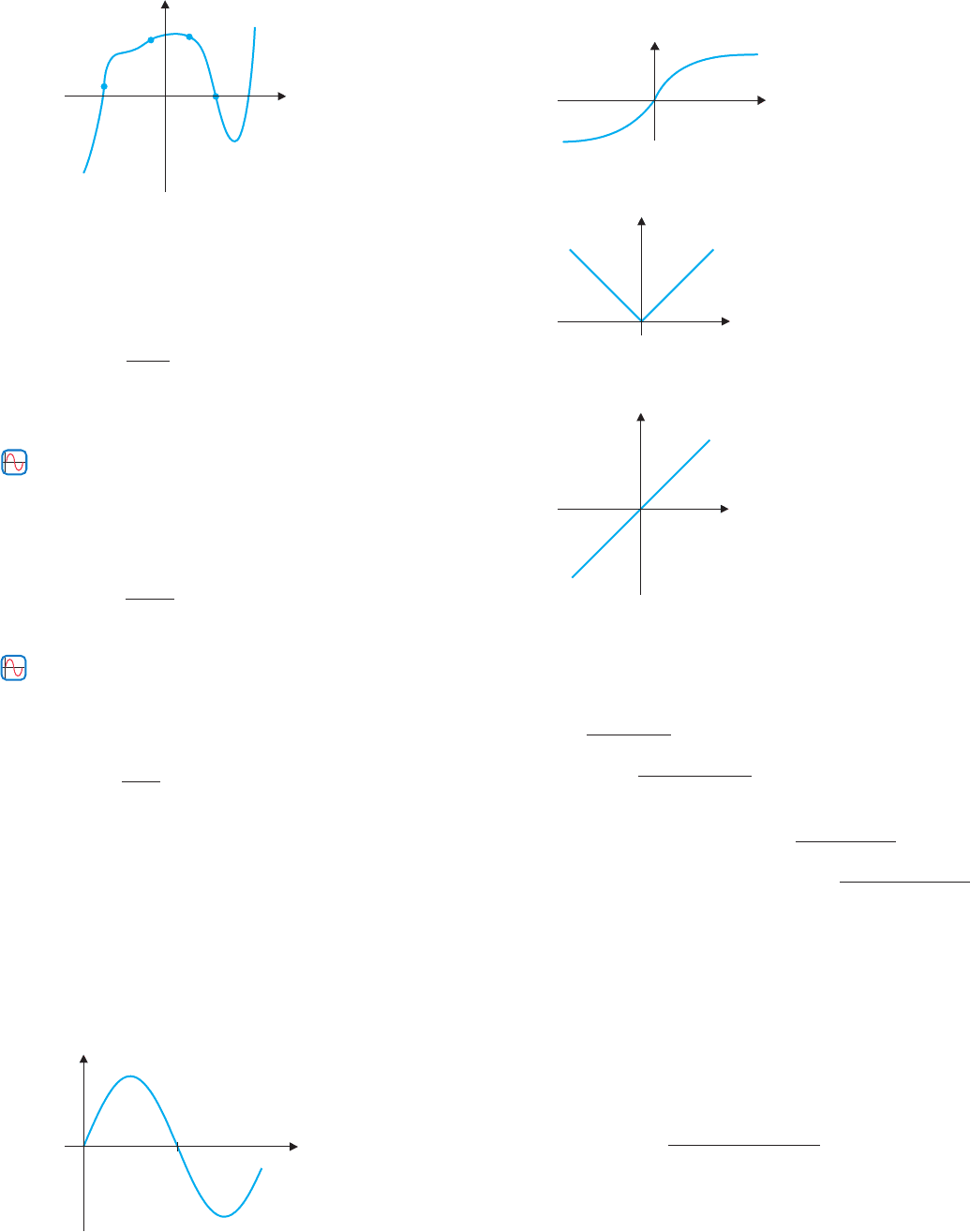
In exercises 27–30, sketch in a plausible tangent line at the given
point or state that there is no tangent line.
27. y = sin x at x = π
y
x
p
28. y = f (x)atx = 0
y
x
29. y =|x|at x = 0
y
x
30. y = x at x = 1
y
x
............................................................
In exercises 31 and 32, interpret (a)–(c) as in example 1.6.
31. Suppose that f (t) represents the balance in dollars
of a bank account t years after January 1, 2000.
(a)
f (4) − f (2)
2
= 21,034, (b) 2[ f (4) − f (3.5)] = 25,036
and (c) lim
h→0
f (4 +h) − f (4)
h
= 30,000.
32. Suppose that f (m) represents the value of a car that has
been driven m thousand miles. (a)
f (40) − f (38)
2
=−2103,
(b) f (40) − f (39) =−2040 and (c) lim
h→0
f (40 +h) − f (40)
h
=−2000.
............................................................
33. Sometimes an incorrect method accidentally produces a cor-
rect answer. For quadratic functions (but definitely not most
other functions), the average velocity between t = r and t = s
equals the average of the velocities at t = r and t = s.To
show this, assume that f (t) = at
2
+ bt + c is the distance
function. Show that the average velocity between t = r and
t = s equals a(s + r) + b. Show that the velocity at t = r is
2ar + b andthe velocity at t = s is 2as + b. Finally, show that
a(s + r) + b =
(2ar + b) + (2as +b)
2
.
34. Find a cubic function [try f (t) = t
3
+···] and numbers r
and s such that the averagevelocity between t = r and t = s is
different from the average of the velocities at t = r and t = s.
P1: OSO/OVY P2: OSO/OVY QC: OSO/OVY T1: OSO
MHDQ256-Ch02 MHDQ256-Smith-v1.cls December 8, 2010 18:21
LT (Late Transcendental)
CONFIRMING PAGES
2-11 SECTION 2.2
..
Tangent Lines and Velocity 117
35. (a) Find all points at which the slope of the tangent line to
y = x
3
+ 3x + 1 equals 5.
(b) Show that the slope of the tangent line to y = x
3
+ 3x + 1
is not equal to 1 at any point.
36. (a) Show that the graphs of y = x
2
+ 1 and y = x do not
intersect.
(b) Find the valueof x such thatthe tangent lines to y = x
2
+ 1
and y = x are parallel.
37. (a) Find an equation of the tangent line to y = x
3
+ 3x + 1at
x = 1.
(b) Show that the tangent line in part (a) intersects
y = x
3
+ 3x + 1 at more than one point.
(c) Show that for any number c, the tangent line to y = x
2
+ 1
at x = c only intersects y = x
2
+ 1 at one point.
38. Show that lim
h→0
f (a + h) − f (a)
h
= lim
x→a
f (x) − f (a)
x −a
. (Hint:
Let h = x −a.)
APPLICATIONS
39. The table shows the freezing temperature of water in degrees
Celsius at various pressures. Estimate the slope of the tangent
line at p = 1 and interpret the result. Estimate the slope of the
tangent line at p = 3 and interpret the result.
p (atm) 0 1 2 3 4
◦
C 0 −7 −20 −16 −11
40. The table shows the range of a soccer kick launched at 30
◦
above the horizontal at various initial speeds. Estimate the
slope of the tangent line at v = 50 and interpret the result.
Distance (yd) 19 28 37 47 58
Speed (mph) 30 40 50 60 70
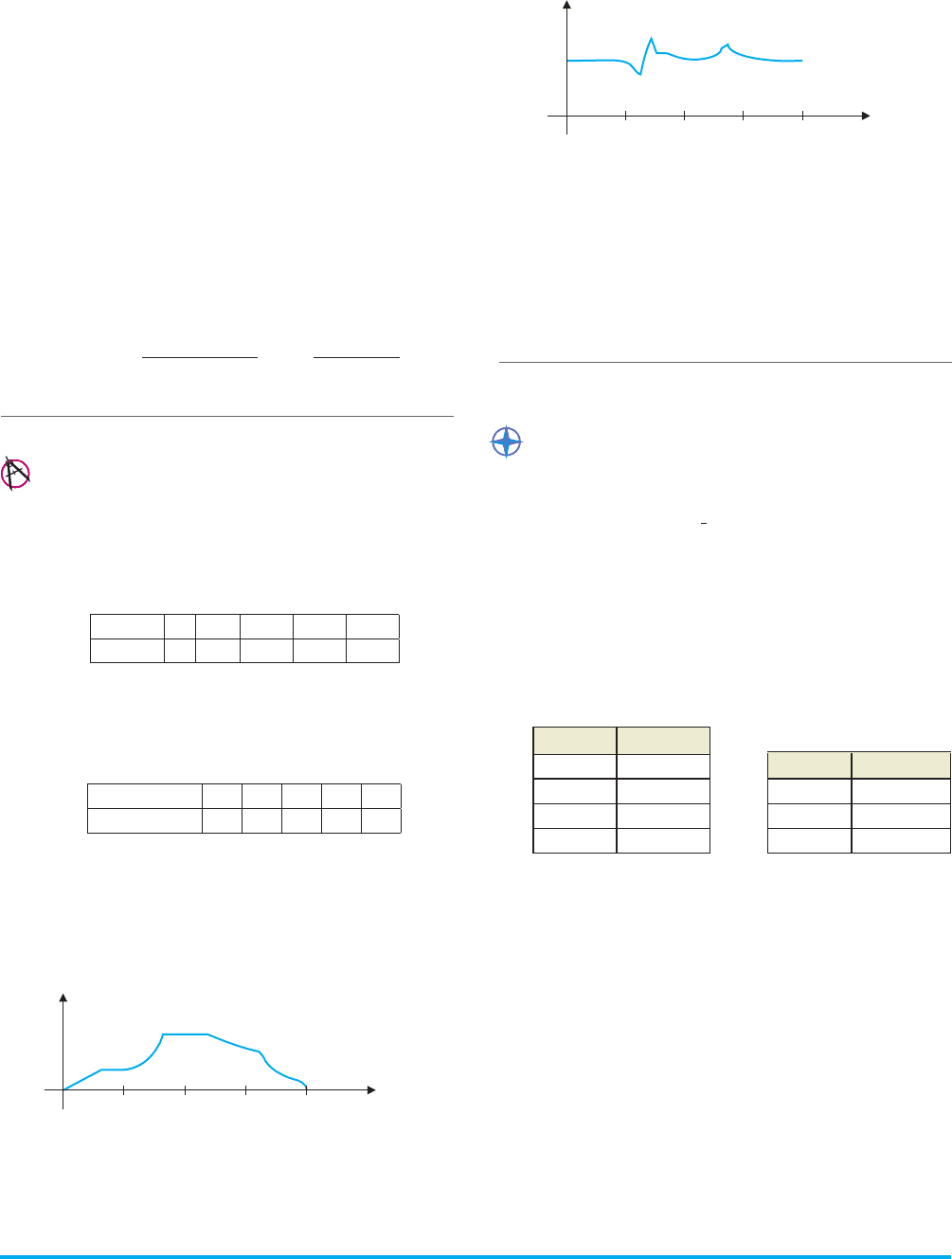
41. The graph shows the elevation of a person on a climb up a
cliffas afunction oftime. Whendid theclimber reachthe top?
When was the climber going the fastest on the way up? When
was the climber going the fastest on the way down? What do
you think occurred at places where the graph is level?
Elevation
Time
4 hours
42. The graph shows the amount of water in a city water tank as a
function of time. When was the tank the fullest? the emptiest?
When was the tank filling up at the fastest rate? When was the
tank emptying at the fastest rate? What time of day do you
think the level portion represents?
Water level
Time
24 hours
43. Suppose a hot cup of coffee is left in a room for 2 hours. Sketch
a reasonable graph of what the temperature would look like
as a function of time. Then sketch a graph of what the rate of
change of the temperature would look like.
44. Sketch a graph representing the height of a bungee-jumper.
Sketch the graph of the person’s velocity (use + for upward
velocity and − for downward velocity).
EXPLORATORY EXERCISES
1. A car moves on a road that takes the shape of y = x
2
. The car
moves from left to right, and its headlights illuminate a deer
standing at the point (1,
3
4
). Find the location of the car. If the
car moves from right to left, how does the answer change?
Is there a location (x, y) such that the car’s headlights would
never illuminate (x, y)?
2. What is the peak speed for a human being? It has been esti-
mated that Carl Lewis reached a peak speed of 28 mph while
winning a gold medal in the 1992 Olympics. Suppose that we
have the following data for a sprinter.
Meters Seconds
50 5.16666
56 5.76666
58 5.93333
60 6.1
Meters Seconds
62 6.26666
64 6.46666
70 7.06666
We want to estimate peak speed. Argue that we want to com-
pute averagespeeds using adjacent measurements (e.g., 50 and
56 meters). Do this for all 6 adjacent pairs and find the largest
speed (if you want to convert to mph, divide by 0.447).
Noticethatalltimesareessentiallymultiples of 1/30, indi-
cating a video capture rate of 30 frames per second. Given this,
why is it suspicious that all the distances are whole numbers?
To get an idea of howmuch this might affect your calculations,
change some of the distances. For instance, if you change
60 (meters) to 59.8, how much do your average velocity calcu-
lations change? One possible way to identify where mistakes
have been made is to look at the pattern of average veloc-
ities: does it seem reasonable? In places where the pattern
seems suspicious, try adjusting the distances and see if you
can produce a more realistic pattern. Try to quantify your
error analysis: what is the highest (lowest) the peak speed
could be?

P1: OSO/OVY P2: OSO/OVY QC: OSO/OVY T1: OSO
MHDQ256-Ch02 MHDQ256-Smith-v1.cls December 8, 2010 18:21
LT (Late Transcendental)
CONFIRMING PAGES
118 CHAPTER 2
..
Differentiation 2-12
2.2 THE DERIVATIVE
In section 2.1, we investigated two seemingly unrelated concepts: slopes of tangent lines
and velocity, both of which are expressed in terms of the same limit. This is an indication
of the power of mathematics, that otherwise unrelated notions are described by the same
mathematical expression. This particular limit turns out to be so useful that we give it a
special name.
DEFINITION 2.1
The derivative of the function f at the point x = a is defined as
f
(a) = lim
h→0
f (a + h) − f (a)
h
, (2.1)
provided the limit exists. If the limit exists, we say that f is differentiable at x = a.
An alternative form of (2.1) is
f
(a) = lim
b→a
f (b) − f (a)
b −a
. (2.2)
(See exercise 38 in section 2.1.)
EXAMPLE 2.1 Finding the Derivative at a Point
Compute the derivative of f (x) = 3x
3
+ 2x − 1atx = 1.
Solution From (2.1), we have
f
(1) = lim
h→0
f (1 +h) − f (1)
h
= lim
h→0
3(1 + h)
3
+ 2(1 + h) − 1
− (3 +2 −1)
h
= lim
h→0
3(1 + 3h +3h
2
+ h
3
) + (2 + 2h) −1 −4
h
Multiply out and cancel.
= lim
h→0
11h + 9h
2
+ 3h
3
h
Factor out common h and cancel.
= lim
h→0
(11 + 9h +3h
2
) = 11.
Suppose that in example 2.1 we had also needed to find f
(2) and f
(3). Rather than
repeat the same long limit calculation to find each of f
(2) and f
(3), in example 2.2 we
compute the derivative without specifying a value for x, leaving us with a function from
which we can calculate f
(a) for any a, simply by substituting a for x.
EXAMPLE 2.2 Finding the Derivative at an Unspecified Point
Find the derivative of f (x) = 3x
3
+ 2x − 1 at an unspecified value of x. Then, evaluate
the derivative at x = 1, x = 2 and x = 3.
Solution Replacing a with x in the definition of the derivative (2.1), we have
f
(x) = lim
h→0
f (x +h) − f (x)
h
= lim
h→0
3(x + h)
3
+ 2(x + h) − 1
− (3x
3
+ 2x − 1)
h

P1: OSO/OVY P2: OSO/OVY QC: OSO/OVY T1: OSO
MHDQ256-Ch02 MHDQ256-Smith-v1.cls December 8, 2010 18:21
LT (Late Transcendental)
CONFIRMING PAGES
2-13 SECTION 2.2
..
The Derivative 119
= lim
h→0
3(x
3
+ 3x
2
h + 3xh
2
+ h
3
) + (2x + 2h) −1 −3x
3
− 2x + 1
h
Multiply out
and cancel.
= lim
h→0
9x
2
h + 9xh
2
+ 3h
3
+ 2h
h
Factor out
common h
and cancel.
= lim
h→0
(9x
2
+ 9xh + 3h
2
+ 2)
= 9x
2
+ 0 +0 +2 = 9x
2
+ 2.
Notice that in this case, we have derived a new function, f
(x) = 9x
2
+ 2. Simply
substituting in for x, we get f
(1) = 9 + 2 = 11 (the same as we got in example 2.1!),
f
(2) = 9(4) + 2 = 38 and f
(3) = 9(9) + 2 = 83.
Example 2.2 leads us to the following definition.
DEFINITION 2.2
The derivative of the function f is the function f
given by
f
(x) = lim
h→0
f (x +h) − f (x)
h
. (2.3)
The domain of f
is the set of all x’s for which this limit exists. The process of
computing a derivative is called differentiation. Further, f is differentiable on an
open interval I if it is differentiable at every point in I.
In examples 2.3 and 2.4, observe that finding a derivative involves writing down the
defining limit and then finding some way of evaluating that limit (which initially has the
indeterminate form
0
0
).
EXAMPLE 2.3 Finding the Derivative of a Simple Rational Function
If f (x) =
1
x
(x = 0), find f
(x).
Solution We have
f
(x) = lim
h→0
f (x +h) − f (x)
h
= lim
h→0
1
x +h
−
1
x
h
Since f (x + h) =
1
x + h
.
= lim
h→0
x −(x +h)
x(x + h)
h
Add fractions and cancel.
= lim
h→0
−h
hx(x +h)
Cancel h’s.
= lim
h→0
−1
x(x + h)
=−
1
x
2
,
so that f
(x) =−x
−2
.
EXAMPLE 2.4 The Derivative of the Square Root Function
If f (x) =
√
x (for x ≥ 0), find f
(x).
P1: OSO/OVY P2: OSO/OVY QC: OSO/OVY T1: OSO
MHDQ256-Ch02 MHDQ256-Smith-v1.cls December 8, 2010 18:21
LT (Late Transcendental)
CONFIRMING PAGES
120 CHAPTER 2
..
Differentiation 2-14
Solution We have
f
(x) = lim
h→0
f (x +h) − f (x)
h
= lim
h→0
√
x +h −
√
x
h
= lim
h→0
√
x +h −
√
x
h
√
x +h +
√
x
√
x +h +
√
x
Multiply numerator and denominator by
the conjugate:
√
x + h +
√
x.
= lim
h→0
(x + h) − x
h
√
x +h +
√
x
Multiply out and cancel.
= lim
h→0
h
h
√
x +h +
√
x
Cancel common h’s.
= lim
h→0
1
√
x +h +
√
x
=
1
2
√
x
=
1
2
x
−1/2
.
Notice that f
(x) is defined only for x > 0, even though f (x) is defined for x ≥ 0.
Thebenefitsofhavingaderivativefunction gowellbeyondsimplifyingthecomputation
of a derivative at multiple points. As we’ll see, the derivative function tells us a great deal
about the original function.
y
x
5
10
15
424 2
FIGURE 2.13a
m
tan
< 0
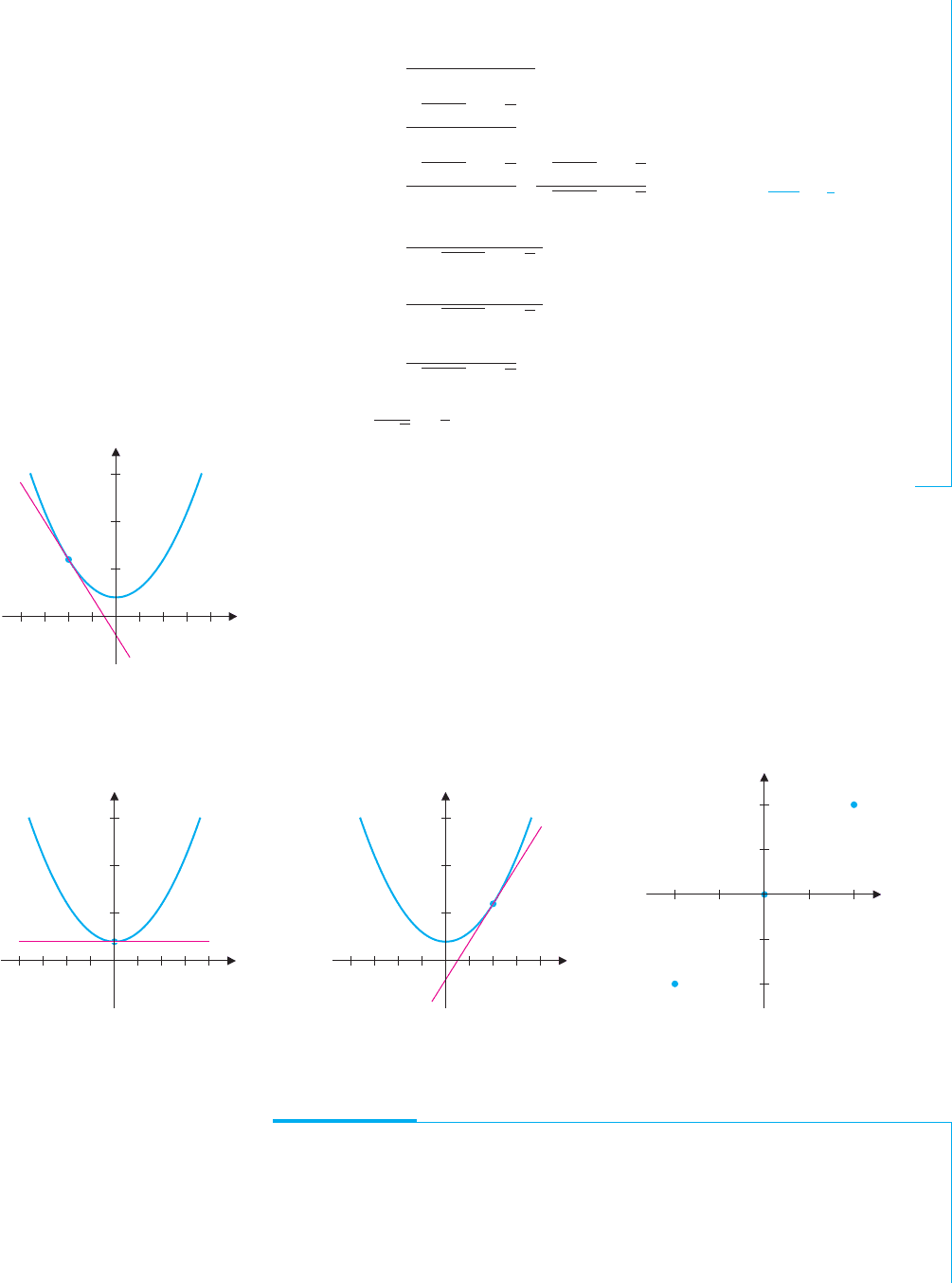
Keep in mind that the value of the derivative function at a point is the slope of the
tangent line at that point. In Figures 2.13a–2.13c, we have graphed a function along with
its tangent lines at three different points. The slope of the tangent line in Figure 2.13a is
negative; the slope of the tangent line in Figure 2.13c is positive and the slope of the tangent
line in Figure 2.13b is zero. These three tangent lines give us three points on the graph of the
derivative function (see Figure 2.13d), by estimating the value of f
(x) at the three points.
y
x
5
10
15
424 2
y
x
5
10
15
424 2
y
x
212 1
4
2
2
4
FIGURE 2.13b
m
tan
= 0
FIGURE 2.13c
m
tan
> 0
FIGURE 2.13d
y = f
(x) (three points)
EXAMPLE 2.5 Sketching the Graph of f
Given the Graph of f
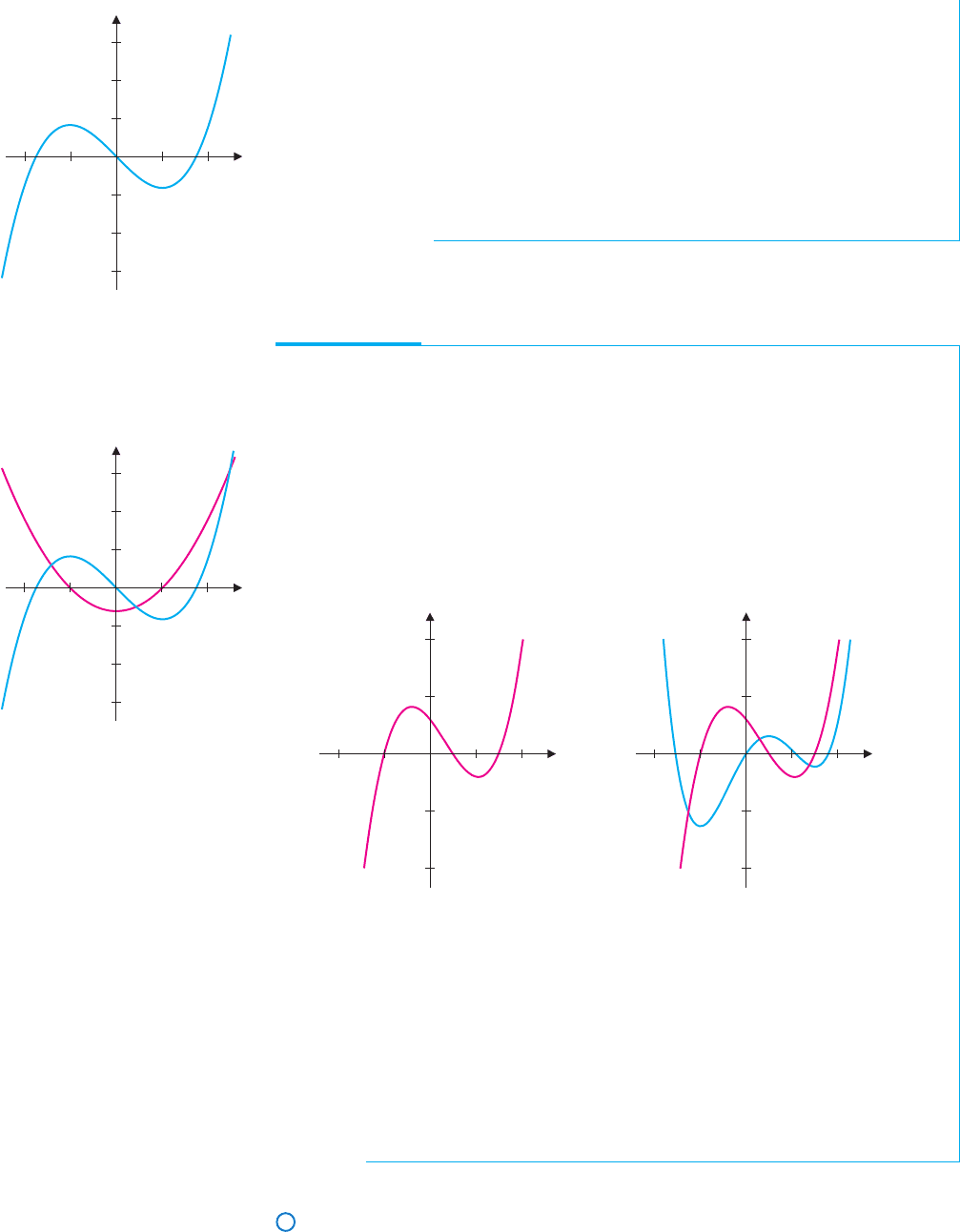
Given the graph of f in Figure 2.14, sketch a plausible graph of f
.
Solution Rather than worrying about exact values of f
(x), we only wish to find the
general shape of its graph. As in Figures 2.13a–2.13d, pick a few important points to
analyze carefully. You should focus on any discontinuities and any places where the
graph of f turns around.
P1: OSO/OVY P2: OSO/OVY QC: OSO/OVY T1: OSO
MHDQ256-Ch02 MHDQ256-Smith-v1.cls December 8, 2010 18:21
LT (Late Transcendental)
CONFIRMING PAGES
2-15 SECTION 2.2
..
The Derivative 121
The graph of y = f (x) levels out at approximately x =−2 and x = 2. At these
points, the derivative is 0. As we move from left to right, the graph rises for x < −2,
drops for −2 < x < 2 and rises again for x > 2. This means that f
(x) > 0 for x < −2,
f
(x) < 0 for −2 < x < 2 and finally, f
(x) > 0 for x > 2. We can say even more. As
x approaches −2 from the left, observe that the tangent lines get less steep. Therefore,
f
(x) becomes less positive as x approaches −2 from the left. Moving to the right from
x =−2, the graph gets steeper until about x = 0, then gets less steep until it levels out
at x = 2. Thus, f
(x) gets more negative until x = 0, then less negative until x = 2.
Finally, the graph gets steeper as we move to the right from x = 2. Putting this all
together, we have the possible graph of f
shown in red in Figure 2.15, superimposed
on the graph of f .
y
x
4224
60
40
20
20
40
60
FIGURE 2.14
y = f (x)
4224
60
40
20
20
40
60
y f'(x)
y f (x)
y
x
FIGURE 2.15
y = f (x) and y = f
(x)
It is even more interesting to ask what the graph of y = f (x)looks like given the graph
of y = f
(x). We explore this in example 2.6.
EXAMPLE 2.6 Sketching the Graph of f Given the Graph of f
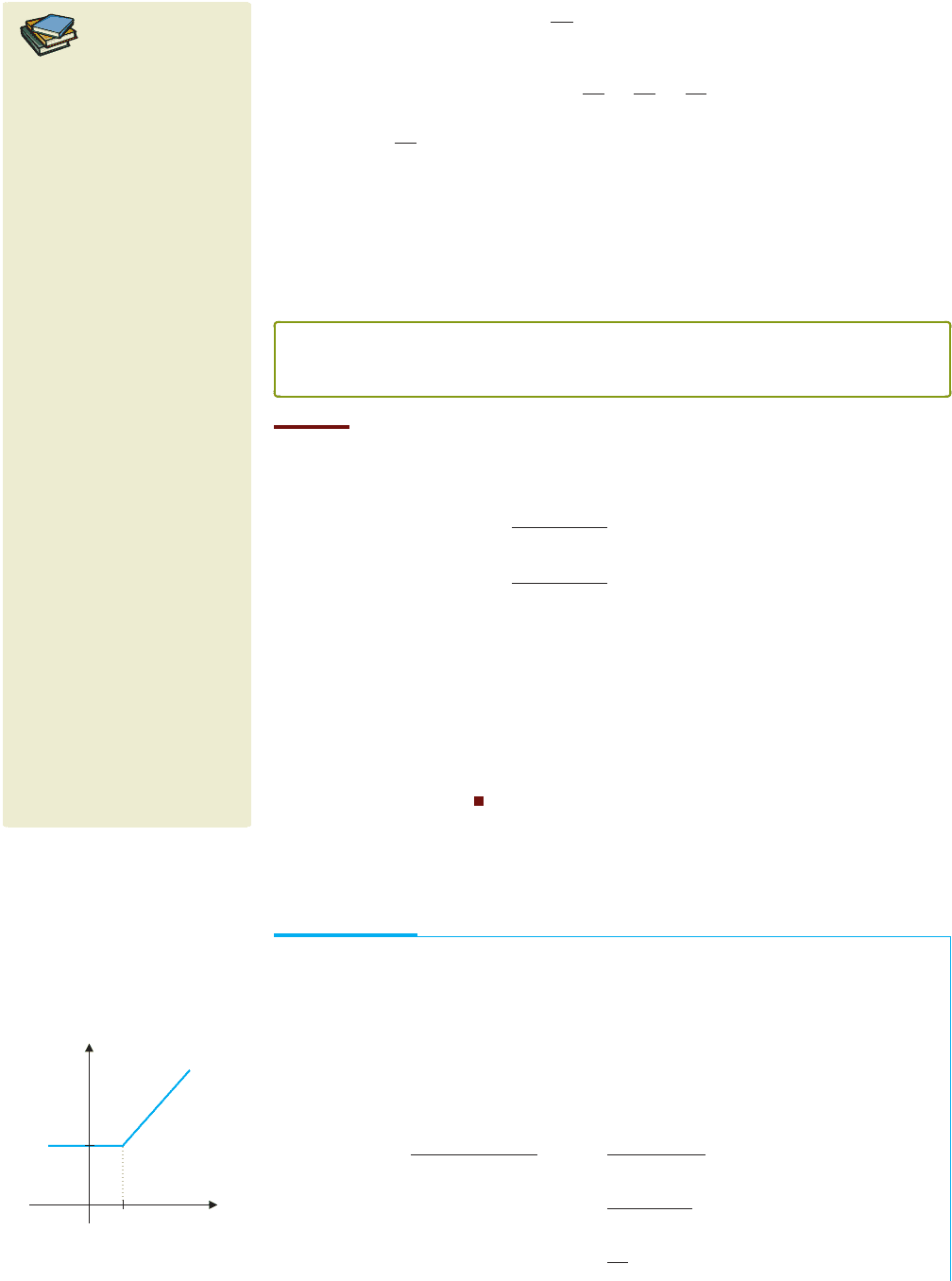
Given the graph of f
in Figure 2.16, sketch a plausible graph of f .
Solution Again, do not worry about getting exact values of the function, but rather
only the general shape of the graph. Notice from the graph of y = f
(x) that f
(x) < 0
for x < −2, so that on this interval, the slopes of the tangent lines to y = f (x) are
negative and the graph is falling. On the interval (−2, 1), f
(x) > 0, indicating that the
tangent lines to the graph of y = f (x) have positive slope and the graph is rising.
Further, this says that the graph turns around (i.e., goes from falling to rising) at
x =−2.
y
x
424
20
10
10
20
y
x
424
20
10
10
20
f (x)
f '(x)
FIGURE 2.16
y = f
(x)
FIGURE 2.17
y = f
(x) and a plausible graph
of y = f (x)
Further, f
(x) < 0 on the interval (1, 3), so that the graph falls here. Finally, for x > 3,
we have that f
(x) > 0, so that the graph is rising here. We show a graph exhibiting all
of these behaviors superimposed on the graph of y = f (x) in Figure 2.17. We have
drawn the graph of f so that the small “valley” on the right side of the y-axis is not as
deep as the one on the left side of the y-axis for a reason. Look carefully at the graph of
f
(x) and notice that | f
(x)| gets much larger on (−2, 1) than on (1, 3). This says that
the tangent lines and hence, the graph will be much steeper on the interval (−2, 1) than
on (1, 3).
Alternative Derivative Notations
We have denoted the derivative function by f
. There are other commonly used notations
for f
, each with advantages and disadvantages. One of the coinventors of the calculus,
P1: OSO/OVY P2: OSO/OVY QC: OSO/OVY T1: OSO
MHDQ256-Ch02 MHDQ256-Smith-v1.cls December 8, 2010 18:21
LT (Late Transcendental)
CONFIRMING PAGES
122 CHAPTER 2
..
Differentiation 2-16
Gottfried Leibniz, used the notation
df
dx
(Leibniz notation) for the derivative. If we write
y = f (x), the following are all alternatives for denoting the derivative:
f
(x) = y
=
dy
dx
=
df
dx
=
d
dx
f (x).
The expression
d
dx
is called a differential operator and tells you to take the derivative of
whatever expression follows.
HISTORICAL
NOTES
Gottfried Wilhelm Leibniz
(1646–1716) A German
mathematician and philosopher
who introduced much of the
notation and terminology in
calculus and who is credited
(together with Sir Isaac Newton)
with inventing the calculus.
Leibniz was a prodigy who had
already received his law degree
and published papers on logic and
jurisprudence by age 20. A true
Renaissance man, Leibniz made
important contributions to
politics, philosophy, theology,
engineering, linguistics, geology,
architecture and physics, while
earning a reputation as the
greatest librarian of his time.
Mathematically, he derived many
fundamental rules for computing
derivatives and helped promote
the development of calculus
through his extensive
communications. The simple and
logical notation he invented made
calculus accessible to a wide
audience and has only been
marginally improved upon in the
intervening 300 years. He wrote,
“In symbols one observes an
advantage in discovery which is
greatest when they express the
exact nature of a thing briefly . . .
then indeed the labor of thought
is wonderfully diminished.”
In section 2.1, we observed that f (x) =|x| does not have a tangent line at x = 0
(i.e., it is not differentiable at x = 0), although it is continuous everywhere. Thus, there are
continuous functions that are not differentiable. You might have already wondered whether
the reverse is true. That is, are there differentiable functions that are not continuous? The
answer is “no,” as provided by Theorem 2.1.
THEOREM 2.1
If f is differentiable at x = a, then f is continuous at x = a.
PROOF
For f to be continuous at x = a, we need only show that lim
x→a
f (x) = f (a). We consider
lim
x→a
[
f (x) − f (a)
]
= lim
x→a
f (x) − f (a)
x −a
(x − a)
Multiply and divide by (x − a).
= lim
x→a
f (x) − f (a)
x −a
lim
x→a
(x − a)
By Theorem 3.1 (iii)
from section 1.3.
= f
(a)(0) = 0, Since f is differentiable at x = a.
where we have used the alternative definition of derivative (2.2) discussed earlier. By
Theorem 3.1 in section 1.3, it now follows that
0 = lim
x→a
[ f (x) − f (a)] = lim
x→a
f (x) − lim
x→a
f (a)
= lim
x→a
f (x) − f (a),
which gives us the result.
Note that Theorem 2.1 says that if afunction is not continuous at a point, then it cannot
have a derivative at that point. It also turns out that functions are not differentiable at any
point where their graph has a “sharp” corner, as is the case for f (x) =|x| at x = 0. (See
example 1.7.)
y
x
2
f(x) 2
f(x) 0
y f(x)
4
FIGURE 2.18
A sharp corner
EXAMPLE 2.7 Showing That a Function Is Not Differentiable at a Point
Show that f (x) =
4ifx < 2
2x if x ≥ 2
is not differentiable at x = 2.
Solution The graph (see Figure 2.18) indicates a sharp corner at x = 2, so you
might expect that the derivative does not exist. To verify this, we investigate the
derivative by evaluating one-sided limits. For h > 0, note that (2 +h) > 2 and so,
f (2 +h) = 2(2 +h). This gives us
lim
h→0
+
f (2 +h) − f (2)
h
= lim
h→0
+
2(2 + h) −4
h
= lim
h→0
+
4 + 2h −4
h
Multiply out and cancel.
= lim
h→0
+
2h
h
= 2.
Cancel common h’s.