
Smith R., Minton R. Calculus
Подождите немного. Документ загружается.


P1: OSO/OVY P2: OSO/OVY QC: OSO/OVY T1: OSO
MHDQ256-Ch02 MHDQ256-Smith-v1.cls December 8, 2010 18:21
LT (Late Transcendental)
CONFIRMING PAGES
2-27 SECTION 2.3
..
Computation of Derivatives: The Power Rule 133
Computing the derivative of this function gives us
a(t) = v
(t) =−32 ft/s
2
.
Since the distance here is measured in feet and time is measured in seconds, the units of
the velocity are feet per second, so that the units of acceleration are feet per second per
second, written ft/s/s, or more commonly ft/s
2
(feet per second squared). This indicates
that the velocity changes by −32 ft/s every second and the speed in the downward
(negative) direction increases by 32 ft/s every second due to gravity.
BEYOND FORMULAS
The power rule gives us a much-needed shortcut for computing many derivatives.
Mathematicians always seek the shortest, most efficient computations. By skipping
unnecessary lengthy steps and saving brain power, mathematicians free themselves
to tackle complex problems with creativity. It’s important to remember, however, that
shortcuts such as the power rule require careful proof.
EXERCISES 2.3
WRITING EXERCISES
1. Explain to a non-calculus-speaking friend how to (mechan-
ically) use the power rule. Decide whether it is better to
give separate explanationsfor positiveandnegative exponents;
integer and noninteger exponents; other special cases.
2. In the 1700s, mathematical “proofs” were, by modern stan-
dards,abitfuzzyandlackedrigor.In1734,theIrish metaphysi-
cian Bishop Berkeley wrote The Analyst to an “infidel math-
ematician” (thought to be Edmund Halley of Halley’s comet
fame). The accepted proof at the time of the power rule may
be described as follows.
If x is incremented to x + h, then x
n
is incre-
mented to (x + h)
n
. It follows that
(x + h)
n
− x
n
(x + h) − x
=
nx
n−1
+
n
2
− n
2
hx
n−2
+···. Now, let the increment h vanish,
and the derivative is nx
n−1
.
Bishop Berkeley objected to this argument.
“But it should seem thatthe reasoning isnot fair or conclusive.
For when it is said, ‘let the increments vanish,’ the former
supposition that the increments were something, or that there
were increments, is destroyed, and yet a consequence of that
supposition is retained. Which ...isafalse way of reasoning.
Certainly, whenwe suppose the increments tovanish, we must
suppose...everything derived from the supposition of their
existence to vanish with them.”
Doyou think Berkeley’sobjection is fair?Isit logically accept-
able to assume that something exists to draw one conclusion,
andthenassumethatthesamethingdoesnot existtoavoidhav-
ing to accept other consequences? Mathematically speaking,
howdoes the limit avoid Berkeley’s objection of the increment
h both existing and not existing?
3. The historical episode in exercise 2 is just one part of an on-
going conflict between people who blindly use mathematical
techniques without proof and those who insist on a full proof
before permitting anyone to use the technique. To which side
are you sympathetic? Defend your position in an essay. Try to
anticipate and rebut the other side’s arguments.
4. Now that you know the “easy” way to compute the derivative
of f (x) = x
4
, you might wonder why we wanted you to learn
the“hard” way.To provide one answer, discuss howyouwould
find the derivative of a function for which you had not learned
a shortcut.
In exercises 1–14, differentiate each function.
1. f (x) = x
3
− 2x + 1 2. f (x) = x
9
−3x
5
+ 4x
2
−4x
3. f (t) = 3t
3
− 2
√
t 4. f (s) = 5
√
s − 4s
2
+ 3
5. f (w) =
3
w
− 8w + 1 6. f (y) =
2
y
4
− y
3
+ 2
7. h(x) =
10
3
√
x
− 2x + π 8. h(x) = 12x − x
2
−
3
3
√
x
2
9. f (s) = 2s
3/2
− 3s
−1/3
10. f (t) = 3t
π
− 2t
1.3
11. f (x) =
3x
2
− 3x + 1
2x
12. f (x) =
4x
2
− x + 3
√
x
13. f (x) = x
3x
2
−
√
x
14. f (x) = (x + 1)(3x
2
− 4)
............................................................
In exercises 15–20, compute the indicated derivative.
15. f
(t) for f (t) = t
4
+ 3t
2
− 2
16. f
(t) for f (t) = 4t
2
− 12 +
4
t
2
17.
d
2
f
dx
2
for f (x) = 2x
4
−
3
√
x
18.
d
2
f
dx
2
for f (x) = x
6
−
√
x
19. f
(4)
(x) for f (x) = x
4
+ 3x
2
− 2/
√
x
20. f
(5)
(x) for f (x) = x
10
− 3x
4
+ 2x − 1
............................................................
P1: OSO/OVY P2: OSO/OVY QC: OSO/OVY T1: OSO
MHDQ256-Ch02 MHDQ256-Smith-v1.cls December 8, 2010 18:21
LT (Late Transcendental)
CONFIRMING PAGES
134 CHAPTER 2
..
Differentiation 2-28
In exercises 21–24, use the given position function to find the
velocity and acceleration functions.
21. s(t) =−16t
2
+ 40t + 10
22. s(t) =−4.9t
2
+ 12t − 3
23. s(t) =
√
t + 2t
2
24. s(t) = 10 −
10
t
............................................................
In exercises 25 and 26, thegiven function representsthe height of
an object. Compute the velocity and acceleration at time t t
0
.
Is the object going up or down? Is the speed of the object in-
creasing or decreasing?
25. h(t) =−16t
2
+ 40t + 5, (a) t
0
= 1, (b) t
0
= 2
26. h(t) = 10t
2
− 24t, (a) t
0
= 2, (b) t
0
= 1
............................................................
In exercises 27–30, find an equation of the tangent line to
y f (x)atx a.
27. f (x) = x
2
− 2, a = 2 28. f (x) = x
2
− 2x + 1, a = 2
29. f (x) = 4
√
x − 2x, a = 4 30. f (x) = 3
√
x + 4, a = 2
............................................................
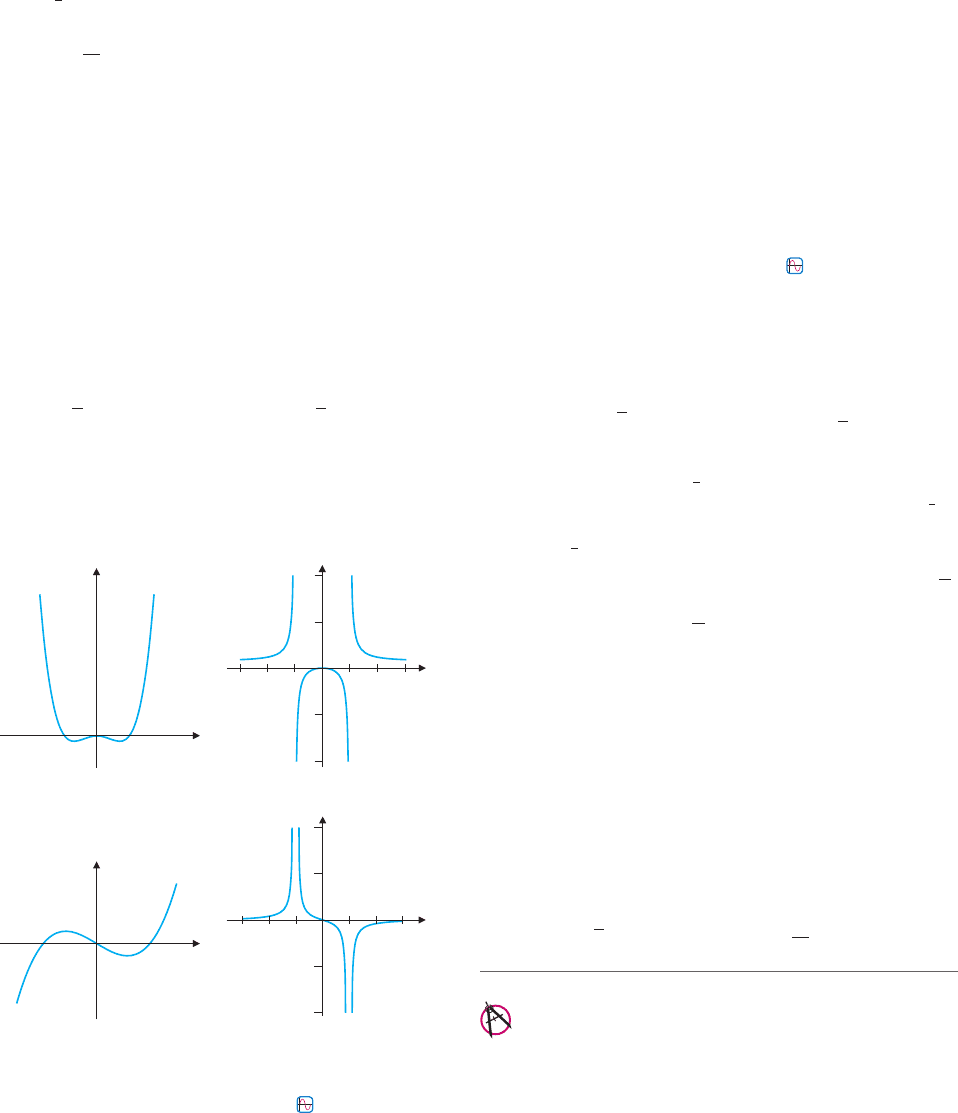
In exercises 31 and 32, use the graph of f to sketch a graph of
f
. (Hint: Sketch f
first.)
31.
(a)
y
x
(b)
y
x
21 32 13
10
5
5
10
32.
(a)
y
x
(b)
212 13
y
x
3
10
5
5
10
............................................................
In exercises 33 and 34, (a) determine the value(s) of x for which
the tangent line to y f (x) is horizontal.
(b) Graph the
function and determine the graphical significance of each such
point. (c) Determine the value(s) of x for which the tangent line
to y f (x) intersects the x-axis at a 45
◦
angle.
33. f (x) = x
3
− 3x + 1 34. f (x) = x
4
− 4x + 2
............................................................
In exercises 35 and 36, (i) determine the value(s) of x for which
the slope of the tangent line to y f (x) does not exist. (ii) Graph
the function and determine the graphical significance of each
such point.
35. (a) f (x) = x
2/3
(b) f (x) =|x − 5|
(c) f (x) =|x
2
− 3x − 4|
36. (a) f (x) = x
1/3
(b) f (x) =|x + 2|
(c) f (x) =|x
2
+ 5x + 4|
............................................................
37. Find all values of x for which the tangent line to
y = x
3
− 3x + 1 is (a) at an angle of 45
◦
with the x-axis;
(b) at an angle of 30
◦
with the x-axis (assuming that the angles
are measured counterclockwise).
38. Findall valuesof x for which tangent lines to y = x
3
+ 2x + 1
and y = x
4
+ x
3
+ 3 are (a) parallel, (b) perpendicular.
39. Find a second-degree polynomial (of the form
f (x) = ax
2
+ bx +c)suchthat(a) f (0) =−2, f
(0) = 2and
f
(0) = 3. (b) f (0) = 0, f
(0) = 5 and f
(0) = 1.
40. Find a general formula for the nth derivative f
(n)
(x).
(a) f (x) =
√
x (b) f (x) =
2
x
41. Find the area of the triangle bounded by x = 0, y = 0 and
the tangent line to y =
1
x
at x = 1. Repeat with the triangle
bounded by x = 0, y = 0 and the tangent line to y =
1
x
at
x = 2. Show that you get the same area using the tangent line
to y =
1
x
at any x = a > 0.
42. Show that the result of exercise 41 does not hold for y =
1
x
2
.
That is, the area of the triangle bounded by x = 0, y = 0 and
the tangent line to y =
1
x
2
at x = a > 0 does depend on the
value of a.
43. Assume that a is a real number, f is differentiable for all
x ≥ a and g(x) = max
a≤t≤x
f (t) for x ≥ a. Find g
(x) in the cases
(a) f
(x) > 0 and (b) f
(x) < 0.
44. Assume that a is a real number, f is differentiable for all
x ≥ a and g(x) = min
a≤t≤x
f (t) for x ≥ a. Find g
(x) in the cases
(a) f
(x) > 0 and (b) f
(x) < 0.
............................................................
In exercises 45–48, find a function with the given derivative.
45. f
(x) = 4x
3
46. f
(x) = 5x
4
47. f
(x) =
√
x 48. f
(x) =
1
x
2
APPLICATIONS
49. For most land animals, the relationship between leg width w
andbodylengthb followsanequationoftheformw = cb
3/2
for
someconstantc > 0.Showthatifb is largeenough,w
(b) > 1.
Conclude that for larger animals, leg width (necessary for sup-
port) increases faster than body length. Why does this put a
limitation on the size of land animals?
50. Suppose the function v(d) represents the average speed in
m/s of the world record running time for d meters. For

P1: OSO/OVY P2: OSO/OVY QC: OSO/OVY T1: OSO
MHDQ256-Ch02 MHDQ256-Smith-v1.cls December 8, 2010 18:21
LT (Late Transcendental)
CONFIRMING PAGES
2-29 SECTION 2.4
..
The Product and Quotient Rules 135
example, if the fastest 200-meter time ever is 19.32 s,
then v(200) = 200/19.32 ≈ 10.35. Explain what v
(d) would
represent.
51. Let f (t) equal the gross domestic product (GDP) in billions of
dollars for the United States in year t. Several values are given
in the table. Estimate and interpret f
(2000) and f
(2000).
[Hint: To estimate the second derivative, estimate f
(1998)
and f
(1999) and look for a trend.]
t 1996 1997 1998 1999 2000 2001
f (t) 7664.8 8004.5 8347.3 8690.7 9016.8 9039.5
52. Let f (t) equalthe averageweight of a domestic SUV in year t.
Several values are given in the table below. Estimate and inter-
pret f
(2000) and f
(2000).
t 1985 1990 1995 2000
f (t) 4055 4189 4353 4619
53. Iftheposition x ofanobjectattimet isgivenby f (t),then f
(t)
represents velocity and f
(t) gives acceleration. By Newton’s
second law, acceleration is proportional to the net force on the
object (causing it to accelerate). Interpret the third derivative
f
(t) in terms of force. The term jerk is sometimes applied to
f
(t). Explain why this is an appropriate term.
54. A public official solemnly proclaims, “We have achieved a re-
duction in the rate at which the national debt is increasing.” If
d(t) represents the national debt at time t years, which deriva-
tive of d(t) is being reduced? What can you conclude about the
size of d(t) itself?
EXPLORATORY EXERCISES
1. A plane is cruising at an altitude of 2 miles at a distance
of 10 miles from an airport. The airport is at the point
(0, 0), and the plane starts its descent at the point (10, 2) to
land at the airport. Sketch a graph of a reasonable flight path
y = f (x), where y represents altitude and x gives the ground
distance from the airport. (Think about it as you draw!) Ex-
plain what the derivative f
(x) represents. (Hint: It’s not ve-
locity.) Explain why it is important and/or necessary to have
f (0) = 0, f (10) = 2, f
(0) = 0 and f
(10) = 0. The simplest
polynomial that can meet these requirements is a cubic poly-
nomial f (x) = ax
3
+ bx
2
+ cx +d. Find values of the con-
stants a, b, c and d to fit the flight path. [Hint: Start by setting
f (0) = 0 and then set f
(0) = 0. You may want to use your
CAStosolvetheequations.]Graphtheresulting function; does
it look right? Suppose that airline regulations prohibit a deriva-
tive of
2
10
or larger. Why might such a regulation exist? Show
that the flight path you found is illegal. Argue that in fact all
flight paths meeting the four requirements are illegal. There-
fore, the descent needs to start farther awaythan 10 miles. Find
aflightpathwithdescentstartingat20milesawaythatmeetsall
requirements.
2. In the enjoyable book Surely You’re Joking Mr. Feynman,
physicist Richard Feynman tells the story of a contest he
had pitting his brain against the technology of the day (an
abacus). The contest was to compute the cube root of 1729.03.
Feynman came up with 12.002 before the abacus expert gave
up. Feynman admits to some luck in the choice of the num-
ber 1729.03: he knew that a cubic foot contains 1728 cubic
inches. Explain why this told Feynman that the answer is
slightly greater than 12. How did he get three digits of ac-
curacy? “I had learned in calculus that for small fractions, the
cube root’s excess is one-third of the number’s excess. The ex-
cess, 1.03, is only one part in nearly 2000. So all I had to do is
findthefraction1/1728,divideby3and multiply by 12.”Tosee
what he did, find an equation of the tangent line to y = x
1/3
at x = 1728 and find the y-coordinate of the tangent line at
x = 1729.03.
2.4 THE PRODUCT AND QUOTIENT RULES
We have now developed rules for computing the derivatives of a variety of functions,
including general formulas for the derivative of a sum or difference of two functions. Given
this, you might wonder whether the derivative of a product of two functions is the same as
the product of the derivatives. We test this conjecture with a simple example.
Product Rule
Consider
d
dx
[(x
2
)(x
5
)]. Combining the two factors, we have:
d
dx
[(x
2
)(x
5
)] =
d
dx
x
7
= 7x
6
.
However,
d
dx
x
2
d
dx
x
5
= (2x)(5x
4
)
= 10x
5
= 7x
6
=
d
dx
[(x
2
)(x
5
)]. (4.1)

P1: OSO/OVY P2: OSO/OVY QC: OSO/OVY T1: OSO
MHDQ256-Ch02 MHDQ256-Smith-v1.cls December 8, 2010 18:21
LT (Late Transcendental)
CONFIRMING PAGES
136 CHAPTER 2
..
Differentiation 2-30
You can now plainly see from (4.1) that the derivative of a product is not generally the
product of the corresponding derivatives. The correct rule is given in Theorem 4.1.
THEOREM 4.1 (Product Rule)
Suppose that f and g are differentiable. Then
d
dx
[ f (x)g(x)] = f
(x)g(x) + f (x)g
(x). (4.2)
PROOF
Since we are proving a general rule, we have only the limit definition of derivative to use.
For p(x) = f (x)g(x), we have
d
dx
[ f (x)g(x)] = p
(x) = lim
h→0
p(x + h) − p(x)
h
= lim
h→0
f (x +h)g(x + h) − f (x)g(x)
h
. (4.3)
Notice that the elements of the derivatives of f and g are present, but we need to get them
into the right form. Adding and subtracting f (x)g(x +h) in the numerator, we have
p
(x) = lim
h→0
f (x +h)g(x + h) − f (x)g(x + h) + f (x)g(x + h) − f (x)g(x)
h
= lim
h→0
f (x +h)g(x + h) − f (x)g(x + h)
h
+ lim
h→0
f (x)g(x +h) − f (x)g(x)
h
Break into two pieces.
= lim
h→0
f (x +h) − f (x)
h
g(x + h)
+ lim
h→0
f (x)
g(x + h) − g(x)
h
=
lim
h→0
f (x +h) − f (x)
h
lim
h→0
g(x + h)
+ f (x) lim
h→0
g(x + h) − g(x)
h
= f
(x)g(x) + f (x)g
(x). Recognize the derivative of f and the derivative of g.
There is a subtle technical detail in the last step: since g is differentiable at x, recall that it
must also be continuous at x, so that g(x +h) → g(x)ash → 0.
In example 4.1, notice that the product rule saves us from multiplying out a messy product.
EXAMPLE 4.1 Using the Product Rule
Find f
(x)if f (x) = (2x
4
− 3x + 5)
x
2
−
√
x +
2
x
.
Solution Although we could first multiply out the expression, the product rule
will simplify our work:
f
(x) =
d
dx
(2x
4
− 3x + 5)
x
2
−
√
x +
2
x
+ (2x
4
− 3x + 5)
d
dx
x
2
−
√
x +
2
x
= (8x
3
− 3)
x
2
−
√
x +
2
x
+ (2x
4
− 3x + 5)
2x −
1
2
√
x
−
2
x
2
.

P1: OSO/OVY P2: OSO/OVY QC: OSO/OVY T1: OSO
MHDQ256-Ch02 MHDQ256-Smith-v1.cls December 8, 2010 18:21
LT (Late Transcendental)
CONFIRMING PAGES
2-31 SECTION 2.4
..
The Product and Quotient Rules 137
EXAMPLE 4.2 Finding the Equation of the Tangent Line
Find an equation of the tangent line to
y = (x
4
− 3x
2
+ 2x)(x
3
− 2x + 3)
at x = 0.
Solution From the product rule, we have
y
= (4x
3
− 6x + 2)(x
3
− 2x + 3) +(x
4
− 3x
2
+ 2x)(3x
2
− 2).
Evaluating at x = 0, we have y
(0) = (2)(3) + (0)(−2) = 6. The line with slope 6 and
passing through the point (0, 0) [why (0, 0)?] has equation y = 6x.
Quotient Rule
Given our experience with the product rule, you probably have no expectation that the
derivative of a quotient will turn out to be the quotient of the derivatives. Just to be sure,
let’s try a simple experiment. Note that
d
dx
x
5
x
2
=
d
dx
(x
3
) = 3x
2
,
while
d
dx
(x
5
)
d
dx
(x
2
)
=
5x
4
2x
1
=
5
2
x
3
= 3x
2
=
d
dx
x
5
x
2
.
Since these are obviously not the same, we know that the derivative of a quotient is
generally not the quotient of the corresponding derivatives. The correct rule is given in
Theorem 4.2.
THEOREM 4.2 (Quotient Rule)
Suppose that f and g are differentiable. Then
d
dx
f (x)
g(x)
=
f
(x)g(x) − f (x)g
(x)
[g(x)]
2
, (4.4)
provided g(x) = 0.
PROOF
For Q(x) =
f (x)
g(x)
, we have from the limit definition of derivative that
d
dx
f (x)
g(x)
= Q
(x) = lim
h→0
Q(x + h) − Q(x)
h
= lim
h→0
f (x +h)
g(x + h)
−
f (x)
g(x)
h
= lim
h→0
f (x +h)g(x) − f (x)g(x + h)
g(x + h)g(x)
h
Add the fractions.
= lim
h→0
f (x +h)g(x) − f (x)g(x + h)
hg(x + h)g(x)
.
Simplify.

P1: OSO/OVY P2: OSO/OVY QC: OSO/OVY T1: OSO
MHDQ256-Ch02 MHDQ256-Smith-v1.cls December 8, 2010 18:21
LT (Late Transcendental)
CONFIRMING PAGES
138 CHAPTER 2
..
Differentiation 2-32
As in the proof of the product rule, we look for the right term to add and subtract in
the numerator, so that we can isolate the limit definitions of f
(x) and g
(x). Adding and
subtracting f (x)g(x), we get
Q
(x) = lim
h→0
f (x +h)g(x) − f (x)g(x) + f (x)g(x) − f (x)g(x +h)
hg(x + h)g(x)
= lim
h→0
f (x +h) − f (x)
h
g(x) − f (x)
g(x + h) − g(x)
h
g(x + h)g(x)
Group first two and last
two terms together
and factor out common
terms.
=
lim
h→0
f (x +h) − f (x)
h
g(x) − f (x) lim
h→0
g(x + h) − g(x)
h
lim
h→0
g(x + h)g(x)
=
f
(x)g(x) − f (x)g
(x)
[g(x)]
2
, Recognize the derivatives of f and g.
where we have again used the fact that g is differentiable to imply that g is continuous, so
that g(x + h) → g(x), ash → 0.
Notice that the numerator in the quotient rule looks very much like the product rule,
but with a minus sign between the two terms. For this reason, you need to be very careful
with the order.
EXAMPLE 4.3 Using the Quotient Rule
Compute the derivative of f (x) =
x
2
− 2
x
3
+ 1
.
Solution Using the quotient rule, we have
f
(x) =
d
dx
(x
2
− 2)
(x
3
+ 1) −(x
2
− 2)
d
dx
(x
3
+ 1)
(x
3
+ 1)
2
=
2x(x
3
+ 1) −(x
2
− 2)(3x
2
)
(x
3
+ 1)
2
=
−x
4
+ 6x
2
+ 2x
(x
3
+ 1)
2
.
In this case, we rewrote the numerator because it simplified significantly. This often
occurs with the quotient rule.
Nowthat we havethe quotient rule, we can justify the use of the powerrule for negative
integerexponents. (Recall that we have been using this rule without proof since section2.3.)
THEOREM 4.3 (Power Rule)
For any integer exponent n,
d
dx
x
n
= nx
n−1
.
PROOF
We have already proved this for positive integer exponents. So, suppose that n < 0 and let
M =−n > 0. Then, using the quotient rule, we get
d
dx
x
n
=
d
dx
x
−M
=
d
dx
1
x
M
Since x
−M
=
1
x
M
.

P1: OSO/OVY P2: OSO/OVY QC: OSO/OVY T1: OSO
MHDQ256-Ch02 MHDQ256-Smith-v1.cls December 8, 2010 18:21
LT (Late Transcendental)
CONFIRMING PAGES
2-33 SECTION 2.4
..
The Product and Quotient Rules 139
=
d
dx
(1)
x
M
− (1)
d
dx
(x
M
)
(x
M
)
2
By the quotient rule.
=
(0)x
M
− (1)Mx
M−1
x
2M
By the power rule, since M > 0.
=
−Mx
M−1
x
2M
=−Mx
M−1−2M
By the usual rules of exponents.
= (−M)x
−M−1
= nx
n−1
. Since n =−M.
As we see in example 4.4, it is sometimes preferable to rewrite a function, instead of
automatically using the product or quotient rule.
EXAMPLE 4.4 A Case Where the Product and Quotient Rules
Are Not Needed
Compute the derivative of f (x) = x
√
x +
2
x
2
.
Solution Although it may be tempting to use the product rule for the first term and
the quotient rule for the second term, notice that it’s simpler to first rewrite the function.
We can combine the two powers of x in the first term. Since the second term is a
fraction with a constant numerator, we can more simply write it using a negative
exponent. We have
f (x) = x
√
x +
2
x
2
= x
3/2
+ 2x
−2
.
Using the power rule, we have simply
f
(x) =
3
2
x
1/2
− 4x
−3
.
Applications
You will see important uses of the product and quotient rules throughout your mathematical
and scientific studies. We start you off with a couple of simple applications now.
EXAMPLE 4.5 Investigating the Rate of Change of Revenue
Suppose that a product currently sells for $25, with the price increasing at the rate of
$2 per year. At the current price, consumers will buy 150 thousand items, but the
number sold is decreasing at the rate of 8 thousand per year. At what rate is the total
revenue changing? Is the total revenue increasing or decreasing?
Solution To answer these questions, we need the basic relationship
revenue = quantity × price
(e.g., if you sell 10 items at $4 each, you earn $40). Since these quantities are changing
in time, we write R(t) = Q(t)P(t), where R(t) is revenue, Q(t) is quantity sold and
P(t) is the price, all at time t. We don’t have formulas for any of these functions, but
from the product rule, we have
R
(t) = Q
(t)P(t) + Q(t)P
(t).
We have information about each of these terms: the initial price, P(0), is 25 (dollars);
the rate of change of the price is P
(0) = 2 (dollars per year); the initial quantity, Q(0),
is 150 (thousand items) and the rate of change of quantity is Q
(0) =−8 (thousand
items per year). Note that the negative sign of Q
(0) denotes a decrease in Q. Thus,
R
(0) = (−8)(25) + (150)(2) = 100 thousand dollars per year.
Since the rate of change is positive, the revenue is increasing.
P1: OSO/OVY P2: OSO/OVY QC: OSO/OVY T1: OSO
MHDQ256-Ch02 MHDQ256-Smith-v1.cls December 8, 2010 18:21
LT (Late Transcendental)
CONFIRMING PAGES
140 CHAPTER 2
..
Differentiation 2-34
EXAMPLE 4.6 Using the Derivative to Analyze a Golf Shot
A golf ball of mass 0.05 kg struck by a golf club of mass m kg with speed 50 m/s will
have an initial speed of u(m) =
83m
m + 0.05
m/s. Show that u
(m) > 0 and interpret this
result in golf terms. Compare u
(0.15) and u
(0.20).
Solution From the quotient rule, we have
u
(m) =
83(m + 0.05) −83m
(m + 0.05)
2
=
4.15
(m + 0.05)
2
.
Both the numerator and denominator are positive, so u
(m) > 0. A positive slope for
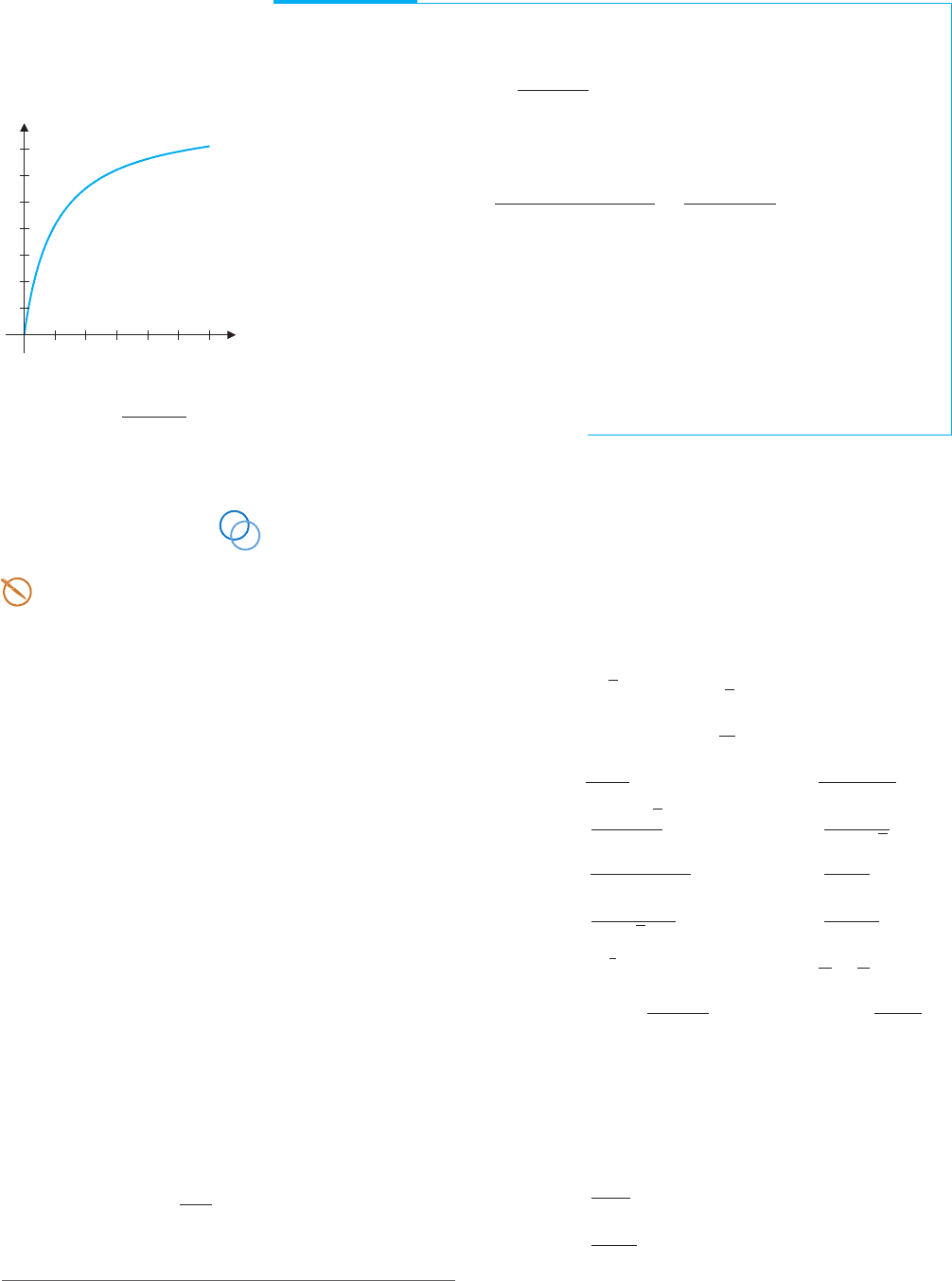
all tangent lines indicates that the graph of u(m) should rise from left to right. (See
Figure 2.23.) Said a different way, u(m) increases as m increases. In golf terms, this
says that (all other things being equal) the greater the mass of the club, the greater the
velocity of the ball will be. Finally, we compute u
(0.15) = 103.75 and u
(0.20) = 66.4.
This says that the rate of increase in ball speed is much less for the heavier club than
for the lighter one. Since heavier clubs can be harder to control, the relatively small
increase in ball speed obtained by making the heavy club even heavier may not
compensate for the decrease in control.
y
m
20
40
60
0.1 0.2 0.3
FIGURE 2.23
u(m) =
83m
m + 0.05
EXERCISES 2.4
WRITING EXERCISES
1. The product and quotient rules give you the abilityto symboli-
callycalculatethederivativeofawiderangeoffunctions.How-
ever, many calculators and almost every computer algebra sys-
tem (CAS) can do this work for you. Discuss why you should
learn these basic rules anyway. (Keep example 4.5 in mind.)
2. Gottfried Wilhelm Leibniz is recognized (along with Sir Isaac
Newton) as a coinventor of calculus. Many of the funda-
mental methods and notation of calculus are due to Leibniz.
The product rule was worked out by Leibniz in 1675, in the
form d(xy) = (dx)y + x(dy). His “proof,” as given in a letter
written in 1699, follows.“If we are to differentiate xy we write:
(x + dx)(y + dy) − xy = xdy+ ydx+dx dy.
But here dx dy is to be rejected as incomparably less than
xdy+ ydx. Thus, in any particular case the error is less than
anyfinite quantity.”AnswerLeibniz’ letter withone describing
your own “discovery” of the product rule for d(xyz).
3. You may have noticed that in example 4.1, we did not mul-
tiply out the terms of the derivative. If you want to compute
f
(a) for some number a, discuss whether it would be easier
to substitute x = a first and then simplify or multiply out all
terms and then substitute x = a.
4. Many students prefer the product rule to the quotient rule.
Many computer algebra systems actually use the product rule
to compute the derivative of f (x)[g(x)]
−1
instead of using
the quotient rule on
f (x)
g(x)
. (See exercise 34.) Given the sim-
plifications in problems like example 4.3, explain why the
quotient rule can be preferable.
In exercises 1–16, find the derivative of each function.
1. f (x) = (x
2
+ 3)(x
3
− 3x + 1)
2. f (x) = (x
3
− 2x
2
+ 5)(x
4
− 3x
2
+ 2)
3. f (x) = (
√
x + 3x)
5x
2
−
3
x
4. f (x) = (x
3/2
− 4x)
x
4
−
3
x
2
+ 2
5. g(t) =
3t − 2
5t + 1
6. g(t) =
t
2
+ 2t + 5
t
2
− 5t + 1
7. f (x) =
3x − 6
√
x
5x
2
− 2
8. f (x) =
6x − 2/x
x
2
+
√
x
9. f (u) =
(u + 1)(u − 2)
u
2
− 5u + 1
10. f (x) =
2x
x
2
+ 1
(x + 3)
11. f (x) =
x
2
+ 3x − 2
√
x
12. f (u) =
u
2
− 2u
u
2
+ 5u
13. h(t) = t(
3
√
t + 3) 14. h(t) =
t
2
3
+
5
t
2
15. f (x) = (x
2
− 1)
x
3
+ 3x
2
x
2
+ 2
16. f (x) = (x + 2)
x
2
− 1
x
2
+ x
............................................................
In exercises 17–20, find an equation of the tangent line to the
graph of y f (x)atx a.
17. f (x) = (x
2
+ 2x)(x
4
+ x
3
+ 1), a = 0
18. f (x) = (x
3
+ x + 1)(3x
2
+ 2x − 1), a = 1
19. f (x) =
x + 1
x + 2
, a = 0
20. f (x) =
x + 3
x
2
+ 1
, a = 1
............................................................

P1: OSO/OVY P2: OSO/OVY QC: OSO/OVY T1: OSO
MHDQ256-Ch02 MHDQ256-Smith-v1.cls December 8, 2010 18:21
LT (Late Transcendental)
CONFIRMING PAGES
2-35 SECTION 2.4
..
The Product and Quotient Rules 141
In exercises 21–24, assume that f and g are differentiable
with f (0) −1, f (1) −2, f
(0) −1, f
(1) 3, g(0) 3,
g(1) 1, g
(0) −1 and g
(1) −2. Find an equation of the
tangent line to the graph of y h(x)atx a.
21. h(x) = f (x)g(x)at (a) a = 0, (b) a = 1.
22. h(x) =
f (x)
g(x)
at (a) a = 1, (b) a = 0.
23. h(x) = x
2
f (x) at (a) a = 1, (b) a = 0.
24. h(x) =
x
2
g(x)
at (a) a = 1, (b) a = 0.
............................................................
25. Suppose that for some toy, the quantity sold Q(t) at time t
years decreases at a rate of 4%; explain why this translates to
Q
(t) =−0.04Q(t). Suppose also that the price increases at
a rate of 3%; write out a similar equation for P
(t) in terms
of P(t). The revenue for the toy is R(t) = Q(t)P(t). Sub-
stituting the expressions for Q
(t) and P
(t) into the product
rule R
(t) = Q
(t)P(t) + Q(t)P
(t), show that the revenue
decreases at a rate of 1%. Explain why this is “obvious.”
26. As in exercise 25, suppose that the quantity sold decreases at
a rate of 4%. By what rate must the price be increased to keep
the revenue constant?
27. Suppose the price of an object is $20 and 20,000 units are
sold. If the price increases at a rate of $1.25 per year and the
quantity sold increases at a rate of 2000 per year, at what rate
will revenue increase?
28. Suppose the price of an object is $14and 12,000 units are sold.
The company wants to increase the quantity sold by 1200 units
per year, while increasing the revenue by $20,000 per year. At
what rate would the price have to be increased to reach these
goals?
29. A baseball with mass 0.15 kg and speed 45 m/s is struck by a
baseball bat of mass m kg and speed 40 m/s (in the opposite
direction of the ball’s motion). After the collision, the ball has
initial speed u(m) =
82.5m − 6.75
m + 0.15
m/s. Show that u
(m) > 0
and interpret this in baseball terms.Compare u
(1) and u
(1.2).
30. In exercise 29, if the baseball has mass M kg at speed 45 m/s
and the bat has mass 1.05 kg and speed 40 m/s, the ball’s initial
speed is u(M) =
86.625 − 45M
M +1.05
m/s. Compute u
(M) and
interpret its sign (positive or negative) in baseball terms.
31. In example 4.6, it is reasonable to assume that the speed of
the golf club at impact decreases as the mass of the club
increases. If, for example, the speed of a club of mass m is
v = 8.5/m m/s at impact, then the initial speed of the golf ball
is u(m) =
14.11
m + 0.05
m/s. Show that u
(m) < 0 and interpret
this in golf terms.
32. In example 4.6, if the golf club has mass 0.17 kg and strikes
the ball with speed v m/s, the ball has initial speed
u(v) =
0.2822v
0.217
m/s. Compute and interpret the derivative
u
(v).
33. Write out the product rule for the function f (x)g(x)h(x).
(Hint: Group the first two terms together.) Describe the gen-
eral product rule: for n functions, what is the derivative of
the product f
1
(x) f
2
(x) f
3
(x)··· f
n
(x)? How many terms are
there? What does each term look like?
34. Use the quotient rule to show that the derivative of [g(x)]
−1
is −g
(x)[g(x)]
−2
. Then use the product rule to compute the
derivative of f (x)[g(x)]
−1
.
............................................................
In exercises 35 and 36, find the derivative of each function using
the general product rule developed in exercise 33.
35. f (x) = x
2/3
(x
2
− 2)(x
3
− x + 1)
36. f (x) = (x + 4)(x
3
− 2x
2
+ 1)(3 − 2/x)
............................................................
37. Assume that g is continuous at x = 0 and define
f (x) = xg(x).Showthat f is differentiableat x = 0.Illustrate
the result with g(x) =|x|.
38. In exercise 37, if x = 0 is replaced with x = a = 0, how
must you modify the definition of f (x) to guarantee that f is
differentiable?
39. For f (x) =
x
x
2
+ 1
, show that the slope m of the tangent line
to the graph of y = f (x) satisfies −
1
8
≤ m ≤ 1. Graph the
function and identify points of maximum and minimum slope.
40. For f (x) =
x
√
x
2
+ 1
, show that the slope m of the tangent
line to the graph of y = f (x) satisfies 0 < m ≤ 1. Graph the
function and identify the point of maximum slope.
41. Repeat example 4.4 with your CAS. If its answer is not in the
same form as ours in the text, explain how the CAS computed
its answer.
42. Use your CAS to sketch the derivative of sin x. What function
does this look like? Repeat with sin2x and sin3x. Generalize
to conjecture the derivative of sinkx for any constant k.
43. Find the derivativeof f (x) =
√
3x
3
+ x
2
x
on your CAS. Com-
pare its answer to
3
2
√
3x + 1
for x > 0 and
−3
2
√
3x + 1
for
x < 0. Explain how to get this answer and yourCAS’s answer,
if it differs.
44. Find the derivative of f (x) =
x
2
− x − 2
x − 2
2x −
2x
2
x + 1
on
your CAS. Compare its answer to 2. Explain how to get this
answer and your CAS’s answer, if it differs.
45. Suppose that F(x) = f (x)g(x) for infinitely differentiable
functions f and g (that is, f
(x), f
(x), etc. exist for all x).
Show that F
(x) = f
(x)g(x) +2 f
(x)g
(x) + f (x)g
(x).
Compute F
(x). Compare F
(x) to the binomial formula for
(a + b)
2
and compare F
(x) to the formula for (a + b)
3
.
46. With F(x) defined as in exercise 45, compute F
(4)
(x) using
the fact that (a + b)
4
= a
4
+ 4a
3
b +6a
2
b
2
+ 4ab
3
+ b
4
.
47. Use the product rule to show that if g(x) =
[
f (x)
]
2
and f (x)
is differentiable, then g
(x) = 2 f (x) f
(x). This can also be
obtained using the chain rule, to be discussed in section 2.5.
48. Use the result from exercise 47 and the product rule to
show that if g(x) = [ f (x)]
3
and f (x) is differentiable, then
g
(x) = 3[ f (x)]
2
f
(x). Hypothesize the derivative of [ f (x)]
n
.

P1: OSO/OVY P2: OSO/OVY QC: OSO/OVY T1: OSO
MHDQ256-Ch02 MHDQ256-Smith-v1.cls January 21, 2011 7:48
LT (Late Transcendental)
CONFIRMING PAGES
142 CHAPTER 2
..
Differentiation 2-36
APPLICATIONS
49. The amount of an allosteric enzyme is affected by the pres-
ence of an activator. If x is the amount of activator and f is
the amount of enzyme, then one model of an allosteric ac-
tivation is f (x) =
x
2.7
1 + x
2.7
. Find and interpret lim
x→0
f (x) and
lim
x→∞
f (x). Compute and interpret f
(x).
50. Enzyme production can also be inhibited. In this situation, the
amount of enzyme as a function of the amount of inhibitor
is modeled by f (x) =
1
1 + x
2.7
. Find and interpret lim
x→0
f (x),
lim
x→∞
f (x) and f
(x).
51. Most cars are rated for fuel efficiency by estimating miles per
gallon in city driving (c) and miles per gallon in highway driv-
ing(h).TheEnvironmentalProtectionAgencyusestheformula
r =
1
0.55/c +0.45/ h
as its overall rating of gas usage.
(a) Think of c as the variable and h as a constant, and show
that
dr
dc
> 0. Interpret this result in terms of gas mileage.
(b) Think of h as the variable and c as a constant, and show
that
dr
dh
> 0.
(c) Show that if c = h, then r = c.
(d) Show that if c < h, then c < r < h. To do this, assume
that c is a constant and c < h. Explain why the results
of parts (b) and (c) imply that r > c. Next, show that
dr
dh
< 0.45. Explain why this result along with the result
of part (c) implies that r < h.
Explainwhytheresultsofparts(a)–(d)mustbetrueiftheEPA’s
combined formula is a reasonable way to average the ratings c
andh.Togetsomesenseofhowtheformulaworks,takec = 20
andgraphr as a function of h. Comment onwhytheEPAmight
wantto useafunctionwhosegraph flattens out as thisonedoes.
EXPLORATORY EXERCISES
1. In many sports, the collision between a ball and a striking
implement is central to the game. Suppose the ball has weight
w and velocity v before the collision and the striker (bat, tennis
racket, golf club, etc.) has weight W and velocity −V before
the collision (the negative indicatesthe striker ismoving in the
opposite direction from the ball). The velocity of the ball after
the collision will be u =
WV(1 + c) +v(cW − w)
W +w
, where
the parameter c, called the coefficient of restitution, repre-
sents the “bounciness” of the ball in the collision. Treating
W as the independent variable (like x) and the other pa-
rameters as constants, compute the derivative and verify that
du
dW
=
V (1 +c)w +cvw + vw
(W + w)
2
≥ 0, since all parameters
are nonnegative. Explain why this implies that if the athlete
uses a bigger striker (bigger W ) with all other things equal,
the speed of the ball increases. Does this match yourintuition?
What is doubtful about the assumption of all other things being
equal? Similarly compute and interpret
du
dw
,
du
dv
,
du
dV
and
du
dc
.
(Hint: c is between 0 and 1 with 0 representing a dead ball and
1 the liveliest ball possible.)
2. Suppose that a soccer player strikes the ball with enough en-
ergy that a stationary ball would have initial speed 80 mph.
Show that the same energy kick on a ball moving directly to
the player at 40 mph will launch the ball at approximately
100 mph. (Use the general collision formula in exploratory
exercise 1 with c = 0.5 and assume that the ball’s weight is
much less than the soccer player’s weight.) In general, what
proportion of the ball’s incoming speed is converted by the
kick into extra speed in the opposite direction?
2.5 THE CHAIN RULE
Wecurrentlyhavenowaytocomputethederivativeofafunctionsuchas P(t) =
√
100 + 8t,
except by the limit definition. However, observe that P(t) is the composition of the two
functions f (t) =
√
t and g(t) = 100 +8t, so that P(t) = f (g(t)), where both f
(t) and
g
(t) are easily computed. We nowdevelopa general rule for the derivative of a composition
of two functions.
The following simple examples will help us to identify the form of the chain rule.
Notice that from the product rule
d
dx
[(x
2
+ 1)
2
] =
d
dx
[(x
2
+ 1)(x
2
+ 1)]
= 2x(x
2
+ 1) +(x
2
+ 1)2x
= 2(x
2
+ 1)2x.
Of course, we can write this as 4x(x
2
+ 1), but the unsimplified form helps us to understand
the form of the chain rule. Using this result and the product rule, notice that
d
dx
[(x
2
+ 1)
3
] =
d
dx
[(x
2
+ 1)(x
2
+ 1)
2
]