
Smith R., Minton R. Calculus
Подождите немного. Документ загружается.

P1: OSO/OVY P2: OSO/OVY QC: OSO/OVY T1: OSO
MHDQ256-Ch03 MHDQ256-Smith-v1.cls January 21, 2011 8:29
LT (Late Transcendental)
CONFIRMING PAGES
3-11 SECTION 3.1
..
Linear Approximations and Newton’s Method 183
33.
4x
2
− 8x + 1
4x
2
− 3x − 7
= 0, x
0
=−1
34.
x + 1
x − 2
1/3
= 0, x
0
= 0.5
............................................................
35. Use Newton’s method with (a) x
0
= 1.2 and (b) x
0
= 2.2to
find a zero of f (x) = x
3
− 5x
2
+ 8x − 4. Discuss the differ-
ence in the rates of convergence in each case.
36. Use Newton’s method with (a) x
0
= 0.2 and (b) x
0
= 3.0to
find a zero of f (x) = x sin x. Discuss the difference in the
rates of convergence in each case.
37. Use Newton’s method with (a) x
0
=−1.1 and (b) x
0
= 2.1to
find a zero of f (x) = x
3
− 3x − 2. Discuss the difference in
the rates of convergence in each case.
38. Factor the polynomials in exercises 35 and 37. Find a relation-
ship between the factored polynomial and the rate at which
Newton’s method converges to a zero. Explain how the func-
tion in exercise 36, which does not factor, fits into this rela-
tionship. (Note: The relationship will be explored further in
exploratory exercise 2.)
............................................................
In exercises 39–42, find the linear approximation at x 0to
show that the following commonly used approximations are
valid for “small” x. Compare the approximate and exact val-
ues for x 0.01, x 0.1 and x 1.
39. tan x ≈ x 40.
√
1 + x ≈ 1 +
1
2
x
41.
√
4 + x ≈ 2 +
1
4
x 42.
1
1 − x
≈ 1 + x
............................................................
43. (a) Find the linear approximation at x = 0 to each of f (x) =
(x + 1)
2
, g(x) = 1 + sin(2x) and h(x) = 2
√
x + 1/4.
Compare your results.
(b) Graph each function in part (a) together with its linear ap-
proximation derived in part (a). Which function has the
closest fit with its linear approximation?
44. (a) Find the linear approximation at x = 0 to each of f (x) =
sin x, g(x) = x
3
+ x and h(x) = x
4
+ x. Compare your
results.
(b) Graph each function in part (a) together with its linear ap-
proximation derived in part (a). Which function has the
closest fit with its linear approximation?
45. For exercise 7, compute the errors (the absolute value of the
difference between the exact values and the linear approxi-
mations). Thinking of exercises 7a–7c as numbers of the
form
4
√
16 + x, denote the errors as e(x) (where
x = 0.04, x = 0.08 and x = 0.16). Based on these
three computations, conjecture a constant c such that
e(x) ≈ c ·(x)
2
.
46. Use a computer algebra system (CAS) to determine the range
of x’s in exercise 39 for which the approximation is accurate
to within 0.01. That is, find x such that |tan x − x| < 0.01.
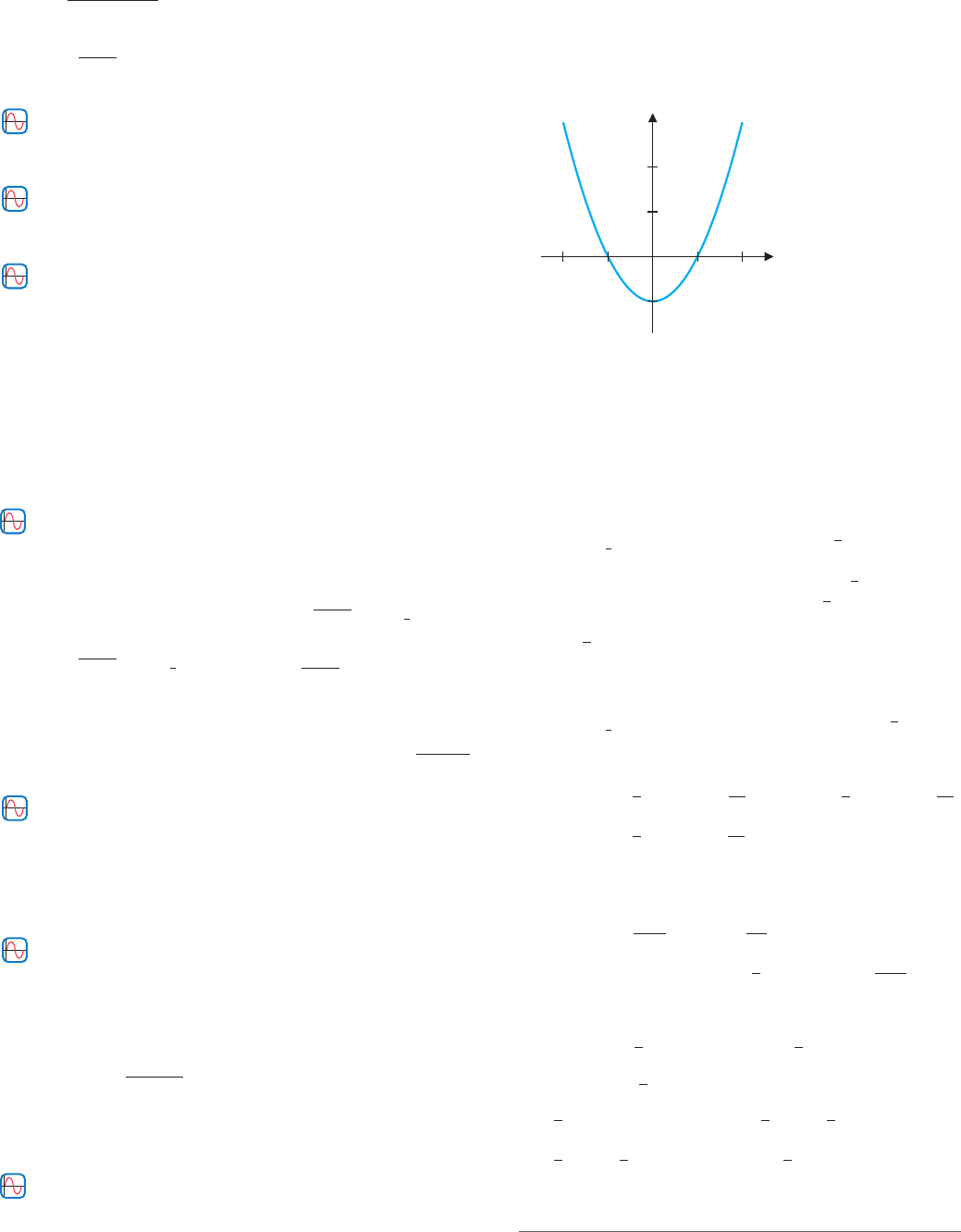
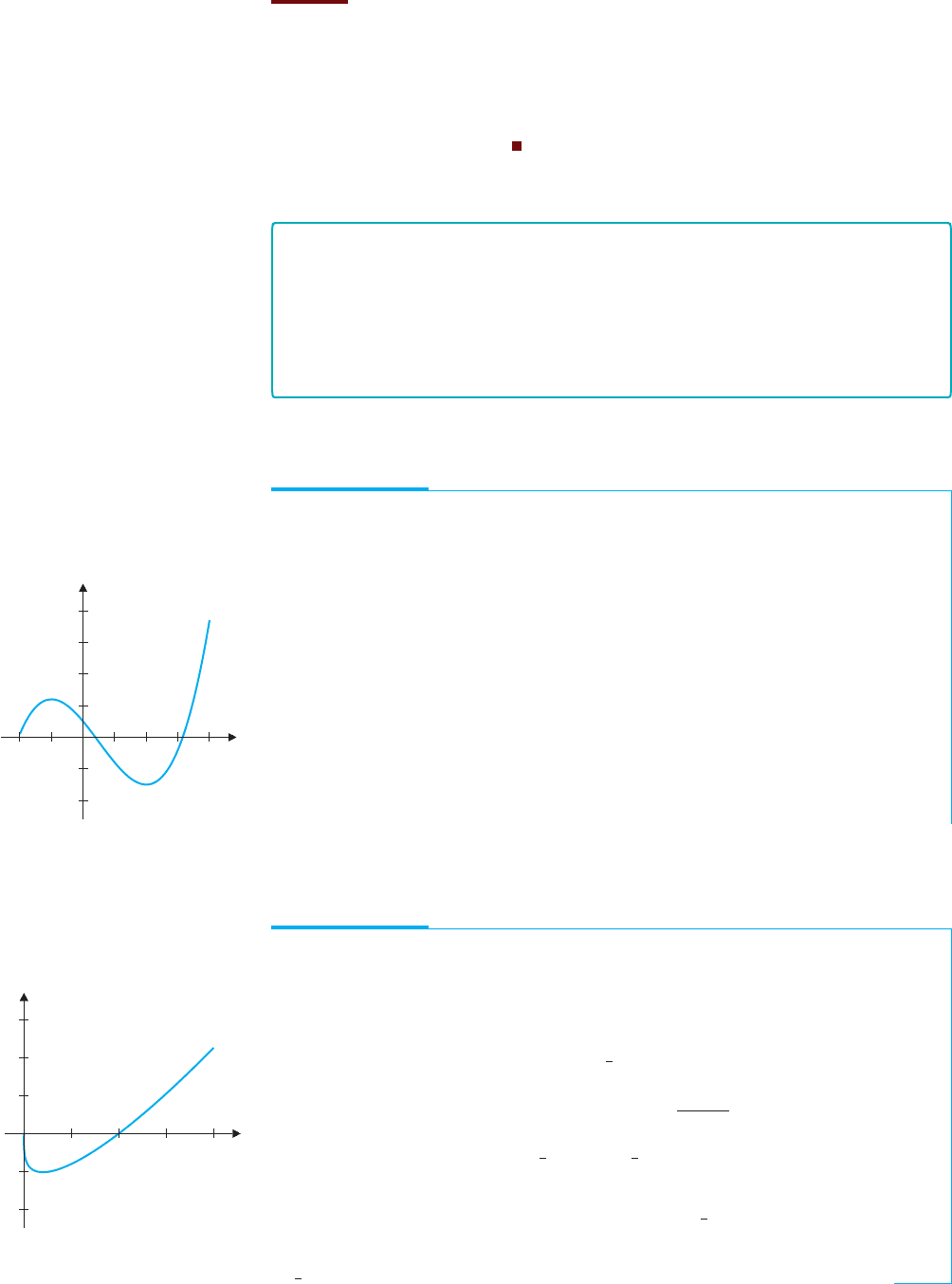
47. Given the graph of y = f (x), draw in the tangent lines used
in Newton’s method to determine x
1
and x
2
after starting at
x
0
=2. Which of the zeros will Newton’s method con-
verge to? Repeat with x
0
=−2 and x
0
= 0.4.
y
x
22
2
48. What would happen to Newton’s method in exercise 47 if you
had a starting value of x
0
= 0? Consider the use of Newton’s
method with x
0
= 0.2 and x
0
= 10. Obviously, x
0
= 0.2is
much closer to a zero of the function, but which initial guess
would work better in Newton’s method? Explain.
49. Show that Newton’s method applied to x
2
− c = 0 (where
c > 0 is some constant) produces the iterative scheme
x
n+1
=
1
2
(x
n
+ c/x
n
) for approximating
√
c. This scheme has
been known for over 2000 years. To understand why it works,
suppose that your initial guess (x
0
) for
√
c is a little too
small. How would c/x
0
compare to
√
c? Explain why the
average of x
0
and c/x
0
would give a better approximation
to
√
c.
50. Show that Newton’s method applied to x
n
− c = 0 (where n
and c are positive constants) produces the iterative scheme
x
n+1
=
1
n
[(n − 1)x
n
+ cx
1−n
n
] for approximating
n
√
c.
51. Applying Newton’s method to x
2
− x − 1 = 0, show that
(a) if x
0
=
3
2
, then x
1
=
13
8
; (b) if x
0
=
5
3
, then x
1
=
34
21
;
(c) if x
0
=
8
5
, then x
1
=
89
55
; (d) the Fibonacci sequence is
defined by F
1
= 1, F
2
= 1, F
3
= 2, F
4
= 3 and F
n
= F
n−1
+
F
n−2
forn ≥ 3.Writeeach numberin parts (a)−(c) as a ratio of
Fibonaccinumbers. Fillin thesubscripts m andk inthe follow-
ing: if x
0
=
F
n+1
F
n
, then x
1
=
F
m
F
k
. (e) Assuming that Newton’s
method converges from x
0
=
3
2
, determine lim
n→∞
F
n+1
F
n
.
52. Determine the behavior of Newton’s method applied to
(a) f
1
(x) =
1
5
(8x − 3); (b) f
2
(x) =
1
5
(16x − 3);
(c) f
3
(x) =
1
5
(32x − 3); (d) f (x), where f (x) = f
1
(x)if
1
2
< x < 1, f (x) = f
2
(x)if
1
4
< x ≤
1
2
, f (x) = f
3
(x)if
1
8
< x ≤
1
4
and so on, with x
0
=
3
4
. Does Newton’s method
converge to a zero of f ? (See Peter Horton’s article in the
December 2007 Mathematics Magazine.)
P1: OSO/OVY P2: OSO/OVY QC: OSO/OVY T1: OSO
MHDQ256-Ch03 MHDQ256-Smith-v1.cls December 10, 2010 20:20
LT (Late Transcendental)
CONFIRMING PAGES
184 CHAPTER 3
..
Applications of Differentiation 3-12
APPLICATIONS
53. Suppose that a species reproduces as follows: with probabil-
ity p
0
, an organism has no offspring; with probability p
1
,an
organism has one offspring; with probability p
2
,anorgan-
ism has two offspring and so on. The probability that the
species goes extinct is given by the smallest nonnega-
tive solution of the equation p
0
+ p
1
x + p
2
x
2
+···=x.
(See Sigmund’s Games of Life.) Find the positive solu-
tions of the equations 0.1 +0.2x + 0.3x
2
+ 0.4x
3
= x and
0.4 + 0.3x + 0.2x
2
+ 0.1x
3
= x. Explain in terms of species
going extinct why the firstequation has a smaller solution than
the second.
54. For the extinction problem in exercise 53, show algebraically
that if p
0
= 0, the probability of extinction is 0. Explain this
result in terms of species reproduction. Show that a species
with p
0
= 0.35, p
1
= 0.4 and p
2
= 0.25 (all other p
n
’s are 0)
goes extinct with certainty (probability 1).
55. The spruce budworm is an enemy of the balsam fir tree.
In one model of the interaction between these organisms,
possible long-term populations of the budworm are solu-
tions of the equation r(1 − x/k) = x/(1 + x
2
), for positive
constants r and k. (See Murray’s Mathematical Biology.)
Find all positive solutions of the equation with r = 0.5 and
k = 7.
56. Repeat exercise 55 with r = 0.5 and k = 7.5. For a small
change in the environmental constant k (from 7 to 7.5), how
did the solution change from exercise 55 to exercise 56? The
largest solution corresponds to an “infestation” of the spruce
budworm.
57. Newton’stheoryofgravitationstatesthattheweightofaperson
at elevation x feet above sea level is W(x) = PR
2
/(R + x)
2
,
where P is the person’s weight at sea level and R is the radius
of the earth (approximately 20,900,000 feet). Find the linear
approximation of W(x)atx = 0. Use the linear approxima-
tion to estimate the elevation required to reduce the weight of
a 120-pound person by 1%.
58. One important aspect of Einstein’s theory of relativity is that
mass is not constant. For a person with mass m
0
at rest, the
mass will equal m = m
0
/
1 − v
2
/c
2
at velocity v (where c
is the speed of light). Thinking of m as a function of v, find
the linear approximation of m(v)atv = 0. Use the linear ap-
proximation to show that mass isessentially constant for small
velocities.
EXPLORATORY EXERCISES
1. An important question involving Newton’s method is how
fast it converges to a given zero. Intuitively, we can distin-
guishbetween the rateof convergencefor f (x) = x
2
− 1(with
x
0
= 1.1) and that for g(x) = x
2
− 2x + 1 (with x
0
= 1.1).
But how can we measure this? One method is to take suc-
cessive approximations x
n−1
and x
n
and compute the differ-
ence
n
= x
n
− x
n−1
. To discoverthe importance of this quan-
tity, run Newton’s method with x
0
= 1.5 and then compute the
ratios
3
/
2
,
4
/
3
,
5
/
4
and so on, for each of the follow-
ing functions:
F
1
(x) = (x −1)(x + 2)
3
= x
4
+ 5x
3
+ 6x
2
− 4x − 8,
F
2
(x) = (x −1)
2
(x + 2)
2
= x
4
+ 2x
3
− 3x
2
− 4x + 4,
F
3
(x) = (x −1)
3
(x + 2) = x
4
− x
3
− 3x
2
+ 5x − 2 and
F
4
(x) = (x −1)
4
= x
4
− 4x
3
+ 6x
2
− 4x + 1.
In each case, conjecture a value for the limit r = lim
n→∞
n+1
n
.
If the limit exists and is nonzero, we say that Newton’s
method converges linearly. How does r relate to your intuitive
sense of how fast the method converges? For f (x) = (x − 1)
4
,
we say that the zero x = 1 has multiplicity 4. For
f (x) = (x − 1)
3
(x + 2), x = 1 has multiplicity 3 and so on.
How does r relate to the multiplicity of the zero? Based on
this analysis, why did Newton’s method converge faster for
f (x) = x
2
− 1 than for g(x) = x
2
− 2x + 1? Finally, use
Newton’s method to compute the rate r and hypothesize
the multiplicity of the zero x = 0 for f (x) = x sinx and
g(x) = x sin x
2
.
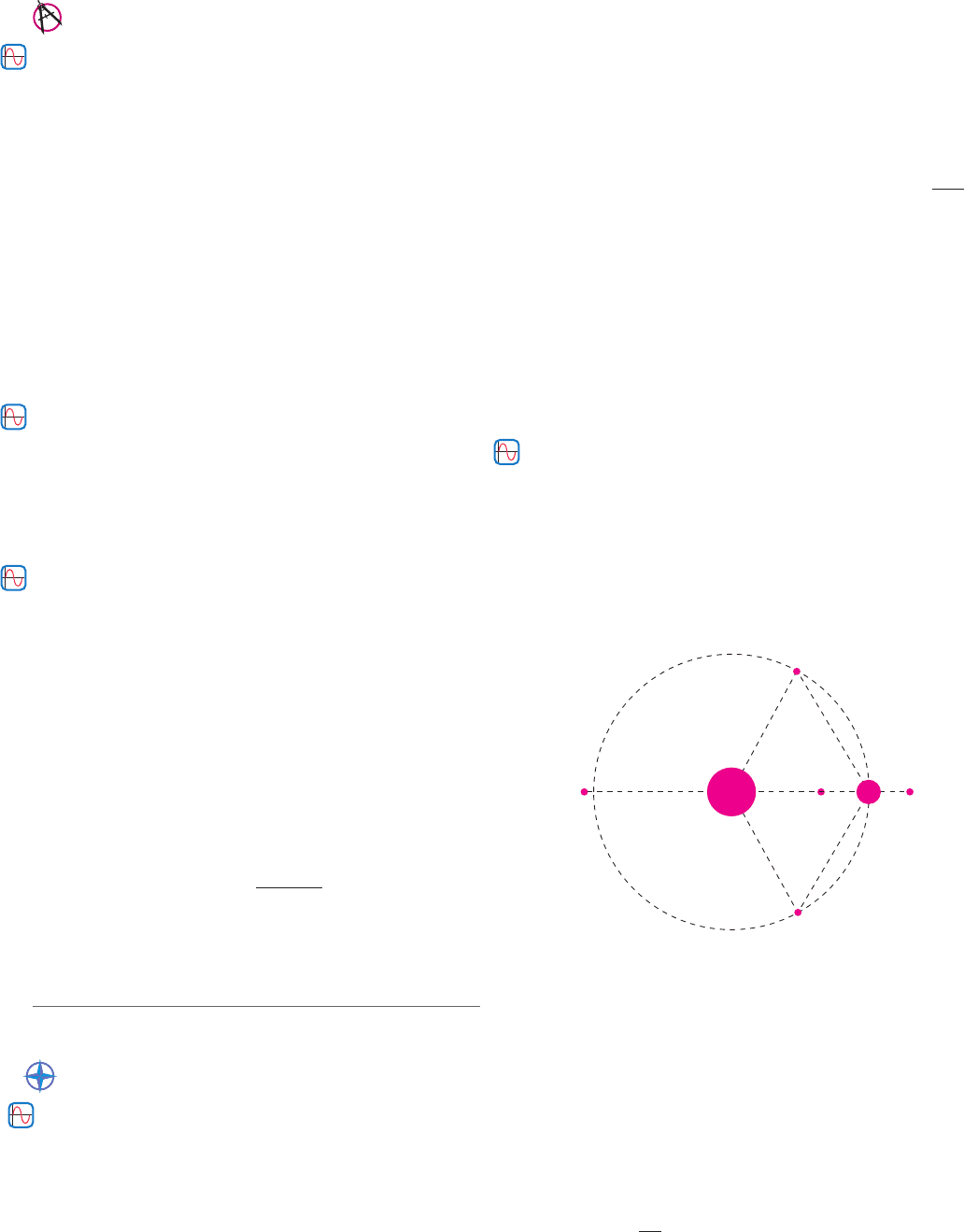
2. This exercise looks at a special case of the three-body prob-
lem, in which there is a large object A of mass m
A
, a much
smaller object B of mass m
B
m
A
and an object C of negli-
gible mass. (Here, m
B
m
A
means that m
B
is much smaller
than m
A
.)Assume that object B orbitsin a circular path around
the common center of mass. There are five circular orbits for
object C that maintain constant relative positions of the three
objects. These are called Lagrange points L
1
, L
2
, L
3
, L
4
and
L
5
, as shown in the figure.
L
2
L
1
L
5
L
3
L
4
A
B
Toderiveequations for the Lagrangepoints,setupa coordinate
system with object A at the origin and object B at the point
(1, 0). Then L
1
is at the point (x
1
, 0), where x
1
is the solution of
(1 + k)x
5
− (3k + 2)x
4
+ (3k + 1)x
3
− x
2
+ 2x − 1 = 0;
L
2
is at the point (x
2
, 0), where x
2
is the solution of
(1 +k)x
5
−(3k +2)x
4
+(3k +1)x
3
−(2k +1)x
2
+2x −1=0
and L
3
is at the point (−x
3
, 0), where x
3
is the solution of
(1 + k)x
5
+ (3k + 2)x
4
+ (3k + 1)x
3
− x
2
− 2x − 1 = 0,
where k =
m
B
m
A
. Use Newton’s method to find approximate
solutions of the following.
P1: OSO/OVY P2: OSO/OVY QC: OSO/OVY T1: OSO
MHDQ256-Ch03 MHDQ256-Smith-v1.cls December 10, 2010 20:20
LT (Late Transcendental)
CONFIRMING PAGES
3-13 SECTION 3.2
..
Maximum and Minimum Values 185
(a) Find L
1
fortheEarth-Sunsystemwithk = 0.000002.This
point has an uninterrupted view of the sun and is the loca-
tion of the solar observatory SOHO.
(b) Find L
2
fortheEarth-Sunsystemwithk = 0.000002.This
is the location of NASA’s Microwave Anisotropy Probe.
(c) Find L
3
fortheEarth-Sunsystemwithk = 0.000002.This
point is invisible from the Earth and is the location of
Planet X in many science fiction stories.
(d) Find L
1
for the Moon-Earth system with k = 0.01229.
This point has been suggested as a good location for a
space station to help colonize the moon.
(e) The points L
4
and L
5
form equilateral triangles with ob-
jects A and B. Explain why this means that polar coor-
dinates for L
4
are (r,θ) =
1,
π
6
. Find (x, y)-coordinates
for L
4
and L
5
. In the Jupiter-Sun system, these are loca-
tions of numerous Trojan asteroids.
3.2 MAXIMUM AND MINIMUM VALUES
To remain competitive, businesses must regularly evaluate how to minimize waste and
maximize the return on their investment. In this section, we consider the problem of finding
maximum and minimum values of functions. In section 3.6, we examine how to apply these
notions to problems of an applied nature.
We begin by giving careful mathematical definitions of some familiar terms.
DEFINITION 2.1
For a function f defined on a set S of real numbers and a number c ∈ S,
(i) f (c)istheabsolute maximum of f on S if f (c) ≥ f (x) for all x ∈ S and
(ii) f (c)istheabsolute minimum of f on S if f (c) ≤ f (x) for all x ∈ S.
An absolute maximum or an absolute minimum is referred to as an absolute
extremum. (The plural form of extremum is extrema.)
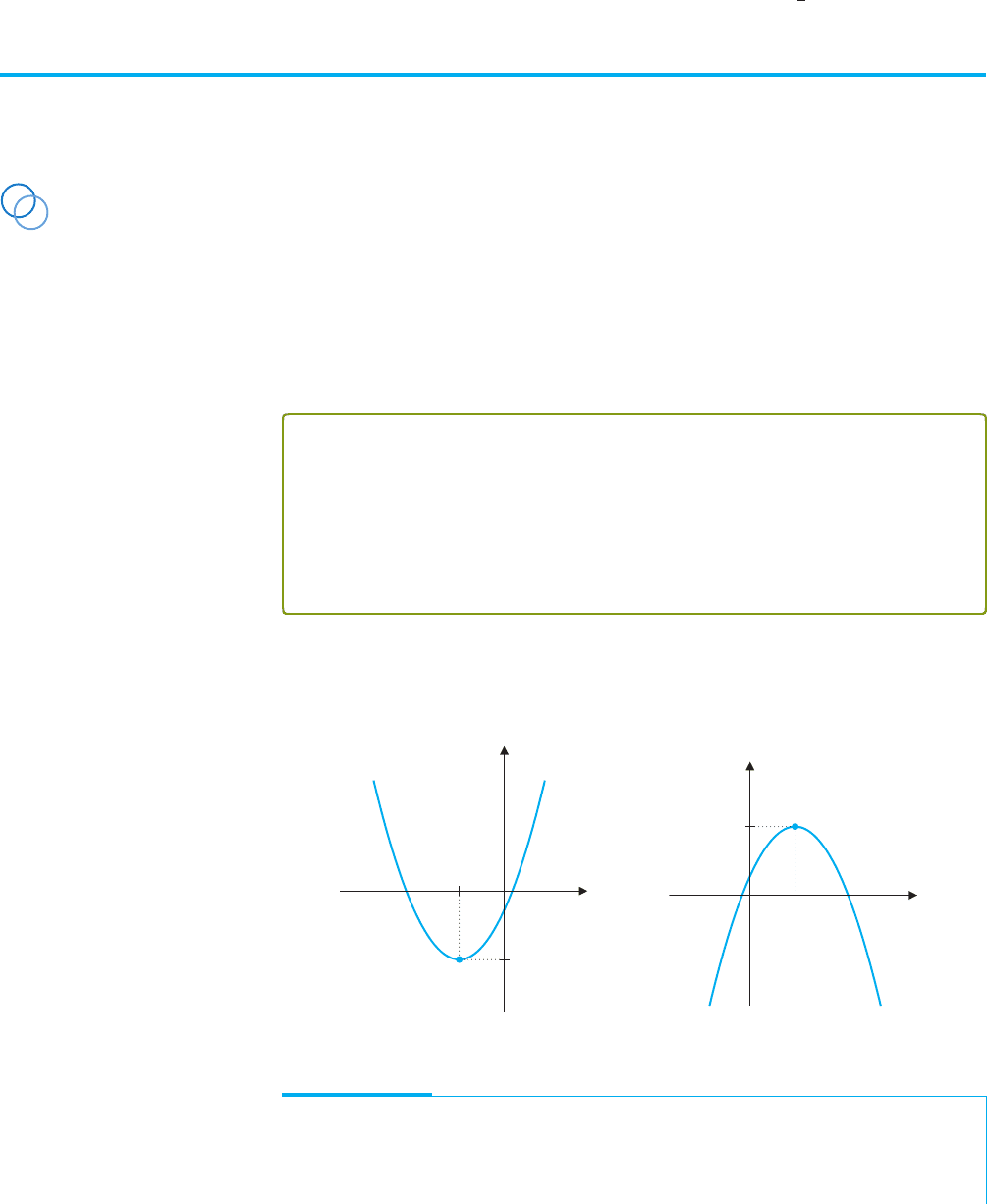
The first question you might ask is whether every function has an absolute maximum
and an absolute minimum. The answer is no, as we can see from Figures 3.14a and 3.14b.
Has no
absolute
maximum
x
y
f (c)
c
Absolute
minimum
Has no
absolute
minimum
x
y
f (c)
c
Absolute
maximum
FIGURE 3.14a FIGURE 3.14b
EXAMPLE 2.1 Absolute Maximum and Minimum Values
(a) Locate any absolute extrema of f (x) = x
2
− 9 on the interval (−∞, ∞). (b) Locate
any absolute extrema of f (x) = x
2
− 9 on the interval (−3, 3). (c) Locate any absolute
extrema of f (x) = x
2
− 9 on the interval [−3, 3].
P1: OSO/OVY P2: OSO/OVY QC: OSO/OVY T1: OSO
MHDQ256-Ch03 MHDQ256-Smith-v1.cls December 10, 2010 20:20
LT (Late Transcendental)
CONFIRMING PAGES
186 CHAPTER 3
..
Applications of Differentiation 3-14
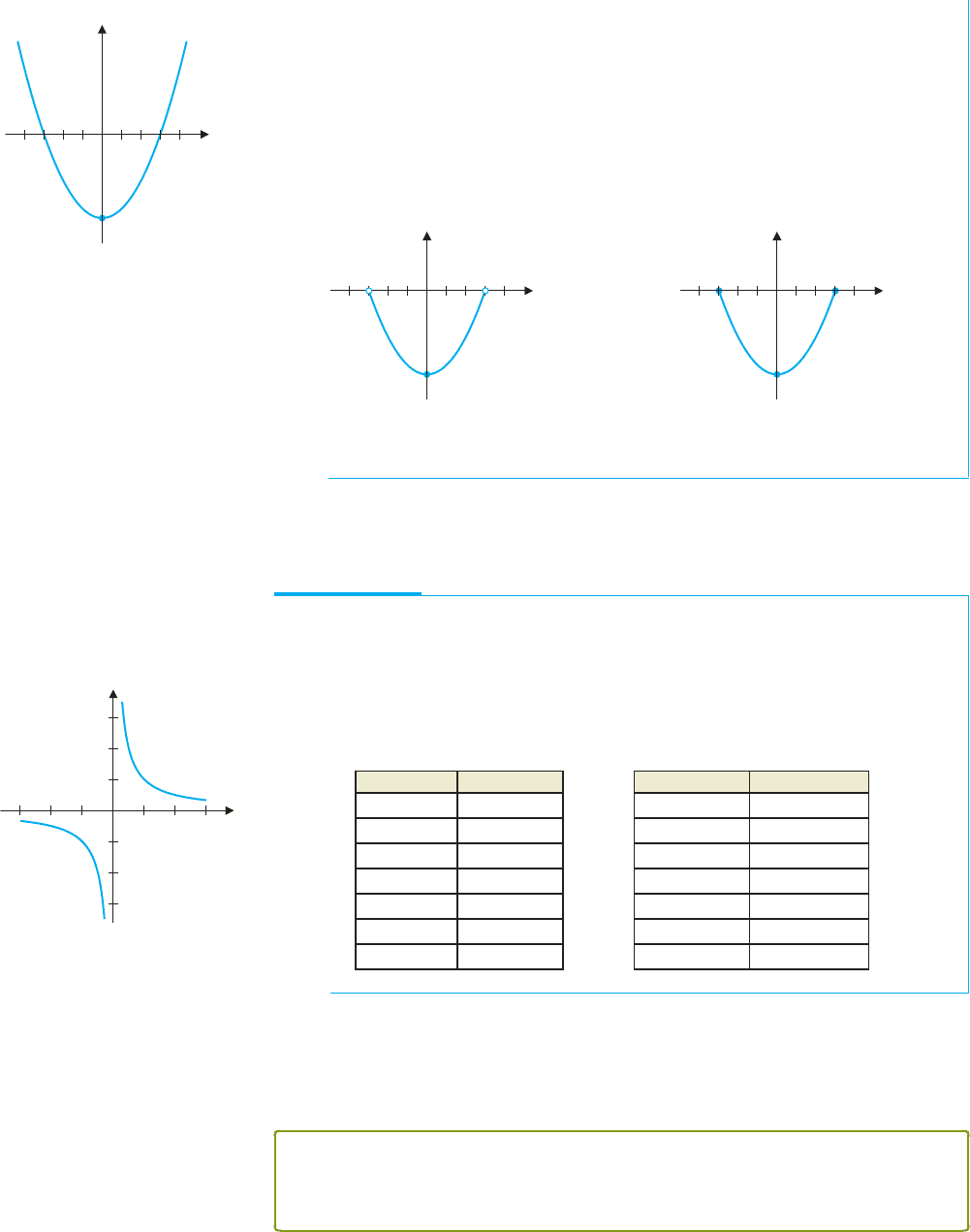
Solution (a) In Figure 3.15, notice that f has an absolute minimum value of
f (0) =−9, but has no absolute maximum value.
(b) In Figure 3.16a, we see that f has an absolute minimum value of f (0) =−9.
Your initial reaction might be to say that f has an absolute maximum of 0, but f (x) = 0
for any x ∈ (−3, 3), since this is an open interval. Hence, f has no absolute maximum
on the interval (−3, 3).
33
y
x
f(0) 9
(Absolute minimum)
No absolute
maximum
FIGURE 3.15
y = x
2
− 9on(−∞, ∞)
(c) In this case, the endpoints 3 and −3 are in the interval [−3, 3]. Here, f assumes
its absolute maximum at two points: f (3) = f (−3) = 0. (See Figure 3.16b.)
y
33
f(0) 9
(
Absolute minimum
)
No absolute
maximum
x
y
33
f(0) 9
(
Absolute minimum
)
Absolute maximum
f(3) f(3) 0
x
FIGURE 3.16a FIGURE 3.16b
y = x
2
− 9on(−3, 3) y = x
2
− 9on[−3, 3]
We have seen that a function may or may not have absolute extrema. In example 2.1,
the function failed to have an absolute maximum, except on the closed, bounded interval
[−3, 3]. Example 2.2 provides another piece of the puzzle.
EXAMPLE 2.2 A Function with No Absolute Maximum or Minimum
Locate any absolute extrema of f (x) = 1/x, on [−3, 0) ∪ (0, 3].
y
x
3
3
2
FIGURE 3.17
y = 1/x
Solution From the graph in Figure 3.17, f clearly fails to have either an absolute
maximum or an absolute minimum on [−3, 0) ∪ (0, 3]. The following table of values
for f (x) for x close to 0 suggests the same conclusion.
x 1/x
1 1
0.1 10
0.01 100
0.001 1000
0.0001 10,000
0.00001 100,000
0.000001 1,000,000
x 1/x
−1 −1
−0.1 −10
−0.01 −100
−0.001 −1000
−0.0001 −10,000
−0.00001 −100,000
−0.000001 −1,000,000
The most obvious difference between the functions in examples 2.1 and 2.2 is that
f (x) = 1/x is not continuous throughout the interval [−3, 3]. We offer the following the-
orem without proof.
THEOREM 2.1 (Extreme Value Theorem)
A continuous function f defined on a closed, bounded interval [a, b] attains both an
absolute maximum and an absolute minimum on that interval.
While you do not need to have a continuous function or a closed interval to have an
absolute extremum, Theorem 2.1 says that continuous functions are guaranteed to have an
absolute maximum and an absolute minimum on a closed, bounded interval.
P1: OSO/OVY P2: OSO/OVY QC: OSO/OVY T1: OSO
MHDQ256-Ch03 MHDQ256-Smith-v1.cls December 10, 2010 20:20
LT (Late Transcendental)
CONFIRMING PAGES
3-15 SECTION 3.2
..
Maximum and Minimum Values 187
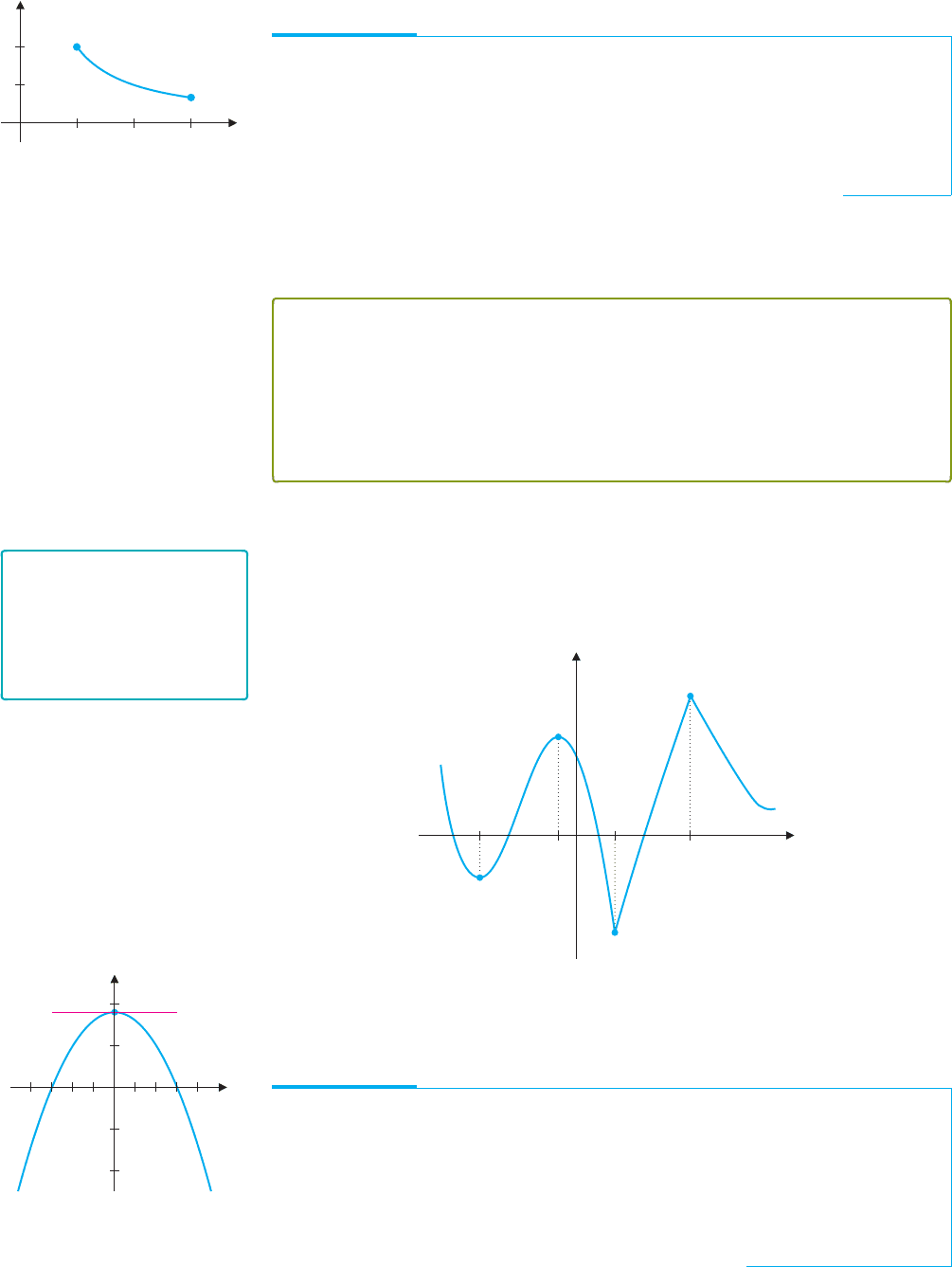
Inexample2.3,werevisitthefunctionfromexample2.2,butlookonadifferentinterval.
x
y
1
31
FIGURE 3.18
y = 1/x on [1, 3]
EXAMPLE 2.3 Finding Absolute Extrema of a Continuous Function
Find the absolute extrema of f (x) = 1/x on the interval [1, 3].
Solution Notice that on the interval [1, 3], f is continuous. Consequently, the Extreme
Value Theorem guarantees that f has both an absolute maximum and an absolute
minimum on [1, 3]. Judging from the graph in Figure 3.18, it appears that f (x) reaches
its maximum value of 1 at x = 1 and its minimum value of 1/3atx = 3.
Our objective is to determine how to locate the absolute extrema of a given function.
Before we do this, we need to consider an additional type of extremum.
DEFINITION 2.2
(i) f (c)isalocal maximum of f if f (c) ≥ f (x) for all x in some open interval
containing c.
(ii) f (c)isalocal minimum of f if f (c) ≤ f (x) for all x in some open interval
containing c.
In either case, we call f (c)alocal extremum of f .
REMARK 2.1
Local maxima and minima (the
plural forms of maximum and
minimum, respectively) are
sometimes referred to as
relative maxima and minima,
respectively.
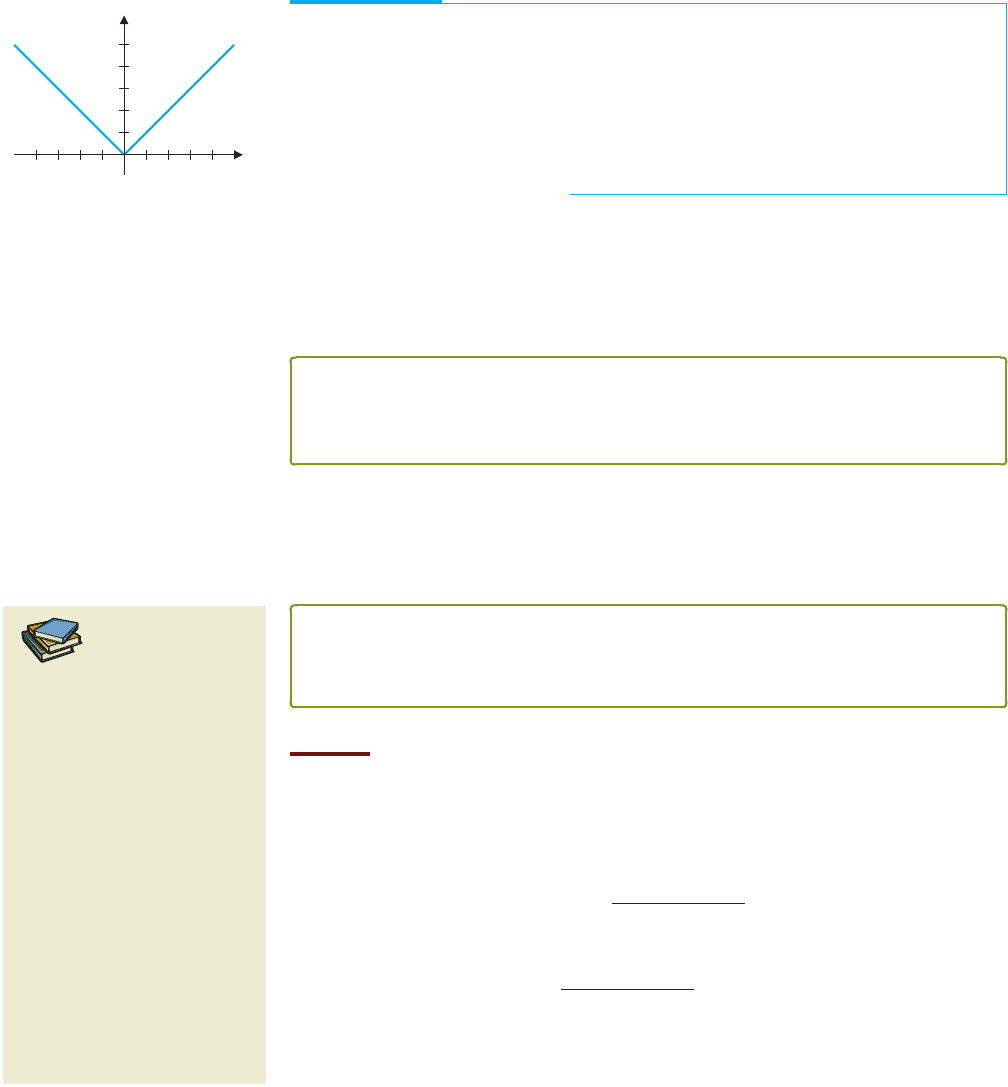
Notice from Figure 3.19 that each local extremum seems to occur either at a point
where the tangent line is horizontal [i.e., where f
(x) = 0], at a point where the tangent
line is vertical [where f
(x) is undefined] or at a corner [again, where f
(x) is undefined].
We can see this behavior quite clearly in examples 2.4 and 2.5.
x
y
db
ca
Local minimum
[ f(a) 0]
Local minimum
[ f(c) is undefined]
Local maximum
[ f(b) 0]
Local maximum
[ f(d) is undefined]
FIGURE 3.19
Local extrema
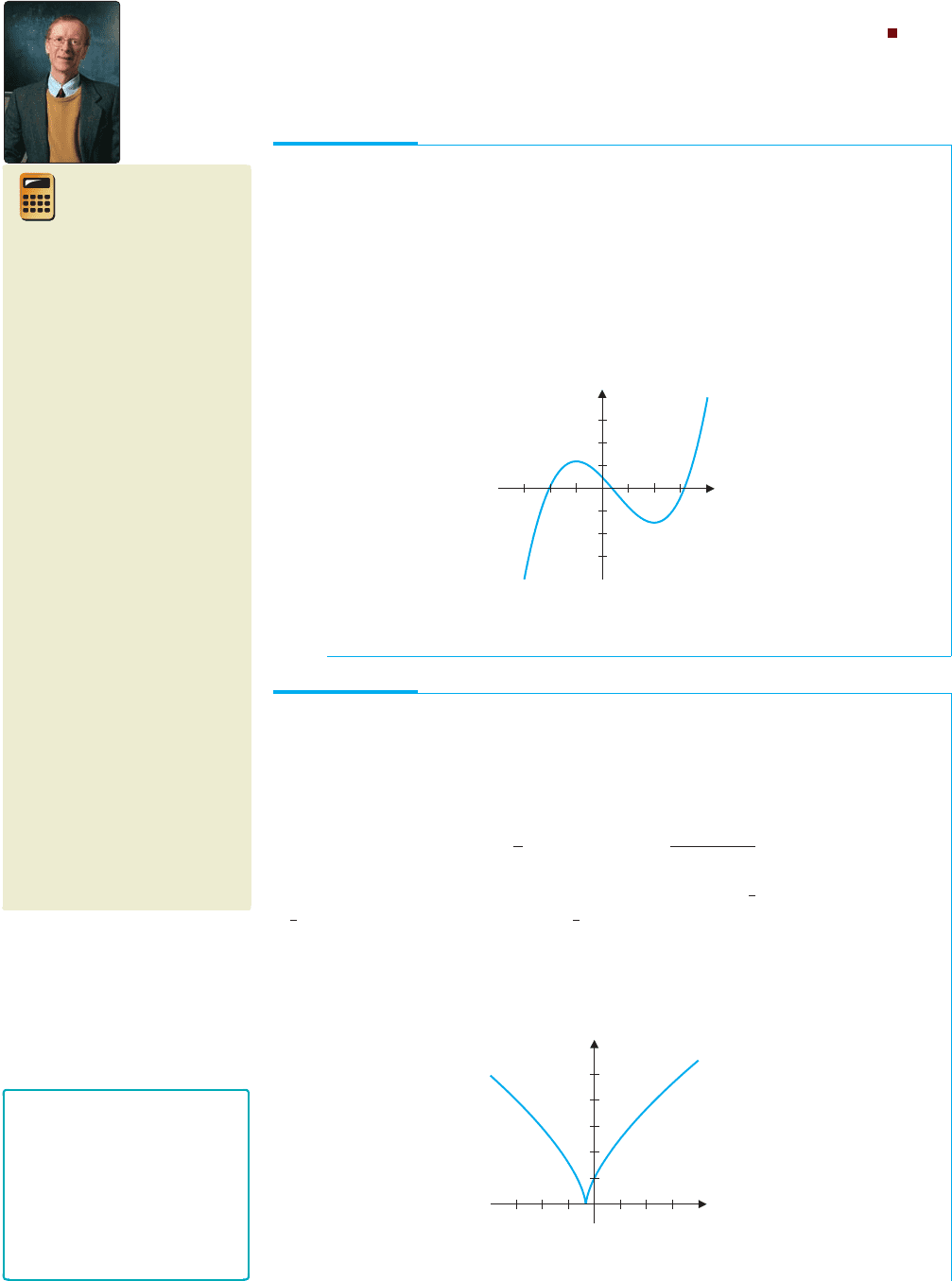
EXAMPLE 2.4 A Function with a Zero Derivative
at a Local Maximum
Locate any local extrema for f (x) = 9 − x
2
and describe the behavior of the derivative
at the local extremum.
x
10
5
22
y
FIGURE 3.20
y = 9 − x
2
and the tangent line
at x = 0
Solution We can see from Figure 3.20 that there is a local maximum at x = 0.
Further, note that f
(x) =−2x and so, f
(0) = 0. This says that the tangent line to
y = f (x)atx = 0 is horizontal, as indicated in Figure 3.20.
P1: OSO/OVY P2: OSO/OVY QC: OSO/OVY T1: OSO
MHDQ256-Ch03 MHDQ256-Smith-v1.cls December 10, 2010 20:20
LT (Late Transcendental)
CONFIRMING PAGES
188 CHAPTER 3
..
Applications of Differentiation 3-16
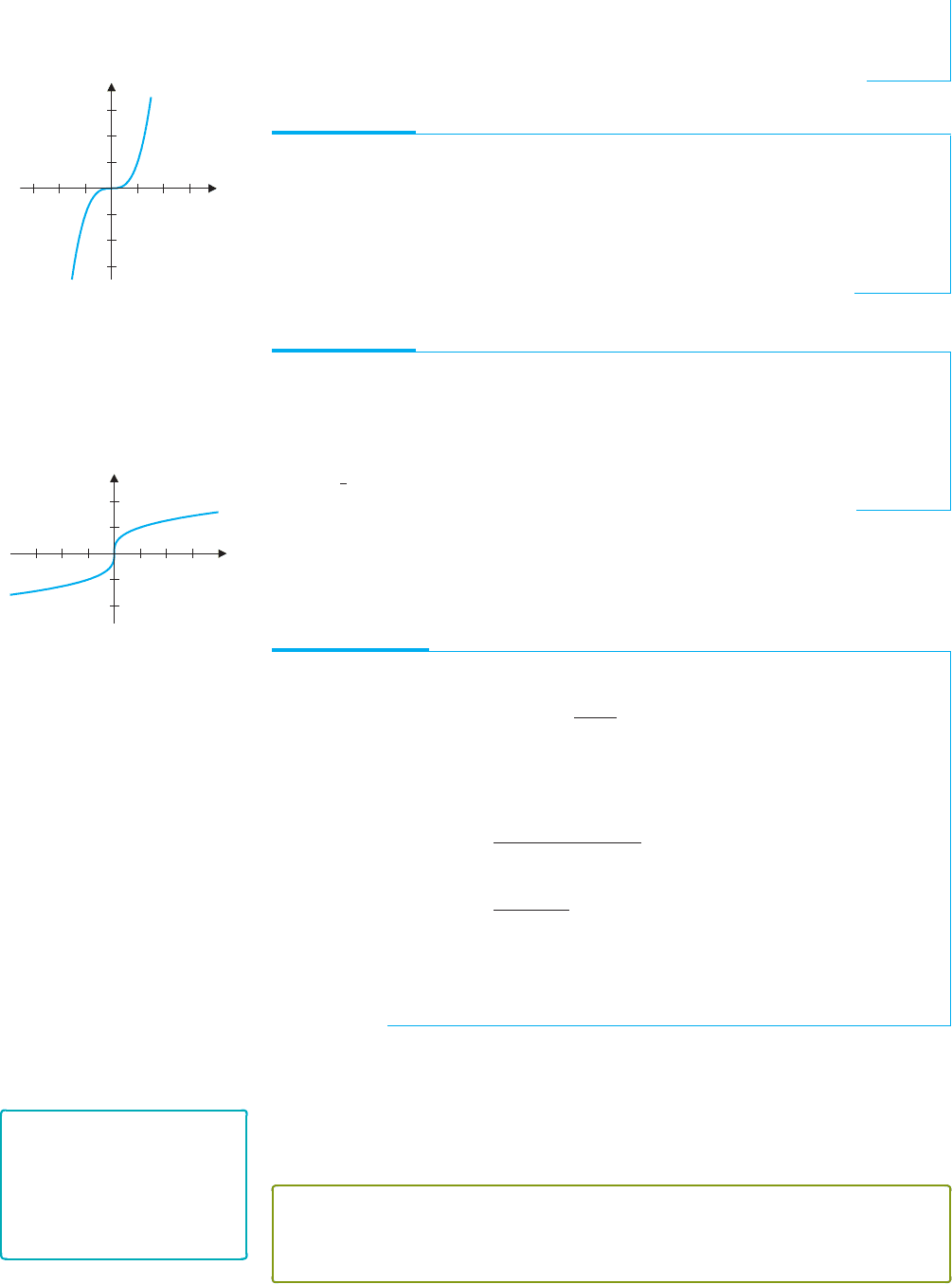
EXAMPLE 2.5 A Function with an Undefined Derivative
at a Local Minimum
Locate any local extrema for f (x) =|x| and describe the behavior of the derivative at
the local extremum.
y
x
3
2
FIGURE 3.21
y =|x|
Solution We can see from Figure 3.21 that there is a local minimum at x = 0. As we
have noted in section 2.1, the graph has a corner at x = 0 and hence, f
(0) is undefined.
[See example 1.7 in section 2.1.]
The graphs shownin Figures 3.19–3.21 are not unusual. In fact, spend a little time now
drawinggraphs of functions with local extrema.It should not take long to convince yourself
that local extrema occur only at points where the derivative is either zero or undefined.
Because of this, we give these points a special name.
DEFINITION 2.3
A number c in the domain of a function f is called a critical number of f if
f
(c) = 0or f
(c) is undefined.
HISTORICAL
NOTES
Pierre de Fermat (1601–1665)
A French mathematician who
discovered many important results,
including the theorem named for
him. Fermat was a lawyer and
member of the Toulouse supreme
court, with mathematics as a
hobby. The “Prince of Amateurs”
left an unusual legacy by writing in
the margin of a book that he had
discovered a wonderful proof of a
clever result, but that the margin
of the book was too small to hold
the proof. Fermat’s Last Theorem
confounded many of the world’s
best mathematicians for more
than 300 years before being
proved by Andrew Wiles in 1995.
It turns out that our earlier observation regarding the location of extrema is correct.
That is, local extrema occur only at points where the derivative is zero or undefined. We
state this formally in Theorem 2.2.
THEOREM 2.2 (Fermat’s Theorem)
Suppose that f (c) is a local extremum (local maximum or local minimum). Then c
must be a critical number of f .
PROOF
Suppose that f is differentiable at x = c. (If not, c is a critical number of f and we are
done.) Suppose further that f
(c) = 0. Then, either f
(c) > 0or f
(c) < 0.
If f
(c) > 0, we have by the definition of derivative that
f
(c) = lim
h→0
f (c + h) − f (c)
h
> 0.
So, for all h sufficiently small,
f (c + h) − f (c)
h
> 0. (2.1)
For h > 0, (2.1) says that
f (c + h) − f (c) > 0
and so,
f (c + h) > f (c).
Thus, f (c) is not a local maximum.
Similarly, for h < 0, (2.1) says that
f (c + h) − f (c) < 0
and so,
f (c + h) < f (c).
Thus, f (c) is not a local minimum, either.
Since we had assumed that f (c) was a local extremum, this is a contradiction. This
rules out the possibility that f
(c) > 0.
P1: OSO/OVY P2: OSO/OVY QC: OSO/OVY T1: OSO
MHDQ256-Ch03 MHDQ256-Smith-v1.cls December 10, 2010 20:20
LT (Late Transcendental)
CONFIRMING PAGES
3-17 SECTION 3.2
..
Maximum and Minimum Values 189
We leave it as an exercise to show that if f
(c) < 0, we obtain the same contradiction.
The only remaining possibility is to have f
(c) = 0 and this proves the theorem.
TODAY IN
MATHEMATICS
Andrew Wiles (1953– )
A British mathematician who
in 1995 published a proof of
Fermat’s Last Theorem, the most
famous unsolved problem of the
20th century. Fermat’s Last
Theorem states that there is no
integer solution x, y and z of the
equation x
n
+ y
n
= z
n
for
integers n > 2. Wiles had wanted
to prove the theorem since
reading about it as a 10-year-old.
After more than ten years
as a successful research
mathematician, Wiles isolated
himself from colleagues for seven
years as he developed the
mathematics needed for his
proof. “I realised that talking to
people casually about Fermat was
impossible because it generated
too much interest. You cannot
focus yourself for years unless you
have this kind of undivided
concentration which too many
spectators would destroy.” The
last step of his proof came, after
a year of intense work on this
one step, as “this incredible
revelation” that was “so
indescribably beautiful, it was
so simple and elegant.”
We can use Fermat’s Theorem and calculator- or computer-generated graphs to find
local extrema, as in examples 2.6 and 2.7.
EXAMPLE 2.6 Finding Local Extrema of a Polynomial
Find the critical numbers and local extrema of f (x) = 2x
3
− 3x
2
− 12x + 5.
Solution Here, f
(x) = 6x
2
− 6x − 12 = 6(x
2
− x −2)
= 6(x − 2)(x + 1).
Thus, f has two critical numbers, x =−1 and x = 2. Notice from the graph in
Figure 3.22 that these correspond to the locations of a local maximum and a local
minimum, respectively.
y
x
20
20
21
FIGURE 3.22
y = 2x
3
− 3x
2
− 12x + 5
REMARK 2.2
Fermat’s Theorem says that
local extrema can occur only at
critical numbers. This does not
say that there is a local
extremum at every critical
number. In fact, this is false, as
we illustrate in examples 2.8
and 2.9.
EXAMPLE 2.7 An Extremum at a Point Where the
Derivative Is Undefined
Find the critical numbers and local extrema of f (x) = (3x +1)
2/3
.
Solution Here, we have
f
(x) =
2
3
(3x + 1)
−1/3
(3) =
2
(3x + 1)
1/3
.
Of course, f
(x) = 0 for all x,but f
(x) is undefined at x =−
1
3
. Be sure to note that
−
1
3
is in the domain of f . Thus, x =−
1
3
is the only critical number of f . From the
graph in Figure 3.23, we see that this corresponds to the location of a local minimum
(also the absolute minimum). If you use your graphing utility to try to produce a graph
of y = f (x), you may get only half of the graph displayed in Figure 3.23. The reason is
y
x
4
22
FIGURE 3.23
y = (3x + 1)
2/3
P1: OSO/OVY P2: OSO/OVY QC: OSO/OVY T1: OSO
MHDQ256-Ch03 MHDQ256-Smith-v1.cls December 10, 2010 20:20
LT (Late Transcendental)
CONFIRMING PAGES
190 CHAPTER 3
..
Applications of Differentiation 3-18
that the algorithms used by most calculators and many computers will return a complex
number (or an error) when asked to compute certain fractional powers of negative
numbers. While this annoying shortcoming presents only occasional difficulties, we
mention this here only so that you are aware that technology has limitations.
EXAMPLE 2.8 A Horizontal Tangent at a Point That Is Not
a Local Extremum
Find the critical numbers and local extrema of f (x) = x
3
.
x
y
2
2
22
FIGURE 3.24
y = x
3
Solution It should be clear from Figure 3.24 that f has no local extrema. However,
f
(x) = 3x
2
= 0 for x = 0 (the only critical number of f ). In this case, f has a
horizontal tangent line at x = 0, but does not have a local extremum there.
2
y
x
2
22
FIGURE 3.25
y = x
1/3
EXAMPLE 2.9 A Vertical Tangent at a Point That Is Not
a Local Extremum
Find the critical numbers and local extrema of f (x) = x
1/3
.
Solution As in example 2.8, f has no local extrema. (See Figure 3.25.) Here,
f
(x) =
1
3
x
−2/3
and so, f has a critical number at x = 0. (In this case, the derivative is
undefined at x = 0.) However, f does not have a local extremum at x = 0.
You should always check that a given value is in the domain of the function before
declaring it a critical number, as in example 2.10.
EXAMPLE 2.10 Finding Critical Numbers of a Rational Function
Find all the critical numbers of f (x) =
2x
2
x +2
.
Solution You should note that the domain of f consists of all real numbers other than
x =−2. Here, we have
f
(x) =
4x(x +2) −2x
2
(1)
(x + 2)
2
From the quotient rule.
=
2x(x +4)
(x + 2)
2
.
Notice that f
(x) = 0 for x = 0, −4 and f
(x) is undefined for x =−2. However, −2is
not in the domain of f and consequently, the only critical numbers are x = 0
and x =−4.
REMARK 2.3
When we use the terms
maximum, minimum or
extremum without specifying
absolute or local, we will
always be referring to absolute
extrema.
We haveobservedthat local extrema occur only at critical numbers and that continuous
functions must have an absolute maximum and an absolute minimum on a closed, bounded
interval. Theorem 2.3 gives us a way to find absolute extrema.
THEOREM 2.3
Suppose that f is continuous on the closed interval [a, b]. Then, each absolute
extremum of f must occur at an endpoint (a or b) or at a critical number.
P1: OSO/OVY P2: OSO/OVY QC: OSO/OVY T1: OSO
MHDQ256-Ch03 MHDQ256-Smith-v1.cls December 10, 2010 20:20
LT (Late Transcendental)
CONFIRMING PAGES
3-19 SECTION 3.2
..
Maximum and Minimum Values 191
PROOF
By the Extreme Value Theorem, f will attain its maximum and minimum values on [a, b],
since f is continuous. Let f (c) be an absolute extremum. If c is not an endpoint (i.e., c = a
and c = b), then c must be in the open interval (a, b). In this case, f (c) is also a local
extremum. By Fermat’s Theorem, then, c must be a critical number, since local extrema
occur only at critical numbers.
REMARK 2.4
Theorem 2.3 gives us a simple procedure for finding the absolute extrema of a
continuous function on a closed, bounded interval:
1. Findall critical numbersinthe intervalandcomputefunction valuesatthesepoints.
2. Compute function values at the endpoints.
3. The largest function value is the absolute maximum and the smallest function
value is the absolute minimum.
We illustrate Theorem 2.3 for the case of a polynomial function in example 2.11.
EXAMPLE 2.11 Finding Absolute Extrema on a Closed Interval
Find the absolute extrema of f (x) = 2x
3
− 3x
2
− 12x + 5 on the interval [−2, 4].
Solution From the graph in Figure 3.26, the maximum appears to be at the
endpoint x = 4, while the minimum appears to be at a local minimum near x = 2. In
example 2.6, we found that the critical numbers of f are x =−1 and x = 2. Further,
both of these are in the interval [−2, 4]. So, we compare the values at the endpoints:
f (−2) = 1 and f (4) = 37,
and the values at the critical numbers:
f (−1) = 12 and f (2) =−15.
20
40
20
y
x
422
FIGURE 3.26
y = 2x
3
− 3x
2
− 12x + 5
Since f is continuous on [−2, 4], Theorem 2.3 says that the absolute extrema must be
among these four values. Thus, f (4) = 37 is the absolute maximum and f (2) =−15 is
the absolute minimum, which is consistent with what we see in the graph in Figure 3.26.
Of course, most real problems of interest are unlikely to result in derivatives with
integer zeros. Consider the following somewhat less user-friendly example.
EXAMPLE 2.12 Finding Extrema for a Function
with Fractional Exponents
Find the absolute extrema of f (x) = 4x
5/4
− 8x
1/4
on the interval [0, 4].
Solution From the graph in Figure 3.27, it appears that the maximum occurs at the
endpoint x = 4 and the minimum near x =
1
2
. Next, observe that
f
(x) = 5x
1/4
− 2x
−3/4
=
5x − 2
x
3/4
.
Thus, the critical numbers are x =
2
5
since f
2
5
= 0
and x = 0 (since f
(0) is
undefined and 0 is in the domain of f ). We now need only compare
f (0) = 0, f (4) ≈ 11.3137 and f
2
5
≈−5.0897.
10
5
y
x
24
FIGURE 3.27
y = 4x
5/4
− 8x
1/4
So, the absolute maximum is f (4) ≈ 11.3137 and the absolute minimum is
f
2
5
≈−5.0897, which is consistent with what we expected from Figure 3.27.
P1: OSO/OVY P2: OSO/OVY QC: OSO/OVY T1: OSO
MHDQ256-Ch03 MHDQ256-Smith-v1.cls December 10, 2010 20:20
LT (Late Transcendental)
CONFIRMING PAGES
192 CHAPTER 3
..
Applications of Differentiation 3-20
In practice, the critical numbers are not always as easy to find as they were in examples
2.11 and 2.12. In example 2.13, it is not even known how many critical numbers there are.
We can, however, estimate the number and locations of these from a careful analysis of
computer-generated graphs.
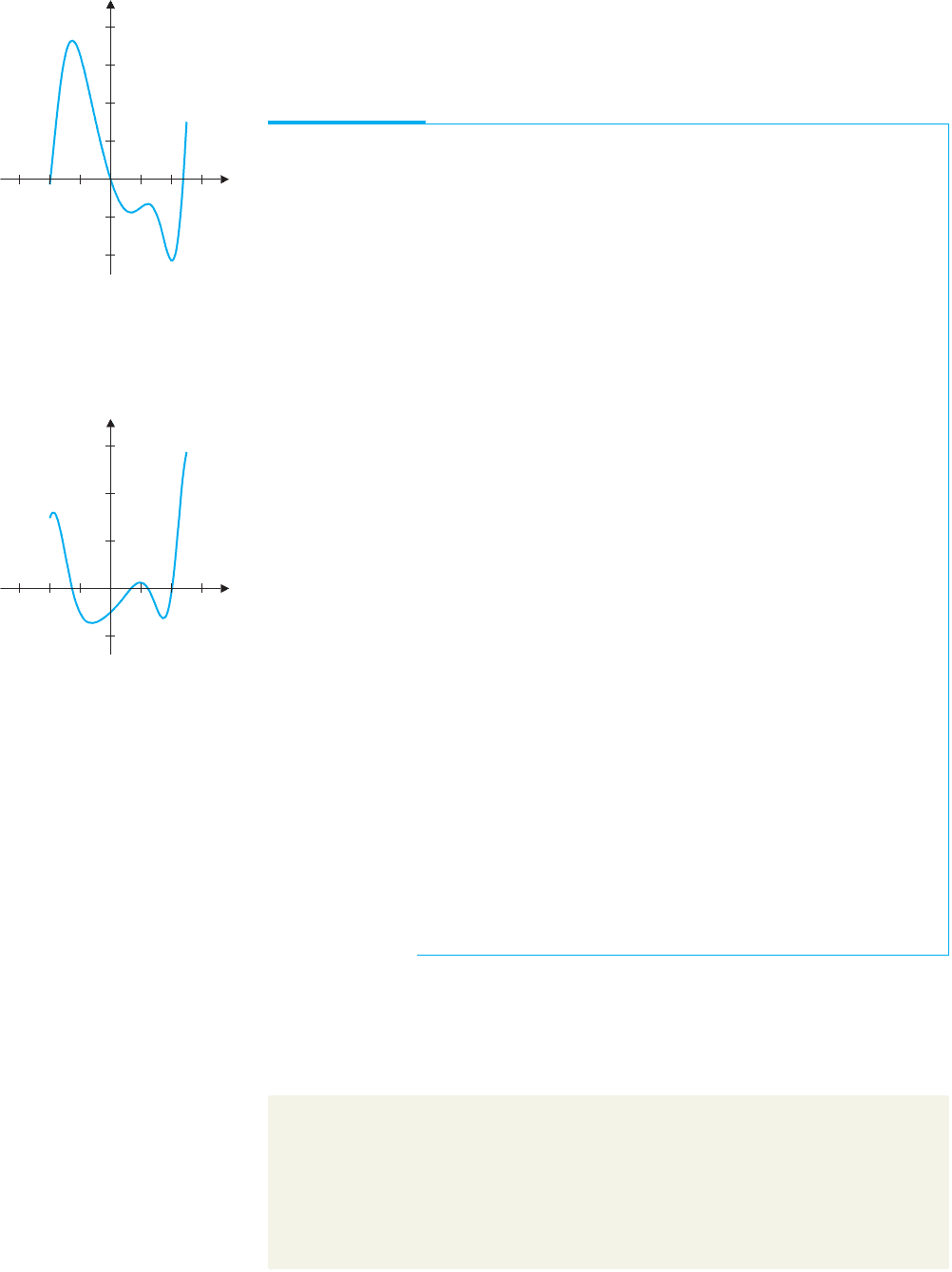
EXAMPLE 2.13 Finding Absolute Extrema Approximately
Find the absolute extrema of f (x) = x
3
− 5x + 3 sin x
2
on the interval [−2, 2.5].
Solution From the graph in Figure 3.28, it appears that the maximum occurs near
x =−1, while the minimum seems to occur near x = 2. Next, we compute
f
(x) = 3x
2
− 5 +6x cos x
2
.
8
4
y
x
32
FIGURE 3.28
y = f (x) = x
3
− 5x + 3 sin x
2
Unlike examples 2.11 and 2.12, there is no algebra we can use to find the zeros of f
.
20
10
y
x
32
FIGURE 3.29
y = f
(x) = 3x
2
− 5 + 6x cos x
2
Our only alternative is to find the zeros approximately. You can do this by using
Newton’s method to solve f
(x) = 0. (You can also use any other rootfinding method
built into your calculator or computer.) First, we’ll need adequate initial guesses. From
the graph of y = f
(x) found in Figure 3.29, it appears that there are four zeros of f
(x)
on the interval in question, located near x =−1.3, 0.7, 1.2 and 2.0. Further, referring
back to Figure 3.28, these four zeros correspond with the four local extrema seen in the
graph of y = f (x). We now apply Newton’s method to solve f
(x) = 0, using the
preceding four values as our initial guesses. This leads us to four approximate critical
numbers of f on the interval [−2, 2.5]. We have
a ≈−1.26410884789, b ≈ 0.674471354085,
c ≈ 1.2266828947 and d ≈ 2.01830371473.
We now need only compare the values of f at the endpoints and the approximate
critical numbers:
f (a) ≈ 7.3, f (b) ≈−1.7, f (c) ≈−1.3
f (d) ≈−4.3, f (−2) ≈−0.3 and f (2.5) ≈ 3.0.
Thus, the absolute maximum is approximately f (−1.26410884789) ≈ 7.3 and the
absolute minimum is approximately f (2.01830371473) ≈−4.3.
It is important (especially in light of how much of our work here was approximate
and graphical) to verify that the approximate extrema correspond with what we expect
from the graph of y = f (x). Since these correspond closely, we have great confidence
in their accuracy.
We have now seen how to locate the absolute extrema of a continuous function on a
closed interval. In section 3.3, we see how to find local extrema.
BEYOND FORMULAS
The Extreme Value Theorem is an important but subtle result. Think of it this way. If
the hypotheses of the theorem are met, you will never waste your time looking for the
maximum of a function that does not have a maximum. That is, the problem is always
solvable. The technique described in Remark 2.4 always works, as long as there are
only finitely many critical numbers.