
Smith R., Minton R. Calculus
Подождите немного. Документ загружается.

P1: OSO/OVY P2: OSO/OVY QC: OSO/OVY T1: OSO
MHDQ256-Ch03 MHDQ256-Smith-v1.cls December 10, 2010 20:20
LT (Late Transcendental)
CONFIRMING PAGES
3-21 SECTION 3.2
..
Maximum and Minimum Values 193
EXERCISES 3.2
WRITING EXERCISES
1. Using one or more graphs, explain why the Extreme Value
Theorem is true. Is the conclusion true if we drop the hypoth-
esis that f is a continuous function? Is the conclusion true if
we drop the hypothesis that the interval is closed?
2. Usingoneor more graphs,arguethatFermat’sTheoremis true.
Discuss how Fermat’s Theorem is used. Restate the theorem
in your own words to make its use clearer.
3. Suppose that f (t) represents your elevation after t hours on
a mountain hike. If you stop to rest, explain why f
(t) = 0.
Discuss the circumstances under which you would be at a lo-
cal maximum, local minimum or neither.
4. Mathematically, an if/then statement is usually strictly one-
directional. When we say “If A, then B” it is generally not the
case that “If B, then A” is also true. When both are true, we
say “A if and only if B,” which is abbreviated to “A iff B.”
Consider the statement, “If you stood in the rain, then you got
wet.” Is this true? How does this differ from its converse, “If
you got wet, then you stood in the rain.”? Apply this logic to
both the Extreme Value Theorem and Fermat’s Theorem: state
the converse and decide whether its conclusion is sometimes
true or always true.
In exercises 1 and 2, use the graph to locate the absolute extrema
(if they exist) of the function on the given interval.
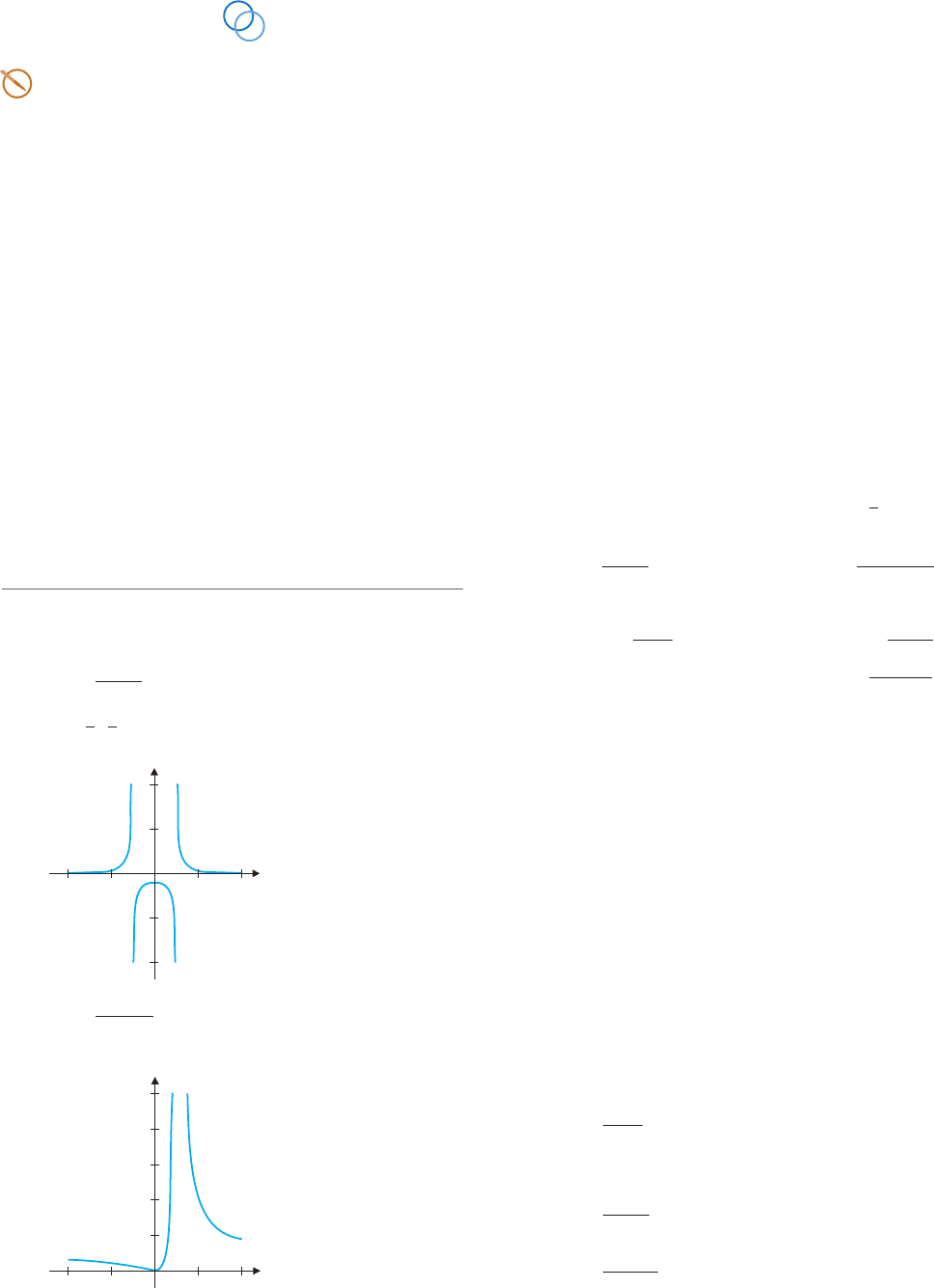
1. f (x) =
1
x
2
− 1
on (a) (0, 1) ∪(1, ∞), (b) (−1, 1), (c) (0, 1),
(d)
−
1
2
,
1
2
x
424 2
y
10
5
5
10
2. f (x) =
x
2
(x − 1)
2
on (a) (−∞, 1) ∪(1, ∞), (b) (−1, 1),
(c) (0,1), (d) [−2, −1]
x
424 2
y
8
6
4
2
10
............................................................
In exercises 3–6, find all critical numbers by hand. Use your
knowledge of the type of graph (i.e., parabola or cubic) to deter-
mine whether the critical number represents a local maximum,
local minimum or neither.
3. (a) f (x) = x
2
+ 5x − 1 (b) f (x) =−x
2
+ 4x + 2
4. (a) f (x) = x
3
− 3x + 1 (b) f (x) =−x
3
+ 6x
2
+ 2
5. (a) f (x) = x
3
− 3x
2
+ 6x (b) f (x) =−x
3
+ 3x
2
− 3x
6. (a) f (x) = x
4
− 2x
2
+ 1 (b) f (x) = x
4
− 3x
3
+ 2
............................................................
In exercises 7–22, find all critical numbers by hand. If avail-
able, use graphing technology to determine whether the critical
number represents a local maximum, local minimum or neither.
7. f (x) = x
4
− 3x
3
+ 2 8. f (x) = x
4
+ 6x
2
− 2
9. f (x) = x
3/4
− 4x
1/4
10. f (x) = (x
2/5
− 3x
1/5
)
2
11. f (x) = sinx cos x, [0, 2π ] 12. f (x) =
√
3sin x + cos x
13. f (x) =
x
2
− 2
x + 2
14. f (x) =
x
2
− x + 4
x − 1
15. f (x) = x
4/3
+ 4x
1/3
+ 4x
−2/3
16. f (x) = x
7/3
− 28x
1/3
17. f (x) = 2x
√
x + 1 18. f (x) = x/
√
x
2
+ 1
19. f (x) =|x
2
− 1| 20. f (x) =
3
√
x
3
− 3x
2
21. f (x) =
x
2
+ 2x − 1ifx < 0
x
2
− 4x + 3ifx ≥ 0
22. f (x) =
sin x if −π<x <π
−tan x if |x|≥π
............................................................
In exercises 23–30, find the absolute extrema of the given func-
tion on each indicated interval.
23. f (x) = x
3
− 3x + 1 on (a) [0, 2] and (b) [−3, 2]
24. f (x) = x
4
− 8x
2
+ 2 on (a) [−3, 1] and (b) [−1, 3]
25. f (x) = x
2/3
on (a) [−4, −2] and (b) [−1, 3]
26. f (x) = sin x + cos x on (a) [0, 2π] and (b) [π/2,π]
27. f (x) =
3x
2
x − 3
on (a) [−2, 2] and (b) [2, 8]
28. f (x) =|2x|−|x − 2| on (a) [0, 1] and (b) [−3, 4]
29. f (x) =
x
x
2
+ 1
on (a) [0, 2] and (b) [−3, 3]
30. f (x) =
3x
x
2
+ 16
on (a) [0, 2] and (b) [0, 6]
............................................................
P1: OSO/OVY P2: OSO/OVY QC: OSO/OVY T1: OSO
MHDQ256-Ch03 MHDQ256-Smith-v1.cls December 10, 2010 20:20
LT (Late Transcendental)
CONFIRMING PAGES
194 CHAPTER 3
..
Applications of Differentiation 3-22
In exercises 31–34, numerically estimate the absolute extrema
of the given function on the indicated intervals.
31. f (x) = x
4
− 3x
2
+ 2x + 1 on (a) [−1, 1] and (b) [−3, 2]
32. f (x) = x
6
− 3x
4
− 2x + 1 on (a) [−1, 1] and (b) [−2, 2]
33. f (x) = x
2
− 3x cos x on (a) [−2, 1] and (b) [−5, 0]
34. f (x) = x sin x + 3on(a)
−π
2
,
π
2
and (b)
[
0, 2π
]
............................................................
35. Sketch a graph of a function f such that the absolute maxi-
mum of f (x) on the interval [−2, 2] equals 3 and the absolute
minimum does not exist.
36. Sketch a graph of a continuous function f such that the abso-
lute maximum of f (x) on the interval (−2, 2) does not exist
and the absolute minimum equals 2.
37. Sketch a graph of a continuous function f such that the abso-
lute maximum of f (x) on the interval (−2, 2) equals 4 and the
absolute minimum equals 2.
38. Sketchagraph ofa function f suchthat the absolute maximum
of f (x) on the interval [−2, 2] does not exist and the absolute
minimum does not exist.
39. In this exercise, we will explore the family of functions
f (x) = x
3
+ cx +1, where c is constant. How many and
what types of local extrema are there? (Your answer will
depend on the value of c.) Assuming that this family is
indicative of all cubic functions, list all types of cubic
functions.
40. Prove that any fourth-order polynomial must have at least
one local extremum and can have a maximum of three local
extrema. Based on this information, sketch several possible
graphs of fourth-order polynomials.
41. Show that f (x) = x
3
+ bx
2
+ cx +d has both a local maxi-
mum and a local minimum if c < 0.
42. In exercise 41, show that the sum of the critical numbers
is −
2b
3
.
43. Forthe family of functions f (x) = x
4
+ cx
2
+ 1, find all local
extrema. (Your answer will depend on the value of the con-
stant c.)
44. Forthe family of functions f (x) = x
4
+ cx
3
+ 1, find all local
extrema. (Your answer will depend on the value of the con-
stant c.)
45. If f is differentiable on the interval [a, b] and
f
(a) < 0 < f
(b), prove that there is a c with a < c < b
for which f
(c) = 0. (Hint: Use the Extreme Value Theorem
and Fermat’s Theorem.)
46. Sketch a graph showing that y = f (x) = x
2
+ 1 and
y = g(x) = sin x do not intersect. Estimate x to minimize
f (x) − g(x). At this value of x, show that the tangent
lines to y = f (x) and y = g(x) are parallel. Explain graph-
ically why it makes sense that the tangent lines are
parallel.
47. Sketch a graph of f (x) =
x
2
x
2
+ 1
for x > 0 and determine
where the graph is steepest. (That is, find where the slope is a
maximum.)
48. Give an example showing that the following statement is false
(not always true): between any two local minima of f (x) there
isa local maximum. Isthe statement trueif f (x) iscontinuous?
APPLICATIONS
49. If you have won three out of four matches against someone,
does that mean that the probability that you will win the next
one is
3
4
? In general, if you have a probability p of winning
each match, the probability of winning m out of n matches
is f (p) =
n!
(n − m)!m!
p
m
(1 − p)
n−m
. Find p to maximize f .
This value of p is called the maximum likelihood estima-
tor of the probability. Briefly explain why your answer makes
sense.
50. A section of roller coaster is in the shape of
y = x
5
− 4x
3
− x + 10, where x is between−2 and 2. Findall
local extrema and explain what portions of the roller coaster
they represent. Find the location of the steepest part of the
roller coaster.
51. The rate R of an enzymatic reaction as a function of the sub-
strate concentration [S]isgivenbyR =
[S]R
m
K
m
+ [S]
, where R
m
and K
m
are constants. K
m
is called the Michaelis constant and
R
m
is referred to as the maximum reaction rate. Show that R
m
is not a proper maximum in that the reaction rate can never be
equal to R
m
.
EXPLORATORY EXERCISES
1. Explore the graphs of
x
x
2
+ 1
,
x
x
2
+ 4
,
x
x
2
+ 9
and
x
x
2
+ 16
.
Find all local extrema and determine the behavior as x →∞.
You can think of the graph of
x
x
2
+ c
2
as showing the results
of a tug-of-war: both x and x
2
+ c
2
tend to ∞ as x →∞,but
at different rates. Explain why the local extrema spread out as
c increases.
2. Johannes Kepler (1571–1630) is best known as an astronomer,
especially for his three laws of planetary motion. However,
he was also brilliant mathematically. While serving in Aus-
trian Emperor Matthew I’s court, Kepler observed the ability
of Austrian vintners to quickly and mysteriously com-
pute the capacities of a variety of wine casks. Each cask
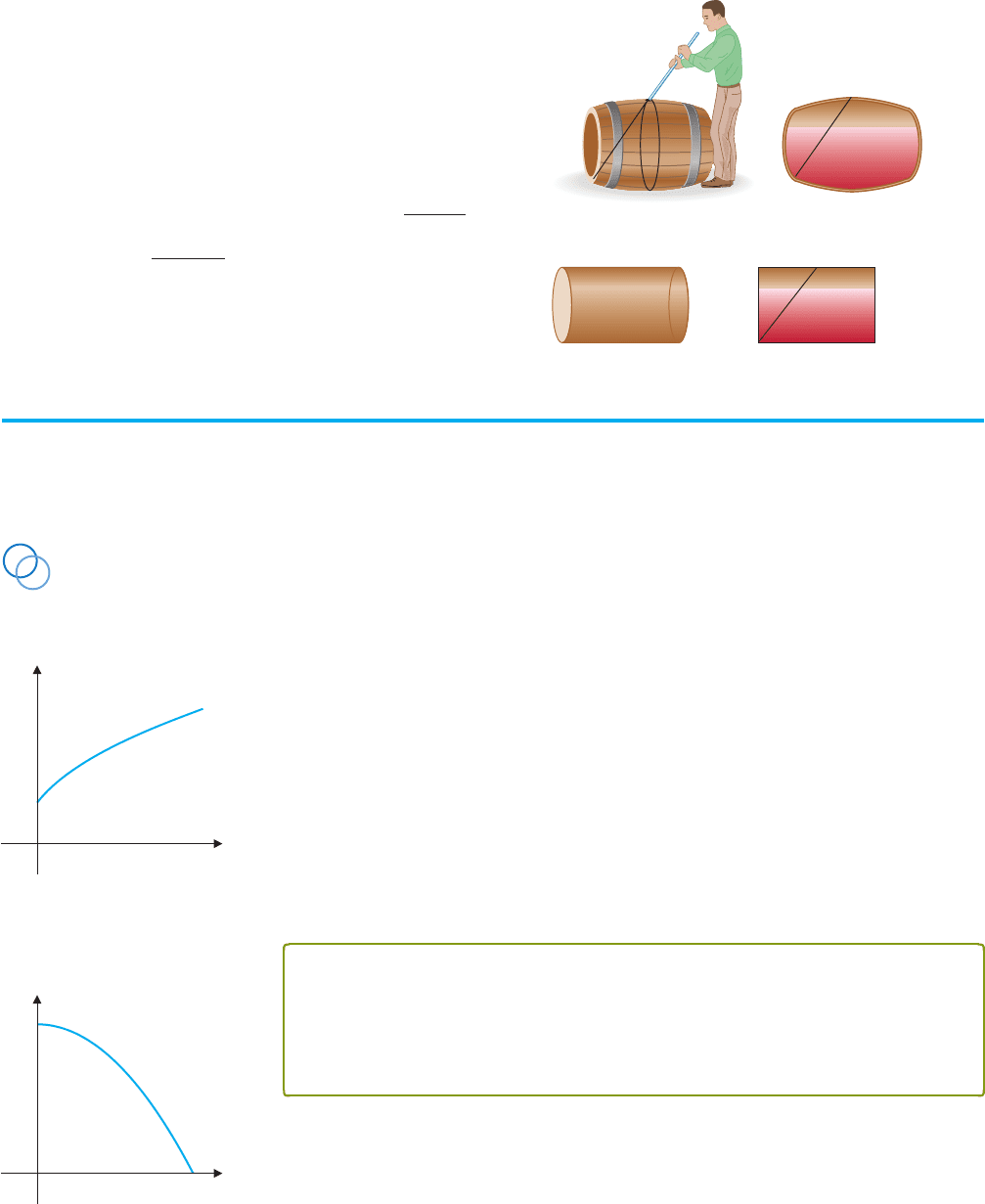
(barrel) had a hole in the middle of its side. (See Figure a.)
P1: OSO/OVY P2: OSO/OVY QC: OSO/OVY T1: OSO
MHDQ256-Ch03 MHDQ256-Smith-v1.cls December 10, 2010 20:20
LT (Late Transcendental)
CONFIRMING PAGES
3-23 SECTION 3.3
..
Increasing and Decreasing Functions 195
The vintner would insert a rod in the hole until it hit the
far corner and then announce the volume. Kepler first an-
alyzed the problem for a cylindrical barrel. (See Figure b.)
The volume of a cylinder is V = πr
2
h. In Figure b, r = y
and h = 2x,soV = 2π y
2
x. Call the rod measurement z.
By the Pythagorean Theorem, x
2
+ (2y)
2
= z
2
. Kepler’s mys-
tery was how to compute V given only z. The key obser-
vation made by Kepler was that Austrian wine casks were
made with the same height-to-diameter ratio (for us, x/y). Let
t = x/y and show that z
2
/y
2
= t
2
+ 4. Use this to replace
y
2
in the volume formula. Then replace x with
z
2
+ 4y
2
.
Show that V =
2π z
3
t
(4 + t
2
)
3/2
. In this formula, t is a constant, so
the vintner could measure z and quickly estimate the volume.
We haven’t told you yet what t equals. Kepler assumed that
the vintners would have made a smart choice for this ratio.
Find the value of t that maximizes the volume for a given z.
This is, in fact, the ratio used in the construction of Austrian
wine casks!
z
FIGURE a
z
2y
2x
FIGURE b
3.3 INCREASING AND DECREASING FUNCTIONS
In section 3.2, we determined that local extrema occur only at critical numbers. However,
notall critical numbers correspond to local extrema.Inthissection,weseehowtodetermine
which critical numbers correspond to local extrema. At the same time, we’ll learn more
about the connection between the derivative and graphing.
We are all familiar with the termsincreasing and decreasing. If your employer informs
you that your salarywill be increasing steadily over the term of your employment, you have
in mind that as time goes on, your salary will rise something like Figure 3.30. If you take
out a loan to purchase a car, once you start paying back the loan, your indebtedness will
decrease over time. If you plotted your debt against time, the graph might look something
like Figure 3.31.
We now carefully define these notions. Notice that Definition 3.1 is merely a formal
statement of something you already understand.
Time
Salary
FIGURE 3.30
Increasing salary
Time
Debt
FIGURE 3.31
Decreasing debt
DEFINITION 3.1
A function f is increasing on an interval I if for every x
1
, x
2
∈ I with x
1
< x
2
,
f (x
1
) < f (x
2
) [i.e., f (x) gets larger as x gets larger].
A function f is decreasing on the interval I if for every x
1
, x
2
∈ I with
x
1
< x
2
, f (x
1
) > f (x
2
) [i.e., f (x) gets smaller as x gets larger].
Whileanyonecan look ata graph of a function andimmediatelysee where that function
is increasing and decreasing, the challenge is to determine where a function is increasing
and decreasing, given only a mathematical formula for the function. For example, can you
determine where f (x) = x
2
sin x is increasing and decreasing, without looking at a graph?
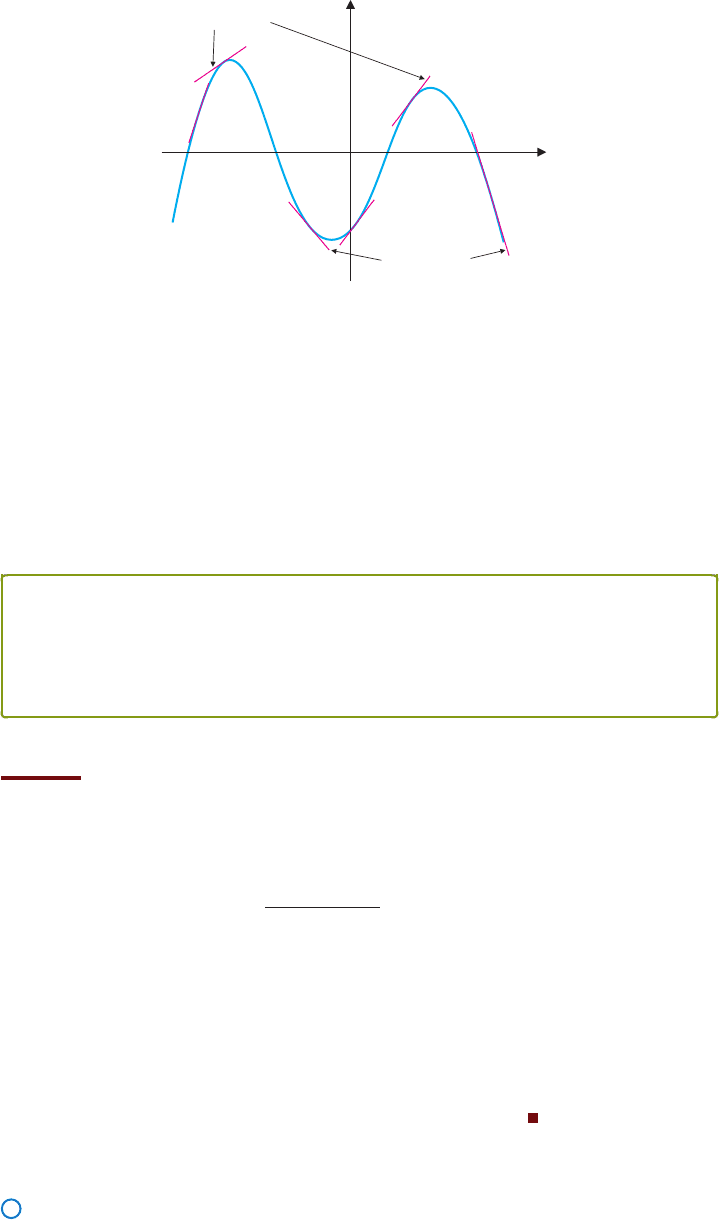
Look carefully at Figure 3.32 (on the following page) to see if you can notice what happens
at every point at which the function is increasing or decreasing.
Observe that on intervals where the tangent lines have positive slope, f is increasing,
while on intervals where the tangent lines have negative slope, f is decreasing. Of course,
P1: OSO/OVY P2: OSO/OVY QC: OSO/OVY T1: OSO
MHDQ256-Ch03 MHDQ256-Smith-v1.cls December 10, 2010 20:20
LT (Late Transcendental)
CONFIRMING PAGES
196 CHAPTER 3
..
Applications of Differentiation 3-24
f increasing
(tangent lines have
positive slope)
f decreasing
(tangent lines have
negative slope)
x
y
y f(x)
FIGURE 3.32
Increasing and decreasing
the slope of the tangent line at a point is given by the value of the derivative at that point.
So, whether a function is increasing or decreasing on an interval seems to be determined by
the sign of itsderivative on that interval. We now state a theorem that makes this connection
precise.
THEOREM 3.1
Suppose that f is differentiable on an interval I.
(i) If f
(x) > 0 for all x ∈ I , then f is increasing on I .
(ii) If f
(x) < 0 for all x ∈ I , then f is decreasing on I .
PROOF
(i) Pick any two points x
1
, x
2
∈ I , with x
1
< x
2
. Applying the Mean Value Theorem
(Theorem 8.4 in section 2.8) to f on the interval (x
1
, x
2
), we get
f (x
2
) − f (x
1
)
x
2
− x
1
= f
(c), (3.1)
for some number c ∈ (x
1
, x
2
). (Why can we apply the Mean Value Theorem here?) By
hypothesis, f
(c) > 0 and since x
1
< x
2
(so that x
2
− x
1
> 0), we have from (3.1) that
0 < f (x
2
) − f (x
1
)
or
f (x
1
) < f (x
2
). (3.2)
Since (3.2) holds for all x
1
< x
2
, f is increasing on I .
The proof of (ii) is nearly identical and is left as an exercise.
What You See May Not Be What You Get
One aim here and in sections 3.4 and 3.5 is to learn how to draw representative graphs
of functions (i.e., graphs that display all of the significant features of a function: where it
is increasing or decreasing, any extrema, asymptotes and two features we’ll introduce in
section 3.4: concavity and inflection points). We draw each graph in a particular viewing
P1: OSO/OVY P2: OSO/OVY QC: OSO/OVY T1: OSO
MHDQ256-Ch03 MHDQ256-Smith-v1.cls December 10, 2010 20:20
LT (Late Transcendental)
CONFIRMING PAGES
3-25 SECTION 3.3
..
Increasing and Decreasing Functions 197
window (i.e., a particular range of x- and y-values). In the case of computer- or calculator-
generated graphs, the window is often chosen by the machine. To uncover when significant
features are hidden outside of a given window or to determine the precise locations of
features that we can see in a given window, we need some calculus.
EXAMPLE 3.1 Drawing a Graph
Draw a graph of f (x) = 2x
3
+ 9x
2
− 24x − 10 showing all local extrema.
10
10
y
x
1010
FIGURE 3.33
y = 2x
3
+ 9x
2
− 24x − 10
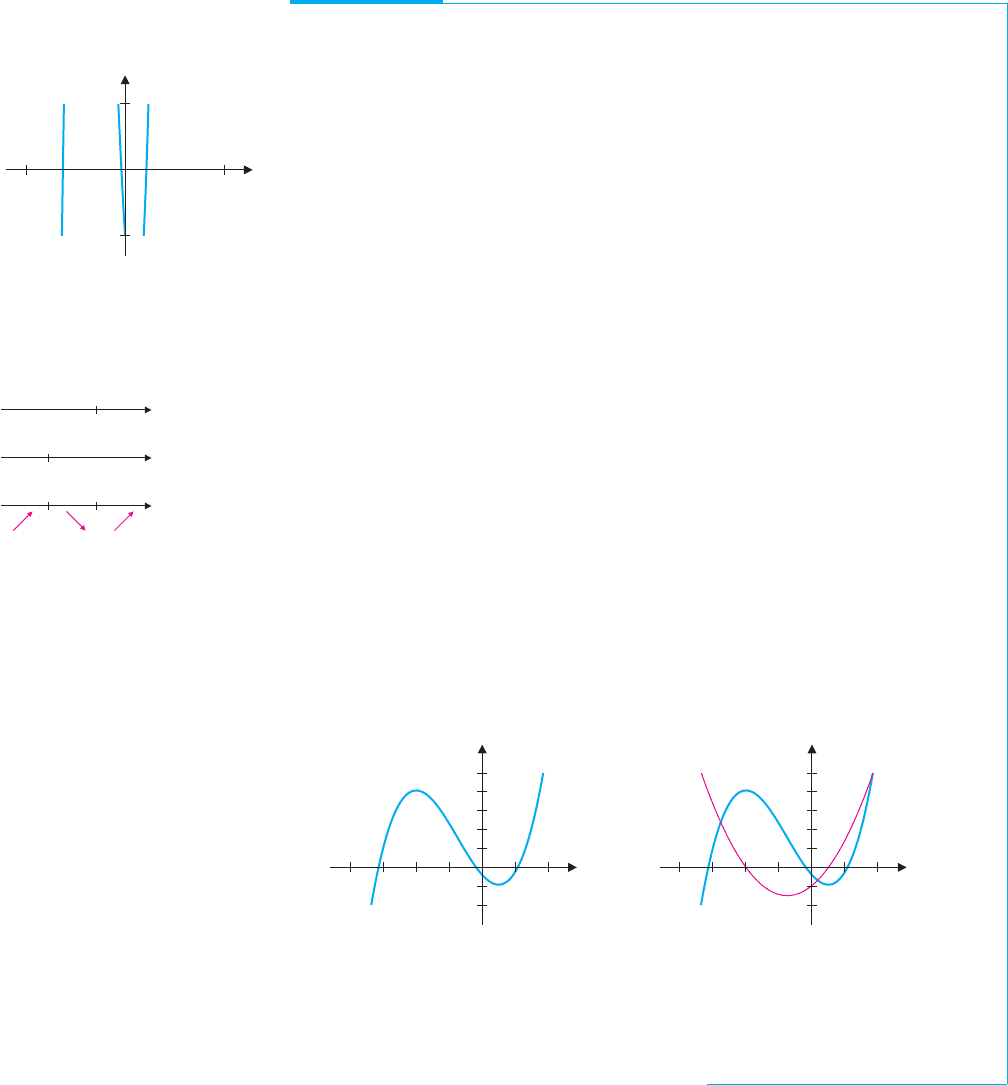
Solution Many graphing calculators use the default window defined by
−10 ≤ x ≤ 10 and −10 ≤ y ≤ 10. Using this window, the graph of y = f (x) looks
like that displayed in Figure 3.33, although the three segments shown are not
particularly revealing. Instead of blindly manipulating the window in the hope that a
reasonable graph will magically appear, we stop briefly to determine where the function
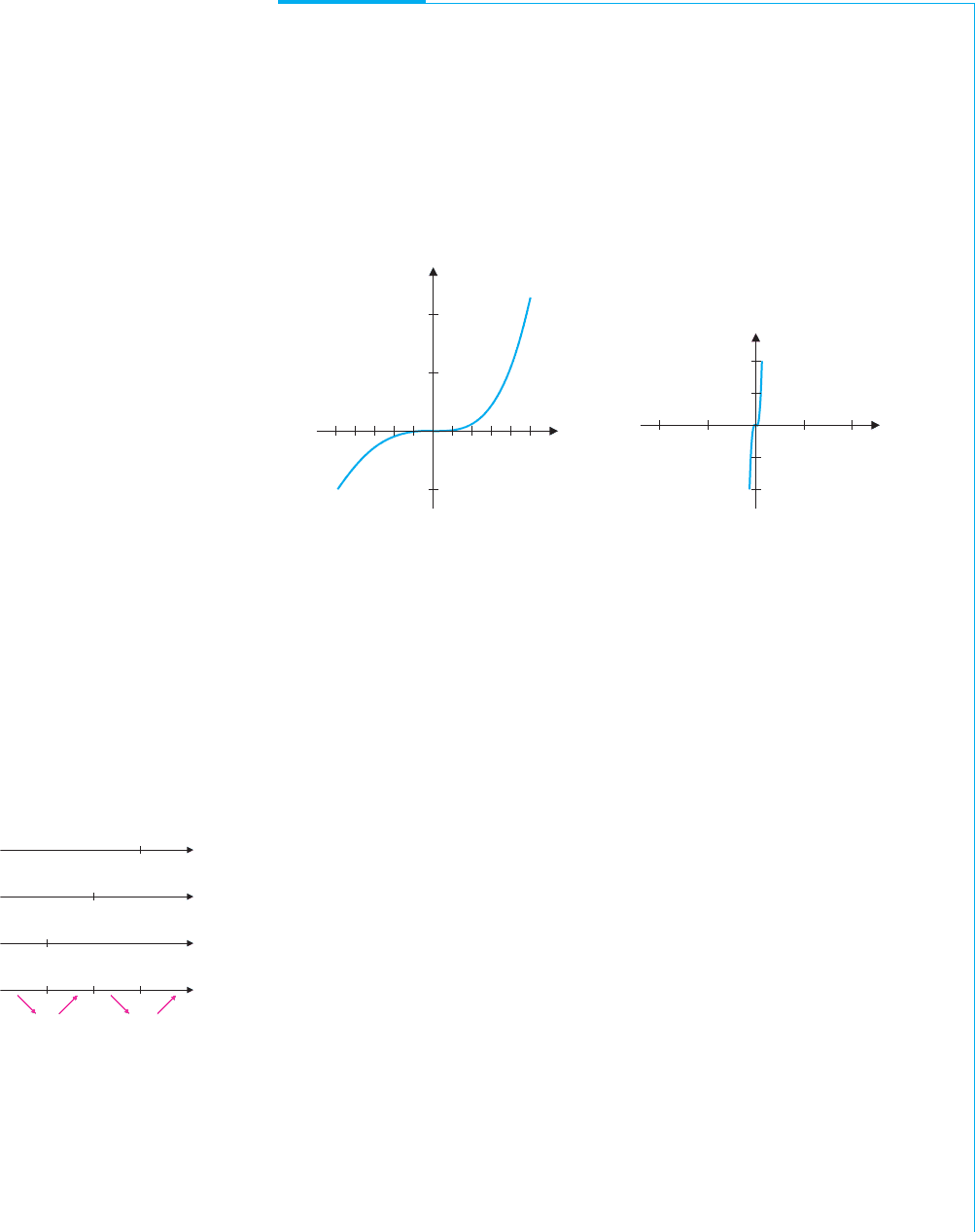
is increasing and decreasing. We have
f
(x) = 6x
2
+ 18x − 24 = 6(x
2
+ 3x − 4)
= 6(x − 1)(x + 4).
Note that the critical numbers (1 and −4) are the only possible locations for local
extrema. We can see where the two factors and consequently the derivative are positive
and negative from the number lines displayed in the margin. From this, note that
f
(x) > 0on(−∞, −4) and (1, ∞) f increasing.
and
f
(x) < 0on(−4, 1). f decreasing.
For convenience, we have placed arrows indicating where the function is increasing and
decreasing beneath the last number line. In Figure 3.34a, we redraw the graph in the
window defined by −8 ≤ x ≤ 4 and −50 ≤ y ≤ 125. Here, we have selected the
y-range so that the critical points (−4, 102) and (1, −23) are displayed. Since f is
increasing on all of (−∞, −4), we know that the function is still increasing to the left of
the portion displayed in Figure 3.34a. Likewise, since f is increasing on all of (1, ∞),
we know that the function continues to increase to the right of the displayed portion. In
Figure 3.34b, we have plotted both y = f (x) (shown in blue) and y = f
(x) (shown in
f'(x) 6(x 1)(x 4)
1
0
4
0
6(x 1)
1
(x 4)
4
0
0
100
50
y
x
48
100
f(x)
f'(x)
50
y
x
48
FIGURE 3.34a FIGURE 3.34b
y = 2x
3
+ 9x
2
− 24x − 10 y = f (x) and y = f
(x)
red). Notice the connection between the two graphs. When f
(x) > 0, f is increasing;
when f
(x) < 0, f is decreasing. Also notice what happens to f
(x) at the local
extrema of f . (We’ll say more about this shortly.)
You may be tempted to think that you can draw graphs by machine and with a little
fiddling with the graphing window, get a reasonable looking graph. Unfortunately, this
frequently isn’t enough. For instance, while it’s clear that the graph in Figure 3.33 is in-
complete, the initial graph in example 3.2 has a familiar shape and may look reasonable,
P1: OSO/OVY P2: OSO/OVY QC: OSO/OVY T1: OSO
MHDQ256-Ch03 MHDQ256-Smith-v1.cls December 13, 2010 15:16
LT (Late Transcendental)
CONFIRMING PAGES
198 CHAPTER 3
..
Applications of Differentiation 3-26
but it is incorrect. The calculus tells you what features you should expect to see in a graph.
Without it, you’re simply taking a shot in the dark.
EXAMPLE 3.2 Uncovering Hidden Behavior in a Graph
Graph f (x) = 3x
4
+ 40x
3
− 0.06x
2
− 1.2x showing all local extrema.
Solution The default graph drawn by our computer algebra system is shown in
Figure 3.35a, while a common default graphing calculator graph is shown in
Figure 3.35b. You can certainly make Figure 3.35b look more like Figure 3.35a by
adjusting the window some. But with some calculus, you can discover features that are
hidden in both graphs.
6000
3000
3000
y
x
44
10
10
y
x
1010
FIGURE 3.35a FIGURE 3.35b
Default CAS graph of Default calculator graph of
y = 3x
4
+ 40x
3
− 0.06x
2
− 1.2xy= 3x
4
+ 40x
3
− 0.06x
2
− 1.2x
First, notice that
f
(x) = 12x
3
+ 120x
2
− 0.12x − 1.2
= 12(x
2
− 0.01)(x + 10)
= 12(x − 0.1)(x + 0.1)(x + 10).
We show number lines for the three factors in the margin. Observe that
f
(x)
> 0on(−10, −0.1)and(0.1, ∞)
f increasing.
< 0on(−∞, −10)and(−0.1, 0.1). f decreasing.
0.1 0.1
0
10
0
0
10
0
0.1
0
0.1
0
f'(x)
(x 10)
(x 0.1)
12(x 0.1)
Since both of the graphs in Figures 3.35a and 3.35b suggest that f is increasing for all x,
neither of these graphs is adequate. As it turns out, no single graph captures all of the
behavior of this function. However, by increasing the range of x-values to the interval
[−15, 5], we get the graph seen in Figure 3.36a. This shows what we refer to as the
global behavior of the function. Here, you can see the local minimum at x =−10,
which was missing in our earlier graphs, but the behavior for values of x close to zero is
not clear. To see this, we need a separate graph, restricted to a smaller range of x-values,
as seen in Figure 3.36b. Here, we can clearly see the behavior of the function for x close
to zero. In particular, the local maximum at x =−0.1 and the local minimum at
x = 0.1 are clearly visible. We often say that a graph such as Figure 3.36b shows the
local behavior of the function. In Figures 3.37a and 3.37b, we show graphs indicating
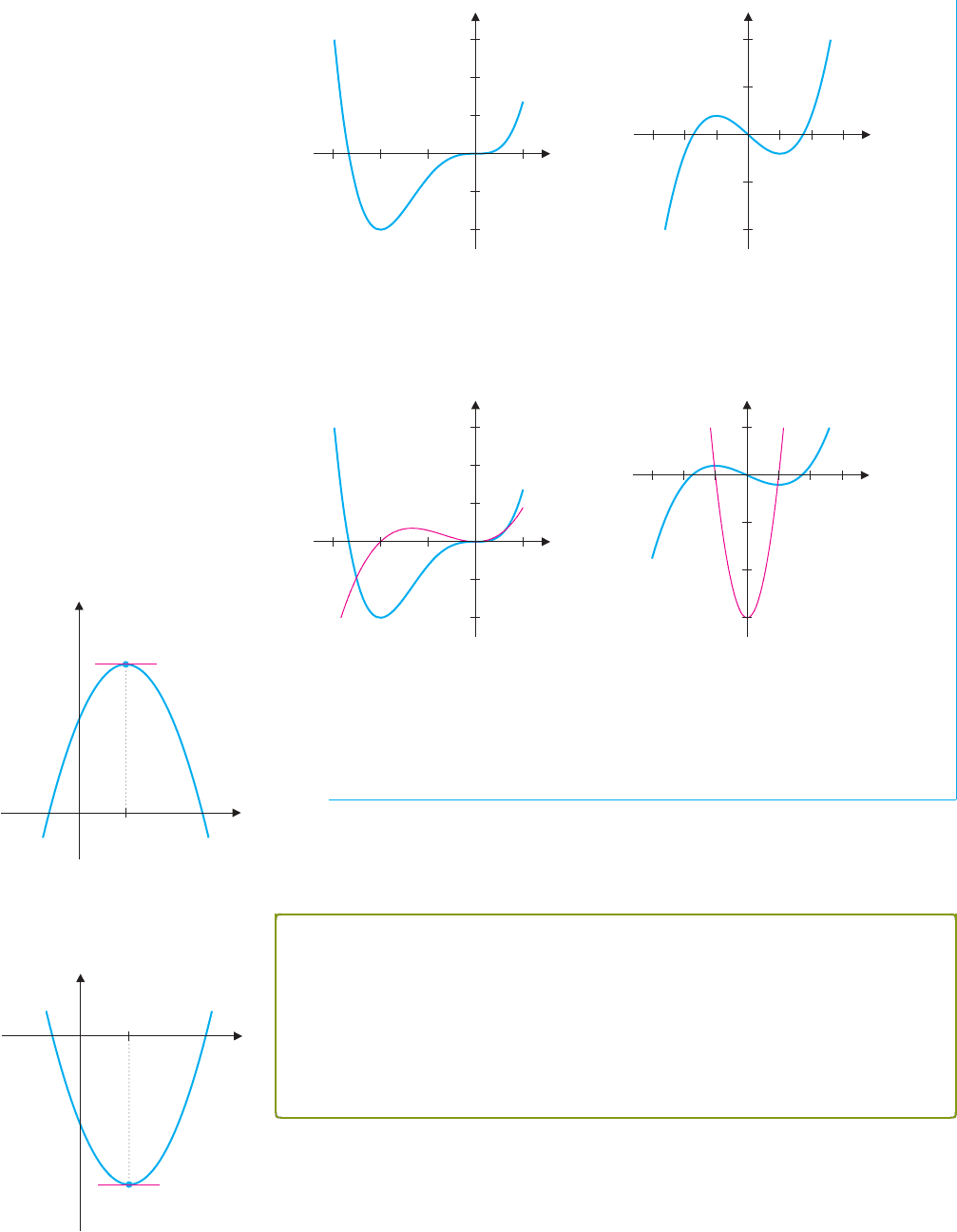
P1: OSO/OVY P2: OSO/OVY QC: OSO/OVY T1: OSO
MHDQ256-Ch03 MHDQ256-Smith-v1.cls December 10, 2010 20:20
LT (Late Transcendental)
CONFIRMING PAGES
3-27 SECTION 3.3
..
Increasing and Decreasing Functions 199
10,000
10,000
y
x
515
0.4
0.4
y
x
0.30.3
FIGURE 3.36a FIGURE 3.36b
The global behavior of Local behavior of
f (x) = 3x
4
+ 40x
3
− 0.06x
2
−1.2xf(x) = 3x
4
+ 40x
3
− 0.06x
2
−1.2x
10,000
f (x)
f '(x)
10,000
y
x
515
0.4
1.2
y
x
0.30.3
f (x)
f '(x)
FIGURE 3.37a FIGURE 3.37b
y = f (x) and y = f
(x) y = f (x) and y = f
(x)
(global behavior) (local behavior)
the global and local behavior of f (x) (in blue) and f
(x) (in red) on the same set of axes.
Pay particular attention to the behavior of f
(x) in the vicinity of local extrema of f (x).
You may have already noticed a connection between local extrema and the intervals on
which a function is increasing and decreasing. We state this in Theorem 3.2.
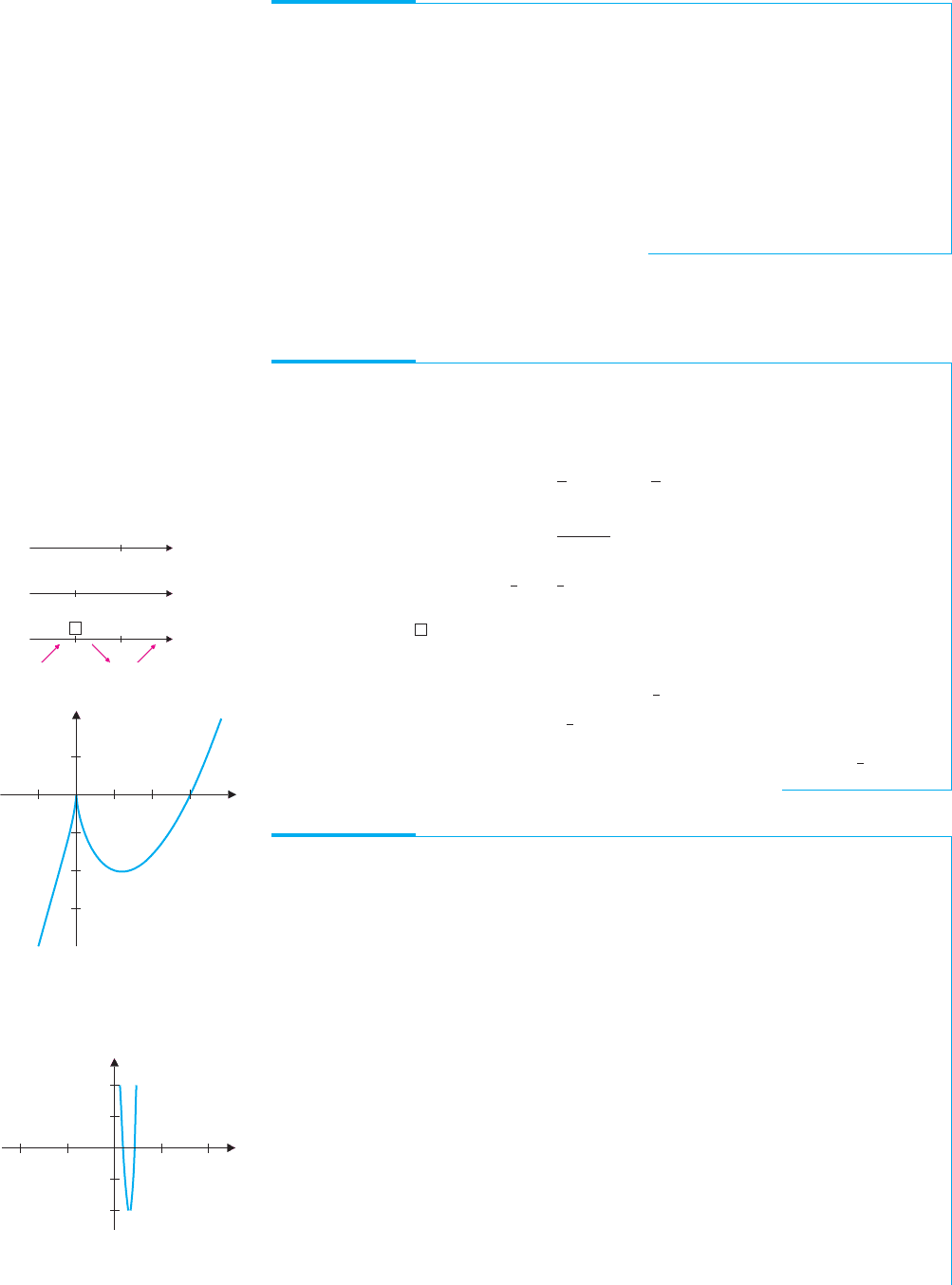
THEOREM 3.2 (First Derivative Test)
Suppose that f is continuous on the interval [a, b] and c ∈ (a, b) is a critical number.
(i) If f
(x) > 0 for all x ∈ (a, c) and f
(x) < 0 for all x ∈ (c, b) (i.e., f changes
from increasing to decreasing at c), then f (c) is a local maximum.
(ii) If f
(x) < 0 for all x ∈ (a, c) and f
(x) > 0 for all x ∈ (c, b) (i.e., f changes
from decreasing to increasing at c), then f (c) is a local minimum.
(iii) If f
(x) has the same sign on (a, c) and (c, b), then f (c)isnot a local extremum.
f(x) 0
f decreasing
f(x) 0
f
increasing
x
y
c
Local
maximum
FIGURE 3.38a
Local maximum
f(x) 0
f increasing
f(x) 0
f decreasing
x
y
c
Local
minimum
FIGURE 3.38b
Local minimum
It’s easiest to think of this result graphically. If f is increasing to the left of a critical
number and decreasing to the right, then there must be a local maximum at the critical
number. (See Figure 3.38a.) Likewise, if f is decreasing to the left of a critical number
and increasing to the right, then there must be a local minimum at the critical number. (See
Figure 3.38b.) This suggests a proof of the theorem; the job of writing out all of the details
is left as an exercise.
P1: OSO/OVY P2: OSO/OVY QC: OSO/OVY T1: OSO
MHDQ256-Ch03 MHDQ256-Smith-v1.cls December 10, 2010 20:20
LT (Late Transcendental)
CONFIRMING PAGES
200 CHAPTER 3
..
Applications of Differentiation 3-28
EXAMPLE 3.3 Finding Local Extrema Using the First
Derivative Test
Find the local extrema of the function from example 3.1, f (x) = 2x
3
+ 9x
2
− 24x − 10.
Solution We had found in example 3.1 that
f
(x)
> 0, on (−∞, −4) and (1, ∞)
f increasing.
< 0, on (−4, 1). f decreasing.
It now follows from the First Derivative Test that f has a local maximum located at
x =−4 and a local minimum located at x = 1.
Theorem 3.2 works equally well for a function with critical points where the derivative
is undefined.
EXAMPLE 3.4 Finding Local Extrema of a Function
with Fractional Exponents
Find the local extrema of f (x) = x
5/3
− 3x
2/3
.
f(x)
6/5
0
0
3x
1/3
(5x 6)
0
0
0
6/5
1
y
x
2
FIGURE 3.39
y = x
5/3
− 3x
2/3
Solution We have
f
(x) =
5
3
x
2/3
− 3
2
3
x
−1/3
=
5x − 6
3x
1/3
,
so that the critical numbers are
6
5
[ f
6
5
= 0] and 0[ f
(0) is undefined]. Again drawing
number lines for the factors, we determine where f is increasing and decreasing. Here,
we have placed an
above the 0 on the number line for f
(x) to indicate that f
(x)is
not defined at x = 0. From this, we can see at a glance where f
is positive and negative:
f
(x)
> 0, on (−∞, 0) and
6
5
, ∞
f increasing.
< 0, on
0,
6
5
.
f decreasing.
Consequently, f has a local maximum at x = 0 and a local minimum at x =
6
5
. These
local extrema are both clearly visible in the graph in Figure 3.39.
EXAMPLE 3.5 Finding Local Extrema Approximately
Find the local extrema of f (x) = x
4
+ 4x
3
− 5x
2
− 31x + 29 and draw a graph.
Solution A graph of y = f (x) using the most common graphing calculator default
window appears in Figure 3.40. Without further analysis, we do not know whether
this graph shows all of the significant behavior of the function. [Note that some
fourth-degree polynomials (e.g., f (x) = x
4
) have graphs that look very much like the
one in Figure 3.40.] First, we compute
f
(x) = 4x
3
+ 12x
2
− 10x − 31.
However, this derivative does not easily factor. A graph of y = f
(x) (see Figure 3.41)
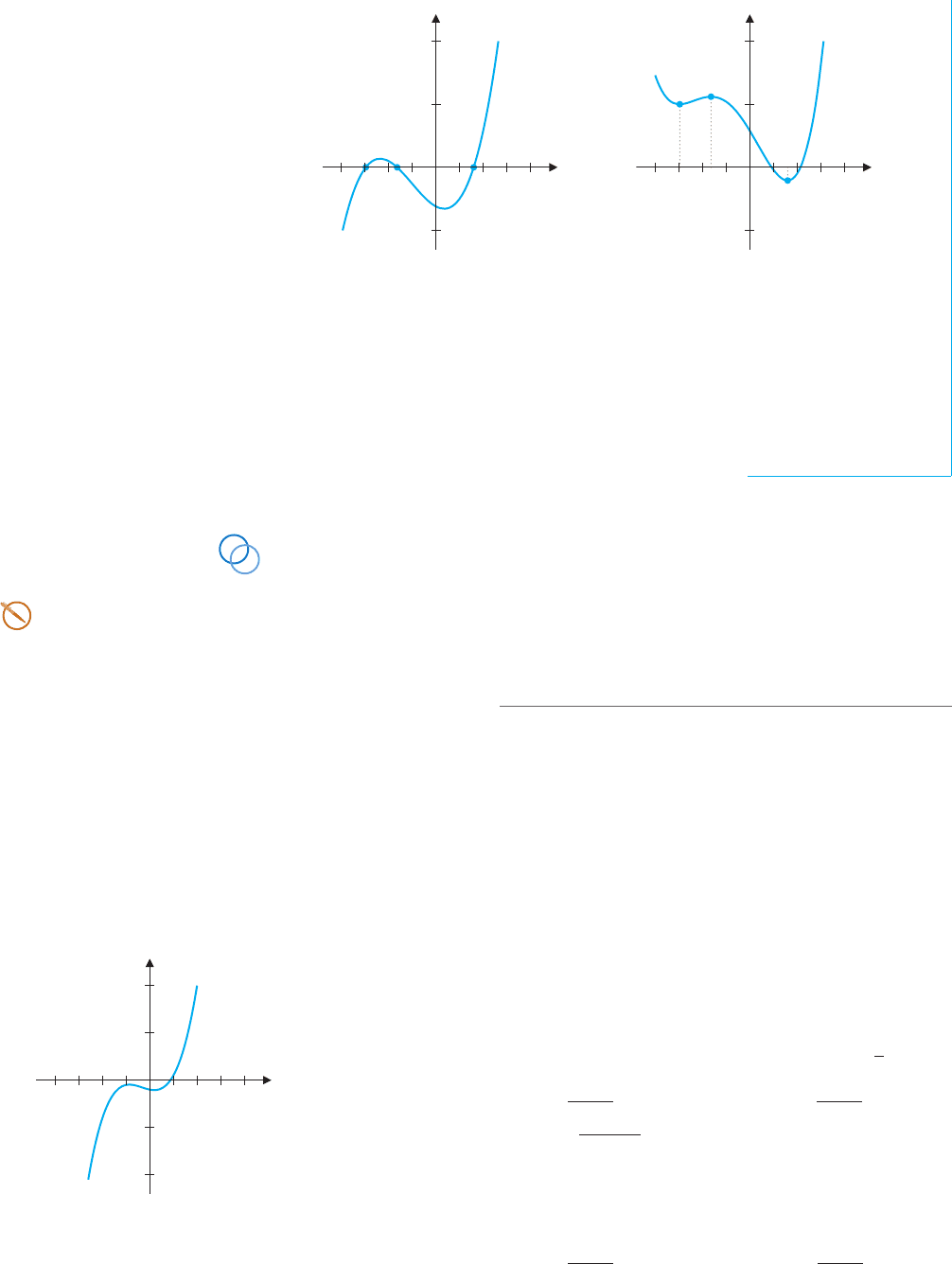
reveals three zeros, one near each of x =−3, −1.5 and 1.5. Since a cubic polynomial
has at most three zeros, there are no others. Using Newton’s method or some other
rootfinding method [applied to f
(x)], we can find approximations to the three zeros of
f
.Wegeta ≈−2.96008, b ≈−1.63816 and c ≈ 1.59824. From Figure 3.41, we can
see that
f
(x) > 0on(a, b) and (c, ∞) f increasing.
10
10
y
x
1010
FIGURE 3.40
f (x) = x
4
+ 4x
3
− 5x
2
− 31x + 29
and
f
(x) < 0on(−∞, a) and (b, c). f decreasing.
P1: OSO/OVY P2: OSO/OVY QC: OSO/OVY T1: OSO
MHDQ256-Ch03 MHDQ256-Smith-v1.cls December 10, 2010 20:20
LT (Late Transcendental)
CONFIRMING PAGES
3-29 SECTION 3.3
..
Increasing and Decreasing Functions 201
100
50
50
y
x
44
ab c
100
50
y
x
44
ab
c
FIGURE 3.41
f
(x) = 4x
3
+ 12x
2
− 10x − 31
FIGURE 3.42
f (x) = x
4
+4x
3
−5x
2
−31x +29
From the First Derivative Test, there is a local minimum at a ≈−2.96008, a local
maximum at b ≈−1.63816 and a local minimum at c ≈ 1.59824. Since only the local
minimum at x = c is visible in the graph in Figure 3.40, this graph is inadequate. By
narrowing the range of displayed x-values and widening the range of displayed
y-values, we obtain the far more useful graph seen in Figure 3.42. Note that the local
minimum at x = c ≈ 1.59824 is also the absolute minimum.
EXERCISES 3.3
WRITING EXERCISES
1. Suppose that f (0) = 2 and f is an increasing function. To
sketch the graph of y = f (x), you could start by plotting the
point (0, 2). Filling in the graph to the left, would you move
your pencil up or down? How does this fit with the definition
of increasing?
2. Suppose you travel east on an east-west interstate highway.
You reach your destination,stay a while and then return home.
Explain the First Derivative Test in terms of your velocities
(positive and negative) on this trip.
3. Supposethat youhaveadifferentiablefunction f with two dis-
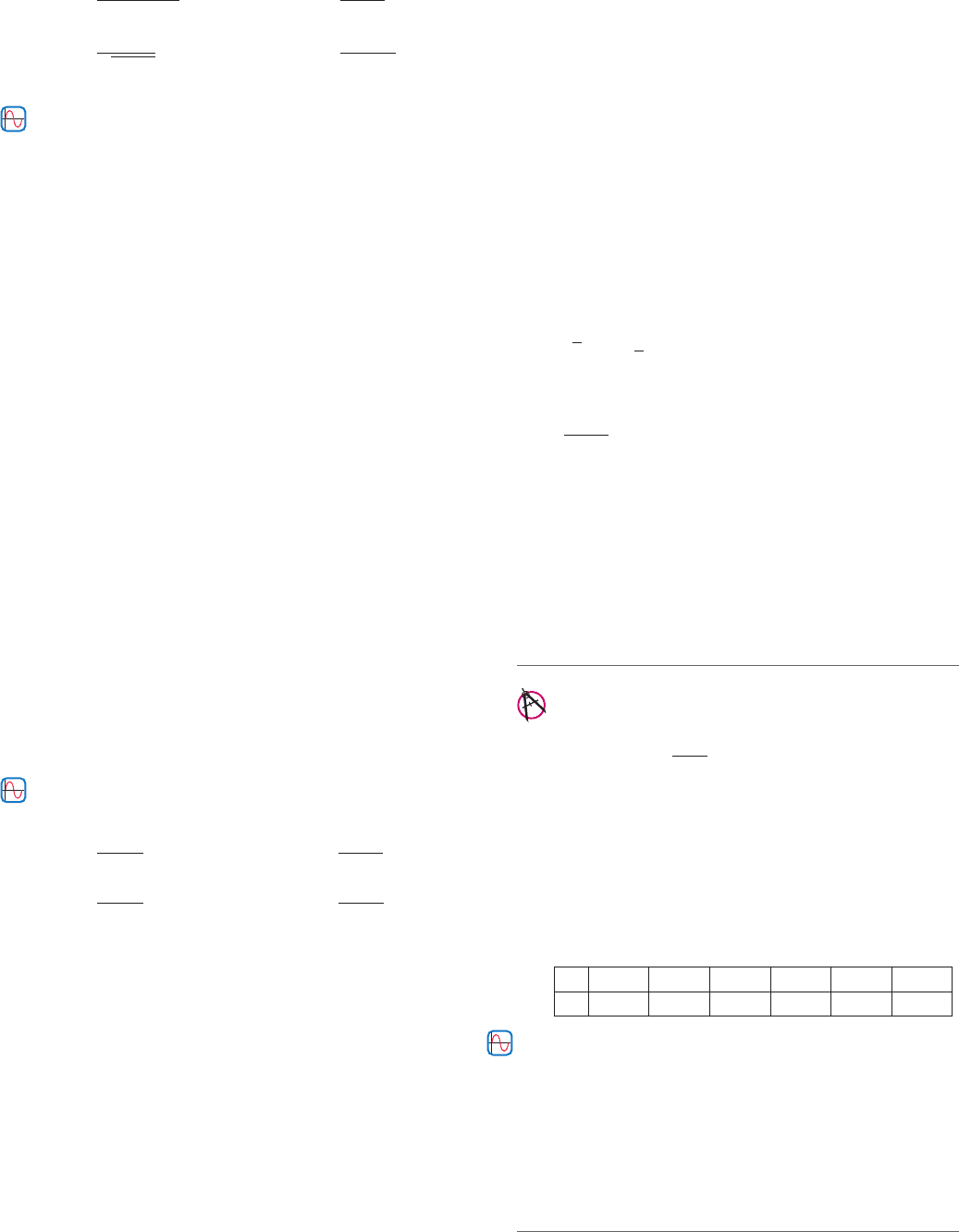
tinct critical numbers. Your computer has shown you a graph
that looks like the one in the figure.
10
10
y
x
44
Discuss the possibility that this is a representative graph: that
is, is it possible that there are any important points not shown
in this window?
4. Supposethatthefunction in exercise3 has threedistinctcritical
numbers. Explain why the graph is not a representative graph.
Discuss how you would change the graphing window to show
the rest of the graph.
In exercises 1–8, find (by hand) the intervals where the function
is increasing and decreasing. Use this information to determine
all local extrema and sketch a graph.
1. y = x
3
− 3x + 2 2. y = x
3
+ 2x
2
+ 1
3. y = x
4
− 8x
2
+ 1 4. y = x
3
− 3x
2
− 9x + 1
5. y = (x + 1)
2/3
6. y = (x − 1)
1/3
7. y = sin x + cos x 8. y = sin
2
x
............................................................
In exercises 9–16, find (by hand) all critical numbers and use
the First Derivative Test to classify each as the location of a local
maximum, local minimum or neither.
9. y = x
4
+ 4x
3
− 2 10. y = x
5
− 5x
2
+ 1
11. y = x
2
− 2x
2/3
+ 2 12. y = x
2
− 2
√
x + 2
13. y =
x
1 + x
3
14. y =
x
1 + x
4
15. y =
√
x
3
+ 3x
2
16. y = x
4/3
+ 4x
1/3
............................................................
In exercises 17–22, find (by hand) all asymptotes and extrema,
and sketch a graph.
17. y =
x
x
2
− 1
18. y =
x
2
x
2
− 1
P1: OSO/OVY P2: OSO/OVY QC: OSO/OVY T1: OSO
MHDQ256-Ch03 MHDQ256-Smith-v1.cls December 10, 2010 20:20
LT (Late Transcendental)
CONFIRMING PAGES
202 CHAPTER 3
..
Applications of Differentiation 3-30
19. y =
x
2
x
2
− 4x + 3
20. y =
x
1 − x
4
21. y =
x
√
x
2
+ 1
22. y =
x
2
+ 2
(x + 1)
2
............................................................
In exercises 23–26, find the x-coordinates of all extrema
and sketch graphs showing global and local behavior of the
function.
23. y = x
4
− 15x
3
− 2x
2
+ 40x − 2
24. y = x
4
− 16x
3
− 0.1x
2
+ 0.5x − 1
25. y = x
5
− 200x
3
+ 605x − 2
26. y = x
4
− 0.5x
3
− 0.02x
2
+ 0.02x + 1
............................................................
In exercises 27–32, sketch a graph of a function with the given
properties.
27. f (0) = 1, f (2) = 5, f
(x) < 0 for x < 0 and x > 2,
f
(x) > 0 for 0 < x < 2.
28. f (−1) = 1, f (2) = 5, f
(x) < 0 for x < −1 and x > 2,
f
(x) > 0 for −1 < x < 2, f
(−1) = 0, f
(2) does not exist.
29. f (3) = 0, f
(x) < 0 for x < 0 and x > 3, f
(x) > 0 for
0 < x < 3, f
(3) = 0, f (0) and f
(0) do not exist.
30. f (1) = 0, lim
x→∞
f (x) = 2, f
(x) < 0 for x < 1, f
(x) > 0 for
x > 1, f
(1) = 0.
31. f (−1) = f (2) = 0, f
(x) < 0 for x < −1 and 0 < x < 2
and x > 2, f
(x) > 0 for −1 < x < 0, f
(−1) does not
exist, f
(2) = 0.
32. f (0) = 0, f (3) =−1, f
(x) < 0 for x > 3, f
(x) > 0 for
x < 0and0 < x < 1and1 < x < 3, f
(0) = 0, f
(1)doesnot
exist and f
(3) = 0.
............................................................
In exercises 33–36, estimate critical numbers and sketch graphs
showing both global and local behavior.
33. y =
x − 30
x
4
− 1
34. y =
x
2
− 8
x
4
− 1
35. y =
x + 60
x
2
+ 1
36. y =
x − 60
x
2
− 1
............................................................
37. Give a graphicalexampleshowingthatthe followingstatement
is false. If f (0) = 4 and f is a decreasing function, then the
equation f (x) = 0 has exactly one solution.
38. Give a graphical example showing that the conclusion of exer-
cise 37 is still false if the assumption f (8) =−2 is added. Is
the conclusion valid if f is assumed to be continuous?
39. If f and g are both increasing functions, is it true that f (g(x))
isalsoincreasing?Eitherprovethat it is true orgiveanexample
that proves it false.
40. If f and g areboth increasing functions with f (5) = 0, findthe
maximum and minimum of the following values: g(1), g(4),
g( f (1)), g( f (4)).
41. For f (x)=
x + 2x
2
sin(1/x)ifx =0
0ifx =0, show that f
(0)> 0,
but that f is not increasing in any interval around 0. Explain
why this does not contradict Theorem 3.1.
42. For f (x) = x
3
, show that f is increasing in any interval
around 0, but f
(0) = 0. Explain why this does not contradict
Theorem 3.1.
43. Prove Theorem 3.2 (the First Derivative Test).
44. Give a graphical argument that if f (a) = g(a) and
f
(x) > g
(x) for all x > a, then f (x) > g(x) for all x > a.
Use the Mean Value Theorem to prove it.
............................................................
In exercises 45–48, use the result of exercise 44 to verify the
inequality.
45. 2
√
x > 3 −
1
x
for x > 1
46. x > sin x for x > 0
47. tan x > x for 0 < x <π/2
48.
√
1 + x
2
< 1 + x
2
/2 for x > 0
............................................................
49. Show that f (x) = x
3
+ bx
2
+ cx +d is an increasing func-
tion if b
2
≤ 3c. Find a condition on the coefficients b and c
that guarantees that f (x) = x
5
+ bx
3
+ cx +d is an increas-
ing function.
50. Suppose that f and g are differentiable functions and x = c is
a critical number of both functions. Either prove (if it is true)
or disprove (with a counterexample) that the composition f
◦ g
also has a critical number at x = c.
APPLICATIONS
51. Suppose that the total sales of a product after t months is
given by s(t) =
√
t + 4 thousand dollars. Compute and inter-
pret s
(t).
52. In exercise 51, show that s
(t) > 0 for all t > 0. Explain in
business terms why it is impossible to have s
(t) < 0.
53. The table showsthe coefficientof friction μ of ice as afunction
of temperature. The lower μ is, the more “slippery” the ice is.
Estimate μ
(C) at (a) C =−10 and (b) C =−6. If skating
warms the ice, does it get easier or harder to skate? Briefly
explain.
◦
C −12 −10 −8 −6 −4 −2
μ 0.0048 0.0045 0.0043 0.0045 0.0048 0.0055
54. In this exercise, you will play the role of professor and con-
struct a tricky graphing exercise. The first goal is to find a
function with local extrema so close together that they’re dif-
ficult to see. For instance, suppose you want local extrema
at x =−0.1 and x = 0.1. Explain why you could start with
f
(x) = (x − 0.1)(x +0.1) = x
2
− 0.01. Look for a function
whose derivative is as given. Graph your function to see if the
extrema are “hidden.” Next, construct a polynomial of degree
4 with two extrema very near x = 1 and another near x = 0.