
Smith R., Minton R. Calculus
Подождите немного. Документ загружается.

P1: OSO/OVY P2: OSO/OVY QC: OSO/OVY T1: OSO
MHDQ256-Ch03 MHDQ256-Smith-v1.cls December 10, 2010 20:20
LT (Late Transcendental)
CONFIRMING PAGES
3-41 SECTION 3.5
..
Overview of Curve Sketching 213
x
y
400
800
1200
1600
2341−1−2−3−4
y
x
−10
10
10−10
FIGURE 3.54a
y = x
4
+ 6x
3
+ 12x
2
+ 8x + 1
(one view)
FIGURE 3.54b
y = x
4
+ 6x
3
+ 12x
2
+ 8x + 1
(standard calculator view)
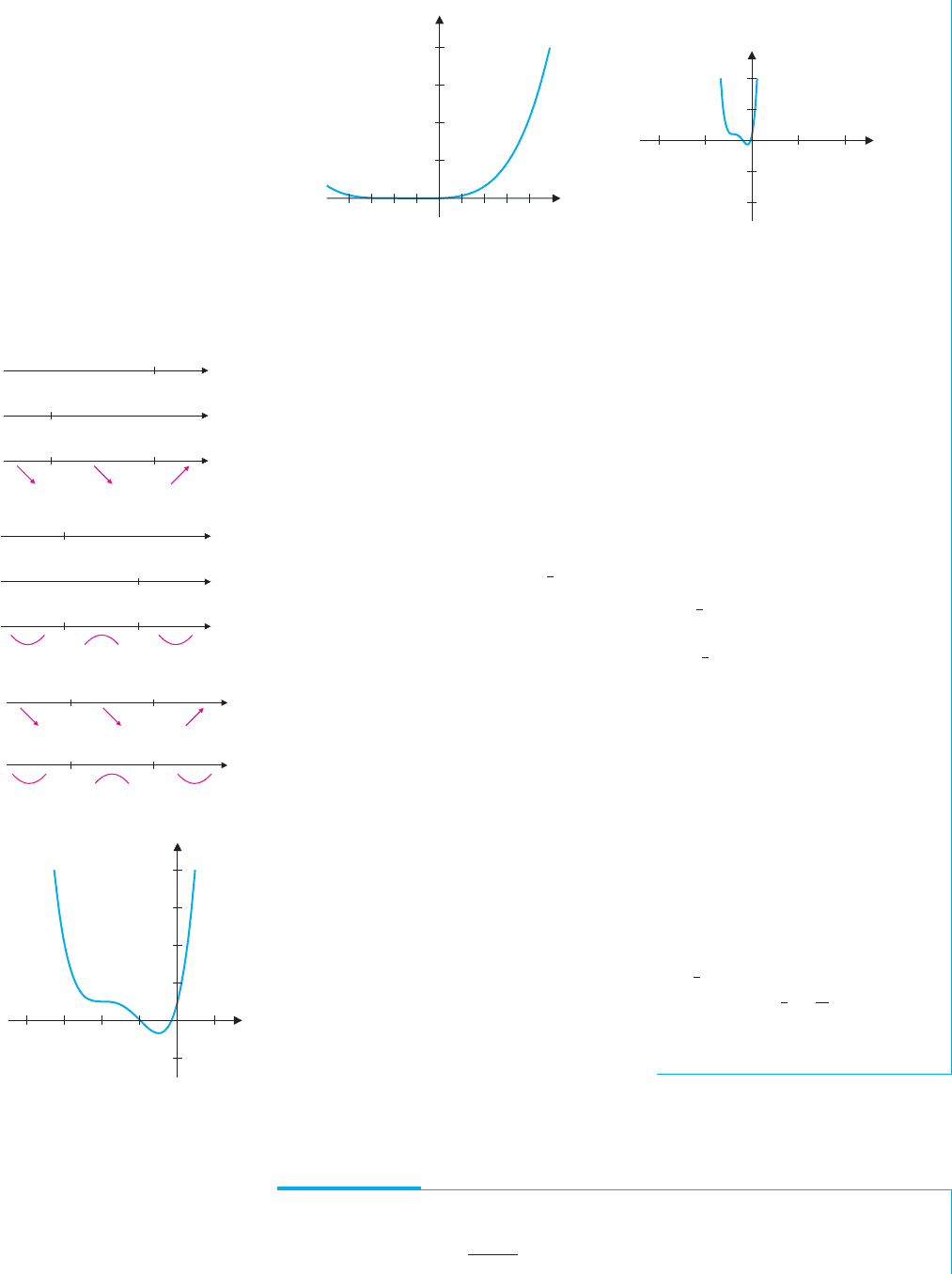
Using this window, we get the graph shown in Figure 3.54b. Of course, these two
graphs are very different and it’s difficult to tell which, if either, of these is truly
representative of the behavior of f . First, note that the domain of f is the entire real
line. Further, since f is a polynomial, its graph doesn’t have any vertical or horizontal
asymptotes. Next, note that
f
(x) = 4x
3
+ 18x
2
+ 24x + 8 = 2(2x +1)(x +2)
2
.
Drawing number lines for the individual factors of f
(x), we have that
f
(x)
> 0, on
−
1
2
, ∞
f increasing.
< 0, on (−∞, −2) and
−2, −
1
2
.
f decreasing.
This also tells us that there is a local minimum at x =−
1
2
and that there are no local
maxima. Next, we have
f
(x) = 12x
2
+ 36x + 24 = 12(x +2)(x +1).
Drawing number lines for the factors of f
(x), we have
f
(x)
> 0, on (−∞, −2) and (−1, ∞)
Concave up.
< 0, on (−2, −1). Concave down.
From this, we see that there are inflection points at x =−2 and at x =−1. Finally, to
find the x-intercepts, we need to solve f (x) = 0 approximately. Doing this (for instance
by using Newton’s method or your calculator’s solver), we find that there are two
x-intercepts: x =−1 (exactly) and x ≈−0.160713. Notice that the significant x-values
that we have identified are x =−2, x =−1 and x =−
1
2
. Computing the corresponding
y-values from y = f (x), we get the points (−2, 1), (−1, 0) and
−
1
2
, −
11
16
.We
summarize the first and second derivative information in the number lines in the margin.
In Figure 3.55, we include all of these important points by setting the x-range to be
−4 ≤ x ≤ 1 and the y-range to be −2 ≤ y ≤ 8.
f(x)
0
2
0
(x 2)
2
2
0
2(2x 1)
Q
0
Q
f (x)
2
0
1
0
12(x 2)
2
0
(x 1)
1
0
f (x)
1
0
2
0
f(x)
2
0
0
Q
y
x
−2
2
4
6
8
1−1−2−3−4
FIGURE 3.55
y = x
4
+ 6x
3
+ 12x
2
+ 8x + 1
In example 5.2, we examine a function that has local extrema, inflection points and
both vertical and horizontal asymptotes.
EXAMPLE 5.2 Drawing a Graph of a Rational Function
Draw a graph of f (x) =
x
2
− 3
x
3
, showing all significant features.
P1: OSO/OVY P2: OSO/OVY QC: OSO/OVY T1: OSO
MHDQ256-Ch03 MHDQ256-Smith-v1.cls December 10, 2010 20:20
LT (Late Transcendental)
CONFIRMING PAGES
214 CHAPTER 3
..
Applications of Differentiation 3-42
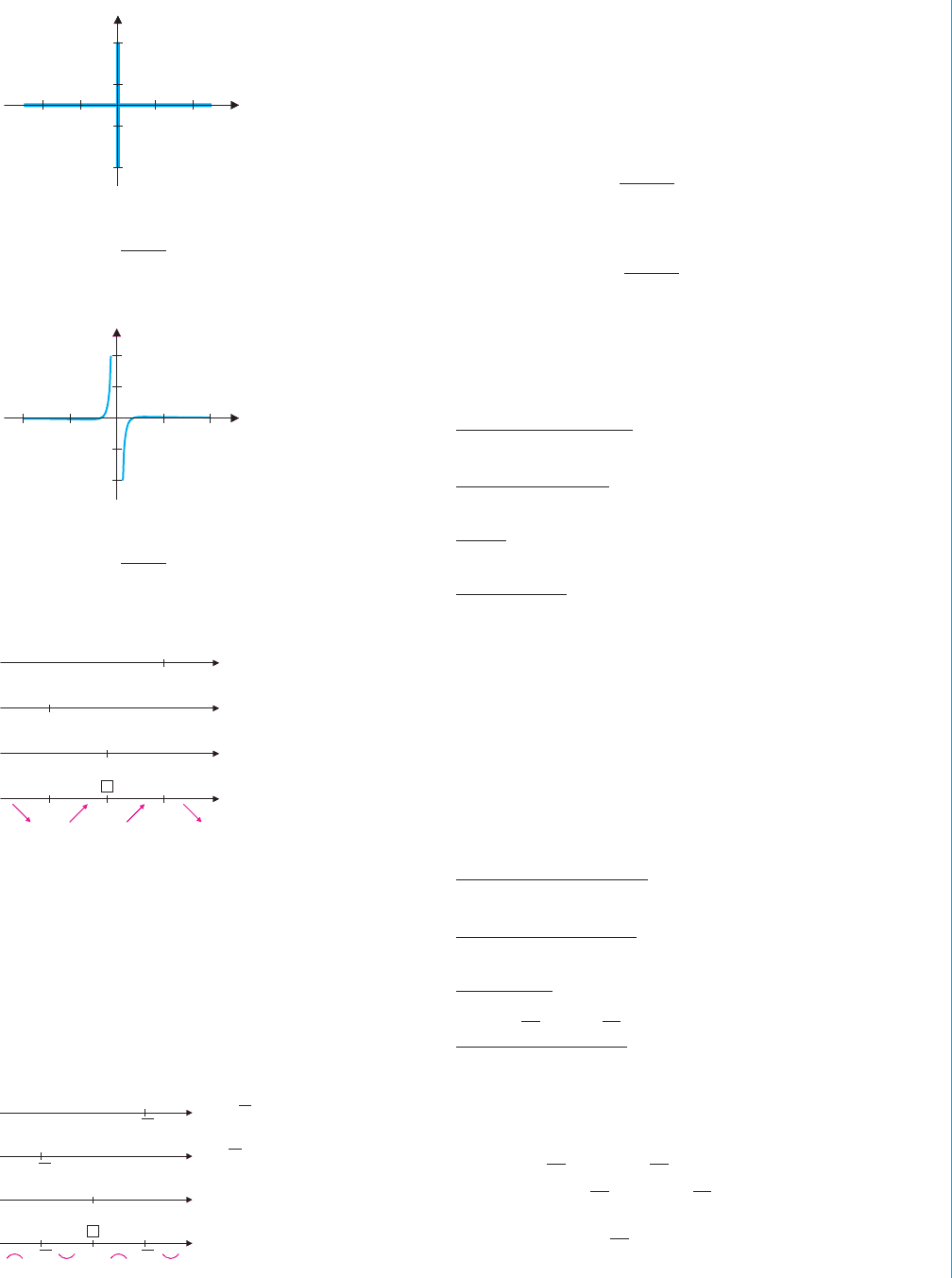
Solution The default graph drawn by our computer algebra system appears in
Figure 3.56a, while the graph drawn using the most common graphing calculator
default window is seen in Figure 3.56b. This is arguably an improvement over
Figure 3.56a, but this graph also leaves something to be desired, as we’ll see.
First, observe that the domain of f includes all real numbers x = 0. Since x = 0is
an isolated point not in the domain of f, we consider
lim
x→0
+
f (x) = lim
x→0
+
−
x
2
− 3
x
3
+
=−∞ (5.1)
y
x
−3e 24
−1e 24
3e 24
1e 24
4−4
+
+
+
+
FIGURE 3.56a
y =
x
2
− 3
x
3
y
x
−10
10
10−10
FIGURE 3.56b
y =
x
2
− 3
x
3
0
f
'
(x)
3
0
0
3
0
0
x
4
(3 + x)
−3
−3
0
(3 − x)
3
0
−
−
+
×
+
+
+
−
−
+
+
0
f (x)
0
0
x
5
0
兹
18
0
兹
18
0
兹
18
0
兹
18
x 兹
18
x 兹18 )(2
)(
and
lim
x→0
−
f (x) = lim
x→0
−
−
x
2
− 3
x
3
−
=∞. (5.2)
From (5.1) and (5.2), we see that the graph has a vertical asymptote at x = 0.
Next, we look for whatever information the first derivative will yield. We have
f
(x) =
2x(x
3
) − (x
2
− 3)(3x
2
)
(x
3
)
2
Quotient rule.
=
x
2
[2x
2
− 3(x
2
− 3)]
x
6
Factor out x
2
.
=
9 − x
2
x
4
Combine terms.
=
(3 − x)(3 + x)
x
4
. Factor difference of two squares.
Looking at the individual factors in f
(x), we have the number lines shown in the
margin. Thus,
f
(x)
> 0, on (−3, 0) and (0, 3)
f increasing.
< 0, on (−∞, −3) and (3, ∞). f decreasing.
(5.3)
So, f has a local minimum at x =−3 and a local maximum at x = 3.
Next, we look at
f
(x) =
−2x(x
4
) − (9 − x
2
)(4x
3
)
(x
4
)
2
Quotient rule.
=
−2x
3
[x
2
+ (9 − x
2
)(2)]
x
8
Factor out −2x
3
.
=
−2(18 − x
2
)
x
5
Combine terms.
=
2(x −
√
18)(x +
√
18)
x
5
. Factor difference of two squares.
Looking at the individual factors in f
(x), we obtain the number lines shown in the
margin. Thus, we have
f
(x)
> 0, on (−
√
18, 0) and (
√
18, ∞) Concave up.
< 0, on (−∞, −
√
18) and (0,
√
18), Concave down.
(5.4)
so that there are inflection points at x =±
√
18. (Why is there no inflection point at
x = 0?)
P1: OSO/OVY P2: OSO/OVY QC: OSO/OVY T1: OSO
MHDQ256-Ch03 MHDQ256-Smith-v1.cls December 10, 2010 20:20
LT (Late Transcendental)
CONFIRMING PAGES
3-43 SECTION 3.5
..
Overview of Curve Sketching 215
To determine the limiting behavior as x →±∞, we consider
lim
x→∞
f (x) = lim
x→∞
x
2
− 3
x
3
= lim
x→∞
1
x
−
3
x
3
= 0. (5.5)
Likewise, we have
lim
x→−∞
f (x) = 0. (5.6)
So, the line y = 0 is a horizontal asymptote both as x →∞and as x →−∞. Finally,
the x-intercepts are where
0 = f (x) =
x
2
− 3
x
3
,
that is, at x =±
√
3. Notice that there are no y-intercepts, since x = 0 is not in the
domain of the function. We now have all of the information that we need to draw a
representative graph. With some experimentation, you can set the x- and y-ranges so
that most of the significant features of the graph (i.e., vertical and horizontal
asymptotes, local extrema, inflection points, etc.) are displayed, as in Figure 3.57,
which is consistent with all of the information that we accumulated about the function
in (5.1)–(5.6). Although the existence of the inflection points is clearly indicated by the
change in concavity, their precise location is as yet a bit fuzzy in this graph. However,
both vertical and horizontal asymptotes and the local extrema are clearly indicated,
something that cannot be said about either Figure 3.56a or 3.56b.
0
0
f (x)
0
兹
18
0
兹
18
f(x)
3
0
3
0
y
x
0.4
0.4
1055
FIGURE 3.57
y =
x
2
− 3
x
3
In example 5.3, there are multiple vertical asymptotes, only one extremum and no
inflection points.
EXAMPLE 5.3 A Graph with Two Vertical Asymptotes
Draw a graph of f (x) =
x
2
x
2
− 4
showing all significant features.
y
x
44
50
50
100
150
200
FIGURE 3.58a
y =
x
2
x
2
− 4
y
x
5
5
105510
FIGURE 3.58b
y =
x
2
x
2
− 4
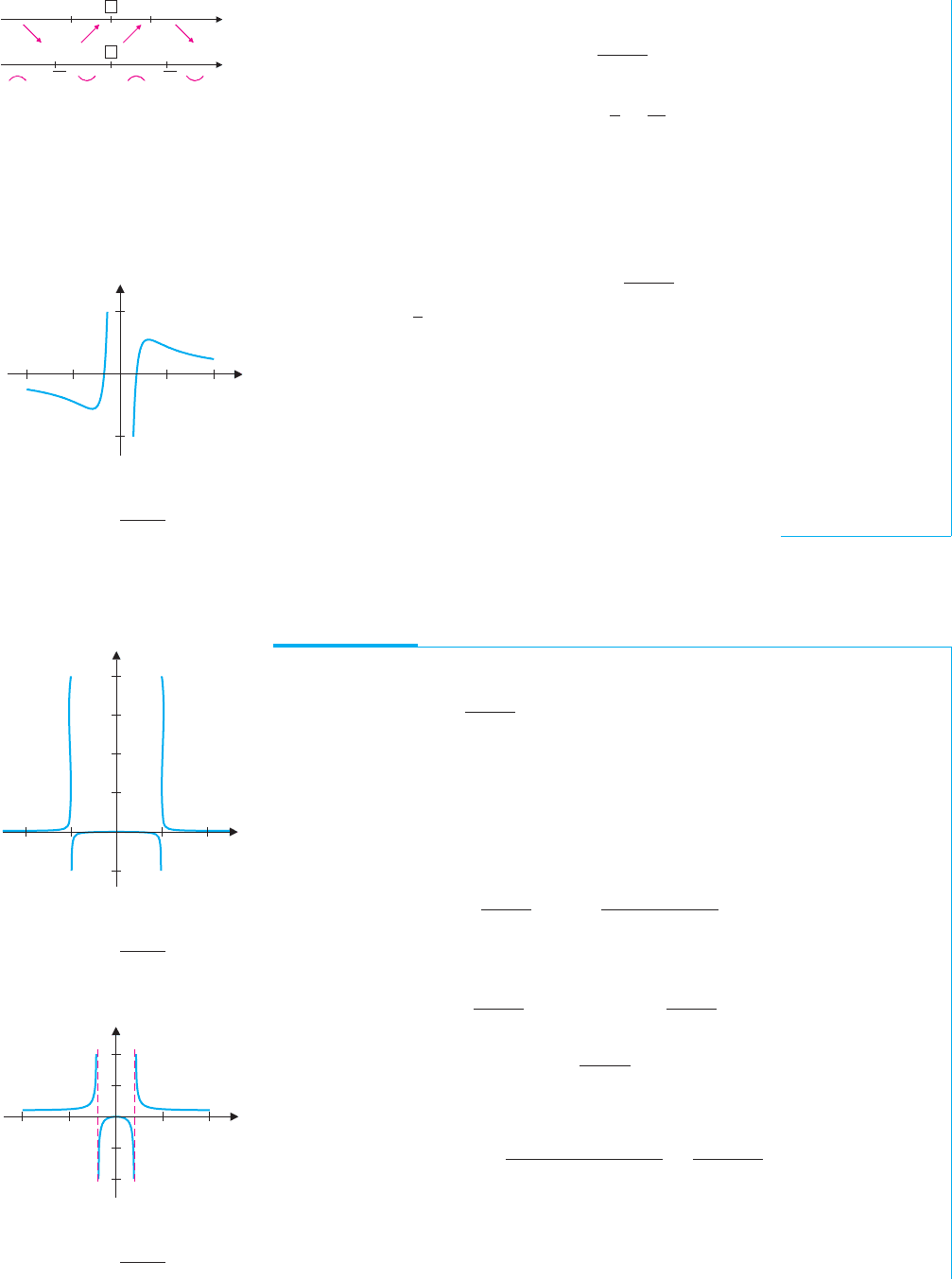
Solution The default graph produced by our computer algebra system is seen in
Figure 3.58a, while the default graph drawn by most graphing calculators looks like the
graph seen in Figure 3.58b. Notice that the domain of f includes all x except x =±2
(since the denominator is zero at x =±2). Figure 3.58b suggests that there are vertical
asymptotes at x =±2, but let’s establish this carefully. We have
lim
x→2
+
x
2
x
2
− 4
= lim
x→2
+
+
x
2
(x − 2)
+
(x + 2)
+
=∞. (5.7)
Similarly, we get
lim
x→2
−
x
2
x
2
− 4
=−∞, lim
x→−2
+
x
2
x
2
− 4
=−∞ (5.8)
and
lim
x→−2
−
x
2
x
2
− 4
=∞. (5.9)
Thus, there are vertical asymptotes at x =±2. Next, we have
f
(x) =
2x(x
2
− 4) − x
2
(2x)
(x
2
− 4)
2
=
−8x
(x
2
− 4)
2
.
Since the denominator is positive for x =±2, it is a simple matter to see that
f
(x)
> 0, on (−∞, −2) and (−2, 0) f increasing.
< 0, on (0, 2) and (2, ∞). f decreasing.
(5.10)
P1: OSO/OVY P2: OSO/OVY QC: OSO/OVY T1: OSO
MHDQ256-Ch03 MHDQ256-Smith-v1.cls December 10, 2010 20:20
LT (Late Transcendental)
CONFIRMING PAGES
216 CHAPTER 3
..
Applications of Differentiation 3-44
In particular, notice that the only critical number is x = 0 (since x =−2, 2 are not in
the domain of f ). Thus, the only local extremum is the local maximum located at
x = 0. Next, we have
f
(x) =
−8(x
2
− 4)
2
+ (8x)2(x
2
− 4)
1
(2x)
(x
2
− 4)
4
Quotient rule.
=
8(x
2
− 4)[−(x
2
− 4) +4x
2
]
(x
2
− 4)
4
Factor out 8(x
2
− 4).
=
8(3x
2
+ 4)
(x
2
− 4)
3
Combine terms.
=
8(3x
2
+ 4)
(x − 2)
3
(x + 2)
3
. Factor difference of two squares.
Since the numerator is positive for all x, we need only consider the factors in the
denominator, as seen in the margin. We then have
f
(x)
> 0, on (−∞, −2) and (2, ∞) Concave up.
< 0, on (−2, 2). Concave down.
(5.11)
However, since x = 2, −2 are not in the domain of f , there are no inflection points. It is
an easy exercise to verify that
lim
x→∞
x
2
x
2
− 4
= 1 (5.12)
and lim
x→−∞
x
2
x
2
− 4
= 1. (5.13)
From (5.12) and (5.13), we have that y = 1 is a horizontal asymptote, both as x →∞
and as x →−∞. Finally, we observe that the only x-intercept is at x = 0. We
summarize the information in (5.7)–(5.13) in the graph seen in Figure 3.59.
f (x)
22
(x 2)
3
2
0
(x 2)
3
2
0
f (x)
f(x)
0
0
2
2
2
2
y
x
4
6
2
4
2
6
4 646
FIGURE 3.59
y =
x
2
x
2
− 4
In example 5.4, we need to use computer-generated graphs, as well as a rootfinding
method to determine the behavior of the function.
y
x
10
10
1010
FIGURE 3.60
y =
1
x
3
+ 3x
2
+ 3x + 3
EXAMPLE 5.4 Graphing Where the Domain and Extrema
Must Be Approximated
Draw a graph of f (x) =
1
x
3
+ 3x
2
+ 3x + 3
showing all significant features.
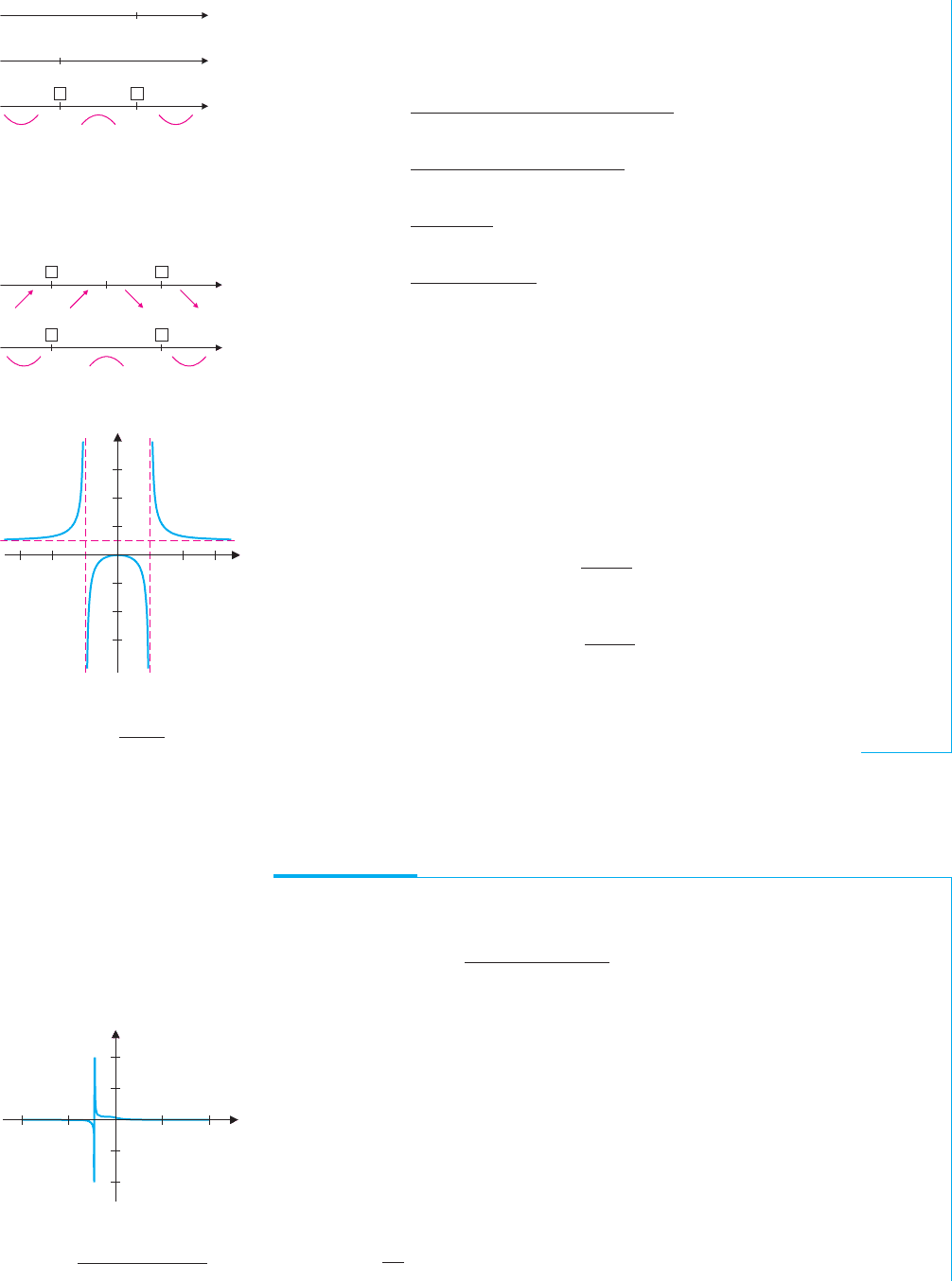
Solution The default graph drawn by most graphing calculators and computer algebra
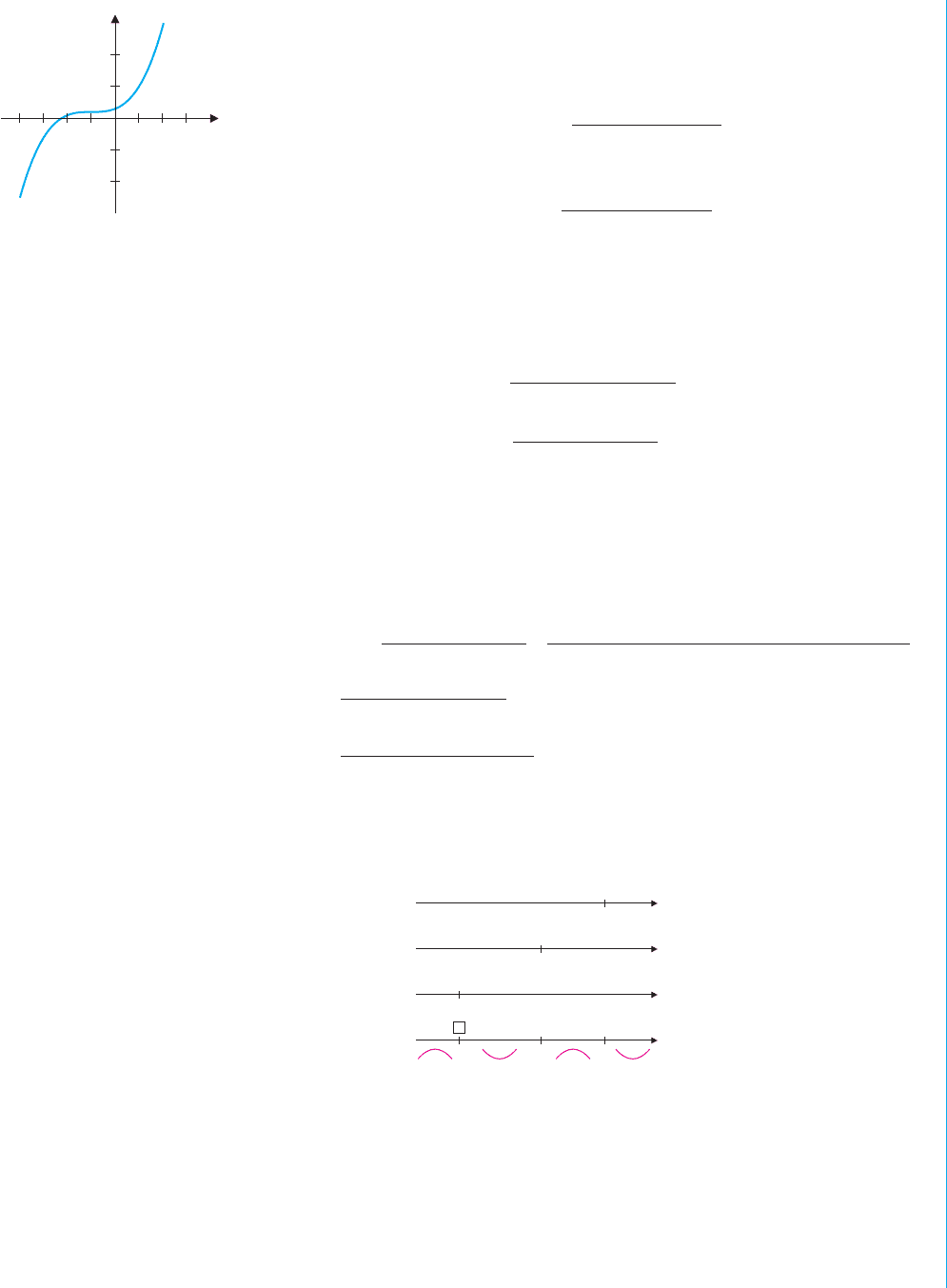
systems looks something like the one shown in Figure 3.60. We use some calculus to
refine this.
Since f is a rational function, it is defined for all x, except for where the
denominator is zero, that is, where
g(x) = x
3
+ 3x
2
+ 3x + 3 = 0.
From the graph of y = g(x) in Figure 3.61, we see that g has only one zero, around
x =−2. We can verify that this is the only zero, since
d
dx
(x
3
+ 3x
2
+ 3x + 3) = 3x
2
+ 6x + 3 = 3(x +1)
2
≥ 0.
P1: OSO/OVY P2: OSO/OVY QC: OSO/OVY T1: OSO
MHDQ256-Ch03 MHDQ256-Smith-v1.cls December 10, 2010 20:20
LT (Late Transcendental)
CONFIRMING PAGES
3-45 SECTION 3.5
..
Overview of Curve Sketching 217
Since g
(x) ≥ 0 for all x, observe that g has only one zero. You can get the approximate
zero x = a ≈−2.25992 using Newton’s method or your calculator’s solver. We can use
the graph in Figure 3.61 to help us compute the limits
lim
x→a
+
f (x) = lim
x→a
+
+
1
x
3
+ 3x
2
+ 3x + 3
+
=∞ (5.14)
and
lim
x→a
−
f (x) = lim
x→a
−
+
1
x
3
+ 3x
2
+ 3x + 3
−
=−∞. (5.15)
y
x
20
10
10
20
224
FIGURE 3.61
y = x
3
+ 3x
2
+ 3x + 3
From (5.14) and (5.15), f has a vertical asymptote at x = a. Turning to the derivative
information, we have
f
(x) =−(x
3
+ 3x
2
+ 3x + 3)
−2
(3x
2
+ 6x + 3)
=−3
(x + 1)
2
(x
3
+ 3x
2
+ 3x + 3)
2
=−3
x +1
x
3
+ 3x
2
+ 3x + 3
2
< 0, for x = a or −1 (5.16)
and f
(−1) = 0. Thus, f is decreasing for x < a and x > a. Also, notice that the only
critical number is x =−1, but since f is decreasing everywhere except at x = a, there
are no local extrema. Turning to the second derivative, we get
f
(x) =−6
x +1
x
3
+ 3x
2
+ 3x + 3
1(x
3
+ 3x
2
+ 3x + 3) −(x +1)(3x
2
+ 6x + 3)
(x
3
+ 3x
2
+ 3x + 3)
2
=
−6(x + 1)
(x
3
+ 3x
2
+ 3x + 3)
3
(−2x
3
− 6x
2
− 6x)
=
12x(x +1)(x
2
+ 3x + 3)
(x
3
+ 3x
2
+ 3x + 3)
3
.
Since (x
2
+ 3x + 3) > 0 for all x (why is that?), we need not consider this factor.
Considering the remaining factors, we have the number lines shown here.
f (x)
a
0
0
1
0
0
(x
3
3x
2
3x 3)
3
a 2.2599…
(x 1)
1
0
12x
0
0
Thus, we have that
f
(x)
> 0, on (a, −1)and (0, ∞)
Concave up.
< 0, on (−∞, a)and(−1, 0). Concave down.
(5.17)
It now follows that there are inflection points at x = 0 and at x =−1. Notice that in
Figure 3.60, the concavity information is not very clear and the inflection points are
difficult to discern.
P1: OSO/OVY P2: OSO/OVY QC: OSO/OVY T1: OSO
MHDQ256-Ch03 MHDQ256-Smith-v1.cls December 10, 2010 20:20
LT (Late Transcendental)
CONFIRMING PAGES
218 CHAPTER 3
..
Applications of Differentiation 3-46
We note the obvious fact that the function is never zero and hence, there are no
x-intercepts. Finally, we consider the limits
lim
x→∞
1
x
3
+ 3x
2
+ 3x + 3
= 0 (5.18)
and
lim
x→−∞
1
x
3
+ 3x
2
+ 3x + 3
= 0. (5.19)
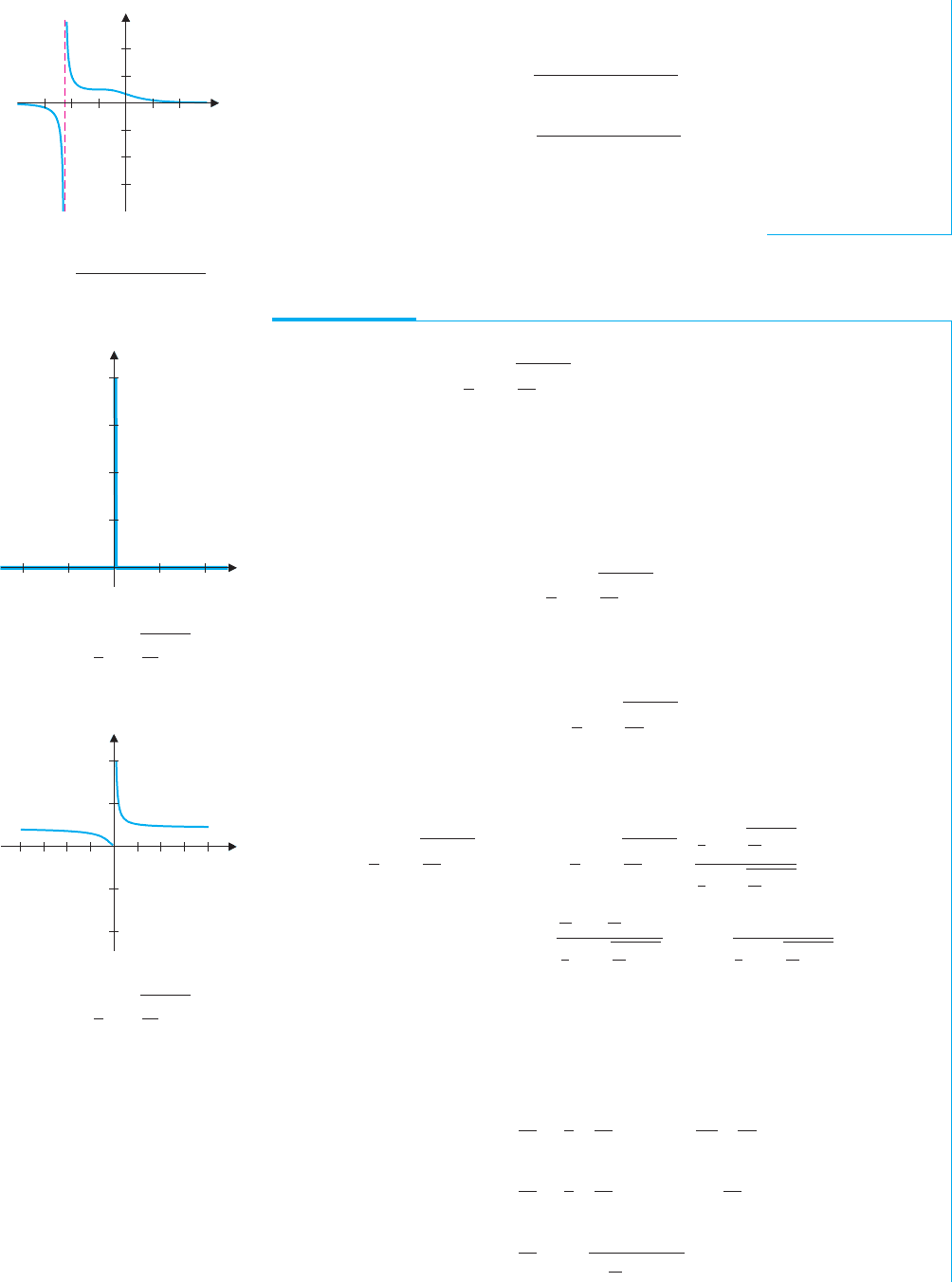
Using all of the information in (5.14)–(5.19), we draw the graph seen in Figure 3.62.
Here, we can clearly see the vertical and horizontal asymptotes, the inflection points and
the fact that the function is decreasing across its entire domain.
In example 5.5, we see a function that has a vertical asymptote on only one side of
x = 0.
y
x
1213
3
2
1
1
2
FIGURE 3.62
y =
1
x
3
+ 3x
2
+ 3x + 3
EXAMPLE 5.5 Graphing Where Some Features Are Difficult to See
Draw a graph of f (x) =
1
x
+
1
x
2
+ 4 showing all significant features.
Solution The default graph produced by our computer algebra system is not
particularly helpful. (See Figure 3.63.) The default graph produced by most graphing
calculators (see Figure 3.64) appears to be better, but we can’t be certain of its adequacy
without further analysis.
y
x
2e08
1e08
1.5e08
5e07
422
0
4
FIGURE 3.63
y =
1
x
+
1
x
2
+ 4
y
x
10
5
5
10
105510
FIGURE 3.64
y =
1
x
+
1
x
2
+ 4
First, notice that the domain of f is (−∞, 0) ∪(0, ∞). For this reason, we consider
the behavior of f as x approaches 0, by examining the limits:
lim
x→0
+
1
x
+
1
x
2
+ 4
=∞, (5.20)
since 1/x →∞,asx → 0
+
. For the limit as x → 0
−
, we must be more careful. First,
observe that
lim
x→0
−
1
x
+
1
x
2
+ 4
has the indeterminate form ∞−∞. We can resolve this by multiplying and dividing by
the conjugate of the expression:
lim
x→0
−
1
x
+
1
x
2
+ 4
= lim
x→0
−
1
x
+
1
x
2
+ 4
1
x
−
1
x
2
+ 4
1
x
−
1
x
2
+ 4
= lim
x→0
−
1
x
2
−
1
x
2
+ 4
1
x
−
1
x
2
+ 4
= lim
x→0
−
−4
1
x
−
1
x
2
+ 4
= 0, (5.21)
since the denominator tends to −∞,asx → 0
−
. From (5.20) and (5.21), there is a
vertical asymptote at x = 0, but an unusual one, since f (x) →∞from one side of
x = 0, but tends to 0 from the other side. Observe that this is consistent with the
behavior seen in Figure 3.64. Next, we have
f
(x) =−
1
x
2
+
1
2
1
x
2
+ 4
−1/2
d
dx
1
x
2
=−
1
x
2
+
1
2
1
x
2
+ 4
−1/2
−
2
x
3
=−
1
x
2
1 +
1
x
1
x
2
+ 4
1/2
.
P1: OSO/OVY P2: OSO/OVY QC: OSO/OVY T1: OSO
MHDQ256-Ch03 MHDQ256-Smith-v1.cls December 10, 2010 20:20
LT (Late Transcendental)
CONFIRMING PAGES
3-47 SECTION 3.5
..
Overview of Curve Sketching 219
While it’s fairly easy to see that f
(x) < 0, for x > 0, the situation for x < 0 is less
clear. (Why is that?) To shed some light on this, we first rewrite f
(x) as follows:
f
(x) =−
1
x
2
1 +
1
x
1
x
2
+ 4
1/2
=−
1
x
2
x
1
x
2
+ 4
1/2
+ 1
x
1
x
2
+ 4
1/2
=−
1
x
2
x
1
x
2
+ 4
1/2
+ 1
x
1
x
2
+ 4
1/2
x
1
x
2
+ 4
1/2
− 1
x
1
x
2
+ 4
1/2
− 1
=−
1
x
2
x
2
1
x
2
+ 4
− 1
x
1
x
2
+ 4
1/2
x
1
x
2
+ 4
1/2
− 1
=
−4
x
1
x
2
+ 4
1/2
x
1
x
2
+ 4
1/2
− 1
< 0,
for x < 0. We can conclude that f is decreasing on its entire domain. We leave it to the
reader to show that for x > 0.
f
(x) =
2
x
3
+
2(x
2
+ 2)
x
2
(x
2
+ 4)
3/2
> 0, (5.22)
so that the graph is concave up for x > 0. Similarly, for x < 0, we can show that
f
(x) =
2
x
3
−
2(x
2
+ 2)
x
2
(x
2
+ 4)
3/2
< 0, (5.23)
so that the graph is concave down for x < 0. [In order to get the expressions for f
(x)
in (5.22) and (5.23), you will need to use the fact that
√
x
2
=|x|.] Notice that since
x = 0 is not in the domain of the function, there is no inflection point. Next, note that
lim
x→∞
1
x
+
1
x
2
+ 4
= 2, (5.24)
since 1/x → 0, as x →∞. Likewise, we have
lim
x→−∞
1
x
+
1
x
2
+ 4
= 2. (5.25)
From (5.24) and (5.25), observe that y = 2 is a horizontal asymptote, both as x →∞
and as x →−∞. Finally, observe that f (x) > 0, for x > 0, while for x < 0,
f (x) =
1
x
+
1
x
2
+ 4 =
1 + x
1
x
2
+ 4
x
=
1 −
√
1 + 4x
2
x
> 0,
since for x < 0,
√
x
2
=|x| and since the numerator of the last expression is always
negative. Consequently, there are no x-intercepts. Putting together all of this
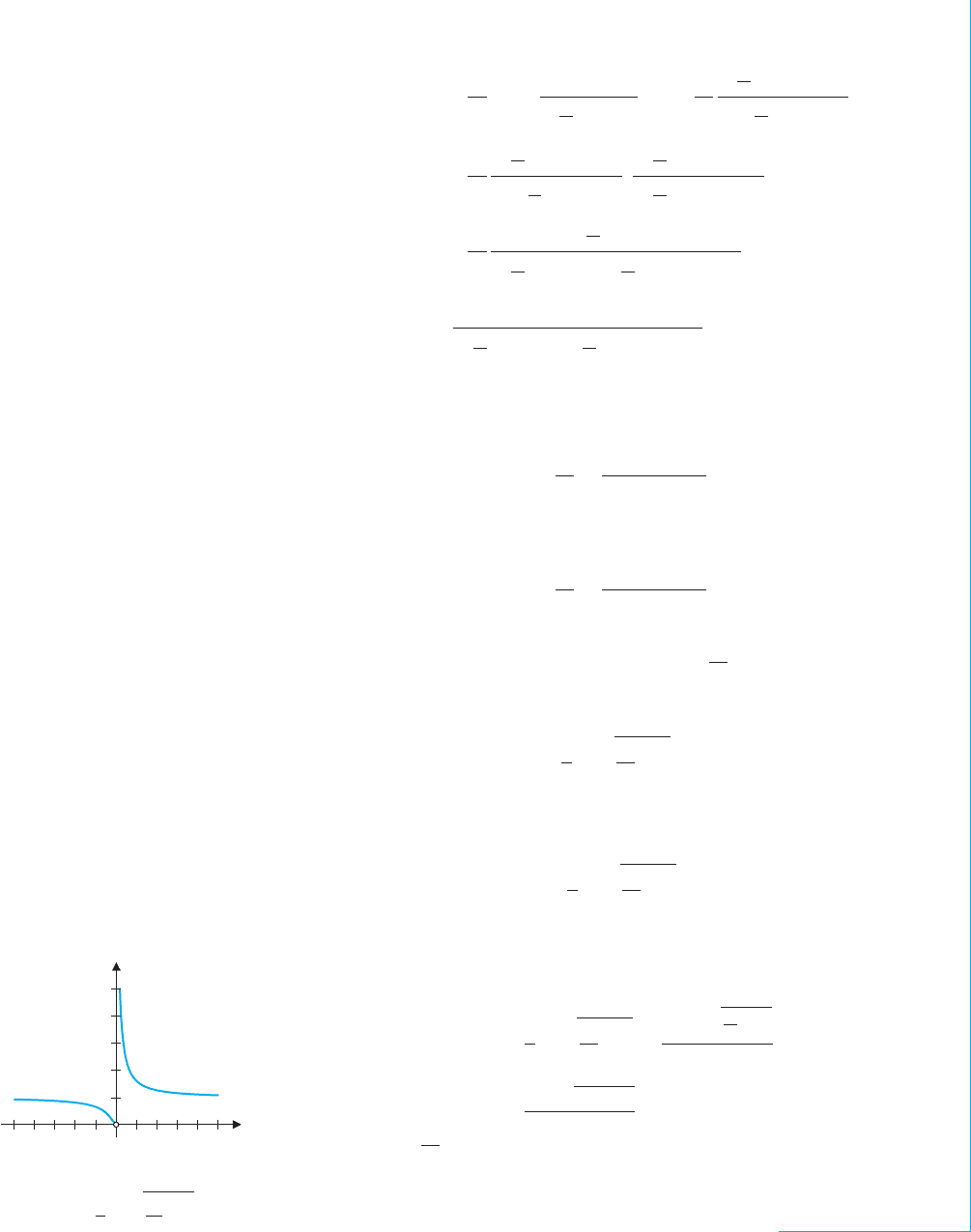
information, we see that the graph in Figure 3.64 is reasonably representative of the
behavior of the function. We refine this slightly in Figure 3.65.
y
x
4
8
42
24
FIGURE 3.65
y =
1
x
+
1
x
2
+ 4
In our final example, we consider the graph of a function that is the sum of a trigono-
metric function and a polynomial.
P1: OSO/OVY P2: OSO/OVY QC: OSO/OVY T1: OSO
MHDQ256-Ch03 MHDQ256-Smith-v1.cls December 10, 2010 20:20
LT (Late Transcendental)
CONFIRMING PAGES
220 CHAPTER 3
..
Applications of Differentiation 3-48
EXAMPLE 5.6 Graphing the Sum of a Polynomial
and a Trigonometric Function
Draw a graph of f (x) = cos x − x, showing all significant features.
y
x
4
2
2
4
424 2
y
x
10
5
5
10
105510
FIGURE 3.66a
y = cos x − x
FIGURE 3.66b
y = cos x − x
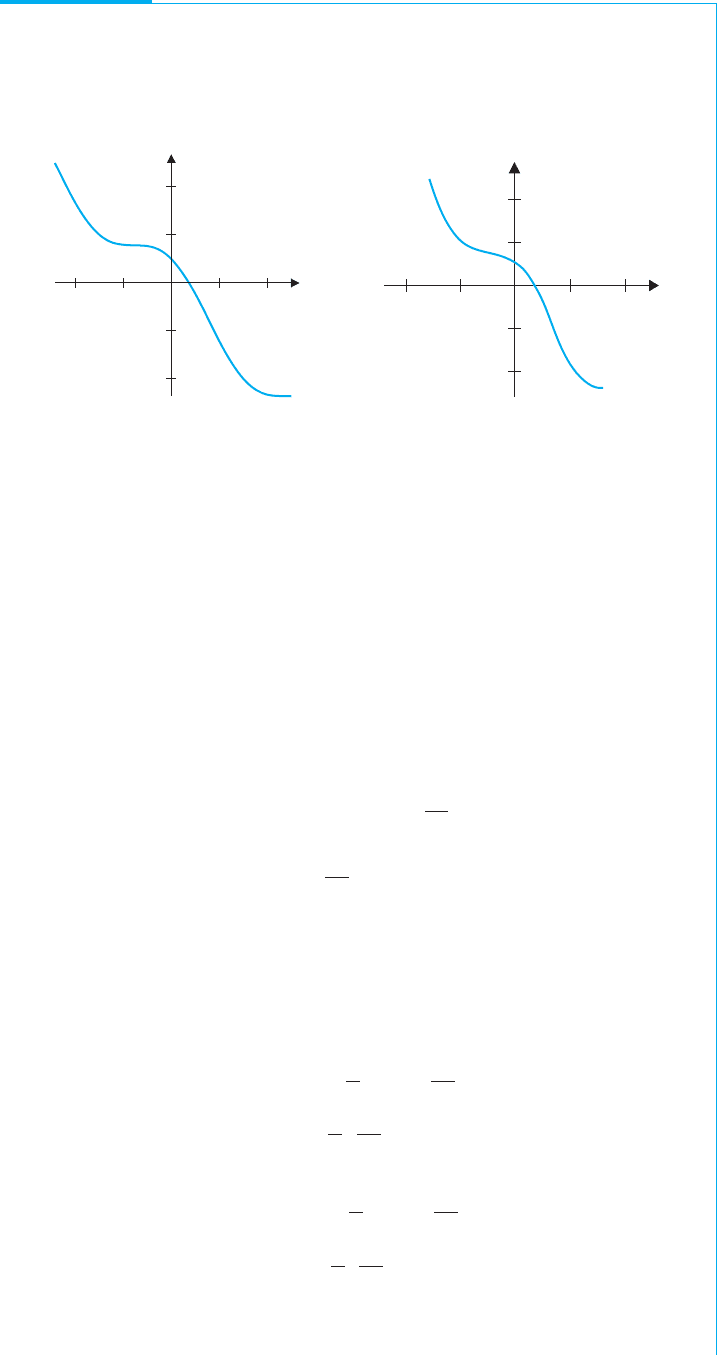
Solution The default graph provided by our computer algebra system can be seen in
Figure 3.66a. The graph produced by most graphing calculators looks like that in
Figure 3.66b. First, since the domain of f is the entire real line, there are no vertical
asymptotes. Next, we have
f
(x) =−sin x −1 ≤ 0, for all x. (5.26)
Further, f
(x) = 0 if and only if sin x =−1. So, there are critical numbers (here, these
are all locations of horizontal tangent lines), but since f
(x) does not change sign, there
are no local extrema. Even so, it is still of interest to find the locations of the horizontal
tangent lines. Recall that
sin x =−1 for x =
3π
2
and more generally, for x =
3π
2
+ 2nπ,
for any integer n. Next, we see that
f
(x) =−cos x
and on the interval [0, 2π ], we have
cos x
⎧
⎪
⎪
⎨
⎪
⎪
⎩
> 0, on
0,
π
2
and
3π
2
, 2π
< 0, on
π
2
,
3π
2
.
So,
f
(x) =−cos x
⎧
⎪
⎪
⎨
⎪
⎪
⎩
< 0, on
0,
π
2
and
3π
2
, 2π
Concave down.
> 0, on
π
2
,
3π
2
.
Concave up.
(5.27)
Outside of [0, 2π ], f
(x) simply repeats this pattern. In particular, this says that the
graph has infinitely many inflection points, located at odd multiples of π/2.
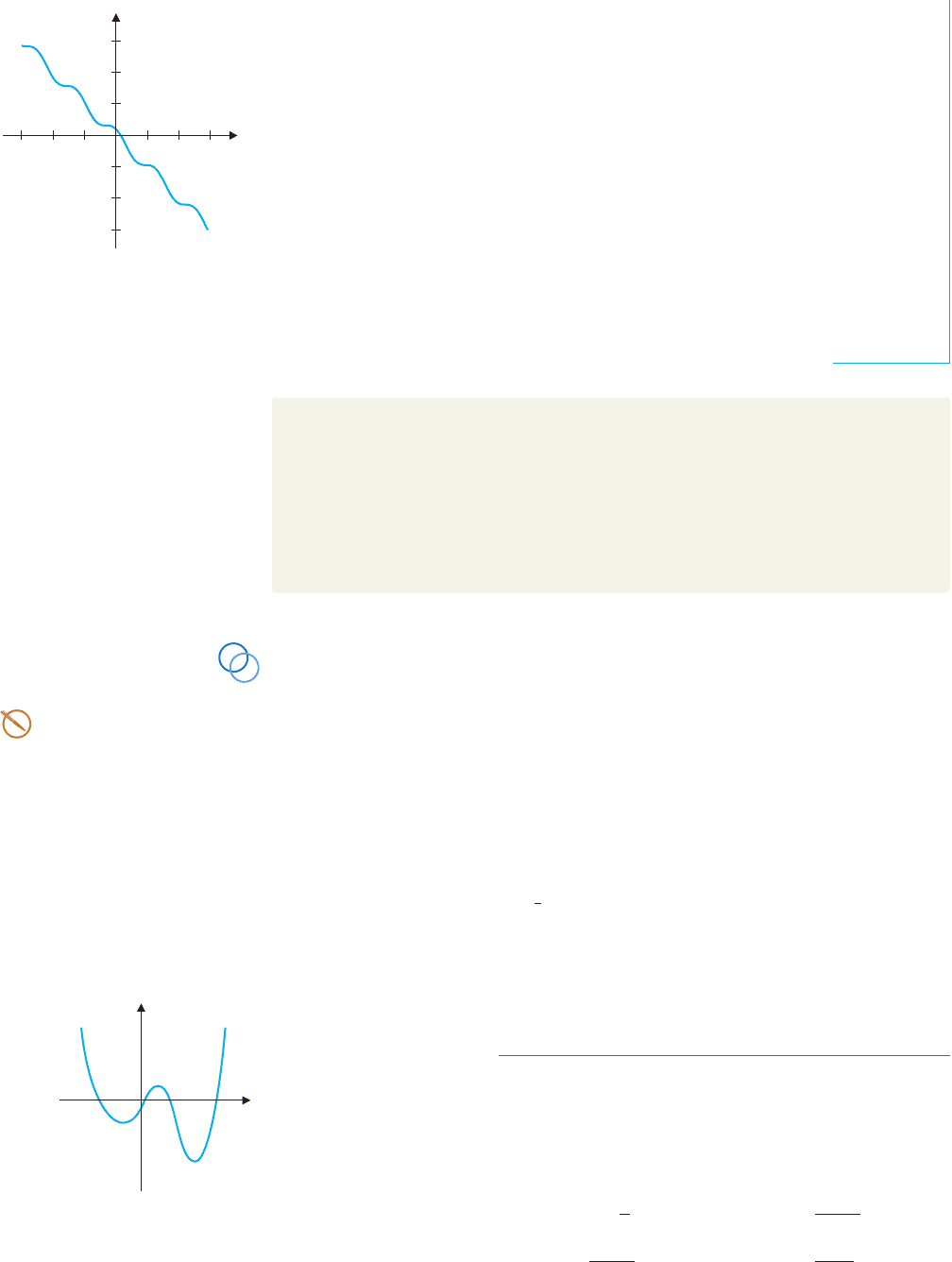
P1: OSO/OVY P2: OSO/OVY QC: OSO/OVY T1: OSO
MHDQ256-Ch03 MHDQ256-Smith-v1.cls December 10, 2010 20:20
LT (Late Transcendental)
CONFIRMING PAGES
3-49 SECTION 3.5
..
Overview of Curve Sketching 221
To determine the behavior as x →±∞, we examine the limits
lim
x→∞
(cos x − x) =−∞ (5.28)
and
lim
x→−∞
(cos x − x) =∞, (5.29)
since −1 ≤ cos x ≤ 1, for all x, while lim
x→∞
x =∞.
Finally, to determine the x-intercept(s), we need to solve
f (x) = cos x − x = 0.
This can’t be solved exactly, however. Since f
(x) ≤ 0 for all x and Figures 3.66a and
3.66b show a zero around x = 1, there is only one zero and we must approximate this.
(Use Newton’s method or your calculator’s solver.) We get x ≈ 0.739085 as an
approximation to the only x-intercept. Assembling all of the information in
(5.26)–(5.29), we can draw the graph seen in Figure 3.67. Notice that Figure 3.66b
shows the behavior just as clearly as Figure 3.67, but for a smaller range of x- and
y-values. Which of these is more “representative” is open to discussion.
y
x
1551051015
15
10
5
5
10
15
FIGURE 3.67
y = cos x − x
BEYOND FORMULAS
The main characteristic of the examples in sections 3.3–3.5 is the interplay between
graphing and equation solving. To analyze the graph of a function, you will go back
and forth several times between solving equations (for critical numbers and inflection
points and so on) and identifying graphical features of interest. Even if you have access
to graphing technology, the equation solving may lead you to uncover hidden features
of the graph. What types of graphical features can sometimes be hidden?
EXERCISES 3.5
WRITING EXERCISES
1. We have talked about sketching representative graphs, but it is
often impossible to draw a graph correctly to scale that shows
all of the properties we might be interested in. For example,
try to generate a computer or calculator graph that shows all
three local extrema of x
4
− 25x
3
− 2x
2
+ 80x − 3. Whentwo
extrema have y-coordinates of approximately −60 and 50, it
takesaverylargegraphtoalsoshowapointwith y =−40,000!
If an accurate graph cannot show all the points of inter-
est, perhaps a freehand sketch like the one shown below is
needed.
x
y
Thereisno scale shownonthe graph because wehavedistorted
different portions of the graph in an attempt to show all of the
interesting points. Discuss the relative merits of an “honest”
graph with a consistent scale but not showing all the points
of interest versus a caricature graph that distorts the scale but
does show all the points of interest.
2. While studying for a test, a friend of yours says that a graph is
not allowed to intersect an asymptote. While it is often the case
that graphs don’t intersect asymptotes, there is definitely not
anyrule against it. Explain why graphs can intersect a horizon-
tal asymptote any number of times (Hint: Look at the graph of
1
x
sin x), but can’t pass through a vertical asymptote.
3. Explain why polynomials never have vertical or horizontal
asymptotes.
4. Explain how the graph of f (x) = cosx − x in example 5.6
relates to the graphs of y = cos x and y =−x. Based on this
discussion, explain how to sketch the graph of y = x + sin x.
In exercises 1–20, graph the function and completely discuss the
graph as in example 5.2.
1. f (x) = x
3
− 3x
2
+ 3x 2. f (x) = x
4
− 3x
2
+ 2x
3. f (x) = x
5
− 2x
3
+ 1 4. f (x) = x
4
+ 4x
3
− 1
5. f (x) = x +
4
x
6. f (x) =
x
2
− 1
x
7. f (x) =
x
2
+ 4
x
3
8. f (x) =
x − 4
x
3

P1: OSO/OVY P2: OSO/OVY QC: OSO/OVY T1: OSO
MHDQ256-Ch03 MHDQ256-Smith-v1.cls December 10, 2010 20:20
LT (Late Transcendental)
CONFIRMING PAGES
222 CHAPTER 3
..
Applications of Differentiation 3-50
9. f (x) =
2x
x
2
− 1
10. f (x) =
3x
2
x
2
+ 1
11. f (x) = x +sin x 12. f (x) = sin x − cos x
13. f (x) =
√
x
2
+ 1 14. f (x) =
√
2x − 1
15. f (x) =
3
√
x
3
− 3x
2
+ 2x 16. f (x) =
√
x
3
− 3x
2
+ 2x
17. f (x) = x
5/3
− 5x
2/3
18. f (x) = x
3
−
3
400
x
19. f (x) =
2
x
+
1
x
2
+ 9 20. f (x) =
1
x
−
1
x
2
+ 1
............................................................
In exercises 21–32, determine all significant features (approxi-
mately if necessary) and sketch a graph.
21. f (x) =
1
x
3
− 3x
2
− 9x + 1
22. f (x) =
1
x
3
+ 3x
2
+ 4x + 1
23. f (x) = (x
3
− 3x
2
+ 2x)
2/3
24. f (x) = x
6
− 10x
5
− 7x
4
+ 80x
3
+ 12x
2
− 192x
25. f (x) =
x
2
+ 1
3x
2
− 1
26. f (x) =
5x
x
3
− x + 1
27. f (x) = x
2
x
2
− 9 28. f (x) =
3
2x
2
− 1
29. f (x) =
25 − 50
√
x
2
+ 0.25
x
30. f (x) = sinx −
1
2
sin2x
31. f (x) = x
4
− 16x
3
+ 42x
2
− 39.6x + 14
32. f (x) = x
4
+ 32x
3
− 0.02x
2
− 0.8x
............................................................
In exercises 33–38, the “family of functions” contains a param-
eter c. The value of c affects the properties of the functions.
Determine what differences, if any, there are for c being zero,
positive or negative. Then determine what the graph would look
like for very large positive c’s and for very large negative c’s.
33. f (x) = x
4
+ cx
2
34. f (x) = x
4
+ cx
2
+ x
35. f (x) =
x
2
x
2
+ c
2
36. f (x) =
x
2
√
x
2
+ c
2
37. f (x) = sin(cx) 38. f (x) = x
2
√
c
2
− x
2
............................................................
A function f has a slant asymptote y mx b (m 0) if
lim
x→∞
[ f (x) − (mx b)] 0 and/or lim
x→−∞
[ f (x)− (mx b)] 0.
In exercises39–44, find the slant asymptote. (Use long division to
rewrite the function.) Then, graph the function and its asymp-
tote on the same axes.
39. f (x) =
3x
2
− 1
x
40. f (x) =
3x
2
− 1
x − 1
41. f (x) =
x
3
− 2x
2
+ 1
x
2
42. f (x) =
x
3
− 1
x
2
− 1
43. f (x) =
x
4
x
3
+ 1
44. f (x) =
x
4
− 1
x
3
+ x
............................................................
In exercises 45–48, find a function whose graph has the given
asymptotes.
45. x = 1, x = 2 and y = 3
46. x =−1, x = 1 and y = 0
47. x =−1, x = 1, y =−2 and y = 2
48. x = 1, y = 2 and x = 3
............................................................
49. It can be useful to identify asymptotes other than vertical and
horizontal. For example, the parabola y = x
2
is an asymptote
of f (x) if lim
x→∞
[ f (x) − x
2
] = 0 and/or lim
x→−∞
[ f (x) − x
2
] = 0.
Show that x
2
is an asymptote of f (x) =
x
4
− x
2
+ 1
x
2
− 1
. Graph
y = f (x) and zoom out until the graph looks like a parabola.
(Note: The effect of zooming out is to emphasize large
values of x.)
50. For each function, find a polynomial p(x) such that
lim
x→∞
[ f (x) − p(x)] = 0.
(a)
x
4
x + 1
(b)
x
5
− 1
x + 1
(c)
x
6
− 2
x + 1
Show by zooming out that f (x) and p(x) look similar for
large x.
APPLICATIONS
51. In a variety of applications, researchers model a phenomenon
whose graph starts at the origin, rises to a single maximum
and then drops off to a horizontal asymptote of y = 0. For ex-
ample, the probability density function of events such as the
time from conception to birth of an animal and the amount
of time surviving after contracting a fatal disease might have
these properties. Show that the family of functions
x
x
2
+ b
has
these properties for all positive constants b. What effect does
b have on the location of the maximum? In the case of the
time since conception, what would b represent? In the case of
survival time, what would b represent?
52. The “FM” in FM radio stands for frequency modulation, a
method of transmitting information encoded in a radio wave
by modulating (or varying) the frequency. A basic example
of such a modulated wave is f (x) = cos(10x + 2 cos x). Use
computer-generated graphs of f (x), f
(x) and f
(x) to try to
locate all local extrema of f (x).
EXPLORATORY EXERCISES
1. One of the natural enemies of the balsam fir tree is the spruce
budworm, which attacks the leaves of the fir tree in devastat-
ing outbreaks. Define N(t) to be the number of worms on a
particular tree at time t. A mathematical model of the popula-
tion dynamics of the worm must include a term to indicate the
worm’s death rate due to its predators (e.g., birds). The form
of this term is often taken to be
B[N(t)]
2
A
2
+ [N (t)]
2
for positive