
Smith R., Minton R. Calculus
Подождите немного. Документ загружается.

P1: OSO/OVY P2: OSO/OVY QC: OSO/OVY T1: OSO
MHDQ256-Ch02 MHDQ256-Smith-v1.cls December 8, 2010 18:21
LT (Late Transcendental)
CONFIRMING PAGES
2-47 SECTION 2.6
..
Derivatives of Trigonometric Functions 153
suspended from a spring, in the absence of damping (i.e., when resistance to the motion,
such as air resistance, is negligible), is given by
u(t) = a cos(ωt) + b sin(ωt),
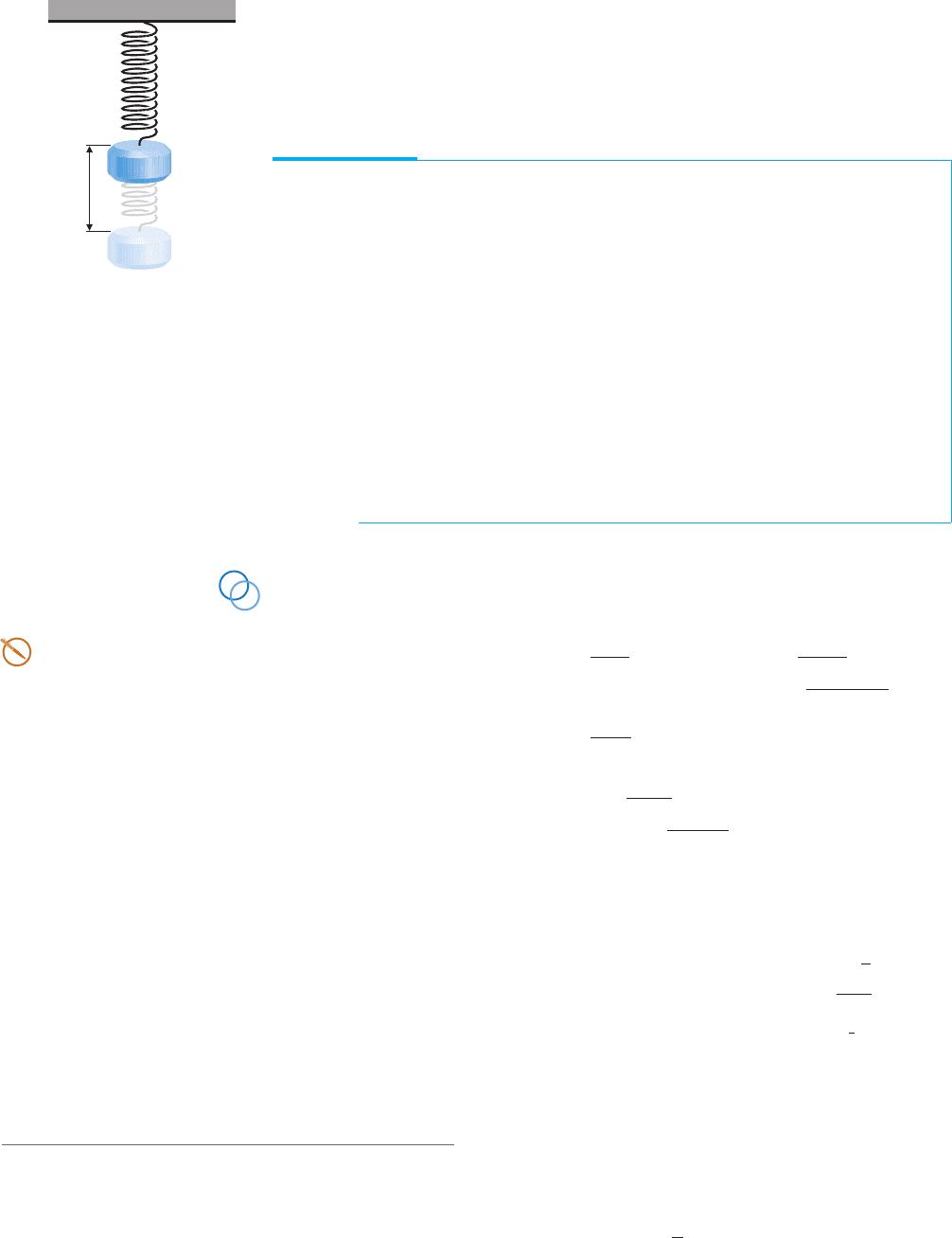
whereω isthe frequency, t istime and a andb are constants. (SeeFigure 2.32 for a depiction
of such a spring-mass system.)
Displacement
u(t)
Equilibrium
position
FIGURE 2.32
Spring-mass system
EXAMPLE 6.6 Analysis of a Spring-Mass System
Suppose that u(t) measures the displacement (measured in inches) of a mass suspended
from a spring t seconds after it is released and that
u(t) = 4cos2t.
Find the velocity at any time t and determine the maximum velocity.
Solution Since u(t) represents position (displacement), the velocity is given by u
(t).
We have
u
(t) = 4(−sin2t) · 2 =−8 sin2t,
where u
(t) is measured in inches per second. Of course, sin2t oscillates between −1 and
1 and hence, the largest that u
(t) can be is −8(−1) = 8 inches per second. This occurs
when sin2t =−1, that is, at t = 3π/4, t = 7π/4 and so on. Notice that at these times
u(t) = 0, so that the mass is moving fastest when it is passing through its equilibrium
position.
EXERCISES 2.6
WRITING EXERCISES
1. Most people draw sine curves that are very steep and rounded.
Given the results of this section, discuss theactual shape of the
sine curve. Starting at (0, 0), how steep should the graph be
drawn? What is the steepest the graph should be drawn any-
where? In which regions is the graph almost straight and where
does it curve a lot?
2. In many common physics and engineering applications, the
term sin x makes calculations difficult. A common simplifica-
tion is to replace sin x with x, accompanied by the justification
“sin x approximately equals x for small angles.” Discuss this
approximationinterms ofthetangentlineto y = sin x at x =0.
How small is the “small angle” for which the approximation is
good? The tangent line to y = cosx at x = 0 is simply y = 1,
but the simplification “cosx approximately equals 1 for small
angles”isalmostneverused.Whywouldthisapproximationbe
less useful than sin x ≈ x?
3. Use a graphical analysis as in the text to argue that the deriva-
tive of cos x is −sinx.
4. If a differentiable function f has a period of p, explain why
f
also has a period of p.
In exercises 1–18, find the derivative of each function.
1. f (x) = 4sin 3x − x 2. f (x) = 4x
2
− 3tan2x
3. f (t) = tan
3
2t − csc
4
3t 4. f (t) = t
2
+ 2cos
2
4t
5. f (x) = x cos5x
2
6. f (x) = x
2
sec4x
7. f (x) =
sin x
2
x
2
8. f (x) =
x
2
csc
4
2x
9. f (t) = sin3t sec 3t 10. f (t) =
√
cos5t sec5t
11. f (x) =
1
sin4x
12. f (x) = x
2
sec
2
3x
13. f (x) = 2sin 2x cos 2x 14. f (x) = 4sin
2
3x +4cos
2
3x
15. f (x) = tan
√
x
2
+ 1 16. f (x) = 4x
2
sin x sec3x
17. f (x) = sin
3
cos
x
3
+ 2x
2
18. f (x) = tan
4
[sin
2
(x
3
+ 2x)]
............................................................
In exercises 19–22, differentiate each function.
19. (a) f (x) = sin x
2
20. (a) f (x) = cos
√
x
(b) f (x) = sin
2
x (b) f (x) =
√
cos x
(c) f (x) = sin2x (c) f (x) = cos
1
2
x
21. (a) f (x) = sin x
2
tan x 22. (a) f (x) = sec x
2
tan x
2
(b) f (x) = sin
2
(tan x) (b) f (x) = sec
2
(tan x)
(c) f (x) = sin(tan
2
x) (c) f (x) = sec(tan
2
x)
............................................................
In exercises 23–26, find an equation of the tangent line to
y f (x)atx a.
23. f (x) = sin4x, a =
π
8
24. f (x) = tan3x, a = 0
P1: OSO/OVY P2: OSO/OVY QC: OSO/OVY T1: OSO
MHDQ256-Ch02 MHDQ256-Smith-v1.cls December 8, 2010 18:21
LT (Late Transcendental)
CONFIRMING PAGES
154 CHAPTER 2
..
Differentiation 2-48
25. f (x) = x
2
cos x, a =
π
2
26. f (x) = x sin x, a =
π
2
............................................................
In exercises 27–30, use the position function to find the velocity
at time t t
0
. Assume units of feet and seconds.
27. s(t) = t
2
− sin2t, t
0
= 0
28. s(t) = 4 +3 sin t, t
0
= π
29. s(t) =
cost
t
, t
0
= π
30. s(t) = t cos(t
2
+ π), t
0
= 0
............................................................
31. A spring hanging from the ceiling vibrates up and down. Its
vertical position at time t is given by f (t) = 4sin3t. (a) Find
the velocity of the spring at time t. (b) What is the spring’s
maximum speed? (c) What is its location when it reaches its
maximum speed?
32. In exercise 31, (a) for what time values is the velocity 0?
(b) What is the location of the spring when its velocity is 0?
(c) When does the spring change directions?
33. Use the basic limits lim
x→0
sin x
x
= 1 and lim
x→0
cos x − 1
x
= 0to
find the following limits:
(a) lim
x→0
sin3x
x
(b) lim
t→0
sint
4t
(c) lim
x→0
cos x − 1
5x
(d) lim
x→0
sin x
2
x
2
34. Use the basic limits lim
x→0
sin x
x
= 1 and lim
x→0
cos x − 1
x
= 0to
find the following limits:
(a) lim
t→0
2t
sint
(b) lim
x→0
cos x
2
− 1
x
2
(c) lim
x→0
sin6x
sin5x
(d) lim
x→0
tan2x
x
35. For f (x) = sin2x, find f
(75)
(x) and f
(150)
(x).
36. For f (x) = cos3x, find f
(77)
(x) and f
(120)
(x).
37. For Lemma 6.1, show that lim
θ→0
−
sinθ = 0.
38. Use Lemma 6.1 and the identity cos
2
θ +sin
2
θ = 1toprove
Lemma 6.2.
39. Use the identity cos(x + h) = cos x cosh − sin x sin h to
prove Theorem 6.2.
40. Use the quotient rule to derive formulas for the derivatives of
cot x, sec x and csc x.
41. Repeat exercise 13 with your CAS. If its answer is not in the
same form as ours in the back of the book, explain how the
CAS computed its answer.
42. Repeat exercise 14 with your CAS. If its answer is not 0,
explain how the CAS computed its answer.
43. Find the derivative of f (x) = 2sin
2
x + cos 2x on your CAS.
Compare its answer to 0. Explain how to get this answer and
your CAS’s answer, if it differs.
44. Find the derivativeof f (x) =
tan x
sin x
on your CAS. Compare its
answer to sec x tan x. Explain how to get this answer and your
CAS’s answer, if it differs.
45. For f (x) =
⎧
⎨
⎩
sin x
x
if x = 0
1ifx = 0
(a) show numerically that f is
continuous and differentiable for all x. (Hint: Focus on x = 0.)
(b) Show numerically that the derivative f
(x) is continuous.
46. In the proof of
d
dx
(sin x) = cos x, where do we use the
assumption that x is in radians? If you have access to a CAS,
find out what the derivative of sin x
◦
is; explain where the
π/180 came from.
47. Sketch a graph of y = sin x and its tangent line at x = 0. Try
to determine how many times they intersect by zooming in on
the graph (but don’t spend too much time on this). Show that
for f (x) = sin x, f
(x) < 1 for 0 < x < 1. Explain why this
implies that sin x < x for 0 < x < 1. Use a similar argument
toshowthat sin x > x for−1 < x < 0. Explain why y = sinx
intersects y = x at only one point.
48. For different positive values of k, determine how many times
y = sin kx intersects y = x. In particular, what is the largest
value of k for which there is only one intersection? Try to
determine the largest value of k for which there are three
intersections.
EXPLORATORY EXERCISES
1. The function f (x) =
x
2
sin
1
x
if x = 0
0ifx = 0
has several un-
usual properties. Show that f is continuous and differentiable
at x = 0. However, f
(x)is discontinuousat x = 0. Tosee this,
show that f
(x) =−1 for x =
1
2π
, x =
1
4π
and so on. Then
show that f
(x) = 1 for x =
1
π
, x =
1
3π
and so on. Explain
why this proves that f
(x) cannot be continuous at x = 0.
2. When a ball bounces, we often think of the bounce occurring
instantaneously. This does not take into account that the ball
actually compresses and maintains contact with the ground for
a brief period of time.As shown in John Wesson’s The Science
of Soccer, the amount s that the ball is compressed satisfies the
equation s
(t) =−
cp
m
s(t), where c is the circumference of the
ball, p is the pressure of air in the ball and m is the mass of
the ball. Assume that the ball hits the ground at time 0 with
vertical speed v m/s. Then s(0) = 0 and s
(0) = v. Show that
s(t) =
v
k
sinkt satisfies the three conditions s
(t) =−
cp
m
s(t),
s(0) = 0 and s
(0) = v with k =
cp
m
. Use the properties of
the sine function to show that the duration of the bounce is
π
k
seconds and find the maximum compression. For a soc-
cer ball with c = 0.7m,p = 0.86 × 10
5
N/m
2
, v = 15 m/s,
radius R = 0.112 m and m = 0.43 kg, compute the duration
of the bounce and the maximum compression.
P1: OSO/OVY P2: OSO/OVY QC: OSO/OVY T1: OSO
MHDQ256-Ch02 MHDQ256-Smith-v1.cls December 8, 2010 18:21
LT (Late Transcendental)
CONFIRMING PAGES
2-49 SECTION 2.7
..
Implicit Differentiation 155
y
x
s(t)
A ball being compressed
Putting together the physics for before, during and after
the bounce, we obtain the height of the center of mass of
a ball of radius R:
h(t) =
⎧
⎨
⎩
−4.9t
2
− vt + R if t < 0
R −
v
k
sinkt if 0 ≤ t ≤
π
k
−4.9(t −
π
k
)
2
+ v(t −
π
k
) + R if t >
π
k
.
Determine whether h(t) is continuous for all t and sketch a
reasonable graph of this function.
2.7 IMPLICIT DIFFERENTIATION
Compare the following two equations describing familiar curves:
y = x
2
+ 3 (parabola)
and
x
2
+ y
2
= 4 (circle).
The first equation defines y as a function of x explicitly, since for each x, the equation
gives an explicit formula for finding the corresponding value of y. On the other hand, the
second equation does not define a function, since the circle in Figure 2.33 doesn’t pass
the vertical line test. However, you can solve for y and find at least two functions that are
defined implicitly by the equation x
2
+ y
2
= 4.
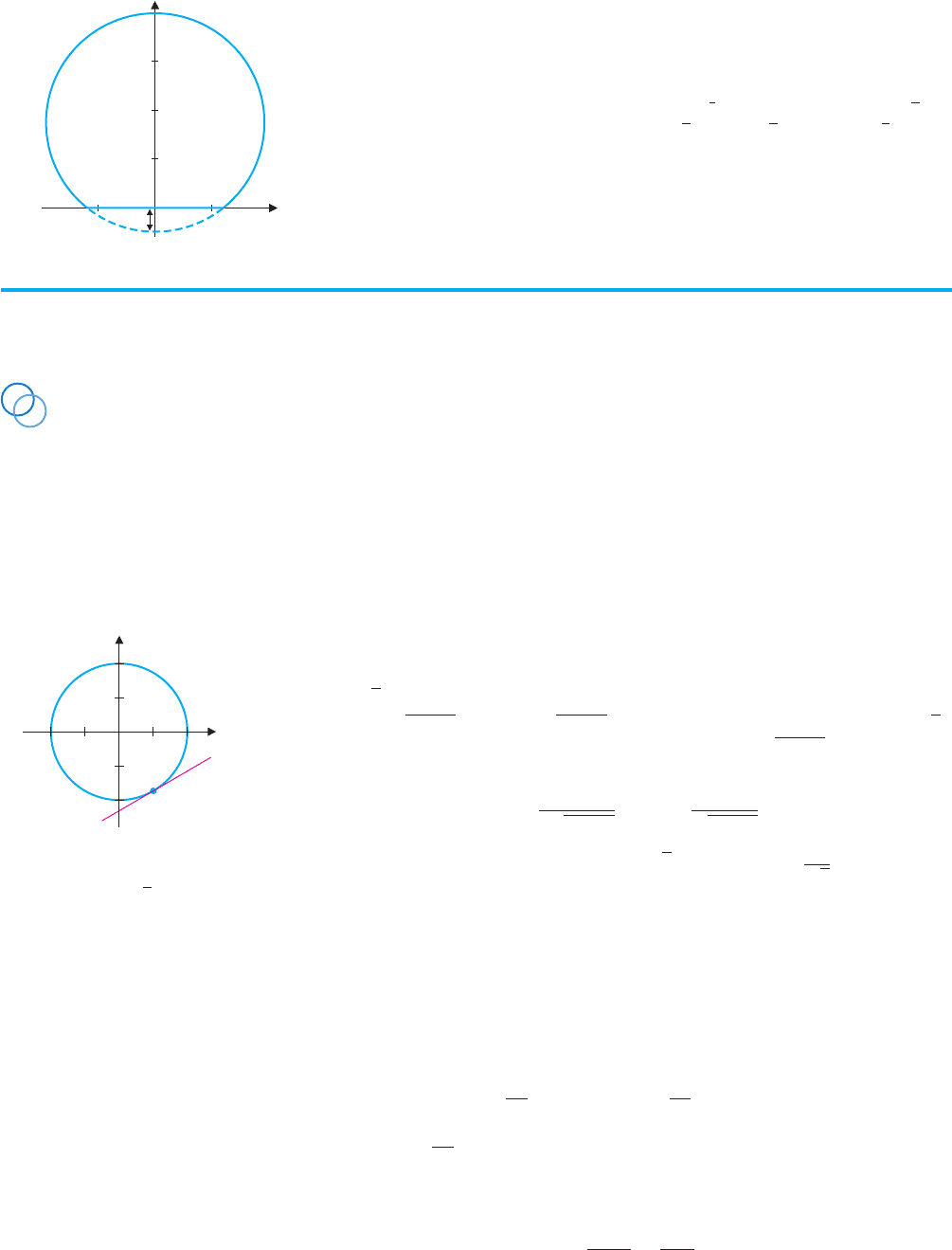
Supposethat we wanttofindtheslope of the tangent line tothecircle x
2
+ y
2
= 4atthe
point
1, −
√
3
.(SeeFigure 2.33.)Wecanthinkofthecircleasthe graphoftwosemicircles,
definedby y =
√
4 − x
2
and y =−
√
4 − x
2
.Since we are interested in thepoint(1, −
√
3),
we use the equation describing the bottom semicircle, y =−
√
4 − x
2
to compute the
derivative
y
(x) =−
1
2
√
4 − x
2
(−2x) =
x
√
4 − x
2
.
So, the slope of the tangent line at the point
1, −
√
3
is then y
(1) =
1
√
3
.
This calculation was not especially challenging, although we will soon see an easier
way to do it. Moreover, it’s not always possible to explicitly solve for a function defined
implicitly by a given equation.
y
x
22
2
2
FIGURE 2.33
The tangent line at the point
(1, −
√
3)
Alternatively, assuming the equation x
2
+ y
2
= 4 defines one or more differentiable
functions of x: y = y(x), the equation is
x
2
+ [y(x)]
2
= 4. (7.1)
Differentiating both sides of equation (7.1) with respect to x, we obtain
d
dx
x
2
+ [y(x)]
2
=
d
dx
(4).
From the chain rule,
d
dx
[y(x)]
2
= 2y(x)y
(x) and so, we have
2x + 2y(x)y
(x) = 0.
Solving this equation for y
(x), we have
y
(x) =
−2x
2y(x)
=
−x
y(x)
.
P1: OSO/OVY P2: OSO/OVY QC: OSO/OVY T1: OSO
MHDQ256-Ch02 MHDQ256-Smith-v1.cls December 8, 2010 18:21
LT (Late Transcendental)
CONFIRMING PAGES
156 CHAPTER 2
..
Differentiation 2-50
Notice that here, the derivative y
(x) is expressed in terms of both x and y. To get the slope
at the point (1, −
√
3), we substitute x = 1 and y =−
√
3, so that
y
(1) =
−x
y(x)
!
!
!
!
x=1
=
−1
−
√
3
=
1
√
3
.
Notice that this is the same slope as we had found earlier by first solving for y explicitly and
then differentiating. This process of differentiating both sides of an equation with respect
to x and then solving for y
(x) is called implicit differentiation.
Throughout this section, we assume that each equation implicitly defines one or more
differentiable functions y = y(x). When faced with such an equation, differentiate both
sides with respect to x, being careful to recognize that differentiating any function of y will
require the chain rule:
d
dx
g(y) = g
(y)y
(x).
Then, gather any terms with a factor of y
(x) on one side of the equation, with the remaining
terms on the other side of the equation and solve for y
(x). We illustrate this process in the
examples that follow.
EXAMPLE 7.1 Finding a Tangent Line Implicitly
Find y
(x) for x
2
+ y
3
− 2y = 3. Then, find the equation of the tangent line at the
point (2, 1).
Solution Since we can’t (easily) solve for y explicitly in terms of x, we compute the
derivative implicitly. Differentiating both sides with respect to x,weget
d
dx
(x
2
+ y
3
− 2y) =
d
dx
(3)
and so,
2x + 3y
2
y
(x) −2y
(x) = 0.
Subtracting 2x from both sides of the equation and factoring y
(x) from the remaining
terms, we have
(3y
2
− 2)y
(x) =−2x.
Solving for y
(x), we get
y
(x) =
−2x
3y
2
− 2
.
Substituting x = 2 and y = 1, we find that the slope of the tangent line at the point
(2, 1) is
y
(2) =
−4
3 − 2
=−4.
The equation of the tangent line is then
y − 1 =−4(x − 2).
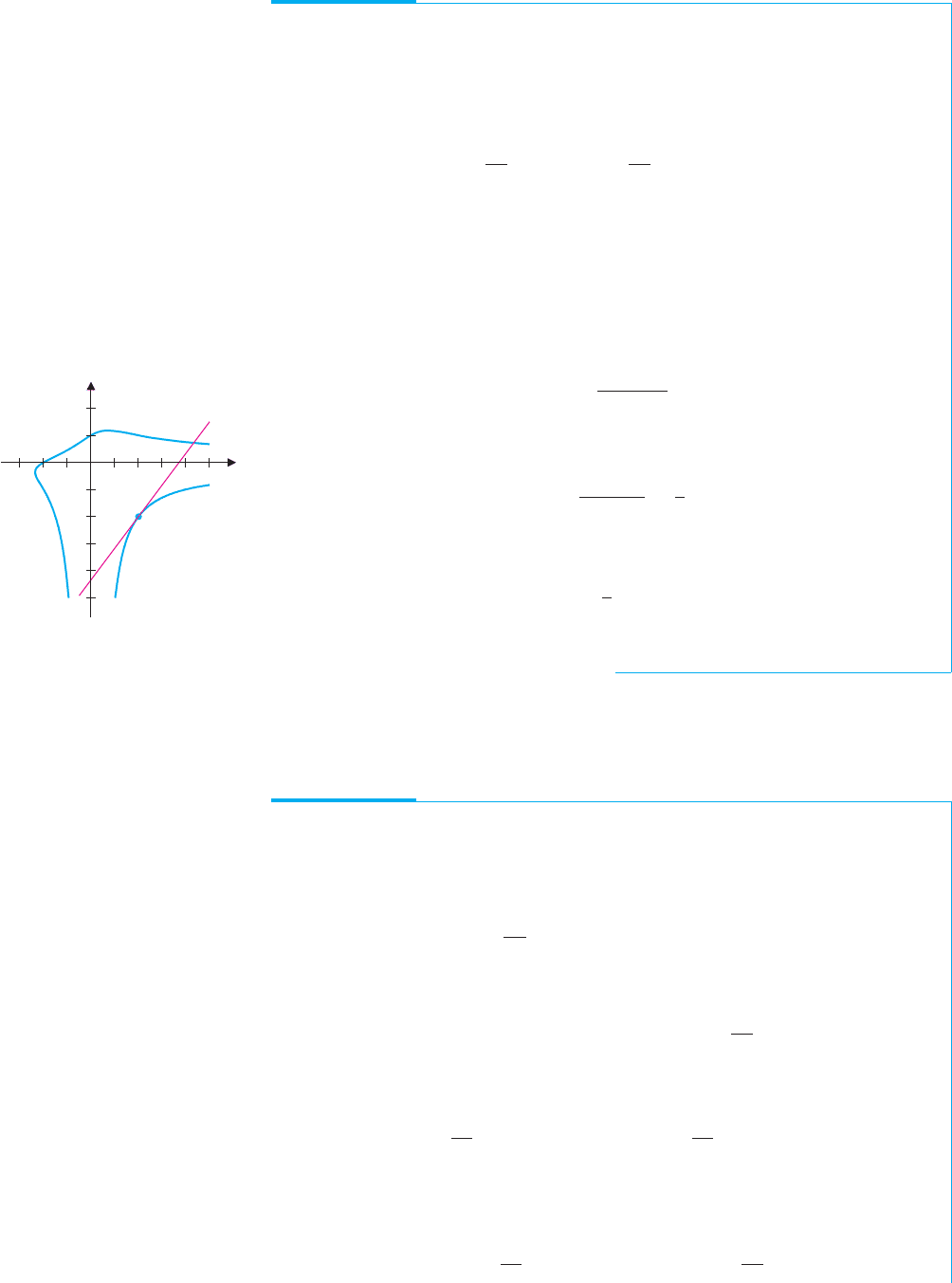
We have plotted a graph of the equation and the tangent line in Figure 2.34 using the
implicit plot mode of our computer algebra system.
y
x
2424
3
2
1
1
2
3
(2, 1)
FIGURE 2.34
Tangent line at (2, 1)
P1: OSO/OVY P2: OSO/OVY QC: OSO/OVY T1: OSO
MHDQ256-Ch02 MHDQ256-Smith-v1.cls December 8, 2010 18:21
LT (Late Transcendental)
CONFIRMING PAGES
2-51 SECTION 2.7
..
Implicit Differentiation 157
EXAMPLE 7.2 Finding a Tangent Line by Implicit Differentiation
Find y
(x) for x
2
y
2
− 2x = 4 − 4y. Then, find an equation of the tangent line at the
point (2, −2).
Solution Differentiating both sides with respect to x,weget
d
dx
(x
2
y
2
− 2x) =
d
dx
(4 − 4y).
Since the first term is the product of x
2
and y
2
, we must use the product rule. We get
2xy
2
+ x
2
(2y)y
(x) −2 = 0 − 4y
(x).
Grouping the terms with y
(x) on one side, we get
(2x
2
y + 4)y
(x) = 2 −2xy
2
,
so that
y
(x) =
2 − 2xy
2
2x
2
y + 4
.
Substituting x = 2 and y =−2, we get the slope of the tangent line,
y
(2) =
2 − 16
−16 + 4
=
7
6
.
Finally, an equation of the tangent line is given by
y + 2 =
7
6
(x − 2).
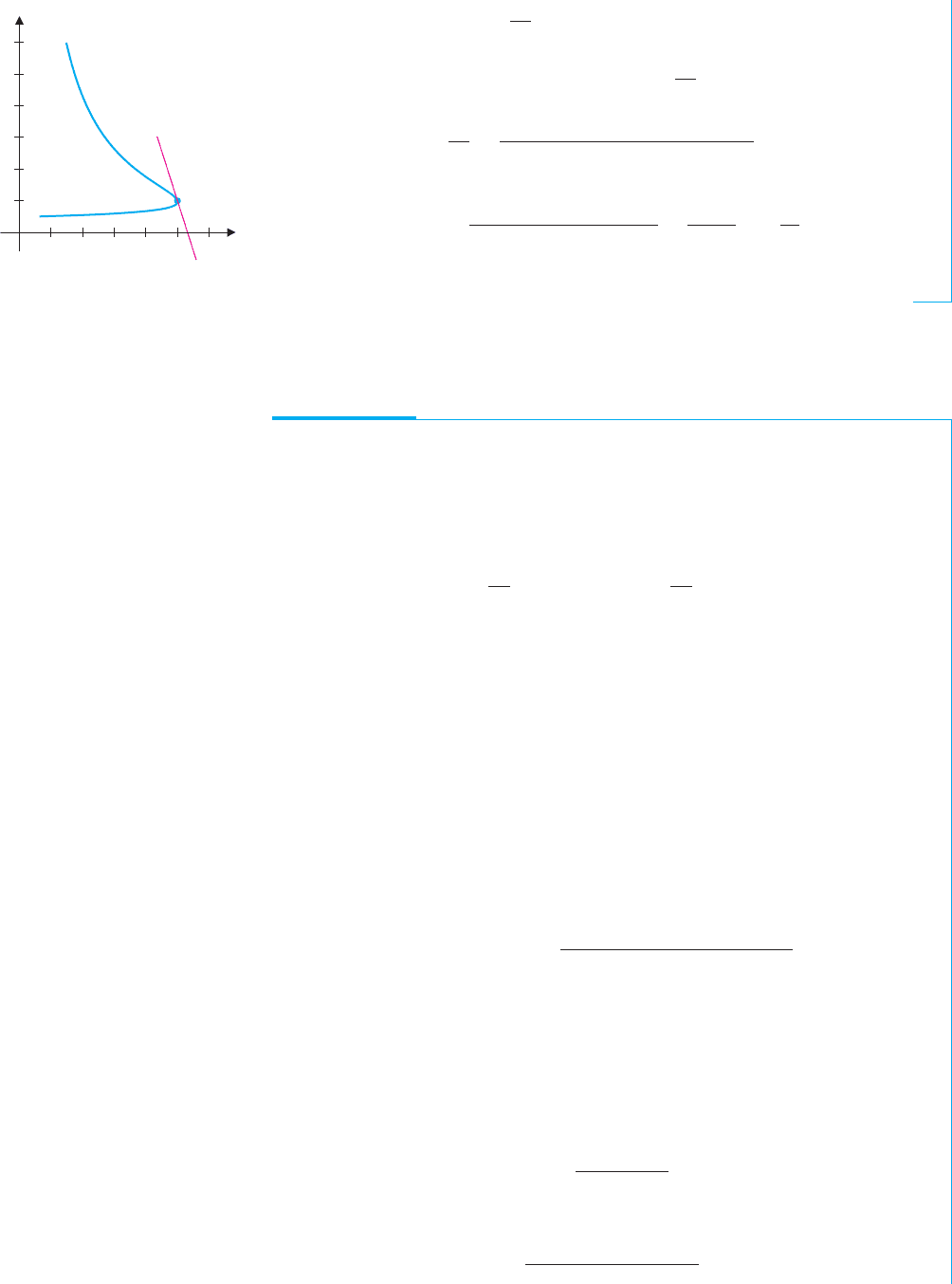
We have plotted the curve and the tangentline at (2, −2) in Figure 2.35 using the implicit
plot mode of our computer algebra system.
y
x
24
2
2
4
3
FIGURE 2.35
Tangent line at (2, −2)
You can use implicit differentiation to find a needed derivative from virtually any
equation you can write down. We illustrate this next for an application.
EXAMPLE 7.3 Rate of Change of Volume with Respect to Pressure
Under certain conditions, van der Waals’ equation relating the pressure P and volume
V of a gas is
P +
5
V
2
(V − 0.03) = 9.7. (7.2)
Assuming that equation (7.2) implicitly defines the volume V as a function of the
pressure P, use implicit differentiation to find the derivative
dV
dP
at the point (5, 1).
Solution Differentiating both sides of (7.2) with respect to P,wehave
d
dP
[(P + 5V
−2
)(V − 0.03)] =
d
dP
(9.7).
From the product rule and the chain rule, we get
1 − 10V
−3
dV
dP
(V − 0.03) + (P +5V
−2
)
dV
dP
= 0.
P1: OSO/OVY P2: OSO/OVY QC: OSO/OVY T1: OSO
MHDQ256-Ch02 MHDQ256-Smith-v1.cls December 8, 2010 18:21
LT (Late Transcendental)
CONFIRMING PAGES
158 CHAPTER 2
..
Differentiation 2-52
Grouping the terms containing
dV
dP
,weget
[−10V
−3
(V − 0.03) + P + 5V
−2
]
dV
dP
= 0.03 − V,
so that
dV
dP
=
0.03 − V
−10V
−3
(V − 0.03) + P + 5V
−2
.
We now have
V
(5) =
0.03 − 1
−10(1)(0.97) + 5 + 5(1)
=
−0.97
0.3
=−
97
30
.
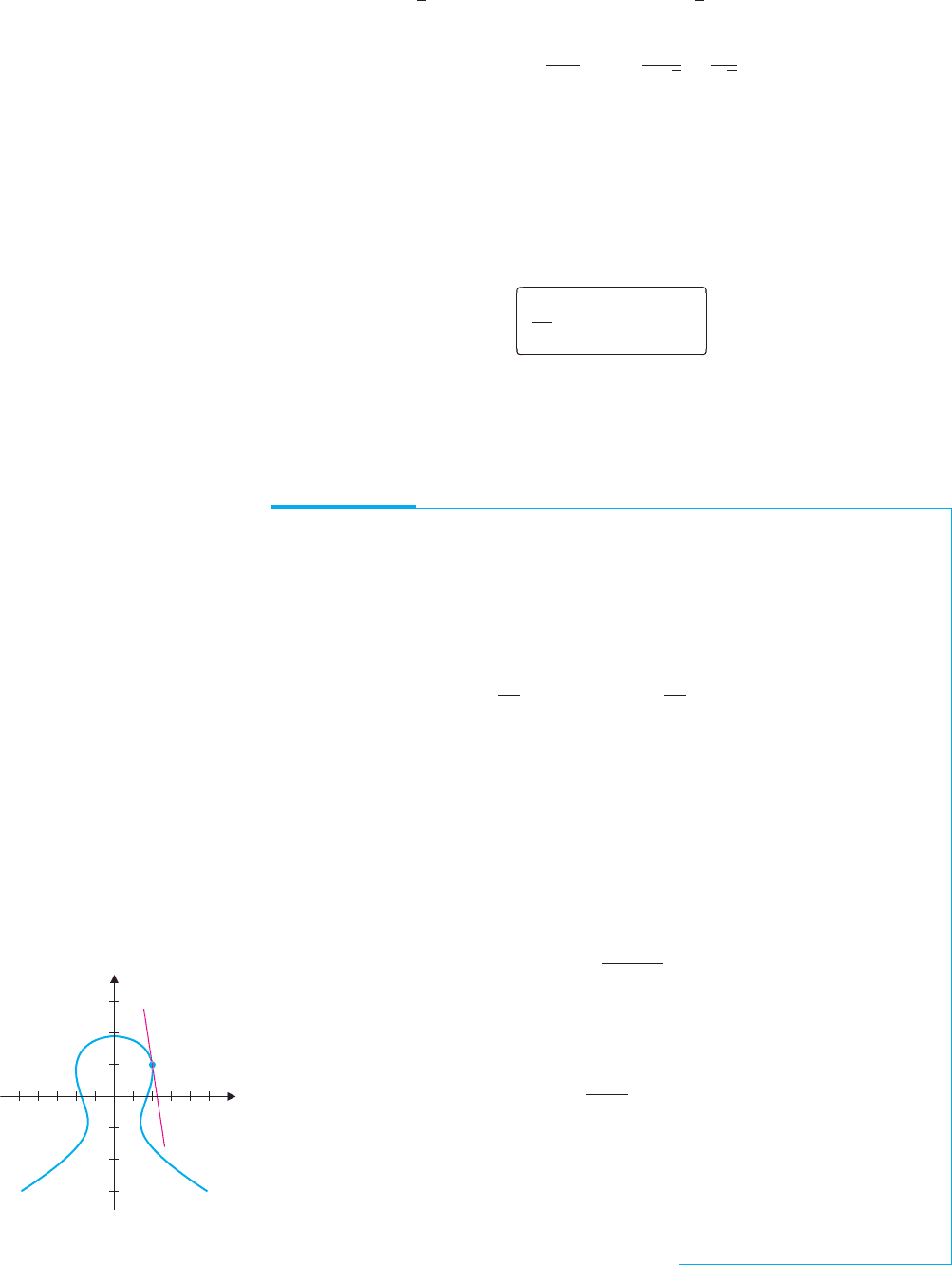
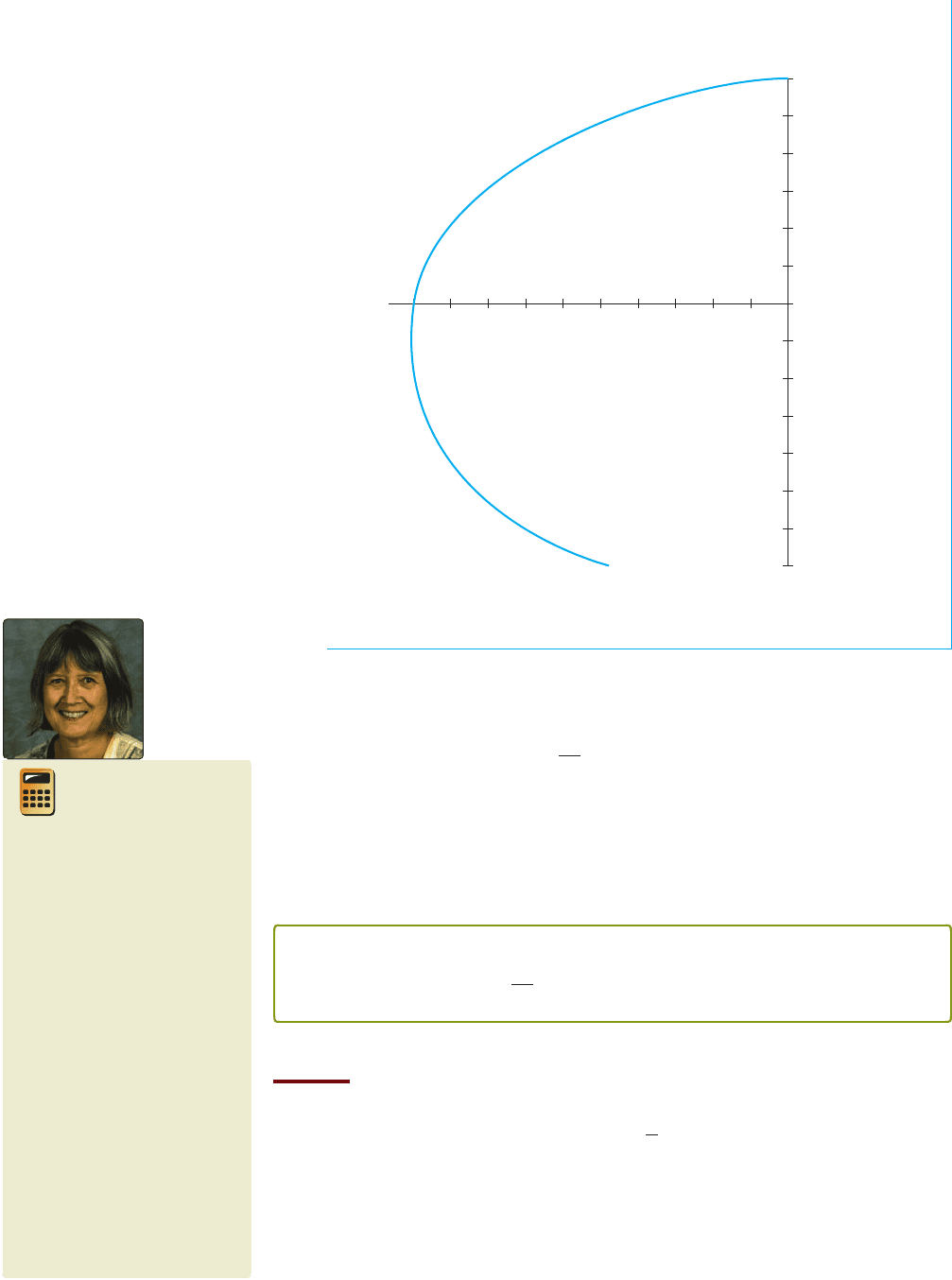
(The units are in terms of volume per unit pressure.) We show a graph of van der Waals’
equation, along with the tangent line to the graph at the point (5, 1) in Figure 2.36.
V
P
246
2
4
6
FIGURE 2.36
Graph of van der Waals’ equation
and the tangent line at the
point (5, 1)
Of course, since we can find one derivative implicitly, we can also find second and
higher order derivatives implicitly, as we illustrate in example 7.4.
EXAMPLE 7.4 Finding a Second Derivative Implicitly
Find y
(x) implicitly for y
2
+ sin y + x
2
= 4. Then find the value of y
at the point
(−2, 0).
Solution We begin by differentiating both sides of the equation with respect
to x.Wehave
d
dx
(y
2
+ sin y + x
2
) =
d
dx
(4).
By the chain rule, we have
2y[y
(x)] +cos y[y
(x)] +2x = 0. (7.3)
Notice that we don’t need to solve this for y
(x). By differentiating again we get
[2y
(x)][y
(x)] +[2y][y
(x)] + [−sin y][y
(x)][y
(x)]
+ [cos y][y
(x)] +2 = 0.
Grouping all the terms involving y
(x) on one side of the equation gives us
2y[y
(x)] +cos y[y
(x)] =−2[y
(x)]
2
+ sin y[y
(x)]
2
− 2.
Factoring out the y
(x) on the left, we get
(2y + cos y)y
(x) =−2[y
(x)]
2
+ sin y[y
(x)]
2
− 2,
so that
y
(x) =
−2[y
(x)]
2
+ sin y[y
(x)]
2
− 2
2y + cos y
. (7.4)
Notice that (7.4) gives us a (rather messy) formula for y
(x) in terms of x, y and y
(x).
If we need to have y
(x) in terms of x and y only, we can solve (7.3) for y
(x) and
substitute into (7.4). However, we don’t need to do this to find y
(−2). Instead, first
substitute x =−2 and y = 0 into (7.3) to get
2(0)[y
(−2)] + cos0[y
(−2)] + 2(−2) = 0,
from which we conclude that
y
(−2) =
4
2(0) + cos0
= 4.
Then substitute x =−2, y = 0 and y
(−2) = 4 into (7.4) to get
y
(−2) =
−2(4)
2
+ sin 0(4)
2
− 2
2(0) + cos0
=−34.
P1: OSO/OVY P2: OSO/OVY QC: OSO/OVY T1: OSO
MHDQ256-Ch02 MHDQ256-Smith-v1.cls December 8, 2010 18:21
LT (Late Transcendental)
CONFIRMING PAGES
2-53 SECTION 2.7
..
Implicit Differentiation 159
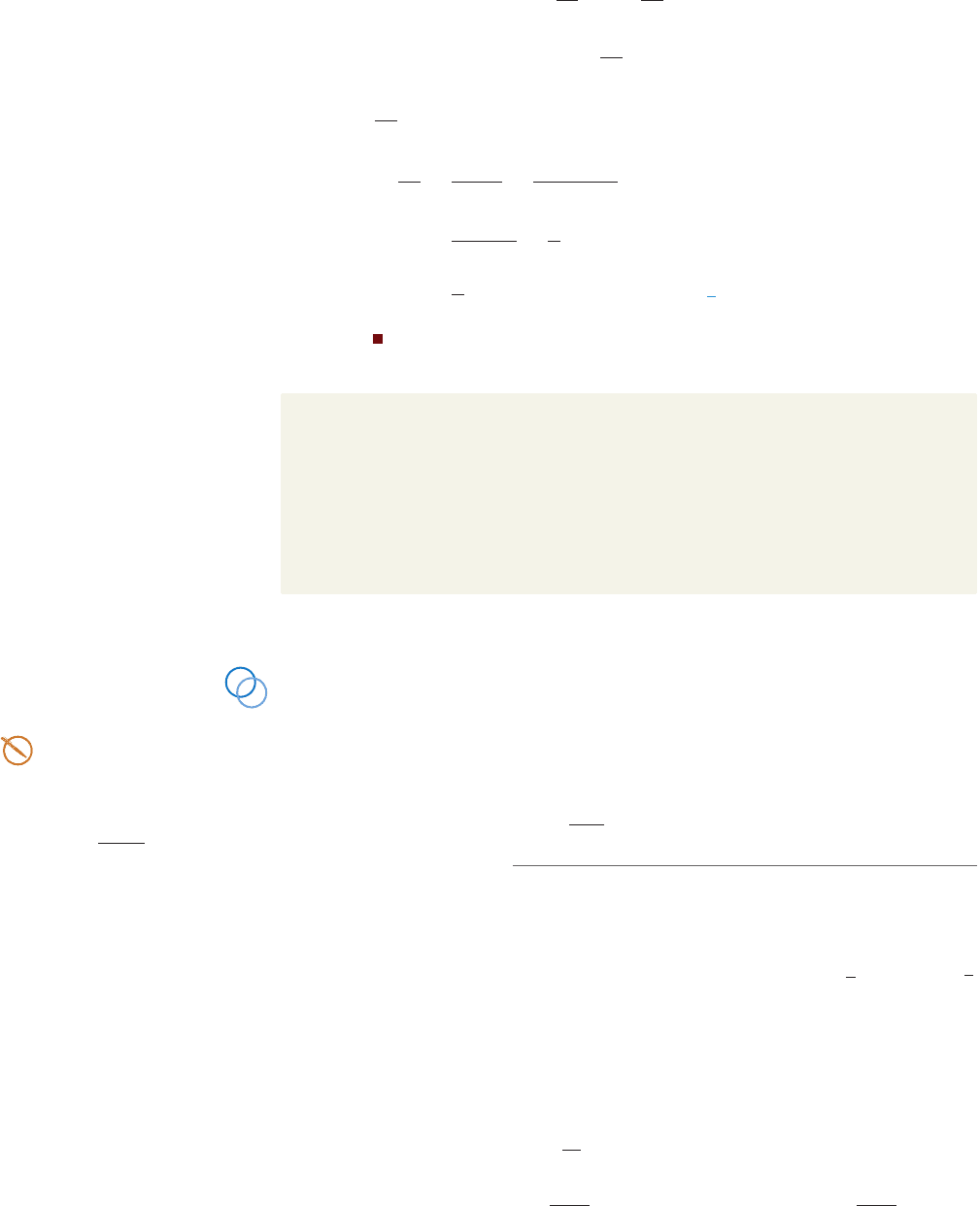
See Figure 2.37 for a graph of y
2
+ sin y + x
2
= 4 near the point (−2, 0).
0.25
0.25
0
2
0.20.40.60.811.21.41.6
1.82
1.25
1.25
1.5
1.5
1.75
0.5
0.5
0.75
0.75
y
x
FIGURE 2.37
y
2
+ sin y + x
2
= 4
Recall that, up to this point, we have proved the power rule
d
dx
x
r
= rx
r−1
only for integer exponents (see Theorems 3.1 and 4.3), although we have been freely using
this result for any real exponent, r. Now that we have developed implicit differentiation,
however, we have the tools we need to prove the power rule for the case of any rational
exponent.
TODAY IN
MATHEMATICS
Dusa McDuff (1945– )
A British mathematician who has
won prestigious awards for her
research in multidimensional
geometry. McDuff was inspired
by Russian mathematician Israel
Gelfand. “Gelfand amazed me by
talking of mathematics as if it
were poetry. . . . I had always
thought of mathematics as being
much more straightforward: a
formula is a formula, and an
algebra is an algebra, but Gelfand
found hedgehogs lurking in the
rows of his spectral sequences!’’
McDuff has made important
contributions to undergraduate
teaching and Women in Science
and Engineering, lectured around
the world and has coauthored
several research monographs.
THEOREM 7.1
For any rational exponent, r,
d
dx
x
r
= rx
r−1
.
PROOF
Suppose that r is any rational number. Then r =
p
q
, for some integers p and q. Let
y = x
r
= x
p/q
. (7.5)
Then, raising both sides of equation (7.5) to the qth power, we get
y
q
= x
p
. (7.6)
P1: OSO/OVY P2: OSO/OVY QC: OSO/OVY T1: OSO
MHDQ256-Ch02 MHDQ256-Smith-v1.cls December 8, 2010 18:21
LT (Late Transcendental)
CONFIRMING PAGES
160 CHAPTER 2
..
Differentiation 2-54
Differentiating both sides of equation (7.6) with respect to x,weget
d
dx
(y
q
) =
d
dx
(x
p
).
From the chain rule, we have
qy
q−1
dy
dx
= px
p−1
.
Solving for
dy
dx
,wehave
dy
dx
=
px
p−1
qy
q−1
=
px
p−1
q(x
p/q
)
q−1
Since y = x
p/q
.
=
px
p−1
qx
p−p/q
=
p
q
x
p−1−p+p/q
Using the usual rules of exponents.
=
p
q
x
p/q−1
= rx
r−1
, Since
p
q
= r.
as desired.
BEYOND FORMULAS
Implicit differentiation allows us to find the derivative of a function even when we
don’t have a formula for the function. This remarkable result means that if we have
nearly any equation for the relationship between two quantities, we can find the rate
of change of one with respect to the other. Here is a case where mathematics requires
creative thinking beyond formula memorization. In what other situations haveyou seen
the need for creativity in mathematics?
EXERCISES 2.7
WRITING EXERCISES
1. For implicit differentiation, we assume that y is a function of
x: we write y(x) to remind ourselves of this. However, for the
circle x
2
+ y
2
= 1, it is not true that y is a function of x. Since
y =±
√
1 − x
2
, there are actually (at least) two functions of x
defined implicitly. Explain why this is not really a contradic-
tion; that is, explain exactly what we are assuming when we
do implicit differentiation.
2. To perform implicit differentiation on an equation such as
x
2
y
2
+ 3 = x, we start by differentiating all terms. We get
2xy
2
+ x
2
(2y)y
= 1. Many students learn the rules this way:
take “regular” derivatives of all terms, and tack on a y
every
time you take a y-derivative. Explain why this works, and
rephrase the rule in a more accurate and understandable form.
3. In implicit differentiation, the derivative is typically a function
of both x and y; for example, on the circle x
2
+ y
2
= r
2
,we
have y
=−x/y. If wetake the derivative −x/y and substitute
any values for x and y, will it always be the slope of a tangent
line? That is, are there any requirements on which x’s and y’s
we can substitute?
4. In each example in this section, after we differentiated the
given equation, we were able to rewrite the resulting equation
in the form f (x, y)y
(x) = g(x, y) for some functions f (x, y)
and g(x, y). Explain why this can always be done; that is,
why doesn’t the chain rule ever produce a term like [y
(x)]
2
or
1
y
(x)
?
In exercises 1–4, compute the slope of the tangent line at the
given point both explicitly (first solve for y as a function of x)
and implicitly.
1. x
2
+ 4y
2
= 8at(2, 1) 2. x
3
y − 4
√
x = x
2
y at (2,
√
2)
3. y − 3x
2
y = cos x at (0, 1) 4. y
2
+ 2xy + 4 = 0at(−2, 2)
............................................................
In exercises 5–16, find the derivative y
(x) implicitly.
5. x
2
y
2
+ 3y = 4x 6. 3xy
3
− 4x = 10y
2
7.
√
xy −4y
2
= 12 8. sin xy = x
2
− 3
9.
x + 3
y
= 4x + y
2
10. 3x + y
3
−
4y
x + 2
= 10x
2
11. cos(x
2
y) −sin y = x 12. x sec y − 3y sin x = 1
P1: OSO/OVY P2: OSO/OVY QC: OSO/OVY T1: OSO
MHDQ256-Ch02 MHDQ256-Smith-v1.cls December 8, 2010 18:21
LT (Late Transcendental)
CONFIRMING PAGES
2-55 SECTION 2.7
..
Implicit Differentiation 161
13. y
2
√
x + y − 4x
2
= y 14. x cos(x + y) − y
2
= 8
15. tan(y
2
+ 3) − xy
2
= 2x 16. y cos x
2
−
3
y
2
+ 2
= x
2
+ 1
............................................................
In exercises 17–22, find an equation of the tangent line at the
given point. If you have a CAS that will graph implicit curves,
sketch the curve and the tangent line.
17. x
2
− 4y
3
= 0at(2, 1) 18. x
2
y
2
= 4x at (1, 2)
19. x
2
y
2
= 3y + 1at(2, 1) 20. x
3
y
2
=−2xy − 3at(−1, −3)
21. x
4
= 4(x
2
− y
2
)at(1,
√
3
2
) 22. x
4
= 8(x
2
− y
2
)at(2, −
√
2)
............................................................
In exercises 23–28, find the second derivative y
(x).
23. x
2
y
2
+ 3x − 4y = 5 24. x
2/3
+ y
2/3
= 4
25. y
2
= x
3
− 6x + 4 cos y 26. 3xy + 2y − 3x = sin y
27. (y −1)
2
= 3xy + cos(4y) 28. (x + y)
2
− sin(y + 1) = 3x
............................................................
In exercises 29 and 30, find the locations of all horizontal and
vertical tangents.
29. x
2
+ y
3
− 3y = 4 30. xy
2
− 2y = 2
............................................................
31. Name the method by identifying whether you would find the
derivative y
directly or implicitly.
(a) x
2
y
2
+ 3y = 4x (b) x
2
+ 3y = 4x
(c) 3xy + 6x
2
cos x = y sin x (d) 3xy + 6x
2
cos y = y sinx
32. Suppose that f is a differentiable function such that f (sinx) = x
for all x. Show that, for −1 < x < 1, f
(x) =
1
√
1−x
2
.
33. Use implicit differentiation to find y
(x) for x
2
y − 2y = 4.
Based on this equation, why would you expect to find vertical
tangents at x =±
√
2 and a horizontal tangent at y = 0? Show
that there are no points for these values. To see what’s going
on, solve the original equation for y and sketch the graph.
Describe what’s happening at x =±
√
2 and y = 0.
34. Show that any curve of the form xy = c for some constant c
intersects any curve of the form x
2
− y
2
= k for some constant
k at right angles (that is, the tangent lines to the curves at the
intersection points are perpendicular). In this case, we say that
the families of curves are orthogonal.
............................................................
In exercises 35–38, show that the families of curves are orthog-
onal. (See exercise 34.)
35. y =
c
x
and y
2
= x
2
+ k
36. x
2
+ y
2
= cx and x
2
+ y
2
= ky
37. y = cx
3
and x
2
+ 3y
2
= k
38. y = cx
4
and x
2
+ 4y
2
= k
............................................................
39. Based on exercises 37 and 38, make a conjecture for a family
of functions that is orthogonal to y = cx
n
. Show that your
conjecture is correct. Are there any values of n that must be
excluded?
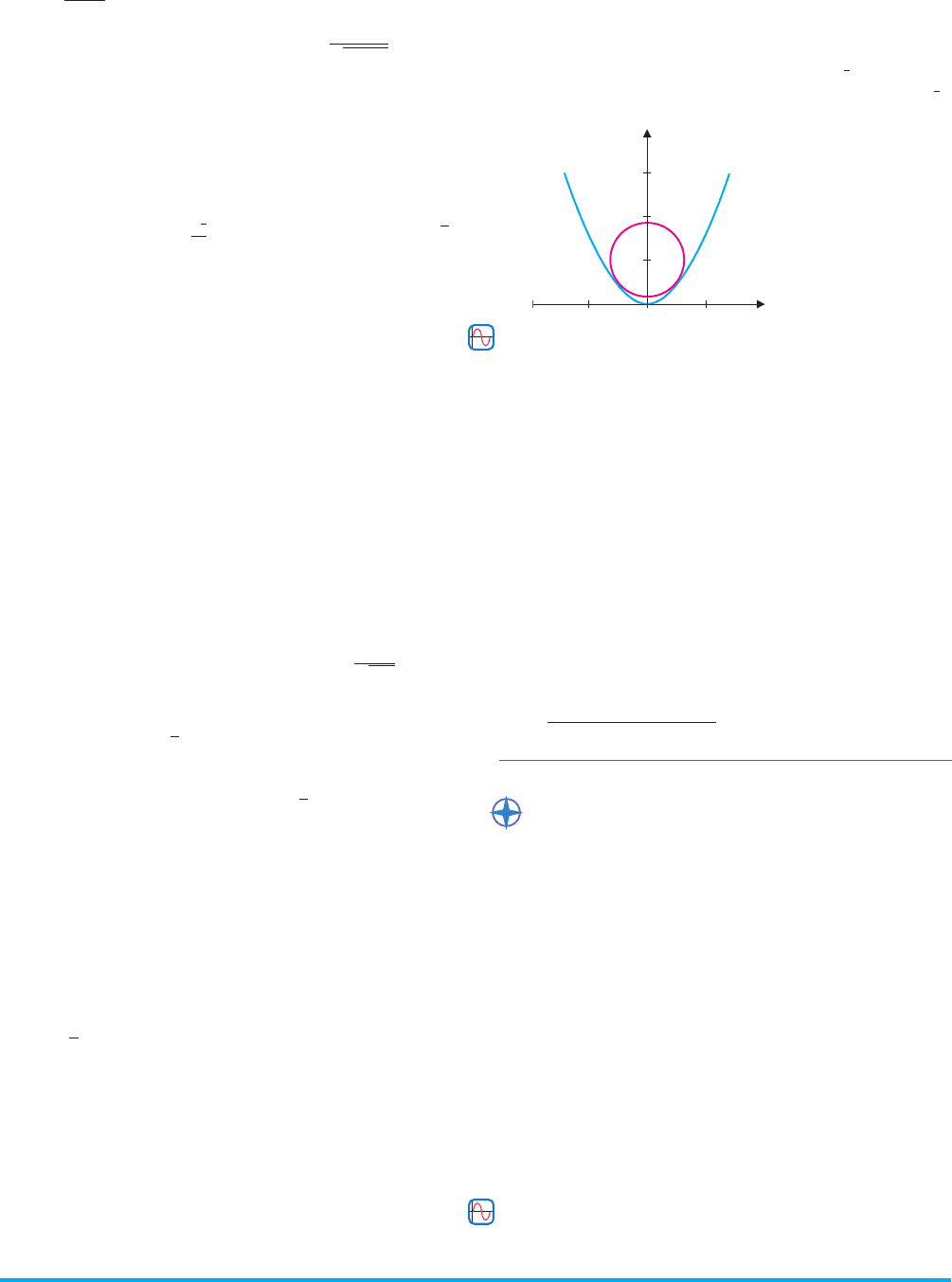
40. Suppose that a circle of radius r and center (0, c) is inscribed
in the parabola y = x
2
. At the point of tangency, the slopes
must be the same. Find the slope of the circle implicitly and
show that at the point of tangency, y = c −
1
2
. Then use the
equations of the circle and parabola to show that c = r
2
+
1
4
.
y
x
41. For elliptic curves, there are nice ways of finding points with
rational coordinates. (See Ezra Brown’s article “Three Fermat
Trails to Elliptic Curves” in the May 2000 College Mathemat-
ics Journal.)
(a) Show that the points (−3, 0) and (0, 3) are on the elliptic
curve defined by y
2
= x
3
− 6x + 9. Find the line through
these two points and show that the line intersects the
curve in another point with rational (in this case, integer)
coordinates.
(b) Fortheellipticcurve y
2
= x
3
− 6x + 4, showthatthepoint
(−1, 3) is on the curve. Find the tangent line to the curve
at this point and show that it intersects the curve at another
point with rational coordinates.
42. Suppose a slingshot (see section 2.1) rotates counterclock-
wise along the circle x
2
+ y
2
= 9 and the rock is released
at the point (2.9, 0.77). If the rock travels 300 feet, where
does it land? [Hint: Find the tangent line at (2.9, 0.77), and
find the point (x, y) on that line such that the distance is
(x − 2.9)
2
+ (y − 0.77)
2
= 300.]
EXPLORATORY EXERCISES
1. A landowner’s property line runs along the path y = 6 − x.
The landowner wants to run an irrigation ditch from a reser-
voir bounded by the ellipse 4x
2
+ 9y
2
= 36. The landowner
wants to build the shortest ditch possible from the reservoir
to the closest point on the property line. We explore how to
find the best path. Sketch the line and ellipse, and draw in a
tangent line to the ellipse that is parallel to the property line.
Argue that the ditch should start at the point of tangency and
run perpendicular to the two lines. We start by identifying the
point on the right side of the ellipse with tangent line parallel
to y = 6 − x. Find theslope of thetangent line to the ellipse at
(x, y) and set it equal to −1. Solve for x and substitute into the
equation of the ellipse. Solve for y and you have the point on
the ellipse at which to start the ditch. Find an equation of the
(normal) line through this point perpendicular to y = 6 − x
and find the intersection of the normal line and y = 6 − x.
This point is where the ditch ends.
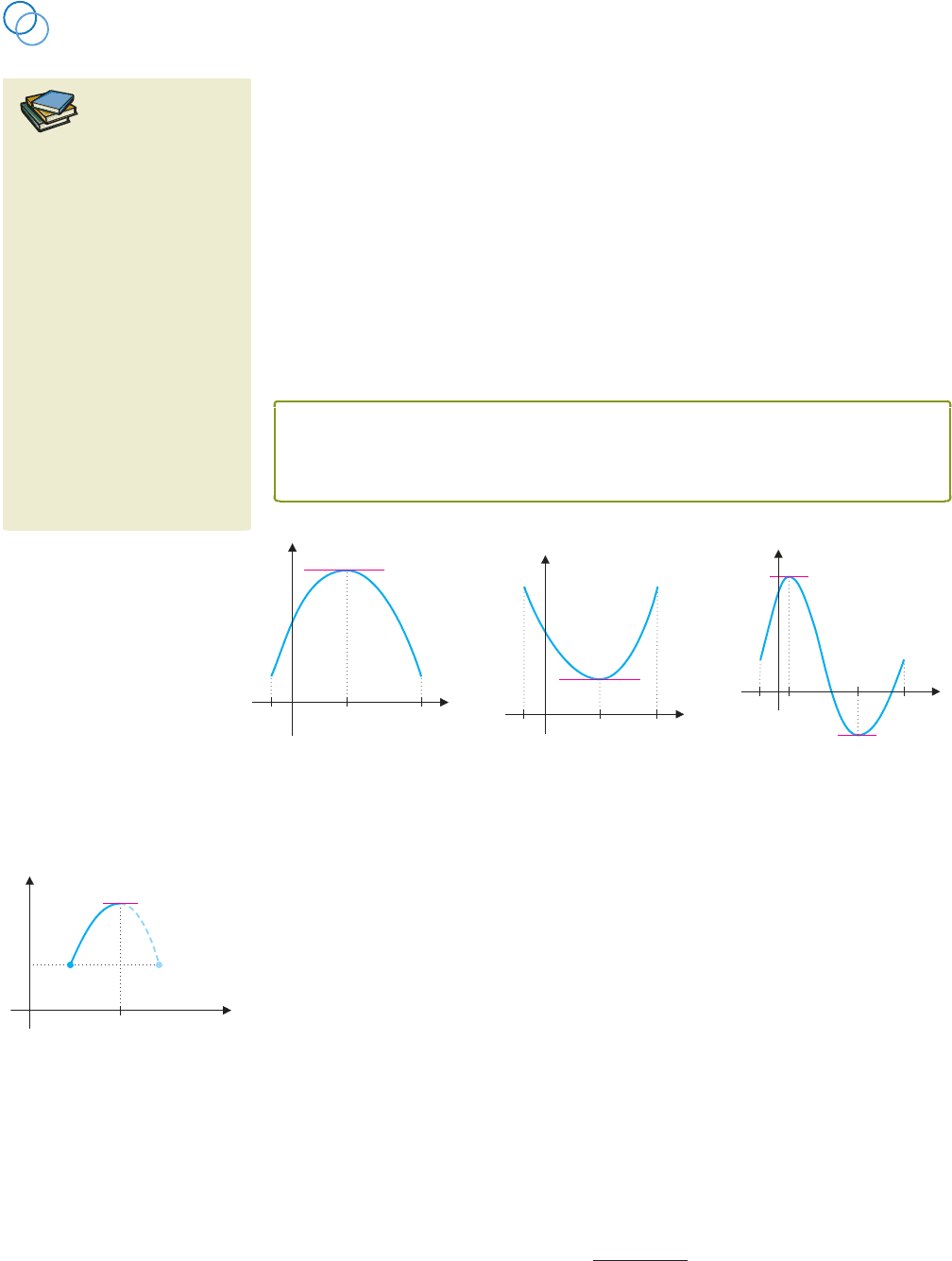
2. Use a CAS to plot the set of points for which
(cos x)
2
+ (sin y)
2
= 1. Determine whether the segments
plotted are straight or not.
P1: OSO/OVY P2: OSO/OVY QC: OSO/OVY T1: OSO
MHDQ256-Ch02 MHDQ256-Smith-v1.cls December 8, 2010 18:21
LT (Late Transcendental)
CONFIRMING PAGES
162 CHAPTER 2
..
Differentiation 2-56
2.8 THE MEAN VALUE THEOREM
In this section, we present the Mean Value Theorem, which is so significant that we will be
deriving new ideas from it for many chapters to come. Before considering the main result,
we look at a special case, called Rolle’s Theorem.
The idea behind Rolle’s Theorem is really quite simple. For any function f that is
continuous on the closed interval [a, b] and differentiable on the open interval (a, b) and
where f (a) = f (b), there must be at least one point between x = a and x = b where the
tangent line to y = f (x)is horizontal. In Figures 2.38a–2.38c, we draw a number of graphs
satisfying the above criteria. Notice that each one has at least one point where there is
a horizontal tangent line. Draw your own graphs, to convince yourself that, under these
circumstances, it’s not possible to connect the two points (a, f (a)) and (b, f (b)) without
having at least one horizontal tangent line.
HISTORICAL
NOTES
Michel Rolle (1652–1719)
A French mathematician who
proved Rolle’s Theorem for
polynomials. Rolle came from a
poor background, being largely
self-taught and struggling through
a variety of jobs including assistant
attorney, scribe and elementary
school teacher. He was a vigorous
member of the French Academy
of Sciences, arguing against such
luminaries as Descartes that if
a < b then −b < −a (so, for
instance, −2 < −1). Oddly, Rolle
was known as an opponent of the
newly developed calculus, calling
it a “collection of ingenious
fallacies.”
Note that since f
(x) = 0 at a horizontal tangent, this says that there is at least one
point c in (a, b), for which f
(c) = 0. (See Figures 2.38a–2.38c.)
THEOREM 8.1 (Rolle’s Theorem)
Suppose that f is continuous on the interval [a, b], differentiable on the interval
(a, b) and f (a) = f (b). Then there is a number c ∈ (a, b) such that f
(c) = 0.
y
x
ba c
y
x
ba c
y
x
a bc
1
c
2
FIGURE 2.38a
Graph initially rising
FIGURE 2.38b
Graph initially falling
FIGURE 2.38c
Graph with two horizontal
tangents
A proof of Rolle’s Theorem depends on the Extreme Value Theorem, which we present in
section 3.2. For now, we present the main ideas of the prooffrom a graphical perspective.A
proof is given in Appendix A. First, note that if f (x) is constant on [a, b], then f
(x) = 0
for all x’s between a and b. On the other hand, if f (x) is not constant on [a, b], then, as
you look from left to right, the graph must at some point start to either rise or fall. (See
Figures 2.39a and 2.39b.) For the case where the graph starts to rise, notice that in order
to return to the level at which it started, it will need to turn around at some point and start
to fall. (Think about it this way: if you start to climb up a mountain—so that your altitude
rises—if you are to get back down to where you started, you will need to turn around at
some point—where your altitude starts to fall.)
y
x
c
(a, f(a)) (b, f(b))
f(c) 0
FIGURE 2.39a
Graph rises and turns around to fall
back to where it started.
So, there is at least one point where the graph turns around, changing from rising
to falling. (See Figure 2.39a.) Likewise, in the case where the graph first starts to fall, the
graph must turn around from fallingto rising. (See Figure 2.39b.)We name this point x = c.
Since we know that f
(c) exists, we have that either f
(c) > 0, f
(c) < 0or f
(c) = 0. We
want to argue that f
(c) = 0, as Figures 2.39a and 2.39b suggest. To establish this, it is
easier to show that it is not true that f
(c) > 0or f
(c) < 0. If it were true that f
(c) > 0,
then from the alternative definition of the derivative given in equation (2.2) in section 2.2,
we have
f
(c) = lim
x→c
f (x) − f (c)
x −c
> 0.